EP0241864A2 - Process for the preparation of addition compounds of dipeptides and of free peptides thereof - Google Patents
Process for the preparation of addition compounds of dipeptides and of free peptides thereof Download PDFInfo
- Publication number
- EP0241864A2 EP0241864A2 EP87105261A EP87105261A EP0241864A2 EP 0241864 A2 EP0241864 A2 EP 0241864A2 EP 87105261 A EP87105261 A EP 87105261A EP 87105261 A EP87105261 A EP 87105261A EP 0241864 A2 EP0241864 A2 EP 0241864A2
- Authority
- EP
- European Patent Office
- Prior art keywords
- ester
- aspartic acid
- preparation
- group
- general formula
- Prior art date
- Legal status (The legal status is an assumption and is not a legal conclusion. Google has not performed a legal analysis and makes no representation as to the accuracy of the status listed.)
- Withdrawn
Links
- 150000001875 compounds Chemical class 0.000 title claims description 19
- 238000000034 method Methods 0.000 title claims description 12
- 238000002360 preparation method Methods 0.000 title claims description 8
- 108010016626 Dipeptides Proteins 0.000 title description 6
- 108090000765 processed proteins & peptides Proteins 0.000 title description 2
- 102000004196 processed proteins & peptides Human genes 0.000 title 1
- -1 N-protected L-aspartic acid Chemical class 0.000 claims abstract description 45
- 125000006239 protecting group Chemical group 0.000 claims abstract description 11
- 125000002924 primary amino group Chemical group [H]N([H])* 0.000 claims abstract description 8
- CKLJMWTZIZZHCS-REOHCLBHSA-N L-aspartic acid Chemical compound OC(=O)[C@@H](N)CC(O)=O CKLJMWTZIZZHCS-REOHCLBHSA-N 0.000 claims description 13
- 229960005261 aspartic acid Drugs 0.000 claims description 13
- 235000003704 aspartic acid Nutrition 0.000 claims description 13
- OQFSQFPPLPISGP-UHFFFAOYSA-N beta-carboxyaspartic acid Natural products OC(=O)C(N)C(C(O)=O)C(O)=O OQFSQFPPLPISGP-UHFFFAOYSA-N 0.000 claims description 13
- 239000004365 Protease Substances 0.000 claims description 12
- 108091005804 Peptidases Proteins 0.000 claims description 10
- 102100037486 Reverse transcriptase/ribonuclease H Human genes 0.000 claims description 8
- 125000000217 alkyl group Chemical group 0.000 claims description 8
- 125000004432 carbon atom Chemical group C* 0.000 claims description 5
- 150000002148 esters Chemical class 0.000 claims description 4
- 239000003929 acidic solution Substances 0.000 claims description 3
- 125000001449 isopropyl group Chemical group [H]C([H])([H])C([H])(*)C([H])([H])[H] 0.000 claims description 2
- 125000001495 ethyl group Chemical group [H]C([H])([H])C([H])([H])* 0.000 claims 1
- 125000002496 methyl group Chemical group [H]C([H])([H])* 0.000 claims 1
- 125000004123 n-propyl group Chemical group [H]C([H])([H])C([H])([H])C([H])([H])* 0.000 claims 1
- 102000004190 Enzymes Human genes 0.000 description 14
- 108090000790 Enzymes Proteins 0.000 description 14
- 229940088598 enzyme Drugs 0.000 description 14
- 239000000243 solution Substances 0.000 description 11
- QGZKDVFQNNGYKY-UHFFFAOYSA-N Ammonia Chemical class N QGZKDVFQNNGYKY-UHFFFAOYSA-N 0.000 description 9
- COLNVLDHVKWLRT-UHFFFAOYSA-N phenylalanine Natural products OC(=O)C(N)CC1=CC=CC=C1 COLNVLDHVKWLRT-UHFFFAOYSA-N 0.000 description 9
- 229960005190 phenylalanine Drugs 0.000 description 9
- 238000006243 chemical reaction Methods 0.000 description 7
- IAZDPXIOMUYVGZ-UHFFFAOYSA-N Dimethylsulphoxide Chemical compound CS(C)=O IAZDPXIOMUYVGZ-UHFFFAOYSA-N 0.000 description 6
- XEKOWRVHYACXOJ-UHFFFAOYSA-N Ethyl acetate Chemical compound CCOC(C)=O XEKOWRVHYACXOJ-UHFFFAOYSA-N 0.000 description 6
- QAOWNCQODCNURD-UHFFFAOYSA-N Sulfuric acid Chemical compound OS(O)(=O)=O QAOWNCQODCNURD-UHFFFAOYSA-N 0.000 description 6
- 235000019419 proteases Nutrition 0.000 description 6
- 150000003839 salts Chemical class 0.000 description 5
- 229910021529 ammonia Inorganic materials 0.000 description 4
- 239000000203 mixture Substances 0.000 description 4
- JIAARYAFYJHUJI-UHFFFAOYSA-L zinc dichloride Chemical compound [Cl-].[Cl-].[Zn+2] JIAARYAFYJHUJI-UHFFFAOYSA-L 0.000 description 4
- QTBSBXVTEAMEQO-UHFFFAOYSA-N Acetic acid Chemical compound CC(O)=O QTBSBXVTEAMEQO-UHFFFAOYSA-N 0.000 description 3
- 108010011485 Aspartame Proteins 0.000 description 3
- YMWUJEATGCHHMB-UHFFFAOYSA-N Dichloromethane Chemical compound ClCCl YMWUJEATGCHHMB-UHFFFAOYSA-N 0.000 description 3
- RTZKZFJDLAIYFH-UHFFFAOYSA-N Diethyl ether Chemical compound CCOCC RTZKZFJDLAIYFH-UHFFFAOYSA-N 0.000 description 3
- LFQSCWFLJHTTHZ-UHFFFAOYSA-N Ethanol Chemical compound CCO LFQSCWFLJHTTHZ-UHFFFAOYSA-N 0.000 description 3
- LYCAIKOWRPUZTN-UHFFFAOYSA-N Ethylene glycol Chemical compound OCCO LYCAIKOWRPUZTN-UHFFFAOYSA-N 0.000 description 3
- PEDCQBHIVMGVHV-UHFFFAOYSA-N Glycerine Chemical compound OCC(O)CO PEDCQBHIVMGVHV-UHFFFAOYSA-N 0.000 description 3
- OKKJLVBELUTLKV-UHFFFAOYSA-N Methanol Chemical compound OC OKKJLVBELUTLKV-UHFFFAOYSA-N 0.000 description 3
- ZMXDDKWLCZADIW-UHFFFAOYSA-N N,N-Dimethylformamide Chemical compound CN(C)C=O ZMXDDKWLCZADIW-UHFFFAOYSA-N 0.000 description 3
- KWYUFKZDYYNOTN-UHFFFAOYSA-M Potassium hydroxide Chemical compound [OH-].[K+] KWYUFKZDYYNOTN-UHFFFAOYSA-M 0.000 description 3
- 125000003277 amino group Chemical group 0.000 description 3
- IAOZJIPTCAWIRG-QWRGUYRKSA-N aspartame Chemical compound OC(=O)C[C@H](N)C(=O)N[C@H](C(=O)OC)CC1=CC=CC=C1 IAOZJIPTCAWIRG-QWRGUYRKSA-N 0.000 description 3
- 239000000605 aspartame Substances 0.000 description 3
- 229960003438 aspartame Drugs 0.000 description 3
- 235000010357 aspartame Nutrition 0.000 description 3
- 150000002993 phenylalanine derivatives Chemical class 0.000 description 3
- 239000002244 precipitate Substances 0.000 description 3
- 239000000047 product Substances 0.000 description 3
- 239000011541 reaction mixture Substances 0.000 description 3
- 239000002904 solvent Substances 0.000 description 3
- XLYOFNOQVPJJNP-UHFFFAOYSA-N water Substances O XLYOFNOQVPJJNP-UHFFFAOYSA-N 0.000 description 3
- UXVMQQNJUSDDNG-UHFFFAOYSA-L Calcium chloride Chemical compound [Cl-].[Cl-].[Ca+2] UXVMQQNJUSDDNG-UHFFFAOYSA-L 0.000 description 2
- 229930182832 D-phenylalanine Natural products 0.000 description 2
- XTHFKEDIFFGKHM-UHFFFAOYSA-N Dimethoxyethane Chemical compound COCCOC XTHFKEDIFFGKHM-UHFFFAOYSA-N 0.000 description 2
- VEXZGXHMUGYJMC-UHFFFAOYSA-N Hydrochloric acid Chemical compound Cl VEXZGXHMUGYJMC-UHFFFAOYSA-N 0.000 description 2
- LRHPLDYGYMQRHN-UHFFFAOYSA-N N-Butanol Chemical compound CCCCO LRHPLDYGYMQRHN-UHFFFAOYSA-N 0.000 description 2
- 102000035195 Peptidases Human genes 0.000 description 2
- 108090001109 Thermolysin Proteins 0.000 description 2
- 239000002253 acid Substances 0.000 description 2
- 239000000654 additive Substances 0.000 description 2
- 239000008346 aqueous phase Substances 0.000 description 2
- 235000003599 food sweetener Nutrition 0.000 description 2
- VSDUZFOSJDMAFZ-VIFPVBQESA-N methyl L-phenylalaninate Chemical compound COC(=O)[C@@H](N)CC1=CC=CC=C1 VSDUZFOSJDMAFZ-VIFPVBQESA-N 0.000 description 2
- 239000003960 organic solvent Substances 0.000 description 2
- JHJLBTNAGRQEKS-UHFFFAOYSA-M sodium bromide Chemical compound [Na+].[Br-] JHJLBTNAGRQEKS-UHFFFAOYSA-M 0.000 description 2
- HEMHJVSKTPXQMS-UHFFFAOYSA-M sodium hydroxide Inorganic materials [OH-].[Na+] HEMHJVSKTPXQMS-UHFFFAOYSA-M 0.000 description 2
- 239000003765 sweetening agent Substances 0.000 description 2
- 239000011592 zinc chloride Substances 0.000 description 2
- 235000005074 zinc chloride Nutrition 0.000 description 2
- AVQQQNCBBIEMEU-UHFFFAOYSA-N 1,1,3,3-tetramethylurea Chemical compound CN(C)C(=O)N(C)C AVQQQNCBBIEMEU-UHFFFAOYSA-N 0.000 description 1
- XNWFRZJHXBZDAG-UHFFFAOYSA-N 2-METHOXYETHANOL Chemical compound COCCO XNWFRZJHXBZDAG-UHFFFAOYSA-N 0.000 description 1
- JTXMVXSTHSMVQF-UHFFFAOYSA-N 2-acetyloxyethyl acetate Chemical compound CC(=O)OCCOC(C)=O JTXMVXSTHSMVQF-UHFFFAOYSA-N 0.000 description 1
- HXDLWJWIAHWIKI-UHFFFAOYSA-N 2-hydroxyethyl acetate Chemical compound CC(=O)OCCO HXDLWJWIAHWIKI-UHFFFAOYSA-N 0.000 description 1
- 102000004092 Amidohydrolases Human genes 0.000 description 1
- 108090000531 Amidohydrolases Proteins 0.000 description 1
- 108010004032 Bromelains Proteins 0.000 description 1
- DKPFZGUDAPQIHT-UHFFFAOYSA-N Butyl acetate Natural products CCCCOC(C)=O DKPFZGUDAPQIHT-UHFFFAOYSA-N 0.000 description 1
- OYPRJOBELJOOCE-UHFFFAOYSA-N Calcium Chemical compound [Ca] OYPRJOBELJOOCE-UHFFFAOYSA-N 0.000 description 1
- OIFBSDVPJOWBCH-UHFFFAOYSA-N Diethyl carbonate Chemical compound CCOC(=O)OCC OIFBSDVPJOWBCH-UHFFFAOYSA-N 0.000 description 1
- 108090000270 Ficain Proteins 0.000 description 1
- DGAQECJNVWCQMB-PUAWFVPOSA-M Ilexoside XXIX Chemical compound C[C@@H]1CC[C@@]2(CC[C@@]3(C(=CC[C@H]4[C@]3(CC[C@@H]5[C@@]4(CC[C@@H](C5(C)C)OS(=O)(=O)[O-])C)C)[C@@H]2[C@]1(C)O)C)C(=O)O[C@H]6[C@@H]([C@H]([C@@H]([C@H](O6)CO)O)O)O.[Na+] DGAQECJNVWCQMB-PUAWFVPOSA-M 0.000 description 1
- KFZMGEQAYNKOFK-UHFFFAOYSA-N Isopropanol Chemical compound CC(C)O KFZMGEQAYNKOFK-UHFFFAOYSA-N 0.000 description 1
- 150000008575 L-amino acids Chemical class 0.000 description 1
- SVFKZPQPMMZHLZ-UHFFFAOYSA-N N-Phenylacetylaspartic acid Chemical compound OC(=O)CC(C(O)=O)NC(=O)CC1=CC=CC=C1 SVFKZPQPMMZHLZ-UHFFFAOYSA-N 0.000 description 1
- 239000007832 Na2SO4 Substances 0.000 description 1
- 108090000526 Papain Proteins 0.000 description 1
- 102000057297 Pepsin A Human genes 0.000 description 1
- 108090000284 Pepsin A Proteins 0.000 description 1
- XBDQKXXYIPTUBI-UHFFFAOYSA-M Propionate Chemical compound CCC([O-])=O XBDQKXXYIPTUBI-UHFFFAOYSA-M 0.000 description 1
- VYPSYNLAJGMNEJ-UHFFFAOYSA-N Silicium dioxide Chemical compound O=[Si]=O VYPSYNLAJGMNEJ-UHFFFAOYSA-N 0.000 description 1
- PMZURENOXWZQFD-UHFFFAOYSA-L Sodium Sulfate Chemical compound [Na+].[Na+].[O-]S([O-])(=O)=O PMZURENOXWZQFD-UHFFFAOYSA-L 0.000 description 1
- 102000004142 Trypsin Human genes 0.000 description 1
- 108090000631 Trypsin Proteins 0.000 description 1
- PTFCDOFLOPIGGS-UHFFFAOYSA-N Zinc dication Chemical compound [Zn+2] PTFCDOFLOPIGGS-UHFFFAOYSA-N 0.000 description 1
- 150000001242 acetic acid derivatives Chemical class 0.000 description 1
- KXKVLQRXCPHEJC-UHFFFAOYSA-N acetic acid trimethyl ester Natural products COC(C)=O KXKVLQRXCPHEJC-UHFFFAOYSA-N 0.000 description 1
- 150000007513 acids Chemical class 0.000 description 1
- 230000004913 activation Effects 0.000 description 1
- 230000001476 alcoholic effect Effects 0.000 description 1
- 150000001298 alcohols Chemical class 0.000 description 1
- 125000003545 alkoxy group Chemical group 0.000 description 1
- 150000001408 amides Chemical class 0.000 description 1
- 229940024606 amino acid Drugs 0.000 description 1
- 238000013459 approach Methods 0.000 description 1
- 239000007864 aqueous solution Substances 0.000 description 1
- 150000001509 aspartic acid derivatives Chemical class 0.000 description 1
- 125000003236 benzoyl group Chemical group [H]C1=C([H])C([H])=C(C([H])=C1[H])C(*)=O 0.000 description 1
- 125000001584 benzyloxycarbonyl group Chemical group C(=O)(OCC1=CC=CC=C1)* 0.000 description 1
- 235000019835 bromelain Nutrition 0.000 description 1
- 125000000484 butyl group Chemical group [H]C([*])([H])C([H])([H])C([H])([H])C([H])([H])[H] 0.000 description 1
- 239000006227 byproduct Substances 0.000 description 1
- 239000011575 calcium Substances 0.000 description 1
- 229910052791 calcium Inorganic materials 0.000 description 1
- 238000000354 decomposition reaction Methods 0.000 description 1
- 230000001419 dependent effect Effects 0.000 description 1
- MTHSVFCYNBDYFN-UHFFFAOYSA-N diethylene glycol Chemical compound OCCOCCO MTHSVFCYNBDYFN-UHFFFAOYSA-N 0.000 description 1
- 239000003085 diluting agent Substances 0.000 description 1
- POLCUAVZOMRGSN-UHFFFAOYSA-N dipropyl ether Chemical compound CCCOCCC POLCUAVZOMRGSN-UHFFFAOYSA-N 0.000 description 1
- 230000000694 effects Effects 0.000 description 1
- 238000006911 enzymatic reaction Methods 0.000 description 1
- 150000002170 ethers Chemical class 0.000 description 1
- 235000019836 ficin Nutrition 0.000 description 1
- POTUGHMKJGOKRI-UHFFFAOYSA-N ficin Chemical compound FI=CI=N POTUGHMKJGOKRI-UHFFFAOYSA-N 0.000 description 1
- 150000008282 halocarbons Chemical class 0.000 description 1
- FUZZWVXGSFPDMH-UHFFFAOYSA-N hexanoic acid Chemical compound CCCCCC(O)=O FUZZWVXGSFPDMH-UHFFFAOYSA-N 0.000 description 1
- 238000004128 high performance liquid chromatography Methods 0.000 description 1
- 150000003840 hydrochlorides Chemical class 0.000 description 1
- 238000005984 hydrogenation reaction Methods 0.000 description 1
- 125000000959 isobutyl group Chemical group [H]C([H])([H])C([H])(C([H])([H])[H])C([H])([H])* 0.000 description 1
- SWVMLNPDTIFDDY-FVGYRXGTSA-N methyl (2s)-2-amino-3-phenylpropanoate;hydrochloride Chemical compound Cl.COC(=O)[C@@H](N)CC1=CC=CC=C1 SWVMLNPDTIFDDY-FVGYRXGTSA-N 0.000 description 1
- 239000000693 micelle Substances 0.000 description 1
- 125000004108 n-butyl group Chemical group [H]C([H])([H])C([H])([H])C([H])([H])C([H])([H])* 0.000 description 1
- 125000000740 n-pentyl group Chemical group [H]C([H])([H])C([H])([H])C([H])([H])C([H])([H])C([H])([H])* 0.000 description 1
- 125000001971 neopentyl group Chemical group [H]C([*])([H])C(C([H])([H])[H])(C([H])([H])[H])C([H])([H])[H] 0.000 description 1
- 150000002895 organic esters Chemical class 0.000 description 1
- 239000012074 organic phase Substances 0.000 description 1
- 125000005740 oxycarbonyl group Chemical group [*:1]OC([*:2])=O 0.000 description 1
- 235000019834 papain Nutrition 0.000 description 1
- 229940055729 papain Drugs 0.000 description 1
- 229940111202 pepsin Drugs 0.000 description 1
- WVDDGKGOMKODPV-ZQBYOMGUSA-N phenyl(114C)methanol Chemical compound O[14CH2]C1=CC=CC=C1 WVDDGKGOMKODPV-ZQBYOMGUSA-N 0.000 description 1
- UYWQUFXKFGHYNT-UHFFFAOYSA-N phenylmethyl ester of formic acid Natural products O=COCC1=CC=CC=C1 UYWQUFXKFGHYNT-UHFFFAOYSA-N 0.000 description 1
- 229910052700 potassium Inorganic materials 0.000 description 1
- JYOVXQXCQIAUSL-UHFFFAOYSA-N propyl 2-amino-3-phenylpropanoate;hydrochloride Chemical compound Cl.CCCOC(=O)C(N)CC1=CC=CC=C1 JYOVXQXCQIAUSL-UHFFFAOYSA-N 0.000 description 1
- 235000019833 protease Nutrition 0.000 description 1
- 239000000376 reactant Substances 0.000 description 1
- 238000007127 saponification reaction Methods 0.000 description 1
- 239000011734 sodium Substances 0.000 description 1
- 229910052708 sodium Inorganic materials 0.000 description 1
- 229910052938 sodium sulfate Inorganic materials 0.000 description 1
- 235000011152 sodium sulphate Nutrition 0.000 description 1
- 239000007787 solid Substances 0.000 description 1
- 239000011877 solvent mixture Substances 0.000 description 1
- 239000007858 starting material Substances 0.000 description 1
- 239000000126 substance Substances 0.000 description 1
- 125000000475 sulfinyl group Chemical group [*:2]S([*:1])=O 0.000 description 1
- 125000000472 sulfonyl group Chemical group *S(*)(=O)=O 0.000 description 1
- 150000003467 sulfuric acid derivatives Chemical class 0.000 description 1
- 239000012588 trypsin Substances 0.000 description 1
- 238000002604 ultrasonography Methods 0.000 description 1
Classifications
-
- C—CHEMISTRY; METALLURGY
- C07—ORGANIC CHEMISTRY
- C07K—PEPTIDES
- C07K5/00—Peptides containing up to four amino acids in a fully defined sequence; Derivatives thereof
- C07K5/04—Peptides containing up to four amino acids in a fully defined sequence; Derivatives thereof containing only normal peptide links
- C07K5/06—Dipeptides
- C07K5/06104—Dipeptides with the first amino acid being acidic
- C07K5/06113—Asp- or Asn-amino acid
- C07K5/06121—Asp- or Asn-amino acid the second amino acid being aromatic or cycloaliphatic
- C07K5/0613—Aspartame
-
- Y—GENERAL TAGGING OF NEW TECHNOLOGICAL DEVELOPMENTS; GENERAL TAGGING OF CROSS-SECTIONAL TECHNOLOGIES SPANNING OVER SEVERAL SECTIONS OF THE IPC; TECHNICAL SUBJECTS COVERED BY FORMER USPC CROSS-REFERENCE ART COLLECTIONS [XRACs] AND DIGESTS
- Y02—TECHNOLOGIES OR APPLICATIONS FOR MITIGATION OR ADAPTATION AGAINST CLIMATE CHANGE
- Y02P—CLIMATE CHANGE MITIGATION TECHNOLOGIES IN THE PRODUCTION OR PROCESSING OF GOODS
- Y02P20/00—Technologies relating to chemical industry
- Y02P20/50—Improvements relating to the production of bulk chemicals
- Y02P20/55—Design of synthesis routes, e.g. reducing the use of auxiliary or protecting groups
Definitions
- German Offenlegungsschrift 2 801 238 describes the preparation of a dipeptide-amino acid ester addition compound from phenylalanine esters and an aspartic acid, the amino group of which is protected by an oxycarbonyl, benzyloxycarbonyl, benzoyl residue or an aromatically substituted sulfonyl or sulfinyl residue under the action of a protease .
- the amino protective group is separated off by hydrogenation of the dipeptide.
- the sweetener aspartame is accessible in this way.
- the method according to the invention opens up a new route to the sweetener aspartame. It is namely possible, in accordance with Belgian Patent No. 902 474, to remove the protective group according to the invention in a pH range of about 5.0-7.5 in a subsequent reaction step very easily and gently under the action of amidases.
- R1 denotes a phenoxyacetyl, phenoxypropionyl or phenylacetyl group and is used as an amino protecting group.
- R2 is a lower alkyl group with preferably 1-5 carbon atoms, in particular 1-3 C atoms.
- the corresponding dipeptide is formed from one mole of N-protected aspartic acid and one mole of phenylalanine ester by enzymatic reaction, which forms a poorly soluble adduct (formula I) with excess phenylalanine ester and precipitates. It is therefore advantageous to use 2-4 moles of phenylalanine ester per mole of N-protected aspartic acid. Since the enzyme only links the L-amino acids, it is particularly advantageous to use at least 2 moles of racemic phenylalanine ester for one mole of N-protected L-aspartic acid.
- the L, L-dipeptide is then formed, while the D-phenylalanine ester in the adduct is bound like a salt. This procedure enables the use of the cheaper racemic phenylalanine ester and the enantiomerically pure D-phenylalanine ester from the reaction mixture as a by-product.
- Suitable phenylalanine esters are preferably those compounds whose alkoxy radical contains 1-5 carbon atoms, that is to say, for example, methyl-ethyl-n-propyl, i-propyl, n-butyl, i-butyl, tert. Butyl, n-pentyl, neo-pentyl esters, the C1 to C3 alkyl groups mentioned being particularly preferred. Higher alkoxy residues are also possible, but it is becoming increasingly difficult, e.g. to dissolve in an aqueous alcoholic medium.
- the phenylalanine esters can be used in free form or in the form of their salts, for example as hydrochlorides, sulfates or acetates.
- the N-protected aspartic acid used according to the invention is easily accessible by methods known per se.
- the amino group of the relatively inexpensive aspartic acid is advantageously protected for the preparation of the L, L-dipeptide.
- the N-protected aspartic acid can be used in free form or as a salt, for example as Na, K or NH4 salt.
- protease The action of a protease is required to carry out the reaction.
- Enzymes which cleave or form peptide bonds such as bromelain, ficin, papain, pepsin, peptidase or trypsin, are suitable.
- the linkage is particularly smooth and due to the thermal stability even at relatively high temperatures when using thermolysin or thermoase. 1 g to 100 g of enzyme, preferably 5 g to 50 g, are used per mole of N-protected aspartic acid.
- Enzyme additives that are too high are disadvantageous because of the high price and the difficult processing of the approaches for recovering the enzyme. If the enzyme additives are too low, the reaction proceeds more slowly.
- the enzyme can be used in bulk, dissolved or undissolved, and in fixed form on a support.
- small amounts are added of calcium and zinc ions advantageous.
- the reaction is carried out in solvents or diluents. Systems in which the starting materials are readily soluble are particularly advantageous, while the dipeptide formed precipitates in substance as an adduct or salt. Since the linkage is an equilibrium reaction, particularly high yields are obtained in this way. Water and aqueous mixtures with organic solvents are particularly suitable.
- Suitable as such are: alcohols, such as methanol, ethanol, i-propanol, butanol, benzyl alcohol, ethylene glycol, ethylene glycol monomethyl ether, diglycol and glycerol; organic esters such as methyl acetate, ethyl acetate, butyl acetate, ethylene glycol monoacetate, ethylene glycol diacetate and diethyl carbonate; Ethers such as diethyl ether, di-i-propyl ether, ethylene glycol dimethyl ether; Halogenated hydrocarbons, such as methylene chloride, or acid amides, such as dimethylformamide and tetramethylurea.
- alcohols such as methanol, ethanol, i-propanol, butanol, benzyl alcohol, ethylene glycol, ethylene glycol monomethyl ether, diglycol and glycerol
- organic esters such as methyl acetate, ethyl acetate
- an organic solvent in which an emulsified aqueous phase is, for example, in the form of the moist, fixed enzyme (Biotechnology 3, May 1985, p. 459) or in the form of inverse micelles [Ang . Chemie 97, 449 (1985)].
- the reaction is not pH-dependent. It is advantageously carried out in the pH range of 5-8. At a lower pH value, the N-protected aspartic acid becomes increasingly difficult to dissolve, while at higher pH values, the saponification of the phenylalanine ester increasingly leads to losses in yield.
- the reaction is carried out in the temperature range of about 20-50 ° C. At lower temperatures it runs more slowly, at higher temperatures the enzymes gradually lose their activity.
- the reactants can be added in any order at once or over a longer period of time.
- the enzyme can be introduced in aqueous solution and the phenylalanine ester and the N-protected aspartic acid can be added in solid or dissolved form, as salts or in free form, separately or in a common solution. You can submit the phenylalanine ester with the enzyme and add the N-protected aspartic acid. You can submit the N-protected aspartic acid with the enzyme and add the phenylalanine ester. The solution of N-protected aspartic acid and phenylalanine ester can also be added to the enzyme.
- the reaction mixture is acidified, the excess phenylalanine ester bound in the addition compound going into solution, while the released dipeptide is suctioned off or extracted with a solvent.
- the addition compound which has precipitated from the reaction mixture can also be filtered off with suction and the precipitate can be treated with acid in the same way in aqueous or non-aqueous phases or in solvent mixtures.
- Suitable acids are, for example, hydrochloric acid, sulfuric acid, acetic acid, which are advantageously used in dilute form.
- HPLC of the adduct shows the composition of equimolar amounts of phenylacetylaspartam and phenylalanine methyl ester: column RP8; Hypersil 5 ⁇ m; 250 x 4.6 nm; Flow: 1.0 ml / min. Phenylacetylaspartam: RT 16.35 min. L-phenylalanine methyl ester: RT 3.89 min.
- Example 1 The product obtained according to Example 1 is already introduced into the ice-cold mixture of 100 ml of sulfuric acid in the moist state and extracted with ethyl acetate. The organic phase is dried over Na2SO4 and evaporated.
Landscapes
- Chemical & Material Sciences (AREA)
- Organic Chemistry (AREA)
- Genetics & Genomics (AREA)
- Biochemistry (AREA)
- Biophysics (AREA)
- General Health & Medical Sciences (AREA)
- Health & Medical Sciences (AREA)
- Medicinal Chemistry (AREA)
- Molecular Biology (AREA)
- Proteomics, Peptides & Aminoacids (AREA)
- Life Sciences & Earth Sciences (AREA)
- Peptides Or Proteins (AREA)
- Preparation Of Compounds By Using Micro-Organisms (AREA)
- Organic Low-Molecular-Weight Compounds And Preparation Thereof (AREA)
Abstract
Description
In der Deutschen Offenlegungsschrift 2 801 238 ist die Herstellung einer Dipeptid-Aminosäureester-additionsverbindung aus Phenylalaninestern und einer Asparaginsäure, deren Aminogruppe durch einen Oxycarbonyl-, Benzyloxycarbonyl-, Benzoylrest bzw. einen aromatisch substituierten Sulfonyl- oder Sulfinylrest geschützt ist, unter Einwirkung einer Protease beschrieben. Nach der Zersetzung der Additionsverbindungen in wäßrig sauren Lösungen wird durch Hydrierung des Dipeptids die Aminoschutzgruppe abgetrennt. Auf diesem Wege ist der Süßstoff Aspartam zugänglich.German Offenlegungsschrift 2 801 238 describes the preparation of a dipeptide-amino acid ester addition compound from phenylalanine esters and an aspartic acid, the amino group of which is protected by an oxycarbonyl, benzyloxycarbonyl, benzoyl residue or an aromatically substituted sulfonyl or sulfinyl residue under the action of a protease . After the decomposition of the addition compounds in aqueous acidic solutions, the amino protective group is separated off by hydrogenation of the dipeptide. The sweetener aspartame is accessible in this way.
Überraschend hat sich gezeigt, daß neben den in der Deutschen Offenlegungsschrift aufgelisteten Schutzgruppen auch Phenacetyl-, Phenoxyacetyl- und Phenoxypropionylreste als Aminoschutzgruppen für die Peptidverknüpfung durch Proteasen verwendet werden können. Die beanspruchte Verfahrensweise ist vorteilhaft, da die erfindungsgemäßen Schutzgruppen wesentlich preiswerter einführbar sind als die schon bekannten Gruppen.Surprisingly, it has been found that, in addition to the protective groups listed in the German Offenlegungsschrift, phenacetyl, phenoxyacetyl and phenoxypropionyl residues can also be used as amino protective groups for the peptide linkage by proteases. The claimed procedure is advantageous since the protective groups according to the invention can be introduced much more economically than the groups already known.
Das erfindungsgemäße Verfahren eröffnet einen neuen Weg zu dem Süßstoff Aspartam. Es ist nämlich möglich, entsprechend dem Belgischen Patent Nr. 902 474, in einer nachfolgenden Reaktionsstufe die erfindungsgemäße Schutzgruppe im pH-Bereich von etwa 5,0-7,5 unter Einwirkung von Amidasen sehr einfach und schonend wieder abzuspalten.The method according to the invention opens up a new route to the sweetener aspartame. It is namely possible, in accordance with Belgian Patent No. 902 474, to remove the protective group according to the invention in a pH range of about 5.0-7.5 in a subsequent reaction step very easily and gently under the action of amidases.
Die Erfindung betrifft somit:
- 1. Ein Verfahren zur Herstellung der Additionsverbindung der allgemeinen Formel I,
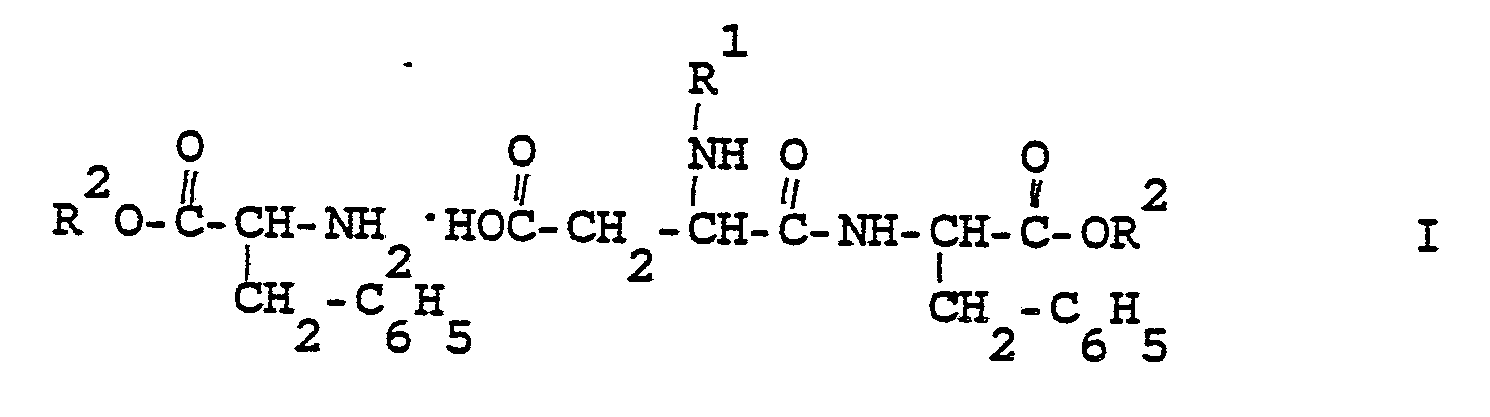
- 2. Eine Additionsverbindung der allgemeinen Formel I, in der R¹ eine Phenoxyacetyl-, Phenoxypropionyl- oder Phenylacetylgruppe ist und R² die oben genannte Bedeutung hat.
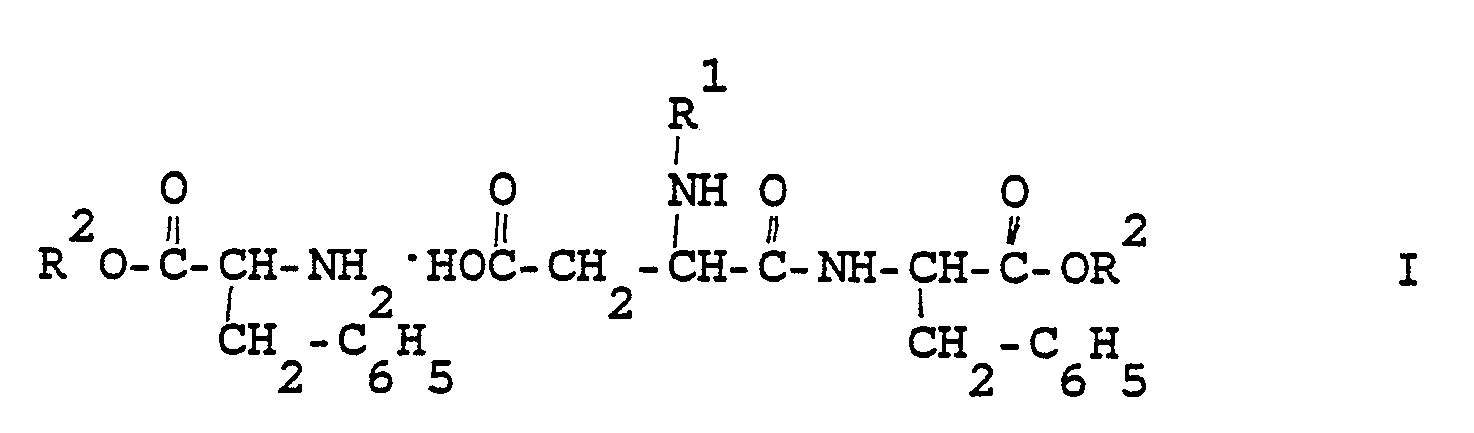
- 3. Ein Verfahren zur Herstellung der Verbindung der allgemeinen Formel II,

- 1. A process for the preparation of the addition compound of the general formula I,
- 2. An addition compound of the general formula I in which R¹ is a phenoxyacetyl, phenoxypropionyl or phenylacetyl group and R² has the meaning given above.
- 3. A process for the preparation of the compound of general formula II,
In der folgenden Beschreibung wird die Erfindung genauer erläutert sowie in den Ansprüchen definiert.In the following description, the invention is explained in more detail and defined in the claims.
In den allgemeinen Formeln I und II bedeutet R¹ eine Phenoxyacetyl-, Phenoxypropionyl- oder Phenylacetylgruppe und wird als Aminoschutzgruppe eingesetzt. R² ist eine niedere Alkylgruppe mit vorzugsweise 1-5 Kohlenstoffatomen, insbesondere 1-3 C-Atomen.In the general formulas I and II, R1 denotes a phenoxyacetyl, phenoxypropionyl or phenylacetyl group and is used as an amino protecting group. R² is a lower alkyl group with preferably 1-5 carbon atoms, in particular 1-3 C atoms.
Die Herstellung der Additionsverbindung der allgemeinen Formel I und die Freisetzung der Verbindung der allgemeinen Formel II aus dieser Additionsverbindung erfolgt analog der Deutschen Offenlegungsschrift 2 801 238.The preparation of the addition compound of general formula I and the release of the compound of general formula II from this addition compound is carried out analogously to German Offenlegungsschrift 2 801 238.
Durch enzymatische Reaktion entsteht aus einem Mol N-geschützter Asparaginsäure und einem Mol Phenylalaninester das entsprechende Dipeptid, das mit überschüssigem Phenylalaninester ein schwerlösliches Addukt (Formel I) bildet und ausfällt. Es ist deshalb vorteilhaft, auf ein Mol N-geschützter Asparaginsäure 2-4 Mol Phenylalaninester einzusetzen. Da das Enzym nur die L-Aminosäuren verknüpft, ist es besonders vorteilhaft für ein Mol N-geschützter L-Asparaginsäure mindestens 2 Mol racemischen Phenylalaninester einzusetzen. Es entsteht dann das L,L-Dipeptid, während der D-Phenylalaninester im Addukt salzartig gebunden ist. Diese Verfahrensweise ermöglicht den Einsatz des preiswerteren racemischen Phenylalaninesters und die Gewinnung des enantiomerenreinen D-Phenylalaninesters aus dem Reaktionsgemisch als Nebenprodukt.The corresponding dipeptide is formed from one mole of N-protected aspartic acid and one mole of phenylalanine ester by enzymatic reaction, which forms a poorly soluble adduct (formula I) with excess phenylalanine ester and precipitates. It is therefore advantageous to use 2-4 moles of phenylalanine ester per mole of N-protected aspartic acid. Since the enzyme only links the L-amino acids, it is particularly advantageous to use at least 2 moles of racemic phenylalanine ester for one mole of N-protected L-aspartic acid. The L, L-dipeptide is then formed, while the D-phenylalanine ester in the adduct is bound like a salt. This procedure enables the use of the cheaper racemic phenylalanine ester and the enantiomerically pure D-phenylalanine ester from the reaction mixture as a by-product.
Als Phenylalaninester sind vorzugsweise solche Verbindungen geeignet, deren Alkoxyrest 1-5 Kohlenstoffatome enthält, also beispielsweise die Methyl- Ethyl- n-Propyl, i-Propyl-, n-Butyl, i-Butyl-, tert. Butyl-, n-Pentyl-, Neo-Pentylester, wobei die genannten C₁ bis C₃ -Alkylgruppen besonders bevorzugt sind. Auch höhere Alkoxyreste kommen noch in Frage, es wird aber immer schwieriger diese z.B. in wäßrig alkoholischem Medium zu lösen. Die Phenylalaninester können in freier Form oder in Form ihrer Salze, beispielsweise als Hydrochloride, Sulfate oder Acetate eingesetzt werden.Suitable phenylalanine esters are preferably those compounds whose alkoxy radical contains 1-5 carbon atoms, that is to say, for example, methyl-ethyl-n-propyl, i-propyl, n-butyl, i-butyl, tert. Butyl, n-pentyl, neo-pentyl esters, the C₁ to C₃ alkyl groups mentioned being particularly preferred. Higher alkoxy residues are also possible, but it is becoming increasingly difficult, e.g. to dissolve in an aqueous alcoholic medium. The phenylalanine esters can be used in free form or in the form of their salts, for example as hydrochlorides, sulfates or acetates.
Die erfindungsgemäß eingesetzte N-geschützte Asparaginsäure ist durch an sich bekannte Verfahren leicht zugänglich. Vorteilhaft schützt man für die Herstellung des L,L-Dipeptides die Aminogruppe der verhältnismäßig preiswerten Asparaginsäure. Die N-geschützte Asparaginsäure kann in freier Form oder als Salz, beispielsweise als Na-, K- oder NH₄ -Salz, eingesetzt werden.The N-protected aspartic acid used according to the invention is easily accessible by methods known per se. The amino group of the relatively inexpensive aspartic acid is advantageously protected for the preparation of the L, L-dipeptide. The N-protected aspartic acid can be used in free form or as a salt, for example as Na, K or NH₄ salt.
Um die Reaktion durchzuführen, ist die Einwirkung einer Protease erforderlich. Geeignet sind Enzyme, die Peptidbindungen spalten bzw. knüpfen, wie beispielsweise Bromelain, Ficin, Papain, Pepsin, Peptidase oder Trypsin. Besonders glatt und aufgrund der Thermostabilität auch bei relativ hohen Temperaturen verläuft die Verknüpfung bei Verwendung von Thermolysin oder Thermoase. Man verwendet pro Mol N-geschützter Asparaginsäure 1 g bis 100 g Enzym, vorzugsweise 5 g bis 50 g. Zu hohe Enzymzusätze sind unvorteilhaft wegen des hohen Preises und der schwierigen Aufarbeitung der Ansätze zur Rückgewinnung des Enzyms. Bei zu geringen Enzymzusätzen verläuft die Reaktion langsamer.The action of a protease is required to carry out the reaction. Enzymes which cleave or form peptide bonds, such as bromelain, ficin, papain, pepsin, peptidase or trypsin, are suitable. The linkage is particularly smooth and due to the thermal stability even at relatively high temperatures when using thermolysin or thermoase. 1 g to 100 g of enzyme, preferably 5 g to 50 g, are used per mole of N-protected aspartic acid. Enzyme additives that are too high are disadvantageous because of the high price and the difficult processing of the approaches for recovering the enzyme. If the enzyme additives are too low, the reaction proceeds more slowly.
Das Enzym kann in Substanz, gelöst oder ungelöst, sowie in fixierter Form auf einem Träger eingesetzt werden. Zur dauernden Aktivierung des Enzyms sind Zusätze geringer Mengen von Calcium- und Zink-ionen vorteilhaft. Die Reaktion wird in Lösungs- oder Verdünnungsmitteln durchgeführt. Besonders vorteilhaft sind solche Systeme, in denen die Ausgangsmaterialien gut löslich sind, während das gebildete Dipeptid in Substanz als Addukt oder Salz ausfällt. Da die Verknüpfung eine Gleichgewichtsreaktion ist, werden auf diese Weise besonders hohe Ausbeuten erhalten. Besonders geeignet sind Wasser und wäßrige Mischungen mit organischen Lösungsmitteln. Als solche sind geeignet: Alkohole, wie Methanol, Ethanol,i-Propanol, Butanol, Benzylalkohol, Ethylenglykol, Ethylenglykol-mono-methylether, Diglykol und Glycerin; organische Ester, wie Methylacetat, Ethylacetat, Butylacetat, Ethylenglykolmonoacetat, Ethylenglykol-diacetat und Diethylcarbonat; Ether, wie Diethylether, Di-i-Propylether, Ethylenglykol-dimethylether; Halogenkohlenwasserstoffe, wie Methylenchlorid, bzw. Säureamide, wie Dimethylformamid und Tetramethylharnstoff.The enzyme can be used in bulk, dissolved or undissolved, and in fixed form on a support. For the permanent activation of the enzyme, small amounts are added of calcium and zinc ions advantageous. The reaction is carried out in solvents or diluents. Systems in which the starting materials are readily soluble are particularly advantageous, while the dipeptide formed precipitates in substance as an adduct or salt. Since the linkage is an equilibrium reaction, particularly high yields are obtained in this way. Water and aqueous mixtures with organic solvents are particularly suitable. Suitable as such are: alcohols, such as methanol, ethanol, i-propanol, butanol, benzyl alcohol, ethylene glycol, ethylene glycol monomethyl ether, diglycol and glycerol; organic esters such as methyl acetate, ethyl acetate, butyl acetate, ethylene glycol monoacetate, ethylene glycol diacetate and diethyl carbonate; Ethers such as diethyl ether, di-i-propyl ether, ethylene glycol dimethyl ether; Halogenated hydrocarbons, such as methylene chloride, or acid amides, such as dimethylformamide and tetramethylurea.
Bei der Verwendung von Lösungsmittelsystemen mit Mischungslücken kann beispielsweise in einem organischen Lösungsmittel gearbeitet werden, in dem sich eine emulgierte wäßrige Phase beispielsweise in Form des feuchten, fixierten Enzyms (Biotechnologie 3, Mai 1985, S. 459) oder in Form inverser Mizellen befindet [Ang. Chemie 97, 449 (1985)].When using solvent systems with miscibility gaps, it is possible, for example, to work in an organic solvent in which an emulsified aqueous phase is, for example, in the form of the moist, fixed enzyme (Biotechnology 3, May 1985, p. 459) or in the form of inverse micelles [Ang . Chemie 97, 449 (1985)].
Die Reaktion ist wenig pH-abhängig. Sie wird vorteilhaft im pH-Bereich von 5-8 durchgeführt. Bei niedrigerem pH-Wert wird die N-geschützte Asparaginsäure immer schwerer löslich während bei höheren pH-Werten durch die Verseifung des Phenylalaninesters zunehmend Ausbeuteverluste entstehen. Die Reaktion wird im Temperaturbereich von etwa 20-50°C durchgeführt. Bei tieferen Temperaturen verläuft sie langsamer, bei höheren Temperaturen verlieren die Enzyme allmählich ihre Aktivität.The reaction is not pH-dependent. It is advantageously carried out in the pH range of 5-8. At a lower pH value, the N-protected aspartic acid becomes increasingly difficult to dissolve, while at higher pH values, the saponification of the phenylalanine ester increasingly leads to losses in yield. The reaction is carried out in the temperature range of about 20-50 ° C. At lower temperatures it runs more slowly, at higher temperatures the enzymes gradually lose their activity.
Die Reaktanden können in beliebiger Reihenfolge auf einmal oder über eine längere Zeitspanne zudosiert werden.The reactants can be added in any order at once or over a longer period of time.
Man kann beispielsweise das Enzym in wäßriger Lösung vorlegen und den Phenylalaninester sowie die N-geschützte Asparaginsäure in fester oder gelöster Form, als Salze oder in freier Form, getrennt oder in gemeinsamer Lösung zugeben. Man kann den Phenylalaninester mit dem Enzym vorlegen und die N-geschützte Asparaginsäure zudosieren. Man kann die N-geschützte Asparaginsäure mit dem Enzym vorlegen und den Phenylalaninester hinzufügen. Man kann auch die Lösung von N-geschützter Asparaginsäure und Phenylalaninester dem Enzym zusetzen.For example, the enzyme can be introduced in aqueous solution and the phenylalanine ester and the N-protected aspartic acid can be added in solid or dissolved form, as salts or in free form, separately or in a common solution. You can submit the phenylalanine ester with the enzyme and add the N-protected aspartic acid. You can submit the N-protected aspartic acid with the enzyme and add the phenylalanine ester. The solution of N-protected aspartic acid and phenylalanine ester can also be added to the enzyme.
Zur Gewinnung des Dipeptids wird das Reaktionsgemisch angesäuert, wobei der in der Additionsverbindung gebundene überschüßige Phenylalaninester in Lösung geht, während das freigesetzte Dipeptid abgesaugt oder mit einem Lösungsmittel extrahiert wird. Man kann auch die aus dem Reaktionsgemisch ausgefallene Additionsverbindung absaugen und das Fällungsprodukt in gleicher Weise in wäßrigen oder nicht-wäßrigen Phasen oder in Lösungsmittelgemischen mit Säure behandeln. Geeignete Säuren sind beispielsweise Salzsäure, Schwefelsäure, Essigsäure, die man vorteilhaft in verdünnter Form anwendet.To obtain the dipeptide, the reaction mixture is acidified, the excess phenylalanine ester bound in the addition compound going into solution, while the released dipeptide is suctioned off or extracted with a solvent. The addition compound which has precipitated from the reaction mixture can also be filtered off with suction and the precipitate can be treated with acid in the same way in aqueous or non-aqueous phases or in solvent mixtures. Suitable acids are, for example, hydrochloric acid, sulfuric acid, acetic acid, which are advantageously used in dilute form.
Zu einer mit konz. Ammoniak auf pH 6 gestellten Lösung von 12,5 g (0,05 Mol) L-Phenylacetylasparaginsäure in 50 ml Wasser tropft man innerhalb von 16 Stunden bei 50°C gleichzeitig eine Lösung von 21,5 g (0,1 M) D,L-Phenylalaninmethylester-hydrochlorid, 0,1 ml 4 %-ige Calciumchloridlösung, 0,1 ml 1 %-ige Zinkchloridlösung und 5,0 g Thermoase in 50 ml Wasser einerseits und konz. Ammoniak andererseits, so daß der pH-Wert von 6,0 aufrechterhalten bleibt. Man rührt 48 Stunden nach und saugt ab.To a with conc. Solution of 12.5 g (0.05 mol) of L-phenylacetylaspartic acid in 50 ml of water adjusted to pH 6 is simultaneously dripped with a solution of 21.5 g (0.1 M) D within 16 hours at 50 ° C. L-phenylalanine methyl ester hydrochloride, 0.1 ml of 4% calcium chloride solution, 0.1 ml of 1% zinc chloride solution and 5.0 g of thermoase in 50 ml of water on the one hand and conc. Ammonia, on the other hand, so that the pH of 6.0 is maintained. The mixture is stirred for 48 hours and suction filtered.
Man erhält 28,2 g (95 % d.Th.) Phenacetyl-L-Asp-L-PheOCH₃. D-PheOCH₃.28.2 g (95% of theory) of phenacetyl-L-Asp-L-PheOCH₃ are obtained. D-PheOCH₃.
HPLC des Addukts zeigt die Zusammensetzung aus äquimolaren Mengen Phenylacetylaspartam und Phenylalaninmethylester: Säule RP8; Hypersil 5 µm; 250 × 4,6 nm; Flow: 1,0 ml/Min.
Phenylacetylaspartam: RT 16,35 Min.
L-Phenylalaninmethylester: RT 3,89 Min.HPLC of the adduct shows the composition of equimolar amounts of phenylacetylaspartam and phenylalanine methyl ester: column RP8; Hypersil 5 µm; 250 x 4.6 nm; Flow: 1.0 ml / min.
Phenylacetylaspartam: RT 16.35 min.
L-phenylalanine methyl ester: RT 3.89 min.
Das gemäß Beispiel 1 erhaltene Produkt wird bereits in feuchtem Zustand in die eiskalte Mischung von 100 ml Schwefelsäure eingetragen und mit Ethylacetat extrahiert. Die organische Phase wird über Na₂SO₄ getrocknet und einrotiert.The product obtained according to Example 1 is already introduced into the ice-cold mixture of 100 ml of sulfuric acid in the moist state and extracted with ethyl acetate. The organic phase is dried over Na₂SO₄ and evaporated.
Man erhält 19,3 g (94 % d.Th.) Phenacetyl-Aspartam.
¹H-NMR(DMSO); δ= 2,9 (m); 3,4 (s); 3,6 (s); 4,25-4,75 (m) 7,25 (m); 8,15-8,4 (q).19.3 g (94% of theory) of phenacetyl aspartame are obtained.
1 H NMR (DMSO); δ = 2.9 (m); 3.4 (s); 3.6 (s); 4.25-4.75 (m) 7.25 (m); 8.15-8.4 (q).
Bei Einstellung des pH-Wertes mit 33 %-iger Natron- oder Kalilauge statt konz. Ammoniak erhält man das Produkt in etwa gleicher Ausbeute.When adjusting the pH with 33% sodium or potassium hydroxide instead of conc. Ammonia gives the product in about the same yield.
In die mit konz. Ammoniak auf pH 6 gestellte Lösung von 12,5 g (0,05 Mol) Phenylacetylasparaginsäure, 0,1 ml 4 %-ige Calciumchloridlösung, 0,4 ml 1 %-ige Zinkchloridlösung, 1,0 g in 35 %-iger NaBr-Lösung vorgelöstem Thermolysin trägt man bei 50° innerhalb von 3 Stunden 36,5 g (0,15 Mol) D,L-Phenylalanin-n-propylesterhydrochlorid unter gleichzeitiger Zugabe von konz. Ammoniak bei pH 6 ein. Nach 2 Stunden beginnt die klare Lösung zu kristallisieren. Nach 48 Stunden saugt man ab, verrührt unter gleichzeitiger Ultraschalleinwirkung mit 200 ml 2n Schwefelsäure und saugt ab.In the with conc. Ammonia to pH 6 solution of 12.5 g (0.05 mol) of phenylacetylaspartic acid, 0.1 ml of 4% calcium chloride solution, 0.4 ml of 1% zinc chloride solution, 1.0 g in 35% NaBr Solution of pre-dissolved thermolysin is carried out at 50 ° within 3 hours 36.5 g (0.15 mol) of D, L-phenylalanine-n-propyl ester hydrochloride with simultaneous addition of conc. Ammonia at pH 6. After 2 hours the clear solution begins to crystallize. After 48 hours, the product is suctioned off, stirred with 200 ml of 2N sulfuric acid while being subjected to ultrasound, and suctioned off.
Man erhält 21,1 g (96 % d.Th.) Phenacetyl-L-asparagyl-L-phenylalanin-propylester.21.1 g (96% of theory) of phenacetyl-L-asparagyl-L-phenylalanine propyl ester are obtained.
¹H-NMR (DMSO); δ= 0,8 (t); 1,45 (m) 2,95 (m); 3,4 (s); 3,9 (t); 4,3-4,7 (m) 7,25 (m) 8,2-8,45 (q).1 H NMR (DMSO); δ = 0.8 (t); 1.45 (m) 2.95 (m); 3.4 (s); 3.9 (t); 4.3-4.7 (m) 7.25 (m) 8.2-8.45 (q).
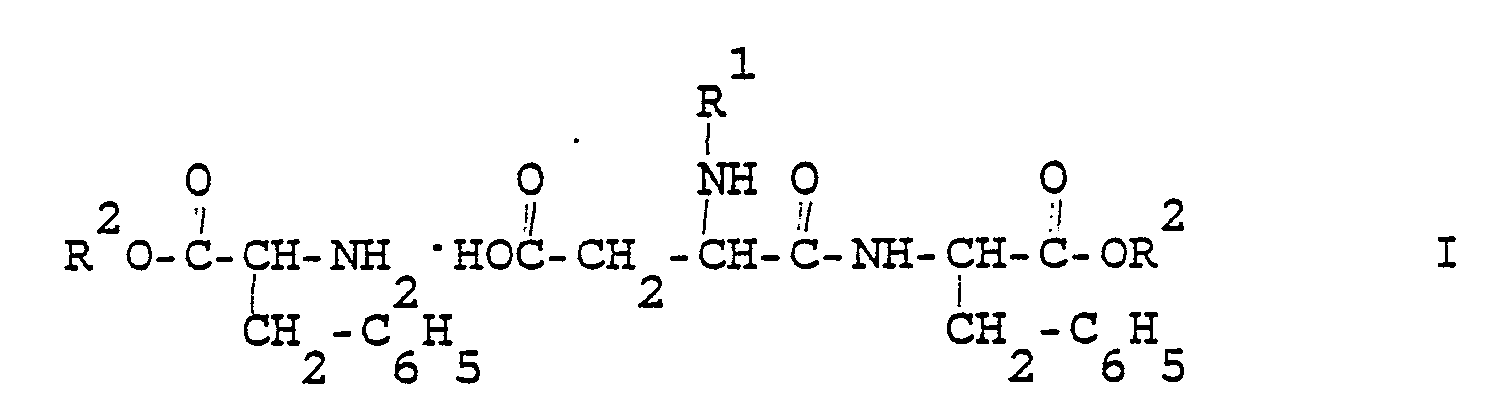
Claims (8)


Applications Claiming Priority (2)
| Application Number | Priority Date | Filing Date | Title |
|---|---|---|---|
| DE19863612344 DE3612344A1 (en) | 1986-04-12 | 1986-04-12 | METHOD FOR PRODUCING DIPEPTIDE ADDITION COMPOUNDS AND THE DIPEPTIDES RELEASED THEREOF |
| DE3612344 | 1986-04-12 |
Publications (1)
| Publication Number | Publication Date |
|---|---|
| EP0241864A2 true EP0241864A2 (en) | 1987-10-21 |
Family
ID=6298542
Family Applications (1)
| Application Number | Title | Priority Date | Filing Date |
|---|---|---|---|
| EP87105261A Withdrawn EP0241864A2 (en) | 1986-04-12 | 1987-04-09 | Process for the preparation of addition compounds of dipeptides and of free peptides thereof |
Country Status (2)
| Country | Link |
|---|---|
| EP (1) | EP0241864A2 (en) |
| DE (1) | DE3612344A1 (en) |
-
1986
- 1986-04-12 DE DE19863612344 patent/DE3612344A1/en not_active Withdrawn
-
1987
- 1987-04-09 EP EP87105261A patent/EP0241864A2/en not_active Withdrawn
Also Published As
| Publication number | Publication date |
|---|---|
| DE3612344A1 (en) | 1987-10-15 |
Similar Documents
| Publication | Publication Date | Title |
|---|---|---|
| DE2256055C2 (en) | Process for the preparation of dipeptide-lower-alkyl esters which contain the α-L-asparagyl radical and which can be used as a sweetener | |
| DE2060969C2 (en) | Process for the production of cystine-containing peptides | |
| DE2635948C2 (en) | Process for splitting off formyl groups from N-formyl amino acid esters and N-formyl peptide esters with free carboxyl groups | |
| DE3229674C2 (en) | ||
| DE2554421C2 (en) | Process for the cleavage of the formyl group from esters of N-α-formylamino acids or N-α-formyl peptides with primary or secondary alcohols | |
| EP0010587B1 (en) | Adamantylalkyloxy-carbonyl derivatives, their preparation and their use for the production of peptides | |
| EP0278454B1 (en) | 2,4- and 2,5-pyridine-dicarboxylic-acid derivatives, process for their preparation, their use and medicines based on these compounds | |
| EP0228625B1 (en) | Peptide derivatives inhibitors of hydroxyling enzymes, their process of preparation, the agents thereof and their use | |
| DE2819898C2 (en) | ||
| DD300232A5 (en) | Process for the preparation of alpha-L-aspartylphenylananine methyl ester hydrochloride using isolated N-formyl-L-asparagine anhydrides | |
| EP0048345B1 (en) | Process for the preparation of an alpha-l-aspartyl-l-phenylalanine-alkyl ester | |
| DE2148203A1 (en) | Process for the preparation of an Ntert-butoxycarbonylamino acid | |
| DE3612344A1 (en) | METHOD FOR PRODUCING DIPEPTIDE ADDITION COMPOUNDS AND THE DIPEPTIDES RELEASED THEREOF | |
| DE2944086A1 (en) | PEPTIDE DERIVATIVES | |
| EP0135183B1 (en) | Process for the preparation of compounds containing carboxylic acid amide groups, especially of peptides | |
| DE2443109A1 (en) | BREAKDOWN OF ALKYLESTERS OF DL-PHENYLALANINE | |
| EP1129107B1 (en) | Method for producing l-prolyl-l-m-sarcolysyl-l-p-fluorophenylalanine and derivatives thereof | |
| DE1143516B (en) | Process for the production of peptides | |
| DE2037697A1 (en) | Biologically active polypeptides | |
| DE2608174A1 (en) | Aspartyl (hydroxy)phenyl-alanine dipeptides prepn. - by hydrogenolysis of benzyl esters, for use as sweeteners | |
| DE2119966A1 (en) | Improved Process for the Production of L-Pyroglutamyl-L-histidyl-L-prolinamide | |
| EP0214550B1 (en) | Process for the preparation of aspartame and agent for its preparation | |
| DE2053188B2 (en) | Process for the preparation of lower alkyl esters of α-L-asparagyl-L-phenylalanine | |
| DE1090663B (en) | Process for the preparation of carboxylic acid aryl esters | |
| DE1065424B (en) | Process for the production of pepfiden |
Legal Events
| Date | Code | Title | Description |
|---|---|---|---|
| PUAI | Public reference made under article 153(3) epc to a published international application that has entered the european phase |
Free format text: ORIGINAL CODE: 0009012 |
|
| AK | Designated contracting states |
Kind code of ref document: A2 Designated state(s): AT BE CH DE FR GB IT LI NL SE |
|
| STAA | Information on the status of an ep patent application or granted ep patent |
Free format text: STATUS: THE APPLICATION HAS BEEN WITHDRAWN |
|
| 18W | Application withdrawn |
Withdrawal date: 19880628 |
|
| RIN1 | Information on inventor provided before grant (corrected) |
Inventor name: KELLER, REINHOLD Inventor name: SCHLINGMANN, MERTEN Inventor name: SCHMIDT, ERWIN |