EP0010587B1 - Adamantylalkyloxy-carbonyl derivatives, their preparation and their use for the production of peptides - Google Patents
Adamantylalkyloxy-carbonyl derivatives, their preparation and their use for the production of peptides Download PDFInfo
- Publication number
- EP0010587B1 EP0010587B1 EP79103160A EP79103160A EP0010587B1 EP 0010587 B1 EP0010587 B1 EP 0010587B1 EP 79103160 A EP79103160 A EP 79103160A EP 79103160 A EP79103160 A EP 79103160A EP 0010587 B1 EP0010587 B1 EP 0010587B1
- Authority
- EP
- European Patent Office
- Prior art keywords
- adpoc
- bzl
- thr
- phe
- compounds
- Prior art date
- Legal status (The legal status is an assumption and is not a legal conclusion. Google has not performed a legal analysis and makes no representation as to the accuracy of the status listed.)
- Expired
Links
- ZAWMFTXLDDGDCI-UHFFFAOYSA-N CC(C)(C1(CC(C2)C3)CC3CC2C1)OC(F)=O Chemical compound CC(C)(C1(CC(C2)C3)CC3CC2C1)OC(F)=O ZAWMFTXLDDGDCI-UHFFFAOYSA-N 0.000 description 1
- ROYKYDVCMIROMK-UHFFFAOYSA-N CC(C)(C1(CC(C2)C3)CC3CC2C1)OC(Oc1ccccc1)=O Chemical compound CC(C)(C1(CC(C2)C3)CC3CC2C1)OC(Oc1ccccc1)=O ROYKYDVCMIROMK-UHFFFAOYSA-N 0.000 description 1
- 0 CON=C(*)C#N Chemical compound CON=C(*)C#N 0.000 description 1
Classifications
-
- C—CHEMISTRY; METALLURGY
- C07—ORGANIC CHEMISTRY
- C07K—PEPTIDES
- C07K5/00—Peptides containing up to four amino acids in a fully defined sequence; Derivatives thereof
- C07K5/04—Peptides containing up to four amino acids in a fully defined sequence; Derivatives thereof containing only normal peptide links
- C07K5/06—Dipeptides
- C07K5/06139—Dipeptides with the first amino acid being heterocyclic
- C07K5/06156—Dipeptides with the first amino acid being heterocyclic and Trp-amino acid; Derivatives thereof
-
- C—CHEMISTRY; METALLURGY
- C07—ORGANIC CHEMISTRY
- C07D—HETEROCYCLIC COMPOUNDS
- C07D209/00—Heterocyclic compounds containing five-membered rings, condensed with other rings, with one nitrogen atom as the only ring hetero atom
- C07D209/02—Heterocyclic compounds containing five-membered rings, condensed with other rings, with one nitrogen atom as the only ring hetero atom condensed with one carbocyclic ring
- C07D209/04—Indoles; Hydrogenated indoles
- C07D209/10—Indoles; Hydrogenated indoles with substituted hydrocarbon radicals attached to carbon atoms of the hetero ring
- C07D209/18—Radicals substituted by carbon atoms having three bonds to hetero atoms with at the most one bond to halogen, e.g. ester or nitrile radicals
- C07D209/20—Radicals substituted by carbon atoms having three bonds to hetero atoms with at the most one bond to halogen, e.g. ester or nitrile radicals substituted additionally by nitrogen atoms, e.g. tryptophane
-
- C—CHEMISTRY; METALLURGY
- C07—ORGANIC CHEMISTRY
- C07K—PEPTIDES
- C07K1/00—General methods for the preparation of peptides, i.e. processes for the organic chemical preparation of peptides or proteins of any length
- C07K1/06—General methods for the preparation of peptides, i.e. processes for the organic chemical preparation of peptides or proteins of any length using protecting groups or activating agents
- C07K1/061—General methods for the preparation of peptides, i.e. processes for the organic chemical preparation of peptides or proteins of any length using protecting groups or activating agents using protecting groups
- C07K1/063—General methods for the preparation of peptides, i.e. processes for the organic chemical preparation of peptides or proteins of any length using protecting groups or activating agents using protecting groups for alpha-amino functions
-
- C—CHEMISTRY; METALLURGY
- C07—ORGANIC CHEMISTRY
- C07K—PEPTIDES
- C07K1/00—General methods for the preparation of peptides, i.e. processes for the organic chemical preparation of peptides or proteins of any length
- C07K1/06—General methods for the preparation of peptides, i.e. processes for the organic chemical preparation of peptides or proteins of any length using protecting groups or activating agents
- C07K1/061—General methods for the preparation of peptides, i.e. processes for the organic chemical preparation of peptides or proteins of any length using protecting groups or activating agents using protecting groups
- C07K1/064—General methods for the preparation of peptides, i.e. processes for the organic chemical preparation of peptides or proteins of any length using protecting groups or activating agents using protecting groups for omega-amino or -guanidino functions
-
- C—CHEMISTRY; METALLURGY
- C07—ORGANIC CHEMISTRY
- C07K—PEPTIDES
- C07K1/00—General methods for the preparation of peptides, i.e. processes for the organic chemical preparation of peptides or proteins of any length
- C07K1/06—General methods for the preparation of peptides, i.e. processes for the organic chemical preparation of peptides or proteins of any length using protecting groups or activating agents
- C07K1/061—General methods for the preparation of peptides, i.e. processes for the organic chemical preparation of peptides or proteins of any length using protecting groups or activating agents using protecting groups
- C07K1/068—General methods for the preparation of peptides, i.e. processes for the organic chemical preparation of peptides or proteins of any length using protecting groups or activating agents using protecting groups for heterocyclic side chains
-
- C—CHEMISTRY; METALLURGY
- C07—ORGANIC CHEMISTRY
- C07K—PEPTIDES
- C07K14/00—Peptides having more than 20 amino acids; Gastrins; Somatostatins; Melanotropins; Derivatives thereof
- C07K14/435—Peptides having more than 20 amino acids; Gastrins; Somatostatins; Melanotropins; Derivatives thereof from animals; from humans
- C07K14/575—Hormones
- C07K14/655—Somatostatins
-
- C—CHEMISTRY; METALLURGY
- C07—ORGANIC CHEMISTRY
- C07K—PEPTIDES
- C07K5/00—Peptides containing up to four amino acids in a fully defined sequence; Derivatives thereof
- C07K5/04—Peptides containing up to four amino acids in a fully defined sequence; Derivatives thereof containing only normal peptide links
- C07K5/10—Tetrapeptides
- C07K5/1002—Tetrapeptides with the first amino acid being neutral
- C07K5/1005—Tetrapeptides with the first amino acid being neutral and aliphatic
- C07K5/1013—Tetrapeptides with the first amino acid being neutral and aliphatic the side chain containing O or S as heteroatoms, e.g. Cys, Ser
Definitions
- the sterically hindered carbon atom ensures that this protective group is split off very gently due to the steric hindrance.
- the cleavage therefore takes place in a much weaker acidic medium than is the case for the Adoc group.
- the protective group can be split off faster by a factor of 1000 than the known Boc group, which has the following structure:
- the Boc group is probably the most common protecting group currently used. However, since the Boc group can be split off from the amino function 1000 times more slowly than the Adpoc group according to the invention, it can be imagined that the side chain protective groups which are to remain intact during the peptide synthesis are also attacked during the Boc group removal.
- the Adpoc group according to the invention does not have these disadvantages. It was surprising and was not obvious that the Adpoc group according to the invention differs so much from the known Boc group.
- the Adoc group behaves in a similar way to the Boc group and therefore all the syntheses using the Adoc group have to accept the same disadvantages as in the case of syntheses using the Boc group.
- the indole residue of tryptophan suffers particularly in the case of acidic cleavage and is partially broken down and destroyed.
- the Adpoc group is therefore particularly suitable for the representation of peptide sequences with a tryptophan residue.
- the applicants could by light absorption spectroscopy show that when the Adpoc group is split off, the indole residue of tryptophan is not destroyed at all.
- Adpoc group Another great advantage of the Adpoc group is that it has strong solubilizing properties, especially in the case of large peptides, in comparison to other protective groups, and therefore also over the Adoc group. Group has. Certain peptide sequences can only be brought into solution in reasonable amounts with the help of the Adpoc group.
- the BPOC group can be split off faster by a factor of 2-3 compared to the Adpoc group according to the invention. You'd think this would be beneficial. However, due to this greater instability, the connection is not sufficiently stable during storage.
- the BPOC group is still photolabile, which is not without its problems, as has become known by various research groups that deal with peptide synthesis. In this respect, this seemingly small difference between the Adpoc group according to the invention and the known BPOC group is very crucial for practice. It was by no means foreseeable and it is completely surprising that the Adpoc group can be split off under such mild conditions on the one hand, and on the other hand the starting materials, i.e. the so-called Adpoc amino acids, can be kept at room temperature for months.
- the protective group 2-adamantane (1) -propyl-2-oxycarbonyl hereinafter called adpoc, also proves to be particularly advantageous in that the removal of the N- [2-adamantane (1)] isopropyl mask in mild acidolytic Medium succeeds, preferably in 3% trifluoroacetic acid in methylene chloride within 4 to 5 minutes at 0 ° C or within 2 to 3 minutes at room temperature. This largely achieves unmasking selectivity towards protecting groups of the tert-butyl type. Of course, N-benzyloxycarbonyl, O-benzyl ether and ester groups remain untouched.
- the compounds of the general formula Ia-1-adamantane carboxylic acid are first reacted with phosphorus pentachloride / ethanol and the reaction product obtained is then reacted with methylmagnesium iodide to give 2-adamantane (1) propanol (2) and CO (X ') 2 um, in which X 'has the meaning given above.
- halogen means fluorine, chlorine, bromine or iodine.
- the 1-adamantane carboxylic acid esters mentioned are prepared from the acids in a manner known per se, e.g. from the corresponding acids by treatment with suitable phosphorus halides and reaction with alcohols.
- Lower alkyl means alkyl radicals with up to eight carbon atoms.
Landscapes
- Chemical & Material Sciences (AREA)
- Organic Chemistry (AREA)
- Health & Medical Sciences (AREA)
- Life Sciences & Earth Sciences (AREA)
- Medicinal Chemistry (AREA)
- Proteomics, Peptides & Aminoacids (AREA)
- Molecular Biology (AREA)
- Biochemistry (AREA)
- Biophysics (AREA)
- General Health & Medical Sciences (AREA)
- Genetics & Genomics (AREA)
- Analytical Chemistry (AREA)
- Gastroenterology & Hepatology (AREA)
- Zoology (AREA)
- Toxicology (AREA)
- Endocrinology (AREA)
- Peptides Or Proteins (AREA)
- Organic Low-Molecular-Weight Compounds And Preparation Thereof (AREA)
- Pyrrole Compounds (AREA)
- Medicines That Contain Protein Lipid Enzymes And Other Medicines (AREA)
Abstract
Description
Die Erfindung betrifft neue substituierte Kohlensäureester und Urethane, Verfahren zur ihrer Herstellung und deren Verwendung.The invention relates to new substituted carbonic acid esters and urethanes, processes for their preparation and their use.
Es sind zahlreiche Schutzgruppen bekannt, die bei Umsetzung von primären und sekundären Aminen, insbesondere Aminosäuren, biogenen Aminen und Aminozuckern Verwendung finden. Eine neuere zusammenfassende Darstellung findet sich z.B. in den beiden Büchern von E. Wünsch in E. Müller (Herausgeber): Houben-Weyl, Methoden der Organischen Chemie 15/1, Georg Thieme Verlag Stuttgart 1974 and H. D. Jakubke und H. Jeschkeit, Aminosäuren-Peptide-Proteine, 2. Auflage, Akademie-Verlag Berlin 1973.Numerous protective groups are known which are used in the reaction of primary and secondary amines, in particular amino acids, biogenic amines and amino sugars. A more recent summary is found e.g. in the two books by E. Wünsch in E. Müller (editor): Houben-Weyl, Methods of Organic Chemistry 15/1, Georg Thieme Verlag Stuttgart 1974 and HD Jakubke and H. Jeschkeit, amino acid peptide proteins, 2nd edition , Akademie-Verlag Berlin 1973.
Obwohl die bekannten Aminoschutzgruppen von Urethantyp (Boc, Z) einen weiten Teil der Anforderungen von eindeutig verlaufenden Syntheseaufbauprinzipien abdecken, ist es in vielen Fällen wüschenswert, Schutzgruppen einzusetzen, die unter sehr milden acidolytischen Bedingungen abspaltbar sind. Dies erlaubt eine optimale Schonung säurelabiler Schutzgruppen z.B. an trifunktionellen Aminosäuren, insbesondere z.B. bei Synthesen mit repetitiven Kupplungs- und Deblockierungsschritten (Festphasen- oder Liquidphasentechnik). Ebenso erfahren z.B. tryptophanhlatige Peptide bei Desacylierungen in stärker saurem Milieu oft eine Zerstörung des Indolsystems, was sich in einer Violett-Verfärbung und UV-Abs.-Verschiebung äußert. Nebenreaktionen solcher Art können bei Verwendung milder Deblockierungsreagentien auf ein Minimum reduziert werden.Although the known amino protecting groups of urethane type (Boc, Z) cover a large part of the requirements of clearly running synthesis principles, in many cases it is desirable to use protective groups that can be split off under very mild acidolytic conditions. This allows optimal protection of acid-labile protective groups e.g. on trifunctional amino acids, especially e.g. in syntheses with repetitive coupling and deblocking steps (solid phase or liquid phase technology). Also experienced e.g. Tryptophan-containing peptides often cause destruction of the indole system in deacylations in a more acidic environment, which is manifested in a violet discoloration and shift in UV abs. Side reactions of this kind can be reduced to a minimum when using mild deblocking reagents.
Im folgenden werden als Abkürzungen verwendet:

Die vor kurzer Zeit entwickelten Schutzgruppen Bpoc, Ddz, Ppoc, Azoc (Abkürzungen nach den allgemeinen Regeln der Peptidchemic vgl. Houben-Weyl, Methoden der Organischen Chemie15/1, Georg Thieme Verlag Stuttgart 1974 und H. D. Jakubke und H. Jeschkeit, Aminosäuren-Peptide-Proteine, 2. Auflage, Akademie-Verlag Berlin 1973) tragen diesen Forderungen Rechnung, jedoch konnten nur die ersten beiden breitere Anwendung finden. In beiden Fällen ist die Lagerung der geschützten Aminosäuren aus Gründen autokatalytischer Zersetzung bzw. Photolabilität nicht ganz unproblematisch. Auch das zur Einführung der Bpoc-Gruppe oft benutzte Bpoc-Phenylcarbonat neigt selbst bei tiefen Temperaturen zur Zersetzung. Eine Darstellung von Bpoc-Trp-OH gelingt nur mit sehr geringen Ausbeuten.The recently developed protective groups Bpoc, Ddz, Ppoc, Azoc (for abbreviations according to the general rules of peptide chemistry see Houben-Weyl, Methods of Organic Chemistry 15/1, Georg Thieme Verlag Stuttgart 1974 and HD Jakubke and H. Jeschkeit, amino acid peptides -Proteine, 2nd edition, Akademie-Verlag Berlin 1973) take these demands into account, but only the first two could be used more broadly. In both cases, the storage of the protected amino acids is not without problems for reasons of autocatalytic decomposition or photolability. Bpoc phenyl carbonate, which is often used to introduce the Bpoc group, also tends to be used decomposes even at low temperatures. Bpoc-Trp-OH can only be prepared with very low yields.
In der Literaturstelle E. Wünsch (ed.): Synthese von Peptiden. Methoden der organischen Chemie (Houben-Weyl), 4. Auflage, Band XV/1, Stuttgart (1974), Seiten 139 bis 141 sowie in der GB-A-1 106 272 werden Substanzen beschrieben, die eine sehr ähnliche Konstitution wie die beanspruchten Verbindungen aufweisen und ebenfalls als Schutzgruppenreagens Verwendung finden, beispielsweise bei Peptidsynthesen. Es handelt sich dabei um Adamant-1-yl-oxycarbonyl-chlorid (Adoc-CI) und Derivate davon. Die anmeldungsgemäßen Verbindungen unterscheiden sich im wesentlichen nur durch eine eingeschobene Alkylengruppe der Formel -C(R')(R 2)-.In the literature reference E. Wünsch (ed.): Synthesis of peptides. Methods of organic chemistry (Houben-Weyl), 4th edition, volume XV / 1, Stuttgart (1974), pages 139 to 141 and in GB-A-1 106 272 substances are described which have a constitution very similar to that claimed Have compounds and are also used as a protective group reagent, for example in peptide synthesis. These are adamant-1-yl-oxycarbonyl chloride (Adoc-CI) and derivatives thereof. The compounds according to the application differ essentially only by an inserted alkylene group of the formula -C (R ') (R 2 ) -.
Bei der in der vorliegenden Anmeldung beanspruchten Verbindung handelt es sich um:
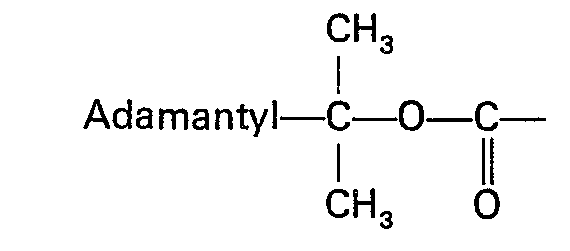
Bei den in der Literatur bekannten Verbindungen handelt es sich um die Adoc-Gruppe der folgenden Formel:

Der Fachmann hätte erwarten müssen, daß sich beide Gruppen ähnlich verhalten und gleiche oder ähnliche Reaktionsfähigkeiten aufweisen. Dies ist jedoch nicht der Fall. Es wurde überraschenderweise gefunden, daß sich die Adpoc-Gruppe wesentlich anders als die bekannte Adoc-Gruppe verhält. Im Gegensatz zur Adoc-Gruppe besitzt die Adpoc-Gruppe ein sterisch sehr stark gehindertes Kohlenstoffatom:
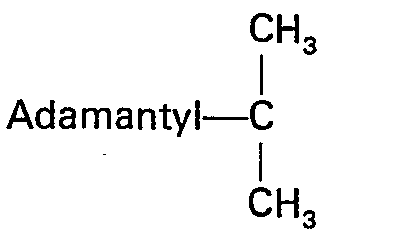
Durch das sterisch gehinderte Kohienstoffatom wird erreicht, daß diese Schutzgruppe, bedingt durch die sterische Behinderung sehr schonend abgespalten wird. Die Abspaltung erfolgt also in wesentlich schwächer saurem Medium als dies für die Adoc-Gruppe der Fall ist. So konnte beispielsweise eindeutig nachgewiesen werden, daß sie die Schutzgruppe um den Faktor 1000 rascher abspalten läßt wie die bekannte Boc-Gruppe, welche die folgende Struktur aufweist:

Die Boc-Gruppe ist wahrscheinlich die derzeit am haufigsten verwendete Schutzgruppe. Da sich die Boc-Gruppe von der Aminofunktion jedoch 1000 mal langsamer abspalten läßt als die erfindungsgemäße Adpoc-Gruppe, kann man sich vorstellen, daß die Seitenkettenschutzgruppen, welche während der Peptidsynthese intakt bleiben sollen, bei der Boc-Gruppenabspaltung auch angegriffen werden. Diese Nachteile besitzt die erfindungsgemäße Adpoc-Gruppe nicht. Es war überraschend und hat nicht nahegelegen, daß sich die erfindungsgemäße Adpoc-Gruppe gegenüber der bekannten Boc-Gruppe so stark unterscheidet. Die Adoc-Gruppe verhält sich ähnlich wie die Boc-Gruppe und somit sind bei allen Synthesen, bei denen die Adoc-Gruppe verwendet wird, dieselben Nachteile in Kauf zu nehmen, wie bei Synthesen unter Verwendung der Boc-Gruppe.The Boc group is probably the most common protecting group currently used. However, since the Boc group can be split off from the amino function 1000 times more slowly than the Adpoc group according to the invention, it can be imagined that the side chain protective groups which are to remain intact during the peptide synthesis are also attacked during the Boc group removal. The Adpoc group according to the invention does not have these disadvantages. It was surprising and was not obvious that the Adpoc group according to the invention differs so much from the known Boc group. The Adoc group behaves in a similar way to the Boc group and therefore all the syntheses using the Adoc group have to accept the same disadvantages as in the case of syntheses using the Boc group.
Bei Peptidsynthesen leidet bei der sauren Abspaltung besonders der Indolrest des Tryptophans und wird teilweise abgebaut und zerstört. Die Adpoc-Gruppe eignet sich daher besonders zur Darstellung von Peptidsequenzen mit Tryptophanrest. Die Anmelder konnten z.B. durch Lichtabsorptionsspektroskopie zeigen, daß bei der Abspaltung der Adpoc-Gruppe der Indolrest des Tryptophans überhaupt nicht zerstört wird.In the case of peptide syntheses, the indole residue of tryptophan suffers particularly in the case of acidic cleavage and is partially broken down and destroyed. The Adpoc group is therefore particularly suitable for the representation of peptide sequences with a tryptophan residue. For example, the applicants could by light absorption spectroscopy show that when the Adpoc group is split off, the indole residue of tryptophan is not destroyed at all.
Ein weiterer großer Vorteil der Adpoc-Gruppe ist, daß sie bsonders bei großen Peptiden stark solubilisierende Eigenschaften im Vergleich zu anderen Schutzgruppen also auch gegenüber der Adoc-Gruppe hat. Bestimmte Peptidsequenzen lassen sich so nur mit Hilfe der Adpoc-Gruppe in vernünftigen Mengen in Lösung bringen.Another great advantage of the Adpoc group is that it has strong solubilizing properties, especially in the case of large peptides, in comparison to other protective groups, and therefore also over the Adoc group. Group has. Certain peptide sequences can only be brought into solution in reasonable amounts with the help of the Adpoc group.
Die BPOC-Gruppe läßt sich im Vergleich zu der erfindungsgemäßen Adpoc-Gruppe um den Faktor 2-3 rascher abspalten. Man könnte meinen, dies sei vorteilhaft. Doch ist durch diese größere Labilität die Verbindung bei Lagerung nicht ausreichend stabil. Die BPOC-Gruppe ist weiterhin photolabil, was nicht unproblematisch ist, wie es von verschiedenen Forschergruppen, die sich mit Peptidsynthesen befassen, bekannt wurde. Insofern ist dieser äußerlich gering erscheinende Unterschied zwischen der erfindungsgemäßen Adpoc-Gruppe und der bekannten BPOC-Gruppe für die Praxis sehr entscheidend. Es war in keiner Weise vorherzusehen und ist völlig überraschend, daß sich die Adpoc-Gruppe einerseits unter so milden Bedingungen abspalten läßt, andererseits die Ausgangsmaterialien, also die sogenannten Adpoc-Aminosäuren, monatelang bie Zimmertemperatur haltbar sind. Die BPOC-Reagenzien sind oft leicht zersetzbar, was für die Adpoc-Aminosäuren in keiner Weise zutrifft. Wie R. S. Feinberg und R. B. Merrifield in Tetrahedron 28 5865 (1972) publiziert haben, neigt das zur Einführung der BPOC-Gruppe oft benützte BPOC-Phenylkarbonat selbst bei tiefen Temperaturen zu Zersetzung. Dies gilt überraschenderweise für das Adpoc-Phenylkarbonat nicht. Das Adpoc-Phenylkarbonat ist sogar bei Zimmertemperatur stabil. Die Synthese von BPOC-Trp-OH gelingt nur mit geringen Ausbeuten. Wie die Anmelder in der Angewandten Chemie (H. Kalbacher und W. Voelter, Angew. Chemie 90, 998 (1978)) beschrieben haben, kann Adpoc-Trp-OH in 72%iger Ausbeute sehr gut hergestellt werden.The BPOC group can be split off faster by a factor of 2-3 compared to the Adpoc group according to the invention. You'd think this would be beneficial. However, due to this greater instability, the connection is not sufficiently stable during storage. The BPOC group is still photolabile, which is not without its problems, as has become known by various research groups that deal with peptide synthesis. In this respect, this seemingly small difference between the Adpoc group according to the invention and the known BPOC group is very crucial for practice. It was by no means foreseeable and it is completely surprising that the Adpoc group can be split off under such mild conditions on the one hand, and on the other hand the starting materials, i.e. the so-called Adpoc amino acids, can be kept at room temperature for months. The BPOC reagents are often easily decomposed, which is not the case for the Adpoc amino acids. As R. S. Feinberg and R. B. Merrifield published in Tetrahedron 28 5865 (1972), the BPOC phenyl carbonate, which is often used to introduce the BPOC group, tends to decompose even at low temperatures. Surprisingly, this does not apply to the Adpoc phenyl carbonate. The Adpoc phenyl carbonate is stable even at room temperature. The synthesis of BPOC-Trp-OH is only possible with low yields. As the applicants in Angewandte Chemie (H. Kalbacher and W. Voelter, Angew. Chemie 90, 998 (1978)) have described, Adpoc-Trp-OH can be produced very well in 72% yield.
Überraschenderweise wurde nun jetzt gefunden, daß mit Hilfe der erfindungsgemäßen Verbindungen neue Schutzgruppen für Verbindungen mit primären und sekundären Aminofunktionen, insbesondere Aminosäuren, Aminozucker, biogene Amino, z.B. Tyramin, Dopamin, Noradrenalin, Adrenalin, Tryptamin, Serotonin, Melatonin, Histamin, Cysteamin, ß-Alanin, y-Amonobuttersäure, Propanolamin, Äthanolamin, Cadaverin, Purescin und Agmatin, eingeführt werden können, die folgende Vorteile gegenüber dem Stand der Technik aufweisen:
- 1. Die Einführung der Schutzgruppe gelingt mit Hilfe stabilier kirstalliner und reaktiver Verbindungen, wie dem Phenylcarbonat (Adpoc-OPh) oder dem Fluorameisensäureester (Adpoc-F).
- 2. Die Adpoc-Gruppe kann unter sehr milden Bedingungen entfert werden. Schutzgruppen vom t-Butyltyp bleiben unangetastet. Tryptophanhaltige Peptide bleiben unter Abspaltungsbedingungen stabil.
- 3. Die Schutzgruppe ist sowohl gegen Alkali, als auch gegenüber Hydrogenolyse stabil.
- 4. Aufgrund der ausgeprägten Lipophilie besitzt der Adpoc-Rest, insbesondere bei höheren Peptiden, stark lösungsvermittelnde Eigenschaften.
- 5. Adpoc-Trp-OH ist in hohen Ausbeuten darstellbar. Die Lagerung dieser Verbindungen bei normalen Lichtverhältnissen und bei Raumtemperatur führte nach 3 Monaten zu keiner Veränderung des Derivats.
- 6. Die in der Peptidchemie üblichen Methoden (DCCI/HOBt-Aktivesterkupplungen, Verseifungen, Hydrierungen) können unter Erhaltung des Adpoc-Restes angewandt werden.
- 1. The introduction of the protective group succeeds with the help of stable church stable and reactive compounds such as phenyl carbonate (Adpoc-OPh) or the fluoroformate (Adpoc-F).
- 2. The Adpoc group can be handled under very mild conditions. Protective groups of the t-butyl type remain untouched. Peptides containing tryptophan remain stable under cleavage conditions.
- 3. The protective group is stable both against alkali and against hydrogenolysis.
- 4. Because of the pronounced lipophilicity, the Adpoc residue, particularly with higher peptides, has strong solubilizing properties.
- 5. Adpoc-Trp-OH can be produced in high yields. Storage of these compounds in normal light conditions and at room temperature did not change the derivative after 3 months.
- 6. The methods customary in peptide chemistry (DCCI / HOBt active ester couplings, saponification, hydrogenation) can be used while maintaining the Adpoc residue.
Als besonders vorteilhaft erweist sich die Schutzgruppe 2-Adamantan(1 )-propyl-2-oxycarbonyl, im folgenden Adpoc genannt, auch dadurch, daß die Aufhebung der N-[2-Adamantan-(1 )]-isopropyl-Maskierung im milden acidolytischen Medium gelingt und zwar vorzugsweise in 3%iger Trifluoressigsäure in Methylenchlorid innerhalb 4 bis 5 Minuten bei 0°C oder innerhalb 2 bis 3 Minuten bei Raumtemperatur. Hierbei wird eine weitgehende Demaskierungsselektivität gegenüber Schutzgruppen vom tert.-Butyltyp erreicht. Selbstverständlich bleiben N-Benzyloxycarbonyl-, O-Benzyläther sowie - Ester-Gruppierungen unangetastet.The protective group 2-adamantane (1) -propyl-2-oxycarbonyl, hereinafter called adpoc, also proves to be particularly advantageous in that the removal of the N- [2-adamantane (1)] isopropyl mask in mild acidolytic Medium succeeds, preferably in 3% trifluoroacetic acid in methylene chloride within 4 to 5 minutes at 0 ° C or within 2 to 3 minutes at room temperature. This largely achieves unmasking selectivity towards protecting groups of the tert-butyl type. Of course, N-benzyloxycarbonyl, O-benzyl ether and ester groups remain untouched.
Die genannten Spaltungsbedingungen erlauben eine um den Faktor 103 schnellere Abspaltung dieser neuen N-Urethanschutzgruppe gegenüber der N-tert.-Butyloxycarbonylgruppe. Gegenüber der N-[2-Biphenyl-(4)]-oxycarbonyl-(Bpoc)-Maskierung weisen Adpoc-Aminosäuren unter acidolytischen Bedingungen dagegen etwa 2- bis 3-fach höhere Stabilität auf.The cleavage conditions mentioned allow the cleavage of this new N-urethane protective group by a factor of 10 3 faster than that of the N-tert-butyloxycarbonyl group. Compared to the N- [2-biphenyl- (4)] - oxycarbonyl- (Bpoc) masking, Adpoc-amino acids, on the other hand, have about 2 to 3 times the stability under acidolytic conditions.
Gegenstand der Erfindung sind verbindungen der allgemeinen Formel I


Bevorzugte Verbindungen sind solche der folgenden Formel la


Die Erfindung betrifft weiterhin ein Verfahren zur Herstellung der neuen Verbindungen der allgemeinen Formel I
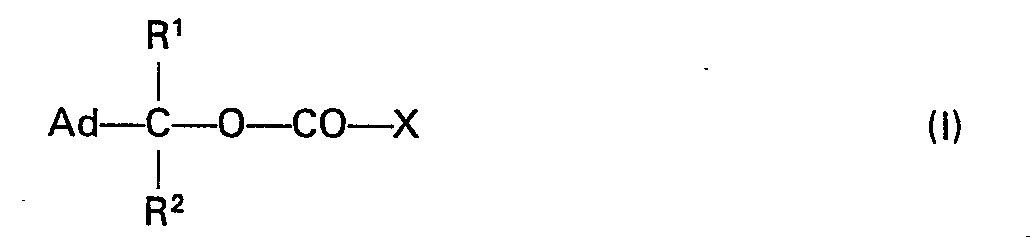


Gemäß einer bevorzugten Ausführungsform setzt man zur Herstellungf der Verbindungen der allgemeinen Formel la 1-Adamantancarbonsäure zuerst mit Phosphorpentachlorid/Äthanol um und setzt dann das erhaltene Reaktionsprodukt mit Methylmagnesiumjodid zu 2-Adamantan(1 )-propanol(2) und CO(X')2 um, worin X' die oben angegebenen Bedeutung besitzt.According to a preferred embodiment, the compounds of the general formula Ia-1-adamantane carboxylic acid are first reacted with phosphorus pentachloride / ethanol and the reaction product obtained is then reacted with methylmagnesium iodide to give 2-adamantane (1) propanol (2) and CO (X ') 2 um, in which X 'has the meaning given above.
Die Erfindung betrifft weiterhin die Verwendung der neuen Verbindungen der Formel zur Herstellung von Verbindungen mit Peptidbindungen, insbesondere zur Herstellung von Verbindungen der allgemeinen Formel Ib

Bevorzugt werden die neuen Verbindungen der Formel zur Darstellung von TRH, LH/FSH-RH, Eledoisin, Secretin, Gastrin, Physalaemin, Glucagon, Adrenocorticotropin, Oxytocin, Vasopressin, Calcitonin, Angiotensin, Bradikinin, Kalidin, Phyllokinin, Gramicidin, Bacitracin, Peptidantibiotika, Peptidtoxine, Peptidinsektizide, Somatostatin und jeweils deren Teilsequenzen sowie von Adpoc-Gly-OH, Adpoc-L-Ala-DCHA, Adpoc-L-Gln-OH, Adpoc-L-Trp-OH, Adpoc-L-Trp-OSu, Adpoc-L-Trp-L-Lys(Z)-OH, Adpoc-L-Thr(Bzl)-OH, Adpoc-L-Thr(Bzl)-L-Phe-OCH3, Adpoc-L-Thr(Bzl)-L-Phe-OH, Adpoc-L-Thr(Bzl)-L-Phe-L-Thr(Bzl)-L-Ser(Bzl)-OCH3, Adpoc-L-Trp-L-Lys(Z)-L-Thr-(Bzl)-L-Phe-L-Thr(Bzl)-L-Ser(OBzl)-OCH3, sowie Adpoc-L-Trp-L-Lys(Z)-L-Thr(Bzt)-L-Phe-L-Thr(Bzl)-L-Ser(OBzI)-L-Cys(Trt)-OH verwendet.The new compounds of the formula for the preparation of TRH, LH / FSH-RH, eledoisin, secretin, gastrin, physalaemin, glucagon, adrenocorticotropin, oxytocin, vasopressin, calcitonin, angiotensin, bradikinin, kalidine, phyllokinin, gramicidin, bacitracin, peptide antibiotics are preferred Peptide toxins, peptide insecticides, somatostatin and their partial sequences, as well as Adpoc-Gly-OH, Adpoc-L-Ala-DCHA, Adpoc-L-Gln-OH, Adpoc-L-Trp-OH, Adpoc-L-Trp-OSu, Adpoc -L-Trp-L-Lys (Z) -OH, Adpoc-L-Thr (Bzl) -OH, Adpoc-L-Thr (Bzl) -L-Phe-OCH 3 , Adpoc-L-Thr (Bzl) - L-Phe-OH, Adpoc-L-Thr (Bzl) -L-Phe-L-Thr (Bzl) -L-Ser (Bzl) -OCH 3 , Adpoc-L-Trp-L-Lys (Z) -L -Thr- (Bzl) -L-Phe-L-Thr (Bzl) -L-Ser (OBzl) -OCH 3 , and Adpoc-L-Trp-L-Lys (Z) -L-Thr (Bzt) -L -Phe-L-Thr (Bzl) -L-Ser (OBzI) -L-Cys (Trt) -OH used.
Gemäß einer weiteren bevorzugten Auführungsform werden die neuen Verbindungen der Formel 1 zur Darstellung von Adpoc-L-Trp-OH, Adpoc-L-Trp-OSu, Adpoc-L-Trp-L-Lys(Z)-OH, Adpoc-L-Trp-L-Lys(Z)-L-Thr(Bzl)-L-Phe-L-Thr(Bzl)-L-Ser(OBzI)-OCH3, Adpoc-L-Trp-L-Lys(Z)-L-Thr(Bzl)-L-Phe-L-Thr(Bzl)-L-Ser(OBzl)-L-Cys(Trt)-OH, sowie Corticotropine, Melanotropine, LH/FSH-RH, Glucagon, Calcitonine, Gastrine, Somatostatin und Teilsequenzen als tryptophanhaltige Peptide verwendet.According to a further preferred embodiment, the new compounds of formula 1 for the preparation of Adpoc-L-Trp-OH, Adpoc-L-Trp-OSu, Adpoc-L-Trp-L-Lys (Z) -OH, Adpoc-L- Trp-L-Lys (Z) -L-Thr (Bzl) -L-Phe-L-Thr (Bzl) -L-Ser (OBzI) -OCH 3 , Adpoc-L-Trp-L-Lys (Z) - L-Thr (Bzl) -L-Phe-L-Thr (Bzl) -L-Ser (OBzl) -L-Cys (Trt) -OH, as well as corticotropins, melanotropins, LH / FSH-RH, glucagon, calcitonins, gastrins , Somatostatin and partial sequences used as tryptophan-containing peptides.
Gemäß einer weiteren bevorzugten Ausführungsform werden die neuen Verbindungen der Formel I zur Darstellung von Adpoc-L-Trp-L-Lys(Z)-OH, Adpoc-L-Thr(Bzl)-OH, Adpoc-L-Thr(Bzl)-L-Phe-OCH3, Adpoc-L-Thr(Bzl)-L-Phe-OH, Adpoc-L-Thr(Bzl)-L-Phe-L-Thr(Bzl)-L-Ser(Bzl)-L-Phe-OH, Adpoc-L-Thr(Bzl)-L-Phe-L-Thr(Bzl)-L-Ser(Bzl)-OCH3, Adpoc-L-Trp-L-Lys(Z)-L-Thr(Bzl)-L-Phe-L-Thr(Bzl)-L-Ser-(OBzl)-OCH3, Adpoc-L-Trp-L-Lys(Z)-L-Thr(Bzl)-L-Phe-L-Thr(Bzl)-L-Ser(OBzl)-L-Cys(Trt)-OH sowie TRH, LH/FSH-RH, Eledoisin, Secretin, Gastrin, Physalaemin, Glucagon, Adrenocorticotropin, Oxytocin, Vasopressin, Calcitonin, Angiotensin, Bradikinin, Kalidin, Phyllokinin, Gramicidin, Bacitracin, Pentidantibiotika, Peptidtoxine, Peptidin-sektizide, Somatostatin und jeweils deren Teilsequenzen, die dadurch gekennzeichnet sind, daß die Aminosäuren mit den Verbindungen der Patentansprüche 1-3 und Benzyltrimethylammoniumhydroxide verwendet.According to a further preferred embodiment, the new compounds of the formula I for the preparation of Adpoc-L-Trp-L-Lys (Z) -OH, Adpoc-L-Thr (Bzl) -OH, Adpoc-L-Thr (Bzl) - L-Phe-OCH 3 , Adpoc-L-Thr (Bzl) -L-Phe-OH, Adpoc-L-Thr (Bzl) -L-Phe-L-Thr (Bzl) -L-Ser (Bzl) -L -Phe-OH, Adpoc-L-Thr (Bzl) -L-Phe-L-Thr (Bzl) -L-Ser (Bzl) -OCH 3 , Adpoc-L-Trp-L-Lys (Z) -L- Thr (Bzl) -L-Phe-L-Thr (Bzl) -L-Ser- (OBzl) -OCH 3 , Adpoc-L-Trp-L-Lys (Z) -L-Thr (Bzl) -L-Phe -L-Thr (Bzl) -L-Ser (OBzl) -L-Cys (Trt) -OH and TRH, LH / FSH-RH, Eledoisin, Secretin, Gastrin, Physalaemin, Glucagon, Adrenocorticotropin, Oxytocin, Vasopressin, Calcitonin, Angiotensin, bradikinin, kalidine, phyllokinin, gramicidin, bacitracin, pentid antibiotics, peptide toxins, peptidine secticides, somatostatin and in each case their partial sequences, which are characterized in that the amino acids are used with the compounds of claims 1-3 and benzyltrimethylammonium hydroxides.
In den obigen Formeln bedeutet Halogen Fluor, Chlor, Brom oder Jod.In the above formulas, halogen means fluorine, chlorine, bromine or iodine.
Die Herstellung der genannten 1-Adamantancarbonsäureester erfolgt aus den Säuren auf an sich bekannte Weise, z.B. aus den entsprechenden Säuren durch Behandlung mit geeigneten Phosphorhalogeniden und Umsetzung mit Alkoholen.The 1-adamantane carboxylic acid esters mentioned are prepared from the acids in a manner known per se, e.g. from the corresponding acids by treatment with suitable phosphorus halides and reaction with alcohols.
Unter Niederalkyl sind Alkylreste mit bis zu acht Kohlenstoffatomen zu verstehen.Lower alkyl means alkyl radicals with up to eight carbon atoms.
Die nachstehenden Reaktionsschemata dienen zur Erläuterung des erfindungsgemäßen Verfahrens.

Unter Aminosäuren sind zu verstehen organische Verbindungen mit einer Carboxylgruppe, welche zusätzlich noch eine -NH2- oder NH-Funktion besitzen, insbesondere aber Glycin, Alanin, Leucin, Isoleucin, Serin, Threonin, Cystein, Cystin, Methionin, Prolin, Hydroxyprolin, Lysin, Hydroxylysin, Arginin, Histidin, Asparaginsäure, Asparagin, Glutaminsäure, Glutamin, Phenylalanin, Adrenalin, Tryptamin, Serotonin, Melatonin, Histamin, Cysteamin, Propanolamin, Äthanolamin, Cadaverin, Putrescin und Agmatin. Unter Aminozucker sind zu verstehen Kohlenhydrate, monomeren oder polymerer Art, welche primäre (-NH2) oder sekundäre (>NH-) Funktion besitzen, z.B. Glucosamin (=2-Amino-2-desoxyglucose) oder Galactosamin (2-Amino-2-desoxygalactose).Amino acids are organic compounds with a carboxyl group, which additionally have an -NH 2 - or NH function, but especially glycine, alanine, leucine, isoleucine, serine, threonine, cysteine, cystine, methionine, proline, hydroxyproline, lysine , Hydroxylysine, arginine, histidine, aspartic acid, asparagine, glutamic acid, glutamine, phenylalanine, adrenaline, tryptamine, serotonin, melatonin, histamine, cysteamine, propanolamine, ethanolamine, cadaverine, putrescine and agmatine. Amino sugar is understood to mean carbohydrates, monomeric or polymeric, which have primary (-NH 2 ) or secondary (> NH-) function, for example glucosamine (= 2-amino-2-deoxyglucose) or galactosamine (2-amino-2- deoxygalactose).
Die erfindungsgemäßen Verbindungen eignen sich ausgezeichnet für Peptidsynthesen, insbesondere zur Synthese von TRH, LH/FSH-RH, Eledoisin, Secretin, Gastrin, Physalaemin, Glucagon, Adrenocorticotropin, Oxytocin, Vasopressin und Somatostatin.The compounds according to the invention are outstandingly suitable for peptide synthesis, in particular for the synthesis of TRH, LH / FSH-RH, eledoisin, secretin, gastrin, physalaemin, glucagon, adrenocorticotropin, oxytocin, vasopressin and somatostatin.
Die nachfolgenden Beispiele sollen die erfindung näher erläutern, ohne sie einzuschränker.The following examples are intended to explain the invention in greater detail without restricting it.
Die Schmelzpunkte wurden im Apparat nach Dr. Tottoli bestimmt und sind nicht korrigiert. Die spezifischen Drehwerte wurden mit einem Digitalpolarimeter OLD 5 der Fa. Zeiss ermittelt. Die Dünnschichtplatten (DE-Fertigplatten, Kieselgel 60F254) wurden von der Fa. Merck bezogen. Indikatoren: UV bei 254 nm Ninhydrin- und Chlortolidin-Reagens. Für die Dünnschichtchromatographie kamen folgende Fließmittelsysteme zur Anwendung:
- A: Chloroform/Methanol/Benzol/H 0 (40:40:40:5)
- B: Butanol/Eisessig/Wasser (3:1:1)
- C: Methanol/Chloroform (2:1)
- A: chloroform / methanol / benzene / H 0 (40: 40: 40: 5)
- B: Butanol / glacial acetic acid / water (3: 1: 1)
- C: methanol / chloroform (2: 1)
Zu 19,4 g (0,1 Mol) 2-Adamantan(1)-propanol(2), hergestellt nach Tetrahedron 27, 3 (1971), in 150 ml trockenem Äther und 14 ml Triäthylamin wird im Laufe von 2-3 Stunden trckenes, SO3-freies Carbonylchloridfluorid (aus 60 g 65%igen Oleum und 25 ml Fluorotrichlorometha'n gewonnen) bei -40° direkt einkondensiert. Hierbei fällt Triäthylaminhydrochlorid aus. Nach Beendigung der Gasentwichlung beläßt man das Gemisch über Nacht bei -20°, danach wird bei 200 Torr und 10° entgast. Nach Filtration wird der Rückstand auf dem Filter mit trockenem Äther nachgewaschen. Das Filtrat enthält 22,9 g Adpoc-F. Es kann sowohl in ätherischer Lösung oder direkt nach Einengen im Vakuum eingesetzt werden. Nach Entfernen des Lösungsmittels im Vakuum kann der Fluorameisensäureester in kristalliner Form gewonnen werden. Bei dieser Umsetzungsmethode kann IR-spektroskopisch kein Carbinol mehr nachgewiesen werden.19.4 g (0.1 mol) of 2-adamantane (1) -propanol (2), prepared according to Tetrahedron 27, 3 (1971), in 150 ml of dry ether and 14 ml of triethylamine are added over the course of 2-3 hours Dry, SO 3 -free carbonyl chloride fluoride (obtained from 60 g 65% oleum and 25 ml fluorotrichloromethane) condensed in directly at -40 °. Here triethylamine hydrochloride fails. After the gas evolution has ended, the mixture is left overnight at -20 °, then degassed at 200 Torr and 10 °. After filtration, the residue on the filter is washed with dry ether. The filtrate contains 22.9 g of Adpoc-F. It can be used either in ethereal solution or directly after concentration in a vacuum be used. After removing the solvent in vacuo, the fluoroformic acid ester can be obtained in crystalline form. With this conversion method, carbinol can no longer be detected by IR spectroscopy.

10 mMol der Aminosäure werden unter Erwärmen in 4,5 cm3 ca. 40%iger Lösung von Triton-B* in Methanol gelöst. Man dampft im Vakuum ein, nimmt den Rückstand in 5-10 cm-3 Dimethylformamid auf, dampft wiederum ein und wiederholt den Vorgang. Nun löst man in 10 cm3 Dimethylformamid, kühlt auf -10° ab und versetzt bei dieser Temperatur mit 2,65 g (11 mMol) Adpoc-F und 1,6 cm3 Triäthylamin. Man rührt 3 Stunden bei -5°C, 2 Stunden bei 0°C, läßt auf Raumtemperatur kommen und gießt die Reaktionslösung in 20 cm3 Eiswasser. Nach 2-facher Extraktion mit je 20 ml Äther-Petroläther (1:1) wird die wäßrige Phase mit Zitronensäure angesäuert und mehrfach mit insgesamt 80 cm3 Äther extrahiert. Die vereinigten Ätherauszüge werden mit Wasser neutral gewaschen; der Äther wird nach kurzem Trocknen über Na2S04 im Vakuum abdestilliert. Der Rückstand wird entweder direkt oder nach Überführen in das DCHA-Salz zur Kristallisation gebracht. Die Eigenschaften von Adpoc-Aminosäuren, die nach diesem Verfahren hergestellt wurden, sind in Tabelle 1 aufgeführt.10 mmoles of the amino acid are dissolved with warming in 4.5 cm 3 of approximately 40% solution of Triton-B * in methanol. It is evaporated in vacuo, the residue is taken up in 5-10 cm -3 dimethylformamide, again evaporated and the process is repeated. Now dissolve in 10 cm 3 of dimethylformamide, cool to -10 ° and add 2.65 g (11 mmol) of Adpoc-F and 1.6 cm 3 of triethylamine at this temperature. The mixture is stirred at -5 ° C. for 3 hours, at 0 ° C. for 2 hours, allowed to come to room temperature and the reaction solution is poured into 20 cm 3 of ice water. After extraction twice with 20 ml ether-petroleum ether (1: 1), the aqueous phase is acidified with citric acid and extracted several times with a total of 80 cm 3 ether. The combined ether extracts are washed neutral with water; the ether is distilled off in vacuo after briefly drying over Na 2 S0 4 . The residue is crystallized either directly or after transfer to the DCHA salt. The properties of Adpoc amino acids made by this method are shown in Table 1.
19,4 g (0,1 Mol) 2-Adamantan(1)propanof(2), 100 ml Dichlormethan und 12.0 ml Pyridin werden bei -5°C innerhalb 30 Minuten mit einer Lösung von 15,2 ml Chlorameisensäurephenylester in 50 ml Dichlormethan versetzt. Die während des Zutropfens gebildete Fällung geht nach Rühren über Nacht bei 0°C wieder in Lösung. Man gießt das Reaktionsgemisch auf Eis, verdünnt mit 150 ml Dichlormethan und trennt die organische Phase ab. Nach 3-maligem Waschen mit Wasser wird über Natriumsulfat getrocknet und bei 30° im Vakuum eingedampft. Durch 2-malige Umkristallisation aus Benzol/n-Hexan werden lange farblose Kristalle erhalten.19.4 g (0.1 mol) of 2-adamantane (1) propanof (2), 100 ml of dichloromethane and 12.0 ml of pyridine are at -5 ° C within 30 minutes with a solution of 15.2 ml of phenyl chloroformate in 50 ml of dichloromethane transferred. The precipitate formed during the dropping goes back into solution after stirring overnight at 0 ° C. The reaction mixture is poured onto ice, diluted with 150 ml of dichloromethane and the organic phase is separated off. After washing 3 times with water, it is dried over sodium sulfate and evaporated at 30 ° in vacuo. Long colorless crystals are obtained by recrystallization twice from benzene / n-hexane.

10 mMoi der Aminosäre werden unter gelindem Erwärmen in 4,6 cm3 einer ca. 40%igen Lösung von Triton B* in Methanol gelöst. Nach Verdampfen des Lösungsmittels wird der Rückstand durch 2- malige azeotrope Destillation mit je 30 ml Dimethylformamid vom Wasser befreit. Der Rückstand wird bei 50°C und 30 ml Dimethylformamid aufgenommen, mit 3,8 g (12 mMol) Adpoc-OPh versetzt und die Reaktionsmischung 3 Stunden bei 50°C gerührt. Zur Aufarbeitung wird zwischen Wasser und Diäthyläther-Petroläther (1:1) verteilt, die abgetrennte wäßrige Phase bei 0.2C mit 1 N Zitronensäurelösung angesäuert (pH 2-3) und mit Diäthyläther erschöpfend extrahiert. Nach üblichem Waschen und Trocknen der Ätherauszüge wird im Vakuum zur Trockene eingedampft. Der verbleibende Rückstand wird entweder direkt oder nach Überführen in das DCHA-Salz zur Kristallisation gebracht.10 mMoi of the amino acids are dissolved with gentle heating in 4.6 cm 3 of an approximately 40% solution of Triton B * in methanol. After evaporation of the solvent, the residue is freed from the water by azeotropic distillation twice with 30 ml of dimethylformamide. The residue is taken up at 50 ° C. and 30 ml of dimethylformamide, 3.8 g (12 mmol) of Adpoc-OPh are added and the reaction mixture is stirred at 50 ° C. for 3 hours. For working up, it is divided between water and diethyl ether-petroleum ether (1: 1), the separated aqueous phase is acidified at 0.2C with 1 N citric acid solution (pH 2-3) and extracted exhaustively with diethyl ether. After usual washing and drying of the ether extracts, the mixture is evaporated to dryness in vacuo. The remaining residue is brought to crystallization either directly or after transfer to the DCHA salt.
Die Eigenschaften von Adpoc-Aminosäuren, die nach diesem Verfahren hergestellt werden, sind in Tabelle 1 aufgeführt. Triton B = Benzyltrimethylammoniumhydroxid


Claims (10)


Priority Applications (1)
| Application Number | Priority Date | Filing Date | Title |
|---|---|---|---|
| AT79103160T ATE3634T1 (en) | 1978-09-07 | 1979-08-27 | ADAMANTYLALKYLOXYCARBONYL DERIVATIVES, THEIR PREPARATION AND USE FOR THE PREPARATION OF PEPTIDES. |
Applications Claiming Priority (2)
| Application Number | Priority Date | Filing Date | Title |
|---|---|---|---|
| LU80207 | 1978-09-07 | ||
| LU80207A LU80207A1 (en) | 1978-09-07 | 1978-09-07 | NEW SUBSTITUTED CARBONIC ESTERS AND URETHANE, METHOD FOR THE PRODUCTION AND USE THEREOF |
Publications (2)
| Publication Number | Publication Date |
|---|---|
| EP0010587A1 EP0010587A1 (en) | 1980-05-14 |
| EP0010587B1 true EP0010587B1 (en) | 1983-06-01 |
Family
ID=19728996
Family Applications (1)
| Application Number | Title | Priority Date | Filing Date |
|---|---|---|---|
| EP79103160A Expired EP0010587B1 (en) | 1978-09-07 | 1979-08-27 | Adamantylalkyloxy-carbonyl derivatives, their preparation and their use for the production of peptides |
Country Status (6)
| Country | Link |
|---|---|
| US (1) | US4440692A (en) |
| EP (1) | EP0010587B1 (en) |
| JP (2) | JPH0662511B2 (en) |
| AT (1) | ATE3634T1 (en) |
| DE (1) | DE2965574D1 (en) |
| LU (1) | LU80207A1 (en) |
Families Citing this family (11)
| Publication number | Priority date | Publication date | Assignee | Title |
|---|---|---|---|---|
| LU80207A1 (en) * | 1978-09-07 | 1980-04-21 | H Kalbacher | NEW SUBSTITUTED CARBONIC ESTERS AND URETHANE, METHOD FOR THE PRODUCTION AND USE THEREOF |
| FR2559764B1 (en) * | 1984-02-16 | 1988-01-29 | Poudres & Explosifs Ste Nale | NOVEL A-CHLORINE CARBONATES, THEIR MANUFACTURING PROCESS AND THEIR APPLICATION TO PROTECT THE AMINE FUNCTIONS OF AMINO ACIDS |
| US4818704A (en) * | 1986-05-16 | 1989-04-04 | Eka Nobel Ab | Method for the separation and determination of enantiomeric amine compounds using an optically active agent |
| US4713480A (en) * | 1987-01-07 | 1987-12-15 | Ortho Pharmaceutical Corporation | Method for the production of crystalline amino-protected-beta-benzyl-L-aspartic acid |
| GB8900376D0 (en) * | 1989-01-09 | 1989-03-08 | Nycomed As | Iodinated esters |
| US5175333A (en) * | 1990-09-14 | 1992-12-29 | Lever Brothers Company, Division Of Conopco, Inc. | Transesterification route to quaternary ammonium substituted carbonate esters |
| KR20010014005A (en) * | 1998-04-21 | 2001-02-26 | 고지마 아끼로, 오가와 다이스께 | Adamantanemethanol derivatives and process for the preparation thereof |
| JP4503109B2 (en) * | 1999-02-09 | 2010-07-14 | ダイセル化学工業株式会社 | Polymerizable alicyclic compound |
| KR100584810B1 (en) * | 2002-06-11 | 2006-05-30 | 주식회사 이엔에프테크놀로지 | Vinyl alkyl (1-adamantyl) ethers and methods for preparing the same |
| GB2402132B (en) * | 2003-05-28 | 2005-10-19 | Reckitt Benckiser Nv | Dishwasher anti-corrosion composition |
| PL1673426T3 (en) * | 2003-10-17 | 2008-07-31 | Reckitt Benckiser Finish Bv | Composition for protection of glassware in dishwashers |
Family Cites Families (8)
| Publication number | Priority date | Publication date | Assignee | Title |
|---|---|---|---|---|
| GB1050422A (en) * | 1963-03-06 | |||
| NL130998C (en) * | 1965-01-21 | |||
| DE1930330A1 (en) * | 1969-06-14 | 1970-12-17 | Hoechst Ag | Cysteine-containing peptides and their derivatives and processes for their preparation |
| DE1924802A1 (en) * | 1969-05-14 | 1970-11-19 | Hoechst Ag | Process for the production of arginine-containing peptides |
| US3705213A (en) * | 1969-07-01 | 1972-12-05 | Smith Kline French Lab | Adamantoyl and adamantyl (alkyl) glycerophosphoryl (and phosphonyl)ethanolamines |
| DE2063087A1 (en) * | 1969-12-29 | 1971-08-19 | Eli Lilly and Co , Indianapolis, Ind (V St A) | Histidine and tryptophan derivatives |
| IE46462B1 (en) * | 1977-02-22 | 1983-06-15 | American Home Prod | Somatostatin peptide analogues |
| LU80207A1 (en) * | 1978-09-07 | 1980-04-21 | H Kalbacher | NEW SUBSTITUTED CARBONIC ESTERS AND URETHANE, METHOD FOR THE PRODUCTION AND USE THEREOF |
-
1978
- 1978-09-07 LU LU80207A patent/LU80207A1/en unknown
-
1979
- 1979-08-27 EP EP79103160A patent/EP0010587B1/en not_active Expired
- 1979-08-27 AT AT79103160T patent/ATE3634T1/en not_active IP Right Cessation
- 1979-08-27 DE DE7979103160T patent/DE2965574D1/en not_active Expired
- 1979-09-07 JP JP54115646A patent/JPH0662511B2/en not_active Expired - Lifetime
-
1982
- 1982-04-28 US US06/372,798 patent/US4440692A/en not_active Expired - Fee Related
-
1988
- 1988-04-06 JP JP63086213A patent/JPS6452748A/en active Granted
Also Published As
| Publication number | Publication date |
|---|---|
| DE2965574D1 (en) | 1983-07-07 |
| US4440692A (en) | 1984-04-03 |
| JPH0317824B2 (en) | 1991-03-11 |
| JPS6452748A (en) | 1989-02-28 |
| JPS5543087A (en) | 1980-03-26 |
| JPH0662511B2 (en) | 1994-08-17 |
| ATE3634T1 (en) | 1983-06-15 |
| EP0010587A1 (en) | 1980-05-14 |
| LU80207A1 (en) | 1980-04-21 |
Similar Documents
| Publication | Publication Date | Title |
|---|---|---|
| DE2712086C2 (en) | N-acyl dipeptides, processes for their preparation and pharmaceuticals containing these compounds | |
| DE2060969C2 (en) | Process for the production of cystine-containing peptides | |
| EP0010587B1 (en) | Adamantylalkyloxy-carbonyl derivatives, their preparation and their use for the production of peptides | |
| EP0142739A2 (en) | Amino acid derivatives and their preparation | |
| EP0179332B1 (en) | Zns-active peptides acting on the cholinergetic system | |
| EP0292729B1 (en) | Process for solid phase peptide synthesis | |
| DE2905502A1 (en) | METHOD FOR PRODUCING LH-RH AND LH-RH ANALOGS USING PYRO-GLU-HIS (DNP) -OH | |
| DE2234798A1 (en) | 9-LOWER-ALKYL-9-FLUORENYLOXYCARBONYL DERIVATIVES, PROCESS FOR THEIR PRODUCTION AND THEIR USE AS AMINO GROUP PROTECTING REAGENTS IN PEPTIDE SYNTHESIS | |
| DE2740699C2 (en) | ||
| DE2730549A1 (en) | PEPTIDE DERIVATIVES AND THEIR PRODUCTION | |
| DE2460753A1 (en) | METHOD FOR MANUFACTURING HUMAN INSULIN | |
| DE69031623T2 (en) | THIOACYLATING AGENTS AND INTERMEDIATE PRODUCTS, THIOPEPTIDES, AND METHOD FOR THE PRODUCTION AND USE THEREOF | |
| DE2148203A1 (en) | Process for the preparation of an Ntert-butoxycarbonylamino acid | |
| CH416667A (en) | Process for protecting the hydroxyl groups of oxyamino acids or their functional derivatives in the synthesis of peptides | |
| DE3200662C2 (en) | Nitrosourea derivatives, processes for their production and pharmaceuticals containing them | |
| DE1568452A1 (en) | Process for the preparation of compounds with protected amino groups | |
| DE2124451C3 (en) | Peptides and their use in combating hypertension | |
| DE2736889A1 (en) | NEW PROCESS FOR THE PRODUCTION OF PEPTIDES | |
| EP0135183B1 (en) | Process for the preparation of compounds containing carboxylic acid amide groups, especially of peptides | |
| DE68913936T2 (en) | Retro-inverso-thrymopentin analogs, process for their preparation and their use for the preparation of pharmaceutical compositions. | |
| DE2902015A1 (en) | PROCESS FOR THE PREPARATION OF THE DECAPEPTIDE CERULETIDE | |
| DE3421303A1 (en) | SALTS FROM 3-HYDROXY-4-OXO-3,4-DIHYDRO-1,2,3-BENZOTRIAZINE AND AMINO COMPOUNDS | |
| DE3886655T2 (en) | Process for the preparation of an octapeptide. | |
| DE2013033C3 (en) | Process for the preparation of N-isobornyloxycarbonylaminocarboxylic acids | |
| DE2022032A1 (en) | Process for the production of peptides |
Legal Events
| Date | Code | Title | Description |
|---|---|---|---|
| PUAI | Public reference made under article 153(3) epc to a published international application that has entered the european phase |
Free format text: ORIGINAL CODE: 0009012 |
|
| AK | Designated contracting states |
Designated state(s): AT BE CH DE FR GB IT NL SE |
|
| 17P | Request for examination filed | ||
| ITF | It: translation for a ep patent filed | ||
| GRAA | (expected) grant |
Free format text: ORIGINAL CODE: 0009210 |
|
| AK | Designated contracting states |
Designated state(s): AT BE CH DE FR GB IT NL SE |
|
| REF | Corresponds to: |
Ref document number: 3634 Country of ref document: AT Date of ref document: 19830615 Kind code of ref document: T |
|
| REF | Corresponds to: |
Ref document number: 2965574 Country of ref document: DE Date of ref document: 19830707 |
|
| ET | Fr: translation filed | ||
| PLBE | No opposition filed within time limit |
Free format text: ORIGINAL CODE: 0009261 |
|
| STAA | Information on the status of an ep patent application or granted ep patent |
Free format text: STATUS: NO OPPOSITION FILED WITHIN TIME LIMIT |
|
| 26N | No opposition filed | ||
| PGFP | Annual fee paid to national office [announced via postgrant information from national office to epo] |
Ref country code: DE Payment date: 19900813 Year of fee payment: 12 Ref country code: AT Payment date: 19900813 Year of fee payment: 12 |
|
| PGFP | Annual fee paid to national office [announced via postgrant information from national office to epo] |
Ref country code: FR Payment date: 19900816 Year of fee payment: 12 |
|
| PGFP | Annual fee paid to national office [announced via postgrant information from national office to epo] |
Ref country code: SE Payment date: 19900817 Year of fee payment: 12 |
|
| PGFP | Annual fee paid to national office [announced via postgrant information from national office to epo] |
Ref country code: GB Payment date: 19900820 Year of fee payment: 12 |
|
| PGFP | Annual fee paid to national office [announced via postgrant information from national office to epo] |
Ref country code: BE Payment date: 19900823 Year of fee payment: 12 |
|
| PGFP | Annual fee paid to national office [announced via postgrant information from national office to epo] |
Ref country code: CH Payment date: 19900829 Year of fee payment: 12 |
|
| ITTA | It: last paid annual fee | ||
| PGFP | Annual fee paid to national office [announced via postgrant information from national office to epo] |
Ref country code: NL Payment date: 19900831 Year of fee payment: 12 |
|
| PG25 | Lapsed in a contracting state [announced via postgrant information from national office to epo] |
Ref country code: GB Effective date: 19910827 Ref country code: AT Effective date: 19910827 |
|
| PG25 | Lapsed in a contracting state [announced via postgrant information from national office to epo] |
Ref country code: SE Effective date: 19910828 |
|
| PG25 | Lapsed in a contracting state [announced via postgrant information from national office to epo] |
Ref country code: CH Effective date: 19910831 Ref country code: BE Effective date: 19910831 |
|
| BERE | Be: lapsed |
Owner name: VOELTER WOLFGANG Effective date: 19910831 Owner name: KALBACHER HUBERT Effective date: 19910831 |
|
| PG25 | Lapsed in a contracting state [announced via postgrant information from national office to epo] |
Ref country code: NL Effective date: 19920301 |
|
| NLV4 | Nl: lapsed or anulled due to non-payment of the annual fee | ||
| GBPC | Gb: european patent ceased through non-payment of renewal fee | ||
| PG25 | Lapsed in a contracting state [announced via postgrant information from national office to epo] |
Ref country code: FR Effective date: 19920430 |
|
| REG | Reference to a national code |
Ref country code: CH Ref legal event code: PL |
|
| PG25 | Lapsed in a contracting state [announced via postgrant information from national office to epo] |
Ref country code: DE Effective date: 19920501 |
|
| REG | Reference to a national code |
Ref country code: FR Ref legal event code: ST |
|
| EUG | Se: european patent has lapsed |
Ref document number: 79103160.2 Effective date: 19920306 |