EP0241324A2 - Verfahren und Einrichtung zur Datenübertragung - Google Patents
Verfahren und Einrichtung zur Datenübertragung Download PDFInfo
- Publication number
- EP0241324A2 EP0241324A2 EP87400495A EP87400495A EP0241324A2 EP 0241324 A2 EP0241324 A2 EP 0241324A2 EP 87400495 A EP87400495 A EP 87400495A EP 87400495 A EP87400495 A EP 87400495A EP 0241324 A2 EP0241324 A2 EP 0241324A2
- Authority
- EP
- European Patent Office
- Prior art keywords
- function
- data
- center
- linked
- message
- Prior art date
- Legal status (The legal status is an assumption and is not a legal conclusion. Google has not performed a legal analysis and makes no representation as to the accuracy of the status listed.)
- Withdrawn
Links
- 230000005540 biological transmission Effects 0.000 title claims abstract description 32
- 238000000034 method Methods 0.000 title claims description 25
- 230000015654 memory Effects 0.000 claims abstract description 20
- 238000001914 filtration Methods 0.000 claims abstract description 14
- 238000012545 processing Methods 0.000 claims abstract description 8
- 238000012544 monitoring process Methods 0.000 claims abstract description 6
- 230000006870 function Effects 0.000 claims description 250
- 238000012795 verification Methods 0.000 claims description 11
- 239000000872 buffer Substances 0.000 claims description 7
- 238000012905 input function Methods 0.000 claims description 4
- 238000013475 authorization Methods 0.000 claims description 3
- 238000004364 calculation method Methods 0.000 claims description 3
- 238000012790 confirmation Methods 0.000 claims description 2
- 125000004122 cyclic group Chemical group 0.000 claims description 2
- 238000005315 distribution function Methods 0.000 claims description 2
- 230000000694 effects Effects 0.000 claims description 2
- 230000008054 signal transmission Effects 0.000 claims description 2
- 238000009434 installation Methods 0.000 description 12
- 238000010586 diagram Methods 0.000 description 9
- 210000000056 organ Anatomy 0.000 description 8
- 238000004891 communication Methods 0.000 description 7
- 238000012986 modification Methods 0.000 description 5
- 230000004048 modification Effects 0.000 description 5
- 238000012546 transfer Methods 0.000 description 4
- 230000000717 retained effect Effects 0.000 description 3
- 230000003213 activating effect Effects 0.000 description 2
- 238000007792 addition Methods 0.000 description 2
- 210000004027 cell Anatomy 0.000 description 2
- 238000007726 management method Methods 0.000 description 2
- 230000004913 activation Effects 0.000 description 1
- 239000002131 composite material Substances 0.000 description 1
- 230000007812 deficiency Effects 0.000 description 1
- 230000001419 dependent effect Effects 0.000 description 1
- 230000005032 impulse control Effects 0.000 description 1
- 230000001788 irregular Effects 0.000 description 1
- 238000012423 maintenance Methods 0.000 description 1
- 239000000463 material Substances 0.000 description 1
- 239000000203 mixture Substances 0.000 description 1
- 238000012360 testing method Methods 0.000 description 1
- 230000001960 triggered effect Effects 0.000 description 1
Images




Classifications
-
- H—ELECTRICITY
- H04—ELECTRIC COMMUNICATION TECHNIQUE
- H04L—TRANSMISSION OF DIGITAL INFORMATION, e.g. TELEGRAPHIC COMMUNICATION
- H04L9/00—Cryptographic mechanisms or cryptographic arrangements for secret or secure communications; Network security protocols
-
- H—ELECTRICITY
- H04—ELECTRIC COMMUNICATION TECHNIQUE
- H04L—TRANSMISSION OF DIGITAL INFORMATION, e.g. TELEGRAPHIC COMMUNICATION
- H04L51/00—User-to-user messaging in packet-switching networks, transmitted according to store-and-forward or real-time protocols, e.g. e-mail
- H04L51/21—Monitoring or handling of messages
- H04L51/212—Monitoring or handling of messages using filtering or selective blocking
-
- H—ELECTRICITY
- H04—ELECTRIC COMMUNICATION TECHNIQUE
- H04L—TRANSMISSION OF DIGITAL INFORMATION, e.g. TELEGRAPHIC COMMUNICATION
- H04L51/00—User-to-user messaging in packet-switching networks, transmitted according to store-and-forward or real-time protocols, e.g. e-mail
- H04L51/21—Monitoring or handling of messages
- H04L51/23—Reliability checks, e.g. acknowledgments or fault reporting
Definitions
- the present invention relates to a data transmission method and installation.
- the transmission of data between one or more sets of terminals and one or more data processing centers gives rise to the creation in one, more or all of the centers of the network of a recording space.
- an "electronic messaging" comprising compartments - "mailboxes” - which can themselves be subdivided into several hierarchically dependent levels, each level corresponding to a type of data processed.
- one of the centers plays a preponderant role compared to the other centers, that of a master center or that of a sorting center.
- the present invention proposes to solve these problems.
- the invention relates to an installation characterized in that it consists of at least one keyboard 20 and a processor 30 provided with a memory which can possibly check identical conformity of the data sent with that received by the center B and, where applicable, an encryption module for the transmission of data forming a terminal A available to a user and a processing center B connected to terminal A and consisting of an automatic data filtering and duplicate request 100 (FAD) means, an automatic coding with acknowledgment 200 (PAC) means, a means of verifying the hierarchical compatibility 300 (VACH), of a queue 550 connected by means of verification of hierarchical compatibility VACH 300 and linked in output by means of automatic coding with acknowledgment of receipt PAC 200, the means of verification VACH 300 being connected to electronic messaging 500 communicating itself with destination or satellite centers 1000 and a memory 600 supplying a means of checking the consistency between the data and the significant elements of the codification 400 (EAB) po ur allow either the automatic issuance of authentication slips 900 or a backup record 800 intended to be placed in a safe 700
- the means for automatic filtering of data and for requesting duplicates FAD 100 consists of the input function B1 connected to the terminal A and the input function B3 connected to other parts processing center B; the decryption and identification function B1 receiving requests from terminal A and the function B3 receiving the request from another part of the processing center B to check the consistency and the authorization for disclosure are respectively linked to a sorting function 101, split for clarity of the graph, communicating to a data cutting function 102 which supplies data packets to buffer registers 109, 110, 111 of different levels via distribution functions 103, 107, 109 as well as a pulse generation function 104 connected to a counter 105, shown on the graph in its two possible positions, itself connected to a transmission function 106 connected to the function of verifying the consistency of the initial message with any encryption B4, the buffer registers 109, 110, 111 being connected to a comparator 112, the output of which is connected to a sorting function 113 which, when the comparison is correct, provides a signal to the reset function
- the automatic coding means and acknowledgment of receipt PAC 200 is composed at the input of a sorting function 201 which receives the signals of the automatic filtering function 100, from the queue waiting 550 or of a satellite center 1000, to send according to their origin the signals thus received according to three signal transmission paths, to a function 202 receiving the information originating from the filtering function 100, and which supplies coding pulses in data packets to a value calculation function 203, the output of which is linked to the hierarchical compatibility verification function 300 as well as to the data encryption function 216, the function 202 also being linked to a function 206 which specifies the cycle number for the encryption algorithm, this function 206 being connected at output to a register 207 for the date and possibly the time of the message, the PAC 200 coding means also comprising a parking meter 204 controlling the register 207 as well as a cycle counter 205, the cycle counter controlling an initialization function of the coding encryption algorithm 213 and a function of initialization of the data encryption algorithm 214,
- the processing center B commanding, by pulses, the duplication instruction in a function integrated in the center B if the message originates therefrom, and in a function integrated in each of the terminals when the message has as its source one of the terminals, this instruction is made to repeat until the comparison of a pair of messages, original and single duplicate or successive duplicates, no longer exhibits any discrepancy.
- a code and call number is dialed on the user's terminal.
- the data when the data must not be accessible to any third party, the data is also encrypted, but differently from the encryption of the code.
- the processing center taking into account the operating constraints of the system, the compatibility of these data is tested as well as the effects of the instructions which accompany them with the data and the availability of execution already recorded and the processing is continued in the absence of incompatibility whereas in the event of incompatibility the data and their codification are put on hold.
- the significant elements of the encrypted code are compared with the corresponding elements of the data. encrypted according to a different method and we check by this comparison if there has been a break-in in order to modify these elements or to appropriate the data.
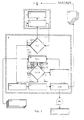
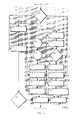
- FIGS. 1 and 2 are overall block diagrams of the invention.
- the installation consists of a terminal A comprising a keyboard 20 and a processor 30.
- the processor 30 records the instructions of the user 10, and encrypts them for their transmission.
- This processor 30 can perform the identical comparison functions in the case where the FAD 100 is unloaded.
- Terminal A is linked by a double link to processing center B.
- This processing center consists of a means of automatic filtering of information and of FAD 100 duplicate requests receiving the information from terminal A and likely to request the return of a duplicate from terminal A.
- This FAD 100 means is connected to an automatic coding and acknowledgment of receipt means PAC 200 itself connected to a hierarchical compatibility checking means VACH 300.
- This VACH means 300 communicates with either electronic messaging 500, that is to say a set of electronic mailboxes not shown diagrammatically and on the other hand, with a queue 550.
- the electronic messaging system 500 is linked to satellite centers 1000 recipients of certain parts of the message. These centers 1000 can also communicate back with the messaging system 500 by the means of the PAC 200 means and of the VACH means 300.
- the electronic messaging system 500 is connected to a memory 600, the latter being connected to a means of checking the consistency between the data. and the significant elements of the EAB 400 codification.
- This EAB 400 means can transmit the information to non-fugitive memories 800, such as microfilms, etc. which can be stored in a protected means such as a safe 700.
- the E.A.B. 400 can also automatically issue authentication documents 900 intended for user 10.
- FIG. 1 shows the implementation of the method and the installation first in the user direction towards processing center B and satellite centers 1000, then, possible feedback to the user in the form of parts d identification 900.
- FIG. 2 shows the implementation of the method and the installation in reverse, that is to say the transmission of information from the centers 1000 and from the center B to the user 10.
- the steps of the method according to the invention are implemented in the manner described below.
- the user 10 introduces by the keyboard 20 into the processor 30 the data to be transmitted.
- This data represents an addition to electronic mail 500 or, if necessary, a modification of its content. They result either from a message whose only source is the authorized user, or from a dialogue between the user and center B, the user having then made use of the processing and calculation capacities specific to center B to structure and compose its message.
- the message is transmitted to the center B by the chosen network, after having possibly been encrypted for transmission by the processor 30.
- the message passes through the device of the invention comprising the means 100, 200, 300 and 400.
- This system ensures: - for the medium 100, automatic data filtering (FAD) to verify the identical conformity of the data cut into standard packets and of a duplicate obtained by instruction from the assembly 100 to the processor 30, unless the processor 30 performs this verification itself.
- FAD automatic data filtering
- PAC automatic coding process
- VACH hierarchical compatibility of the data
- EAB automatic emission of pieces of authentication
- the means 400 can, moreover, produce individual slips 900 indicating to the user, at specified deadlines, the situation of his mailbox and, if applicable, the statement of data concerning him which are stored on queue 550.
- the general slip 800 and the copies of the individual slips 900, are kept in a safe 700 with the corresponding security.
- the steps of the method of the invention are implemented in the following manner: the electronic messaging 500 can be supplied with data by two sources other than those of the users. Those are : - the processing centers at level 1000 which produce data which has just been added via the PAC 200 and VACH 300 means to the data of the levels corresponding to these centers in the mailboxes of the electronic mail 500 of center B, or , if necessary, modify their content, the queue 550 which contains data which has become compatible with that of the electronic messaging system 500 following additions or modifications made to the content of the mailboxes by the transfer of the data coming from the centers of the level 1000. Thus, and at least once before the end of each operating cycle of the system, all of the data in the queue 550 will pass through the PAC 200 and VACH 300 means to integrate the electronic messaging 500 when the compati hierarchical bility allows it.
- a user 10 wishes to consult his mailbox in the electronic messaging system 500, he transmits the instruction which gives him access to the desired information after having powered up the terminal A and carried out the identification transactions which confirm the connection with the center B.
- This information passes through the ADF means 100 which causes the information received to be returned to terminal A to verify identical compliance with the initial message transmitted by the center B.
- the return of the information from terminal A to the center B is triggered by the means F.A.D. 100 which activates in the processor 30 the ad hoc function.
- F.A.D. 100 P.A.C. 200, V.A.C.H. 300 and E.A.B. 400 which constitute the invention.
- FIG. 3 shows the entire means of automatic filtering of information and request for duplicates F.A.D. 100.
- This means consists of a reception function B1 for decrypting a possible encrypted transmission and identification, as well as a function B4 for checking the consistency of the message sent and the possible encryption of the message.
- the two functions B1 and B4 constitute the interfaces with terminal A.
- the means also includes a function B3 for checking the consistency and the authorization for disclosure, which receives the information coming from other organs of the center B, and a function B2 connected to the sorting means and which filters the information transmitted by the function B1 to retain significant information, for example instructions for consulting the messaging system.
- the function B1 is linked to the sorting function 101 which sorts the data contained in the message to pass them through the different functions downstream of the means 100.
- the function B3 is linked to this sorting means 101 which is dissociated in Figure 3 to clarify the circuits.
- the sorting function 101 is linked to a data cutting function 102 which cuts the data into packets when they come from the terminal A.
- the function 102 transmits the data, packet by packet, according to its delivery to zero by the reset function 117 described later.
- the function 103 is linked at the output to the function 107 and is optionally linked to the function 108.
- the function 103 is also connected to the pulse function 104 which controls the counters 105, 105 ⁇ themselves connected to the function of transmission 106 which sends the complete message to terminal A and requests the return of standard packets to center B by activating the processor 30 of terminal A.
- the function 107 sends its data packet to the buffer 109 as well as the function 108 sends its data to the buffers 110 and 111. These different buffers 109, 110, 111 are connected to the comparator 112 ⁇ which compares them. At output, comparator 112 is connected to function 113. This sends the accepted data packet to function 114 through the reset function 117 which controls the reset of all of the means 100. The refused data are transmitted by function 113 to function 116 linked to function 106. Function 114 is linked to function 115. The latter transforms the status of the message from "test-message" to "final message". Functions 102 to 113 can be performed by processor 30 and thus discharge the F.A.D. 100 of this part of the salary.
- the message to be transmitted comes either from terminal A or from another organ in center B: - If it comes from terminal A, it is processed by the reception function B1 which: . decrypts it if the transmission has been encrypted, . carried out identification transactions between the user of terminal A and center B. - If the message comes from another organ of center B - for example from messaging - it is processed by function B3 which: . restores the coherence of the whole message, . verifies that the user of terminal A is authorized to read it. - Then function 101 sorts in the message the data that is retained to pass through the different functions of the ADF: .
- function 101 when the source of the message is terminal A, function 101: - toggles the data retained in function 102, - transmits the other information to function B2 which retains the significant information (for example, the instructions for consulting the messaging system) and eliminates the others. .
- function 101 When the source of the message is another organ of center B, function 101: - transmits standard data packets to function 102, - transmits the complete message to function 106 so that it is sent to terminal A. Arrived at terminal A, the complete message first takes on the status of "test-message". - The function 102 cuts the data retained in standard packets when they come from the terminal A.
- the function 102 Whether the data comes from the terminal A or from another organ of the center B, the function 102 introduces them into the function 103 packet by packet; the following packet only accesses function 103 when functions 103 to 113 are reset by function 117.
- - Function 103 transmits the standard packet to function 107 and stimulates function 104 when this transfer is completed.
- the counter 105 registers a unit.
- - Function 104 boosts counter 105 and function 106: . when the message originates from terminal A, the counter 105 admits a maximum of three identical packets (position 3 maximum); function 106 activates the processor 30 of terminal A (see Figure 1) to transmit the message from terminal A again to center B. .
- function 106 when the message comes from another organ of center B, the counter 105 cannot exceed position 2 at the most; function 106 then sends the complete message to terminal A and requests the return of standard packets to center B by activating processor 30 (see FIG. 2).
- - Function 107 switches the original data packet to function 109. If, on the other hand, it is a duplicate: . either the message comes from terminal A and, in this case, function 108 switches the first duplicate to function 110 and, if necessary, the second duplicate to function 111, . or the message has its source in another organ of center B, and in this case, function 108 is not used: the duplicate returned by terminal A is housed in function 110.
- the comparator 112 analyzes in pairs the packets housed in functions 109 and 110, possibly the packets housed in functions 109 and 111 and, if necessary, the packets housed in functions 110 and 111. - When function 112 does not detect any divergence in a pair of packets, function 113 transmits the accepted data packet to function 114. Access to the latter passes through function 117 which delivers all of the functions 100 to zero: the FAD means is then ready to receive a new packet and data. On the other hand, when in the analyzed pairs, function 112 detects a significant divergence, function 113 activates function 116. - If the message comes from terminal A, function 116 activates function 106 to: .
- function 116 activates function 117 which resets the FAD to zero and requests function B3 to reproduce the initial message.
- the function 114 stores each packet of accepted data until the total of the packets included in the message is restored.
- function 114 switches the packets to function 200.
- function 114 activates function 115 which transforms the status of the message from "message- test "in” final message ".
- the B4 function ensures the consistency of the message from center B and the possible encryption of its transmission to terminal A.
- This means P.A.C. 200 is composed of a sorting function 201 which is connected to terminal A via the filtering means 100, to the queue 550 or to the centers 1000.
- the sorting function 201 is linked to a function 202 which supplies coding pulses by data packets.
- This means is connected either to a function for calculating the values 202, or to a function 206 which specifies the cycle for the encryption algorithm, the latter means being itself connected to a register 207 for the date and possibly the time. of the message.
- the register 207 is connected to a function for sorting orders 208.
- the means 200 comprises a parking meter 204 connected to the register 207 as well as to a cycle counter 205, the latter being connected on the one hand to the function 206 which specifies the cycle number for the encryption algorithm and, on the other hand, to functions 109, 213 and 214.
- Function 213 provides the initialization of the coding encryption algorithm and function 214 the initialization of the data encryption algorithm.
- Functions 213 and 214 are linked to functions 215 which emits the algorithm.
- Function 209 expresses the period of validity as a number of operating cycles. This function 209 is linked to function 211 which assigns each packet a significant serial number.
- Function 210 inserts into the codification an execution criterion intended to be implemented by the center 1000 upon receipt of data. This function 210 is linked to function 211.
- Function 211 is linked to function 212 which allocates to each packet the final acknowledgment of receipt or allocates to it the space necessary for this allocation.
- the function 217 ensures the encryption of the code according to an algorithm sent by the function 215.
- the function 216 ensures the encryption of the data according to an algorithm sent by the function 215.
- Functions 216 and 217 are linked to function 218 which assembles the packets to form the complete message.
- the control of this function 218 is ensured by the means 300 which not only ensures the verification of the hierarchical compatibility but also ensures the impulse control of this function 218.
- the PAC 200 means described above implements the invention as follows: - the function 201 sorts the data according to whether they come from the FAD means 100, from the queue 550 or from one of the centers of the level 1000: . this latter eventuality occurs when for some reason a center at level 1000 has not delegated to center B the authority to issue on its behalf the final acknowledgment of receipt of data and that, moreover, it does not there is no real-time link between this center at level 1000 and center B. It should be noted that this final acknowledgment must be issued during the same operating cycle of the system in which the data is transmitted by terminal A In fact, function 201 switches the two parts of the code attached to each data packet into function 212.
- the first part of the code is encrypted during a first pass of the packet in the PAC; the second, however, which represents the final acknowledgment, is not yet encrypted.
- Function 201 offers this composite code to function 212 for encryption by function 217. All the packets are then reconstituted by function 218 to be stored in the messaging system 500. .
- each packet is provided with a complete code: the functions 203 to 216 are thus short-circuited, the data being directly passed on to the function 203. .
- the function 202 activates the set of functions 203 to 216 to establish the individual codification of each packet.
- the creation of the code is done simultaneously with the activation of all the VACH 300 functions described below.
- the function 203 calculates the values for all the data packets of a message, whether they come from the FAD means or from the queue 550. These values are compared with those of the other levels of the mailbox. of the user of terminal A: function 203 transmits all of these values to function 300. It simultaneously switches all the packets to function 216. If the system provides for encryption of the data themselves, the Data encryption algorithm is initialized differently from coding encryption. If the system does not provide data encryption, all of the packets switch directly to function 218. - The parking meter 204 supplies the function 207 and drives the counter for the operating cycles of the system 205.
- the counter 205 supplies the functions 206 and 209 and drives the encryption initialization algorithms 213 and 214. The first is assigned to coding encryption and the second to data encryption, if this is provided by the system. - The coding process is driven by function 202 for each individual data packet. - Function 206 specifies the number of the operating cycle of the system which controls the encryption algorithm. - Function 207 records the date and possibly the time of the message. - The function 208 sorts the orders according to the existence or not of a period of validity of the data.
- the coding takes this into account thanks to function 209 which expresses this duration in number of operating cycles. Otherwise, the function 210 provides in the codification an execution criterion intended to be implemented by the center of the level 1000 upon reception of the data. - Function 211 assigns each packet a non-significant order number. - Function 212 assigns to each packet the final acknowledgment of receipt, if the center B is authorized to do so. Otherwise, it allocates the space necessary for the allocation of this part of the code by the center concerned at level 1000. - Function 217 encrypts the code according to an algorithm sent by function 215. As already mentioned, this encryption is different from the possible encryption of data.
- - Function 218 assembles the packets - and their respective codes - for a complete message. This function is driven by all of the VACH 300 functions to switch the message to messaging 500, queue 550 or queue 560.
- the means 300 comprises as input a function 203 which calculates the value corresponding to the entirety of the data forming the message.
- This function 203 is linked to the level functions 301, 302 ... 30n in which each value is compared with the corresponding value previously recorded. The comparison is made with the mailbox levels 500, 501, 502 ... 50n also shown in this figure as well as the levels 560, 561, 562 ... 56n of the queue 550.
- the means 400 includes the function 401 which decrypts the data packets and their coding and the function 402 which emits, on the one hand, the individual slips of each user and, on the other hand, periodically, a general messaging slip on tapes, discs or microfilms.
- FIG. 5 represents the flowchart of the VACH 300 and EAB 400 means: -
- Function 203 calculates the values corresponding to all of the data forming the message. These are then compared with the corresponding values of the different levels of the user's mailbox. At each level 301, 302 ... 30n, each value is compared with the corresponding value previously recorded. - If at one of these levels, an incompatibility is noted, function 218 is actuated to put the message in queue 550. - If on the contrary, compatibility is established at all levels, function 218 toggles the data either in function 500 or in function 560 depending on whether center B can transmit or not, the final acknowledgment. In the first case, the function 218 confirms the modifications which have occurred at levels 501, 502 ...
- the function 402 emits on the one hand the individual slips of each user, and, on the other hand, periodically, a general messaging slip on tape, disk or microfilm, which is put in the safe 700 under the required security conditions.
- - Function 401 can be located either before or after memory 600. In the first case, the optimal solution would be that it operates in real time between the memory 500 and the memory 600 so that any untimely intrusion into the center B would be immediately detected. The memory 600 would then contain all of the messaging 500 fully decrypted. In the second case, function 401 could only be activated by periods. An unauthorized intrusion into center B would thus have time to cause damage leading to the cancellation of all operations made between two pulses of this function 401. Conversely, memory 600 would be the full copy of memory 500, encryption included.
- processors integrating the F.A.D., P.A.C. and V.A.C.H. control access to center B by one, two or more doors, depending on whether the average density of data processed by the device is higher or lower in all communications with users. All the processors forming the E.A.B. for their part, in principle, only control one exit.
- FIG. 6 illustrates a first example of a network in the context of which the invention considered finds its application. It represents a network supplying a CLN center with a number lottery (level 1000 center). A concession association of the lottery company manages the CB center (preponderant B center). The association's cash flows are processed by the FB center (level 1000 center) of the association's bank.
- the lottery bank is the FC establishment.
- the banks of individual bettors are banks F1, F2, ... F N.
- Bettors J1, J2 ... J n each have a minitel.
- the bettors J11, J12, ... J1 n for their part, each have a minitel equipped with a memory card reader: communications b between the latter and the CB center are thus encrypted. Bettors transmit their issues to the CB center and consult their mailbox there: - when they have joined the association which assigns them an individual code, - when they have their personal account credited to the association so that the bets corresponding to their stakes can be debit
- Bettors can communicate with their respective banks F1, F2 ... F N via links c. These banks communicate with the FB center via d links.
- the FB center credits the FC center with bets corresponding to the bettors' stakes and is in turn credited with the amount of their winnings through the link f.
- the CLN center records the bets and has the total amount credited by the link g.
- the CB center transmits the stakes and the results of the draws are seen by the link h. Finally, the CB center issues before each draw a general slip of all the transactions managed by the B center and individual BJ slips for bettors J1 to J n who request it.
- the links a and b must pass through the switched network and possibly a packet data transmission network.
- the fluidity of the system preferably requires real-time connections.
- Links c and d are those pre-existing at the creation of the CB center.
- the constraints relating to the links f and g are those linked to the frequency of the lottery draws.
- the application of the invention provides the security necessary for the management of the CB center and for transmissions by the links a and b. It would indeed be very costly for those responsible for the system if errors were made in the figures for the stakes. It would also be unfortunate if fraud could be committed in mailboxes. Connections e and f can be the same security offered by the invention. These securities can extend to other links insofar as they use the switched network, dedicated links or another mode of transmission.
- FIG. 7 very schematically illustrates a second example of a network to which the invention provides the essential security.
- Investors with terminals with or without a memory card reader (D11, D12 ... D1 n ; D21, D22 ... D2 n ; ..; D n 1, D n 2 ... D nn ) give instructions to their respective stockbrokers (A1, A2, ... A n ) either directly or, for certain stockbrokers, through a CB center.
- Stockbrokers execute these instructions on markets M1, M2, ... M n .
- the flows corresponding to these transactions may involve their bankers F1, F2 ... F n and those of stockbrokers F A , F B ... F N.
Landscapes
- Engineering & Computer Science (AREA)
- Computer Networks & Wireless Communication (AREA)
- Signal Processing (AREA)
- Computer Security & Cryptography (AREA)
- Data Exchanges In Wide-Area Networks (AREA)
- Computer And Data Communications (AREA)
Applications Claiming Priority (2)
| Application Number | Priority Date | Filing Date | Title |
|---|---|---|---|
| FR8603249 | 1986-03-07 | ||
| FR8603249A FR2595523A1 (fr) | 1986-03-07 | 1986-03-07 | Procede et installation de transmission de donnees |
Publications (2)
| Publication Number | Publication Date |
|---|---|
| EP0241324A2 true EP0241324A2 (de) | 1987-10-14 |
| EP0241324A3 EP0241324A3 (de) | 1989-10-18 |
Family
ID=9332883
Family Applications (1)
| Application Number | Title | Priority Date | Filing Date |
|---|---|---|---|
| EP87400495A Withdrawn EP0241324A3 (de) | 1986-03-07 | 1987-03-06 | Verfahren und Einrichtung zur Datenübertragung |
Country Status (2)
| Country | Link |
|---|---|
| EP (1) | EP0241324A3 (de) |
| FR (1) | FR2595523A1 (de) |
Family Cites Families (1)
| Publication number | Priority date | Publication date | Assignee | Title |
|---|---|---|---|---|
| US4245212A (en) * | 1978-03-13 | 1981-01-13 | The United States Of America As Represented By The Secretary Of The Navy | Serial digital data decoder |
-
1986
- 1986-03-07 FR FR8603249A patent/FR2595523A1/fr not_active Withdrawn
-
1987
- 1987-03-06 EP EP87400495A patent/EP0241324A3/de not_active Withdrawn
Also Published As
| Publication number | Publication date |
|---|---|
| FR2595523A1 (fr) | 1987-09-11 |
| EP0241324A3 (de) | 1989-10-18 |
Similar Documents
| Publication | Publication Date | Title |
|---|---|---|
| EP0950303B1 (de) | Verfahren und einrichtung zur sicherung der ferndienstleistungen der finanzinstitute | |
| EP0055986A2 (de) | Sicherheitsverfahren und -vorrichtung zur Dreieckkommunikation von vertraulichen Daten | |
| CA2064204C (fr) | Systeme de protection de documents ou d'objets enfermes dans un contenant inviolable | |
| US20020095370A1 (en) | Method and apparatus for managing electronic money and storage for storing an electronic money management program | |
| EP0464766B1 (de) | Verarbeitungssystem für Paketversand | |
| FR2514593A1 (fr) | Procede et dispositif pour authentifier la signature d'un message signe | |
| EP1008257A2 (de) | Verfahren und system zur absicherung von fernsprech-anrufssteuerungseinrichtungen | |
| FR2492135A1 (fr) | Appareil de distribution d'objets et d'acquisition de services | |
| EP0423035A1 (de) | System zum Bezahlen oder Transferieren von Informationen mit einer als Geldbörse dienenden elektronischen Speicherkarte | |
| EP0998731A1 (de) | Verfahren und system zum bezahlen mit elektronischem scheck | |
| EP0775988A2 (de) | Verfahren und Apparat für ein modulares Postgebührenabrechnungssystem | |
| CA2398317A1 (fr) | Systeme et procede de securisation des transmissions d'informations | |
| EP1483645A2 (de) | Vorrichtung und verfahren zur sicherung empfindlicher daten zwischen zwei teilen durch dritte partei | |
| CA2259285C (fr) | Systeme de transport securise d'objets en conteneur inviolable dont au moins une station destinataire est mobile et transportable | |
| EP1012792B1 (de) | Verfahren und einrichtung zum erzeugen einer unfälschbaren personifizierten teilnehmerkarte | |
| EP0731580B1 (de) | Zahlungsverfahren in einer Datenübertragungsanordnung und Anordnung zu dessen Implementierung | |
| WO2005041133A1 (fr) | Systeme de controle d'informations liees a un vehicule | |
| FR2595523A1 (fr) | Procede et installation de transmission de donnees | |
| EP1912182A1 (de) | Berechtigung zur Durchführung einer Transaktion zwischen einem elektronischen Schaltkreis und einem Endgerät | |
| FR3125622A1 (fr) | Procédé de transaction entre un organisme et un établissement sur une chaîne de blocs | |
| FR2710769A1 (fr) | Système de traitement des données d'une carte à microcircuit, carte et lecteur pour ce système et procédé de mise en Óoeuvre. | |
| EP2407920A1 (de) | Server, Endgerät und gesichertes Transaktionsverfahren | |
| FR2819662A1 (fr) | Procede utilisant les cartes de paiement electroniques pour securiser les transactions | |
| EP0831434A1 (de) | Verfahren zum Schliessen einer Vielzahl von Dienstleistungen, insbesondere durch Setzen auf eine schwarze Liste, und entsprechende Server zum Schliessen, Annahmeendgerät und tragbare Vorrichtungen | |
| FR2900010A1 (fr) | Procede et dispositif de securisation de transferts de donnees |
Legal Events
| Date | Code | Title | Description |
|---|---|---|---|
| PUAI | Public reference made under article 153(3) epc to a published international application that has entered the european phase |
Free format text: ORIGINAL CODE: 0009012 |
|
| AK | Designated contracting states |
Kind code of ref document: A2 Designated state(s): AT BE CH DE ES GB GR IT LI LU NL SE |
|
| PUAL | Search report despatched |
Free format text: ORIGINAL CODE: 0009013 |
|
| AK | Designated contracting states |
Kind code of ref document: A3 Designated state(s): AT BE CH DE ES GB GR IT LI LU NL SE |
|
| STAA | Information on the status of an ep patent application or granted ep patent |
Free format text: STATUS: THE APPLICATION IS DEEMED TO BE WITHDRAWN |
|
| 18D | Application deemed to be withdrawn |
Effective date: 19900419 |