EP0241324A2 - Data transmission method and device - Google Patents
Data transmission method and device Download PDFInfo
- Publication number
- EP0241324A2 EP0241324A2 EP87400495A EP87400495A EP0241324A2 EP 0241324 A2 EP0241324 A2 EP 0241324A2 EP 87400495 A EP87400495 A EP 87400495A EP 87400495 A EP87400495 A EP 87400495A EP 0241324 A2 EP0241324 A2 EP 0241324A2
- Authority
- EP
- European Patent Office
- Prior art keywords
- function
- data
- center
- linked
- message
- Prior art date
- Legal status (The legal status is an assumption and is not a legal conclusion. Google has not performed a legal analysis and makes no representation as to the accuracy of the status listed.)
- Withdrawn
Links
- 230000005540 biological transmission Effects 0.000 title claims abstract description 32
- 238000000034 method Methods 0.000 title claims description 25
- 230000015654 memory Effects 0.000 claims abstract description 20
- 238000001914 filtration Methods 0.000 claims abstract description 14
- 238000012545 processing Methods 0.000 claims abstract description 8
- 238000012544 monitoring process Methods 0.000 claims abstract description 6
- 230000006870 function Effects 0.000 claims description 250
- 238000012795 verification Methods 0.000 claims description 11
- 239000000872 buffer Substances 0.000 claims description 7
- 238000012905 input function Methods 0.000 claims description 4
- 238000013475 authorization Methods 0.000 claims description 3
- 238000004364 calculation method Methods 0.000 claims description 3
- 238000012790 confirmation Methods 0.000 claims description 2
- 125000004122 cyclic group Chemical group 0.000 claims description 2
- 238000005315 distribution function Methods 0.000 claims description 2
- 230000000694 effects Effects 0.000 claims description 2
- 230000008054 signal transmission Effects 0.000 claims description 2
- 238000009434 installation Methods 0.000 description 12
- 238000010586 diagram Methods 0.000 description 9
- 210000000056 organ Anatomy 0.000 description 8
- 238000004891 communication Methods 0.000 description 7
- 238000012986 modification Methods 0.000 description 5
- 230000004048 modification Effects 0.000 description 5
- 238000012546 transfer Methods 0.000 description 4
- 230000000717 retained effect Effects 0.000 description 3
- 230000003213 activating effect Effects 0.000 description 2
- 238000007792 addition Methods 0.000 description 2
- 210000004027 cell Anatomy 0.000 description 2
- 238000007726 management method Methods 0.000 description 2
- 230000004913 activation Effects 0.000 description 1
- 239000002131 composite material Substances 0.000 description 1
- 230000007812 deficiency Effects 0.000 description 1
- 230000001419 dependent effect Effects 0.000 description 1
- 230000005032 impulse control Effects 0.000 description 1
- 230000001788 irregular Effects 0.000 description 1
- 238000012423 maintenance Methods 0.000 description 1
- 239000000463 material Substances 0.000 description 1
- 239000000203 mixture Substances 0.000 description 1
- 238000012360 testing method Methods 0.000 description 1
- 230000001960 triggered effect Effects 0.000 description 1
Images




Classifications
-
- H—ELECTRICITY
- H04—ELECTRIC COMMUNICATION TECHNIQUE
- H04L—TRANSMISSION OF DIGITAL INFORMATION, e.g. TELEGRAPHIC COMMUNICATION
- H04L9/00—Cryptographic mechanisms or cryptographic arrangements for secret or secure communications; Network security protocols
-
- H—ELECTRICITY
- H04—ELECTRIC COMMUNICATION TECHNIQUE
- H04L—TRANSMISSION OF DIGITAL INFORMATION, e.g. TELEGRAPHIC COMMUNICATION
- H04L51/00—User-to-user messaging in packet-switching networks, transmitted according to store-and-forward or real-time protocols, e.g. e-mail
- H04L51/21—Monitoring or handling of messages
- H04L51/212—Monitoring or handling of messages using filtering or selective blocking
-
- H—ELECTRICITY
- H04—ELECTRIC COMMUNICATION TECHNIQUE
- H04L—TRANSMISSION OF DIGITAL INFORMATION, e.g. TELEGRAPHIC COMMUNICATION
- H04L51/00—User-to-user messaging in packet-switching networks, transmitted according to store-and-forward or real-time protocols, e.g. e-mail
- H04L51/21—Monitoring or handling of messages
- H04L51/23—Reliability checks, e.g. acknowledgments or fault reporting
Definitions
- the present invention relates to a data transmission method and installation.
- the transmission of data between one or more sets of terminals and one or more data processing centers gives rise to the creation in one, more or all of the centers of the network of a recording space.
- an "electronic messaging" comprising compartments - "mailboxes” - which can themselves be subdivided into several hierarchically dependent levels, each level corresponding to a type of data processed.
- one of the centers plays a preponderant role compared to the other centers, that of a master center or that of a sorting center.
- the present invention proposes to solve these problems.
- the invention relates to an installation characterized in that it consists of at least one keyboard 20 and a processor 30 provided with a memory which can possibly check identical conformity of the data sent with that received by the center B and, where applicable, an encryption module for the transmission of data forming a terminal A available to a user and a processing center B connected to terminal A and consisting of an automatic data filtering and duplicate request 100 (FAD) means, an automatic coding with acknowledgment 200 (PAC) means, a means of verifying the hierarchical compatibility 300 (VACH), of a queue 550 connected by means of verification of hierarchical compatibility VACH 300 and linked in output by means of automatic coding with acknowledgment of receipt PAC 200, the means of verification VACH 300 being connected to electronic messaging 500 communicating itself with destination or satellite centers 1000 and a memory 600 supplying a means of checking the consistency between the data and the significant elements of the codification 400 (EAB) po ur allow either the automatic issuance of authentication slips 900 or a backup record 800 intended to be placed in a safe 700
- the means for automatic filtering of data and for requesting duplicates FAD 100 consists of the input function B1 connected to the terminal A and the input function B3 connected to other parts processing center B; the decryption and identification function B1 receiving requests from terminal A and the function B3 receiving the request from another part of the processing center B to check the consistency and the authorization for disclosure are respectively linked to a sorting function 101, split for clarity of the graph, communicating to a data cutting function 102 which supplies data packets to buffer registers 109, 110, 111 of different levels via distribution functions 103, 107, 109 as well as a pulse generation function 104 connected to a counter 105, shown on the graph in its two possible positions, itself connected to a transmission function 106 connected to the function of verifying the consistency of the initial message with any encryption B4, the buffer registers 109, 110, 111 being connected to a comparator 112, the output of which is connected to a sorting function 113 which, when the comparison is correct, provides a signal to the reset function
- the automatic coding means and acknowledgment of receipt PAC 200 is composed at the input of a sorting function 201 which receives the signals of the automatic filtering function 100, from the queue waiting 550 or of a satellite center 1000, to send according to their origin the signals thus received according to three signal transmission paths, to a function 202 receiving the information originating from the filtering function 100, and which supplies coding pulses in data packets to a value calculation function 203, the output of which is linked to the hierarchical compatibility verification function 300 as well as to the data encryption function 216, the function 202 also being linked to a function 206 which specifies the cycle number for the encryption algorithm, this function 206 being connected at output to a register 207 for the date and possibly the time of the message, the PAC 200 coding means also comprising a parking meter 204 controlling the register 207 as well as a cycle counter 205, the cycle counter controlling an initialization function of the coding encryption algorithm 213 and a function of initialization of the data encryption algorithm 214,
- the processing center B commanding, by pulses, the duplication instruction in a function integrated in the center B if the message originates therefrom, and in a function integrated in each of the terminals when the message has as its source one of the terminals, this instruction is made to repeat until the comparison of a pair of messages, original and single duplicate or successive duplicates, no longer exhibits any discrepancy.
- a code and call number is dialed on the user's terminal.
- the data when the data must not be accessible to any third party, the data is also encrypted, but differently from the encryption of the code.
- the processing center taking into account the operating constraints of the system, the compatibility of these data is tested as well as the effects of the instructions which accompany them with the data and the availability of execution already recorded and the processing is continued in the absence of incompatibility whereas in the event of incompatibility the data and their codification are put on hold.
- the significant elements of the encrypted code are compared with the corresponding elements of the data. encrypted according to a different method and we check by this comparison if there has been a break-in in order to modify these elements or to appropriate the data.
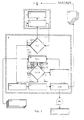
- FIGS. 1 and 2 are overall block diagrams of the invention.
- the installation consists of a terminal A comprising a keyboard 20 and a processor 30.
- the processor 30 records the instructions of the user 10, and encrypts them for their transmission.
- This processor 30 can perform the identical comparison functions in the case where the FAD 100 is unloaded.
- Terminal A is linked by a double link to processing center B.
- This processing center consists of a means of automatic filtering of information and of FAD 100 duplicate requests receiving the information from terminal A and likely to request the return of a duplicate from terminal A.
- This FAD 100 means is connected to an automatic coding and acknowledgment of receipt means PAC 200 itself connected to a hierarchical compatibility checking means VACH 300.
- This VACH means 300 communicates with either electronic messaging 500, that is to say a set of electronic mailboxes not shown diagrammatically and on the other hand, with a queue 550.
- the electronic messaging system 500 is linked to satellite centers 1000 recipients of certain parts of the message. These centers 1000 can also communicate back with the messaging system 500 by the means of the PAC 200 means and of the VACH means 300.
- the electronic messaging system 500 is connected to a memory 600, the latter being connected to a means of checking the consistency between the data. and the significant elements of the EAB 400 codification.
- This EAB 400 means can transmit the information to non-fugitive memories 800, such as microfilms, etc. which can be stored in a protected means such as a safe 700.
- the E.A.B. 400 can also automatically issue authentication documents 900 intended for user 10.
- FIG. 1 shows the implementation of the method and the installation first in the user direction towards processing center B and satellite centers 1000, then, possible feedback to the user in the form of parts d identification 900.
- FIG. 2 shows the implementation of the method and the installation in reverse, that is to say the transmission of information from the centers 1000 and from the center B to the user 10.
- the steps of the method according to the invention are implemented in the manner described below.
- the user 10 introduces by the keyboard 20 into the processor 30 the data to be transmitted.
- This data represents an addition to electronic mail 500 or, if necessary, a modification of its content. They result either from a message whose only source is the authorized user, or from a dialogue between the user and center B, the user having then made use of the processing and calculation capacities specific to center B to structure and compose its message.
- the message is transmitted to the center B by the chosen network, after having possibly been encrypted for transmission by the processor 30.
- the message passes through the device of the invention comprising the means 100, 200, 300 and 400.
- This system ensures: - for the medium 100, automatic data filtering (FAD) to verify the identical conformity of the data cut into standard packets and of a duplicate obtained by instruction from the assembly 100 to the processor 30, unless the processor 30 performs this verification itself.
- FAD automatic data filtering
- PAC automatic coding process
- VACH hierarchical compatibility of the data
- EAB automatic emission of pieces of authentication
- the means 400 can, moreover, produce individual slips 900 indicating to the user, at specified deadlines, the situation of his mailbox and, if applicable, the statement of data concerning him which are stored on queue 550.
- the general slip 800 and the copies of the individual slips 900, are kept in a safe 700 with the corresponding security.
- the steps of the method of the invention are implemented in the following manner: the electronic messaging 500 can be supplied with data by two sources other than those of the users. Those are : - the processing centers at level 1000 which produce data which has just been added via the PAC 200 and VACH 300 means to the data of the levels corresponding to these centers in the mailboxes of the electronic mail 500 of center B, or , if necessary, modify their content, the queue 550 which contains data which has become compatible with that of the electronic messaging system 500 following additions or modifications made to the content of the mailboxes by the transfer of the data coming from the centers of the level 1000. Thus, and at least once before the end of each operating cycle of the system, all of the data in the queue 550 will pass through the PAC 200 and VACH 300 means to integrate the electronic messaging 500 when the compati hierarchical bility allows it.
- a user 10 wishes to consult his mailbox in the electronic messaging system 500, he transmits the instruction which gives him access to the desired information after having powered up the terminal A and carried out the identification transactions which confirm the connection with the center B.
- This information passes through the ADF means 100 which causes the information received to be returned to terminal A to verify identical compliance with the initial message transmitted by the center B.
- the return of the information from terminal A to the center B is triggered by the means F.A.D. 100 which activates in the processor 30 the ad hoc function.
- F.A.D. 100 P.A.C. 200, V.A.C.H. 300 and E.A.B. 400 which constitute the invention.
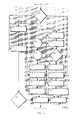
- FIG. 3 shows the entire means of automatic filtering of information and request for duplicates F.A.D. 100.
- This means consists of a reception function B1 for decrypting a possible encrypted transmission and identification, as well as a function B4 for checking the consistency of the message sent and the possible encryption of the message.
- the two functions B1 and B4 constitute the interfaces with terminal A.
- the means also includes a function B3 for checking the consistency and the authorization for disclosure, which receives the information coming from other organs of the center B, and a function B2 connected to the sorting means and which filters the information transmitted by the function B1 to retain significant information, for example instructions for consulting the messaging system.
- the function B1 is linked to the sorting function 101 which sorts the data contained in the message to pass them through the different functions downstream of the means 100.
- the function B3 is linked to this sorting means 101 which is dissociated in Figure 3 to clarify the circuits.
- the sorting function 101 is linked to a data cutting function 102 which cuts the data into packets when they come from the terminal A.
- the function 102 transmits the data, packet by packet, according to its delivery to zero by the reset function 117 described later.
- the function 103 is linked at the output to the function 107 and is optionally linked to the function 108.
- the function 103 is also connected to the pulse function 104 which controls the counters 105, 105 ⁇ themselves connected to the function of transmission 106 which sends the complete message to terminal A and requests the return of standard packets to center B by activating the processor 30 of terminal A.
- the function 107 sends its data packet to the buffer 109 as well as the function 108 sends its data to the buffers 110 and 111. These different buffers 109, 110, 111 are connected to the comparator 112 ⁇ which compares them. At output, comparator 112 is connected to function 113. This sends the accepted data packet to function 114 through the reset function 117 which controls the reset of all of the means 100. The refused data are transmitted by function 113 to function 116 linked to function 106. Function 114 is linked to function 115. The latter transforms the status of the message from "test-message" to "final message". Functions 102 to 113 can be performed by processor 30 and thus discharge the F.A.D. 100 of this part of the salary.
- the message to be transmitted comes either from terminal A or from another organ in center B: - If it comes from terminal A, it is processed by the reception function B1 which: . decrypts it if the transmission has been encrypted, . carried out identification transactions between the user of terminal A and center B. - If the message comes from another organ of center B - for example from messaging - it is processed by function B3 which: . restores the coherence of the whole message, . verifies that the user of terminal A is authorized to read it. - Then function 101 sorts in the message the data that is retained to pass through the different functions of the ADF: .
- function 101 when the source of the message is terminal A, function 101: - toggles the data retained in function 102, - transmits the other information to function B2 which retains the significant information (for example, the instructions for consulting the messaging system) and eliminates the others. .
- function 101 When the source of the message is another organ of center B, function 101: - transmits standard data packets to function 102, - transmits the complete message to function 106 so that it is sent to terminal A. Arrived at terminal A, the complete message first takes on the status of "test-message". - The function 102 cuts the data retained in standard packets when they come from the terminal A.
- the function 102 Whether the data comes from the terminal A or from another organ of the center B, the function 102 introduces them into the function 103 packet by packet; the following packet only accesses function 103 when functions 103 to 113 are reset by function 117.
- - Function 103 transmits the standard packet to function 107 and stimulates function 104 when this transfer is completed.
- the counter 105 registers a unit.
- - Function 104 boosts counter 105 and function 106: . when the message originates from terminal A, the counter 105 admits a maximum of three identical packets (position 3 maximum); function 106 activates the processor 30 of terminal A (see Figure 1) to transmit the message from terminal A again to center B. .
- function 106 when the message comes from another organ of center B, the counter 105 cannot exceed position 2 at the most; function 106 then sends the complete message to terminal A and requests the return of standard packets to center B by activating processor 30 (see FIG. 2).
- - Function 107 switches the original data packet to function 109. If, on the other hand, it is a duplicate: . either the message comes from terminal A and, in this case, function 108 switches the first duplicate to function 110 and, if necessary, the second duplicate to function 111, . or the message has its source in another organ of center B, and in this case, function 108 is not used: the duplicate returned by terminal A is housed in function 110.
- the comparator 112 analyzes in pairs the packets housed in functions 109 and 110, possibly the packets housed in functions 109 and 111 and, if necessary, the packets housed in functions 110 and 111. - When function 112 does not detect any divergence in a pair of packets, function 113 transmits the accepted data packet to function 114. Access to the latter passes through function 117 which delivers all of the functions 100 to zero: the FAD means is then ready to receive a new packet and data. On the other hand, when in the analyzed pairs, function 112 detects a significant divergence, function 113 activates function 116. - If the message comes from terminal A, function 116 activates function 106 to: .
- function 116 activates function 117 which resets the FAD to zero and requests function B3 to reproduce the initial message.
- the function 114 stores each packet of accepted data until the total of the packets included in the message is restored.
- function 114 switches the packets to function 200.
- function 114 activates function 115 which transforms the status of the message from "message- test "in” final message ".
- the B4 function ensures the consistency of the message from center B and the possible encryption of its transmission to terminal A.
- This means P.A.C. 200 is composed of a sorting function 201 which is connected to terminal A via the filtering means 100, to the queue 550 or to the centers 1000.
- the sorting function 201 is linked to a function 202 which supplies coding pulses by data packets.
- This means is connected either to a function for calculating the values 202, or to a function 206 which specifies the cycle for the encryption algorithm, the latter means being itself connected to a register 207 for the date and possibly the time. of the message.
- the register 207 is connected to a function for sorting orders 208.
- the means 200 comprises a parking meter 204 connected to the register 207 as well as to a cycle counter 205, the latter being connected on the one hand to the function 206 which specifies the cycle number for the encryption algorithm and, on the other hand, to functions 109, 213 and 214.
- Function 213 provides the initialization of the coding encryption algorithm and function 214 the initialization of the data encryption algorithm.
- Functions 213 and 214 are linked to functions 215 which emits the algorithm.
- Function 209 expresses the period of validity as a number of operating cycles. This function 209 is linked to function 211 which assigns each packet a significant serial number.
- Function 210 inserts into the codification an execution criterion intended to be implemented by the center 1000 upon receipt of data. This function 210 is linked to function 211.
- Function 211 is linked to function 212 which allocates to each packet the final acknowledgment of receipt or allocates to it the space necessary for this allocation.
- the function 217 ensures the encryption of the code according to an algorithm sent by the function 215.
- the function 216 ensures the encryption of the data according to an algorithm sent by the function 215.
- Functions 216 and 217 are linked to function 218 which assembles the packets to form the complete message.
- the control of this function 218 is ensured by the means 300 which not only ensures the verification of the hierarchical compatibility but also ensures the impulse control of this function 218.
- the PAC 200 means described above implements the invention as follows: - the function 201 sorts the data according to whether they come from the FAD means 100, from the queue 550 or from one of the centers of the level 1000: . this latter eventuality occurs when for some reason a center at level 1000 has not delegated to center B the authority to issue on its behalf the final acknowledgment of receipt of data and that, moreover, it does not there is no real-time link between this center at level 1000 and center B. It should be noted that this final acknowledgment must be issued during the same operating cycle of the system in which the data is transmitted by terminal A In fact, function 201 switches the two parts of the code attached to each data packet into function 212.
- the first part of the code is encrypted during a first pass of the packet in the PAC; the second, however, which represents the final acknowledgment, is not yet encrypted.
- Function 201 offers this composite code to function 212 for encryption by function 217. All the packets are then reconstituted by function 218 to be stored in the messaging system 500. .
- each packet is provided with a complete code: the functions 203 to 216 are thus short-circuited, the data being directly passed on to the function 203. .
- the function 202 activates the set of functions 203 to 216 to establish the individual codification of each packet.
- the creation of the code is done simultaneously with the activation of all the VACH 300 functions described below.
- the function 203 calculates the values for all the data packets of a message, whether they come from the FAD means or from the queue 550. These values are compared with those of the other levels of the mailbox. of the user of terminal A: function 203 transmits all of these values to function 300. It simultaneously switches all the packets to function 216. If the system provides for encryption of the data themselves, the Data encryption algorithm is initialized differently from coding encryption. If the system does not provide data encryption, all of the packets switch directly to function 218. - The parking meter 204 supplies the function 207 and drives the counter for the operating cycles of the system 205.
- the counter 205 supplies the functions 206 and 209 and drives the encryption initialization algorithms 213 and 214. The first is assigned to coding encryption and the second to data encryption, if this is provided by the system. - The coding process is driven by function 202 for each individual data packet. - Function 206 specifies the number of the operating cycle of the system which controls the encryption algorithm. - Function 207 records the date and possibly the time of the message. - The function 208 sorts the orders according to the existence or not of a period of validity of the data.
- the coding takes this into account thanks to function 209 which expresses this duration in number of operating cycles. Otherwise, the function 210 provides in the codification an execution criterion intended to be implemented by the center of the level 1000 upon reception of the data. - Function 211 assigns each packet a non-significant order number. - Function 212 assigns to each packet the final acknowledgment of receipt, if the center B is authorized to do so. Otherwise, it allocates the space necessary for the allocation of this part of the code by the center concerned at level 1000. - Function 217 encrypts the code according to an algorithm sent by function 215. As already mentioned, this encryption is different from the possible encryption of data.
- - Function 218 assembles the packets - and their respective codes - for a complete message. This function is driven by all of the VACH 300 functions to switch the message to messaging 500, queue 550 or queue 560.
- the means 300 comprises as input a function 203 which calculates the value corresponding to the entirety of the data forming the message.
- This function 203 is linked to the level functions 301, 302 ... 30n in which each value is compared with the corresponding value previously recorded. The comparison is made with the mailbox levels 500, 501, 502 ... 50n also shown in this figure as well as the levels 560, 561, 562 ... 56n of the queue 550.
- the means 400 includes the function 401 which decrypts the data packets and their coding and the function 402 which emits, on the one hand, the individual slips of each user and, on the other hand, periodically, a general messaging slip on tapes, discs or microfilms.
- FIG. 5 represents the flowchart of the VACH 300 and EAB 400 means: -
- Function 203 calculates the values corresponding to all of the data forming the message. These are then compared with the corresponding values of the different levels of the user's mailbox. At each level 301, 302 ... 30n, each value is compared with the corresponding value previously recorded. - If at one of these levels, an incompatibility is noted, function 218 is actuated to put the message in queue 550. - If on the contrary, compatibility is established at all levels, function 218 toggles the data either in function 500 or in function 560 depending on whether center B can transmit or not, the final acknowledgment. In the first case, the function 218 confirms the modifications which have occurred at levels 501, 502 ...
- the function 402 emits on the one hand the individual slips of each user, and, on the other hand, periodically, a general messaging slip on tape, disk or microfilm, which is put in the safe 700 under the required security conditions.
- - Function 401 can be located either before or after memory 600. In the first case, the optimal solution would be that it operates in real time between the memory 500 and the memory 600 so that any untimely intrusion into the center B would be immediately detected. The memory 600 would then contain all of the messaging 500 fully decrypted. In the second case, function 401 could only be activated by periods. An unauthorized intrusion into center B would thus have time to cause damage leading to the cancellation of all operations made between two pulses of this function 401. Conversely, memory 600 would be the full copy of memory 500, encryption included.
- processors integrating the F.A.D., P.A.C. and V.A.C.H. control access to center B by one, two or more doors, depending on whether the average density of data processed by the device is higher or lower in all communications with users. All the processors forming the E.A.B. for their part, in principle, only control one exit.
- FIG. 6 illustrates a first example of a network in the context of which the invention considered finds its application. It represents a network supplying a CLN center with a number lottery (level 1000 center). A concession association of the lottery company manages the CB center (preponderant B center). The association's cash flows are processed by the FB center (level 1000 center) of the association's bank.
- the lottery bank is the FC establishment.
- the banks of individual bettors are banks F1, F2, ... F N.
- Bettors J1, J2 ... J n each have a minitel.
- the bettors J11, J12, ... J1 n for their part, each have a minitel equipped with a memory card reader: communications b between the latter and the CB center are thus encrypted. Bettors transmit their issues to the CB center and consult their mailbox there: - when they have joined the association which assigns them an individual code, - when they have their personal account credited to the association so that the bets corresponding to their stakes can be debit
- Bettors can communicate with their respective banks F1, F2 ... F N via links c. These banks communicate with the FB center via d links.
- the FB center credits the FC center with bets corresponding to the bettors' stakes and is in turn credited with the amount of their winnings through the link f.
- the CLN center records the bets and has the total amount credited by the link g.
- the CB center transmits the stakes and the results of the draws are seen by the link h. Finally, the CB center issues before each draw a general slip of all the transactions managed by the B center and individual BJ slips for bettors J1 to J n who request it.
- the links a and b must pass through the switched network and possibly a packet data transmission network.
- the fluidity of the system preferably requires real-time connections.
- Links c and d are those pre-existing at the creation of the CB center.
- the constraints relating to the links f and g are those linked to the frequency of the lottery draws.
- the application of the invention provides the security necessary for the management of the CB center and for transmissions by the links a and b. It would indeed be very costly for those responsible for the system if errors were made in the figures for the stakes. It would also be unfortunate if fraud could be committed in mailboxes. Connections e and f can be the same security offered by the invention. These securities can extend to other links insofar as they use the switched network, dedicated links or another mode of transmission.
- FIG. 7 very schematically illustrates a second example of a network to which the invention provides the essential security.
- Investors with terminals with or without a memory card reader (D11, D12 ... D1 n ; D21, D22 ... D2 n ; ..; D n 1, D n 2 ... D nn ) give instructions to their respective stockbrokers (A1, A2, ... A n ) either directly or, for certain stockbrokers, through a CB center.
- Stockbrokers execute these instructions on markets M1, M2, ... M n .
- the flows corresponding to these transactions may involve their bankers F1, F2 ... F n and those of stockbrokers F A , F B ... F N.
Landscapes
- Engineering & Computer Science (AREA)
- Computer Networks & Wireless Communication (AREA)
- Signal Processing (AREA)
- Computer Security & Cryptography (AREA)
- Data Exchanges In Wide-Area Networks (AREA)
- Computer And Data Communications (AREA)
Abstract
Description
La présente invention concerne un procédé et une installation de transmission de données.The present invention relates to a data transmission method and installation.
On sait que la fiabilité de la transmission de données n'est pas absolue en raison des déficiences des matériels utilisés ou du mode de communication choisi. C'est le cas lorsque le réseau concerné comporte un ou plusieurs centres de traitement de données reliés à un ou plusieurs ensembles de terminaux intelligents ou transparents. On sait aussi que des tiers non autorisés cherchent par malveillance ou par simple curiosité à connaître ou à modifier de telles données à des fins intéressées voire même par simple amusement.We know that the reliability of data transmission is not absolute due to the deficiencies of the materials used or the chosen mode of communication. This is the case when the network concerned comprises one or more data processing centers linked to one or more sets of intelligent or transparent terminals. We also know that unauthorized third parties seek maliciously or out of curiosity to know or modify such data for interested purposes or even simply for fun.
Généralement, la transmission de données entre un ou plusieurs ensembles de terminaux et un ou plusieurs centres de traitement de données donne lieu à la création dans un, plusieurs ou la totalité des centres du réseau d'un espace d'enregistrement
- une "messagerie électronique" - comportant des compartiments
- des "boîtes aux lettres" - pouvant eux-mêmes être subdivisés en plusieurs niveaux hiérarchiquement dépendants, chaque niveau correspondant à un type de données traité. Il y a habituellement correspondance univoque entre l'utilisateur d'un terminal et un compartiment ou boîte aux lettres, comme il y a habituellement adéquation entre le traitement d'un type de données et un centre. En outre, dans un réseau complexe, un des centres joue un rôle prépondérant par rapport aux autres centres, celui d'un centre maître ou celui d'un centre de tri. De ce fait, il représente l'interface privilégié pour l'ensemble des utilisateurs des terminaux. Il détient donc la messagerie électronique la plus complète et la plus structurée de l'ensemble des centres. Les liaisons entre centres ainsi qu'entre centres et utilisateurs des terminaux sont de nature contractuelle et sont généralement régies par des textes juridiques. Les transactions qui en résultent doivent généralement pouvoir être justifiées par des pièces ayant valeur de preuve.Generally, the transmission of data between one or more sets of terminals and one or more data processing centers gives rise to the creation in one, more or all of the centers of the network of a recording space.
- an "electronic messaging" - comprising compartments
- "mailboxes" - which can themselves be subdivided into several hierarchically dependent levels, each level corresponding to a type of data processed. There is usually a one-to-one correspondence between the user of a terminal and a compartment or mailbox, as there is usually a match between the processing of a data type and a center. In addition, in a complex network, one of the centers plays a preponderant role compared to the other centers, that of a master center or that of a sorting center. Therefore, it represents the preferred interface for all terminal users. It therefore has the most complete and structured electronic messaging of all the centers. Links between centers as well as between centers and users of terminals are contractual in nature and are generally governed by legal texts. The resulting transactions must generally be able to be justified by documents having value of proof.
Dans le cas de réseaux complexes, les problèmes techniques les plus importants consistent :
- - Premièrement, à vérifier la conformité à l'identique des données émises et des données reçues par paquets de données standardisés par type, dans une zone déterminée de la chaîne liant l'émetteur au récepteur. Le transfert des données entre le terminal et le centre de traitement, peut être soit mono- soit bi-directionnel.
- - Deuxièment, dans la zone même qui contient le dispositif de l'invention, à constituer soit simultanément soit successivement la codification d'émission et de réception des données. Cette codification comportera l'ensemble ou une partie des éléments suivants : l'identité de l'émetteur, la date, l'heure, la durée de validité, un attribut alphanumérique spécifique à chaque paquet standardisé de données et l'identité du ou des récepteurs - intermédiaire(s) et final -. La codification précède ou suit chaque paquet de données. Les codes - et éventuellement les données - sont cryptés par un module de cryptage intégré au dispositif.
- - Troisièmement, à vérifier que les données enregistrées sont compatibles avec celles qui sont conservées dans les boîtes aux lettres et dont la validité subsiste. En cas d'incompatibilité, il convient d'aviser l'émetteur et d'effectuer par une procédure ad hoc, un stockage particulier de ces données ou de les rejeter.
- - Quatrièmement, à stocker pour la période correspondant au cycle de fonctionnement du système, les données enregistrées et éventuellement les données incompatibles en attente par un transfert unidirectionnel dans une mémoire verrouillée. La cohérence entre les paquets de données et leur codification doit prévenir toute intervention intempestive dans le système. Des bordereaux sont émis pour authentifier les transactions effectuées.
- - Firstly, to verify the identical conformity of the data sent and the data received by data packets standardized by type, in a determined zone of the chain linking the transmitter to the receiver. The data transfer between the terminal and the processing center can be either one-way or two-way.
- - Secondly, in the same area which contains the device of the invention, to constitute either simultaneously or successively the codification of transmission and reception of the data. This codification will include all or part of the following elements: the identity of the transmitter, the date, the time, the period of validity, an alphanumeric attribute specific to each standardized data packet and the identity of the receivers - intermediate (s) and final -. The coding precedes or follows each data packet. The codes - and possibly the data - are encrypted by an encryption module integrated into the device.
- - Thirdly, to verify that the data recorded is compatible with that which is kept in the mailboxes and whose validity remains. In the event of incompatibility, it is advisable to advise the issuer and to carry out by an ad hoc procedure, a particular storage of these data or to reject them.
- - Fourth, to store for the period corresponding to the operating cycle of the system, the recorded data and possibly the incompatible data pending by a unidirectional transfer in a locked memory. The consistency between the data packets and their coding must prevent any untimely intervention in the system. Slips are issued to authenticate the transactions carried out.
La présente invention se propose de résoudre ces problèmes.The present invention proposes to solve these problems.
A cet effet, l'invention concerne une installation caractérisée en ce qu'elle se compose d'au moins un clavier 20 et un processeur 30 doté d'une mémoire qui peut éventuellement vérifier la conformité à l'identique des données émises avec celles reçues par le centre B et, le cas échéant, d'un module de cryptage pour la transmission des données formant un terminal A à la disposition d'un utilisateur et un centre de traitement B relié au terminal A et se composant d'un moyen de filtrage automatique des données et de demande de duplicata 100 (F.A.D.), d'un moyen de codification automatique avec accusé de réception 200 (P.A.C.), d'un moyen de vérification de la compatibilité hiérarchique 300 (V.A.C.H.), d'une file d'attente 550 reliée au moyen de vérification de la compatibilité hiérarchique V.A.C.H. 300 et reliée en sortie au moyen de codification automatique avec accusé de réception P.A.C. 200, le moyen de vérification V.A.C.H. 300 étant relié à la messagerie électronique 500 communiquant elle-même avec les centres destinataires ou satellites 1000 et une mémoire 600 alimentant un moyen de contrôle de la cohérence entre les données et les éléments significatifs de la codification 400 (E.A.B.) pour permettre soit l'émission automatique de bordereaux d'authentification 900 soit un enregistrement de sauvegarde 800 destiné à être mis dans un coffre-fort 700.To this end, the invention relates to an installation characterized in that it consists of at least one
La solution exposée ci-dessous est susceptible de trouver une application chaque fois qu'il y a lieu :
- de vérifier et d'assurer la fiabilité de la transmission des données,
- et/ou d'identifier et de codifier ces données,
et/ou de vérifier la compatibilité entre des données de niveaux hiérarchiques différents,
- et/ou de prévenir l'accès à ces données par des tiers non autorisés tout en produisant des pièces authentifiant les transactions effectuées.The solution described below is likely to find an application whenever necessary:
- to verify and ensure the reliability of the data transmission,
- and / or identify and codify these data,
and / or to check the compatibility between data from different hierarchical levels,
- and / or prevent access to this data by unauthorized third parties while producing documents authenticating the transactions carried out.
Suivant une autre caractéristique de l'invention, le moyen de filtrage automatique des données et de demande de duplicatas F.A.D. 100 se compose de la fonction d'entrée B₁ reliée au terminal A et de la fonction d'entrée B₃ reliée à d'autres parties du centre de traitement B ; la fonction de décryptage et d'identification B₁ recevant les demandes du terminal A et la fonction B₃ recevant la demande d'une autre partie du centre de traitement B pour vérifier la cohérence et l'autorisation de divulgation sont respectivement reliées à une fonction de triage 101, dédoublée pour la clarté du graphique, communiquant à une fonction de tronçonnement de données 102 qui fournit des paquets de données à des registres tampon 109, 110, 111 de niveaux différents par l'intermédiaire de fonctions de répartition 103, 107, 109 ainsi qu'une fonction de génération d'impulsions 104 reliée à un compteur 105, représenté sur le graphique dans ses deux positions possibles, lui-même relié à une fonction d'émission 106 reliée à la fonction de vérification de la cohérence du message de départ avec un éventuel cryptage B₄, les registres tampon 109, 110, 111 étant reliés à un comparateur 112 dont la sortie est reliée à une fonction de triage 113 qui, lorsque la comparaison est correcte, fournit un signal à la fonction de remise à l'état initial 117 de l'ensemble du moyen F.A.D. 100 pour commander la fonction de reconstitution du message 114 et transmettre l'information au moyen de codification automatique et d'accusé de réception P.A.C. 200 ainsi qu'à la fonction de confirmation du message 115, elle-même reliée à la fonction de cohérence B₄, alors que la sortie du comparateur en cas de comparaison négative est reliée à la fonction de demande de duplicata 116, elle-même reliée à la fonction d'émission 106. Les fonctions 102 à 113 peuvent être incluses dans l'élément 30 et, de ce fait, décharger le F.A.D. de la vérification des messages émis avec les messages reçus par le centre B.According to another characteristic of the invention, the means for automatic filtering of data and for requesting
Suivant une autre caractéristique de l'invention, le moyen de codification automatique et d'accusé de réception P.A.C. 200 se compose en entrée d'une fonction de triage 201 qui reçoit les signaux de la fonction de filtrage automatique 100, de la file d'attente 550 ou d'un centre satellite 1000, pour envoyer suivant leur origine les signaux ainsi reçus suivant trois chemins de transmission de signaux, à une fonction 202 recevant les informations en provenance de la fonction de filtrage 100, et qui fournit des impulsions de codification par paquets de données à une fonction de calcul de valeurs 203 dont la sortie est reliée à la fonction de vérification de la compatibilité hiérarchique 300 ainsi qu'à la fonction de cryptage des donées 216, la fonction 202 étant également reliée à une fonction 206 qui précise le numéro de cycle pour l'algorithme de cryptage, cette fonction 206 étant reliée en sortie à un registre 207 pour la date et éventuellement l'heure du message, le moyen de codification P.A.C. 200 comportant également un horodateur 204 commandant le registre 207 ainsi qu'un compteur de cycle 205, le compteur de cycle commandant une fonction d'initialisation de l'algorithme de cryptage de codification 213 et une fonction d'initialisation de l'algorithme de cryptage de données 214, ces deux fonctions 213 et 214 étant reliées à un algorithme de cryptage 215, lui-même relié à la fonction de cryptage des données 216, le compteur de cycle 205 étant également relié à la fonction 209 qui exprime la durée de validité en cycles de fonctionnement, et qui est reliée à la fonction de triage des ordres 208, ainsi qu'une fonction 210 qui insère dans la codification un critère d'éxécution destiné à être mis en oeuvre par un centre destinataire 1000, cette fonction 210 étant également reliée à la fonction de triage des ordres 208 pour alimenter une fonction 211 qui attribue un numéro d'ordre, elle-même reliée à une fonction 212 qui attribue à chaque paquet de donnés l'accusé de réception définitif, les fonctions 215, 212 étant reliées à une fonction de cryptage 217 qui crypte le code selon l'algorithme de cryptage 215, pour fournir les données à une fonction d'assemblage 218 qui reconstitue le message complet, ce dernier étant envoyé à la messagerie électronique 500, à la file d'attente 550 ou à une file d'attent cyclique 560.According to another characteristic of the invention, the automatic coding means and acknowledgment of
L'invention concerne également un procédé caractérisé en ce que :
- a) on vérifie que les données essentielles du dialogue entre les terminaux et les centres correspondent exactement à celles émises par leurs sources,
- b) on codifie ces données selon des critères dont certains doivent être significatifs, on crypte la codification selon un algorithme aléatoire pouvant varier à chaque cycle de fonctionnement du système, on crypte éventuellement les données selon un algorithme différent du précédent,
- c) on vérifie que ces données peuvent être acceptées soit immédiatement soit après un délai d'attente par le centre de traitement, compte tenu des contraintes régissant le fonctionnement du système,
- d) on alerte le système de surveillance du centre de traitement lorsqu'une tierce partie modifie ou s'approprie par effraction les données du centre,
- e) on produit les pièces authentifiant les transactions entre le centre et les terminaux afin que les instructions données par les utilisateurs du système ne donnent pas lieu à des litiges.
- a) it is checked that the essential data of the dialogue between the terminals and the centers correspond exactly to that emitted by their sources,
- b) these data are coded according to criteria some of which must be significant, the codification is encrypted according to a random algorithm which can vary at each operating cycle of the system, the data is optionally encrypted according to an algorithm different from the previous one,
- c) it is checked that these data can be accepted either immediately or after a waiting period by the processing center, taking into account the constraints governing the operation of the system,
- d) the processing center monitoring system is alerted when a third party tampers with or appropriates data from the processing center,
- e) documents authenticating transactions between the center and the terminals are produced so that the instructions given by the users of the system do not give rise to disputes.
Suivant une autre caractéristique de l'invention, pour vérifier les données essentielles du dialogue entre les terminaux et les centres afin qu'elles correspondent exactement à celles émises par leurs sources, on compare les données d'un message original avec celles du message dupliqué une ou plusieurs fois, le centre de traitement B commandant, par impulsions, l'instruction de duplication à une fonction intégrée au centre B si le message en provient, et à une fonction intégrée à chacun des terminaux lorsque le message a pour source l'un des terminaux, on fait répéter cette instruction jusqu'à ce que la comparaison d'une paire de messages, original et duplicata unique ou duplicatas successifs, ne présente plus aucune divergence.According to another characteristic of the invention, to verify the essential data of the dialogue between the terminals and the centers so that they correspond exactly to those emitted by their sources, the data of an original message is compared with that of the duplicated message a or several times, the processing center B commanding, by pulses, the duplication instruction in a function integrated in the center B if the message originates therefrom, and in a function integrated in each of the terminals when the message has as its source one of the terminals, this instruction is made to repeat until the comparison of a pair of messages, original and single duplicate or successive duplicates, no longer exhibits any discrepancy.
Suivant une autre caractéristique de l'invention, on compose un numéro de code et d'appel sur le terminal de l'utilisateur.According to another characteristic of the invention, a code and call number is dialed on the user's terminal.
Suivant une autre caractéristique de l'invention, pour codifier les données selon des critères dont certains doivent être significatifs et pour crypter la codification selon un algorithme aléatoire variant à chaque cycle de fonctionement du système et, éventuellement, pour crypter les données selon un algorithme différent de celui de la codification, on associe un code à un paquet de données en intégrant dans la codification certains éléments significatifs figurant dans les données, tels que la date d'émission, la durée de validité, l'identité de l'émetteur et du récepteur, un accusé de réception émis par le centre de traitement lui-même ou par un autre centre destinataire de l'environnement du système.According to another characteristic of the invention, for coding the data according to criteria some of which must be significant and for encrypting the coding according to a random algorithm varying at each operating cycle of the system and, possibly, for encrypting the data according to a different algorithm that of codification, we associate a code with a packet of data by integrating into the codification certain significant elements appearing in the data, such as the date of issue, the period of validity, the identity of the sender and receiver, an acknowledgment of receipt issued by the processing center itself or by another center recipient of the system environment.
Suivant une autre caractéristique de l'invention, lorsque les données doivent n'être accessibles à aucun tiers, on crypte aussi les données mais de manière différente du cryptage du code.According to another characteristic of the invention, when the data must not be accessible to any third party, the data is also encrypted, but differently from the encryption of the code.
Suivant une autre caractéristique de l'invention, pour vérifier que les données peuvent être acceptées soit immédiatement, soit après un délai d'attente par le centre de traitement compte tenu des contraintes de fonctionnement du système, on teste la compatibilité de ces données ainsi que les effets des instructions qui les accompagnent avec les données et les disponibilités d'exécution déjà enregistrées et on poursuit le traitement en l'absence d'incompatibilité alors qu'en cas d'incompatibilité on met les données et leur codification en attente.According to another characteristic of the invention, to verify that the data can be accepted either immediately or after a waiting period by the processing center taking into account the operating constraints of the system, the compatibility of these data is tested as well as the effects of the instructions which accompany them with the data and the availability of execution already recorded and the processing is continued in the absence of incompatibility whereas in the event of incompatibility the data and their codification are put on hold.
Suivant une autre caractéristique de l'invention, pour alerter le système de surveillance du centre de traitement qu'une tierce partie modifie ou s'approprie par effraction les données du centre, on compare les éléments significatifs du code crypté avec les éléments correspondants des données cryptées selon une méthode différente et on vérifie par cette comparaison s'il y a eu effraction en vue de modifier ces éléments ou de s'approprier les données.According to another characteristic of the invention, to alert the monitoring system of the processing center that a third party modifies or appropriates by break-in the data of the center, the significant elements of the encrypted code are compared with the corresponding elements of the data. encrypted according to a different method and we check by this comparison if there has been a break-in in order to modify these elements or to appropriate the data.
Suivant une autre caractéristique de l'invention, pour produire les pièces authentifiant les transactions entre le centre et les terminaux afin que les instructions données par les utilisateurs du système n'occasionnent par de litige, on émet des bordereaux authentifiant les transactions du système.According to another characteristic of the invention, in order to produce the documents authenticating the transactions between the center and the terminals so that the instructions given by the users of the system do not give rise to any dispute, issuing slips authenticating the transactions of the system are issued.
La présente invention sera décrite de façon plus détaillée à l'aide des dessins annexés dans lesquels :
- - La figure 1 est un schéma d'ensemble par blocs à la manière d'un organigramme d'une installation.
- - La figure 2 représente le schéma de la figure 1, pour un autre mode de fonctionnement.
- - La figure 3 est un schéma-bloc du moyen de filtrage automatique des données F.A.D.
- - La figure 4 est un schéma du moyen de codification automatique et l'accusé de réception P.A.C.
- - La figure 5 est un schéma du moyen de contrôle de compatibilité entre les données archivées et les données nouvelles V.A.C.H., du moyen de contrôle de cohérence entre les données et les éléments significatifs de leur codification et d'émission automatique de bordereaux (E.A.B.)
- - La figure 6 est un schéma général montrant l'application du procédé et de l'installation de l'invention à un premier cas particulier.
- - La figure 7 est un schéma montrant l'application du procédé et de l'installation de l'invention à un second cas particulier.
- - Figure 1 is an overall block diagram in the manner of a flow diagram of an installation.
- - Figure 2 shows the diagram of Figure 1, for another mode of operation.
- - Figure 3 is a block diagram of the automatic filtering means of FAD data
- - Figure 4 is a diagram of the automatic coding means and the acknowledgment of receipt PAC
- FIG. 5 is a diagram of the means of checking compatibility between the archived data and the new VACH data, of the means of checking consistency between the data and the significant elements of their codification and automatic issue of slips (EAB)
- - Figure 6 is a general diagram showing the application of the method and the installation of the invention to a first particular case.
- - Figure 7 is a diagram showing the application of the method and the installation of the invention to a second particular case.
Le procédé et l'installation pour la mise en oeuvre de celui-ci seront décrits de façon générale à l'aide des figures 1 et 2 qui sont des schémas-blocs d'ensemble de l'invention.The method and the installation for the implementation thereof will be described in general with the aid of FIGS. 1 and 2 which are overall block diagrams of the invention.
Selon la figure 1, l'installation se compose d'un terminal A comprenant un clavier 20 et un processeur 30. Le processeur 30 enregistre les instructions de l'utilisateur 10, et les crypte pour leur transmission. Ce processeur 30 peut assurer les fonctions de comparaison à l'identique dans le cas où le F.A.D. 100 en est déchargé. Le terminal A est relié par une double liaison au centre de traitement B. Ce centre de traitement se compose d'un moyen de filtrage automatique de l'information et de demandes de duplicata F.A.D. 100 recevant les informations du terminal A et susceptible de demander le renvoi d'un duplicata en provenance du terminal A. Ce moyen F.A.D. 100 est relié à un moyen de codification automatique et d'accusé de réception P.A.C. 200 relié lui-même à un moyen de vérification de la compatibilité hiérarchique V.A.C.H. 300. Ce moyen V.A.C.H. 300 communique soit avec la messagerie électronique 500, c'est-à-dire un ensemble de boîtes aux lettres électroniques non représentées schématiquement et d'autre part, avec une file d'attente 550. La messagerie électronique 500 est reliée à des centres satellites 1000 destinataires de certaines parties du message. Ces centres 1000 peuvent également communiquer en retour avec la messagerie 500 par le canal du moyen P.A.C. 200 et du moyen V.A.C.H. 300. La messagerie électronique 500 est reliée à une mémoire 600 cette dernière étant reliée à un moyen de contrôle de la cohérence entre les données et les éléments significatifs de la codification E.A.B. 400. Ce moyen E.A.B. 400 peut transmettre les informations à des mémoires non fugitives 800, tels que des microfilms, etc... qui peuvent se conserver dans un moyen protégé tel qu'un coffre fort 700.According to FIG. 1, the installation consists of a terminal A comprising a
Le moyen de contrôle de la cohérence E.A.B. 400 peut également émettre automatiquement des pièces d'authentification 900 destinées à l'utilisateur 10.The E.A.B. 400 can also automatically issue
La figure 1 montre la mise en oeuvre du procédé et de l'installation tout d'abord dans le sens utilisateur vers centre de traitement B et centres satellites 1000, puis, éventuel retour d'informations vers l'utilisateur sous la forme de pièces d'identification 900. La figure 2 montre la mise en oeuvre du procédé et de l'installation de manière inverse c'est-à-dire de transmission d'informations des centres 1000 et du centre B vers l'utilisateur 10. Ces deux directions de transmission d'informations seront explicitées ci-après :FIG. 1 shows the implementation of the method and the installation first in the user direction towards processing center B and
La transmission de données qui modifient l'état de la messagerie électronique dans le centre de traitement B pour la prise en compte des instructions fournies par un utilisateur autorisé est décrite ci-après à l'aide de la figure 1.The transmission of data which modifies the state of electronic messaging in processing center B to take account of the instructions provided by an authorized user is described below with the aid of FIG. 1.
Dans le cas de la figure 1, les étapes du procédé selon l'invention sont mises en oeuvre de la manière décrite ci-dessous. A la suite de la mise sous tension d'un terminal A par un utilisateur 10 et de sa connexion avec un centre de traitement B, selon un mode de communication bi-directionnel - réseau commuté, réseau de transmission de données par paquets, ou tout autre mode de communication - et après que les transactions d'identification entre l'utilisateur et le centre aient confirmé le maintien de la connexion, l'utilisateur 10 introduit par le clavier 20 dans le processeur 30 les données à transmettre. Ces données représentent une addition à la messagerie électronique 500 ou, les cas échéant, une modification de son contenu. Elles résultent soit d'un message dont la seule source est l'utilisateur autorisé, soit d'un dialogue entre l'utilisateur et le centre B, l'utilisateur ayant alors fait usage des capacités de traitement et de calcul propres au centre B pour structurer et constituer son message. Le message es transmis au centre B par le réseau choisi, après avoir été éventuellement crypté pour la transmission par le processeur 30. A réception au centre B, le message transite dans le dispositif de l'invention comportant les moyens 100, 200, 300 et 400. Ce dispositif assure :
- pour le moyen 100, le filtrage automatique des données (F.A.D.) pour vérifier le conformité à l'identique des données tronçonnées en paquets standard et d'un duplicata obtenu par instruction de l'ensemble 100 au processeur 30, sauf si le processeur 30 procède lui-même à cette vérification.
- pour le moyen 200, le processus automatique de codification (P.A.C.) identifiant le message, la codification prévoyant un accusé de réception par le centre B ou le centre concerné du niveau 1000.
- pour le moyen 300, la vérification automatique de la compatibilité hiérarchique des données (V.A.C.H.) qui aiguille les paquets de données soit vers la messagerie électronique 500 et les centres correspondants du niveau 1000, soit vers la file d'attente 550, selon que ces données sont ou ne sont pas compatibles avec celles déjà contenues dans la messagerie électronique 500.
- pour le moyen 400, le contrôle de la cohérence entre les données et les éléments significatifs de la codification, et d'autre part, l'émission automatique de pièces d'authentification (E.A.B.) qui, à chaque cycle de fonctionnement du système, produit un bordereau général 800 - sur microfilm, bande, disque, etc. - de l'ensemble des données contenues dans la mémoire 600. En effet, la totalité des données contenues dans la messagerie électronique 500 est transférée dans la mémoire 600. Le moyen 400 peut, en outre, produire des bordereaux individuels 900 indiquant à l'utilisateur, à des échéances déterminées, la situation de sa boîte aux lettres et, le cas échéant, le relevé des données le concernant qui sont stockées sur la file d'attente 550. Le bordereau général 800 et les copies des bordereaux individuels 900, sont conservés dans un coffre-fort 700 avec les sûretés correspondantes.In the case of FIG. 1, the steps of the method according to the invention are implemented in the manner described below. Following the power-up of a terminal A by a
- for the medium 100, automatic data filtering (FAD) to verify the identical conformity of the data cut into standard packets and of a duplicate obtained by instruction from the
- for the
- for the
- for the
La transmission de données n'entraînant aucune modification de la messagerie électronique du centre de traitement, c'est-à-dire la consultation des données par un utilisateur, autorisé est décrite ci-après à l'aide de la figure 2.The transmission of data not causing any modification of the electronic mail of the processing center, that is to say the consultation of the data by an authorized user, is described below with the aid of FIG. 2.
Dans le cas de la figure 2, les étapes du procédé de l'invention sont mises en oeuvre de la manière suivante : la messagerie électronique 500 peut être alimentée en données par deux sources autres que celles des utilisateurs. Ce sont :
- les centres de traitement du niveau 1000 qui produisent des données venant d'additionner par le canal du moyen P.A.C. 200 et du moyen V.A.C.H. 300 aux données des niveaux correspondant à ces centres dans les boîtes aux lettres de la messagerie électronique 500 du centre B ou, le cas échéant, modifier leur contenu,
- la file d'attente 550 qui contient des données devenues compatibles avec celles de la messagerie électronique 500 à la suite des additions ou des modifications apportées au contenu des boîtes aux lettres par le transfert des données provenant des centres du niveau 1000. Ainsi, et au moins une fois avant la fin de chaque cycle de fonctionnement du système, l'ensemble des données de la file d'attente 550 transitera par les moyens P.A.C. 200 et V.A.C.H. 300 pour intégrer la messagerie électronique 500 lorsque la compati bilité hiérarchique le permet.In the case of FIG. 2, the steps of the method of the invention are implemented in the following manner: the
- the processing centers at
the
Si un utilisateur 10 désire consulter sa boîte aux lettres dans la messagerie électronique 500, il transmet l'instruction qui lui donne accès aux informations désirées après avoir mis sous tension le terminal A et effectué les transactions d'identification qui confirment la connexion avec le centre B. Ces informations transitent par le moyen F.A.D. 100 qui provoque le retour des informations reçues au terminal A pour vérifier la conformité à l'identique avec le message initial transmis par le centre B. Le renvoi des informations du terminal A vers le centre B est déclenché par le moyen F.A.D. 100 qui active dans le processeur 30 la fonction ad hoc. Ce sont les moyens F.A.D. 100, P.A.C. 200, V.A.C.H. 300 et E.A.B. 400 qui constituent l'invention. Le fonctionnement de chacun de ces moyens est détaillé ci-après et illustré respectivement par les figures 3 - moyen F.A.D. 100 - 4 - moyen P.A.C. 200 - et 5 - moyens V.A.C.H. 300 et E.A.B. 400 -If a
La figure 3 montre l'ensemble du moyen de filtrage automatique de l'information et de demande de duplicatas F.A.D. 100. Ce moyen se compose d'une fonction d'accueil B₁ pour le décryptage d'une éventuelle transmission cryptée et l'identification, ainsi qu'une fonction B₄ de vérification de la cohérence du message envoyé et de l'éventuel cryptage du message. Les deux fonctions B₁ et B₄ constituent les interfaces avec le terminal A.Figure 3 shows the entire means of automatic filtering of information and request for duplicates F.A.D. 100. This means consists of a reception function B₁ for decrypting a possible encrypted transmission and identification, as well as a function B₄ for checking the consistency of the message sent and the possible encryption of the message. . The two functions B₁ and B₄ constitute the interfaces with terminal A.
Le moyen comporte également une fonction B₃ de vérification de la cohérence et de l'autorisation de divulgation, qui reçoit les informations venant d'autres organes du centre B, et une fonction B₂ reliée au moyen de triage et qui filtre les informations transmises par la fonction B₁ pour retenir les informations significatives, par exemple les instructions de consultation de la messagerie.The means also includes a function B₃ for checking the consistency and the authorization for disclosure, which receives the information coming from other organs of the center B, and a function B₂ connected to the sorting means and which filters the information transmitted by the function B₁ to retain significant information, for example instructions for consulting the messaging system.
La fonction B₁ est reliée à la fonction de triage 101 qui trie les données contenues dans le message pour les faire passer dans le différentes fonctions en aval du moyen 100. De la même manière, la fonction B₃ est reliée à ce moyen de triage 101 dissocié sur la figure 3 pour clarifier les circuits.The function B₁ is linked to the
La fonction de triage 101 est reliée à une fonction de tronçonnage de données 102 qui tronçonne les données en paquets lorsqu'elles proviennent du terminal A. La fonction 102 transmet à la fonction 103, les données, paquet par paquet et cela suivant sa remise à zéro par la fonction de remise à zéro 117 décrite ultérieurement.The
La fonction 103 est reliée en sortie à la fonction 107 et l'est éventuellement à la fonction 108. La fonction 103 est également reliée à la fonction d'impulsion 104 qui commande les compteurs 105, 105ʹ eux-mêmes reliés à la fonction d'émission 106 qui envoie le message complet au terminal A et demande le renvoi des paquets standard vers le centre B en activant le processeur 30 du terminal A.The
La fonction 107 envoie son paquet de données dans le tampon 109 de même que la fonction 108 envoie ses données dans les tampons 110 et 111. Ces différents tampons 109, 110, 111 sont reliés au comparateur 112ʹ qui les compare. En sortie, le comparateur 112 est relié à la fonction 113. Celle-ci envoie le paquet de données acceptées à la fonction 114 à travers la fonction de remise à zéro 117 qui commande la remise à zéro de l'ensemble du moyen 100. Les données refusées sont transmises par la fonction 113 à la fonction 116 reliée à la fonction 106. La fonction 114 est reliée à la fonction 115. Cette dernière transforme le statut du message de "message-test" en "message définitif". Les fonctions 102 à 113 peuvent être assurées par le processeur 30 et ainsi décharger le F.A.D. 100 de cette partie du traitement.The
La mise en oeuvre de la fonction 100 dont la structure vient d'être décrite ci-dessus et à l'aide de la figure 3 est la suivante :The implementation of the
Le message à transmettre provient soit du terminal A soit d'un autre organe du centre B :
- S'il provient du terminal A, il est traité par la fonction d'accueil B1 qui :
. le décrypte si la transmission a été cryptée,
. procédé aux transactions d'identification entre l'utilisateur du terminal A et le centre B.
- Si le message provient d'un autre organe du centre B - par exemple de la messagerie -, il est traité par la fonction B3 qui :
. reconstitue la cohérence de l'ensemble du message,
. vérifie que l'utilisateur du terminal A est autorisé à en prendre connaissance.
- Ensuite la fonction 101 trie dans le message les données qui sont retenues pour transiter par les différentes fonctions du F.A.D. :
. lorsque la source du message est le terminal A, la fonction 101 :
- bascule les données retenues dans la fonction 102,
- transmet les autres informations à la fonction B2 qui retient les informations significatives (par exemple, les instructions de consultation de la messagerie) et élimine les autres.
. Lorsque la source du message est un autre organe du centre B, la fonction 101 :
- transmet les paquets standard de données à la fonction 102,
- transmet le message complet à la fonction 106 pour qu'il soit envoyé au terminal A. Arrivé au terminal A, le message complet prend d'abord le statut de "message-test".
- La fonction 102 tronçonne les données retenues en paquets standard lorsqu'elles proviennent du terminal A. Que les données proviennent du terminal A ou d'un autre organe du centre B, la fonction 102 les introduit dans la fonction 103 paquet par paquet ; le paquet suivant n'accède à la fonction 103 que lorsque les fonctions 103 à 113 sont remises à zéro par la fonction 117.
- La fonction 103 transmet le paquet standard à la fonction 107 et impulse la fonction 104 lorsque ce transfert est achevé. A chaque passage d'un paquet de données, le compteur 105 enregistre une unité.
- La fonction 104 impulse le compteur 105 et la fonction 106 :
. lorsque le message a pour source le terminal A, le compteur 105 admet au maximum le passage de trois paquets identiques (position 3 maximum) ; la fonction 106 active le processeur 30 du terminal A (voir figure 1) pour transmettre une nouvelle fois le message du terminal A vers le centre B.
. lorsque le message provient d'un autre organe du centre B, le compteur 105 ne peut dépasser la position 2 au maximum ; la fonction 106 envoie alors le message complet au terminal A et demande le renvoi des paquets standard vers le centre B en activant le processeur 30 (voir figure 2).
- La fonction 107 bascule le paquet des données originales dans la fonction 109. Si en revanche il s'agit d'un duplicata :
. soit le message provient du terminal A et, dans ce cas, la fonction 108 bascule le premier duplicata dans la fonction 110 et, le cas échéant, le deuxième duplicata dans la fonction 111,
. soit le message a pour source un autre organe du centre B, et dans ce cas, la fonction 108 n'est pas utilisée : le duplicata renvoyé par le terminal A est logé dans la fonction 110.
- Le comparateur 112 analyse par paires les paquets logés dans les fonctions 109 et 110, éventuellement les paquets logés dans les fonctions 109 et 111 et, s'il y a lieu, les paquets logés dans les fonctions 110 et 111.
- Quand la fonction 112 ne décèle aucune divergence dans une paire de paquets, la fonction 113 transmet le paquet de données acceptées à la fonction 114. L'accès à cette dernière passe par la fonction 117 qui remet l'ensemble des fonctions 100 à zéro : le moyen F.A.D. est alors prêt à recevoir un nouveau paquet et données. En revanche, lorsque dans les paires analysées, la fonction 112 décèle une divergence significative, la fonction 113 active la fonction 116.
- Si le message provient du terminal A, la fonction 116 active la fonction 106 pour :
. demander un second duplicata, s'il n'en a été émis qu'un seul,
. recommencer la transmission du message intégral ou du paquet de données litigieuses, si deux duplicatas ont déjà été transmis, le procédure complète du F.A.D. étant remise en route.
- Si au contraire, le message provient du centre B, la fonction 116 active la fonction 117 qui remet le F.A.D. à zéro et demande à la fonction B3 de reproduire le message initial.
- La fonction 114 mémorise chaque paquet de données acceptées jusqu'à ce que le total des paquets compris dans le message soit reconstitué. Lorsque le message a pour source le terminal A, la fonction 114 bascule les paquets dans la fonction 200. Lorsque le message a pour source un autre organe de B, la fonction 114 active la fonction 115 qui transforme le statut du message de "message-test" en "message définitif".
- La fonction B4 assure la cohérence du message au départ du centre B et le cryptage éventuel de sa transmission vers le terminal A.The message to be transmitted comes either from terminal A or from another organ in center B:
- If it comes from terminal A, it is processed by the reception function B1 which:
. decrypts it if the transmission has been encrypted,
. carried out identification transactions between the user of terminal A and center B.
- If the message comes from another organ of center B - for example from messaging - it is processed by function B3 which:
. restores the coherence of the whole message,
. verifies that the user of terminal A is authorized to read it.
- Then function 101 sorts in the message the data that is retained to pass through the different functions of the ADF:
. when the source of the message is terminal A, function 101:
- toggles the data retained in
- transmits the other information to function B2 which retains the significant information (for example, the instructions for consulting the messaging system) and eliminates the others.
. When the source of the message is another organ of center B, function 101:
- transmits standard data packets to function 102,
- transmits the complete message to function 106 so that it is sent to terminal A. Arrived at terminal A, the complete message first takes on the status of "test-message".
- The
-
-
. when the message originates from terminal A, the
. when the message comes from another organ of center B, the
-
. either the message comes from terminal A and, in this case, function 108 switches the first duplicate to function 110 and, if necessary, the second duplicate to function 111,
. or the message has its source in another organ of center B, and in this case, function 108 is not used: the duplicate returned by terminal A is housed in
The
- When
- If the message comes from terminal A,
. request a second duplicate, if only one has been issued,
. restart the transmission of the full message or the disputed data packet, if two duplicates have already been transmitted, the full ADF procedure being restarted.
- If, on the contrary, the message comes from center B, function 116 activates
- The
- The B4 function ensures the consistency of the message from center B and the possible encryption of its transmission to terminal A.
Il faut relever que l'ensemble des fonctions du moyen F.A.D. 100 peut être dédoublé pour obtenir une plus grande fluidité du dialogue entre les terminaux A et le centre B. C'est pour cette raison que le processeur 30 peut être investi des fonctions 102 à 113 de vérification à l'identique des données émises avec celles reçues. Chaque moitié de cet ensemble double est alors affectée à une seule direction du dialogue. En outre, les fonctions 107 à 111 peuvent être multipliées si l'objet du moyen F.A.D. l'exige. Tel serait le cas pour vérifier le numéro d'accès à un central, l'utilisateur du terminal n'ayant alors à composer le numéro exact qu'une seule fois pour obtenir la communication avec son correspondant.It should be noted that all of the functions of the FAD means 100 can be duplicated in order to obtain greater fluidity of the dialogue between the terminals A and the center B. It is for this reason that the
Le moyen de contrôle de la cohérence entre les données et les éléments significatifs de la codification et d'émission automatique éventuelle de pièces d'authentification 200 sera décrit ci-après à l'aide de la figure 4.The means of checking the consistency between the data and the significant elements of the codification and possible automatic transmission of
Ce moyen P.A.C. 200 se compose d'une fonction de triage 201 qui est reliée au terminal A par l'intermédiaire du moyen de filtrage 100, à la file d'attente 550 ou aux centres 1000.This means P.A.C. 200 is composed of a
Suivant que l'information a telle ou telle origine, elle est répartie dans l'une des trois filières et à cet effet, la fonction de triage 201 est reliée à une fonction 202 qui fournit des impulsions de codification par paquets de données. Ce moyen est relié soit à une fonction de calcul des valeurs 202, soit à une fonction 206 qui précise le cycle pour l'algorithme de cryptage, ce dernier moyen étant lui-même relié à un registre 207 pour la date et éventuellement l'heure du message. En sortie, le registre 207 est relié à une fonction de triage des ordres 208. Le moyen 200 comporte un horodateur 204 relié au registre 207 ainsi qu'à un compteur de cycle 205, ce dernier étant relié d'une part à la fonction 206 qui précise le numéro du cycle pour l'algorithme de cryptage et, d'autre part, aux fonctions 109, 213 et 214.Depending on whether the information has such or such origin, it is distributed in one of the three channels and for this purpose, the
La fonction 213 fournit l'initialisation de l'algorithme de cryptage de la codification et la fonction 214 l'initialisation de l'algorithme de cryptage des données. Les fonctions 213 et 214 sont reliées à la fonctions 215 qui émet l'algorithme. La fonction 209 exprime la durée de validité sous la forme d'un nombre de cycles de fonctionnement. Cette fonction 209 est reliée à la fonction 211 qui attribue à chaque paquet un numéro d'ordre significatif. La fonction 210 insère dans la codification un critère d'exécution destiné à être mis en oeuvre par le centre 1000 dès réception des données. Cette fonction 210 est reliée à la fonction 211. La fonction 211 est reliée à la fonction 212 qui attribue à chaque paquet l'accusé de réception définitif ou lui alloue l'espace nécessaire à cette attribution.
La fonction 217 assure le cryptage du code selon un algorithme émis par la fonction 215. La fonction 216 assure le cryptage des donées selon un algorithme émis par la fonction 215.The
Les fonctions 216 et 217 sont reliées à la fonction 218 qui assemble les paquets pour former le message complet. La commande de cette fonction 218 est assurée par le moyen 300 qui, non seulement assure la vérification de la compatibilité hiérarchique mais assure également la commande impulsionnelle de cette fonction 218.
Le moyen P.A.C. 200 décrit ci-dessus met en oeuvre l'invention de la manière suivante :
- la fonction 201 trie les données selon qu'elles proviennent du moyen F.A.D. 100, de la file d'attente 550 ou de l'un des centres du niveau 1000 :
. cette dernière éventualité se produit lorsque pour une raison quelconque, un centre du niveau 1000 n'a pas délégué au centre B l'autorité d'émettre en son nom l'accusé de réception final des donées et que, de plus, il n'y a pas de liaison en temps réel entre ce centre du niveau 1000 et le centre B. Il est à noter que cet accusé de réception final doit être émis durant le même cycle de fonctionnement du système dans lequel les données sont transmises par le terminal A. An effet, la fonction 201 bascule dans la fonction 212 les deux parties du code attachées à chaque paquet de données. La première partie du code est cryptée lors d'un premier passage du paquet dans le P.A.C. ; la seconde en revanche, qui représente l'accusé de réception final, n'est pas encore cryptée. La fonction 201 propose ce code composite à la fonction 212 pour cryptage par la fonction 217. L'ensemble des paquets est ensuite reconstitué par la fonction 218 pour être stocké dans la messagerie 500.
. Lorsque les données proviennent de la file d'attente 550, chaque paquet est doté d'un code complet : les fonctions 203 à 216 sont ainsi court-circuitées, les données étant directement répercutées sur la fonction 203.
. Lorsque les paquets de données proviennent du moyen F.A.D., la fonction 202 active l'ensemble des fonctions 203 à 216 pour établir la codification individuelle de chaque paquet. La création du code se fait simultanément à l'activation de l'ensemble des fonctions V.A.C.H. 300 décrites plus loin.
- La fonction 203 calcule les valeurs pour l'ensemble des paquets de données d'un message, qu'ils proviennent du moyen F.A.D. ou de la file d'attente 550. Ces valeurs sont confrontées avec celles des autres niveaux de la boîte aux lettres de l'utilisateur du terminal A : la fonction 203 transmet l'ensemble de ces valeurs à la fonction 300. Elle bascule simultanément l'ensemble des paquets sur la fonction 216. Si le système prévoit le cryptage des données elles-mêmes, l'algorithme du cryptage des données est initialisé différemment par rapport au cryptage de la codification. Si le système ne prévoit pas de cryptage des données, l'ensemble des paquets bascule directment dans la fonction 218.
- L'horodateur 204 alimente la fonction 207 et impulse le compteur des cycles de fonctionnement du système 205. Il est à noter que la périodicité des cycles de fonctionnement peut être irrégulière : elle peut, par exemple, être quotidienne pour les jours ouvrables et porter sur plusieurs jours en fin de semaine où à l'occasion de congés.
- Le compteur 205 alimente les fonctions 206 et 209 et impulse les algorithmes d'initialisation du cryptage 213 et 214. Le premier est affecté au cryptage de la codification et le second au cryptage des données, si celui-ci est prévu par le système.
- Le processus de codification est impulsé par la fonction 202 pour chaque paquet individuel de données.
- La fonction 206 précise le numéro du cycle de fonctionnement du système qui commande l'algorithme de cryptage.
- La fonction 207 enregistre la date et éventuellement l'heure du message.
- La fonction 208 trie les ordres en fonction de l'existence ou non d'une durée de validité des données. Si les données ont une durée de validité, la codification en tient compte grâce à la fonction 209 qui exprime cette durée en nombre de cycles de fonctionnement. Dans le cas contraire, la fonction 210 prévoit dans la codification un critère d'exécution destiné à être mis en oeuvre par le centre du niveau 1000 dès réception des données.
- La fonction 211 attribue à chaque paquet un numéro d'ordre non significatif.
- La fonction 212 attribue à chaque paquet l'accusé de réception définitif, si le centre B est habilité à le faire. Sinon, elle alloue l'espace nécessaire à l'attribution de cette partie du code par le centre concerné du niveau 1000.
- La fonction 217 crypte le code selon un algorithme émis par la fonction 215. Comme il a déjà été dit, ce cryptage est différent du cryptage éventuel des données. Cette différence est justifiée par le fait que les éléments significatifs de la codification se retrouvent dans les données elles-mêmes. La cohérence du code et du paquet de données est contrôlée par l'ensemble 400 décrit ci-après.
- La fonction 218 assemble les paquets - et leurs codes respectifs - d'un message complet. Cette fonction est impulsée par l'ensemble des fonctions V.A.C.H. 300 pour basculer le message dans la messagerie 500, la file d'attente 550 ou la file d'attente 560.The
- the
. this latter eventuality occurs when for some reason a center at
. When the data comes from the
. When the data packets come from the FAD means, the
- The
- The
- The
- The coding process is driven by
-
-
- The
- Function 211 assigns each packet a non-significant order number.
-
-
-
Le moyen de vérification de la compatibilité hiérarchique 300 et le moyen de contrôle de la cohérence entre les données et les éléments significatifs de la codification 400 seront décrits ci-après à l'aide de la figure 5.The means of checking the
Le moyen 300 comporte en entrée une fonction 203 qui calcule la valeur correspondant à l'intégralité des données formant le message. Cette fonction 203 est reliée aux fonctions de niveau 301, 302...30n dans lesquelles chaque valeur est confrontée à la valeur correspondante précédemment enregistrée. La comparaison se fait avec les niveaux de boîtes aux lettres 500, 501, 502...50n également représentés dans cette figure ainsi que les niveaux 560, 561, 562...56n de la file d'attente 550.The means 300 comprises as input a
Le moyen 400 comporte la fonction 401 qui décrypte les paquets du données et leur codification et la fonction 402 qui émet, d'une part, les bordereaux individuels de chaque utilisateur et, d'autre part, périodiquement, un bordereau général de la messagerie sur bandes, disques ou microfilms.The means 400 includes the
De façon plus détaillée, la mise en oeuvre des fonctions décrites ci-dessus à l'aide de la figure est la suivante :In more detail, the implementation of the functions described above using the figure is as follows:
La figure 5 représente l'organigramme des moyens V.A.C.H. 300 et E.A.B. 400 :
- La fonction 203 calcule les valeurs correspondant à l'intégralité des données formant le message. Celles-ci sont ensuite confrontrées aux valeurs correspondantes des différents niveaux de la boîte aux lettres de l'utilisateur. A chacun des niveaux 301, 302 ... 30n, chaque valeur est confrontée avec la valeur correspondante précédemment enregistrée.
- Si à l'un de ces niveaux, une incompatibilité est constatée, la fonction 218 est actionnée pour mettre le message en file d'attente 550.
- Si au contraire, la compatibilité est établie à tous les niveaux, la fonction 218 bascule les données soit dans la fonction 500, soit dans la fonction 560 selon que le centre B peut ou non émettre, l'accusé de réception final.
Dans le premier cas, la fonction 218 entérine les modifications intervenues aux niveaux 501, 502 ... 50n de la boîte aux lettres de l'utilisateur à la suite de l'acceptation du nouveau message. Dans le deuxième cas, ces modifications sont stockées dans les niveaux 561, 562 ... 56n de la file d'attente 560. Dans ce dernier cas, le centre du niveau 1000 qui émet les accusés de réception finaux des paquets de données est impulsé par le niveau correspondant de la file d'attente 560. Tous les niveaux de cette file sont alors intégrés dans la messagerie 500, dès que les données et leur codification sont repassées par le P.A.C. comme cela a été décrit ci-dessus.
- Dès l'achèvement des opérations au niveau de la messagerie 500, un duplicata de la nouvelle situation de la boîte aux lettres de l'utilisateur est basculé dans la mémoire 600 selon un mode de communication unidirectionnel, mémoire 500 vers mémoire 600.
- L'ensemble E.A.B. comporte deux fonctions principales :
. La fonction 401 qui décrypte les paquets de données et leur codification. Elle compare les éléments significatifs du code aux éléments correspondants intégrés aux données. Toute divergence révèlerait par conséquent l'intervention frauduleuse d'un tiers non autorisé, la fonction 401 alertant immédiatement la surveillance du sytème.
. La fonction 402 émet d'une part les bordereaux individuels de chaque utilisateur, et, d'autre part, périodiquement, un bordereau général de la messagerie sur bande, disque ou microfilm, que est mis en coffre 700 dans les conditions de sécurité requises.
- La fonction 401 peut se situer soit avant, soit après la mémoire 600. Dans le premier cas, la solution optimale serait qu'elle fonctionne en temps réel entre la mémoire 500 et la mémoire 600 de sorte que toute intrusion intempestive dans le centre B serait immédiatement détectée. La mémoire 600 contiendrait alors l'intégralité de la messagerie 500 entièrement décryptée. Dans le second cas, la fonction 401 pourrait n'être impulsée que par périodes. Une intrusion non autorisée dans le centre B aurait ainsi le temps d'entraîner des dommages conduisant à l'annulation de toutes les opérations faites entre deux impulsions de cette fonction 401. A l'inverse, la mémoire 600 serait la copie intégrale de la mémoire 500, cryptage compris.FIG. 5 represents the flowchart of the
-
- If at one of these levels, an incompatibility is noted, function 218 is actuated to put the message in
- If on the contrary, compatibility is established at all levels, function 218 toggles the data either in
In the first case, the
- Upon completion of operations at the
- The EAB assembly has two main functions:
. The 401 function which decrypts the data packets and their coding. It compares the significant elements of the code with the corresponding elements integrated into the data. Any discrepancy would therefore reveal the fraudulent intervention of an unauthorized third party, function 401 immediately alerting system monitoring.
. The
-
Techniquement, les processeurs intégrant les ensembles F.A.D., P.A.C. et V.A.C.H. contrôlent l'accès au centre B par une, deux ou plusieurs portes, selon que la densité moyenne des données traitées par le dispositif est plus ou moins élevée dans l'ensemble des communications avec les utilisateurs. L'ensemble des processeurs formant l'E.A.B. de leur côté ne contrôlent en principe qu'une seule sortie.Technically, processors integrating the F.A.D., P.A.C. and V.A.C.H. control access to center B by one, two or more doors, depending on whether the average density of data processed by the device is higher or lower in all communications with users. All the processors forming the E.A.B. for their part, in principle, only control one exit.
Deux applications particulières de l'invention telle que décrite ci-dessus, seront exposées ci-après à l'aide des figures 6 et 7.Two particular applications of the invention as described above will be explained below with the aid of Figures 6 and 7.
La figure 6 illustre un premier exemple de réseau dans le cadre duquel l'invention considérée trouve son application. Elle représente un réseau alimentant un centre CLN d'une loterie à numéros (centre de niveau 1000). Une association concessionnaire de la société de loterie gère le centre CB (centre B prépondérant). Les flux de la trésorerie de l'association sont traités par le centre FB (centre de niveau 1000) de la banque de l'association. La banque de la loterie est l'établissement FC. Les banques des parieurs individuels sont les banques F₁, F₂, ... FN. Les parieurs J₁, J₂ ... Jn disposent chacun d'un minitel. Les parieurs J₁₁, J₁₂, ... J₁n de leur côté, disposent chacun d'un minitel équipé d'un lecteur de carte à mémoire : les communications b entre ces derniers et le centre C.B. se trouvent ainsi cryptées. Les parieurs transmettent leurs enjeux au centre CB et y consultent leur boîte aux lettres :
- lorsqu'ils ont adhéré à l'association qui leur attribue un code individuel,
- lorsqu'ils font créditer leur compte personnel auprès de l'association afin que les mises correspondant à leurs enjeux puissent être débitées.FIG. 6 illustrates a first example of a network in the context of which the invention considered finds its application. It represents a network supplying a CLN center with a number lottery (
- when they have joined the association which assigns them an individual code,
- when they have their personal account credited to the association so that the bets corresponding to their stakes can be debited.
Ils utilisent à cette fin les liaisons a et b du réseau commuté et éventuellement du réseau de transmission par paquets. Les parieurs peuvent dialoguer avec leurs banques respectives F₁, F₂ ... FN par des liaisons c. Ces banques dialoguent avec le centre FB par des liaisons d. Le centre FB crédite le centre FC des mises correspondant aux enjeux des parieurs et il est crédité à son tour du montant de leurs gains par la liaison f. Le centre CLN enregistre les mises et fait créditer le montant total des gains par la liaison g. Le centre CB transmet les enjeux et il est evisé des résultats des tirages par la liaison h. Enfin, le centre CB émet avant chaque tirage un bordereau général de l'ensemble des transactions gérées par le centre B et des bordereaux individuels BJ pour les parieurs J₁ à Jn qui en font la demande. Les liaisons a et b passent obligatoirement par le réseau commuté et éventuellement un réseau de transmission de données par paquets. La fluidité du système requiert de préférence des connexions en temps réel. Les liaisons c et d sont celles préexistant à la création du centre CB. Enfin, les contraintes relatives aux liaisons f et g sont celles liées à la fréquence des tirages de la loterie. Dans le système représenté par la figure 6, l'application de l'invention aporte les sécurités nécessaires à la gestion du centre CB et aux transmissions par les liaisons a et b. Il serait très coûteux en effet pour les responsables du système que des erreurs se glissent dans les chiffres des enjeux. Il serait également malencontreux que des fraudes puissent être commises dans les boîtes aux lettres. Les liaisons e et f peuvent faire l'objet des mêmes sécurités offertes par l'invention. Ces sécurités peuvent s'étendre aux autres liaisons dans la mesure où elles utilisent le réseau commuté, des liaisons dédiés ou un autre mode de transmission.To this end, they use the links a and b of the switched network and possibly of the packet transmission network. Bettors can communicate with their respective banks F₁, F₂ ... F N via links c. These banks communicate with the FB center via d links. The FB center credits the FC center with bets corresponding to the bettors' stakes and is in turn credited with the amount of their winnings through the link f. The CLN center records the bets and has the total amount credited by the link g. The CB center transmits the stakes and the results of the draws are seen by the link h. Finally, the CB center issues before each draw a general slip of all the transactions managed by the B center and individual BJ slips for bettors J₁ to J n who request it. The links a and b must pass through the switched network and possibly a packet data transmission network. The fluidity of the system preferably requires real-time connections. Links c and d are those pre-existing at the creation of the CB center. Finally, the constraints relating to the links f and g are those linked to the frequency of the lottery draws. In the system represented by FIG. 6, the application of the invention provides the security necessary for the management of the CB center and for transmissions by the links a and b. It would indeed be very costly for those responsible for the system if errors were made in the figures for the stakes. It would also be unfortunate if fraud could be committed in mailboxes. Connections e and f can be the same security offered by the invention. These securities can extend to other links insofar as they use the switched network, dedicated links or another mode of transmission.
La figure 7 illustre de manière très schématisée un deuxième exemple de réseau auquel l'invention apporte les sécurités indispensables. Des investisseurs dotés de terminaux avec ou sans lecteur de carte à mémoire (D₁₁, D₁₂ ... D₁n ; D₂₁, D₂₂ ... D₂n ; .. ; Dn₁, Dn₂ ... Dnn) donnent des instructions à leurs agents de change respectifs (A₁, A₂, ... An) soit directment, soit, pour certains agents de change, par l'intermédiaire d'un centre CB. Les agents de change exécutent ces instructions sur les marchés M₁, M₂, ... Mn. Les flux correspondant à ces transactions peuvent faire intervenir leurs banquiers F₁, F₂ ... Fn et ceux des agents de change FA, FB ... FN. La gestion des boîtes aux lettres individuelles des investisseurs est d'une complexité plus grande que dans le cas de la figure 1, car elle doit tenir compte, pour ne citer que quelques facteurs, de la nature des ordres, de délais, de la composition et de la valeur des portefeuilles, des disponibilités diverses des investisseurs, des pouvoirs donnés dans chaque cas à l'agent de change. Cette gestion ne peut tolérer d'erreurs, accidentelles ou intentionnelles. Le procédé et le dispositif de la présente invention résolvent ce problème avec les garanties nécessaires.FIG. 7 very schematically illustrates a second example of a network to which the invention provides the essential security. Investors with terminals with or without a memory card reader (D₁₁, D₁₂ ... D₁ n ; D₂₁, D₂₂ ... D₂ n ; ..;
Claims (11)
Applications Claiming Priority (2)
| Application Number | Priority Date | Filing Date | Title |
|---|---|---|---|
| FR8603249 | 1986-03-07 | ||
| FR8603249A FR2595523A1 (en) | 1986-03-07 | 1986-03-07 | METHOD AND INSTALLATION OF DATA TRANSMISSION |
Publications (2)
| Publication Number | Publication Date |
|---|---|
| EP0241324A2 true EP0241324A2 (en) | 1987-10-14 |
| EP0241324A3 EP0241324A3 (en) | 1989-10-18 |
Family
ID=9332883
Family Applications (1)
| Application Number | Title | Priority Date | Filing Date |
|---|---|---|---|
| EP87400495A Withdrawn EP0241324A3 (en) | 1986-03-07 | 1987-03-06 | Data transmission method and device |
Country Status (2)
| Country | Link |
|---|---|
| EP (1) | EP0241324A3 (en) |
| FR (1) | FR2595523A1 (en) |
Family Cites Families (1)
| Publication number | Priority date | Publication date | Assignee | Title |
|---|---|---|---|---|
| US4245212A (en) * | 1978-03-13 | 1981-01-13 | The United States Of America As Represented By The Secretary Of The Navy | Serial digital data decoder |
-
1986
- 1986-03-07 FR FR8603249A patent/FR2595523A1/en not_active Withdrawn
-
1987
- 1987-03-06 EP EP87400495A patent/EP0241324A3/en not_active Withdrawn
Also Published As
| Publication number | Publication date |
|---|---|
| FR2595523A1 (en) | 1987-09-11 |
| EP0241324A3 (en) | 1989-10-18 |
Similar Documents
| Publication | Publication Date | Title |
|---|---|---|
| EP0950303B1 (en) | Method and system for ensuring the security of the remote supply of services of financial institutions | |
| EP0055986A2 (en) | Security system and apparatus for the three-way communication of confidential data | |
| CA2064204C (en) | System for protecting documents or objects enclosed in a tamper-proof container | |
| US20020095370A1 (en) | Method and apparatus for managing electronic money and storage for storing an electronic money management program | |
| EP0464766B1 (en) | Parcels shipping processing system | |
| FR2514593A1 (en) | METHOD AND DEVICE FOR AUTHENTICATING THE SIGNATURE OF A SIGNED MESSAGE | |
| EP1008257A2 (en) | Method and system for ensuring the security of telephone call management centres | |
| FR2492135A1 (en) | APPARATUS FOR DISTRIBUTING OBJECTS AND ACQUIRING SERVICES | |
| EP0423035A1 (en) | Payment or information transfer system using an electronic memory card as wallet | |
| EP0998731A1 (en) | Method and system for payment by electronic cheque | |
| EP0775988A2 (en) | Method and apparatus for a modular postage accounting system | |
| CA2398317A1 (en) | System and method for making secure data transmissions | |
| EP1483645A2 (en) | Device and method for making secure sensitive data, in particular between two parties via a third party entity | |
| CA2259285C (en) | System for securely transporting objects in a tamper-proof container, wherein at least one recipient station is mobile and portable | |
| EP1012792B1 (en) | Method and installation for producing a personalised user identification card which cannot be forged | |
| EP0731580B1 (en) | Method of payment in a data communications application and device for its implementation | |
| WO2005041133A1 (en) | System for controlling information relating to a vehicle | |
| FR2595523A1 (en) | METHOD AND INSTALLATION OF DATA TRANSMISSION | |
| EP1912182A1 (en) | Authorisation of a transaction between an electronic circuit and a terminal | |
| FR3125622A1 (en) | Transaction process between an organization and an institution on a blockchain | |
| FR2710769A1 (en) | System for processing the data from a microcircuit card, card and reader for this system and method of implementation | |
| EP2407920A1 (en) | Server, terminal and secured transaction method | |
| FR2819662A1 (en) | PROCESS USING ELECTRONIC PAYMENT CARDS TO SECURE TRANSACTIONS | |
| EP0831434A1 (en) | Method for blocking a plurality of services by blacklisting them, and associated blocking server, receiving terminal and portable device | |
| FR2900010A1 (en) | METHOD AND DEVICE FOR SECURING DATA TRANSFERS |
Legal Events
| Date | Code | Title | Description |
|---|---|---|---|
| PUAI | Public reference made under article 153(3) epc to a published international application that has entered the european phase |
Free format text: ORIGINAL CODE: 0009012 |
|
| AK | Designated contracting states |
Kind code of ref document: A2 Designated state(s): AT BE CH DE ES GB GR IT LI LU NL SE |
|
| PUAL | Search report despatched |
Free format text: ORIGINAL CODE: 0009013 |
|
| AK | Designated contracting states |
Kind code of ref document: A3 Designated state(s): AT BE CH DE ES GB GR IT LI LU NL SE |
|
| STAA | Information on the status of an ep patent application or granted ep patent |
Free format text: STATUS: THE APPLICATION IS DEEMED TO BE WITHDRAWN |
|
| 18D | Application deemed to be withdrawn |
Effective date: 19900419 |