EP0241141A2 - Verfahren zur Beseitigung von Stickstoffoxid aus Fluidströmen unter Verwendung eines Gemisches eines wasserlöslichen polymeren Chelats und eines mehrwertigen Metalls - Google Patents
Verfahren zur Beseitigung von Stickstoffoxid aus Fluidströmen unter Verwendung eines Gemisches eines wasserlöslichen polymeren Chelats und eines mehrwertigen Metalls Download PDFInfo
- Publication number
- EP0241141A2 EP0241141A2 EP87302038A EP87302038A EP0241141A2 EP 0241141 A2 EP0241141 A2 EP 0241141A2 EP 87302038 A EP87302038 A EP 87302038A EP 87302038 A EP87302038 A EP 87302038A EP 0241141 A2 EP0241141 A2 EP 0241141A2
- Authority
- EP
- European Patent Office
- Prior art keywords
- polymeric
- chelate
- ch2ch
- water
- chelant
- Prior art date
- Legal status (The legal status is an assumption and is not a legal conclusion. Google has not performed a legal analysis and makes no representation as to the accuracy of the status listed.)
- Ceased
Links
Images

Classifications
-
- C—CHEMISTRY; METALLURGY
- C10—PETROLEUM, GAS OR COKE INDUSTRIES; TECHNICAL GASES CONTAINING CARBON MONOXIDE; FUELS; LUBRICANTS; PEAT
- C10K—PURIFYING OR MODIFYING THE CHEMICAL COMPOSITION OF COMBUSTIBLE GASES CONTAINING CARBON MONOXIDE
- C10K1/00—Purifying combustible gases containing carbon monoxide
- C10K1/08—Purifying combustible gases containing carbon monoxide by washing with liquids; Reviving the used wash liquors
- C10K1/10—Purifying combustible gases containing carbon monoxide by washing with liquids; Reviving the used wash liquors with aqueous liquids
- C10K1/12—Purifying combustible gases containing carbon monoxide by washing with liquids; Reviving the used wash liquors with aqueous liquids alkaline-reacting including the revival of the used wash liquors
- C10K1/14—Purifying combustible gases containing carbon monoxide by washing with liquids; Reviving the used wash liquors with aqueous liquids alkaline-reacting including the revival of the used wash liquors organic
-
- B—PERFORMING OPERATIONS; TRANSPORTING
- B01—PHYSICAL OR CHEMICAL PROCESSES OR APPARATUS IN GENERAL
- B01D—SEPARATION
- B01D53/00—Separation of gases or vapours; Recovering vapours of volatile solvents from gases; Chemical or biological purification of waste gases, e.g. engine exhaust gases, smoke, fumes, flue gases, aerosols
- B01D53/34—Chemical or biological purification of waste gases
- B01D53/46—Removing components of defined structure
- B01D53/54—Nitrogen compounds
- B01D53/56—Nitrogen oxides
-
- B—PERFORMING OPERATIONS; TRANSPORTING
- B01—PHYSICAL OR CHEMICAL PROCESSES OR APPARATUS IN GENERAL
- B01D—SEPARATION
- B01D53/00—Separation of gases or vapours; Recovering vapours of volatile solvents from gases; Chemical or biological purification of waste gases, e.g. engine exhaust gases, smoke, fumes, flue gases, aerosols
- B01D53/34—Chemical or biological purification of waste gases
- B01D53/46—Removing components of defined structure
- B01D53/60—Simultaneously removing sulfur oxides and nitrogen oxides
-
- C—CHEMISTRY; METALLURGY
- C10—PETROLEUM, GAS OR COKE INDUSTRIES; TECHNICAL GASES CONTAINING CARBON MONOXIDE; FUELS; LUBRICANTS; PEAT
- C10K—PURIFYING OR MODIFYING THE CHEMICAL COMPOSITION OF COMBUSTIBLE GASES CONTAINING CARBON MONOXIDE
- C10K1/00—Purifying combustible gases containing carbon monoxide
- C10K1/08—Purifying combustible gases containing carbon monoxide by washing with liquids; Reviving the used wash liquors
- C10K1/10—Purifying combustible gases containing carbon monoxide by washing with liquids; Reviving the used wash liquors with aqueous liquids
- C10K1/105—Purifying combustible gases containing carbon monoxide by washing with liquids; Reviving the used wash liquors with aqueous liquids containing metal compounds other than alkali- or earth-alkali carbonates, -hydroxides, oxides, or salts of inorganic acids derived from sulfur
- C10K1/106—Purifying combustible gases containing carbon monoxide by washing with liquids; Reviving the used wash liquors with aqueous liquids containing metal compounds other than alkali- or earth-alkali carbonates, -hydroxides, oxides, or salts of inorganic acids derived from sulfur containing Fe compounds
-
- C—CHEMISTRY; METALLURGY
- C10—PETROLEUM, GAS OR COKE INDUSTRIES; TECHNICAL GASES CONTAINING CARBON MONOXIDE; FUELS; LUBRICANTS; PEAT
- C10K—PURIFYING OR MODIFYING THE CHEMICAL COMPOSITION OF COMBUSTIBLE GASES CONTAINING CARBON MONOXIDE
- C10K1/00—Purifying combustible gases containing carbon monoxide
- C10K1/08—Purifying combustible gases containing carbon monoxide by washing with liquids; Reviving the used wash liquors
- C10K1/10—Purifying combustible gases containing carbon monoxide by washing with liquids; Reviving the used wash liquors with aqueous liquids
- C10K1/12—Purifying combustible gases containing carbon monoxide by washing with liquids; Reviving the used wash liquors with aqueous liquids alkaline-reacting including the revival of the used wash liquors
- C10K1/124—Purifying combustible gases containing carbon monoxide by washing with liquids; Reviving the used wash liquors with aqueous liquids alkaline-reacting including the revival of the used wash liquors containing metal compounds other than alkali- or earth-alkali carbonates, hydroxides- or oxides- or salts of inorganic acids derived from sulfur
- C10K1/125—Purifying combustible gases containing carbon monoxide by washing with liquids; Reviving the used wash liquors with aqueous liquids alkaline-reacting including the revival of the used wash liquors containing metal compounds other than alkali- or earth-alkali carbonates, hydroxides- or oxides- or salts of inorganic acids derived from sulfur containing Fe compounds
-
- Y—GENERAL TAGGING OF NEW TECHNOLOGICAL DEVELOPMENTS; GENERAL TAGGING OF CROSS-SECTIONAL TECHNOLOGIES SPANNING OVER SEVERAL SECTIONS OF THE IPC; TECHNICAL SUBJECTS COVERED BY FORMER USPC CROSS-REFERENCE ART COLLECTIONS [XRACs] AND DIGESTS
- Y02—TECHNOLOGIES OR APPLICATIONS FOR MITIGATION OR ADAPTATION AGAINST CLIMATE CHANGE
- Y02C—CAPTURE, STORAGE, SEQUESTRATION OR DISPOSAL OF GREENHOUSE GASES [GHG]
- Y02C20/00—Capture or disposal of greenhouse gases
- Y02C20/10—Capture or disposal of greenhouse gases of nitrous oxide (N2O)
Definitions
- This invention concerns a process wherein a fluid stream comprising a noxious gas, e.g., nitric oxide (NO), and sulfur dioxide (SO2) is treated with a composition containing a water-soluble polymeric chelate of a polyvalent metal (i.e. a metal having more than one possible oxidation state) to adsorb the nitric oxide.
- a noxious gas e.g., nitric oxide (NO), and sulfur dioxide (SO2)
- SO2 sulfur dioxide
- the present invention relates to a process of removing NO from a gas stream using an aqueous solution of a water-soluble polymeric chelate of iron in the Fe (11) state, separating the imidodisulfonate and a portion of the water by concentrating the aqueous water-soluble polymeric chelate of iron using ultrafiltration or dialysis, and recycling and re-using the polymeric chelate of iron (11).
- U.S. Patent 4,448,899 discloses a process for removing NO from a gas stream by absorption with a water-soluble iron (11) chelate.
- the SO x and NO pollutants dissolved in the absorbent during regeneration are converted to hydrogen sulfide and nitrogen, respectively.
- U.S. Patent 4,423,158 discloses introducing a monomeric chelate-forming group into a polymer such as polystyrene. There is obtained an adsorbant for bivalent or multivalent metal ions which are useful in ion-exchange chromatography. The reference does not disclose the water-soluble polymeric chelates of the present invention which are useful to remove noxious NO from fluid streams.
- U.S. Patents 3,984,522 and 4,044,101 disclose a process for removing NO from a gas stream the use of a solution containing a monomeric iron chelate and sulfite or sulfide. There is no disclosure regarding using a polymeric chelate of a metal, with separation of water and low molecular weight products and materials, from the chelate.
- U.S. Patents 4,079,118 and 4,091,074 disclose a process for the absorption of NO in a solution of ferric (or ferrous) ion-ethylenediamine tetraacetic acid (EDTA) and sulfite.
- EDTA ferric ion-ethylenediamine tetraacetic acid
- the liquid is treated to recover SO2, then by a complex procedure recovers iron by alkaline precipitation with recycle of the iron and EDTA and separation of the dithionate and other products for disposal. In this process, monomeric EDTA is lost by the system.
- the present invention concerns a process for the removal of NO from a fluid stream comprising mixtures of NO and SO2, which process comprises:
- the polyvalent metal in the chelate is iron (II).
- step (C) a portion of the aqueous solution is separated from the polymeric chelate by separation means incorporating a membrane, for example ultrafiltration or dialysis.
- FIG. 1 illustrates a process in which an aqueous solution of an organic polymeric chelate of a polyvalent metal of this invention is applied to the removal of NO and SO2 contained in a fluid stream, such as from a stack gas from a power plant.
- a portion of the water is separated from water and low molecular weight material using dialysis or ultrafiltration techniques.
- the organic polymeric chelate is continuously recycled and re-used. The process eliminates the environmental pollution problem associated with the discharge of an effluent stream containing toxic and noxious nitric oxide.
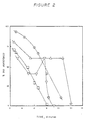
- Figure 2 shows a comparison of the saturation capacity of the iron (II) chelates to remove NO.
- fluid stream refers to any gaseous, liquid or combination gaseous-liquid stream.
- fluid streams include, for example, stack gases from a power plant, combustion gases from the burning of natural gas, petroleum, oil shale, coal and the like.
- any otherwise inert water-soluble polymeric chelant capable of chelating a polyvalent metal is suitable in the present process. Inert in this context is defined as not detrimentally reactive in the reaction to an intolerable extent.
- Polymeric chelants having a molecular weight between 500 and 1,000,000 are preferred in the present process. Polymeric chelants having a molecular weight between 1000 and 500,000 are more preferred.
- mixtures of the water-soluble organic polymeric chelants described hereinabove are useful in the present invention.
- concentration of the polymer should be at a level so as to provide up to about 1-gram equivalent weight of the chelating group per liter of solution.
- One embodiment of the chelant designated (a) where X1 is either -H or -CH2COOH is prepared by dissolving polyethyleneimine (CORCAT 150 or CORCAT 600, available from the Cordova Chemical Company) in water followed by reaction with excess sodium choroacetate in the presence of strong base.
- the procedure usually includes the addition of the pendent group to an available polymeric backbone.
- the repeating unit is: some of the pendant groups, X1, are - H and others are, for example, -CH2COOH, e.g.: This type of random pattern of addition occurs for the pendant chelant groups in the polymeric chelants [(a) to (h)].
- the polymer backbone contains a pendant epoxide group, e.g.: -CH2 , then after addition, if all epoxide groups do not react further, then the chemical groups -CH2CH(OH)CH2OH, or Ch2CH(OH)CH2Cl are pendant groups from the polymer backbone.
- a pendant epoxide group e.g.: -CH2
- a further embodiment of the polymeric chelant (a) designated -(CH2-CH2- ) , where X1 in each polymer unit is -H or: and R1 and R2 are each methyl (CHELANT C), is obtained by dissolving polyethyleneimine in water followed by treatment with 2,4-dimethylphenol and formaldehyde.
- the general procedure described by G. Grillot and W. Gormley, Jr., J. Amer. Chem. Soc., Vol. 67, pp 1968ff (1945) for the monomer is adapted using the polymeric imine.
- One embodiment of the polymeric chelate designated (b) where X2 in each polymer unit is either -H or -CH2CH(OH)CH2N(CH2COOH)CH2CH2N(CH2COOH)2 and q is 1 (CHELANT D) is obtained by first reacting epichlorohydrin, H(CH2Cl), with ethylenediamine-triacetic acid to produce HCH2-N-(CH2COOH)CH2CH2N(CH2COOH)2, followed by reaction with polyethyleneimine.
- the procedure described above, for CHELANT A may also be adapted.
- the ethylenediamine is replaced with the corresponding diethylenetriamine, triethylenetetraamine and tetraethylene-pentamine, respectively.
- Another embodiment is of the polymeric chelant designated (b), wherein X2 in each polymer unit is either -H or -CH2CH(OH)CH2[N(R3)CH2CH2] q N(R4)(R5), p is about 20,000, q is 0, and R3, R4 and R5 are each -CH2COOH (CHELANT D-1), iminodiacetic acid is dissolved in water and epichlorhydrin, about a 20% excess is added. The product is extracted with a chlorinated hydrocarbon such as methylene chloride to remove the unreacted epichlorhydrin.
- a chlorinated hydrocarbon such as methylene chloride
- aqueous solution a 33% aqueous solution of polyethyleneimine, e.g., CORCAT 600, the solution is heated and further treated with sodium hydroxide at a pH of 9 to 10.
- the chelant solution is used without further purification.
- polymeric chelant designated (c), wherein X3 in each polymer unit is either -OH or -[NC(R3)CH2CH2] s N(R4) (R5), r is about 100 and R3, R4 and R5 are each -CH2COOH (CHELATE E) is prepared by treating polyepichlorohydrin with ethylenediamine in the presence of base followed by treatment with excess sodium chloroacetate.
- One embodiment of the chelant designated (d), wherein X4 in each polymer unit is either -OH or -NH[CH2CH2N(R3) x CH2CH2N(R4)(R5), t is 100, x is 1 and R3, R4 and R5 are each -CH2COOH ( CHELANT F) is prepared by the treatment of poly(ethylacrylate) with diethylenetriamine followed by treatment with sodium chloroacetate in the presence of a strong base.
- X5 in each polymer unit is either -OH or -[N(R3)CH2CH2] z N(R4)(R5), and R3, R4 and R5 are each -CH2COOH, y is 100 and z is 1 ( CHELANT G) is the treatment of poly(vinylbenzylchloride) with ethylenediamine in the presence of strong base. The product in the presence of base, is next treated with excess sodium chloroacetate. By replacement of ethylenediamine with diethylenetriamine, triethylene tetraamine, and the like, the higher homologues are produced.
- One embodiment of the chelant designated (f) where X6 in each polymer unit is either -CH2CH(OH)CH2OH or -CH2CH(OH)CH2[N(R3)CH2CH2] c N(R4)(R5) where R3, R4 and R5 are each -CH2COOH and c is 1 ( CHELANT H) is obtained by the treatment of the commercial polymer KYMENE 557H (which is obtained from the Hercules Corporation of Wilmington, Delaware) with ethylenediamine triacetic acid.
- One embodiment of the chelant designated (g) where X7 in each polymer unit is either -H or -CH2(OH)CH2[N(R3)-CH2CH2] c N(R4)(R5) where m is 1, g is 1,000, c is 1 and R3, R4 and R5 are each -CH2COOH ( CHELANT J), is obtained by reacting the polymer of methylacrylate and ethylenediamine with the epoxide adduct formed by the treatment of iminodiacetic acid with epichlorohydrin.
- X8, X9 and X10 in each polymer unit are each independently -H or -CH2CH(OH)CH2OH or -CH2CH(OH)CH2-N(R3)CH2CH2N(R4)(R5) where R3, R4 and R5 are each -CH2COOH, the added group is obtained by reacting the commercially available FIBRABON 35 (from the Diamond Shamrock Co., Cleveland, Ohio) with ethylenediamine-triacetic acid in the presence of base ( K).
- the proportion of each of the groups X1 to X10 which is -H, -OCH3, -OCH2CH3, -OH or Cl is from 10% to 90%, more preferably from 10% to 40%.
- any polyvalent metal i.e. a metal having more than one possible oxidation state
- any polyvalent metal can be used in the present invention as the metal component of the polymeric chelate to remove NO, but iron, copper, cobalt and manganese are preferred. Iron is particularly preferred.
- the polyvalent metal chelate should be capable of acting as a catalyst to instantaneously complex NO and should then be capable of regeneration.
- the means to separate the organic polymeric chelate from the water and water-soluble low molecular weight products and materials can employ any single or combination of techniques suitable for this purpose.
- membrane separation such as ultrafiltration or dialysis are used. More preferably, ultrafiltration is employed using a membrane consisting of any of a variety of synthetic polymers in the shape of a film, hollow fiber of the like.
- membranes such as Spectrapor 6 (2000 molecular weight maximum permeability).
- the gas stream is, for example, from a stack gas containing up to about 1.0 percent by volume of NO, preferably between 0.02 and 0.05 percent by volume, or a chemical stream containing up to about 1.0 percent by volume of NO.
- NO is about 250 parts per million (ppm).
- Sulfur dioxide (SO2) is also normally a product of combustion. In the present process the SO2 content is generally between 0.05 and 0.02 percent by volume.
- the gas stream (line 1) enters column 2 which contains an aqueous admixture comprising an aqueous solution about 1-molar and a water-soluble polymeric chelate containing a polyvalent metal.
- Fe(II) is preferred and will be used hereafter.
- FE(III) (oxidized form) and FE(II)(reduced form) will be representative of any comparable polyvalent metal.
- the pressure of the feed gas is generally not critical and may vary from between 10 and 100 pounds per square inch gauge (psig) in Pascal (Pa) units (169 KPa and 777 KPa), preferably between 15 and 50 psig (201) KPa and 439 KPa).
- a reducing agent is added to the process in an amount effective to reduce the chelate FE(111) to chelate FE(II).
- a preferred reducing agent is an aqueous solution of NaSH.
- the reducing agent may be added through any of the lines of Figure 1 in which aqueous solution is added.
- the NaSH solution is added through line 13.
- a fresh aqueous solution of the polymeric chelate FE(II) described above is added through line 3.
- the gas stream is simply contacted with the aqueous stream, although a countercurrent configuration of the gas rising through a column of aqueous chelate solution is preferred.
- the temperature of the aqueous admixture is between 10 and 90°C, preferably between 20° and 80°C, more preferrably between 50 and 70°C.
- a contact time between the aqueous admixture and the gas is usually 1 sec and 2 min, with between 2 sec and 1 min being preferred.
- This time period is sufficient to adsorb substantially all of the NO to the Fe(II) chelate and to react with the bisulfite present to produce the imidodisulfonate. It has been determined that a 0.05 M Fe(II)-EDTA process requires a residence time of 2 to 3 seconds to remove 90% of the NO from a gas stream containing 250 ppm of NO, while a CM PEI 150 system under the same process conditions requires about 15 seconds of residence time.
- the purified gas stream then leaves column 2 via line 4.
- the purified gas exiting in line 4 meets standard environmental emission standards.
- the NO has been converted by the Fe(II)-containing polymeric chelate to chelate ⁇ Fe(II) ⁇ NO, which instantaneously combines with HSO3 ⁇ present to produce primarily imidodisulfonate.
- the polymeric chelate-containing aqueous solution is conveyed via line 9 to a separator unit 10.
- Separator 10 uses means to separate excess water, imidodisulfonate and low molecular weight products and byproducts. Generally, ultrafiltration or dialysis is used, with ultrafiltration being preferred.
- the water and low molecular weight materials, such as inorganic products, etc. having a molecular weight of less than 1000, preferably less than 500, are conveyed away through line 11 and disposed of in an environmentally acceptable manner.
- the polymeric chelate is then conveyed through line 12.
- Some permeabilities of monomeric and polymeric chelates of iron (11) and iron (III) using ultrafiltration and dialysis are shown below, in Table II in Example 9.
- the polymeric chelate containing the polymeric chelate metal Fe(II) is then conveyed through line 12 to contacting zone 2 to begin the reaction process cycle again. As needed, make-up water, polymeric chelate and polyvalent metal are added to the process through line 13.
- the vertical line (having the arrowhead) between the pump and the degassing unit 8, and connects line 6 and horizontal line 12, is an optional feature.
- This line will have a controlling valve to adjust the flow of liquid through it.
- a portion of the aqueous solution in line 6 is optionally moved (shunted) through the vertical line to return to contact unit 2 via line 12.
- Figure 2 shows that the polymeric chelates of Fe(II) have comparable absorption of NO under similar conditions.
- the reaction mixture is then heated for about 20 minutes to the boiling temperature thereby producing a homogenous clear solution having a boiling point of between 110-115°C.
- the resulting clear aqueous solution is maintained at boiling for about 2 hrs., and 22 g (0.66 mole) of paraformaldehyde is added.
- the clear reaction mixture is kept boiling for an additional 30 min and cooled to about 25-30°C.
- the clear solution has an amber color, and contains about 50% by weight of the polyethyleneimine phosphonate which was used without further purification.
- CHELANT D X2 is -H or -CH2 CH(OH)CH2N(CH2COOH)CH2CH2-N(CH2COOH)2
- This preparation was performed in two steps: (1) attachment of ethylenediamine to the polymer; and (2) conversion of the amine to the ethylenediaminetriacetic acid.
- Step 1 23.5 Grams of polyepichlorhydrin (0.25 Mole monomer unit) and 94 grams of 85% ethylenediamine (1.3 moles) were dissolved in 50 ml isopropanol and 25 ml of toluene and refluxed (about 100°C) for six hrs. As the reaction proceeded additional isopropanol was added to maintain homogeneity, with the final system being about 75/25 isopropanol/toluene. The reaction was followed by titrating aliquots for chloride ion with silver nitrate.
- Step 2 This intermediate was taken up in about 200 ml of water, to which 3.3 moles of sodium chloroacetate was added per mole of nitrogen. The system was kept at about 60°C and a pH of about 10 for about one hr. At this point a white precipitate (presumably NaCl) was filtered off, the pH was adjusted to about 2 (the expected isoelectric point), at which point considerable white solid formed. This solid was filtered and found to be EDTA, presumably formed because all of the unreacted ethylenediamine had not been removed during the vacuum evaporation. The filtrate was dialyzed against about 4 liters of water.
- CHELANT E IS -OH or -[N(CH2COOH)CH2CH]N(CH2COOH)2
- CHELANT F X4 is -OH or -NH(CH2CH2N( CH2COOH)]- CH2CH2N(CH2COOH)2, t is 100 and x is 1
- Poly(methylacrylate) (86 g., equivalent to one mole of formula weight of the monomeric methyl acrylate) is dissolved in about 300 ml of toluene, and 520 g of diethylenetriamine (5 moles) were added. The solution is heated to 40-50°C for an hour and the excess amine and toluene were evaporated under vacuum. The residue is taken up in 500 ml of water and 348 g. of sodium chloroacetate (3.0 mol) are added to the solution, and heated to about 60°C for about 30 minutes while sodium hydroxide is added at a rate sufficient to maintain the pH at 9-10. This solution, which has the desired structure is used without further purification in subsequent experiments.
- CHELANT G X5 is -OH or -N(CH2COOH)CH2CH2N(CH2COOH)2 and y is 100
- Polyvinylbenzyl chloride (15 g., equivalent to 0.1 mole of monomer units) is dissolved in 100 ml of methylene chloride, and 30 g of ethylene diamine (0.5 mole) are added. The solution is warmed to 40°C and stirred for 2 hours. The excess amine and methylene chloride are evaporated under vacuum. The resulting polymer is taken up in 200 ml of water and carboxymethylated as in the preceding example. The resulting polymer has the desired structure, and is used further without purification.
- CHELANT X6 is -H or -CH2CH(OH)CH2N(CH2COOH)-CH2CH2 N(CH2COOH)2
- X7 is -H or -CH2CH(OH)CH2N(CH2COOH) -CH2CH2 N(CH2COOH)2
- m is 1 and g is about 100.
- the solution is heated to 80°C for 2 hours, and the resulting polymer is used in subsequent experiments.
- CHELANT K; ; X8, X9 and X10 in each polymer unit are either -H, -CH2CH(OH)CH2OH or CH2CH(OH)CH2N(CH2COOH)CH2CH2N(CH2COOH)2
- Ratio W is the mole ratio of nitrogen in chelating monomer or polymer to iron at point of incipient precipitation at room temperature. pH in all tests is 7 ⁇ 0.5.
- the pendant group in each polymer unit of the polymer is selected from those designated. It is also to be understood that from the description herein that if complete or partial addition of the pendant chelating group on the polymer backbone is desired, the experimental synthesis conditions need only to be adjusted. That is, if only partial substitution is required adjustment to shorter reaction times, lower concentrations of reactants, lower reaction temperatures and those techniques known in the art are used. For more complete or complete addition of the pendant chelating group to the polymer backbone, longer reaction times, higher concentration of reactants nad higher reaction temperatures are used.
- the molecular weights of the polymers described herein are usually expressed as the weight average molecular weight.
- the proportion of the groups X1 to X10 which were -H, -OCH3, -OCH2CH3, -CL, or -OH was from 10% to 90% of the total of the respective groups X1 to X10.
- iron (II) organic chelate made up to be about 0.1 molar in iron, was dialyzed into two liters of deionized water overnight.
- the CM PEl 150 and CM PEl 600 polymeric chelating agents were dialyzed through SPECTROPOR 1, from Van Waters & Rogers, San Francisco, California which has a nominal molecular weight cut-off of about 6000-8000. In both cases, about 3-5% of the iron was lost.
- the CM PEl 6 solution was dialyzed through SPECTROPOR 6 (Van Waters & Rogers) which has a cut-off of about 2000. In this case about 10% of the iron was lost.
- the ultrafiltration tests were performed in an Amicon Model 52 cell which is a cylindrical chamber with a 43 mm diameter (12.5 cm) membrane as the bottom surface.
- the cell volume is about 60 ml and the cell contains a suspended magnetic stirring bar to reduce polarization effects.
- a 25-ml volume of solution was placed in the cell and the gas space was connected to an air line maintained at 15 psi.
- CM PEl 6 carboxymethylated polyethyleneimine 6
- PM 10 cut-off 10,000
- a gas stream from an oil combustion unit having a concentration of NO of 0.011 weight percent and SO2 of 0.03 weight percent enters a contact vessel which contains an aqueous solution containing 1.0 percent by weight of iron (II) (based on the total weight of the mixture) as the polymeric chelate of carboxymethyl polyethyleneimine CM PEl6.
- the chelate is supplied at 50% molar excess based on iron and the pH of the system is about 7.
- the pressure of the fluid gas is about 15 psig (201KPa) and the temperature of the reaction is 55°C.
- a contact time of 60 seconds is used.
- the aqueous solution is then subjected to ultrafiltration using an Amicom UM2 membrane and apparatus.
- the retained aqueous solution containing the CM PEl 6 Fe(II) is recycled to the contact vessel.
Landscapes
- Chemical & Material Sciences (AREA)
- Engineering & Computer Science (AREA)
- Combustion & Propulsion (AREA)
- Chemical Kinetics & Catalysis (AREA)
- General Chemical & Material Sciences (AREA)
- Oil, Petroleum & Natural Gas (AREA)
- Organic Chemistry (AREA)
- Health & Medical Sciences (AREA)
- Biomedical Technology (AREA)
- Environmental & Geological Engineering (AREA)
- Analytical Chemistry (AREA)
- Inorganic Chemistry (AREA)
- Treatment Of Water By Ion Exchange (AREA)
- Addition Polymer Or Copolymer, Post-Treatments, Or Chemical Modifications (AREA)
- Solid-Sorbent Or Filter-Aiding Compositions (AREA)
- Treating Waste Gases (AREA)
Applications Claiming Priority (2)
| Application Number | Priority Date | Filing Date | Title |
|---|---|---|---|
| US06/837,927 US4708854A (en) | 1986-03-10 | 1986-03-10 | Process for the removal of NO from fluid streams using a water-soluble polymeric chelate of a polyvalent metal |
| US837927 | 1986-03-10 |
Publications (2)
| Publication Number | Publication Date |
|---|---|
| EP0241141A2 true EP0241141A2 (de) | 1987-10-14 |
| EP0241141A3 EP0241141A3 (de) | 1989-02-08 |
Family
ID=25275811
Family Applications (1)
| Application Number | Title | Priority Date | Filing Date |
|---|---|---|---|
| EP87302038A Ceased EP0241141A3 (de) | 1986-03-10 | 1987-03-10 | Verfahren zur Beseitigung von Stickstoffoxid aus Fluidströmen unter Verwendung eines Gemisches eines wasserlöslichen polymeren Chelats und eines mehrwertigen Metalls |
Country Status (9)
| Country | Link |
|---|---|
| US (1) | US4708854A (de) |
| EP (1) | EP0241141A3 (de) |
| JP (1) | JPS62269732A (de) |
| CN (1) | CN1007889B (de) |
| AU (1) | AU597622B2 (de) |
| CA (1) | CA1290312C (de) |
| DK (1) | DK123387A (de) |
| NO (1) | NO168019C (de) |
| NZ (1) | NZ219525A (de) |
Cited By (1)
| Publication number | Priority date | Publication date | Assignee | Title |
|---|---|---|---|---|
| EP0397098A3 (de) * | 1989-05-08 | 1991-01-02 | The Dow Chemical Company | Verfahren zur Entfernung von NOx und SOx aus Gasströmen unter Verwendung eines wasserlöslichen polymerischen Chelates eines mehrwertigen Metalls und Vorrichtung zur Membrantrennung |
Families Citing this family (25)
| Publication number | Priority date | Publication date | Assignee | Title |
|---|---|---|---|---|
| US4778664A (en) * | 1986-03-10 | 1988-10-18 | The Dow Chemical Company | Process for the removal of NO from fluid streams using a water soluble polymeric chelate of a polyvalent metal |
| US4941991A (en) * | 1987-10-22 | 1990-07-17 | Rajamannan A H J | Composition and process for use in neutralizing malodorous gases |
| US4957716A (en) * | 1988-11-21 | 1990-09-18 | Electric Power Research Institute, Inc. | Method for removal of SO2 and NOx from combustion gases by metal chelation and thermal reduction |
| US4921683A (en) * | 1989-06-20 | 1990-05-01 | The Dow Chemical Company | Nitric oxide abatement with polymeric cobalt(III) chelates |
| US5721365A (en) * | 1989-09-15 | 1998-02-24 | Us Health | N-substituted piperazine NONOates |
| US5208233A (en) * | 1989-09-15 | 1993-05-04 | The United States Of America As Represented By The Department Of Health And Human Services | Anti-hypertensive compositions of secondary amine-nitric oxide adducts and use thereof |
| WO1993003825A1 (en) * | 1991-08-13 | 1993-03-04 | The Dow Chemical Company | A composition and method for simultaneous absorption of sulfur dioxide and nitric oxide |
| AU668107B2 (en) * | 1991-09-24 | 1996-04-26 | United States Of America, Represented By The Secretary, Department Of Health And Human Services, The | Oxygen substituted derivatives of nucleophile-nitric oxide adducts as nitric oxide donor prodrugs |
| US5910316A (en) * | 1992-08-24 | 1999-06-08 | The United States Of America, As Represented By The Department Of Health And Human Services | Use of nitric oxide-releasing agents to treat impotency |
| US5525357A (en) * | 1992-08-24 | 1996-06-11 | The United States Of America As Represented By The Department Of Health And Human Services | Polymer-bound nitric oxide/nucleophile adduct compositions, pharmaceutical compositions incorporating same and methods of treating biological disorders using same |
| US6200558B1 (en) | 1993-09-14 | 2001-03-13 | The United States Of America As Represented By The Department Of Health And Human Services | Biopolymer-bound nitric oxide-releasing compositions, pharmaceutical compositions incorporating same and methods of treating biological disorders using same |
| US5691423A (en) * | 1992-08-24 | 1997-11-25 | The United States Of America As Represented By The Department Of Health And Human Services | Polysaccharide-bound nitric oxide-nucleophile adducts |
| US5405919A (en) * | 1992-08-24 | 1995-04-11 | The United States Of America As Represented By The Secretary Of Health And Human Services | Polymer-bound nitric oxide/nucleophile adduct compositions, pharmaceutical compositions and methods of treating biological disorders |
| US5320816A (en) * | 1992-10-21 | 1994-06-14 | The Dow Chemical Company | Process for absorption of sulfur dioxide and nitric oxide from flue gas |
| US5658545A (en) * | 1995-03-29 | 1997-08-19 | The Regents Of California | Metal regeneration of iron chelates in nitric oxide scrubbing |
| US5714511A (en) * | 1995-07-31 | 1998-02-03 | The United States Of America As Represented By The Secretary Of The Department Of Health And Human Services | Selective prevention of organ injury in sepsis and shock using selection release of nitric oxide in vulnerable organs |
| US6261594B1 (en) | 1998-11-25 | 2001-07-17 | The University Of Akron | Chitosan-based nitric oxide donor compositions |
| EP1414550A1 (de) * | 2001-08-06 | 2004-05-06 | Cansolv Technologies Inc. | Verfahren und vorrichtung zur entfernung von nox und sox |
| US8293696B2 (en) * | 2009-02-06 | 2012-10-23 | Ecolab, Inc. | Alkaline composition comprising a chelant mixture, including HEIDA, and method of producing same |
| CN101711943B (zh) * | 2009-09-15 | 2012-09-05 | 华东理工大学 | 一种低温液相催化还原治理含no污染物废气的方法 |
| KR102053486B1 (ko) | 2012-12-19 | 2019-12-06 | 롬 앤드 하스 캄파니 | 자동 식기세척기 세제 |
| CN111167263B (zh) * | 2018-11-13 | 2021-04-13 | 黄华丽 | 一种氮氧化物吸收剂浆液及其制备和使用方法 |
| CN110075677A (zh) * | 2019-04-09 | 2019-08-02 | 苏州华加星光环保工程技术有限公司 | 一种脱硫脱硝装置及方法 |
| CN110064278A (zh) * | 2019-04-26 | 2019-07-30 | 大连理工大学 | 一种烟气脱硫脱硝吸收液中硫酸盐副产单质硫的调控方法 |
| CN115738599B (zh) * | 2022-11-23 | 2024-06-04 | 攀钢集团攀枝花钢铁研究院有限公司 | 同时吸收NOx及CO的络合脱硝液的制备方法 |
Family Cites Families (23)
| Publication number | Priority date | Publication date | Assignee | Title |
|---|---|---|---|---|
| US3790610A (en) * | 1971-09-07 | 1974-02-05 | Colloids Inc | Organic polymer chelants for iron and manganese ions |
| JPS4949289B2 (de) * | 1972-09-12 | 1974-12-26 | ||
| GB1446973A (en) * | 1973-09-24 | 1976-08-18 | Asahi Chemical Ind | Method of removing nitrogen monoxide from a nitrogen mono xide-containing gas |
| GB1482643A (en) * | 1973-10-31 | 1977-08-10 | Kureha Chemical Ind Co Ltd | Method for removing oxides of nitrogen from a gas |
| JPS5096478A (de) * | 1973-12-27 | 1975-07-31 | ||
| GB1501701A (en) * | 1974-01-21 | 1978-02-22 | Kureha Chemical Ind Co Ltd | Method of removing nitrogen oxides from a gas containing nitrogen oxides |
| US4055623A (en) * | 1974-01-21 | 1977-10-25 | Kureha Kagaku Kogyo Kabushiki Kaisha | Method of removing nitrogen oxides from a gas as a salt of imidodisulfonic acid |
| US4044101A (en) * | 1974-12-21 | 1977-08-23 | Asahi Kasei Kogyo Kabushiki Kaisha | Method of treating exhaust gases containing nitrogen oxides and sulfurous acid gas |
| US3974090A (en) * | 1975-03-20 | 1976-08-10 | Monsanto Company | Imino alkylimino phosphonates and method for preparing and using same |
| JPS51112786A (en) * | 1975-03-31 | 1976-10-05 | Hitachi Ltd | Process for the removal of nitrogen oxide by absorption from exhaust g as |
| JPS5290477A (en) * | 1976-01-27 | 1977-07-29 | Chisso Eng Co Ltd | Method of scrubbing industrial exhaust gases |
| JPS5930455B2 (ja) * | 1976-09-14 | 1984-07-27 | 出光興産株式会社 | 排ガス処理法 |
| US4126529A (en) * | 1977-08-05 | 1978-11-21 | Southern California Edison Company | Ferrous ion scrubbing of flue gas |
| US4113837A (en) * | 1977-09-26 | 1978-09-12 | Union Carbide Corporation | Process for separating polymeric contaminants from aqueous absorbent solutions used to treat organic gas-containing gas streams |
| JPS5468775A (en) * | 1977-11-11 | 1979-06-02 | Kureha Chem Ind Co Ltd | Treating method for exhaust gas containing nitrogen oxides and sulfur oxides |
| US4372932A (en) * | 1978-05-18 | 1983-02-08 | Union Oil Company Of California | Process for removing SOx and NOx compounds from gas streams |
| JPS5520608A (en) * | 1978-07-28 | 1980-02-14 | Kureha Chem Ind Co Ltd | Treating method for waste gas absorption product |
| DE2839055C2 (de) * | 1978-09-07 | 1984-08-23 | Linde Ag, 6200 Wiesbaden | Verfahren zum Auswaschen von sauren Gasen aus polymerisationsfähige organische Bestandteile enthaltenden Gasgemischen |
| US4448899A (en) * | 1980-05-21 | 1984-05-15 | Union Oil Company Of California | Process for removing SOx and NOx compounds from gas streams |
| US4347227A (en) * | 1981-03-11 | 1982-08-31 | Union Oil Company Of California | Process for removing SOx and NOx compounds from gas streams |
| US4386058A (en) * | 1981-03-11 | 1983-05-31 | Union Oil Company Of California | Process for removing SOx and NOx compounds from gas streams |
| DE3248019A1 (de) * | 1982-12-24 | 1984-06-28 | Cassella Ag, 6000 Frankfurt | Wasserloesliche copolymerisate, ihre herstellung und ihre verwendung |
| US4423158A (en) * | 1983-01-27 | 1983-12-27 | Gelinnovation Handelsaktiebolag | Ion adsorbent for metals having a coordination number greater than two |
-
1986
- 1986-03-10 US US06/837,927 patent/US4708854A/en not_active Expired - Fee Related
-
1987
- 1987-02-23 AU AU69138/87A patent/AU597622B2/en not_active Ceased
- 1987-03-06 NZ NZ219525A patent/NZ219525A/xx unknown
- 1987-03-09 NO NO870969A patent/NO168019C/no unknown
- 1987-03-09 CA CA000531490A patent/CA1290312C/en not_active Expired - Fee Related
- 1987-03-10 JP JP62053200A patent/JPS62269732A/ja active Pending
- 1987-03-10 CN CN87101791.1A patent/CN1007889B/zh not_active Expired
- 1987-03-10 DK DK123387A patent/DK123387A/da not_active Application Discontinuation
- 1987-03-10 EP EP87302038A patent/EP0241141A3/de not_active Ceased
Cited By (1)
| Publication number | Priority date | Publication date | Assignee | Title |
|---|---|---|---|---|
| EP0397098A3 (de) * | 1989-05-08 | 1991-01-02 | The Dow Chemical Company | Verfahren zur Entfernung von NOx und SOx aus Gasströmen unter Verwendung eines wasserlöslichen polymerischen Chelates eines mehrwertigen Metalls und Vorrichtung zur Membrantrennung |
Also Published As
| Publication number | Publication date |
|---|---|
| NO870969D0 (no) | 1987-03-09 |
| DK123387A (da) | 1987-09-11 |
| EP0241141A3 (de) | 1989-02-08 |
| AU6913887A (en) | 1987-09-17 |
| NZ219525A (en) | 1990-07-26 |
| NO168019B (no) | 1991-09-30 |
| CN1007889B (zh) | 1990-05-09 |
| DK123387D0 (da) | 1987-03-10 |
| AU597622B2 (en) | 1990-06-07 |
| US4708854A (en) | 1987-11-24 |
| NO870969L (no) | 1987-09-11 |
| NO168019C (no) | 1992-01-08 |
| JPS62269732A (ja) | 1987-11-24 |
| CA1290312C (en) | 1991-10-08 |
| CN87101791A (zh) | 1988-03-30 |
Similar Documents
| Publication | Publication Date | Title |
|---|---|---|
| EP0241141A2 (de) | Verfahren zur Beseitigung von Stickstoffoxid aus Fluidströmen unter Verwendung eines Gemisches eines wasserlöslichen polymeren Chelats und eines mehrwertigen Metalls | |
| US4921683A (en) | Nitric oxide abatement with polymeric cobalt(III) chelates | |
| EP0368423B1 (de) | Entfernung und Rückgewinnung von Schwefeldioxyd aus Gasströmen | |
| US5223173A (en) | Method and composition for the removal of hydrogen sulfide from gaseous streams | |
| US4741831A (en) | Process and composition for removal of metal ions from aqueous solutions | |
| AU605764B2 (en) | Process and composition for the removal of hydrogen sulfide from gaseous streams | |
| US6872371B2 (en) | Method and apparatus for NOx and SO2 removal | |
| US4331639A (en) | Process for removing SOx and NOx compounds from gas streams | |
| US4808385A (en) | Process for the removal of H2 S from fluid streams using a water soluble polymeric chelate of an oxidizing polyvalent metal | |
| CN100518887C (zh) | 低能耗so2洗涤方法 | |
| US4778664A (en) | Process for the removal of NO from fluid streams using a water soluble polymeric chelate of a polyvalent metal | |
| US6998099B2 (en) | Method for desulphurizing acid gases using catalysts that are insensitive to oxidation and contain aminocarboxylate | |
| US4386058A (en) | Process for removing SOx and NOx compounds from gas streams | |
| US4859437A (en) | Process for the removal of H2S from fluid streams using a water soluble polymeric chelate of an oxidizing polyvalent metal | |
| GB2037723A (en) | Solutions for the absorption of co2 and h2s | |
| EP0397098A2 (de) | Verfahren zur Entfernung von NOx und SOx aus Gasströmen unter Verwendung eines wasserlöslichen polymerischen Chelates eines mehrwertigen Metalls und Vorrichtung zur Membrantrennung | |
| EP0066309B1 (de) | Verfahren zur Rückgewinnung von Schwefel | |
| US4781901A (en) | Method and composition for the removal of hydrogen sulfide and carbon dioxide from gaseous streams | |
| WO1996030299A1 (en) | Method of regeneration of iron chelates in nitric oxide scrubbing | |
| US4871468A (en) | Method and composition for the removal of hydrogen sulfide and carbon dioxide from gaseous streams | |
| US4859436A (en) | H2 S removal process and composition | |
| US4871520A (en) | Process and composition for H2 S removal | |
| US5912387A (en) | Amine heat stable salt neutralization having reduced solids | |
| US5149460A (en) | Composition for H2 S removal | |
| GB2087752A (en) | Removal of sulfur dioxide from waste gas streams |
Legal Events
| Date | Code | Title | Description |
|---|---|---|---|
| PUAI | Public reference made under article 153(3) epc to a published international application that has entered the european phase |
Free format text: ORIGINAL CODE: 0009012 |
|
| AK | Designated contracting states |
Kind code of ref document: A2 Designated state(s): BE DE FR GB IT NL SE |
|
| PUAL | Search report despatched |
Free format text: ORIGINAL CODE: 0009013 |
|
| AK | Designated contracting states |
Kind code of ref document: A3 Designated state(s): BE DE FR GB IT NL SE |
|
| 17P | Request for examination filed |
Effective date: 19890802 |
|
| 17Q | First examination report despatched |
Effective date: 19910422 |
|
| STAA | Information on the status of an ep patent application or granted ep patent |
Free format text: STATUS: THE APPLICATION HAS BEEN REFUSED |
|
| 18R | Application refused |
Effective date: 19930109 |
|
| RIN1 | Information on inventor provided before grant (corrected) |
Inventor name: GRINSTEAD, ROBERT R. |