EP0240465A2 - Dye mixtures - Google Patents
Dye mixtures Download PDFInfo
- Publication number
- EP0240465A2 EP0240465A2 EP87810186A EP87810186A EP0240465A2 EP 0240465 A2 EP0240465 A2 EP 0240465A2 EP 87810186 A EP87810186 A EP 87810186A EP 87810186 A EP87810186 A EP 87810186A EP 0240465 A2 EP0240465 A2 EP 0240465A2
- Authority
- EP
- European Patent Office
- Prior art keywords
- dye
- formula
- dye mixtures
- chlorine
- bromine
- Prior art date
- Legal status (The legal status is an assumption and is not a legal conclusion. Google has not performed a legal analysis and makes no representation as to the accuracy of the status listed.)
- Ceased
Links
- 239000000203 mixture Substances 0.000 title claims abstract description 38
- 238000005859 coupling reaction Methods 0.000 claims abstract description 28
- 230000008878 coupling Effects 0.000 claims abstract description 27
- 238000010168 coupling process Methods 0.000 claims abstract description 27
- 229910052801 chlorine Inorganic materials 0.000 claims abstract description 18
- 239000000460 chlorine Chemical group 0.000 claims abstract description 18
- WKBOTKDWSSQWDR-UHFFFAOYSA-N Bromine atom Chemical group [Br] WKBOTKDWSSQWDR-UHFFFAOYSA-N 0.000 claims abstract description 13
- GDTBXPJZTBHREO-UHFFFAOYSA-N bromine Chemical group BrBr GDTBXPJZTBHREO-UHFFFAOYSA-N 0.000 claims abstract description 13
- 229910052794 bromium Inorganic materials 0.000 claims abstract description 13
- 229910052739 hydrogen Inorganic materials 0.000 claims abstract description 11
- 239000001257 hydrogen Substances 0.000 claims abstract description 10
- 125000004435 hydrogen atom Chemical group [H]* 0.000 claims abstract description 10
- ZAMOUSCENKQFHK-UHFFFAOYSA-N Chlorine atom Chemical group [Cl] ZAMOUSCENKQFHK-UHFFFAOYSA-N 0.000 claims abstract description 9
- 238000004043 dyeing Methods 0.000 claims abstract description 8
- 239000000463 material Substances 0.000 claims abstract description 8
- 125000002496 methyl group Chemical group [H]C([H])([H])* 0.000 claims abstract description 7
- 229920000728 polyester Polymers 0.000 claims abstract description 7
- 125000001309 chloro group Chemical group Cl* 0.000 claims abstract description 6
- 238000000034 method Methods 0.000 claims description 16
- 239000000243 solution Substances 0.000 claims description 15
- 239000002270 dispersing agent Substances 0.000 claims description 10
- 238000006193 diazotization reaction Methods 0.000 claims description 9
- 239000006185 dispersion Substances 0.000 claims description 9
- 239000002253 acid Substances 0.000 claims description 7
- 125000000217 alkyl group Chemical group 0.000 claims description 7
- 238000002360 preparation method Methods 0.000 claims description 7
- UBQKCCHYAOITMY-UHFFFAOYSA-N pyridin-2-ol Chemical class OC1=CC=CC=N1 UBQKCCHYAOITMY-UHFFFAOYSA-N 0.000 claims description 7
- 125000003118 aryl group Chemical group 0.000 claims description 6
- 239000012954 diazonium Substances 0.000 claims description 6
- 150000001989 diazonium salts Chemical class 0.000 claims description 6
- 239000004753 textile Substances 0.000 claims description 6
- 125000003342 alkenyl group Chemical group 0.000 claims description 5
- 150000001412 amines Chemical class 0.000 claims description 5
- 125000000129 anionic group Chemical group 0.000 claims description 5
- 150000003927 aminopyridines Chemical class 0.000 claims description 4
- 150000001448 anilines Chemical class 0.000 claims description 4
- 229940111121 antirheumatic drug quinolines Drugs 0.000 claims description 4
- DMBHHRLKUKUOEG-UHFFFAOYSA-N diphenylamine Chemical class C=1C=CC=CC=1NC1=CC=CC=C1 DMBHHRLKUKUOEG-UHFFFAOYSA-N 0.000 claims description 4
- 125000000623 heterocyclic group Chemical group 0.000 claims description 4
- 150000002475 indoles Chemical class 0.000 claims description 4
- 150000004780 naphthols Chemical class 0.000 claims description 4
- 150000005002 naphthylamines Chemical class 0.000 claims description 4
- 150000002989 phenols Chemical class 0.000 claims description 4
- 150000003217 pyrazoles Chemical class 0.000 claims description 4
- 150000003248 quinolines Chemical class 0.000 claims description 4
- JVVRJMXHNUAPHW-UHFFFAOYSA-N 1h-pyrazol-5-amine Chemical class NC=1C=CNN=1 JVVRJMXHNUAPHW-UHFFFAOYSA-N 0.000 claims description 3
- 229940051880 analgesics and antipyretics pyrazolones Drugs 0.000 claims description 3
- 125000000753 cycloalkyl group Chemical group 0.000 claims description 3
- JEXVQSWXXUJEMA-UHFFFAOYSA-N pyrazol-3-one Chemical class O=C1C=CN=N1 JEXVQSWXXUJEMA-UHFFFAOYSA-N 0.000 claims description 3
- 125000004178 (C1-C4) alkyl group Chemical group 0.000 claims description 2
- RAIPHJJURHTUIC-UHFFFAOYSA-N 1,3-thiazol-2-amine Chemical class NC1=NC=CS1 RAIPHJJURHTUIC-UHFFFAOYSA-N 0.000 claims description 2
- 229910006074 SO2NH2 Inorganic materials 0.000 claims description 2
- DYRDKSSFIWVSNM-UHFFFAOYSA-N acetoacetanilide Chemical class CC(=O)CC(=O)NC1=CC=CC=C1 DYRDKSSFIWVSNM-UHFFFAOYSA-N 0.000 claims description 2
- 125000001797 benzyl group Chemical group [H]C1=C([H])C([H])=C(C([H])=C1[H])C([H])([H])* 0.000 claims description 2
- 125000003917 carbamoyl group Chemical group [H]N([H])C(*)=O 0.000 claims description 2
- 150000004806 hydroxypyridines Chemical class 0.000 claims description 2
- 125000000286 phenylethyl group Chemical group [H]C1=C([H])C([H])=C(C([H])=C1[H])C([H])([H])C([H])([H])* 0.000 claims description 2
- VHNQIURBCCNWDN-UHFFFAOYSA-N pyridine-2,6-diamine Chemical class NC1=CC=CC(N)=N1 VHNQIURBCCNWDN-UHFFFAOYSA-N 0.000 claims description 2
- 150000003230 pyrimidines Chemical class 0.000 claims description 2
- 150000008318 pyrimidones Chemical class 0.000 claims description 2
- 150000007660 quinolones Chemical class 0.000 claims description 2
- 239000000126 substance Substances 0.000 claims description 2
- 125000000565 sulfonamide group Chemical group 0.000 claims description 2
- 229930192474 thiophene Natural products 0.000 claims description 2
- 150000003577 thiophenes Chemical class 0.000 claims description 2
- 239000002657 fibrous material Substances 0.000 claims 3
- 125000004209 (C1-C8) alkyl group Chemical group 0.000 claims 1
- 239000000975 dye Substances 0.000 description 37
- HEMHJVSKTPXQMS-UHFFFAOYSA-M Sodium hydroxide Chemical compound [OH-].[Na+] HEMHJVSKTPXQMS-UHFFFAOYSA-M 0.000 description 12
- XLYOFNOQVPJJNP-UHFFFAOYSA-N water Substances O XLYOFNOQVPJJNP-UHFFFAOYSA-N 0.000 description 10
- VEXZGXHMUGYJMC-UHFFFAOYSA-N Hydrochloric acid Chemical compound Cl VEXZGXHMUGYJMC-UHFFFAOYSA-N 0.000 description 8
- KKEYFWRCBNTPAC-UHFFFAOYSA-N Terephthalic acid Chemical compound OC(=O)C1=CC=C(C(O)=O)C=C1 KKEYFWRCBNTPAC-UHFFFAOYSA-N 0.000 description 4
- 239000000835 fiber Substances 0.000 description 4
- 229910052736 halogen Inorganic materials 0.000 description 4
- 150000002367 halogens Chemical class 0.000 description 4
- 239000000047 product Substances 0.000 description 4
- LPXPTNMVRIOKMN-UHFFFAOYSA-M sodium nitrite Chemical compound [Na+].[O-]N=O LPXPTNMVRIOKMN-UHFFFAOYSA-M 0.000 description 4
- -1 sulfo, carboxyl Chemical group 0.000 description 4
- QTBSBXVTEAMEQO-UHFFFAOYSA-N Acetic acid Chemical compound CC(O)=O QTBSBXVTEAMEQO-UHFFFAOYSA-N 0.000 description 3
- LYCAIKOWRPUZTN-UHFFFAOYSA-N Ethylene glycol Chemical compound OCCO LYCAIKOWRPUZTN-UHFFFAOYSA-N 0.000 description 3
- 125000004432 carbon atom Chemical group C* 0.000 description 3
- 230000003197 catalytic effect Effects 0.000 description 3
- 238000005562 fading Methods 0.000 description 3
- 125000000229 (C1-C4)alkoxy group Chemical group 0.000 description 2
- NBIIXXVUZAFLBC-UHFFFAOYSA-N Phosphoric acid Chemical compound OP(O)(O)=O NBIIXXVUZAFLBC-UHFFFAOYSA-N 0.000 description 2
- QAOWNCQODCNURD-UHFFFAOYSA-N Sulfuric acid Chemical compound OS(O)(=O)=O QAOWNCQODCNURD-UHFFFAOYSA-N 0.000 description 2
- 230000002378 acidificating effect Effects 0.000 description 2
- 239000000987 azo dye Substances 0.000 description 2
- 239000000969 carrier Substances 0.000 description 2
- 239000002131 composite material Substances 0.000 description 2
- 238000001816 cooling Methods 0.000 description 2
- 125000000664 diazo group Chemical group [N-]=[N+]=[*] 0.000 description 2
- 229920000591 gum Polymers 0.000 description 2
- 238000004519 manufacturing process Methods 0.000 description 2
- 125000001997 phenyl group Chemical group [H]C1=C([H])C([H])=C(*)C([H])=C1[H] 0.000 description 2
- 238000006068 polycondensation reaction Methods 0.000 description 2
- 239000000843 powder Substances 0.000 description 2
- 150000003839 salts Chemical class 0.000 description 2
- 235000010288 sodium nitrite Nutrition 0.000 description 2
- QPILZZVXGUNELN-UHFFFAOYSA-M sodium;4-amino-5-hydroxynaphthalene-2,7-disulfonate;hydron Chemical compound [Na+].OS(=O)(=O)C1=CC(O)=C2C(N)=CC(S([O-])(=O)=O)=CC2=C1 QPILZZVXGUNELN-UHFFFAOYSA-M 0.000 description 2
- 238000003756 stirring Methods 0.000 description 2
- 239000000725 suspension Substances 0.000 description 2
- 238000001291 vacuum drying Methods 0.000 description 2
- PBGKNXWGYQPUJK-UHFFFAOYSA-N 4-chloro-2-nitroaniline Chemical compound NC1=CC=C(Cl)C=C1[N+]([O-])=O PBGKNXWGYQPUJK-UHFFFAOYSA-N 0.000 description 1
- JJHVYGVVMBYCMQ-UHFFFAOYSA-N 6-hydroxy-4-methyl-1h-pyridin-2-one Chemical compound CC=1C=C(O)NC(=O)C=1 JJHVYGVVMBYCMQ-UHFFFAOYSA-N 0.000 description 1
- 244000215068 Acacia senegal Species 0.000 description 1
- 241000416162 Astragalus gummifer Species 0.000 description 1
- 229920002134 Carboxymethyl cellulose Polymers 0.000 description 1
- IAYPIBMASNFSPL-UHFFFAOYSA-N Ethylene oxide Chemical compound C1CO1 IAYPIBMASNFSPL-UHFFFAOYSA-N 0.000 description 1
- 229920000084 Gum arabic Polymers 0.000 description 1
- 229920000663 Hydroxyethyl cellulose Polymers 0.000 description 1
- 239000004354 Hydroxyethyl cellulose Substances 0.000 description 1
- 229920001612 Hydroxyethyl starch Polymers 0.000 description 1
- 239000005909 Kieselgur Substances 0.000 description 1
- 229920001732 Lignosulfonate Polymers 0.000 description 1
- 229920000161 Locust bean gum Polymers 0.000 description 1
- VYPSYNLAJGMNEJ-UHFFFAOYSA-N Silicium dioxide Chemical compound O=[Si]=O VYPSYNLAJGMNEJ-UHFFFAOYSA-N 0.000 description 1
- 229920001615 Tragacanth Polymers 0.000 description 1
- YIMQCDZDWXUDCA-UHFFFAOYSA-N [4-(hydroxymethyl)cyclohexyl]methanol Chemical compound OCC1CCC(CO)CC1 YIMQCDZDWXUDCA-UHFFFAOYSA-N 0.000 description 1
- 238000010521 absorption reaction Methods 0.000 description 1
- 235000010489 acacia gum Nutrition 0.000 description 1
- 239000000205 acacia gum Substances 0.000 description 1
- 150000007513 acids Chemical class 0.000 description 1
- 235000010443 alginic acid Nutrition 0.000 description 1
- 229920000615 alginic acid Polymers 0.000 description 1
- 229910052783 alkali metal Inorganic materials 0.000 description 1
- 125000003282 alkyl amino group Chemical group 0.000 description 1
- 229910000147 aluminium phosphate Inorganic materials 0.000 description 1
- 239000007900 aqueous suspension Substances 0.000 description 1
- 238000000889 atomisation Methods 0.000 description 1
- 150000001555 benzenes Chemical class 0.000 description 1
- 230000015572 biosynthetic process Effects 0.000 description 1
- 229910052799 carbon Inorganic materials 0.000 description 1
- 239000001768 carboxy methyl cellulose Substances 0.000 description 1
- 235000010948 carboxy methyl cellulose Nutrition 0.000 description 1
- 239000008112 carboxymethyl-cellulose Substances 0.000 description 1
- 229940105329 carboxymethylcellulose Drugs 0.000 description 1
- 150000001875 compounds Chemical class 0.000 description 1
- 239000007859 condensation product Substances 0.000 description 1
- 238000007796 conventional method Methods 0.000 description 1
- 239000013078 crystal Substances 0.000 description 1
- 125000004093 cyano group Chemical group *C#N 0.000 description 1
- 125000004663 dialkyl amino group Chemical group 0.000 description 1
- 239000000986 disperse dye Substances 0.000 description 1
- 239000004744 fabric Substances 0.000 description 1
- 150000002191 fatty alcohols Chemical class 0.000 description 1
- 239000011521 glass Substances 0.000 description 1
- 150000002334 glycols Chemical class 0.000 description 1
- 238000000227 grinding Methods 0.000 description 1
- 125000002887 hydroxy group Chemical group [H]O* 0.000 description 1
- 235000019447 hydroxyethyl cellulose Nutrition 0.000 description 1
- 229940071826 hydroxyethyl cellulose Drugs 0.000 description 1
- 229940050526 hydroxyethylstarch Drugs 0.000 description 1
- 238000005470 impregnation Methods 0.000 description 1
- 125000003010 ionic group Chemical group 0.000 description 1
- 235000010420 locust bean gum Nutrition 0.000 description 1
- 239000000711 locust bean gum Substances 0.000 description 1
- OPUAWDUYWRUIIL-UHFFFAOYSA-N methanedisulfonic acid Chemical class OS(=O)(=O)CS(O)(=O)=O OPUAWDUYWRUIIL-UHFFFAOYSA-N 0.000 description 1
- WSFSSNUMVMOOMR-NJFSPNSNSA-N methanone Chemical compound O=[14CH2] WSFSSNUMVMOOMR-NJFSPNSNSA-N 0.000 description 1
- 125000000956 methoxy group Chemical group [H]C([H])([H])O* 0.000 description 1
- PSZYNBSKGUBXEH-UHFFFAOYSA-N naphthalene-1-sulfonic acid Chemical class C1=CC=C2C(S(=O)(=O)O)=CC=CC2=C1 PSZYNBSKGUBXEH-UHFFFAOYSA-N 0.000 description 1
- 150000002790 naphthalenes Chemical class 0.000 description 1
- 125000001624 naphthyl group Chemical group 0.000 description 1
- 229930014626 natural product Natural products 0.000 description 1
- 125000000449 nitro group Chemical group [O-][N+](*)=O 0.000 description 1
- 239000004745 nonwoven fabric Substances 0.000 description 1
- 238000005580 one pot reaction Methods 0.000 description 1
- 239000002245 particle Substances 0.000 description 1
- 125000000951 phenoxy group Chemical group [H]C1=C([H])C([H])=C(O*)C([H])=C1[H] 0.000 description 1
- 229920002401 polyacrylamide Polymers 0.000 description 1
- 229920002451 polyvinyl alcohol Polymers 0.000 description 1
- 235000019422 polyvinyl alcohol Nutrition 0.000 description 1
- 125000002924 primary amino group Chemical group [H]N([H])* 0.000 description 1
- 125000001453 quaternary ammonium group Chemical group 0.000 description 1
- 150000003254 radicals Chemical class 0.000 description 1
- 239000012429 reaction media Substances 0.000 description 1
- 239000011541 reaction mixture Substances 0.000 description 1
- 239000008107 starch Substances 0.000 description 1
- 235000019698 starch Nutrition 0.000 description 1
- 125000001424 substituent group Chemical group 0.000 description 1
- 238000003786 synthesis reaction Methods 0.000 description 1
- 239000002562 thickening agent Substances 0.000 description 1
- 235000010487 tragacanth Nutrition 0.000 description 1
- 239000000196 tragacanth Substances 0.000 description 1
- 229940116362 tragacanth Drugs 0.000 description 1
- 239000000080 wetting agent Substances 0.000 description 1
Classifications
-
- C—CHEMISTRY; METALLURGY
- C09—DYES; PAINTS; POLISHES; NATURAL RESINS; ADHESIVES; COMPOSITIONS NOT OTHERWISE PROVIDED FOR; APPLICATIONS OF MATERIALS NOT OTHERWISE PROVIDED FOR
- C09B—ORGANIC DYES OR CLOSELY-RELATED COMPOUNDS FOR PRODUCING DYES, e.g. PIGMENTS; MORDANTS; LAKES
- C09B67/00—Influencing the physical, e.g. the dyeing or printing properties of dyestuffs without chemical reactions, e.g. by treating with solvents grinding or grinding assistants, coating of pigments or dyes; Process features in the making of dyestuff preparations; Dyestuff preparations of a special physical nature, e.g. tablets, films
- C09B67/0033—Blends of pigments; Mixtured crystals; Solid solutions
- C09B67/0046—Mixtures of two or more azo dyes
- C09B67/0051—Mixtures of two or more azo dyes mixture of two or more monoazo dyes
-
- Y—GENERAL TAGGING OF NEW TECHNOLOGICAL DEVELOPMENTS; GENERAL TAGGING OF CROSS-SECTIONAL TECHNOLOGIES SPANNING OVER SEVERAL SECTIONS OF THE IPC; TECHNICAL SUBJECTS COVERED BY FORMER USPC CROSS-REFERENCE ART COLLECTIONS [XRACs] AND DIGESTS
- Y10—TECHNICAL SUBJECTS COVERED BY FORMER USPC
- Y10S—TECHNICAL SUBJECTS COVERED BY FORMER USPC CROSS-REFERENCE ART COLLECTIONS [XRACs] AND DIGESTS
- Y10S8/00—Bleaching and dyeing; fluid treatment and chemical modification of textiles and fibers
- Y10S8/92—Synthetic fiber dyeing
- Y10S8/922—Polyester fiber
Definitions
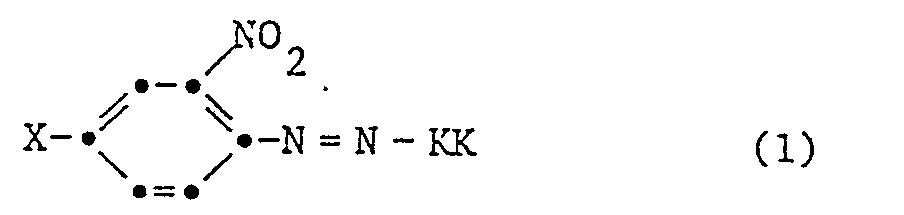
- the invention relates to new dye mixtures, processes for their preparation and their use for dyeing and printing textile materials.
- Dyes of the formula are likewise known in which X and KK have the meaning given and Y is chlorine or bromine.
- the dyes of formula (2) require a relatively complex synthesis and show undesirable "catalytic fading".
- dye mixtures consisting of 75 to 99% by weight of a dye of the formula (1) and 1 to 25% by weight of a dye of the formula (2) show better absorption than the individual dyes and also "catalytic fading "not or only to a tolerable extent.
- the present invention relates to dye mixtures consisting of 75 to 99% by weight of a dye of the formula wherein X is hydrogen, chlorine, bromine or methyl and KK means the rest of a coupling component free of water-solubilizing groups, and 1 to 25% by weight of a dye of the formula wherein X and KK have the meaning given and Y is chlorine or bromine.
- Preferred dye mixtures consist of 85 to 95% by weight of a dye of the formula (1) and 5 to 15% by weight of a dye of the formula (2).
- X is hydrogen and especially chlorine.
- Suitable coupling components KK are the coupling components customary in azochemistry and known from the relevant literature, provided they do not contain any water-solubilizing groups, i.e. no ionic groups, e.g. contains no sulfo, carboxyl or quaternary ammonium groups (coupling components for dispersion azo dyes).
- Examples of the mentioned residues of coupling components KK are residues from the series of the acylacetarylamides, phenols, pyridones, quinolines, pyrazoles, indoles, diphenylamines, anilines, aminopyridines, pyrimidines, pyrimidones, naphthols, naphthylamines, aminothiazoles, thiophenes or hydroxypyridines.
- residues KK are those from the series of acetoacetanilides, phenols, anilines, diphenylamines, naphthylamines, naphthols, indoles, quinolines, pyridones, pyrazoles, quinolones, aminopyridines, in particular 2,6-diaminopyridines, the heterocyclic KKs mentioned being preferred, especially those from the series of the aminopyrazoles, pyrazolones or especially the pyridones.
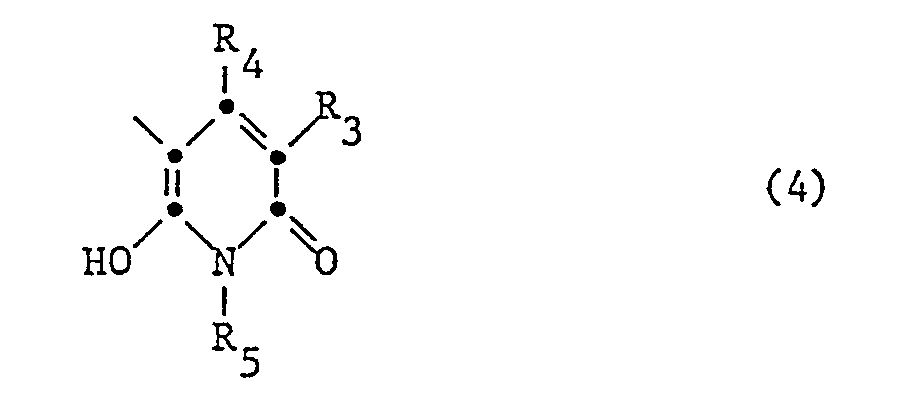
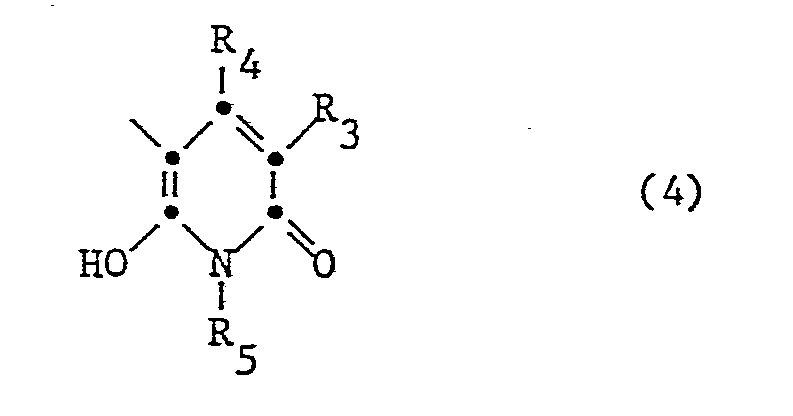
- KK radicals from the pyridone series are those of the formula wherein R3 is alkyl, CN, CONH2 or SO2NH2, R4 alkyl and R5 are hydrogen, alkenyl, aryl or preferably optionally substituted C1-C8-Aklyl.
- alkyl groups are referred to as such in the above definitions or as "optionally substituted” in composite groups, unless otherwise stated, substituents are used, e.g. the following in question: hydroxy, cyano, halogen (e.g. chlorine, bromine), C1-C4alkoxy, phenoxy or phenyl (both optionally substituted 1 to 3 times by halogen, methyl or methoxy), amino, alkylamino or dialkylamino.
- the alkyl groups as such or in composite groups preferably have 1 to 8, in particular 1 to 4, carbon atoms, alkenyl groups preferably 2 to 8, in particular 2 to 4, carbon atoms and cycloalkyl groups preferably 5 or 6 carbon atoms.
- Aryl is preferably understood to mean naphthyl and especially phenyl, which is unsubstituted or substituted, for example, by C1-C4-alkyl, C1-C4-alkoxy or halogen.
- the particularly preferred coupling components KK are 1-phenyl-3-methylpyrazolon-5 and 1-ethyl-3-cyano-4-methyl-6-hydroxypyridon-2.
- the coupling components are known.
- Another object of the present invention is a process for the preparation of dye mixtures consisting of 75 to 90% by weight of a dye of the formula wherein X is hydrogen, chlorine, bromine or methyl and KK represents the remainder of a coupling component free of water-solubilizing groups, and 1 to 25% by weight of a dye of the formula wherein X and KK have the meaning given and Y is chlorine or bromine, characterized in that an amine of the formula diazotized in an aqueous hydrohalic acid of the formula HY, then aftertreated after the addition of further hydrohalic acid HY at 20 to 50 ° C. for 0.5 to 10 hours and finally the diazonium salt solution obtained is coupled to a coupling component H-KK.
- the diazotization and coupling reaction can be carried out by conventional methods such as e.g. described in Ullmann's Encyclopedia of Industrial Chemistry, Volume 5 (1954), page 783 ff.
- the amine of the formula (5) is diazotized with an alkali metal nitrite, e.g. with sodium nitrite, in an acidic medium.
- the purpose of the diazotization is at temperatures from -10 to 40 ° C, e.g. from room temperature ( ⁇ 15 ° C) to 35 ° C.
- hydrohalic acid HY is added, preferably 0.5 to 3 mol, in particular 0.5 to 1 mol, per mol of diazonium salt and an aftertreatment is carried out. This consists e.g. in shaking or stirring the diazonium salt solution at 20 to 50 ° C, preferably 25 to 45 ° C for 0.5 to 10, preferably for 1 to 6 hours. It is then coupled to an H-KK coupling component. During the aftertreatment, the nitro group is partially replaced by halogen. This exchange takes place to a small extent even with slow diazotization.
- the coupling of the diazotized amine to the coupling component also takes place in a known manner, for example in an acidic, aqueous or aqueous-organic medium, advantageously at temperatures from -10 to 30 ° C., in particular below 10 ° C.
- the acids used are, for example, hydrochloric acid, acetic acid, sulfuric acid or phosphoric acid.
- Diazotization and coupling can be carried out, for example, in a one-pot process, that is to say in the same reaction medium.
- the dye mixture obtained is then worked up in a conventional manner.
- Another method for producing the dye mixtures according to the invention is that the dyes of the formulas (1) and (2) are combined and mixed or melted with one another. It is advantageous to add dispersants, for example those of an anionic or nonionic nature, and water to the mixture and to grind the mixture with the aid of grinding aids (e.g. glass balls) to form a ready-to-use dispersion.
- dispersants for example those of an anionic or nonionic nature
- the individual components are ground in the manner described above with dispersant and water and only the resulting dispersions are mixed, which likewise leads to ready-to-use dispersions of the dye mixtures according to the invention.
- Anionic dispersants which are suitable for the above process are, for example, condensation products of naphthalene sulfonic acids and formaldehyde, in particular dinaphthalene methane disulfonates or modified lignin sulfonates.
- Suitable nonionic dispersants are e.g. Addition products of about 3 to 40 moles of ethylene oxide with alkylphenols, fatty alcohols or fatty amines.
- the individual dyes are mixed together, they are melted together to form a homogeneous melt, which is then allowed to cool and, if appropriate, ground with anionic or nonionic dispersants, as described above. In this way, ready-to-use dispersions of the dye mixtures according to the invention are also obtained.
- the dye mixtures according to the invention are used for dyeing and printing textile materials which can be dyed with disperse dyes. Before they are used, the dye mixtures are advantageously converted into dye preparations, if this has not already been done during production. For this purpose, they can be crushed so that their particle size is on average between 0.01 and 10 ⁇ m. The comminution can take place in the presence of dispersants.
- the dried dye mixture is ground with a dispersant or kneaded in paste form with a dispersant and then dried in vacuo or by atomization.
- the preparations thus obtained can be dyed, padded or printed in a long liquor (liquor ratio greater than 1: 5) or in a short liquor (liquor ratio 1: 1 to 1: 5).
- the new dyestuff mixes excellently from aqueous suspension or dispersion on textile materials made from fully synthetic or semi-synthetic high-molecular substances. They are particularly suitable for dyeing, padding or printing fibers, threads or nonwovens, woven or knitted fabrics, in particular fibers, from linear, aromatic polyesters. These are generally polycondensation products from terephthalic acid and glycols, especially ethylene glycol, or polycondensation products from terephthalic acid and 1,4-bis (hydroxymethyl) hexahydrobenzene.
- polyester fibers are dyed, for example, by processes known per se in the presence of carriers at temperatures between about 80 and 125 ° C., or in the absence of carriers under pressure at about 100 to 140 ° C. by the exhaust process. Furthermore, these fibers can be padded or printed with the aqueous dispersions of the dye mixtures and the impregnation obtained can be fixed at about 140 ° to 230 ° C, e.g. with the help of water vapor, contact heat or hot air.
- the usual dispersants already mentioned are added, which are preferably anionic or nonionic and can also be used in a mixture with one another.
- thickeners When padding and printing you can use the usual thickeners use, for example modified or unmodified natural products, for example alginates, British gum, gum arabic, crystal gum, locust bean gum, tragacanth, carboxymethyl cellulose, hydroxyethyl cellulose, starch or synthetic products, for example polyacrylamides or polyvinyl alcohols.
- modified or unmodified natural products for example alginates, British gum, gum arabic, crystal gum, locust bean gum, tragacanth, carboxymethyl cellulose, hydroxyethyl cellulose, starch or synthetic products, for example polyacrylamides or polyvinyl alcohols.
- the pH is adjusted to 4.5 to 5 in 30 minutes to complete the coupling with about 43 to 45 parts by volume of an aqueous 10N sodium hydroxide solution, and the mixture is stirred for a further 30 minutes.
- the coupling is complete when a violet dye no longer forms with soda-alkaline H-acid solution.
- the yellow suspension is then heated to 95 ° C. and stirred at 95 ° C. for 2 hours. After cooling to 60 ° C., the dye is filtered off, washed free of salt with hot water and dried to constant weight at 80 ° C. in a vacuum drying cabinet.
- the solution of the diazonium salt mixture described above in Example 1 is metered into a solution of 100 parts of water, 25 parts by volume of an aqueous 10N sodium hydroxide solution and 43.6 parts of 1-phenyl-3-methyl-pyrazolone- (5) at 15 to 20 ° C evenly in 20 minutes.
- the pH is adjusted to 4 to 4.5 in about 30 minutes with about 36 parts by volume of an aqueous 10N sodium hydroxide solution. Stir for another 30 minutes.
- the coupling is complete when a violet dye no longer forms with soda-alkaline H-acid solution.
- the yellow suspension is then heated to 90 ° C. and stirred at 90 ° C. for 1 hour. After cooling to 60 ° C the dye of the formula filtered off, washed free of salt with hot water and dried to constant weight at 80 ° C. in a vacuum drying cabinet.
- Y is a mixture of 75 to 99 NO2 and 25 to 1% Cl.
- Example 1 If the procedure is exactly as described in Example 1, but only 6.4 parts by volume of an aqueous 10N hydrochloric acid are added instead of 25 parts by volume after the diazotization, a dye mixture of the formula given in Example 1 is obtained if the procedure is otherwise the same. wherein Y is 67% and NO2 and 33% Cl.
Landscapes
- Chemical & Material Sciences (AREA)
- Chemical Kinetics & Catalysis (AREA)
- Organic Chemistry (AREA)
- Coloring (AREA)
Abstract
Farbstoffmischungen, bestehend aus 75 bis 99 Gew.% eines Farbstoffes der Formel

Description
Die Erfindung betrifft neue Farbstoffmischungen, Verfahren zu deren Herstellung sowie deren Verwendung zum Färben und Bedrucken von Textilmaterialien.The invention relates to new dye mixtures, processes for their preparation and their use for dyeing and printing textile materials.
Farbstoffe der Formel

Ebenso sind Farbstoffe der Formel

Es wurde nun gefunden, dass überraschenderweise Farbstoffmischungen, bestehend aus 75 bis 99 Gew.% eines Farbstoffes der Formel (1) und 1 bis 25 Gew.% eines Farbstoffes der Formel (2) ein besseres Aufziehen zeigen als die Einzelfarbstoffe und ausserdem "Catalytic Fading" nicht oder nur in tolerierbarem Masse zeigen.It has now been found that, surprisingly, dye mixtures consisting of 75 to 99% by weight of a dye of the formula (1) and 1 to 25% by weight of a dye of the formula (2) show better absorption than the individual dyes and also "catalytic fading "not or only to a tolerable extent.
Gegenstand der vorliegenden Erfindung sind Farbstoffmischungen, bestehend aus 75 bis 99 Gew.% eines Farbstoffes der Formel

X Wasserstoff, Chlor, Brom oder Methyl und
KK den Rest einer von wasserlöslichmachenden Gruppen freien Kupplungskomponente bedeutet,
und 1 bis 25 Gew.% eines Farbstoffes der Formel

X und KK die angegebene Bedeutung aufweisen und Y Chlor oder Brom ist.The present invention relates to dye mixtures consisting of 75 to 99% by weight of a dye of the formula
X is hydrogen, chlorine, bromine or methyl and
KK means the rest of a coupling component free of water-solubilizing groups,
and 1 to 25% by weight of a dye of the formula
X and KK have the meaning given and Y is chlorine or bromine.
Bevorzugte Farbstoffmischungen bestehen aus 85 bis 95 Gew.% eines Farbstoffes der Formel (1) und 5 bis 15 Gew.% eines Farbstoffes der Formel (2).Preferred dye mixtures consist of 85 to 95% by weight of a dye of the formula (1) and 5 to 15% by weight of a dye of the formula (2).
Die bevorzugte Bedeutung von X ist Wasserstoff und vor allem Chlor.The preferred meaning of X is hydrogen and especially chlorine.
Als Kupplungskomponente KK kommen die in der Azochemie üblichen und aus der einschlägigen Literatur bekannten Kupplungskomponenten in Frage, sofern sie keine wasserlöslichmachenden Gruppen, also keine ionischen Gruppen, z.B. keine Sulfo-, Carboxyl- oder quaternären Ammoniumgruppen, enthalten (Kupplungskomponenten für Dispersions-Azofarbstoffe).Suitable coupling components KK are the coupling components customary in azochemistry and known from the relevant literature, provided they do not contain any water-solubilizing groups, i.e. no ionic groups, e.g. contains no sulfo, carboxyl or quaternary ammonium groups (coupling components for dispersion azo dyes).
Aus der Vielzahl der Möglichkeiten seien beispielsweise erwähnt: Kupplungskomponenten der Benzolreihe, der Naphthalinreihe, der offenkettigen methylenaktiven Verbindungen (wie z.B. der Acylacetarylamide) sowie der heterocyclischen Reihe. Die heterocyclischen Kupplungskomponenten sind bevorzugt.From the multitude of possibilities, examples may be mentioned: coupling components of the benzene series, the naphthalene series, the open-chain methylene-active compounds (such as, for example, the acylacetarylamides) and the heterocyclic series. The heterocyclic coupling components are preferred.
Beispiele für die genannten Reste von Kupplungskomponenten KK sind Reste aus der Reihe der Acylacetarylamide, Phenole, Pyridone, Chinoline, Pyrazole, Indole, Diphenylamine, Aniline, Aminopyridine, Pyrimidine, Pyrimidone, Naphthole, Naphthylamine, Aminothiazole, Thiophene oder Hydroxypyridine.Examples of the mentioned residues of coupling components KK are residues from the series of the acylacetarylamides, phenols, pyridones, quinolines, pyrazoles, indoles, diphenylamines, anilines, aminopyridines, pyrimidines, pyrimidones, naphthols, naphthylamines, aminothiazoles, thiophenes or hydroxypyridines.
Besonders zu erwähnende Reste KK sind solche aus der Reihe der Acetoacetanilide, Phenole, Aniline, Diphenylamine, Naphthylamine, Naphthole, Indole, Chinoline, Pyridone, Pyrazole, Chinolone, Aminopyridine, insbesondere 2,6-Diaminopyridine, wobei die genannten heterocyclischen KK bevorzugt sind, insbesondere jene aus der Reihe der Aminopyrazole, Pyrazolone oder vor allem der Pyridone.Particularly noteworthy residues KK are those from the series of acetoacetanilides, phenols, anilines, diphenylamines, naphthylamines, naphthols, indoles, quinolines, pyridones, pyrazoles, quinolones, aminopyridines, in particular 2,6-diaminopyridines, the heterocyclic KKs mentioned being preferred, especially those from the series of the aminopyrazoles, pyrazolones or especially the pyridones.
Bei den Aminopyrazolen und Pyrazolonen handelt es sich vor allem um solche der Formel

Beispiele für Reste KK aus der Pyridonreihe sind solche der Formel
Soweit in obigen Definitionen Alkylgruppen als solche oder in zusammengesetzten Gruppen als "gegebenenfalls substituiert" bezeichnet sind, kommen als Substituenten, sofern nichts anderes angegeben ist, z.B. folgende in Frage: Hydroxy, Cyano, Halogen (z.B. Chlor, Brom), C₁-C₄-Alkoxy, Phenoxy oder Phenyl (beide gegebenenfalls 1- bis 3fach substituiert durch Halogen, Methyl oder Methoxy), Amino, Alkylamino oder Dialkylamino. Die Alkylgruppen als solche oder in zusammengesetzten Gruppen weisen vorzugsweise 1 bis 8, insbesondere 1 bis 4, C-Atome, Alkenylgruppen vorzugsweise 2 bis 8, insbesondere 2 bis 4, C-Atome und Cycloalkylgruppen vorzugsweise 5 oder 6 C-Atome auf.Insofar as alkyl groups are referred to as such in the above definitions or as "optionally substituted" in composite groups, unless otherwise stated, substituents are used, e.g. the following in question: hydroxy, cyano, halogen (e.g. chlorine, bromine), C₁-C₄alkoxy, phenoxy or phenyl (both optionally substituted 1 to 3 times by halogen, methyl or methoxy), amino, alkylamino or dialkylamino. The alkyl groups as such or in composite groups preferably have 1 to 8, in particular 1 to 4, carbon atoms, alkenyl groups preferably 2 to 8, in particular 2 to 4, carbon atoms and cycloalkyl groups preferably 5 or 6 carbon atoms.
Unter Aryl wird vorzugsweise Naphthyl und insbesondere Phenyl verstanden, welches unsubstituiert oder beispielsweise durch C₁-C₄-Alkyl, C₁-C₄-Alkoxy oder Halogen substituiert ist.Aryl is preferably understood to mean naphthyl and especially phenyl, which is unsubstituted or substituted, for example, by C₁-C₄-alkyl, C₁-C₄-alkoxy or halogen.
Die besonders bevorzugten Kupplungskomponenten KK sind 1-Phenyl-3-methylpyrazolon-5 und 1-Ethyl-3-cyan-4-methyl-6-hydroxypyridon-2.The particularly preferred coupling components KK are 1-phenyl-3-methylpyrazolon-5 and 1-ethyl-3-cyano-4-methyl-6-hydroxypyridon-2.
Die Kupplungskomponenten sind bekannt.The coupling components are known.
Einen weiteren Gegenstand der vorliegenden Erfindung bildet ein Verfahren zur Herstellung von Farbstoffmischungen, bestehend aus 75 bis 90 Gew.% eines Farbstoffes der Formel


Die Diazotierung- und Kupplungsreaktion kann nach üblichen Methoden durchgeführt werden, wie z.B. beschrieben in Ullmann's Enzyclopädie der technischen Chemie, Band 5 (1954), Seite 783 ff. Beispielsweise erfolgt die Diazotierung des Amins der Formel (5) mit einem Alkalinitrit, z.B. mit Natriumnitrit, in saurem Medium.Zweckmässig wird die Diazotierung bei Temperaturen von -10 bis 40°C, z.B. von Raumtemperatur (∼ 15°C) bis 35°C, durchgeführt.The diazotization and coupling reaction can be carried out by conventional methods such as e.g. described in Ullmann's Encyclopedia of Industrial Chemistry, Volume 5 (1954), page 783 ff. For example, the amine of the formula (5) is diazotized with an alkali metal nitrite, e.g. with sodium nitrite, in an acidic medium. The purpose of the diazotization is at temperatures from -10 to 40 ° C, e.g. from room temperature (∼ 15 ° C) to 35 ° C.
Im Anschluss an die Diazotierung gibt man weitere Halogenwasserstoffsäure HY zu, vorzugsweise 0,5 bis 3 Mol, insbesondere 0,5 bis 1 Mol, je Mol Diazoniumsalz und führt eine Nachbehandlung durch. Diese besteht z.B. im Schütteln oder Rühren der Diazoniumsalzlösung bei 20 bis 50°C, vorzugsweise 25 bis 45°C während 0,5 bis 10, vorzugsweise während 1 bis 6 Stunden. Anschliessend wird auf eine Kupplungskomponente H-KK gekuppelt. Während der Nachbehandlung erfolgt ein teilweiser Austausch der Nitrogruppe gegen Halogen. Dieser Austausch findet in geringem Masse auch bei langsamer Diazotierung statt.Following the diazotization, further hydrohalic acid HY is added, preferably 0.5 to 3 mol, in particular 0.5 to 1 mol, per mol of diazonium salt and an aftertreatment is carried out. This consists e.g. in shaking or stirring the diazonium salt solution at 20 to 50 ° C, preferably 25 to 45 ° C for 0.5 to 10, preferably for 1 to 6 hours. It is then coupled to an H-KK coupling component. During the aftertreatment, the nitro group is partially replaced by halogen. This exchange takes place to a small extent even with slow diazotization.
Die Kupplung des diazotierten Amins auf die Kupplungskomponente erfolgt ebenfalls in bekannter Weise, beispielsweise in saurem, wässrigem oder wässrig-organischem Medium, vorteilhaft bei Temperaturen von -10 bis 30°C, insbesondere unter 10°C. Als Säuren verwendet man z.B. Salzsäure, Essigsäure, Schwefelsäure oder Phosphorsäure. Diazotierung und Kupplung kann beispielsweise im Eintopfverfahren, also im gleichen Reaktionsmedium, durchgeführt werden. Anschliessend wird die erhaltene Farbstoffmischung auf übliche Weise aufgearbeitet.The coupling of the diazotized amine to the coupling component also takes place in a known manner, for example in an acidic, aqueous or aqueous-organic medium, advantageously at temperatures from -10 to 30 ° C., in particular below 10 ° C. The acids used are, for example, hydrochloric acid, acetic acid, sulfuric acid or phosphoric acid. Diazotization and coupling can be carried out, for example, in a one-pot process, that is to say in the same reaction medium. The dye mixture obtained is then worked up in a conventional manner.
Eine weitere Methode zur Herstellung der erfindungsgemässen Farbstoffmischungen besteht darin, dass man die Farbstoffe der Formel (1) und (2) zusammengibt und miteinander vermischt oder schmilzt. Vorteilhaft setzt man der Mischung noch Dispergiermittel, zum Beispiel solche anionischer oder nichtionischer Natur, sowie Wasser zu und vermahlt die Mischung mit Hilfe von Mahlhilfsmitteln (z.B. Glaskugeln) zu einer gebrauchsfertigen Dispersion.Another method for producing the dye mixtures according to the invention is that the dyes of the formulas (1) and (2) are combined and mixed or melted with one another. It is advantageous to add dispersants, for example those of an anionic or nonionic nature, and water to the mixture and to grind the mixture with the aid of grinding aids (e.g. glass balls) to form a ready-to-use dispersion.
Alternativ können z.B. auch die einzelnen Komponenten (Einzelfarbstoffe) in der vorstehend beschriebenen Weise mit Dispergiermittel und Wasser vermahlen und erst die resultierenden Dispersionen gemischt werden, wodurch man ebenfalls zu gebrauchsfertigen Dispersionen der erfindungsgemässen Farbstoffmischungen kommt.Alternatively, e.g. also the individual components (individual dyes) are ground in the manner described above with dispersant and water and only the resulting dispersions are mixed, which likewise leads to ready-to-use dispersions of the dye mixtures according to the invention.
Anionische Dispergiermittel, die für obiges Verfahren in Betracht kommen, sind beispielsweise Kondensationsprodukte aus Naphthalinsulfonsäuren und Formaldehyd, insbesondere Dinaphthalinmethandisulfonate oder modifizierte Ligninsulfonate. Geeignete nichtionische Dispergiermittel sind z.B. Anlagerungsprodukte von etwa 3 bis 40 Mol Aethylenoxid an Alkylphenole, Fettalkohole oder Fettamine.Anionic dispersants which are suitable for the above process are, for example, condensation products of naphthalene sulfonic acids and formaldehyde, in particular dinaphthalene methane disulfonates or modified lignin sulfonates. Suitable nonionic dispersants are e.g. Addition products of about 3 to 40 moles of ethylene oxide with alkylphenols, fatty alcohols or fatty amines.
Sofern man die Einzelfarbstoffe durch Zusammenschmelzen vermischt, werden diese zu einer homogenen Schmelze zusammengeschmolzen, die man anschliessend abkühlen lässt und gegebenenfalls mit anionischen oder nichtionischen Dispergiermitteln vermahlt, wie oben beschrieben. Auf diese Weise erhält man ebenfalls gebrauchsfertige Dispersionen der erfindungsgemässen Farbstoffmischungen.If the individual dyes are mixed together, they are melted together to form a homogeneous melt, which is then allowed to cool and, if appropriate, ground with anionic or nonionic dispersants, as described above. In this way, ready-to-use dispersions of the dye mixtures according to the invention are also obtained.
Verwendung finden die erfindungsgemässen Farbstoffmischungen zum Färben und Bedrucken von Textilmaterialien, welche mit Dispersionsfarbstoffen färbbar sind. Vor ihrer Verwendung werden die Farbstoffgemische vorteilhaft, sofern dies bei der Herstellung nicht schon geschah, in Farbstoffpräparate übergeführt. Hierzu kann man sie zerkleinern, so dass ihre Teilchengrösse im Mittel zwischen 0,01 und 10 µm beträgt. Das Zerkleinern kann in Gegenwart von Dispergiermitteln erfolgen.The dye mixtures according to the invention are used for dyeing and printing textile materials which can be dyed with disperse dyes. Before they are used, the dye mixtures are advantageously converted into dye preparations, if this has not already been done during production. For this purpose, they can be crushed so that their particle size is on average between 0.01 and 10 µm. The comminution can take place in the presence of dispersants.
Beispielsweise wird das getrocknete Farbstoffgemisch mit einem Dispergiermittel gemahlen oder in Pastenform mit einem Dispergiermittel geknetet und hierauf im Vakuum oder durch Zerstäuben getrocknet. Mit den so erhaltenen Präparaten kan man, nach Zugabe von Wasser, in langer Flotte (Flottenverhältnis grösser als 1:5) oder kurzer Flotte (Flottenverhältnis 1:1 bis 1:5) färben, klotzen oder bedrucken.For example, the dried dye mixture is ground with a dispersant or kneaded in paste form with a dispersant and then dried in vacuo or by atomization. After the addition of water, the preparations thus obtained can be dyed, padded or printed in a long liquor (liquor ratio greater than 1: 5) or in a short liquor (liquor ratio 1: 1 to 1: 5).
Die neuen Farbstoffmischungen ziehen aus wässriger Suspension oder Dispersion ausgezeichnet auf Textilmaterialien aus vollsynthetischen oder halbsynthetischen hochmolekularen Stoffen auf. Besonders geeignet sind sie zum Färben, Klotzen oder Bedrucken von Fasern, Fäden oder Vliesen, Geweben oder Gewirken, insbesondere Fasern, aus linearen, aromatischen Polyestern. Diese sind im allgemeinen Polykondensationsprodukt aus Terephthalsäure und Glykolen, besonders Aethylenglykol, oder Polykondensationsprodukte aus Terephthalsäure und 1,4-Bis-(hydroxymethyl)-hexahydrobenzol.The new dyestuff mixes excellently from aqueous suspension or dispersion on textile materials made from fully synthetic or semi-synthetic high-molecular substances. They are particularly suitable for dyeing, padding or printing fibers, threads or nonwovens, woven or knitted fabrics, in particular fibers, from linear, aromatic polyesters. These are generally polycondensation products from terephthalic acid and glycols, especially ethylene glycol, or polycondensation products from terephthalic acid and 1,4-bis (hydroxymethyl) hexahydrobenzene.
Man färbt die Polyesterfasern beispielsweise nach an sich bekannten Verfahren in Gegenwart von Carriern bei Temperaturen zwischen etwa 80 und 125°C, oder in Abwesenheit von Carriern unter Druck bei etwa 100 bis 140°C nach dem Ausziehverfahren. Ferner kann man diese Fasern mit den wässrigen Dispersionen der Farbstoffmischungen klotzen oder bedrucken und die erhaltene Imprägnierung bei etwa 140° bis 230°C fixieren, z.B. mit Hilfe von Wasserdampf, Kontakthitze oder heisser Luft.The polyester fibers are dyed, for example, by processes known per se in the presence of carriers at temperatures between about 80 and 125 ° C., or in the absence of carriers under pressure at about 100 to 140 ° C. by the exhaust process. Furthermore, these fibers can be padded or printed with the aqueous dispersions of the dye mixtures and the impregnation obtained can be fixed at about 140 ° to 230 ° C, e.g. with the help of water vapor, contact heat or hot air.
Meist gibt man die üblichen, bereits genannten Dispergiermittel zu, die vorzugsweise anionisch oder nichtionogen sind und auch im Gemisch miteinander verwendet werden können.Usually, the usual dispersants already mentioned are added, which are preferably anionic or nonionic and can also be used in a mixture with one another.
Beim Klotzen und Bedrucken kann man die üblichen Verdickungsmittel verwenden, z.B. modifizierte oder nichtmodifizierte natürliche Produkte, beispielsweise Alginate, Britischgummi, Gummi arabicum, Kristallgummi, Johannisbrotkernmehl, Tragant, Carboxymethylcellulose, Hydroxyäthylcellulose, Stärke oder synthetische Produkte, beispielsweise Polyacrylamide oder Polyvinylalkohole.When padding and printing you can use the usual thickeners use, for example modified or unmodified natural products, for example alginates, British gum, gum arabic, crystal gum, locust bean gum, tragacanth, carboxymethyl cellulose, hydroxyethyl cellulose, starch or synthetic products, for example polyacrylamides or polyvinyl alcohols.
In den nachfolgenden Beispielen beziehen sich die Teil- und Prozentangaben auf das Gewicht, sofern nichts anderes angegeben ist. Die Temperaturen sind in Grad Celsius angegeben.In the examples below, the parts and percentages relate to the weight, unless stated otherwise. The temperatures are given in degrees Celsius.
43,2 Teile 4-Chlor-2-nitroanilin werden in 120 Teilen Wasser mit 74 Vol.-Teilen einer wässrigen 10n-Salzsäure versetzt. Dann werden 0,3 Vol.-Teile eines gebräuchlichen Netzmittels zugesetzt und 1 Stunde bei Raumtemperatur gerührt. Dann diazotiert man bei ansteigender Temperatur über einen Zeitraum von 20 Minuten durch gleichmässige Zugabe von insgesamt 63 Vol.-Teilen einer wässrigen 4n-Natriumnitritlösung. Während der Diazotierung steigt die Temperatur des Reaktionsgemisches auf 30 bis 33°C an. Es werden nun weitere 25 Vol.-Teile einer wässrigen 10n-Salzsäure zugegeben und 5 Stunden bei 40°C im Wasserbad gerührt. Dann wird mit 5 g Kieselgur geklärt und man erhält eine gelb gefärbte Lösung der Diazoniumsalzmischung. Diese Lösung wird bei 20 bis 25°C in 30 Minuten gleichmässig zu einer Lösung aus 250 Vol.-Teilen Wasser, 25 Vol.-Teilen einer wässrigen 10n-Natronlauge und 45,4 Gew.-Teilen 3-Cyan-1-ethyl-6-hydroxy-4-methyl-2-pyridon gegeben.43.2 parts of 4-chloro-2-nitroaniline in 120 parts of water are mixed with 74 parts by volume of an aqueous 10N hydrochloric acid. Then 0.3 part by volume of a customary wetting agent is added and the mixture is stirred at room temperature for 1 hour. Then diazotized at increasing temperature over a period of 20 minutes by evenly adding a total of 63 parts by volume of an aqueous 4N sodium nitrite solution. During the diazotization, the temperature of the reaction mixture rises to 30 to 33 ° C. A further 25 parts by volume of an aqueous 10N hydrochloric acid are then added and the mixture is stirred in a water bath at 40 ° C. for 5 hours. Then it is clarified with 5 g of diatomaceous earth and a yellow colored solution of the diazonium salt mixture is obtained. This solution is uniformly at 20 to 25 ° C in 30 minutes to a solution of 250 parts by volume of water, 25 parts by volume of an aqueous 10N sodium hydroxide solution and 45.4 parts by weight of 3-cyan-1-ethyl Given 6-hydroxy-4-methyl-2-pyridone.
Nach der Diazozugabe stellt man zur Vervollständigung der Kupplung mit ca. 43 bis 45 Vol.-Teilen einer wässrigen 10n-Natronlauge den pH in 30 Minuten auf 4,5 bis 5 und rührt weitere 30 Minuten nach. Die Kupplung ist beendet, wenn sich mit sodaalkalischer H-Säure-Lösung kein violetter Farbstoff mehr bildet.After the addition of diazo, the pH is adjusted to 4.5 to 5 in 30 minutes to complete the coupling with about 43 to 45 parts by volume of an aqueous 10N sodium hydroxide solution, and the mixture is stirred for a further 30 minutes. The coupling is complete when a violet dye no longer forms with soda-alkaline H-acid solution.
Die gelbe Suspension wird anschliessend auf 95°C geheizt und 2 Stunden bei 95°C gerührt. Nach Abkühlen auf 60°C wird der Farbstoff abfiltriert, mit heissem Wasser salzfrei gewaschen und bei 80°C im Vakuumtrockenschrank bis zur Gewichtskonstanz getrocknet.The yellow suspension is then heated to 95 ° C. and stirred at 95 ° C. for 2 hours. After cooling to 60 ° C., the dye is filtered off, washed free of salt with hot water and dried to constant weight at 80 ° C. in a vacuum drying cabinet.
Ausbeute: 85 bis 87 g eines hellgelben Pulvers der Formel
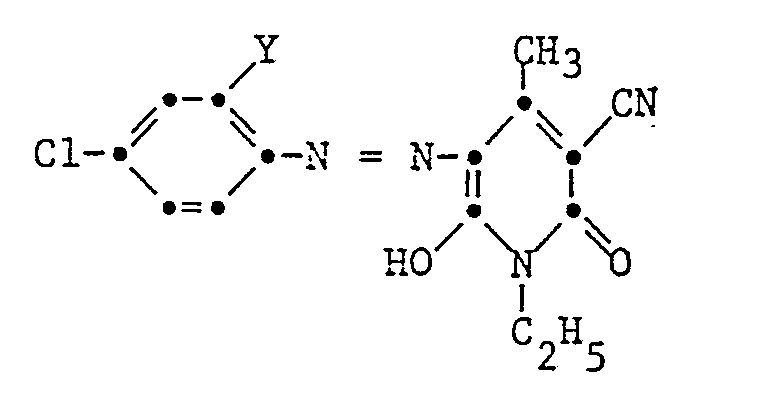
welches nach entsprechender Aufbereitung Polyester in einem brillanten Gelb anfärbt und "Catalytic Fading" nur in tolerierbarem Masse zeigt.Yield: 85 to 87 g of a light yellow powder of the formula
which, after appropriate preparation, dyes polyester in a brilliant yellow and shows "catalytic fading" only to a tolerable extent.
Man dosiert die vorstehend unter Beispiel 1 beschriebene Lösung der Diazoniumsalzmischung zu einer Lösung aus 100 Teilen Wasser, 25 Vol.-Teilen einer wässrigen 10n-Natronlauge und 43,6 Teilen 1-Phenyl-3-methyl-pyrazolon-(5) bei 15 bis 20°C in 20 Minuten gleichmässig zu.The solution of the diazonium salt mixture described above in Example 1 is metered into a solution of 100 parts of water, 25 parts by volume of an aqueous 10N sodium hydroxide solution and 43.6 parts of 1-phenyl-3-methyl-pyrazolone- (5) at 15 to 20 ° C evenly in 20 minutes.
Zur Vervollständigung der Kupplung wird der pH mit ca. 36 Vol.-Teilen einer wässrigen 10n-Natronlauge in 30 Minuten auf 4 bis 4,5 gestellt. Man rührt noch 30 Minuten nach. Die Kupplung ist beendet, wenn sich mit sodaalkalischer H-Säure-Lösung kein violetter Farbstoff mehr bildet.To complete the coupling, the pH is adjusted to 4 to 4.5 in about 30 minutes with about 36 parts by volume of an aqueous 10N sodium hydroxide solution. Stir for another 30 minutes. The coupling is complete when a violet dye no longer forms with soda-alkaline H-acid solution.
Die gelbe Suspension wird anschliessend auf 90°C geheizt und 1 Stunde bei 90°C gerührt. Nach Abkühlen auf 60°C wird der Farbstoff der Formel

Ausbeute: 76 bis 78 g eines orangefarbenen Pulvers, welches nach entsprechender Aufbereitung Polyester in einem rotstichigen Gelb anfärbt.Yield: 76 to 78 g of an orange powder which, after appropriate preparation, dyes polyester in a reddish yellow.
Arbeitet man wie im Beispiel 1 beschrieben, verwendet jedoch die in Spalte 2 der folgenden Tabelle aufgeführten Diazokomponenten und die in Spalte 3 aufgeführten Kupplungskomponenten so erhält man die in Spalte 3 aufgeführten Azofarbstoffe. Y bedeutet jeweils ein Gemisch von 75 bis 99 NO₂ und 25 bis 1 % Cl.

Arbeitet man genau wie im Beispiel 1 beschrieben, setzt jedoch nach der Diazotierung nur 6.4 Vol.-Teil einer wässrigen 10n-Salzsäure anstelle von 25 Vol.-Teilen zu, so erhält man bei ansonsten gleicher Arbeitsweise eine Farbstoffmischung der im Beispiel 1 angegebenen Formel, worin Y 67 % und NO₂ und 33 % Cl bedeutet.If the procedure is exactly as described in Example 1, but only 6.4 parts by volume of an aqueous 10N hydrochloric acid are added instead of 25 parts by volume after the diazotization, a dye mixture of the formula given in Example 1 is obtained if the procedure is otherwise the same. wherein Y is 67% and NO₂ and 33% Cl.
Claims (20)

X Wasserstoff, Chlor, Brom oder Methyl und
KK den Rest einer von wasserlöslichmachenden Gruppen freien Kupplungskomponente bedeutet,
und 1 bis 25 Gew.% eines Farbstoffes der Formel

X und KK die angegebene Bedeutung aufweisen und
Y Chlor oder Brom ist.1. dye mixtures consisting of 75 to 99% by weight of a dye of the formula
X is hydrogen, chlorine, bromine or methyl and
KK means the rest of a coupling component free of water-solubilizing groups,
and 1 to 25% by weight of a dye of the formula
X and KK have the meaning given and
Y is chlorine or bromine.



Applications Claiming Priority (2)
| Application Number | Priority Date | Filing Date | Title |
|---|---|---|---|
| CH131986 | 1986-04-04 | ||
| CH1319/86 | 1986-04-04 |
Publications (2)
| Publication Number | Publication Date |
|---|---|
| EP0240465A2 true EP0240465A2 (en) | 1987-10-07 |
| EP0240465A3 EP0240465A3 (en) | 1990-07-25 |
Family
ID=4207659
Family Applications (1)
| Application Number | Title | Priority Date | Filing Date |
|---|---|---|---|
| EP87810186A Ceased EP0240465A3 (en) | 1986-04-04 | 1987-03-30 | Dye mixtures |
Country Status (3)
| Country | Link |
|---|---|
| US (1) | US4731094A (en) |
| EP (1) | EP0240465A3 (en) |
| JP (1) | JPS62236864A (en) |
Cited By (2)
| Publication number | Priority date | Publication date | Assignee | Title |
|---|---|---|---|---|
| EP0425434A3 (en) * | 1989-10-23 | 1992-01-02 | Ciba-Geigy Ag | Dyestuff mixtures and their use |
| WO1993002145A1 (en) * | 1991-07-23 | 1993-02-04 | Engelhard Corporation | Mixed coupled azo pigments |
Families Citing this family (1)
| Publication number | Priority date | Publication date | Assignee | Title |
|---|---|---|---|---|
| FR2917736B1 (en) * | 2007-06-22 | 2009-09-11 | Oreal | AZOIC DERIVATIVES WITH PYRAZOLINONE PATTERN FOR COLORING KERATIN FIBERS |
Family Cites Families (3)
| Publication number | Priority date | Publication date | Assignee | Title |
|---|---|---|---|---|
| US83553A (en) * | 1868-10-27 | Improvement in hot-water heaters | ||
| US2237768A (en) * | 1937-07-28 | 1941-04-08 | Du Pont | Production of azo colors |
| DE3012863A1 (en) * | 1980-04-02 | 1981-10-08 | Cassella Ag, 6000 Frankfurt | DYE MIXTURE, METHOD FOR THEIR PRODUCTION, DYES CONTAINING IT AND METHOD FOR COLORING AND PRINTING SYNTHETIC, HYDROPHOBIC FIBER MATERIAL |
-
1987
- 1987-03-30 EP EP87810186A patent/EP0240465A3/en not_active Ceased
- 1987-04-01 US US07/033,322 patent/US4731094A/en not_active Expired - Fee Related
- 1987-04-04 JP JP62082242A patent/JPS62236864A/en active Pending
Cited By (3)
| Publication number | Priority date | Publication date | Assignee | Title |
|---|---|---|---|---|
| EP0425434A3 (en) * | 1989-10-23 | 1992-01-02 | Ciba-Geigy Ag | Dyestuff mixtures and their use |
| WO1993002145A1 (en) * | 1991-07-23 | 1993-02-04 | Engelhard Corporation | Mixed coupled azo pigments |
| USRE35654E (en) * | 1991-07-23 | 1997-11-11 | Engelhard Corporation | Mixed coupled azo pigments |
Also Published As
| Publication number | Publication date |
|---|---|
| US4731094A (en) | 1988-03-15 |
| JPS62236864A (en) | 1987-10-16 |
| EP0240465A3 (en) | 1990-07-25 |
Similar Documents
| Publication | Publication Date | Title |
|---|---|---|
| DE2844299C2 (en) | ||
| DE2106585A1 (en) | Aminothiodiazoles and thiodiazole azo dyes | |
| EP0038439B1 (en) | Dyestuff mixtures, method for their preparation, the component dyestuffs and their use in dyeing and printing synthetic, hydrophobic fibre material | |
| EP0699718A2 (en) | Azothiophene dyes with a 2,4,6-triamino-3-cyanopyridine coupling component | |
| EP0894830A2 (en) | Dispersion dyestuffs | |
| EP0240465A2 (en) | Dye mixtures | |
| DE2732384A1 (en) | NEW CATIONIC COLORS, THEIR PRODUCTION AND USE | |
| EP0152005B1 (en) | Mixtures of monoazo dyes | |
| DE2307169A1 (en) | AZO DYES | |
| DE2111734C3 (en) | Azo dyes and their uses | |
| DE1007451B (en) | Process for the preparation of monoazo dyes | |
| DE3001266A1 (en) | ALPHA -HYDRAZONO- ALPHA -PHENYL- ACETONITRILES, PROCESS FOR THEIR PRODUCTION AND THEIR USE AS DISPERSION DYES FOR DYING ARTIFICIAL OR SYNTHETIC MATERIALS | |
| DE2520123A1 (en) | PROCESS FOR THE PRODUCTION OF FORMAZAN METAL COMPLEX DYES | |
| DE1298661B (en) | Process for the preparation of disperse dyes that are difficult to dissolve in water | |
| EP0342158B1 (en) | Water soluble phthalocyanine compounds, process for their preparation and their use | |
| EP0342159B1 (en) | Water soluble phthalocyanine compounds, process for their preparation and their use | |
| EP0185620A2 (en) | Monoazo compounds | |
| DE2922227A1 (en) | METHOD OF MANUFACTURING AZO DYES | |
| DE2355967A1 (en) | POLYCYCLIC COLORS, METHOD FOR MANUFACTURING AND USING them | |
| CH505880A (en) | Slightly water sol azo dyes | |
| CH654589A5 (en) | DYE MIXTURES. | |
| CH478192A (en) | Process for the production of dyes of the anthraquinone series that are sparingly soluble in water | |
| DE1941542C (en) | Polycych dyes, processes for their production and their use | |
| DE1214816B (en) | Process for the preparation of sulfamide monoazo dyes and their metal complex compounds | |
| DE1644245C (en) | Difficult to dissolve in water before azo dyes and processes for their manufacture and use |
Legal Events
| Date | Code | Title | Description |
|---|---|---|---|
| PUAI | Public reference made under article 153(3) epc to a published international application that has entered the european phase |
Free format text: ORIGINAL CODE: 0009012 |
|
| 17P | Request for examination filed |
Effective date: 19870401 |
|
| AK | Designated contracting states |
Kind code of ref document: A2 Designated state(s): BE CH DE FR GB IT LI |
|
| PUAL | Search report despatched |
Free format text: ORIGINAL CODE: 0009013 |
|
| AK | Designated contracting states |
Kind code of ref document: A3 Designated state(s): BE CH DE FR GB IT LI |
|
| 17Q | First examination report despatched |
Effective date: 19920207 |
|
| STAA | Information on the status of an ep patent application or granted ep patent |
Free format text: STATUS: THE APPLICATION HAS BEEN REFUSED |
|
| 18R | Application refused |
Effective date: 19930220 |
|
| RIN1 | Information on inventor provided before grant (corrected) |
Inventor name: KAISER, HELGA, DR. Inventor name: EUGSTER, PETER ERNST, DR. Inventor name: ANGLIKER, HANS-JOERG, DR. |