EP0231998A1 - Baumaterial und Verfahren zu seiner Herstellung - Google Patents
Baumaterial und Verfahren zu seiner Herstellung Download PDFInfo
- Publication number
- EP0231998A1 EP0231998A1 EP87300083A EP87300083A EP0231998A1 EP 0231998 A1 EP0231998 A1 EP 0231998A1 EP 87300083 A EP87300083 A EP 87300083A EP 87300083 A EP87300083 A EP 87300083A EP 0231998 A1 EP0231998 A1 EP 0231998A1
- Authority
- EP
- European Patent Office
- Prior art keywords
- pellets
- bloated
- mass
- skins
- sticky
- Prior art date
- Legal status (The legal status is an assumption and is not a legal conclusion. Google has not performed a legal analysis and makes no representation as to the accuracy of the status listed.)
- Withdrawn
Links
Images



Classifications
-
- C—CHEMISTRY; METALLURGY
- C04—CEMENTS; CONCRETE; ARTIFICIAL STONE; CERAMICS; REFRACTORIES
- C04B—LIME, MAGNESIA; SLAG; CEMENTS; COMPOSITIONS THEREOF, e.g. MORTARS, CONCRETE OR LIKE BUILDING MATERIALS; ARTIFICIAL STONE; CERAMICS; REFRACTORIES; TREATMENT OF NATURAL STONE
- C04B38/00—Porous mortars, concrete, artificial stone or ceramic ware; Preparation thereof
- C04B38/0038—Porous mortars, concrete, artificial stone or ceramic ware; Preparation thereof by superficial sintering or bonding of particulate matter
Definitions
- This invention relates to building material, and more particularly to building material of light weight suitable inter alia for building blocks.
- the pellets bloat to form expanded balls as they become hot, each ball developing a vitrifying skin, flexible and tending to become sticky, which contains the gas bubbles and completes the bloating of the ball.
- the size of the balls can be generally controlled by varying the size of the pellets, that is to say small pellets produce small bloated balls whilst large pellets produce large balls.
- the aim during manufacture is to prevent the balls coming into contact with one another so that clean, separate, expanded balls emerge, cooled and hard, at the end of the process. Sometimes, however, some of the balls do come accidentally into mutual contact during the firing and bloating process, and fuse together into a mass of slag in which their individual skins tend to be destroyed, such a mass being known in the trade as a "pig". These pigs are thrown out and are considered to be useless except for land-fill.
- bloating clay is ground to a uniform particle size and may then be mixed with water to form a slurry, is heated as a mass, placed in a mould, and thereafter subjected to further heating to form products which are vesicular, that is to say have a uniform structure of small cells.
- the object of the present invention is to utilise the phenomenon of bloating to produce building material having a novel and advantageous structure.
- building material comprises bloated pellets of bloatable material and is characterised in that said pellets are so compacted together that their vitrified skins fuse where they touch but remain intact and continue to enclose their foamed cores.
- a method of producing building material comprises the steps of forming pellets of bloatable material and firing them in a kiln of a type which tends to keep them apart at a temperature high enough to cause them to bloat but not so high as to cause them to melt, and is characterised by the further steps of ensuring that their skins are rendered sticky, compacting then together when bloated and whilst still hot, soft and sticky into a mass wherein their skins fuse where they touch but remain intact and continue to enclose their foamed cores, and allowing the mass to cool.
- building material for use for example as building blocks such as 10 is manufactured from bloating clay which is first formed into pellets of the requisite size. These pellets are fed into a kiln of a type which tends to keep them apart as hereinbefore described, and fired at a temperature high enough to cause them to bloat but not so high as to cause them to melt.
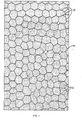
- the bloated pellets 11 thus produced have vitrifying skins 12, flexible and tending to become sticky, enclosing foamed cores 13. It is essential to ensure that the skins 12 are rendered sticky at this stage of the process for a sufficient period of time to enable fusing to be effectively achieved as hereinafter described.
- the skins 12 can be rendered sticky by precise temperature control. However, said period can be more readily controlled, whereby the production process is facilitated, by rendering the skins 12 sticky by coating the bloated pellets 11 with either a glaze or a clay slurry. If a coating material is employed which vitrifies at a lower temperature than the pellets, the coating will be vitrified by the residual heat of the pellets. Glazing the bloated pellets 11 has two further advantages - they fuse together more readily, and the finished product has an improved resistance to water absorption.
- the bloated pellets are next allowed to fall together, whilst they are still hot, soft and sticky, into the confines of at least one mould where they form a mass which is compacted under its own weight so that spaces between the pellets 11 tend to be somewhat reduced in size and the skins 12 of the pellets fuse together and deform where they touch but remain intact and continue to enclose the foamed cores 13 of the pellets.
- the mass is then allowed to cool and harden.
- the product can be improved by compacting the mass prior to cooling by the application of a positive pressure the maximum value of which is no greater than that which suffices to ensure that spaces between the pellets 11 are substantially eliminated.
- a positive pressure lower than said maximum value causes the size of the spaces between the pellets 11 to be proportionately reduced.
- Positive pressures of or lower than said maximum value still cause the skins 12 of the pellets to fuse together where they touch but remain intact and continue to enclose the foamed cores 13 of the pellets.
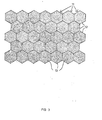
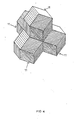
- a positive pressure of said maximum value applied equally from all sides, theoretically deforms the skins 12 into a structure comprising an assembly of rhombic dodecahedra (see Fig.
- one method of producing the building blocks 10 comprises first forming bloating clay into pellets of the requisite size by means of any suitable apparatus.
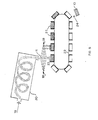
- the pellets are fed as indicated by the arrow 19 into a rotary kiln 20, fired at a suitable temperature so that they become bloated but do not melt, and then rendered sticky either by temperature control or by coating.
- Coating can be effected, if desired, by means of nozzles 18 arranged to spray the bloated pellets 11 as they emerge from the kiln 20.
- the bloated pellets 11 are then allowed to fall into a multiplicity of individual moulds 21 carried by an endless conveyor 22 having a filling station 23 and a discharge station 24.
- each mass of pellets 11 in each mould 21 is compacted under its own weight so that the skins 12 of the pellets deform and fuse together as hereinbefore described.
- the masses cool and harden quickly due to their relatively small size, and the portions of material then removed from the moulds 21 constitute finished building blocks 10.
- each mass is compacted, for example by means of a ram or a roller represented by the arrows 25, by the application of a positive pressure the maximum value of which is hereinbefore defined, so as to produce in theory the formation shown in Fig. 5.
- a fluidised-bed kiln is employed instead of a rotary kiln.
- the moulds 21 are carried by a rotary table instead of by an endless conveyor.
- the moulds are so shaped that roof-tiles, floor-tiles, drainage pipes and other suitable clayware products are manufactured instead of building blocks. Cost is saved and a superior, that is to say unbroken and therefore less water permeable, external surface is obtained by employing individual moulds to avoid the need for cutting the hardened material.
- the building blocks 10 are manufactured in a continuous process from pellets of bloating clay which are formed, fired in a rotary kiln 20, and if desired coated, in precisely the same manner as that described in the preceding paragraph.
- the bloated pellets 11 are next allowed to fall together, whilst they are still hot, soft and sticky, into the confines of a single mould 30 where they form a mass which is compacted under its own weight so that once again the skins 12 of the pellets deform and fuse together as hereinbefore described.
- the mould 30 may be heated, at least when the process is being started up, and comprises a metal floor 31 movable in the direction of the arrow 29 and disposed between parallel metal walls 32 so that a continuous slab 33 of the mass is produced.
- This slab is cut into portions constituting building blocks 10 by means of a stone saw (not shown) after it has cooled and hardened.
- the mass is compacted, for example by means of a ram or a roller represented by the arrows 34, by the application of a positive pressure the maximum value of which is hereinbefore defined, so as to produce in theory the formation shown in Fig. 5.
- a fluidised-bed kiln is employed instead of a rotary kiln.
- the building material produced in accordance with this invention is inert and has high strength, high thermal insulation, low water absorption, and very low weight. These factors can be varied as required by varying either the size of the pellets, the type of raw material used, the coating if any applied to the bloated pellets 11, or the amount of pressure if any applied to the or each mass in its mould 21 or 30.
- a building material which has a primary skeletal structure constituted by the fused skins of the bloated pellets, and a secondary structure constituted by the foamed cores of the pellets.
- the material has superior physical characteristics to building materials currently available, and should be cheaper to produce.
Landscapes
- Chemical & Material Sciences (AREA)
- Engineering & Computer Science (AREA)
- Ceramic Engineering (AREA)
- Materials Engineering (AREA)
- Structural Engineering (AREA)
- Organic Chemistry (AREA)
- Press-Shaping Or Shaping Using Conveyers (AREA)
Applications Claiming Priority (4)
| Application Number | Priority Date | Filing Date | Title |
|---|---|---|---|
| GB868601056A GB8601056D0 (en) | 1986-01-16 | 1986-01-16 | Building material |
| GB8601056 | 1986-01-16 | ||
| GB8620198 | 1986-08-20 | ||
| GB868620198A GB8620198D0 (en) | 1986-08-20 | 1986-08-20 | Building material |
Publications (1)
| Publication Number | Publication Date |
|---|---|
| EP0231998A1 true EP0231998A1 (de) | 1987-08-12 |
Family
ID=26290230
Family Applications (1)
| Application Number | Title | Priority Date | Filing Date |
|---|---|---|---|
| EP87300083A Withdrawn EP0231998A1 (de) | 1986-01-16 | 1987-01-07 | Baumaterial und Verfahren zu seiner Herstellung |
Country Status (2)
| Country | Link |
|---|---|
| EP (1) | EP0231998A1 (de) |
| DK (1) | DK25487A (de) |
Cited By (2)
| Publication number | Priority date | Publication date | Assignee | Title |
|---|---|---|---|---|
| WO1997038169A1 (en) * | 1996-04-09 | 1997-10-16 | Nobar Oy | Method and machine for manufacturing ceramic products, such as roads, and the ceramic products |
| RU2214574C2 (ru) * | 2001-06-22 | 2003-10-20 | Евгений Павлович Маков | Способ скоростного изготовления обжиговых формованных изделий |
Citations (5)
| Publication number | Priority date | Publication date | Assignee | Title |
|---|---|---|---|---|
| US2271845A (en) * | 1937-12-09 | 1942-02-03 | United States Gypsum Co | Process for making porous material |
| AT252783B (de) * | 1960-10-29 | 1967-03-10 | Heinz Josef Ing Krause | Verfahren und Vorrichtung zur Herstellung von Bausteinen |
| GB1121266A (en) * | 1966-07-12 | 1968-07-24 | Celotex Corp | A method of making porous ceramic product and the product resulting therefrom |
| DE1940358A1 (de) * | 1969-08-08 | 1971-02-25 | Bronner Hans Dipl Ing | Verfahren zum Herstellen von poroesen,keramischen Bauelementen,insbesondere fuer Isolierzwecke |
| FR2136861A1 (en) * | 1971-05-07 | 1972-12-29 | Ceric | Sintered expanded clay bodies for building panels |
-
1987
- 1987-01-07 EP EP87300083A patent/EP0231998A1/de not_active Withdrawn
- 1987-01-16 DK DK25487A patent/DK25487A/da not_active Application Discontinuation
Patent Citations (5)
| Publication number | Priority date | Publication date | Assignee | Title |
|---|---|---|---|---|
| US2271845A (en) * | 1937-12-09 | 1942-02-03 | United States Gypsum Co | Process for making porous material |
| AT252783B (de) * | 1960-10-29 | 1967-03-10 | Heinz Josef Ing Krause | Verfahren und Vorrichtung zur Herstellung von Bausteinen |
| GB1121266A (en) * | 1966-07-12 | 1968-07-24 | Celotex Corp | A method of making porous ceramic product and the product resulting therefrom |
| DE1940358A1 (de) * | 1969-08-08 | 1971-02-25 | Bronner Hans Dipl Ing | Verfahren zum Herstellen von poroesen,keramischen Bauelementen,insbesondere fuer Isolierzwecke |
| FR2136861A1 (en) * | 1971-05-07 | 1972-12-29 | Ceric | Sintered expanded clay bodies for building panels |
Cited By (3)
| Publication number | Priority date | Publication date | Assignee | Title |
|---|---|---|---|---|
| WO1997038169A1 (en) * | 1996-04-09 | 1997-10-16 | Nobar Oy | Method and machine for manufacturing ceramic products, such as roads, and the ceramic products |
| EP0971074A1 (de) * | 1996-04-09 | 2000-01-12 | Nobar Oy | Verfahren zur Herstellung von keramischen Produkten in Form von Bauschichten aus Erde oder vorgefertigten Bauelementen |
| RU2214574C2 (ru) * | 2001-06-22 | 2003-10-20 | Евгений Павлович Маков | Способ скоростного изготовления обжиговых формованных изделий |
Also Published As
| Publication number | Publication date |
|---|---|
| DK25487A (da) | 1987-07-17 |
| DK25487D0 (da) | 1987-01-16 |
Similar Documents
| Publication | Publication Date | Title |
|---|---|---|
| US3056184A (en) | Manufacture of uniform cellular ceramic articles | |
| US20220315244A1 (en) | Foamed glass composite material and a method using the same | |
| US20150336846A1 (en) | Foamed glass composite material and a method for using the same | |
| US9637246B2 (en) | Foamed glass composite arrestor beds and methods for making and using the same | |
| GB2052475A (en) | Continuous cellular glass manufacturing method | |
| SU1009275A3 (ru) | Способ изготовлени пористых стекл нных шариков | |
| EP3154860B1 (de) | Verfahren zum verlangsamen eines rollfeld-überschreitenden flugzeuges, herstellung eines auffangsystemes für flughäfen und rollfeldsicherheitszone | |
| CA1281545C (en) | Treatment of expansible materials to form lightweight aggregate | |
| EP0231998A1 (de) | Baumaterial und Verfahren zu seiner Herstellung | |
| GB2183200A (en) | Moulding of hollow core construction products | |
| US5151228A (en) | Process for manufacturing large-size porous shaped bodies of low density by swelling | |
| US3745201A (en) | Method of manufacturing ceramic foam bodies | |
| US4370285A (en) | Method of production of a lightweight building element | |
| EP0560837B1 (de) | Leichte Zuschlastoffe | |
| US3354245A (en) | Method and composition of matter for forming ceramic structures | |
| US3331694A (en) | Sintered product for use in foaming ceramics | |
| WO2016200286A1 (ru) | Способ изготовления крупноразмерных стеклокристаллических пеноблоков | |
| RU2132834C1 (ru) | Способ изготовления пористых строительных изделий | |
| US3402229A (en) | Process for manufacturing structural material | |
| JPH0433734B2 (de) | ||
| USRE18844E (en) | And sherman q | |
| RU1796854C (ru) | Кольцева печь | |
| JP2648070B2 (ja) | 多孔質セラミック板の製法 | |
| RU8098U1 (ru) | Установка для производства пористых керамических изделий | |
| JP2644210B2 (ja) | 多孔質セラミック板 |
Legal Events
| Date | Code | Title | Description |
|---|---|---|---|
| PUAI | Public reference made under article 153(3) epc to a published international application that has entered the european phase |
Free format text: ORIGINAL CODE: 0009012 |
|
| AK | Designated contracting states |
Kind code of ref document: A1 Designated state(s): BE DE FR GB IT NL |
|
| 17P | Request for examination filed |
Effective date: 19880209 |
|
| 17Q | First examination report despatched |
Effective date: 19891124 |
|
| STAA | Information on the status of an ep patent application or granted ep patent |
Free format text: STATUS: THE APPLICATION IS DEEMED TO BE WITHDRAWN |
|
| 18D | Application deemed to be withdrawn |
Effective date: 19910928 |