EP0230880B1 - Vorrichtung und Verfahren zur Ultraschallerfassung von Einschliessungen in einem Schmelzkörper - Google Patents
Vorrichtung und Verfahren zur Ultraschallerfassung von Einschliessungen in einem Schmelzkörper Download PDFInfo
- Publication number
- EP0230880B1 EP0230880B1 EP87100152A EP87100152A EP0230880B1 EP 0230880 B1 EP0230880 B1 EP 0230880B1 EP 87100152 A EP87100152 A EP 87100152A EP 87100152 A EP87100152 A EP 87100152A EP 0230880 B1 EP0230880 B1 EP 0230880B1
- Authority
- EP
- European Patent Office
- Prior art keywords
- window
- coupling medium
- transducer
- shell
- fact
- Prior art date
- Legal status (The legal status is an assumption and is not a legal conclusion. Google has not performed a legal analysis and makes no representation as to the accuracy of the status listed.)
- Expired
Links
Images
Classifications
-
- G—PHYSICS
- G01—MEASURING; TESTING
- G01N—INVESTIGATING OR ANALYSING MATERIALS BY DETERMINING THEIR CHEMICAL OR PHYSICAL PROPERTIES
- G01N29/00—Investigating or analysing materials by the use of ultrasonic, sonic or infrasonic waves; Visualisation of the interior of objects by transmitting ultrasonic or sonic waves through the object
- G01N29/22—Details, e.g. general constructional or apparatus details
- G01N29/24—Probes
- G01N29/2437—Piezoelectric probes
-
- G—PHYSICS
- G01—MEASURING; TESTING
- G01N—INVESTIGATING OR ANALYSING MATERIALS BY DETERMINING THEIR CHEMICAL OR PHYSICAL PROPERTIES
- G01N29/00—Investigating or analysing materials by the use of ultrasonic, sonic or infrasonic waves; Visualisation of the interior of objects by transmitting ultrasonic or sonic waves through the object
- G01N29/22—Details, e.g. general constructional or apparatus details
- G01N29/228—Details, e.g. general constructional or apparatus details related to high temperature conditions
-
- G—PHYSICS
- G01—MEASURING; TESTING
- G01N—INVESTIGATING OR ANALYSING MATERIALS BY DETERMINING THEIR CHEMICAL OR PHYSICAL PROPERTIES
- G01N29/00—Investigating or analysing materials by the use of ultrasonic, sonic or infrasonic waves; Visualisation of the interior of objects by transmitting ultrasonic or sonic waves through the object
- G01N29/22—Details, e.g. general constructional or apparatus details
- G01N29/24—Probes
- G01N29/2462—Probes with waveguides, e.g. SAW devices
-
- G—PHYSICS
- G01—MEASURING; TESTING
- G01N—INVESTIGATING OR ANALYSING MATERIALS BY DETERMINING THEIR CHEMICAL OR PHYSICAL PROPERTIES
- G01N29/00—Investigating or analysing materials by the use of ultrasonic, sonic or infrasonic waves; Visualisation of the interior of objects by transmitting ultrasonic or sonic waves through the object
- G01N29/22—Details, e.g. general constructional or apparatus details
- G01N29/28—Details, e.g. general constructional or apparatus details providing acoustic coupling, e.g. water
-
- G—PHYSICS
- G01—MEASURING; TESTING
- G01N—INVESTIGATING OR ANALYSING MATERIALS BY DETERMINING THEIR CHEMICAL OR PHYSICAL PROPERTIES
- G01N2291/00—Indexing codes associated with group G01N29/00
- G01N2291/02—Indexing codes associated with the analysed material
- G01N2291/025—Change of phase or condition
- G01N2291/0252—Melting, molten solids
Definitions
- the present invention as well as the earlier application EP-A-0171820 (published 19.02.86) relate to apparatus and methods for ultrasonic detection of inclusions in molten bodies, including molten metals and glasses.
- the devices relying upon a probe of titanium metal have a short operating life when used to detect inclusions in molten aluminum because titanium is soluble in aluminum.
- solid titanium and other solid metal probes such as that disclosed in U.S. Patent No. 4,261,197 usually contain grain boundaries, gas voids, inclusions and other impurities which may attenuate ultrasonic waves.
- the solid probe of U.S. No. 4,261,197 also has the disadvantage that the transducer is separated from the probe merely by a thin film of coupling medium so that the transducer is not protected from the high temperature molten body.
- a further limitation of prior art devices is the need to focus on a reflecting surface. Under production conditions, it is difficult to focus an ultrasonic beam and to maintain a reflective surface at a constant distance from the beam.
- Another objective of the invention is to provide an apparatus and method that are suitable for detecting particulate inclusions in molten glasses.
- One advantage of the probe described herein is that it is suitable for detecting particles in molten aluminum having a smaller effective particle size than with prior art devices.
- Another advantage is that the apparatus and method described herein are suitable for use either with or without focusing a beam of ultrasonic waves. In addition, it is not necessary to have a reflecting surface.
- a probe for carrying ultrasonic waves between a transducer and a molten body said body having a melting point below about 2500°C., said probe comprising
- the invention further provides a process for ultrasonically inspecting a body comprising a molten metal or alloy or molten glass having a melting point below about 2500°C., said process comprising
- the acoustic attenuation factor for ultrasonic waves between the transducer and coupling medium is less than about 3 dB.
- the acoustic attenuation factor for ultrasonic waves between the coupling medium and interior surface portion is less than about 6 dB.
- the acoustic attenuation factor for ultrasonic waves between the interior and exterior surface portions is preferably less than about 3 dB.
- the acoustic attenuation factor for ultrasonic waves between the exterior surface portion and the molten body is less than about 8 dB. All acoustic attenuation factors are optimally as small as possible.
- the coupling medium comprises liquid gallium.
- the coupling medium preferably comprises a minor proportion of a metal solute dissolved in the gallium that reduces differences in acoustic impedance between the coupling medium, transducer and interior surface portion of the window.
- the term "minor proportion" means less than about 50 wt% of the metal solute.
- the coupling medium comprises about 4.8 wt% silver dissolved in liquid gallium.
- the liquid gallium is preferably treated to removed oxides, solid inclusions and dissolved gases. Such treatment is desirable in order to minimize reflection of acoustic waves within the coupling medium.
- a probe containing liquid gallium has the advantage of lacking grain boundaries, gas voids, inclusions and other impurities found in solid metal probes.
- the shell comprises a refractory material that is inert to the molten body.
- refractory refers to materials that are capable of withstanding extremely high temperatures for prolonged periods of time and includes traditional refractories such as alumina, silica and silicon carbide as well as refractory metals such as tungsten, molybdenum, and tantalum.
- the shell is a hollow cylinder consisting of tungsten.
- a particularly preferred window is made of single crystal sapphire.
- the window may also be made from polycrystalline sapphire or amorphous silica.
- a preferred apparatus includes a piezoelectric transducer capable of generating ultrasonic waves having a frequency of about 8-25 MHz. In order to maintain effective operation of the transducer, it is spaced from the window, preferably by a distance of at least l0 cm.
- the preferred apparatus further comprises a cooling means for maintaining the transducer and liquid gallium adjacent thereto at a temperature below about l49°C.
- a probe having an inert refractory shell is capable of withstanding the caustic effects of molten aluminum and is sufficiently resistant to thermal stress for use with molten aluminum.
- a probe for detecting inclusions in molten ferrous alloys comprises a tungsten shell, a liquid gallium-tin alloy coupling medium, and a sapphire window.
- Coupling media comprising a major proportion (greater than 50 wt%) of gallium and a minor proportion (less than 50 wt%) of tin are preferred.
- a particularly preferred coupling medium comprises about 55 wt% gallium and about 45 wt% tin.
- a probe for detecting inclusions in molten glass has a coupling medium comprising a gallium-tin alloy.
- the shell may be steel, nickel, cobalt, chromium, silicon, or carbon with steel being particularly preferred.
- the window may be nickel, steel, cobalt, chromium, or carbon with nickel being particularly preferred.
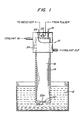
- Figure l is a schematic view of an apparatus for ultrasonic inspection of molten aluminum, including the probe of the present invention.
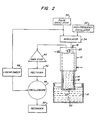
- Figure 2 is a schematic diagram of the apparatus and method of the invention.
- the probe l0 shown in Figure l is used for detecting particulate inclusions in a body l2 comprising a molten metal or alloy or molten glass. While the particular apparatus and method described herein are intended for detection of particulate inclusions in molten aluminum and aluminum alloys, the invention is not limited to use solely with aluminum or for detection of only particulate inclusions. The present apparatus and method are also probably suitable for ultrasonic testing of other metals and alloys having melting points below about l000°C., including but not limited to bismuth, gallium, indium, lead, lithium, magnesium, mercury, potassium, sodium, tin, zinc and their alloys.
- the invention may also be applicable to ultrasonic testing of higher melting metals such as cobalt, copper, gold, iron, manganese, nickel, silver and their alloys.
- metals generally have melting points below about 2500°C., usually less than about 2000°C.
- the invention may also be applicable to ultrasonic testing of molten glasses, including silica glass, leaded silica glass, borosilicate glass, and flint glass.
- molten glasses including silica glass, leaded silica glass, borosilicate glass, and flint glass.
- the greatest need for inclusion detection in glasses lies in optical quality glass manufacture.
- the probe l0 comprises a hollow tubular tungsten shell or envelope l4 containing a liquid metal coupling medium l6.
- the shell l4 is provided with an upwardly extending riser tube l8 in order to allow for expansion and contraction of the coupling medium l6 at different temperatures.
- the shell l4 must be chemically inert both to the body l2 and coupling medium l6 at elevated temperatures.
- a preferred shell l4 is made from tungsten. This material is inert to aluminum alloys in the body l2 and to liquid gallium in the coupling medium l6 at elevated temperatures up to at least 800°C.
- the shell l4 may also be made from other inert refractories such as aluminum, silica, silicon carbide and mullite. When the shell l4 is made from tungsten, it may be provided with an outer alumina frit jacket (not shown) to retard heat transfer and thereby protect against thermal shock.
- a piezoelectric transducer 20 adjacent an upper end of the probe l0 sends ultrasonic waves through the coupling medium l6 to a window 22 spaced downwardly of the transducer 20.
- the preferred transducer 20 shown is a piezoelectric transducer. This transducer generates ultrasonic waves having a frequency of about 8-25 MHz in response to electrical stimuli. A particularly preferred operating frequency is about l5 MHz.
- the transducer 20 is situated adjacent an amorphous silica upper wall or upper window 23 of the shell l4.
- the transducer 20 is attached to the upper wall 23 by means of a thin layer of silicone mounting material (not shown).
- This resilient silicone layer relaxes stress between the transducer 20 and upper wall 23 resulting from expansion and contraction of the coupling medium l6. Such stress relaxation avoids breakage of the fragile transducer 20 and minimizes frequency changes of ultrasonic waves generated therein.
- the probe l0 is provided with a cooling means or cooling jacket 24 for maintaining the transducer 20 and adjacent coupling medium l6 at a temperature below about l49°C.
- the preferred probe l0 utilizes water as a coolant in the cooling means 24.
- the cooling means may be omitted entirely from the probe l0 if the apparatus is used for detection of inclusions in metals having low melting points such as bismuth, lithium or their alloys, or if a sufficiently large distance is maintained between the window and transducer 20 to insulate the transducer 20 from the generally hotter body l2.
- the transducer 20 and window 22 should be separated by a distance of at least l0 cm. While it is desirable to maintain this distance as small as possible consistent with an acceptable thermal gradient, the distance must be increased in certain cases to avoid damaging the transducer 20. In the particularly preferred probe l0 described herein, the transducer 20 and window 22 are separated by a distance of about l5 cm.
- the window 22 includes an interior surface portion 22a contacting the coupling medium l6 and an exterior surface portion 22b that is wettable by the body l2. It is contemplated that the interior surface portion 22a and exterior surface portion 22b will generally comprise a unitary structure, although composite structures are also within the scope of the invention. A unitary structure is preferred in order to minimize acoustic attenuation between the interior surface portion 22a and exterior surface portion 22b.
- a particularly preferred window 22 is made from single crystal sapphire and has a cylindrical or disc shape.
- Sapphire has the advantage of being readily wetted by molten aluminum and its alloys as well as being inert at elevated temperatures.
- the coupling medium l6 and window 22 are each made from materials which are selected to reduce acoustic attenuation between the transducer 20 and coupling medium l6, between the coupling medium l6 and window 22, and between the window 22 and body l2.
- acoustic attenuation factor is defined by the following expression: wherein B is the acoustic intensity level in decibels and I is acoustic intensity of the sound waves, expressed in W/m2.
- the acoustic attenuation factors for ultrasonic waves between the transducer 20 and coupling medium l6, between the coupling medium l6 and window 22, and between the window 22 and body l2 should each be maintained as low as possible.
- a minor proportion of a metal solute is dissolved in liquid gallium.
- the coupling medium l6 preferably comprises about 2.5-5 wt% silver dissolved in liquid gallium.
- the concentration of dissolved silver in the coupling medium l6 should generally be maintained below about 5 wt% in order to avoid precipitation of phases that might interfere with transmission of sound waves.
- the gallium should be treated to remove oxides, solid inclusions and dissolved gases so that sound waves will be transmitted efficiently between transducer 20 and window 22.
- the preferred coupling medium containing about 4.8 wt% silver dissolved in gallium has an acoustic impedance that is close to the acoustic impedance of the window and approximately equal to the acoustic impedance of the transducer 20. Accordingly, acoustic attenuation at interfaces between the transducer 20 and coupling medium l6 is essentially zero and acoustic attentuation between the coupling medium l6 and interior surface portion 22a is only about 4 dB.
- acoustic attenuation between the outer surface portion 22b and a body l2 of molten aluminum is calculated to be only about 5.8 dB. Accordingly, the probe of the invention is highly efficient for carrying ultrasonic waves between the transducer 20 and body l2 without thermal damage to the transducer 20.
- the coupling medium l6 preferably has a low vapor pressure at the temperature of the body l2. Liquids having significant vapor pressure at elevated temperatures may form bubbles that would interfere with transmission of ultrasonic wave trains through the coupling medium.
- An advantage of liquid gallium is that its boiling point is 2403°C. Accordingly, a coupling medium comprising a principal proportion of liquid gallium has low vapor pressure even at temperatures up to about 732°C. (l350°F.), the highest temperature at which aluminum alloys are usually maintained.
- the apparatus further comprises a voltage pulse oscillator 30, a high frequency oscillator 32 generating alternating voltage of ultrasonic frequency, and a modulator 34 receiving electrical pulses from the voltage pulse oscillator 30 and a high frequency oscillator 32.
- the modulator 34 generates a direct current voltage train having a voltage of about 300 volts by passing voltage of ultrasonic frequency only during the period that the modulator 34 is receiving a pulse from the voltage pulse oscillator 30. This direct current voltage train energizes the transducer 20.
- the transducer 20 also acts as a receiving transducer for receiving wave trains from the body l2 through the window 22 and coupling medium l6.
- the receiving transducer 20 then generates voltage trains in response to wave trains received from the body l2.
- the voltage trains so generated are sent to an amplifier 40, rectifier 42 and oscilloscope 44.
- a linear sweep circuit 46 synchronized with the voltage pulse oscillator 30 is connected to the oscilloscope 44.
- the oscilloscope 44 has a spot that is deflected in one direction by the sweep circuit 46 and deflected in a different direction by the voltage output from the receiving transducer 20.
- a permanent record of the oscilloscope display is maintained in a recorder 50.
- the voltage pulse oscillator 30, high frequency oscillator 32 and modulator 34 are referred to collectively as a "pulser".
- the amplifier 40, rectifier 42, oscilloscope 44 and sweep circuit 46 are similarly called "receiver".
- ultrasonic waves generated by the transducer 20 are transmitted through the coupling medium l6 and window 22 into a body l2 of molten aluminum.
- extra vibration wave trains are sent back to the transducer 20 and voltage trains are generated in response to such ultrasonic wave trains.
- the voltage trains are then displayed on the oscilloscope 44.
- An advantage of the probe l0 described herein is that it is so efficient at transmitting ultrasonic wave trains that the claimed apparatus detects smaller particles 60 than prior art apparatus.
- the probe l0 consistently detects solid particulate inclusions having an effective diameter of less than about 400 microns, and particles as small as about 50 microns have been detected in molten aluminum.
- the probe l0 is theoretically capable of detecting particles in about the l-l0 microns diameter range.
Landscapes
- Physics & Mathematics (AREA)
- Health & Medical Sciences (AREA)
- Life Sciences & Earth Sciences (AREA)
- Chemical & Material Sciences (AREA)
- Analytical Chemistry (AREA)
- Biochemistry (AREA)
- General Health & Medical Sciences (AREA)
- General Physics & Mathematics (AREA)
- Immunology (AREA)
- Pathology (AREA)
- Investigating Or Analyzing Materials By The Use Of Ultrasonic Waves (AREA)
Claims (11)
- Sonde zum Übertragen von Ultraschallwellen zwischen einem Wandler (20) und einem Schmelzekörper (12), dessen Schmelzpunkt unter etwa 2600 °C liegt, wobei die Sonde umfaßt(a) einen hohlen Mantel (14),(b) ein Koppelungsmedium (16) zum Übertragen von Ultraschallwellen zwischen einem Wandler und einem im Abstand von dem Wandler angeordneten Fenster (22), wobei das Koppelungsmedium wenigstens teilweise aus einem in einem Hohlraum des Mantels enthaltenen flüssigen Metall besteht,(c) ein Fenster (22) zum Übertragen von Ultraschallwellen zwischen dem Koppelungsmedium und dem Körper, wobei das Fenster aufweist:(1) einen das Koppelungsmedium berührenden Innenflächenteil (22a) und(2) einen von dem Körper benetzbaren Außenflächenteil (22b);
wobei der Mantel wenigstens teilweise aus Wolfram, Nickel oder Stahl besteht. - Sonde nach Anspruch 1, dadurch gekennzeichnet, daß das Fenster (22) wenigstens teilweise aus Saphir besteht.
- Sonde nach Anspruch 1 oder 2, dadurch gekennzeichnet, daß das Koppelungsmedium (16) wenigstens teilweise aus einer flüssigen Galliumlegierung besteht.
- Sonde nach Anspruch 3, dadurch gekennzeichnet, daß das Koppelungsmedium (16) wenigstens teilweise aus einer Gallium-Zinn-Legierung besteht.
- Sonde nach Anspruch 1, dadurch gekennzeichnet, daß sowohl der Mantel (14) als auch das Fenster (22) wenigstens teilweise aus Nickel oder Stahl besteht.
- Verfahren zur Ultraschallprüfung eines Körpers, der mindestens teilweise aus schmelzflüssigem Metall oder einer schmelzflüssigen Legierung oder schmelzflüssigem Glas mit einem Schmelzpunkt unter etwa 2500 °C besteht, wobei in dem Verfahren(a) mit einem piezoelektrischen Wandler Ultraschallwellen erzeugt werden,(b) die Wellen von dem Wandler zu einem im Abstand von ihm angeordneten Fenster (22) durch ein Koppelungsmedium (16) übertragen werden, das wenigstens teilweise aus einem in einem hohlen Mantel (14) angeordneten, flüssigen Metall besteht,(c) die Wellen durch ein Fenster (22) in einen Körper (12) übertragen werden, der wenigstens teilweise aus schmelzflüssigem Metall oder einer schmelzflüssigen Legierung oder schmelzflüssigem Glas besteht, wobei das Fenster(1) einen das Koppelungsmedium berührenden Innenflächenteil (22a) und(2) einen von dem Körper benetzten Außenflachenteil (22b) besitzt, und(d) Echos der genannten Wellen nach ihrem Austritt aus dem Körper empfangen und ausgewertet werden; wobei der Mantel mindestens teilweise aus Wolfram, Nickel oder Stahl besteht.
- Verfahren nach Anspruch 6, dadurch gekennzeichnet, daß der Körper (12) wenigstens teilweise aus einem schmelzflüssigen Metall oder einer schmelzflüssigen Legierung besteht und daß der Mantel wenigstens teilweise aus Wolfram besteht.
- Verfahren nach Anspruch 7, dadurch gekennzeichnet, daß der Körper (12) wenigstens teilweise aus schmelzflüssigem Aluminium oder einer Aluminiumlegierung besteht.
- Verfahren nach Anspruch 8, dadurch gekennzeichnet, daß das Fenster (22) wenigstens teilweise aus Saphir besteht.
- Verfahren nach Anspruch 6, dadurch gekennzeichnet, daß der Körper (12) wenigstens teilweise aus schmelzflüssigem Glas besteht, das Koppelungsmedium (16) wenigstens teilweise aus einer flüssigen Galliumlegierung besteht und der Mantel (14) wenigstens teilweise aus Nickel oder Stahl besteht.
- Verfahren nach Anspruch 10, dadurch gekennzeichnet, daß das Fenster (22) wenigstens teilweise aus Nickel oder Stahl besteht.
Applications Claiming Priority (2)
| Application Number | Priority Date | Filing Date | Title |
|---|---|---|---|
| US06/818,257 US4662215A (en) | 1984-08-20 | 1986-01-13 | Apparatus and method for ultrasonic detection of inclusions in a molten body |
| US818257 | 1986-01-13 |
Publications (2)
| Publication Number | Publication Date |
|---|---|
| EP0230880A1 EP0230880A1 (de) | 1987-08-05 |
| EP0230880B1 true EP0230880B1 (de) | 1991-03-27 |
Family
ID=25225078
Family Applications (1)
| Application Number | Title | Priority Date | Filing Date |
|---|---|---|---|
| EP87100152A Expired EP0230880B1 (de) | 1986-01-13 | 1987-01-08 | Vorrichtung und Verfahren zur Ultraschallerfassung von Einschliessungen in einem Schmelzkörper |
Country Status (6)
| Country | Link |
|---|---|
| US (1) | US4662215A (de) |
| EP (1) | EP0230880B1 (de) |
| JP (1) | JPH0641942B2 (de) |
| AU (1) | AU571797B2 (de) |
| CA (1) | CA1267211A (de) |
| DE (1) | DE3768819D1 (de) |
Cited By (1)
| Publication number | Priority date | Publication date | Assignee | Title |
|---|---|---|---|---|
| DE10136737A1 (de) * | 2001-07-27 | 2003-02-13 | Univ Ilmenau Tech | Verfahren und Mikrowerkzeug für die minimal-invasive Chirurgie |
Families Citing this family (26)
| Publication number | Priority date | Publication date | Assignee | Title |
|---|---|---|---|---|
| CA1235476A (en) * | 1984-05-17 | 1988-04-19 | University Of Toronto Innovations Foundation (The) | Testing of liquid melts |
| JPS63107095A (ja) * | 1986-10-23 | 1988-05-12 | 富士通株式会社 | 多層セラミツク回路基板 |
| US5289436A (en) * | 1992-10-22 | 1994-02-22 | General Electric Company | Ultrasonic waveguide |
| US5435186A (en) * | 1992-10-26 | 1995-07-25 | General Electric Company | Ultrasonic parametric amplifier |
| US5708209A (en) * | 1996-08-27 | 1998-01-13 | Aluminum Company Of America | Apparatus and method for ultrasonic particle detection in molten metal |
| US6065344A (en) * | 1998-10-20 | 2000-05-23 | General Electric Co. | Apparatus and methods for cooling an ultrasonic inspection transducer for turbine rotor wheel repair |
| US6693443B2 (en) | 1999-04-02 | 2004-02-17 | Worcester Polytechnic Institute | Systems for detecting and measuring inclusions |
| FR2796155B1 (fr) | 1999-07-09 | 2001-09-07 | Pechiney Rhenalu | Procede et dispositif ameliores de comptage des inclusions dans un bain de metal liquide par ultrasons |
| JP2002062282A (ja) * | 2000-08-17 | 2002-02-28 | Daikure Co Ltd | 溶融金属用容器の欠陥部を測定する方法及び装置 |
| US7131333B2 (en) * | 2002-07-16 | 2006-11-07 | Sonix, Inc. | Pulse echo ultrasonic test chamber for tray production system |
| US7181969B2 (en) * | 2002-07-16 | 2007-02-27 | Sonix, Inc. | Ultrasonic test chamber for tray production system and the like |
| US7013732B2 (en) * | 2003-02-19 | 2006-03-21 | Sonix, Inc. | Method and apparatus for temperature-controlled ultrasonic inspection |
| US7062972B2 (en) * | 2003-07-21 | 2006-06-20 | Horiba Instruments, Inc. | Acoustic transducer |
| US7021145B2 (en) * | 2003-07-21 | 2006-04-04 | Horiba Instruments, Inc | Acoustic transducer |
| US7661315B2 (en) * | 2004-05-24 | 2010-02-16 | Sonix, Inc. | Method and apparatus for ultrasonic scanning of a fabrication wafer |
| US7682556B2 (en) * | 2005-08-16 | 2010-03-23 | Ut-Battelle Llc | Degassing of molten alloys with the assistance of ultrasonic vibration |
| US20070167965A1 (en) * | 2006-01-05 | 2007-07-19 | Ethicon Endo-Surgery, Inc. | Ultrasonic medical instrument |
| US8650958B2 (en) * | 2006-02-02 | 2014-02-18 | The Boeing Company | Thin-film ultrasonic probe having a flexible membrane |
| US7917317B2 (en) * | 2006-07-07 | 2011-03-29 | Sonix, Inc. | Ultrasonic inspection using acoustic modeling |
| CN101500955B (zh) * | 2006-08-04 | 2011-09-07 | 康宁股份有限公司 | 采用超声波照射表征玻璃熔体的方法和设备 |
| DE102007027391B3 (de) * | 2007-06-11 | 2009-01-08 | Forschungszentrum Dresden - Rossendorf E.V. | Ultraschallsensor zur Messung von lokalen Strömungsgeschwindigkeiten in flüssigen Schmelzen |
| CN102654513B (zh) * | 2012-03-30 | 2014-04-16 | 中国科学院合肥物质科学研究院 | 高温强磁场下液态金属边界层速度分布的测量方法 |
| US9145597B2 (en) | 2013-02-22 | 2015-09-29 | Almex Usa Inc. | Simultaneous multi-mode gas activation degassing device for casting ultraclean high-purity metals and alloys |
| EP3438658B1 (de) * | 2014-10-07 | 2021-12-08 | Constellium Issoire | Messgeräte zur ultraschallkontrolle eines flüssigmetalls |
| CN108519440B (zh) * | 2018-04-09 | 2024-07-26 | 河北珠峰仪器仪表设备有限公司 | 一种适合高温下在线检测的超声波测量探头 |
| CN119780231B (zh) * | 2025-03-10 | 2025-06-06 | 博罗县何氏模具制造有限公司 | 一种粉末冶金工模具钢非金属夹杂物的检测装置及方法 |
Family Cites Families (9)
| Publication number | Priority date | Publication date | Assignee | Title |
|---|---|---|---|---|
| GB1057802A (en) * | 1962-08-13 | 1967-02-08 | Yawata Iron & Steel Company | Ultrasonic internal flaw detecting apparatus for hot metal |
| GB1127231A (en) * | 1965-01-06 | 1968-09-18 | British Aluminium Co Ltd | Improvements in or relating to methods of and apparatus for testing molten metal |
| US3497728A (en) * | 1967-03-20 | 1970-02-24 | Standard Oil Co | Ultrasonic inspection apparatus |
| GB1482350A (en) * | 1973-09-17 | 1977-08-10 | Atomic Energy Authority Uk | Ultra sonic testing |
| US4179937A (en) * | 1978-06-02 | 1979-12-25 | Ocean Ecology Ltd. | Sound measuring device |
| US4287755A (en) * | 1979-09-12 | 1981-09-08 | Reynolds Metals Company | Probes for the ultrasonic treatment or inspection of molten aluminum |
| US4261197A (en) * | 1979-09-12 | 1981-04-14 | Reynolds Metals Company | Probe for the ultrasonic inspection of molten aluminum |
| US4509360A (en) * | 1983-06-24 | 1985-04-09 | Massachusetts Institute Of Technology | On-line measurement of fluid mixtures |
| US4563895A (en) * | 1984-08-20 | 1986-01-14 | Aluminum Company Of America | Apparatus and method for ultrasonic detection of inclusions in molten metals |
-
1986
- 1986-01-13 US US06/818,257 patent/US4662215A/en not_active Expired - Lifetime
- 1986-10-15 CA CA000520496A patent/CA1267211A/en not_active Expired
- 1986-10-27 AU AU64406/86A patent/AU571797B2/en not_active Ceased
- 1986-12-12 JP JP61295069A patent/JPH0641942B2/ja not_active Expired - Lifetime
-
1987
- 1987-01-08 DE DE8787100152T patent/DE3768819D1/de not_active Expired - Lifetime
- 1987-01-08 EP EP87100152A patent/EP0230880B1/de not_active Expired
Cited By (1)
| Publication number | Priority date | Publication date | Assignee | Title |
|---|---|---|---|---|
| DE10136737A1 (de) * | 2001-07-27 | 2003-02-13 | Univ Ilmenau Tech | Verfahren und Mikrowerkzeug für die minimal-invasive Chirurgie |
Also Published As
| Publication number | Publication date |
|---|---|
| JPS62165148A (ja) | 1987-07-21 |
| DE3768819D1 (de) | 1991-05-08 |
| EP0230880A1 (de) | 1987-08-05 |
| US4662215A (en) | 1987-05-05 |
| AU571797B2 (en) | 1988-04-21 |
| AU6440686A (en) | 1987-07-16 |
| JPH0641942B2 (ja) | 1994-06-01 |
| CA1267211A (en) | 1990-03-27 |
Similar Documents
| Publication | Publication Date | Title |
|---|---|---|
| EP0230880B1 (de) | Vorrichtung und Verfahren zur Ultraschallerfassung von Einschliessungen in einem Schmelzkörper | |
| US4563895A (en) | Apparatus and method for ultrasonic detection of inclusions in molten metals | |
| US5708209A (en) | Apparatus and method for ultrasonic particle detection in molten metal | |
| US4770699A (en) | Method of treating liquid melts | |
| US5604301A (en) | Ultrasound detection techniques | |
| US2697936A (en) | Supersonic testing of hot articles | |
| NO811593L (no) | Sonder for ultralydbehandling eller inspeksjon av smeltet aluminium | |
| EP0035563B1 (de) | Sonde für die ultraschallprüfung geschmolzenen aluminiums | |
| US10563285B2 (en) | Method for inspecting a liquid metal by ultrasounds | |
| AU6394980A (en) | Probe for the ultrasonic inspection of moulten aluminum | |
| JPH08105802A (ja) | 温度測定用センサ装置 | |
| RU95116372A (ru) | Сенсорное устройство, устройство для измерения температуры и способ измерения температуры ликвидуса криолитовых расплавов | |
| Parker et al. | Application of pulse-echo ultrasonics to locate the solid/liquid interface during solidification and melting | |
| CN215639321U (zh) | 一种用于高温管道的压电超声波传感器及检测系统 | |
| JPS5823918B2 (ja) | 欠陥のある核燃料要素を突とめる為の方法 | |
| JP2004524536A (ja) | 薄壁管の部分層厚みの接触法による高周波超音波測定 | |
| WO2008018997A2 (en) | Method and apparatus for characterizing a glass melt by ultrasonic illumination | |
| RU2069849C1 (ru) | Способ исследования электрокапиллярных явлений на жидком электроде и устройство для их регистрации | |
| Ono et al. | Development of ultrasonic techniques with buffer rod in molten aluminum | |
| Currie et al. | Development of an ultrasonic liquid steel inclusion monitor | |
| RU2070840C1 (ru) | Ультразвуковой преобразователь | |
| Monitor | pggio OF THIS D00UMENT IS eee SS | |
| SU1649398A1 (ru) | Способ измерени люминесценции щелочно-галоидных солей | |
| JPH0153419B2 (de) |
Legal Events
| Date | Code | Title | Description |
|---|---|---|---|
| PUAI | Public reference made under article 153(3) epc to a published international application that has entered the european phase |
Free format text: ORIGINAL CODE: 0009012 |
|
| AK | Designated contracting states |
Kind code of ref document: A1 Designated state(s): CH DE FR GB LI NL |
|
| RAP1 | Party data changed (applicant data changed or rights of an application transferred) |
Owner name: ALUMINUM COMPANY OF AMERICA |
|
| 17P | Request for examination filed |
Effective date: 19880209 |
|
| R17P | Request for examination filed (corrected) |
Effective date: 19880204 |
|
| 17Q | First examination report despatched |
Effective date: 19890929 |
|
| GRAA | (expected) grant |
Free format text: ORIGINAL CODE: 0009210 |
|
| AK | Designated contracting states |
Kind code of ref document: B1 Designated state(s): CH DE FR GB LI NL |
|
| REF | Corresponds to: |
Ref document number: 3768819 Country of ref document: DE Date of ref document: 19910508 |
|
| ET | Fr: translation filed | ||
| PLBE | No opposition filed within time limit |
Free format text: ORIGINAL CODE: 0009261 |
|
| STAA | Information on the status of an ep patent application or granted ep patent |
Free format text: STATUS: NO OPPOSITION FILED WITHIN TIME LIMIT |
|
| 26N | No opposition filed | ||
| PGFP | Annual fee paid to national office [announced via postgrant information from national office to epo] |
Ref country code: GB Payment date: 19951211 Year of fee payment: 10 |
|
| PGFP | Annual fee paid to national office [announced via postgrant information from national office to epo] |
Ref country code: FR Payment date: 19951222 Year of fee payment: 10 |
|
| PGFP | Annual fee paid to national office [announced via postgrant information from national office to epo] |
Ref country code: CH Payment date: 19951229 Year of fee payment: 10 |
|
| PGFP | Annual fee paid to national office [announced via postgrant information from national office to epo] |
Ref country code: DE Payment date: 19960109 Year of fee payment: 10 |
|
| PGFP | Annual fee paid to national office [announced via postgrant information from national office to epo] |
Ref country code: NL Payment date: 19960123 Year of fee payment: 10 |
|
| PG25 | Lapsed in a contracting state [announced via postgrant information from national office to epo] |
Ref country code: GB Effective date: 19970108 |
|
| PG25 | Lapsed in a contracting state [announced via postgrant information from national office to epo] |
Ref country code: LI Effective date: 19970131 Ref country code: CH Effective date: 19970131 |
|
| PG25 | Lapsed in a contracting state [announced via postgrant information from national office to epo] |
Ref country code: NL Effective date: 19970801 |
|
| GBPC | Gb: european patent ceased through non-payment of renewal fee |
Effective date: 19970108 |
|
| REG | Reference to a national code |
Ref country code: CH Ref legal event code: PL |
|
| PG25 | Lapsed in a contracting state [announced via postgrant information from national office to epo] |
Ref country code: FR Effective date: 19970930 |
|
| NLV4 | Nl: lapsed or anulled due to non-payment of the annual fee |
Effective date: 19970801 |
|
| PG25 | Lapsed in a contracting state [announced via postgrant information from national office to epo] |
Ref country code: DE Effective date: 19971001 |
|
| REG | Reference to a national code |
Ref country code: FR Ref legal event code: ST |