EP0228724B1 - Separator for aggregate - Google Patents
Separator for aggregate Download PDFInfo
- Publication number
- EP0228724B1 EP0228724B1 EP19860201987 EP86201987A EP0228724B1 EP 0228724 B1 EP0228724 B1 EP 0228724B1 EP 19860201987 EP19860201987 EP 19860201987 EP 86201987 A EP86201987 A EP 86201987A EP 0228724 B1 EP0228724 B1 EP 0228724B1
- Authority
- EP
- European Patent Office
- Prior art keywords
- aggregate
- separator
- water
- vessel
- separation vessel
- Prior art date
- Legal status (The legal status is an assumption and is not a legal conclusion. Google has not performed a legal analysis and makes no representation as to the accuracy of the status listed.)
- Expired - Lifetime
Links
- XLYOFNOQVPJJNP-UHFFFAOYSA-N water Substances O XLYOFNOQVPJJNP-UHFFFAOYSA-N 0.000 claims abstract description 32
- 238000000926 separation method Methods 0.000 claims abstract description 30
- 239000002699 waste material Substances 0.000 claims abstract description 19
- 238000000034 method Methods 0.000 claims abstract description 18
- 238000007654 immersion Methods 0.000 claims abstract description 13
- 239000011368 organic material Substances 0.000 claims abstract description 13
- 239000002361 compost Substances 0.000 claims abstract description 9
- 238000001665 trituration Methods 0.000 claims abstract description 6
- 239000000428 dust Substances 0.000 claims abstract description 4
- 239000000463 material Substances 0.000 claims description 47
- 238000001556 precipitation Methods 0.000 claims description 7
- 238000011144 upstream manufacturing Methods 0.000 claims description 3
- 239000007787 solid Substances 0.000 abstract description 4
- 239000011521 glass Substances 0.000 description 8
- 229910052751 metal Inorganic materials 0.000 description 8
- 239000002184 metal Substances 0.000 description 8
- 150000002739 metals Chemical class 0.000 description 8
- 238000005406 washing Methods 0.000 description 6
- 239000004033 plastic Substances 0.000 description 5
- 229920003023 plastic Polymers 0.000 description 5
- 239000000725 suspension Substances 0.000 description 5
- 239000012530 fluid Substances 0.000 description 4
- 238000012423 maintenance Methods 0.000 description 4
- 238000002156 mixing Methods 0.000 description 4
- 239000004575 stone Substances 0.000 description 4
- 229910010293 ceramic material Inorganic materials 0.000 description 3
- 238000009264 composting Methods 0.000 description 3
- 230000007774 longterm Effects 0.000 description 3
- 238000003860 storage Methods 0.000 description 3
- 239000000126 substance Substances 0.000 description 3
- 239000003344 environmental pollutant Substances 0.000 description 2
- 238000000855 fermentation Methods 0.000 description 2
- 230000004151 fermentation Effects 0.000 description 2
- 239000000446 fuel Substances 0.000 description 2
- 238000009434 installation Methods 0.000 description 2
- 238000004519 manufacturing process Methods 0.000 description 2
- 231100000719 pollutant Toxicity 0.000 description 2
- 241000282320 Panthera leo Species 0.000 description 1
- 239000012620 biological material Substances 0.000 description 1
- 238000001354 calcination Methods 0.000 description 1
- 239000000919 ceramic Substances 0.000 description 1
- 238000012790 confirmation Methods 0.000 description 1
- 238000010276 construction Methods 0.000 description 1
- 230000002542 deteriorative effect Effects 0.000 description 1
- 238000005265 energy consumption Methods 0.000 description 1
- -1 etc.) Inorganic materials 0.000 description 1
- 239000002440 industrial waste Substances 0.000 description 1
- 229910010272 inorganic material Inorganic materials 0.000 description 1
- 239000011147 inorganic material Substances 0.000 description 1
- 239000000203 mixture Substances 0.000 description 1
- 239000003895 organic fertilizer Substances 0.000 description 1
- 239000005416 organic matter Substances 0.000 description 1
- 239000010815 organic waste Substances 0.000 description 1
- 239000000843 powder Substances 0.000 description 1
- 238000002360 preparation method Methods 0.000 description 1
- 238000012545 processing Methods 0.000 description 1
- 238000009877 rendering Methods 0.000 description 1
- 239000004576 sand Substances 0.000 description 1
- 239000002352 surface water Substances 0.000 description 1
Images

Classifications
-
- B—PERFORMING OPERATIONS; TRANSPORTING
- B03—SEPARATION OF SOLID MATERIALS USING LIQUIDS OR USING PNEUMATIC TABLES OR JIGS; MAGNETIC OR ELECTROSTATIC SEPARATION OF SOLID MATERIALS FROM SOLID MATERIALS OR FLUIDS; SEPARATION BY HIGH-VOLTAGE ELECTRIC FIELDS
- B03B—SEPARATING SOLID MATERIALS USING LIQUIDS OR USING PNEUMATIC TABLES OR JIGS
- B03B5/00—Washing granular, powdered or lumpy materials; Wet separating
- B03B5/28—Washing granular, powdered or lumpy materials; Wet separating by sink-float separation
- B03B5/30—Washing granular, powdered or lumpy materials; Wet separating by sink-float separation using heavy liquids or suspensions
- B03B5/36—Devices therefor, other than using centrifugal force
- B03B5/40—Devices therefor, other than using centrifugal force of trough type
-
- B—PERFORMING OPERATIONS; TRANSPORTING
- B03—SEPARATION OF SOLID MATERIALS USING LIQUIDS OR USING PNEUMATIC TABLES OR JIGS; MAGNETIC OR ELECTROSTATIC SEPARATION OF SOLID MATERIALS FROM SOLID MATERIALS OR FLUIDS; SEPARATION BY HIGH-VOLTAGE ELECTRIC FIELDS
- B03B—SEPARATING SOLID MATERIALS USING LIQUIDS OR USING PNEUMATIC TABLES OR JIGS
- B03B9/00—General arrangement of separating plant, e.g. flow sheets
- B03B9/06—General arrangement of separating plant, e.g. flow sheets specially adapted for refuse
-
- Y—GENERAL TAGGING OF NEW TECHNOLOGICAL DEVELOPMENTS; GENERAL TAGGING OF CROSS-SECTIONAL TECHNOLOGIES SPANNING OVER SEVERAL SECTIONS OF THE IPC; TECHNICAL SUBJECTS COVERED BY FORMER USPC CROSS-REFERENCE ART COLLECTIONS [XRACs] AND DIGESTS
- Y02—TECHNOLOGIES OR APPLICATIONS FOR MITIGATION OR ADAPTATION AGAINST CLIMATE CHANGE
- Y02W—CLIMATE CHANGE MITIGATION TECHNOLOGIES RELATED TO WASTEWATER TREATMENT OR WASTE MANAGEMENT
- Y02W30/00—Technologies for solid waste management
- Y02W30/50—Reuse, recycling or recovery technologies
- Y02W30/52—Mechanical processing of waste for the recovery of materials, e.g. crushing, shredding, separation or disassembly
Definitions
- This invention concerns a separator for aggregate which is suitable to separate glass, metals and other heavy inorganic materials in urban wastes so as to obtain an organic waste and a waste consisting of aggregate in separate areas.
- this invention concerns a device to separate aggregate such as glass, even in a powdered form, metals, torch batteries and all the other heavy inorganic parts contained in urban wastes which have undergone a trituration and riddling process or in compost obtained by treatment or in other like wastes.
- the aggregate separator is therefore of a type which separates the aggregate from suitable triturated and riddled solid urban wastes and thereafter sends the separated organic fraction to the composting process so as to obtain compost for use as an organic fertilizer.
- the known systems do not attain the desired level of efficiency.
- the known systems entail considerable power consumption and complex installation and maintenance.
- the aggregate leaving the known separators is polluted through continuous contact with the various deteriorating parts, and the aggregate is therefore not easy to store and does not possess adequate stability in the long term owing to the inclusion of material which may become rotten.
- the present applicant has designed, tested and embodied a device to separate aggregate which employs water to separate the aggregate from organic material and thus enables not only a proper separation of the components to be carried out but also a considerable energy saving to be obtained with a resulting very restricted employment of power.
- US 3 568 839 discloses an apparatus to remove rubbish according to the precharacterizing part of the main claim.
- FR 2 394 333 teaches the provision of a rotary drum with a separator knife.
- US 4 203 376 teaches a method for treatment of rubbish with the separation and preparation of solid compost by calcining.
- the invention employs water to separate the glass, aggregate (stones, ceramic materials, etc.), metals, batteries and all the heavy parts (including some plastics) which cannot be composed and are included in urban and/or similar industrial wastes and in compost.
- the invention permits also noteworthy simplicity of installation and maintenance together with the ability to adjust the various components of the system to suit the specific requirements of the various wastes to be treated.
- a separation vessel full of water collects the material to be treated, which can sink directly to the bottom of the vessel or can remain in suspension.
- the surface water flows in one direction only and induces the material remaining in suspension to pass into a zone where an immersion device is working.
- Such immersion device pushes all the material constantly below the water level and thus breaks any isolating films which may have formed on the material.
- the material still afloat after passing the immersion device reaches the neighbourhood of a first weir, from which it is withdrawn together with a given quantity of water by a rotary drum that discharges the organic matter onto a scraper blade, whereas the drum discharges downwards the water, which is collected in a precipitation vessel and, after passing over a second weir, is delivered into a collection vessel.
- the heavy fines which cannot be composted are gathered in the precipitation vessel, whereas the sludges are collected in the collection vessel and, as soon as they have been extracted, are combined with the organic fraction to be composted.
- the water to be recirculated is put back into circulation from the collection vessel immediately upstream of the zone where the material to be treated falls.
- Withdrawal means are comprised in cooperation with the bottom of the separation vessel and are advantageously sloped, and collect the aggregate falling onto the bottom of the vessel and discharge it.
- Scrubber nozzles are also positioned at the bottom of the separation vessel and tend to keep in suspension the material falling to the bottom, thus enabling an excellent separation to be obtained and any organic material which has accidentally become deposited together with the heavy aggregate, to be returned to the surface of the water.
- Sprayers are also included together with the extractor means and are positioned downstream of the zone of immission of the water to be re-circulated.
- Nozzles placed at a tangent to the direction of motion of the aggregate are included advantageously in cooperation with the outlet zone of the aggregate and serve to clean the worm screw extractor means and to provide a last washing operation for the departing aggregate.
- the invention is therefore embodied as disclosed in claim 1 with a separator for aggregate which is suitable to separate heavy aggregate, even in the form of dust, arriving from a trituration or riddling process, from organic material, compost or other like wastes.
- Such separator for aggregate is applied correctly to a system which separates aggregates.
- the proposed system separates the required products almost completely. Moreover, the aggregate separated by means of other systems always contains organic material and therefore is liable to become rotten.
- the water is fully recirculated and does not lead to pollution, and moreover the quantity required for topping up is negligible compared to that used in other systems.
- the compressed air too is employed in very small quantities and serves also to oxygenate the water and the organic material.
- the urban wastes or other like wastes feed a trituration means, at the outlet of which they are collected on a conveyor that delivers them to a single or multiple stage riddle.
- a possible means to separate metals and/or any other material unsuitable for the subsequent processes may be included at this segment of the system.
- the materials are divided in the riddle according to their various piece sizes; the material having a small piece size is delivered by a conveyor to a separator for aggregate.
- the material having an intermediate piece size is sent on a conveyor to a possible separation treatment to separate to a mixing station.
- the material having a larger piece size is sent, instead, on a conveyor to a possible treatment process for the production of fuel from wastes and for the separation of paper and/or plastic and for other processes and/or sorting.
- the fraction containing the organic material enters the aggregate separator, and as a result of actions which it undergoes, is divided there into the aggregate components comprising glass and ceramic materials (even in a powdered form), stones, metals, batteries, heavy plastics and any other element heavier than water, and into the fraction which can be composted and which consists mainly of organic material with traces of light elements that cannot be composted.
- the following material may come to the mixing station: materials of an intermediate piece size arriving from the riddle; biological sludges; water to adjust the humidity; and biological matter to initiate the fermentation process.
- This material is then sent on a conveyor from the mixing station to the process of composting the organic fraction and making hygienic any materials still included which cannot be composted.
- an aggregate separator 10 cooperates with a means 11 that delivers material to be treated and discharges such material into a dropping zone 12.
- a means 11 that delivers material to be treated and discharges such material into a dropping zone 12.
- Upstream of this dropping zone 12 is a continuous delivery of recirculated water 22, which creates a one-way flow of water at least on the surface of a separation vessel 32.
- any material still in suspension will be light and mainly organic material, which passes over a first weir 15 and is picked up by a perforated filter drum 16.
- Such light material is removed from the filter drum 16 by a doctor knife 17 and is discharged at 21 as being an organic substance.
- the water passing over the first weir 15 falls into a precipitation vessel 20 and, passing over a second weir 19, may be assisted by a pump 28 in dropping into a collection vessel 29.
- a means 18 to extract heavy fines which cannot be composted is included in the precipitation vessel 20, whereas a means 30 to extract sludges is located in the lower portion of the collection vessel 29.
- the water leaving the collection vessel 29 falls into a storage reservoir 31, whence it is put back into circulation by a pump 128 in a zone 22 for pre-washing the heavy aggregate.
- Withdrawal means 25 are located in the lower portion of the separation vessel 32 and may consist of one or more worm screws or of one or more scraper belts or conveyors.
- An elevator 14 to raise the withdrawal means 25 out of the separation vessel 32 for maintenance is also shown.
- Scrubber nozzles 23 are included in cooperation with the bottom of the separation vessel 32 and with the withdrawal means 25, being advantageously of an orientable type, and serve to deliver a fluid under pressure, which is advantageously a gaseous fluid such as air or another fluid.
- the air or fluid leaving the scrubber nozzles 23 tends to re-mix all the heavy material deposited on the bottom of the separation vessel 32 and therefore to bring to the surface any light material drawn down by the descent of the heavy material. Such light material is thus returned to the cycle and passes through the area of the immersion device 13 after an accurate and careful separation and selection.
- the material removed by the withdrawal means 25 undergoes a first thorough washing in the area 22, which lies in the neighbourhood of the withdrawal means 25. Such thorough washing is carried out by water recirculated by a pump 128.
- the pump 128 draws water from the storage reservoir 31, which may comprise an overflow element for topping-up water.
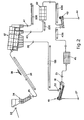
- Such separator for aggregate according to the invention is installed advantageously in a new system for separation of aggregate, for instance of the type shown in Fig.2.
- the process set forth in that example is as follows.
- Wastes 33 are fed to a trituration means 34, at the outlet of which they are gathered by a conveyor 36, which delivers them to a single or multiple stage riddle 37.
- a possible separator of metals 38 and/or any other material not desired in the subsequent steps may be installed.
- the riddle 37 sorts the materials according to their various piece sizes; in fact, the material 39 of a smaller piece size is delivered by a conveyor 136 to the separator for aggregate.
- Material 40 of an intermediate piece size is delivered by a conveyor 236 to a possible treatment process for separation of materials 42 which cannot be composted, whence such material is sent on a conveyor 436 to a mixer 43.
- Material 41 of a greater piece size is sent, instead, on a conveyor 336 to a possible treatment process for the production of fuel from wastes and for the separation of paper and/or plastics or for other processings and/or sorting.
- the fraction of a smaller piece size containing the organic substances enters at 22 the aggregate separator 10, where, following on the actions performed, it is sorted into aggregate components 27 containing glass and ceramics (even in a powdered form), stones, metals, batteries, heavy plastics and any other element heavier than water, and into material 21 which can be composted and which consists mainly of organic material with traces of light elements that cannot be composted.
- Material of an intermediate piece size 40 coming from the riddle 37, biological sludges, water to adjust the humidity and biological material to initiate the fermentation process may arrive at the mixer 43.
- Material is sent from the mixer on a conveyor 44 to a process of composting the organic fraction and rendering hygienic any material still included which cannot be composted.
Landscapes
- Processing Of Solid Wastes (AREA)
- Fertilizers (AREA)
- Disintegrating Or Milling (AREA)
- Cell Separators (AREA)
- Filtering Materials (AREA)
- Separation By Low-Temperature Treatments (AREA)
- Centrifugal Separators (AREA)
Abstract
Description
- This invention concerns a separator for aggregate which is suitable to separate glass, metals and other heavy inorganic materials in urban wastes so as to obtain an organic waste and a waste consisting of aggregate in separate areas.
- To be more exact, this invention concerns a device to separate aggregate such as glass, even in a powdered form, metals, torch batteries and all the other heavy inorganic parts contained in urban wastes which have undergone a trituration and riddling process or in compost obtained by treatment or in other like wastes.
- The aggregate separator is therefore of a type which separates the aggregate from suitable triturated and riddled solid urban wastes and thereafter sends the separated organic fraction to the composting process so as to obtain compost for use as an organic fertilizer.
- Various systems exist to separate aggregate from compost and from a fraction capable of being composed.
- The best known separation systems employ air, but no known system reaches the required efficiency of separation of heavy aggregate.
- Thus, even when powdered glass has to be treated, the known systems do not attain the desired level of efficiency. Moreover, the known systems entail considerable power consumption and complex installation and maintenance.
- Furthermore, the aggregate leaving the known separators is polluted through continuous contact with the various deteriorating parts, and the aggregate is therefore not easy to store and does not possess adequate stability in the long term owing to the inclusion of material which may become rotten.
- Moreover, the known systems to treat such materials suffer considerable wear, and their consumption of parts is very high.
- To overcome such drawbacks, the present applicant has designed, tested and embodied a device to separate aggregate which employs water to separate the aggregate from organic material and thus enables not only a proper separation of the components to be carried out but also a considerable energy saving to be obtained with a resulting very restricted employment of power.
- US 3 568 839 discloses an apparatus to remove rubbish according to the precharacterizing part of the main claim.
- As regards the confirmation of the thank, the position of the spillway, the position where the rubbish is immitted and removed, the method of working of the immersion device and the construction and functioning of the extractor, the teaching of US '839 does not reach the standard of quality and quantity capable of solving the separation.
- FR 2 394 333 teaches the provision of a rotary drum with a separator knife.
- US 4 203 376 teaches a method for treatment of rubbish with the separation and preparation of solid compost by calcining.
- The invention employs water to separate the glass, aggregate (stones, ceramic materials, etc.), metals, batteries and all the heavy parts (including some plastics) which cannot be composed and are included in urban and/or similar industrial wastes and in compost.
- It is possible to use the invention to obtain a fraction which can be composted and is almost free of aggregate such as glass, stones, ceramic material, metals and other heavy pollutant elements, by starting with solid, triturated, riddled urban wastes or with compost or with wastes similar to urban wastes and by employing a lowe consumption of energy.
- Moreover, it is possible by means of the invention to obtain clean aggregate fractions not containing organic material liable to rot, and therefore clean aggregate which can be easily stored.
- The invention permits also noteworthy simplicity of installation and maintenance together with the ability to adjust the various components of the system to suit the specific requirements of the various wastes to be treated.
- Furthermore, the maintenance problems are considerably lessened in that the wear on the system can be easily controlled and restricted in the long term
- According to the invention a separation vessel full of water collects the material to be treated, which can sink directly to the bottom of the vessel or can remain in suspension.
- The surface water flows in one direction only and induces the material remaining in suspension to pass into a zone where an immersion device is working. Such immersion device pushes all the material constantly below the water level and thus breaks any isolating films which may have formed on the material.
- The material still afloat after passing the immersion device reaches the neighbourhood of a first weir, from which it is withdrawn together with a given quantity of water by a rotary drum that discharges the organic matter onto a scraper blade, whereas the drum discharges downwards the water, which is collected in a precipitation vessel and, after passing over a second weir, is delivered into a collection vessel.
- The heavy fines which cannot be composted (sand, dust glass powder, etc.) are gathered in the precipitation vessel, whereas the sludges are collected in the collection vessel and, as soon as they have been extracted, are combined with the organic fraction to be composted.
- The water to be recirculated is put back into circulation from the collection vessel immediately upstream of the zone where the material to be treated falls.
- Withdrawal means are comprised in cooperation with the bottom of the separation vessel and are advantageously sloped, and collect the aggregate falling onto the bottom of the vessel and discharge it.
- Scrubber nozzles are also positioned at the bottom of the separation vessel and tend to keep in suspension the material falling to the bottom, thus enabling an excellent separation to be obtained and any organic material which has accidentally become deposited together with the heavy aggregate, to be returned to the surface of the water.
- Sprayers are also included together with the extractor means and are positioned downstream of the zone of immission of the water to be re-circulated.
- Nozzles placed at a tangent to the direction of motion of the aggregate are included advantageously in cooperation with the outlet zone of the aggregate and serve to clean the worm screw extractor means and to provide a last washing operation for the departing aggregate.
- Such multiple washings make it possible to obtain aggregate which is non-pollutant and is perfectly washed in a current flowing in the reverse direction, so that the aggregate is easy to store since it is definitely stable in the long term and is free of any material which might rot.
- The invention is therefore embodied as disclosed in claim 1 with a separator for aggregate which is suitable to separate heavy aggregate, even in the form of dust, arriving from a trituration or riddling process, from organic material, compost or other like wastes.
- Such separator for aggregate is applied correctly to a system which separates aggregates.
- The proposed system separates the required products almost completely. Moreover, the aggregate separated by means of other systems always contains organic material and therefore is liable to become rotten.
- With the system the aggregate is washed repeatedly and is almost free of any organic substance, thus providing noteworthy ease of storage and disposal.
- The energy consumption of this system is considerably less than that of the other systems normally employed hitherto.
- The water is fully recirculated and does not lead to pollution, and moreover the quantity required for topping up is negligible compared to that used in other systems.
- The compressed air too is employed in very small quantities and serves also to oxygenate the water and the organic material.
- According to the system the urban wastes or other like wastes feed a trituration means, at the outlet of which they are collected on a conveyor that delivers them to a single or multiple stage riddle.
- A possible means to separate metals and/or any other material unsuitable for the subsequent processes may be included at this segment of the system.
- The materials are divided in the riddle according to their various piece sizes; the material having a small piece size is delivered by a conveyor to a separator for aggregate.
- The material having an intermediate piece size is sent on a conveyor to a possible separation treatment to separate to a mixing station.
- The material having a larger piece size is sent, instead, on a conveyor to a possible treatment process for the production of fuel from wastes and for the separation of paper and/or plastic and for other processes and/or sorting.
- The fraction containing the organic material enters the aggregate separator, and as a result of actions which it undergoes, is divided there into the aggregate components comprising glass and ceramic materials (even in a powdered form), stones, metals, batteries, heavy plastics and any other element heavier than water, and into the fraction which can be composted and which consists mainly of organic material with traces of light elements that cannot be composted.
- Thereafter the fraction which can be composted is sent on to a possible dewatering process and then reaches the mixing station on a conveyor.
- The following material may come to the mixing station: materials of an intermediate piece size arriving from the riddle; biological sludges; water to adjust the humidity; and biological matter to initiate the fermentation process.
- This material is then sent on a conveyor from the mixing station to the process of composting the organic fraction and making hygienic any materials still included which cannot be composted.
- The attached figures are given as a non-restrictive example and show the following:-
- Fig.1 shows diagrammatically a separator complete with the specific pieces of equipment which are useful to understand the method of working of the system;
- Fig.2 shows a system that employs such separator.
- In the attached figure an
aggregate separator 10 cooperates with ameans 11 that delivers material to be treated and discharges such material into a droppingzone 12. Upstream of this droppingzone 12 is a continuous delivery of recirculatedwater 22, which creates a one-way flow of water at least on the surface of aseparation vessel 32. - Owing to such continuous flow the materials which have fallen in the
zone 12 for treatment and have not sunk at once in the water but have remained in suspension are sent to cooperate with an immersion device 13, which compels all the materials to be immersed and therefore to break any superficial film or containing bubble created when they fell into the water. - Downstream of the immersion device 13, therefore, any material still in suspension will be light and mainly organic material, which passes over a
first weir 15 and is picked up by aperforated filter drum 16. - Such light material is removed from the
filter drum 16 by adoctor knife 17 and is discharged at 21 as being an organic substance. - The water passing over the
first weir 15 falls into aprecipitation vessel 20 and, passing over asecond weir 19, may be assisted by apump 28 in dropping into a collection vessel 29. - A
means 18 to extract heavy fines which cannot be composted is included in theprecipitation vessel 20, whereas ameans 30 to extract sludges is located in the lower portion of the collection vessel 29. - The water leaving the collection vessel 29 falls into a
storage reservoir 31, whence it is put back into circulation by apump 128 in azone 22 for pre-washing the heavy aggregate. -
Withdrawal means 25 are located in the lower portion of theseparation vessel 32 and may consist of one or more worm screws or of one or more scraper belts or conveyors. - An
elevator 14 to raise the withdrawal means 25 out of theseparation vessel 32 for maintenance is also shown. -
Scrubber nozzles 23 are included in cooperation with the bottom of theseparation vessel 32 and with the withdrawal means 25, being advantageously of an orientable type, and serve to deliver a fluid under pressure, which is advantageously a gaseous fluid such as air or another fluid. - The air or fluid leaving the
scrubber nozzles 23 tends to re-mix all the heavy material deposited on the bottom of theseparation vessel 32 and therefore to bring to the surface any light material drawn down by the descent of the heavy material. Such light material is thus returned to the cycle and passes through the area of the immersion device 13 after an accurate and careful separation and selection. - The material removed by the withdrawal means 25 undergoes a first thorough washing in the
area 22, which lies in the neighbourhood of the withdrawal means 25. Such thorough washing is carried out by water recirculated by apump 128. - Thereafter, the same material removed by the withdrawal means 25 is washed by
sprayers 24, which perform continuous washing with clean water, thus eliminating any organic material still contained in the aggregate. - Before reaching the
outlet 27 for aggregate, the material is washed once again by tangentially disposednozzles 26, which not only wash the heavy material departing but also serve to keep the withdrawal means clean. - The
pump 128 draws water from thestorage reservoir 31, which may comprise an overflow element for topping-up water. - Such separator for aggregate according to the invention is installed advantageously in a new system for separation of aggregate, for instance of the type shown in Fig.2. The process set forth in that example is as follows.
-
Wastes 33 are fed to a trituration means 34, at the outlet of which they are gathered by aconveyor 36, which delivers them to a single ormultiple stage riddle 37. In this tract a possible separator ofmetals 38 and/or any other material not desired in the subsequent steps may be installed. - The
riddle 37 sorts the materials according to their various piece sizes; in fact, thematerial 39 of a smaller piece size is delivered by aconveyor 136 to the separator for aggregate. -
Material 40 of an intermediate piece size is delivered by aconveyor 236 to a possible treatment process for separation ofmaterials 42 which cannot be composted, whence such material is sent on aconveyor 436 to amixer 43. -
Material 41 of a greater piece size is sent, instead, on aconveyor 336 to a possible treatment process for the production of fuel from wastes and for the separation of paper and/or plastics or for other processings and/or sorting. - The fraction of a smaller piece size containing the organic substances enters at 22 the
aggregate separator 10, where, following on the actions performed, it is sorted intoaggregate components 27 containing glass and ceramics (even in a powdered form), stones, metals, batteries, heavy plastics and any other element heavier than water, and intomaterial 21 which can be composted and which consists mainly of organic material with traces of light elements that cannot be composted. - Thereafter this material is delivered to a
possible dewatering process 45 and thence reaches themixer 43 on theconveyor 436. - Material of an
intermediate piece size 40 coming from theriddle 37, biological sludges, water to adjust the humidity and biological material to initiate the fermentation process may arrive at themixer 43. - Material is sent from the mixer on a
conveyor 44 to a process of composting the organic fraction and rendering hygienic any material still included which cannot be composted.
Claims (8)
Priority Applications (1)
| Application Number | Priority Date | Filing Date | Title |
|---|---|---|---|
| AT86201987T ATE55928T1 (en) | 1985-12-19 | 1986-11-13 | SEPARATOR FOR UNITS. |
Applications Claiming Priority (2)
| Application Number | Priority Date | Filing Date | Title |
|---|---|---|---|
| IT8345085 | 1985-12-19 | ||
| IT8345085A IT1187616B (en) | 1985-12-19 | 1985-12-19 | INERT SEPARATOR AND INERT SEPARATION SYSTEM ADOPTING THIS DEVICE |
Publications (3)
| Publication Number | Publication Date |
|---|---|
| EP0228724A2 EP0228724A2 (en) | 1987-07-15 |
| EP0228724A3 EP0228724A3 (en) | 1987-10-28 |
| EP0228724B1 true EP0228724B1 (en) | 1990-08-29 |
Family
ID=11322072
Family Applications (1)
| Application Number | Title | Priority Date | Filing Date |
|---|---|---|---|
| EP19860201987 Expired - Lifetime EP0228724B1 (en) | 1985-12-19 | 1986-11-13 | Separator for aggregate |
Country Status (6)
| Country | Link |
|---|---|
| EP (1) | EP0228724B1 (en) |
| AT (1) | ATE55928T1 (en) |
| DE (1) | DE3673790D1 (en) |
| ES (1) | ES2013228B3 (en) |
| GR (1) | GR3001068T3 (en) |
| IT (1) | IT1187616B (en) |
Cited By (2)
| Publication number | Priority date | Publication date | Assignee | Title |
|---|---|---|---|---|
| DE19745896A1 (en) * | 1997-10-17 | 1999-04-22 | Babcock Anlagen Gmbh | Waste treatment method and apparatus |
| DE102007027400A1 (en) * | 2007-06-11 | 2008-12-18 | Retech Gmbh | Method for recycling broken glass with inherent impurities, involves passing used glass through water stream and drawing off released impurities in water stream onto glass reception face |
Families Citing this family (25)
| Publication number | Priority date | Publication date | Assignee | Title |
|---|---|---|---|---|
| US4830188A (en) * | 1987-09-30 | 1989-05-16 | Rutgers, The State University | Plastics separation and recycling methods |
| DE3743768A1 (en) * | 1987-12-23 | 1989-07-13 | He Anlagentechnik Hellmich Gmb | SINKSCHEIDER, ESPECIALLY TO SEPARATE SHREDDED MATERIAL |
| US5110454A (en) * | 1988-01-19 | 1992-05-05 | Recovery Systems Technology, Inc. | Apparatus for reclaiming gravel, soil particles and wood pieces from a mixture of the same |
| FR2633198B1 (en) * | 1988-06-27 | 1992-03-06 | Sigoure Sa | PROCESS FOR SORTING MIXED ORGANIC MATERIALS AND PLANT FOR IMPLEMENTING SAME |
| DE3825223A1 (en) * | 1988-07-25 | 1990-02-01 | Schauenburg Masch | Installation for separating a mixture of sand, water and impurities |
| DE4222128A1 (en) * | 1991-07-05 | 1993-01-14 | Bischof Rudolf Gmbh | Sewage solids removal - involves applying eddy action to wash solids for extraction to leave liq. and organic matter |
| DE4125565A1 (en) * | 1991-08-02 | 1993-02-04 | Bormet Horst | METHOD AND DEVICE FOR THE TREATMENT OF SCREEN MATERIALS IN CLEANING PLANTS |
| FR2689790A1 (en) * | 1992-04-10 | 1993-10-15 | Sovadec Valorisation Dechets | Decontamination of waste material after biological treatment - where products of earthworm composting are sieved, subjected to magnetic separation stage then washed and aerated |
| DE4215610C2 (en) * | 1992-05-12 | 1994-12-08 | Herbert Opfer | Method and device for separating shredded plastic materials of different densities |
| FR2695046B1 (en) * | 1992-08-31 | 1994-10-28 | Jean Jouve | Method for sorting household waste consisting of separating plastics, glasses and metals from reusable organic materials for the manufacture of composts. |
| NL9300041A (en) * | 1993-01-08 | 1994-08-01 | Heidemij Realisatie Bv | Treatment of organic material. |
| NL9302124A (en) * | 1993-12-07 | 1995-07-03 | Linatex Nederland Bv | Method for processing waste and/or compost |
| DE4418759A1 (en) * | 1994-05-28 | 1995-11-30 | Ecotechniek Bv | Cleaning device for sand, with a distributor for suspended matter |
| DE4418760A1 (en) * | 1994-05-28 | 1995-11-30 | Ecotechniek Bv | Sand cleaning device with lamellas in the entire tank |
| DE4418758A1 (en) * | 1994-05-28 | 1995-11-30 | Ecotechniek Bv | Cleaning device for sand, with gas inlet in the lower area |
| ATE277878T1 (en) * | 1997-02-24 | 2004-10-15 | Linde Ag | WASTE TREATMENT METHODS |
| DE19749530C2 (en) * | 1997-11-08 | 1999-08-12 | Hoffmeister Helmut Dr | Method and device for processing organic waste groupage |
| IT1312218B1 (en) * | 1999-03-22 | 2002-04-09 | Eco Bat S P A | APPARATUS AND PROCESS TO CARRY OUT SEPARATION AND TRANSOLID REACTIONS IN WATER SUSPENSION AND / OR BETWEEN LIQUIDS AND SOLIDS. |
| ES2231151T3 (en) * | 2000-02-18 | 2005-05-16 | Ing. Friedrich Bauer Gmbh | PROCEDURE AND DEVICE FOR PROCESSING CONTAMINATED ORGANIC GARBAGE. |
| US6505743B1 (en) * | 2000-08-31 | 2003-01-14 | Envirotech Pumpsystems, Inc. | Unitarily-formed grit classifier tank and bearing |
| ES2172459B1 (en) * | 2001-01-16 | 2003-12-16 | Envitech Global Konsta S A | PROCEDURE AND DEVICE FOR THE TREATMENT OF URBAN SOLID WASTE. |
| ES2310474B1 (en) * | 2007-04-20 | 2009-11-13 | Esperanza Beteta Bermudez | MACHINE FOR THE RECOVERY OF MATERIALS FROM WASTE. |
| CN101912758B (en) * | 2010-08-03 | 2013-11-06 | 沈安平 | V-shaped reaction kettle |
| GB2548856B (en) | 2016-03-30 | 2018-03-21 | Cde Global Ltd | Apparatus for processing aggregate material |
| GB2609224B (en) | 2021-07-23 | 2023-08-02 | Cde Global Ltd | Apparatus for processing aggregate material |
Family Cites Families (9)
| Publication number | Priority date | Publication date | Assignee | Title |
|---|---|---|---|---|
| CH243267A (en) * | 1943-08-16 | 1946-07-15 | Marcovigi Vittorio | Process for separating and separating various types of material, especially from solid urban waste. |
| FR1405290A (en) * | 1964-05-25 | 1965-07-09 | Improvement of the process and equipment for sorting household waste | |
| US3568839A (en) * | 1969-02-14 | 1971-03-09 | Seadun | Apparatus for separating and removing floatables |
| US3848813A (en) * | 1973-03-09 | 1974-11-19 | Us Interior | Continuous process for mechanically separating materials contained in urban refuse |
| US3897215A (en) * | 1973-04-27 | 1975-07-29 | Charles H Kauffman | Converting municipal refuse into compost |
| DE2602306A1 (en) * | 1976-01-22 | 1977-07-28 | Adolf H Borst | Refuse disposal system - disintegrates floating organic substances from refuse sewage mixture in aerator for activated carbon filters |
| US4203376A (en) * | 1976-12-21 | 1980-05-20 | Refuse Derived Fuels (London) Limited | Treatment of waste |
| DE2727181C2 (en) * | 1977-06-16 | 1983-01-20 | Buckau-Walther AG, 4048 Grevenbroich | Washing device for shredded plastic films and tapes |
| US4276155A (en) * | 1977-11-07 | 1981-06-30 | Occidental Petroleum Corporation | Method for recycling the water used in a process for recovering glass from municipal waste |
-
1985
- 1985-12-19 IT IT8345085A patent/IT1187616B/en active
-
1986
- 1986-11-13 DE DE8686201987T patent/DE3673790D1/en not_active Expired - Lifetime
- 1986-11-13 ES ES86201987T patent/ES2013228B3/en not_active Expired - Lifetime
- 1986-11-13 AT AT86201987T patent/ATE55928T1/en not_active IP Right Cessation
- 1986-11-13 EP EP19860201987 patent/EP0228724B1/en not_active Expired - Lifetime
-
1990
- 1990-11-08 GR GR90400882T patent/GR3001068T3/en unknown
Cited By (2)
| Publication number | Priority date | Publication date | Assignee | Title |
|---|---|---|---|---|
| DE19745896A1 (en) * | 1997-10-17 | 1999-04-22 | Babcock Anlagen Gmbh | Waste treatment method and apparatus |
| DE102007027400A1 (en) * | 2007-06-11 | 2008-12-18 | Retech Gmbh | Method for recycling broken glass with inherent impurities, involves passing used glass through water stream and drawing off released impurities in water stream onto glass reception face |
Also Published As
| Publication number | Publication date |
|---|---|
| ES2013228A4 (en) | 1990-05-01 |
| ATE55928T1 (en) | 1990-09-15 |
| DE3673790D1 (en) | 1990-10-04 |
| ES2013228B3 (en) | 1991-03-16 |
| EP0228724A3 (en) | 1987-10-28 |
| GR3001068T3 (en) | 1992-03-20 |
| IT8583450A0 (en) | 1985-12-19 |
| IT1187616B (en) | 1987-12-23 |
| EP0228724A2 (en) | 1987-07-15 |
Similar Documents
| Publication | Publication Date | Title |
|---|---|---|
| EP0228724A2 (en) | Separator for aggregate | |
| US4940187A (en) | Systematic equipments for recycling raw materials from waste wires | |
| US4849116A (en) | Process and a plant for separating low density material from substrate mixtures | |
| EP0046654B1 (en) | Battery reclaiming method and apparatus | |
| US4043513A (en) | Process and apparatus for sorting refuse | |
| CN1280887A (en) | Wet-type pretreating method for life garbage | |
| JP2009136846A (en) | Powder processing system and powder processing method | |
| US3817459A (en) | Device and process for reclaiming used wood | |
| DE69801308D1 (en) | Apparatus and method for cleaning water | |
| EP0469903A2 (en) | Process and apparatus for separating a mixture of plastic material into fractions | |
| SU1755704A3 (en) | Plant for preparation of pond-flotation coal slime | |
| DE3512965C2 (en) | ||
| ATE172889T1 (en) | MINERAL SEPARATOR | |
| JP2012121025A (en) | Wet sorting apparatus | |
| JP2946168B2 (en) | Ore washing process | |
| JP3255775B2 (en) | Ore water washing treatment method and apparatus | |
| US3717255A (en) | Liquid clarification unit | |
| KR101126007B1 (en) | Separating Small Rubbish and Organic Matters from Garbage | |
| US4584094A (en) | Method and apparatus for reclaiming coal | |
| KR20050031104A (en) | A dividing equipment of waste aggregate for reuse | |
| CN223392999U (en) | A sorter for kitchen garbage handles | |
| JPH0653235B2 (en) | Paint slag separator | |
| WO1998056516A1 (en) | Method for cleaning contaminated ground and soils and device for implementing the same | |
| CN215844120U (en) | Recovery screening plant of concrete clout | |
| FI60147C (en) | OVER ANCHORING FOER FRAMSTAELLNING AV METALLGRANULER |
Legal Events
| Date | Code | Title | Description |
|---|---|---|---|
| PUAI | Public reference made under article 153(3) epc to a published international application that has entered the european phase |
Free format text: ORIGINAL CODE: 0009012 |
|
| AK | Designated contracting states |
Kind code of ref document: A2 Designated state(s): AT BE CH DE ES FR GB GR LI LU NL SE |
|
| PUAL | Search report despatched |
Free format text: ORIGINAL CODE: 0009013 |
|
| AK | Designated contracting states |
Kind code of ref document: A3 Designated state(s): AT BE CH DE ES FR GB GR LI LU NL SE |
|
| 17P | Request for examination filed |
Effective date: 19880129 |
|
| 17Q | First examination report despatched |
Effective date: 19890216 |
|
| GRAA | (expected) grant |
Free format text: ORIGINAL CODE: 0009210 |
|
| AK | Designated contracting states |
Kind code of ref document: B1 Designated state(s): AT BE CH DE ES FR GB GR LI LU NL SE |
|
| REF | Corresponds to: |
Ref document number: 55928 Country of ref document: AT Date of ref document: 19900915 Kind code of ref document: T |
|
| REF | Corresponds to: |
Ref document number: 3673790 Country of ref document: DE Date of ref document: 19901004 |
|
| ET | Fr: translation filed | ||
| REG | Reference to a national code |
Ref country code: GR Ref legal event code: FG4A Free format text: 3001068 |
|
| PLBE | No opposition filed within time limit |
Free format text: ORIGINAL CODE: 0009261 |
|
| STAA | Information on the status of an ep patent application or granted ep patent |
Free format text: STATUS: NO OPPOSITION FILED WITHIN TIME LIMIT |
|
| 26N | No opposition filed | ||
| PGFP | Annual fee paid to national office [announced via postgrant information from national office to epo] |
Ref country code: LU Payment date: 19921028 Year of fee payment: 7 |
|
| PGFP | Annual fee paid to national office [announced via postgrant information from national office to epo] |
Ref country code: AT Payment date: 19921030 Year of fee payment: 7 |
|
| PGFP | Annual fee paid to national office [announced via postgrant information from national office to epo] |
Ref country code: BE Payment date: 19921104 Year of fee payment: 7 |
|
| PGFP | Annual fee paid to national office [announced via postgrant information from national office to epo] |
Ref country code: GB Payment date: 19921110 Year of fee payment: 7 |
|
| PGFP | Annual fee paid to national office [announced via postgrant information from national office to epo] |
Ref country code: CH Payment date: 19921120 Year of fee payment: 7 |
|
| PGFP | Annual fee paid to national office [announced via postgrant information from national office to epo] |
Ref country code: SE Payment date: 19921125 Year of fee payment: 7 |
|
| PGFP | Annual fee paid to national office [announced via postgrant information from national office to epo] |
Ref country code: FR Payment date: 19921127 Year of fee payment: 7 |
|
| PGFP | Annual fee paid to national office [announced via postgrant information from national office to epo] |
Ref country code: NL Payment date: 19921130 Year of fee payment: 7 |
|
| EPTA | Lu: last paid annual fee | ||
| PG25 | Lapsed in a contracting state [announced via postgrant information from national office to epo] |
Ref country code: LU Free format text: LAPSE BECAUSE OF NON-PAYMENT OF DUE FEES Effective date: 19931113 Ref country code: GB Effective date: 19931113 Ref country code: AT Effective date: 19931113 |
|
| PG25 | Lapsed in a contracting state [announced via postgrant information from national office to epo] |
Ref country code: SE Effective date: 19931114 |
|
| PG25 | Lapsed in a contracting state [announced via postgrant information from national office to epo] |
Ref country code: LI Effective date: 19931130 Ref country code: CH Effective date: 19931130 Ref country code: BE Effective date: 19931130 |
|
| BERE | Be: lapsed |
Owner name: DANECO DANIELI ECOLOGIA S.P.A. Effective date: 19931130 |
|
| PG25 | Lapsed in a contracting state [announced via postgrant information from national office to epo] |
Ref country code: NL Effective date: 19940601 |
|
| GBPC | Gb: european patent ceased through non-payment of renewal fee |
Effective date: 19931113 |
|
| NLV4 | Nl: lapsed or anulled due to non-payment of the annual fee | ||
| PG25 | Lapsed in a contracting state [announced via postgrant information from national office to epo] |
Ref country code: FR Effective date: 19940729 |
|
| REG | Reference to a national code |
Ref country code: CH Ref legal event code: PL |
|
| REG | Reference to a national code |
Ref country code: FR Ref legal event code: ST |
|
| PGFP | Annual fee paid to national office [announced via postgrant information from national office to epo] |
Ref country code: GR Payment date: 19941116 Year of fee payment: 9 Ref country code: ES Payment date: 19941116 Year of fee payment: 9 |
|
| PGFP | Annual fee paid to national office [announced via postgrant information from national office to epo] |
Ref country code: DE Payment date: 19941202 Year of fee payment: 9 |
|
| EUG | Se: european patent has lapsed |
Ref document number: 86201987.4 Effective date: 19940610 |
|
| PG25 | Lapsed in a contracting state [announced via postgrant information from national office to epo] |
Ref country code: ES Free format text: LAPSE BECAUSE OF NON-PAYMENT OF DUE FEES Effective date: 19951114 |
|
| PG25 | Lapsed in a contracting state [announced via postgrant information from national office to epo] |
Ref country code: GR Free format text: THE PATENT HAS BEEN ANNULLED BY A DECISION OF A NATIONAL AUTHORITY Effective date: 19960531 |
|
| REG | Reference to a national code |
Ref country code: GR Ref legal event code: MM2A Free format text: 3001068 |
|
| PG25 | Lapsed in a contracting state [announced via postgrant information from national office to epo] |
Ref country code: DE Effective date: 19960801 |
|
| REG | Reference to a national code |
Ref country code: ES Ref legal event code: FD2A Effective date: 19961213 |