EP0225265A1 - Seringue pour l'injection de produits pâteux destinés à la prise d'empreintes dentaires, avec dispositif de remplissage incorporé - Google Patents
Seringue pour l'injection de produits pâteux destinés à la prise d'empreintes dentaires, avec dispositif de remplissage incorporé Download PDFInfo
- Publication number
- EP0225265A1 EP0225265A1 EP86420283A EP86420283A EP0225265A1 EP 0225265 A1 EP0225265 A1 EP 0225265A1 EP 86420283 A EP86420283 A EP 86420283A EP 86420283 A EP86420283 A EP 86420283A EP 0225265 A1 EP0225265 A1 EP 0225265A1
- Authority
- EP
- European Patent Office
- Prior art keywords
- tube
- syringe
- syringe according
- piston
- injection
- Prior art date
- Legal status (The legal status is an assumption and is not a legal conclusion. Google has not performed a legal analysis and makes no representation as to the accuracy of the status listed.)
- Granted
Links
- 238000002347 injection Methods 0.000 title claims abstract description 21
- 239000007924 injection Substances 0.000 title claims abstract description 21
- 238000005070 sampling Methods 0.000 claims abstract description 13
- 235000011837 pasties Nutrition 0.000 claims abstract description 12
- 239000000463 material Substances 0.000 abstract description 18
- 238000002156 mixing Methods 0.000 abstract description 10
- 238000007790 scraping Methods 0.000 abstract description 2
- 230000037431 insertion Effects 0.000 abstract 1
- 238000003780 insertion Methods 0.000 abstract 1
- 229940090044 injection Drugs 0.000 description 15
- 238000000034 method Methods 0.000 description 5
- 239000000203 mixture Substances 0.000 description 5
- 230000000712 assembly Effects 0.000 description 2
- 238000000429 assembly Methods 0.000 description 2
- 239000012530 fluid Substances 0.000 description 2
- 239000000499 gel Substances 0.000 description 2
- 238000004898 kneading Methods 0.000 description 2
- 230000035515 penetration Effects 0.000 description 2
- 208000031968 Cadaver Diseases 0.000 description 1
- 241000195493 Cryptophyta Species 0.000 description 1
- 229920000615 alginic acid Polymers 0.000 description 1
- 235000010443 alginic acid Nutrition 0.000 description 1
- 230000000903 blocking effect Effects 0.000 description 1
- 239000003054 catalyst Substances 0.000 description 1
- 238000004140 cleaning Methods 0.000 description 1
- 230000003749 cleanliness Effects 0.000 description 1
- 230000001627 detrimental effect Effects 0.000 description 1
- 229920001971 elastomer Polymers 0.000 description 1
- 239000000806 elastomer Substances 0.000 description 1
- 230000001939 inductive effect Effects 0.000 description 1
- 239000007788 liquid Substances 0.000 description 1
- 239000004848 polyfunctional curative Substances 0.000 description 1
- 229920001296 polysiloxane Polymers 0.000 description 1
- 238000003825 pressing Methods 0.000 description 1
- 239000000243 solution Substances 0.000 description 1
- XLYOFNOQVPJJNP-UHFFFAOYSA-N water Substances O XLYOFNOQVPJJNP-UHFFFAOYSA-N 0.000 description 1
Images

Classifications
-
- B—PERFORMING OPERATIONS; TRANSPORTING
- B05—SPRAYING OR ATOMISING IN GENERAL; APPLYING FLUENT MATERIALS TO SURFACES, IN GENERAL
- B05C—APPARATUS FOR APPLYING FLUENT MATERIALS TO SURFACES, IN GENERAL
- B05C17/00—Hand tools or apparatus using hand held tools, for applying liquids or other fluent materials to, for spreading applied liquids or other fluent materials on, or for partially removing applied liquids or other fluent materials from, surfaces
- B05C17/005—Hand tools or apparatus using hand held tools, for applying liquids or other fluent materials to, for spreading applied liquids or other fluent materials on, or for partially removing applied liquids or other fluent materials from, surfaces for discharging material from a reservoir or container located in or on the hand tool through an outlet orifice by pressure without using surface contacting members like pads or brushes
- B05C17/00593—Hand tools of the syringe type
-
- A—HUMAN NECESSITIES
- A61—MEDICAL OR VETERINARY SCIENCE; HYGIENE
- A61C—DENTISTRY; APPARATUS OR METHODS FOR ORAL OR DENTAL HYGIENE
- A61C9/00—Impression cups, i.e. impression trays; Impression methods
- A61C9/0026—Syringes or guns for injecting impression material; Mixing impression material for immediate use
-
- B—PERFORMING OPERATIONS; TRANSPORTING
- B05—SPRAYING OR ATOMISING IN GENERAL; APPLYING FLUENT MATERIALS TO SURFACES, IN GENERAL
- B05C—APPARATUS FOR APPLYING FLUENT MATERIALS TO SURFACES, IN GENERAL
- B05C17/00—Hand tools or apparatus using hand held tools, for applying liquids or other fluent materials to, for spreading applied liquids or other fluent materials on, or for partially removing applied liquids or other fluent materials from, surfaces
- B05C17/005—Hand tools or apparatus using hand held tools, for applying liquids or other fluent materials to, for spreading applied liquids or other fluent materials on, or for partially removing applied liquids or other fluent materials from, surfaces for discharging material from a reservoir or container located in or on the hand tool through an outlet orifice by pressure without using surface contacting members like pads or brushes
- B05C17/00503—Details of the outlet element
- B05C17/00516—Shape or geometry of the outlet orifice or the outlet element
Definitions
- the present invention relates to a syringe with incorporated filling system for the injection of pasty products intended for taking dental impressions.
- the alginates composed of powdered algae, which the user at the time of their use must mix in a bowl with water in order to obtain a pasty product, which gels after a few minutes.
- Silicones, thiocols or elastomers which are viscous pastes which are kneaded, before their use on a plate or on a mixing block, with a paste or a catalyst or hardener liquid. These materials also polymerize after a few minutes.
- the object of the invention is to provide a syringe allowing all these problems to be resolved simultaneously.
- the present invention provides a syringe for the injection of pasty products comprising a cylinder in which a piston can slide, and further comprising a sampling tube split over most of its length and provided with a gripping means such as a ring, the internal diameter of the cylinder corresponding substantially to the external diameter of the tube, so that, when the tube is placed in the cylinder, this assembly defines an injection chamber delimited by the internal wall of the tube and, at the opening of the latter, by the internal wall of the cylinder.
- the opening of the slot is between a quarter and a half of the periphery of the tube.
- the main body 1 of the syringe is composed of a tube axially bored to a given diameter (2); it has at its front end 3 a thread into which is screwed a nut 4 blocking the injection nozzle 5. Its rear part comprises a collar 6 intended to hold the syringe body 1 between the fingers of the user.
- the rear orifice of the syringe comprises a chamfer 7 facilitating the penetration of the sampling tube described below.
- the sampling tube 8, of external diameter equal to the bore 2 is split over at least a large part of its length.
- the slot 9 has an opening of between about a quarter and about half the circumference of the tube.
- the end 10 of the tube is beveled or rounded in order to facilitate penetration into the body of the syringe 1 through the chamfered orifice 7. Its rear part passes through a ring 11 used for gripping and handling the assembly.
- the split part 9 also passes through this ring.
- the slot 9 generates two edges 12 which are bevelled (sharpened) in order to be able to scrape the impression material well during the sampling.
- the front opening of the gripping ring 11 is provided with a chamfer 19.
- the rear opening of this ring 11 and therefore of the sampling tube 8 is provided with a chamfer 20.
- the piston 13 comprises in its front part 14, a first annular groove 15 as well as a second groove 16 receiving an O-ring 17.
- This groove 16 is wider than the section of the O-ring 17 and has a diameter smaller than the inside diameter of the seal 17.
- the piston 13 includes a push button 18.
- the user fixes the injection nozzle 5 via the nut 4 on the thread 3 of the main body 1 of the syringe. It has the piston 13 in the sampling tube 8 by making its front part 14 penetrate through the chamfered orifice 20 the O-ring 17 not exceeding the limit of the chamfer 19. The two assemblies thus formed are left waiting during execution of the mixture of the pasty product.
- the user grasps the tube 8 plus piston 13 assembly by the gripping ring 11. He has the slit part 9 facing the product to be removed, one of the edges 12 being in contact with the surface of the block mixing or the wall of the mixing bowl which, it should be specified, is always flexible and has a vertical wall.
- the user moves this assembly while keeping the edge 12 in contact with the mixing surface and thus fills the sampling tube 8 through the slot 9.
- the user After removal, as shown in Figure 6, the user, still holding the grip ring 11, has the beveled or rounded end 10, facing the rear orifice provided with a chamfer 7, and pushes the sampling tube 8 fully into the internal bore 2 of the main body 1 of the syringe.
- the user waits until the material has taken up before cleaning his syringe. It then suffices to remove the piston 13 by turning it slightly.
- the O-ring 17 passes without problem through the internal bore of the grip ring 11 thanks to the chamfer 19.
- the gelled or polymerized material which remained in the injection nozzle 5 remains integral with the end 14 of the piston 13, because having been crimped in the first annular groove 15 of the latter.
- This operation being carried out the user then removes the filling tube 8 from the main body 1, by turning it slightly. The passage of a swab is then enough to clean all the components of this syringe.
Landscapes
- Health & Medical Sciences (AREA)
- Life Sciences & Earth Sciences (AREA)
- Mechanical Engineering (AREA)
- Oral & Maxillofacial Surgery (AREA)
- Dentistry (AREA)
- Epidemiology (AREA)
- Engineering & Computer Science (AREA)
- Animal Behavior & Ethology (AREA)
- General Health & Medical Sciences (AREA)
- Public Health (AREA)
- Veterinary Medicine (AREA)
- Infusion, Injection, And Reservoir Apparatuses (AREA)
- Dental Tools And Instruments Or Auxiliary Dental Instruments (AREA)
Abstract
Description
- La présente invention concerne une seringue avec système de remplissage incorporé pour l'injection de produits pâteux destinés à la prise d'empreintes dentaires.
- Les chirurgiens dentistes utilisent actuellement pour la prise d'empreintes plusieurs types de matériaux. Tous ces matériaux, au moment de l'injection ont une consistance pâteuse. Les matériaux, non limitatifs, pour lesquels cette invention offre un intérêt particulier sont de deux types.
- Les alginates, composés d'algues en poudre, que l'utilisateur au moment de leur emploi doit mélanger dans un bol avec de l'eau afin d'obtenir un produit pâteux, qui gélifie au bout de quelques minutes.
- Les silicones, thiocols ou élastomères, qui sont des pâtes visqueuses que l'on malaxe, avant leur utilisation sur une plaque ou sur un bloc de mélange, avec une pâte ou un liquide catalyseur ou durcisseur. Ces matériaux polymérisent, eux aussi, au bout de quelques minutes.
- Le problème posé par tous ces matériaux est le temps, relativement court, de 2 à 4 minutes en moyenne, dont l'utilisateur dispose entre le moment où il commence le malaxage et le moment où le matériau commence sa prise ou sa gélification, et donc, n'est plus injectable.
- Les seringues, destinées à l'injection de ces produits d'empreinte pâteux, posent toutes le problème de leur remplissage, car la section de leur alésage intérieur est faible.
- Il existe plusieurs types de techniques ou de systèmes de remplissage. Tout d'abord, dans la majeure partie des cas, les seringues se remplissent en raclant sur le bol de mélange leur partie arrière, afin d'y faire pénétrer, par gravitation le matériau. Cette technique est caractérisée par la mauvaise qualité du remplissage, car elle entraîne nécessairement un mélange d'air et de matériau dans la seringue, induisant, au moment de l'injection, des bulles d'air, très préjudiciables à la qualité de l'empreinte. De plus, il est très difficile, en un minimum de temps, de racler, sur toute la surface du bloc de mélange, la totalité du mélange ; il en résulte une perte de matériau.
- Il existe également des seringues avec des systèmes de chargeurs, parties intégrantes ou ajoutées, puis enlevés de l'arrière de la seringue, eux-mêmes remplis avec une spatule servant au prélèvement du matériau sur le bloc de mélange ou dans le bol de malaxage. Ces procédés sont peu satisfaisants car ils entraînent une perte de temps par la manipulation d'accessoires de remplissage, tels que pistons des chargeurs intégrés ou ensembles chargeurs plus pistons amovibles. Ces procédés entraînent également une perte de matériau, et sont souvent d'une manipulation compliquée souillant souvent la seringue.
- Il existe enfin des systèmes de seringues à double corps et double pistons, pouvant même servir au malaxage de certains produits d'empreintes très fluides. Ces systèmes n'apportent pas la solution à l'injection de produits moins fluides et, par leur conception, sont souvent peu pratiques, encombrants et inadaptés pour des injections de petites quantités de matériau.
- L'examen de ces techniques montre que, si certaines d'entre elles en résolvent une partie, aucune ne résoud entièrement à elle seule tous les problèmes de rapidité d'exécution, d'efficacité, d'économie de matériau, de propreté et de simplicité d'emploi.
- L'objet de l'invention est de prévoir une seringue permettant de résoudre simultanément tous ces problèmes.
- Pour atteindre cet objet, la présente invention prévoit une seringue pour l'injection de produits pâteux comprenant un cylindre dans lequel peut coulisser un piston, et comprenant en outre un tube de prélèvement fendu sur la plus grande partie de sa longueur et muni d'un moyen de préhension tel qu'une bague, le diamètre interne du cylindre correspondant sensiblement au diamètre externe du tube, de sorte que, quand le tube est disposé dans le cylindre, cet ensemble définit une chambre d'injection délimitée par la paroi interne du tube et, au niveau de l'ouverture de celui-ci, par la paroi interne du cylindre.
- Selon un mode de réalisation de l'invention, l'ouverture de la fente est comprise entre le quart et la moitié de la périphérie du tube.
- On décrira ci-après un mode de réalisation de la présente invention, en relation avec les figures jointes parmi lesquelles :
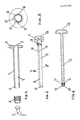
- la figure 1 est une vue en coupe du corps principal de la seringue, avec son embout d'injection et un écrou de fixation ;
- la figure 2 est une vue du tube de prélèvement selon l'invention ;
- la figure 3 est une coupe suivant la ligne AA de la figure 2 de ce tube de prélèvement agrandie deux fois ;
- la figure 4 est une vue en coupe d'un piston d'injection ; et
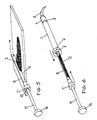
- les figures 5, 6 et 7 sont destinées à illustrer le mode d'utilisation d'une seringue selon la présente invention.
- Comme le représente la figure 1, le corps principal 1 de la seringue est composé d'un tube alésé axialement selon un diamètre donné (2) ; il comporte à son extrémité avant 3 un filetage où vient se visser un écrou 4 bloquant l'embout d'injection 5. Sa partie arrière comporte une colerette 6 destinée à maintenir le corps de seringue 1 entre les doigts de l'utilisateur. L'orifice arrière de la seringue comporte un chanfrein 7 facilitant la pénétration du tube de prélèvement décrit ci-après.
- Comme le représentent les figures 2 et 3, le tube de prélèvement 8, de diamètre extérieur égal à l'alésage 2, est fendu sur au moins une grande partie de sa longueur. La fente 9 a une ouverture comprise entre environ le quart et environ la moitié de la circonférence du tube. L'extrémité 10 du tube est en biseau ou arrondie afin de faciliter la pénétration dans le corps de la seringue 1 par l'orifice chanfreiné 7. Sa partie arrière traverse une bague 11 servant à la préhension et à la manipulation de l'ensemble. La partie fendue 9 traverse également cette bague. La fente 9 génère deux arêtes 12 qui sont taillées en biseau (aiguisées) afin de bien pouvoir racler le matériau d'empreinte lors du prélèvement.
- L'orifice avant de la bague de préhension 11 est muni d'un chanfrein 19. L'orifice arrière de cette bague 11 et donc du tube de prélèvement 8 est muni d'un chanfrein 20.
- Comme le représente la figure 4, le piston 13 comporte en sa partie avant 14, une première rainure annulaire 15 ainsi qu'une deuxième gorge 16 recevant un joint torique 17. Cette gorge 16 est plus large que la section du joint torique 17 et a un diamètre inférieur au diamètre intérieur du joint 17. En sa partie arrière le piston 13 comporte un bouton poussoir 18.
- A titre d'exemple, on décrira ci-après une manipulation.
- Avant d'effectuer le mélange du produit pâteux d'empreinte, l'utilisateur fixe par l'intermédiaire de l'écrou 4 l'embout d'injection 5 sur le filetage 3 du corps principal 1 de la seringue. Il dispose le piston 13 dans le tube de prélèvement 8 en faisant pénétrer sa partie avant 14 par l'orifice chanfreiné 20 le joint torique 17 ne dépassant pas la limite du chanfrein 19. Les deux ensembles ainsi constitués sont laissés en attente pendant l'exécution du mélange du produit pâteux.
- Le mélange réalisé, l'utilisateur saisit par la bague de préhension 11 l'ensemble tube 8 plus piston 13. Il dispose la partie fendue 9 face au produit à prélever, l'une des arêtes 12 étant au contact de la surface du bloc de malaxage ou de la paroi du bol de mélange qui, il faut le préciser, est toujours souple et possède une paroi verticale.
- Comme cela est représenté en figure 5, l'utilisateur déplace cet ensemble en maintenant l'arête 12 au contact de la surface de mélange et remplit ainsi par la fente 9 le tube de prélèvement 8.
- Après le prélèvement, comme cela est représenté en figure 6, l'utilisateur, tenant toujours la bague de préhension 11, présente l'extrémité 10 biseautée ou arrondie, face à l'orifice arrière muni d'un chanfrein 7, et pousse à fond le tube de prélèvement 8 dans l'alésage interne 2 du corps principal 1 de la seringue.
- Cette opération effectuée, il ne lui reste plus, comme cela est représenté en figure 7, qu'à injecter le produit pâteux en appuyant, par le bouton poussoir 18, pour faire pénétrer le piston 13 dans l'ensemble corps principal 1 de seringue plus tube de prélèvement 8. Il agit alors comme avec une seringue classique.
- L'injection étant achevée, l'utilisateur attend que le matériau ait effectué sa prise avant de nettoyer sa seringue. Il suffit alors de retirer le piston 13 en le tournant légèrement. Le joint torique 17 passe sans problème par l'alésage interne de la bague de préhension 11 grâce au chanfrein 19. Le matériau gélifié ou polymérisé qui demeurait dans l'embout d'injection 5 restant solidaire de l'extrémité 14 du piston 13, car s'étant serti dans la première rainure annulaire 15 de ce dernier. Cette opération étant effectuée, l'utilisateur retire ensuite le tube de remplissage 8 du corps principal 1, en le tournant légèrement. Le passage d'un écouvillon suffit alors au nettoyage de tous les éléments composant cette seringue.
- L'exposé de cette manipulation démontre sa simplicté, sa rapidité, et l'efficacité du remplissage de cette seringue, évitant ainsi toute perte de temps et toute perte de matériau.
Claims (9)
Applications Claiming Priority (2)
| Application Number | Priority Date | Filing Date | Title |
|---|---|---|---|
| FR8517550 | 1985-11-25 | ||
| FR8517550A FR2590487A1 (fr) | 1985-11-25 | 1985-11-25 | Seringue pour l'injection de produits pateux destines a la prise d'empreintes dentaires, avec dispositif de remplissage incorpore |
Publications (2)
| Publication Number | Publication Date |
|---|---|
| EP0225265A1 true EP0225265A1 (fr) | 1987-06-10 |
| EP0225265B1 EP0225265B1 (fr) | 1991-04-24 |
Family
ID=9325202
Family Applications (1)
| Application Number | Title | Priority Date | Filing Date |
|---|---|---|---|
| EP86420283A Expired - Lifetime EP0225265B1 (fr) | 1985-11-25 | 1986-11-20 | Seringue pour l'injection de produits pâteux destinés à la prise d'empreintes dentaires, avec dispositif de remplissage incorporé |
Country Status (5)
| Country | Link |
|---|---|
| US (1) | US4784607A (fr) |
| EP (1) | EP0225265B1 (fr) |
| DE (1) | DE3678910D1 (fr) |
| ES (1) | ES2021606B3 (fr) |
| FR (1) | FR2590487A1 (fr) |
Cited By (2)
| Publication number | Priority date | Publication date | Assignee | Title |
|---|---|---|---|---|
| US6848906B2 (en) | 2000-12-05 | 2005-02-01 | Heraeus Kulzer Gmbh & Co. Kg | Syringe for the metered delivery of dental materials |
| FR2937313A1 (fr) * | 2008-10-21 | 2010-04-23 | Prophytec | Capsule et procede de distribution d'un produit |
Families Citing this family (27)
| Publication number | Priority date | Publication date | Assignee | Title |
|---|---|---|---|---|
| US5236355A (en) * | 1988-12-22 | 1993-08-17 | American Cyanamid Company | Apparatus for the treatment of periodontal disease |
| US5267859A (en) * | 1991-01-07 | 1993-12-07 | Centrix, Inc. | Bulk dental cartridge |
| US5165890A (en) * | 1991-01-07 | 1992-11-24 | Centrix, Inc. | Dosing dental cartridge |
| US5122057A (en) * | 1991-01-07 | 1992-06-16 | Centrix, Inc. | Dosing dental cartridge |
| US5324273A (en) * | 1992-09-30 | 1994-06-28 | Centrix, Inc. | Disposable barrel dental impression material syringe |
| US5322440A (en) * | 1992-10-20 | 1994-06-21 | Kerr Manufacturing Company | Dental syringe tip |
| US5387103A (en) * | 1993-02-16 | 1995-02-07 | Ultradent Products, Inc. | Syringe apparatus for delivering tooth composites and other solid yet pliable materials |
| US5451214A (en) * | 1993-03-22 | 1995-09-19 | Hajishoreh; Kaveh-Karimi | Syringe apparatus |
| US5445523A (en) * | 1993-09-03 | 1995-08-29 | Ultradent Products, Inc. | Syringe apparatus and methods for dispensing viscous materials |
| USD363986S (en) | 1994-05-02 | 1995-11-07 | Rigoberto Pena | Dental syringe |
| DE9419200U1 (de) * | 1994-11-30 | 1996-04-11 | Ernst Mühlbauer KG, 22547 Hamburg | Applikationsgerät für Dentalmasse |
| US20020119417A1 (en) * | 1998-05-29 | 2002-08-29 | Arthur Ashman | Nozzle tip for use with syringe and method for using same |
| US6554803B1 (en) * | 1997-04-02 | 2003-04-29 | Arthur Ashman | Combination syringe and aspirator for bone regeneration material and method for using the syringe |
| US7563249B2 (en) * | 2002-12-20 | 2009-07-21 | Medrad, Inc. | Syringe having an alignment flange, an extending lip and a radial expansion section of reduced wall thickness |
| US6638065B2 (en) | 2001-12-17 | 2003-10-28 | Ultradent Products, Inc. | Quad cutter tool for removing syringe divider |
| US6682348B2 (en) * | 2002-03-29 | 2004-01-27 | Orapharma, Inc. | Dispensing apparatus and cartridge |
| CA2485900C (fr) * | 2002-05-28 | 2012-07-10 | Kelsan Technologies Corp. | Ensemble buse de pulverisation |
| US7513901B2 (en) * | 2005-05-19 | 2009-04-07 | Warsaw Orthopedic, Inc. | Graft syringe assembly |
| CA2567936C (fr) | 2006-11-14 | 2016-01-05 | Atomic Energy Of Canada Limited | Dispositif et methode de replication de couche superficielle |
| US7976491B2 (en) * | 2007-12-04 | 2011-07-12 | Orapharma, Inc. | Actuators for device for delivering medicinal implants |
| US7976489B2 (en) | 2007-12-04 | 2011-07-12 | Orapharma, Inc. | Device for delivering medicinal implants |
| US7976490B2 (en) * | 2007-12-04 | 2011-07-12 | Orapharma, Inc. | Medicinal implant cartridge |
| US8048021B2 (en) | 2008-12-02 | 2011-11-01 | Orapharma, Inc. | Medicinal implant device and cartridge |
| US8034034B2 (en) * | 2009-01-12 | 2011-10-11 | Howmedica Osteonics Corp. | Syringe and method of use |
| US10034726B2 (en) * | 2009-05-05 | 2018-07-31 | Dentsply Sirona Inc | Air activated impression syringe to deliver impression material around tooth in crown preparation |
| EP3597130A1 (fr) * | 2014-12-17 | 2020-01-22 | Sulzer Mixpac AG | Dispositif de distribution pour matériaux de remplacement osseux |
| EP3595539B1 (fr) * | 2017-03-15 | 2024-05-08 | Smith & Nephew, Inc | Instruments de préparation et de pose de greffon |
Citations (4)
| Publication number | Priority date | Publication date | Assignee | Title |
|---|---|---|---|---|
| DE675455C (de) * | 1937-07-24 | 1942-01-05 | Albert Boerner | Zigarettenstopfvorrichtung |
| GB549938A (en) * | 1941-07-31 | 1942-12-15 | Echeale Joseph Bloom | Hand appliance for making cigarettes |
| US2825134A (en) * | 1956-01-09 | 1958-03-04 | Paul L Hicks | Device for use in making impressions from dental impression material |
| US2869763A (en) * | 1957-04-03 | 1959-01-20 | Robert C Bonvini | Syringe for ejecting plastic material |
Family Cites Families (2)
| Publication number | Priority date | Publication date | Assignee | Title |
|---|---|---|---|---|
| US723822A (en) * | 1903-01-05 | 1903-03-31 | Albert E Buchanan | Syringe for dental or other uses. |
| US3346147A (en) * | 1966-08-18 | 1967-10-10 | Brunswick Corp | Dental compound syringe |
-
1985
- 1985-11-25 FR FR8517550A patent/FR2590487A1/fr not_active Withdrawn
-
1986
- 1986-11-20 EP EP86420283A patent/EP0225265B1/fr not_active Expired - Lifetime
- 1986-11-20 DE DE8686420283T patent/DE3678910D1/de not_active Expired - Fee Related
- 1986-11-20 ES ES86420283T patent/ES2021606B3/es not_active Expired - Lifetime
- 1986-11-25 US US06/934,849 patent/US4784607A/en not_active Expired - Lifetime
Patent Citations (4)
| Publication number | Priority date | Publication date | Assignee | Title |
|---|---|---|---|---|
| DE675455C (de) * | 1937-07-24 | 1942-01-05 | Albert Boerner | Zigarettenstopfvorrichtung |
| GB549938A (en) * | 1941-07-31 | 1942-12-15 | Echeale Joseph Bloom | Hand appliance for making cigarettes |
| US2825134A (en) * | 1956-01-09 | 1958-03-04 | Paul L Hicks | Device for use in making impressions from dental impression material |
| US2869763A (en) * | 1957-04-03 | 1959-01-20 | Robert C Bonvini | Syringe for ejecting plastic material |
Cited By (3)
| Publication number | Priority date | Publication date | Assignee | Title |
|---|---|---|---|---|
| US6848906B2 (en) | 2000-12-05 | 2005-02-01 | Heraeus Kulzer Gmbh & Co. Kg | Syringe for the metered delivery of dental materials |
| FR2937313A1 (fr) * | 2008-10-21 | 2010-04-23 | Prophytec | Capsule et procede de distribution d'un produit |
| EP2179705A1 (fr) | 2008-10-21 | 2010-04-28 | Prophytec | Capsule et procédé de distribution d'un produit |
Also Published As
| Publication number | Publication date |
|---|---|
| US4784607A (en) | 1988-11-15 |
| ES2021606B3 (es) | 1991-11-16 |
| FR2590487A1 (fr) | 1987-05-29 |
| DE3678910D1 (de) | 1991-05-29 |
| EP0225265B1 (fr) | 1991-04-24 |
Similar Documents
| Publication | Publication Date | Title |
|---|---|---|
| EP0225265B1 (fr) | Seringue pour l'injection de produits pâteux destinés à la prise d'empreintes dentaires, avec dispositif de remplissage incorporé | |
| US5697903A (en) | Methods and apparatus for dispensing compositions | |
| AU685157B2 (en) | Methods and apparatus for mixing and dispensing multi-part compositions | |
| EP1113831B1 (fr) | Seringues pour l'administration de formulations pateuses ou semi-solides | |
| US5328462A (en) | Methods and apparatus for mixing and dispensing multi-part compositions | |
| EP1651293B1 (fr) | Dispositif d ejection d un produit liquide ou pateux | |
| CH672984A5 (fr) | ||
| CH620126A5 (fr) | ||
| FR2515047A1 (fr) | Seringue dentaire a usages multiples, et poignee de commande, cartouche de distribution de matiere et corps pour cette seringue | |
| FR2858931A1 (fr) | Dispositif d'administration orale d'un medicament | |
| FR2796561A1 (fr) | Seringue de securite | |
| EP0944440B1 (fr) | Dispositif de distribution d'une matiere extrudable telle qu'une pate a usage dentaire | |
| FR2690332A1 (fr) | Injecteur de matière osseuse pour greffes osseuses. | |
| US20040164097A1 (en) | Multiple use dental viscous material dispenser | |
| CH630541A5 (fr) | Embout pour l'injection d'un produit liquide a l'interieur d'une piece, notamment pour la lubrification d'une piece a main dentaire. | |
| CH570169A5 (en) | Rear filling liq syringe distributor - with filling device | |
| FR2931684A1 (fr) | Ligne de perfusion pour l'administration de liquides de traitement medical, tels que des produits de chimiotherapie, a un patient, et procede d'utilisation d'une telle ligne de perfusion | |
| FR2572677A1 (fr) | Dispositif de melange et de transfert d'une matiere pateuse en particulier matiere pateuse durcissables pour prise d'empreinte | |
| EP0626830B1 (fr) | Dispositif d'application de matiere d'obturation dans une cavite dentaire | |
| FR2966738A1 (fr) | Seringue melangeuse | |
| FR2903594A1 (fr) | Dispositif de production d'une mousse injectable. | |
| EP1064036A1 (fr) | Dispositif pour l'injection sous-cutanee sans aiguille d'un medicament sous forme liquide | |
| EP4684867A2 (fr) | Dispositif pour le melange et l'injection d'une composition, notamment un ciment osseux | |
| EP0856298B1 (fr) | Embout de remplissage pour éléments de conditionnement de liquide biologique, notamment pour l'insémination artificielle | |
| FR2602416A1 (fr) | Dispositif pour remplir les seringues a prise d'empreinte en chirurgie dentaire |
Legal Events
| Date | Code | Title | Description |
|---|---|---|---|
| PUAI | Public reference made under article 153(3) epc to a published international application that has entered the european phase |
Free format text: ORIGINAL CODE: 0009012 |
|
| AK | Designated contracting states |
Kind code of ref document: A1 Designated state(s): BE CH DE ES FR GB IT LI NL |
|
| 17P | Request for examination filed |
Effective date: 19871201 |
|
| 17Q | First examination report despatched |
Effective date: 19890626 |
|
| GRAA | (expected) grant |
Free format text: ORIGINAL CODE: 0009210 |
|
| AK | Designated contracting states |
Kind code of ref document: B1 Designated state(s): BE CH DE ES FR GB IT LI NL |
|
| PG25 | Lapsed in a contracting state [announced via postgrant information from national office to epo] |
Ref country code: NL Effective date: 19910424 Ref country code: GB Effective date: 19910424 |
|
| REF | Corresponds to: |
Ref document number: 3678910 Country of ref document: DE Date of ref document: 19910529 |
|
| ITF | It: translation for a ep patent filed | ||
| NLV1 | Nl: lapsed or annulled due to failure to fulfill the requirements of art. 29p and 29m of the patents act | ||
| GBV | Gb: ep patent (uk) treated as always having been void in accordance with gb section 77(7)/1977 [no translation filed] | ||
| PLBE | No opposition filed within time limit |
Free format text: ORIGINAL CODE: 0009261 |
|
| STAA | Information on the status of an ep patent application or granted ep patent |
Free format text: STATUS: NO OPPOSITION FILED WITHIN TIME LIMIT |
|
| 26N | No opposition filed | ||
| PGFP | Annual fee paid to national office [announced via postgrant information from national office to epo] |
Ref country code: BE Payment date: 19961118 Year of fee payment: 11 |
|
| PG25 | Lapsed in a contracting state [announced via postgrant information from national office to epo] |
Ref country code: BE Free format text: LAPSE BECAUSE OF NON-PAYMENT OF DUE FEES Effective date: 19971130 |
|
| BERE | Be: lapsed |
Owner name: STABYL S.A.R.L. Effective date: 19971130 |
|
| PGFP | Annual fee paid to national office [announced via postgrant information from national office to epo] |
Ref country code: CH Payment date: 20001130 Year of fee payment: 15 |
|
| PG25 | Lapsed in a contracting state [announced via postgrant information from national office to epo] |
Ref country code: LI Free format text: LAPSE BECAUSE OF NON-PAYMENT OF DUE FEES Effective date: 20011130 Ref country code: CH Free format text: LAPSE BECAUSE OF NON-PAYMENT OF DUE FEES Effective date: 20011130 |
|
| REG | Reference to a national code |
Ref country code: CH Ref legal event code: PL |
|
| PGFP | Annual fee paid to national office [announced via postgrant information from national office to epo] |
Ref country code: DE Payment date: 20021118 Year of fee payment: 17 |
|
| PGFP | Annual fee paid to national office [announced via postgrant information from national office to epo] |
Ref country code: FR Payment date: 20021129 Year of fee payment: 17 |
|
| PGFP | Annual fee paid to national office [announced via postgrant information from national office to epo] |
Ref country code: ES Payment date: 20031029 Year of fee payment: 18 |
|
| PG25 | Lapsed in a contracting state [announced via postgrant information from national office to epo] |
Ref country code: DE Free format text: LAPSE BECAUSE OF NON-PAYMENT OF DUE FEES Effective date: 20040602 |
|
| PG25 | Lapsed in a contracting state [announced via postgrant information from national office to epo] |
Ref country code: FR Free format text: LAPSE BECAUSE OF NON-PAYMENT OF DUE FEES Effective date: 20040730 |
|
| REG | Reference to a national code |
Ref country code: FR Ref legal event code: ST |
|
| PG25 | Lapsed in a contracting state [announced via postgrant information from national office to epo] |
Ref country code: ES Free format text: LAPSE BECAUSE OF NON-PAYMENT OF DUE FEES Effective date: 20041122 |
|
| PG25 | Lapsed in a contracting state [announced via postgrant information from national office to epo] |
Ref country code: IT Free format text: LAPSE BECAUSE OF NON-PAYMENT OF DUE FEES;WARNING: LAPSES OF ITALIAN PATENTS WITH EFFECTIVE DATE BEFORE 2007 MAY HAVE OCCURRED AT ANY TIME BEFORE 2007. THE CORRECT EFFECTIVE DATE MAY BE DIFFERENT FROM THE ONE RECORDED. Effective date: 20051120 |
|
| REG | Reference to a national code |
Ref country code: ES Ref legal event code: FD2A Effective date: 20041122 |