EP0224318A1 - Verfahren zum Verpacken von flüssigen oder zum Teil flüssigen Nahrungsmitteln in sterilisierbare Kunststoffbehältnisse - Google Patents
Verfahren zum Verpacken von flüssigen oder zum Teil flüssigen Nahrungsmitteln in sterilisierbare Kunststoffbehältnisse Download PDFInfo
- Publication number
- EP0224318A1 EP0224318A1 EP86305815A EP86305815A EP0224318A1 EP 0224318 A1 EP0224318 A1 EP 0224318A1 EP 86305815 A EP86305815 A EP 86305815A EP 86305815 A EP86305815 A EP 86305815A EP 0224318 A1 EP0224318 A1 EP 0224318A1
- Authority
- EP
- European Patent Office
- Prior art keywords
- container
- container body
- heat
- temperature
- product
- Prior art date
- Legal status (The legal status is an assumption and is not a legal conclusion. Google has not performed a legal analysis and makes no representation as to the accuracy of the status listed.)
- Granted
Links
- 238000000034 method Methods 0.000 title claims abstract description 15
- 230000008569 process Effects 0.000 title claims abstract description 13
- 239000007788 liquid Substances 0.000 title claims abstract description 7
- 235000021056 liquid food Nutrition 0.000 title claims abstract description 6
- 238000004806 packaging method and process Methods 0.000 title claims abstract description 4
- 239000000463 material Substances 0.000 claims abstract description 14
- 229920001169 thermoplastic Polymers 0.000 claims abstract description 14
- 239000004416 thermosoftening plastic Substances 0.000 claims abstract description 14
- 235000013361 beverage Nutrition 0.000 claims abstract description 10
- 238000001816 cooling Methods 0.000 claims abstract description 7
- 235000021057 semi-liquid food Nutrition 0.000 claims abstract description 5
- 238000009998 heat setting Methods 0.000 claims description 25
- 229920000139 polyethylene terephthalate Polymers 0.000 claims description 11
- 239000005020 polyethylene terephthalate Substances 0.000 claims description 11
- -1 polyethylene terephthalate Polymers 0.000 claims description 6
- 238000002844 melting Methods 0.000 claims description 5
- 230000008018 melting Effects 0.000 claims description 5
- 238000000465 moulding Methods 0.000 claims description 4
- 238000007669 thermal treatment Methods 0.000 claims description 2
- 239000000047 product Substances 0.000 description 16
- 229920000642 polymer Polymers 0.000 description 6
- 239000002184 metal Substances 0.000 description 5
- 230000008859 change Effects 0.000 description 4
- 235000013305 food Nutrition 0.000 description 4
- 230000009467 reduction Effects 0.000 description 4
- 238000009928 pasteurization Methods 0.000 description 3
- 238000002425 crystallisation Methods 0.000 description 2
- 235000013399 edible fruits Nutrition 0.000 description 2
- 239000012530 fluid Substances 0.000 description 2
- 230000009477 glass transition Effects 0.000 description 2
- 238000010438 heat treatment Methods 0.000 description 2
- 238000004826 seaming Methods 0.000 description 2
- 238000004659 sterilization and disinfection Methods 0.000 description 2
- 235000013311 vegetables Nutrition 0.000 description 2
- 229920002799 BoPET Polymers 0.000 description 1
- 230000015572 biosynthetic process Effects 0.000 description 1
- 238000000071 blow moulding Methods 0.000 description 1
- 230000007423 decrease Effects 0.000 description 1
- 230000000694 effects Effects 0.000 description 1
- 238000002474 experimental method Methods 0.000 description 1
- 238000004880 explosion Methods 0.000 description 1
- 239000012263 liquid product Substances 0.000 description 1
- 229920000728 polyester Polymers 0.000 description 1
- 239000002861 polymer material Substances 0.000 description 1
- 230000000452 restraining effect Effects 0.000 description 1
- 229920006395 saturated elastomer Polymers 0.000 description 1
- 238000007789 sealing Methods 0.000 description 1
Images
Classifications
-
- B—PERFORMING OPERATIONS; TRANSPORTING
- B65—CONVEYING; PACKING; STORING; HANDLING THIN OR FILAMENTARY MATERIAL
- B65B—MACHINES, APPARATUS OR DEVICES FOR, OR METHODS OF, PACKAGING ARTICLES OR MATERIALS; UNPACKING
- B65B3/00—Packaging plastic material, semiliquids, liquids or mixed solids and liquids, in individual containers or receptacles, e.g. bags, sacks, boxes, cartons, cans, or jars
- B65B3/02—Machines characterised by the incorporation of means for making the containers or receptacles
- B65B3/022—Making containers by moulding of a thermoplastic material
-
- B—PERFORMING OPERATIONS; TRANSPORTING
- B29—WORKING OF PLASTICS; WORKING OF SUBSTANCES IN A PLASTIC STATE IN GENERAL
- B29C—SHAPING OR JOINING OF PLASTICS; SHAPING OF MATERIAL IN A PLASTIC STATE, NOT OTHERWISE PROVIDED FOR; AFTER-TREATMENT OF THE SHAPED PRODUCTS, e.g. REPAIRING
- B29C71/00—After-treatment of articles without altering their shape; Apparatus therefor
- B29C71/02—Thermal after-treatment
-
- B—PERFORMING OPERATIONS; TRANSPORTING
- B29—WORKING OF PLASTICS; WORKING OF SUBSTANCES IN A PLASTIC STATE IN GENERAL
- B29L—INDEXING SCHEME ASSOCIATED WITH SUBCLASS B29C, RELATING TO PARTICULAR ARTICLES
- B29L2023/00—Tubular articles
Definitions
- the present invention relates to methods for heat-treating thermoplastic tubular articles which are at least partially oriented, these articles comprising particularly, but not exclusively, tubular articles of saturated linear polyester materials such as polyethylene terephthalate (PET), intended for use as processable food and beverage container bodies.
- PET polyethylene terephthalate
- a degree of orientation of the container body is known to be desirable for improving its mechanical properties and is conventionally induced by mechanical deformation, such as drawing, stretching or stretch-blow-moulding of the polymer.
- the oriented body will shrink if heated above the temperature at which the mechanical deformation took place.
- the oriented body can be heat stabilised to an elevated temperature above the glass transition temperature, by heating it to a temperature at least 40 0 C above that elevated temperature whilst restraining it from deformation: the process is known as heat-setting. Internal stress is eliminated by molecular relaxation and, where the polymer is crystallisable, by partial crystallisation.
- thermoplastic container bodies have been made by simply using a thicker body wall, of the order of 1 mm. Not only is this wasteful of material, but such a thick-walled container body is not compatible with conventional double seaming equipment which is used for attaching metal end closures and which requires a body wall thickness in the range of from 0.25 mm to 0.75 mm.
- thermoplastics material it has been thought desirable to heat-set an oriented thermoplastics material at as high a temperature as possible for that material, which is a temperature just below the melting point.
- a temperature e.g. a temperature just below the melting point.
- heat-setting temperatures of around 230 o C have been used.
- the choice of a high heat-set temperature has ensured a minimum residual volume shrinkage (reduction in volume), e.g. less than 3%, and hence good dimensional stability in the heat-set article.
- a process for packaging a liquid or semi-liquid food or beverage product in a container which comprises:
- the present invention provides a package comprising a liquid or semi-liquid food or beverage product and a container enclosing said product, the container having a body and at least one closure closing said body on to said product, the container body having been formed from a thermoplastics material by a moulding operation to have a body wall which is at least partially oriented and has a wall thickness lying in the range 0.25 mm to 0.75 mm, said container body prior to charging with said product having been heat-set at a predetermined temperature which is at least 10 0 C below the melting point of the thermoplastics material of the container body, said container having been thermally processed after closure, together with its contents, at a processing temperature which lies within the range of from 60°C to 140 0 C, the predetermined heat-setting temperature being such that, at ambient temperature and after thermal processing, any pressure differential across the container body wall is insufficient to cause panelling of the same, and the container body is therefore unpanelled.
- a suitable material for the container body is polyethylene terephthalate for which a suitable range of predetermined heat-setting temperatures would be from 100 0 C to 2300C.
- the pressure within the container In order to reduce the tendency to panelling, it is desirable, when the container has cooled to ambient temperature, for the pressure within the container to be at least as great as the pressure existing outside the container; indeed, in certain cases a slight overpressure is desirable within the container, as this helps improve top-load performance.
- the main factor affecting the pressure in the sealed container is the head space, i.e. the air or vapour-filled gap between the product and container lid, because of its relatively high compressibility in comparison with that of the liquid or semi-liquid product, and the pressure changes which will occur during the stages of filling, retorting and cooling to ambient will depend upon the volume of this head space and the temperature changes which occur during those stages.
- the head space volume is normally set at the filling station, a typical head space height being 1 cm.
- this pressure change is normally negative, i.e. a reduction in pressure, by the time the product and head space have cooled to ambient temperatures.
- this pressure reduction it is possible to determine what volume shrinkage in the container body would compensate for it so as to ensure that the pressure difference across the container body wall at ambient temperature is insufficient to cause panelling of the container body despite the thinness of the body wall imposed by practical and commercial restraints (e.g. double-seaming of end closures, polymer costs etc.).
- an appropriate heat-setting temperature for the heat-set container body to have sufficient residual shrinkage to meet the required container shrinkage during a particular subsequent thermal process: the lower the heat-set temperature in relation to the processing temperature to be used, the greater the residual shrinkage which occurs during processing.
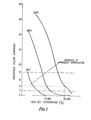
- FIG. 1 there is shown a family of three curves relating to identical containers charged with different products requiring different processing regimes.
- the curves relate to process temperature of 85 0 C, 100°C and 120°C respectively, the process times for the curves being 30 mins. in each case: these are representative temperatures and times for carrying out a typical beverage pasteurisation, fruit pasteurisation and vegetable sterilisation process respectively. From any individual curve, it will be seen that the volume shrinkage decreases with increasing heat-setting temperature (T h ).
- the containers have tubular bodies of biaxially oriented polyethylene terephthalate (PET), and conventional metal end closures double-seamed to the ends of the bodies.
- PET polyethylene terephthalate
- a graph of the type shown in Figure 1 could be prepared for a given thermoplastics material of the container, container configuration, particular product and its processing requirements (i.e. temperature and time and volume head space.
- a percentage volume shrinkage of say 6% is selected, and Figure 1 indicates the heat-set temperature which would be appropriate for two containers which are to be retorted at 100 o C and 120 o C and have the characteristics of the appropriate curves shown there.
- the first of these containers, holding a product such as fruit is to be pasteurised at 100 o C and such a container would therefore have to be set at the temperature indicated T h (100).
- the container which is to be retorted at a 120 o C would have to have been heat-set at the (higher) temperature T h (120) if panelling of the container body on cooling is again to be reliably avoided.
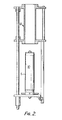
- the cylindrical container body to be heat set is indicated by the reference numeral 5 and is shown when it has been sleeved over a cooled mandrel 10 on which it is a loose or sliding fit.
- the mandrel with the body thereon is inserted longitudinally into the central bore of a heated tubular mould 12 which then surrounds the body with a small clearance. With its ends restrained against axial movement by means not shown, the body is then expanded by differential fluid pressure radially into contact with the mould and is held there while heat-setting takes place. After the required degree of thermal stability has been imparted to the container body, the fluid pressure is removed, and the body accordingly shrinks into contact with the mandrel.
- the mandrel cools the body quickly to below its glass transition temperature and restrains it against further shrinkage, so , giving it the predetermined cross-sectional dimensions of the body required for closing, filling and, in particular, processing as described above. After cooling, the body is stripped from the mandrel.
- the temperature of the mould 12, in particular its interior surface is made to be such that during heat-setting, that is to say, while the mould is contacted by the container body 5, the polymer material of the body can within a reasonable time attain the heat-setting temperature T h throughout its wall thickness. In order to make allowance for the temperature differential which will exist across the wall, this requires an operating temperature for the mould interior surface which is greater than T h .
- the time allowed for heat-setting should be the minimum which will allow the body to attain the thermal condition mentioned in the preceding paragraph, and the graphs of Figure 1 are developed accordingly. It will be understood that the use of a heat-setting time greater than that required to attain the temperature T h throughout the wall thickness is undesirable in that it will tend to result in reduced throughput and in a potential residual shrinkage capability which is less than that required to ensure lack of panelling in the closed container after processing. Thus, heat-setting times within the range 5-10 secs. are typical.
- the invention is not limited in application to containers having biaxially oriented tubular bodies of polyethylene terephthalate which are closed by metal end closures double-seamed to their ends (as particularly described). It may be used with containers having bodies of PET or other polymers (preferably, but not necessarily, crystallisable), whether biaxially or uniaxially oriented, and/or closed by end closures at one or both of their ends.
- the or each end closure may be double-seamed into position, or it may be attached by other means, for example by heat-sealing.
Landscapes
- Physics & Mathematics (AREA)
- Thermal Sciences (AREA)
- Engineering & Computer Science (AREA)
- Mechanical Engineering (AREA)
- Processing And Handling Of Plastics And Other Materials For Molding In General (AREA)
- Containers Having Bodies Formed In One Piece (AREA)
- Food Preservation Except Freezing, Refrigeration, And Drying (AREA)
- Packages (AREA)
Priority Applications (1)
| Application Number | Priority Date | Filing Date | Title |
|---|---|---|---|
| AT86305815T ATE49173T1 (de) | 1985-08-27 | 1986-07-29 | Verfahren zum verpacken von fluessigen oder zum teil fluessigen nahrungsmitteln in sterilisierbare kunststoffbehaeltnisse. |
Applications Claiming Priority (2)
| Application Number | Priority Date | Filing Date | Title |
|---|---|---|---|
| GB858521295A GB8521295D0 (en) | 1985-08-27 | 1985-08-27 | Heat-treatment of thermoplastic tubular articles |
| GB8521295 | 1985-08-27 |
Publications (2)
| Publication Number | Publication Date |
|---|---|
| EP0224318A1 true EP0224318A1 (de) | 1987-06-03 |
| EP0224318B1 EP0224318B1 (de) | 1990-01-03 |
Family
ID=10584321
Family Applications (1)
| Application Number | Title | Priority Date | Filing Date |
|---|---|---|---|
| EP86305815A Expired - Lifetime EP0224318B1 (de) | 1985-08-27 | 1986-07-29 | Verfahren zum Verpacken von flüssigen oder zum Teil flüssigen Nahrungsmitteln in sterilisierbare Kunststoffbehältnisse |
Country Status (8)
| Country | Link |
|---|---|
| EP (1) | EP0224318B1 (de) |
| JP (1) | JPH0755142B2 (de) |
| AT (1) | ATE49173T1 (de) |
| CA (1) | CA1272008A (de) |
| DE (1) | DE3667953D1 (de) |
| GB (2) | GB8521295D0 (de) |
| ZA (1) | ZA865793B (de) |
| ZW (1) | ZW15886A1 (de) |
Citations (2)
| Publication number | Priority date | Publication date | Assignee | Title |
|---|---|---|---|---|
| EP0115380A1 (de) * | 1983-01-05 | 1984-08-08 | American National Can Company | Verfahren zum Verpacken von Nahrungsmitteln in Kunststoffbehälter |
| EP0125013A2 (de) * | 1983-04-22 | 1984-11-14 | METAL BOX p.l.c. | Dimensionsstabiler thermoplastischer Rohrkörper |
-
1985
- 1985-08-27 GB GB858521295A patent/GB8521295D0/en active Pending
-
1986
- 1986-07-29 EP EP86305815A patent/EP0224318B1/de not_active Expired - Lifetime
- 1986-07-29 AT AT86305815T patent/ATE49173T1/de active
- 1986-07-29 DE DE8686305815T patent/DE3667953D1/de not_active Expired - Lifetime
- 1986-07-29 GB GB8618411A patent/GB2179585B/en not_active Expired
- 1986-07-31 CA CA000515111A patent/CA1272008A/en not_active Expired - Lifetime
- 1986-08-01 ZA ZA865793A patent/ZA865793B/xx unknown
- 1986-08-06 ZW ZW158/86A patent/ZW15886A1/xx unknown
- 1986-08-27 JP JP61201215A patent/JPH0755142B2/ja not_active Expired - Lifetime
Patent Citations (2)
| Publication number | Priority date | Publication date | Assignee | Title |
|---|---|---|---|---|
| EP0115380A1 (de) * | 1983-01-05 | 1984-08-08 | American National Can Company | Verfahren zum Verpacken von Nahrungsmitteln in Kunststoffbehälter |
| EP0125013A2 (de) * | 1983-04-22 | 1984-11-14 | METAL BOX p.l.c. | Dimensionsstabiler thermoplastischer Rohrkörper |
Also Published As
| Publication number | Publication date |
|---|---|
| DE3667953D1 (de) | 1990-02-08 |
| EP0224318B1 (de) | 1990-01-03 |
| CA1272008A (en) | 1990-07-31 |
| GB2179585A (en) | 1987-03-11 |
| ZA865793B (en) | 1987-05-27 |
| JPS6248365A (ja) | 1987-03-03 |
| ATE49173T1 (de) | 1990-01-15 |
| GB2179585B (en) | 1989-08-09 |
| JPH0755142B2 (ja) | 1995-06-14 |
| ZW15886A1 (en) | 1986-11-26 |
| GB8521295D0 (en) | 1985-10-02 |
| GB8618411D0 (en) | 1986-09-03 |
Similar Documents
| Publication | Publication Date | Title |
|---|---|---|
| EP2358602B1 (de) | Auf vakuumkräfte ansprechende behälterbodenstruktur | |
| CA1143522A (en) | Method for producing polyester container | |
| US20200095008A1 (en) | Container Base Including Hemispherical Actuating Diaphragm | |
| US6502369B1 (en) | Method of supporting plastic containers during product filling and packaging when exposed to elevated temperatures and internal pressure variations | |
| CA2606421C (en) | Container base structure responsive to vacuum related forces | |
| KR920005692B1 (ko) | 플라스틱용기 및 그 제조방법 | |
| EP2242635B1 (de) | Verfahren zur herstellung eines behälters | |
| US7451886B2 (en) | Container base structure responsive to vacuum related forces | |
| US7520399B2 (en) | Interlocking rectangular container | |
| US8240493B2 (en) | Container having oriented standing surface | |
| JP2688089B2 (ja) | レトルトキャニングで用いるのに適した容器 | |
| US5071029A (en) | Functional and economical plastic can | |
| US20100213204A1 (en) | Headspace sealing and displacement method for removal of vacuum pressure | |
| US20070170144A1 (en) | Container having segmented bumper rib | |
| KR20060031606A (ko) | 진공에 관련된 힘에 반응하는 용기의 베이스 구조 | |
| US7140505B2 (en) | Base design for pasteurization | |
| WO1993012975A1 (en) | Retortable plastic container | |
| WO2012012182A9 (en) | Pressure resistant vacuum/label panel | |
| EP3386904B1 (de) | Verfahren zum befüllen einer polimerischen behälters | |
| EP0224318B1 (de) | Verfahren zum Verpacken von flüssigen oder zum Teil flüssigen Nahrungsmitteln in sterilisierbare Kunststoffbehältnisse | |
| KR101199692B1 (ko) | 내열성과 내충격성이 우수한 폴리에스테르 용기 및 그 제조방법 | |
| WO2015013013A1 (en) | Base for hot-fill plastic containers | |
| JP3678789B2 (ja) | キャップ付容器 | |
| JPH09221131A (ja) | 超高圧殺菌用食品容器 | |
| JPH08244808A (ja) | キャップ付容器 |
Legal Events
| Date | Code | Title | Description |
|---|---|---|---|
| PUAI | Public reference made under article 153(3) epc to a published international application that has entered the european phase |
Free format text: ORIGINAL CODE: 0009012 |
|
| 17P | Request for examination filed |
Effective date: 19860813 |
|
| AK | Designated contracting states |
Kind code of ref document: A1 Designated state(s): AT BE CH DE FR GB IT LI LU NL SE |
|
| 17Q | First examination report despatched |
Effective date: 19881024 |
|
| RAP1 | Party data changed (applicant data changed or rights of an application transferred) |
Owner name: MB GROUP PLC |
|
| RAP1 | Party data changed (applicant data changed or rights of an application transferred) |
Owner name: CMB PACKAGING (UK) LIMITED |
|
| GRAA | (expected) grant |
Free format text: ORIGINAL CODE: 0009210 |
|
| AK | Designated contracting states |
Kind code of ref document: B1 Designated state(s): AT BE CH DE FR GB IT LI LU NL SE |
|
| REF | Corresponds to: |
Ref document number: 49173 Country of ref document: AT Date of ref document: 19900115 Kind code of ref document: T |
|
| ITF | It: translation for a ep patent filed | ||
| REF | Corresponds to: |
Ref document number: 3667953 Country of ref document: DE Date of ref document: 19900208 |
|
| ET | Fr: translation filed | ||
| PGFP | Annual fee paid to national office [announced via postgrant information from national office to epo] |
Ref country code: BE Payment date: 19900515 Year of fee payment: 5 |
|
| PG25 | Lapsed in a contracting state [announced via postgrant information from national office to epo] |
Ref country code: AT Effective date: 19900729 |
|
| PG25 | Lapsed in a contracting state [announced via postgrant information from national office to epo] |
Ref country code: SE Effective date: 19900730 |
|
| PG25 | Lapsed in a contracting state [announced via postgrant information from national office to epo] |
Ref country code: LU Free format text: LAPSE BECAUSE OF NON-PAYMENT OF DUE FEES Effective date: 19900731 Ref country code: LI Effective date: 19900731 Ref country code: CH Effective date: 19900731 |
|
| PGFP | Annual fee paid to national office [announced via postgrant information from national office to epo] |
Ref country code: NL Payment date: 19900731 Year of fee payment: 5 |
|
| RAP2 | Party data changed (patent owner data changed or rights of a patent transferred) |
Owner name: CMB FOODCAN PLC |
|
| NLT2 | Nl: modifications (of names), taken from the european patent patent bulletin |
Owner name: CMB FOODCAN PLC TE WORCESTER, GROOT-BRITTANNIE. |
|
| PLBE | No opposition filed within time limit |
Free format text: ORIGINAL CODE: 0009261 |
|
| STAA | Information on the status of an ep patent application or granted ep patent |
Free format text: STATUS: NO OPPOSITION FILED WITHIN TIME LIMIT |
|
| 26N | No opposition filed | ||
| REG | Reference to a national code |
Ref country code: CH Ref legal event code: PL |
|
| PG25 | Lapsed in a contracting state [announced via postgrant information from national office to epo] |
Ref country code: BE Effective date: 19910731 |
|
| BERE | Be: lapsed |
Owner name: CMB FOODCAN P.L.C. Effective date: 19910731 |
|
| PG25 | Lapsed in a contracting state [announced via postgrant information from national office to epo] |
Ref country code: NL Effective date: 19920201 |
|
| NLV4 | Nl: lapsed or anulled due to non-payment of the annual fee | ||
| EUG | Se: european patent has lapsed |
Ref document number: 86305815.2 Effective date: 19910402 |
|
| PGFP | Annual fee paid to national office [announced via postgrant information from national office to epo] |
Ref country code: FR Payment date: 19950612 Year of fee payment: 10 |
|
| PGFP | Annual fee paid to national office [announced via postgrant information from national office to epo] |
Ref country code: GB Payment date: 19950616 Year of fee payment: 10 |
|
| PGFP | Annual fee paid to national office [announced via postgrant information from national office to epo] |
Ref country code: DE Payment date: 19950620 Year of fee payment: 10 |
|
| PG25 | Lapsed in a contracting state [announced via postgrant information from national office to epo] |
Ref country code: GB Effective date: 19960729 |
|
| GBPC | Gb: european patent ceased through non-payment of renewal fee |
Effective date: 19960729 |
|
| PG25 | Lapsed in a contracting state [announced via postgrant information from national office to epo] |
Ref country code: FR Effective date: 19970328 |
|
| PG25 | Lapsed in a contracting state [announced via postgrant information from national office to epo] |
Ref country code: DE Effective date: 19970402 |
|
| REG | Reference to a national code |
Ref country code: FR Ref legal event code: ST |
|
| PG25 | Lapsed in a contracting state [announced via postgrant information from national office to epo] |
Ref country code: IT Free format text: LAPSE BECAUSE OF NON-PAYMENT OF DUE FEES;WARNING: LAPSES OF ITALIAN PATENTS WITH EFFECTIVE DATE BEFORE 2007 MAY HAVE OCCURRED AT ANY TIME BEFORE 2007. THE CORRECT EFFECTIVE DATE MAY BE DIFFERENT FROM THE ONE RECORDED. Effective date: 20050729 |