EP0223355B1 - Method of manufacturing a pressure-sensitive conductive elastomer compound - Google Patents
Method of manufacturing a pressure-sensitive conductive elastomer compound Download PDFInfo
- Publication number
- EP0223355B1 EP0223355B1 EP86307049A EP86307049A EP0223355B1 EP 0223355 B1 EP0223355 B1 EP 0223355B1 EP 86307049 A EP86307049 A EP 86307049A EP 86307049 A EP86307049 A EP 86307049A EP 0223355 B1 EP0223355 B1 EP 0223355B1
- Authority
- EP
- European Patent Office
- Prior art keywords
- particles
- spherical particles
- carbonized
- compound
- pressure
- Prior art date
- Legal status (The legal status is an assumption and is not a legal conclusion. Google has not performed a legal analysis and makes no representation as to the accuracy of the status listed.)
- Expired
Links
- 150000001875 compounds Chemical class 0.000 title claims description 34
- 229920001971 elastomer Polymers 0.000 title claims description 9
- 239000000806 elastomer Substances 0.000 title claims description 7
- 238000004519 manufacturing process Methods 0.000 title claims description 6
- 239000002245 particle Substances 0.000 claims description 66
- 239000012798 spherical particle Substances 0.000 claims description 17
- 239000000463 material Substances 0.000 claims description 10
- 238000000034 method Methods 0.000 claims description 8
- 239000005011 phenolic resin Substances 0.000 claims description 7
- 229920005989 resin Polymers 0.000 claims description 7
- 239000011347 resin Substances 0.000 claims description 7
- PPBRXRYQALVLMV-UHFFFAOYSA-N Styrene Chemical compound C=CC1=CC=CC=C1 PPBRXRYQALVLMV-UHFFFAOYSA-N 0.000 claims description 6
- 239000011159 matrix material Substances 0.000 claims description 6
- 239000000203 mixture Substances 0.000 claims description 6
- OKTJSMMVPCPJKN-UHFFFAOYSA-N Carbon Chemical compound [C] OKTJSMMVPCPJKN-UHFFFAOYSA-N 0.000 claims description 5
- 239000000178 monomer Substances 0.000 claims description 5
- 229920002379 silicone rubber Polymers 0.000 claims description 5
- 239000004945 silicone rubber Substances 0.000 claims description 5
- CSCPPACGZOOCGX-UHFFFAOYSA-N Acetone Chemical compound CC(C)=O CSCPPACGZOOCGX-UHFFFAOYSA-N 0.000 claims description 4
- 239000011261 inert gas Substances 0.000 claims description 4
- 238000003756 stirring Methods 0.000 claims description 4
- 238000010557 suspension polymerization reaction Methods 0.000 claims description 4
- XLYOFNOQVPJJNP-UHFFFAOYSA-N water Substances O XLYOFNOQVPJJNP-UHFFFAOYSA-N 0.000 claims description 4
- 238000010000 carbonizing Methods 0.000 claims description 3
- 239000002270 dispersing agent Substances 0.000 claims description 3
- 229920005990 polystyrene resin Polymers 0.000 claims description 3
- 238000010298 pulverizing process Methods 0.000 claims description 3
- 229920003987 resole Polymers 0.000 claims description 3
- 239000000126 substance Substances 0.000 claims description 3
- 229910052799 carbon Inorganic materials 0.000 claims description 2
- 239000002685 polymerization catalyst Substances 0.000 claims description 2
- 238000003763 carbonization Methods 0.000 description 7
- KXGFMDJXCMQABM-UHFFFAOYSA-N 2-methoxy-6-methylphenol Chemical compound [CH]OC1=CC=CC([CH])=C1O KXGFMDJXCMQABM-UHFFFAOYSA-N 0.000 description 6
- 229920001568 phenolic resin Polymers 0.000 description 6
- 238000003825 pressing Methods 0.000 description 5
- MYRTYDVEIRVNKP-UHFFFAOYSA-N 1,2-Divinylbenzene Chemical compound C=CC1=CC=CC=C1C=C MYRTYDVEIRVNKP-UHFFFAOYSA-N 0.000 description 4
- 239000011231 conductive filler Substances 0.000 description 4
- 238000005259 measurement Methods 0.000 description 4
- WSFSSNUMVMOOMR-UHFFFAOYSA-N Formaldehyde Chemical compound O=C WSFSSNUMVMOOMR-UHFFFAOYSA-N 0.000 description 3
- XPFVYQJUAUNWIW-UHFFFAOYSA-N furfuryl alcohol Chemical compound OCC1=CC=CO1 XPFVYQJUAUNWIW-UHFFFAOYSA-N 0.000 description 3
- 229910002804 graphite Inorganic materials 0.000 description 3
- 239000010439 graphite Substances 0.000 description 3
- 239000007788 liquid Substances 0.000 description 3
- VNWKTOKETHGBQD-UHFFFAOYSA-N methane Chemical compound C VNWKTOKETHGBQD-UHFFFAOYSA-N 0.000 description 3
- 229920001296 polysiloxane Polymers 0.000 description 3
- 238000009747 press moulding Methods 0.000 description 3
- VEXZGXHMUGYJMC-UHFFFAOYSA-N Hydrochloric acid Chemical compound Cl VEXZGXHMUGYJMC-UHFFFAOYSA-N 0.000 description 2
- PXHVJJICTQNCMI-UHFFFAOYSA-N Nickel Chemical compound [Ni] PXHVJJICTQNCMI-UHFFFAOYSA-N 0.000 description 2
- 239000004372 Polyvinyl alcohol Substances 0.000 description 2
- 229910021383 artificial graphite Inorganic materials 0.000 description 2
- 239000000945 filler Substances 0.000 description 2
- 238000010438 heat treatment Methods 0.000 description 2
- 239000013528 metallic particle Substances 0.000 description 2
- 229940068984 polyvinyl alcohol Drugs 0.000 description 2
- 235000019422 polyvinyl alcohol Nutrition 0.000 description 2
- 229920002451 polyvinyl alcohol Polymers 0.000 description 2
- 239000005060 rubber Substances 0.000 description 2
- 239000007787 solid Substances 0.000 description 2
- OEPOKWHJYJXUGD-UHFFFAOYSA-N 2-(3-phenylmethoxyphenyl)-1,3-thiazole-4-carbaldehyde Chemical compound O=CC1=CSC(C=2C=C(OCC=3C=CC=CC=3)C=CC=2)=N1 OEPOKWHJYJXUGD-UHFFFAOYSA-N 0.000 description 1
- 239000004342 Benzoyl peroxide Substances 0.000 description 1
- OMPJBNCRMGITSC-UHFFFAOYSA-N Benzoylperoxide Chemical compound C=1C=CC=CC=1C(=O)OOC(=O)C1=CC=CC=C1 OMPJBNCRMGITSC-UHFFFAOYSA-N 0.000 description 1
- 244000043261 Hevea brasiliensis Species 0.000 description 1
- YIVJZNGAASQVEM-UHFFFAOYSA-N Lauroyl peroxide Chemical compound CCCCCCCCCCCC(=O)OOC(=O)CCCCCCCCCCC YIVJZNGAASQVEM-UHFFFAOYSA-N 0.000 description 1
- VVQNEPGJFQJSBK-UHFFFAOYSA-N Methyl methacrylate Chemical compound COC(=O)C(C)=C VVQNEPGJFQJSBK-UHFFFAOYSA-N 0.000 description 1
- 229920000459 Nitrile rubber Polymers 0.000 description 1
- ISWSIDIOOBJBQZ-UHFFFAOYSA-N Phenol Chemical compound OC1=CC=CC=C1 ISWSIDIOOBJBQZ-UHFFFAOYSA-N 0.000 description 1
- BZHJMEDXRYGGRV-UHFFFAOYSA-N Vinyl chloride Chemical compound ClC=C BZHJMEDXRYGGRV-UHFFFAOYSA-N 0.000 description 1
- 239000012670 alkaline solution Substances 0.000 description 1
- 239000007864 aqueous solution Substances 0.000 description 1
- 235000019400 benzoyl peroxide Nutrition 0.000 description 1
- 239000006229 carbon black Substances 0.000 description 1
- 244000145845 chattering Species 0.000 description 1
- 239000004020 conductor Substances 0.000 description 1
- 238000001035 drying Methods 0.000 description 1
- 238000002474 experimental method Methods 0.000 description 1
- 238000001914 filtration Methods 0.000 description 1
- 239000008187 granular material Substances 0.000 description 1
- 238000003801 milling Methods 0.000 description 1
- 229920003052 natural elastomer Polymers 0.000 description 1
- 229910021382 natural graphite Inorganic materials 0.000 description 1
- 229920001194 natural rubber Polymers 0.000 description 1
- 229910052759 nickel Inorganic materials 0.000 description 1
- 230000003647 oxidation Effects 0.000 description 1
- 238000007254 oxidation reaction Methods 0.000 description 1
- 229920001084 poly(chloroprene) Polymers 0.000 description 1
- 229920000728 polyester Polymers 0.000 description 1
- 229920002635 polyurethane Polymers 0.000 description 1
- 239000004814 polyurethane Substances 0.000 description 1
- 239000000843 powder Substances 0.000 description 1
- 238000002360 preparation method Methods 0.000 description 1
- 239000012858 resilient material Substances 0.000 description 1
- 230000035945 sensitivity Effects 0.000 description 1
- 239000002904 solvent Substances 0.000 description 1
- 229920003048 styrene butadiene rubber Polymers 0.000 description 1
- 239000000725 suspension Substances 0.000 description 1
- 229920003051 synthetic elastomer Polymers 0.000 description 1
- 239000005061 synthetic rubber Substances 0.000 description 1
Images
Classifications
-
- H—ELECTRICITY
- H01—ELECTRIC ELEMENTS
- H01C—RESISTORS
- H01C10/00—Adjustable resistors
- H01C10/10—Adjustable resistors adjustable by mechanical pressure or force
- H01C10/106—Adjustable resistors adjustable by mechanical pressure or force on resistive material dispersed in an elastic material
-
- H—ELECTRICITY
- H01—ELECTRIC ELEMENTS
- H01B—CABLES; CONDUCTORS; INSULATORS; SELECTION OF MATERIALS FOR THEIR CONDUCTIVE, INSULATING OR DIELECTRIC PROPERTIES
- H01B1/00—Conductors or conductive bodies characterised by the conductive materials; Selection of materials as conductors
- H01B1/20—Conductive material dispersed in non-conductive organic material
- H01B1/24—Conductive material dispersed in non-conductive organic material the conductive material comprising carbon-silicon compounds, carbon or silicon
Definitions
- This invention relates to a method of manufacturing a pressure-sensitive conductive elastomer compound of the type exhibits high resistance (insulating performance) when it is in non-pressed condition, and of which the resistance, as the compound is pressed, will vary according to the magnitude of the pressure.
- pressure-sensitive conductive materials which are in the form of a compound comprising a resilient material, such as rubber or the like, and a conductive filler mixed therewith.
- metallic particles such as nickel, conductive carbon black, graphite particles and the like are normally used as the filler.
- Such conductive compounds, moulded into rod or sheet form, are widely used today as switching elements, are as pressure-sensitive elements for sensors such as pressure sensors and tactile sensors.
- a number of problems are associated with conductive compounds of the aforesaid conventional type.
- Those incorporating metallic particles as a conductive filler are liable to a change of properties with time due to oxidation of the particles. Thus, such compounds lack stability and are often subject of chattering and noise generation.
- Those incorporating powdery masses of conductive carbon black as a conductive filler exhibit insignificant change in resistance when they are under pressure, because the particle diameter of the carbon black is extremely small, i.e. only 20 to 30 mp. As such, these latter compounds are of no practical use.
- graphite particles are used as a conductive filler, no characteristic stability can be obtained if they are of non-uniform shape, as in natural graphite. Therefore, it is known to use artificial graphite particles which have been rounded and freed of sharpness by pulverization, or milling, or otherwise, to provide good characteristic stability.
- Conductive compounds incorporating artificial graphite particles of such type are advantageous in that they are characteristically stable, durable, and less liable to noise generation than other types of compound.
- they have drawbacks in that preparation of graphite particles to the desired configuration requires a complicated and troublesome procedure and in that the attainable yield thereof is rather low.
- this invention has as its primary object the provision of a pressure-sensitive conductive elastomer compound which has high stable conductive characteristics under pressure and which is also easy to manufacture.
- Another object of the invention is to provide a pressure-sensitive conductive elastomer compound whose conductive characteristics under pressure may be varied without changing the mechanical properties of the compound.
- a method of manufacturing a pressure-sensitive conductive elastomer compound comprises the steps of:
- Materials which may by used as the aforesaid matrix material having insulating and elastomeric properties include natural rubber; synthetic rubbers, such a chloroprene rubber, SBR, NBR, and silicone polyester, and EVA: and liquid rubbers, such as polyurethane and silicone. Particularly preferable among them is a silicone rubber, material having a high heat resistance, excellent electrical properties, and good resistance to chemicals.
- Macromolecular materials having a spherical particle configuration useful for the purpose of the invention include styrene, vinylchloride, vinylidene-chloride, methyl methacrylate, and furfuryl alcohol, all prepared in spherical particle form by suspension polymerization, and resol resins chemically pulverized into spherical partical form.
- suspension polymerization means a process where a polymerization catalyst is added to monomers, the mixture being stirred in water with a dispersant added to allow the monomers to disperse in oil-drop form and then polymerize.
- chemically pulverized means a process whereby a resin dissolved in a solvent is cooled or added to a precipitant so that the resin is separated out in fine powder form.
- the particle diameter of the conductive particles in the compound of the invention is from 30 to 120 pm, preferably from 50 to 100 um, and the proportion of the particles to the compound as a whole is 20% to 60% by volume. If the particle diameter is less than 30 itm, the possible variation in resistance of the compound is extremely small, while if it is greater than 120um, the particles cannot satisfactorily be dispersed in the matrix material.
- the proportion by volume of the particles may be suitably determined according to the desired characteristics and sensitivity of the compound, and also taking into account the type of matrix material.
- the proportion of the particles should be withing the range of 20 vol % to 60 vol %.
- the spherical particles of a macromolecular material have conductivity imparted to them by being baked and thereby wholly or partially carbonized. This process facilitates the selection of particle size for the conductive particles. It is thus possible to use particles having a uniform particle size, and thereby obtain a compound having highly stable pressure-sensitive conductive properties. Furthermore, the compound is easy to manufacture.
- the degree of carbonization of the particles i.e. the thickness of the carbonized portion of each particle's spherical shell
- the degree of carbonization of the particles can be varied by changing the degree of baking of the paricles, and thus particles of varying grades of conductivity can be easily produced. It is, therefore, possible to obtain differing pressure-sensitive conductive characteristics without changing the mechanical properties of the compound.
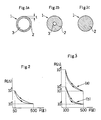
- Figs. 1a, 16 and 1c are schematic views showing a few examples of spherical carbonized particles used for the purpose of the invention. Particles of various grades of conductivity are shown as they are formed from non-conductivity spherical particles of a macromolecular material. Experiments have revealed that the electric conductivity of the particles varies according to the heating and baking conditions. This is considered to be attributable to the following facts. If, as in Fig. 1a, only a region around the outer periphery of a particle 1 is carbonized to a thickness (t) in a spherical shell pattern, the conductivity of the particle 1 is low because the carbonized portion 2, i.e.
- the portion having electric conductivity is of a small volume relative to the total volume (the non-carbonized portion being designated by reference numeral 3). If carbonization progresses further to the extent that a larger part of the particle 1 is carbonized, as shown in Fig. 1b, the conductivity of the particle 1 becomes considerably greater. Finally, if carbonization progresses still further until the particle is completely carbonized, the conductivity of the particle is maximised. Thus, even if particles 1 of the same diameter are used, the degree of carbonization of the particles varies according to the baking conditions applied.
- the degree of carbonization of the particles 1 is adjustable by changes in baking conditions, such as heating temperature and time. Therefore, by baking and carbonizing preselected particles 1 of the specified diameter under preset baking conditions it is possible to obtain quite easily, particles 1 having the required conductivity.
- Spherical particles of a polystyrene resin material cross-linked with divinylbenzene and having a particle diameter of about 70 to 130 um were heated to 300°C in an air current, then heated and baked to 1000°C in an inert gas.
- the particle diameter measurements of the carbonized particles thus obtained showed that more than 90 wt% of the particles prior to baking were within the range of 53 to 105 pm.
- One hundred parts by weight of the carbonized particles within this diameter range were mixed with 100 parts by weight of a silicone rubber (TSE 270 - 4 U, produced by Toshiba Silicone Co.), the mixture being kneaded, and one form of the pressure-sensitive conductive elastomer compound according to the invention was thus produced.
- the compound was moulded by press-moulding into a sheet having a thickness of 0.5 mm. Pressure was applied to the sheet by a rod-like pressing electrode having a 5 mm diameter, and the relationships between the pressing force and the resistance were measured. The measurements as shown in Fig. 2 revealed satisfactory resistance variation characteristis, with only a small degree of hysteresis.
- the fine spherical particles of polystyrene resin were produced in the following way. Benzoyl peroxide or lauroyl peroxide was dissolved in a mixed monomer liquid of styrene a divinylbenzene, and the resulting liquid was vigorously agitated in water to which a dispersant, such as completely-saponified polyvinylalcohol, non-completely-saponified polyvinyl-alcohol or the like had been added, then suspension polymerized at 80°C for 6 to 8 hours.
- a dispersant such as completely-saponified polyvinylalcohol, non-completely-saponified polyvinyl-alcohol or the like had been added
- a phenolic resin having a spheric particle configuration and a particle diameter of about 60 to 100 pm was heated and baked at 800°C in an inert gas.
- the particle diameters of the carbonized spherical particles thus obtained in glass-like (amorphous) form were such that more than 90 wt % of the particles prior to baking were within the range of 44 to 74 um.
- One hundred parts by weight of the carbonized particles within this range were mixed with 100 parts by weight of same silicone rubber as in Example 1, the mixture being kneaded together, then moulded by press moulding into a sheet having a thickness of 0.5 mm.
- the spherical phenolic resin particles were produced in the following way. A resol resin was dissolved in acetone, and a precipitant was added to the mixture during stirring, so that fine spherical resin particles were separated out. The particles were then subjected to filtration and drying and subsequently heated and hardened.
- Spherical phenolic resin particles were also produced in the following way. Phenol was added to a large amount of an aqueous solution of hydrochloric acid and formaldehyde during stirring, whereby solid matter having a spherical configuration was produced. The solid matter was separated out, then neutralized in an alkaline solution, and subsequently washed in water and dried. Use of the phenolic resin particles thus obtained also gave satisfactory results as in aforesaid case.
- Spherical phenolic resin particles identical with those used in Example 2 were heated and baked at 600°C.
- the particle diameters of the glass-like spherical carbonized particles were such that more than 90 wt % of the particles prior to baking were within the diameter range of 44 to 74 ⁇ lm.
- One hundred and twenty parts by weight of the carbonized particles within this range were mixed with 100 parts by weight of same silicone rubber as in Example 1, the mixture being kneaded together and a 0.5 mm thick sheet was produced by press-moulding.
Landscapes
- Chemical & Material Sciences (AREA)
- Dispersion Chemistry (AREA)
- Physics & Mathematics (AREA)
- Spectroscopy & Molecular Physics (AREA)
- Engineering & Computer Science (AREA)
- Microelectronics & Electronic Packaging (AREA)
- Compositions Of Macromolecular Compounds (AREA)
- Carbon And Carbon Compounds (AREA)
- Conductive Materials (AREA)
- Adjustable Resistors (AREA)
Description
- This invention relates to a method of manufacturing a pressure-sensitive conductive elastomer compound of the type exhibits high resistance (insulating performance) when it is in non-pressed condition, and of which the resistance, as the compound is pressed, will vary according to the magnitude of the pressure.
- Hitherto, pressure-sensitive conductive materials have been known which are in the form of a compound comprising a resilient material, such as rubber or the like, and a conductive filler mixed therewith. In this respect, metallic particles, such as nickel, conductive carbon black, graphite particles and the like are normally used as the filler. Such conductive compounds, moulded into rod or sheet form, are widely used today as switching elements, are as pressure-sensitive elements for sensors such as pressure sensors and tactile sensors.
- A number of problems are associated with conductive compounds of the aforesaid conventional type. Those incorporating metallic particles as a conductive filler are liable to a change of properties with time due to oxidation of the particles. Thus, such compounds lack stability and are often subject of chattering and noise generation. Those incorporating powdery masses of conductive carbon black as a conductive filler exhibit insignificant change in resistance when they are under pressure, because the particle diameter of the carbon black is extremely small, i.e. only 20 to 30 mp. As such, these latter compounds are of no practical use. Finally, if a granulated material formed of conductive carbon black is used as a filler, it is possible to obtain greater variations in resistance, but a conductive compound incorporating such material is liable to particle breakage when it is under pressure. Thus, such compound lacks both durability and stability.
- If graphite particles are used as a conductive filler, no characteristic stability can be obtained if they are of non-uniform shape, as in natural graphite. Therefore, it is known to use artificial graphite particles which have been rounded and freed of sharpness by pulverization, or milling, or otherwise, to provide good characteristic stability. Conductive compounds incorporating artificial graphite particles of such type are advantageous in that they are characteristically stable, durable, and less liable to noise generation than other types of compound. On the other hand they have drawbacks in that preparation of graphite particles to the desired configuration requires a complicated and troublesome procedure and in that the attainable yield thereof is rather low.
- In view of the aforesaid difficulties with the prior-art compounds, this invention has as its primary object the provision of a pressure-sensitive conductive elastomer compound which has high stable conductive characteristics under pressure and which is also easy to manufacture.
- Another object of the invention is to provide a pressure-sensitive conductive elastomer compound whose conductive characteristics under pressure may be varied without changing the mechanical properties of the compound.
- In order to accomplish the above and other objects according to the invention a method of manufacturing a pressure-sensitive conductive elastomer compound comprises the steps of:
- (a) forming spherical particles of macromolecular material of 30 to 120 um in diameter by chemical pulverization or suspension polymerization;
- (b) at least partially carbonizing said spherical particles by baking them within inert gas (without addition of carbon); and
- (c) incorporating and dispersing the resultant carbonized spherical particles into a matrix material having insulating and elastomeric properties, the proportion of particles to the entire compound being 20 to 60% by volume.
- Materials which may by used as the aforesaid matrix material having insulating and elastomeric properties include natural rubber; synthetic rubbers, such a chloroprene rubber, SBR, NBR, and silicone polyester, and EVA: and liquid rubbers, such as polyurethane and silicone. Particularly preferable among them is a silicone rubber, material having a high heat resistance, excellent electrical properties, and good resistance to chemicals.
- Macromolecular materials having a spherical particle configuration useful for the purpose of the invention include styrene, vinylchloride, vinylidene-chloride, methyl methacrylate, and furfuryl alcohol, all prepared in spherical particle form by suspension polymerization, and resol resins chemically pulverized into spherical partical form.
- The term "suspension polymerization" referred to herein means a process where a polymerization catalyst is added to monomers, the mixture being stirred in water with a dispersant added to allow the monomers to disperse in oil-drop form and then polymerize.
- The term "chemically pulverized" referred to herein means a process whereby a resin dissolved in a solvent is cooled or added to a precipitant so that the resin is separated out in fine powder form.
- The particle diameter of the conductive particles in the compound of the invention is from 30 to 120 pm, preferably from 50 to 100 um, and the proportion of the particles to the compound as a whole is 20% to 60% by volume. If the particle diameter is less than 30 itm, the possible variation in resistance of the compound is extremely small, while if it is greater than 120um, the particles cannot satisfactorily be dispersed in the matrix material. The proportion by volume of the particles may be suitably determined according to the desired characteristics and sensitivity of the compound, and also taking into account the type of matrix material. However, if it is less than 20% by volume, the compound may not exhibit sufficient conductivity, and if it is more than 60% by volume, the variation in conductivity (resistance) when the compound is under pressure, from the conductivity level when the compound is not under pressure, is insignificant, the compound being thus of no practical use. Therefore, the proportion of the particles should be withing the range of 20 vol % to 60 vol %.
- In accordance with the invention, the spherical particles of a macromolecular material have conductivity imparted to them by being baked and thereby wholly or partially carbonized. This process facilitates the selection of particle size for the conductive particles. It is thus possible to use particles having a uniform particle size, and thereby obtain a compound having highly stable pressure-sensitive conductive properties. Furthermore, the compound is easy to manufacture.
- The degree of carbonization of the particles (i.e. the thickness of the carbonized portion of each particle's spherical shell) can be varied by changing the degree of baking of the paricles, and thus particles of varying grades of conductivity can be easily produced. It is, therefore, possible to obtain differing pressure-sensitive conductive characteristics without changing the mechanical properties of the compound.
- The invention will be described further, by way of example, with reference to the accompanying drawing, in which:
- Figs. 1a to 1c, inclusive, are sectional illustrations showing various degrees of carbonization of spherical particles of a macromelecular material as incorporated in exemplified compounds in accordance with the invention. In Fig. 1a, only the surface area of the particle is carbonized. In Fig. 1b, almost the entire particle is carbonized. In Fig. 1c, the particle is entirely carbonized;
- Fig. 2 is a graph showing the pressing force-resistance relationships in Example 1; and
- Fig. 3 is a graph showing the pressing force-resistance relationships in Examples 2 and 3, in which graph the reference character (a) represents such relationships in Example 2 and the reference character (b) represents those in Example 3.
- Figs. 1a, 16 and 1c are schematic views showing a few examples of spherical carbonized particles used for the purpose of the invention. Particles of various grades of conductivity are shown as they are formed from non-conductivity spherical particles of a macromolecular material. Experiments have revealed that the electric conductivity of the particles varies according to the heating and baking conditions. This is considered to be attributable to the following facts. If, as in Fig. 1a, only a region around the outer periphery of a particle 1 is carbonized to a thickness (t) in a spherical shell pattern, the conductivity of the particle 1 is low because the carbonized
portion 2, i.e. the portion having electric conductivity, is of a small volume relative to the total volume (the non-carbonized portion being designated by reference numeral 3). If carbonization progresses further to the extent that a larger part of the particle 1 is carbonized, as shown in Fig. 1b, the conductivity of the particle 1 becomes considerably greater. Finally, if carbonization progresses still further until the particle is completely carbonized, the conductivity of the particle is maximised. Thus, even if particles 1 of the same diameter are used, the degree of carbonization of the particles varies according to the baking conditions applied. These facts are considered to be responsible for the variations in conductivity which can be obtained in different embodiments of the invention. - The degree of carbonization of the particles 1 is adjustable by changes in baking conditions, such as heating temperature and time. Therefore, by baking and carbonizing preselected particles 1 of the specified diameter under preset baking conditions it is possible to obtain quite easily, particles 1 having the required conductivity.
- Particular examples are given hereinbelow to further illustrate the invention.
- Spherical particles of a polystyrene resin material cross-linked with divinylbenzene and having a particle diameter of about 70 to 130 um were heated to 300°C in an air current, then heated and baked to 1000°C in an inert gas. The particle diameter measurements of the carbonized particles thus obtained showed that more than 90 wt% of the particles prior to baking were within the range of 53 to 105 pm. One hundred parts by weight of the carbonized particles within this diameter range were mixed with 100 parts by weight of a silicone rubber (TSE 270 - 4 U, produced by Toshiba Silicone Co.), the mixture being kneaded, and one form of the pressure-sensitive conductive elastomer compound according to the invention was thus produced.
- The compound was moulded by press-moulding into a sheet having a thickness of 0.5 mm. Pressure was applied to the sheet by a rod-like pressing electrode having a 5 mm diameter, and the relationships between the pressing force and the resistance were measured. The measurements as shown in Fig. 2 revealed satisfactory resistance variation characteristis, with only a small degree of hysteresis.
- In this example, the fine spherical particles of polystyrene resin were produced in the following way. Benzoyl peroxide or lauroyl peroxide was dissolved in a mixed monomer liquid of styrene a divinylbenzene, and the resulting liquid was vigorously agitated in water to which a dispersant, such as completely-saponified polyvinylalcohol, non-completely-saponified polyvinyl-alcohol or the like had been added, then suspension polymerized at 80°C for 6 to 8 hours.
- A phenolic resin having a spheric particle configuration and a particle diameter of about 60 to 100 pm was heated and baked at 800°C in an inert gas. The particle diameters of the carbonized spherical particles thus obtained in glass-like (amorphous) form were such that more than 90 wt % of the particles prior to baking were within the range of 44 to 74 um. One hundred parts by weight of the carbonized particles within this range were mixed with 100 parts by weight of same silicone rubber as in Example 1, the mixture being kneaded together, then moulded by press moulding into a sheet having a thickness of 0.5 mm.
- Pressing force-resistance characteristics were measured in same way as in Example 1. The measurements, as shown in Fig. 3 graph (a), revealed that the sheet had good characteristics, with a small degree of hysteresis.
- In this example, the spherical phenolic resin particles were produced in the following way. A resol resin was dissolved in acetone, and a precipitant was added to the mixture during stirring, so that fine spherical resin particles were separated out. The particles were then subjected to filtration and drying and subsequently heated and hardened.
- Spherical phenolic resin particles were also produced in the following way. Phenol was added to a large amount of an aqueous solution of hydrochloric acid and formaldehyde during stirring, whereby solid matter having a spherical configuration was produced. The solid matter was separated out, then neutralized in an alkaline solution, and subsequently washed in water and dried. Use of the phenolic resin particles thus obtained also gave satisfactory results as in aforesaid case.
- Spherical phenolic resin particles identical with those used in Example 2 were heated and baked at 600°C. The particle diameters of the glass-like spherical carbonized particles were such that more than 90 wt % of the particles prior to baking were within the diameter range of 44 to 74 ¡lm. One hundred and twenty parts by weight of the carbonized particles within this range were mixed with 100 parts by weight of same silicone rubber as in Example 1, the mixture being kneaded together and a 0.5 mm thick sheet was produced by press-moulding.
- Measurements were made in same way as in Example 1. The results are shown in Fig. 3 graph (b). In this instance, the variations in resistance shown are of a similar pattern to those in Example 2 except that the range of variations is different. This indicates that the conductivity of the spherical phenolic resin particles varies according to the baking temperature for the particles. Presumably, this is due to the face that the degree of carbonization varies according to the baking temperature and that as the baking temperature becomes higher, the carbonized portion of each particle will become greater. In other words, it is considered that the thickness (t) of the carbonized spherical shell portion in Fig. 1a becomes greater at a higher baking temperature and as the carbonized portion is increased so the conductivity of the particle is increased.
Claims (5)
Applications Claiming Priority (2)
| Application Number | Priority Date | Filing Date | Title |
|---|---|---|---|
| JP60253525A JPS62112641A (en) | 1985-11-11 | 1985-11-11 | Pressure-sensitive, electrically conductive elastomer composition |
| JP253525/85 | 1985-11-11 |
Publications (2)
| Publication Number | Publication Date |
|---|---|
| EP0223355A1 EP0223355A1 (en) | 1987-05-27 |
| EP0223355B1 true EP0223355B1 (en) | 1989-10-11 |
Family
ID=17252578
Family Applications (1)
| Application Number | Title | Priority Date | Filing Date |
|---|---|---|---|
| EP86307049A Expired EP0223355B1 (en) | 1985-11-11 | 1986-09-12 | Method of manufacturing a pressure-sensitive conductive elastomer compound |
Country Status (4)
| Country | Link |
|---|---|
| EP (1) | EP0223355B1 (en) |
| JP (1) | JPS62112641A (en) |
| DE (1) | DE3666304D1 (en) |
| MY (1) | MY100739A (en) |
Cited By (3)
| Publication number | Priority date | Publication date | Assignee | Title |
|---|---|---|---|---|
| WO2003018307A1 (en) * | 2001-08-24 | 2003-03-06 | Commonwealth Scientific And Industrial Research Organisation | Strain gauges |
| US6993954B1 (en) | 2004-07-27 | 2006-02-07 | Tekscan, Incorporated | Sensor equilibration and calibration system and method |
| US7258026B2 (en) | 2003-12-30 | 2007-08-21 | Tekscan Incorporated | Sensor with a plurality of sensor elements arranged with respect to a substrate |
Families Citing this family (8)
| Publication number | Priority date | Publication date | Assignee | Title |
|---|---|---|---|---|
| DE3916921C1 (en) * | 1989-05-24 | 1990-10-11 | Preh-Werke Gmbh & Co Kg, 8740 Bad Neustadt, De | |
| DE3942799A1 (en) * | 1989-12-23 | 1991-06-27 | Bosch Gmbh Robert | METHOD FOR PRODUCING AN ABRASION-RESISTANT LAYER |
| US5989700A (en) * | 1996-01-05 | 1999-11-23 | Tekscan Incorporated | Pressure sensitive ink means, and methods of use |
| US7785704B2 (en) | 2003-05-14 | 2010-08-31 | Tekscan, Inc. | High temperature pressure sensitive devices and methods thereof |
| JP5577022B2 (en) * | 2008-01-24 | 2014-08-20 | 東海ゴム工業株式会社 | Composite materials for sensors and deformation sensors |
| JP2009198483A (en) * | 2008-01-24 | 2009-09-03 | Tokai Rubber Ind Ltd | Sensor thin film, manufacturing method thereof and deformation sensor |
| JP2009198482A (en) * | 2008-01-24 | 2009-09-03 | Tokai Rubber Ind Ltd | Sensor thin film, manufacturing method thereof and deformation sensor |
| CN111732836A (en) * | 2020-06-17 | 2020-10-02 | 东南大学 | A sensor material for real-time monitoring of health status of high-speed railway ballastless track slab and preparation method thereof |
Family Cites Families (3)
| Publication number | Priority date | Publication date | Assignee | Title |
|---|---|---|---|---|
| JPS55120656A (en) * | 1979-03-09 | 1980-09-17 | Toray Silicone Co Ltd | Curable liquid organopolysiloxane composition |
| JPS59109562A (en) * | 1982-12-16 | 1984-06-25 | Denki Kagaku Kogyo Kk | Carbon black and electrically conductive composition containing the same |
| JPS6011215A (en) * | 1983-06-30 | 1985-01-21 | Agency Of Ind Science & Technol | Carbonaceous material having high electric conductivity and its composition |
-
1985
- 1985-11-11 JP JP60253525A patent/JPS62112641A/en active Pending
-
1986
- 1986-09-12 DE DE8686307049T patent/DE3666304D1/en not_active Expired
- 1986-09-12 EP EP86307049A patent/EP0223355B1/en not_active Expired
-
1987
- 1987-09-29 MY MYPI87002097A patent/MY100739A/en unknown
Cited By (4)
| Publication number | Priority date | Publication date | Assignee | Title |
|---|---|---|---|---|
| WO2003018307A1 (en) * | 2001-08-24 | 2003-03-06 | Commonwealth Scientific And Industrial Research Organisation | Strain gauges |
| US7116209B2 (en) | 2001-08-24 | 2006-10-03 | Commonwealth Scientific And Industrial Research Organization | Strain gauges |
| US7258026B2 (en) | 2003-12-30 | 2007-08-21 | Tekscan Incorporated | Sensor with a plurality of sensor elements arranged with respect to a substrate |
| US6993954B1 (en) | 2004-07-27 | 2006-02-07 | Tekscan, Incorporated | Sensor equilibration and calibration system and method |
Also Published As
| Publication number | Publication date |
|---|---|
| JPS62112641A (en) | 1987-05-23 |
| MY100739A (en) | 1991-01-31 |
| DE3666304D1 (en) | 1989-11-16 |
| EP0223355A1 (en) | 1987-05-27 |
Similar Documents
| Publication | Publication Date | Title |
|---|---|---|
| US5175214A (en) | Pressure-sensitive conductive elastomer compound | |
| EP0223355A1 (en) | Method of manufacturing a pressure-sensitive conductive elastomer compound | |
| US3629774A (en) | Progressively collapsible variable resistance element | |
| EP0871681B1 (en) | Pressure sensitive ink means, and methods of use | |
| US3003975A (en) | Conductive plastic composition and method of making the same | |
| US5498644A (en) | Silcone elastomer incorporating electrically conductive microballoons and method for producing same | |
| US2683669A (en) | Conductive plastics and method of making the same | |
| GB1561189A (en) | Pressure responsive electrically conductive elastomeric composition | |
| EP1050054B1 (en) | Polymer composition | |
| US6495069B1 (en) | Polymer composition | |
| US4152304A (en) | Pressure-sensitive flexible resistors | |
| US4832870A (en) | Electrically conductive composite material | |
| GB2166745A (en) | Molded carbonaceous material | |
| Boonstra et al. | Electrical conductivity of rubber-carbon black vulcanizates | |
| US3978177A (en) | Process for the production of graphite molding powder | |
| EP0210002A1 (en) | Pressure responsive electrically conductive materials | |
| US3808678A (en) | Method of making pressure-sensitive resistor element | |
| US4117065A (en) | Method of forming conductive carbon-plastic material | |
| JP2788513B2 (en) | Glassy carbon powder and method for producing the same | |
| JPH0471108A (en) | Pressure sensitive conductive elastomer | |
| US4246217A (en) | Conductive rubber antennas having improved physical and electrical properties | |
| JPH0779006B2 (en) | Pressure-sensitive conductive elastomer | |
| US5179155A (en) | Antistatic molded article of monomer-cast nylon | |
| US4166870A (en) | Manufacture of electrodes for electrochemical cells | |
| JPH04253109A (en) | Deformable conductive elastomer |
Legal Events
| Date | Code | Title | Description |
|---|---|---|---|
| PUAI | Public reference made under article 153(3) epc to a published international application that has entered the european phase |
Free format text: ORIGINAL CODE: 0009012 |
|
| AK | Designated contracting states |
Kind code of ref document: A1 Designated state(s): CH DE FR GB LI |
|
| 17P | Request for examination filed |
Effective date: 19870424 |
|
| 17Q | First examination report despatched |
Effective date: 19880610 |
|
| GRAA | (expected) grant |
Free format text: ORIGINAL CODE: 0009210 |
|
| AK | Designated contracting states |
Kind code of ref document: B1 Designated state(s): CH DE FR GB LI |
|
| ET | Fr: translation filed | ||
| REF | Corresponds to: |
Ref document number: 3666304 Country of ref document: DE Date of ref document: 19891116 |
|
| PLBE | No opposition filed within time limit |
Free format text: ORIGINAL CODE: 0009261 |
|
| STAA | Information on the status of an ep patent application or granted ep patent |
Free format text: STATUS: NO OPPOSITION FILED WITHIN TIME LIMIT |
|
| 26N | No opposition filed | ||
| PGFP | Annual fee paid to national office [announced via postgrant information from national office to epo] |
Ref country code: CH Payment date: 20010925 Year of fee payment: 16 |
|
| REG | Reference to a national code |
Ref country code: GB Ref legal event code: IF02 |
|
| PG25 | Lapsed in a contracting state [announced via postgrant information from national office to epo] |
Ref country code: LI Free format text: LAPSE BECAUSE OF NON-PAYMENT OF DUE FEES Effective date: 20020930 Ref country code: CH Free format text: LAPSE BECAUSE OF NON-PAYMENT OF DUE FEES Effective date: 20020930 |
|
| REG | Reference to a national code |
Ref country code: CH Ref legal event code: PL |
|
| PGFP | Annual fee paid to national office [announced via postgrant information from national office to epo] |
Ref country code: GB Payment date: 20040902 Year of fee payment: 19 |
|
| PGFP | Annual fee paid to national office [announced via postgrant information from national office to epo] |
Ref country code: FR Payment date: 20040927 Year of fee payment: 19 |
|
| PGFP | Annual fee paid to national office [announced via postgrant information from national office to epo] |
Ref country code: DE Payment date: 20040928 Year of fee payment: 19 |
|
| PG25 | Lapsed in a contracting state [announced via postgrant information from national office to epo] |
Ref country code: GB Free format text: LAPSE BECAUSE OF NON-PAYMENT OF DUE FEES Effective date: 20050912 |
|
| PG25 | Lapsed in a contracting state [announced via postgrant information from national office to epo] |
Ref country code: DE Free format text: LAPSE BECAUSE OF NON-PAYMENT OF DUE FEES Effective date: 20060401 |
|
| GBPC | Gb: european patent ceased through non-payment of renewal fee |
Effective date: 20050912 |
|
| PG25 | Lapsed in a contracting state [announced via postgrant information from national office to epo] |
Ref country code: FR Free format text: LAPSE BECAUSE OF NON-PAYMENT OF DUE FEES Effective date: 20060531 |
|
| REG | Reference to a national code |
Ref country code: FR Ref legal event code: ST Effective date: 20060531 |