EP0220000A2 - Method for the production of aqueous polyurethane coating compositions - Google Patents
Method for the production of aqueous polyurethane coating compositions Download PDFInfo
- Publication number
- EP0220000A2 EP0220000A2 EP86307582A EP86307582A EP0220000A2 EP 0220000 A2 EP0220000 A2 EP 0220000A2 EP 86307582 A EP86307582 A EP 86307582A EP 86307582 A EP86307582 A EP 86307582A EP 0220000 A2 EP0220000 A2 EP 0220000A2
- Authority
- EP
- European Patent Office
- Prior art keywords
- weight
- diol
- diisocyanate
- diphenylmethane
- prepolymer
- Prior art date
- Legal status (The legal status is an assumption and is not a legal conclusion. Google has not performed a legal analysis and makes no representation as to the accuracy of the status listed.)
- Granted
Links
- 239000000203 mixture Substances 0.000 title claims description 56
- 238000000034 method Methods 0.000 title description 4
- 239000011527 polyurethane coating Substances 0.000 title description 3
- 238000004519 manufacturing process Methods 0.000 title description 2
- 150000002009 diols Chemical class 0.000 claims abstract description 39
- 229920001228 polyisocyanate Polymers 0.000 claims abstract description 32
- 239000005056 polyisocyanate Substances 0.000 claims abstract description 32
- 229920005862 polyol Polymers 0.000 claims abstract description 20
- 150000003077 polyols Chemical class 0.000 claims abstract description 20
- 239000001257 hydrogen Substances 0.000 claims abstract description 19
- 229910052739 hydrogen Inorganic materials 0.000 claims abstract description 19
- UFHFLCQGNIYNRP-UHFFFAOYSA-N Hydrogen Chemical compound [H][H] UFHFLCQGNIYNRP-UHFFFAOYSA-N 0.000 claims abstract description 18
- 125000003178 carboxy group Chemical group [H]OC(*)=O 0.000 claims abstract description 16
- LFSYUSUFCBOHGU-UHFFFAOYSA-N 1-isocyanato-2-[(4-isocyanatophenyl)methyl]benzene Chemical compound C1=CC(N=C=O)=CC=C1CC1=CC=CC=C1N=C=O LFSYUSUFCBOHGU-UHFFFAOYSA-N 0.000 claims abstract description 15
- 239000004970 Chain extender Substances 0.000 claims abstract description 13
- XSTXAVWGXDQKEL-UHFFFAOYSA-N Trichloroethylene Chemical compound ClC=C(Cl)Cl XSTXAVWGXDQKEL-UHFFFAOYSA-N 0.000 claims abstract description 11
- 239000004814 polyurethane Substances 0.000 claims abstract description 7
- 229920002635 polyurethane Polymers 0.000 claims abstract description 7
- 229920001730 Moisture cure polyurethane Polymers 0.000 claims abstract description 6
- 239000007795 chemical reaction product Substances 0.000 claims abstract description 5
- 125000000271 carboxylic acid salt group Chemical group 0.000 claims abstract description 4
- 229920003009 polyurethane dispersion Polymers 0.000 claims abstract description 4
- 239000006185 dispersion Substances 0.000 claims description 44
- OAKJQQAXSVQMHS-UHFFFAOYSA-N Hydrazine Chemical compound NN OAKJQQAXSVQMHS-UHFFFAOYSA-N 0.000 claims description 30
- -1 heterocyclic diamines Chemical class 0.000 claims description 17
- UPMLOUAZCHDJJD-UHFFFAOYSA-N 4,4'-Diphenylmethane Diisocyanate Chemical class C1=CC(N=C=O)=CC=C1CC1=CC=C(N=C=O)C=C1 UPMLOUAZCHDJJD-UHFFFAOYSA-N 0.000 claims description 14
- DVKJHBMWWAPEIU-UHFFFAOYSA-N toluene 2,4-diisocyanate Chemical compound CC1=CC=C(N=C=O)C=C1N=C=O DVKJHBMWWAPEIU-UHFFFAOYSA-N 0.000 claims description 10
- 238000000576 coating method Methods 0.000 claims description 9
- VEIOBOXBGYWJIT-UHFFFAOYSA-N cyclohexane;methanol Chemical compound OC.OC.C1CCCCC1 VEIOBOXBGYWJIT-UHFFFAOYSA-N 0.000 claims description 6
- 229920000909 polytetrahydrofuran Polymers 0.000 claims description 6
- 229920000570 polyether Polymers 0.000 claims description 5
- 239000000758 substrate Substances 0.000 claims description 5
- QGZKDVFQNNGYKY-UHFFFAOYSA-N Ammonia Chemical group N QGZKDVFQNNGYKY-UHFFFAOYSA-N 0.000 claims description 4
- 229920000728 polyester Polymers 0.000 claims description 4
- CBCKQZAAMUWICA-UHFFFAOYSA-N 1,4-phenylenediamine Chemical compound NC1=CC=C(N)C=C1 CBCKQZAAMUWICA-UHFFFAOYSA-N 0.000 claims description 3
- PTBDIHRZYDMNKB-UHFFFAOYSA-N 2,2-Bis(hydroxymethyl)propionic acid Chemical compound OCC(C)(CO)C(O)=O PTBDIHRZYDMNKB-UHFFFAOYSA-N 0.000 claims description 3
- 229940044174 4-phenylenediamine Drugs 0.000 claims description 3
- 125000003118 aryl group Chemical group 0.000 claims description 3
- 239000011248 coating agent Substances 0.000 claims description 3
- 150000002429 hydrazines Chemical class 0.000 claims description 3
- KOGSPLLRMRSADR-UHFFFAOYSA-N 4-(2-aminopropan-2-yl)-1-methylcyclohexan-1-amine Chemical compound CC(C)(N)C1CCC(C)(N)CC1 KOGSPLLRMRSADR-UHFFFAOYSA-N 0.000 claims description 2
- PIICEJLVQHRZGT-UHFFFAOYSA-N Ethylenediamine Chemical compound NCCN PIICEJLVQHRZGT-UHFFFAOYSA-N 0.000 claims description 2
- 239000004721 Polyphenylene oxide Substances 0.000 claims description 2
- 125000002723 alicyclic group Chemical group 0.000 claims description 2
- 125000001931 aliphatic group Chemical group 0.000 claims description 2
- 229910021529 ammonia Inorganic materials 0.000 claims description 2
- WZCQRUWWHSTZEM-UHFFFAOYSA-N 1,3-phenylenediamine Chemical compound NC1=CC=CC(N)=C1 WZCQRUWWHSTZEM-UHFFFAOYSA-N 0.000 claims 1
- 239000008199 coating composition Substances 0.000 abstract description 7
- LYCAIKOWRPUZTN-UHFFFAOYSA-N Ethylene glycol Chemical compound OCCO LYCAIKOWRPUZTN-UHFFFAOYSA-N 0.000 description 21
- XLYOFNOQVPJJNP-UHFFFAOYSA-N water Substances O XLYOFNOQVPJJNP-UHFFFAOYSA-N 0.000 description 20
- ZMANZCXQSJIPKH-UHFFFAOYSA-N Triethylamine Chemical compound CCN(CC)CC ZMANZCXQSJIPKH-UHFFFAOYSA-N 0.000 description 15
- 229920000642 polymer Polymers 0.000 description 12
- 238000006243 chemical reaction Methods 0.000 description 10
- ZWEHNKRNPOVVGH-UHFFFAOYSA-N 2-Butanone Chemical compound CCC(C)=O ZWEHNKRNPOVVGH-UHFFFAOYSA-N 0.000 description 9
- 239000002904 solvent Substances 0.000 description 9
- IJGRMHOSHXDMSA-UHFFFAOYSA-N Atomic nitrogen Chemical compound N#N IJGRMHOSHXDMSA-UHFFFAOYSA-N 0.000 description 8
- CWTHTGKOCPAPSL-UHFFFAOYSA-N methanol;propanoic acid Chemical compound OC.OC.CCC(O)=O CWTHTGKOCPAPSL-UHFFFAOYSA-N 0.000 description 8
- SECXISVLQFMRJM-UHFFFAOYSA-N N-Methylpyrrolidone Chemical compound CN1CCCC1=O SECXISVLQFMRJM-UHFFFAOYSA-N 0.000 description 7
- 238000009472 formulation Methods 0.000 description 7
- PEDCQBHIVMGVHV-UHFFFAOYSA-N Glycerine Chemical compound OCC(O)CO PEDCQBHIVMGVHV-UHFFFAOYSA-N 0.000 description 6
- DNIAPMSPPWPWGF-UHFFFAOYSA-N Propylene glycol Chemical compound CC(O)CO DNIAPMSPPWPWGF-UHFFFAOYSA-N 0.000 description 6
- MTHSVFCYNBDYFN-UHFFFAOYSA-N diethylene glycol Chemical compound OCCOCCO MTHSVFCYNBDYFN-UHFFFAOYSA-N 0.000 description 6
- 238000002360 preparation method Methods 0.000 description 6
- WGCNASOHLSPBMP-UHFFFAOYSA-N hydroxyacetaldehyde Natural products OCC=O WGCNASOHLSPBMP-UHFFFAOYSA-N 0.000 description 5
- IQPQWNKOIGAROB-UHFFFAOYSA-N isocyanate group Chemical group [N-]=C=O IQPQWNKOIGAROB-UHFFFAOYSA-N 0.000 description 5
- 239000007787 solid Substances 0.000 description 5
- 239000002253 acid Substances 0.000 description 4
- 239000008367 deionised water Substances 0.000 description 4
- 150000004985 diamines Chemical class 0.000 description 4
- 125000002887 hydroxy group Chemical group [H]O* 0.000 description 4
- 229910052757 nitrogen Inorganic materials 0.000 description 4
- 150000003839 salts Chemical group 0.000 description 4
- CSCPPACGZOOCGX-UHFFFAOYSA-N Acetone Chemical compound CC(C)=O CSCPPACGZOOCGX-UHFFFAOYSA-N 0.000 description 3
- XEKOWRVHYACXOJ-UHFFFAOYSA-N Ethyl acetate Chemical compound CCOC(C)=O XEKOWRVHYACXOJ-UHFFFAOYSA-N 0.000 description 3
- ZMXDDKWLCZADIW-UHFFFAOYSA-N N,N-Dimethylformamide Chemical compound CN(C)C=O ZMXDDKWLCZADIW-UHFFFAOYSA-N 0.000 description 3
- SJRJJKPEHAURKC-UHFFFAOYSA-N N-Methylmorpholine Chemical compound CN1CCOCC1 SJRJJKPEHAURKC-UHFFFAOYSA-N 0.000 description 3
- KWYUFKZDYYNOTN-UHFFFAOYSA-M Potassium hydroxide Chemical compound [OH-].[K+] KWYUFKZDYYNOTN-UHFFFAOYSA-M 0.000 description 3
- YXFVVABEGXRONW-UHFFFAOYSA-N Toluene Chemical compound CC1=CC=CC=C1 YXFVVABEGXRONW-UHFFFAOYSA-N 0.000 description 3
- 150000001412 amines Chemical class 0.000 description 3
- 239000003054 catalyst Substances 0.000 description 3
- 239000003795 chemical substances by application Substances 0.000 description 3
- 238000001816 cooling Methods 0.000 description 3
- 229910021641 deionized water Inorganic materials 0.000 description 3
- 150000002334 glycols Chemical class 0.000 description 3
- 239000007788 liquid Substances 0.000 description 3
- 239000000463 material Substances 0.000 description 3
- 229920005989 resin Polymers 0.000 description 3
- 239000011347 resin Substances 0.000 description 3
- 238000003756 stirring Methods 0.000 description 3
- 239000004094 surface-active agent Substances 0.000 description 3
- RUELTTOHQODFPA-UHFFFAOYSA-N toluene 2,6-diisocyanate Chemical compound CC1=C(N=C=O)C=CC=C1N=C=O RUELTTOHQODFPA-UHFFFAOYSA-N 0.000 description 3
- HZAXFHJVJLSVMW-UHFFFAOYSA-N 2-Aminoethan-1-ol Chemical compound NCCO HZAXFHJVJLSVMW-UHFFFAOYSA-N 0.000 description 2
- PAYRUJLWNCNPSJ-UHFFFAOYSA-N Aniline Chemical compound NC1=CC=CC=C1 PAYRUJLWNCNPSJ-UHFFFAOYSA-N 0.000 description 2
- RPNUMPOLZDHAAY-UHFFFAOYSA-N Diethylenetriamine Chemical compound NCCNCCN RPNUMPOLZDHAAY-UHFFFAOYSA-N 0.000 description 2
- VGGSQFUCUMXWEO-UHFFFAOYSA-N Ethene Chemical compound C=C VGGSQFUCUMXWEO-UHFFFAOYSA-N 0.000 description 2
- 239000004606 Fillers/Extenders Substances 0.000 description 2
- DGAQECJNVWCQMB-PUAWFVPOSA-M Ilexoside XXIX Chemical compound C[C@@H]1CC[C@@]2(CC[C@@]3(C(=CC[C@H]4[C@]3(CC[C@@H]5[C@@]4(CC[C@@H](C5(C)C)OS(=O)(=O)[O-])C)C)[C@@H]2[C@]1(C)O)C)C(=O)O[C@H]6[C@@H]([C@H]([C@@H]([C@H](O6)CO)O)O)O.[Na+] DGAQECJNVWCQMB-PUAWFVPOSA-M 0.000 description 2
- GLUUGHFHXGJENI-UHFFFAOYSA-N Piperazine Chemical compound C1CNCCN1 GLUUGHFHXGJENI-UHFFFAOYSA-N 0.000 description 2
- WYURNTSHIVDZCO-UHFFFAOYSA-N Tetrahydrofuran Chemical compound C1CCOC1 WYURNTSHIVDZCO-UHFFFAOYSA-N 0.000 description 2
- WNLRTRBMVRJNCN-UHFFFAOYSA-N adipic acid Chemical compound OC(=O)CCCCC(O)=O WNLRTRBMVRJNCN-UHFFFAOYSA-N 0.000 description 2
- 235000011037 adipic acid Nutrition 0.000 description 2
- 239000012736 aqueous medium Substances 0.000 description 2
- 230000015572 biosynthetic process Effects 0.000 description 2
- HQABUPZFAYXKJW-UHFFFAOYSA-N butan-1-amine Chemical compound CCCCN HQABUPZFAYXKJW-UHFFFAOYSA-N 0.000 description 2
- JQVDAXLFBXTEQA-UHFFFAOYSA-N dibutylamine Chemical compound CCCCNCCCC JQVDAXLFBXTEQA-UHFFFAOYSA-N 0.000 description 2
- RTZKZFJDLAIYFH-UHFFFAOYSA-N ether Substances CCOCC RTZKZFJDLAIYFH-UHFFFAOYSA-N 0.000 description 2
- 239000011521 glass Substances 0.000 description 2
- NAQMVNRVTILPCV-UHFFFAOYSA-N hexane-1,6-diamine Chemical compound NCCCCCCN NAQMVNRVTILPCV-UHFFFAOYSA-N 0.000 description 2
- 229940042795 hydrazides for tuberculosis treatment Drugs 0.000 description 2
- 125000004435 hydrogen atom Chemical group [H]* 0.000 description 2
- 238000007654 immersion Methods 0.000 description 2
- 150000002596 lactones Chemical class 0.000 description 2
- KDXKERNSBIXSRK-UHFFFAOYSA-N lysine Chemical compound NCCCCC(N)C(O)=O KDXKERNSBIXSRK-UHFFFAOYSA-N 0.000 description 2
- 239000002609 medium Substances 0.000 description 2
- 229910052751 metal Inorganic materials 0.000 description 2
- 239000002184 metal Substances 0.000 description 2
- 238000002156 mixing Methods 0.000 description 2
- 239000003960 organic solvent Substances 0.000 description 2
- 229920003023 plastic Polymers 0.000 description 2
- 239000004033 plastic Substances 0.000 description 2
- 229920006389 polyphenyl polymer Polymers 0.000 description 2
- HEMHJVSKTPXQMS-UHFFFAOYSA-M sodium hydroxide Inorganic materials [OH-].[Na+] HEMHJVSKTPXQMS-UHFFFAOYSA-M 0.000 description 2
- 239000002023 wood Substances 0.000 description 2
- MDJZGXRFYKPSIM-JCYAYHJZSA-N (2r,3r)-2,3-dihydroxybutanedihydrazide Chemical compound NNC(=O)[C@H](O)[C@@H](O)C(=O)NN MDJZGXRFYKPSIM-JCYAYHJZSA-N 0.000 description 1
- DIIIISSCIXVANO-UHFFFAOYSA-N 1,2-Dimethylhydrazine Chemical class CNNC DIIIISSCIXVANO-UHFFFAOYSA-N 0.000 description 1
- VILCJCGEZXAXTO-UHFFFAOYSA-N 2,2,2-tetramine Chemical compound NCCNCCNCCN VILCJCGEZXAXTO-UHFFFAOYSA-N 0.000 description 1
- CVFRFSNPBJUQMG-UHFFFAOYSA-N 2,3-bis(2-hydroxyethyl)benzene-1,4-diol Chemical compound OCCC1=C(O)C=CC(O)=C1CCO CVFRFSNPBJUQMG-UHFFFAOYSA-N 0.000 description 1
- JOMNTHCQHJPVAZ-UHFFFAOYSA-N 2-methylpiperazine Chemical compound CC1CNCCN1 JOMNTHCQHJPVAZ-UHFFFAOYSA-N 0.000 description 1
- JHYNEQNPKGIOQF-UHFFFAOYSA-N 3,4-dihydro-2h-phosphole Chemical class C1CC=PC1 JHYNEQNPKGIOQF-UHFFFAOYSA-N 0.000 description 1
- UENRXLSRMCSUSN-UHFFFAOYSA-N 3,5-diaminobenzoic acid Chemical compound NC1=CC(N)=CC(C(O)=O)=C1 UENRXLSRMCSUSN-UHFFFAOYSA-N 0.000 description 1
- RNLHGQLZWXBQNY-UHFFFAOYSA-N 3-(aminomethyl)-3,5,5-trimethylcyclohexan-1-amine Chemical compound CC1(C)CC(N)CC(C)(CN)C1 RNLHGQLZWXBQNY-UHFFFAOYSA-N 0.000 description 1
- YBRVSVVVWCFQMG-UHFFFAOYSA-N 4,4'-diaminodiphenylmethane Chemical compound C1=CC(N)=CC=C1CC1=CC=C(N)C=C1 YBRVSVVVWCFQMG-UHFFFAOYSA-N 0.000 description 1
- IBOFVQJTBBUKMU-UHFFFAOYSA-N 4,4'-methylene-bis-(2-chloroaniline) Chemical compound C1=C(Cl)C(N)=CC=C1CC1=CC=C(N)C(Cl)=C1 IBOFVQJTBBUKMU-UHFFFAOYSA-N 0.000 description 1
- OCEINMLGYDSKFW-UHFFFAOYSA-N 4-(4-amino-3-nitrophenyl)-2-nitroaniline Chemical compound C1=C([N+]([O-])=O)C(N)=CC=C1C1=CC=C(N)C([N+]([O-])=O)=C1 OCEINMLGYDSKFW-UHFFFAOYSA-N 0.000 description 1
- AZWLGPJBVAQRHW-UHFFFAOYSA-N 4-aminobutane-1,3-diol Chemical compound NCC(O)CCO AZWLGPJBVAQRHW-UHFFFAOYSA-N 0.000 description 1
- SLXKOJJOQWFEFD-UHFFFAOYSA-N 6-aminohexanoic acid Chemical compound NCCCCCC(O)=O SLXKOJJOQWFEFD-UHFFFAOYSA-N 0.000 description 1
- NIXOWILDQLNWCW-UHFFFAOYSA-M Acrylate Chemical compound [O-]C(=O)C=C NIXOWILDQLNWCW-UHFFFAOYSA-M 0.000 description 1
- LEVWYRKDKASIDU-QWWZWVQMSA-N D-cystine Chemical compound OC(=O)[C@H](N)CSSC[C@@H](N)C(O)=O LEVWYRKDKASIDU-QWWZWVQMSA-N 0.000 description 1
- IAZDPXIOMUYVGZ-UHFFFAOYSA-N Dimethylsulphoxide Chemical compound CS(C)=O IAZDPXIOMUYVGZ-UHFFFAOYSA-N 0.000 description 1
- JOYRKODLDBILNP-UHFFFAOYSA-N Ethyl urethane Chemical compound CCOC(N)=O JOYRKODLDBILNP-UHFFFAOYSA-N 0.000 description 1
- KMTRUDSVKNLOMY-UHFFFAOYSA-N Ethylene carbonate Chemical compound O=C1OCCO1 KMTRUDSVKNLOMY-UHFFFAOYSA-N 0.000 description 1
- IAYPIBMASNFSPL-UHFFFAOYSA-N Ethylene oxide Chemical compound C1CO1 IAYPIBMASNFSPL-UHFFFAOYSA-N 0.000 description 1
- VZCYOOQTPOCHFL-OWOJBTEDSA-N Fumaric acid Chemical compound OC(=O)\C=C\C(O)=O VZCYOOQTPOCHFL-OWOJBTEDSA-N 0.000 description 1
- OFOBLEOULBTSOW-UHFFFAOYSA-N Malonic acid Chemical compound OC(=O)CC(O)=O OFOBLEOULBTSOW-UHFFFAOYSA-N 0.000 description 1
- CTQNGGLPUBDAKN-UHFFFAOYSA-N O-Xylene Chemical compound CC1=CC=CC=C1C CTQNGGLPUBDAKN-UHFFFAOYSA-N 0.000 description 1
- 229910019142 PO4 Inorganic materials 0.000 description 1
- 239000004743 Polypropylene Substances 0.000 description 1
- GOOHAUXETOMSMM-UHFFFAOYSA-N Propylene oxide Chemical compound CC1CO1 GOOHAUXETOMSMM-UHFFFAOYSA-N 0.000 description 1
- MLHOXUWWKVQEJB-UHFFFAOYSA-N Propyleneglycol diacetate Chemical class CC(=O)OC(C)COC(C)=O MLHOXUWWKVQEJB-UHFFFAOYSA-N 0.000 description 1
- 102100030852 Run domain Beclin-1-interacting and cysteine-rich domain-containing protein Human genes 0.000 description 1
- 101710179516 Run domain Beclin-1-interacting and cysteine-rich domain-containing protein Proteins 0.000 description 1
- 229910000831 Steel Inorganic materials 0.000 description 1
- GSEJCLTVZPLZKY-UHFFFAOYSA-N Triethanolamine Chemical compound OCCN(CCO)CCO GSEJCLTVZPLZKY-UHFFFAOYSA-N 0.000 description 1
- ZJCCRDAZUWHFQH-UHFFFAOYSA-N Trimethylolpropane Chemical compound CCC(CO)(CO)CO ZJCCRDAZUWHFQH-UHFFFAOYSA-N 0.000 description 1
- GKXVJHDEWHKBFH-UHFFFAOYSA-N [2-(aminomethyl)phenyl]methanamine Chemical compound NCC1=CC=CC=C1CN GKXVJHDEWHKBFH-UHFFFAOYSA-N 0.000 description 1
- SOGYZZRPOIMNHO-UHFFFAOYSA-N [2-(hydroxymethyl)furan-3-yl]methanol Chemical compound OCC=1C=COC=1CO SOGYZZRPOIMNHO-UHFFFAOYSA-N 0.000 description 1
- FDLQZKYLHJJBHD-UHFFFAOYSA-N [3-(aminomethyl)phenyl]methanamine Chemical compound NCC1=CC=CC(CN)=C1 FDLQZKYLHJJBHD-UHFFFAOYSA-N 0.000 description 1
- UKLDJPRMSDWDSL-UHFFFAOYSA-L [dibutyl(dodecanoyloxy)stannyl] dodecanoate Chemical compound CCCCCCCCCCCC(=O)O[Sn](CCCC)(CCCC)OC(=O)CCCCCCCCCCC UKLDJPRMSDWDSL-UHFFFAOYSA-L 0.000 description 1
- 238000005299 abrasion Methods 0.000 description 1
- 239000006096 absorbing agent Substances 0.000 description 1
- JABXMSSGPHGCII-UHFFFAOYSA-N acetic acid;propane-1,2-diol Chemical class CC(O)=O.CC(O)CO JABXMSSGPHGCII-UHFFFAOYSA-N 0.000 description 1
- 150000007513 acids Chemical class 0.000 description 1
- 239000001361 adipic acid Substances 0.000 description 1
- 150000001279 adipic acids Chemical class 0.000 description 1
- 238000013019 agitation Methods 0.000 description 1
- 150000001298 alcohols Chemical class 0.000 description 1
- 150000005215 alkyl ethers Chemical class 0.000 description 1
- 125000000217 alkyl group Chemical group 0.000 description 1
- IVHKZGYFKJRXBD-UHFFFAOYSA-N amino carbamate Chemical class NOC(N)=O IVHKZGYFKJRXBD-UHFFFAOYSA-N 0.000 description 1
- 239000000908 ammonium hydroxide Substances 0.000 description 1
- 229910000410 antimony oxide Inorganic materials 0.000 description 1
- 239000003963 antioxidant agent Substances 0.000 description 1
- JXLHNMVSKXFWAO-UHFFFAOYSA-N azane;7-fluoro-2,1,3-benzoxadiazole-4-sulfonic acid Chemical compound N.OS(=O)(=O)C1=CC=C(F)C2=NON=C12 JXLHNMVSKXFWAO-UHFFFAOYSA-N 0.000 description 1
- UTTHLMXOSUFZCQ-UHFFFAOYSA-N benzene-1,3-dicarbohydrazide Chemical compound NNC(=O)C1=CC=CC(C(=O)NN)=C1 UTTHLMXOSUFZCQ-UHFFFAOYSA-N 0.000 description 1
- HIFVAOIJYDXIJG-UHFFFAOYSA-N benzylbenzene;isocyanic acid Chemical class N=C=O.N=C=O.C=1C=CC=CC=1CC1=CC=CC=C1 HIFVAOIJYDXIJG-UHFFFAOYSA-N 0.000 description 1
- 230000001680 brushing effect Effects 0.000 description 1
- VPKDCDLSJZCGKE-UHFFFAOYSA-N carbodiimide group Chemical group N=C=N VPKDCDLSJZCGKE-UHFFFAOYSA-N 0.000 description 1
- 150000001718 carbodiimides Chemical class 0.000 description 1
- 239000004567 concrete Substances 0.000 description 1
- 238000007796 conventional method Methods 0.000 description 1
- 125000004122 cyclic group Chemical group 0.000 description 1
- SKAVEYIADGPFAI-UHFFFAOYSA-N cyclohexane;[4-(hydroxymethyl)cyclohexyl]methanol;methanol Chemical compound OC.OC.C1CCCCC1.OCC1CCC(CO)CC1 SKAVEYIADGPFAI-UHFFFAOYSA-N 0.000 description 1
- 229960003067 cystine Drugs 0.000 description 1
- 150000001983 dialkylethers Chemical class 0.000 description 1
- 239000012975 dibutyltin dilaurate Substances 0.000 description 1
- 150000001991 dicarboxylic acids Chemical class 0.000 description 1
- ZBCBWPMODOFKDW-UHFFFAOYSA-N diethanolamine Chemical compound OCCNCCO ZBCBWPMODOFKDW-UHFFFAOYSA-N 0.000 description 1
- 229960001760 dimethyl sulfoxide Drugs 0.000 description 1
- 238000007598 dipping method Methods 0.000 description 1
- 239000000975 dye Substances 0.000 description 1
- 230000000694 effects Effects 0.000 description 1
- 229920001971 elastomer Polymers 0.000 description 1
- 239000003995 emulsifying agent Substances 0.000 description 1
- 150000002148 esters Chemical class 0.000 description 1
- SWRGUMCEJHQWEE-UHFFFAOYSA-N ethanedihydrazide Chemical compound NNC(=O)C(=O)NN SWRGUMCEJHQWEE-UHFFFAOYSA-N 0.000 description 1
- 238000001704 evaporation Methods 0.000 description 1
- 230000008020 evaporation Effects 0.000 description 1
- 239000004744 fabric Substances 0.000 description 1
- 239000000945 filler Substances 0.000 description 1
- 239000003063 flame retardant Substances 0.000 description 1
- 239000006260 foam Substances 0.000 description 1
- 238000005187 foaming Methods 0.000 description 1
- 125000000524 functional group Chemical group 0.000 description 1
- 239000007863 gel particle Substances 0.000 description 1
- 238000001879 gelation Methods 0.000 description 1
- 238000007429 general method Methods 0.000 description 1
- 150000002311 glutaric acids Chemical class 0.000 description 1
- 125000003827 glycol group Chemical group 0.000 description 1
- 239000012760 heat stabilizer Substances 0.000 description 1
- XLYOFNOQVPJJNP-UHFFFAOYSA-M hydroxide Chemical compound [OH-] XLYOFNOQVPJJNP-UHFFFAOYSA-M 0.000 description 1
- 239000004615 ingredient Substances 0.000 description 1
- 239000003112 inhibitor Substances 0.000 description 1
- 239000003999 initiator Substances 0.000 description 1
- 239000012948 isocyanate Substances 0.000 description 1
- 150000002513 isocyanates Chemical class 0.000 description 1
- 150000002739 metals Chemical class 0.000 description 1
- 230000003472 neutralizing effect Effects 0.000 description 1
- VTRUBDSFZJNXHI-UHFFFAOYSA-N oxoantimony Chemical compound [Sb]=O VTRUBDSFZJNXHI-UHFFFAOYSA-N 0.000 description 1
- 239000000123 paper Substances 0.000 description 1
- 150000004986 phenylenediamines Chemical class 0.000 description 1
- 235000021317 phosphate Nutrition 0.000 description 1
- GWLJTAJEHRYMCA-UHFFFAOYSA-N phospholane Chemical class C1CCPC1 GWLJTAJEHRYMCA-UHFFFAOYSA-N 0.000 description 1
- 150000008039 phosphoramides Chemical class 0.000 description 1
- 150000003013 phosphoric acid derivatives Chemical class 0.000 description 1
- 150000003022 phthalic acids Chemical class 0.000 description 1
- 230000000704 physical effect Effects 0.000 description 1
- 239000000049 pigment Substances 0.000 description 1
- 229920001610 polycaprolactone Polymers 0.000 description 1
- 239000004632 polycaprolactone Substances 0.000 description 1
- 239000004417 polycarbonate Substances 0.000 description 1
- 229920000515 polycarbonate Polymers 0.000 description 1
- 229920005906 polyester polyol Polymers 0.000 description 1
- 229920000098 polyolefin Polymers 0.000 description 1
- 229920006324 polyoxymethylene Polymers 0.000 description 1
- 229920001155 polypropylene Polymers 0.000 description 1
- 229920001451 polypropylene glycol Polymers 0.000 description 1
- 229920006295 polythiol Polymers 0.000 description 1
- 239000000047 product Substances 0.000 description 1
- RUOJZAUFBMNUDX-UHFFFAOYSA-N propylene carbonate Chemical compound CC1COC(=O)O1 RUOJZAUFBMNUDX-UHFFFAOYSA-N 0.000 description 1
- AOHJOMMDDJHIJH-UHFFFAOYSA-N propylenediamine Chemical compound CC(N)CN AOHJOMMDDJHIJH-UHFFFAOYSA-N 0.000 description 1
- KIDHWZJUCRJVML-UHFFFAOYSA-N putrescine Chemical compound NCCCCN KIDHWZJUCRJVML-UHFFFAOYSA-N 0.000 description 1
- VHNQIURBCCNWDN-UHFFFAOYSA-N pyridine-2,6-diamine Chemical compound NC1=CC=CC(N)=N1 VHNQIURBCCNWDN-UHFFFAOYSA-N 0.000 description 1
- 125000001453 quaternary ammonium group Chemical group 0.000 description 1
- 239000005060 rubber Substances 0.000 description 1
- 238000004062 sedimentation Methods 0.000 description 1
- 229910052708 sodium Inorganic materials 0.000 description 1
- 239000011734 sodium Substances 0.000 description 1
- 238000005507 spraying Methods 0.000 description 1
- 239000010959 steel Substances 0.000 description 1
- 239000000126 substance Substances 0.000 description 1
- 150000003444 succinic acids Chemical class 0.000 description 1
- 150000003460 sulfonic acids Chemical class 0.000 description 1
- 150000003512 tertiary amines Chemical class 0.000 description 1
- 238000012360 testing method Methods 0.000 description 1
- AUHHYELHRWCWEZ-UHFFFAOYSA-N tetrachlorophthalic anhydride Chemical class ClC1=C(Cl)C(Cl)=C2C(=O)OC(=O)C2=C1Cl AUHHYELHRWCWEZ-UHFFFAOYSA-N 0.000 description 1
- YLQBMQCUIZJEEH-UHFFFAOYSA-N tetrahydrofuran Natural products C=1C=COC=1 YLQBMQCUIZJEEH-UHFFFAOYSA-N 0.000 description 1
- 239000004753 textile Substances 0.000 description 1
- 239000002562 thickening agent Substances 0.000 description 1
- KSBAEPSJVUENNK-UHFFFAOYSA-L tin(ii) 2-ethylhexanoate Chemical compound [Sn+2].CCCCC(CC)C([O-])=O.CCCCC(CC)C([O-])=O KSBAEPSJVUENNK-UHFFFAOYSA-L 0.000 description 1
- VOZKAJLKRJDJLL-UHFFFAOYSA-N tolylenediamine group Chemical group CC1=C(C=C(C=C1)N)N VOZKAJLKRJDJLL-UHFFFAOYSA-N 0.000 description 1
- VZCYOOQTPOCHFL-UHFFFAOYSA-N trans-butenedioic acid Natural products OC(=O)C=CC(O)=O VZCYOOQTPOCHFL-UHFFFAOYSA-N 0.000 description 1
- 229960001124 trientine Drugs 0.000 description 1
- LENZDBCJOHFCAS-UHFFFAOYSA-N tris Chemical compound OCC(N)(CO)CO LENZDBCJOHFCAS-UHFFFAOYSA-N 0.000 description 1
- 239000008096 xylene Substances 0.000 description 1
- PAPBSGBWRJIAAV-UHFFFAOYSA-N ε-Caprolactone Chemical compound O=C1CCCCCO1 PAPBSGBWRJIAAV-UHFFFAOYSA-N 0.000 description 1
Classifications
-
- C—CHEMISTRY; METALLURGY
- C08—ORGANIC MACROMOLECULAR COMPOUNDS; THEIR PREPARATION OR CHEMICAL WORKING-UP; COMPOSITIONS BASED THEREON
- C08G—MACROMOLECULAR COMPOUNDS OBTAINED OTHERWISE THAN BY REACTIONS ONLY INVOLVING UNSATURATED CARBON-TO-CARBON BONDS
- C08G18/00—Polymeric products of isocyanates or isothiocyanates
- C08G18/06—Polymeric products of isocyanates or isothiocyanates with compounds having active hydrogen
- C08G18/70—Polymeric products of isocyanates or isothiocyanates with compounds having active hydrogen characterised by the isocyanates or isothiocyanates used
- C08G18/72—Polyisocyanates or polyisothiocyanates
- C08G18/74—Polyisocyanates or polyisothiocyanates cyclic
- C08G18/76—Polyisocyanates or polyisothiocyanates cyclic aromatic
- C08G18/7657—Polyisocyanates or polyisothiocyanates cyclic aromatic containing two or more aromatic rings
- C08G18/7664—Polyisocyanates or polyisothiocyanates cyclic aromatic containing two or more aromatic rings containing alkylene polyphenyl groups
- C08G18/7671—Polyisocyanates or polyisothiocyanates cyclic aromatic containing two or more aromatic rings containing alkylene polyphenyl groups containing only one alkylene bisphenyl group
-
- C—CHEMISTRY; METALLURGY
- C08—ORGANIC MACROMOLECULAR COMPOUNDS; THEIR PREPARATION OR CHEMICAL WORKING-UP; COMPOSITIONS BASED THEREON
- C08G—MACROMOLECULAR COMPOUNDS OBTAINED OTHERWISE THAN BY REACTIONS ONLY INVOLVING UNSATURATED CARBON-TO-CARBON BONDS
- C08G18/00—Polymeric products of isocyanates or isothiocyanates
- C08G18/06—Polymeric products of isocyanates or isothiocyanates with compounds having active hydrogen
- C08G18/08—Processes
- C08G18/0804—Manufacture of polymers containing ionic or ionogenic groups
- C08G18/0819—Manufacture of polymers containing ionic or ionogenic groups containing anionic or anionogenic groups
- C08G18/0823—Manufacture of polymers containing ionic or ionogenic groups containing anionic or anionogenic groups containing carboxylate salt groups or groups forming them
-
- C—CHEMISTRY; METALLURGY
- C08—ORGANIC MACROMOLECULAR COMPOUNDS; THEIR PREPARATION OR CHEMICAL WORKING-UP; COMPOSITIONS BASED THEREON
- C08G—MACROMOLECULAR COMPOUNDS OBTAINED OTHERWISE THAN BY REACTIONS ONLY INVOLVING UNSATURATED CARBON-TO-CARBON BONDS
- C08G18/00—Polymeric products of isocyanates or isothiocyanates
- C08G18/06—Polymeric products of isocyanates or isothiocyanates with compounds having active hydrogen
- C08G18/08—Processes
- C08G18/10—Prepolymer processes involving reaction of isocyanates or isothiocyanates with compounds having active hydrogen in a first reaction step
- C08G18/12—Prepolymer processes involving reaction of isocyanates or isothiocyanates with compounds having active hydrogen in a first reaction step using two or more compounds having active hydrogen in the first polymerisation step
-
- C—CHEMISTRY; METALLURGY
- C08—ORGANIC MACROMOLECULAR COMPOUNDS; THEIR PREPARATION OR CHEMICAL WORKING-UP; COMPOSITIONS BASED THEREON
- C08G—MACROMOLECULAR COMPOUNDS OBTAINED OTHERWISE THAN BY REACTIONS ONLY INVOLVING UNSATURATED CARBON-TO-CARBON BONDS
- C08G18/00—Polymeric products of isocyanates or isothiocyanates
- C08G18/06—Polymeric products of isocyanates or isothiocyanates with compounds having active hydrogen
- C08G18/70—Polymeric products of isocyanates or isothiocyanates with compounds having active hydrogen characterised by the isocyanates or isothiocyanates used
- C08G18/72—Polyisocyanates or polyisothiocyanates
- C08G18/74—Polyisocyanates or polyisothiocyanates cyclic
- C08G18/76—Polyisocyanates or polyisothiocyanates cyclic aromatic
- C08G18/7607—Compounds of C08G18/7614 and of C08G18/7657
Definitions
- This invention relates to coating compositions and especially to polyurethane coating compositions in the form of aqueous dispersions.
- Polyurethane coating compositions are well known and are applied to a variety of substrates to provide fast curing surface coatings having high abrasion resistance, skin flexibility, good adhesion to the substrate and a high level of chemical resistance.
- the coating compositions may be formulated as solventless liquid two-component systems or as solutions or dispersions of a polyurethane polymer in a suitable liquid medium.
- Aqueous polyurethane dispersions have been proposed for providing coatings on several substrates, for example plastics, metal, glass, wood, concrete, rubber, paper and textiles. Those available commercially are largely based on toluene diisocyanate.
- the preparation of similar dispersions from prepolymers based on diphenylmethane diisocyanate is said in International Application WO 8l/02894 to be impossible because of exothermic gelling and foaming.
- WO 8l/02894 describes dispersions based on blocked prepolymers of aromatic polyisocyanates, especially diphenylmethane-4,4′-diisocyanate.
- dispersions of polyurethane polymers prepared from polyisocyanate compositions containing diphenylmethane-2,4′-diisocyanate are more resistant to gelation than corresponding dispersions based entirely on diphenylmethane-4,4′- diisocyanate and that the derived coatings have improved solvent and water resistance and superior physical properties compared with corresponding coatings based entirely on toluene diisocyanate.
- the invention provides an aqueous polyurethane dispersion wherein the polyurethane comprises the reaction product of
- the polyisocyanate component used in the preparation of the prepolymer can be a mixture of diphenylmethane-2,4′-diisocyanate with at least one other organic polyisocyanate, such mixtures containing at least l%, preferably at least 5%, more preferably at least l0% by weight of the diphenylmethane-2,4′-diisocyanate.
- the polyisocyanate component may be a mixture of the 2,4′- and 4,4′-isomers of diphenylmethane diisocyanate, possibly with small amounts of the 2,2′-isomer.
- Such mixtures can contain from 5 to 70% by weight of the 2,4′-isomer although mixtures containing more than 70% or less than 5% by weight can also be used.
- polyisocyanate components which may be used in the preparation of the prepolymers include the commercially available mixtures of methylene-bridged polyphenyl polyisocyanates known as polymeric or crude MDI. Such mixtures contain diphenylmethane-4,4′- and 2,4′-diisocyanates together with related methylene-bridged polyphenyl polyisocyanates having three or more isocyanate groups per molecule. These mixtures may be used as the sole polyisocyanate component in some cases or, alternatively, they may be used together with the aforementioned blends of 4,4′- and 2,4′-diphenylmethane diisocyanates.
- polyisocyanate components which may be used include carbodiimide/uretonimine modified diphenylmethane diisocyanates which may be obtained in known manner by treating a mixture of the 4,4′- and 2,4′-isomers with a catalyst for the conversion of isocyanate groups to carbodiimide groups.
- Suitable catalysts which include trialkyl phosphates, phosphoramides, phospholenes and phospholidines, have been described in United Kingdom Patent Specification No l476088.
- Still further polyisocyanate components which may be used in the preparation of the coating compositions of the invention include mixtures of any of the above-mentioned diphenylmethane diisocyanate compositions with other organic polyisocyanates, especially the commercially available polyisocyanates such as toluene diisocyanate. Such mixtures should contain at least l% by weight of the diphenylmethane-2,4′-diisocyanate.
- Useful mixtures contain toluene diisocyanate, especially an 80/20 mixture of the 2,4-and 2,6-isomers, and one of the above-mentioned diphenylmethane diisocyanate compositions, especially a mixture of the 2,4′- and 4,4′-isomers.
- a useful polyisocyanate component comprises:
- mixtures comprising from 30 to 50% by weight of toluene diisocyanate and from 70 to 50% by weight of a 4,4′-/2,4′-diphenylmethane diisocyanate mixture containing from l0 to 40%, especially 20 to 30% by weight of the 2,4′-isomer.
- the polyol present in the active hydrogen containing component used to make the prepolymer may have a molecular weight of from 62 to about 6000 and is preferably a diol.
- Suitable polyols may be selected from polymeric polyols having molecular weights of from about 300 to about 6000, especially 500 to l500 and lower molecular weight polyols having molecular weights from 62 to about 300.
- Mixtures of polyols may be used, especially mixtures of at least one polymeric polyol and at least one lower molecular weight polyol in addition to the carboxy group containing diol or triol.
- Suitable polymeric polyols include polyethers with two or more terminal hydroxyl groups such as may be obtained by the polymerisation of a cyclic oxide, for example ethylene oxide, propylene oxide and tetrahydrofuran, in the presence where necessary of a polyfunctional initiator such as water, ethylene glycol, glycerol or aniline.
- a polyfunctional initiator such as water, ethylene glycol, glycerol or aniline.
- the polyethers and methods for their preparation have been fully described in the prior art.
- Especially suitable polyethers include polypropylene ether glycols, poly(propylene-ethylene) ether glycols and polytetramethylene ether glycols having molecular weights in the range of from 500 to 6000.
- polyester polyols such as may be prepared by reacting polyhydric, especially dihydric, alcohols such as ethylene glycol, diethylene glycol or propylene glycol with polycarboxylic, especially dicarboxylic, acids or their ester-forming derivatives, for example succinic, glutaric and adipic acids and phthalic and tetrachlorophthalic anhydrides.
- Polyesters may also be obtained by the polymerisation of lactones, for example caprolactone, in conjunction with a polyol.
- polystyrene resin examples include polythioethers, polyacetals, polycarbonates and polyolefins such as have already been described in the urethane art.
- Lower molecular weight polyols which may be used in making the prepolymers include ethylene glycol, propylene glycol, diethylene glycol, trimethylolpropane, glycerol, cyclohexane dimethanol (l,4-bis-hydroxymethylcyclohexane), furan dimethanol, bis-2-hydroxyethylhydroquinone, and hydroxyethyl esters of phthalic acids.
- the carboxy group containing diol or triol used in making the prepolymer may be a dihydroxy alkanoic acid of the formula: wherein R is hydrogen or alkyl.
- the preferred carboxy containing diol is 2,2-dimethylol propionic acid.
- the carboxy-containing diol or triol may be incorporated into a polyester by reaction with a dicarboxylic acid before being incorporated into the prepolymer.
- Useful materials include the fumarate polyether glycols described in United States Patent No 4460738.
- Useful active hydrogen containing components comprise:
- Particularly preferred active hydrogen components include those in which the polymeric diol is a polytetramethylene ether glycol, a carboxy-containing diol is present in an amount of from l.2 to l.6 moles per mole of polymeric diol and the low molecular weight diol is cyclohexane dimethanol.
- the isocyanate-terminated polyurethane prepolymer may be prepared in conventional manner by reacting a stoichiometric excess of the polyisocyanate component with the active hydrogen containing component under substantially anhydrous conditions at a temperature between about 30°C and about l30°C until reaction between the isocyanate groups and the hydroxyl groups is substantially complete.
- the polyisocyanate component and the active hydrogen containing component are suitably reacted in such proportions that the ratio of number of isocyanate groups to the number of hydroxyl groups is in the range from about l.l:l to about 6:l, preferably within the range of from l.5:l to 3:l.
- catalysts such as dibutyltin dilaurate and stannous octoate may be used to assist prepolymer formation and a non-reactive solvent may be employed to control the viscosity.
- Suitable solvents which may be used include acetone, methylethylketone, dimethylformamide, ethylene carbonate, propylene carbonate, N-methylpyrrolidone, ethyl acetate, ethylene and propylene glycol diacetates, alkyl ethers of ethylene and propylene glycol monoacetates, toluene, or xylene.
- the preferred solvents are N-methylpyrrolidone, dimethyl sulphoxide and dialkyl ethers of glycol acetates or mixtures of N-methylpyrrolidone and methyl ethyl ketone.
- the prepolymer may be dispersed in water using techniques well known in the art.
- the prepolymer is added to the water with agitation or, alternatively, water may be stirred into the prepolymer.
- Conversion of the carboxy groups present in the prepolymer to salt groups may be effected either before or simultaneously with the addition of the prepolymer to water.
- the neutralising agent used to effect salt formation may suitably be a tertiary amine such as triethylamine, triethanolamine or N-methylmorpholine, an alkaline hydroxide such as sodium or potassium hydroxide or a quaternary ammonium hydroxide.
- the active hydrogen containing chain extender which is reacted with the prepolymer is suitably ammonia, a primary or secondary aliphatic, alicyclic, aromatic, araliphatic or heterocyclic amine, especially a diamine, hydrazine or a substituted hydrazine.
- Water-soluble chain extenders are preferred, and water itself may be effective.
- chain extenders useful herein include ethylene diamine, diethylene triamine, triethylene tetramine, propylene diamine, butylene diamine, hexamethylene diamine, cyclohexylene diamine, piperazine, 2-methyl piperazine, phenylene diamine, tolylene diamine, xylylene diamine, 3,3′-dinitrobenzidine, 4,4′-methylenebis(2-chloroaniline), 3,3′-dichloro-4,4′-bi-phenyl diamine, 2,6-diaminopyridine, 4,4′-diaminodiphenylmethane, menthane diamine, m-xylene diamine, isophorone diamine, N-methyl-3,3′-diaminopropylamine, and adducts of diethylene triamine with acrylate or its hydrolyzed products.
- hydrazine substituted hydrazines such as, for example, dimethyl hydrazine, l,6-hexamethylene-bis-hydrazine, carbodihydrazine, hydrazides of dicarboxylic acids and sulfonic acids such as adipic acid mono- or dihydrazide, oxalic acid dihydrazide, isophthalic acid dihydrazide, tartaric acid dihydrazide, l,3-phenylene disulfonic acid dihydrazide, omega-amino-caproic acid dihydrazide, hydrazides made by reacting lactones with hydrazine such as gamma-hydroxylbutyric hydrazide, bis-semi-carbazide, bis-hydrazide carbonic esters of glycols such as any of the glycols mentioned above.
- substituted hydrazines such as, for example, dimethyl hydrazine, l,
- materials containing functional groups such as hydroxyl containing diamines, such as, for example, hydroxyethylethanolamine and salt containing diamines, such as, for example, sodium(2-aminoethyl)-2-aminoethane sulphonate or diaminocarboxylic acids such as 2,6-diaminohexanoic acid, cystine or 3,5-diaminobenzoic acid can be used in conjunction with the above-mentioned amines to enhance the stability of dispersion.
- a mono functional amine can also be used in mixture with the above-mentioned amines to limit the growth of the polymer molecular weight. Examples of suitable monoamines include butylamine, dibutylamine, ethanolamine, diethanolamine and trimethylolmethylamine.
- the chain extension can be conducted at elevated, reduced or ambient temperatures. Convenient temperatures are from about 5° to 95°C or more, preferably from about l0° to about 45°C.
- the amount of chain extender employed should be approximately equivalent to the free-NCO groups in the prepolymer, the ratio of active hydrogens in the chain extender to NCO groups in the prepolymer preferably being in the range from l.0 to l.75:l.
- the resulting aqueous dispersions of this invention are advantageously employed as coating compositions, for which purpose they may be further diluted with water and/or organic solvents, or they may be supplied in more concentrated form by evaporation of water and/or organic components of the liquid medium.
- coating compositions they may be applied to any substrate including wood, metals, glass, cloth, plastics, foam and the like, by any conventional method including brushing, dipping, flow coating, spraying, and the like.
- compositions may contain other conventional ingredients including organic solvents, pigments, dyes, emulsifiers, surfactants, thickeners, heat stabilizers, levelling agents, anti-cratering agents, fillers, sedimentation inhibitors, UV absorbers, antioxidants and the like introduced at any stage of the production process or subsequently. It is possible to include an amount of an antimony oxide in the dispersions to enhance the fire retardant properties.
- a l000 ml 4-neck resin flask equipped with thermometer, overhead stirrer and nitrogen was charged with l43 g (0.286 eq) of polytetramethylene ether glycol of molecular weight l000 (Teracol l000), 20.4 g (0.286 eq) cyclohexane dimethanol, 28.9 g (0.432 eq) of dimethanol propionic acid and l52 g of N-methylpyrrolidone.
- the reactor was heated to 60°C until all the dimethanol propionic acid dissolved and was then cooled to l5°C.
- a dispersion of the prepolymer was prepared by feeding 400 g of the prepolymer at 45°C into 500 g of deionized water containing 20 g triethylamine, 37.8 g of l6% hydrazine, and 3.0 g of N-95 surfactant.
- the dispersion temperature was controlled between l5-25°C and was allowed to stir one hour after the addition of prepolymer was complete.
- the dispersion had a pH of 8.5, viscosity of 85 cps and a solid content of 30.5%.
- a dispersion of the polymer was prepared by feeding 400 g of the prepolymer at 45°C into 500 g of deionized water containing l9 g triethylamine, 33.4 g of l6% hydrazine and 3.0 g of N-95 surfactant.
- the dispersion temperature was controlled between 20-30°C and was allowed to stir one hour after the addition of prepolymer was complete.
- the dispersion had a pH of 8.5, viscosity of l54 cps and a solids content of 30%.
- Prepolymers and their dispersions were made according to the following formulations: Formulation D based on pure 4,4′-diphenylmethane diisocyanate required a higher solvent level because of its high viscosity and had to be dispersed in water at a lower solids level. All prepolymers were extended with hydrazine at 0.95 eq level. Prepolymers A, B and C could be dispersed with only a few gel particles forming giving clear dispersions with acceptable viscosity. The dispersion from prepolymer D based on pure 4,4′-MDI gelled rapidly.
- Example l The prepolymer described in Example l was dispersed in water as described in that Example except that the hydrazine used as chain extender was replaced by mixtures, in a 50:50 equivalents ratio, of hydrazine with various diamines.
- the total amount of extender used per isocyanate group was 0.97 equivalents. In all cases, a stable dispersion was obtained, their properties being as follows:
- the following Table gives the formulations of prepolymers made from two MDI isomer mixtures and from TDI and the formulations of dispersions made from the prepolymers.
- the Table also gives the properties of the dispersions and of the derived coatings.
- the 7-Day Water Immersion test mentioned in the Table refers to the immersion of a coated steel bar.
- a polyol solvent blend was prepared by mixing l43 g (0.286 eq) of polytetramethylene glycol of molecular weight l000, 28.7 g (0.428 eq) of dimethanol propionic acid, 20.4 g (0.286 eq) of cyclohexane dimethanol, l27 g of N-methylpyrrolidone and 25 g of methyl ethyl ketone. The mixture was heated to 60°C until all the dimethanol propionic acid had dissolved and was then cooled to 25-30°C.
- a polyisocyanate blend was prepared by mixing 67.4 g (0.775 eq) of 80:20 2,4:2,6-toluene diisocyanate, l8.0 g (0.l35 eq) of a crude MDI composition of average functionality 2.2 (MF-l82 ex Rubicon) and 80.0 g (0.64 eq) of 77:23 4,4′:2,4′-diphenylmethane diisocyanate, the latter having been melted at 40-50°C.
- the polyisocyanate blend was cooled to 25-30°C and held under nitrogen.
- the polyol solvent blend was fed into the stirred polyisocyanate blend over a period of one hour, the temperature being allowed to rise to 50-55°C. After the addition of polyol was complete, the mixture was allowed to react at 60-65°C for 2 hours and was then cooled to 40-45°C giving a prepolymer having an NCO content of 4.2%.
- a dispersion was prepared by adding the prepolymer (509.5 g) at 40°C over a 20-30 minute period to 654.5 g of deionised water at l5°C containing 23.8 g of triethylamine and l2.74 g of 64% hydrazine.
- the dispersion had a pH of 8.0, a solids content of 3l% and a viscosity in the range l00-300 cp.
- the derived polymer had a tensile strength in the range 6500-7500 psi, l00% modulus in the range 4l00-4500 psi and elongation of 240-280%.
- the solvent resistance of the polymer was slightly higher and the water resistance much higher than for polymers obtained from formulations containing no higher functionality isocyanate.
- a l000 ml 4-neck resin flask equipped with thermometer, overhead stirrer and nitrogen was charged with l43 g (0.286 eq) of polytetramethylene ether glycol of molecular weight l000, 28.3 g (0.286 eq) of bis(2-hydroxyethyl) hydroquinone, 28.9 g (0.432 eq) of dimethanol propionic acid and l30 g of N-methylpyrrolidone.
- the reactor was heated to 60°C until all the dimethanol propionic acid dissolved and was then cooled to l5°C.
- a dispersion of the polymer was prepared by feeding 200 g of the prepolymer at 45°C into 242 g of deionized water containing 9.9 g triethylamine, l9.2 g of l6% hydrazine.
- the dispersion temperature was controlled between l5-25°C and was allowed to stir one hour after the addition of prepolymer was complete.
- the dispersion had a pH of 8.0, viscosity of l20 cps and a solid content of 3l%.
Landscapes
- Chemical & Material Sciences (AREA)
- Health & Medical Sciences (AREA)
- Chemical Kinetics & Catalysis (AREA)
- Medicinal Chemistry (AREA)
- Polymers & Plastics (AREA)
- Organic Chemistry (AREA)
- Engineering & Computer Science (AREA)
- Manufacturing & Machinery (AREA)
- Polyurethanes Or Polyureas (AREA)
- Paints Or Removers (AREA)
Abstract
- a) an isocyanate-terminated polyurethane prepolymer containing carboxylic acid salt groups formed by reacting:
- (i) a polyisocyanate component containing at least l% by weight of diphenylmethane-2,4′-diisocyanate, and
- (ii) an active hydrogen containing component containing a polyol and a carboxy group containing diol or triol,
- b) an active hydrogen containing chain extender.
Description
- This invention relates to coating compositions and especially to polyurethane coating compositions in the form of aqueous dispersions.
- Polyurethane coating compositions are well known and are applied to a variety of substrates to provide fast curing surface coatings having high abrasion resistance, skin flexibility, good adhesion to the substrate and a high level of chemical resistance. The coating compositions may be formulated as solventless liquid two-component systems or as solutions or dispersions of a polyurethane polymer in a suitable liquid medium.
- In particular, it is known to formulate coating compositions in the form of aqueous dispersions of polyurethane polymers. Thus, United States Patent No 406659l describes aqueous dispersions obtained by dispersing an isocyanate-terminated prepolymer which contains acid salt groups in an aqueous medium and then reacting the prepolymer with an active hydrogen containing chain extender in the aqueous medium.
- Aqueous polyurethane dispersions have been proposed for providing coatings on several substrates, for example plastics, metal, glass, wood, concrete, rubber, paper and textiles. Those available commercially are largely based on toluene diisocyanate. The preparation of similar dispersions from prepolymers based on diphenylmethane diisocyanate is said in International Application WO 8l/02894 to be impossible because of exothermic gelling and foaming. To overcome this problem, WO 8l/02894 describes dispersions based on blocked prepolymers of aromatic polyisocyanates, especially diphenylmethane-4,4′-diisocyanate.
- It has now been found that dispersions of polyurethane polymers prepared from polyisocyanate compositions containing diphenylmethane-2,4′-diisocyanate are more resistant to gelation than corresponding dispersions based entirely on diphenylmethane-4,4′- diisocyanate and that the derived coatings have improved solvent and water resistance and superior physical properties compared with corresponding coatings based entirely on toluene diisocyanate.
- Accordingly, the invention provides an aqueous polyurethane dispersion wherein the polyurethane comprises the reaction product of
- a) an isocyanate-terminated polyurethane prepolymer containing carboxylic acid salt groups formed by reacting:
- (i) a polyisocyanate component containing at least l% by weight of diphenylmethane-2,4′-diisocyanate, and
- (ii) an active hydrogen containing component containing a polyol and a carboxy group containing diol or triol,
and
- b) an active hydrogen containing chain extender.
- The polyisocyanate component used in the preparation of the prepolymer can be a mixture of diphenylmethane-2,4′-diisocyanate with at least one other organic polyisocyanate, such mixtures containing at least l%, preferably at least 5%, more preferably at least l0% by weight of the diphenylmethane-2,4′-diisocyanate.
- Thus, the polyisocyanate component may be a mixture of the 2,4′- and 4,4′-isomers of diphenylmethane diisocyanate, possibly with small amounts of the 2,2′-isomer. Such mixtures can contain from 5 to 70% by weight of the 2,4′-isomer although mixtures containing more than 70% or less than 5% by weight can also be used.
- Other polyisocyanate components which may be used in the preparation of the prepolymers include the commercially available mixtures of methylene-bridged polyphenyl polyisocyanates known as polymeric or crude MDI. Such mixtures contain diphenylmethane-4,4′- and 2,4′-diisocyanates together with related methylene-bridged polyphenyl polyisocyanates having three or more isocyanate groups per molecule. These mixtures may be used as the sole polyisocyanate component in some cases or, alternatively, they may be used together with the aforementioned blends of 4,4′- and 2,4′-diphenylmethane diisocyanates.
- Further polyisocyanate components which may be used include carbodiimide/uretonimine modified diphenylmethane diisocyanates which may be obtained in known manner by treating a mixture of the 4,4′- and 2,4′-isomers with a catalyst for the conversion of isocyanate groups to carbodiimide groups. Suitable catalysts, which include trialkyl phosphates, phosphoramides, phospholenes and phospholidines, have been described in United Kingdom Patent Specification No l476088.
- Still further polyisocyanate components which may be used in the preparation of the coating compositions of the invention include mixtures of any of the above-mentioned diphenylmethane diisocyanate compositions with other organic polyisocyanates, especially the commercially available polyisocyanates such as toluene diisocyanate. Such mixtures should contain at least l% by weight of the diphenylmethane-2,4′-diisocyanate. Useful mixtures contain toluene diisocyanate, especially an 80/20 mixture of the 2,4-and 2,6-isomers, and one of the above-mentioned diphenylmethane diisocyanate compositions, especially a mixture of the 2,4′- and 4,4′-isomers. Thus, a useful polyisocyanate component comprises:
- (i)from l0 to 60% by weight of toluene diisocyanate, and
- (ii) from 90 to 40% by weight of a mixture of 4,4′-and 2,4′-diphenylmethane diisocyanates containing from 5 to 70% by weight of the 2,4′-isomer.
- Particular mention may be made of mixtures comprising from 30 to 50% by weight of toluene diisocyanate and from 70 to 50% by weight of a 4,4′-/2,4′-diphenylmethane diisocyanate mixture containing from l0 to 40%, especially 20 to 30% by weight of the 2,4′-isomer.
- The polyol present in the active hydrogen containing component used to make the prepolymer may have a molecular weight of from 62 to about 6000 and is preferably a diol. Suitable polyols may be selected from polymeric polyols having molecular weights of from about 300 to about 6000, especially 500 to l500 and lower molecular weight polyols having molecular weights from 62 to about 300. Mixtures of polyols may be used, especially mixtures of at least one polymeric polyol and at least one lower molecular weight polyol in addition to the carboxy group containing diol or triol.
- Suitable polymeric polyols include polyethers with two or more terminal hydroxyl groups such as may be obtained by the polymerisation of a cyclic oxide, for example ethylene oxide, propylene oxide and tetrahydrofuran, in the presence where necessary of a polyfunctional initiator such as water, ethylene glycol, glycerol or aniline. The polyethers and methods for their preparation have been fully described in the prior art. Especially suitable polyethers include polypropylene ether glycols, poly(propylene-ethylene) ether glycols and polytetramethylene ether glycols having molecular weights in the range of from 500 to 6000.
- Other suitable polymeric polyols include polyester polyols such as may be prepared by reacting polyhydric, especially dihydric, alcohols such as ethylene glycol, diethylene glycol or propylene glycol with polycarboxylic, especially dicarboxylic, acids or their ester-forming derivatives, for example succinic, glutaric and adipic acids and phthalic and tetrachlorophthalic anhydrides. Polyesters may also be obtained by the polymerisation of lactones, for example caprolactone, in conjunction with a polyol.
- Still other suitable polymeric polyols include polythioethers, polyacetals, polycarbonates and polyolefins such as have already been described in the urethane art.
- Lower molecular weight polyols which may be used in making the prepolymers include ethylene glycol, propylene glycol, diethylene glycol, trimethylolpropane, glycerol, cyclohexane dimethanol (l,4-bis-hydroxymethylcyclohexane), furan dimethanol, bis-2-hydroxyethylhydroquinone, and hydroxyethyl esters of phthalic acids.
- The carboxy group containing diol or triol used in making the prepolymer may be a dihydroxy alkanoic acid of the formula:

- Useful active hydrogen containing components comprise:
- (i) a polymeric diol having a molecular weight of from 500 to 6000, especially from 500 to l500,
- (ii) from l to 2 moles, per mole of polymeric diol, of a carboxy group containing diol or triol, and
- (iii) from 0 to l mole, per mole of polymeric diol, of a diol having a molecular weight from 62 to 300.
- Particularly preferred active hydrogen components include those in which the polymeric diol is a polytetramethylene ether glycol, a carboxy-containing diol is present in an amount of from l.2 to l.6 moles per mole of polymeric diol and the low molecular weight diol is cyclohexane dimethanol.
- The isocyanate-terminated polyurethane prepolymer may be prepared in conventional manner by reacting a stoichiometric excess of the polyisocyanate component with the active hydrogen containing component under substantially anhydrous conditions at a temperature between about 30°C and about l30°C until reaction between the isocyanate groups and the hydroxyl groups is substantially complete. The polyisocyanate component and the active hydrogen containing component are suitably reacted in such proportions that the ratio of number of isocyanate groups to the number of hydroxyl groups is in the range from about l.l:l to about 6:l, preferably within the range of from l.5:l to 3:l.
- If desired, catalysts such as dibutyltin dilaurate and stannous octoate may be used to assist prepolymer formation and a non-reactive solvent may be employed to control the viscosity. Suitable solvents which may be used include acetone, methylethylketone, dimethylformamide, ethylene carbonate, propylene carbonate, N-methylpyrrolidone, ethyl acetate, ethylene and propylene glycol diacetates, alkyl ethers of ethylene and propylene glycol monoacetates, toluene, or xylene. The preferred solvents are N-methylpyrrolidone, dimethyl sulphoxide and dialkyl ethers of glycol acetates or mixtures of N-methylpyrrolidone and methyl ethyl ketone.
- The prepolymer may be dispersed in water using techniques well known in the art. Preferably, the prepolymer is added to the water with agitation or, alternatively, water may be stirred into the prepolymer.
- Conversion of the carboxy groups present in the prepolymer to salt groups may be effected either before or simultaneously with the addition of the prepolymer to water. The neutralising agent used to effect salt formation may suitably be a tertiary amine such as triethylamine, triethanolamine or N-methylmorpholine, an alkaline hydroxide such as sodium or potassium hydroxide or a quaternary ammonium hydroxide.
- The active hydrogen containing chain extender which is reacted with the prepolymer is suitably ammonia, a primary or secondary aliphatic, alicyclic, aromatic, araliphatic or heterocyclic amine, especially a diamine, hydrazine or a substituted hydrazine. Water-soluble chain extenders are preferred, and water itself may be effective.
- Examples of suitable chain extenders useful herein include ethylene diamine, diethylene triamine, triethylene tetramine, propylene diamine, butylene diamine, hexamethylene diamine, cyclohexylene diamine, piperazine, 2-methyl piperazine, phenylene diamine, tolylene diamine, xylylene diamine, 3,3′-dinitrobenzidine, 4,4′-methylenebis(2-chloroaniline), 3,3′-dichloro-4,4′-bi-phenyl diamine, 2,6-diaminopyridine, 4,4′-diaminodiphenylmethane, menthane diamine, m-xylene diamine, isophorone diamine, N-methyl-3,3′-diaminopropylamine, and adducts of diethylene triamine with acrylate or its hydrolyzed products. Also materials such as hydrazine, substituted hydrazines such as, for example, dimethyl hydrazine, l,6-hexamethylene-bis-hydrazine, carbodihydrazine, hydrazides of dicarboxylic acids and sulfonic acids such as adipic acid mono- or dihydrazide, oxalic acid dihydrazide, isophthalic acid dihydrazide, tartaric acid dihydrazide, l,3-phenylene disulfonic acid dihydrazide, omega-amino-caproic acid dihydrazide, hydrazides made by reacting lactones with hydrazine such as gamma-hydroxylbutyric hydrazide, bis-semi-carbazide, bis-hydrazide carbonic esters of glycols such as any of the glycols mentioned above. Also materials containing functional groups such as hydroxyl containing diamines, such as, for example, hydroxyethylethanolamine and salt containing diamines, such as, for example, sodium(2-aminoethyl)-2-aminoethane sulphonate or diaminocarboxylic acids such as 2,6-diaminohexanoic acid, cystine or 3,5-diaminobenzoic acid can be used in conjunction with the above-mentioned amines to enhance the stability of dispersion. Finally, a mono functional amine can also be used in mixture with the above-mentioned amines to limit the growth of the polymer molecular weight. Examples of suitable monoamines include butylamine, dibutylamine, ethanolamine, diethanolamine and trimethylolmethylamine.
- The chain extension can be conducted at elevated, reduced or ambient temperatures. Convenient temperatures are from about 5° to 95°C or more, preferably from about l0° to about 45°C.
- The amount of chain extender employed should be approximately equivalent to the free-NCO groups in the prepolymer, the ratio of active hydrogens in the chain extender to NCO groups in the prepolymer preferably being in the range from l.0 to l.75:l. The resulting aqueous dispersions of this invention are advantageously employed as coating compositions, for which purpose they may be further diluted with water and/or organic solvents, or they may be supplied in more concentrated form by evaporation of water and/or organic components of the liquid medium. As coating compositions they may be applied to any substrate including wood, metals, glass, cloth, plastics, foam and the like, by any conventional method including brushing, dipping, flow coating, spraying, and the like. The compositions may contain other conventional ingredients including organic solvents, pigments, dyes, emulsifiers, surfactants, thickeners, heat stabilizers, levelling agents, anti-cratering agents, fillers, sedimentation inhibitors, UV absorbers, antioxidants and the like introduced at any stage of the production process or subsequently. It is possible to include an amount of an antimony oxide in the dispersions to enhance the fire retardant properties.
- The invention is illustrated but not limited by the following Examples:
- A l000 ml 4-neck resin flask equipped with thermometer, overhead stirrer and nitrogen was charged with l43 g (0.286 eq) of polytetramethylene ether glycol of molecular weight l000 (Teracol l000), 20.4 g (0.286 eq) cyclohexane dimethanol, 28.9 g (0.432 eq) of dimethanol propionic acid and l52 g of N-methylpyrrolidone. The reactor was heated to 60°C until all the dimethanol propionic acid dissolved and was then cooled to l5°C. To the reactor was added l64.2 g (l.55 eq) of a mixture containing 96.4 g (0.775 eq) of a 77:23 ratio of 4,4′:2.4′-diphenylmethane diisocyanate and 67.4 g (0.775 eq) of a 80:20 ratio of 2,4:2,6-toluene diisocyanate. The reaction was allowed to exotherm to 60-70°C while cooling over an ice bath. After the exotherm was complete the reaction was warmed at 65°C for two hours. The NCO content of the prepolymer was 4.1%.
- A dispersion of the prepolymer was prepared by feeding 400 g of the prepolymer at 45°C into 500 g of deionized water containing 20 g triethylamine, 37.8 g of l6% hydrazine, and 3.0 g of N-95 surfactant. The dispersion temperature was controlled between l5-25°C and was allowed to stir one hour after the addition of prepolymer was complete. The dispersion had a pH of 8.5, viscosity of 85 cps and a solid content of 30.5%.
- l000 ml 4-neck resin flask equipped with thermometer, overhead stirrer and nitrogen was charged with l43 g (0.286 eq) of polytetramethylene glycol of molecular weight l000, 20.4 g (0.286 eq) of cyclohexane dimethanol, 28.9 g (0.432 eq) of dimethanol propionic acid and l65 g of N-methylpyrrolidone. The reactor was heated to 60°C until all the dimethanol propionic acid dissolved and was cooled to l5°C. To the reactor was added l93 g (l.55 eq) of a mixture containing a 50:50 ratio of 4,4′:2.4′-diphenylmethane diisocyanate. The reaction was allowed to exotherm to 65°C while cooling over an ice bath. After the exotherm was complete the reaction was warmed to 65°C for two hours. The NCO content of the prepolymer was 3.6%.
- A dispersion of the polymer was prepared by feeding 400 g of the prepolymer at 45°C into 500 g of deionized water containing l9 g triethylamine, 33.4 g of l6% hydrazine and 3.0 g of N-95 surfactant. The dispersion temperature was controlled between 20-30°C and was allowed to stir one hour after the addition of prepolymer was complete. The dispersion had a pH of 8.5, viscosity of l54 cps and a solids content of 30%.
- Prepolymers and their dispersions were made according to the following formulations:

- The prepolymer described in Example l was dispersed in water as described in that Example except that the hydrazine used as chain extender was replaced by mixtures, in a 50:50 equivalents ratio, of hydrazine with various diamines. The total amount of extender used per isocyanate group was 0.97 equivalents. In all cases, a stable dispersion was obtained, their properties being as follows:

- The following Table gives the formulations of prepolymers made from two MDI isomer mixtures and from TDI and the formulations of dispersions made from the prepolymers. The Table also gives the properties of the dispersions and of the derived coatings.

- The 7-Day Water Immersion test mentioned in the Table refers to the immersion of a coated steel bar.
- It can be seen that the properties of the coating derived from the TDI prepolymer are inferior in all respects to the properties of the coatings derived from the MDI prepolymers.
- A polyol solvent blend was prepared by mixing l43 g (0.286 eq) of polytetramethylene glycol of molecular weight l000, 28.7 g (0.428 eq) of dimethanol propionic acid, 20.4 g (0.286 eq) of cyclohexane dimethanol, l27 g of N-methylpyrrolidone and 25 g of methyl ethyl ketone. The mixture was heated to 60°C until all the dimethanol propionic acid had dissolved and was then cooled to 25-30°C.
- A polyisocyanate blend was prepared by mixing 67.4 g (0.775 eq) of 80:20 2,4:2,6-toluene diisocyanate, l8.0 g (0.l35 eq) of a crude MDI composition of average functionality 2.2 (MF-l82 ex Rubicon) and 80.0 g (0.64 eq) of 77:23 4,4′:2,4′-diphenylmethane diisocyanate, the latter having been melted at 40-50°C. The polyisocyanate blend was cooled to 25-30°C and held under nitrogen.
- The polyol solvent blend was fed into the stirred polyisocyanate blend over a period of one hour, the temperature being allowed to rise to 50-55°C. After the addition of polyol was complete, the mixture was allowed to react at 60-65°C for 2 hours and was then cooled to 40-45°C giving a prepolymer having an NCO content of 4.2%.
- A dispersion was prepared by adding the prepolymer (509.5 g) at 40°C over a 20-30 minute period to 654.5 g of deionised water at l5°C containing 23.8 g of triethylamine and l2.74 g of 64% hydrazine. The dispersion had a pH of 8.0, a solids content of 3l% and a viscosity in the range l00-300 cp. The derived polymer had a tensile strength in the range 6500-7500 psi, l00% modulus in the range 4l00-4500 psi and elongation of 240-280%.
- The solvent resistance of the polymer was slightly higher and the water resistance much higher than for polymers obtained from formulations containing no higher functionality isocyanate.
- Using the procedures described in the previous Examples, a prepolymer and then an aqueous dispersion were prepared from the following components, all parts being by weight:

- Corresponding prepolymers and dispersions were made from formulations in which the polytetramethylene glycol was replaced by equivalent amounts of
- l) polypropylene glycol of molecular weight l000 available from Olin as Poly G 20-ll2,
- 2) a polyester diol of molecular weight l000 available from Ruco as SlOl5-l20,
- 3) a polycaprolactone diol of molecular weight 860 available from Union Carbide as Tone 230.
- The properties of the dispersions and of the derived polymers are given in the following Table.

- The preparation of the polytetramethylene glycol formulation described in Example 7 was repeated replacing the hydrazine by an equivalent amount of l,4-phenylene diamine.
- The properties of the polymers made using the two extenders were as follows:

- The replacement of hydrazine by l,4-phenylene diamine has improved the solvent resistance and water resistance of the polymer.
- A l000 ml 4-neck resin flask equipped with thermometer, overhead stirrer and nitrogen was charged with l43 g (0.286 eq) of polytetramethylene ether glycol of molecular weight l000, 28.3 g (0.286 eq) of bis(2-hydroxyethyl) hydroquinone, 28.9 g (0.432 eq) of dimethanol propionic acid and l30 g of N-methylpyrrolidone. The reactor was heated to 60°C until all the dimethanol propionic acid dissolved and was then cooled to l5°C. To the reactor was added l64.2 g (l.55 eq) of a mixture containing 96.4 g (0.775 eq) of a 77:23 ratio of 4,4′:2.4′-diphenyl methane diisocyanate and 67.4 g (0.775 eq) of a 80:20 ratio of 2,4:2,6-toluene diisocyanate. The reaction was allowed to exotherm to 60-70°C while cooling over an ice bath. After the exotherm was complete, the reaction was warmed at 65°C for two hours. The NCO content of the prepolymer was 4.2%.
- A dispersion of the polymer was prepared by feeding 200 g of the prepolymer at 45°C into 242 g of deionized water containing 9.9 g triethylamine, l9.2 g of l6% hydrazine. The dispersion temperature was controlled between l5-25°C and was allowed to stir one hour after the addition of prepolymer was complete. The dispersion had a pH of 8.0, viscosity of l20 cps and a solid content of 3l%.
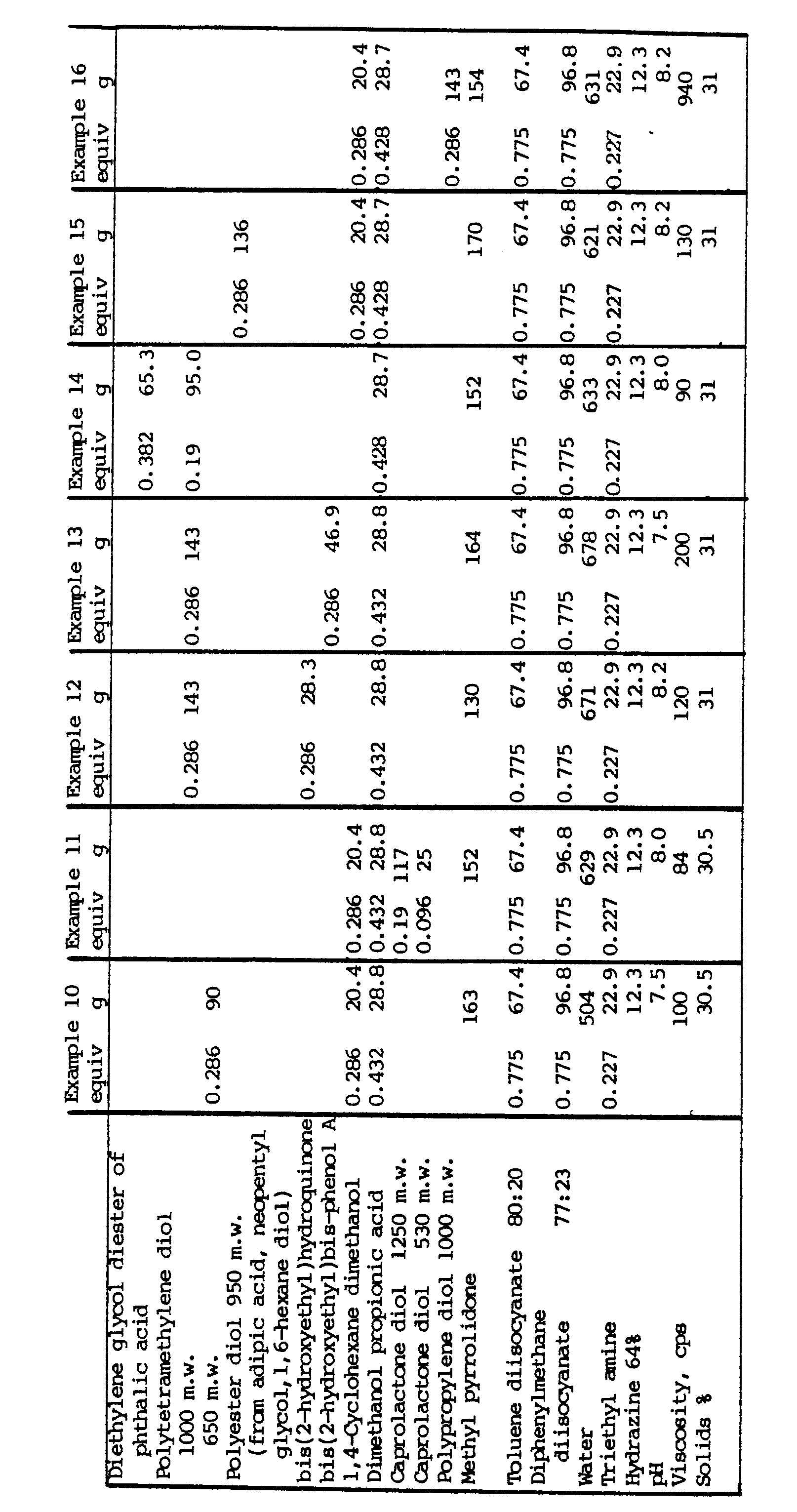
- The following Table gives the compositions of further dispersions (Examples l0-20) prepared by the general method of Example 9.

Claims (20)
and
and
Priority Applications (1)
| Application Number | Priority Date | Filing Date | Title |
|---|---|---|---|
| AT86307582T ATE101166T1 (en) | 1985-10-04 | 1986-10-01 | PROCESS FOR THE MANUFACTURE OF WATER-BASED POLYURETHANE PAINTS. |
Applications Claiming Priority (2)
| Application Number | Priority Date | Filing Date | Title |
|---|---|---|---|
| GB858524579A GB8524579D0 (en) | 1985-10-04 | 1985-10-04 | Coating compositions |
| GB8524579 | 1985-10-04 |
Publications (3)
| Publication Number | Publication Date |
|---|---|
| EP0220000A2 true EP0220000A2 (en) | 1987-04-29 |
| EP0220000A3 EP0220000A3 (en) | 1988-08-17 |
| EP0220000B1 EP0220000B1 (en) | 1994-02-02 |
Family
ID=10586226
Family Applications (1)
| Application Number | Title | Priority Date | Filing Date |
|---|---|---|---|
| EP86307582A Expired - Lifetime EP0220000B1 (en) | 1985-10-04 | 1986-10-01 | Method for the production of aqueous polyurethane coating compositions |
Country Status (10)
| Country | Link |
|---|---|
| US (1) | US4801644A (en) |
| EP (1) | EP0220000B1 (en) |
| JP (1) | JP2537499B2 (en) |
| AT (1) | ATE101166T1 (en) |
| AU (1) | AU596996B2 (en) |
| BR (1) | BR8604816A (en) |
| CA (1) | CA1289967C (en) |
| DE (1) | DE3689604T2 (en) |
| GB (2) | GB8524579D0 (en) |
| NZ (1) | NZ217701A (en) |
Cited By (19)
| Publication number | Priority date | Publication date | Assignee | Title |
|---|---|---|---|---|
| EP0309113A1 (en) * | 1987-09-14 | 1989-03-29 | Zeneca Inc. | Aqueous dispersions |
| US4912154A (en) * | 1988-12-30 | 1990-03-27 | The Sherwin-Williams Company | Water-dispersible air-drying coatings containing 2-oxazoline groups |
| DE3839940A1 (en) * | 1988-11-26 | 1990-05-31 | Stockhausen Chem Fab Gmbh | Aqueous polyurethane and polyurethane-urea dispersions, and process for the flocking of elastomeric mouldings using these dispersions |
| US5039732A (en) * | 1988-12-30 | 1991-08-13 | The Sherwin-Williams Company | Water-dispersable air-drying coatings |
| EP0439792A3 (en) * | 1990-01-20 | 1991-08-14 | Bayer Ag | Polyisocyanate mixtures and their use for the preparation of flexible polyurethane foams |
| WO1991019750A1 (en) * | 1990-06-15 | 1991-12-26 | Henkel Kommanditgesellschaft Auf Aktien | Coating materials |
| US5130405A (en) * | 1989-07-13 | 1992-07-14 | Akzo N.V. | Acid etch resistant coatings |
| US5155163A (en) * | 1990-08-06 | 1992-10-13 | Uniroyal Adhesives And Sealants, Inc. | Aqueous polyurethane dispersion synthesis for adhesive thermoforming applications |
| EP0611095A1 (en) * | 1993-02-08 | 1994-08-17 | Nippon Paint Co., Ltd. | Water-based coating composition |
| EP0802209A1 (en) * | 1996-04-16 | 1997-10-22 | Huntsman Petrochemical Corporation | Polyurea spray railcar lining system |
| WO1999028362A1 (en) * | 1997-12-04 | 1999-06-10 | Henkel Kommanditgesellschaft Auf Aktien | Waterborne polyurethanes with urea-urethane linkages |
| EP0957854A4 (en) * | 1996-09-20 | 1999-12-01 | ||
| WO2006044305A1 (en) * | 2004-10-15 | 2006-04-27 | Dow Global Technologies Inc. | An isocyanate-terminated prepolymer composition and a polyurethane or polyurea elastomer produced therefrom |
| WO2006086715A3 (en) * | 2005-02-11 | 2006-11-30 | Invista Tech Sarl | Solvent free aqueous polyurethane dispersions and shaped articles therefrom |
| WO2007084596A3 (en) * | 2006-01-18 | 2008-01-24 | Invista Tech Sarl | Non-textile polymer compositions and methods |
| WO2008022066A3 (en) * | 2006-08-11 | 2008-05-29 | Invista Tech Sarl | Fabric care compositions |
| DE102007001868A1 (en) | 2007-01-12 | 2008-07-17 | Bayer Materialscience Ag | Polyurethane dispersions based on 2,2'MDI |
| WO2011045416A1 (en) | 2009-10-16 | 2011-04-21 | Bayer Materialscience Ag | Aromatic polyurethane-urea dispersions |
| CN101155847B (en) * | 2005-02-11 | 2013-04-10 | 因维斯塔技术有限公司 | Method to make elastic shirting fabric comprising spandex and hard yarn |
Families Citing this family (54)
| Publication number | Priority date | Publication date | Assignee | Title |
|---|---|---|---|---|
| US4937283A (en) * | 1987-03-02 | 1990-06-26 | The Goodyear Tire & Rubber Company | Meta-tetramethyl xylene diamine polyurethane compositions and process of making the same |
| DE3728140A1 (en) * | 1987-08-22 | 1989-03-02 | Bayer Ag | AQUEOUS SOLUTIONS OR DISPERSIONS OF POLYISOCYANATE POLYADDITION PRODUCTS, A METHOD FOR PRODUCING THE AQUEOUS SOLUTIONS OR DISPERSIONS AND THEIR USE AS ADHESIVE |
| US5179143A (en) * | 1988-07-26 | 1993-01-12 | Bayer Aktiengesellschaft | Process for the preparation of compression molded materials |
| NZ230314A (en) * | 1988-09-09 | 1991-02-26 | Ici Plc | Polyisocyanate composition obtained from the reaction product of uretonimine and/or carbodiimide-modified polyisocyanate with a carboxylic acid |
| US5137967A (en) * | 1990-07-06 | 1992-08-11 | Reichhold Chemicals, Inc. | Hydrazine extended aqueous polyurethane |
| US5532058A (en) * | 1990-12-10 | 1996-07-02 | H. B. Fuller Licensing & Financing, Inc. | Dry-bonded film laminate employing polyurethane dispersion adhesives with improved crosslinkers |
| US5494960A (en) * | 1990-12-10 | 1996-02-27 | H.B. Fuller Licensing & Financing, Inc. | Aqueous polyurethane dispersions and adhesives based thereon |
| DE4129951A1 (en) * | 1991-09-10 | 1993-03-11 | Bayer Ag | COATING AGENTS, A METHOD FOR THE PRODUCTION THEREOF AND THEIR USE FOR THE PRODUCTION OF COATINGS |
| EP0552420A3 (en) * | 1992-01-24 | 1993-09-15 | H.B. Fuller Licensing & Financing, Inc. | Water dispersed polyurethane polymer for improved coatings and adhesives |
| JP3347840B2 (en) * | 1992-09-28 | 2002-11-20 | 三洋化成工業株式会社 | Aqueous pigment dispersion |
| US5610232A (en) * | 1993-09-24 | 1997-03-11 | H.B. Fuller Licensing & Financing, Inc. | Aqueous non-gelling, anionic polyurethane dispersions and process for their manufacture |
| US5703158A (en) * | 1993-09-24 | 1997-12-30 | H.B. Fuller Licensing & Financing, Inc. | Aqueous anionic poly (urethane/urea) dispersions |
| US5608000A (en) * | 1993-09-24 | 1997-03-04 | H. B. Fuller Licensing & Financing, Inc. | Aqueous polyurethane dispersion adhesive compositions with improved heat resistance |
| WO1996002385A1 (en) * | 1994-07-15 | 1996-02-01 | H.B. Fuller Licensing & Financing, Inc. | Non-skid water based coating |
| US5436277A (en) * | 1994-07-28 | 1995-07-25 | Basf Corporation | Polyisocyanate compositions for the preparation of flexible polyurethane foams |
| US5872182A (en) * | 1994-09-09 | 1999-02-16 | H. B. Fuller Licensing & Financing, Inc. | Water-based polyurethanes for footwear |
| US5637639A (en) * | 1994-09-09 | 1997-06-10 | H.B. Fuller Licensing And Financing, Inc. | Reduced solvent process for preparation of aqueous polyurethane dispersions with improved heat-and water-resistance |
| US5834554A (en) * | 1996-03-05 | 1998-11-10 | H. B. Fuller Licensing & Financing, Inc. | Laminating adhesives for flexible packaging |
| US5821294A (en) * | 1996-08-30 | 1998-10-13 | National Starch And Chemical Investment Holding Corporation | Water-based laminating adhesives |
| US6166165A (en) * | 1996-12-18 | 2000-12-26 | Witco Corporation | Polyurethane synthesis from functional group terminated polymers containing sulfonate groups |
| US5912093A (en) * | 1997-05-15 | 1999-06-15 | National Science Council | Polyurethane-based polymeric electrolyte and process for producing same |
| DE19843552A1 (en) | 1998-09-23 | 2000-03-30 | Bayer Ag | Aqueous dispersions with reduced triethylamine content |
| DE19847791A1 (en) * | 1998-10-16 | 2000-04-20 | Bayer Ag | Aqueous polyurethane dispersions |
| WO2002042348A2 (en) * | 2000-11-27 | 2002-05-30 | Arch Chemicals, Inc. | Polyols containing carboxyl groups and production thereof |
| US6716913B1 (en) * | 2000-11-27 | 2004-04-06 | Arch Chemicals, Inc. | Polyols containing grafted carboxyl groups and method of making same |
| JP2002188051A (en) * | 2000-12-19 | 2002-07-05 | Sumitomo Rubber Ind Ltd | Coating agent for electrophotographic device members |
| US20050020767A1 (en) * | 2001-12-04 | 2005-01-27 | Huey-Huey Lo | High performance aqueous polyurethanes dispersion and methods of fabricating the same |
| JP2003212951A (en) | 2002-01-23 | 2003-07-30 | Daicel Chem Ind Ltd | Antioxidant functional resin and emulsion thereof |
| US20040230437A1 (en) * | 2003-04-29 | 2004-11-18 | Havrilak Robert J. | Method for assessing and managing security risk for systems |
| JP2007502350A (en) * | 2003-08-13 | 2007-02-08 | ヴァルスパー ソーシング,インク. | Water-based polyurethane-polyethylene composition |
| CN100491434C (en) * | 2003-12-16 | 2009-05-27 | 安徽大学 | Post-chain extension process of cationic aromatic waterborne polyurethane resin |
| DE102004017436A1 (en) * | 2004-04-08 | 2005-10-27 | Bayer Materialscience Ag | Process for the continuous preparation of an aqueous polyurethane dispersion |
| JP4249109B2 (en) * | 2004-09-30 | 2009-04-02 | 三洋化成工業株式会社 | Polyurethane resin emulsion |
| CA2588404C (en) * | 2004-11-22 | 2011-06-28 | Marc S. Schneider | Energy absorbing padding for sports application |
| US20080004395A1 (en) * | 2005-02-11 | 2008-01-03 | Invista North America S.A.R.L. | Aqueous polyurethaneurea compositions including dispersions and films |
| US20060183849A1 (en) * | 2005-02-11 | 2006-08-17 | Invista North America S.A R.L. | Solvent free aqueous polyurethane dispersions and adhesive films therefrom for stretch fabrics |
| US20070264462A1 (en) * | 2005-02-11 | 2007-11-15 | Invista North America S.A R.L. | Laminated fabric construction with heat activated polyurethaneurea compositions |
| DE102006016639A1 (en) * | 2006-04-08 | 2007-10-11 | Bayer Materialscience Ag | Process for the production of polyurethane foams |
| KR101004242B1 (en) * | 2006-04-28 | 2010-12-24 | 쇼와 덴코 가부시키가이샤 | Thermosetting resin composition and uses thereof |
| US9410010B2 (en) | 2007-12-10 | 2016-08-09 | E I Du Pont De Nemours And Company | Urea-terminated polyurethane dispersants |
| US20130022746A9 (en) * | 2007-12-10 | 2013-01-24 | Harry Joseph Spinelli | Aqueous inkjet inks with ionically stabilized dispersions and polyurethane ink additives |
| WO2009119065A1 (en) * | 2008-03-25 | 2009-10-01 | 日本ポリウレタン工業株式会社 | Aqueous polyurethane dispersing element and manufacturing method thereof |
| US20110039028A1 (en) * | 2008-05-23 | 2011-02-17 | E,I. Du Pont De Nemours And Company | Inkjet ink with self dispersed pigments and polyurethane ink additives |
| US8759418B2 (en) | 2008-05-23 | 2014-06-24 | E I Du Pont De Nemours And Company | Urea-terminated polyurethane dispersants |
| WO2010045359A2 (en) * | 2008-10-17 | 2010-04-22 | Invista Technologies S.A R.L. | Aqueous polyurethaneurea compositions including dispersions and films |
| JP5626620B2 (en) * | 2009-02-26 | 2014-11-19 | 日本ポリウレタン工業株式会社 | Method for producing aqueous polyurethane dispersion |
| CN102424704B (en) * | 2011-08-30 | 2013-05-15 | 吴江市北厍盛源纺织品助剂厂 | Modified water-dispersible polyisocyanate |
| US20130317159A1 (en) | 2012-05-22 | 2013-11-28 | Chevron Phillips Chemical Company Lp | Reinforced Poly(Arylene Sulfide) Compositions |
| US20150105524A1 (en) * | 2013-10-14 | 2015-04-16 | Chevron Phillips Chemical Company Lp | Method of Improving the Melt Properties of Poly(Arylene Sulfide) Polymers |
| US20150376339A1 (en) | 2014-06-27 | 2015-12-31 | Solvay Sa | Process for Production of Poly(Arylene Sulfide) |
| EP3243397B1 (en) | 2015-01-09 | 2019-10-09 | Mizuno Corporation | Garment |
| JP7393173B2 (en) * | 2019-09-30 | 2023-12-06 | 第一工業製薬株式会社 | film coating agent |
| US20230294908A1 (en) * | 2022-03-21 | 2023-09-21 | Geoffrey J. Westfall | Aerosol can having high friction surface coating |
| EP4759849A1 (en) * | 2024-12-12 | 2026-06-17 | Arkema France | Water based polyurethane dispersion for soft touch matte coating |
Family Cites Families (8)
| Publication number | Priority date | Publication date | Assignee | Title |
|---|---|---|---|---|
| US3394164A (en) * | 1965-10-24 | 1968-07-23 | Upjohn Co | Stabilized methylenebis-(phenyl isocyanate) compositions |
| DE2359613C3 (en) * | 1973-11-30 | 1980-05-22 | Bayer Ag, 5090 Leverkusen | Liquid, solvent-free polyisocyanates containing aromatic carboxyl and / or carboxylate groups, processes for their preparation and their use |
| US4066591A (en) * | 1975-06-02 | 1978-01-03 | Ppg Industries, Inc. | Water-reduced urethane coating compositions |
| DE2638759A1 (en) * | 1976-08-27 | 1978-03-09 | Bayer Ag | SOLUTIONS OF POLYISOCYANATE POLYADDITION PRODUCTS |
| DE2811148A1 (en) * | 1978-03-15 | 1979-09-20 | Bayer Ag | PROCESS FOR THE PRODUCTION OF Aqueous POLYURETHANE DISPERSIONS AND SOLUTIONS |
| DE2928182A1 (en) * | 1979-07-12 | 1981-01-29 | Bayer Ag | METHOD FOR PRODUCING ELASTIC, CELL-SHAPED, POLYURETHANE UREAS, IF ANY |
| US4387181A (en) * | 1980-04-09 | 1983-06-07 | Textron, Inc. | Polymer compositions and manufacture |
| DE3139966A1 (en) * | 1981-10-08 | 1983-04-28 | Bayer Ag, 5090 Leverkusen | Process for the preparation of aqueous dispersions or solutions of polyurethanes, and the use thereof for the production of coatings |
-
1985
- 1985-10-04 GB GB858524579A patent/GB8524579D0/en active Pending
-
1986
- 1986-09-24 AU AU63120/86A patent/AU596996B2/en not_active Expired
- 1986-09-26 NZ NZ217701A patent/NZ217701A/en unknown
- 1986-10-01 DE DE3689604T patent/DE3689604T2/en not_active Expired - Lifetime
- 1986-10-01 GB GB868623573A patent/GB8623573D0/en active Pending
- 1986-10-01 EP EP86307582A patent/EP0220000B1/en not_active Expired - Lifetime
- 1986-10-01 AT AT86307582T patent/ATE101166T1/en not_active IP Right Cessation
- 1986-10-03 CA CA000519809A patent/CA1289967C/en not_active Expired - Fee Related
- 1986-10-03 JP JP61234746A patent/JP2537499B2/en not_active Expired - Fee Related
- 1986-10-03 US US06/915,098 patent/US4801644A/en not_active Expired - Lifetime
- 1986-10-03 BR BR8604816A patent/BR8604816A/en not_active IP Right Cessation
Cited By (25)
| Publication number | Priority date | Publication date | Assignee | Title |
|---|---|---|---|---|
| EP0309113A1 (en) * | 1987-09-14 | 1989-03-29 | Zeneca Inc. | Aqueous dispersions |
| US4927876A (en) * | 1987-09-14 | 1990-05-22 | Ici Americas Inc. | Aqueous dispersions |
| DE3839940A1 (en) * | 1988-11-26 | 1990-05-31 | Stockhausen Chem Fab Gmbh | Aqueous polyurethane and polyurethane-urea dispersions, and process for the flocking of elastomeric mouldings using these dispersions |
| US4912154A (en) * | 1988-12-30 | 1990-03-27 | The Sherwin-Williams Company | Water-dispersible air-drying coatings containing 2-oxazoline groups |
| US5039732A (en) * | 1988-12-30 | 1991-08-13 | The Sherwin-Williams Company | Water-dispersable air-drying coatings |
| US5130405A (en) * | 1989-07-13 | 1992-07-14 | Akzo N.V. | Acid etch resistant coatings |
| EP0439792A3 (en) * | 1990-01-20 | 1991-08-14 | Bayer Ag | Polyisocyanate mixtures and their use for the preparation of flexible polyurethane foams |
| WO1991019750A1 (en) * | 1990-06-15 | 1991-12-26 | Henkel Kommanditgesellschaft Auf Aktien | Coating materials |
| US5312865A (en) * | 1990-06-15 | 1994-05-17 | Henkel Kommanditgesellschaft Auf Aktien | Coating compositions |
| US5155163A (en) * | 1990-08-06 | 1992-10-13 | Uniroyal Adhesives And Sealants, Inc. | Aqueous polyurethane dispersion synthesis for adhesive thermoforming applications |
| EP0611095A1 (en) * | 1993-02-08 | 1994-08-17 | Nippon Paint Co., Ltd. | Water-based coating composition |
| US5731397A (en) * | 1996-04-16 | 1998-03-24 | Huntman Petrochemical Corporation | Polyurea spray railcar lining systems |
| EP0802209A1 (en) * | 1996-04-16 | 1997-10-22 | Huntsman Petrochemical Corporation | Polyurea spray railcar lining system |
| EP0957854A4 (en) * | 1996-09-20 | 1999-12-01 | ||
| WO1999028362A1 (en) * | 1997-12-04 | 1999-06-10 | Henkel Kommanditgesellschaft Auf Aktien | Waterborne polyurethanes with urea-urethane linkages |
| WO2006044305A1 (en) * | 2004-10-15 | 2006-04-27 | Dow Global Technologies Inc. | An isocyanate-terminated prepolymer composition and a polyurethane or polyurea elastomer produced therefrom |
| EP2374827A3 (en) * | 2005-02-11 | 2012-02-29 | Invista Technologies S.à.r.l. | Solvent free aqueous polyurethane dispersions and shaped articles therefrom |
| WO2006086715A3 (en) * | 2005-02-11 | 2006-11-30 | Invista Tech Sarl | Solvent free aqueous polyurethane dispersions and shaped articles therefrom |
| CN101155847B (en) * | 2005-02-11 | 2013-04-10 | 因维斯塔技术有限公司 | Method to make elastic shirting fabric comprising spandex and hard yarn |
| WO2007084596A3 (en) * | 2006-01-18 | 2008-01-24 | Invista Tech Sarl | Non-textile polymer compositions and methods |
| WO2008022066A3 (en) * | 2006-08-11 | 2008-05-29 | Invista Tech Sarl | Fabric care compositions |
| WO2008083846A1 (en) | 2007-01-12 | 2008-07-17 | Bayer Materialscience Ag | Polyurethane dispersions based on 2,2'-mdi |
| DE102007001868A1 (en) | 2007-01-12 | 2008-07-17 | Bayer Materialscience Ag | Polyurethane dispersions based on 2,2'MDI |
| WO2011045416A1 (en) | 2009-10-16 | 2011-04-21 | Bayer Materialscience Ag | Aromatic polyurethane-urea dispersions |
| EP2319876A1 (en) | 2009-10-16 | 2011-05-11 | Bayer MaterialScience AG | Aromatic polyurethane urea dispersions |
Also Published As
| Publication number | Publication date |
|---|---|
| CA1289967C (en) | 1991-10-01 |
| AU6312086A (en) | 1987-04-09 |
| JPS62109813A (en) | 1987-05-21 |
| JP2537499B2 (en) | 1996-09-25 |
| DE3689604D1 (en) | 1994-03-17 |
| EP0220000A3 (en) | 1988-08-17 |
| EP0220000B1 (en) | 1994-02-02 |
| BR8604816A (en) | 1987-07-07 |
| NZ217701A (en) | 1989-05-29 |
| US4801644A (en) | 1989-01-31 |
| ATE101166T1 (en) | 1994-02-15 |
| GB8524579D0 (en) | 1985-11-06 |
| DE3689604T2 (en) | 1994-10-13 |
| GB8623573D0 (en) | 1986-11-05 |
| AU596996B2 (en) | 1990-05-24 |
Similar Documents
| Publication | Publication Date | Title |
|---|---|---|
| EP0220000B1 (en) | Method for the production of aqueous polyurethane coating compositions | |
| EP0309113B1 (en) | Aqueous dispersions | |
| US4203883A (en) | Aqueous colloidal dispersions of tertiary amine salts of urea-urethane polymers and method for manufacture | |
| US4387181A (en) | Polymer compositions and manufacture | |
| US4251427A (en) | Coating compositions from polyurethanes containing a molecular sieve of the sodium aluminum silicate type | |
| CA1333314C (en) | Aqueous dispersion of nonionic polyurethane | |
| US4335029A (en) | Aqueous polyurethane compositions | |
| US4383051A (en) | Process for the preparation of polyurethane plastics using dianhydro-hexite diols | |
| US6515070B2 (en) | Low-temperature, heat-activated adhesives with high heat resistance properties | |
| CA1191995A (en) | Heterogeneous systems of polyol/diphenyl methane uret dione diisocyanates and a process for their production | |
| US4447571A (en) | Stabilization of polyurethanes | |
| KR20210122224A (en) | Process for preparing aqueous polyurethane dispersions with high solids content substantially free of volatile organic compounds | |
| EP3898738B1 (en) | Process to prepare halogen-free, flame-retardant aqueous polyurethane dispersions | |
| US20210269669A1 (en) | Process to prepare aqueous polyurethane dispersions in which the polyurethane includes polysiloxane as side chain | |
| EP0208226A2 (en) | Aqueous-based urethane coating compositions | |
| US4481345A (en) | Process for the production of combinations of organic polyisocyanates and at least partly blocked polyamines, the combinations obtainable by this process and their use for the production of lacquers, coating or sealing compositions | |
| CA1338718C (en) | Solvent-based urethane coating compositions | |
| US4937283A (en) | Meta-tetramethyl xylene diamine polyurethane compositions and process of making the same | |
| US6136941A (en) | Aqueous polyurethane dispersions containing dimer/trimer | |
| JPH07228651A (en) | Production of polyurethane emulsion | |
| BR112021009699B1 (en) | PROCESS FOR PREPARING AN AQUEOUS POLYURETHANE DISPERSION, DISPERSION AND COATING OR FILM | |
| CS199343B1 (en) | Method of producing segmented polyurethans/polyureas in solution |
Legal Events
| Date | Code | Title | Description |
|---|---|---|---|
| PUAI | Public reference made under article 153(3) epc to a published international application that has entered the european phase |
Free format text: ORIGINAL CODE: 0009012 |
|
| AK | Designated contracting states |
Kind code of ref document: A2 Designated state(s): AT BE CH DE ES FR GB IT LI LU NL SE |
|
| PUAL | Search report despatched |
Free format text: ORIGINAL CODE: 0009013 |
|
| AK | Designated contracting states |
Kind code of ref document: A3 Designated state(s): AT BE CH DE ES FR GB IT LI LU NL SE |
|
| 17P | Request for examination filed |
Effective date: 19890124 |
|
| 17Q | First examination report despatched |
Effective date: 19900430 |
|
| RAP1 | Party data changed (applicant data changed or rights of an application transferred) |
Owner name: ZENECA INC. |
|
| GRAA | (expected) grant |
Free format text: ORIGINAL CODE: 0009210 |
|
| AK | Designated contracting states |
Kind code of ref document: B1 Designated state(s): AT BE CH DE ES FR GB IT LI LU NL SE |
|
| PG25 | Lapsed in a contracting state [announced via postgrant information from national office to epo] |
Ref country code: IT Free format text: LAPSE BECAUSE OF FAILURE TO SUBMIT A TRANSLATION OF THE DESCRIPTION OR TO PAY THE FEE WITHIN THE PRE;WARNING: LAPSES OF ITALIAN PATENTS WITH EFFECTIVE DATE BEFORE 2007 MAY HAVE OCCURRED AT ANY TIME BEFORE 2007. THE CORRECT EFFECTIVE DATE MAY BE DIFFERENT FROM THE ONE RECORDED.SCRIBED TIME-LIMIT Effective date: 19940202 Ref country code: FR Effective date: 19940202 Ref country code: NL Effective date: 19940202 Ref country code: SE Effective date: 19940202 Ref country code: BE Effective date: 19940202 Ref country code: LI Effective date: 19940202 Ref country code: CH Effective date: 19940202 Ref country code: AT Effective date: 19940202 |
|
| REF | Corresponds to: |
Ref document number: 101166 Country of ref document: AT Date of ref document: 19940215 Kind code of ref document: T |
|
| REF | Corresponds to: |
Ref document number: 3689604 Country of ref document: DE Date of ref document: 19940317 |
|
| PG25 | Lapsed in a contracting state [announced via postgrant information from national office to epo] |
Ref country code: ES Free format text: LAPSE BECAUSE OF FAILURE TO SUBMIT A TRANSLATION OF THE DESCRIPTION OR TO PAY THE FEE WITHIN THE PRESCRIBED TIME-LIMIT Effective date: 19940513 |
|
| REG | Reference to a national code |
Ref country code: CH Ref legal event code: PL |
|
| EN | Fr: translation not filed | ||
| NLV1 | Nl: lapsed or annulled due to failure to fulfill the requirements of art. 29p and 29m of the patents act | ||
| PG25 | Lapsed in a contracting state [announced via postgrant information from national office to epo] |
Ref country code: LU Free format text: LAPSE BECAUSE OF NON-PAYMENT OF DUE FEES Effective date: 19941031 |
|
| PLBI | Opposition filed |
Free format text: ORIGINAL CODE: 0009260 |
|
| 26 | Opposition filed |
Opponent name: HERBERTS GMBH Effective date: 19941101 |
|
| PLBO | Opposition rejected |
Free format text: ORIGINAL CODE: EPIDOS REJO |
|
| PLBN | Opposition rejected |
Free format text: ORIGINAL CODE: 0009273 |
|
| STAA | Information on the status of an ep patent application or granted ep patent |
Free format text: STATUS: OPPOSITION REJECTED |
|
| 27O | Opposition rejected |
Effective date: 19960224 |
|
| REG | Reference to a national code |
Ref country code: GB Ref legal event code: 732E |
|
| REG | Reference to a national code |
Ref country code: GB Ref legal event code: IF02 |
|
| PGFP | Annual fee paid to national office [announced via postgrant information from national office to epo] |
Ref country code: GB Payment date: 20050928 Year of fee payment: 20 |
|
| PGFP | Annual fee paid to national office [announced via postgrant information from national office to epo] |
Ref country code: DE Payment date: 20051130 Year of fee payment: 20 |
|
| PG25 | Lapsed in a contracting state [announced via postgrant information from national office to epo] |
Ref country code: GB Free format text: LAPSE BECAUSE OF EXPIRATION OF PROTECTION Effective date: 20060930 |
|
| REG | Reference to a national code |
Ref country code: GB Ref legal event code: PE20 |
|
| REG | Reference to a national code |
Ref country code: GB Ref legal event code: 732E |