EP0217484A2 - Synthetischer Flaum - Google Patents
Synthetischer Flaum Download PDFInfo
- Publication number
- EP0217484A2 EP0217484A2 EP86302856A EP86302856A EP0217484A2 EP 0217484 A2 EP0217484 A2 EP 0217484A2 EP 86302856 A EP86302856 A EP 86302856A EP 86302856 A EP86302856 A EP 86302856A EP 0217484 A2 EP0217484 A2 EP 0217484A2
- Authority
- EP
- European Patent Office
- Prior art keywords
- diameter
- microns
- fibers
- fiber
- macrofibers
- Prior art date
- Legal status (The legal status is an assumption and is not a legal conclusion. Google has not performed a legal analysis and makes no representation as to the accuracy of the status listed.)
- Granted
Links
Images
Classifications
-
- D—TEXTILES; PAPER
- D04—BRAIDING; LACE-MAKING; KNITTING; TRIMMINGS; NON-WOVEN FABRICS
- D04H—MAKING TEXTILE FABRICS, e.g. FROM FIBRES OR FILAMENTARY MATERIAL; FABRICS MADE BY SUCH PROCESSES OR APPARATUS, e.g. FELTS, NON-WOVEN FABRICS; COTTON-WOOL; WADDING ; NON-WOVEN FABRICS FROM STAPLE FIBRES, FILAMENTS OR YARNS, BONDED WITH AT LEAST ONE WEB-LIKE MATERIAL DURING THEIR CONSOLIDATION
- D04H1/00—Non-woven fabrics formed wholly or mainly of staple fibres or like relatively short fibres
- D04H1/40—Non-woven fabrics formed wholly or mainly of staple fibres or like relatively short fibres from fleeces or layers composed of fibres without existing or potential cohesive properties
- D04H1/42—Non-woven fabrics formed wholly or mainly of staple fibres or like relatively short fibres from fleeces or layers composed of fibres without existing or potential cohesive properties characterised by the use of certain kinds of fibres insofar as this use has no preponderant influence on the consolidation of the fleece
- D04H1/4282—Addition polymers
- D04H1/4291—Olefin series
-
- D—TEXTILES; PAPER
- D04—BRAIDING; LACE-MAKING; KNITTING; TRIMMINGS; NON-WOVEN FABRICS
- D04H—MAKING TEXTILE FABRICS, e.g. FROM FIBRES OR FILAMENTARY MATERIAL; FABRICS MADE BY SUCH PROCESSES OR APPARATUS, e.g. FELTS, NON-WOVEN FABRICS; COTTON-WOOL; WADDING ; NON-WOVEN FABRICS FROM STAPLE FIBRES, FILAMENTS OR YARNS, BONDED WITH AT LEAST ONE WEB-LIKE MATERIAL DURING THEIR CONSOLIDATION
- D04H1/00—Non-woven fabrics formed wholly or mainly of staple fibres or like relatively short fibres
- D04H1/40—Non-woven fabrics formed wholly or mainly of staple fibres or like relatively short fibres from fleeces or layers composed of fibres without existing or potential cohesive properties
- D04H1/42—Non-woven fabrics formed wholly or mainly of staple fibres or like relatively short fibres from fleeces or layers composed of fibres without existing or potential cohesive properties characterised by the use of certain kinds of fibres insofar as this use has no preponderant influence on the consolidation of the fleece
- D04H1/4326—Condensation or reaction polymers
- D04H1/4334—Polyamides
- D04H1/4342—Aromatic polyamides
-
- D—TEXTILES; PAPER
- D04—BRAIDING; LACE-MAKING; KNITTING; TRIMMINGS; NON-WOVEN FABRICS
- D04H—MAKING TEXTILE FABRICS, e.g. FROM FIBRES OR FILAMENTARY MATERIAL; FABRICS MADE BY SUCH PROCESSES OR APPARATUS, e.g. FELTS, NON-WOVEN FABRICS; COTTON-WOOL; WADDING ; NON-WOVEN FABRICS FROM STAPLE FIBRES, FILAMENTS OR YARNS, BONDED WITH AT LEAST ONE WEB-LIKE MATERIAL DURING THEIR CONSOLIDATION
- D04H1/00—Non-woven fabrics formed wholly or mainly of staple fibres or like relatively short fibres
- D04H1/40—Non-woven fabrics formed wholly or mainly of staple fibres or like relatively short fibres from fleeces or layers composed of fibres without existing or potential cohesive properties
- D04H1/42—Non-woven fabrics formed wholly or mainly of staple fibres or like relatively short fibres from fleeces or layers composed of fibres without existing or potential cohesive properties characterised by the use of certain kinds of fibres insofar as this use has no preponderant influence on the consolidation of the fleece
- D04H1/4326—Condensation or reaction polymers
- D04H1/435—Polyesters
-
- D—TEXTILES; PAPER
- D04—BRAIDING; LACE-MAKING; KNITTING; TRIMMINGS; NON-WOVEN FABRICS
- D04H—MAKING TEXTILE FABRICS, e.g. FROM FIBRES OR FILAMENTARY MATERIAL; FABRICS MADE BY SUCH PROCESSES OR APPARATUS, e.g. FELTS, NON-WOVEN FABRICS; COTTON-WOOL; WADDING ; NON-WOVEN FABRICS FROM STAPLE FIBRES, FILAMENTS OR YARNS, BONDED WITH AT LEAST ONE WEB-LIKE MATERIAL DURING THEIR CONSOLIDATION
- D04H1/00—Non-woven fabrics formed wholly or mainly of staple fibres or like relatively short fibres
- D04H1/40—Non-woven fabrics formed wholly or mainly of staple fibres or like relatively short fibres from fleeces or layers composed of fibres without existing or potential cohesive properties
- D04H1/42—Non-woven fabrics formed wholly or mainly of staple fibres or like relatively short fibres from fleeces or layers composed of fibres without existing or potential cohesive properties characterised by the use of certain kinds of fibres insofar as this use has no preponderant influence on the consolidation of the fleece
- D04H1/4382—Stretched reticular film fibres; Composite fibres; Mixed fibres; Ultrafine fibres; Fibres for artificial leather
- D04H1/43835—Mixed fibres, e.g. at least two chemically different fibres or fibre blends
-
- D—TEXTILES; PAPER
- D04—BRAIDING; LACE-MAKING; KNITTING; TRIMMINGS; NON-WOVEN FABRICS
- D04H—MAKING TEXTILE FABRICS, e.g. FROM FIBRES OR FILAMENTARY MATERIAL; FABRICS MADE BY SUCH PROCESSES OR APPARATUS, e.g. FELTS, NON-WOVEN FABRICS; COTTON-WOOL; WADDING ; NON-WOVEN FABRICS FROM STAPLE FIBRES, FILAMENTS OR YARNS, BONDED WITH AT LEAST ONE WEB-LIKE MATERIAL DURING THEIR CONSOLIDATION
- D04H1/00—Non-woven fabrics formed wholly or mainly of staple fibres or like relatively short fibres
- D04H1/40—Non-woven fabrics formed wholly or mainly of staple fibres or like relatively short fibres from fleeces or layers composed of fibres without existing or potential cohesive properties
- D04H1/42—Non-woven fabrics formed wholly or mainly of staple fibres or like relatively short fibres from fleeces or layers composed of fibres without existing or potential cohesive properties characterised by the use of certain kinds of fibres insofar as this use has no preponderant influence on the consolidation of the fleece
- D04H1/4382—Stretched reticular film fibres; Composite fibres; Mixed fibres; Ultrafine fibres; Fibres for artificial leather
- D04H1/43838—Ultrafine fibres, e.g. microfibres
-
- D—TEXTILES; PAPER
- D04—BRAIDING; LACE-MAKING; KNITTING; TRIMMINGS; NON-WOVEN FABRICS
- D04H—MAKING TEXTILE FABRICS, e.g. FROM FIBRES OR FILAMENTARY MATERIAL; FABRICS MADE BY SUCH PROCESSES OR APPARATUS, e.g. FELTS, NON-WOVEN FABRICS; COTTON-WOOL; WADDING ; NON-WOVEN FABRICS FROM STAPLE FIBRES, FILAMENTS OR YARNS, BONDED WITH AT LEAST ONE WEB-LIKE MATERIAL DURING THEIR CONSOLIDATION
- D04H1/00—Non-woven fabrics formed wholly or mainly of staple fibres or like relatively short fibres
- D04H1/40—Non-woven fabrics formed wholly or mainly of staple fibres or like relatively short fibres from fleeces or layers composed of fibres without existing or potential cohesive properties
- D04H1/42—Non-woven fabrics formed wholly or mainly of staple fibres or like relatively short fibres from fleeces or layers composed of fibres without existing or potential cohesive properties characterised by the use of certain kinds of fibres insofar as this use has no preponderant influence on the consolidation of the fleece
- D04H1/4391—Non-woven fabrics formed wholly or mainly of staple fibres or like relatively short fibres from fleeces or layers composed of fibres without existing or potential cohesive properties characterised by the use of certain kinds of fibres insofar as this use has no preponderant influence on the consolidation of the fleece characterised by the shape of the fibres
- D04H1/43918—Non-woven fabrics formed wholly or mainly of staple fibres or like relatively short fibres from fleeces or layers composed of fibres without existing or potential cohesive properties characterised by the use of certain kinds of fibres insofar as this use has no preponderant influence on the consolidation of the fleece characterised by the shape of the fibres nonlinear fibres, e.g. crimped or coiled fibres
-
- Y—GENERAL TAGGING OF NEW TECHNOLOGICAL DEVELOPMENTS; GENERAL TAGGING OF CROSS-SECTIONAL TECHNOLOGIES SPANNING OVER SEVERAL SECTIONS OF THE IPC; TECHNICAL SUBJECTS COVERED BY FORMER USPC CROSS-REFERENCE ART COLLECTIONS [XRACs] AND DIGESTS
- Y10—TECHNICAL SUBJECTS COVERED BY FORMER USPC
- Y10S—TECHNICAL SUBJECTS COVERED BY FORMER USPC CROSS-REFERENCE ART COLLECTIONS [XRACs] AND DIGESTS
- Y10S428/00—Stock material or miscellaneous articles
- Y10S428/903—Microfiber, less than 100 micron diameter
-
- Y—GENERAL TAGGING OF NEW TECHNOLOGICAL DEVELOPMENTS; GENERAL TAGGING OF CROSS-SECTIONAL TECHNOLOGIES SPANNING OVER SEVERAL SECTIONS OF THE IPC; TECHNICAL SUBJECTS COVERED BY FORMER USPC CROSS-REFERENCE ART COLLECTIONS [XRACs] AND DIGESTS
- Y10—TECHNICAL SUBJECTS COVERED BY FORMER USPC
- Y10S—TECHNICAL SUBJECTS COVERED BY FORMER USPC CROSS-REFERENCE ART COLLECTIONS [XRACs] AND DIGESTS
- Y10S428/00—Stock material or miscellaneous articles
- Y10S428/92—Fire or heat protection feature
-
- Y—GENERAL TAGGING OF NEW TECHNOLOGICAL DEVELOPMENTS; GENERAL TAGGING OF CROSS-SECTIONAL TECHNOLOGIES SPANNING OVER SEVERAL SECTIONS OF THE IPC; TECHNICAL SUBJECTS COVERED BY FORMER USPC CROSS-REFERENCE ART COLLECTIONS [XRACs] AND DIGESTS
- Y10—TECHNICAL SUBJECTS COVERED BY FORMER USPC
- Y10T—TECHNICAL SUBJECTS COVERED BY FORMER US CLASSIFICATION
- Y10T442/00—Fabric [woven, knitted, or nonwoven textile or cloth, etc.]
- Y10T442/60—Nonwoven fabric [i.e., nonwoven strand or fiber material]
- Y10T442/603—Including strand or fiber material precoated with other than free metal or alloy
- Y10T442/607—Strand or fiber material is synthetic polymer
-
- Y—GENERAL TAGGING OF NEW TECHNOLOGICAL DEVELOPMENTS; GENERAL TAGGING OF CROSS-SECTIONAL TECHNOLOGIES SPANNING OVER SEVERAL SECTIONS OF THE IPC; TECHNICAL SUBJECTS COVERED BY FORMER USPC CROSS-REFERENCE ART COLLECTIONS [XRACs] AND DIGESTS
- Y10—TECHNICAL SUBJECTS COVERED BY FORMER USPC
- Y10T—TECHNICAL SUBJECTS COVERED BY FORMER US CLASSIFICATION
- Y10T442/00—Fabric [woven, knitted, or nonwoven textile or cloth, etc.]
- Y10T442/60—Nonwoven fabric [i.e., nonwoven strand or fiber material]
- Y10T442/608—Including strand or fiber material which is of specific structural definition
- Y10T442/614—Strand or fiber material specified as having microdimensions [i.e., microfiber]
- Y10T442/626—Microfiber is synthetic polymer
Definitions
- the invention relates to a synthetic thermal insulator made of fibrous components and more particularly relates to such a material which is a replacement for down.
- the blend of the invention compares favorably to down or mixtures of down with feathers as an insulator in that it will:
- Down sleeping bags and garments are extremely efficient thermal insulators because they have a very low internal heat transfer coefficient at all bulk densities when compared to the alternative materials presently employed. Moreover, experimental data also shows that the relative advantage of down becomes greater at the very low bulk densities at which it is generally used.
- the literature it is common practice to compare the thermal performance of materials in terms of an 'apparent or effective thermal conductivity'. However it is extremely important to realize that for fibrous insulating materials at the bulk densities that are of interest in personal cold-weather protection applications, the heat transfer is as much due to radiation and convection as it is to conduction in the fibers and the air.
- Heat transfer by thermal conduction in a low density fibrous web occurs by conduction across the air gaps and by conduction through and between fibers.
- the conduction can be treated theoretically as taking place in a two-phase mixture of air and fibers - the air being the matrix and the fibers the included component.
- the large conductivity at low densities is due to radiation if the heat flow direction is downwards or to radiation and natural convection when the heat flow direction is upwards.
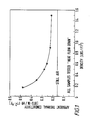
- Experimental data for down at a range of densities measured with the heat flow down is shown in Figure 1, and since there is no convective component the increase in heat transfer at low densities is clearly attributable to radiation.
- the direct plot of effective thermal conductivity as a function of density P F does not permit ready comparisons between materials since it is not easy to estimate relevant characterizing parameters from a curvilinear plot.
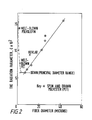
- Table I gives measured values of this parameter for a wide range of polymeric fiber assemblies, together with details of the test materials, and Figure 2 shows a plot of the radiation parameter against fiber diameter.
- the general tendency that is clear from the experimental results is that the radiative parameter is reduced as the fiber diameter is decreased, with the result that the effective thermal resis tance of the assembly is increased. It is equally clear, however, that this reduction in fiber diameter is not beneficial without limit, since the samples of fiber assemblies containing microfibers show a sharp increase in radiation parameter.
- One of these assemblies is a commercial manifestation of the material described by Hauser (U.S. Patent 4,118,531) and Hauser's unequivocal statement (col.
- the fiber assembly contains a significant proportion of very fine fibers (here defined as having diameters smaller than 3 microns), and since the slope of the curve is extremely steep on the small diameter side of the minimum, then only a small fraction of very fine fiber is sufficient to compromise the low value of the radiation parameter.
- the fiber assembly contain no more than 5% of fiber material with a diameter smaller than 3 microns.
- this length of fiber In order to be effective, this length of fiber must be distributed uniformly within the 1 cm cube in a configuration that permits good recovery from compressive loading in any direction, and such a distribution is essentially impossible to attain. Calculation indicates that the maximum fiber diameter that can be tolerated as a recovery modifier in a low density assembly is approximately 30 denier, and smaller denier materials would be preferred for minimum impact on the volume fraction.
- the foregoing discussion addresses the issue of how much additional high denier material can be tolerated : it is equally important to attempt to estimate how much is needed .
- the mechanism of deformation of the high-denier component will be principally bending and torsion, and in each of these modes of deformation the flexural rigidity of a circular filament varies as the fourth power of the diameter, and the stiffness of a flexural or torsional beam varies inversely as the third power of the length of the element.
- the deformation stiffness S of the assembly can be written S ⁇ EI/ l3 where l is the free length of fiber between contact points. Since I ⁇ d4 and l ⁇ d/V F it is possible to write: S ⁇ dV F 3.
- the invention comprises a thermal insulation material, which comprises a blend of
- the insulation material of the invention is useful as a replacement for down and down/feather mixtures in clothing, bedding and like articles of insulation.
- the thermal insulation material of the invention comprises a blend of two different textile fibers.
- the fibers differ, essentially, in their diameters.
- the majority of the fibers in the blend are microfibers, with a diameter within the range of from 3 to 12 microns.
- the minor proportion of the blend is made up with macrofibers, i.e., fibers having a diameter of more than 12 microns, up to about 50 microns.
- microfibers employed in preparing the blended materials of the preferred form of the invention are spun and drawn microfibers of a polyester, preferably of polyethylene terephthalate, though other polymeric materials may also be used in this invention. Methods of their manufacture are well known; see for example U.S. Patent 4,148,103. Advantageously the microfibers are drawn following their extrusion, to achieve a high tensile modulus, which is about 70 to 90 gms/denier in the present example. A relatively high tensile modulus contributes to a high bending modulus in the material of the invention, and helps with the mechanical performance.
- the macrofibers are also spun and drawn fibers of a synthetic polymeric resin such as a polyester (preferably polyethylene terephthalate).
- a synthetic polymeric resin such as a polyester (preferably polyethylene terephthalate).
- macrofibers of polyaramids such as poly(p-phenylene terephthalamide) to be advantageous.
- Macrofibers of poly(p-phenylene terephthalamine) are commercially available under the trademark Kevlar.
- the microfibers and preferably the macrofibers making up the thermally insulative blends of the invention are crimped fibers since this makes it possible to produce low density intimate blends of the two components.
- the techniques for crimping fibers are well known and process details need not be recited here.
- the average crimp number for both the microfibers and the macrofibers is within the range of from 8 to 20 crimps per inch. It is possible to achieve satisfactory results with uncrimped macrofibers but I believe that the presence of crimp on the microfiber component is critical to the successful operation of a low density, lofty assembly.
- the presence of individualized opened and crimped microfiber also helps to make it possible to reestablish loft in the fiber assembly after compression or wetting, and hence improve the long term utility of the invention.
- microfibers and the macrofibers employed in the blends of the invention may, optionally, be lubricated.
- lubricants conventionally used are aqueous solutions of organopolysiloxanes, emulsions of polytetrafluoroethylene, non-ionic surfactants and the like. Such lubricants may be applied to the fibers by spray or dip techniques well known in the art.
- the macrofibers and the microfibers are blended together to form batts consisting of plied card-laps, although other fibrous forms may be equally suitable.
- the card-laps, or output webs from a carding machine are intimate blends of spun-and-drawn microfibers and macrofibers.
- the batts are advantageously made to achieve densities comparable to the densities characteristic of down, i.e., on the order of less than 1.0 lb/cubic foot, typically around 0.5 lb/cubic foot.
- Compressional Recovery and Work of Compression and Recovery Section 4.3.2 of Military Specification MIL-B-41826E describes a compressional-recovery test technique for fibrous batting that was adapted for this work.
- the essential difference between the Military Specification method and the one employed is the lower pressure at which initial thickness and recovered-to-thickness were measured.
- the measuring pressure in the specification is 0.01 lb/in.2, whereas 0.002 lb/in.2 was used in this work.
- Water Absorption Capacity ASTM Method D1117 provided the starting point for development of the water absorption- capacity and absorption-time test used.
- down used throughout the examples was actually a down/feathers mixture, 80/20 by weight, per MIL-F-43097G, Type II, Class I. This mixture is commonly and commercially referred to as “down” and is often referred to as “down” herein.
- a quantity of spun and drawn 1.2 inch long microfibers having a diameter of 7.5 microns is provided.
- the fibers are lubricated with a silicone finish.
- the spun-and-drawn microfibers are polyester and have been drawn to achieve a rela tively high tensile modulus (60-90 grams/denier), which contributes significantly to a high bending modulus. After drawing they have been crimped, cut into staple and thoroughly opened, or separated, in a card.
- the high bending stiffness and crimp are essential characteristics which provide and help to maintain advantageous loft.
- the average crimp frequency is 14/inch and the average crimp amplitude is 0.04 inches.
- the macrofibers are lubricated with a silicone finish and are characterized in part by a staple length of 2.2 inches, an average crimp frequency of 8.5/inch and a crimp amplitude (average) of 0.06 inches.
- the blend is carded into a batt. The physical properties of the batt are shown in Table II , below, compared to a batt of down.
- Example 2 The procedure of Example 1, supra ., is repeated except that the macrofiber as used therein is replaced with 20 percent by weight of uncrimped poly(p-phenylene terephthalamide) fibers having a diameter of 12 microns, a length of 3.0 inches, and a silicone lubricant finish.
- the physical characteristics of the material formed are given in Table II below.
- both examples of the invention offer performance equivalent to that of the down/feathers mixture, and that the values of compressional recovery, work to compress, and resilience measured for both embodiments represent some improvement over those of down. Improvement of perhaps greater significance is apparent through comparison of densities at the "6 hr wetting,” “30 min drying” and “6 hr drying” intervals in the wetting/drying cycle. The much lower densities measured for the two forms of the invention show that it retains its loft while wet and, most probably its insulating value, to a far greater degree than does down. Resistance-to-wetting and resistance to loss-of-loft while wet are inherent advantages of the fiber combination described. The hydrophobic nature of polyester and the microporous structure of the insulators are assumed to contribute to these desirable characteristics.
Landscapes
- Engineering & Computer Science (AREA)
- Textile Engineering (AREA)
- Chemical & Material Sciences (AREA)
- Chemical Kinetics & Catalysis (AREA)
- Nonwoven Fabrics (AREA)
- Non-Silver Salt Photosensitive Materials And Non-Silver Salt Photography (AREA)
- Artificial Filaments (AREA)
- Medicines Containing Plant Substances (AREA)
- Transition And Organic Metals Composition Catalysts For Addition Polymerization (AREA)
- Yarns And Mechanical Finishing Of Yarns Or Ropes (AREA)
Priority Applications (1)
| Application Number | Priority Date | Filing Date | Title |
|---|---|---|---|
| AT86302856T ATE92122T1 (de) | 1985-09-26 | 1986-04-16 | Synthetischer flaum. |
Applications Claiming Priority (2)
| Application Number | Priority Date | Filing Date | Title |
|---|---|---|---|
| US780384 | 1985-09-26 | ||
| US06/780,384 US4588635A (en) | 1985-09-26 | 1985-09-26 | Synthetic down |
Publications (3)
| Publication Number | Publication Date |
|---|---|
| EP0217484A2 true EP0217484A2 (de) | 1987-04-08 |
| EP0217484A3 EP0217484A3 (en) | 1989-06-07 |
| EP0217484B1 EP0217484B1 (de) | 1993-07-28 |
Family
ID=25119447
Family Applications (1)
| Application Number | Title | Priority Date | Filing Date |
|---|---|---|---|
| EP19860302856 Expired - Lifetime EP0217484B1 (de) | 1985-09-26 | 1986-04-16 | Synthetischer Flaum |
Country Status (6)
| Country | Link |
|---|---|
| US (1) | US4588635A (de) |
| EP (1) | EP0217484B1 (de) |
| JP (1) | JPS6278245A (de) |
| AT (1) | ATE92122T1 (de) |
| CA (1) | CA1280880C (de) |
| DE (1) | DE3688770T2 (de) |
Cited By (3)
| Publication number | Priority date | Publication date | Assignee | Title |
|---|---|---|---|---|
| RU2425915C2 (ru) * | 2006-04-27 | 2011-08-10 | Либелтекс | Способ получения изоляционных войлоков из полимерного волокна для применения в жилищном и промышленном строительстве |
| WO2014116439A1 (en) * | 2013-01-22 | 2014-07-31 | Primaloft, Inc. | Blowable insulation material with enhanced durability and water repellency |
| US9797845B2 (en) | 2013-09-20 | 2017-10-24 | Izoteh D.O.O. | Apparatus and method for monitoring melt stream within a fiberizing apparatus |
Families Citing this family (51)
| Publication number | Priority date | Publication date | Assignee | Title |
|---|---|---|---|---|
| US5344707A (en) * | 1980-12-27 | 1994-09-06 | E. I. Du Pont De Nemours And Company | Fillings and other aspects of fibers |
| US4681801A (en) * | 1986-08-22 | 1987-07-21 | Minnesota Mining And Manufacturing Company | Durable melt-blown fibrous sheet material |
| EP0279677B1 (de) * | 1987-02-20 | 1993-05-26 | Albany International Corp. | Künstliche Daunen |
| US4992327A (en) * | 1987-02-20 | 1991-02-12 | Albany International Corp. | Synthetic down |
| US4837067A (en) * | 1987-06-08 | 1989-06-06 | Minnesota Mining And Manufacturing Company | Nonwoven thermal insulating batts |
| US4813948A (en) * | 1987-09-01 | 1989-03-21 | Minnesota Mining And Manufacturing Company | Microwebs and nonwoven materials containing microwebs |
| US4988560A (en) * | 1987-12-21 | 1991-01-29 | Minnesota Mining And Manufacturing Company | Oriented melt-blown fibers, processes for making such fibers, and webs made from such fibers |
| US5993943A (en) * | 1987-12-21 | 1999-11-30 | 3M Innovative Properties Company | Oriented melt-blown fibers, processes for making such fibers and webs made from such fibers |
| CH679822B5 (de) * | 1988-01-12 | 1992-10-30 | Breveteam Sa | |
| US4908263A (en) * | 1988-05-13 | 1990-03-13 | Minnesota Mining And Manufacturing Company | Nonwoven thermal insulating stretch fabric |
| GB8823704D0 (en) * | 1988-10-10 | 1988-11-16 | Albany Research Uk | Continuous filament insulator |
| US4970111A (en) * | 1988-10-12 | 1990-11-13 | Smith Novis W Jr | Flame retarding fusion bonded non-woven fabrics |
| AU661550B2 (en) * | 1992-11-30 | 1995-07-27 | Albany International Corp. | Breathable buoyant thermal insulating material |
| US5298694A (en) * | 1993-01-21 | 1994-03-29 | Minnesota Mining And Manufacturing Company | Acoustical insulating web |
| CA2096470A1 (en) * | 1993-04-16 | 1994-10-17 | Zivile M. Groh | Synthetic down clusters |
| US5437922A (en) * | 1994-05-04 | 1995-08-01 | Schuller International, Inc. | Fibrous, non-woven polymeric insulation |
| US5437909A (en) * | 1994-05-20 | 1995-08-01 | Minnesota Mining And Manufacturing Company | Multilayer nonwoven thermal insulating batts |
| US5443893A (en) * | 1994-05-20 | 1995-08-22 | Minnesota Mining And Manufacturing Company | Multilayer nonwoven thermal insulating batts |
| WO1995032859A1 (en) * | 1994-05-26 | 1995-12-07 | Beck Martin H | Polyester insulation |
| US5773375A (en) * | 1996-05-29 | 1998-06-30 | Swan; Michael D. | Thermally stable acoustical insulation |
| US6206744B1 (en) | 1999-01-29 | 2001-03-27 | Jerald N. Wigutow | Insulated flotation garments |
| US6329052B1 (en) | 1999-04-27 | 2001-12-11 | Albany International Corp. | Blowable insulation |
| US6329051B1 (en) | 1999-04-27 | 2001-12-11 | Albany International Corp. | Blowable insulation clusters |
| US20050106970A1 (en) * | 2000-09-01 | 2005-05-19 | Stanitis Gary E. | Melt processable perfluoropolymer forms |
| US20030157293A1 (en) * | 2002-02-21 | 2003-08-21 | Quinn Darren Scott | Filled articles comprising blown fibers |
| US6613431B1 (en) | 2002-02-22 | 2003-09-02 | Albany International Corp. | Micro denier fiber fill insulation |
| US7000729B2 (en) * | 2002-07-08 | 2006-02-21 | Acoustek Nonwovens | Five-layer sound absorbing pad: improved acoustical absorber |
| EP1382730A1 (de) * | 2002-07-15 | 2004-01-21 | Paul Hartmann AG | Kosmetisches Wattepad |
| US20040043207A1 (en) * | 2002-08-28 | 2004-03-04 | Donovan James G. | Lofty, stretchable thermal insulator |
| US7261936B2 (en) * | 2003-05-28 | 2007-08-28 | Albany International Corp. | Synthetic blown insulation |
| US7051459B1 (en) | 2003-11-05 | 2006-05-30 | Wigutow Jerald N | Insulated lightweight pack boot |
| US20050124256A1 (en) * | 2003-12-09 | 2005-06-09 | Vanessa Mason | Synthetic insulation with microporous membrane |
| US20060248651A1 (en) * | 2005-05-05 | 2006-11-09 | Creative Bedding Technologies, Inc. | Stuffing, filler and pillow |
| US7790639B2 (en) * | 2005-12-23 | 2010-09-07 | Albany International Corp. | Blowable insulation clusters made of natural material |
| DE102007043946A1 (de) | 2007-09-14 | 2009-03-19 | Bayerisches Zentrum für Angewandte Energieforschung e.V. | Faserverbünde und deren Verwendung in Vakuumisolationssystemen |
| DE102008040367A1 (de) | 2008-07-11 | 2010-02-25 | Evonik Degussa Gmbh | Bauteil zur Herstellung von Vakuumisolationssystemen |
| ES2714678T3 (es) | 2012-03-06 | 2019-05-29 | Hydrapak Llc | Recipiente flexible |
| US20140259328A1 (en) | 2013-03-15 | 2014-09-18 | W. L. Gore & Associates, Inc. | Moisture-insensitive thermally protective materials and garments made therefrom |
| EP2789320B1 (de) | 2013-04-12 | 2018-05-23 | 3M Innovative Properties Company | Strickgewebe für orthopädisches Trägermaterial |
| KR101862966B1 (ko) * | 2014-05-08 | 2018-05-31 | 미쯔비시 케미컬 주식회사 | 충전솜 |
| EP3247826B1 (de) | 2015-01-21 | 2019-05-01 | PrimaLoft, Inc. | Migrationsbeständige rohbaumwolle mit streckung und verfahren zur herstellung und artikel damit |
| CN107438681B (zh) | 2015-03-25 | 2023-12-22 | 3M创新有限公司 | 可吹动的天然羽绒替代物 |
| USD817632S1 (en) * | 2015-10-02 | 2018-05-15 | Hydrapak, Inc. | Flask |
| DE102016224251B4 (de) * | 2016-12-06 | 2019-02-28 | Adidas Ag | Wärmedämmende Struktur |
| UA117405C2 (uk) * | 2016-12-13 | 2018-07-25 | Анна Анатоліївна Мариненко | Матеріал для виробництва плетених та в'язаних текстильних виробів |
| WO2018231206A1 (en) | 2017-06-13 | 2018-12-20 | Sysco Guest Supply, Llc | Textile products comprising natural down and fibrous materials |
| EP3425099A1 (de) * | 2017-07-03 | 2019-01-09 | Axel Nickel | Meltblown-vliesstoff mit verbesserter stapelbarkeit und lagerbarkeit |
| US11447893B2 (en) | 2017-11-22 | 2022-09-20 | Extrusion Group, LLC | Meltblown die tip assembly and method |
| FR3077182B1 (fr) | 2018-01-31 | 2020-02-21 | Creations Fusalp | Article vestimentaire ayant un empilement d'isolation thermique |
| US10835708B2 (en) | 2018-11-16 | 2020-11-17 | Bearaby Inc. | Layered yarn and weighted blanket for deep pressure therapy |
| TWI878638B (zh) | 2020-12-11 | 2025-04-01 | 美商普利馬洛夫特公司 | 透氣多層絕緣結構 |
Family Cites Families (8)
| Publication number | Priority date | Publication date | Assignee | Title |
|---|---|---|---|---|
| US100902A (en) * | 1870-03-15 | Improvement in the manufacture op stave baskets | ||
| US3016599A (en) * | 1954-06-01 | 1962-01-16 | Du Pont | Microfiber and staple fiber batt |
| CA1073648A (en) * | 1976-08-02 | 1980-03-18 | Edward R. Hauser | Web of blended microfibers and crimped bulking fibers |
| JPS56169813A (en) * | 1980-05-29 | 1981-12-26 | Toyobo Co Ltd | Synthetic fiber for wadding |
| JPS5756560A (en) * | 1980-09-18 | 1982-04-05 | Kanebo Ltd | Padding material |
| UST100902I4 (en) | 1980-12-29 | 1981-08-04 | Hauser Edward R | Uses for microfiber-based webs |
| JPS57205564A (en) * | 1981-06-08 | 1982-12-16 | Kuraray Co | Padding matirial and method |
| GB2148706B (en) * | 1983-11-04 | 1986-10-01 | Fogarty Plc | Improvements in and relating to fillings for articles and filled articles |
-
1985
- 1985-09-26 US US06/780,384 patent/US4588635A/en not_active Expired - Lifetime
-
1986
- 1986-04-16 AT AT86302856T patent/ATE92122T1/de not_active IP Right Cessation
- 1986-04-16 EP EP19860302856 patent/EP0217484B1/de not_active Expired - Lifetime
- 1986-04-16 DE DE86302856T patent/DE3688770T2/de not_active Expired - Fee Related
- 1986-05-27 JP JP61120333A patent/JPS6278245A/ja active Pending
- 1986-09-10 CA CA 517896 patent/CA1280880C/en not_active Expired - Lifetime
Cited By (5)
| Publication number | Priority date | Publication date | Assignee | Title |
|---|---|---|---|---|
| RU2425915C2 (ru) * | 2006-04-27 | 2011-08-10 | Либелтекс | Способ получения изоляционных войлоков из полимерного волокна для применения в жилищном и промышленном строительстве |
| WO2014116439A1 (en) * | 2013-01-22 | 2014-07-31 | Primaloft, Inc. | Blowable insulation material with enhanced durability and water repellency |
| US10266674B2 (en) | 2013-01-22 | 2019-04-23 | Primaloft, Inc. | Blowable insulation material with enhanced durability and water repellency |
| US10844197B2 (en) | 2013-01-22 | 2020-11-24 | Primaloft, Inc. | Blowable insulation material with enhanced durability and water repellency |
| US9797845B2 (en) | 2013-09-20 | 2017-10-24 | Izoteh D.O.O. | Apparatus and method for monitoring melt stream within a fiberizing apparatus |
Also Published As
| Publication number | Publication date |
|---|---|
| DE3688770T2 (de) | 1993-11-25 |
| DE3688770D1 (de) | 1993-09-02 |
| EP0217484A3 (en) | 1989-06-07 |
| EP0217484B1 (de) | 1993-07-28 |
| US4588635A (en) | 1986-05-13 |
| CA1280880C (en) | 1991-03-05 |
| ATE92122T1 (de) | 1993-08-15 |
| JPS6278245A (ja) | 1987-04-10 |
Similar Documents
| Publication | Publication Date | Title |
|---|---|---|
| EP0217484B1 (de) | Synthetischer Flaum | |
| US4992327A (en) | Synthetic down | |
| KR920001037B1 (ko) | 방염 및 방화성 탄소질 섬유 구조물 및 이의 제조방법 | |
| US5776607A (en) | Flexible biregional carbonaceous fiber, articles made from biregional carbonaceous fibers, and method of manufacture | |
| US5043207A (en) | Thermally insulating continuous filaments materials | |
| US4933129A (en) | Process for producing nonwoven insulating webs | |
| US4837076A (en) | Carbonaceous fibers with spring-like reversible deflection and method of manufacture | |
| EP0137101A1 (de) | Wattierungsmaterialien | |
| NZ284294A (en) | Multilayer nonwoven thermal insulating batt regarding bonding of bond and fill fibres | |
| US4681789A (en) | Thermal insulator comprised of split and opened fibers and method for making same | |
| CA2049503A1 (en) | Batting thermal insulation with fire resistant properties | |
| CA2044268A1 (en) | Linear carbonaceous fiber with improved elongatability | |
| EP0279677B1 (de) | Künstliche Daunen | |
| EP0048605B1 (de) | Wattematerialien | |
| US4950540A (en) | Method of improving the flame retarding and fire blocking characteristics of a fiber tow or yarn | |
| US4868037A (en) | Insulated articles containing non-linear carbonaceous fibers | |
| US5484650A (en) | Hollow fiber identification | |
| DE69505995T2 (de) | Isoliermaterial | |
| US7790639B2 (en) | Blowable insulation clusters made of natural material | |
| US5527611A (en) | Relating to hollow fiber identification | |
| NZ224061A (en) | Thermal insulation material of mixed diameter cross bonded polymeric fibres | |
| Betrabet et al. | Microfibrillar Morphology of Normal and Swollen Cotton Cellulose. | |
| JPS54101921A (en) | Mass of acrylonitrile fibers |
Legal Events
| Date | Code | Title | Description |
|---|---|---|---|
| PUAI | Public reference made under article 153(3) epc to a published international application that has entered the european phase |
Free format text: ORIGINAL CODE: 0009012 |
|
| AK | Designated contracting states |
Kind code of ref document: A2 Designated state(s): AT BE CH DE FR GB IT LI LU NL SE |
|
| PUAL | Search report despatched |
Free format text: ORIGINAL CODE: 0009013 |
|
| AK | Designated contracting states |
Kind code of ref document: A3 Designated state(s): AT BE CH DE FR GB IT LI LU NL SE |
|
| 17P | Request for examination filed |
Effective date: 19891109 |
|
| 17Q | First examination report despatched |
Effective date: 19910419 |
|
| RAP1 | Party data changed (applicant data changed or rights of an application transferred) |
Owner name: ALBANY INTERNATIONAL CORP. |
|
| GRAA | (expected) grant |
Free format text: ORIGINAL CODE: 0009210 |
|
| AK | Designated contracting states |
Kind code of ref document: B1 Designated state(s): AT BE CH DE FR GB IT LI LU NL SE |
|
| REF | Corresponds to: |
Ref document number: 92122 Country of ref document: AT Date of ref document: 19930815 Kind code of ref document: T |
|
| REF | Corresponds to: |
Ref document number: 3688770 Country of ref document: DE Date of ref document: 19930902 |
|
| ITF | It: translation for a ep patent filed | ||
| ET | Fr: translation filed | ||
| PG25 | Lapsed in a contracting state [announced via postgrant information from national office to epo] |
Ref country code: GB Effective date: 19940416 Ref country code: AT Effective date: 19940416 |
|
| PG25 | Lapsed in a contracting state [announced via postgrant information from national office to epo] |
Ref country code: SE Effective date: 19940417 |
|
| PG25 | Lapsed in a contracting state [announced via postgrant information from national office to epo] |
Ref country code: LU Free format text: LAPSE BECAUSE OF NON-PAYMENT OF DUE FEES Effective date: 19940430 Ref country code: LI Effective date: 19940430 Ref country code: CH Effective date: 19940430 Ref country code: BE Effective date: 19940430 |
|
| PLBE | No opposition filed within time limit |
Free format text: ORIGINAL CODE: 0009261 |
|
| STAA | Information on the status of an ep patent application or granted ep patent |
Free format text: STATUS: NO OPPOSITION FILED WITHIN TIME LIMIT |
|
| 26N | No opposition filed | ||
| BERE | Be: lapsed |
Owner name: ALBANY INTERNATIONAL CORP. Effective date: 19940430 |
|
| PG25 | Lapsed in a contracting state [announced via postgrant information from national office to epo] |
Ref country code: NL Effective date: 19941101 |
|
| GBPC | Gb: european patent ceased through non-payment of renewal fee |
Effective date: 19940416 |
|
| NLV4 | Nl: lapsed or anulled due to non-payment of the annual fee | ||
| PG25 | Lapsed in a contracting state [announced via postgrant information from national office to epo] |
Ref country code: FR Effective date: 19941229 |
|
| REG | Reference to a national code |
Ref country code: CH Ref legal event code: PL |
|
| PG25 | Lapsed in a contracting state [announced via postgrant information from national office to epo] |
Ref country code: DE Effective date: 19950103 |
|
| EUG | Se: european patent has lapsed |
Ref document number: 86302856.9 Effective date: 19941110 |
|
| REG | Reference to a national code |
Ref country code: FR Ref legal event code: ST |
|
| PG25 | Lapsed in a contracting state [announced via postgrant information from national office to epo] |
Ref country code: IT Free format text: LAPSE BECAUSE OF NON-PAYMENT OF DUE FEES;WARNING: LAPSES OF ITALIAN PATENTS WITH EFFECTIVE DATE BEFORE 2007 MAY HAVE OCCURRED AT ANY TIME BEFORE 2007. THE CORRECT EFFECTIVE DATE MAY BE DIFFERENT FROM THE ONE RECORDED. Effective date: 20050416 |