EP0217469A1 - Dispositif d'affichage à commande d'attaque - Google Patents
Dispositif d'affichage à commande d'attaque Download PDFInfo
- Publication number
- EP0217469A1 EP0217469A1 EP86201660A EP86201660A EP0217469A1 EP 0217469 A1 EP0217469 A1 EP 0217469A1 EP 86201660 A EP86201660 A EP 86201660A EP 86201660 A EP86201660 A EP 86201660A EP 0217469 A1 EP0217469 A1 EP 0217469A1
- Authority
- EP
- European Patent Office
- Prior art keywords
- picture
- linear switching
- switching element
- row
- electrodes
- Prior art date
- Legal status (The legal status is an assumption and is not a legal conclusion. Google has not performed a legal analysis and makes no representation as to the accuracy of the status listed.)
- Granted
Links
- 239000000463 material Substances 0.000 claims abstract description 8
- 239000004973 liquid crystal related substance Substances 0.000 claims description 11
- 239000000725 suspension Substances 0.000 claims description 2
- 238000000034 method Methods 0.000 description 7
- 239000011159 matrix material Substances 0.000 description 4
- 230000007423 decrease Effects 0.000 description 3
- 229910021417 amorphous silicon Inorganic materials 0.000 description 2
- 230000005540 biological transmission Effects 0.000 description 2
- 230000008878 coupling Effects 0.000 description 2
- 238000010168 coupling process Methods 0.000 description 2
- 238000005859 coupling reaction Methods 0.000 description 2
- 238000007599 discharging Methods 0.000 description 2
- GZPBVLUEICLBOA-UHFFFAOYSA-N 4-(dimethylamino)-3,5-dimethylphenol Chemical compound CN(C)C1=C(C)C=C(O)C=C1C GZPBVLUEICLBOA-UHFFFAOYSA-N 0.000 description 1
- 229910052782 aluminium Inorganic materials 0.000 description 1
- XAGFODPZIPBFFR-UHFFFAOYSA-N aluminium Chemical compound [Al] XAGFODPZIPBFFR-UHFFFAOYSA-N 0.000 description 1
- 239000004411 aluminium Substances 0.000 description 1
- 230000008901 benefit Effects 0.000 description 1
- UHYPYGJEEGLRJD-UHFFFAOYSA-N cadmium(2+);selenium(2-) Chemical compound [Se-2].[Cd+2] UHYPYGJEEGLRJD-UHFFFAOYSA-N 0.000 description 1
- 230000008859 change Effects 0.000 description 1
- 238000010276 construction Methods 0.000 description 1
- 230000003247 decreasing effect Effects 0.000 description 1
- 230000001419 dependent effect Effects 0.000 description 1
- 230000000694 effects Effects 0.000 description 1
- 230000008030 elimination Effects 0.000 description 1
- 238000003379 elimination reaction Methods 0.000 description 1
- 238000005516 engineering process Methods 0.000 description 1
- 230000002349 favourable effect Effects 0.000 description 1
- 230000006870 function Effects 0.000 description 1
- AMGQUBHHOARCQH-UHFFFAOYSA-N indium;oxotin Chemical compound [In].[Sn]=O AMGQUBHHOARCQH-UHFFFAOYSA-N 0.000 description 1
- 239000007788 liquid Substances 0.000 description 1
- 238000004519 manufacturing process Methods 0.000 description 1
- 230000004048 modification Effects 0.000 description 1
- 238000012986 modification Methods 0.000 description 1
- 229910021421 monocrystalline silicon Inorganic materials 0.000 description 1
- 230000003287 optical effect Effects 0.000 description 1
- 230000005693 optoelectronics Effects 0.000 description 1
- 230000002093 peripheral effect Effects 0.000 description 1
- 229910021420 polycrystalline silicon Inorganic materials 0.000 description 1
- 239000004065 semiconductor Substances 0.000 description 1
Images


Classifications
-
- G—PHYSICS
- G09—EDUCATION; CRYPTOGRAPHY; DISPLAY; ADVERTISING; SEALS
- G09G—ARRANGEMENTS OR CIRCUITS FOR CONTROL OF INDICATING DEVICES USING STATIC MEANS TO PRESENT VARIABLE INFORMATION
- G09G3/00—Control arrangements or circuits, of interest only in connection with visual indicators other than cathode-ray tubes
- G09G3/20—Control arrangements or circuits, of interest only in connection with visual indicators other than cathode-ray tubes for presentation of an assembly of a number of characters, e.g. a page, by composing the assembly by combination of individual elements arranged in a matrix no fixed position being assigned to or needed to be assigned to the individual characters or partial characters
- G09G3/34—Control arrangements or circuits, of interest only in connection with visual indicators other than cathode-ray tubes for presentation of an assembly of a number of characters, e.g. a page, by composing the assembly by combination of individual elements arranged in a matrix no fixed position being assigned to or needed to be assigned to the individual characters or partial characters by control of light from an independent source
- G09G3/36—Control arrangements or circuits, of interest only in connection with visual indicators other than cathode-ray tubes for presentation of an assembly of a number of characters, e.g. a page, by composing the assembly by combination of individual elements arranged in a matrix no fixed position being assigned to or needed to be assigned to the individual characters or partial characters by control of light from an independent source using liquid crystals
-
- G—PHYSICS
- G09—EDUCATION; CRYPTOGRAPHY; DISPLAY; ADVERTISING; SEALS
- G09G—ARRANGEMENTS OR CIRCUITS FOR CONTROL OF INDICATING DEVICES USING STATIC MEANS TO PRESENT VARIABLE INFORMATION
- G09G3/00—Control arrangements or circuits, of interest only in connection with visual indicators other than cathode-ray tubes
- G09G3/20—Control arrangements or circuits, of interest only in connection with visual indicators other than cathode-ray tubes for presentation of an assembly of a number of characters, e.g. a page, by composing the assembly by combination of individual elements arranged in a matrix no fixed position being assigned to or needed to be assigned to the individual characters or partial characters
- G09G3/34—Control arrangements or circuits, of interest only in connection with visual indicators other than cathode-ray tubes for presentation of an assembly of a number of characters, e.g. a page, by composing the assembly by combination of individual elements arranged in a matrix no fixed position being assigned to or needed to be assigned to the individual characters or partial characters by control of light from an independent source
- G09G3/36—Control arrangements or circuits, of interest only in connection with visual indicators other than cathode-ray tubes for presentation of an assembly of a number of characters, e.g. a page, by composing the assembly by combination of individual elements arranged in a matrix no fixed position being assigned to or needed to be assigned to the individual characters or partial characters by control of light from an independent source using liquid crystals
- G09G3/3611—Control of matrices with row and column drivers
- G09G3/367—Control of matrices with row and column drivers with a nonlinear element in series with the liquid crystal cell, e.g. a diode, or M.I.M. element
-
- G—PHYSICS
- G09—EDUCATION; CRYPTOGRAPHY; DISPLAY; ADVERTISING; SEALS
- G09G—ARRANGEMENTS OR CIRCUITS FOR CONTROL OF INDICATING DEVICES USING STATIC MEANS TO PRESENT VARIABLE INFORMATION
- G09G2300/00—Aspects of the constitution of display devices
- G09G2300/08—Active matrix structure, i.e. with use of active elements, inclusive of non-linear two terminal elements, in the pixels together with light emitting or modulating elements
- G09G2300/088—Active matrix structure, i.e. with use of active elements, inclusive of non-linear two terminal elements, in the pixels together with light emitting or modulating elements using a non-linear two-terminal element
- G09G2300/0895—Active matrix structure, i.e. with use of active elements, inclusive of non-linear two terminal elements, in the pixels together with light emitting or modulating elements using a non-linear two-terminal element having more than one selection line for a two-terminal active matrix LCD, e.g. Lechner and D2R circuits
Definitions
- the invention relates to a display arrangement comprising an electrooptical display medium between two supporting plates, a system of picture elements arranged in rows and columns, each picture element being constituted by two picture electrodes provided on the surfaces of the supporting plates facing each other, a system of row and collumn electrodes for driving the picture elements, the row electrodes being provided on one supporting plate and the column electrodes being provided on the other supporting plate, and a system of switching elements, at least one first asymmetrically non-linear switching element being arranged between a first row electrode and a column electrode in series with each picture element and at least one additional asymmetrically non-linear switching element being arranged in series with the first asymmetrically non-linear switching element between the first row electrode and a second row electrode, which additional switching element is connected in the same direction as the first asymmetrically non-linear switching element between the picture element and the second row electrode.
- asymmetrically non-linear switching element is to be understood to mean in this Application in the first instance a diode usual in the technology for manufacturing the said display arrangements, such as, for example, a pn diode, a Schottky diode or a PIN diode made of monocrystalline, polycrystalline or amorphous silicon, CdSe or other semiconductor materials, although also other types of non-linear switching elements, such as, for example, bipolar transistors with a shortcircuited base-collector junction or MOS transistors whose gate is connected to the drain zone, are not excluded.
- Such a display arrangement is suitable for displaying alphanumerical video information by means of passive electrooptical display media, such as liquid crystals, electrophoretic suspensions and electrochrome materials.
- the known passive electrooptical display media generally have an insufficiently steep threshold with respect to the applied voltage and/or have an insufficient intrinsic memory.
- these properties result in that, in order to obtain a sufficient contrast, the number of lines to be driven is limited. Due to the lack of memory, the information supplied to a selected row electrode via the column electrode has to be written again and again.
- the voltages supplied at the column electrodes are applied not only across the picture elements of a driven row electrode, but also across the picture elements of all the other rows. Thus, for the time in which they are not driven, the picture elements are subjected to an effective voltage which must be sufficiently small not to bring a picture element into the ON state.
- the ratio of the effective voltage to which a picture element is subjected in the ON and OFF state decreases. Due to an insufficiently steep threshold, the contrast between picture elements in the CN and OFF state then decreases.
- the number of rows to be driven can be increased by providing per picture element an additional switching element.
- This switching element ensures that a sufficiently steep threshold is obtained with respect to the applied voltage and ensures that the information supplied to a driven row electrode is maintained across a picture element for the time in which the remaining row electrodes are driven.
- the switching element also prevents that a picture element is subjected to an effective voltage meant for other picture elements in the same column for the time in which it is not driven.
- the present invention has for its object to provide such a display arrangement, in which measures are taken to avoid these additional circuits so that the number of driving points can be practically halved as compared with the display arrangement with ac D 2 C drive described in the aforementioned publication. It has further for its object to provide the possibility of blaiming a wide choice in the electro- optical materials to be used.
- a display arrangement is for this purpose characterized in that the first row electrode is connected via a first number of asymmetrically non-linear switching elements of the same polarity connected in series with the first asymmetrically non-linear switching element and the second row electrode is connected via a second number of asymmetrically non-linear switching elements of the same polarity connected in series with the additional asymmetrically non-linear switching element to a common connection.
- the invention is based inter alia on the recognition of the fact that a great voltage difference across a picture element (and hence a wide choice in the electrooptical materials to be used, such as, for example, liquid crystals) can be attained by connecting per row electrode between the first or the additional switching element and a cosrmon connection point one or more switching elements in series with this first or additional switching element.
- this first embodiment of a display arrangement according to the invention yields very favourable results with a small number of picture elements, it is found that, when larger numbers of picture elements are used, due to capacitive cross-talk row electrodes can be charged or discharged to such voltages that picture elements connected thereto display wrong information.
- a preferred embodiment of a display arrangement according to the invention is characterized in that parallel to both the first number of asymmetrically non-linear elements and to the second number of asymmetrically non-linear elements at least one asymmetrically non-linear element with opposite polarity is connected.
- a particular embodiment of a display arrangement according to the invention is for this purpose characterized in that each of the row electrodes is connected via at least one asymmetrically non-linear switching element of opposite polarity to a common point, while at least one series arrangement of a third number of asymmetrically non-linear switching elements each of the same polarity is arranged anti parallel to these elements connected with opposite polarity and to the series arrangement of the first and the additional asymmetrically non-linear switching element.
- Fig. 1 is a sectional view of a part of a display arrangement 1 provided with two supporting plates 2 and 3, between which a liquid crystal 4 is disposed.
- the inner surfaces of the supporting plates 2 and 3 are provided with electrically and chemically insulating layers 5.
- a large number of picture electrodes 6 and 7 arranged in rows and colurms, respectively, are provided on the supporting plates 2 and 3.
- the oppositely arranged picture electrodes 6 and 7 constitude the picture elements of the display arrangement.
- Stripshaped column electrodes 11 are arranged between the columns of picture electrodes 7.
- the columns electrodes 11 and the picture electrodes 7 may be integrated to form strip-shaped electrodes.
- Strip-shaped row electrodes 8a, 8b are provided between the rows of picture electrodes 6.
- Each picture electrode 6 is connected to two row electrodes 8 by means of diodes 9a, 9b not shown further in Fig. 1.
- the diodes 9 provide for the liquid crystal 4 a sufficiently steep threshold with respect to the applied voltage and provide a memory for the liquid crystal 4.
- liquid crystal orientating layers 10 are provided on the inner surfaces of the supporting plates 2 and 3. As is known, another state of orientation of the liquid crystal molecules and hence an optically different state can be obtained by applying a voltage across the liquid crystal layer 4.
- the display arrangement can be realized both as a transmissive and as a reflective arrangement.
- Fig. 2 shows diagrammatically a transmission/voltage characteristic of a display cell as used in the display arrangement of Fig. 1. Below a given threshold voltage (V 1 or V th ), the cell practically does not transmit any light, while above a given saturation voltage (V 2 or V SAT ) the cell is practically entirely translucent. It should be noted that, because such cells are generally operated with alternating voltage, the absolute value of the voltage is plotted on the abscissa.
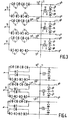
- Fig. 3 shows diagrammatically a first embodiment of a part of a display arrangement according to the invention, especially a part of the control section.
- each picture element 12 forming part of, for example, a matrix is connected on the one hand via the picture electrode 7 to a column electrode 11 and is connected on the other hand via the picture electrode 6 and two diodes 9a and 9b or other unilaterally non-linear switching elements to two row electrodes 8a, 8b.
- a circuit in which the display arrangement is controlled according to the ac-D2C method, gives rise to doubling of the number of row connection points.
- control lines 13 of the row electrodes 8a, 8b include a number of additional diodes 14 a, 14 b . These diodes 14 a and 14 b , respectively, are connected in series with the diodes 9a and 9 b , respectively. The two series arrangements are in turn connected in parallel between a (from a viewpoint of switching technique common) point 15 corresponding to the picture electrode 6 and a driving point 16.
- the diodes 14 may be manufactured in a manner different from that in which the diodes 9 are manufactured, it is assumed hereinafter that the diodes 9, 14 have practically the same ON and OFF voltages.
- the ON voltage V ON is a voltage at which the current through the diode is sufficiently large to rapidly charge the capacitance associated with the picture element, while the OFF voltage V OFF is chosen so that the associated current is so small that the said capacitance is practically not discharged.
- the voltage drop between the driving point 16 and the junction point 15 is then at least (k+1)V ON .
- a data voltage ⁇ V D ⁇ is supplied at the column electrode 11, where 0 ⁇ V D ⁇ V DMAX , so that the voltage difference across the picture element 12 is V D , and V ON across the (k+1) diodes 14, 9 (k+1) V ON '
- limitations are set to the data voltage because after one field period the picture element is generally operated with inverted voltages. The data voltage therefore has a value between -V DMAX an V DMAX '.
- V DMAX Due to capacitive couplings between the picture electrodes 7, 6, a maximum voltage V DMAX and a minimum voltage -V DMAX can then occur at the electrodes 6.
- a nonselected line receives a voltage O at the point 16.
- V DMAX ⁇ (k+1)V OFF .
- a nonselected row which still has to be written receives at the point 16 a voltage (k+1)V OFF . With such a row, the maximum voltage at the electrode 6 is 2V DMAX and the minimum voltage is 0 so that it holds again that V DMAX ⁇ (k+1 )V OFF .
- the maximum voltage across the picture element is V D with 0 ⁇ V D ⁇ (k+1)V OFF .
- Fig. 4 shows diagramnatically a part of a control device in which this disadvantage is net by connecting a diode 17 antiparallel to the diodes 14.
- the row electrodes 8 now do not assume an undefined voltage value, but these electrodes 8 assume via the additional diodes 17 a voltage value which is higher or lower by an amount equal to the forward voltage of the diode 17 than the voltage at the point 16.
- This current through the diode 17 can be a few times larger than that through the diodes 14 so that other ON and OFF voltages hold for the diodes 17.
- other ON and OFF voltages will be given also for the diodes 14 hereinafter.
- this junction point 15 may not yet be charged and discharged, respectively, so that it holds that This gives: or
- the criteria (f), (g) and (h) can now be derived in the same manner as above for (b), (c) and (d).
- the number of diodes in the peripheral electronic circuit can thus be considerably reduced (in the present example, whilst maintaining practically the same control voltage range across the picture element, the number of diodes is nearly halved with respect to the configuration of Fig. 4).
- Fig. 6 finally shows in plan view a possible embodiment of the picture electrode 6, which is made, for example, of indium tin oxide.
- This electrode is connected through the diodes 9a, 9 b shown diagranma- tically to the aluminium row electrodes 8a, 8 b .
- the diodes 9 a , 9 b are made, for example, of amorphous silicon, which is contacted on the one hand on the upper side and on the other hand on the lower side by the electrodes 8a, 8 b (as the case may be via an intermediate layer) so that. the desired polarity with respect to the picture electrode 6 is obtained.
- the picture electrode 6 In order to obtain an increased reliability, it is of course possible to subdivide the picture electrode 6 into several sub- electrodes, which are each connected via separate diodes 9 a , 9 b to the row electrodes 8 a , 8 b or to provide additional diodes 9 a , 9 b .
- diodes may be connected parallel to the diodes 17 in order to increase the reliability in operation. Such a parallel arrangement then again fulfils the function of a unilaterally non-linear switching element.
- diodes instead of one diode 17, two diodes may be connected in series, while the common point may be connected, if desired, to a point in the circuit of the diodes 14, which is thus connected antiparallel.
- the circuit of the diodes 14 in Fig. 5 may have a double construction.
- a switching matrix as described may also be used in other display media, such as, for example, electrophoretic and electrochrome display media.
Landscapes
- Engineering & Computer Science (AREA)
- Chemical & Material Sciences (AREA)
- Crystallography & Structural Chemistry (AREA)
- Physics & Mathematics (AREA)
- Computer Hardware Design (AREA)
- General Physics & Mathematics (AREA)
- Theoretical Computer Science (AREA)
- Liquid Crystal (AREA)
- Liquid Crystal Display Device Control (AREA)
- Devices For Indicating Variable Information By Combining Individual Elements (AREA)
Applications Claiming Priority (2)
| Application Number | Priority Date | Filing Date | Title |
|---|---|---|---|
| NL8502662A NL8502662A (nl) | 1985-09-30 | 1985-09-30 | Weergeefinrichting met verbeterde aansturing. |
| NL8502662 | 1985-09-30 |
Publications (2)
| Publication Number | Publication Date |
|---|---|
| EP0217469A1 true EP0217469A1 (fr) | 1987-04-08 |
| EP0217469B1 EP0217469B1 (fr) | 1990-12-27 |
Family
ID=19846640
Family Applications (1)
| Application Number | Title | Priority Date | Filing Date |
|---|---|---|---|
| EP86201660A Expired - Lifetime EP0217469B1 (fr) | 1985-09-30 | 1986-09-24 | Dispositif d'affichage à commande d'attaque |
Country Status (7)
| Country | Link |
|---|---|
| US (1) | US4794385A (fr) |
| EP (1) | EP0217469B1 (fr) |
| JP (1) | JPH0731484B2 (fr) |
| KR (1) | KR940005236B1 (fr) |
| CA (1) | CA1273138A (fr) |
| DE (1) | DE3676614D1 (fr) |
| NL (1) | NL8502662A (fr) |
Cited By (4)
| Publication number | Priority date | Publication date | Assignee | Title |
|---|---|---|---|---|
| EP0296662A3 (en) * | 1987-06-18 | 1989-01-11 | N.V. Philips' Gloeilampenfabrieken | Display device and method of driving such a device |
| EP0357147A1 (fr) * | 1988-09-01 | 1990-03-07 | Koninklijke Philips Electronics N.V. | Dispositif d'affichage |
| EP0362939A1 (fr) * | 1988-10-05 | 1990-04-11 | Koninklijke Philips Electronics N.V. | Procédé pour la commande d'un dispositif d'affichage |
| EP0430360A1 (fr) * | 1989-11-27 | 1991-06-05 | Koninklijke Philips Electronics N.V. | Dispositif de reproduction active |
Families Citing this family (9)
| Publication number | Priority date | Publication date | Assignee | Title |
|---|---|---|---|---|
| NL8701420A (nl) * | 1987-06-18 | 1989-01-16 | Philips Nv | Weergeefinrichting en werkwijze voor het besturen van een dergelijke weergeefinrichting. |
| DE3888735T2 (de) * | 1987-06-18 | 1994-10-27 | Philips Nv | Anzeigegerät. |
| GB2215506A (en) * | 1988-02-24 | 1989-09-20 | Philips Electronic Associated | Matrix display devices |
| GB2219682A (en) * | 1988-06-10 | 1989-12-13 | Philips Electronic Associated | Matrix display device |
| NL8802997A (nl) * | 1988-12-07 | 1990-07-02 | Philips Nv | Weergeefinrichting. |
| DE69106302T2 (de) * | 1990-10-05 | 1995-05-18 | Toshiba Kawasaki Kk | Verfahren und Einrichtung zum Steuern eines Flüssigkristallanzeigegeräts. |
| US5483085A (en) * | 1994-05-09 | 1996-01-09 | Motorola, Inc. | Electro-optic integrated circuit with diode decoder |
| WO2006085241A1 (fr) * | 2005-02-14 | 2006-08-17 | Koninklijke Philips Electronics N.V. | Dispositifs a matrice active |
| KR20080080117A (ko) * | 2005-11-16 | 2008-09-02 | 폴리머 비젼 리미티드 | 강유전성 박막 트랜지스터 기반의 픽셀들을 가지는 액티브메트릭스 디스플레이들을 어드레싱하기 위한 방법 |
Citations (1)
| Publication number | Priority date | Publication date | Assignee | Title |
|---|---|---|---|---|
| EP0070598A1 (fr) * | 1981-07-16 | 1983-01-26 | Koninklijke Philips Electronics N.V. | Dispositif d'affichage |
Family Cites Families (3)
| Publication number | Priority date | Publication date | Assignee | Title |
|---|---|---|---|---|
| US3654606A (en) * | 1969-11-06 | 1972-04-04 | Rca Corp | Alternating voltage excitation of liquid crystal display matrix |
| US4251136A (en) * | 1979-07-25 | 1981-02-17 | Northern Telecom Limited | LCDs (Liquid crystal displays) controlled by thin film diode switches |
| US4554537A (en) * | 1982-10-27 | 1985-11-19 | At&T Bell Laboratories | Gas plasma display |
-
1985
- 1985-09-30 NL NL8502662A patent/NL8502662A/nl not_active Application Discontinuation
-
1986
- 1986-09-22 US US06/910,103 patent/US4794385A/en not_active Expired - Fee Related
- 1986-09-24 EP EP86201660A patent/EP0217469B1/fr not_active Expired - Lifetime
- 1986-09-24 DE DE8686201660T patent/DE3676614D1/de not_active Expired - Lifetime
- 1986-09-30 KR KR1019860008208A patent/KR940005236B1/ko not_active Expired - Fee Related
- 1986-09-30 JP JP61233125A patent/JPH0731484B2/ja not_active Expired - Lifetime
- 1986-10-15 CA CA000520563A patent/CA1273138A/fr not_active Expired - Lifetime
Patent Citations (1)
| Publication number | Priority date | Publication date | Assignee | Title |
|---|---|---|---|---|
| EP0070598A1 (fr) * | 1981-07-16 | 1983-01-26 | Koninklijke Philips Electronics N.V. | Dispositif d'affichage |
Non-Patent Citations (1)
| Title |
|---|
| PROCEEDINGS OF THE IEEE, vol. 59, no. 11, November 1971, pages 1566-1579, New York, US; B.J.LECHNER et al.: "Liquid crystal matrix displays" * |
Cited By (4)
| Publication number | Priority date | Publication date | Assignee | Title |
|---|---|---|---|---|
| EP0296662A3 (en) * | 1987-06-18 | 1989-01-11 | N.V. Philips' Gloeilampenfabrieken | Display device and method of driving such a device |
| EP0357147A1 (fr) * | 1988-09-01 | 1990-03-07 | Koninklijke Philips Electronics N.V. | Dispositif d'affichage |
| EP0362939A1 (fr) * | 1988-10-05 | 1990-04-11 | Koninklijke Philips Electronics N.V. | Procédé pour la commande d'un dispositif d'affichage |
| EP0430360A1 (fr) * | 1989-11-27 | 1991-06-05 | Koninklijke Philips Electronics N.V. | Dispositif de reproduction active |
Also Published As
| Publication number | Publication date |
|---|---|
| DE3676614D1 (de) | 1991-02-07 |
| KR940005236B1 (ko) | 1994-06-15 |
| JPH0731484B2 (ja) | 1995-04-10 |
| KR870003460A (ko) | 1987-04-17 |
| NL8502662A (nl) | 1987-04-16 |
| US4794385A (en) | 1988-12-27 |
| EP0217469B1 (fr) | 1990-12-27 |
| JPS6290694A (ja) | 1987-04-25 |
| CA1273138A (fr) | 1990-08-21 |
Similar Documents
| Publication | Publication Date | Title |
|---|---|---|
| USRE37906E1 (en) | Display device and method of driving such a device | |
| EP0217466B1 (fr) | Dispositif d'affichage à commande d'attaque | |
| US6590552B1 (en) | Method of driving liquid crystal display device | |
| EP0217469B1 (fr) | Dispositif d'affichage à commande d'attaque | |
| EP0489459A2 (fr) | Méthode de commande d'un dispositif d'affichage matriciel et un dispositif d'affichage matriciel commandé par cette méthode | |
| EP0296663B1 (fr) | Dispositif d'affichage | |
| EP0269150A1 (fr) | Méthode de commande d'un dispositif d'affichage et dispositif d'affichage convenant à une telle méthode | |
| KR960007476B1 (ko) | 디스플레이 장치 및 그 구동 방법 | |
| US5032830A (en) | Electro-optical display device with non-linear switching units with auxiliary voltages and capacitively coupled row electrodes | |
| US5323254A (en) | Display device with electrostatic discharge protection | |
| US5576728A (en) | Driving method for an electrooptical device | |
| EP0296662B1 (fr) | Dispositif d'affichage et méthode de commande d'un tel dispositif | |
| JPH04353823A (ja) | 液晶表示素子の駆動方法 | |
| WO2008085666A1 (fr) | Matrice acive à mémoire en écriture | |
| JPH04225330A (ja) | アクティブマトリックス液晶表示装置 | |
| JPH04261516A (ja) | 液晶表示素子の駆動方法 | |
| JPH0718987B2 (ja) | 表示装置 |
Legal Events
| Date | Code | Title | Description |
|---|---|---|---|
| PUAI | Public reference made under article 153(3) epc to a published international application that has entered the european phase |
Free format text: ORIGINAL CODE: 0009012 |
|
| AK | Designated contracting states |
Kind code of ref document: A1 Designated state(s): CH DE FR GB LI NL |
|
| 17P | Request for examination filed |
Effective date: 19870716 |
|
| 17Q | First examination report despatched |
Effective date: 19890608 |
|
| GRAA | (expected) grant |
Free format text: ORIGINAL CODE: 0009210 |
|
| AK | Designated contracting states |
Kind code of ref document: B1 Designated state(s): CH DE FR GB LI NL |
|
| PG25 | Lapsed in a contracting state [announced via postgrant information from national office to epo] |
Ref country code: NL Effective date: 19901227 |
|
| REF | Corresponds to: |
Ref document number: 3676614 Country of ref document: DE Date of ref document: 19910207 |
|
| ET | Fr: translation filed | ||
| NLV1 | Nl: lapsed or annulled due to failure to fulfill the requirements of art. 29p and 29m of the patents act | ||
| PLBE | No opposition filed within time limit |
Free format text: ORIGINAL CODE: 0009261 |
|
| STAA | Information on the status of an ep patent application or granted ep patent |
Free format text: STATUS: NO OPPOSITION FILED WITHIN TIME LIMIT |
|
| PGFP | Annual fee paid to national office [announced via postgrant information from national office to epo] |
Ref country code: CH Payment date: 19911217 Year of fee payment: 6 |
|
| 26N | No opposition filed | ||
| PG25 | Lapsed in a contracting state [announced via postgrant information from national office to epo] |
Ref country code: LI Effective date: 19920930 Ref country code: CH Effective date: 19920930 |
|
| REG | Reference to a national code |
Ref country code: CH Ref legal event code: PL |
|
| REG | Reference to a national code |
Ref country code: FR Ref legal event code: CD |
|
| PGFP | Annual fee paid to national office [announced via postgrant information from national office to epo] |
Ref country code: GB Payment date: 19960830 Year of fee payment: 11 |
|
| PGFP | Annual fee paid to national office [announced via postgrant information from national office to epo] |
Ref country code: FR Payment date: 19960925 Year of fee payment: 11 |
|
| PGFP | Annual fee paid to national office [announced via postgrant information from national office to epo] |
Ref country code: DE Payment date: 19961125 Year of fee payment: 11 |
|
| PG25 | Lapsed in a contracting state [announced via postgrant information from national office to epo] |
Ref country code: GB Free format text: LAPSE BECAUSE OF NON-PAYMENT OF DUE FEES Effective date: 19970924 |
|
| PG25 | Lapsed in a contracting state [announced via postgrant information from national office to epo] |
Ref country code: FR Free format text: THE PATENT HAS BEEN ANNULLED BY A DECISION OF A NATIONAL AUTHORITY Effective date: 19970930 |
|
| GBPC | Gb: european patent ceased through non-payment of renewal fee |
Effective date: 19970924 |
|
| PG25 | Lapsed in a contracting state [announced via postgrant information from national office to epo] |
Ref country code: DE Free format text: LAPSE BECAUSE OF NON-PAYMENT OF DUE FEES Effective date: 19980603 |
|
| REG | Reference to a national code |
Ref country code: FR Ref legal event code: ST |