EP0216640A2 - Catalytic compound and process for production of silanes - Google Patents
Catalytic compound and process for production of silanes Download PDFInfo
- Publication number
- EP0216640A2 EP0216640A2 EP86307399A EP86307399A EP0216640A2 EP 0216640 A2 EP0216640 A2 EP 0216640A2 EP 86307399 A EP86307399 A EP 86307399A EP 86307399 A EP86307399 A EP 86307399A EP 0216640 A2 EP0216640 A2 EP 0216640A2
- Authority
- EP
- European Patent Office
- Prior art keywords
- beads
- tri
- compound
- reaction
- catalyst
- Prior art date
- Legal status (The legal status is an assumption and is not a legal conclusion. Google has not performed a legal analysis and makes no representation as to the accuracy of the status listed.)
- Granted
Links
Classifications
-
- C—CHEMISTRY; METALLURGY
- C07—ORGANIC CHEMISTRY
- C07F—ACYCLIC, CARBOCYCLIC OR HETEROCYCLIC COMPOUNDS CONTAINING ELEMENTS OTHER THAN CARBON, HYDROGEN, HALOGEN, OXYGEN, NITROGEN, SULFUR, SELENIUM OR TELLURIUM
- C07F7/00—Compounds containing elements of Groups 4 or 14 of the Periodic Table
- C07F7/02—Silicon compounds
- C07F7/08—Compounds having one or more C—Si linkages
- C07F7/12—Organo silicon halides
-
- C—CHEMISTRY; METALLURGY
- C08—ORGANIC MACROMOLECULAR COMPOUNDS; THEIR PREPARATION OR CHEMICAL WORKING-UP; COMPOSITIONS BASED THEREON
- C08F—MACROMOLECULAR COMPOUNDS OBTAINED BY REACTIONS ONLY INVOLVING CARBON-TO-CARBON UNSATURATED BONDS
- C08F8/00—Chemical modification by after-treatment
- C08F8/40—Introducing phosphorus atoms or phosphorus-containing groups
-
- B—PERFORMING OPERATIONS; TRANSPORTING
- B01—PHYSICAL OR CHEMICAL PROCESSES OR APPARATUS IN GENERAL
- B01J—CHEMICAL OR PHYSICAL PROCESSES, e.g. CATALYSIS OR COLLOID CHEMISTRY; THEIR RELEVANT APPARATUS
- B01J31/00—Catalysts comprising hydrides, coordination complexes or organic compounds
- B01J31/02—Catalysts comprising hydrides, coordination complexes or organic compounds containing organic compounds or metal hydrides
- B01J31/06—Catalysts comprising hydrides, coordination complexes or organic compounds containing organic compounds or metal hydrides containing polymers
-
- B—PERFORMING OPERATIONS; TRANSPORTING
- B01—PHYSICAL OR CHEMICAL PROCESSES OR APPARATUS IN GENERAL
- B01J—CHEMICAL OR PHYSICAL PROCESSES, e.g. CATALYSIS OR COLLOID CHEMISTRY; THEIR RELEVANT APPARATUS
- B01J31/00—Catalysts comprising hydrides, coordination complexes or organic compounds
- B01J31/16—Catalysts comprising hydrides, coordination complexes or organic compounds containing coordination complexes
- B01J31/165—Polymer immobilised coordination complexes, e.g. organometallic complexes
-
- C—CHEMISTRY; METALLURGY
- C01—INORGANIC CHEMISTRY
- C01B—NON-METALLIC ELEMENTS; COMPOUNDS THEREOF; METALLOIDS OR COMPOUNDS THEREOF NOT COVERED BY SUBCLASS C01C
- C01B33/00—Silicon; Compounds thereof
- C01B33/04—Hydrides of silicon
- C01B33/043—Monosilane
-
- C—CHEMISTRY; METALLURGY
- C01—INORGANIC CHEMISTRY
- C01B—NON-METALLIC ELEMENTS; COMPOUNDS THEREOF; METALLOIDS OR COMPOUNDS THEREOF NOT COVERED BY SUBCLASS C01C
- C01B33/00—Silicon; Compounds thereof
- C01B33/08—Compounds containing halogen
- C01B33/107—Halogenated silanes
- C01B33/10773—Halogenated silanes obtained by disproportionation and molecular rearrangement of halogenated silanes
-
- B—PERFORMING OPERATIONS; TRANSPORTING
- B01—PHYSICAL OR CHEMICAL PROCESSES OR APPARATUS IN GENERAL
- B01J—CHEMICAL OR PHYSICAL PROCESSES, e.g. CATALYSIS OR COLLOID CHEMISTRY; THEIR RELEVANT APPARATUS
- B01J31/00—Catalysts comprising hydrides, coordination complexes or organic compounds
- B01J31/02—Catalysts comprising hydrides, coordination complexes or organic compounds containing organic compounds or metal hydrides
- B01J31/0234—Nitrogen-, phosphorus-, arsenic- or antimony-containing compounds
- B01J31/0255—Phosphorus containing compounds
- B01J31/0267—Phosphines or phosphonium compounds, i.e. phosphorus bonded to at least one carbon atom, including e.g. sp2-hybridised phosphorus compounds such as phosphabenzene, the other atoms bonded to phosphorus being either carbon or hydrogen
- B01J31/0268—Phosphonium compounds, i.e. phosphine with an additional hydrogen or carbon atom bonded to phosphorous so as to result in a formal positive charge on phosphorous
-
- B—PERFORMING OPERATIONS; TRANSPORTING
- B01—PHYSICAL OR CHEMICAL PROCESSES OR APPARATUS IN GENERAL
- B01J—CHEMICAL OR PHYSICAL PROCESSES, e.g. CATALYSIS OR COLLOID CHEMISTRY; THEIR RELEVANT APPARATUS
- B01J31/00—Catalysts comprising hydrides, coordination complexes or organic compounds
- B01J31/02—Catalysts comprising hydrides, coordination complexes or organic compounds containing organic compounds or metal hydrides
- B01J31/12—Catalysts comprising hydrides, coordination complexes or organic compounds containing organic compounds or metal hydrides containing organo-metallic compounds or metal hydrides
- B01J31/122—Metal aryl or alkyl compounds
Definitions
- This invention relates to compounds useful as catalysts, to a process for the production of silanes and more particularly, it is concerned with a process for the production of silanes, in particular, monosilane and/or chlorosilanes by disproportionation and/or redistribution reaction.
- Silanes, in particular, monosilane are a raw material useful for production of semiconductors, amorphous solar cells, IC devices and photosensitive materials. It is known that chlorosilanes or monosilane is obtained by disproportionation or redistribution reaction of chlorosilanes as a raw material, as shown by the following formulas: Thus, the development or study of catalysts useful for these reactions has hitherto been carried out. These catalysts are insoluble solid anion exchange resins containing amino groups, etc. (Japanese Patent Application OPI (Kokai) No. 119798/1975), trimethylamine or dimethylethylamine (Japanese Patent Application OPI (Kokai) No. 121110/1984).
- the above described Japanese Patent Application OPI (Kokai) No. 60915/1985 proposes the use of an anion exchange resin consisting of a styrene-divinylbenzene type polymer combined with a tertiary phosphine as a catalyst.
- this catalyst has technical problems with respect to water resistance, chemical resistance, heat resistance and life at high temperatures. Because of the short life at high temperatures, in particular, it is not favourably useful on a commercial scale.
- the catalysts consisting of organic macromolecules combined with phosphino or phosphonium groups have already been proposed, but their activity tends to deteriorate readily under reaction conditions.
- the inventors have made various studies on a catalyst system in which a phosphorus-carbon bond is not easily cleaved considering that the deterioration of activity is probably due to the tendency of cleavage of the phosphorus-carbon bond in an organic macromolecule in which phosphorus atom is directly bonded with an aromatic nucleus to form phosphino or phosphonium group and consequently, have found that the activity durability is superior in a case where the bonding state of an organic macromolecule and phosphorus atom is such that the phenyl carbon in the organic macromolecule is not directly bonded to phosphorus atom, but is bonded through at least one methylene carbon or its derivative, and the residual bonding groups to the phosphorus atom, which are not related with bonding to the organic macromolecule, contain primary carbon such as of methyl, ethyl, n-propyl, n-butyl or n-octyl, and the activity durability is very poor in another case where the residual bonding groups to the phosphorus
- the present invention provides a process for the production of silanes, which comprises subjecting chlorosilanes represented by the general formula SiH n Ci 4 - nW herein 1 S n 5 3 to disproportionation and/or redistribution in the presence of a quaternary phosphonium salt bonded to an organic high molecular weight compound, represented by the following general formula,
- ® represents an organic macromolecule and A represents a bridging group between phosphorus and the organic macromolecule, in particular, a hydrocarbon biradical group of C, to C 20 which is not always required to be of a straight chain if bonding with phosphorus is effected through primary carbon, but can contain a side chain or cyclic structure or can be saturated.
- the bonding end of this biradical with the organic macromolecule can be any carbon atom of secondary to quaternary, as shown in the following general formulas: wherein R 4 and R 5 are alkyl groups.
- R 1 , R 2 and R 3 are each independently hydrogen, C 1 -C 20 alkyl or aralkyl such as benzyl and phenethyl, which can contain oxygen or halogen atoms.
- X represents a halogen atom.
- the organic macromolecule used in the present invention is preferably one having a surface area of 2 to 1000 m 2 /g and polystyrene structure or styrene-divinylbenzene copolymer structure.
- An organic macromolecule having polyethylene or polyfluoroethylene structure can also be used.
- PSt-DVB polystyrene or styrene-divinylbenzene copolymer
- this alternative method comprises (a) a step of contacting an organic high molecular weight compound in which a halogen atom is directly bonded to the aromatic nucleus with metallic lithium and an a, m-dihaloalkane represented by the general formula X (-CH 2 ) n -X' wherein X and X' represent same or different halogen atoms and n represents an integer of from 2 to 10 in a solvent and thereby obtaining an organic high molecular weight compound whose aromatic nucleus is w-haloalkylated, (b) a step of bringing the w-haloalkylated organic high molecular weight compound obtained in step (a) into the reaction with a trialkylphosphine, and thereby forming a
- the dihaloalkane is reacted with metallic lithium to form an organolithium reagent which undergoes lithium-halogen exchange with, for example, a brominated polystyrene while the organo lithium reagent itself returns to the a, m-dihaloalkane and then reacted again with metallic lithium to form the organolithium reagent.
- This process is repeated until the metallic lithium is used up.
- the lithiated aromatic nucleus and regenerated dihaloalkane are reacted to cause m-haloalkylation and on the other hand, form a lithium halide.
- the solvent used in the above described step (a) is preferably an ether type solvent, more preferably diethyl ether.
- the reaction temperature is preferably 0 to 40 °C.
- m-dihaloalkane represented by the above described general formula there can be used 1,2-dibromoethane, 1,3-dibromopropane, 1,4-dibromobutane, 1,5-dibromopentane, 1,6-dibromohexane, 1,7-dibromoheptane, 1,8-dibromooctane, 1,10-dibromodecane, 1,3-bromochloropropane, 1,4-dichlorobutane and 1,6-dichlorohexane.
- organic high molecular weight compound in which a halogen atom is directly bonded to the aromatic nucleus there are ordinarily used polymers such as polystyrene and styrene-divinylbenzene copolymers and in particular, brominated polystyrenes are preferably used.
- the metallic lithium and ⁇ , ⁇ -dihaloalkane are preferably used in a proportion of 0.1 to 2 gram atom and 0.1 to 1 mol respectively to 1 mol of the organic high molecular weight compound.
- the trialkylphosphine used in the above described step (b) is represented by the general formula PR 1 R 2 R 3 wherein R 1 , R 2 and R 3 are selected from the group consisting of C l -C s n-alkyl groups such as methyl, ethyl, n-propyl, n-butyl and n-octyl, and C 4 -C 8 alkyl groups such as isobutyl, isopentyl and neopentyl groups in which the carbon atom bonded to phosphorus atom is bonded to only one carbon atom.
- the trialkylphosphines are trimethylphosphine, triethylphosphine, tri-n-propylphosphine, tri-n-butylphosphine, tri-n-hexylphosphine, tri-n-octylphosphine, dipropylbutylphosphine, triisobutylphosphine, triisopentylphosphine, triisohexylphosphine, triisooctylphosphine and trineopentylphosphine.
- the reaction is carried out ordinarily at 50 to 180 ° C, preferably 100 to 150 ° C, optionally in the presence of a solvent such as N,N-dimethytformamide, N-methylpyrrolidone, chlorobenzene, toluene, benzene and the like.
- a solvent such as N,N-dimethytformamide, N-methylpyrrolidone, chlorobenzene, toluene, benzene and the like.
- the reaction can be carried out by heating for several ten minutes to several hours using the phosphine itself as the solvent.
- the thus resulting polymer beads are washed with methanol or the like and dried to obtain a catalyst.
- the disproportionation and/or redistribution reaction of chlorosilanes is carried out in liquid or gaseous phase in batchwise or continuous manner.
- the reaction is carried out in gaseous phase and in continuous manner, i.e. by a flowing system, because the pressure is lower and separation of the catalyst and product is easy.
- Other conditions are generally: a reaction temperature of 0 to 300 °C, preferably 20 to 200 "C, a pressure of normal pressure to 50 kg/cm 2 gauge and a contact time of 0.01 to 20 seconds in the gaseous phase and flowing system and 1 second to 20 minutes in the liquid phase.
- the chlorosilanes used as a raw material are chlorohydrosilanes represented by SiH n C1 4 - n wherein 1 5 n ⁇ 3. That is, at least one member selected from the group consisting of monochlorosilane, dichlorosilane and trichlorosilane and mixtures thereof can be used and the chlorosilane can be diluted with an inert gas such as nitrogen gas.
- the catalyst according to the present invention is most excellent in the capacity of holding the activity of the catalysts in which phosphonium groups are bonded to organic macromolecules, and suitable for commercial use.
- the capacity of holding the catalytic activity is measured by the half-life method. That is, the half-life of the catalytic activity at a reaction temperature is determined by tracing a change of the rate constant K with the passage of time, K being represented by:
- the temperature of the flask was kept at 0 °C by ice water and after the dropwise addition, this temperature was kept for 4 hours, followed by gradually raising the temperature of the mixture in the flask to room temperature for 4 hours, the mixture being stirred at room temperature for 4 hours. While gradually stirring, 10 ml of methanol was added to the flask to quench the reaction, the resulting beads were taken out by filtration, washed with methanol three times, dried in atmosphere and then dried in the air at 100 °C, thus obtaining styrene-divinylbenzene copolymer beads in which m-bromo-n-hexyl group is bonded to the aromatic nucleus.
- the activity of a catalyst is determined per catalytically active site (Kc) and per volume (Kv) using the following formulas:
- the resulting reaction mixture from which a solution portion had been removed by a syringe, was washed with 10 ml of dry cyclohexane two times and the thus obtained brown beads were mixed with 50 ml of a solution of 15.0 g of 1.6-dibromohexane (61 mmol) in benzene, followed by stirring at room temperature for 10 hours.
- the beads were separated by filtration, washed with methanol two times and with chloroform one time, and then dried to obtain ⁇ -bromohexylated polystyrene beads.
- the reaction mixture was warmed to room temperature and stirred as it was for 24 hours.
- the copolymer beads were taken by filtration, washed with, in order, water-dioxane (volume ratio: 1/1), water-dioxane-hydrochloric acid (volume ratio: 5/5/1), water, dioxane and tetrahydrofuran and then subjected to Soxhlet extraction using tetrahydrofuran for 5 hours.
- the thus resulting beads were dried at room temperature In a nitrogen stream, thus obtaining a styrene-divinytben- zene copolymer which phenyl ring was partially chloromethylated in a proportion of about 6 % based on the all aromatic nuclei.
- chloromethylated PSt-DVB chloromethylated styrene-divinylbenzene copolymer beads
- DMF N,N-dimethylformamide
- copolymer beads were adequately washed with methanol and chloroform, air-dried and dried at 100 "C in the air for 10 hours, thus obtaining 2.79 g of a phosphonium chloride-modified resin (Sample No. 5).
- the phosphonium chloride group-bonded beads (Sample No. 5) prepared by the above described procedure (2) were charged in a glass reactor of gaseous, normal pressure flowing type (inner diameter: 5 mm) to form a reaction bed and heated at 120 °C in a nitrogen stream for 1 hour. While keeping the reaction bed at a predetermined temperature, a mixed gas of SiHC1 3 /N 2 (volume ratio: 3/7) under a pressure of 1 atm was fed thereto to effect the disproportionation reaction. The disproportionation reaction was traced for several hours to one hundred and several tens hours to measure a reduction of the catalytic activity and to determine a half life of the catalytic activity at 120 °C under the above described disproportionation reaction conditions. The results are shown in Table 2.
- Example No. 7 0.5 ml of triethylphosphine, 2.0 g of the chloromethylated PSt-DVB obtained in Example 5, (1) and 5 ml of DMF were charged in a flask of 50 ml equipped with a condenser, rinsed adequately with nitrogen, and heated at 120 °C in a nitrogen atmosphere for 6 hours. After cooling, the product was washed and dried in an analogous manner to Example 5 to obtain 2.10 g of a phosphonium chloride-modified resin (Sample No. 7).
- Example No. 7 Using the phosphonium chloride-modified resin (Sample No. 7) prepared by the above described procedure (1) as a catalyst, disproportionation reaction of the trichlorosilane was carried out in an analogous manner in Example 5 -(3). The results are shown in Table 2.
- Br-Pst-DVB A styrene-divinyl benzene copolymer with aromatic nucleus is brominated (hereinafter referred to as Br-Pst-DVB) was prepared in known manner, for example, as disclosed in Japanese Patent Application OPI (Kokai) No. 80307/1983. 8.2 g of the Br-PSt-DVB, 4.0 g of triphenylphosphine and 0.4 g of anhydrous nickel bromide were charged in a flask of 100 ml purged adequately with nitrogen and 30 ml of DMF as a solvent was added thereto, followed by heating and refluxing for 4 hours.
- Example No. 8 After air-drying, the beads were dried at 100 ° C in the air to obtain beads having tri-n-butylphosphonium group chemically bonded to polystyrene through C 4 Hs bridging group (Sample No. 8). Using the beads as a catalyst, disproportionation reaction of trichlorosilane was carried out in an analogous manner in Example 5, (3). The results are shown in Table 2.
- P(n-C 4 H 9 ) 3 (C 6 H 12 Br)+Br- was prepared from 2.3 ml of tri-n-butylphosphine and 4.9 g of 1,6-dibromohexane in an analogous manner to the synthesis method of Example 8 and used for obtaining beads having tri-n-butylphosphonium group chemically bonded to polystyrene through C 6 H 12 group (Sample No. 9).
- disproportionation reaction of trichlorosilane was carried out in an analogous manner to Example 5 - (3). The results are shown in Table 2.
- P(n-C 4 H 9 ) 3 (C 8 H 16 Br)+Br- was prepared from 2.3 ml of tri-n-butylphosphine and 5.4 g of 1,8-dibromooctane in an analogous manner to Example 8.
- 0.48 g of the said phosphonium salt and 1.16 g of aluminum chloride were dissolved in 2.5 ml of nitrobenzene, to which 0.93 g of styrene-divinylbenzene copolymer beads were added, and the mixture was heated at 100 °C for 18 hours and then washed with methanol and chloroform. After air-drying, the thus treated beads were dried at 100 °C in the air to obtain beads having tri-n-butylphosphonium group chemically bonded to polystyrene through C 8 H 16 bridging group (Sample No. 10).
- Comparative Example 7 The procedure of Comparative Example 7 was repeated except using 1,4-dibromobutane in place of the 1,2-dibromoethane and tri-n-octylphosphine in place of the tri-n-butylphosphine, thus obtaining beads having tri-n-octylphosphonium group chemically bonded to polystyrene (Comparative Sample No. 8).
- Comparative Example 7 The procedure of Comparative Example 7 was repeated except using 1,6-dibromohexane in place of the 1,2-dibromo ethane and tri-n-octylphosphine in place of the tri-n-butylphosphine, thus obtaining beads having tri-n-octylphosphonium group chemically bonded to polystyrene (Comparative Sample No. 9).
- TMEDA tetramethylethylenediamine
- reaction mixture was subjected to decantation to remove a solution portion and washed with cyclohexane to obtain a styrene-divinylbenzene copolymer which phenyl ring is lithiated.
- Styrene-divinylbenzene copolymer beads in which 6-bromohexyl group is bonded to the phenyl group were obtained from lithiated styrene-divinylbenzene copolymer beads prepared using n-butyllithium as a metallating agent in an analogous manner to Example 12 and 1,6-dibromohexane.
- Example 15 The procedure of Example 15 was repeated except that the lithiated resin was heated with 5 ml of benzene and 4 ml of 1,10-dibromodecane.
- the catalyst of the present invention is more suitable for commercial uses than that of the prior art, since the former has a much longer half-life as to the catalytic activity than the latter.
Landscapes
- Chemical & Material Sciences (AREA)
- Organic Chemistry (AREA)
- Inorganic Chemistry (AREA)
- Chemical Kinetics & Catalysis (AREA)
- Engineering & Computer Science (AREA)
- Materials Engineering (AREA)
- General Chemical & Material Sciences (AREA)
- Health & Medical Sciences (AREA)
- Medicinal Chemistry (AREA)
- Polymers & Plastics (AREA)
- Catalysts (AREA)
- Silicon Compounds (AREA)
- Silicon Polymers (AREA)
- Addition Polymer Or Copolymer, Post-Treatments, Or Chemical Modifications (AREA)
Abstract
Description
- This invention relates to compounds useful as catalysts, to a process for the production of silanes and more particularly, it is concerned with a process for the production of silanes, in particular, monosilane and/or chlorosilanes by disproportionation and/or redistribution reaction.
- Silanes, in particular, monosilane are a raw material useful for production of semiconductors, amorphous solar cells, IC devices and photosensitive materials. It is known that chlorosilanes or monosilane is obtained by disproportionation or redistribution reaction of chlorosilanes as a raw material, as shown by the following formulas:


- That is, the above described Japanese Patent Application OPI (Kokai) No. 60915/1985 proposes the use of an anion exchange resin consisting of a styrene-divinylbenzene type polymer combined with a tertiary phosphine as a catalyst. However, this catalyst has technical problems with respect to water resistance, chemical resistance, heat resistance and life at high temperatures. Because of the short life at high temperatures, in particular, it is not favourably useful on a commercial scale.
- As described above, the catalysts consisting of organic macromolecules combined with phosphino or phosphonium groups have already been proposed, but their activity tends to deteriorate readily under reaction conditions.
- It is desired to provide a process for the production of silanes by the disproportionation and/or redistribution reaction of chlorosilanes.
- It is further desired to provide a catalyst consisting of an organic macromolecule combined with a quaternary phosphonium salt.
- The inventors have made various studies on a catalyst system in which a phosphorus-carbon bond is not easily cleaved considering that the deterioration of activity is probably due to the tendency of cleavage of the phosphorus-carbon bond in an organic macromolecule in which phosphorus atom is directly bonded with an aromatic nucleus to form phosphino or phosphonium group and consequently, have found that the activity durability is superior in a case where the bonding state of an organic macromolecule and phosphorus atom is such that the phenyl carbon in the organic macromolecule is not directly bonded to phosphorus atom, but is bonded through at least one methylene carbon or its derivative, and the residual bonding groups to the phosphorus atom, which are not related with bonding to the organic macromolecule, contain primary carbon such as of methyl, ethyl, n-propyl, n-butyl or n-octyl, and the activity durability is very poor in another case where the residual bonding groups to the phosphorus atom contain secondary or tertiary carbon such as of cyclohexyl, t-butyl or aryl groups and even primary carbon bonded directly with an aromatic nucleus carbon such as of benzyl or tolylmethyl group. The present invention is based on this finding.
- Accordingly, the present invention provides a process for the production of silanes, which comprises subjecting chlorosilanes represented by the general formula SiHnCi4-nWherein 1 S n 5 3 to disproportionation and/or redistribution in the presence of a quaternary phosphonium salt bonded to an organic high molecular weight compound, represented by the following general formula,
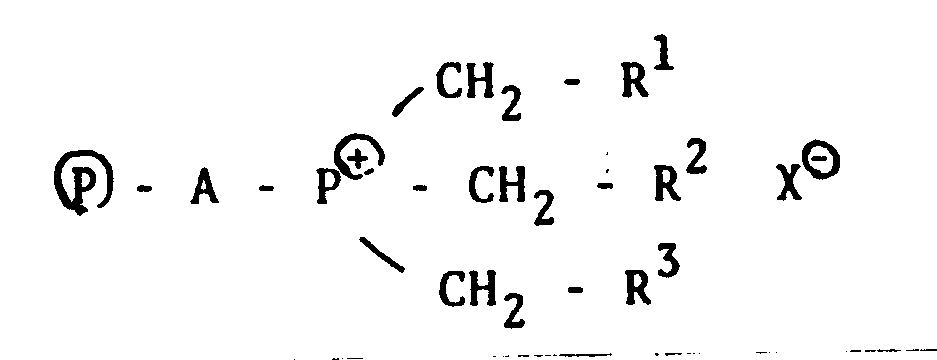
- In the above described formula, ® represents an organic macromolecule and A represents a bridging group between phosphorus and the organic macromolecule, in particular, a hydrocarbon biradical group of C, to C20 which is not always required to be of a straight chain if bonding with phosphorus is effected through primary carbon, but can contain a side chain or cyclic structure or can be saturated. On the other hand, the bonding end of this biradical with the organic macromolecule can be any carbon atom of secondary to quaternary, as shown in the following general formulas:
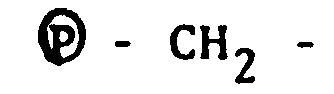


- R1, R2 and R3 are each independently hydrogen, C1-C20 alkyl or aralkyl such as benzyl and phenethyl, which can contain oxygen or halogen atoms. X represents a halogen atom.
- The organic macromolecule used in the present invention is preferably one having a surface area of 2 to 1000 m2/g and polystyrene structure or styrene-divinylbenzene copolymer structure. An organic macromolecule having polyethylene or polyfluoroethylene structure can also be used.
- Preparation of a catalyst using polystyrene or styrene-divinylbenzene copolymer (which will hereinafter be referred to as PSt-DVB) is for example carried out as follows:
- (1) Polystyrene or PSt-DVB is reacted with an a, ω-dihaloalkane using a catalyst of AlCl3 to introduce the ω-haloalkyl group into the aromatic nucleus of the polymer and then reacted with PR3 wherein R is a primary alkyl group or phenethyl group to obtain an object compound. In this case, when the m-haloalkyl group is introduced into the aromatic nucleus, isomerization sometimes takes place to form a haloalkyl group in which the halogen originally at the ω-position is bonded to secondary or tertiary carbon atom and accordingly, it is preferable to effect an ω-haloalkylation under moderate reaction conditions or to use a dihaloalkane having different halogen atoms such as a, m-fluorobromoalkane or a, ω-chlorobromoalkane.
- (2) An object compound is prepared by the Friedel-Craft alkylation reaction of polystyrene or PSt-DVB and a trialkyl-ω-haloalkylphosphonium halide RaP-R' - X⊕X'⊖ wherein R is a primary alkyl or phenethyl group, R'-X is a primary ω-haloalkyl group such as 4-bromobutyl or 10-bromodecyl group and X and X' are halogen atoms, using a catalyst of AlCl3.
- (3) An object compound is prepared by reacting a halomethylated styrene-divinylbenzene copolymer with PR3 wherein R is a primary alkyl group or phenethyl group, the halomethylated styrene-divinylbenzene copolymer being obtained by the halomethylation reaction of the aromatic ring of PSt-DVB or by the copolymerization of a styrene-halomethyl-styrene divinylbenzene.
- (4) An object compound is prepared by lithiating the m- or p- position of the aromatic ring of PSt-DVB by an alkyllithium and N,N,N',N'-tetramethylethylenediamine, then introducing an m-haloalkyl group into the aromatic nucleus by an α, ω-dihaloalkane and replacing the ω-halogen by a trialkylphosphine.
- (5) An object compound is prepared by reacting p-brominated PSt-DVB and an alkyllithium to substitute Br with Li, reacting this with an a, ω-dihaloalkane to introduce the ω-haloalkyl group into the p-position and further reacting with a trialkylphosphine.
- The above described reactions are known, for example, as disclosed in "Synthesis" (1978) page 315-316 and "Journal of Organic Chemistry" Vol. 41 (1976), No. 24, page 3877-3882.
- In these methods, however, organolithium reagents are used which are expensive and cannot be handled without danger. Thus, it is considered that metallic lithium which can be handled with ease and safety is used instead of the dangerous and expensive organolithium reagents. That is, this alternative method comprises (a) a step of contacting an organic high molecular weight compound in which a halogen atom is directly bonded to the aromatic nucleus with metallic lithium and an a, m-dihaloalkane represented by the general formula X (-CH2)n-X' wherein X and X' represent same or different halogen atoms and n represents an integer of from 2 to 10 in a solvent and thereby obtaining an organic high molecular weight compound whose aromatic nucleus is w-haloalkylated, (b) a step of bringing the w-haloalkylated organic high molecular weight compound obtained in step (a) into the reaction with a trialkylphosphine, and thereby forming a catalyst for the disproportionation reaction of chlorosilanes, in which the tetraalkylphosphonium salt is bonded to the organo macromolecule through the methylene group of (-CH2-)n where n = 2-10 as a bridging group.
- In this method, the dihaloalkane is reacted with metallic lithium to form an organolithium reagent which undergoes lithium-halogen exchange with, for example, a brominated polystyrene while the organo lithium reagent itself returns to the a, m-dihaloalkane and then reacted again with metallic lithium to form the organolithium reagent. This process is repeated until the metallic lithium is used up. Thereafter, the lithiated aromatic nucleus and regenerated dihaloalkane are reacted to cause m-haloalkylation and on the other hand, form a lithium halide. This method of preparing the catalyst is more economical, since the process is simplified and an organolithium reagent is not used, thus avoiding a danger of handling it.
- The solvent used in the above described step (a) is preferably an ether type solvent, more preferably diethyl ether. The reaction temperature is preferably 0 to 40 °C. As the a, m-dihaloalkane represented by the above described general formula, there can be used 1,2-dibromoethane, 1,3-dibromopropane, 1,4-dibromobutane, 1,5-dibromopentane, 1,6-dibromohexane, 1,7-dibromoheptane, 1,8-dibromooctane, 1,10-dibromodecane, 1,3-bromochloropropane, 1,4-dichlorobutane and 1,6-dichlorohexane.
- For the organic high molecular weight compound in which a halogen atom is directly bonded to the aromatic nucleus, there are ordinarily used polymers such as polystyrene and styrene-divinylbenzene copolymers and in particular, brominated polystyrenes are preferably used.
- In the step (a), the metallic lithium and α,ω-dihaloalkane are preferably used in a proportion of 0.1 to 2 gram atom and 0.1 to 1 mol respectively to 1 mol of the organic high molecular weight compound.
- The trialkylphosphine used in the above described step (b) is represented by the general formula PR1R2R3 wherein R1, R2 and R3 are selected from the group consisting of Cl-Cs n-alkyl groups such as methyl, ethyl, n-propyl, n-butyl and n-octyl, and C4-C8 alkyl groups such as isobutyl, isopentyl and neopentyl groups in which the carbon atom bonded to phosphorus atom is bonded to only one carbon atom. For example, the trialkylphosphines are trimethylphosphine, triethylphosphine, tri-n-propylphosphine, tri-n-butylphosphine, tri-n-hexylphosphine, tri-n-octylphosphine, dipropylbutylphosphine, triisobutylphosphine, triisopentylphosphine, triisohexylphosphine, triisooctylphosphine and trineopentylphosphine.
- In the step (b), the reaction is carried out ordinarily at 50 to 180 ° C, preferably 100 to 150 ° C, optionally in the presence of a solvent such as N,N-dimethytformamide, N-methylpyrrolidone, chlorobenzene, toluene, benzene and the like. When the phosphine used has a sufficiently high boiling point, the reaction can be carried out by heating for several ten minutes to several hours using the phosphine itself as the solvent. The thus resulting polymer beads are washed with methanol or the like and dried to obtain a catalyst.
- Using such a catalyst, the disproportionation and/or redistribution reaction of chlorosilanes is carried out in liquid or gaseous phase in batchwise or continuous manner. Preferably, the reaction is carried out in gaseous phase and in continuous manner, i.e. by a flowing system, because the pressure is lower and separation of the catalyst and product is easy. Other conditions are generally: a reaction temperature of 0 to 300 °C, preferably 20 to 200 "C, a pressure of normal pressure to 50 kg/cm2 gauge and a contact time of 0.01 to 20 seconds in the gaseous phase and flowing system and 1 second to 20 minutes in the liquid phase.
- The chlorosilanes used as a raw material are chlorohydrosilanes represented by SiHnC14-n wherein 1 5 n ≦ 3. That is, at least one member selected from the group consisting of monochlorosilane, dichlorosilane and trichlorosilane and mixtures thereof can be used and the chlorosilane can be diluted with an inert gas such as nitrogen gas.
- The catalyst according to the present invention is most excellent in the capacity of holding the activity of the catalysts in which phosphonium groups are bonded to organic macromolecules, and suitable for commercial use.
- The following examples are given in order to illustrate the present invention in greater detail. In these examples, the capacity of holding the catalytic activity is measured by the half-life method. That is, the half-life of the catalytic activity at a reaction temperature is determined by tracing a change of the rate constant K with the passage of time, K being represented by:

- ln: natural logarithm
- Ceq: equilibrium conversion of trichlorosilane at reaction temperature
- C: conversion of trichlorosilane
- SV: space velocity (min-1)
- (1) Preparation of beads of a styrene-divinylbenzene copolymer whose aromatic nucleus is w-bromo-n-hexylated
- 10.7 g of porous styrene-divinylbenzene copolymer beads having bromine atom on the aromatic nucleus, prepared by a known method, for example, described in Japanese Patent Application OPI (Kokai) No. 80307/1983, 0.42 g of plate-shaped metallic lithium and 36 ml of ethyl ether were charged in a 4-necked flask of 250 ml purged adequately with nitrogen and gradually stirred in nitrogen atmosphere, to which a mixture of 4.12 ml of 1,6-dibromohexane in 14 ml of ether was dropwise added in 20 minutes. During the same time, the temperature of the flask was kept at 0 °C by ice water and after the dropwise addition, this temperature was kept for 4 hours, followed by gradually raising the temperature of the mixture in the flask to room temperature for 4 hours, the mixture being stirred at room temperature for 4 hours. While gradually stirring, 10 ml of methanol was added to the flask to quench the reaction, the resulting beads were taken out by filtration, washed with methanol three times, dried in atmosphere and then dried in the air at 100 °C, thus obtaining styrene-divinylbenzene copolymer beads in which m-bromo-n-hexyl group is bonded to the aromatic nucleus.
- 7.2 g of the beads obtained by the above described procedure (1) were heated with 1.0 ml of tri-n-butylphosphine and 30 ml of N,N-dimethylformamide at 1350C in nitrogen for 3 hours. The beads were filtrated, washed with methanol three times, air-dried and then vacuum-dried at room temperature for 1 hour, thus obtaining styrene-divinylbenzene copolymer beads in which tri-n-butylphosphine is bonded to the aromatic nucleus through hexamethylene group, PSt -

- 10.5 mg of the polymer-bonded phosphonium salt beads obtained in the above described (2) were charged in a glass reactor (inner diameter: 5 mm) of normal pressure flowing type, heated at 120 °C in a nitrogen stream for 1 hour and then a mixed gas of SiHC13/N2 (molar ratio: 3/7) was fed thereto while holding the reaction bed at a predetermined temperature, thereby effecting a disproportionation reaction of SiHCl3. A product obtained at 5 hours after the reaction conditions had been settled was subjected to analysis by gas chromatography using helium as a carrier gas to obtain results as shown in Table 1.
- The activity of a catalyst is determined per catalytically active site (Kc) and per volume (Kv) using the following formulas:


- Ceq: equilibrium conversion of tri- chlorosilane
- C : real conversion of trichlorosilane
- SV : space velocity
- N : phosphorus concentration in catalyst (meq/ml)
- (1) Preparation of beads of a styrene-divinylbenzene copolymer whose aromatic nucleus is ω-bromo-n-butylated
- 49 g of the brominated polystyrene used in Example 1 - (1), 1.01 g of plate-shaped metallic lithium and 200 ml of ethyl ether were charged in a 4-necked flask of 1000 ml rinsed with nitrogen and cooled to 0 °C by ice water. While gradually stirring the suspension of the brominated poly styrene beads, a mixture of 11.0 ml of 1,4-dibromobutane and 20 ml of ethyl ether was dropwise added to the flask slowly for 30 minutes. While cooling the flask at 0 °C, the mixture was stirred for one night and heated and refluxed for 3 hours after confirming that no lithium metal remained. Then, 80 ml of methanol was dropwise added thereto to quench the reaction, and the beads were filtered, washed with methanol three times, air-dried and then dried in the air at 100 °C.
- 10 g of the beads obtained by the above described procedure (1) were heated at 135 °C for 3 hours in nitrogen with 1.0 ml of tri-n-butylphosphine and 30 ml of N,N-dimethylformamide. The subsequent treatment was similar to that of Example 1 - (2). Elementary analysis of the product showed a phosphorus content of 0.75 % by weight.
- Using the phosphonium salt-bonded beads obtained in the above described procedure (2) as a catalyst, disproportionation reaction of the trichlorosilane was carried out in an analogous manner to Example 1 - (3). The results are shown in Table 1.
- A mixture of 3.0 g of styrene-divinylbenzene copolymer beads (29 meq), 29 mmol of n-butyllithium (petroleum ether solution), 3.35 g (29 mmol) of tetramethylethylenediamine and 20 ml of cyclohexane was heated at 65 °C and reacted for 20 hours. The resulting reaction mixture, from which a solution portion had been removed by a syringe, was washed with 10 ml of dry cyclohexane two times and the thus obtained brown beads were mixed with 50 ml of a solution of 15.0 g of 1.6-dibromohexane (61 mmol) in benzene, followed by stirring at room temperature for 10 hours. The beads were separated by filtration, washed with methanol two times and with chloroform one time, and then dried to obtain ω-bromohexylated polystyrene beads.
- A mixture of 1.0 g of ω-bromohexylated polystyrene, 0.4 ml of tri-n-butylphosphine and 5 ml of N.N-dimethylformamide was heated at 140c C for 24 hours and subjected to phosphonium salt formation, followed by washing with methanol and chloroform, thus obtaining phosphonium-bonded polystyrene beads. Elementary analysis of the product showed a phosphorus content of 0.42 % by weight (bonded to 1.5 % of phenyl ring).
- Using the phosphonium salt-bonded beads obtained in the above described procedure (2) as a catalyst, disproportionation reaction of trichlorosilane was carried out in an analogous manner to Example 1 - (3). The results are shown in Table 1.
- 5.0 g (25 meq) of brominated styrene-divinylbenzene copolymer beads, 25 mmol of n-butyllithium (hexane solution) and 20 ml of ether were charged in a reaction flask and stirred at room temperature for 30 minutes. The reaction mixture, from which a solution portion had been separated by a syringe, was washed with ether. The thus obtained beads were then mixed with 5.7 ml of 1,6-dibromohexane, stirred at room temperature for 20 hours, separated by filtration, washed with methanol and with chloroform and dried.
- The m-bromohexylated polystyrene obtained by the above described procedure (1) and tri-n-butylphosphine were reacted in N,N-dimethylformamide to obtain phosphonium-bonded polystyrene beads. Elementary analysis of the product showed a phosphorus content of 0.84 % by weight.
- Using the phosphonium salt-bonded beads obtained by the above described procedure (2) as a catalyst, disproportionation reaction of trichlorosilane was carried out in an analogous manner to Example 1 - (3). The results are shown in Table 1.

- 10.4 g of styrene-divinylbenzene copolymer beads (Diaion HP-20 -commercial name- manufactured by Nippon Rensui KK), 40 ml of carbon tetrachloride and 2.0 mi of chloromethyl ethyl ether were charged in a 4-necked flask of 300 ml equipped with a stirrer and cooled at 0 °C by ice water. While stirring the mixture, 0.5 ml of stannic chloride and 1.5 ml of chloromethyl ethyl ether dissolved in 10 ml of carbon tetrachloride were dropwise added thereto for 30 minute by a dropping funnel. The reaction mixture was warmed to room temperature and stirred as it was for 24 hours. The copolymer beads were taken by filtration, washed with, in order, water-dioxane (volume ratio: 1/1), water-dioxane-hydrochloric acid (volume ratio: 5/5/1), water, dioxane and tetrahydrofuran and then subjected to Soxhlet extraction using tetrahydrofuran for 5 hours. The thus resulting beads were dried at room temperature In a nitrogen stream, thus obtaining a styrene-divinytben- zene copolymer which phenyl ring was partially chloromethylated in a proportion of about 6 % based on the all aromatic nuclei.
- 2.59 g of the chloromethylated styrene-divinylbenzene copolymer beads (hereinafter referred to as "chloromethylated PSt-DVB") obtained by the above described procedure (1), 1.0 ml of tri-n-butylphosphine and 10 ml of N,N-dimethylformamide (hereinafter referred to as DMF) were charged in a flask of 50 ml equipped with a condenser and heated at 155 "C for 20 hours in a nitrogen atmosphere. After cooling, the copolymer beads were adequately washed with methanol and chloroform, air-dried and dried at 100 "C in the air for 10 hours, thus obtaining 2.79 g of a phosphonium chloride-modified resin (Sample No. 5).
- The phosphonium chloride group-bonded beads (Sample No. 5) prepared by the above described procedure (2) were charged in a glass reactor of gaseous, normal pressure flowing type (inner diameter: 5 mm) to form a reaction bed and heated at 120 °C in a nitrogen stream for 1 hour. While keeping the reaction bed at a predetermined temperature, a mixed gas of SiHC13/N2 (volume ratio: 3/7) under a pressure of 1 atm was fed thereto to effect the disproportionation reaction. The disproportionation reaction was traced for several hours to one hundred and several tens hours to measure a reduction of the catalytic activity and to determine a half life of the catalytic activity at 120 °C under the above described disproportionation reaction conditions. The results are shown in Table 2.
- 1.1 ml of tri-n-octylphosphine, 2.04 g of the chloromethylated PSt-DVB and 10 ml of DMF were charged in a flask of 50 ml equipped with a condenser, purged adequately with nitrogen, and heated at 155°C in nitrogen for 12 hours. After cooling, the product was washed and dried in an analogous manner to Example 5 to obtain 2.19 g of a phosphonium chloride-modified resin (Sample No. 6).
- Using the phosphonium chloride-modified resin prepared by the above described procedure (1) as a catalyst, disproportionation reaction of trichlorosilane was carried out in an analogous manner to Example 5 - (3). The results are shown in Table 2.
- 0.5 ml of triethylphosphine, 2.0 g of the chloromethylated PSt-DVB obtained in Example 5, (1) and 5 ml of DMF were charged in a flask of 50 ml equipped with a condenser, rinsed adequately with nitrogen, and heated at 120 °C in a nitrogen atmosphere for 6 hours. After cooling, the product was washed and dried in an analogous manner to Example 5 to obtain 2.10 g of a phosphonium chloride-modified resin (Sample No. 7).
- Using the phosphonium chloride-modified resin (Sample No. 7) prepared by the above described procedure (1) as a catalyst, disproportionation reaction of the trichlorosilane was carried out in an analogous manner in Example 5 -(3). The results are shown in Table 2.
- Reactions of the chloromethylated PSt-DVB with the above described 4 kinds of the tertiary phosphines were carried out in the same manner as Example 5, (2) to obtain phosphonium chloride-anchored styrene-divinylbenzene copolymer beads corresponding to the respective phosphines. That is, there were formed Ⓟ-


- Using the phosphonium chloride-bonded beads prepared in Comparative Examples 1 to 4, (1) as a catalyst, disproportionation reaction of trichlorosilane was carried out in an analogous manner to Example 5 - (3) to measure a deterioration time of the catalytic activity. The results are shown in Table 2.
- A styrene-divinyl benzene copolymer with aromatic nucleus is brominated (hereinafter referred to as Br-Pst-DVB) was prepared in known manner, for example, as disclosed in Japanese Patent Application OPI (Kokai) No. 80307/1983. 8.2 g of the Br-PSt-DVB, 4.0 g of triphenylphosphine and 0.4 g of anhydrous nickel bromide were charged in a flask of 100 ml purged adequately with nitrogen and 30 ml of DMF as a solvent was added thereto, followed by heating and refluxing for 4 hours. The resin beads were then filtered, washed with 100 ml of hot water two times and with 100 ml of ethanol three times, subjected to reduced pressure to remove the ethanol and dried at 100 °C in the air for 12 hours, thus obtaining triphenylphosphonium bromide group-bonded polymer beads, Ⓟ-

- Using the catalytic beads (Comparative Sample No. 5) prepared in Comparative Example 5, (1), disproportionation reaction of chlorosilane was carried out in an analogous manner to Example 5, (3). The results are shown in Table 2.
- 4.2 g of the porous styrene-divinylbenzene of copolymer beads having bromine atom on the aromatic nucleus (Cf. Comparative Example 5) was charged in a flask of 100 ml equipped with a condenser, rinsed adequately with nitrogen, and heated and refluxed with 0.8 g of tri-n-butylphosphine, 0.15 g of anhydrous nickel bromide and 15 ml of DMF under normal pressure for 6 hours. Then, the resin beads were filtered, washed with, in order, hot water and ethanol, air-dried and dried at 100 ° C In the air for 12 hours, thus obtaining polymer beads in which tri-n-butylphosphonium bromide group is bonded to the aromatic nucleus,Ⓟ -

- Using the catalyst (Comparative Sample No. 6) prepared in Comparative Example 6 - (1), disproportionation reaction of trichlorosilane was carried out in an analogous manner in Example 5 - (3). The results are shown in Table 2.
- 2.3 ml of tri-n-butylphosphine and 4.4 g of 1,4-dibromobutane were charged in a flask of 50 ml equipped with a condenser and heated at 130 ° C for 12 hours. The reaction mixture was then subjected to vacuum distillation (130 °C, 1mmHg) to remove volatile components and P(n-C4H9)3(C4HeBr)+Br- was obtained as a colorless viscous liquid. 1 ml of this viscous liquid and 1.0 g of aluminum chloride were dissolved in 6 ml of nitrobenzene, with which 2.0 g of styrene-divinylbenzene copolymer beads were impregnated. The mixture was heated at 85 °C for 2 hours in nitrogen, to which methanol was added to quench the reaction. The resulting beads were taken by filtration, washed with methanol (4 times), dioxane (2 times) and chloroform (2 times) and then subjected to Soxhlet extraction with tetrahydrofuran for 4 hours. After air-drying, the beads were dried at 100 ° C in the air to obtain beads having tri-n-butylphosphonium group chemically bonded to polystyrene through C4Hs bridging group (Sample No. 8). Using the beads as a catalyst, disproportionation reaction of trichlorosilane was carried out in an analogous manner in Example 5, (3). The results are shown in Table 2.
- P(n-C4H9)3(C6H12Br)+Br- was prepared from 2.3 ml of tri-n-butylphosphine and 4.9 g of 1,6-dibromohexane in an analogous manner to the synthesis method of Example 8 and used for obtaining beads having tri-n-butylphosphonium group chemically bonded to polystyrene through C6H12 group (Sample No. 9). Using the thus resulting beads as a catalyst, disproportionation reaction of trichlorosilane was carried out in an analogous manner to Example 5 - (3). The results are shown in Table 2.
- P(n-C4H9)3(C8H16Br)+Br- was prepared from 2.3 ml of tri-n-butylphosphine and 5.4 g of 1,8-dibromooctane in an analogous manner to Example 8. 0.48 g of the said phosphonium salt and 1.16 g of aluminum chloride were dissolved in 2.5 ml of nitrobenzene, to which 0.93 g of styrene-divinylbenzene copolymer beads were added, and the mixture was heated at 100 °C for 18 hours and then washed with methanol and chloroform. After air-drying, the thus treated beads were dried at 100 °C in the air to obtain beads having tri-n-butylphosphonium group chemically bonded to polystyrene through C8H16 bridging group (Sample No. 10).
- Using the thus resulting beads as a catalyst, disproportionation reaction of trichlorosilane was carried out in an analogous manner to Example 5 - (3). The results are shown in Table 2.
- In an analogous manner to Example 8, a solution of 3.77 g of tri-n-octylphosphine and 6.22 g of 1,10-dibromodecane in 10 ml of DMF was charged in a flask of 25 ml equipped with a condenser, heated with agitation at 130 °C in nitrogen for 14.5 hours and then subjected to vacuum distillation to obtain P(n-C8H17)3(C10H20Br)+Br- 0.72 g of the said phosphonium salt and 1.0 g of aluminum chloride and 1.0 g of aluminum chloride were dissolved in 1.5 ml of nitrobenzene, to which 0.93 g of styrene-divinylbenzene copolymer beads were added, and the mixture was heated at 100 ° C for 12 hours, then washed with methanol and chloroform, air-dried and dried at 100 °C in the air, thus obtaining beads having tri-n-octylphosphonium group chemically bonded to polystyrene through CioH20 bridging group (Sample No. 11).
- Using the thus resulting modified beads as a catalyst, disproportionation of trichlorosilane was carried out in an analogous manner to Example 5 - (3). The results are shown in Table 2.
- 2.0 ml of 1,2-dibromoethane and 4.5 ml of nitrobenzene were charged in a flask of 50 ml rinsed with nitrogen, to which 2.0 g of styrene-divinylbenzene copolymer beads were then added for impregnation therewith. 0.35 g of aluminum chloride dissolved in 2 ml of nitrobenzene was added thereto and the mixture was heated at 70 °C for 1.5 hours, then washed with methanol 4 times, air-dried and then dried at 100 ° C in the air for 10 hours to obtain haloethylated styrene-divinylbenzene copolymer beads. 0.5 g of the said beads and 0.5 ml of tri-n-butylphosphine were added to 2 ml of DMF, heated at 160 °C in nitrogen for 12 hours, separated by filtration, washed with methanol 4 times and with chloroform 2 times, air-dried and then dried in the air at 100 "C for 6 hours, thus obtaining beads having tri-n-butylphosphonium group, represented by P- CH- CH- P+(n-C4Hg)3Br- (Comparative Sample No. 7).
- Using the thus resulting beads as a catalyst, dis proportionation reaction of trichlorosilane was carried out in an analogous manner in Example 5 - (3). The results are shown in Table 2, from which it is apparent that deterioration of the activity of the catalyst is remarkable due to that the polymer is bonded to phosphorus atom through secondary carbon.
- The procedure of Comparative Example 7 was repeated except using 1,4-dibromobutane in place of the 1,2-dibromoethane and tri-n-octylphosphine in place of the tri-n-butylphosphine, thus obtaining beads having tri-n-octylphosphonium group chemically bonded to polystyrene (Comparative Sample No. 8).
- Using the thus resulting beads as a catalyst, disproportionation reaction of trichlorosilane was carried out In an analogous manner to Example 5 - (3). The results are shown in Table 2, from which it is apparent that deterioration of the activity of this catalyst is rapid since most of the phosphorus atoms of the phosphonium groups are bonded to the carbon atoms at the a, and y positions in

- The procedure of Comparative Example 7 was repeated except using 1,6-dibromohexane in place of the 1,2-dibromo ethane and tri-n-octylphosphine in place of the tri-n-butylphosphine, thus obtaining beads having tri-n-octylphosphonium group chemically bonded to polystyrene (Comparative Sample No. 9).
- Using the thus resulting beads as a catalyst, disproportionation reaction of trichlorosilane was carried out in an analogous manner to Example 5 - (3). The results are shown in Table 2, from which it is apparent that deterioration of the catalytic activity is rapid since most of the phosphorus atoms of the phosphonium group are bonded to the inner carbon atoms of the C6H12-bridging group similarly to Comparative Example 8.
- 3.0 g of styrene-divinylbenzene copolymer beads, 3.35 g of tetramethylethylenediamine (hereinafter referred to as TMEDA), 30 ml of cyclohexane and 80 ml of a solution of n-hexyllithium (0.42 mol) in hexane were added to a 4-necked flask of 200 ml equipped with a stirrer and heated with stirring at 66 ° C In a nitrogen atmosphere for 14 hours. After the reaction, the reaction mixture was subjected to decantation to remove a solution portion and washed with cyclohexane to obtain a styrene-divinylbenzene copolymer which phenyl ring is lithiated.
- (2) A solution of 1,8-dibromooctane in 80 ml of benzene was added to the lithiated styrene-divinylbenzene copolymer beads, and stirred at room temperature for 6.5 hours and thereafter at 50 °C for 1 hour. The copolymer beads were taken by filtration, washed with, in order, tetrahydrofuran, ether, tetrahydrofuran-water (2/1), water, tetrahydrofuran, benzene and methanol, air-dried and then dried in the air at 100 °C to obtain beads of a 8-bromooctylated styrene-divinylbenzene copolymer.
- (3) Reaction of the 8-bromooctylated styrene-divinylbenzene copolymer beads with tri-n-butyphosphine
2.0 g of the 8-bromooctylated styrene-divinylbenzene copolymer beads, 0.9 ml of tri-n-butylphosphine and 10 ml of N,N-dimethylformamide were charged in a flask of 50 ml equipped with a condenser, heated at 100 0 C in a nitrogen atmosphere for 3.5 hours, cooled and subjected to filtration to obtain the copolymer beads which was then washed with methanol and chloroform, air-dried and then dried in the air at 100 °C, thus obtaining beads having tri-n-butylphosphonium group chemically bonded to polystyrene through C8H16-bridging group (Sample No. 12). - Using the thus resulting beads as a catalyst, disproportionation reaction of trichlorosilane was carried out in an analogous manner to Example 5 - (3). The results are shown in Table 2.
- Styrene-divinylbenzene copolymer beads in which 6-bromohexyl group is bonded to the phenyl group were obtained from lithiated styrene-divinylbenzene copolymer beads prepared using n-butyllithium as a metallating agent in an analogous manner to Example 12 and 1,6-dibromohexane. 1.0 g of the thus resulting beads and 0.4 ml of tri-n-butylphosphine were reacted at 140 °C in 5 ml of DMF for 14.5 hours to obtain beads having tri-n-butylphosphonium group chemically bonded to polystyrene through C6H12-bridging group (Sample No. 13).
- Using the thus resulting beads as a catalyst, disproportionation reaction of trichiorosilane was carried out in an analogous manner to Example 5 - (3). The results are shown in Table 2.
- 2-bromoethylated styrene-divinylbenzene copolymer beads prepared in an analogous manner to Example 13 except using 1,2-dibromoethane instead of the 1,6-dibromohexane and tri-n-butylphosphine were reacted to obtain beads having tri-n-butylphosphonium group chemically bonded to polystyrene through C2H4-bridging group (Sample No. 14).
- Using the thus resulting beads as a catalyst, disproportionation reaction of trichlorosilane was carried out in an analogous manner to Example 5 - (3). The results are shown in Table '2.
- 3.0 g of a styrene-divinylbenzene copolymer whose aromatic nucleus was brominated (Cf. Comparative Example 5) was charged in a flask 50 ml equipped with a condenser and swelled with 10 ml bf absolute tetrahydrofuran. Then, 10 ml of n-propyllithium/petroleum ether (1 mol/1) was dropwise added thereto at room temperature and thereafter, reacted at room temperature for 1 hour. Withdrawing the liquid phase by a syringe, 5 ml of absolute benzene and 5 ml of 1,4-dibromobutane were in order added instead thereof and heated at 80 ° C for 2 hours. 5 ml of methanol was then added to the flask to quench the reaction and the resulting styrene-divinylbenzene beads were washed with 50 ml of methanol 3 times, with water 2 times and with methanol 3 times and air-dried. 1.5 g of the thus resulting 4-bromobutyl group-modified beads were heated at 120 °C in a nitrogen atmosphere for 60 hours with 2.5 ml of N,N-dimethylformamide and 1.0 ml of tri-n-butylphosphine and then washed with methanol 3 times and with chloroform once, thus obtaining beads having tri-n-butylphosphonium group chemically bonded to the styrene-divinylbenzene copolymer through tetramethylene group (Sample No. 15).
- Using the resulting beads as a catalyst, disproportionation reaction of trichlorosilane was carried out in an analogous manner to Example 5 - (3). The results are shown in Table 2.
- Synthesis of a decamethylene-bridged phosphonium catalyst and disproportionation reaction of tri-chlorosilane
- The procedure of Example 15 was repeated except that the lithiated resin was heated with 5 ml of benzene and 4 ml of 1,10-dibromodecane.
- Using the thus resulting beads having tri-n-butylphosphonium group chemically bonded to the styrene-divinylbenzene copolymer through decamethylene group (Sample No. 16) as a catalyst, disproportionation reaction of trichlorosilane was carried out in an analogous manner to Example 5 - (3). The results are shown in Table 2.

- As is evident from the results of Table 2, the catalyst of the present invention is more suitable for commercial uses than that of the prior art, since the former has a much longer half-life as to the catalytic activity than the latter.
- Comparison of the activities of the catalysts, based on the content of phosphorus atoms, is as follows: The activity A based on the content of phosphorus atoms is obtained by the following formula and the activity Ao at the start of reaction (t = 0) is determined by extrapolation.

- ln: natural logarithm
- Ceq: equilibrium conversion of trichlorosilane at reaction temperature
- C: found conversion of trichlorosilane at reaction temperature
- SV: space velocity (min-l)
- N: phosphorus concentration in 1 ml of catalyst (meq/ml)
- The comparison of some catalysts in Examples and Comparative Examples is carried out to give results as shown in Table 3. Consequently, it is found that the catalysts in which tricyclohexylphosphine or triphenylphosphine is bonded as in Comparative Sample Nos. 3 and 5 show larger initial activities. Thus, it can be assumed that the initial activity per phosphorus atom is related with the steric size of a phosphonium group. However, the catalysts of Comparative Sample Nos. 3 and 5 show how much shorter half-lives of the activity, i.e. 8 hours and 4 hours. Collectively, the catalysts of Examples according to the present invention, having a much longer half-life are suitable for continuous operations.

Claims (19)


Applications Claiming Priority (4)
| Application Number | Priority Date | Filing Date | Title |
|---|---|---|---|
| JP210325/85 | 1985-09-25 | ||
| JP60210325A JPS6272513A (en) | 1985-09-25 | 1985-09-25 | Preparation of silane |
| JP175530/86 | 1986-07-28 | ||
| JP61175530A JPS6336840A (en) | 1986-07-28 | 1986-07-28 | Production of chlorosilane disproportionation catalyst |
Publications (3)
| Publication Number | Publication Date |
|---|---|
| EP0216640A2 true EP0216640A2 (en) | 1987-04-01 |
| EP0216640A3 EP0216640A3 (en) | 1990-05-16 |
| EP0216640B1 EP0216640B1 (en) | 1994-08-03 |
Family
ID=26496783
Family Applications (1)
| Application Number | Title | Priority Date | Filing Date |
|---|---|---|---|
| EP86307399A Expired - Lifetime EP0216640B1 (en) | 1985-09-25 | 1986-09-25 | Catalytic compound and process for production of silanes |
Country Status (4)
| Country | Link |
|---|---|
| US (2) | US4725420A (en) |
| EP (1) | EP0216640B1 (en) |
| KR (2) | KR880000264B1 (en) |
| DE (1) | DE3650008T2 (en) |
Cited By (8)
| Publication number | Priority date | Publication date | Assignee | Title |
|---|---|---|---|---|
| WO1994010214A1 (en) * | 1992-11-02 | 1994-05-11 | Exxon Chemical Patents Inc. | Polymeric phosphonium ionomers |
| WO1996018592A1 (en) * | 1994-12-10 | 1996-06-20 | Smithkline Beecham Plc | Resin-bound phosphonium salts and their use in organic synthesis |
| EP0776698A1 (en) * | 1995-11-30 | 1997-06-04 | Wacker-Chemie GmbH | Process for preparing Si-H containing chlorosilanes |
| EP0830388A4 (en) * | 1995-06-07 | 2001-03-21 | Univ California | ION EXCHANGER POLYMERS FOR ANION SEPARATIONS |
| WO2001079213A3 (en) * | 2000-04-13 | 2002-02-07 | Du Pont | Polymer-supported synthesis of heteroatom bidentate ligands for catalysis |
| KR100453211B1 (en) * | 2000-11-01 | 2004-10-15 | 한국과학기술연구원 | A process for preparing organic silanes |
| KR100487904B1 (en) * | 2002-04-16 | 2005-05-06 | 한국과학기술연구원 | A preparation method of organochlorosilanes by reductive deoxysilation reaction of aldehydes or ketones |
| EP2371765A4 (en) * | 2008-12-25 | 2015-05-06 | Tokuyama Corp | PROCESS FOR PRODUCTION OF CHLOROSILANE |
Families Citing this family (7)
| Publication number | Priority date | Publication date | Assignee | Title |
|---|---|---|---|---|
| EP0337322B1 (en) * | 1988-04-13 | 1993-07-21 | Mitsubishi Kasei Corporation | Process for producing monosilane |
| CA2063499C (en) * | 1992-03-19 | 1996-06-18 | Leon Edward St. Pierre | Ingestible polymeric phosphonium salts for the lowering of blood cholesterol |
| US5463140A (en) * | 1994-08-31 | 1995-10-31 | The Dow Chemical Company | Process for making polyphenols from ketones or aldehydes and phenols |
| CN1137788A (en) * | 1994-08-31 | 1996-12-11 | 陶氏化学公司 | Process for the preparation of polyphenols from ketones or aldehydes and phenols |
| US6133190A (en) * | 1998-04-27 | 2000-10-17 | The Dow Chemical Company | Supported mercaptosulfonic acid compounds useful as catalysts for phenolation reactions |
| DE10057519A1 (en) * | 2000-11-21 | 2002-05-23 | Solarworld Ag | Pretreatment of a catalyst for hydrochlorosilane disproportionation comprises washing with water and treatment with methanol in the disproportionation reactor |
| DE102010062984A1 (en) * | 2010-12-14 | 2012-06-14 | Evonik Degussa Gmbh | Process for the preparation of higher halogen and hydridosilanes |
Family Cites Families (8)
| Publication number | Priority date | Publication date | Assignee | Title |
|---|---|---|---|---|
| US3168502A (en) * | 1961-03-09 | 1965-02-02 | American Cyanamid Co | Polymer composed of phosphonium salts |
| FR1477003A (en) * | 1965-04-23 | 1967-04-14 | Ferrania Spa | Polymeric mordants based on phosphonium salts for photographic use |
| US3708462A (en) * | 1971-04-08 | 1973-01-02 | Dow Chemical Co | Cross-linked styrylphosphine resins |
| US3958995A (en) * | 1974-11-19 | 1976-05-25 | Eastman Kodak Company | Photographic elements containing cross-linked mordants and processes of preparing said elements |
| US4124493A (en) * | 1978-02-24 | 1978-11-07 | Uop Inc. | Catalytic oxidation of mercaptan in petroleum distillate including alkaline reagent and substituted ammonium halide |
| CA1139318A (en) * | 1979-12-03 | 1983-01-11 | Dane K. Parker | Process for preparing primary alkyl chlorides |
| FR2541666B1 (en) * | 1983-02-25 | 1985-06-21 | Rhone Poulenc Spec Chim | DISMUTATION PROCESS FOR SILANES |
| FR2552434B1 (en) * | 1983-09-28 | 1985-10-25 | Rhone Poulenc Spec Chim | PROCESS FOR THE MANUFACTURE OF SILANE FROM METHYLDICHLOROSILANE AND CHLOROSILANES |
-
1986
- 1986-09-19 US US06/909,193 patent/US4725420A/en not_active Expired - Fee Related
- 1986-09-25 EP EP86307399A patent/EP0216640B1/en not_active Expired - Lifetime
- 1986-09-25 KR KR1019860008002A patent/KR880000264B1/en not_active Expired
- 1986-09-25 DE DE3650008T patent/DE3650008T2/en not_active Expired - Fee Related
-
1987
- 1987-09-07 KR KR1019870009865A patent/KR880002302B1/en not_active Expired
- 1987-11-17 US US07/122,237 patent/US4775651A/en not_active Expired - Fee Related
Cited By (10)
| Publication number | Priority date | Publication date | Assignee | Title |
|---|---|---|---|---|
| WO1994010214A1 (en) * | 1992-11-02 | 1994-05-11 | Exxon Chemical Patents Inc. | Polymeric phosphonium ionomers |
| WO1996018592A1 (en) * | 1994-12-10 | 1996-06-20 | Smithkline Beecham Plc | Resin-bound phosphonium salts and their use in organic synthesis |
| EP0830388A4 (en) * | 1995-06-07 | 2001-03-21 | Univ California | ION EXCHANGER POLYMERS FOR ANION SEPARATIONS |
| EP0776698A1 (en) * | 1995-11-30 | 1997-06-04 | Wacker-Chemie GmbH | Process for preparing Si-H containing chlorosilanes |
| US5670687A (en) * | 1995-11-30 | 1997-09-23 | Wacker-Chemie Gmbh | Process for preparing SiH-containing organochlorosilanes |
| WO2001079213A3 (en) * | 2000-04-13 | 2002-02-07 | Du Pont | Polymer-supported synthesis of heteroatom bidentate ligands for catalysis |
| KR100453211B1 (en) * | 2000-11-01 | 2004-10-15 | 한국과학기술연구원 | A process for preparing organic silanes |
| KR100487904B1 (en) * | 2002-04-16 | 2005-05-06 | 한국과학기술연구원 | A preparation method of organochlorosilanes by reductive deoxysilation reaction of aldehydes or ketones |
| EP2371765A4 (en) * | 2008-12-25 | 2015-05-06 | Tokuyama Corp | PROCESS FOR PRODUCTION OF CHLOROSILANE |
| US9840421B2 (en) | 2008-12-25 | 2017-12-12 | Tokuyama Corporation | Chlorosilane production method |
Also Published As
| Publication number | Publication date |
|---|---|
| EP0216640A3 (en) | 1990-05-16 |
| DE3650008T2 (en) | 1994-11-17 |
| US4775651A (en) | 1988-10-04 |
| KR880003961A (en) | 1988-06-01 |
| EP0216640B1 (en) | 1994-08-03 |
| KR880000264B1 (en) | 1988-03-15 |
| DE3650008D1 (en) | 1994-09-08 |
| US4725420A (en) | 1988-02-16 |
| KR870003124A (en) | 1987-04-15 |
| KR880002302B1 (en) | 1988-10-22 |
Similar Documents
| Publication | Publication Date | Title |
|---|---|---|
| EP0216640B1 (en) | Catalytic compound and process for production of silanes | |
| JP3273944B2 (en) | Polyanionic transition metal catalyst composition | |
| US4603148A (en) | Macroreticulate polymer scavengers for the removal of impurities from inert fluids | |
| US20100174106A1 (en) | Heterogeneous organotin catalysts | |
| Olah et al. | Organometallic chemistry. 21. Silyl trifluoromethanesulfonate (triflate)-boron trichloride (tribromide) complexes | |
| US4605543A (en) | Preparation of silane from methyldichlorosilane and chlorosilanes | |
| JP3498272B2 (en) | Triorgano substituted tin lithium initiator | |
| Winstein et al. | Large salt effects and mechanism in acetone and ether | |
| Suzuki et al. | Protection and polymerization of functional monomers, 14. Anionic living polymerization of 4‐[N, N‐bis (trimethylsilyl)‐aminomethyl] styrene and 4‐{2‐[N, N‐bis (trimethylsilyl) amino] ethyl} styrene | |
| JPH1059707A (en) | Method for producing monosilane | |
| JPS6060915A (en) | Manufacture of slightly halogenated silane or monosilane | |
| Schwartzen et al. | Tridentate Lewis Acids: Silicon‐Functionalised 1, 3, 5‐Triethynylbenzene and 1, 3, 5‐Trivinylbenzene | |
| JPS643808B2 (en) | ||
| JPH0367738B2 (en) | ||
| Petrucci et al. | A new catalytic hybrid material from simple acid–base hydrolytic chemistry | |
| JPH0471009B2 (en) | ||
| Marciniec et al. | Catalysis of hydrosilylation XIII. Gas‐phase hydrosilylation of acetylene by trichlorosilane on functionalised silica supported rhodium and ruthenium phosphine complexes | |
| Li et al. | Synthesis of polymer-and silica-supported manganese phosphine complexes and their reaction with oxygen | |
| EP0471370A2 (en) | Silane products from reaction of silicon monoxide with hydrogen halides | |
| JPS61201615A (en) | Production of silane | |
| Ejike | Preparation of Platinum Complexes with Polymeric Ligands Their Use as Catalysts for Hydrosilylation | |
| Pätzold et al. | Base‐Catalyzed Hydrogenation of Chlorosilanes by Organotin Hydrides | |
| Aoshima et al. | Synthesis of functionalized linear poly (divinylbenzene). III. Synthesis of polymeric delocalized carbanion of poly (divinylbenzene) and its reactions | |
| Marks | POLYMER SUPPORTED ORGANOMETALLIC REAGENTS: TETRAARYLBORATES AND ETHYLDIBUTYLSTANNANES | |
| JPS61232214A (en) | Production of silane |
Legal Events
| Date | Code | Title | Description |
|---|---|---|---|
| PUAI | Public reference made under article 153(3) epc to a published international application that has entered the european phase |
Free format text: ORIGINAL CODE: 0009012 |
|
| AK | Designated contracting states |
Kind code of ref document: A2 Designated state(s): DE FR |
|
| PUAL | Search report despatched |
Free format text: ORIGINAL CODE: 0009013 |
|
| AK | Designated contracting states |
Kind code of ref document: A3 Designated state(s): DE FR |
|
| 17P | Request for examination filed |
Effective date: 19901116 |
|
| R17P | Request for examination filed (corrected) |
Effective date: 19901116 |
|
| 17Q | First examination report despatched |
Effective date: 19920430 |
|
| GRAA | (expected) grant |
Free format text: ORIGINAL CODE: 0009210 |
|
| AK | Designated contracting states |
Kind code of ref document: B1 Designated state(s): DE FR |
|
| REF | Corresponds to: |
Ref document number: 3650008 Country of ref document: DE Date of ref document: 19940908 |
|
| ET | Fr: translation filed | ||
| PLBE | No opposition filed within time limit |
Free format text: ORIGINAL CODE: 0009261 |
|
| STAA | Information on the status of an ep patent application or granted ep patent |
Free format text: STATUS: NO OPPOSITION FILED WITHIN TIME LIMIT |
|
| 26N | No opposition filed | ||
| PGFP | Annual fee paid to national office [announced via postgrant information from national office to epo] |
Ref country code: FR Payment date: 19960911 Year of fee payment: 11 |
|
| PGFP | Annual fee paid to national office [announced via postgrant information from national office to epo] |
Ref country code: DE Payment date: 19961031 Year of fee payment: 11 |
|
| PG25 | Lapsed in a contracting state [announced via postgrant information from national office to epo] |
Ref country code: FR Free format text: THE PATENT HAS BEEN ANNULLED BY A DECISION OF A NATIONAL AUTHORITY Effective date: 19970930 |
|
| PG25 | Lapsed in a contracting state [announced via postgrant information from national office to epo] |
Ref country code: DE Free format text: LAPSE BECAUSE OF NON-PAYMENT OF DUE FEES Effective date: 19980603 |
|
| REG | Reference to a national code |
Ref country code: FR Ref legal event code: ST |