EP0214902B1 - Lanze zum Blasen und Frischen im Konverter - Google Patents
Lanze zum Blasen und Frischen im Konverter Download PDFInfo
- Publication number
- EP0214902B1 EP0214902B1 EP86401842A EP86401842A EP0214902B1 EP 0214902 B1 EP0214902 B1 EP 0214902B1 EP 86401842 A EP86401842 A EP 86401842A EP 86401842 A EP86401842 A EP 86401842A EP 0214902 B1 EP0214902 B1 EP 0214902B1
- Authority
- EP
- European Patent Office
- Prior art keywords
- auxiliary
- oxygen
- lance
- diameter
- primary
- Prior art date
- Legal status (The legal status is an assumption and is not a legal conclusion. Google has not performed a legal analysis and makes no representation as to the accuracy of the status listed.)
- Expired - Lifetime
Links
- QVGXLLKOCUKJST-UHFFFAOYSA-N atomic oxygen Chemical compound [O] QVGXLLKOCUKJST-UHFFFAOYSA-N 0.000 claims description 128
- 229910052760 oxygen Inorganic materials 0.000 claims description 127
- 239000001301 oxygen Substances 0.000 claims description 127
- 229910052751 metal Inorganic materials 0.000 claims description 37
- 239000002184 metal Substances 0.000 claims description 37
- 238000002485 combustion reaction Methods 0.000 claims description 30
- UGFAIRIUMAVXCW-UHFFFAOYSA-N Carbon monoxide Chemical compound [O+]#[C-] UGFAIRIUMAVXCW-UHFFFAOYSA-N 0.000 claims description 19
- 229910002091 carbon monoxide Inorganic materials 0.000 claims description 19
- 238000006243 chemical reaction Methods 0.000 claims description 14
- 230000001965 increasing effect Effects 0.000 claims description 4
- 230000001939 inductive effect Effects 0.000 claims description 4
- 230000004323 axial length Effects 0.000 claims description 2
- 238000010438 heat treatment Methods 0.000 description 11
- 239000002826 coolant Substances 0.000 description 10
- 230000000694 effects Effects 0.000 description 5
- 238000002474 experimental method Methods 0.000 description 5
- 229910000805 Pig iron Inorganic materials 0.000 description 4
- 239000002893 slag Substances 0.000 description 4
- 238000010276 construction Methods 0.000 description 3
- 238000005187 foaming Methods 0.000 description 3
- 239000000463 material Substances 0.000 description 3
- 230000002093 peripheral effect Effects 0.000 description 3
- OKTJSMMVPCPJKN-UHFFFAOYSA-N Carbon Chemical compound [C] OKTJSMMVPCPJKN-UHFFFAOYSA-N 0.000 description 2
- XEEYBQQBJWHFJM-UHFFFAOYSA-N Iron Chemical compound [Fe] XEEYBQQBJWHFJM-UHFFFAOYSA-N 0.000 description 2
- 229910052799 carbon Inorganic materials 0.000 description 2
- 239000000498 cooling water Substances 0.000 description 2
- 239000007789 gas Substances 0.000 description 2
- 230000001404 mediated effect Effects 0.000 description 2
- 238000007670 refining Methods 0.000 description 2
- 235000008733 Citrus aurantifolia Nutrition 0.000 description 1
- OAICVXFJPJFONN-UHFFFAOYSA-N Phosphorus Chemical compound [P] OAICVXFJPJFONN-UHFFFAOYSA-N 0.000 description 1
- 235000011941 Tilia x europaea Nutrition 0.000 description 1
- 230000005540 biological transmission Effects 0.000 description 1
- 239000000571 coke Substances 0.000 description 1
- 229910052742 iron Inorganic materials 0.000 description 1
- 239000004571 lime Substances 0.000 description 1
- 238000012986 modification Methods 0.000 description 1
- 230000004048 modification Effects 0.000 description 1
- 150000002926 oxygen Chemical class 0.000 description 1
- 229910052698 phosphorus Inorganic materials 0.000 description 1
- 239000011574 phosphorus Substances 0.000 description 1
- 230000005855 radiation Effects 0.000 description 1
- 230000002000 scavenging effect Effects 0.000 description 1
- 230000003068 static effect Effects 0.000 description 1
Images



Classifications
-
- C—CHEMISTRY; METALLURGY
- C21—METALLURGY OF IRON
- C21C—PROCESSING OF PIG-IRON, e.g. REFINING, MANUFACTURE OF WROUGHT-IRON OR STEEL; TREATMENT IN MOLTEN STATE OF FERROUS ALLOYS
- C21C5/00—Manufacture of carbon-steel, e.g. plain mild steel, medium carbon steel or cast steel or stainless steel
- C21C5/28—Manufacture of steel in the converter
- C21C5/30—Regulating or controlling the blowing
-
- C—CHEMISTRY; METALLURGY
- C21—METALLURGY OF IRON
- C21C—PROCESSING OF PIG-IRON, e.g. REFINING, MANUFACTURE OF WROUGHT-IRON OR STEEL; TREATMENT IN MOLTEN STATE OF FERROUS ALLOYS
- C21C5/00—Manufacture of carbon-steel, e.g. plain mild steel, medium carbon steel or cast steel or stainless steel
- C21C5/28—Manufacture of steel in the converter
- C21C5/42—Constructional features of converters
- C21C5/46—Details or accessories
- C21C5/4606—Lances or injectors
-
- C—CHEMISTRY; METALLURGY
- C21—METALLURGY OF IRON
- C21C—PROCESSING OF PIG-IRON, e.g. REFINING, MANUFACTURE OF WROUGHT-IRON OR STEEL; TREATMENT IN MOLTEN STATE OF FERROUS ALLOYS
- C21C5/00—Manufacture of carbon-steel, e.g. plain mild steel, medium carbon steel or cast steel or stainless steel
- C21C5/28—Manufacture of steel in the converter
- C21C5/42—Constructional features of converters
- C21C5/46—Details or accessories
Definitions
- the present invention relates generally to a lance for blow-refinement in a converter such as a Bessemer converter. More specifically, the invention relates to a lance having an auxiliary nozzle which can improve the thermal efficiency of secondary combustion in a converter.
- a lance for blow-refinement installed in the converter is directed to a molten metal bath for injecting a high-pressure, high-velocity jet of oxygen to cause strong churning and rapid reaction near the molten metal bath surface.
- High-purity, high-energy gaseous oxygen injected toward the molten metal bath surface causes a gas-metal reaction, specifically carbon reduction.
- the oxygen flow causes a slag-metal reaction, such as slagging of lime, and scavenging of phosphorus.
- the proportion of pig iron in the source material is relatively high, specifically approximately 95%, the carbon content in the pig iron is sufficient as a heat source to heat the molten metal.
- Various lances have been proposed and which include an auxiliary nozzle for supplying the oxygen needed for secondary combustion of carbon monoxide.
- a typical structure of this kind of lance has been disclosed in Japanese Patent First Publication (Tokkai) shows 53-102205.
- the lance disclosed has a plurality of primary nozzles and a plurality of auxiliary nozzles arranged altematingly.
- the injecting outlets of the auxiliary nozzles are located higher, i.e. further from the bath surface, the primary nozzles.
- These primary and auxiliary nozzles adjoin an oxygen passage through the lance.
- the lance is also provided with a cooling medium circuit for a cooling medium, such as cooling water.
- the refining operation in the converter is mediated by secondary combustion of carbon monoxide generated in the primary gas-metal reaction.
- the internal pressure in the converter is held at about atmospheric pressure.
- the internal pressure in the oxygen passage of the lance is several kg/cm 2 to several tens of kg/cm2.
- the primary nozzles are in the form of Laval nozzles.
- the velocity of the oxygen discharged through the primary nozzle is supersonic.
- the high discharge velocity of the oxygen ensures that the pressure of the oxygen stream at the molten metal surface will be higher than the static pressure of the slag on the molten metal surface, even though the oxygen is injected from a distance from the molten metal surface of about I to 3m.
- this oxygen jet flows at velocity of over 100 m/sec. Therefore, the oxygen jet churns up the molten metal bath and induces rapid reaction.
- the auxiliary nozzles are located higher than the primary nozzles and are essentially straight and untapered.
- the auxiliary nozzles discharge oxygen at near the speed of sound. Because of their greater distance from the molten metal bath and their straight shape, the auxiliary nozzles produce lower-energy oxygen jets. Thus the oxygen discharged through the auxiliary nozzles can more easily react with the carbon monoxide gas generated by the gas-metal reaction induced by the oxygen jet.
- the maximum secondary combustion rate of this conventional blow-refinement lance is about 30% and its heating efficiency is limited to about 20%.
- the effective heating efficiency is significantly lower than 20%.
- this heating efficiency can be improved by adjusting the ratio of pig iron to scrap, the maximum possible increase in heating efficiency is only about 5%.
- Another and more specific object of the present invention is to provide an improved lance which can slow down the oxygen jet discharged through the auxiliary nozzle in order to achieve a higher secondary combustion rate and a higher heating efficiency.
- a lance for blow-refinement in a converter comprises a primary nozzle generating a high-velocity, high-pressure primary oxygen jet, and an auxiliary nozzle generating an auxiliary oxygen jet.
- the auxiliary oxygen jet formed by the auxiliary nozzle has a velocity lower than the speed of sound.
- the auxiliary nozzle is configured so as to impede but not prevent oxygen flow therethrough.
- deceleration of the oxygen jet from the auxiliary nozzle is achieved by exerting resistance to oxygen flow.
- a lance for blow-refinement in a converter comprises a pressurized oxygen source, a primary nozzle having an outlet directed toward the surface of a molten metal bath in the converter and forming a high-pressure high-velocity primary oxygen jet capable of for agitating the molten metal and inducing a chemical reaction therewith, an auxiliary nozzle for forming an auxiliary oxygen jet for inducing secondary combustion of carbon monoxide generated in the reaction induced by the primary oxygen jet, and means, incorporated in the auxiliary nozzle, for limiting the velocity of oxygen flow through the auxiliary nozzle to a point where the resulting jet forms a combustion zone in which the carbon monoxide oxidizes above the molten metal surface and for adjusting the velocity of the auxiliary oxygen jet within the combustioning zone to approximately the flame propagation speed therein.
- the flow velocity limiting means controls the velocity of the auxiliary oxygen jet at the outlet of the auxiliary nozzle to below the speed of sound, preferably, no greater than 100 m/sec.
- the diameter at the outlet of the auxiliary nozzle is greater than that at an inlet opening into the pressurized oxygen source.
- the flow velocity limiting means comprises means for defining a taper in the auxiliary nozzle by which the diameter of the auxiliary nozzle gradually increases toward the outlet.
- the flow velocity limiting means comprises a member exerting resistance to oxygen flow through the auxiliary nozzle.
- the auxiliary nozzle has a first section adjoining the pressurized oxygen source in which the inner diameter increàses toward the outlet, a second section adjoining the larger-diameter end of the first section and having a constant diameter, and a third section adjoining the end of the second section remote from the first section, including the outlet and having inner diameter gradually increasing toward the outlet.
- the flow resistance member is disposed within the second section.
- the flow resistance member is a multi-conduit assembly defining a plurality of small-diameter conduits exerting resistance to oxygen flow through the second section. Altema- tively the flow resistance member defines a zig-zag path for oxygen flow through the second section.
- the first section has an inlet at the point of juncture with the pressurized oxygen source and that the ratio of the diameters of its distal end and the inlet in the range of 1.1 to 10.0 and the diameter of the outlet is 1.1 to 20.0 times the diameter of the inlet. 10, wherein the axial length of the auxiliary nozzle is between I and 200 times the diameter of the inlet.
- the pressurized oxygen source comprises a primary oxygen source connected to the primary nozzle and an auxiliary oxygen source connected to the auxiliary nozzle, the primary and auxiliary sources supplying pressurized oxygen to the primary and auxiliary nozzles independently.
- the first embodiment of a lance 2 for blow-refinement in a converter has a plurality of primary nozzles 4 and a plurality of auxiliary nozzles 6.
- the primary and auxiliary nozzles 4 and 6 are arranged alternating at given intervals radially around the lance 2.
- Each of the primary and auxiliary nozzles 4 and 6 has an outer or upper end adjoining an oxygen passage 8 through the axis of the lance 2.
- Essentially annular cooling medium passages 10 surround the oxygen passage 8 and the primary and the auxiliary nozzles 4 and 6.
- the oxygen passage 8 is connected to an oxygen source (not shown) in a perse well-known manner. Therefore, high-purity and high-pressure of oxygen (0 2 ) is supplied through the oxygen passage 8. In practice, the pressure of the oxygen within the oxygen passage 8 is several kg/cm 2 to several tens of kg/cm 2 .
- the cooling medium passages 10 are connected to a cooling medium source (not shown) to conduct a cooling medium, such as coolant, cooling water or the like.
- Each primary nozzle 4 is in the form of a Laval nozzle and has an inner or lower end located near the central axis of the lance and directed toward the upper surface of a molten metal bath in the converter.
- the primary nozzles 4 thus direct oxygen lets toward the upper surface of the molten metal bath, which oxygen jets discharged through the primary nozzles will be hereafter referred to as "primary oxygen jets" or "primary jets".
- the configuration of the primary nozzles 4 is determined so that the velocity of the primary oxygen jets discharged or injected therethrough will be supersonic.
- the high velocity and resulting high kinetic energy of the primary oxygen jets causes strong churning in the molten metal bath and an accordingly rapid reaction. This reaction generates carbon monoxide, which becomes available for secondary combustion.
- auxiliary oxygen jets open onto the sides of the lance 2 rather than on its lower face.
- the inner ends of the auxiliary nozzles 6 are thus located further from the molten bath than the inner ends of the primary nozzles 4.
- the auxiliary nozzles 6 are so arranged and configured to discharge oxygen at a velocity lower than the speed of sound, preferable lower than 100 m/sec.
- the oxygen jets formed by the auxiliary nozzles 6 will be hereafter referred to as "auxiliary oxygen jets" or "auxiliary jets".
- the velocity of the auxiliary oxygen jets discharged through the auxiliary nozzles 6 must be adjusted so as to induce flame propagation at distances of 1.0 to 4.0m from the inner ends of the auxiliary nozzles 6.
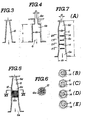
- the auxiliary nozzles 6 gradually increase in internal diameter toward their inner ends, as shown in Fig. 3.
- the velocity of the oxygen jet at the outer end of the auxiliary nozzle 6 is about the speed of sound due to the high pressure, i.e. several kg/cm2 to several tens of kg/cm2 and the high velocity, i.e. about 200 m/sec. to 300 m/sec, in the oxygen passage 8.
- the gradual expansion of the internal diameter of the auxiliary passage 8 lowers both the pressure of the oxygen in the auxiliary nozzle 6 and the velocity of the discharged oxygen jet.
- a similar deceleration of the auxiliary oxygen jet can be obtained by various configurations of the auxiliary nozzles 6.
- the auxiliary nozzle has sections 6a and 6b of differing diameter.
- the smaller-diameter section 6a adjoins the outer end and has a diameter d i .
- the larger-diameter section 6b is located downstream of the smaller-diameter section 6a and adjoins the inner end.
- the diameter d 2 of the larger-diameter section 6b is significantly greater than that of the smaller-diameter section.
- the auxiliary nozzle 6 increases in internal diameter gradually toward the inner end.
- the auxiliary nozzle 6 of Fig. 5 also has a fixed- diameter section 6c separating tapering upper and lower sections 6d and 6e.
- a flow-restriction conduit assembly 12 is disposed within the fixed-diameter section 6c.
- the conduit assembly 12 comprises a plurality of a small-diameter or capillary conduits 12a, as shown in Fig. 6. These small-diameter conduits 12a exert resistance against the oxygen flow through the auxiliary nozzle 6 and so lowers the velocity of the oxygen to below the speed of sound.
- This conduit assembly 12 thus augments the effect of the taper of the auxiliary nozzle 6 which gradually increases in diameter toward the inner end in the sections 6d and 6e. This achieves a more pronounced deceleration than in the first and second embodiments of Figs. 3 and 4.
- a similar effect can be achieved by the fourth embodiment of the auxiliary nozzle 6 of Figs. 7(A) to 7(E).
- a plurality of flow-restricting vanes 14 extend inward from the inner periphery of the fixed-diameter section 6c of the auxiliary nozzle 6.
- the flow-restricting vanes 14 lie perpendicular to the longitudinal axis of the auxiliary nozzle.
- Each vane 14 occludes the center of the auxiliary nozzle 6, leaving a peripheral section open for oxygen flow.
- the vanes 14 are arranged so that they overlap as viewed along the axis of the auxiliary nozzle 6. Therefore, a zig-zag path is defined through the fixed- diameter section 6c of the auxiliary passage 6. This further slows down the oxygen flow.
- Figs. 8 and 9 show a practical application of the auxiliary nozzle 6 of the fourth embodiment of Figs. 7(A) to 7(E).
- three auxiliary nozzles 6 are arranged in the lance 2 at regular angular intervals, i.e. 120°.
- three primary nozzles 4 are arranged radially symmetrically between pairs of auxiliary nozzles 6.
- the auxiliary nozzles 6 turn at the point where the outer (upper) section 6d and the fixed-diameter section 6c meet.
- the axis of the section 6d is essentially parallel to the axis of the lance 2 and the axis of the constant diameter section 6c lies oblique to the axis of the lance.
- the angle of the axis of the fixed-diameter section 6c is determined so as to have the inner end of the auxiliary nozzle 6 open at the edge of the lower face of the lance.
- the overall length ⁇ of the auxiliary nozzle 6 is selected to be 20d i .
- the velocity of the primary flow at the lower end of the primary nozzle 4 should still be higher than the speed of sound in order to maintain the effect of churning and rapid reaction.
- effective secondary combustion can be achieved by the relatively low-speed auxiliary oxygen jet through the auxiliary nozzles 6.
- the rate of combustion of the carbon monoxide gas is determined by its the flame propagation speed.
- the flame propagation speed of carbon monoxide is lower than or equal to 10 m/sec, most commonly several m/sec. Therefore, in order to achieve effective combustion, the velocity of the auxiliary oxygen jet must be lower than or equal to 10 m/sec at the point where the oxygen mixes with the carbon monoxide.
- Other experiments have shown that it is preferable to define a combustion zone in the region above the molten metal bath in the converter, where a large amount of foaming slag exists.
- the velocity of the auxiliary oxygen jet in the region 1.0m to 4.0m from the inner end of the lance will be approximately equal to the flame propagation speed.
- the output velocity of the auxiliary nozzle 6 must be lower than the speed of sound, preferable lower than 100 m/sec.
- blow-refinement was performed in a 200 t/ch converter.
- Oxygen is introduced not only from the top of the converter but also from below.
- Oxygen flows at 500N m3/min through the primary nozzles 4 and at 170N m 3 /min through the auxiliary nozzles.
- the lower face of the lance 2 is set 3.5m above the surface of the molten metal bath.
- the combustion rate of carbon monoxide can be brought to 35% to 40%.
- the combustion zone is formed in the region 1m to 2m from the inner end of the lance 2. This combustion zone lies about lm to 2m above the molten metal bath. At this distance, the combustion zone could effi- : ciently heat the molten metal.
- a heating efficiency of 60% to 70% was obtained in this experiment.
- auxiliary nozzles connected to a common oxygen passage together with the primary nozzles
- Figs. 10, II and 12 show the fifth embodiment of the lance according to the invention, in which separate oxygen passages 8A and 8B are defined in the lance.
- the primary nozzles 4 are connected to the primary oxygen passage 8A and the auxiliary nozzles 6 are connected to the auxiliary oxygen passage 8B.
- the auxiliary oxygen passage 8B is annular in cross-section and surrounds the primary oxygen passage 8A.
- the auxiliary oxygen passage 8B itself is surrounded by the cooling medium passages 10.
- the primary oxygen passage 8A is connected to a primary oxygen source (not shown) through an oxygen supply passage which is joined to the outer end 16 thereof.
- the auxiliary oxygen passage 8B is connected to an auxiliary oxygen source (not shown) through an auxiliary oxygen supply passage which is connected to the outer end 18 thereof.
- the cooling medium passage 10 is connected to a cooling medium source (not shown) at the outer end 22 thereof.
- the auxiliary nozzles 6 are all connected to the auxiliary oxygen passage 8B through small-diameter orifices 6f.
- the orifice 6f has a diameter d 4 substantially smaller than the inner diameter d 2 of the essentially fixed-diameter auxiliary nozzles 6.
- the overall length ⁇ , of the auxiliary nozzle should be 20d 2 .
- separating the primary and auxiliary oxygen passages allows precise oxygen flow control through the auxiliary nozzles according to combustion conditions in the converter. This further improves the efficiency of carbon monoxide combustion and heating of the molten metal.
Landscapes
- Engineering & Computer Science (AREA)
- Chemical & Material Sciences (AREA)
- Manufacturing & Machinery (AREA)
- Materials Engineering (AREA)
- Metallurgy (AREA)
- Organic Chemistry (AREA)
- Carbon Steel Or Casting Steel Manufacturing (AREA)
Claims (13)
Applications Claiming Priority (4)
| Application Number | Priority Date | Filing Date | Title |
|---|---|---|---|
| JP60182487A JPS6244517A (ja) | 1985-08-20 | 1985-08-20 | 転炉吹錬用ランス |
| JP182487/85 | 1985-08-20 | ||
| JP3240/86 | 1986-01-10 | ||
| JP61003240A JPS62161911A (ja) | 1986-01-10 | 1986-01-10 | 転炉吹錬用ランス |
Publications (2)
| Publication Number | Publication Date |
|---|---|
| EP0214902A1 EP0214902A1 (de) | 1987-03-18 |
| EP0214902B1 true EP0214902B1 (de) | 1990-05-23 |
Family
ID=26336774
Family Applications (1)
| Application Number | Title | Priority Date | Filing Date |
|---|---|---|---|
| EP86401842A Expired - Lifetime EP0214902B1 (de) | 1985-08-20 | 1986-08-19 | Lanze zum Blasen und Frischen im Konverter |
Country Status (6)
| Country | Link |
|---|---|
| US (1) | US4746103A (de) |
| EP (1) | EP0214902B1 (de) |
| KR (1) | KR930007311B1 (de) |
| BR (1) | BR8603962A (de) |
| CA (1) | CA1293121C (de) |
| DE (1) | DE3671472D1 (de) |
Families Citing this family (13)
| Publication number | Priority date | Publication date | Assignee | Title |
|---|---|---|---|---|
| LU87156A1 (fr) * | 1988-03-11 | 1989-10-26 | Arbed | Tuyere pour lance d'affinage |
| LU87855A1 (fr) * | 1990-12-10 | 1992-08-25 | Arbed | Lance de soufflage |
| DE4221266C1 (de) * | 1992-06-26 | 1993-10-21 | Mannesmann Ag | Verfahren und Vorrichtung zum Aufblasen von Sauerstoff auf Metallschmelzen |
| US5377960A (en) * | 1993-03-01 | 1995-01-03 | Berry Metal Company | Oxygen/carbon blowing lance assembly |
| US5865876A (en) * | 1995-06-07 | 1999-02-02 | Ltv Steel Company, Inc. | Multipurpose lance |
| DE19529932C1 (de) * | 1995-08-02 | 1997-01-16 | Mannesmann Ag | Lanzenkopf einer Blaslanze zur Behandlung von Schmelzen |
| US5681526A (en) * | 1996-04-23 | 1997-10-28 | Usx Corporation | Method and apparatus for post-combustion of gases during the refining of molten metal |
| US5830259A (en) * | 1996-06-25 | 1998-11-03 | Ltv Steel Company, Inc. | Preventing skull accumulation on a steelmaking lance |
| US5810905A (en) * | 1996-10-07 | 1998-09-22 | Cleveland Cliffs Iron Company | Process for making pig iron |
| US5885323A (en) * | 1997-04-25 | 1999-03-23 | Ltv Steel Company, Inc. | Foamy slag process using multi-circuit lance |
| US6805724B2 (en) * | 2000-02-10 | 2004-10-19 | Process Technology International, Inc. | Method for particulate introduction for metal furnaces |
| US6749661B2 (en) * | 2000-02-10 | 2004-06-15 | Process Technology International, Inc. | Method for melting and decarburization of iron carbon melts |
| GB0128878D0 (en) | 2001-12-03 | 2002-01-23 | Boc Group Plc | Metallurgical lance and apparatus |
Family Cites Families (8)
| Publication number | Priority date | Publication date | Assignee | Title |
|---|---|---|---|---|
| DE1064970B (de) * | 1955-01-05 | 1959-09-10 | Hoerder Huettenunion Ag | Verfahren zum Oberwindfrischen von phosphorhaltigem Roheisen |
| FR1346214A (fr) * | 1963-02-02 | 1963-12-13 | Demag Ag | Lance pour souffler de l'oxygène notamment dans les fours à affiner l'acier ou lesconvertisseurs |
| FR1543169A (fr) * | 1964-02-06 | 1900-01-01 | Buse à tubes capillaires | |
| GB1190137A (en) * | 1968-07-02 | 1970-04-29 | Inst Chernoi Metallurgii | Apparatus for Blowing Gas Through Molten Metal |
| US3745943A (en) * | 1972-03-31 | 1973-07-17 | Bethlehem Steel Corp | Baffle nose tuyere |
| SU438702A1 (ru) * | 1972-04-10 | 1974-08-05 | Центральный научно-исследовательский институт черной металлургии им. И.П. Бардина | Фурма дл продувки жидкого металла |
| JPS5310225A (en) * | 1976-07-16 | 1978-01-30 | Matsushita Electric Ind Co Ltd | Recorder |
| DE3231867A1 (de) * | 1982-08-27 | 1984-03-01 | Saar-Metallwerke GmbH, 6600 Saarbrücken | Zweikreislanze zum frischen von metallschmelzen |
-
1986
- 1986-08-18 CA CA000516195A patent/CA1293121C/en not_active Expired - Lifetime
- 1986-08-18 US US06/897,524 patent/US4746103A/en not_active Expired - Fee Related
- 1986-08-19 BR BR8603962A patent/BR8603962A/pt not_active IP Right Cessation
- 1986-08-19 DE DE8686401842T patent/DE3671472D1/de not_active Expired - Fee Related
- 1986-08-19 EP EP86401842A patent/EP0214902B1/de not_active Expired - Lifetime
- 1986-08-19 KR KR1019860006818A patent/KR930007311B1/ko not_active Expired - Fee Related
Also Published As
| Publication number | Publication date |
|---|---|
| EP0214902A1 (de) | 1987-03-18 |
| BR8603962A (pt) | 1987-03-31 |
| KR870002277A (ko) | 1987-03-30 |
| DE3671472D1 (de) | 1990-06-28 |
| CA1293121C (en) | 1991-12-17 |
| US4746103A (en) | 1988-05-24 |
| KR930007311B1 (ko) | 1993-08-05 |
Similar Documents
| Publication | Publication Date | Title |
|---|---|---|
| US4746103A (en) | Lance for blow-refinement in converter | |
| US5802097A (en) | Melting method for an electric ARC furnace with alternative sources of energy and relative electric ARC furnace with special burner positioning | |
| KR930004731B1 (ko) | 용융욕 속에서 발생한 반응가스의 후연소방법 및 장치 | |
| US5377960A (en) | Oxygen/carbon blowing lance assembly | |
| CA1042207A (en) | Metallurgical lance | |
| US2829960A (en) | Method and metallurgical device for the refining of steel | |
| CA2234041C (en) | Particulate injection burner | |
| JP2003172584A (ja) | 粉体吹込み装置および精錬方法 | |
| CA2483131C (en) | Lance for injecting particulate material into liquid metal | |
| EP1497472B1 (de) | Injektieren von feststoffen in flüssigkeiten mittels eines umhüllten ultraschall-gasstroms | |
| CA2222750C (en) | Combined oxygen blowing/fuel burner lance assembly | |
| US4366953A (en) | Oxygen lance | |
| KR100370632B1 (ko) | 회전로에서금속장입물을용융하는방법과이러한방법을실행하기위한회전로 | |
| KR102012534B1 (ko) | 제어 가능한 고체 분사 방법 | |
| WO2005111247A2 (en) | Refining molten metal | |
| RU2186294C2 (ru) | Многосопловой наконечник устройства для плавления | |
| SU1675344A1 (ru) | Фурма дл ввода в расплав порошкообразных реагентов | |
| SU1766961A1 (ru) | Дутьева фурма доменной печи | |
| RU1822423C (ru) | Сводова газокислородна горелка мартеновской печи | |
| JPS6244517A (ja) | 転炉吹錬用ランス | |
| SU899661A1 (ru) | Газо-кислородна фурма дл продувки расплавов | |
| WO1997002366A2 (en) | Method and apparatus for after-burning atmospheric gases in a steel smelting arc furnace | |
| CA2225404A1 (en) | Method and apparatus for after-burning the combustible components of the atmosphere in metallurgical smelting vessels | |
| SU1206310A1 (ru) | Дутьева фурма доменной печи | |
| JPS62164813A (ja) | 転炉ランス |
Legal Events
| Date | Code | Title | Description |
|---|---|---|---|
| PUAI | Public reference made under article 153(3) epc to a published international application that has entered the european phase |
Free format text: ORIGINAL CODE: 0009012 |
|
| AK | Designated contracting states |
Kind code of ref document: A1 Designated state(s): DE FR GB |
|
| 17P | Request for examination filed |
Effective date: 19870914 |
|
| 17Q | First examination report despatched |
Effective date: 19890803 |
|
| GRAA | (expected) grant |
Free format text: ORIGINAL CODE: 0009210 |
|
| AK | Designated contracting states |
Kind code of ref document: B1 Designated state(s): DE FR GB |
|
| REF | Corresponds to: |
Ref document number: 3671472 Country of ref document: DE Date of ref document: 19900628 |
|
| ET | Fr: translation filed | ||
| PLBE | No opposition filed within time limit |
Free format text: ORIGINAL CODE: 0009261 |
|
| STAA | Information on the status of an ep patent application or granted ep patent |
Free format text: STATUS: NO OPPOSITION FILED WITHIN TIME LIMIT |
|
| 26N | No opposition filed | ||
| PGFP | Annual fee paid to national office [announced via postgrant information from national office to epo] |
Ref country code: GB Payment date: 19970811 Year of fee payment: 12 Ref country code: FR Payment date: 19970811 Year of fee payment: 12 |
|
| PGFP | Annual fee paid to national office [announced via postgrant information from national office to epo] |
Ref country code: DE Payment date: 19970822 Year of fee payment: 12 |
|
| PG25 | Lapsed in a contracting state [announced via postgrant information from national office to epo] |
Ref country code: GB Free format text: LAPSE BECAUSE OF NON-PAYMENT OF DUE FEES Effective date: 19980819 |
|
| GBPC | Gb: european patent ceased through non-payment of renewal fee |
Effective date: 19980819 |
|
| PG25 | Lapsed in a contracting state [announced via postgrant information from national office to epo] |
Ref country code: FR Free format text: LAPSE BECAUSE OF NON-PAYMENT OF DUE FEES Effective date: 19990430 |
|
| PG25 | Lapsed in a contracting state [announced via postgrant information from national office to epo] |
Ref country code: DE Free format text: LAPSE BECAUSE OF NON-PAYMENT OF DUE FEES Effective date: 19990601 |
|
| REG | Reference to a national code |
Ref country code: FR Ref legal event code: ST |