EP0211698B1 - Dérivés de (dihydro-4,5 1H-imidazolyl-2)-2 dihydro-2,3 indole, leur préparation et leur application en thérapeutique - Google Patents
Dérivés de (dihydro-4,5 1H-imidazolyl-2)-2 dihydro-2,3 indole, leur préparation et leur application en thérapeutique Download PDFInfo
- Publication number
- EP0211698B1 EP0211698B1 EP86400200A EP86400200A EP0211698B1 EP 0211698 B1 EP0211698 B1 EP 0211698B1 EP 86400200 A EP86400200 A EP 86400200A EP 86400200 A EP86400200 A EP 86400200A EP 0211698 B1 EP0211698 B1 EP 0211698B1
- Authority
- EP
- European Patent Office
- Prior art keywords
- radical
- denotes
- formula
- compounds according
- dihydro
- Prior art date
- Legal status (The legal status is an assumption and is not a legal conclusion. Google has not performed a legal analysis and makes no representation as to the accuracy of the status listed.)
- Expired - Lifetime
Links
- 239000003814 drug Substances 0.000 title claims 2
- 238000002360 preparation method Methods 0.000 title description 5
- 229940054051 antipsychotic indole derivative Drugs 0.000 title 1
- -1 (C1-4)alkoxy radical Chemical class 0.000 claims description 35
- 150000001875 compounds Chemical class 0.000 claims description 34
- QGZKDVFQNNGYKY-UHFFFAOYSA-N Ammonia Chemical compound N QGZKDVFQNNGYKY-UHFFFAOYSA-N 0.000 claims description 14
- 150000002148 esters Chemical class 0.000 claims description 11
- 150000001408 amides Chemical class 0.000 claims description 10
- JUJWROOIHBZHMG-UHFFFAOYSA-N Pyridine Chemical compound C1=CC=NC=C1 JUJWROOIHBZHMG-UHFFFAOYSA-N 0.000 claims description 8
- CIUQDSCDWFSTQR-UHFFFAOYSA-N [C]1=CC=CC=C1 Chemical compound [C]1=CC=CC=C1 CIUQDSCDWFSTQR-UHFFFAOYSA-N 0.000 claims description 8
- 150000002825 nitriles Chemical class 0.000 claims description 8
- YYROPELSRYBVMQ-UHFFFAOYSA-N 4-toluenesulfonyl chloride Chemical compound CC1=CC=C(S(Cl)(=O)=O)C=C1 YYROPELSRYBVMQ-UHFFFAOYSA-N 0.000 claims description 7
- PIICEJLVQHRZGT-UHFFFAOYSA-N Ethylenediamine Chemical compound NCCN PIICEJLVQHRZGT-UHFFFAOYSA-N 0.000 claims description 7
- 125000005843 halogen group Chemical group 0.000 claims description 6
- 229910021529 ammonia Inorganic materials 0.000 claims description 5
- 125000004435 hydrogen atom Chemical group [H]* 0.000 claims description 5
- 125000002496 methyl group Chemical group [H]C([H])([H])* 0.000 claims description 5
- JLTRXTDYQLMHGR-UHFFFAOYSA-N trimethylaluminium Chemical compound C[Al](C)C JLTRXTDYQLMHGR-UHFFFAOYSA-N 0.000 claims description 5
- DGAQECJNVWCQMB-PUAWFVPOSA-M Ilexoside XXIX Chemical compound C[C@@H]1CC[C@@]2(CC[C@@]3(C(=CC[C@H]4[C@]3(CC[C@@H]5[C@@]4(CC[C@@H](C5(C)C)OS(=O)(=O)[O-])C)C)[C@@H]2[C@]1(C)O)C)C(=O)O[C@H]6[C@@H]([C@H]([C@@H]([C@H](O6)CO)O)O)O.[Na+] DGAQECJNVWCQMB-PUAWFVPOSA-M 0.000 claims description 4
- 239000002253 acid Substances 0.000 claims description 4
- 125000000217 alkyl group Chemical group 0.000 claims description 4
- 239000000460 chlorine Substances 0.000 claims description 4
- 238000000034 method Methods 0.000 claims description 4
- 125000000956 methoxy group Chemical group [H]C([H])([H])O* 0.000 claims description 4
- UMJSCPRVCHMLSP-UHFFFAOYSA-N pyridine Natural products COC1=CC=CN=C1 UMJSCPRVCHMLSP-UHFFFAOYSA-N 0.000 claims description 4
- 239000011734 sodium Substances 0.000 claims description 4
- 229910052708 sodium Inorganic materials 0.000 claims description 4
- PFKFTWBEEFSNDU-UHFFFAOYSA-N carbonyldiimidazole Chemical compound C1=CN=CN1C(=O)N1C=CN=C1 PFKFTWBEEFSNDU-UHFFFAOYSA-N 0.000 claims description 3
- 229910052739 hydrogen Inorganic materials 0.000 claims description 3
- 239000001257 hydrogen Substances 0.000 claims description 3
- 239000008194 pharmaceutical composition Substances 0.000 claims description 3
- 239000000546 pharmaceutical excipient Substances 0.000 claims description 3
- 125000001424 substituent group Chemical group 0.000 claims description 3
- 125000003903 2-propenyl group Chemical group [H]C([*])([H])C([H])=C([H])[H] 0.000 claims description 2
- WKBOTKDWSSQWDR-UHFFFAOYSA-N Bromine atom Chemical group [Br] WKBOTKDWSSQWDR-UHFFFAOYSA-N 0.000 claims description 2
- UFHFLCQGNIYNRP-UHFFFAOYSA-N Hydrogen Chemical compound [H][H] UFHFLCQGNIYNRP-UHFFFAOYSA-N 0.000 claims description 2
- 150000007513 acids Chemical class 0.000 claims description 2
- 125000003342 alkenyl group Chemical group 0.000 claims description 2
- 125000001797 benzyl group Chemical group [H]C1=C([H])C([H])=C(C([H])=C1[H])C([H])([H])* 0.000 claims description 2
- 229910052801 chlorine Inorganic materials 0.000 claims description 2
- 125000001316 cycloalkyl alkyl group Chemical group 0.000 claims description 2
- 229910052731 fluorine Inorganic materials 0.000 claims description 2
- 125000001153 fluoro group Chemical group F* 0.000 claims description 2
- 229910052740 iodine Inorganic materials 0.000 claims description 2
- PNDPGZBMCMUPRI-UHFFFAOYSA-N iodine Chemical compound II PNDPGZBMCMUPRI-UHFFFAOYSA-N 0.000 claims description 2
- 239000011630 iodine Substances 0.000 claims description 2
- WCYWZMWISLQXQU-UHFFFAOYSA-N methyl Chemical compound [CH3] WCYWZMWISLQXQU-UHFFFAOYSA-N 0.000 claims description 2
- 150000003839 salts Chemical class 0.000 claims description 2
- 238000004519 manufacturing process Methods 0.000 claims 2
- 125000001997 phenyl group Chemical group [H]C1=C([H])C([H])=C(*)C([H])=C1[H] 0.000 claims 2
- KZBUYRJDOAKODT-UHFFFAOYSA-N Chlorine Chemical compound ClCl KZBUYRJDOAKODT-UHFFFAOYSA-N 0.000 claims 1
- 229940079593 drug Drugs 0.000 claims 1
- RMCDUNHIVVEEDD-UHFFFAOYSA-N methylcyclopropane Chemical compound [CH2]C1CC1 RMCDUNHIVVEEDD-UHFFFAOYSA-N 0.000 claims 1
- 125000003944 tolyl group Chemical group 0.000 claims 1
- YXFVVABEGXRONW-UHFFFAOYSA-N Toluene Chemical compound CC1=CC=CC=C1 YXFVVABEGXRONW-UHFFFAOYSA-N 0.000 description 30
- XEKOWRVHYACXOJ-UHFFFAOYSA-N Ethyl acetate Chemical compound CCOC(C)=O XEKOWRVHYACXOJ-UHFFFAOYSA-N 0.000 description 21
- XLYOFNOQVPJJNP-UHFFFAOYSA-N water Substances O XLYOFNOQVPJJNP-UHFFFAOYSA-N 0.000 description 18
- LFQSCWFLJHTTHZ-UHFFFAOYSA-N Ethanol Chemical compound CCO LFQSCWFLJHTTHZ-UHFFFAOYSA-N 0.000 description 17
- VLKZOEOYAKHREP-UHFFFAOYSA-N n-Hexane Chemical compound CCCCCC VLKZOEOYAKHREP-UHFFFAOYSA-N 0.000 description 15
- VZCYOOQTPOCHFL-OWOJBTEDSA-N Fumaric acid Chemical compound OC(=O)\C=C\C(O)=O VZCYOOQTPOCHFL-OWOJBTEDSA-N 0.000 description 13
- 239000007787 solid Substances 0.000 description 13
- 239000000203 mixture Substances 0.000 description 12
- 239000011541 reaction mixture Substances 0.000 description 12
- 150000003254 radicals Chemical class 0.000 description 10
- VZCYOOQTPOCHFL-UHFFFAOYSA-N trans-butenedioic acid Natural products OC(=O)C=CC(O)=O VZCYOOQTPOCHFL-UHFFFAOYSA-N 0.000 description 10
- 0 *N(C(C1)C2=NCCN2)c2c1cccc2 Chemical compound *N(C(C1)C2=NCCN2)c2c1cccc2 0.000 description 9
- UHOVQNZJYSORNB-UHFFFAOYSA-N Benzene Chemical compound C1=CC=CC=C1 UHOVQNZJYSORNB-UHFFFAOYSA-N 0.000 description 9
- XKRFYHLGVUSROY-UHFFFAOYSA-N Argon Chemical compound [Ar] XKRFYHLGVUSROY-UHFFFAOYSA-N 0.000 description 8
- CSCPPACGZOOCGX-UHFFFAOYSA-N Acetone Chemical compound CC(C)=O CSCPPACGZOOCGX-UHFFFAOYSA-N 0.000 description 7
- RTZKZFJDLAIYFH-UHFFFAOYSA-N Diethyl ether Chemical compound CCOCC RTZKZFJDLAIYFH-UHFFFAOYSA-N 0.000 description 6
- ZMXDDKWLCZADIW-UHFFFAOYSA-N N,N-Dimethylformamide Chemical compound CN(C)C=O ZMXDDKWLCZADIW-UHFFFAOYSA-N 0.000 description 6
- XDTMQSROBMDMFD-UHFFFAOYSA-N Cyclohexane Chemical compound C1CCCCC1 XDTMQSROBMDMFD-UHFFFAOYSA-N 0.000 description 5
- KFZMGEQAYNKOFK-UHFFFAOYSA-N Isopropanol Chemical compound CC(C)O KFZMGEQAYNKOFK-UHFFFAOYSA-N 0.000 description 5
- 239000003921 oil Substances 0.000 description 5
- 235000019198 oils Nutrition 0.000 description 5
- VEXZGXHMUGYJMC-UHFFFAOYSA-N Hydrochloric acid Chemical compound Cl VEXZGXHMUGYJMC-UHFFFAOYSA-N 0.000 description 4
- SIKJAQJRHWYJAI-UHFFFAOYSA-N Indole Chemical compound C1=CC=C2NC=CC2=C1 SIKJAQJRHWYJAI-UHFFFAOYSA-N 0.000 description 4
- WYURNTSHIVDZCO-UHFFFAOYSA-N Tetrahydrofuran Chemical compound C1CCOC1 WYURNTSHIVDZCO-UHFFFAOYSA-N 0.000 description 4
- 239000005557 antagonist Substances 0.000 description 4
- 229910052786 argon Inorganic materials 0.000 description 4
- ZWEHNKRNPOVVGH-UHFFFAOYSA-N 2-Butanone Chemical compound CCC(C)=O ZWEHNKRNPOVVGH-UHFFFAOYSA-N 0.000 description 3
- YMWUJEATGCHHMB-UHFFFAOYSA-N Dichloromethane Chemical compound ClCCl YMWUJEATGCHHMB-UHFFFAOYSA-N 0.000 description 3
- OKKJLVBELUTLKV-UHFFFAOYSA-N Methanol Chemical compound OC OKKJLVBELUTLKV-UHFFFAOYSA-N 0.000 description 3
- 239000000556 agonist Substances 0.000 description 3
- 239000001530 fumaric acid Substances 0.000 description 3
- 239000012074 organic phase Substances 0.000 description 3
- FVAUCKIRQBBSSJ-UHFFFAOYSA-M sodium iodide Chemical compound [Na+].[I-] FVAUCKIRQBBSSJ-UHFFFAOYSA-M 0.000 description 3
- WZRQWFLFJLFUPU-UHFFFAOYSA-N 2,3-dihydro-1h-indole Chemical compound C1=C[C]2NCCC2=C=C1 WZRQWFLFJLFUPU-UHFFFAOYSA-N 0.000 description 2
- NLXLAEXVIDQMFP-UHFFFAOYSA-N Ammonia chloride Chemical compound [NH4+].[Cl-] NLXLAEXVIDQMFP-UHFFFAOYSA-N 0.000 description 2
- 241000283973 Oryctolagus cuniculus Species 0.000 description 2
- VYPSYNLAJGMNEJ-UHFFFAOYSA-N Silicium dioxide Chemical compound O=[Si]=O VYPSYNLAJGMNEJ-UHFFFAOYSA-N 0.000 description 2
- ATJFFYVFTNAWJD-UHFFFAOYSA-N Tin Chemical compound [Sn] ATJFFYVFTNAWJD-UHFFFAOYSA-N 0.000 description 2
- 125000004429 atom Chemical group 0.000 description 2
- 239000002775 capsule Substances 0.000 description 2
- ZPUCINDJVBIVPJ-LJISPDSOSA-N cocaine Chemical compound O([C@H]1C[C@@H]2CC[C@@H](N2C)[C@H]1C(=O)OC)C(=O)C1=CC=CC=C1 ZPUCINDJVBIVPJ-LJISPDSOSA-N 0.000 description 2
- 230000008602 contraction Effects 0.000 description 2
- 230000000694 effects Effects 0.000 description 2
- 229940082150 encore Drugs 0.000 description 2
- 239000007789 gas Substances 0.000 description 2
- 238000000338 in vitro Methods 0.000 description 2
- 239000000133 nasal decongestant Substances 0.000 description 2
- 239000012071 phase Substances 0.000 description 2
- BWHMMNNQKKPAPP-UHFFFAOYSA-L potassium carbonate Chemical compound [K+].[K+].[O-]C([O-])=O BWHMMNNQKKPAPP-UHFFFAOYSA-L 0.000 description 2
- IENZQIKPVFGBNW-UHFFFAOYSA-N prazosin Chemical compound N=1C(N)=C2C=C(OC)C(OC)=CC2=NC=1N(CC1)CCN1C(=O)C1=CC=CO1 IENZQIKPVFGBNW-UHFFFAOYSA-N 0.000 description 2
- 229960001289 prazosin Drugs 0.000 description 2
- 239000002244 precipitate Substances 0.000 description 2
- 210000001147 pulmonary artery Anatomy 0.000 description 2
- 238000001953 recrystallisation Methods 0.000 description 2
- 238000010992 reflux Methods 0.000 description 2
- 239000000725 suspension Substances 0.000 description 2
- BBHMZHDPVNXFMI-UHFFFAOYSA-N 4-chloro-2,3-dihydro-1h-indole Chemical compound ClC1=CC=CC2=C1CCN2 BBHMZHDPVNXFMI-UHFFFAOYSA-N 0.000 description 1
- HBAQYPYDRFILMT-UHFFFAOYSA-N 8-[3-(1-cyclopropylpyrazol-4-yl)-1H-pyrazolo[4,3-d]pyrimidin-5-yl]-3-methyl-3,8-diazabicyclo[3.2.1]octan-2-one Chemical class C1(CC1)N1N=CC(=C1)C1=NNC2=C1N=C(N=C2)N1C2C(N(CC1CC2)C)=O HBAQYPYDRFILMT-UHFFFAOYSA-N 0.000 description 1
- CURLTUGMZLYLDI-UHFFFAOYSA-N Carbon dioxide Chemical compound O=C=O CURLTUGMZLYLDI-UHFFFAOYSA-N 0.000 description 1
- GJSURZIOUXUGAL-UHFFFAOYSA-N Clonidine Chemical compound ClC1=CC=CC(Cl)=C1NC1=NCCN1 GJSURZIOUXUGAL-UHFFFAOYSA-N 0.000 description 1
- 208000020401 Depressive disease Diseases 0.000 description 1
- 208000001953 Hypotension Diseases 0.000 description 1
- 206010028735 Nasal congestion Diseases 0.000 description 1
- 208000008589 Obesity Diseases 0.000 description 1
- 235000019502 Orange oil Nutrition 0.000 description 1
- OCBFFGCSTGGPSQ-UHFFFAOYSA-N [CH2]CC Chemical compound [CH2]CC OCBFFGCSTGGPSQ-UHFFFAOYSA-N 0.000 description 1
- 239000000443 aerosol Substances 0.000 description 1
- 230000001476 alcoholic effect Effects 0.000 description 1
- 235000019270 ammonium chloride Nutrition 0.000 description 1
- 239000003708 ampul Substances 0.000 description 1
- 208000006673 asthma Diseases 0.000 description 1
- AGEZXYOZHKGVCM-UHFFFAOYSA-N benzyl bromide Chemical compound BrCC1=CC=CC=C1 AGEZXYOZHKGVCM-UHFFFAOYSA-N 0.000 description 1
- 230000015572 biosynthetic process Effects 0.000 description 1
- 230000005587 bubbling Effects 0.000 description 1
- 235000011089 carbon dioxide Nutrition 0.000 description 1
- 239000003153 chemical reaction reagent Substances 0.000 description 1
- 125000001309 chloro group Chemical group Cl* 0.000 description 1
- 238000004587 chromatography analysis Methods 0.000 description 1
- 229960002896 clonidine Drugs 0.000 description 1
- 229960003920 cocaine Drugs 0.000 description 1
- 239000012141 concentrate Substances 0.000 description 1
- 235000008504 concentrate Nutrition 0.000 description 1
- 238000001816 cooling Methods 0.000 description 1
- 125000004186 cyclopropylmethyl group Chemical group [H]C([H])(*)C1([H])C([H])([H])C1([H])[H] 0.000 description 1
- 206010012601 diabetes mellitus Diseases 0.000 description 1
- 238000001035 drying Methods 0.000 description 1
- 239000003480 eluent Substances 0.000 description 1
- 125000001495 ethyl group Chemical group [H]C([H])([H])C([H])([H])* 0.000 description 1
- 238000001914 filtration Methods 0.000 description 1
- 239000008187 granular material Substances 0.000 description 1
- 230000036543 hypotension Effects 0.000 description 1
- 210000003405 ileum Anatomy 0.000 description 1
- MTNDZQHUAFNZQY-UHFFFAOYSA-N imidazoline Chemical compound C1CN=CN1 MTNDZQHUAFNZQY-UHFFFAOYSA-N 0.000 description 1
- 201000001881 impotence Diseases 0.000 description 1
- PZOUSPYUWWUPPK-UHFFFAOYSA-N indole Natural products CC1=CC=CC2=C1C=CN2 PZOUSPYUWWUPPK-UHFFFAOYSA-N 0.000 description 1
- RKJUIXBNRJVNHR-UHFFFAOYSA-N indolenine Natural products C1=CC=C2CC=NC2=C1 RKJUIXBNRJVNHR-UHFFFAOYSA-N 0.000 description 1
- 238000002329 infrared spectrum Methods 0.000 description 1
- 230000002401 inhibitory effect Effects 0.000 description 1
- 239000006193 liquid solution Substances 0.000 description 1
- 230000007246 mechanism Effects 0.000 description 1
- 239000000155 melt Substances 0.000 description 1
- 230000003982 neuronal uptake Effects 0.000 description 1
- 238000000655 nuclear magnetic resonance spectrum Methods 0.000 description 1
- 235000020824 obesity Nutrition 0.000 description 1
- 239000010502 orange oil Substances 0.000 description 1
- 230000001769 paralizing effect Effects 0.000 description 1
- 230000000144 pharmacologic effect Effects 0.000 description 1
- 230000000704 physical effect Effects 0.000 description 1
- 235000020004 porter Nutrition 0.000 description 1
- 230000002980 postoperative effect Effects 0.000 description 1
- 230000001242 postsynaptic effect Effects 0.000 description 1
- 229910000027 potassium carbonate Inorganic materials 0.000 description 1
- 239000000047 product Substances 0.000 description 1
- 125000002572 propoxy group Chemical group [*]OC([H])([H])C(C([H])([H])[H])([H])[H] 0.000 description 1
- 239000000018 receptor agonist Substances 0.000 description 1
- 229940044601 receptor agonist Drugs 0.000 description 1
- 229940044551 receptor antagonist Drugs 0.000 description 1
- 239000002464 receptor antagonist Substances 0.000 description 1
- 229920006395 saturated elastomer Polymers 0.000 description 1
- 239000000377 silicon dioxide Substances 0.000 description 1
- 235000009518 sodium iodide Nutrition 0.000 description 1
- 239000002904 solvent Substances 0.000 description 1
- 239000000126 substance Substances 0.000 description 1
- 235000020357 syrup Nutrition 0.000 description 1
- 239000006188 syrup Substances 0.000 description 1
- 239000003826 tablet Substances 0.000 description 1
- YLQBMQCUIZJEEH-UHFFFAOYSA-N tetrahydrofuran Natural products C=1C=COC=1 YLQBMQCUIZJEEH-UHFFFAOYSA-N 0.000 description 1
- 230000001225 therapeutic effect Effects 0.000 description 1
- 238000002560 therapeutic procedure Methods 0.000 description 1
- 210000001177 vas deferen Anatomy 0.000 description 1
- 238000005406 washing Methods 0.000 description 1
Classifications
-
- C—CHEMISTRY; METALLURGY
- C07—ORGANIC CHEMISTRY
- C07D—HETEROCYCLIC COMPOUNDS
- C07D403/00—Heterocyclic compounds containing two or more hetero rings, having nitrogen atoms as the only ring hetero atoms, not provided for by group C07D401/00
- C07D403/02—Heterocyclic compounds containing two or more hetero rings, having nitrogen atoms as the only ring hetero atoms, not provided for by group C07D401/00 containing two hetero rings
- C07D403/04—Heterocyclic compounds containing two or more hetero rings, having nitrogen atoms as the only ring hetero atoms, not provided for by group C07D401/00 containing two hetero rings directly linked by a ring-member-to-ring-member bond
-
- C—CHEMISTRY; METALLURGY
- C07—ORGANIC CHEMISTRY
- C07D—HETEROCYCLIC COMPOUNDS
- C07D209/00—Heterocyclic compounds containing five-membered rings, condensed with other rings, with one nitrogen atom as the only ring hetero atom
- C07D209/02—Heterocyclic compounds containing five-membered rings, condensed with other rings, with one nitrogen atom as the only ring hetero atom condensed with one carbocyclic ring
- C07D209/04—Indoles; Hydrogenated indoles
- C07D209/30—Indoles; Hydrogenated indoles with hetero atoms or with carbon atoms having three bonds to hetero atoms with at the most one bond to halogen, directly attached to carbon atoms of the hetero ring
- C07D209/42—Carbon atoms having three bonds to hetero atoms with at the most one bond to halogen, e.g. ester or nitrile radicals
Definitions
- the present invention relates to derivatives of (dihydro-4,5 1H-imidazolyl-2) -2 dihydro-2,3 indole, their preparation and their therapeutic application.
- the compounds of the invention may exist in the form of racemates or enantiomers which are part of the invention.
- the pharmaceutically acceptable salts of the compounds (I) also form part of the invention.
- a first series of preferred compounds is that in formula (I) of which X is a chlorine or fluorine atom or a methyl, methoxy or allyloxy radical (more particularly in position 4, 6 or 7), and R is an alkyl radical , benzyl, allyl or cyclopropylmethyl.
- X is a hydrogen atom or a methyl radical (more particularly in position 4) and R is an unsubstituted phenyl radical or carrying a methyl, ethyl, propyl radical , methoxy, ethoxy or propoxy (more particularly in position 3 or 4).
- the starting esters (II) are described in the literature.
- the ester (III) and a compound RZ (Z being a labile group, in particular an iodine or bromine atom) are then reacted in a solvent such as acetone, methyl ethyl ketone or dimethylformamide, at the temperature room temperature or higher, in the presence of a base, such as potassium carbonate.
- a solvent such as acetone, methyl ethyl ketone or dimethylformamide
- imidazoline from the ester (IV) is carried out with ethylenediamine in the presence of trimethylaluminum.
- the starting acids (V) are described in the literature. They are reacted with ammonia in the presence of carbonyldiimidazole to obtain the amide (VI) which is reduced using liquid ammonia and sodium, then the amide (VII) is converted into nitrile ( VIII) using p-toluenesulfonyl chloride in the presence of pyridine, or by any other known method, and the nitrile (VIII) is reacted with ethylenediamine to obtain the compound (I).
- reaction mixture is stirred at room temperature for 24 h. It is poured onto a mixture of water and ice, extracted with ether, washed with water, dried and concentrated. An oil is obtained which is purified by chromatography on silica using the eluent cyclohexane / ethyl acetate (99/1) and which is used as it is in the following step.
- This reaction mixture is brought to 50 ° C and then added 5.3 g (0.0168 mole) of the ester obtained under 2. in solution in 30 ml of toluene.
- the mixture is heated to 90 ° C, distilled hexane and brought to reflux temperature for 4 h. It is hydrolyzed by adding water and cooled.
- the solution is filtered, rinsed with CH 2 CL 2 , extracted with CH 2 C1 2 , washed with water, dried and concentrated. A white solid is obtained.
- the compound obtained is converted into fumarate by reacting 4.6 g (0.0148 mole) of the base in solution in 50 ml of ethanol and 1.63 g (0.0140 mole) of fumaric acid in solution in 100 ml of ethanol.
- a white solid forms which, after filtration and recrystallization from methanol, melts at 229-231 ° C.
- reaction mixture is brought to 50 ° C and added 5.5 g (0.0235 mole) of the nitrile obtained in 3. dissolved in 50 ml of toluene
- the mixture is heated to 90 ° C., the hexane is distilled and the mixture is brought to reflux temperature for 10 h.
- the mixture is hydrolyzed, while cooling with 60 ml of water.
- the solution obtained is filtered and rinsed with CH Z CI 2 .
- the organic phase is decanted, washed with water, dried and concentrated.
- the fumarate is prepared by reacting 3.55 g (0.0128 mole) of base in solution in 100 ml of ethanol with 1.4 g (0.0122 mole) of fumaric acid in solution in 100 ml of ethanol.
- the compounds of the invention have been subjected to pharmacological tests which have shown their interest as a 2 -antagonists.
- the pA 2 of the compounds of the invention are between 6 and 11.
- the compounds of the invention are powerful a 2 -antagonists which can be used for the treatment of depression (either alone or in combination with a product which inhibits neuronal uptake mechanisms), the treatment of hypotension, the treatment of post-operative paralytic ileum, treatment of asthma and obesity, treatment of diabetes, treatment of impotence.
- some of the compounds of the invention are also ⁇ 1 -agonists which are of interest as nasal vasoconstrictors.
- Some of the compounds are substances which contract powerfully in vitro, a rabbit pulmonary artery preparation (preparation containing at the post synaptic level only ⁇ 1 receptors), according to Starke et al, 1975, Naunyn Schmiedeberg's Arch. Pharmacol., 291, 55-78.
- the concentration of compound (I) necessary to obtain 50% of the maximum contraction (EC 50) ranges from 10 ⁇ M to 0.1 pM.
- They can therefore be used in therapy, for example as nasal vasoconstrictors.
- compositions with 2- antagonist activities may be in a form suitable for administration by the oral, rectal or parenteral route; for example in the form of capsules, tablets, granules, capsules or liquid solutions, syrups or oral suspensions, and contain the appropriate excipients.
- compositions with ⁇ 1 -agonist activities which can be used for the treatment of nasal congestion, may be in a form suitable for administration by the external or local route, for example in the form of aerosols or sprayable solutions, and contain the suitable excipients.
- the daily dosage can range from 0.1 to 10 mg / kg p.o.
Landscapes
- Chemical & Material Sciences (AREA)
- Organic Chemistry (AREA)
- Pharmaceuticals Containing Other Organic And Inorganic Compounds (AREA)
- Plural Heterocyclic Compounds (AREA)
- Medicines That Contain Protein Lipid Enzymes And Other Medicines (AREA)
Description
- La présente invention à pour objet des dérivés de (dihydro-4,5 1H-imidazolyl-2)-2 dihydro-2,3 indole, leur préparation et leur application en thérapeutique.
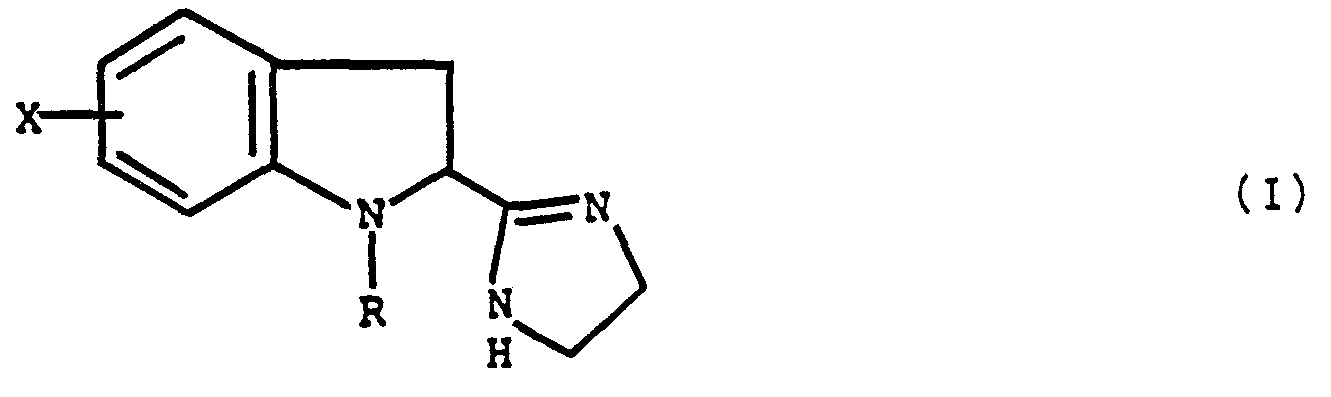
- Les composés de l'invention répondent à la formule générale (I)
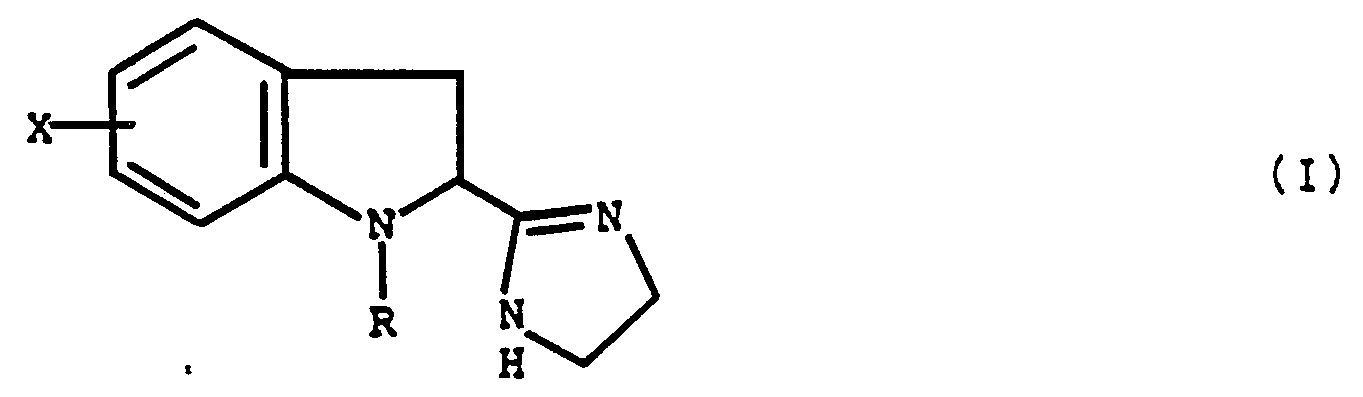
- X est en position 4, 5, 6 ou 7 et représente un atome d'halogène, un radical (C1-4)alcoxy, un radical (C1-4)alkyle ou le radical allyloxy, ou encore, lorsque R représente un radical phényle éventuellement substitué, X peut représenter aussi un atome d'hydrogène et
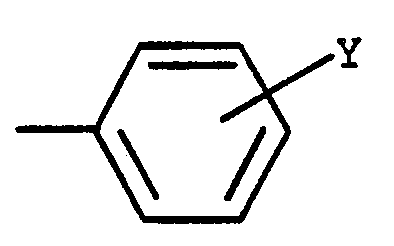
- R représente un radical (C1-6)alkyle droit ou ramifié, un radical (C3-6)cycloalkyl-(Cl-4)alkyle, un radical (C3-6)alcényle, un radical aryl-(Ci-4)alkyle pouvant porter un ou plusieurs substituants choisis parmi les atomes d'halogène et les radicaux méthyle, méthoxy et méthylènedioxy, ou encore un radical phényle éventuellement substitué, de formule
- Les composé de l'invention peuvent exister sous la forme de racémates ou d'énantiomères qui font partie de l'invention. Les sels pharmaceutiquement acceptables des composés (I) font également partie de l'invention.
- Une première série de composés préférés est celle dans la formule (I) desquels X est un atome de chlore ou de fluor ou un radical méthyle, méthoxy ou allyloxy (plus particulièrement en position 4, 6 ou 7), et R est un radical alkyle, benzyle, allyle ou cyclopropylméthyle.
- Une autre série de composés préférés est celle dans la formule (I) desquels X est un atome d'hydrogène ou un radical méthyle (plus particulièrement en position 4) et R est un radical phényle non substitué ou portant un radical méthyle, éthyle, propyle, méthoxy, éthoxy ou propoxy (plus particulièrement en position 3 ou 4).
- Les composés de l'invention dans la formule (I) desquels R représente un radical alkyle, cycloalkylalkyle, alcényle ou arylalkyle, peuvent être préparés selon le schéma réactionnel 1 donné ci-après.
- Les esters de départ (II) sont décrits dans la littérature. On hydrogène l'ester de départ (II) dans lequel R' est un radical (C1-4)alkyle à l'aide de gaz chlorhydrique et d'étain.
- On fait ensuite réagir l'ester (III) et un composé RZ (Z étant un groupe labile, en particulier un atome d'iode ou de brome) dans un solvant tel que l'acétone, la méthyléthylcétone ou le diméthylformamide, à la température ambiante ou à température plus élevée, en présence d'une base, telle que le carbonate de potassium. La réaction peut être catalysée par exemple par addition d'iodure de sodium.
- La formation de l'imidazoline à partir de l'ester (IV) est effectuée par l'éthylènediamine en présence de triméthylaluminium.


- Les composés de l'invention dans la formule (I) desquels R représente un radical phényle portant un substituant Y peuvent être préparés selon le schéma réactionnel 2 donné ci-après.
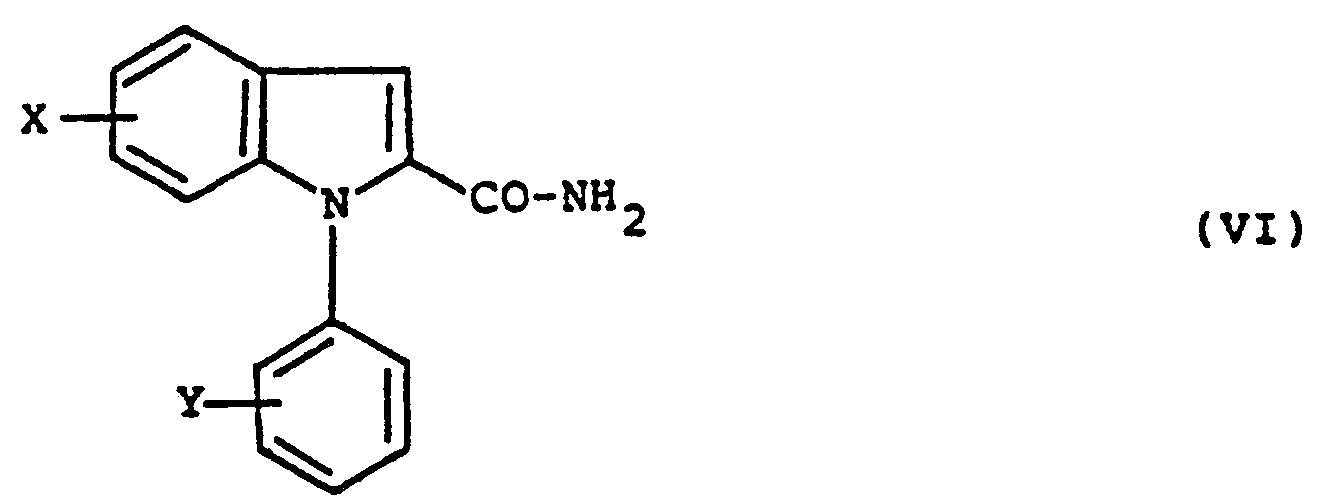
- Les acides de départ (V) sont décrits dans la littérature. On les fait réagir avec de l'ammoniac en présence de carbonyldiimidazole pour obtenir l'amide (VI) que l'on réduit à l'aide d'ammoniac liquide et de sodium, puis on transforme l'amide (VII) en nitrile (VIII) à l'aide de chlorure de p-toluènesulfonyle en présence de pyridine, ou par toute autre méthode connue, et l'on fait réagir le nitrile (VIII) avec de l'éthylènediamine pour obtenir le composé (I).
- Enfin, lorsque X représente l'hydrogène et R représente un radical phényle substitué ou non, le composé peut encore être préparé selon le schéma réactionnel 3 (cf. exemple 3).
- Les exemples suivants illustrent l'invention. Les spectres IR et RMN et les analyses confirment la structure des composés.
- Dans un ballon tricol de 2 I, que l'on maintient à -50°C dans un mélange de carboglace et d'isopropanol, on introduit 350 ml d'éthanol et on fait passer un courant de gaz chlorhydrique.
- On introduit alors 33,0 g (0,148 mole) de chloro-4 1H-indolecarboxylate-2 d'éthyle puis on ajoute 105,4 g (0,888 at-g) d'étain en une seule fois. On agite le mélange réactionnel et le laisse revenir lentement à la température ambiante. On agite la solution pendant 40 h et la traite par un courant d'ammoniac. On filtre le précipité formé et le rince à l'alcool. On concentré la phase alcoolique et la reprend par du dichlorométhane.
- Après lavage à l'eau, séchage et concentration, on obtient une huile orange que l'on reprend par du cyclohexane. On obtient un solide. F = 48, 5-50, 5°C.


- Dans un ballon de 500 ml, on introduit, sous argon, 7,9 g (0,035 mole) de l'ester obtenu sous 1., 7,7 g (0.056 mole) de K2C03 et 100 ml de diméthylformamide puis 7,2 g (0,042 mole) de bromure de benzyle.
- On agite le mélange réactionnel à la température ambiante pendant 24 h. On le verse sur un mélange d'eau et de glace, extrait à l'éther, lave à l'eau, sèche et concentre. On obtient une huile que l'on purifie par chromatographie sur silice à l'aide de l'éluant cyclohexane/acétate d'éthyle (99/1) et que l'on utilise telle qu'elle dans l'étape suivante.
- A une solution de 2,9 g (0,0403 mole) de triméthylaluminium (16,5 ml d'une solution à 25% dans de l'hexane) dans 30 ml de toluène, refroidie à 0°C, on ajoute, sous argon, goutte à goutte, en 30 mn, une solution de 2,46 g (0,0410 mole) d'éthylènediamine dans 15 ml de toluène.
- On porte ce mélange réactionnel à 50°C et ajoute alors 5,3 g (0,0168 mole) de l'ester obtenu sous 2. en solution dans 30 ml de toluène. On chauffe le mélange à 90°C, distille l'hexane et porte à la température du reflux pendant 4 h. On hydrolyse par addition d'eau et refroidit. On filtre la solution, rince avec CH2CL2, extrait avec CH2C12, lave à l'eau, sèche et concentre. On obtient un solide blanc.
- On transforme le composé obtenu en fumarate en faisant réagir 4,6 g (0,0148 mole) de la base en solution dans 50 ml d'éthanol et 1,63 g (0,0140 mole) d'acide fumarique en solution dans 100 ml d'éthanol.
- Un solide blanc se forme qui après filtration et recristallisation dans le méthanol fond à 229-231°C.
- A une solution de 10,9 g (0,0434 mole) d'acide méthyl-4 phényl-1 indolecarboxylique-2 dans 500 ml de CH2CI2, on ajoute, par positions, 10,95 g (0,0675 mole) de carbonyldiimidazole.
- On agite le mélange réactionnel pendant 3 h à la température ambiante. On le refroidit ensuite dans un mélange d'eau et de glace et fait passer un courant d'ammoniac. Après avoir fait barboter l'ammoniac pendant 1 h, on agite le mélange réactionnel à la température ambiante pendant 22 h. On le reprend par de l'eau et élimine le précipité. On lave la phase organique, la sèche et la concentre. On obtient un solide que l'on fait recristalliser dans un mélange toluène/acétate d'éthyle (1/1).
- F = 187-189°C.
- Dans un mélange de 100 ml de tétrahydrofuranne et de 200 ml d'ammoniac liquide, on ajoute 8,6 g (0,0344 mole) de l'amide obtenu sous 1., puis on introduit 1,74 g (0,0757 at-g) de sodium en 15 mn. On agite le mélange réactionnel pendant 30 mn. On l'hydrolyse par 100 ml d'une solution de NH4CI, laisse décanter et extrait à l'acétate d'éthyle, lave à l'eau, sèche et concentre.
- Après recristallisation dans un mélange toluène/acétate d'éthyle (1/2) on obtient un solide blanc.
- F = 187-189°C.
- Dans un ballon tricol de 250 ml, on introduit 7,0 g (0,0277 mole) de l'amide obtenu sous 2. et 9,9 g (0,125 mole) de pyridine. On ajoute lentement 10,6 g (0,0555 mole) de chlorure de p-toluènesulfonyle. On agite le mélange réactionnel pendant 23 h à la température ambiante. On le verse sur un mélange d'eau et de glace, extrait à l'éther, lave à l'eau acidulée (5% HCI en poids), puis à l'eau, sèche et concentre à froid. On reprend par du cyclohexane l'huile obtenue. Un solide blanc cristallise.
- F = 98,5-100,5°C.
- A une solution de 4,06 g (0,0563 mole) de triméthylaluminium (23,0 ml d'une solution à 25% dans de l'hexane) dans 50 ml de toluène, on ajoute, sous argon, à 0-5°C, goutte à goutte, en 30 mn, une solution de 3,4 g (0,0569 mole) d'éthylènediamine dans 20 ml de toluène.
- On porte le mélange réactionnel à 50°C et ajoute 5,5 g (0,0235 mole) du nitrile obtenu sous 3. en solution dans 50 ml de toluène
- L'addition terminée, on chauffe le mélange à 90°C, distille l'hexane et porte à la température du reflux pendant 10 h. On hydrolyse le mélange, tout en le refroidissant par 60 ml d'eau. On filtre la solution obtenue et rince avec CHZCI2. On décante la phase organique, lave à l'eau, sèche et concentre.
- On obtient un solide blanc.
- On prépare lefumarate en faisant réagir3,55 g (0,0128 mole) de base en solution dans 100 ml d'éthanol avec 1,4 g (0,0122 mole) d'acide fumarique en solution dans 100 ml d'éthanol.
- On obtient une huile que l'on triture dans de l'acétone. Le solide est recristallisé dans le l'alcool isopropylique.
- F = 199-200,5°C.
- A une suspension de 5,35 g (0,10 mole) de chlorure d'ammonium dans 100 ml de benzène sec, à 5°C, on ajoute lentement 41,5 ml d'une solution de triméthylaluminium à 25% dans de l'hexane. On rince l'ampoule avec 10 ml de benzène sec. On laisse le mélange réactionnel revenir à la température ambiante, puis on agite pendant 2 h.
- A une solution de 8,0 g (0,03 mole) de phényl-1 1H-indolecarboxylate-2 d'éthyle dans 300 ml de benzène, on ajoute 135 ml (0,09 mole) du réactif préparé précédement. On chauffe le mélange réactionnel à 50°C, sous argon, pendant 12 h. On hydrolyse par 50 ml de HCI à 5%, filtre, lave à l'acétate d'éthyle. Les phases organiques sont lavées à l'eau, séchées et concentrées. On obtient un solide que l'on lave au toluène et fait recristalliser dans de l'acétone.
- F = 193-194,5°C.
- Dans un mélange de 175 ml de THF sec et de 175 ml d'ammoniac liquide, on ajoute 9,4 g (0,0398 mole) de phényl-1 1H-indolecarboxamide-2 et ajoute 2,0 g (0,088 atome-gramme) de sodium, en 10 mn, puis on agite 30 mn. On hydrolyse par 100 ml d'une solution de NH4CI, décante, extrait à l'acétate d'éthyle, lave à l'eau, sèche et concentre. Le solide obtenu est recristallisé dans du toluène.
- F = 190-191,5°C.
- Dans un tricol de 250 ml, on introduit 6,0 g (0,025 mole) de phényl-1 dihydro-2,3 1H-indolecarboxamide-2 et 9,0 g (9,2 ml, 0,113 mole) de pyridine. On ajoute lentement 9,5 g (0,050 mole) de chlorure de p-toluènesulfonyle et agite le mélange réactionnel 3h30, à la température ambiante. On verse le mélange réactionnel sur de l'eau et de la glace, extrait à l'éther, lave avec de l'acide chlorhydrique à 5%, puis à l'eau, sèche et concentre à froid. On reprend l'huile formée dans du cyclohexane. On concentre la phase cyclohexanique, on obtient un solide.
- F = 47,5-49°C.
- On sature à 0°C, par H2S, une solution de 2,2 g (0,01 mole) de phényl-1 dihydro-2,3, 1H-indolecarbonitrile-2 dans 1,8 g (2,06 ml, 0,03 mole) d'éthylènediamine. On laisse reposer à la température ambiante pendant 4 jours. On reprend le solide formé par CH2CL2, lave 3 fois à l'eau, sèche et concentre. On obtient une huile.
- On prépare le fumarate du composé obtenu en faisant réagir 3,5 g (0,0133 mole) de base en solution dans 50 ml d'éthanol et 1,4 g (0,0120 mole) d'acide fumarique en solution dans 80 ml d'éthanol. On concentre la solution, reprend le concentré par de l'acétate d'éthyle et triture; on obtient un solide que l'on fait recristalliser dans de l'éthanol.
- F = 212,5-215°C.
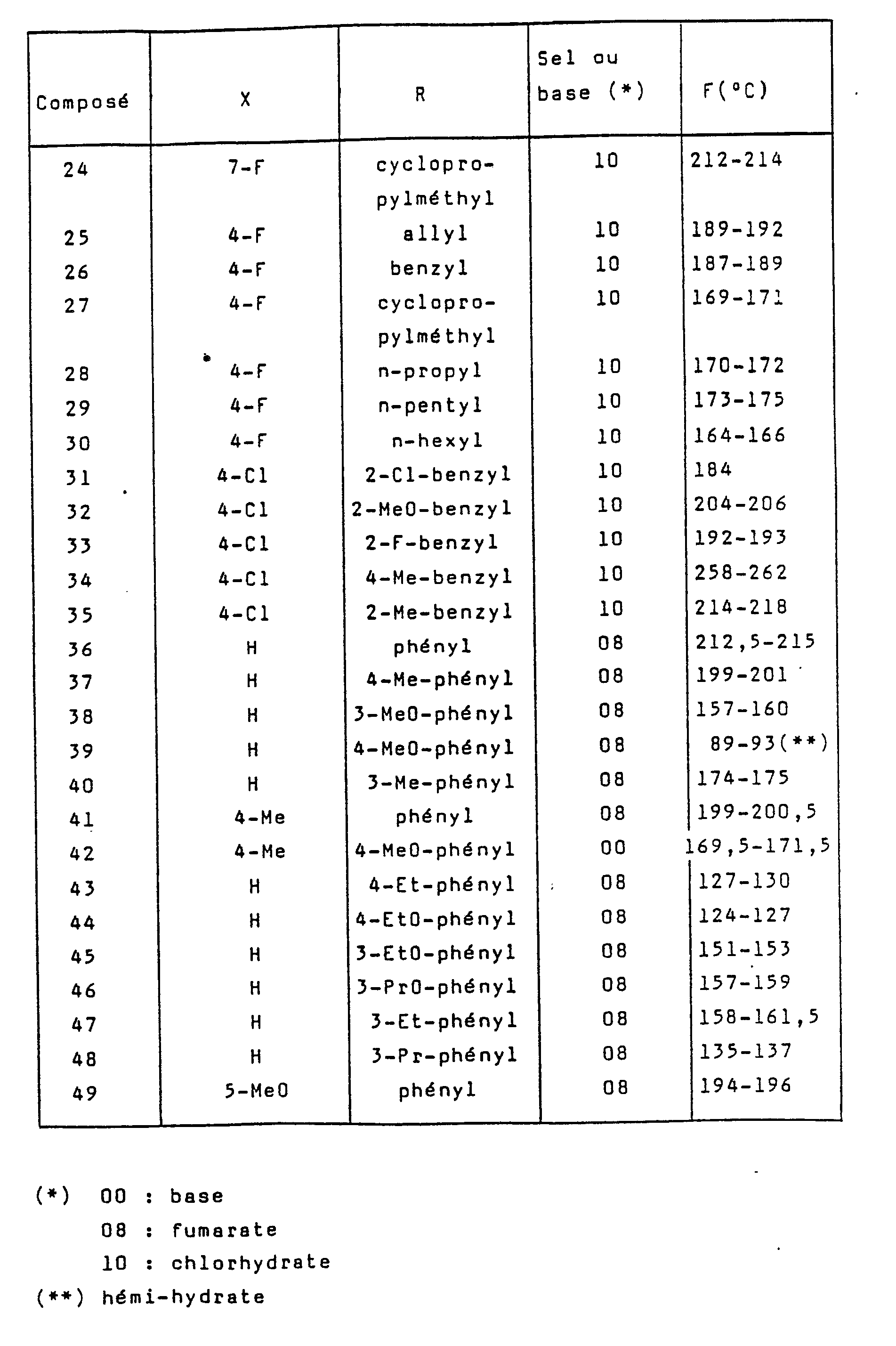
- Le tableau ci-après illustre les structures et propriétés physiques de quelques composés selon l'intervention.

- Les composés de l'invention ont été soumis à des essais pharmacologiques qui ont montré leur intérêt en tant que a2-antagonistes.
- A cet effet les composés ont été étudiés dans le test de potentialité et de sélectivité des antagonistes à l'égard des récepteurs a2 in vitro.
- La détermination de la valeur pA2 à l'égard des effets inhibiteurs de la clonidine, a2-agoniste bien connu, a eu lieu sur le vas deferens du rat stimulé à une fréquence de 0,1 Hz en présence de 300 nM de prazosine et de 1 pM de cocaïne, selon la méthode décrite par G. M. Drew (European Journal of Pharmacology, 42, (1977) 123-130).
- Les pA2 des composés de l'invention sont compris entre 6 et 11.
- Les composés de l'invention sont des a2-antagonistes puissants qui peuvent être utilisés pour le traitement de la dépression (soit seuls, soit en association avec un produit qui inhibe les mécanismes de captation neuronale), le traitement de l'hypotension, le traitement de l'ileum paralytique post-opératoire, le traitement de l'asthme et de l'obésité, le traitement du diabète, le traitement de l'impuissance.
- Par ailleurs certains des composés de l'invention sont également des α1-agonistes qui présentent de l'intérêt comme vasoconstricteurs nasals.
- Certains des composés sont des substances qui contractent puissamment in vitro, une préparation d'artère pulmonaire de lapin (préparation contenant au niveau post synaptique seulement des récepteurs α1), selon Starke et al, 1975, Naunyn Schmiedeberg's Arch. Pharmacol., 291, 55-78.
- La concentration de composé (I) nécessaire pour obtenir 50% de la contraction maximum (CE 50) va de 10 µM à 0,1 pM.
- Ces composés sont bien des agonistes des récepteurs a1, car les contractions qu'ils induisent sur la préparation d'artère pulmonaire de lapin sont antagonisées par la prazosine, antagoniste des récepteurs α1.
- Ils peuvent donc être utilisés en thérapeutique par exemple comme vasoconstricteurs nasals.
- Les compositions pharmaceutiques à activités a2-antagonistes peuvent être sous forme appropriée pour l'administration par voie orale, rectale ou parentérale; par exemple sous la forme de capsules, comprimés, granulés, gélules ou solutés liquides, sirops ou suspensions buvables, et contenir les excipients appropriés.
- Les compositions pharmaceutiques à activités α1-agonistes, utilisables pour le traitement des congestions nasales, peuvent être sous une forme appropriée pour l'administration par voie externe ou locale, par exemple sous la forme d'aérosols ou de solutions pulvérisables, et contenir les excipients appropriés.
- La posologie quotidienne péut aller de 0,1 à 10 mg/kg p.o.
Claims (10)

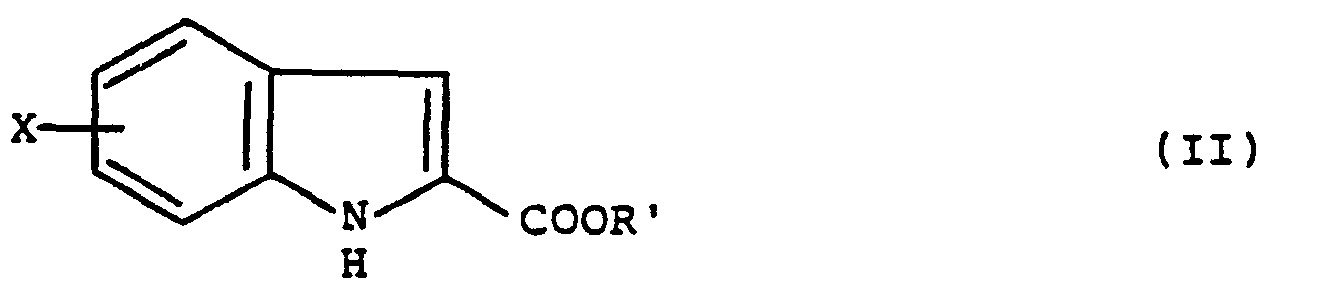

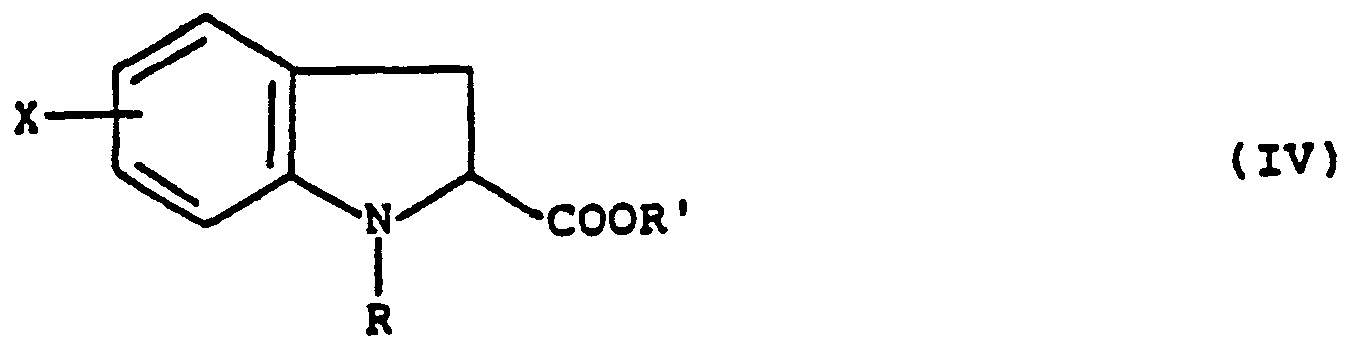
R' étant un radical (C1-4)alkyle, et X et R ayant les significations données ci-dessus.




Priority Applications (1)
| Application Number | Priority Date | Filing Date | Title |
|---|---|---|---|
| AT86400200T ATE60601T1 (de) | 1985-02-08 | 1986-01-31 | (dihydro-4,5-1h-imidazolyl-2)-2-dihydro-2,3indolderivate, ihre herstellung und anwendung als heilmittel. |
Applications Claiming Priority (4)
| Application Number | Priority Date | Filing Date | Title |
|---|---|---|---|
| FR8501774 | 1985-02-08 | ||
| FR8501774A FR2577223B1 (fr) | 1985-02-08 | 1985-02-08 | Derives de l'indole, leur preparation et leur application en therapeutique |
| FR8501775 | 1985-02-08 | ||
| FR8501775A FR2577224B1 (fr) | 1985-02-08 | 1985-02-08 | Derives de phenyl-1 indole, leur preparation et leur application en therapeutique |
Publications (3)
| Publication Number | Publication Date |
|---|---|
| EP0211698A2 EP0211698A2 (fr) | 1987-02-25 |
| EP0211698A3 EP0211698A3 (en) | 1988-12-14 |
| EP0211698B1 true EP0211698B1 (fr) | 1991-01-30 |
Family
ID=26224367
Family Applications (1)
| Application Number | Title | Priority Date | Filing Date |
|---|---|---|---|
| EP86400200A Expired - Lifetime EP0211698B1 (fr) | 1985-02-08 | 1986-01-31 | Dérivés de (dihydro-4,5 1H-imidazolyl-2)-2 dihydro-2,3 indole, leur préparation et leur application en thérapeutique |
Country Status (13)
| Country | Link |
|---|---|
| US (1) | US4659731A (fr) |
| EP (1) | EP0211698B1 (fr) |
| AU (1) | AU575711B2 (fr) |
| CA (1) | CA1273939A (fr) |
| DE (1) | DE3677277D1 (fr) |
| DK (1) | DK60486A (fr) |
| ES (2) | ES8707226A1 (fr) |
| FI (1) | FI80690C (fr) |
| GR (1) | GR860363B (fr) |
| HU (1) | HU195212B (fr) |
| NO (1) | NO164899C (fr) |
| NZ (1) | NZ215070A (fr) |
| PT (1) | PT81992B (fr) |
Families Citing this family (10)
| Publication number | Priority date | Publication date | Assignee | Title |
|---|---|---|---|---|
| US4912125A (en) * | 1985-09-03 | 1990-03-27 | Ciba-Geigy Corporation | 2,3-dihydro-2-(4,5-dihydroimidazol-2-yl)-indoles for reducing intraocular pressure |
| US4908376A (en) * | 1985-09-03 | 1990-03-13 | Ciba-Geigy Corporation | 2,3-dihydro-2-(4,5-dihydroimidazol-2-yl)-indoles in composition form for reducing intraocular pressure |
| DE3935514A1 (de) * | 1989-10-25 | 1991-05-02 | Boehringer Mannheim Gmbh | Neue bicyclo-imidazole, verfahren zu ihrer herstellung und diese verbindungen enthaltende arzneimittel |
| GB9012469D0 (en) * | 1990-06-05 | 1990-07-25 | Glaxo Group Ltd | Medicaments |
| GB9022858D0 (en) * | 1990-10-20 | 1990-12-05 | Reckitt & Colmann Prod Ltd | Derivatives of indoles |
| TW229140B (fr) * | 1992-06-05 | 1994-09-01 | Shell Internat Res Schappej B V | |
| US5677321A (en) | 1996-02-29 | 1997-10-14 | Synaptic Pharmaceutical Corporation | 5- and 6-(2-imidazolin-2-ylamino) and -(2-thiazolin-2-ylamino)-benzothiazoles as alpha-2 adrenergic ligands |
| ES2198033T3 (es) * | 1997-12-19 | 2004-01-16 | Eli Lilly And Company | Compuestos de imidazolina hipoglucemicos. |
| US6410562B1 (en) | 1998-12-18 | 2002-06-25 | Eli Lilly And Company | Hypoglycemic imidazoline compounds |
| CA2627426A1 (fr) * | 2005-11-11 | 2007-05-18 | Markus Boehringer | Nouvelles amines cycliques fusionnees a un carbocyclyle |
Citations (1)
| Publication number | Priority date | Publication date | Assignee | Title |
|---|---|---|---|---|
| EP0141686A1 (fr) * | 1983-08-11 | 1985-05-15 | Synthelabo | Dérivés de l'indole, leur préparation et leur application en thérapeutique |
Family Cites Families (3)
| Publication number | Priority date | Publication date | Assignee | Title |
|---|---|---|---|---|
| US3586695A (en) * | 1968-01-26 | 1971-06-22 | Dow Chemical Co | Substituted imidazolinyl indoles |
| DE3047388A1 (de) * | 1980-12-16 | 1982-07-15 | Basf Ag, 6700 Ludwigshafen | Isatogenderivate, verfahren zu ihrer herstellung und ihre verwendung als fungizide |
| DE3141063A1 (de) * | 1981-10-13 | 1983-04-28 | Schering Ag, 1000 Berlin Und 4619 Bergkamen | Neue imidazol-derivate, verfahren zu ihrer herstellung und diese enthaltende pharmazeutische praeparate |
-
1986
- 1986-01-31 DE DE8686400200T patent/DE3677277D1/de not_active Expired - Fee Related
- 1986-01-31 EP EP86400200A patent/EP0211698B1/fr not_active Expired - Lifetime
- 1986-02-05 US US06/826,500 patent/US4659731A/en not_active Expired - Fee Related
- 1986-02-07 NO NO860429A patent/NO164899C/no unknown
- 1986-02-07 AU AU53303/86A patent/AU575711B2/en not_active Ceased
- 1986-02-07 CA CA000501356A patent/CA1273939A/fr not_active Expired - Fee Related
- 1986-02-07 FI FI860561A patent/FI80690C/fi not_active IP Right Cessation
- 1986-02-07 GR GR860363A patent/GR860363B/el unknown
- 1986-02-07 HU HU86523A patent/HU195212B/hu not_active IP Right Cessation
- 1986-02-07 DK DK60486A patent/DK60486A/da not_active Application Discontinuation
- 1986-02-07 ES ES551733A patent/ES8707226A1/es not_active Expired
- 1986-02-07 PT PT81992A patent/PT81992B/pt not_active IP Right Cessation
- 1986-02-07 NZ NZ215070A patent/NZ215070A/xx unknown
-
1987
- 1987-02-06 ES ES557370A patent/ES8802515A1/es not_active Expired
Patent Citations (1)
| Publication number | Priority date | Publication date | Assignee | Title |
|---|---|---|---|---|
| EP0141686A1 (fr) * | 1983-08-11 | 1985-05-15 | Synthelabo | Dérivés de l'indole, leur préparation et leur application en thérapeutique |
Also Published As
| Publication number | Publication date |
|---|---|
| HUT40112A (en) | 1986-11-28 |
| NO164899C (no) | 1990-11-28 |
| DK60486A (da) | 1986-08-09 |
| US4659731A (en) | 1987-04-21 |
| FI80690C (fi) | 1990-07-10 |
| FI860561L (fi) | 1986-08-09 |
| FI860561A0 (fi) | 1986-02-07 |
| FI80690B (fi) | 1990-03-30 |
| DK60486D0 (da) | 1986-02-07 |
| NO164899B (no) | 1990-08-20 |
| ES8802515A1 (es) | 1988-06-16 |
| AU5330386A (en) | 1986-08-14 |
| ES557370A0 (es) | 1988-06-16 |
| PT81992A (fr) | 1986-03-01 |
| PT81992B (pt) | 1988-07-01 |
| AU575711B2 (en) | 1988-08-04 |
| GR860363B (en) | 1986-06-10 |
| ES8707226A1 (es) | 1987-07-16 |
| ES551733A0 (es) | 1987-07-16 |
| DE3677277D1 (de) | 1991-03-07 |
| NO860429L (no) | 1986-08-11 |
| EP0211698A2 (fr) | 1987-02-25 |
| NZ215070A (en) | 1988-08-30 |
| EP0211698A3 (en) | 1988-12-14 |
| HU195212B (en) | 1988-04-28 |
| CA1273939A (fr) | 1990-09-11 |
Similar Documents
| Publication | Publication Date | Title |
|---|---|---|
| EP0591057B1 (fr) | Arylalkyl(thio)amides ayant une affinité sélective pour les récepteurs de la mélatonine et leur procédé de préparation | |
| EP0610134B1 (fr) | Dérivés de l'indole comme 5-Ht1-like agonistes | |
| EP0307303B1 (fr) | [(Pyrimidinyl-2)-aminoalkyl]-1 pipéridines, leur préparation et leur application en thérapeutique | |
| EP0636609A1 (fr) | Dérivés du 1-benzyl-1,3-dihydro-indol-2-one, leur préparation, les compositions pharmaceutiques en contenant | |
| EP0302788A1 (fr) | Dérivés de [(pipéridinyl-4)méthyl]-2 tétrahydro-1,2,3,4 9H-pyrido[3,4-b]indole, leur préparation et leur application en thérapeutique | |
| JPH08501575A (ja) | エルゴチオネインの新規合成方法 | |
| EP0217700A1 (fr) | Derives de benzimidazole, leur preparation et leur application en therapeutique | |
| EP0488897B1 (fr) | Nouveaux dérivés de guanidine, leur procédé de préparation et les compositions pharmaceutiques qui les contiennent | |
| EP0540400A1 (fr) | Dérivés de quinoléine, utile comme angiotensine II antagonistes | |
| EP0211698B1 (fr) | Dérivés de (dihydro-4,5 1H-imidazolyl-2)-2 dihydro-2,3 indole, leur préparation et leur application en thérapeutique | |
| EP0538080A1 (fr) | Dérivés de l'aminométhyl-4 pipéridine, leur préparation et leur application en thérapeutique | |
| CA1315283C (fr) | Amines tricycliques derivees du tetrahydro-5,6,7,8 naphto ¬2,3b| dihydro-2,3 furanne, et du tetrahydro-6,7,8,9 5h-benzocyclohepta ¬2,3b| dihydro-2,3 furanne, leurs procedes de preparation et les compositions pharmaceutiques qui les contiennent | |
| FR2660657A1 (fr) | Nouveaux derives du 3-aminochromane, leur procede de preparation et les compositions pharmaceutiques qui les contiennent. | |
| EP0486385B1 (fr) | Dérivés d'imidazole, leur procédé de préparation et les compositions pharmaceutiques qui les contiennent | |
| EP0301936B1 (fr) | Dérivés de pipéridine, leur préparation et leur application en thérapeutique | |
| EP0141686B1 (fr) | Dérivés de l'indole, leur préparation et leur application en thérapeutique | |
| FR2558835A1 (fr) | Derives d'hydantoine, leur procede de production et medicament les contenant | |
| EP0638568B1 (fr) | Pipérazines substituées, leur procédé de préparation et les compositions pharmaceutiques les contenant | |
| FR2600647A1 (fr) | Derives de la glycine | |
| CA1313871C (fr) | Derives de l'acide (dihydro-2,3 oxo-2 benzofurannyl-3)-2 acetique, leurs procedes de preparation et les compositions pharmaceutiques qui les contiennent | |
| CA2408290A1 (fr) | Indanylimidazoles polycycliques a activite alpha2 adrenergique | |
| EP0302787B1 (fr) | Dérivés de (pipéridinyl-4)méthyl-2 benzofuro[2,3-c]pyridines, leur préparation et leur application en thérapeutique | |
| FR2702211A1 (fr) | Nouveaux dérivés de la phénoxy-2 éthylamine, leur préparation et leur application en thérapeutique. | |
| AU2001258469A1 (en) | New polycyclic indanylimidazoles with alpha2 adrenergic activity | |
| EP0145591B1 (fr) | Dérivés de pyrrolo[3,2,1-hi]indole, leur préparation et leur application en thérapeutique |
Legal Events
| Date | Code | Title | Description |
|---|---|---|---|
| PUAI | Public reference made under article 153(3) epc to a published international application that has entered the european phase |
Free format text: ORIGINAL CODE: 0009012 |
|
| AK | Designated contracting states |
Kind code of ref document: A2 Designated state(s): AT BE CH DE FR GB IT LI LU NL SE |
|
| PUAL | Search report despatched |
Free format text: ORIGINAL CODE: 0009013 |
|
| AK | Designated contracting states |
Kind code of ref document: A3 Designated state(s): AT BE CH DE FR GB IT LI LU NL SE |
|
| 17P | Request for examination filed |
Effective date: 19881128 |
|
| 17Q | First examination report despatched |
Effective date: 19900530 |
|
| GRAA | (expected) grant |
Free format text: ORIGINAL CODE: 0009210 |
|
| AK | Designated contracting states |
Kind code of ref document: B1 Designated state(s): AT BE CH DE FR GB IT LI LU NL SE |
|
| REF | Corresponds to: |
Ref document number: 60601 Country of ref document: AT Date of ref document: 19910215 Kind code of ref document: T |
|
| ITF | It: translation for a ep patent filed | ||
| GBT | Gb: translation of ep patent filed (gb section 77(6)(a)/1977) | ||
| REF | Corresponds to: |
Ref document number: 3677277 Country of ref document: DE Date of ref document: 19910307 |
|
| PLBE | No opposition filed within time limit |
Free format text: ORIGINAL CODE: 0009261 |
|
| STAA | Information on the status of an ep patent application or granted ep patent |
Free format text: STATUS: NO OPPOSITION FILED WITHIN TIME LIMIT |
|
| PGFP | Annual fee paid to national office [announced via postgrant information from national office to epo] |
Ref country code: SE Payment date: 19911230 Year of fee payment: 7 Ref country code: AT Payment date: 19911230 Year of fee payment: 7 |
|
| PGFP | Annual fee paid to national office [announced via postgrant information from national office to epo] |
Ref country code: BE Payment date: 19920107 Year of fee payment: 7 |
|
| PGFP | Annual fee paid to national office [announced via postgrant information from national office to epo] |
Ref country code: LU Payment date: 19920108 Year of fee payment: 7 |
|
| PGFP | Annual fee paid to national office [announced via postgrant information from national office to epo] |
Ref country code: GB Payment date: 19920117 Year of fee payment: 7 |
|
| PGFP | Annual fee paid to national office [announced via postgrant information from national office to epo] |
Ref country code: FR Payment date: 19920121 Year of fee payment: 7 |
|
| 26N | No opposition filed | ||
| PGFP | Annual fee paid to national office [announced via postgrant information from national office to epo] |
Ref country code: CH Payment date: 19920124 Year of fee payment: 7 |
|
| PGFP | Annual fee paid to national office [announced via postgrant information from national office to epo] |
Ref country code: DE Payment date: 19920130 Year of fee payment: 7 |
|
| PGFP | Annual fee paid to national office [announced via postgrant information from national office to epo] |
Ref country code: NL Payment date: 19920131 Year of fee payment: 7 |
|
| EPTA | Lu: last paid annual fee | ||
| PG25 | Lapsed in a contracting state [announced via postgrant information from national office to epo] |
Ref country code: LU Free format text: LAPSE BECAUSE OF NON-PAYMENT OF DUE FEES Effective date: 19930131 Ref country code: LI Effective date: 19930131 Ref country code: GB Effective date: 19930131 Ref country code: CH Effective date: 19930131 Ref country code: BE Effective date: 19930131 Ref country code: AT Effective date: 19930131 |
|
| PG25 | Lapsed in a contracting state [announced via postgrant information from national office to epo] |
Ref country code: SE Effective date: 19930201 |
|
| BERE | Be: lapsed |
Owner name: SYNTHELABO Effective date: 19930131 |
|
| PG25 | Lapsed in a contracting state [announced via postgrant information from national office to epo] |
Ref country code: NL Effective date: 19930801 |
|
| NLV4 | Nl: lapsed or anulled due to non-payment of the annual fee | ||
| GBPC | Gb: european patent ceased through non-payment of renewal fee |
Effective date: 19930131 |
|
| PG25 | Lapsed in a contracting state [announced via postgrant information from national office to epo] |
Ref country code: FR Effective date: 19930930 |
|
| REG | Reference to a national code |
Ref country code: CH Ref legal event code: PL |
|
| PG25 | Lapsed in a contracting state [announced via postgrant information from national office to epo] |
Ref country code: DE Effective date: 19931001 |
|
| REG | Reference to a national code |
Ref country code: FR Ref legal event code: ST |
|
| EUG | Se: european patent has lapsed |
Ref document number: 86400200.1 Effective date: 19930912 |
|
| PG25 | Lapsed in a contracting state [announced via postgrant information from national office to epo] |
Ref country code: IT Free format text: LAPSE BECAUSE OF NON-PAYMENT OF DUE FEES;WARNING: LAPSES OF ITALIAN PATENTS WITH EFFECTIVE DATE BEFORE 2007 MAY HAVE OCCURRED AT ANY TIME BEFORE 2007. THE CORRECT EFFECTIVE DATE MAY BE DIFFERENT FROM THE ONE RECORDED. Effective date: 20050131 |