EP0211468A2 - Vorrichtung zur Herstellung von abwechselnden monomolekularen Schichten - Google Patents
Vorrichtung zur Herstellung von abwechselnden monomolekularen Schichten Download PDFInfo
- Publication number
- EP0211468A2 EP0211468A2 EP86201506A EP86201506A EP0211468A2 EP 0211468 A2 EP0211468 A2 EP 0211468A2 EP 86201506 A EP86201506 A EP 86201506A EP 86201506 A EP86201506 A EP 86201506A EP 0211468 A2 EP0211468 A2 EP 0211468A2
- Authority
- EP
- European Patent Office
- Prior art keywords
- substrate
- liquid
- tank
- compartment
- monomolecular layers
- Prior art date
- Legal status (The legal status is an assumption and is not a legal conclusion. Google has not performed a legal analysis and makes no representation as to the accuracy of the status listed.)
- Granted
Links
Images


Classifications
-
- B—PERFORMING OPERATIONS; TRANSPORTING
- B82—NANOTECHNOLOGY
- B82Y—SPECIFIC USES OR APPLICATIONS OF NANOSTRUCTURES; MEASUREMENT OR ANALYSIS OF NANOSTRUCTURES; MANUFACTURE OR TREATMENT OF NANOSTRUCTURES
- B82Y30/00—Nanotechnology for materials or surface science, e.g. nanocomposites
-
- B—PERFORMING OPERATIONS; TRANSPORTING
- B05—SPRAYING OR ATOMISING IN GENERAL; APPLYING FLUENT MATERIALS TO SURFACES, IN GENERAL
- B05C—APPARATUS FOR APPLYING FLUENT MATERIALS TO SURFACES, IN GENERAL
- B05C3/00—Apparatus in which the work is brought into contact with a bulk quantity of liquid or other fluent material
- B05C3/02—Apparatus in which the work is brought into contact with a bulk quantity of liquid or other fluent material the work being immersed in the liquid or other fluent material
-
- B—PERFORMING OPERATIONS; TRANSPORTING
- B05—SPRAYING OR ATOMISING IN GENERAL; APPLYING FLUENT MATERIALS TO SURFACES, IN GENERAL
- B05C—APPARATUS FOR APPLYING FLUENT MATERIALS TO SURFACES, IN GENERAL
- B05C3/00—Apparatus in which the work is brought into contact with a bulk quantity of liquid or other fluent material
- B05C3/02—Apparatus in which the work is brought into contact with a bulk quantity of liquid or other fluent material the work being immersed in the liquid or other fluent material
- B05C3/09—Apparatus in which the work is brought into contact with a bulk quantity of liquid or other fluent material the work being immersed in the liquid or other fluent material for treating separate articles
-
- B—PERFORMING OPERATIONS; TRANSPORTING
- B05—SPRAYING OR ATOMISING IN GENERAL; APPLYING FLUENT MATERIALS TO SURFACES, IN GENERAL
- B05D—PROCESSES FOR APPLYING FLUENT MATERIALS TO SURFACES, IN GENERAL
- B05D1/00—Processes for applying liquids or other fluent materials
- B05D1/18—Processes for applying liquids or other fluent materials performed by dipping
- B05D1/20—Processes for applying liquids or other fluent materials performed by dipping substances to be applied floating on a fluid
- B05D1/202—Langmuir Blodgett films (LB films)
- B05D1/206—LB troughs
-
- B—PERFORMING OPERATIONS; TRANSPORTING
- B82—NANOTECHNOLOGY
- B82Y—SPECIFIC USES OR APPLICATIONS OF NANOSTRUCTURES; MEASUREMENT OR ANALYSIS OF NANOSTRUCTURES; MANUFACTURE OR TREATMENT OF NANOSTRUCTURES
- B82Y40/00—Manufacture or treatment of nanostructures
-
- H—ELECTRICITY
- H01—ELECTRIC ELEMENTS
- H01B—CABLES; CONDUCTORS; INSULATORS; SELECTION OF MATERIALS FOR THEIR CONDUCTIVE, INSULATING OR DIELECTRIC PROPERTIES
- H01B19/00—Apparatus or processes specially adapted for manufacturing insulators or insulating bodies
- H01B19/04—Treating the surfaces, e.g. applying coatings
Definitions
- the present invention relates to methods of manufacturing and depositing on a substrate of monomolecular layers and more specifically relates to a device allowing the production of alternating monomolecular layers, that is to say sequences of layers of two different materials.
- the monomolecular layers in particular of organic compounds, find numerous applications, particularly in the field of electronics where they make it possible to produce metal-insulator-metal structures in which the insulator layer has a perfectly controlled and defined thickness.
- the best known method for producing monomolecular layers is the so-called "Langmuir-Blodgett” method which consists in spreading a solution of the molecule to be deposited on the surface of a liquid, generally water.
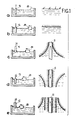
- Figures 1a to 1e illustrate this method.
- the solution spreads on the surface (FIG. 1a ), then the solvent is allowed to evaporate to form the monomolecular layer which is then compressed to a surface pressure determined by displacement of a floating barrier B (FIG. 1b ).
- the deposition is carried out by immersing and raising the substrate S in the water of the tank through this monomolecular layer (FIGS. 1c , 1d and 1e ).
- the molecules of the layer to be deposited are amphiphilic molecules, that is to say that they have both a hydrophilic part and a hydrophobic part: after evaporation of the solvent, the molecules are oriented so that the hydrophilic part is against the surface of the water while the hydrophobic part tends to move away from said surface ( Figure 1b ).
- the hydrophobic part consists of an inert aliphatic chain and the hydrophilic part contains the active part of the molecule.
- the usual practice for compressing the monomolecular layer consists in displacing a floating barrier on the surface of the liquid as the deposition is carried out on the substrate in order to maintain the surface pressure at the desired value.
- the movable barrier is returned to its starting position in order to be able to repeat the operation by introducing a new quantity of solvent on the surface of the water.
- French patent n ° 2 341 199 belonging to the applicant, describes an improvement to this method thanks to rotating rollers partially immersed in the water of a compartmentalized tank which make it possible to transfer the monomolecular layer from one compartment to the other under pressure: it is thus possible to carry out continuous deposition on plastic or metal strips.
- the film which can be obtained by either of these two methods can be transferred to a solid substrate by simply passing said substrate through the surface of the water.
- By successive immersions and emersions, other monomolecular layers identical to the first can be deposited, the hydrophilic part of one layer being in contact with the hydrophilic part of the next layer, the same for the hydrophobic parts.
- the deposit thus obtained bears the name of Langmuir-Blodgett film or LB film
- this method still has a drawback: if it allows the continuous deposition to be carried out, it only makes it possible to manufacture Langmuir-Blodgett layers which are identical to each other. We can also consider the successive use of two independent tanks with transfer of the sample by air, but we can only carry out sequences "two by two" and not "alternating" since the hydrophilic parts in contact necessarily belong to two molecules identical.
- the object of the present invention is precisely to remedy these drawbacks by means of a device which makes it possible to produce alternating monomolecular layers, that is to say that the hydrophilic part of a monomolecular layer of a first material is in contact with the hydrophilic part of a monomolecular layer of a second material different from the first.
- One of the materials (A) can be a molecule and the other (B) a different molecule.
- the materials may also be mixtures, one of which may contain certain constituents of the other or, optionally, all of them.
- the device which is the subject of the invention comprises, in a known manner: a tank separated into two compartments by a partition, at least part of which has a shape such that it allows the substrate to pass from one compartment to the other inside the liquid, and - Means for transferring the substrate from one compartment to another.
- said partition which is located partially above and below the surface of the liquid, has an opening allowing the substrate to pass from one compartment to the other and the means for transferring said substrate comprise: - a lifting system making it possible to move the substrate both vertically and horizontally, and - Two sets of two elastic blades arranged in the vicinity of the surface of the liquid, at the opening, on each of the faces of the partition corresponding to the two compartments.
- the device essentially comprises two tanks 2 and 4 which are joined by a common wall part 6 and can therefore be considered as two compartments of a single tank 3.
- the wall 6 has an opening 7 which allows communication between the two compartments, the upper part of the opening 7 being equipped with a device 16 which will be described later with reference to FIG. 3 and which prevents any contact between the monomolecular layers located in each of the compartments 2 and 4 respectively.
- a barrier floating 8 movable in the direction of arrow F1 on the surface of the liquid contained in the tank 2 allows the compression of the monomolecular layer 9 contained in this tank 2 while a floating barrier 10 movable in the direction of arrow F2 at the surface of the liquid contained in compartment 4 allows the compression of the monomolecular layer 11 contained in this compartment.
- a substrate or sample 12 is introduced into the part of the tank 2 containing the monomolecular layer 9 using lifting means 14 shown schematically in phantom in the figure and which allow the sample 12 to be moved both in a vertical direction and in a horizontal direction.
- lifting means 14 shown schematically in phantom in the figure and which allow the sample 12 to be moved both in a vertical direction and in a horizontal direction.
- FIG. 3 illustrates in more detail the means for transferring the substrate from one compartment to another or from one tank to another.
- the tanks 2 and 4 separated by the partition 6 which has an opening 7.
- This is closed, in the vicinity of the surface of the liquid, by two sets of two elastic blades fixed on each of the faces of the partition 6, namely a first set of two blades 26 and 28 on the side of the tank 2 and a second set of two blades 27 and 29 on the side of the tank 4.
- the partition 6 and the elastic blades each have a part located inside the liquid and a part located outside the liquid.
- the blades are normally in the closed position like the blades 27 and 29 in FIG. 3 in order to define an airlock and to prevent any communication between the monomolecular layers contained in each of the tanks respectively.
- the lifting means 14 When the first layer has been deposited in the tank 2, the lifting means 14 are moved in the direction of the opening 7.
- the movement of the assembly has the effect of causing the opening of the first blades 26 and 28 , which allows the support 14 to enter the airlock: of course, in this case, the support 14 must be constituted by a rigid rod in order to ensure the spacing of the blades.
- a clamp 15 at the lower part of the rod 14 makes it possible to maintain the sample 12 which, here, is in the form of a rectangular plate.
- the cleaning can be done for example using a capillary whose movements are controlled by the means of displacement of the rod 14: it is not necessary to mark a downtime in the airlock and very short transfer times are obtained, of the order of 20 seconds.
- FIG. 4 shows various sequences which it is possible to obtain with the device which is the subject of the invention and which were impossible to obtain with the devices of the prior art.
- Figure 4 corresponds to the case where we deposit monomolecular layers of two different materials A and B.
- the molecules of the first material A consist of a hydrophilic part A1 represented schematically in the form of a circle and a hydrophobic part A2 represented in the form of a solid line.
- the molecules of the second material B consist of a hydrophilic part B1 represented schematically by a square and a hydrophobic part B2 represented schematically by a solid line.
- the sequence which has been carried out comprises two molecules A oriented in opposite directions, then two molecules B also oriented in opposite directions, then two molecules A always oriented in opposite directions and so on, the hydrophilic part of a molecule A being in contact with the hydrophilic part of a molecule B while two hydrophobic parts in contact belong to two identical molecules: this result is obtained by transfers from compartment to compartment underwater only.
- the device which is the subject of the invention has particularly advantageous advantages since it is possible to produce alternating monomolecular layers with different combinations of molecular orientation in a simple and rapid manner, the transfer times from one tank to another being very reduced. It is therefore not only possible to carry out sequences of successive molecules in superimposed monomolecular layers, but also vectorially orient the molecules in each layer. In addition, this device is simple and easy to produce, which leads to a low cost of the installation.
- the compression of the monomolecular layers can be done either by the classic Langmuir-Blodgett method, or by the method with rotating rollers illustrated in French patent n ° 2,341,199 mentioned at the beginning of this description. .
Landscapes
- Engineering & Computer Science (AREA)
- Chemical & Material Sciences (AREA)
- Nanotechnology (AREA)
- Crystallography & Structural Chemistry (AREA)
- Condensed Matter Physics & Semiconductors (AREA)
- General Physics & Mathematics (AREA)
- Physics & Mathematics (AREA)
- Materials Engineering (AREA)
- Composite Materials (AREA)
- Manufacturing & Machinery (AREA)
- Coating Apparatus (AREA)
- Physical Or Chemical Processes And Apparatus (AREA)
- Liquid Deposition Of Substances Of Which Semiconductor Devices Are Composed (AREA)
- Application Of Or Painting With Fluid Materials (AREA)
- Laminated Bodies (AREA)
Applications Claiming Priority (2)
| Application Number | Priority Date | Filing Date | Title |
|---|---|---|---|
| FR8303578 | 1983-03-04 | ||
| FR8303578A FR2541936B1 (fr) | 1983-03-04 | 1983-03-04 | Procede et dispositif pour la realisation de couches monomoleculaires alternees |
Related Parent Applications (2)
| Application Number | Title | Priority Date | Filing Date |
|---|---|---|---|
| EP84400384A Division EP0119126B1 (de) | 1983-03-04 | 1984-02-27 | Verfahren und Vorrichtung zur Herstellung von abwechselnden monomolekularen Schichten |
| EP84400384A Division-Into EP0119126B1 (de) | 1983-03-04 | 1984-02-27 | Verfahren und Vorrichtung zur Herstellung von abwechselnden monomolekularen Schichten |
Publications (3)
| Publication Number | Publication Date |
|---|---|
| EP0211468A2 true EP0211468A2 (de) | 1987-02-25 |
| EP0211468A3 EP0211468A3 (en) | 1987-03-18 |
| EP0211468B1 EP0211468B1 (de) | 1989-03-08 |
Family
ID=9286502
Family Applications (3)
| Application Number | Title | Priority Date | Filing Date |
|---|---|---|---|
| EP86201507A Expired EP0212762B1 (de) | 1983-03-04 | 1984-02-27 | Vorrichtung zur Herstellung von abwechselnden monomolekularen Schichten |
| EP86201506A Expired EP0211468B1 (de) | 1983-03-04 | 1984-02-27 | Vorrichtung zur Herstellung von abwechselnden monomolekularen Schichten |
| EP84400384A Expired EP0119126B1 (de) | 1983-03-04 | 1984-02-27 | Verfahren und Vorrichtung zur Herstellung von abwechselnden monomolekularen Schichten |
Family Applications Before (1)
| Application Number | Title | Priority Date | Filing Date |
|---|---|---|---|
| EP86201507A Expired EP0212762B1 (de) | 1983-03-04 | 1984-02-27 | Vorrichtung zur Herstellung von abwechselnden monomolekularen Schichten |
Family Applications After (1)
| Application Number | Title | Priority Date | Filing Date |
|---|---|---|---|
| EP84400384A Expired EP0119126B1 (de) | 1983-03-04 | 1984-02-27 | Verfahren und Vorrichtung zur Herstellung von abwechselnden monomolekularen Schichten |
Country Status (4)
| Country | Link |
|---|---|
| US (1) | US4511604A (de) |
| EP (3) | EP0212762B1 (de) |
| JP (1) | JPS59183861A (de) |
| FR (1) | FR2541936B1 (de) |
Cited By (1)
| Publication number | Priority date | Publication date | Assignee | Title |
|---|---|---|---|---|
| EP0332786A3 (en) * | 1988-03-16 | 1990-03-14 | Kabushiki Kaisha Toshiba | Method and apparatus for manufacturing organic thin film |
Families Citing this family (40)
| Publication number | Priority date | Publication date | Assignee | Title |
|---|---|---|---|---|
| US4674436A (en) * | 1984-04-19 | 1987-06-23 | Canon Kabushiki Kaisha | Film forming apparatus |
| JPS60222168A (ja) * | 1984-04-19 | 1985-11-06 | Canon Inc | 成膜装置 |
| JPS60222167A (ja) * | 1984-04-19 | 1985-11-06 | Canon Inc | 成膜方法及びその装置 |
| US4785762A (en) * | 1984-04-19 | 1988-11-22 | Canon Kabushiki Kaisha | Apparatus for forming film |
| FR2564004B1 (fr) * | 1984-05-10 | 1993-04-09 | Commissariat Energie Atomique | Procede de fabrication d'un film mince comportant au moins une couche monomoleculaire de molecules non amphiphiles |
| GB8417959D0 (en) * | 1984-07-14 | 1984-08-15 | Nima Technology Ltd | Barrier system |
| US4716851A (en) * | 1984-08-06 | 1988-01-05 | Canon Kabushiki Kaisha | Curved surface shaping apparatus and curved surface shaping method using the same |
| US4643125A (en) * | 1984-11-13 | 1987-02-17 | Vickers Public Limited Company | Barriers |
| DE3573080D1 (en) * | 1984-11-13 | 1989-10-26 | Joyce Loebl Limited | Assembly and method for langmuir-blodgett film production |
| US4840821A (en) * | 1985-05-27 | 1989-06-20 | Canon Kabushiki Kaisha | Method of and apparatus for forming film |
| JPS6261673A (ja) * | 1985-09-11 | 1987-03-18 | Kanegafuchi Chem Ind Co Ltd | 製膜方法 |
| GB8527213D0 (en) * | 1985-11-05 | 1985-12-11 | British Petroleum Co Plc | Separation process |
| US4722856A (en) * | 1986-01-02 | 1988-02-02 | Molecular Electronics Corporation | Method and apparatus for depositing monomolecular layers on a substrate |
| US4779562A (en) * | 1986-03-19 | 1988-10-25 | Fujitsu Limited | Apparatus for depositing mono-molecular layer |
| GB8610025D0 (en) * | 1986-04-24 | 1986-05-29 | Unilever Plc | Silica films |
| JPS62274732A (ja) * | 1986-05-23 | 1987-11-28 | Nippon Les-The Denshi Kk | 基板上への薄膜付着装置 |
| FR2601136B1 (fr) * | 1986-07-03 | 1989-05-12 | Commissariat Energie Atomique | Procede et dispositif de detection d'especes moleculaires ou ioniques |
| GB8622158D0 (en) * | 1986-09-15 | 1987-02-04 | Gen Electric Co Plc | Optical coatings |
| US4801476A (en) * | 1986-09-24 | 1989-01-31 | Exxon Research And Engineering Company | Method for production of large area 2-dimensional arrays of close packed colloidal particles |
| JPS6393375A (ja) * | 1986-10-09 | 1988-04-23 | Agency Of Ind Science & Technol | 複合累積膜作成装置 |
| US4848270A (en) * | 1986-12-02 | 1989-07-18 | Kabushiki Kaisha Toshiba | Method and apparatus for forming thin organic film |
| US4987851A (en) * | 1988-01-12 | 1991-01-29 | Kabushiki Kaisha Toshiba | Apparatus for forming organic thin film |
| US5286529A (en) * | 1988-02-24 | 1994-02-15 | Kabushiki Kaisha Toshiba | Method of forming an organic thin film |
| EP0330454B1 (de) * | 1988-02-24 | 1993-04-14 | Kabushiki Kaisha Toshiba | Verfahren zur Herstellung eines dünnen organischen Films |
| US5033404A (en) * | 1988-10-26 | 1991-07-23 | Nima Technology Ltd. | Barrier mechanism for isolating drive chain from active chamber in Langmuir trough |
| US5021268A (en) * | 1990-01-17 | 1991-06-04 | The United States Of America As Represented By The Secretary Of The Air Force | Method of making asymmetric Langmuir-Blodgett films |
| EP0619165A1 (de) * | 1993-04-07 | 1994-10-12 | Minnesota Mining And Manufacturing Company | Schleifartikel |
| EP0770210A1 (de) * | 1994-07-14 | 1997-05-02 | Technobiochip | Biosensor und verfahren und vorrichtung zur ablagerung alternierender monomolekularer schichten |
| JPH08330371A (ja) * | 1996-04-22 | 1996-12-13 | Tokyo Electron Ltd | プローブ検査装置及び検査方法 |
| IT1291710B1 (it) * | 1997-05-30 | 1999-01-21 | Gilles Picard | Metodo ed apparecchiatura per la preparazione di film monostrato di particelle o molecole. |
| US6068878A (en) * | 1998-09-03 | 2000-05-30 | Micron Technology, Inc. | Methods of forming layers of particulates on substrates |
| DE19928658C2 (de) * | 1999-06-23 | 2002-12-19 | Michael Gleiche | Verfahren zur Erzeugung geordneter Kanalstrukturen durch Benetzungsinstabilitäten |
| JP2006176362A (ja) * | 2004-12-22 | 2006-07-06 | Fuji Xerox Co Ltd | カーボンナノチューブ薄膜の製造方法 |
| GB2444036A (en) * | 2006-11-21 | 2008-05-28 | Univ Muenster Wilhelms | Rotating a substrate through material on a liquid surface, to obtain a striped effect |
| US8455055B1 (en) * | 2007-10-26 | 2013-06-04 | The Boeing Company | Aligning nanotubes |
| US8425985B2 (en) * | 2008-08-22 | 2013-04-23 | Corning Incorporated | Method for particulate coating |
| US8389050B2 (en) | 2008-11-21 | 2013-03-05 | Corning Incorporated | Method of coating tubes using a self-assembly process |
| US10688521B1 (en) * | 2019-06-04 | 2020-06-23 | Weixing Lu | Langmuir-Blodgett double trough system |
| US20210060604A1 (en) * | 2019-08-29 | 2021-03-04 | Purdue Research Foundation | Process and device for large-scale noncovalent functionalization of nanometer-scale 2d materials using heated roller langmuir-schaefer conversion |
| CN114833023B (zh) * | 2022-04-20 | 2024-07-02 | 南京茂汇广信息科技有限公司 | 错位下压式加快泡沫陶瓷过滤板浸浆设备 |
Family Cites Families (8)
| Publication number | Priority date | Publication date | Assignee | Title |
|---|---|---|---|---|
| BE430388A (de) * | ||||
| US2087504A (en) * | 1934-04-25 | 1937-07-20 | Willard E Johnson | Coating compound and apparatus for using same |
| US2078214A (en) * | 1935-06-17 | 1937-04-20 | Fiberloid Corp | Process of making colored sheets of cellulose esters, synthetic resins, and the like |
| US2833023A (en) * | 1953-01-21 | 1958-05-06 | Nat Acme Co | Tool turret indexing mechanism |
| US2838023A (en) * | 1955-10-28 | 1958-06-10 | Phillip C Jaime | Conveyer apparatus with coating, shaking, heating, and cooling of metal panels |
| US2945471A (en) * | 1957-06-10 | 1960-07-19 | Willis L Harrold | Conveyor and coating mechanism |
| FR2341199A1 (fr) * | 1976-02-11 | 1977-09-09 | Commissariat Energie Atomique | Procede et dispositif de formation et de depot sur un substrat de couches monomoleculaires de molecules amphiphiles |
| GB1582860A (en) * | 1977-02-23 | 1981-01-14 | Ici Ltd | Device |
-
1983
- 1983-03-04 FR FR8303578A patent/FR2541936B1/fr not_active Expired
-
1984
- 1984-02-27 EP EP86201507A patent/EP0212762B1/de not_active Expired
- 1984-02-27 EP EP86201506A patent/EP0211468B1/de not_active Expired
- 1984-02-27 EP EP84400384A patent/EP0119126B1/de not_active Expired
- 1984-02-29 US US06/584,918 patent/US4511604A/en not_active Expired - Fee Related
- 1984-03-02 JP JP59040247A patent/JPS59183861A/ja active Granted
Cited By (1)
| Publication number | Priority date | Publication date | Assignee | Title |
|---|---|---|---|---|
| EP0332786A3 (en) * | 1988-03-16 | 1990-03-14 | Kabushiki Kaisha Toshiba | Method and apparatus for manufacturing organic thin film |
Also Published As
| Publication number | Publication date |
|---|---|
| US4511604A (en) | 1985-04-16 |
| JPS59183861A (ja) | 1984-10-19 |
| EP0211468B1 (de) | 1989-03-08 |
| EP0119126A1 (de) | 1984-09-19 |
| EP0211468A3 (en) | 1987-03-18 |
| EP0119126B1 (de) | 1988-06-15 |
| FR2541936A1 (fr) | 1984-09-07 |
| EP0212762B1 (de) | 1989-05-24 |
| JPS625662B2 (de) | 1987-02-05 |
| EP0212762A1 (de) | 1987-03-04 |
| FR2541936B1 (fr) | 1985-10-04 |
Similar Documents
| Publication | Publication Date | Title |
|---|---|---|
| EP0211468B1 (de) | Vorrichtung zur Herstellung von abwechselnden monomolekularen Schichten | |
| EP2731731B1 (de) | Vorrichtung und verfahren zum absetzen eines breiteneinstellbaren films aus geordneten teilchen auf ein bewegliches substrat | |
| EP2657364A1 (de) | Reaktor für Atomschichtabscheidung (ALD), Anwendung zum Einkapseln einer OLED-Vorrichtung durch Abscheidung einer transparenten Al2o3-Schicht | |
| WO2013132177A1 (fr) | Installation de séchage de pot biodégradable, installation de fabrication et procédé de fabrication associé, et pot biodégradable obtenu selon l'invention | |
| FR2583216A1 (fr) | Procede de fabrication de condensateurs electrolytiques et condensateur obtenu par un tel procede | |
| FR2459723A1 (fr) | Procede pour la superposition de sacs ou sachets | |
| FR2678380A1 (fr) | Dispositif permettant l'etalement d'un ou plusieurs reactifs sur un gel. | |
| EP3192944B1 (de) | Verfahren und vorrichtung zur aufbringung eines pastösen produkts | |
| FR2730512A1 (fr) | Diffuseur septique | |
| FR2900848A1 (fr) | Procede de depot de film mince nanometrique sur un substrat | |
| CA1127825A (fr) | Appareil pour l'extraction au moyen d'un liquide de produits faisant partie de matieres solides | |
| FR2481325A1 (fr) | Nacelle utilisable pour des depots epitaxiques multicouches en phase liquide et procede de depot mettant en jeu ladite nacelle | |
| EP0094465A1 (de) | Verfahren zur Herstellung von Konstruktionsplatten hergestellte Platten und Vorrichtung zur Ausführung des Verfahrens | |
| FR3020767A1 (fr) | Dispositif de realisation d'un depot de particules sur un substrat et procede de depot utilisant un tel dispositif | |
| EP1307717A1 (de) | Pyroelektrischer sensor mit reduzierter parasitärer thermischer kopplung zwischen seinen pixeln | |
| CA2452184A1 (fr) | Dispensateur de fluide multi-canal | |
| FR2722949A1 (fr) | Dispositif de detroquage de tuiles de collecte de naissains d'huitres et tuiles de collecte associees | |
| FR3077950A1 (fr) | Caissette de pose precultivee pour la vegetalisation de toitures, ensemble vegetal incluant au moins deux caissettes | |
| WO1993001491A1 (fr) | Procede et dispositif de fabrication d'une plaque de gel a membrane microporeuse et cassette de gel | |
| CH687659A5 (fr) | Dispositif de moulage sous vide pour la fabrication des fromages à pates pressées cuites et demi-cuites. | |
| EP0590218B1 (de) | Verfahren und Lagerungskorb für das Trocknen von pflanzlichen Blättern, insbesondere Tabakblättern | |
| FR3165314A1 (fr) | Système de pluviation | |
| FR3038602A1 (fr) | Dispositif de degradation biologique de matiere organique | |
| EP3405974A1 (de) | Verfahren zur herstellung einer verbindung mit einer durch ein substrat reichenden durchkontaktierung | |
| WO2018011487A1 (fr) | Couverture d'isolation thermique pour couvrir une surface et installation pour sa mise en oeuvre |
Legal Events
| Date | Code | Title | Description |
|---|---|---|---|
| PUAI | Public reference made under article 153(3) epc to a published international application that has entered the european phase |
Free format text: ORIGINAL CODE: 0009012 |
|
| PUAL | Search report despatched |
Free format text: ORIGINAL CODE: 0009013 |
|
| AC | Divisional application: reference to earlier application |
Ref document number: 119126 Country of ref document: EP |
|
| AK | Designated contracting states |
Kind code of ref document: A2 Designated state(s): DE GB NL |
|
| AK | Designated contracting states |
Kind code of ref document: A3 Designated state(s): DE GB NL |
|
| 17P | Request for examination filed |
Effective date: 19870820 |
|
| RAP1 | Party data changed (applicant data changed or rights of an application transferred) |
Owner name: COMMISSARIAT A L'ENERGIE ATOMIQUE |
|
| 17Q | First examination report despatched |
Effective date: 19880225 |
|
| GRAA | (expected) grant |
Free format text: ORIGINAL CODE: 0009210 |
|
| AC | Divisional application: reference to earlier application |
Ref document number: 119126 Country of ref document: EP |
|
| AK | Designated contracting states |
Kind code of ref document: B1 Designated state(s): DE GB NL |
|
| REF | Corresponds to: |
Ref document number: 3476973 Country of ref document: DE Date of ref document: 19890413 |
|
| GBT | Gb: translation of ep patent filed (gb section 77(6)(a)/1977) | ||
| PLBE | No opposition filed within time limit |
Free format text: ORIGINAL CODE: 0009261 |
|
| STAA | Information on the status of an ep patent application or granted ep patent |
Free format text: STATUS: NO OPPOSITION FILED WITHIN TIME LIMIT |
|
| 26N | No opposition filed | ||
| PGFP | Annual fee paid to national office [announced via postgrant information from national office to epo] |
Ref country code: DE Payment date: 19960227 Year of fee payment: 13 |
|
| PGFP | Annual fee paid to national office [announced via postgrant information from national office to epo] |
Ref country code: NL Payment date: 19960328 Year of fee payment: 13 |
|
| PG25 | Lapsed in a contracting state [announced via postgrant information from national office to epo] |
Ref country code: NL Effective date: 19970901 |
|
| PG25 | Lapsed in a contracting state [announced via postgrant information from national office to epo] |
Ref country code: DE Effective date: 19971101 |
|
| NLV4 | Nl: lapsed or anulled due to non-payment of the annual fee |
Effective date: 19970901 |
|
| PGFP | Annual fee paid to national office [announced via postgrant information from national office to epo] |
Ref country code: GB Payment date: 20010221 Year of fee payment: 18 |
|
| REG | Reference to a national code |
Ref country code: GB Ref legal event code: IF02 |
|
| PG25 | Lapsed in a contracting state [announced via postgrant information from national office to epo] |
Ref country code: GB Free format text: LAPSE BECAUSE OF NON-PAYMENT OF DUE FEES Effective date: 20020227 |
|
| GBPC | Gb: european patent ceased through non-payment of renewal fee |
Effective date: 20020227 |