EP0210035B1 - High strength stainless steel - Google Patents
High strength stainless steel Download PDFInfo
- Publication number
- EP0210035B1 EP0210035B1 EP86305409A EP86305409A EP0210035B1 EP 0210035 B1 EP0210035 B1 EP 0210035B1 EP 86305409 A EP86305409 A EP 86305409A EP 86305409 A EP86305409 A EP 86305409A EP 0210035 B1 EP0210035 B1 EP 0210035B1
- Authority
- EP
- European Patent Office
- Prior art keywords
- steel
- stainless steel
- amount
- high strength
- kgf
- Prior art date
- Legal status (The legal status is an assumption and is not a legal conclusion. Google has not performed a legal analysis and makes no representation as to the accuracy of the status listed.)
- Expired
Links
- 229910001220 stainless steel Inorganic materials 0.000 title claims description 29
- 239000010935 stainless steel Substances 0.000 title claims description 24
- 229910000831 Steel Inorganic materials 0.000 claims description 51
- 239000010959 steel Substances 0.000 claims description 51
- 230000032683 aging Effects 0.000 claims description 20
- 229910000734 martensite Inorganic materials 0.000 claims description 18
- 229910001566 austenite Inorganic materials 0.000 claims description 13
- 229910052758 niobium Inorganic materials 0.000 claims description 11
- 229910052726 zirconium Inorganic materials 0.000 claims description 11
- 229910052720 vanadium Inorganic materials 0.000 claims description 10
- 239000012535 impurity Substances 0.000 claims description 5
- 230000001131 transforming effect Effects 0.000 claims description 4
- 229910052719 titanium Inorganic materials 0.000 claims description 3
- 238000003483 aging Methods 0.000 description 26
- 239000000463 material Substances 0.000 description 15
- 230000000052 comparative effect Effects 0.000 description 11
- 230000000694 effects Effects 0.000 description 6
- 239000000203 mixture Substances 0.000 description 6
- 229910052750 molybdenum Inorganic materials 0.000 description 6
- 238000005482 strain hardening Methods 0.000 description 6
- 230000009466 transformation Effects 0.000 description 6
- 229910000859 α-Fe Inorganic materials 0.000 description 6
- 239000002244 precipitate Substances 0.000 description 5
- 239000000126 substance Substances 0.000 description 5
- 229910052804 chromium Inorganic materials 0.000 description 4
- 238000004891 communication Methods 0.000 description 4
- 229910052759 nickel Inorganic materials 0.000 description 4
- 238000001556 precipitation Methods 0.000 description 4
- 229910045601 alloy Inorganic materials 0.000 description 3
- 239000000956 alloy Substances 0.000 description 3
- 238000001816 cooling Methods 0.000 description 3
- 230000007797 corrosion Effects 0.000 description 3
- 238000005260 corrosion Methods 0.000 description 3
- 238000010438 heat treatment Methods 0.000 description 3
- 238000000034 method Methods 0.000 description 3
- 238000007796 conventional method Methods 0.000 description 2
- 239000013078 crystal Substances 0.000 description 2
- 230000007423 decrease Effects 0.000 description 2
- 230000003247 decreasing effect Effects 0.000 description 2
- 238000010586 diagram Methods 0.000 description 2
- 239000011159 matrix material Substances 0.000 description 2
- 238000005259 measurement Methods 0.000 description 2
- 238000002844 melting Methods 0.000 description 2
- 230000008018 melting Effects 0.000 description 2
- 239000013585 weight reducing agent Substances 0.000 description 2
- 229910000851 Alloy steel Inorganic materials 0.000 description 1
- 229910017532 Cu-Be Inorganic materials 0.000 description 1
- 229910003271 Ni-Fe Inorganic materials 0.000 description 1
- 229910000943 NiAl Inorganic materials 0.000 description 1
- NPXOKRUENSOPAO-UHFFFAOYSA-N Raney nickel Chemical compound [Al].[Ni] NPXOKRUENSOPAO-UHFFFAOYSA-N 0.000 description 1
- ATJFFYVFTNAWJD-UHFFFAOYSA-N Tin Chemical compound [Sn] ATJFFYVFTNAWJD-UHFFFAOYSA-N 0.000 description 1
- 238000002441 X-ray diffraction Methods 0.000 description 1
- 230000009471 action Effects 0.000 description 1
- 230000015572 biosynthetic process Effects 0.000 description 1
- 230000008859 change Effects 0.000 description 1
- 239000003344 environmental pollutant Substances 0.000 description 1
- 238000011835 investigation Methods 0.000 description 1
- 150000001247 metal acetylides Chemical class 0.000 description 1
- 229910001000 nickel titanium Inorganic materials 0.000 description 1
- 230000035699 permeability Effects 0.000 description 1
- 231100000719 pollutant Toxicity 0.000 description 1
- 230000001376 precipitating effect Effects 0.000 description 1
- 238000004881 precipitation hardening Methods 0.000 description 1
- 230000009467 reduction Effects 0.000 description 1
- 230000003014 reinforcing effect Effects 0.000 description 1
- 238000005096 rolling process Methods 0.000 description 1
- 229920006395 saturated elastomer Polymers 0.000 description 1
- 238000009864 tensile test Methods 0.000 description 1
Images


Classifications
-
- C—CHEMISTRY; METALLURGY
- C22—METALLURGY; FERROUS OR NON-FERROUS ALLOYS; TREATMENT OF ALLOYS OR NON-FERROUS METALS
- C22C—ALLOYS
- C22C38/00—Ferrous alloys, e.g. steel alloys
- C22C38/18—Ferrous alloys, e.g. steel alloys containing chromium
- C22C38/40—Ferrous alloys, e.g. steel alloys containing chromium with nickel
- C22C38/44—Ferrous alloys, e.g. steel alloys containing chromium with nickel with molybdenum or tungsten
-
- C—CHEMISTRY; METALLURGY
- C21—METALLURGY OF IRON
- C21D—MODIFYING THE PHYSICAL STRUCTURE OF FERROUS METALS; GENERAL DEVICES FOR HEAT TREATMENT OF FERROUS OR NON-FERROUS METALS OR ALLOYS; MAKING METAL MALLEABLE, e.g. BY DECARBURISATION OR TEMPERING
- C21D6/00—Heat treatment of ferrous alloys
- C21D6/004—Heat treatment of ferrous alloys containing Cr and Ni
-
- C—CHEMISTRY; METALLURGY
- C22—METALLURGY; FERROUS OR NON-FERROUS ALLOYS; TREATMENT OF ALLOYS OR NON-FERROUS METALS
- C22C—ALLOYS
- C22C38/00—Ferrous alloys, e.g. steel alloys
- C22C38/18—Ferrous alloys, e.g. steel alloys containing chromium
- C22C38/40—Ferrous alloys, e.g. steel alloys containing chromium with nickel
- C22C38/42—Ferrous alloys, e.g. steel alloys containing chromium with nickel with copper
-
- C—CHEMISTRY; METALLURGY
- C22—METALLURGY; FERROUS OR NON-FERROUS ALLOYS; TREATMENT OF ALLOYS OR NON-FERROUS METALS
- C22C—ALLOYS
- C22C38/00—Ferrous alloys, e.g. steel alloys
- C22C38/18—Ferrous alloys, e.g. steel alloys containing chromium
- C22C38/40—Ferrous alloys, e.g. steel alloys containing chromium with nickel
- C22C38/54—Ferrous alloys, e.g. steel alloys containing chromium with nickel with boron
Definitions
- This invention relates to a high strength stainless steel, in particular suitable for use in components requiring high strength and corrosion resistance in office machines, electrical communication equipment, measurement instruments, automobile parts and the like, such as thin leaf springs, coil springs, antennae and precision threads.
- the invention relates to high strength stainless steels having a tensile strength of not less than 230 kgf/mm 2 , which has not previously been attained in conventional precipitation hardened stainless steel, through ageing treatment after cold working.
- JIS SUS 301 (0.1 %C-17%Cr-7%Ni-Fe) after cold working and SUS 631 (0.07%C-17%Cr-7%Ni-l%AI-Fe) after cold working and ageing have been frequently used as a spring material for office machines, electrical communication equipment and the like in view of their corrosion resistance.
- These stainless steels have strengths of about 190 kgf/mm 2 and 210 kgf/mm 2 at maximum, respectively.
- the toughness and ductility become lower, so that it is difficult to form a spring material from such a steel by means of a press machine, a coiling machine or the like.
- the strength exceeds 200 kgf/ mm 2 , there may occur breaking of the steel material during the formation of the spring. Therefore, if it is intended to provide a strength of not less than 200 kgf/mm 2 at a use state, the steel material is first formed into a spring material at such a state that the strength of the steel material is less than 200 kgf/mm 2 in order to avoid breaking of the steel material, and then the increase of strength should be attained by any method.
- the steel is shaped into a spring of a given form, which is then hardened by an ageing treatment.
- the elemental amounts of Al, Mo and so on precipitated by the ageing treatment are small, so that the tensile strength after the ageing treatment is 220 kgf/mm 2 at most.
- Md 30 is used as an indication.
- This Md 30 is defined by "temperature of transforming 50% of austenite into martensite under a true strain of 0.3".
- T. Angel proposes the following equation (1) as a relationship between Md 30 and the chemical composition of a steel:
- the value of Md 30 can be made unchangeable.
- the decreases of Cr and Ni also reduce Ni equivalent and Cr equivalent calculated by the following equations (2) and (3): so that the structure of the steel alloy is closed to martensite + ferrite phase as shown in the Schaeffler diagram of Fig. 1 of the accompanying drawings. Therefore, the work hardening by drawing is small, and particularly hot workability is considerably deteriorated.
- phase transformation temperature is finely controlled for ensuring stable quality.
- the present invention aims to overcome or at least mitigate the aforementioned problems of the conventional techniques and to provide high strength stainless steels, wherein a high tensile strength of not less than 230 kgf/mm 2 , which has not previously been attained in conventional precipitation hardened stainless steel, can be obtained by subjecting the steel material after working to an ageing treatment without lowering the toughness and ductility of the steel material.
- the present invention provides a high strength stainless steel which comprises 0.010.15 wt% of C and/or N, 1.0 ⁇ 4.0 wt% of Cu, 7.0-11.0 wt% of Ni, 12.0-17.0 wt% of Cr, 0.5-2.5 wt% of AI and/or Ti, 0.001-0.02 wt% of B, 0.02-0.2 wt% of Be and/or 1.0-4.0 wt% of Mo, and the balance being Fe and inevitable impurities.
- the steel may further contain 0.05 ⁇ 0.5 wt% of at least one of V, Nb and Zr, if necessary.
- the steel has a temperature (Md 30 ) of transforming 50% of austenite into martensite under a true strain of 0.3 within a range of from room temperature to -196°C, and a tensile strength of not less than 230 kgf/mm 2 through ageing treatment after working.
- the high strength stainless steel according to the invention comprises the above defined chemical composition
- the temperature (Md 30 ) of transforming 50% of austenite into martensite under a true strain of 0.3 is within a range of from room temperature at -196°C.
- This Md 30 is usually determined by measuring amount of martensite in specimen by X-ray diffraction method or magnetic permeability method when it is worked at a given temperature under a true strain of 0.3.
- the Md 30 is desirably made low for adding the age hardening elements at a large amount as far as possible, but when Md 30 is too low, there is caused no martensitic transformation even in working at low temperature, so that it is desirably within a range of from room temperature to - 196°C.
- a steel having a chemical composition as shown in the following Table 1 was melted and shaped into an ingot, which was then rolled to a diameter of 9.5 mm.
- the rolled rod was subjected to a solution treatment by heating at 1050°C for 1 hour and cooling in air, and then drawn at a low temperature of +30 to -50°C at a working ratio of 30%, 52%, 72% or 90%, and was subjected to an ageing treatment under conditions as shown in the following Table 2.
- the ageing temperature was selected to be a temperature giving maximum age hardened amount to the steel specimen.
- the tensile strength was measured with respect to the steel specimen after the ageing treatment to obtain a result as shown in Table 2.
- the invention steel I-I among steels of Table 1 has Md 30 of 0°C and Ms (temperature starting martensitic transformation) of not more than -196°C. Therefore, when this steel is drawn at +30 to -50°C, the martensitic transformation proceeds, during which the austenite amount is about 3% at the working ratio of 90%. Since the age hardened amount of the steel is made large by the addition of Be, a tensile strength of not less than 230 kgf/mm 2 is obtained by ageing after the drawing above 80%. Furthermore, the invention steel 1-2 is a steel having an age hardened amount increased by addition of Mo, which also clearly has a large tensile strength.
- the comparative steel C-1 has Ms point of 100°C, so that the structure after the solution treatment consists of 50% martensite and 50% austenite. Thus, martensite existent before the working is not hardened even by the working. Therefor, even when this comparative steel is subjected to an ageing treatment, a tensile strength of more than 230 kgf/mm 2 can not be obtained. Furthermore, the comparative steel C-2 has Md 30 below -196°C, so that martensitic transformation is not sufficiently caused even in the drawing at low temperature. As a result, this steel is small in the age hardened amount and has not a tensile strength of not less than 230 kgf/mm 2 .
- the comparative steel 17-7PH has poor drawability owing to the large work hardening, so that cracks are caused by drawing at a working ratio of 70%. Also, the age hardened amount is small, so that a tensile strength of more than 230 kgf/mm 2 is not obtained.
- a steel having a chemical composition as shown in the following Table 3 was melted and shaped into an ingot, which was rolled to a diameter of 9.5 mm. Then, the rolled rod was subjected to a solution treatment by heating at 1050°C for 1 hour and cooling in air and then drawn at a low temperature of -50 to -100°C at a working ratio of 82%, and then was subjected to an ageing treatment by heating at 475°C for 4 hours and cooling in air. Thereafter, the steel specimen after the ageing treatment was subjected to a tensile test, whereby the tensile strength, elongation and reduction of area were measured. The results are shown in the following Table 4.
- the invention steels 1-3, 4 are steels obtained by adding 0.05% and 0.075% of Be to the comparative steel C-3, respectively, whose tensile strength after the ageing treatment is higher than that of the comparative steel C-3 owing to the addition of Be. Furthermore, the invention steel 1-5 is obtained by adding Mo to the comparative steel, and the invention steel 1-6 is obtained by adding Mo and Be to the comparative steel, whereby the tensile strength is increased. Further, it is clear from the invention steel 1-6 that the addition of N is effective for the enhancement of the matrix.
- steels 1-7 and 1-9 a part of AI is replaced with Ti and in this case, a high strength of more than 230 kgf/mm 2 is obtained, and particularly the steel 1 ⁇ 9 containing a large amount of Cu shows a fairly high strength.
- steels 1-8 and 1 ⁇ 10 ⁇ 13 a part of V is replaced with Nb, Zr in addition to Be alone or Be and Mo with complex, wherein the tensile strength is more than 230 kgf/mm 2 .
- the invention steel 1-13 containing V, Nb and Zr with Be, Mo has fairly high ductility.
- the comparative steel C-3 has a tensile strength of less than 230 kgf/mm 2 and has low ductility.
- NiAI is coarsened to considerably lower the tensile strength.
- the occurrence of cracks in the hot working is conspicuous in the comparative steels C-3 and 4.
- the high strength stainless steel according to the invention comprises 0.01-0.15% of C and/or N, 1.0 ⁇ 4.0% of Cu, 7.0-11.0% of Ni, 12.0 ⁇ 17.0% of Cr, 0.5 ⁇ 2.5% of Al and/or Ti, 0.001-0.02% of B, at least one of 0.02-0.2% of Be and 1.0 ⁇ 4.0% of Mo, and the balance being Fe and inevitable impurities.
- the steels according to the invention can be suitably used as a material for components requiring high strength and corrosion resistance in office machines, electrical communication equipments, measurement instruments, automobile parts and the like, such as thin leaf springs, coil springs, antennae, precision threads and so on. Moreover, the steels according to the invention can satisfy the requirements for miniaturization weight reduction and high performances of various equipment.
Landscapes
- Chemical & Material Sciences (AREA)
- Engineering & Computer Science (AREA)
- Materials Engineering (AREA)
- Mechanical Engineering (AREA)
- Metallurgy (AREA)
- Organic Chemistry (AREA)
- Physics & Mathematics (AREA)
- Thermal Sciences (AREA)
- Crystallography & Structural Chemistry (AREA)
- Heat Treatment Of Steel (AREA)
Description
- This invention relates to a high strength stainless steel, in particular suitable for use in components requiring high strength and corrosion resistance in office machines, electrical communication equipment, measurement instruments, automobile parts and the like, such as thin leaf springs, coil springs, antennae and precision threads.
- More particularly, the invention relates to high strength stainless steels having a tensile strength of not less than 230 kgf/mm2, which has not previously been attained in conventional precipitation hardened stainless steel, through ageing treatment after cold working.
- Heretofore, JIS SUS 301 (0.1 %C-17%Cr-7%Ni-Fe) after cold working and SUS 631 (0.07%C-17%Cr-7%Ni-l%AI-Fe) after cold working and ageing have been frequently used as a spring material for office machines, electrical communication equipment and the like in view of their corrosion resistance. These stainless steels have strengths of about 190 kgf/mm2 and 210 kgf/mm2 at maximum, respectively. Recently, it has become desirable to develop stainless steels for spring material having a strength of not less than 230 kgf/mm2, in view of a tendency towards miniaturization, weight reduction and high performance in office machines, electrical communication equipment and the like.
- In general, however, as the strength of a stainless steel for spring material becomes higher, the toughness and ductility become lower, so that it is difficult to form a spring material from such a steel by means of a press machine, a coiling machine or the like. Particularly, when the strength exceeds 200 kgf/ mm2, there may occur breaking of the steel material during the formation of the spring. Therefore, if it is intended to provide a strength of not less than 200 kgf/mm2 at a use state, the steel material is first formed into a spring material at such a state that the strength of the steel material is less than 200 kgf/mm2 in order to avoid breaking of the steel material, and then the increase of strength should be attained by any method.
- Hitherto, metastable austenite-type precipitation hardened stainless steels represented by JIS SUS 631 and 15-7Mo steel (0.2%C-15%Cr-7%Ni-1.2%AI-2.3%Mo-Fe) have been used to meet the above requirement. This type of stainless steel is in an austenite state after solution treatment and is drawn to a strength of not more than 200 kgf/mm2 capable of forming of the spring material during which austenite is transformed into martensite.
- At such a state, the steel is shaped into a spring of a given form, which is then hardened by an ageing treatment.
- In the above conventional technique, however, the elemental amounts of Al, Mo and so on precipitated by the ageing treatment are small, so that the tensile strength after the ageing treatment is 220 kgf/mm2 at most.
- In order to further increase the tensile strength at the use state, it is effective to increase precipitation hardening elements such as Al, Mo and so on, but as the amounts of these elements increase austenite is stabilized and is hardly transformed into martensite even by working.
- In order to evaluate the stability of austenite, Md30 is used as an indication. This Md30 is defined by "temperature of transforming 50% of austenite into martensite under a true strain of 0.3". For instance, T. Angel proposes the following equation (1) as a relationship between Md30 and the chemical composition of a steel:

- According to the equation (1), for example, if the amount of Mo is increased, when the amounts of Cr and Ni are decreased at a rate corresponding to the decreased rate of Md30, the value of Md30 can be made unchangeable. However, the decreases of Cr and Ni also reduce Ni equivalent and Cr equivalent calculated by the following equations (2) and (3):


- Thus, it is very important that in the metastable austenite-type stainless steel, phase transformation temperature is finely controlled for ensuring stable quality.
- The present invention aims to overcome or at least mitigate the aforementioned problems of the conventional techniques and to provide high strength stainless steels, wherein a high tensile strength of not less than 230 kgf/mm2, which has not previously been attained in conventional precipitation hardened stainless steel, can be obtained by subjecting the steel material after working to an ageing treatment without lowering the toughness and ductility of the steel material.
- The present invention provides a high strength stainless steel which comprises 0.010.15 wt% of C and/or N, 1.0―4.0 wt% of Cu, 7.0-11.0 wt% of Ni, 12.0-17.0 wt% of Cr, 0.5-2.5 wt% of AI and/or Ti, 0.001-0.02 wt% of B, 0.02-0.2 wt% of Be and/or 1.0-4.0 wt% of Mo, and the balance being Fe and inevitable impurities. In the case of the Be inclusion, the steel may further contain 0.05―0.5 wt% of at least one of V, Nb and Zr, if necessary.
- According to a preferred embodiment of the invention, the steel has a temperature (Md30) of transforming 50% of austenite into martensite under a true strain of 0.3 within a range of from room temperature to -196°C, and a tensile strength of not less than 230 kgf/mm2 through ageing treatment after working.
- In the following description, reference will be made to the accompanying drawings, wherein:
- Fig. 1 is a Schaeffler diagram showing the structure region of stainless steel; and
- Fig. 2 is a graph showing results on the change of tensile strength at various working ratios for drawing in Examples of the invention.
- The invention will be described in detail below.
- The reason why the chemical composition (% by weight) of the high strength stainless steel according to the invention is limited to the above range is as follows
- C, N :
- C and N are elements effective for reinforcing the matrix of the steel. In order to obtain such an effect, it is necessary to add the element in an amount of not less than 0.01 %. However, if the amount is too large, Md30 becomes less than -196°C and the transformation to martensite is hardly caused even by cold working, so that the upper limit should be 0.15%. Therefore, the amount of C and/or N is within a range of 0.01-0.15%.
- Cu:
- Cu is an element forming e-Cu phase among precipitates contributing to the age hardening of the steel. This e-Cu phase is finely precipitated from martensite transformed by drawing after solution treatment through ageing at 400-500°C. The e-Cu phase not only reinforces itself but also forms nuclei for precipitates such as NiAl, Fe2Mo and the like precipitating at higher temperature, which acts to enhance the hardening of these fine precipitates. In order to obtain such an action, therefore, it is necessary to add Cu in an amount of not less than 1.0%. However, if the amount is too large, the hot workability is considerably degraded as is well-known, so that the upper limit should be 4.0%.
- Ni, Cr:
- Ni and Cr are dependently determined by deciding Md3o, Ni equivalent and Cr equivalent in the high strength stainless steel according to the invention. As a result, the amount of Ni is within a range of 7.011.0% and that of Cr is within a range of 12.0-17.0%.
- AI, Ti:
- AI and Ti are elements forming NiAI phase and NiTi phase as a precipitate contributing to the age hardening. In order to form such precipitate, therefore, it is required to add at least one of AI and Ti in an amount of not less than 0.5%. If the amount exceeds 2.5%, the precipitated grains are coarsened to reduce the strength after the ageing treatment, so that the amount is limited to a range of 0.5-2.5%. Moreover, if the amount of AI and Ti is too large, inclusions such as
A1 203, AIN, Ti02, TiN and the like increase through atmospheric melting, which particularly decreases the fatigue strength significantly required as a material for springs. Therefore, the upper limit of AI and Ti is 2.5% in total.
- AI and Ti are elements forming NiAI phase and NiTi phase as a precipitate contributing to the age hardening. In order to form such precipitate, therefore, it is required to add at least one of AI and Ti in an amount of not less than 0.5%. If the amount exceeds 2.5%, the precipitated grains are coarsened to reduce the strength after the ageing treatment, so that the amount is limited to a range of 0.5-2.5%. Moreover, if the amount of AI and Ti is too large, inclusions such as
- B:
- B is particularly an important element for improving hot workability of the stainless steel according to the invention. That is, the stainless steel according to the invention may contain a large amount of ferrite forming elements such as AI, Ti, V, Nb, Zr, Mo, so that the hot workability is considerably degraded when adding no B. In general, it is desired that metastable austenite stainless steel contains 1-3% of ferrite in order to finely divide crystal grains after the hot working, but if the amount of ferrite exceeds 5%, the hot workability considerably deteriorates. In the stainless steel according to the invention, however, the hot working is made possible by adding not less than 0.001% of B even if the ferrite is existent in an amount of 3-10%. If the amount of B is too large, the effect of improving the hot workability rather lowers, so that the upper limit is 0.02%.
- Be:
- Be is an element effective for the age hardening to more increase the strength. It has been confirmed from investigations that the influence per 0.1% of Be upon the strength after the drawing and age hardening is 40 kgf/mm2 and the effect thereof is fairly large in a slight amount as compared with the case of Cu, AI and the like. However, it has also been confirmed that Be addition exceeding 0.2% considerably damages the hot workability. Therefore, the amount of Be added is limited to a range of 0.02-0.2% from the above reasons. Moreover, when Be is added as metallic Be during melting, a part of the addition amount evaporates and constitutes a harmful pollutant. On the other hand, according to the invention,
- Mo:
- Mo is an element producing Fe2Mo phase by ageing at 450-600°C to more enhance the strength. In order to obtain such an effect, it is necessary to add Mo in an amount of not less than 1.0%. As the amount of Mo added increases, the strength after the age hardening increases, but if the amount exceeds 4.0%, the amount of ferrite produced at high temperature considerably increases to degrade the hot workability, so that the upper limit is 4.0%.
- V, Nb, Zr:
- V, Nb and Zr are elements for finely dividing crystal grains after the solution treatment. In this connection, Japanese Patent Application No. 53-28052 has disclosed that the fatigue strength of metastable austenite-type stainless steel increases as the strain-induced martensite becomes finer. The inventors have found that the strain-induced martensite becomes finer as the grain size of former-austenite becomes smaller. Further, it has been confirmed that V, Nb, Zr form carbides during the rolling to make the former austenite grain size smaller. In order to obtain such an effect, there is added at least one of V, Nb and Zr in an amount of not less than 0.1 %. If the amount exceeds 0.5%, the addition effect is saturated, so that the upper limit is 0.5%
- Although the high strength stainless steel according to the invention comprises the above defined chemical composition, it is more desirable that the temperature (Md30) of transforming 50% of austenite into martensite under a true strain of 0.3 is within a range of from room temperature at -196°C. This Md30 is usually determined by measuring amount of martensite in specimen by X-ray diffraction method or magnetic permeability method when it is worked at a given temperature under a true strain of 0.3. In this case, the Md30 is desirably made low for adding the age hardening elements at a large amount as far as possible, but when Md30 is too low, there is caused no martensitic transformation even in working at low temperature, so that it is desirably within a range of from room temperature to - 196°C.
- It has been observed that the acceptable range of the alloy addition is increased by subjecting the steel of the above composition after the solution treatment to a drawing at low temperature, from which it has been found that high strength stainless steel having a tensile strength of more than 230 kgf/mm2 can be obtained by adding various age hardening elements at once.
- The invention will be further described with reference to the following illustrative Examples.
- A steel having a chemical composition as shown in the following Table 1 was melted and shaped into an ingot, which was then rolled to a diameter of 9.5 mm. Next, the rolled rod was subjected to a solution treatment by heating at 1050°C for 1 hour and cooling in air, and then drawn at a low temperature of +30 to -50°C at a working ratio of 30%, 52%, 72% or 90%, and was subjected to an ageing treatment under conditions as shown in the following Table 2. In this case, the ageing temperature was selected to be a temperature giving maximum age hardened amount to the steel specimen. The tensile strength was measured with respect to the steel specimen after the ageing treatment to obtain a result as shown in Table 2.


- As seen from Table 1, 2 and Fig. 2, the invention steel I-I among steels of Table 1 has Md30 of 0°C and Ms (temperature starting martensitic transformation) of not more than -196°C. Therefore, when this steel is drawn at +30 to -50°C, the martensitic transformation proceeds, during which the austenite amount is about 3% at the working ratio of 90%. Since the age hardened amount of the steel is made large by the addition of Be, a tensile strength of not less than 230 kgf/mm2 is obtained by ageing after the drawing above 80%. Furthermore, the invention steel 1-2 is a steel having an age hardened amount increased by addition of Mo, which also clearly has a large tensile strength.
- On the other hand, the comparative steel C-1 has Ms point of 100°C, so that the structure after the solution treatment consists of 50% martensite and 50% austenite. Thus, martensite existent before the working is not hardened even by the working. Therefor, even when this comparative steel is subjected to an ageing treatment, a tensile strength of more than 230 kgf/mm2 can not be obtained. Furthermore, the comparative steel C-2 has Md30 below -196°C, so that martensitic transformation is not sufficiently caused even in the drawing at low temperature. As a result, this steel is small in the age hardened amount and has not a tensile strength of not less than 230 kgf/mm2. Moreover, the comparative steel 17-7PH has poor drawability owing to the large work hardening, so that cracks are caused by drawing at a working ratio of 70%. Also, the age hardened amount is small, so that a tensile strength of more than 230 kgf/mm2 is not obtained.
- A steel having a chemical composition as shown in the following Table 3 was melted and shaped into an ingot, which was rolled to a diameter of 9.5 mm. Then, the rolled rod was subjected to a solution treatment by heating at 1050°C for 1 hour and cooling in air and then drawn at a low temperature of -50 to -100°C at a working ratio of 82%, and then was subjected to an ageing treatment by heating at 475°C for 4 hours and cooling in air. Thereafter, the steel specimen after the ageing treatment was subjected to a tensile test, whereby the tensile strength, elongation and reduction of area were measured. The results are shown in the following Table 4.
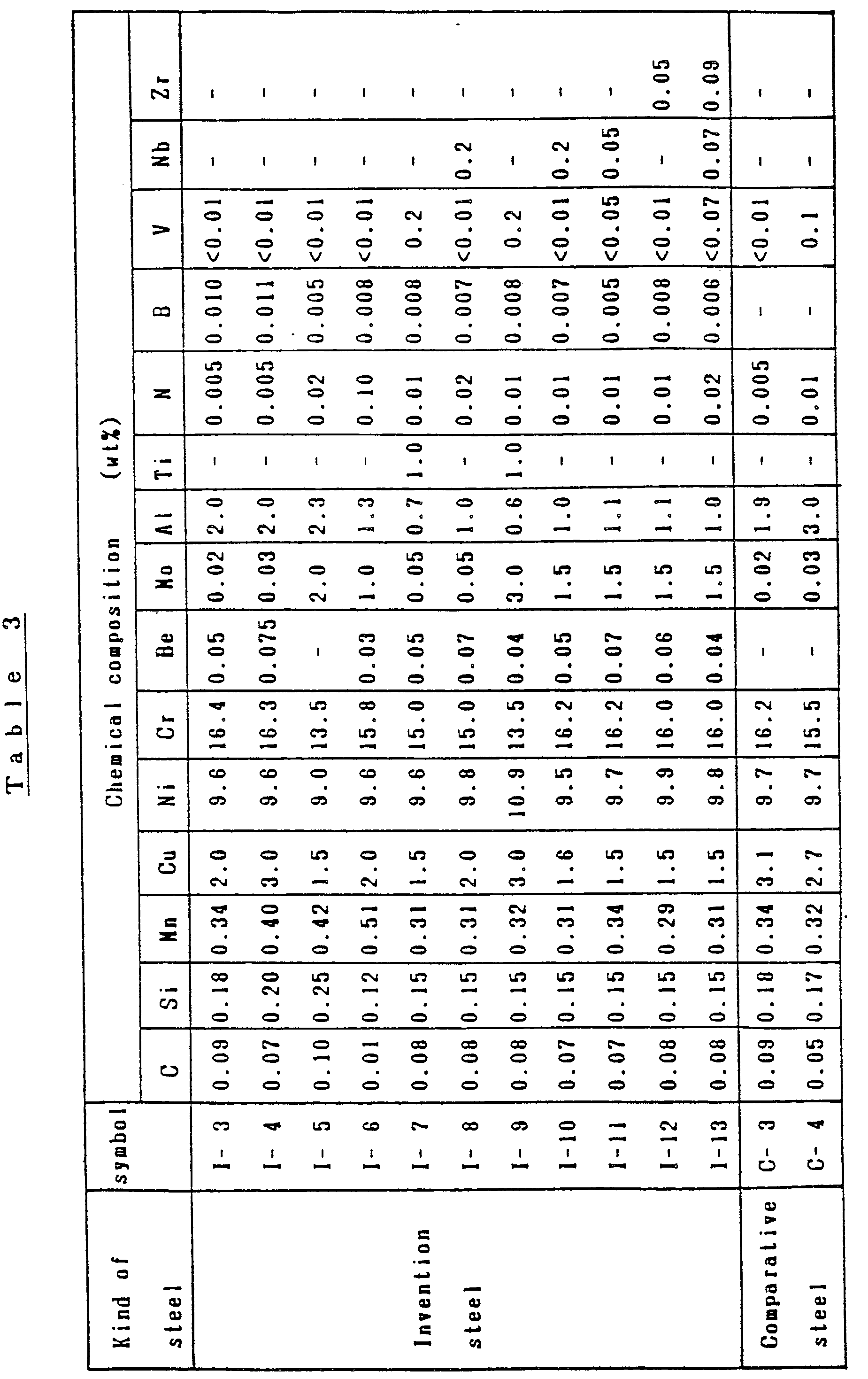

- As seen from Table 3 and 4, the invention steels 1-3, 4 are steels obtained by adding 0.05% and 0.075% of Be to the comparative steel C-3, respectively, whose tensile strength after the ageing treatment is higher than that of the comparative steel C-3 owing to the addition of Be. Furthermore, the invention steel 1-5 is obtained by adding Mo to the comparative steel, and the invention steel 1-6 is obtained by adding Mo and Be to the comparative steel, whereby the tensile strength is increased. Further, it is clear from the invention steel 1-6 that the addition of N is effective for the enhancement of the matrix.
- In the invention steels 1-7 and 1-9, a part of AI is replaced with Ti and in this case, a high strength of more than 230 kgf/mm2 is obtained, and particularly the steel 1―9 containing a large amount of Cu shows a fairly high strength.
- In the invention steels 1-8 and 1―10 ~ 13, a part of V is replaced with Nb, Zr in addition to Be alone or Be and Mo with complex, wherein the tensile strength is more than 230 kgf/mm2. Particularly, the invention steel 1-13 containing V, Nb and Zr with Be, Mo has fairly high ductility.
- On the contrary, the comparative steel C-3 has a tensile strength of less than 230 kgf/mm2 and has low ductility. In the comparative steel C-4, NiAI is coarsened to considerably lower the tensile strength. Moreover, the occurrence of cracks in the hot working is conspicuous in the comparative steels C-3 and 4.
- As mentioned above, the high strength stainless steel according to the invention comprises 0.01-0.15% of C and/or N, 1.0―4.0% of Cu, 7.0-11.0% of Ni, 12.0―17.0% of Cr, 0.5―2.5% of Al and/or Ti, 0.001-0.02% of B, at least one of 0.02-0.2% of Be and 1.0―4.0% of Mo, and the balance being Fe and inevitable impurities. In the case of Be addition, 0.05―0.5% in total of at least one of V, Nb and Zr may be added, if necessary, so that considerably high tensile strength of not less than 230 kgf/mm2, which has not previously attained in conventional precipitation hardened stainless steel, can be obtained by an ageing treatment after proper working without lowering toughness and ductility of the steel material. Further, the steels according to the invention can be suitably used as a material for components requiring high strength and corrosion resistance in office machines, electrical communication equipments, measurement instruments, automobile parts and the like, such as thin leaf springs, coil springs, antennae, precision threads and so on. Moreover, the steels according to the invention can satisfy the requirements for miniaturization weight reduction and high performances of various equipment.
Claims (4)
Applications Claiming Priority (2)
| Application Number | Priority Date | Filing Date | Title |
|---|---|---|---|
| JP60159536A JPS6220857A (en) | 1985-07-19 | 1985-07-19 | high strength stainless steel |
| JP159536/85 | 1985-07-19 |
Publications (3)
| Publication Number | Publication Date |
|---|---|
| EP0210035A2 EP0210035A2 (en) | 1987-01-28 |
| EP0210035A3 EP0210035A3 (en) | 1988-01-13 |
| EP0210035B1 true EP0210035B1 (en) | 1990-05-23 |
Family
ID=15695912
Family Applications (1)
| Application Number | Title | Priority Date | Filing Date |
|---|---|---|---|
| EP86305409A Expired EP0210035B1 (en) | 1985-07-19 | 1986-07-14 | High strength stainless steel |
Country Status (4)
| Country | Link |
|---|---|
| US (1) | US4902472A (en) |
| EP (1) | EP0210035B1 (en) |
| JP (1) | JPS6220857A (en) |
| DE (1) | DE3671480D1 (en) |
Families Citing this family (13)
| Publication number | Priority date | Publication date | Assignee | Title |
|---|---|---|---|---|
| US5338367A (en) * | 1989-07-26 | 1994-08-16 | Ugine, Aciers De Chatillon Et Gueugnon | Pickling process in an acid bath of metallic products containing titanium or at least one chemical element of the titanium family |
| JPH03100147U (en) * | 1990-02-01 | 1991-10-18 | ||
| JPH058785U (en) * | 1991-07-03 | 1993-02-05 | 日立マクセル株式会社 | Tape cartridge |
| SE469986B (en) * | 1991-10-07 | 1993-10-18 | Sandvik Ab | Detachable curable martensitic stainless steel |
| US7235212B2 (en) * | 2001-02-09 | 2007-06-26 | Ques Tek Innovations, Llc | Nanocarbide precipitation strengthened ultrahigh strength, corrosion resistant, structural steels and method of making said steels |
| JPH0645818A (en) * | 1992-07-27 | 1994-02-18 | Harada Ind Co Ltd | Electric telescopic antenna for vehicles |
| DE29517799U1 (en) * | 1995-11-09 | 1996-02-08 | Vacuumschmelze Gmbh, 63450 Hanau | High-strength, corrosion-resistant maraging alloy |
| US6696016B1 (en) * | 1999-09-24 | 2004-02-24 | Japan As Represented By Director General Of National Research Institute For Metals | High-chromium containing ferrite based heat resistant steel |
| DE10001650A1 (en) * | 2000-01-17 | 2001-07-26 | Vacuumschmelze Gmbh | High strength hardenable corrosion-resistant spring steel used for spring elements contains alloying additions of nickel, chromium, titanium and beryllium |
| ATE485454T1 (en) * | 2008-06-16 | 2010-11-15 | Gally S P A | SELF-LOCKING NUT |
| JP6259579B2 (en) * | 2012-03-29 | 2018-01-10 | 新日鐵住金ステンレス株式会社 | High-strength stainless steel wire, high-strength spring, and method of manufacturing the same |
| SE540110C2 (en) | 2016-06-01 | 2018-04-03 | Ovako Sweden Ab | High strength steel, method of manufacturing a part made of steel and use of the steel |
| SE539763C2 (en) * | 2016-06-16 | 2017-11-21 | Uddeholms Ab | Steel suitable for plastic moulding tools |
Family Cites Families (7)
| Publication number | Priority date | Publication date | Assignee | Title |
|---|---|---|---|---|
| US2850380A (en) * | 1957-03-04 | 1958-09-02 | Armco Steel Corp | Stainless steel |
| US3303023A (en) * | 1963-08-26 | 1967-02-07 | Crucible Steel Co America | Use of cold-formable austenitic stainless steel for valves for internal-combustion engines |
| GB1295163A (en) * | 1970-03-25 | 1972-11-01 | ||
| FR2086805A5 (en) * | 1970-04-09 | 1971-12-31 | Armco Steel Corp | Precipitation hardenable stainless steel |
| US3795507A (en) * | 1972-03-31 | 1974-03-05 | Armco Steel Corp | Semi-austenitic cr-ni-al-cu stainless steel |
| SE8102015L (en) * | 1980-04-07 | 1981-10-08 | Armco Inc | FERRIT-FREE SEPARATION HARDENABLE STAINLESS STEEL |
| JP3142409B2 (en) * | 1993-01-22 | 2001-03-07 | 岡三リビック株式会社 | Structure of anchor reinforced earth wall |
-
1985
- 1985-07-19 JP JP60159536A patent/JPS6220857A/en active Pending
-
1986
- 1986-07-14 EP EP86305409A patent/EP0210035B1/en not_active Expired
- 1986-07-14 DE DE8686305409T patent/DE3671480D1/en not_active Expired - Fee Related
-
1988
- 1988-06-17 US US07/208,784 patent/US4902472A/en not_active Expired - Fee Related
Also Published As
| Publication number | Publication date |
|---|---|
| US4902472A (en) | 1990-02-20 |
| DE3671480D1 (en) | 1990-06-28 |
| JPS6220857A (en) | 1987-01-29 |
| EP0210035A3 (en) | 1988-01-13 |
| EP0210035A2 (en) | 1987-01-28 |
Similar Documents
| Publication | Publication Date | Title |
|---|---|---|
| CA2032317C (en) | Nickel titanium alloy for surgical needles | |
| DE69208059T2 (en) | Stainless duplex steel with improved strength and corrosion resistance properties | |
| US4878955A (en) | Process for preparing a high strength stainless steel having excellent workability and free form weld softening | |
| EP4177369A1 (en) | Austenitic stainless steel and manufacturing method thereof | |
| CN116323994B (en) | Austenitic stainless steel and its manufacturing methods, as well as leaf springs | |
| EP0210035A2 (en) | High strength stainless steel | |
| KR20150082611A (en) | Thick steel plate having excellent cryogenic toughness | |
| JPS61130456A (en) | High-strength bolt and its production | |
| US20080210344A1 (en) | Precipitation Hardenable Martensitic Stainless Steel | |
| US4849166A (en) | High strength stainless steel | |
| US5314549A (en) | High strength and high toughness stainless steel sheet and method for producing thereof | |
| US6793745B2 (en) | Maraging type spring steel | |
| JP3603726B2 (en) | Austenitic stainless steel sheet for electronic components | |
| JP2002194506A (en) | Stainless steel plate and method of manufacturing the same | |
| JPH06316736A (en) | Ni-Fe based magnetic alloy excellent in magnetic properties and manufacturability and method for producing the same | |
| JP3385603B2 (en) | Precipitation hardening stainless steel | |
| EP4481081A1 (en) | Austenitic stainless steel | |
| EP4343013A1 (en) | Austenitic stainless steel and manufacturing method thereof | |
| JPH07233452A (en) | Ferritic stainless steel with excellent magnetic properties | |
| EP0498105A1 (en) | High strength and high toughness stainless steel and method of manufacturing the same | |
| US5429688A (en) | Work hardened stainless steel for springs | |
| JPH08193249A (en) | Ferrite and martensitic stainless steel with excellent machinability | |
| WO2023153185A1 (en) | Austenitic stainless steel and method for producing austenitic stainless steel | |
| JP2000063947A (en) | Manufacturing method of high strength stainless steel | |
| JP2000129400A (en) | Annealed martensitic stainless steel excellent in strength, toughness, and spring characteristic |
Legal Events
| Date | Code | Title | Description |
|---|---|---|---|
| PUAI | Public reference made under article 153(3) epc to a published international application that has entered the european phase |
Free format text: ORIGINAL CODE: 0009012 |
|
| AK | Designated contracting states |
Kind code of ref document: A2 Designated state(s): DE FR GB IT |
|
| PUAL | Search report despatched |
Free format text: ORIGINAL CODE: 0009013 |
|
| AK | Designated contracting states |
Kind code of ref document: A3 Designated state(s): DE FR GB IT |
|
| 17P | Request for examination filed |
Effective date: 19880421 |
|
| 17Q | First examination report despatched |
Effective date: 19890726 |
|
| GRAA | (expected) grant |
Free format text: ORIGINAL CODE: 0009210 |
|
| AK | Designated contracting states |
Kind code of ref document: B1 Designated state(s): DE FR GB IT |
|
| ET | Fr: translation filed | ||
| REF | Corresponds to: |
Ref document number: 3671480 Country of ref document: DE Date of ref document: 19900628 |
|
| ITF | It: translation for a ep patent filed | ||
| PLBE | No opposition filed within time limit |
Free format text: ORIGINAL CODE: 0009261 |
|
| STAA | Information on the status of an ep patent application or granted ep patent |
Free format text: STATUS: NO OPPOSITION FILED WITHIN TIME LIMIT |
|
| 26N | No opposition filed | ||
| ITTA | It: last paid annual fee | ||
| PGFP | Annual fee paid to national office [announced via postgrant information from national office to epo] |
Ref country code: GB Payment date: 19940705 Year of fee payment: 9 |
|
| PGFP | Annual fee paid to national office [announced via postgrant information from national office to epo] |
Ref country code: DE Payment date: 19940708 Year of fee payment: 9 |
|
| PGFP | Annual fee paid to national office [announced via postgrant information from national office to epo] |
Ref country code: FR Payment date: 19940711 Year of fee payment: 9 |
|
| PG25 | Lapsed in a contracting state [announced via postgrant information from national office to epo] |
Ref country code: GB Effective date: 19950714 |
|
| GBPC | Gb: european patent ceased through non-payment of renewal fee |
Effective date: 19950714 |
|
| PG25 | Lapsed in a contracting state [announced via postgrant information from national office to epo] |
Ref country code: DE Effective date: 19960402 |
|
| PG25 | Lapsed in a contracting state [announced via postgrant information from national office to epo] |
Ref country code: FR Effective date: 19960430 |
|
| REG | Reference to a national code |
Ref country code: FR Ref legal event code: ST |
|
| REG | Reference to a national code |
Ref country code: FR Ref legal event code: ST |
|
| REG | Reference to a national code |
Ref country code: FR Ref legal event code: ST |
|
| PG25 | Lapsed in a contracting state [announced via postgrant information from national office to epo] |
Ref country code: IT Free format text: LAPSE BECAUSE OF NON-PAYMENT OF DUE FEES;WARNING: LAPSES OF ITALIAN PATENTS WITH EFFECTIVE DATE BEFORE 2007 MAY HAVE OCCURRED AT ANY TIME BEFORE 2007. THE CORRECT EFFECTIVE DATE MAY BE DIFFERENT FROM THE ONE RECORDED. Effective date: 20050714 |