EP0208627A1 - Procédé pour l'obtention d'un article textile enduit - Google Patents
Procédé pour l'obtention d'un article textile enduit Download PDFInfo
- Publication number
- EP0208627A1 EP0208627A1 EP86420149A EP86420149A EP0208627A1 EP 0208627 A1 EP0208627 A1 EP 0208627A1 EP 86420149 A EP86420149 A EP 86420149A EP 86420149 A EP86420149 A EP 86420149A EP 0208627 A1 EP0208627 A1 EP 0208627A1
- Authority
- EP
- European Patent Office
- Prior art keywords
- film
- support
- coated
- textile
- grid
- Prior art date
- Legal status (The legal status is an assumption and is not a legal conclusion. Google has not performed a legal analysis and makes no representation as to the accuracy of the status listed.)
- Granted
Links
- 239000004753 textile Substances 0.000 title claims abstract description 33
- 238000004519 manufacturing process Methods 0.000 title abstract 2
- 239000002184 metal Substances 0.000 claims abstract description 10
- 238000003490 calendering Methods 0.000 claims abstract description 7
- 229920002379 silicone rubber Polymers 0.000 claims abstract description 3
- 239000004945 silicone rubber Substances 0.000 claims abstract description 3
- 239000004744 fabric Substances 0.000 claims description 21
- 238000000034 method Methods 0.000 claims description 12
- 238000000576 coating method Methods 0.000 claims description 8
- 238000009940 knitting Methods 0.000 claims description 8
- 239000011248 coating agent Substances 0.000 claims description 7
- 239000010410 layer Substances 0.000 claims description 6
- 239000011247 coating layer Substances 0.000 claims description 4
- 238000001125 extrusion Methods 0.000 claims description 4
- 229920001971 elastomer Polymers 0.000 claims description 3
- 230000000149 penetrating effect Effects 0.000 claims description 2
- 239000012815 thermoplastic material Substances 0.000 claims description 2
- 229920001169 thermoplastic Polymers 0.000 abstract 1
- 239000004416 thermosoftening plastic Substances 0.000 abstract 1
- 239000002759 woven fabric Substances 0.000 abstract 1
- 239000004800 polyvinyl chloride Substances 0.000 description 7
- 229920000915 polyvinyl chloride Polymers 0.000 description 6
- 238000009434 installation Methods 0.000 description 4
- 229920000728 polyester Polymers 0.000 description 4
- 239000000463 material Substances 0.000 description 2
- -1 polyethylene Polymers 0.000 description 2
- 239000004698 Polyethylene Substances 0.000 description 1
- 239000004743 Polypropylene Substances 0.000 description 1
- 229920002301 cellulose acetate Polymers 0.000 description 1
- 238000001816 cooling Methods 0.000 description 1
- 238000010586 diagram Methods 0.000 description 1
- 230000000694 effects Effects 0.000 description 1
- 239000011521 glass Substances 0.000 description 1
- 239000010985 leather Substances 0.000 description 1
- 229920000573 polyethylene Polymers 0.000 description 1
- 229920001155 polypropylene Polymers 0.000 description 1
- 229920001296 polysiloxane Polymers 0.000 description 1
- 229920002635 polyurethane Polymers 0.000 description 1
- 239000004814 polyurethane Substances 0.000 description 1
- 230000003014 reinforcing effect Effects 0.000 description 1
- 239000000126 substance Substances 0.000 description 1
- 238000004381 surface treatment Methods 0.000 description 1
Images
Classifications
-
- D—TEXTILES; PAPER
- D06—TREATMENT OF TEXTILES OR THE LIKE; LAUNDERING; FLEXIBLE MATERIALS NOT OTHERWISE PROVIDED FOR
- D06N—WALL, FLOOR, OR LIKE COVERING MATERIALS, e.g. LINOLEUM, OILCLOTH, ARTIFICIAL LEATHER, ROOFING FELT, CONSISTING OF A FIBROUS WEB COATED WITH A LAYER OF MACROMOLECULAR MATERIAL; FLEXIBLE SHEET MATERIAL NOT OTHERWISE PROVIDED FOR
- D06N3/00—Artificial leather, oilcloth or other material obtained by covering fibrous webs with macromolecular material, e.g. resins, rubber or derivatives thereof
- D06N3/0086—Artificial leather, oilcloth or other material obtained by covering fibrous webs with macromolecular material, e.g. resins, rubber or derivatives thereof characterised by the application technique
-
- B—PERFORMING OPERATIONS; TRANSPORTING
- B32—LAYERED PRODUCTS
- B32B—LAYERED PRODUCTS, i.e. PRODUCTS BUILT-UP OF STRATA OF FLAT OR NON-FLAT, e.g. CELLULAR OR HONEYCOMB, FORM
- B32B27/00—Layered products comprising a layer of synthetic resin
- B32B27/12—Layered products comprising a layer of synthetic resin next to a fibrous or filamentary layer
-
- B—PERFORMING OPERATIONS; TRANSPORTING
- B32—LAYERED PRODUCTS
- B32B—LAYERED PRODUCTS, i.e. PRODUCTS BUILT-UP OF STRATA OF FLAT OR NON-FLAT, e.g. CELLULAR OR HONEYCOMB, FORM
- B32B37/00—Methods or apparatus for laminating, e.g. by curing or by ultrasonic bonding
- B32B37/14—Methods or apparatus for laminating, e.g. by curing or by ultrasonic bonding characterised by the properties of the layers
- B32B37/15—Methods or apparatus for laminating, e.g. by curing or by ultrasonic bonding characterised by the properties of the layers with at least one layer being manufactured and immediately laminated before reaching its stable state, e.g. in which a layer is extruded and laminated while in semi-molten state
- B32B37/153—Methods or apparatus for laminating, e.g. by curing or by ultrasonic bonding characterised by the properties of the layers with at least one layer being manufactured and immediately laminated before reaching its stable state, e.g. in which a layer is extruded and laminated while in semi-molten state at least one layer is extruded and immediately laminated while in semi-molten state
-
- B—PERFORMING OPERATIONS; TRANSPORTING
- B32—LAYERED PRODUCTS
- B32B—LAYERED PRODUCTS, i.e. PRODUCTS BUILT-UP OF STRATA OF FLAT OR NON-FLAT, e.g. CELLULAR OR HONEYCOMB, FORM
- B32B5/00—Layered products characterised by the non- homogeneity or physical structure, i.e. comprising a fibrous, filamentary, particulate or foam layer; Layered products characterised by having a layer differing constitutionally or physically in different parts
- B32B5/22—Layered products characterised by the non- homogeneity or physical structure, i.e. comprising a fibrous, filamentary, particulate or foam layer; Layered products characterised by having a layer differing constitutionally or physically in different parts characterised by the presence of two or more layers which are next to each other and are fibrous, filamentary, formed of particles or foamed
- B32B5/24—Layered products characterised by the non- homogeneity or physical structure, i.e. comprising a fibrous, filamentary, particulate or foam layer; Layered products characterised by having a layer differing constitutionally or physically in different parts characterised by the presence of two or more layers which are next to each other and are fibrous, filamentary, formed of particles or foamed one layer being a fibrous or filamentary layer
- B32B5/26—Layered products characterised by the non- homogeneity or physical structure, i.e. comprising a fibrous, filamentary, particulate or foam layer; Layered products characterised by having a layer differing constitutionally or physically in different parts characterised by the presence of two or more layers which are next to each other and are fibrous, filamentary, formed of particles or foamed one layer being a fibrous or filamentary layer another layer next to it also being fibrous or filamentary
-
- D—TEXTILES; PAPER
- D06—TREATMENT OF TEXTILES OR THE LIKE; LAUNDERING; FLEXIBLE MATERIALS NOT OTHERWISE PROVIDED FOR
- D06N—WALL, FLOOR, OR LIKE COVERING MATERIALS, e.g. LINOLEUM, OILCLOTH, ARTIFICIAL LEATHER, ROOFING FELT, CONSISTING OF A FIBROUS WEB COATED WITH A LAYER OF MACROMOLECULAR MATERIAL; FLEXIBLE SHEET MATERIAL NOT OTHERWISE PROVIDED FOR
- D06N3/00—Artificial leather, oilcloth or other material obtained by covering fibrous webs with macromolecular material, e.g. resins, rubber or derivatives thereof
- D06N3/0002—Artificial leather, oilcloth or other material obtained by covering fibrous webs with macromolecular material, e.g. resins, rubber or derivatives thereof characterised by the substrate
- D06N3/0013—Artificial leather, oilcloth or other material obtained by covering fibrous webs with macromolecular material, e.g. resins, rubber or derivatives thereof characterised by the substrate using multilayer webs
-
- B—PERFORMING OPERATIONS; TRANSPORTING
- B32—LAYERED PRODUCTS
- B32B—LAYERED PRODUCTS, i.e. PRODUCTS BUILT-UP OF STRATA OF FLAT OR NON-FLAT, e.g. CELLULAR OR HONEYCOMB, FORM
- B32B2305/00—Condition, form or state of the layers or laminate
- B32B2305/10—Fibres of continuous length
- B32B2305/18—Fabrics, textiles
-
- B—PERFORMING OPERATIONS; TRANSPORTING
- B32—LAYERED PRODUCTS
- B32B—LAYERED PRODUCTS, i.e. PRODUCTS BUILT-UP OF STRATA OF FLAT OR NON-FLAT, e.g. CELLULAR OR HONEYCOMB, FORM
- B32B2327/00—Polyvinylhalogenides
- B32B2327/06—PVC, i.e. polyvinylchloride
Definitions
- coated textile articles in particular knitwear, one of the faces of which is associated with a layer of polyvinyl chloride (PVC) or the like.
- PVC polyvinyl chloride
- the method according to the invention consists, in a known manner, of combining by calendering, a textile support (knitting, fabric) and a film of thermoplastic material (PVC in particular), the calender used comprising a cylinder made of metal (smooth or grained) and a counter cylinder coated with a layer of silicone rubber and is characterized by the fact that a textile grid is inserted between the film and the textile article during the calendering operation allowing the different layers to be bonded together, the textile article (knitted fabric or fabric ) being brought so as to be in contact with the rubber-coated counter roller while the film is, in turn, in contact with the metal roller.
- the calender used comprising a cylinder made of metal (smooth or grained) and a counter cylinder coated with a layer of silicone rubber and is characterized by the fact that a textile grid is inserted between the film and the textile article during the calendering operation allowing the different layers to be bonded together, the textile article (
- the association of the different layers between them is preferably carried out immediately downstream of the extrusion head of the PVC film, the distance between the outlet of this extrusion head and the contact line between the cylinders of the calender being very weak, of the order of a few centimeters, so that the cooling of the film formed is weak.
- a knitted, coated fabric which not only has great stability, a result which results obviously from the use of a reinforcing textile grid, but also, and this surprisingly, that it was possible, even with a calender with a smooth metal cylinder, to obtain a material which has on its coated side a slightly grainy, regular appearance, corresponding both to the structure of the grid and, inside the days in this grid, a grain corresponding to the surface condition of the film support (knitting, fabric). Obviously, the grain is accentuated if a grained metallic roller is used.
- any type of knitting or fabric based on any type of yarn can be used and, like films intended to form the coating layer, it is possible to , in addition to PVC-based films, use any other type of film capable of adhering to the textile support, for example example of films based on polyurethane, polyethylene, polypropylene, cellulose acetate ...
- Such films can be either mass-dyed or, on the contrary, be transparent.
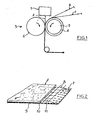
- FIG. 1 illustrates an installation allowing the implementation of the method according to the invention.
- such an installation includes an extruder (1), conventional, for producing the film (2), for example PVC.
- an extruder (1) for producing the film (2), for example PVC.
- a calender (3) comprising a metal cylinder (4) (smooth or grained), and a counter cylinder (5) covered with a coating of rubber (6), itself silicone.
- the speed of the calender cylinders (3) is adjusted so as to produce a stretch of the film produced between the outlet of the extruder (1) and the pinch line of said film between the cylinders.
- the draw rate is close to two.
- a textile grid (8) is interposed between these two elements.
- the film (2) is in contact with the metal roller (4) (smooth or grained), while the textile material (7) is, in turn, in contact with the counter rubberized roller (5).
- the complex formed has a structure as illustrated in FIG. 2, the textile grid (8) being perfectly maintained between the coating layer (2) and the textile support (7).
- the film (2) forming the surface coating penetrates only over part (9) of the thickness of the support (7), so that its face (10) retains all of its textile characteristics.
- the coated face (2) has a slightly grainy appearance if the metal roller is smooth, this appearance corresponding to the combination of the effects provided by the grid structure (8) and to the surface condition of the support (7) in the zones (11) between the days of the grid (8).
- This knitting (7) is associated, in accordance with the invention, with a textile grid (8) constituted by the superposition of warp and weft threads bonded together, these threads being glass threads having a count of 51 tex and defining between them five-millimeter-wide days.
- the extruded film (2) is a PVC film which, at the exit from the extruder (1), has a thickness of 0.5 mm and undergoes stretching at a rate of 2 as a result of the speed of the call of the cylinders (4,5) of the grille (3).
- the distance between the outlet of the extruder (1) and the junction area of the three components is of the order of 5 cm. As a result, the connection between the different layers is carried out while the film (2) still has a temperature of the order of 170 ° C.
- a coated knitted fabric is obtained, one face (10) of which has a perfectly textile feel and appearance, this coated knitted fabric being perfectly stable both longitudinally and transversely and, moreover, having on its coated side (2), a slightly grainy appearance reproducing the structure of the grid (8) and the surface condition of the knitted fabric (7) comprised between the threads forming said grid (8).
- Such an article can be successfully used for luggage, furniture ...
- Example 1 is repeated, but a fabric (7) made of a taffeta weave comprising 14 threads and 14 strokes per centimeter is substituted for knitting.
- pn uses 167 dtex FTF polyester yarns twisted at 130 turns / meter.
- a coated article After association with a film (2) according to the invention, a coated article is obtained, one face (10) of which has a feel, and a perfectly textile appearance corresponding to the fabric and which is perfectly stable both longitudinally and transversely.
- Such an article can be used in furniture or any other application.
- the fabric or knitted fabric can optionally be dyed or printed.
Landscapes
- Engineering & Computer Science (AREA)
- Textile Engineering (AREA)
- Laminated Bodies (AREA)
- Extrusion Moulding Of Plastics Or The Like (AREA)
- Treatments For Attaching Organic Compounds To Fibrous Goods (AREA)
- Treatment Of Fiber Materials (AREA)
- Application Of Or Painting With Fluid Materials (AREA)
Abstract
Description
- Depuis longtemps, il a été proposé de réaliser des articles textiles enduits, notamment des tricots dont une des faces est associée à une couche de chlorure de polyvinyle (PVC) ou similaire. De tels articles sont notamment utilisés comme substituts du cuir dans le domaine de l'ameublement, pour le revêtement de sièges de véhicules, là bagagerie...
- Parmi les nombreux procédés connus à ce jour pour réaliser de telles enductions, l'un consiste à associer par calandrage un film de PVC au support textile. Dans le cas où le support textile est déformable, par exemple constitué par un tricot ou tissu léger aécontex- turé, se pose le problème de la stabilité après enduction.
- Par ailleurs, tant d'un point de vue esthétique que d'un point de vue fonctionnel, de tels articles doivent en général subir un traitement superficiel afin de grainer leur surface.
- Or on a trouvé, et c'est ce qui fait l'objet de la présente invention, un procédé qui. en une seule opération, non seulement permet d'améliorer les caractéristiques mécaniques de tels articles enduits (tricot pat exemple), notamment d'améliorer leur stabilité dimensionnelle, mais qui, par ailleurs, permet, d'obtenir directement, sans traitement particulier, un aspect de surface grainé.
- D'une manière générale, le procédé conforme à l'invention consiste, de manière connue, à associer par calandrage, un support textile (tricot, tissu) et un film de matière thermoplastique (PVC notamment), la calandre utilisée comportant un cylindre en métal (lisse ou grainé) et un contre cylindre revêtu d'une couche de caoutchouc siliconé et se caractérise par le fait que l'on intercale, entre le film et l'article textile, une grille textile lors de l'opération de calandrage permettant la liaison des différentes couches entre elles, l'article textile (tricot ou tissu) étant amené de manière à être en contact avec le contre rouleau revêtu de caoutchouc alors que le film est, quant à lui, en contact avec le rouleau métallique.
- Par ailleurs, pour la bonne mise en oeuvre du procédé selon l'invention, l'association des différentes couches entre elles est réalisée, de préférence, immédiatement en aval de la tête d'extrusion du film de PVC, la distance entre la sortie de cette tête d'extrusion et la ligne de contact entre les cylindres de la calandre étant très faible, de l'ordre de quelques centimètres, de manière à ce que le refroidissement du film formé soit faible. Grâce à un tel procédé, on obtient un tricot, tissu enduit qui non seulement présente une grande stabilité, résultat qui découle de manière évidente de l'utilisation d'une grille textile de renfort' mais également, et ce de manière surprenante, qu'il était possible, même avec une calandre dont le cylindre métallique est lisse, d'obtenir un matériau qui présente sur sa face enduite un aspect légèrement grainé, régulier, correspondant à la fois à la structure de la grille et, à l'intérieur des jours que comporte cette grille, un grain correspondant à l'état de surface du support du film (tricot, tissu). Bien évidemment, le grain est accentué si l'on utilise un rouleau métallique grainé.
- Pour la mise en oeuvre d'un tel procédé, on peut utiliser tout type de tricot ou tissu à base de tout type de fils (d'origine naturelle ou chimique) et, comm films destinés à former la couche d'enduction, on peut, outre les films à base de PVC, utiliser tout autre type de films susceptibles d'adhérer au support textile, par exemple des films à base de polyuréthane, de polyéthylène, de polypropylène, acétate de celluloses...
- Par ailleurs, de tels films peuvent être soit teintés dans la masse soit, au contraire, être transparents.
- Enfin, il convient de noter que dans l'article enduit terminé, une face conserve son aspect et son toucher textile, l'enduit ne pénétrant que partiellement dans l'épaisseur du support textile. En conséquence, en fonction des utilisations, un tel article peut être utilisé en ayant comme face endroit soit la face à caractéristiques textiles soit, au contraire, celle qui est enduite.
- L'invention et les avantages qu'elle apporte seront cependant mieux compris grâce à l'exemple de réalisation suivant donné ci-après à titre indicatif mais non limitatif et qui est illustré par les schémas annexés dans lesquels :
- - la figure 1 est une vue schématique de côté, d'une installation permettant la mise en oeuvre du procédé selon l'invention ;
- - la figure 2 est une vue schématique en perspective éclatée d'un article enduit obtenu par la mise en oeuvre de ce procédé.
- La figure 1 illustre une installation permettant la mise en oeuvre du procédé selon l'invention.
- Si l'on se reporte à cette figure, une telle installation comporte une extrudeuse (1), conventionnelle, permettant de produire le film (2), par exemple en PVC. A la sortie de cette extrudeuse et le plus près possible de celle-ci, est disposée une calandre (3) comportant un cylindre (4) en métal (lisse eu grainé), et un contre cylindre (5) recouvert d'un revêtement en caoutchouc (6), lui-même siliconé.
- La vitesse des cylindres de la calandre (3) est réglée de manière à produire un étirage du film produit entre la sortie de l'extrudeuse (1) et la ligne de pincement dudit film entre les cylindres. En général, le taux d'étirage est voisin de deux.
- Selon l'invention, lors de l'association du film (2) et du support textile (7), (tricot ou tissu), on intercale entre ces deux éléments une grille textile (8). Ainsi que cela ressort de la figure 1, le film (2) se trouve en contact avec le rouleau en métal (4) (lisse ou grainé), alors que la matière textile (7) est, quant à elle, en contact avec le contré rouleau caoutchouté (5). Après passage dans la calandre, le complexe formé a une structure telle qu'illustrée à la figure 2, la grille textile (8) étant parfaitement maintenue entre la couche d'enduction (2) et le support textile (7). Le film (2) formant l'enduit superficiel pénètre seulement sur une partie (9) de l'épaisseur du support (7), de telle sorte que sa face (10) conserve toutes ses caractéristiques textiles.
- En revanche, la face enduite (2) présente un aspect légèrement grainé si le rouleau métallique est lisse, cet aspect correspondant à la combinaison des effets fournis par la structure grille (8) et à l'état de surface du support (7) dans les zones (11) comprises entre les jours de la grille (8).
- De la manière énoncée précédemment, on réalise un complexe comportant :
- - comme support textile (7), un tricot à mailles cueillies, réalisé sur métier circulaire double fonture, jauge 14, l'armure étant une armure relief obtenue par charges. Le fil utilisé est un fil polyester FTF de 167 dtex. A la tombée du métier, un cel tricot pèse 200 g/m2 et est, de par nature, déformable dans toutes les directions.
- On associe, conformément à l'invention, à ce tricot (7) une grille textile (8) constituée par la superposition de fils de chaine et de trame collés entre eux, ces fils étant des fils de verre ayant un titre de 51 tex et définissant entre eux des jours de cinq millimètres de côté. Le film (2) extrudé est un film de PVC qui, en sortie de l'extrudeuse (1), a une épaisseur de 0,5 mm et subit un étirage à un taux de 2 par suite de la vitesse de l'appel des cylindres (4,5) de la calandre (3). La distance entre la sortie de l'extrudeuse (1) et la zone de jonction des trois constituants est de l'ordre de 5 cm. Par suite, la liaison entre les différentes couches est réalisée alors que le film (2) a encore une température de l'ordre de 170°C.
- En procédant d'une telle manière, on obtient un tricot enduit, dont une face (10) a un toucher et un aspect parfaitement textile, ce tricot enduit étant parfaitement stable tant longitudinalement que transversalement et, présentant, par ailleurs, sur sa face enduite (2), un aspect légèrement grainé reproduisant la structure de la grille (8) et de l'état de surface du tricot (7) compris entre les fils formant ladite grille (8).
- Un tel article peut être utilisé avec succès pour la bagagerie, l'ameublement....
- On répète l'exemple 1 mais on substitue au tricot un tissu (7) réalisé selon une armure taffetas comportant 14 fils et 14 coups par centimètre.
- Comme chaine, pn utilise des fils polyester FTF de 167 dtex tordus à 130 tours/mètre.
- Comme trame, on utilise également des fils de polyester FTF de 160 dtex mais non tordus.
- A la tombée du métier, un tel tissu pèse 60 g/m2 et est déformable.
- Après association avec un film (2) conformément à l'invention, on obtient un article enduit dont une face (10) a un toucher, et un aspect parfaitement textiles correspondant au tissu et qui est parfaitement stable tant longitudinalement que transversalement.
- Un tel article peut être utilisé dans l'ameublement ou toute autre application..
- Bien entendu, l'invention n'est pas limitée aux exemples de réalisation décrits précédemment, mais elle en couvre toutes les variantes réalisées dans le même esprit.
- Ainsi, on ne sort pas du cadre de l'invention en remplaçant la grille textile non tissée par un article équivalent, par exemple par une grille tissée. Par ailleurs, le tissu ou tricot peut éventuellement être teint ou imprimé.
Claims (8)
Priority Applications (1)
| Application Number | Priority Date | Filing Date | Title |
|---|---|---|---|
| AT86420149T ATE39857T1 (de) | 1985-06-13 | 1986-06-05 | Verfahren zur herstellung eines beschichteten textilartikels. |
Applications Claiming Priority (2)
| Application Number | Priority Date | Filing Date | Title |
|---|---|---|---|
| FR8509185A FR2583339B1 (fr) | 1985-06-13 | 1985-06-13 | Procede pour l'obtention d'un article textile enduit et article enduit obtenu par la mise en oeuvre de ce procede |
| FR8509185 | 1985-06-13 |
Publications (2)
| Publication Number | Publication Date |
|---|---|
| EP0208627A1 true EP0208627A1 (fr) | 1987-01-14 |
| EP0208627B1 EP0208627B1 (fr) | 1989-01-11 |
Family
ID=9320335
Family Applications (1)
| Application Number | Title | Priority Date | Filing Date |
|---|---|---|---|
| EP86420149A Expired EP0208627B1 (fr) | 1985-06-13 | 1986-06-05 | Procédé pour l'obtention d'un article textile enduit |
Country Status (4)
| Country | Link |
|---|---|
| EP (1) | EP0208627B1 (fr) |
| AT (1) | ATE39857T1 (fr) |
| DE (1) | DE3661687D1 (fr) |
| FR (1) | FR2583339B1 (fr) |
Cited By (5)
| Publication number | Priority date | Publication date | Assignee | Title |
|---|---|---|---|---|
| WO1995011803A1 (fr) * | 1993-10-28 | 1995-05-04 | Textiles Et Plastiques Chomarat | Procede de realisation d'une feuille souple, etanche, constituee par un support textile revetu sur ses deux faces d'une couche d'enduction a base de polypropylene |
| WO2000032861A1 (fr) * | 1998-12-01 | 2000-06-08 | Recaro Gmbh & Co. | Stabilisation d'un article tricote par un materiau thermique |
| FR2796974A1 (fr) | 1999-07-30 | 2001-02-02 | Textiles Plastiques Chomarat | Revetement d'etancheite |
| FR2830880A1 (fr) * | 2001-10-16 | 2003-04-18 | Textiles Plastiques Chomarat | Materiau complexe a base d'une structure textile associee a une couche de matiere plastique, polyolefine notamment, utilisable comme revetement de surfaces diverses |
| CZ307869B6 (cs) * | 2017-12-28 | 2019-07-10 | VĂšTS, a.s. | Technická textilie a zařízení pro její výrobu |
Citations (3)
| Publication number | Priority date | Publication date | Assignee | Title |
|---|---|---|---|---|
| GB982758A (en) * | 1960-03-16 | 1965-02-10 | St Regis Paper Co | Improvements in or relating to the manufacture of plastics coated webs |
| GB1098381A (en) * | 1964-06-15 | 1968-01-10 | Ici Ltd | Reinforced plastic sheet |
| US3470055A (en) * | 1965-01-21 | 1969-09-30 | Nat Distillers Chem Corp | Extrusion coating method |
-
1985
- 1985-06-13 FR FR8509185A patent/FR2583339B1/fr not_active Expired
-
1986
- 1986-06-05 EP EP86420149A patent/EP0208627B1/fr not_active Expired
- 1986-06-05 DE DE8686420149T patent/DE3661687D1/de not_active Expired
- 1986-06-05 AT AT86420149T patent/ATE39857T1/de not_active IP Right Cessation
Patent Citations (3)
| Publication number | Priority date | Publication date | Assignee | Title |
|---|---|---|---|---|
| GB982758A (en) * | 1960-03-16 | 1965-02-10 | St Regis Paper Co | Improvements in or relating to the manufacture of plastics coated webs |
| GB1098381A (en) * | 1964-06-15 | 1968-01-10 | Ici Ltd | Reinforced plastic sheet |
| US3470055A (en) * | 1965-01-21 | 1969-09-30 | Nat Distillers Chem Corp | Extrusion coating method |
Cited By (6)
| Publication number | Priority date | Publication date | Assignee | Title |
|---|---|---|---|---|
| WO1995011803A1 (fr) * | 1993-10-28 | 1995-05-04 | Textiles Et Plastiques Chomarat | Procede de realisation d'une feuille souple, etanche, constituee par un support textile revetu sur ses deux faces d'une couche d'enduction a base de polypropylene |
| WO2000032861A1 (fr) * | 1998-12-01 | 2000-06-08 | Recaro Gmbh & Co. | Stabilisation d'un article tricote par un materiau thermique |
| FR2796974A1 (fr) | 1999-07-30 | 2001-02-02 | Textiles Plastiques Chomarat | Revetement d'etancheite |
| FR2830880A1 (fr) * | 2001-10-16 | 2003-04-18 | Textiles Plastiques Chomarat | Materiau complexe a base d'une structure textile associee a une couche de matiere plastique, polyolefine notamment, utilisable comme revetement de surfaces diverses |
| WO2003033260A1 (fr) * | 2001-10-16 | 2003-04-24 | Textiles Et Plastiques Chomarat | Materiau complexe a base d'une structure textile associee a une couche de matiere plastique, polyolefine notamment, utilisable comme revetement de surfaces diverses |
| CZ307869B6 (cs) * | 2017-12-28 | 2019-07-10 | VĂšTS, a.s. | Technická textilie a zařízení pro její výrobu |
Also Published As
| Publication number | Publication date |
|---|---|
| DE3661687D1 (en) | 1989-02-16 |
| EP0208627B1 (fr) | 1989-01-11 |
| FR2583339B1 (fr) | 1987-07-24 |
| FR2583339A1 (fr) | 1986-12-19 |
| ATE39857T1 (de) | 1989-01-15 |
Similar Documents
| Publication | Publication Date | Title |
|---|---|---|
| EP0118373B1 (fr) | Structure textile ajourée et procédé pour son obtention | |
| CA1310178C (fr) | Armature textile utilisable pour la realisation de complexes stratifies et complexes stratifies en forme comportant une telle armature | |
| EP0208627B1 (fr) | Procédé pour l'obtention d'un article textile enduit | |
| EP3676085A1 (fr) | Feuille composite multicouche transparente | |
| FR2543984A1 (fr) | Structure textile enduite decoree et procede pour sa realisation | |
| FR2991936A1 (fr) | Element de garnissage retroeclaire au moyen d'un element de support translucide | |
| FR2856896A1 (fr) | Complexe constitue d'un film et d'un tricot ou d'un non tisse pour autoagrippant, notamment pour couche-culotte. | |
| FR2695859A1 (fr) | Procédé de fabrication d'un objet multicouche par moulage, objet obtenu et application à la fabrication de tableaux de bord et/ou d'élements d'habillage d'une carrosserie de véhicule. | |
| EP0542639A1 (fr) | Structure complexe utilisable notamment pour la réfection de conduites et procédé d'obtention d'une telle structure | |
| CA2103043A1 (fr) | Procede permettant l'incorporation d'une structure metallique a l'interieur d'une matiere plastique en vue de realiser des articles moules, nouveau type de structure metallique particulierement adaptee pour la mise en oeuvre d'un tel proc de et article moule incorporant une telle structure | |
| FR2583338A1 (fr) | Procede pour la realisation de structures textiles enduites et structures textiles enduites ainsi obtenues | |
| FR3043036A1 (fr) | Element de garnissage de vehicule et procede de fabrication associe | |
| FR2714397A1 (fr) | Armature textile utilisable pour la réalisation de matériaux composites. | |
| EP1380678A1 (fr) | Tricot double face et complexe incorporant un tel tricot | |
| EP1448383A1 (fr) | Materiau complexe a base d'une structure textile associee a une couche de matiere plastique, polyolefine notamment, utilisable comme revetement de surfaces diverses | |
| EP0725731B1 (fr) | Procede de realisation d'une feuille souple, etanche, constituee par un support textile revetu sur ses deux faces d'une couche d'enduction a base de polypropylene | |
| EP0986463B1 (fr) | Complexe en feuille utilisable pour réaliser le revêtement de surface de structures moulées | |
| FR2991937A1 (fr) | Element de garnissage comprenant une couche de decor translucide retroeclairee | |
| FR2688164A1 (fr) | Procede pour la fabrication in situ de pieces thermoplastiques revetues d'etoffe, l'etoffe pour la mise en óoeuvre du procede et produit obtenu par ce procede. | |
| FR2780419A1 (fr) | Tricots de verre, structures textiles complexes et composites | |
| EP0764733A1 (fr) | Revêtement textile pour siège | |
| FR2664801A1 (fr) | Garniture souple pour sieges, procede de fabrication d'une telle garniture et son utilisation pour le garnissage d'une ossature de siege. | |
| CN107399132A (zh) | 一种消光膜及其制造方法 | |
| EP0984857B1 (fr) | Complexe en feuille utilisable pour realiser le revetement de surface de structures moulees et procede pour son obtention | |
| FR3084676A1 (fr) | Procede de fabrication d'une nappe de fils par points de couture, notamment pour la realisation de pieces en materiaux composites |
Legal Events
| Date | Code | Title | Description |
|---|---|---|---|
| PUAI | Public reference made under article 153(3) epc to a published international application that has entered the european phase |
Free format text: ORIGINAL CODE: 0009012 |
|
| AK | Designated contracting states |
Kind code of ref document: A1 Designated state(s): AT BE DE GB IT |
|
| 17P | Request for examination filed |
Effective date: 19870519 |
|
| 17Q | First examination report despatched |
Effective date: 19871106 |
|
| GRAA | (expected) grant |
Free format text: ORIGINAL CODE: 0009210 |
|
| AK | Designated contracting states |
Kind code of ref document: B1 Designated state(s): AT BE DE GB IT |
|
| PG25 | Lapsed in a contracting state [announced via postgrant information from national office to epo] |
Ref country code: IT Free format text: LAPSE BECAUSE OF FAILURE TO SUBMIT A TRANSLATION OF THE DESCRIPTION OR TO PAY THE FEE WITHIN THE PRE;WARNING: LAPSES OF ITALIAN PATENTS WITH EFFECTIVE DATE BEFORE 2007 MAY HAVE OCCURRED AT ANY TIME BEFORE 2007. THE CORRECT EFFECTIVE DATE MAY BE DIFFERENT FROM THE ONE RECORDED.SCRIBED TIME-LIMIT Effective date: 19890111 Ref country code: GB Free format text: LAPSE BECAUSE OF NON-PAYMENT OF DUE FEES Effective date: 19890111 Ref country code: AT Effective date: 19890111 |
|
| REF | Corresponds to: |
Ref document number: 39857 Country of ref document: AT Date of ref document: 19890115 Kind code of ref document: T |
|
| REF | Corresponds to: |
Ref document number: 3661687 Country of ref document: DE Date of ref document: 19890216 |
|
| GBV | Gb: ep patent (uk) treated as always having been void in accordance with gb section 77(7)/1977 [no translation filed] | ||
| PLBE | No opposition filed within time limit |
Free format text: ORIGINAL CODE: 0009261 |
|
| STAA | Information on the status of an ep patent application or granted ep patent |
Free format text: STATUS: NO OPPOSITION FILED WITHIN TIME LIMIT |
|
| 26N | No opposition filed | ||
| PGFP | Annual fee paid to national office [announced via postgrant information from national office to epo] |
Ref country code: DE Payment date: 20050608 Year of fee payment: 20 |
|
| PGFP | Annual fee paid to national office [announced via postgrant information from national office to epo] |
Ref country code: BE Payment date: 20050629 Year of fee payment: 20 |
|
| BE20 | Be: patent expired |
Owner name: S.A. TEXTILES ET PLASTIQUES *CHOMARAT Effective date: 20060605 |