EP0208504A2 - Bauteil für faser-optisches Netzwerk - Google Patents
Bauteil für faser-optisches Netzwerk Download PDFInfo
- Publication number
- EP0208504A2 EP0208504A2 EP86305128A EP86305128A EP0208504A2 EP 0208504 A2 EP0208504 A2 EP 0208504A2 EP 86305128 A EP86305128 A EP 86305128A EP 86305128 A EP86305128 A EP 86305128A EP 0208504 A2 EP0208504 A2 EP 0208504A2
- Authority
- EP
- European Patent Office
- Prior art keywords
- optical fibre
- optical
- network
- tdam
- detector
- Prior art date
- Legal status (The legal status is an assumption and is not a legal conclusion. Google has not performed a legal analysis and makes no representation as to the accuracy of the status listed.)
- Withdrawn
Links
- 239000000835 fiber Substances 0.000 title description 6
- 239000013307 optical fiber Substances 0.000 claims abstract description 31
- 230000003287 optical effect Effects 0.000 claims abstract description 21
- 239000000463 material Substances 0.000 claims description 8
- 230000008878 coupling Effects 0.000 claims description 5
- 238000010168 coupling process Methods 0.000 claims description 5
- 238000005859 coupling reaction Methods 0.000 claims description 5
- 239000004065 semiconductor Substances 0.000 claims description 4
- 239000013078 crystal Substances 0.000 claims description 2
- 230000005540 biological transmission Effects 0.000 description 4
- 238000001514 detection method Methods 0.000 description 3
- 229910001218 Gallium arsenide Inorganic materials 0.000 description 2
- 238000010521 absorption reaction Methods 0.000 description 2
- 238000000576 coating method Methods 0.000 description 2
- 230000000694 effects Effects 0.000 description 2
- 230000007257 malfunction Effects 0.000 description 2
- 239000011149 active material Substances 0.000 description 1
- 238000010276 construction Methods 0.000 description 1
- 238000010586 diagram Methods 0.000 description 1
- 230000005684 electric field Effects 0.000 description 1
- 238000003780 insertion Methods 0.000 description 1
- 230000037431 insertion Effects 0.000 description 1
- 230000001902 propagating effect Effects 0.000 description 1
- 239000007787 solid Substances 0.000 description 1
- 239000000758 substrate Substances 0.000 description 1
Images


Classifications
-
- G—PHYSICS
- G02—OPTICS
- G02F—OPTICAL DEVICES OR ARRANGEMENTS FOR THE CONTROL OF LIGHT BY MODIFICATION OF THE OPTICAL PROPERTIES OF THE MEDIA OF THE ELEMENTS INVOLVED THEREIN; NON-LINEAR OPTICS; FREQUENCY-CHANGING OF LIGHT; OPTICAL LOGIC ELEMENTS; OPTICAL ANALOGUE/DIGITAL CONVERTERS
- G02F1/00—Devices or arrangements for the control of the intensity, colour, phase, polarisation or direction of light arriving from an independent light source, e.g. switching, gating or modulating; Non-linear optics
- G02F1/01—Devices or arrangements for the control of the intensity, colour, phase, polarisation or direction of light arriving from an independent light source, e.g. switching, gating or modulating; Non-linear optics for the control of the intensity, phase, polarisation or colour
- G02F1/015—Devices or arrangements for the control of the intensity, colour, phase, polarisation or direction of light arriving from an independent light source, e.g. switching, gating or modulating; Non-linear optics for the control of the intensity, phase, polarisation or colour based on semiconductor elements having potential barriers, e.g. having a PN or PIN junction
- G02F1/017—Structures with periodic or quasi periodic potential variation, e.g. superlattices, quantum wells
-
- B—PERFORMING OPERATIONS; TRANSPORTING
- B82—NANOTECHNOLOGY
- B82Y—SPECIFIC USES OR APPLICATIONS OF NANOSTRUCTURES; MEASUREMENT OR ANALYSIS OF NANOSTRUCTURES; MANUFACTURE OR TREATMENT OF NANOSTRUCTURES
- B82Y20/00—Nanooptics, e.g. quantum optics or photonic crystals
Definitions
- This invention relates to components for fibre-optic networks.
- One way of distributing optical power between the modes of a fibre-optic network is to wire the nodes in a star configuration.
- an optical output from the optical source at any particular node is fed into a mixer element for distribution among a set of fibres which feed detectors at all the other nodes.
- the number of nodes that can be accommodated by such a system is limited because an increase in their number automatically entails a reduction in the share of the power transmitted from any one mode that will be available for reception.by any one of the other nodes.
- An alternative way of distributing power around the nodes of a network is to adopt a ring configuration in which the nodes are connected in series around the ring.
- a node in a conventional design of ring configuration is like that of a node in a star configuration in having its own source and its own detector, but, particularly in the case of a ring system node whose detector is arranged to intercept all the circulating optical power, the node will also include a regenerator for the onward transmission of optical data that is not destined for that node. If the detector of such a node intercepts all the circulating power, then, if there is a malfunction at this node, the whole of the downstream part of the ring is disabled.
- the node may incorporate an optical bypass which is designed to arrange that only a fraction of the circulating optical power is tapped off the ring and fed to the detector. The optical signals generated at this mode then have to be tapped into the ring. Therefore it is seen that bypass of this sort is useful in protecting against failure of the whole ring in the event of certain kinds of malfunction at a single node, but that this protection is achieved at the expense of a significant increase of attenuation.
- the present invention is concerned with a component that may be used at selected nodes in serial type networks and has the characteristic that it is capable of functioning both as a photodetector and a variable attenuation optical modulator, and the further characteristic that it is a relatively low attenuation device in its quiescent unpowered state.
- a component will hereafter be referred to as a 'transmissive detector and modulator' (TDAM) components.
- TDAM 'transmissive detector and modulator'
- a fibre optic ring system may be provided that has at least one, and possibly several nodes, each provided with an electro-optic source and an electro-optic detector, and has, between these nodes, one or more other (series connected) nodes each provided by one of these TDAM components.
- an optical fibre network component for connection between an electro-optical source and a detector, which component includes an optical fibre coupling in which the end of one optical fibre is optically coupled with the end of another through the layers of a multi-layer semiconductive device having a stack of electrically commoned sub-micron thickness p-type layers interleaved with a stack of electrically commoned sub-micron thickness n-type layers, said device constituting a transmissive detector and modulator (TDAM).
- TDAM transmissive detector and modulator
- Such a device typically takes the form of a single crystal doping superlattice semiconductor device.
- the final detector of the network may also be constituted by a TDAM device operated solely as a detector.
- a TDAM device operated solely as a detector.
- all the TDAM devices may be operated solely as detectors.
- the invention also resides in an optical fibre network incorporating one or more optical fibre components of the type defined in the preceding paragraph.
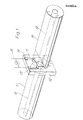
- a doping superlattice TDAM device consists of a stack 11 of alternate p- and n-type layers supported on a substrate 12, and having a p-type contact 13 extending down one side edge of the stack and a n-type contact 14 extending down the opposite edge.
- a voltage source schematically depicted at 15 is connected across the contacts.
- Doping superlattice devices have been described for instance by Y. Horikoshi and K. Ploog in the paper entitled 'New Photoconductive Detector Based on Doping Superlattices with High-Speed Response over a Wide Energy Range', published in Extended Abstracts of the l6th (1984 International) Conference on Solid state Devices and Materials, Kobe, 1984, pp 571-574. Butted against the face of the stack is the end of an optical fibre 16, and on the opposite side of the device is butted the end of a second optical fibre 17, with the fibre cores 18 in registry with each other.
- An optical fibre network typically has many modes 'wired' in series.
- Many, but not all, of the nodes of such a network may be provided by a TDAM device connected into the network in the manner depicted in Figure 1.
- An example of such a network is illustrated in Figure 2.
- just two of the nodes 20 and 21 employ conventional lasers 22 and detectors 23. These are linked by optical fibre 24 with the remaining 2n nodes in which lasers and detectors have been replaced by TDAM devices 25, each having the general construction of the device of Figure 1.
- Node 20 may be a gateway terminal node that links with other ring networks (not snown), while node 21 is represented as a node incorporating a regenerator terminal 26.
- the characteristics of the TDAM device of Figure 1 in detector mode and in modulator mode are depicted respectively in Figures 3 and 4.
- With no voltage applied across the device its transmissivity is high, and thus the device allows a high proportion of light launched into the core 8 of either one of the fibres 6 and 7 to be transmitted straight through the device and into the core of the other fibre.
- this property is most important insofar as it means that, in the event of a power failure at any one of the TDAM devices, light is still able to pass through that device for onward transmission to further detection devices.
- As the voltage across the device is increased, so it begins to absorb an increasing proportion of the light launched into it. The absorbed light is efficiently converted into current so that any signal on the light stream can be detected.
- the TDAM device In the detection mode the TDAM device is powered with just sufficient voltage applied across it to pick up sufficient signal for error free detection. Rapid automatic feedback control of the voltage is used for this purpose. In this way there is the minimum possible loss of optical power at each node, and the remainder is transmitted on to the next mode.
- Table I shows the maximum number of nodes that can be 'wired' in series assuming various values for the transmission and absorbed (detected) optical power. This was calculated numerically assuming 1 mW mean launched power.
- the device In its modulation mode, the device is driven with a larger electrical signal voltage to modulate the light transmitted through the TDAM ( Figure 4).
- This modulation might for instance take the form of a relatively low bandwidth envelope modulation superimposed on the high speed digital bit stream propagation around the ring. This signal would be detected at the terminal nodes and retransmitted in full binary digital form.
- the TDAM device has sufficient modulation bandwidth it could be used to directly modulate the amplitude of a series of binary '1's transmitted by the laser transmitter for this purpose. These '1's could be added to the standard transmitted word of the laser transmitter or time division multiplexed in some other way.
- TDAM devices of the kind described in the above-referenced paper by Y. Horikoshi and K. Ploog, it is possible to vary the responsivity, and hence the absorption, from 10 -4 to 0.2 for an applied lateral voltage of about 200 V across a lmm diameter device.
- the device is believed to operate by reduction of the effective bandgap as the electric field across the device is increased.
- Tne operating voltage is low because of the strong built in field provided by the doping superlattice.
- the Franz-Keldysh effect is normally regarded so small that efficient detectors or modulators can only be made using by propagating light laterally along the plane of the pn junction.
- the use of a multilayer superlattice structure allows the effect to be repeated many times on light travelling perpendicular to the layers.
- the high losses associated with optical coupling in to and out of lateral waveguides can thus be avoided.
- the particular device reported in the above-referenced paper is made of GaAs and will operate best at about 1.15 ⁇ m wavelength. Operation can be optimised to about 1.3 Mm wavelength by using higher doping levels in the superlattice or by using GaInAsP as the base semiconductor with a bandgap set to absorb light with wavelengths less than about 1.2 ⁇ m. Such superlattices are therefore particularly appropriate for use as TDAM's.
- the p- and n-type layers are directly interleaved.
- This structure can however be modified by the inclusion of a layer of intrinsic or compensated material between each p- and n-type layer.
- These additional layers may be of the same material (excluding doping) as the layers they separate or they may be of lower band gap material.
- the device may be formed of alternate layers of p- and n-type GaAlAs separated by layers of intrinsic GaAs.
Landscapes
- Physics & Mathematics (AREA)
- Nonlinear Science (AREA)
- Optics & Photonics (AREA)
- Chemical & Material Sciences (AREA)
- Engineering & Computer Science (AREA)
- Nanotechnology (AREA)
- General Physics & Mathematics (AREA)
- Life Sciences & Earth Sciences (AREA)
- Biophysics (AREA)
- Crystallography & Structural Chemistry (AREA)
- Optical Communication System (AREA)
- Measuring Instrument Details And Bridges, And Automatic Balancing Devices (AREA)
Applications Claiming Priority (2)
| Application Number | Priority Date | Filing Date | Title |
|---|---|---|---|
| GB8517534A GB2177868B (en) | 1985-07-11 | 1985-07-11 | Fibre optic network component |
| GB8517534 | 1985-07-11 |
Publications (2)
| Publication Number | Publication Date |
|---|---|
| EP0208504A2 true EP0208504A2 (de) | 1987-01-14 |
| EP0208504A3 EP0208504A3 (de) | 1988-07-20 |
Family
ID=10582137
Family Applications (1)
| Application Number | Title | Priority Date | Filing Date |
|---|---|---|---|
| EP86305128A Withdrawn EP0208504A3 (de) | 1985-07-11 | 1986-07-02 | Bauteil für faser-optisches Netzwerk |
Country Status (2)
| Country | Link |
|---|---|
| EP (1) | EP0208504A3 (de) |
| GB (1) | GB2177868B (de) |
Cited By (1)
| Publication number | Priority date | Publication date | Assignee | Title |
|---|---|---|---|---|
| EP0352019A3 (de) * | 1988-07-21 | 1991-10-02 | AT&T Corp. | Modulationsvorrichtung für optische Kommunikationstechnik |
Families Citing this family (1)
| Publication number | Priority date | Publication date | Assignee | Title |
|---|---|---|---|---|
| FR2739507B1 (fr) * | 1995-10-02 | 1997-12-19 | Devaux Fabrice | Dispositif de modulation en ligne pour systeme de transmission optique |
Family Cites Families (10)
| Publication number | Priority date | Publication date | Assignee | Title |
|---|---|---|---|---|
| GB1531263A (en) * | 1975-10-24 | 1978-11-08 | Xerox Corp | Optoelectronic device |
| DE2627291C3 (de) * | 1976-06-18 | 1982-03-11 | Licentia Patent-Verwaltungs-Gmbh, 6000 Frankfurt | Kupplung für zwei fluchtende Lichtleitfasern |
| DE2652608C3 (de) * | 1976-11-19 | 1979-12-13 | Licentia Patent-Verwaltungs-Gmbh, 6000 Frankfurt | Anordnung zur Regelung der Ausgangsleistung eines Halbleiterlasers |
| FR2387519A1 (fr) * | 1977-04-15 | 1978-11-10 | Thomson Csf | Diode electroluminescente photodetectrice et lignes " bus " utilisant cette diode |
| FR2396419A1 (fr) * | 1977-06-27 | 1979-01-26 | Thomson Csf | Diode capable de fonctionner en emetteur et detecteur de lumiere de la meme longueur d'onde alternativement |
| FR2412862A1 (fr) * | 1977-12-22 | 1979-07-20 | Thomson Csf | Dispositif de couplage a une ligne de transmission optique et systeme de transmission comportant de tels dispositifs |
| CA1158082A (en) * | 1980-03-28 | 1983-12-06 | Masataka Shirasaki | Optical waveguide device |
| US4369524A (en) * | 1980-10-14 | 1983-01-18 | Xerox Corporation | Single component transceiver device for linear fiber optical network |
| GB2108357B (en) * | 1981-09-28 | 1985-08-14 | Nippon Telegraph & Telephone | Method for resolving collision in local network |
| US4525687A (en) * | 1983-02-28 | 1985-06-25 | At&T Bell Laboratories | High speed light modulator using multiple quantum well structures |
-
1985
- 1985-07-11 GB GB8517534A patent/GB2177868B/en not_active Expired
-
1986
- 1986-07-02 EP EP86305128A patent/EP0208504A3/de not_active Withdrawn
Cited By (1)
| Publication number | Priority date | Publication date | Assignee | Title |
|---|---|---|---|---|
| EP0352019A3 (de) * | 1988-07-21 | 1991-10-02 | AT&T Corp. | Modulationsvorrichtung für optische Kommunikationstechnik |
Also Published As
| Publication number | Publication date |
|---|---|
| GB2177868A (en) | 1987-01-28 |
| GB2177868B (en) | 1989-02-22 |
| EP0208504A3 (de) | 1988-07-20 |
| GB8517534D0 (en) | 1985-08-14 |
Similar Documents
| Publication | Publication Date | Title |
|---|---|---|
| JP3262331B2 (ja) | 周波数分割光通信システムのための端子 | |
| EP0545401B1 (de) | Optische integrierte Knoten und optische Übertragungssysteme und Netzwerke unter Verwendung dieser optischen integrierten Knoten | |
| WO1998031080A1 (en) | Vcsel-based multi-wavelength transmitter and receiver modules for serial and parallel optical links | |
| US5652813A (en) | Line bi-directional link | |
| US5654812A (en) | Light-receiving device, optoelectronic transmission apparatus, and optical demultiplexing method | |
| US6584245B1 (en) | High speed data link including a superconductive plate assembly for use in a data transmission scheme and method | |
| US6148015A (en) | Device, in particular a semiconductor device, for processing two waves, in particular light waves | |
| GB2105863A (en) | Optical waveguiding devices | |
| US6271943B1 (en) | Wavelength demultiplexing stack photodiode detector with electrical isolation layers | |
| Personick | Review of fundamentals of optical fiber systems | |
| EP0208504A2 (de) | Bauteil für faser-optisches Netzwerk | |
| US6815828B1 (en) | Large multi-function integrated circuit device | |
| CN113395114A (zh) | 光模块、数据中心系统以及数据传输方法 | |
| EP0249645B1 (de) | Optoelektronischer spannungsgesteuerter Modulator | |
| JPH09200127A (ja) | 波長分割多重化ソリトン伝送に於ける信号対雑音比を改善する装置と方法 | |
| MXPA96006718A (es) | Aparato y metodo para mejorar la proporcion de señal-a-interferencia en sistemas para transmision de soliton multiplejado con division de longitud deonda | |
| Kaede et al. | 12-channel parallel optical-fiber transmission using a low-drive current 1.3-mu m LED array and a pin PD array | |
| Matsushita et al. | Fiber-optic devices for local area network application | |
| US20020033985A1 (en) | Method of differentially connecting photonic devices | |
| JP3147570B2 (ja) | 光通信装置 | |
| Bohn et al. | The SLC 96 subscriber loop carrier system: The fiber SLC carrier system | |
| Lee et al. | Monolithic GaInAs/InP photodetector arrays for high-density wavelength division multiplexing (HDWDM) applications | |
| JP3203539B2 (ja) | 双方向光伝送システム及び方法 | |
| JPS598440A (ja) | 光情報伝送システム | |
| Trischitta et al. | Repeaterless undersea lightwave systems |
Legal Events
| Date | Code | Title | Description |
|---|---|---|---|
| PUAI | Public reference made under article 153(3) epc to a published international application that has entered the european phase |
Free format text: ORIGINAL CODE: 0009012 |
|
| AK | Designated contracting states |
Kind code of ref document: A2 Designated state(s): BE DE FR IT NL |
|
| RHK1 | Main classification (correction) |
Ipc: H01L 31/02 |
|
| PUAL | Search report despatched |
Free format text: ORIGINAL CODE: 0009013 |
|
| AK | Designated contracting states |
Kind code of ref document: A3 Designated state(s): BE DE FR IT NL |
|
| 17P | Request for examination filed |
Effective date: 19880801 |
|
| 17Q | First examination report despatched |
Effective date: 19900807 |
|
| STAA | Information on the status of an ep patent application or granted ep patent |
Free format text: STATUS: THE APPLICATION IS DEEMED TO BE WITHDRAWN |
|
| 18D | Application deemed to be withdrawn |
Effective date: 19901218 |
|
| RIN1 | Information on inventor provided before grant (corrected) |
Inventor name: KIRKBY, PAUL ANTHONY |