EP0206494B1 - Schneideinsatz - Google Patents
Schneideinsatz Download PDFInfo
- Publication number
- EP0206494B1 EP0206494B1 EP86303629A EP86303629A EP0206494B1 EP 0206494 B1 EP0206494 B1 EP 0206494B1 EP 86303629 A EP86303629 A EP 86303629A EP 86303629 A EP86303629 A EP 86303629A EP 0206494 B1 EP0206494 B1 EP 0206494B1
- Authority
- EP
- European Patent Office
- Prior art keywords
- blade
- process according
- ions
- compound
- compounds
- Prior art date
- Legal status (The legal status is an assumption and is not a legal conclusion. Google has not performed a legal analysis and makes no representation as to the accuracy of the status listed.)
- Expired
Links
- 238000005520 cutting process Methods 0.000 title claims description 16
- 239000000463 material Substances 0.000 claims description 27
- 150000002500 ions Chemical class 0.000 claims description 16
- 150000001875 compounds Chemical class 0.000 claims description 15
- 238000000034 method Methods 0.000 claims description 13
- IJGRMHOSHXDMSA-UHFFFAOYSA-N Atomic nitrogen Chemical compound N#N IJGRMHOSHXDMSA-UHFFFAOYSA-N 0.000 claims description 11
- 229910052757 nitrogen Inorganic materials 0.000 claims description 7
- RTAQQCXQSZGOHL-UHFFFAOYSA-N Titanium Chemical compound [Ti] RTAQQCXQSZGOHL-UHFFFAOYSA-N 0.000 claims description 6
- 239000010936 titanium Substances 0.000 claims description 6
- ZOXJGFHDIHLPTG-UHFFFAOYSA-N Boron Chemical compound [B] ZOXJGFHDIHLPTG-UHFFFAOYSA-N 0.000 claims description 5
- 229910052796 boron Inorganic materials 0.000 claims description 5
- -1 carbon monoxide ions Chemical class 0.000 claims description 5
- 229910052719 titanium Inorganic materials 0.000 claims description 5
- OKTJSMMVPCPJKN-UHFFFAOYSA-N Carbon Chemical compound [C] OKTJSMMVPCPJKN-UHFFFAOYSA-N 0.000 claims description 4
- 229910052799 carbon Inorganic materials 0.000 claims description 4
- 238000000151 deposition Methods 0.000 claims description 4
- 238000009684 ion beam mixing Methods 0.000 claims description 4
- 229910052735 hafnium Inorganic materials 0.000 claims description 3
- VBJZVLUMGGDVMO-UHFFFAOYSA-N hafnium atom Chemical compound [Hf] VBJZVLUMGGDVMO-UHFFFAOYSA-N 0.000 claims description 3
- WFKWXMTUELFFGS-UHFFFAOYSA-N tungsten Chemical compound [W] WFKWXMTUELFFGS-UHFFFAOYSA-N 0.000 claims description 3
- 229910052721 tungsten Inorganic materials 0.000 claims description 3
- 239000010937 tungsten Substances 0.000 claims description 3
- 229910052720 vanadium Inorganic materials 0.000 claims description 3
- GPPXJZIENCGNKB-UHFFFAOYSA-N vanadium Chemical compound [V]#[V] GPPXJZIENCGNKB-UHFFFAOYSA-N 0.000 claims description 3
- 229910002091 carbon monoxide Inorganic materials 0.000 claims 1
- 238000000576 coating method Methods 0.000 description 6
- 239000010410 layer Substances 0.000 description 4
- 239000002344 surface layer Substances 0.000 description 4
- 229910052582 BN Inorganic materials 0.000 description 3
- PZNSFCLAULLKQX-UHFFFAOYSA-N Boron nitride Chemical compound N#B PZNSFCLAULLKQX-UHFFFAOYSA-N 0.000 description 3
- 239000011248 coating agent Substances 0.000 description 3
- 239000000203 mixture Substances 0.000 description 3
- 229910001069 Ti alloy Inorganic materials 0.000 description 2
- 230000008021 deposition Effects 0.000 description 2
- 239000010935 stainless steel Substances 0.000 description 2
- 229910001220 stainless steel Inorganic materials 0.000 description 2
- 239000000126 substance Substances 0.000 description 2
- 229910052580 B4C Inorganic materials 0.000 description 1
- 229910001200 Ferrotitanium Inorganic materials 0.000 description 1
- 229910045601 alloy Inorganic materials 0.000 description 1
- 239000000956 alloy Substances 0.000 description 1
- INAHAJYZKVIDIZ-UHFFFAOYSA-N boron carbide Chemical group B12B3B4C32B41 INAHAJYZKVIDIZ-UHFFFAOYSA-N 0.000 description 1
- 239000000919 ceramic Substances 0.000 description 1
- 238000005137 deposition process Methods 0.000 description 1
- 238000009826 distribution Methods 0.000 description 1
- 238000005566 electron beam evaporation Methods 0.000 description 1
- 238000010849 ion bombardment Methods 0.000 description 1
- 230000001788 irregular Effects 0.000 description 1
- 238000012423 maintenance Methods 0.000 description 1
- 238000004519 manufacturing process Methods 0.000 description 1
- 150000001247 metal acetylides Chemical class 0.000 description 1
- 150000004767 nitrides Chemical class 0.000 description 1
- 239000002245 particle Substances 0.000 description 1
- 239000000758 substrate Substances 0.000 description 1
Images
Classifications
-
- C—CHEMISTRY; METALLURGY
- C23—COATING METALLIC MATERIAL; COATING MATERIAL WITH METALLIC MATERIAL; CHEMICAL SURFACE TREATMENT; DIFFUSION TREATMENT OF METALLIC MATERIAL; COATING BY VACUUM EVAPORATION, BY SPUTTERING, BY ION IMPLANTATION OR BY CHEMICAL VAPOUR DEPOSITION, IN GENERAL; INHIBITING CORROSION OF METALLIC MATERIAL OR INCRUSTATION IN GENERAL
- C23C—COATING METALLIC MATERIAL; COATING MATERIAL WITH METALLIC MATERIAL; SURFACE TREATMENT OF METALLIC MATERIAL BY DIFFUSION INTO THE SURFACE, BY CHEMICAL CONVERSION OR SUBSTITUTION; COATING BY VACUUM EVAPORATION, BY SPUTTERING, BY ION IMPLANTATION OR BY CHEMICAL VAPOUR DEPOSITION, IN GENERAL
- C23C26/00—Coating not provided for in groups C23C2/00 - C23C24/00
-
- C—CHEMISTRY; METALLURGY
- C23—COATING METALLIC MATERIAL; COATING MATERIAL WITH METALLIC MATERIAL; CHEMICAL SURFACE TREATMENT; DIFFUSION TREATMENT OF METALLIC MATERIAL; COATING BY VACUUM EVAPORATION, BY SPUTTERING, BY ION IMPLANTATION OR BY CHEMICAL VAPOUR DEPOSITION, IN GENERAL; INHIBITING CORROSION OF METALLIC MATERIAL OR INCRUSTATION IN GENERAL
- C23C—COATING METALLIC MATERIAL; COATING MATERIAL WITH METALLIC MATERIAL; SURFACE TREATMENT OF METALLIC MATERIAL BY DIFFUSION INTO THE SURFACE, BY CHEMICAL CONVERSION OR SUBSTITUTION; COATING BY VACUUM EVAPORATION, BY SPUTTERING, BY ION IMPLANTATION OR BY CHEMICAL VAPOUR DEPOSITION, IN GENERAL
- C23C14/00—Coating by vacuum evaporation, by sputtering or by ion implantation of the coating forming material
- C23C14/22—Coating by vacuum evaporation, by sputtering or by ion implantation of the coating forming material characterised by the process of coating
- C23C14/48—Ion implantation
Definitions
- the present invention relates to the production of cutting edges.
- Knives and other cutting edges which are intended for use in corrosive environments may be fabricated from alloys such as those of titanium, or stainless steel.
- Scalpels in particular are made of titanium alloys because of their lightness.
- such materials are softer than those usually used for cutting edges, so that the provision and maintenance of sharp cutting edges is difficult.
- Attempts to provide hard surfaces by conventional coating processes such as chemical vapour or plasma vapour deposition do not give a sharp edge because the coatings produced are too thick, and often are irregular also.
- a process for producing a self-sharpening cutting edge wherein there is included the operations of depositing in vacuo upon a region of one surface (4) only of a cutting edge of a blade (1) a layer (3) of at least one material which is capable of forming a compound which is harder than the material of the blade (1), and bombarding the deposited material with ions (5) of at least one other material such as to react with the deposited material (3) to form the said compound or compounds the said ions (5) having an energy sufficient to cause at least some ion beam mixing of the compound or compounds with the material of the blade (1), thereby to produce a layer (8) on the said surface (4) which is harder than the remainder of the blade (1) so that in use the untreated surface (2) of the cutting edge of the blade (1) will wear faster than the treated surface (4) so as to make the blade (1) self sharpening.
- ions of other materials which may act to provide coatings of mixed compositions, or to enhance the ion beam mixing of the coating with the substrate material.
- Suitable materials to be deposited are boron, tungsten, titanium, vanadium or hafnium, and suitable second materials are nitrogen in the form of N + ions, and/or carbon in the form of CO + ions.
- a suitable thickness for the layer of deposited material is 0.1 to 0.2 um.
- a suitable ion dose is at least 25 % of that required for stoichiometry in the surface layer, implanted with energies in the range of 10 to 200 keV.
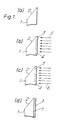
- Figure 1 illustrates the stages of a process for carrying out the invention
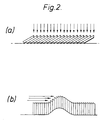
- Figure 2 shows how a desired distribution of deposited material can be achieved.
- FIG. 1 shows a section of a blade 1 having a cutting edge 2 of chisel form. Scalpels and single-edged razor blades are examples of cutting edges of this type.
- the blade 1 is made of a titanium alloy or a stainless steel.
- a coating 3, of between 0.1 and 0.2 m of boron is deposited on one surface 4 of the cutting edge 2 of the blade 1, by means of electron beam evaporation 5 from a source which is not shown in Figure 1 (b).
- the coated surface 4 of the cutting edge 2 of the blade 1 is then bombarded by a beam 6 of nitrogen ions, as is shown in Figure 1 (c).
- the nitrogen ions have an energy of 10 to 200 KeV, and the bombardment is continued until sufficient nitrogen has been implanted to cause at least 25 per cent of the boron to be converted to boron nitride.
- the nitrogen ions cause it to migrate into the main body of blade 1 by means of the process known as ion beam mixing.
- the result is to produce a region of graded composition 7 between the hard surface ceramic layer 8 of boron nitride and the softer main body of the blade 1, as shown in Figure 1 (d).
- the whole process is carried out in a vacuum of about 10- 5 torr.
- the softer main body of the blade 1 wears away preferentially, leaving the hard surface layer 8 and the region 7 exposed to form a self-maintaining fine cutting edge.
- carbon can be implanted with the nitrogen so that the surface layer 8 has a mixed composition of boron carbide and nitride.
- Other materials which form hard nitrides or carbides, such as tungsten, vanadium, hafnium or titanium can be used. Titanium, of course, would not be used if the blade itself is made of titanium.
- the coating need only be applied to a restricted region of the blade 1.
- Advantage can be taken of the straight line trajectory of particles in a vacuum to achieve this, either by stacking a plurality of blades 1 at an angle to the incident atoms and ions, as shown in Figure 2 or causing them to traverse a hump, 31 in a track, 32 as shown in Figure 2b, so that only the tip 33 of the blades 1 are exposed to the atoms and ions.
Landscapes
- Chemical & Material Sciences (AREA)
- Chemical Kinetics & Catalysis (AREA)
- Engineering & Computer Science (AREA)
- Materials Engineering (AREA)
- Mechanical Engineering (AREA)
- Metallurgy (AREA)
- Organic Chemistry (AREA)
- Physical Vapour Deposition (AREA)
- Cutting Tools, Boring Holders, And Turrets (AREA)
Claims (7)
Applications Claiming Priority (2)
| Application Number | Priority Date | Filing Date | Title |
|---|---|---|---|
| GB858512542A GB8512542D0 (en) | 1985-05-17 | 1985-05-17 | Improved cutting edges |
| GB8512542 | 1985-05-17 |
Publications (2)
| Publication Number | Publication Date |
|---|---|
| EP0206494A1 EP0206494A1 (de) | 1986-12-30 |
| EP0206494B1 true EP0206494B1 (de) | 1989-08-02 |
Family
ID=10579304
Family Applications (1)
| Application Number | Title | Priority Date | Filing Date |
|---|---|---|---|
| EP86303629A Expired EP0206494B1 (de) | 1985-05-17 | 1986-05-13 | Schneideinsatz |
Country Status (4)
| Country | Link |
|---|---|
| EP (1) | EP0206494B1 (de) |
| JP (1) | JPS61274825A (de) |
| DE (1) | DE3664792D1 (de) |
| GB (2) | GB8512542D0 (de) |
Families Citing this family (11)
| Publication number | Priority date | Publication date | Assignee | Title |
|---|---|---|---|---|
| US4653373A (en) * | 1986-01-08 | 1987-03-31 | Gerber Scientific Inc. | Knife blade and method for making same |
| GB8626330D0 (en) * | 1986-11-04 | 1986-12-31 | Atomic Energy Authority Uk | Ion assisted coatings |
| JP2648329B2 (ja) * | 1987-09-18 | 1997-08-27 | エフ・ホフマン−ラ ロシュ アーゲー | エイズの予防または治療用医薬組成物 |
| DE3931565C1 (de) * | 1989-09-22 | 1991-01-24 | Dornier Luftfahrt Gmbh, 8000 Muenchen, De | |
| GB2261227B (en) * | 1991-11-08 | 1995-01-11 | Univ Hull | Surface treatment of metals |
| CN1034679C (zh) * | 1992-09-28 | 1997-04-23 | 大连理工大学 | 全元素离子束材料表面改性方法 |
| GB9302384D0 (en) * | 1993-02-06 | 1993-03-24 | Mcphersons Ltd | Coatings |
| GB2290554B (en) * | 1993-02-06 | 1996-07-24 | Mcphersons Ltd | Coatings |
| RU2119551C1 (ru) * | 1997-10-21 | 1998-09-27 | Омский государственный университет | Способ обработки твердосплавного режущего инструмента |
| RU2156831C1 (ru) * | 1999-01-26 | 2000-09-27 | Институт физики прочности и материаловедения СО РАН | Способ повышения коррозионной стойкости режущего инструмента на основе стали |
| RU2167216C1 (ru) * | 1999-10-05 | 2001-05-20 | Омский государственный университет | Способ упрочнения твердосплавного режущего инструмента |
Citations (1)
| Publication number | Priority date | Publication date | Assignee | Title |
|---|---|---|---|---|
| EP0175538A1 (de) * | 1984-09-14 | 1986-03-26 | United Kingdom Atomic Energy Authority | Oberflächenbehandlung von Metallen |
Family Cites Families (7)
| Publication number | Priority date | Publication date | Assignee | Title |
|---|---|---|---|---|
| DE326971C (de) * | 1914-04-25 | 1920-10-05 | Westinghouse Electric Corp | Fahrschalter, der beim Loslassen der Kurbel selbsttaetig ausschaltet und die Bremsen anlegt |
| GB1258259A (de) * | 1968-04-05 | 1971-12-30 | ||
| US3900636A (en) * | 1971-01-21 | 1975-08-19 | Gillette Co | Method of treating cutting edges |
| US3915757A (en) * | 1972-08-09 | 1975-10-28 | Niels N Engel | Ion plating method and product therefrom |
| CA1041881A (en) * | 1974-09-11 | 1978-11-07 | Niels N. Engel | Coated steel product and process of producing the same |
| GB2073254B (en) * | 1980-04-09 | 1984-05-23 | Atomic Energy Authority Uk | Ion implanting metal coated ferrous surfaces |
| GB2125442B (en) * | 1982-05-24 | 1986-02-19 | Atomic Energy Authority Uk | A procedure for the hardening of materials |
-
1985
- 1985-05-17 GB GB858512542A patent/GB8512542D0/en active Pending
-
1986
- 1986-05-13 DE DE8686303629T patent/DE3664792D1/de not_active Expired
- 1986-05-13 GB GB8611627A patent/GB2175316B/en not_active Expired
- 1986-05-13 EP EP86303629A patent/EP0206494B1/de not_active Expired
- 1986-05-17 JP JP11343786A patent/JPS61274825A/ja active Pending
Patent Citations (1)
| Publication number | Priority date | Publication date | Assignee | Title |
|---|---|---|---|---|
| EP0175538A1 (de) * | 1984-09-14 | 1986-03-26 | United Kingdom Atomic Energy Authority | Oberflächenbehandlung von Metallen |
Also Published As
| Publication number | Publication date |
|---|---|
| DE3664792D1 (en) | 1989-09-07 |
| GB8512542D0 (en) | 1985-06-19 |
| JPS61274825A (ja) | 1986-12-05 |
| GB8611627D0 (en) | 1986-06-18 |
| GB2175316B (en) | 1989-04-26 |
| GB2175316A (en) | 1986-11-26 |
| EP0206494A1 (de) | 1986-12-30 |
Similar Documents
| Publication | Publication Date | Title |
|---|---|---|
| CA1338053C (en) | Method and apparatus for forming or modifying cutting edges | |
| US4933058A (en) | Formation of hard coatings on cutting edges | |
| EP0206494B1 (de) | Schneideinsatz | |
| US4470895A (en) | Coatings for cutting implements | |
| Ramm et al. | Pulse enhanced electron emission (P3e™) arc evaporation and the synthesis of wear resistant Al–Cr–O coatings in corundum structure | |
| Freller et al. | TixAl1− xN films deposited by ion plating with an arc evaporator | |
| JPH08209332A (ja) | 耐摩耗性に優れた工具を製造する方法 | |
| SE451002B (sv) | Beleggning for metallskerande verktyg | |
| US5185211A (en) | Non-stoichiometric titanium nitride coating | |
| EP0351093B1 (de) | Nassrasierer | |
| EP0255834A4 (de) | Bildung harter beschichtungen auf schneidrändern. | |
| JP2875892B2 (ja) | 立方晶窒化ほう素膜の形成方法 | |
| JPS62164869A (ja) | 高硬度被覆材料とその製造方法 | |
| JP4808972B2 (ja) | 表面被覆切削工具 | |
| JPS5918475B2 (ja) | 被覆高速度鋼 | |
| JPH0419001A (ja) | 非晶質硬質炭素膜被覆ダイヤモンド工具 | |
| US5069092A (en) | Cutting tool for aluminum workpieces having enhanced crater wear resistance | |
| JP3021488B2 (ja) | 高機能薄膜の製造方法 | |
| Freller | Vapour-phase coating processes for hard coatings | |
| JPH0548713B2 (de) | ||
| GB2197346A (en) | Ion assisted coating process | |
| JPH0250948A (ja) | 複合超硬材料 | |
| JPH0627321B2 (ja) | セラミツクコ−テイング刃物の製造方法 | |
| JPH05330956A (ja) | Ti−希土類元素−N系超硬質化合物膜およびその形成方法 | |
| US5157997A (en) | Cutting tool for aluminum workpieces having enhanced crater wear resistance |
Legal Events
| Date | Code | Title | Description |
|---|---|---|---|
| PUAI | Public reference made under article 153(3) epc to a published international application that has entered the european phase |
Free format text: ORIGINAL CODE: 0009012 |
|
| AK | Designated contracting states |
Kind code of ref document: A1 Designated state(s): CH DE FR IT LI SE |
|
| 17P | Request for examination filed |
Effective date: 19870618 |
|
| 17Q | First examination report despatched |
Effective date: 19880805 |
|
| GRAA | (expected) grant |
Free format text: ORIGINAL CODE: 0009210 |
|
| XX | Miscellaneous (additional remarks) |
Free format text: VERFAHREN ABGESCHLOSSEN INFOLGE VERBINDUNG MIT 871016200/0234361 (EUROPAEISCHE ANMELDENUMMER/VEROEFFENTLICHUNGSNUMMER) VOM 30.05.89. |
|
| AK | Designated contracting states |
Kind code of ref document: B1 Designated state(s): CH DE FR IT LI SE |
|
| ITF | It: translation for a ep patent filed | ||
| REF | Corresponds to: |
Ref document number: 3664792 Country of ref document: DE Date of ref document: 19890907 |
|
| ET | Fr: translation filed | ||
| ITTA | It: last paid annual fee | ||
| PLBE | No opposition filed within time limit |
Free format text: ORIGINAL CODE: 0009261 |
|
| STAA | Information on the status of an ep patent application or granted ep patent |
Free format text: STATUS: NO OPPOSITION FILED WITHIN TIME LIMIT |
|
| 26N | No opposition filed | ||
| PGFP | Annual fee paid to national office [announced via postgrant information from national office to epo] |
Ref country code: SE Payment date: 19910620 Year of fee payment: 6 |
|
| PGFP | Annual fee paid to national office [announced via postgrant information from national office to epo] |
Ref country code: CH Payment date: 19910627 Year of fee payment: 6 |
|
| PG25 | Lapsed in a contracting state [announced via postgrant information from national office to epo] |
Ref country code: SE Effective date: 19920514 |
|
| PG25 | Lapsed in a contracting state [announced via postgrant information from national office to epo] |
Ref country code: LI Effective date: 19920531 Ref country code: CH Effective date: 19920531 |
|
| REG | Reference to a national code |
Ref country code: CH Ref legal event code: PL |
|
| PGFP | Annual fee paid to national office [announced via postgrant information from national office to epo] |
Ref country code: DE Payment date: 19940420 Year of fee payment: 9 |
|
| PGFP | Annual fee paid to national office [announced via postgrant information from national office to epo] |
Ref country code: FR Payment date: 19940421 Year of fee payment: 9 |
|
| EUG | Se: european patent has lapsed |
Ref document number: 86303629.9 Effective date: 19921204 |
|
| PG25 | Lapsed in a contracting state [announced via postgrant information from national office to epo] |
Ref country code: DE Effective date: 19960201 |
|
| PG25 | Lapsed in a contracting state [announced via postgrant information from national office to epo] |
Ref country code: FR Effective date: 19960229 |
|
| REG | Reference to a national code |
Ref country code: FR Ref legal event code: ST |
|
| REG | Reference to a national code |
Ref country code: FR Ref legal event code: ST |
|
| PG25 | Lapsed in a contracting state [announced via postgrant information from national office to epo] |
Ref country code: IT Free format text: LAPSE BECAUSE OF NON-PAYMENT OF DUE FEES;WARNING: LAPSES OF ITALIAN PATENTS WITH EFFECTIVE DATE BEFORE 2007 MAY HAVE OCCURRED AT ANY TIME BEFORE 2007. THE CORRECT EFFECTIVE DATE MAY BE DIFFERENT FROM THE ONE RECORDED. Effective date: 20050513 |