EP0202003A2 - Method and apparatus for measuring delay and/or gain difference - Google Patents
Method and apparatus for measuring delay and/or gain difference Download PDFInfo
- Publication number
- EP0202003A2 EP0202003A2 EP86302190A EP86302190A EP0202003A2 EP 0202003 A2 EP0202003 A2 EP 0202003A2 EP 86302190 A EP86302190 A EP 86302190A EP 86302190 A EP86302190 A EP 86302190A EP 0202003 A2 EP0202003 A2 EP 0202003A2
- Authority
- EP
- European Patent Office
- Prior art keywords
- signal
- amplitude
- channels
- repetitive
- signals
- Prior art date
- Legal status (The legal status is an assumption and is not a legal conclusion. Google has not performed a legal analysis and makes no representation as to the accuracy of the status listed.)
- Withdrawn
Links
Images
Classifications
-
- H—ELECTRICITY
- H04—ELECTRIC COMMUNICATION TECHNIQUE
- H04N—PICTORIAL COMMUNICATION, e.g. TELEVISION
- H04N17/00—Diagnosis, testing or measuring for television systems or their details
Definitions
- This invention relates to a method and apparatus for measuring delay and/or gain difference.
- differences in delay and/or gain between two signal transmission channels are measured by impressing on each channel a repetitive signal comprising a burst packet.
- the two burst packets are of different predetermined frequencies and are timed to have a predetermined phase relationship at a selected time during each burst packet.
- the two signals that have been transmitted through the signal transmission channels respectively are additively combined, and depending upon whether it is the gain or delay of the channels that is to be measured, the amplitude of the combined signal at a turning point in the amplitude of the signal envelope or the difference, if any, between the selected time (at which the packets have the predetermined phase relationship) and the time at which a turning point in the amplitude of the envelope occurs, is measured.
- the burst packets occur at line rate and the two signals are synchronized so that the burst packets are in phase at the midpoint of the line.
- the output signals are subtracted and the difference signal is displayed on an oscilloscope, or the output signals are applied to the A and B terminals of a waveform monitor in the A-B mode. If the two channels are of equal delay and gain, the envelope signal will have zero amplitude at the midpoint of the line. If the gains are unequal, the turning point of the envelope amplitude will occur at a finite value of the envelope amplitude, and if the delays are different the turning point of the envelope amplitude will be displaced from the midpoint of the line.
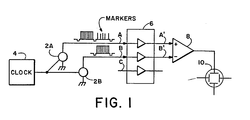
- the measurement system illustrated in FIG. 1 comprises a pair of video signal generators 2A and 2B.
- the two video signal generators are digital, each comprising a PROM that is programmed to produce a predetermined signal when the PROM is addressed.
- the two video signal generators 2A and 2B receive their clocks from a common master clock generator 4.
- the signal generated by each generator repeats at video line rate and includes a blanking interval and a full line burst packet on a pedestal.
- the two burst packets are at slightly . different frequencies (e. g. 500 kHz and 502 kHz) and are timed to be in phase in the middle of the video line.
- the two test signals are applied to the inputs A and B of two of the three channels of an analog component video system 6, and the signals at the outputs A' and B' are applied to respective inputs of a subtraction amplifier 8 that combines the signals in additive fashion.
- the output of the amplifier 8 is applied to the vertical input of a waveform monitor or other suitable display device, such as an oscilloscope.
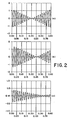
- FIG. 2(a) shows the display that is obtained when the burst packets are at 500 kHz and 510 kHz and there is no gain or delay difference between the two channels.
- the envelope of the combined signal then has zero amplitude at the midpoint of the horizontal line.
- the burst packets are at 500 kHz and at 510 kHz, and again the envelope of the combined signal has a point of zero amplitude, but this is spaced from the midpoint of the line, implying a delay difference between the channels.
- T is 5 us/division and this corresponds, in the case of FIGS. 2(a) and 2(b) to approximately 100 ns delay per division.
- FIG. 2(c) shows the display that is obtained with signals of 500 kHz and 502 kHz. This results in a calibration of about 20 ns delay per division.
- the two signals do not cancel completely, and accordingly the envelope has non-zero amplitude at its minimum amplitude point.
- the amplitude of the envelope at its minimum amplitude point represents a gain difference of about 5%.
- the minimum amplitude point is spaced from the midpoint of the line by about two and one-half divisions, corresponding to a delay of 50 ns between the channels.
- the blanking interval for the luminance component would include a horizontal sync pulse but it would not be necessary to include a horizontal sync pulse in the blanking intervals for the color difference components.
- one of the test signals could include markers (see FIG. 1) that are spaced apart along the line and provide the timing calibration independently of the calibration of the display. Markers of different height could be employed to provide a calibration of gain difference.
Landscapes
- Engineering & Computer Science (AREA)
- Health & Medical Sciences (AREA)
- Biomedical Technology (AREA)
- General Health & Medical Sciences (AREA)
- Multimedia (AREA)
- Signal Processing (AREA)
- Testing, Inspecting, Measuring Of Stereoscopic Televisions And Televisions (AREA)
- Measurement Of Resistance Or Impedance (AREA)
Abstract
Description
- This invention relates to a method and apparatus for measuring delay and/or gain difference.
- It is conventional in the color television field for the color video signal to be processed in encoded (e. g. NTSC) form. Although component signals (generally R, G, B) are produced in cameras and telecines, it has hitherto been usual to encode these component signals and carry out further operations on the encoded signal. Recently, however, the use of component signals (R, G, B or luminance, and two color difference components) has increased, with the result that the need for accurately identifying different characteristics (among them gain and delay) of the channels through which the component signals pass, has arisen. It will be understood that unless the gain and delay of the channels are equal, when the components are encoded and the encoded signal is used by a television display, the picture produced by the encoded signal on the television display will not be an accurate representation of the original scene.
- The need to provide for accurate measurement of the characteristics of the different channels of a component video system was discussed at International Broadcasting Conference which took place at Brighton, England in September, 1984. In the paper "Measurements in a Television Component Environment" by A. James and P. J. Marshall, mention is made of the use of a 500 kHz sine wave for measuring delay difference among the channels. This measurement is carried out by impressing a 500 kHz signal on the channels, two at a time, and observing, on a dual trace oscilloscope, whether the zero crossing points of the output sine waves are aligned. This type of measurement, however, is rather difficult to carry out, and, in any event, does not provide an accurate indication of gain difference.
- In accordance with the present invention, differences in delay and/or gain between two signal transmission channels are measured by impressing on each channel a repetitive signal comprising a burst packet. The two burst packets are of different predetermined frequencies and are timed to have a predetermined phase relationship at a selected time during each burst packet. The two signals that have been transmitted through the signal transmission channels respectively are additively combined, and depending upon whether it is the gain or delay of the channels that is to be measured, the amplitude of the combined signal at a turning point in the amplitude of the signal envelope or the difference, if any, between the selected time (at which the packets have the predetermined phase relationship) and the time at which a turning point in the amplitude of the envelope occurs, is measured.
- In the case of a component video system, the burst packets occur at line rate and the two signals are synchronized so that the burst packets are in phase at the midpoint of the line. The output signals are subtracted and the difference signal is displayed on an oscilloscope, or the output signals are applied to the A and B terminals of a waveform monitor in the A-B mode. If the two channels are of equal delay and gain, the envelope signal will have zero amplitude at the midpoint of the line. If the gains are unequal, the turning point of the envelope amplitude will occur at a finite value of the envelope amplitude, and if the delays are different the turning point of the envelope amplitude will be displaced from the midpoint of the line.
- For a better understanding of the invention, and to show how the same may be carried into effect, reference will now be made, by way of example, to the accompanying drawings in which:
- FIG. 1 is a block diagram illustrating a measurement system embodying the present invention, and
- FIG. 2 shows signal waveforms provided by the system under three different conditions.
- The measurement system illustrated in FIG. 1 comprises a pair of
video signal generators video signal generators master clock generator 4. The signal generated by each generator repeats at video line rate and includes a blanking interval and a full line burst packet on a pedestal. The two burst packets are at slightly . different frequencies (e. g. 500 kHz and 502 kHz) and are timed to be in phase in the middle of the video line. The two test signals are applied to the inputs A and B of two of the three channels of an analogcomponent video system 6, and the signals at the outputs A' and B' are applied to respective inputs of asubtraction amplifier 8 that combines the signals in additive fashion. The output of theamplifier 8 is applied to the vertical input of a waveform monitor or other suitable display device, such as an oscilloscope. - The type of display provided on the waveform monitor is shown in FIG. 2. FIG. 2(a) shows the display that is obtained when the burst packets are at 500 kHz and 510 kHz and there is no gain or delay difference between the two channels. The envelope of the combined signal then has zero amplitude at the midpoint of the horizontal line. In the case of FIG. 2(b) the burst packets are at 500 kHz and at 510 kHz, and again the envelope of the combined signal has a point of zero amplitude, but this is spaced from the midpoint of the line, implying a delay difference between the channels.
- It can be shown that if the frequencies of the packets are fo and fo + Δf, and the sweep rate of the display is T s/div, and Δf is small in relation to fo, then the delay calibration that relates the position of the point of minimum amplitude of the signal envelope to the position of that point if there were no relative delay is T Δf/fo s/div. In the displays shown in FIG. 2, T is 5 us/division and this corresponds, in the case of FIGS. 2(a) and 2(b) to approximately 100 ns delay per division.
- FIG. 2(c) shows the display that is obtained with signals of 500 kHz and 502 kHz. This results in a calibration of about 20 ns delay per division. In the case of FIG. 2(c), the two signals do not cancel completely, and accordingly the envelope has non-zero amplitude at its minimum amplitude point. In this particular case, the amplitude of the envelope at its minimum amplitude point represents a gain difference of about 5%. The minimum amplitude point is spaced from the midpoint of the line by about two and one-half divisions, corresponding to a delay of 50 ns between the channels.
- In the event that the component signals passed through the three channels of the
video system 6 are a luminance component and two color difference components, the blanking interval for the luminance component would include a horizontal sync pulse but it would not be necessary to include a horizontal sync pulse in the blanking intervals for the color difference components. - It will be appreciated that the invention is not restricted to the particular method and apparatus that have been described, and that variations may be made therein without departing from the scope of the invention as defined in the appended claims, and equivalents thereof. For example, although the output signals from the two channels are subtracted in the case of the illustrated system, if the signals were arranged to be precisely out of phase at a predetermined point of the line, cancellation of the signals would be brought about by addition. In order to facilitate display, one of the test signals could include markers (see FIG. 1) that are spaced apart along the line and provide the timing calibration independently of the calibration of the display. Markers of different height could be employed to provide a calibration of gain difference.
Claims (6)
Applications Claiming Priority (2)
| Application Number | Priority Date | Filing Date | Title |
|---|---|---|---|
| US722943 | 1985-04-12 | ||
| US06/722,943 US4829366A (en) | 1985-04-12 | 1985-04-12 | Method and apparatus for measuring delay and/or gain difference using two different frequency sources |
Publications (2)
| Publication Number | Publication Date |
|---|---|
| EP0202003A2 true EP0202003A2 (en) | 1986-11-20 |
| EP0202003A3 EP0202003A3 (en) | 1988-09-14 |
Family
ID=24904093
Family Applications (1)
| Application Number | Title | Priority Date | Filing Date |
|---|---|---|---|
| EP86302190A Withdrawn EP0202003A3 (en) | 1985-04-12 | 1986-03-25 | Method and apparatus for measuring delay and/or gain difference |
Country Status (6)
| Country | Link |
|---|---|
| US (1) | US4829366A (en) |
| EP (1) | EP0202003A3 (en) |
| JP (1) | JPS6254173A (en) |
| AU (1) | AU566220B2 (en) |
| CA (1) | CA1272508A (en) |
| DK (1) | DK165286A (en) |
Cited By (1)
| Publication number | Priority date | Publication date | Assignee | Title |
|---|---|---|---|---|
| DE3900531A1 (en) * | 1988-01-11 | 1989-07-27 | Tektronix Inc | DISPLAY DEVICE FOR MEASURING THE DELAY AND REINFORCEMENT RATIO FROM CHROMINANCE TO LUMINANCE |
Families Citing this family (7)
| Publication number | Priority date | Publication date | Assignee | Title |
|---|---|---|---|---|
| US5010403A (en) * | 1990-04-12 | 1991-04-23 | Tektronix, Inc. | Measurement of timebase jitter for component video |
| US6124897A (en) * | 1996-09-30 | 2000-09-26 | Sigma Designs, Inc. | Method and apparatus for automatic calibration of analog video chromakey mixer |
| US5528309A (en) * | 1994-06-28 | 1996-06-18 | Sigma Designs, Incorporated | Analog video chromakey mixer |
| US7180537B2 (en) * | 2004-02-18 | 2007-02-20 | Tektronix, Inc. | Relative channel delay measurement |
| JP4980602B2 (en) * | 2005-10-12 | 2012-07-18 | 株式会社エヌ・ティ・ティ・ドコモ | Transmitter and receiver for measuring propagation delay time difference |
| JP2023090138A (en) * | 2021-12-17 | 2023-06-29 | アストロデザイン株式会社 | DELAY TIME MEASUREMENT METHOD AND DELAY TIME MEASUREMENT DEVICE |
| CN114778915B (en) * | 2022-03-16 | 2025-06-27 | 中电科思仪科技股份有限公司 | A circuit and method for reducing input capacitance of high-impedance channel of digital oscilloscope |
Family Cites Families (7)
| Publication number | Priority date | Publication date | Assignee | Title |
|---|---|---|---|---|
| US2333322A (en) * | 1940-02-22 | 1943-11-02 | Int Standard Electric Corp | Apparatus for measuring phase differences and for analogous purposes |
| NL298287A (en) * | 1962-09-24 | |||
| GB1100655A (en) * | 1965-09-20 | 1968-01-24 | Marconi Instruments Ltd | Improvements in or relating to cathode ray tube display oscilloscope instruments |
| US3441843A (en) * | 1966-06-08 | 1969-04-29 | Claire R Wainwright | System for tilting frequency marker in sweep generator display |
| US3706931A (en) * | 1971-04-01 | 1972-12-19 | Bell Telephone Labor Inc | Apparatus for use in measuring phase dispersion produced by apparatus or a system |
| US3986113A (en) * | 1973-11-23 | 1976-10-12 | Hewlett-Packard Company | Two channel test instrument with active electronicphase shift means |
| DE3025971C2 (en) * | 1980-07-09 | 1984-03-08 | Institut für Rundfunktechnik GmbH, 8000 München | Method for measuring amplitude and / or phase distortions in an FM transmission system |
-
1985
- 1985-04-12 US US06/722,943 patent/US4829366A/en not_active Expired - Lifetime
-
1986
- 1986-03-25 EP EP86302190A patent/EP0202003A3/en not_active Withdrawn
- 1986-04-10 CA CA000506331A patent/CA1272508A/en not_active Expired - Fee Related
- 1986-04-11 AU AU56025/86A patent/AU566220B2/en not_active Ceased
- 1986-04-11 DK DK165286A patent/DK165286A/en not_active IP Right Cessation
- 1986-04-11 JP JP61083968A patent/JPS6254173A/en active Pending
Cited By (1)
| Publication number | Priority date | Publication date | Assignee | Title |
|---|---|---|---|---|
| DE3900531A1 (en) * | 1988-01-11 | 1989-07-27 | Tektronix Inc | DISPLAY DEVICE FOR MEASURING THE DELAY AND REINFORCEMENT RATIO FROM CHROMINANCE TO LUMINANCE |
Also Published As
| Publication number | Publication date |
|---|---|
| DK165286A (en) | 1986-10-13 |
| AU5602586A (en) | 1986-10-16 |
| JPS6254173A (en) | 1987-03-09 |
| AU566220B2 (en) | 1987-10-15 |
| EP0202003A3 (en) | 1988-09-14 |
| CA1272508A (en) | 1990-08-07 |
| DK165286D0 (en) | 1986-04-11 |
| US4829366A (en) | 1989-05-09 |
Similar Documents
| Publication | Publication Date | Title |
|---|---|---|
| US4829366A (en) | Method and apparatus for measuring delay and/or gain difference using two different frequency sources | |
| EP0090426A2 (en) | Method and apparatus for measuring horizontal sync subcarrier phase | |
| US2885470A (en) | Television transmission quality testing system | |
| US5010403A (en) | Measurement of timebase jitter for component video | |
| US3825835A (en) | Signal-to-noise ratio measurement | |
| GB1191256A (en) | Apparatus for measuring a characteristic of a repetitively varying electrical signal | |
| US4694324A (en) | Measurement of SC/H phase using a polar display | |
| US4204228A (en) | Digital testing apparatus | |
| US4680620A (en) | Measurement of SC/H phase using a subcarrier time mark generator and a calibrated phase shifter | |
| US4069500A (en) | Arrangements for testing color television systems | |
| US4603346A (en) | Subcarrier/horizontal sync phase measurement | |
| US2855515A (en) | Television test apparatus | |
| US4635094A (en) | Method and apparatus for measurement of component video signal characteristics using an oscilloscope | |
| US4587551A (en) | Measurement of SC/H phase | |
| US4149044A (en) | Method and apparatus for graphically displaying amplitude and phase jitter | |
| EP0162236B1 (en) | Measurement of sc/h phase using a polar display | |
| US3250853A (en) | Color-television test signal generator | |
| US4123705A (en) | Oscillographic apparatus for measuring the magnitude and duration and for separately viewing an input signal | |
| JP2870874B2 (en) | Method and apparatus for measuring relative delay | |
| Teear et al. | Measurement techniques in television studios and outside broadcasts | |
| SU946010A1 (en) | Device for measuring parameters of colour television channels | |
| GB949072A (en) | Apparatus for comparing amplitudes at selected points in recurrent electrical signal waveforms | |
| CA1256196A (en) | Measurement of subcarrier to horizontal sync phase using a polar display | |
| GB1315312A (en) | Cathode ray tube display devices | |
| JPS5499478A (en) | Measuring apparatus for radio apparatus |
Legal Events
| Date | Code | Title | Description |
|---|---|---|---|
| PUAI | Public reference made under article 153(3) epc to a published international application that has entered the european phase |
Free format text: ORIGINAL CODE: 0009012 |
|
| AK | Designated contracting states |
Kind code of ref document: A2 Designated state(s): DE FR GB NL |
|
| PUAL | Search report despatched |
Free format text: ORIGINAL CODE: 0009013 |
|
| AK | Designated contracting states |
Kind code of ref document: A3 Designated state(s): DE FR GB NL |
|
| 17P | Request for examination filed |
Effective date: 19881122 |
|
| STAA | Information on the status of an ep patent application or granted ep patent |
Free format text: STATUS: THE APPLICATION HAS BEEN WITHDRAWN |
|
| 18W | Application withdrawn |
Withdrawal date: 19910221 |
|
| RIN1 | Information on inventor provided before grant (corrected) |
Inventor name: PENNEY, BRUCE J. |