EP0201831A2 - Thermotrope aromatische Polyester mit hoher Wärmeformbeständigkeit, Verfahren zu ihrer Herstellung und ihre Verwendung zur Herstellung von Formkörpern, Filamenten, Fasern und Folien - Google Patents
Thermotrope aromatische Polyester mit hoher Wärmeformbeständigkeit, Verfahren zu ihrer Herstellung und ihre Verwendung zur Herstellung von Formkörpern, Filamenten, Fasern und Folien Download PDFInfo
- Publication number
- EP0201831A2 EP0201831A2 EP86106117A EP86106117A EP0201831A2 EP 0201831 A2 EP0201831 A2 EP 0201831A2 EP 86106117 A EP86106117 A EP 86106117A EP 86106117 A EP86106117 A EP 86106117A EP 0201831 A2 EP0201831 A2 EP 0201831A2
- Authority
- EP
- European Patent Office
- Prior art keywords
- residues
- diphenyl
- fabrication
- mol
- diphenol
- Prior art date
- Legal status (The legal status is an assumption and is not a legal conclusion. Google has not performed a legal analysis and makes no representation as to the accuracy of the status listed.)
- Withdrawn
Links
- 229920000728 polyester Polymers 0.000 title claims abstract description 49
- 238000000034 method Methods 0.000 title claims description 11
- 239000000835 fiber Substances 0.000 title claims description 7
- 238000004519 manufacturing process Methods 0.000 title claims description 7
- 125000003118 aryl group Chemical group 0.000 title abstract description 7
- XKZQKPRCPNGNFR-UHFFFAOYSA-N 2-(3-hydroxyphenyl)phenol Chemical group OC1=CC=CC(C=2C(=CC=CC=2)O)=C1 XKZQKPRCPNGNFR-UHFFFAOYSA-N 0.000 claims abstract description 13
- -1 dicarboxylic acid diphenyl ester Chemical class 0.000 claims description 9
- KKEYFWRCBNTPAC-UHFFFAOYSA-N terephthalic acid group Chemical group C(C1=CC=C(C(=O)O)C=C1)(=O)O KKEYFWRCBNTPAC-UHFFFAOYSA-N 0.000 claims description 9
- 150000001991 dicarboxylic acids Chemical class 0.000 claims description 8
- 238000000465 moulding Methods 0.000 claims description 6
- 239000006085 branching agent Substances 0.000 claims description 5
- 239000003054 catalyst Substances 0.000 claims description 4
- 238000002360 preparation method Methods 0.000 claims description 3
- 235000010290 biphenyl Nutrition 0.000 claims 1
- 239000004305 biphenyl Substances 0.000 claims 1
- ZUOUZKKEUPVFJK-UHFFFAOYSA-N phenylbenzene Natural products C1=CC=CC=C1C1=CC=CC=C1 ZUOUZKKEUPVFJK-UHFFFAOYSA-N 0.000 claims 1
- 238000000354 decomposition reaction Methods 0.000 abstract description 3
- 238000006243 chemical reaction Methods 0.000 description 11
- 239000000155 melt Substances 0.000 description 9
- IJGRMHOSHXDMSA-UHFFFAOYSA-N Atomic nitrogen Chemical compound N#N IJGRMHOSHXDMSA-UHFFFAOYSA-N 0.000 description 8
- 125000004432 carbon atom Chemical group C* 0.000 description 7
- 238000002844 melting Methods 0.000 description 7
- 230000008018 melting Effects 0.000 description 7
- 239000000126 substance Substances 0.000 description 6
- QIGBRXMKCJKVMJ-UHFFFAOYSA-N Hydroquinone Chemical compound OC1=CC=C(O)C=C1 QIGBRXMKCJKVMJ-UHFFFAOYSA-N 0.000 description 5
- 125000001142 dicarboxylic acid group Chemical group 0.000 description 5
- 150000003839 salts Chemical class 0.000 description 5
- 229910052757 nitrogen Inorganic materials 0.000 description 4
- 239000012071 phase Substances 0.000 description 4
- 230000004580 weight loss Effects 0.000 description 4
- JWZZKOKVBUJMES-UHFFFAOYSA-N (+-)-Isoprenaline Chemical compound CC(C)NCC(O)C1=CC=C(O)C(O)=C1 JWZZKOKVBUJMES-UHFFFAOYSA-N 0.000 description 3
- QTBSBXVTEAMEQO-UHFFFAOYSA-N Acetic acid Chemical compound CC(O)=O QTBSBXVTEAMEQO-UHFFFAOYSA-N 0.000 description 3
- ISWSIDIOOBJBQZ-UHFFFAOYSA-N Phenol Chemical compound OC1=CC=CC=C1 ISWSIDIOOBJBQZ-UHFFFAOYSA-N 0.000 description 3
- HEMHJVSKTPXQMS-UHFFFAOYSA-M Sodium hydroxide Chemical compound [OH-].[Na+] HEMHJVSKTPXQMS-UHFFFAOYSA-M 0.000 description 3
- 125000005587 carbonate group Chemical group 0.000 description 3
- 125000003178 carboxy group Chemical group [H]OC(*)=O 0.000 description 3
- MVPPADPHJFYWMZ-UHFFFAOYSA-N chlorobenzene Chemical compound ClC1=CC=CC=C1 MVPPADPHJFYWMZ-UHFFFAOYSA-N 0.000 description 3
- 150000001875 compounds Chemical class 0.000 description 3
- 229910052732 germanium Inorganic materials 0.000 description 3
- GNPVGFCGXDBREM-UHFFFAOYSA-N germanium atom Chemical compound [Ge] GNPVGFCGXDBREM-UHFFFAOYSA-N 0.000 description 3
- QQVIHTHCMHWDBS-UHFFFAOYSA-N isophthalic acid Chemical compound OC(=O)C1=CC=CC(C(O)=O)=C1 QQVIHTHCMHWDBS-UHFFFAOYSA-N 0.000 description 3
- 239000000203 mixture Substances 0.000 description 3
- 239000000178 monomer Substances 0.000 description 3
- 239000002904 solvent Substances 0.000 description 3
- 239000010936 titanium Substances 0.000 description 3
- 229910052719 titanium Inorganic materials 0.000 description 3
- JWAZRIHNYRIHIV-UHFFFAOYSA-N 2-naphthol Chemical compound C1=CC=CC2=CC(O)=CC=C21 JWAZRIHNYRIHIV-UHFFFAOYSA-N 0.000 description 2
- UYEMGAFJOZZIFP-UHFFFAOYSA-N 3,5-dihydroxybenzoic acid Chemical compound OC(=O)C1=CC(O)=CC(O)=C1 UYEMGAFJOZZIFP-UHFFFAOYSA-N 0.000 description 2
- FJKROLUGYXJWQN-UHFFFAOYSA-N 4-hydroxybenzoic acid Chemical compound OC(=O)C1=CC=C(O)C=C1 FJKROLUGYXJWQN-UHFFFAOYSA-N 0.000 description 2
- DGAQECJNVWCQMB-PUAWFVPOSA-M Ilexoside XXIX Chemical compound C[C@@H]1CC[C@@]2(CC[C@@]3(C(=CC[C@H]4[C@]3(CC[C@@H]5[C@@]4(CC[C@@H](C5(C)C)OS(=O)(=O)[O-])C)C)[C@@H]2[C@]1(C)O)C)C(=O)O[C@H]6[C@@H]([C@H]([C@@H]([C@H](O6)CO)O)O)O.[Na+] DGAQECJNVWCQMB-PUAWFVPOSA-M 0.000 description 2
- FYYHWMGAXLPEAU-UHFFFAOYSA-N Magnesium Chemical compound [Mg] FYYHWMGAXLPEAU-UHFFFAOYSA-N 0.000 description 2
- PXHVJJICTQNCMI-UHFFFAOYSA-N Nickel Chemical compound [Ni] PXHVJJICTQNCMI-UHFFFAOYSA-N 0.000 description 2
- QCWXUUIWCKQGHC-UHFFFAOYSA-N Zirconium Chemical compound [Zr] QCWXUUIWCKQGHC-UHFFFAOYSA-N 0.000 description 2
- ZOIORXHNWRGPMV-UHFFFAOYSA-N acetic acid;zinc Chemical compound [Zn].CC(O)=O.CC(O)=O ZOIORXHNWRGPMV-UHFFFAOYSA-N 0.000 description 2
- 239000002253 acid Substances 0.000 description 2
- 150000007513 acids Chemical class 0.000 description 2
- WNLRTRBMVRJNCN-UHFFFAOYSA-N adipic acid Chemical compound OC(=O)CCCCC(O)=O WNLRTRBMVRJNCN-UHFFFAOYSA-N 0.000 description 2
- 229910052784 alkaline earth metal Inorganic materials 0.000 description 2
- 150000001342 alkaline earth metals Chemical class 0.000 description 2
- ADCOVFLJGNWWNZ-UHFFFAOYSA-N antimony trioxide Chemical compound O=[Sb]O[Sb]=O ADCOVFLJGNWWNZ-UHFFFAOYSA-N 0.000 description 2
- QMKYBPDZANOJGF-UHFFFAOYSA-N benzene-1,3,5-tricarboxylic acid Chemical compound OC(=O)C1=CC(C(O)=O)=CC(C(O)=O)=C1 QMKYBPDZANOJGF-UHFFFAOYSA-N 0.000 description 2
- WPYMKLBDIGXBTP-UHFFFAOYSA-N benzoic acid Chemical compound OC(=O)C1=CC=CC=C1 WPYMKLBDIGXBTP-UHFFFAOYSA-N 0.000 description 2
- IISBACLAFKSPIT-UHFFFAOYSA-N bisphenol A Chemical compound C=1C=C(O)C=CC=1C(C)(C)C1=CC=C(O)C=C1 IISBACLAFKSPIT-UHFFFAOYSA-N 0.000 description 2
- YHWCPXVTRSHPNY-UHFFFAOYSA-N butan-1-olate;titanium(4+) Chemical compound [Ti+4].CCCC[O-].CCCC[O-].CCCC[O-].CCCC[O-] YHWCPXVTRSHPNY-UHFFFAOYSA-N 0.000 description 2
- BVKZGUZCCUSVTD-UHFFFAOYSA-N carbonic acid Chemical class OC(O)=O BVKZGUZCCUSVTD-UHFFFAOYSA-N 0.000 description 2
- 239000011248 coating agent Substances 0.000 description 2
- 238000000576 coating method Methods 0.000 description 2
- 238000009833 condensation Methods 0.000 description 2
- 238000001816 cooling Methods 0.000 description 2
- 150000005690 diesters Chemical class 0.000 description 2
- HPGJOUYGWKFYQW-UHFFFAOYSA-N diphenyl benzene-1,4-dicarboxylate Chemical compound C=1C=C(C(=O)OC=2C=CC=CC=2)C=CC=1C(=O)OC1=CC=CC=C1 HPGJOUYGWKFYQW-UHFFFAOYSA-N 0.000 description 2
- WLGVXUAWXQYVQU-UHFFFAOYSA-N formaldehyde;zirconium Chemical compound [Zr].O=C WLGVXUAWXQYVQU-UHFFFAOYSA-N 0.000 description 2
- 230000004927 fusion Effects 0.000 description 2
- 238000011835 investigation Methods 0.000 description 2
- 239000011777 magnesium Substances 0.000 description 2
- 229910052749 magnesium Inorganic materials 0.000 description 2
- AXZKOIWUVFPNLO-UHFFFAOYSA-N magnesium;oxygen(2-) Chemical compound [O-2].[Mg+2] AXZKOIWUVFPNLO-UHFFFAOYSA-N 0.000 description 2
- WPBNNNQJVZRUHP-UHFFFAOYSA-L manganese(2+);methyl n-[[2-(methoxycarbonylcarbamothioylamino)phenyl]carbamothioyl]carbamate;n-[2-(sulfidocarbothioylamino)ethyl]carbamodithioate Chemical compound [Mn+2].[S-]C(=S)NCCNC([S-])=S.COC(=O)NC(=S)NC1=CC=CC=C1NC(=S)NC(=O)OC WPBNNNQJVZRUHP-UHFFFAOYSA-L 0.000 description 2
- 239000000463 material Substances 0.000 description 2
- HKJYVRJHDIPMQB-UHFFFAOYSA-N propan-1-olate;titanium(4+) Chemical compound CCCO[Ti](OCCC)(OCCC)OCCC HKJYVRJHDIPMQB-UHFFFAOYSA-N 0.000 description 2
- 239000011541 reaction mixture Substances 0.000 description 2
- GHMLBKRAJCXXBS-UHFFFAOYSA-N resorcinol Chemical compound OC1=CC=CC(O)=C1 GHMLBKRAJCXXBS-UHFFFAOYSA-N 0.000 description 2
- CXMXRPHRNRROMY-UHFFFAOYSA-N sebacic acid Chemical compound OC(=O)CCCCCCCCC(O)=O CXMXRPHRNRROMY-UHFFFAOYSA-N 0.000 description 2
- 229910052708 sodium Inorganic materials 0.000 description 2
- NESLWCLHZZISNB-UHFFFAOYSA-M sodium phenolate Chemical compound [Na+].[O-]C1=CC=CC=C1 NESLWCLHZZISNB-UHFFFAOYSA-M 0.000 description 2
- 238000002411 thermogravimetry Methods 0.000 description 2
- 229920001169 thermoplastic Polymers 0.000 description 2
- 239000004416 thermosoftening plastic Substances 0.000 description 2
- 230000007704 transition Effects 0.000 description 2
- 239000004246 zinc acetate Substances 0.000 description 2
- 229910052726 zirconium Inorganic materials 0.000 description 2
- BYEAHWXPCBROCE-UHFFFAOYSA-N 1,1,1,3,3,3-hexafluoropropan-2-ol Chemical compound FC(F)(F)C(O)C(F)(F)F BYEAHWXPCBROCE-UHFFFAOYSA-N 0.000 description 1
- 125000004958 1,4-naphthylene group Chemical group 0.000 description 1
- 125000001140 1,4-phenylene group Chemical group [H]C1=C([H])C([*:2])=C([H])C([H])=C1[*:1] 0.000 description 1
- RNFJDJUURJAICM-UHFFFAOYSA-N 2,2,4,4,6,6-hexaphenoxy-1,3,5-triaza-2$l^{5},4$l^{5},6$l^{5}-triphosphacyclohexa-1,3,5-triene Chemical compound N=1P(OC=2C=CC=CC=2)(OC=2C=CC=CC=2)=NP(OC=2C=CC=CC=2)(OC=2C=CC=CC=2)=NP=1(OC=1C=CC=CC=1)OC1=CC=CC=C1 RNFJDJUURJAICM-UHFFFAOYSA-N 0.000 description 1
- 125000004959 2,6-naphthylene group Chemical group [H]C1=C([H])C2=C([H])C([*:1])=C([H])C([H])=C2C([H])=C1[*:2] 0.000 description 1
- PQHRHABVSWOYPG-UHFFFAOYSA-N 2,9-dioxatricyclo[8.2.2.24,7]hexadeca-1(13),4,6,10(14),11,15-hexaene-3,8-dione Chemical compound O1C(=O)C(C=C2)=CC=C2C(=O)OC2=CC=C1C=C2 PQHRHABVSWOYPG-UHFFFAOYSA-N 0.000 description 1
- YQPCHPBGAALCRT-UHFFFAOYSA-N 2-[1-(carboxymethyl)cyclohexyl]acetic acid Chemical compound OC(=O)CC1(CC(O)=O)CCCCC1 YQPCHPBGAALCRT-UHFFFAOYSA-N 0.000 description 1
- RXNYJUSEXLAVNQ-UHFFFAOYSA-N 4,4'-Dihydroxybenzophenone Chemical compound C1=CC(O)=CC=C1C(=O)C1=CC=C(O)C=C1 RXNYJUSEXLAVNQ-UHFFFAOYSA-N 0.000 description 1
- VWGKEVWFBOUAND-UHFFFAOYSA-N 4,4'-thiodiphenol Chemical compound C1=CC(O)=CC=C1SC1=CC=C(O)C=C1 VWGKEVWFBOUAND-UHFFFAOYSA-N 0.000 description 1
- IZKGNQAPFKTUBG-UHFFFAOYSA-N 4-(2-phenylethynyl)cyclohexa-2,4-diene-1,1-dicarboxylic acid Chemical compound C1=CC(C(=O)O)(C(O)=O)CC=C1C#CC1=CC=CC=C1 IZKGNQAPFKTUBG-UHFFFAOYSA-N 0.000 description 1
- NZGQHKSLKRFZFL-UHFFFAOYSA-N 4-(4-hydroxyphenoxy)phenol Chemical compound C1=CC(O)=CC=C1OC1=CC=C(O)C=C1 NZGQHKSLKRFZFL-UHFFFAOYSA-N 0.000 description 1
- SBBQDUFLZGOASY-OWOJBTEDSA-N 4-[(e)-2-(4-carboxyphenyl)ethenyl]benzoic acid Chemical compound C1=CC(C(=O)O)=CC=C1\C=C\C1=CC=C(C(O)=O)C=C1 SBBQDUFLZGOASY-OWOJBTEDSA-N 0.000 description 1
- WXNZTHHGJRFXKQ-UHFFFAOYSA-N 4-chlorophenol Chemical compound OC1=CC=C(Cl)C=C1 WXNZTHHGJRFXKQ-UHFFFAOYSA-N 0.000 description 1
- 229940090248 4-hydroxybenzoic acid Drugs 0.000 description 1
- ISAVYTVYFVQUDY-UHFFFAOYSA-N 4-tert-Octylphenol Chemical compound CC(C)(C)CC(C)(C)C1=CC=C(O)C=C1 ISAVYTVYFVQUDY-UHFFFAOYSA-N 0.000 description 1
- 239000005711 Benzoic acid Substances 0.000 description 1
- OYPRJOBELJOOCE-UHFFFAOYSA-N Calcium Chemical compound [Ca] OYPRJOBELJOOCE-UHFFFAOYSA-N 0.000 description 1
- 229910052684 Cerium Inorganic materials 0.000 description 1
- 229920001634 Copolyester Polymers 0.000 description 1
- 239000002841 Lewis acid Substances 0.000 description 1
- 229920001233 Poly-4-hydroxybenzoate Polymers 0.000 description 1
- ZLMJMSJWJFRBEC-UHFFFAOYSA-N Potassium Chemical compound [K] ZLMJMSJWJFRBEC-UHFFFAOYSA-N 0.000 description 1
- KDYFGRWQOYBRFD-UHFFFAOYSA-N Succinic acid Natural products OC(=O)CCC(O)=O KDYFGRWQOYBRFD-UHFFFAOYSA-N 0.000 description 1
- ATJFFYVFTNAWJD-UHFFFAOYSA-N Tin Chemical compound [Sn] ATJFFYVFTNAWJD-UHFFFAOYSA-N 0.000 description 1
- RTAQQCXQSZGOHL-UHFFFAOYSA-N Titanium Chemical compound [Ti] RTAQQCXQSZGOHL-UHFFFAOYSA-N 0.000 description 1
- HCHKCACWOHOZIP-UHFFFAOYSA-N Zinc Chemical compound [Zn] HCHKCACWOHOZIP-UHFFFAOYSA-N 0.000 description 1
- JJLKTTCRRLHVGL-UHFFFAOYSA-L [acetyloxy(dibutyl)stannyl] acetate Chemical compound CC([O-])=O.CC([O-])=O.CCCC[Sn+2]CCCC JJLKTTCRRLHVGL-UHFFFAOYSA-L 0.000 description 1
- 125000004423 acyloxy group Chemical group 0.000 description 1
- 239000001361 adipic acid Substances 0.000 description 1
- 235000011037 adipic acid Nutrition 0.000 description 1
- 238000004378 air conditioning Methods 0.000 description 1
- 229910052783 alkali metal Inorganic materials 0.000 description 1
- 150000001340 alkali metals Chemical class 0.000 description 1
- 229910052787 antimony Inorganic materials 0.000 description 1
- WATWJIUSRGPENY-UHFFFAOYSA-N antimony atom Chemical compound [Sb] WATWJIUSRGPENY-UHFFFAOYSA-N 0.000 description 1
- 235000010233 benzoic acid Nutrition 0.000 description 1
- YXVFYQXJAXKLAK-UHFFFAOYSA-N biphenyl-4-ol Chemical group C1=CC(O)=CC=C1C1=CC=CC=C1 YXVFYQXJAXKLAK-UHFFFAOYSA-N 0.000 description 1
- 229940106691 bisphenol a Drugs 0.000 description 1
- 238000009835 boiling Methods 0.000 description 1
- 238000005282 brightening Methods 0.000 description 1
- BSDOQSMQCZQLDV-UHFFFAOYSA-N butan-1-olate;zirconium(4+) Chemical compound [Zr+4].CCCC[O-].CCCC[O-].CCCC[O-].CCCC[O-] BSDOQSMQCZQLDV-UHFFFAOYSA-N 0.000 description 1
- KDYFGRWQOYBRFD-NUQCWPJISA-N butanedioic acid Chemical compound O[14C](=O)CC[14C](O)=O KDYFGRWQOYBRFD-NUQCWPJISA-N 0.000 description 1
- 229910052791 calcium Inorganic materials 0.000 description 1
- 239000011575 calcium Substances 0.000 description 1
- 239000004301 calcium benzoate Substances 0.000 description 1
- 235000010237 calcium benzoate Nutrition 0.000 description 1
- HZQXCUSDXIKLGS-UHFFFAOYSA-L calcium;dibenzoate;trihydrate Chemical compound O.O.O.[Ca+2].[O-]C(=O)C1=CC=CC=C1.[O-]C(=O)C1=CC=CC=C1 HZQXCUSDXIKLGS-UHFFFAOYSA-L 0.000 description 1
- 229910052799 carbon Inorganic materials 0.000 description 1
- 150000001734 carboxylic acid salts Chemical class 0.000 description 1
- 150000001735 carboxylic acids Chemical class 0.000 description 1
- ZMIGMASIKSOYAM-UHFFFAOYSA-N cerium Chemical compound [Ce][Ce][Ce][Ce][Ce][Ce][Ce][Ce][Ce][Ce][Ce][Ce][Ce][Ce][Ce][Ce][Ce][Ce][Ce][Ce][Ce][Ce][Ce][Ce][Ce][Ce][Ce][Ce][Ce][Ce][Ce][Ce][Ce][Ce][Ce][Ce][Ce][Ce] ZMIGMASIKSOYAM-UHFFFAOYSA-N 0.000 description 1
- 238000012512 characterization method Methods 0.000 description 1
- 229910017052 cobalt Inorganic materials 0.000 description 1
- 239000010941 cobalt Substances 0.000 description 1
- 229940011182 cobalt acetate Drugs 0.000 description 1
- GUTLYIVDDKVIGB-UHFFFAOYSA-N cobalt atom Chemical compound [Co] GUTLYIVDDKVIGB-UHFFFAOYSA-N 0.000 description 1
- QAHREYKOYSIQPH-UHFFFAOYSA-L cobalt(II) acetate Chemical compound [Co+2].CC([O-])=O.CC([O-])=O QAHREYKOYSIQPH-UHFFFAOYSA-L 0.000 description 1
- QSAWQNUELGIYBC-UHFFFAOYSA-N cyclohexane-1,2-dicarboxylic acid Chemical compound OC(=O)C1CCCCC1C(O)=O QSAWQNUELGIYBC-UHFFFAOYSA-N 0.000 description 1
- 230000007423 decrease Effects 0.000 description 1
- ZXDVQYBUEVYUCG-UHFFFAOYSA-N dibutyltin(2+);methanolate Chemical compound CCCC[Sn](OC)(OC)CCCC ZXDVQYBUEVYUCG-UHFFFAOYSA-N 0.000 description 1
- ROORDVPLFPIABK-UHFFFAOYSA-N diphenyl carbonate Chemical compound C=1C=CC=CC=1OC(=O)OC1=CC=CC=C1 ROORDVPLFPIABK-UHFFFAOYSA-N 0.000 description 1
- 238000004821 distillation Methods 0.000 description 1
- 230000008030 elimination Effects 0.000 description 1
- 238000003379 elimination reaction Methods 0.000 description 1
- 150000002148 esters Chemical class 0.000 description 1
- 238000001125 extrusion Methods 0.000 description 1
- 239000000945 filler Substances 0.000 description 1
- 239000003063 flame retardant Substances 0.000 description 1
- 239000011888 foil Substances 0.000 description 1
- KYXIMMOBOGDUFW-UHFFFAOYSA-N germanium zirconium Chemical compound [Ge].[Zr] KYXIMMOBOGDUFW-UHFFFAOYSA-N 0.000 description 1
- 238000004442 gravimetric analysis Methods 0.000 description 1
- 150000004820 halides Chemical class 0.000 description 1
- 238000010438 heat treatment Methods 0.000 description 1
- 150000004678 hydrides Chemical class 0.000 description 1
- 150000004679 hydroxides Chemical class 0.000 description 1
- 125000002887 hydroxy group Chemical group [H]O* 0.000 description 1
- 238000011065 in-situ storage Methods 0.000 description 1
- 238000002347 injection Methods 0.000 description 1
- 239000007924 injection Substances 0.000 description 1
- 238000001746 injection moulding Methods 0.000 description 1
- 239000012212 insulator Substances 0.000 description 1
- 229910052746 lanthanum Inorganic materials 0.000 description 1
- FZLIPJUXYLNCLC-UHFFFAOYSA-N lanthanum atom Chemical compound [La] FZLIPJUXYLNCLC-UHFFFAOYSA-N 0.000 description 1
- 150000007517 lewis acids Chemical class 0.000 description 1
- 239000007788 liquid Substances 0.000 description 1
- XIXADJRWDQXREU-UHFFFAOYSA-M lithium acetate Chemical compound [Li+].CC([O-])=O XIXADJRWDQXREU-UHFFFAOYSA-M 0.000 description 1
- 235000001055 magnesium Nutrition 0.000 description 1
- UEGPKNKPLBYCNK-UHFFFAOYSA-L magnesium acetate Chemical compound [Mg+2].CC([O-])=O.CC([O-])=O UEGPKNKPLBYCNK-UHFFFAOYSA-L 0.000 description 1
- 239000011654 magnesium acetate Substances 0.000 description 1
- 229940069446 magnesium acetate Drugs 0.000 description 1
- 235000011285 magnesium acetate Nutrition 0.000 description 1
- 239000000395 magnesium oxide Substances 0.000 description 1
- CPLXHLVBOLITMK-UHFFFAOYSA-N magnesium oxide Inorganic materials [Mg]=O CPLXHLVBOLITMK-UHFFFAOYSA-N 0.000 description 1
- AKTIAGQCYPCKFX-FDGPNNRMSA-L magnesium;(z)-4-oxopent-2-en-2-olate Chemical compound [Mg+2].C\C([O-])=C\C(C)=O.C\C([O-])=C\C(C)=O AKTIAGQCYPCKFX-FDGPNNRMSA-L 0.000 description 1
- 238000005259 measurement Methods 0.000 description 1
- 238000002074 melt spinning Methods 0.000 description 1
- 238000000386 microscopy Methods 0.000 description 1
- 150000007522 mineralic acids Chemical class 0.000 description 1
- 150000002763 monocarboxylic acids Chemical class 0.000 description 1
- 229910052759 nickel Inorganic materials 0.000 description 1
- 150000007524 organic acids Chemical class 0.000 description 1
- 235000005985 organic acids Nutrition 0.000 description 1
- 230000000737 periodic effect Effects 0.000 description 1
- FCJSHPDYVMKCHI-UHFFFAOYSA-N phenyl benzoate Chemical class C=1C=CC=CC=1C(=O)OC1=CC=CC=C1 FCJSHPDYVMKCHI-UHFFFAOYSA-N 0.000 description 1
- QCDYQQDYXPDABM-UHFFFAOYSA-N phloroglucinol Chemical compound OC1=CC(O)=CC(O)=C1 QCDYQQDYXPDABM-UHFFFAOYSA-N 0.000 description 1
- 229960001553 phloroglucinol Drugs 0.000 description 1
- 239000004033 plastic Substances 0.000 description 1
- 230000010287 polarization Effects 0.000 description 1
- 229920000515 polycarbonate Polymers 0.000 description 1
- 239000004417 polycarbonate Substances 0.000 description 1
- 238000006068 polycondensation reaction Methods 0.000 description 1
- 229920005862 polyol Polymers 0.000 description 1
- 150000003077 polyols Chemical class 0.000 description 1
- 229910052700 potassium Inorganic materials 0.000 description 1
- SCVFZCLFOSHCOH-UHFFFAOYSA-M potassium acetate Substances [K+].CC([O-])=O SCVFZCLFOSHCOH-UHFFFAOYSA-M 0.000 description 1
- 235000011056 potassium acetate Nutrition 0.000 description 1
- 238000003825 pressing Methods 0.000 description 1
- 238000003672 processing method Methods 0.000 description 1
- 239000011734 sodium Substances 0.000 description 1
- 239000001632 sodium acetate Substances 0.000 description 1
- 235000017281 sodium acetate Nutrition 0.000 description 1
- 239000007790 solid phase Substances 0.000 description 1
- 239000000243 solution Substances 0.000 description 1
- 238000009987 spinning Methods 0.000 description 1
- 239000007858 starting material Substances 0.000 description 1
- 238000012360 testing method Methods 0.000 description 1
- VXUYXOFXAQZZMF-UHFFFAOYSA-N titanium(IV) isopropoxide Chemical compound CC(C)O[Ti](OC(C)C)(OC(C)C)OC(C)C VXUYXOFXAQZZMF-UHFFFAOYSA-N 0.000 description 1
- 229910052720 vanadium Inorganic materials 0.000 description 1
- GPPXJZIENCGNKB-UHFFFAOYSA-N vanadium Chemical compound [V]#[V] GPPXJZIENCGNKB-UHFFFAOYSA-N 0.000 description 1
- 229910052725 zinc Inorganic materials 0.000 description 1
- 239000011701 zinc Substances 0.000 description 1
- 235000013904 zinc acetate Nutrition 0.000 description 1
- NHXVNEDMKGDNPR-UHFFFAOYSA-N zinc;pentane-2,4-dione Chemical compound [Zn+2].CC(=O)[CH-]C(C)=O.CC(=O)[CH-]C(C)=O NHXVNEDMKGDNPR-UHFFFAOYSA-N 0.000 description 1
Classifications
-
- C—CHEMISTRY; METALLURGY
- C08—ORGANIC MACROMOLECULAR COMPOUNDS; THEIR PREPARATION OR CHEMICAL WORKING-UP; COMPOSITIONS BASED THEREON
- C08G—MACROMOLECULAR COMPOUNDS OBTAINED OTHERWISE THAN BY REACTIONS ONLY INVOLVING UNSATURATED CARBON-TO-CARBON BONDS
- C08G63/00—Macromolecular compounds obtained by reactions forming a carboxylic ester link in the main chain of the macromolecule
- C08G63/02—Polyesters derived from hydroxycarboxylic acids or from polycarboxylic acids and polyhydroxy compounds
- C08G63/12—Polyesters derived from hydroxycarboxylic acids or from polycarboxylic acids and polyhydroxy compounds derived from polycarboxylic acids and polyhydroxy compounds
- C08G63/16—Dicarboxylic acids and dihydroxy compounds
- C08G63/18—Dicarboxylic acids and dihydroxy compounds the acids or hydroxy compounds containing carbocyclic rings
- C08G63/19—Hydroxy compounds containing aromatic rings
- C08G63/193—Hydroxy compounds containing aromatic rings containing two or more aromatic rings
-
- C—CHEMISTRY; METALLURGY
- C09—DYES; PAINTS; POLISHES; NATURAL RESINS; ADHESIVES; COMPOSITIONS NOT OTHERWISE PROVIDED FOR; APPLICATIONS OF MATERIALS NOT OTHERWISE PROVIDED FOR
- C09K—MATERIALS FOR MISCELLANEOUS APPLICATIONS, NOT PROVIDED FOR ELSEWHERE
- C09K19/00—Liquid crystal materials
- C09K19/04—Liquid crystal materials characterised by the chemical structure of the liquid crystal components, e.g. by a specific unit
- C09K19/38—Polymers
- C09K19/3804—Polymers with mesogenic groups in the main chain
- C09K19/3809—Polyesters; Polyester derivatives, e.g. polyamides
Definitions
- the invention relates to high molecular weight thermotropic aromatic polyesters with high heat resistance and high thermal and chemical stability, a process for the preparation of these polyesters and their use for the production of moldings, filaments, fibers and films.
- the liquid-crystalline state of polyester melts can be examined with the aid of a polarizing microscope: for the investigations, the eyepiece was equipped with an attachment which contained a photodiode arranged in the focal point of the eyepiece lens. Using a downstream measuring amplifier with control device, the measured value was set to 100 divisions on a switched-on microscope with Nicol prisms arranged in parallel in the absence of a material sample. In the case of crossed Nicol prisms, this gave a value of 0.01 scale divisions.
- the layer thickness of the polyester melts examined was 100 ⁇ m.
- the polyester was examined after the samples had melted at temperatures between 300 and 430.degree. If there was a brightening of the melt observed between the crossed Nicol prisms in all or part of it, the polyester was classified as thermotropic liquid crystalline.
- liquid-crystalline polyesters in the measuring arrangement show values over 1 scale part, mostly values from 3 to 90 scale parts.
- amorphous melts e.g. aromatic polycarbonates
- values of less than 0.1 scale were found.
- the method described above is particularly suitable for a quick determination in the laboratory and delivers unambiguous results in almost all cases. In cases of doubt, on the other hand, it can make sense to detect the presence of liquid-crystalline components in the melt by means of X-ray wide-angle scattering, as it is e.g. at G.W. Gray and P.A. Windsor, "Plastic Crystals, Physico-Chemical Properties and Methods of Investigation", particularly Chapter 3, John Wiley & Sons, New York, Sydney, Toronto, 1974.
- Shaped bodies and foils can be produced from thermotropic polyesters by thermoplastic deformation and by spinning from the melt filaments and fibers with exceptional mechanical properties. The prerequisite, however, is that the polyesters are non-decomposed - meltable.
- Thermotropic polyesters of three or more monomers can be processed thermoplastically (DE-OS 27 04 315, 27 21 786, 27 51 653, 28 34 537, 28 44 817, 29 32 178, 29 63 833, EP-A 1340, 30 182 , 69,587, U.S. Pat. Nos. 41 53 779, 42 45 082, 42 79 803, 43 55 134, 43 71 660, 43 91 966). All these products have in common, however, that the desired lowering of the melting point also results in an undesirable reduction in the heat resistance. In some cases, the heat resistance can be increased by a thermal aftertreatment of the filaments, fibers, films or moldings produced from these thermotropic copolyesters. However, the thermal aftertreatment is uneconomical.
- the object of the invention was to provide thermotropic aromatic polyesters which, despite their high heat resistance, can be processed thermoplastic without decomposition.
- the heat resistance (without thermal aftertreatment) should be at least 200 ° C, preferably at least 250 ° C and in particular at least 300 ° C (measured in each case according to Vicat A, DIN 53 460, ISO 306).
- the transition temperature from the crystalline to the liquid-crystalline phase (melting point) determined by DSC should be below 420 ° C., preferably below 400 ° C.
- thermotropic polyesters should be sufficiently thermally stable at temperatures above the melting point.
- isothermal gravimetric analysis (30 min / 400 ° C)
- a weight loss of 5% by weight, preferably 3% by weight, should not be exceeded.
- thermotropic polyesters have the desired combination of advantageous properties when their dipheno residues consist predominantly or solely of 3,3'-diphenyi-4,4'-dihydroxydiphenyireste.
- the invention thus relates to thermotropic polyesters from aromatic dicarboxylic acid residues, dipheno residues, optionally residues from chain terminators and / or branching agents, characterized in that the diphenol residues contain at least 90 mol%, preferably at least 95 mol%, in particular at least 98 mol% 3,3'-Diphenyl-4,4'-dihydroxy-diphenyl radicals.
- the diphenol residues of particularly preferred polyesters consist entirely of 3,3'-diphenyl-4,4'-dihydroxydiphenyl residues.
- A is a divalent aromatic radical having 8 to 24 carbon atoms, preferably having 8 to 16 carbon atoms.
- Preferred aromatic radicals A are those in which the two bonds to the carboxyl groups extend coaxially in opposite directions, for example in 1,4-phenylene, 1,4-naphthylene or 4,4'-biphenylene, or in those in opposite directions Directional bonds are shifted parallel to each other, such as in 1,5-naphthylene, 2,6-naphthylene or 3,5'-biphenylene.
- Other preferred aromatic dicarboxylic acids are 4,4'-trans-stilbenedicarboxylic acid, 4,4-tolanedicarboxylic acid and 4,4'-azobenzenedicarboxylic acids. Terephthalic acid is particularly preferred.
- polyesters according to the invention can contain mixtures of the dicarboxylic acid residues described above; however, preference is given to those polyesters which each contain only one of the components mentioned as dicarboxylic acid residues.
- the polyesters according to the invention can contain up to 10 mol%, based on diphenol residues, of residues of other diphenols having 6 to 18 carbon atoms, such as e.g. Residues of hydroquinone, resorcinol, bisphenol-A, 4,4'-dihydroxydiphenyl ether, 4,4'-dihydroxydiphenyl sulfide or of 4,4'-dihydroxybenzophenone.
- Residues of hydroquinone, resorcinol, bisphenol-A, 4,4'-dihydroxydiphenyl ether, 4,4'-dihydroxydiphenyl sulfide or of 4,4'-dihydroxybenzophenone such as e.g. Residues of hydroquinone, resorcinol, bisphenol-A, 4,4'-dihydroxydiphenyl ether, 4,4'-dihydroxydiphenyl sulfide or of 4,4'-dihydroxybenzoph
- the polyesters according to the invention can contain up to 10 mol%, based on dicarboxylic acid residues, residues of other aromatic dicarboxylic acids with 8 to 24 C atoms, aliphatic dicarboxylic acids with 4 to 14 C atoms, cycloaliphatic dicarboxylic acids with 8 to 16 C. -Atoms, araliphatic dicarboxylic acids with 10 to 18 carbon atoms and / or hydroxycarboxylic acids with 7 to 19 carbon atoms.
- Preferred examples of such cosacids are Isophthalic acid, succinic acid, adipic acid, sebacic acid, hexahydrophthalic acid, iso and terephthalic acid, cyclohexanediacetic acid and p-hydroxybenzoic acid.
- polyesters according to the invention contain other diphenol residues in addition to the 3,3'-diphenyl-4,4'-dihydroxydiphenyl residues and 11 residues of the aromatic dicarboxylic acids and 11 other dicarboxylic acid residues, the sum of the co-components should total 10 mol%, based on the sum of the Diphenol and dicarboxylic acid residues, do not exceed.
- the polyesters according to the invention can contain up to 10 mol% of carbonate groups, based on the sum of ester and carbonate groups.
- Homopolyesters of 3,3'-diphenyl-4,4'-dihydroxydiphenyl and terephthalic acid are particularly preferred.
- the polyesters according to the invention can contain —COOH, —OH, —OC s H s , acyloxy or residues originating from chain terminators as end groups.
- Preferred chain terminators are monofunctional aromatic hydroxyl compounds such as 4-hydroxydiphenyl, p-nonyiphenol, 4- (1,1,3,3-tetramethylbutyl) phenol, ⁇ -naphthol and aromatic monocarboxylic acids such as benzoic acid, diphenylcarboxylic acids and naphthaiine carboxylic acids.
- Chain terminators can be used in amounts of 0.5-5 mol, in the case of monohydroxyl compounds based on diphenols, in the case of monocarboxylic acids based on dicarboxylic acids.
- three or more functional, preferably three and four functional, preferably aromatic monomers such as e.g. Phloroglucin, 1,3,5-benzenetricarboxylic acid or 3,5-dihydroxybenzoic acid, in amounts of 0.1 to 1 mol%, in the case of poly- and hydroxycarboxylic acids based on dicarboxylic acids, in the case of polyols based on diphenols.
- polyesters according to the invention are in the solvents we have tested, e.g. p-chlorophenol and phenoi / tetrachorethane (1: 1 parts by weight), insoluble.
- the melt viscosity of the polyesters according to the invention measured in each case 20 ° C. above the transition temperature determined by DSC from the crystalline to the liquid-crystalline phase (usually between 350 and 430 ° C.) using a nozzle with a length / diameter ratio of 20 at a shear rate of 10 3 sec- 'is usually 2 to 2000, preferably 5 to 1000, in particular 10 to 500 Pa.s.
- polyesters according to the invention can be reacted by reacting the diphenols or their reactive derivatives, for example their C 1 -C 3 -acyl derivatives, with the dicarboxylic acids or their reactive derivatives, for example their dihalides or diesters, optionally in the presence of branching agents, chain terminators and / or catalysts different processes.
- Carbonate groups can be introduced using diphenyl carbonate.
- the polyesters according to the invention can be prepared at temperatures from 160 ° C. to 400 ° C., the reaction generally being started at low temperatures and the temperature being increased continuously as the reaction progresses.
- a vacuum can be applied, the pressure preferably being reduced from normal pressure to approximately 0.1 mbar.
- the diphenol diacetates which can also be produced in situ, are reacted with the dicarboxylic acids at temperatures of 160 to 400 ° C., if appropriate under reduced pressure.
- the dicarboxylic diesters are reacted with the diphenols at temperatures of 250 to 400 ° C. and a pressure of 0.1 to 1000 mbar.
- the product obtained can be subjected to solid phase post-condensation - preferably under reduced pressure - at a temperature of 220 to 380 ° C. After 2 to 25 hours the molecular weight has increased significantly and the resulting polyester has further improved properties.
- the starting compounds are generally used in amounts such that carboxyl to hydroxyl functions are in a ratio of 0.95 to 1.05, preferably 0.98 to 1.02.
- the reactions can be carried out in the melt or in inert high-boiling solvents.
- Preferred catalysts for the polycondensation are Lewis acids and hydrohalic acids; Oxides, hydrides, hydroxides, halides, alcoholates, phenates, salts of inorganic or organic acids (preferably carboxylic acid salts), complex salts or mixed salts of the alkaline earth metals, e.g. Magnesium, calcium; the subgroup elements, e.g. Vanadium, titanium, manganese, cobalt, nickel, zinc, lanthanum, cerium, zirconium or the elements from other groups of the periodic table, e.g. Germanium, tin, lead and antimony or the alkali metals or alkaline earth metals themselves, especially sodium, e.g. B.
- the alkaline earth metals e.g. Magnesium, calcium
- the subgroup elements e.g. Vanadium, titanium, manganese, cobalt, nickel, zinc, lanthanum, cerium, zirconium or the elements from other groups of the periodic table,
- catalyst is particularly preferred.
- the amounts of catalyst are preferably 0.001 to 1% by weight, in particular 0.01 to 0.2% by weight, based on the total weight of the monomers used.
- thermotropic polyesters according to the invention can be processed thermoplastically into injection molded parts, filaments, fibers, tapes and films.
- a molecular orientation is achieved by the shear forces that occur, which is largely influenced by the strength of these forces. Furthermore, they show a pronounced structural viscosity, i.e. that the melt viscosity drops sharply with increasing shear forces.
- Suitable processing methods are injection molding, extrusion, pressing and melt spinning.
- polyesters according to the invention can also be used as coating and coating material (powdery or dispersed). Also for the production of reinforced or filled molding compounds with an amplifier or. Filler contents of 5 to 65% by weight, based on the reinforced and filled molding compound, are ideally suited.
- Another object of the invention is the use of the new polyester for the production of moldings, filaments, fibers and films.
- the heat resistance was measured by determining the Vicat A softening temperature in accordance with DIN 53 460 (ISO 2306).
- thermogravimetric analysis showed an isothermal measurement (30 minutes / 400 ° C) of a weight loss of 1.8%.
- the softening temperature of the polyester was 335 ° C (Vicat A).
- the product was insoluble in p-chlorophenoi and hexafluoroisopropanol.
- the reaction mixture was heated to 270 ° C. in a salt bath with a gentle stream of nitrogen. After 20 minutes at this temperature, the mixture was heated further to 310 ° C., with acetic acid distilling over. In the further course of the reaction, the temperature was kept at 310 ° C. for 30 minutes, then at 330 ° C. for 45 minutes and finally at 350 ° C. for 40 minutes. Vacuum was applied and at the same time the temperature was raised to 380 ° C. The reaction was continued at this temperature and a pressure of 3 mbar for a further 20 minutes. Finally the product froze. After cooling, a light brown polyester was obtained.
- thermogravimetric analysis - (isothermal 30 minutes at 400 ° C) resulted in a weight loss of 2.1%.
- the Vicat A temperature of the polyester was 345 ° C.
Landscapes
- Chemical & Material Sciences (AREA)
- Organic Chemistry (AREA)
- Health & Medical Sciences (AREA)
- Chemical Kinetics & Catalysis (AREA)
- Medicinal Chemistry (AREA)
- Polymers & Plastics (AREA)
- Crystallography & Structural Chemistry (AREA)
- Engineering & Computer Science (AREA)
- Materials Engineering (AREA)
- Polyesters Or Polycarbonates (AREA)
- Artificial Filaments (AREA)
Abstract
Description
- Die Erfindung betrifft hochmolekulare thermotrope aromatische Polyester mit hoher Wärmeformbeständigkeit sowie hoher thermischer und chemischer Stabilität, ein Verfahren zur Herstellung dieser Polyester sowie ihre Verwendung zur Herstellung von Formkörpern, Filamenten, Fasern und Folien.
- Als "thermotrop" bezeichnet man solche Substanzen, die flüssigkristalline Schmelzen bilden. Thermotrope Polyester sind hinreichend bekannt, vergleiche z.B.
- F.E. McFarlane et al., Liquid Crystal Polymers 11, Contemporary Topics in Polymer Science, Vol. 2, Plenum Publishing Corporation, 1977;
- W. J. Jackson und H.F. Kuhfuss, J. Polymer Science, Polymer Chem. Ed. 14, 2042 (1976);
- W.E. Wooten et ai. in A. Ciferri "Ultra-high Modulus Polymers", Applied Science Publ., London 1979, S. 362 f.;
- A. Blumstein et al., "Liquid Crystalline Order in Polymers", Academic Press 1978;
- J. Preston, Angew. Makromol. Chem. 109/110, 1-19 (1982);
- A. Ciferri, W.R. Krigbaum, R.B. Meyer, "Polymer Liquid Crystals", Academic Press,. New York, 1982;
- EP-A 1185, 8855, 15 856, 17 310, 18 145, 22 344, 44 205, 49 615;
- US-PS 3 991 013, 3 991 014, 4 066 620, 4 083 829, 4 107 134;
- WO 79/797, 79/1030, 79/1040.
- Der flüssigkristalline Zustand von Polyesterschmelzen läßt sich mit Hilfe eines Polarisationsmikroskops untersuchen: für die Untersuchungen war das Okular mit einem Aufsatz ausgerüstet, der eine Fotodiode im Brennpunkt der Okularlinse angeordnet enthielt. Anhand eines nachgeschalteten Meßverstärkers mit Regeleinrichtung wurde der Meßwert am eingeschalteten Mikroskop bei parallel angeordneten Nicolschen Prismen in Abwesenheit einer Materialprobe auf 100 Skalenteile eingestellt. Bei gekreuzten Nicolschen Prismen ergab sich dann ein Wert von 0,01 Skalenteilen.
- Die Schichtdicke der untersuchten Polyesterschmelzen betrug 100 um.
- Die Untersuchung der Polyester erfolgte nach dem Aufschmelzen der Proben bei Temperaturen zwischen 300 und 430°C. Sofern in diesem gesamten Bereich oder in einem Teil davon eine Aufhellung der zwischen den gekreuzten Nicolschen Prismen beobachteten Schmelze auftrat, wurde der Polyester als thermotrop flüssigkristallin eingestuft.
- Die flüssigkristallinen Polyester zeigen in der Meßanordnung Werte über 1 Skalenteil, meist Werte von 3 bis 90 Skalenteilen. Für amorphe Schmelzen, z.B. aromatische Polycarbonate, wurden dagegen Werte von weniger als 0,1 Skalenteil gefunden.
- Die oben beschriebene Methode ist für eine Schnellbestimmung im Laboratorium besonders geeignet und liefert in nahezu allen Fällen zweifelsfreie Ergebnisse. In Zweifelsfällen kann es dagegen sinnvoll sein, das Vorhandensein flüssigkristalliner Komponenten mittels Röntgenweitwinkelstreuung in der Schmelze nachzuweisen, wie es z.B. bei G.W. Gray und P.A. Windsor, "Plastic Crystals, Physico-Chemical Properties and Methods of Investigation", insbesondere Chapter 3, John Wiley & Sons, New York, Sydney, Toronto, 1974 beschrieben ist.
- Aus thermotropen Polyestern lassen sich durch thermoplastische Verformung Formkörper und Folien sowie durch Verspinnen aus der Schmelze Filamente und Fasern mit außergewöhnlichen mechanischen Eigenschaften herstellen. Voraussetzung ist jedoch, daß die Polyester unzersetzt - schmelzbar sind.
- Die einfachsten voll-aromatischen Polyester, wie z.B. Poly(4-hydroxybenzoat) und Poly-(1,4-phe- nylenterephthalat) erfüllen diese Voraussetzungen nicht: Sie schmelzen unter Zersetzung erst bei etwa 600°C.
- Thermotrope Polyester aus drei oder mehr Monomeren können thermoplastisch verarbeitet werden (DE-OS 27 04 315, 27 21 786, 27 51 653, 28 34 537, 28 44 817, 29 32 178, 29 63 833, EP-A 1340, 30 182, 69 587, US-PS 41 53 779, 42 45 082, 42 79 803, 43 55 134, 43 71 660, 43 91 966). Allen diesen Produkten ist jedoch gemeinsam, daß mit der erwünschten Erniedrigung des Schmelzpunktes auch eine unerwünschte Verminderung der Wärmeformbeständigkeit eintritt. In manchen Fällen läßt sich die Wärmeformbeständigkeit durch eine thermische Nachbehandlung der aus diesen thermotropen Copolyestern hergestellten Filamente, Fasern, Folien oder Formkörper erhöhen. Die thermische Nachbehandlung ist jedoch unwirtschaftlich.
- Aufgabe der Erfindung war es, thermotrope aromatische Polyester bereitzustellen, die trotz hoher Wärmeformbeständigkeit thermoplastisch unzersetzt verarbeitet werden können.
- Die Wärmeformbeständigkeit (ohne thermische Nachbehandlung) sollte mindestens 200°C, vorzugsweise mindestens 250°C und insebesondere mindestens 300°C (jeweils gemessen nach Vicat A, DIN 53 460, ISO 306) betragen.
- Die durch DSC bestimmte Übergangstemperatur von der kristallinen in die flüssigkristalline Phase (Schmelzpunkt) sollte unter 420°C, vorzugsweise unter 400°C liegen.
- Ferner sollten die neuen thermotropen Polyester bei Temperaturen oberhalb des Schmelzpunktes ausreichend thermisch stabil sein. Bei isothermer gravimetrischer Analyse (30 min/400°C) sollte ein Gewichtsverlust von 5, vorzugsweise von 3 Gew.-% nicht überschritten werden.
- Überraschenderweise wurde gefunden, daß thermotrope Polyester die gewünschte Kombination vorteilhafter Eigenschaften dann besitzen, wenn ihre Diphenoireste überwiegend oder allein aus 3,3'-Diphenyi-4,4'-dihydroxydiphenyiresten bestehen.
- Gegenstand der Erfindung sind also thermotrope Polyester aus aromatischen Dicarbonsäureresten, Diphenoiresten, gegebenenfalls Resten aus Kettenabbrechern und/oder Verzweigungsmitteln, dadurch gekennzeichnet, daß die Diphenolreste zu mindestens 90 Mol-%, vorzugsweise zu mindestens 95 Mol-%, insbesonndere zu mindestens 98 Mol-% 3,3'-Diphenyl-4,4'-dihydroxy- diphenylreste sind.
- Diese Reste entsprechen der Formel
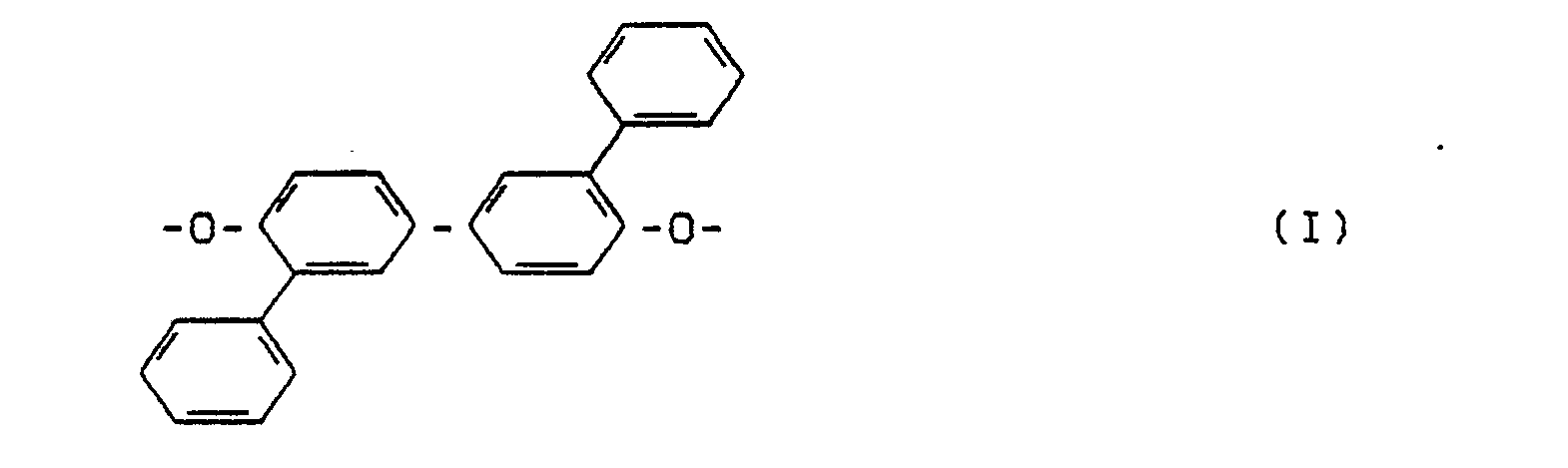
- Die Diphenolreste besonders bevorzugter Polyester bestehen vollständig aus 3,3'-Diphenyl-4,4'-dihydroxydiphenylresten.
- Bevorzugte aromatische Dicarbonsäuren entsprechend der Formel
-

- Die erfindungsgemäßen Polyester können Mischungen der oben beschriebenen Dicarbonsäurereste enthalten; bevorzugt sind jedoch solche Polyester, die als Dicarbonsäurereste jeweils nur eine der genannten Komponenten enthalten.
- Außer 3,3'-Diphenyl-4,4'-dihydroxydiphenyl-reste können die erfindungsgemäßen Polyester bis zu 10 Mol-%, bezogen auf Diphenolreste, Reste anderer Diphenole mit 6 bis 18 C-Atomen enthalten, wie z.B. Reste von Hydrochinon, Resorcin, Bisphenol-A, 4,4'-Dihydroxydiphenylether, 4,4'-Dihydroxy-diphenylsulfid oder von 4,4'-Dihydroxybenzophenon.
- Außer Resten der bevorzugten Dicarbonsäuren 11 können die erfindungsgemäßen Polyester bis zu 10 Mol-%, bezogen auf Dicarbonsäurereste, Reste anderer aromatischer Dicarbonsäuren mit 8 bis 24 C-Atomen, aliphatischer Dicarbonsäuren mit 4 bis 14 C-Atomen, cycloaliphatischer Dicarbonsäuren mit 8 bis 16 C-Atomen, araliphatischer Dicarbonsäuren mit 10 bis 18 C-Atomen und/oder Hydroxycarbonsäuren mit 7 bis 19 C-Atomen enthalten. Bevorzugte Beispiele derartiger Cosäuren sind Isophthalsäure, Bernsteinsäure, Adipinsäure, Sebacinsäure, Hexahydrophthalsäure, -iso-und -terephthalsäure, Cyclohexandiessigsäure und p-Hydroxybenzoesäure.
- Falls die erfindungsgemäßen Polyester neben den 3,3'-Diphenyl-4,4'-dihydroxydiphenyl-resten andere Diphenolreste und neben Resten der aromatischen Dicarbonsäuren 11 andere Dicarbonsäurereste enthalten, soll die Summe der Cokomponenten insgesamt 10 Mol-%, bezogen auf die Summe der Diphenol-und Dicarbonsäurereste, nicht übersteigen.
- Die erfindungsgemäßen Polyester können bis zu 10 Mol-% Carbonatgruppen, bezogen auf die Summe an Ester-und Carbonatgruppen, enthalten.
- Besonders bevorzugt sind Homopolyester aus 3,3'-Diphenyl-4,4'-dihydroxydiphenyl und Terephthalsäure.
- Als Endgruppen können die erfindungsgemäßen Polyester -COOH, -OH, -OCsHs, Acyloxy oder von Kettenabbrechern herrührende Reste enthalten. Bevorzugte Kettenabbrecher sind monofunktionelle aromatische Hydroxylverbindungen wie 4-Hydroxydiphenyl, p-Nonyiphenol, 4-(1,1,3,3-Tetramethyl-butyl)-phenol, ß-Naphthol und aromatische Monocarbonsäuren, wie Benzoesäure, Diphenylcarbonsäuren und Naphthaiincarbonsäuren. Kettenabbrecher können in Mengen von 0,5-5 Mol, bei Monohydroxylverbindungen bezogen auf Diphenole, bei Monocarbonsäuren bezogen auf Dicarbonsäuren, eingesetzt werden.
- Als Verzweigungsmittel können drei-oder höherfunktionelle, vorzugsweise drei-und vierfunktionelle -vorzugsweise aromatische -Monomere, wie z.B. Phloroglucin, 1,3,5-Benzoltricarbonsäure oder 3,5-Dihydroxybenzoesäure, in Mengen von 0,1 bis 1 Mol-%, bei Poly-und Hydroxycarbonsäuren bezogen auf Dicarbonsäuren, bei Polyolen bezogen auf Diphenole, eingesetzt werden.
- Die erfindungsgemäßen Polyester sind in den von uns erprobten Lösungsmitteln, wie z.B. p-Chlorphenol und Phenoi/Tetrachorethan (1:1 Gewichtsteile), unlöslich.
- Die Schmelzviskosität der erfindungsgemäßen Polyester, gemessen jeweils 20°C oberhalb der durch DSC bestimmten Übergangstemperatur von der kristallinen in die flüssigkristalline Phase (üblicherweise zwischen 350 und 430°C) unter Verwendung einer Düse mit einem Länge/Durchmesser-Verhältnis von 20 bei einer Schergeschwindigkeit von 103 sec-' beträgt in der Regel 2 bis 2000, vorzugsweise 5 bis 1000, insbesondere 10 bis 500 Pa.s.
- Die erfindungsgemäßen Polyester können durch Umsetzung der Diphenole oder ihrer reaktionsfähigen Derivate, z.B. ihrer C1-C3-Acylderivate, mit den Dicarbonsäuren oder ihren reaktionsfähigen Derivaten, z.B. ihren Dihalogeniden oder Diestern, gegebenenfalls in Gegenwart von Verzweigungsmitteln, Kettenabbrechern und/oder Katalysatoren, nach verschiedenen Verfahren hergestellt werden.
- Carbonatgruppen können durch Verwendung von Diphenylcarbonat eingeführt werden.
- Die erfindungsgemäßen Polyester können bei Temperaturen von 160°C bis 400°C hergestellt werden, wobei man im allgemeinen die Reaktion bei niedrigen Temperaturen beginnt und im Verlaufe des Reaktionsfortschritts kontinuierlich die Temperatur erhöht. Bei nachlassender Reaktionsgeschwindigkeit kann ein Vakuum angelegt werden, wobei der Druck vorzugsweise von Normaldruck bis auf ca. 0,1 mbar gesenkt wird.
- Nach einem bevorzugten Verfahren werden die Diphenoldiacetate, die auch in situ erzeugt werden können, mit den Dicarbonsäuren bei Temperaturen von 160 bis 400°C, gegebenenfalls unter vermindertem Druck, umgesetzt.
- Nach einem anderen bevorzugten Verfahren werden die Dicarbonsäurediester mit den Diphenolen bei Temperaturen von 250 bis 400°C und einem Druck von 0,1 bis 1000 mbar umgesetzt.
- Das erhaltene Produkt kann einer Festphasennachkondensation -vorzugsweise unter vermindertem Druck -bei einer Temperatur von 220 bis 380°C unterworfen werden. Nach 2 bis 25 Stunden hat sich das Molekulargewicht deutlich erhöht, und damit besitzt der resultierende Polyester weiter verbesserte Eigenschaften.
- Die Ausgangsverbindungen werden in der Regel in solchen Mengen eingesetzt, daß Carboxylzu Hydroxylfunktionen in einem Verhältnis von 0,95 bis 1,05, vorzugsweise 0,98 bis 1,02, stehen.
- Die Reaktionen können in der Schmelze oder in inerten hochsiedenden Lösungsmitteln durchgeführt werden.
- Bevorzugte Katalysatoren für die Polykondensation sind Lewis-Säuren und Halogenwasserstoffsäuren; Oxide, Hydride, Hydroxide, Halogenide, Alkoholate, Phenolate, Salze anorganischer oder organischer Säuren (vorzugsweise Carbonsäuresaize), Komplexsalze oder Mischsalze der Erdalkalimetalle, wie z.B. Magnesium, Calcium; der Nebengruppenelemente, wie z.B. Vanadium, Titan, Mangan, Cobalt, Nickel, Zink, Lanthan, Cer, Zirkonium oder der Elemente aus anderen Gruppen des Periodensystems, wie z.B. Germanium, Zinn, Blei und Antimon oder auch die Alkalimetalle oder Erdalkalimetalle selbst, insbesondere Natrium, z. B.
- Natriumhydroxid, Lithiumacetat, Magnesiumacetat, Cobaltacetat, Zinkacetat, Calciumbenzoat, Magnesiumacetylacetonat, Zinkacetylacetonat, Vanadyl-C ,-Cs alkoxide, Titanalkoxide, wie Titantetrabutylat, Titantetrapropylat, Alkoxytitansilikate, Zirkoniumbutylat, Zirkoniumpropylat, Titantetraphenolat, Natriumphenolat, Germaniumdioxid, Antimontrioxid, Dialkyl-und Diarylzinnoxid, Di-butylzinn-diacetat, Dibutyl-dimethoxy-zinn. Besonders bevorzugt sind Magnesium-, Mangan-, Natrium-, Kalium-und Zinkacetat, Titantetrabutylat, Titantetrapropylat sowie Natriumphenolat. Die Katalysatormengen betragen vorzugsweise 0,001 bis 1 Gew.-%, insbesondere 0,01 bis 0,2 Gew.-%, bezogen auf das Gesamtgewicht der eingesetzten Monomeren.
- Die erfindungsgemäßen thermotropen Polyester können infolge ihrer relativ geringen Schmelzviskosität thermoplastisch zu Spritzgußteilen, Filamenten, Fasern, Bändern und Filmen verarbeitet werden. Durch die hierbei auftretenden Scherkräfte wird eine Molekülorientierung erzielt, die in hohem Maße von der Stärke dieser Kräfte beeinflußt wird. Des weiteren zeigen sie eine ausgeprägte Strukturviskosität, d.h. daß die Schmelzviskosität bei Erhöhung der Scherkräfte stark abfällt. Geeignete Verarbeitungsverfahren sind Spritzguß, Extrusion, Pressen und Schmelzspinnen.
- Aus den erfindungsgemäßen Polyestern können Formteile hoher Zugfestigkeit, hoher Wärmeformbeständigkeit und großer Dimensionsstabilität hergestellt werden. Da die Polyester außerordentlich chemikalienresistent und flammwidrig sind, eignen sie sich bevorzugt zur Herstellung von:
- -elektrotechnischen Artikeln, wie z.B. Isolatoren, gedruckten Schaltungen, Steckkontakten, Armaturenteilen, Umhüllungen von integrierten Schaltungen,
- -Teilen chemisch-technischer Apparate, wie z.B. Rohren, Behälterauskleidungen, Rotoren, Gleitlagern, Dichtungen,
- -Teilen der Flugzeuginnenausstattung,
- -Teilen medizinisch-technischer Geräte, wie z.B. Bauteilen von Klimaanlagen, Ventilteilen.
- Die erfindungsgemäßen Polyester können aber auch als Überzugs-und Beschichtungsmaterial - (pulverförmig oder dispergiert) verwendet werden. Auch zur Herstellung verstärkter oder gefüllter Formmassen mit einem Verstärker-bzw. Füllstoffgehalt von 5 bis 65 Gew.-%, bezogen auf verstärkte und gefüllte Formmasse, sind sie bestens geeignet.
- Weiterer Gegenstand der Erfindung ist also die Verwendung der neuen Polyester zur Herstellung von Formkörpern, Filamenten, Fasern und Filmen.
- Die Prozentangaben der nachfolgenden Beispiele beziehen sich jeweils auf das Gewicht.
- Die Messung der Wärmeformbeständigkeit erfolgte durch Bestimmung der Vicat-A-Erweichungstemperatur gemäß DIN 53 460 (ISO 2306).
- In eine mit Stickstoff gespülte und ausgeheizte Schmelzkondensationsapparatur, bestehend aus einem 250 ml-Planschliffgefäß mit Planschliffdeckel, Rührer, Stickstoffeinleitung und Destillationsaufsatz, wurden folgende Substanzen eingewogen:
- 95,45 g = 0,3 Mol Terephthalsäurediphenylester,
- 101,4 g = 0,3 Mol 3,3'-Diphenyl-4,4'-dihydroxydiphenyl und
- 0,01 g Titantetraisopropylatlösung in Chlorbenzol - (1 %ig).
- Unter leichtem Stickstoffstrom wurde die Reaktionsmischung mittels Salzbad auf 280°C aufgeheizt. Im Verlauf einer Stunde wurde die Temperatur auf 300°C erhöht. Phenol destillierte ab. Über einen Zeitraum von 1,5 Stunden wurde durch allmähliche Erhöhung der Temperatur bis auf 350°C weiter Phenol abdestilliert. Die Destillatmenge betrug zu diesem Zeitpunkt 46,8 g (= 83 % der Theorie). Durch Druckerniedrigung bis auf 4 mbar und gleichzeitiger weiterer Erhöhung der Reaktionstemperatur bis auf 380°C wurde die Phenolabspaltung innerhalb von 20 Minuten zu Ende geführt. Am Ende der Reaktion erstarrte das Produkt im Kolben. Nach dem Abkühlen wurde ein beigefarbener Polyester erhalten.
- Bei der DSC-Untersuchung (verwendetes Gerät: Perkin Eimer DSC 2, Aufheizgeschwindigkeit: 20 K/min) wurde bei 385°C ein Schmelzpeak (Gesamtschmelzwärme: 8,47 cal/g) beobachtet.
- Unter dem Polarisationsmikroskop wurde oberhalb 395°C eine anisotrope Schmelze beobachtet.
- Die thermogravimetrische Analyse ergab bei isothermer Messung (30 Minuten/400°C) einen Gewichtsverlust von 1,8 %.
- Die Erweichungstemperatur des Polyesters betrug 335°C (Vicat A).
- Das Produkt war unlöslich in p-Chlorphenoi und Hexafluorisopropanol.
- In die in Beispiel 1 beschriebene Reaktionsapparatur wurden die folgenden Substanzen eingewogen:
- 49,84 g = 0,3 Mol Terephthalsäure,
- 126,6 g = 0,3 Mol 3,3-Diphenyl-4,4'-diacetoxydiphenyl,
- je 0,05 % Magnesiumoxid und Antimontrioxid, bezogen auf das Gewicht der gesamten Einwaage.
- Unter leichtem Stickstoffstrom wurde die Reaktionsmischung mittels Salzbad auf 270°C aufgeheizt. Nach 20 Minuten bei dieser Temperatur wurde weiter auf 310°C aufgeheizt, wobei Essigsäure überdestillierte. Im weiteren Verlauf der Reaktion wurde die Temperatur 30 Minuten bei 310°C gehalten, dann 45 Minuten bei 330°C und - schließlich 40 Minuten bei 350°C. Vakuum wurde angelegt und gleichzeitig die Temperatur auf 380°C erhöht. Die Reaktion wurde bei dieser Temperatur und einen Druck von 3 mbar noch weitere 20 Minuten fortgeführt. Schließlich erstarrte das Produkt. Nach dem Abkühlen wurde ein hellbrauner Polyester erhalten.
- Bei der DSC-Untersuchung wurde bei 380°C ein Schmelzpeak beobachtet (Gesamtschmelzwärme: 9,3 cal/g).
- Polarisationsmikroskopisch wurde bei Temperaturen oberhalb 385°C eine anisotrope Schmelzphase beobachtet.
- Bei der thermogravimetrischen Analyse - (isotherm 30 Minuten bei 400°C) trat ein Gewichtsverlust von 2,1 % auf.
- Die Vicat-A-Temperatur des Polyesters betrug 345°C.
- Das Produkt war in allen getesteten Lösungsmitteln unlöslich.
- In die im Beispiel 1 beschriebene Reaktionsapparatur wurden die folgenden Substanzen eingewogen:
- 95,45 g = 0,3 Mol Terephthalsäurediphenylester,
- 96,33 g = 0,285 Mol 3,3'-Diphenyl-4,4'-dihydroxydiphenyl,
- 1,65 g = 0,015 Mol Hydrochinon und
- 0,01 g Natriumphenolat.
- Nach dem in Beispiel 1 beschriebenen Reaktionsverfahren wurde ein beigefarbenes Produkt erhalten. Der Polyester wies die folgenden Eigenschaften auf:
- Schmelztemperatur: 365 °C
- Anisotrope Schmelzphase: oberhalb 370°C
- TGA (30 min/400°C): 1,4 % Gewichtsverlust
- Vicat A-Temperatur: 290°C
- Beispiel 4 - 12
- In der in Beispiel 1 beschriebenen Apparatur und nach dem dort erläuterten Verfahren wurden weitere Polyester hergestellt. Die einzelnen Zusammensetzungen und die Ergebnisse der Charakterisierung sind in den nachfolgenden Tabellen 1 und 2 zusammengestellt:


Claims (8)
Applications Claiming Priority (2)
| Application Number | Priority Date | Filing Date | Title |
|---|---|---|---|
| DE3517270 | 1985-05-14 | ||
| DE19853517270 DE3517270A1 (de) | 1985-05-14 | 1985-05-14 | Thermotrope aromatische polyester mit hoher waermeformbestaendigkeit, verfahren zu ihrer herstellung und ihre verwendung zur herstellung von formkoerpern, filamenten, fasern und folien |
Publications (2)
| Publication Number | Publication Date |
|---|---|
| EP0201831A2 true EP0201831A2 (de) | 1986-11-20 |
| EP0201831A3 EP0201831A3 (de) | 1988-09-07 |
Family
ID=6270651
Family Applications (1)
| Application Number | Title | Priority Date | Filing Date |
|---|---|---|---|
| EP86106117A Withdrawn EP0201831A3 (de) | 1985-05-14 | 1986-05-05 | Thermotrope aromatische Polyester mit hoher Wärmeformbeständigkeit, Verfahren zu ihrer Herstellung und ihre Verwendung zur Herstellung von Formkörpern, Filamenten, Fasern und Folien |
Country Status (4)
| Country | Link |
|---|---|
| US (1) | US4701515A (de) |
| EP (1) | EP0201831A3 (de) |
| JP (1) | JPS61261319A (de) |
| DE (1) | DE3517270A1 (de) |
Cited By (5)
| Publication number | Priority date | Publication date | Assignee | Title |
|---|---|---|---|---|
| US4847351A (en) * | 1988-08-01 | 1989-07-11 | General Electric Company | Liquid crystalline polyesters |
| EP0356660A1 (de) * | 1988-07-23 | 1990-03-07 | Bayer Ag | Neue aromatische Polyethersulfone, Verfahren zu ihrer Herstellung und ihre Verwendung |
| EP0324608A3 (de) * | 1988-01-12 | 1990-10-31 | Montedison S.p.A. | Thermotrope flüssigkristalline aromatische Polyester |
| EP0358147A3 (de) * | 1988-09-07 | 1991-10-09 | HIMONT ITALIA S.r.l. | Thermotropische flüssigkristalline aromatische Polyester |
| EP0321107B1 (de) * | 1987-11-24 | 1995-01-25 | HIMONT ITALIA S.r.l. | Thermotrope, flüssigkristalline, aromatische Polyester |
Families Citing this family (8)
| Publication number | Priority date | Publication date | Assignee | Title |
|---|---|---|---|---|
| DE3737638A1 (de) * | 1987-11-06 | 1989-05-18 | Bayer Ag | Keramische koerper, verfahren zu ihrer herstellung und deren verwendung |
| US5235024A (en) * | 1988-05-26 | 1993-08-10 | Sekisui Kagaku Kogyo Kabushiki Kaisha | Polyester and an article made of the same |
| JP2520156B2 (ja) * | 1988-08-31 | 1996-07-31 | 積水化学工業株式会社 | 芳香族ポリエステル |
| JP2520954B2 (ja) * | 1989-02-13 | 1996-07-31 | 積水化学工業株式会社 | 4,4”―ジヒドロキシ―3,3”―ジフェニル―p―タ―フェニル誘導体及びポリエステル |
| US5078700A (en) * | 1990-03-19 | 1992-01-07 | Becton, Dickinson And Company | Liquid crystalline catheter |
| JPH0625249B2 (ja) * | 1991-07-05 | 1994-04-06 | 株式会社三光開発科学研究所 | 芳香族ポリエステル |
| WO2003095520A1 (en) * | 2002-05-07 | 2003-11-20 | Songwon Industrial Co., Ltd. | Method of preparing liquid crystalline polyester resin |
| US10202487B2 (en) * | 2013-01-24 | 2019-02-12 | Mitsubishi Gas Chemical Company, Inc. | Polyarylate and molded article using same |
Family Cites Families (5)
| Publication number | Priority date | Publication date | Assignee | Title |
|---|---|---|---|---|
| US3739035A (en) * | 1971-05-26 | 1973-06-12 | Gen Electric | Bis(2,6-diphenylphenols) |
| US3948856A (en) * | 1973-09-26 | 1976-04-06 | Celanese Corporation | Acid interchange polymerization process for producing an aromatic polyester |
| US4159365A (en) * | 1976-11-19 | 1979-06-26 | E. I. Du Pont De Nemours And Company | Polyphenyl-1,4-phenylene terephthalates and fibers therefrom |
| US4474938A (en) * | 1983-08-04 | 1984-10-02 | Monsanto Company | Process for polymerization of thermotropic polyesters and polyesters |
| US4600765A (en) * | 1984-02-17 | 1986-07-15 | Owens-Corning Fiberglas Corporation | Melt processable optically anisotropic polymers |
-
1985
- 1985-05-14 DE DE19853517270 patent/DE3517270A1/de not_active Withdrawn
-
1986
- 1986-05-02 US US06/858,667 patent/US4701515A/en not_active Expired - Fee Related
- 1986-05-05 EP EP86106117A patent/EP0201831A3/de not_active Withdrawn
- 1986-05-13 JP JP61107800A patent/JPS61261319A/ja active Pending
Cited By (6)
| Publication number | Priority date | Publication date | Assignee | Title |
|---|---|---|---|---|
| EP0321107B1 (de) * | 1987-11-24 | 1995-01-25 | HIMONT ITALIA S.r.l. | Thermotrope, flüssigkristalline, aromatische Polyester |
| EP0324608A3 (de) * | 1988-01-12 | 1990-10-31 | Montedison S.p.A. | Thermotrope flüssigkristalline aromatische Polyester |
| EP0356660A1 (de) * | 1988-07-23 | 1990-03-07 | Bayer Ag | Neue aromatische Polyethersulfone, Verfahren zu ihrer Herstellung und ihre Verwendung |
| US5013815A (en) * | 1988-07-23 | 1991-05-07 | Bayer Aktiengesellschaft | Aromatic polyether sulfones, a process for their production and their use |
| US4847351A (en) * | 1988-08-01 | 1989-07-11 | General Electric Company | Liquid crystalline polyesters |
| EP0358147A3 (de) * | 1988-09-07 | 1991-10-09 | HIMONT ITALIA S.r.l. | Thermotropische flüssigkristalline aromatische Polyester |
Also Published As
| Publication number | Publication date |
|---|---|
| EP0201831A3 (de) | 1988-09-07 |
| JPS61261319A (ja) | 1986-11-19 |
| DE3517270A1 (de) | 1986-11-20 |
| US4701515A (en) | 1987-10-20 |
Similar Documents
| Publication | Publication Date | Title |
|---|---|---|
| EP0165399B1 (de) | Thermotrope aromatische Polyester mit hoher Steifigkeit und Zähigkeit, Verfahren zu ihrer Herstellung und ihre Verwendung zur Herstellung von Formkörpern, Filamenten, Fasern und Folien | |
| EP0131846B1 (de) | Thermotrope aromatische Polyester mit hoher Zähigkeit und verbesserter Schmelzviskosität, Verfahren zu ihrer Herstellung und ihre Verwendung zur Herstellung von Formkörpern, Filamenten, Fasern und Folien | |
| EP0134956B1 (de) | Thermotrope aromatische Polyester mit hoher Steifigkeit und Zähigkeit, Verfahren zu ihrer Herstellung und ihre Verwendung zur Herstellung von Formkörpern, Filamenten, Fasern und Folien | |
| EP0134959B1 (de) | Thermotrope aromatische Polyester mit hoher Steifigkeit und Zähigkeit, Verfahren zu ihrer Herstellung und ihre Verwendung zur Herstellung von Formkörpern, Filamenten, Fasern und Folien | |
| EP0170935B1 (de) | Thermotrope aromatische Polyester mit hoher Steifigkeit, Verfahren zu ihrer Herstellung und ihre Verwendung zur Herstellung von Formkörpern, Filamenten, Fasern und Folien | |
| EP0189073B1 (de) | Thermotrope aromatische Polyester mit hoher thermischer Stabilität, Verfahren zu ihrer Herstellung und ihre Verwendung zur Herstellung von Formkörpern, Filamenten, Fasern und Folien | |
| EP0314976A2 (de) | Thermotrope aromatische Polyester mit hoher Wärmeformbeständigkeit, Verfahren zu ihrer Herstellung und ihre Verwendung zur Herstellung von Formkörpern, Filamenten, Fasern und Folien | |
| EP0293713A1 (de) | Thermotrope Polyesterimide mit ausgezeichneter Verarbeitbarkeit, Verfahren zu ihrer Herstellung und ihre Verwendung zur Herstellung von Formkörpern, Filamenten, Fasern und Folien | |
| DE3517270A1 (de) | Thermotrope aromatische polyester mit hoher waermeformbestaendigkeit, verfahren zu ihrer herstellung und ihre verwendung zur herstellung von formkoerpern, filamenten, fasern und folien | |
| EP0407839A2 (de) | Hochwärmeformbeständige, thermotrope, vollaromatische Polyester, Verfahren zu ihrer Herstellung sowie ihre Verwendung zur Herstellung von Formkörpern, Filamenten und Folien | |
| DE3325703A1 (de) | Mesomorphe aromatische polyester mit hoher steifigkeit und zaehigkeit, verfahren zu ihrer herstellung und ihre verwendung zur herstellung von formkoerpern, filamenten, fasern und folien | |
| EP0205855B1 (de) | Thermotrope aromatische Polyester mit hervorragenden mechanischen Eigenschaften und guter Verarbeitbarkeit, Verfahren zu ihrer Herstellung und ihre Verwendung zur Herstellung von Formkörpern, Filamenten, Fasern und Folien | |
| EP0141320B1 (de) | Thermotrope aromatische Polyester hoher Steifigkeit, Verfahren zu ihrer Herstellung und ihre Verwendung zur Herstellung von Formkörpern, Filamenten, Fasern und Folien | |
| EP0296451A2 (de) | Thermotrope aromatische Polyester mit hoher Reissdehnung, Verfahren zu ihrer Herstellung und ihre Verwendung zur Herstellung von Formkörpern, Filamenten, Fasern und Folien | |
| EP0347548A1 (de) | Thermotrope Polyesterimide mit verbesserter Wärmebeständigkeit, Verfahren zu ihrer Herstellung und ihre Verwendung | |
| EP0297311A2 (de) | In der Schmelze verarbeitbare thermotrope vollaromatische Polyester | |
| DE3419749A1 (de) | Thermotrope aromatische polyester mit hoher steifigkeit und zaehigkeit, verfahren zu ihrer herstellung und ihre verwendung zur herstellung von formkoerpern, filamenten, fasern und folien | |
| EP0314986A1 (de) | Thermotrope Polyesterimide mit ausgezeichneter Wärmeformbeständigkeit, Verfahren zu ihrer Herstellung und ihre Verwendung zur Herstellung von Formkörpern, Filamenten, Fasern und Folien | |
| EP0349844A2 (de) | Thermotrope, vollaromatische Polyester mit niedriger Verarbeitungstemperatur, Verfahren zu ihrer Herstellung und ihre Verwendung zur Herstellung von Formkörpern, Filamenten, Fasern und Folien | |
| EP0221316B1 (de) | Thermotrope aromatische Polyester mit hoher Wärmeformbeständigkeit und hervorragenden mechanischen Eigenschaften, Verfahren zu ihrer Herstellung und ihre Verwendung zur Herstellung von Formkörpern, Filamenten, Fasern und Folien | |
| EP0221302B1 (de) | Thermotrope vollaromatische Polyester mit ausgezeichneter Steifigkeit und Zähigkeit, Verfahren zu ihrer Herstellung und ihre Verwendung zur Herstellung von Formkörpern, Filamenten, Fasern und Folien | |
| EP0340568A1 (de) | Thermotrope aromatische Polyester, Verfahren zu ihrer Herstellung und ihre Verwendung zur Herstellung von Formkörpern, Filamenten, Fasern und Folien | |
| EP0253196A2 (de) | Thermotrope aromatische Polyester/Polysulfon-Blockcokondensate, Verfahren zu ihrer Herstellung und ihre Verwendung zur Herstellung von Fasern, Folien und Formkörpern | |
| DE3842551A1 (de) | Thermotrope aromatische polyester, verfahren zu ihrer herstellung und ihre verwendung zur herstellung von formkoerpern, filamenten, fasern und folien |
Legal Events
| Date | Code | Title | Description |
|---|---|---|---|
| PUAI | Public reference made under article 153(3) epc to a published international application that has entered the european phase |
Free format text: ORIGINAL CODE: 0009012 |
|
| 17P | Request for examination filed |
Effective date: 19860505 |
|
| AK | Designated contracting states |
Kind code of ref document: A2 Designated state(s): DE FR GB IT NL |
|
| PUAL | Search report despatched |
Free format text: ORIGINAL CODE: 0009013 |
|
| AK | Designated contracting states |
Kind code of ref document: A3 Designated state(s): DE FR GB IT NL |
|
| STAA | Information on the status of an ep patent application or granted ep patent |
Free format text: STATUS: THE APPLICATION HAS BEEN WITHDRAWN |
|
| 17Q | First examination report despatched |
Effective date: 19900619 |
|
| 18W | Application withdrawn |
Withdrawal date: 19900712 |
|
| R18W | Application withdrawn (corrected) |
Effective date: 19900712 |
|
| RIN1 | Information on inventor provided before grant (corrected) |
Inventor name: PAETZ, KLAUS-CHRISTIAN, DR. Inventor name: EL SAYED, AZIZ, DR. Inventor name: WEDEMEYER, KARLFRIED, DR. Inventor name: DICKE, HANS-RUDOLF, DR. Inventor name: BOTTENBRUCH, LUDWIG, DR. |