EP0201600B1 - Einen diamanten mit farbzentren als aktives material benutzender festkörperlaser - Google Patents
Einen diamanten mit farbzentren als aktives material benutzender festkörperlaser Download PDFInfo
- Publication number
- EP0201600B1 EP0201600B1 EP86900685A EP86900685A EP0201600B1 EP 0201600 B1 EP0201600 B1 EP 0201600B1 EP 86900685 A EP86900685 A EP 86900685A EP 86900685 A EP86900685 A EP 86900685A EP 0201600 B1 EP0201600 B1 EP 0201600B1
- Authority
- EP
- European Patent Office
- Prior art keywords
- laser
- centers
- diamond
- color
- color centers
- Prior art date
- Legal status (The legal status is an assumption and is not a legal conclusion. Google has not performed a legal analysis and makes no representation as to the accuracy of the status listed.)
- Expired
Links
Images

Classifications
-
- H—ELECTRICITY
- H01—ELECTRIC ELEMENTS
- H01S—DEVICES USING THE PROCESS OF LIGHT AMPLIFICATION BY STIMULATED EMISSION OF RADIATION [LASER] TO AMPLIFY OR GENERATE LIGHT; DEVICES USING STIMULATED EMISSION OF ELECTROMAGNETIC RADIATION IN WAVE RANGES OTHER THAN OPTICAL
- H01S3/00—Lasers, i.e. devices using stimulated emission of electromagnetic radiation in the infrared, visible or ultraviolet wave range
- H01S3/14—Lasers, i.e. devices using stimulated emission of electromagnetic radiation in the infrared, visible or ultraviolet wave range characterised by the material used as the active medium
- H01S3/16—Solid materials
- H01S3/1681—Solid materials using colour centres
-
- C—CHEMISTRY; METALLURGY
- C30—CRYSTAL GROWTH
- C30B—SINGLE-CRYSTAL GROWTH; UNIDIRECTIONAL SOLIDIFICATION OF EUTECTIC MATERIAL OR UNIDIRECTIONAL DEMIXING OF EUTECTOID MATERIAL; REFINING BY ZONE-MELTING OF MATERIAL; PRODUCTION OF A HOMOGENEOUS POLYCRYSTALLINE MATERIAL WITH DEFINED STRUCTURE; SINGLE CRYSTALS OR HOMOGENEOUS POLYCRYSTALLINE MATERIAL WITH DEFINED STRUCTURE; AFTER-TREATMENT OF SINGLE CRYSTALS OR A HOMOGENEOUS POLYCRYSTALLINE MATERIAL WITH DEFINED STRUCTURE; APPARATUS THEREFOR
- C30B29/00—Single crystals or homogeneous polycrystalline material with defined structure characterised by the material or by their shape
- C30B29/02—Elements
- C30B29/04—Diamond
-
- C—CHEMISTRY; METALLURGY
- C30—CRYSTAL GROWTH
- C30B—SINGLE-CRYSTAL GROWTH; UNIDIRECTIONAL SOLIDIFICATION OF EUTECTIC MATERIAL OR UNIDIRECTIONAL DEMIXING OF EUTECTOID MATERIAL; REFINING BY ZONE-MELTING OF MATERIAL; PRODUCTION OF A HOMOGENEOUS POLYCRYSTALLINE MATERIAL WITH DEFINED STRUCTURE; SINGLE CRYSTALS OR HOMOGENEOUS POLYCRYSTALLINE MATERIAL WITH DEFINED STRUCTURE; AFTER-TREATMENT OF SINGLE CRYSTALS OR A HOMOGENEOUS POLYCRYSTALLINE MATERIAL WITH DEFINED STRUCTURE; APPARATUS THEREFOR
- C30B31/00—Diffusion or doping processes for single crystals or homogeneous polycrystalline material with defined structure; Apparatus therefor
- C30B31/20—Doping by irradiation with electromagnetic waves or by particle radiation
- C30B31/22—Doping by irradiation with electromagnetic waves or by particle radiation by ion-implantation
-
- C—CHEMISTRY; METALLURGY
- C30—CRYSTAL GROWTH
- C30B—SINGLE-CRYSTAL GROWTH; UNIDIRECTIONAL SOLIDIFICATION OF EUTECTIC MATERIAL OR UNIDIRECTIONAL DEMIXING OF EUTECTOID MATERIAL; REFINING BY ZONE-MELTING OF MATERIAL; PRODUCTION OF A HOMOGENEOUS POLYCRYSTALLINE MATERIAL WITH DEFINED STRUCTURE; SINGLE CRYSTALS OR HOMOGENEOUS POLYCRYSTALLINE MATERIAL WITH DEFINED STRUCTURE; AFTER-TREATMENT OF SINGLE CRYSTALS OR A HOMOGENEOUS POLYCRYSTALLINE MATERIAL WITH DEFINED STRUCTURE; APPARATUS THEREFOR
- C30B33/00—After-treatment of single crystals or homogeneous polycrystalline material with defined structure
Definitions
- This invention relates to lasers and, more particularly, to the use of a diamond having color centers as a laser active material capable of operating at room temperature in a tunable laser.
- dye laser One type of tunable laser, known as a dye laser, employs an organic dye in solution as the active medium.
- the dye is optically pumped using a flashlamp or laser. Laser action occurs through the emission of light by the excited dye molecules in an optical cavity.
- dye lasers can be tuned over a wide range of wavelengths including the ultraviolet, visible and infrared spectra.
- dye lasers possess several disadvantages which severely limit their usefulness in applications requiring portability and long life.
- mechanization of a dye laser requires a continuous flow of the dye solution. This necessitates a substantial amount of expensive and bulky hardware including pumps, tanks, valves and other fluid control apparatus.
- the temperature of the dye solution must be maintained within a narrow range close to room temperature. This necessitates a system to cool the dye solution.
- the dyes must be replaced very frequently due to photochemical disassociation (which may even take place with exposure to ambient room light), optical bleaching and thermal degradation. Dye replacement is often required on a daily basis which is both expensive and time-consuming. The dye solution must also be changed whenever it is necessary to shift the tuning range of the laser.
- tunable laser is the color center laser.
- This type of laser employs as a host material an alkali halide crystal which has been suitably processed to form within it a number of color centers.
- the more successful of the color center lasers employ the F 2 + , F A (II), and F B (11) centers to provide a tunable laser.
- the tuning range is limited to the near infrared region.
- Tunable color center lasers of the type described above are disclosed in United States Patent No. 3 970 960, entitled Broadly Tunable Continuous-Wave Laser Using Color Centers, issued July 20, 1976, to L. F. Mollenauer.
- the color center laser is relatively high in efficiency and exhibits good frequency stability.
- Color center lasers are potentially useful for space communications and satellite applications since the solid state host crystal enables the use of apparatus which is more portable than that employed for dye lasers and which is potentially trouble-free when operated in zero gravity.
- a laser output beam is produced which peaks at 540 nanometers and is tuneable over the range of 500 to 600 nanometers by exciting the H3 colour centres in a diamond at room temperature with a laser operating at 494 nanometers.
- a color center laser employing a diamond having N3 and H3 centers can be constructed which is tunable over the range of 500 to 600 nanometers. This laser exhibits virtually unlimited shelf life, and can be operated for long periods of time at room temperature while producing a high energy level laser beam without the need for artificial cooling.
- Type I diamonds are those having a distinct color cast such as green or yellow, while Type II diamonds are those which appear to be optically clear.
- Type II diamonds are extremely hard and are believed to have very low levels of impurities, if any at all. These diamonds generally find applications as precious gems.
- Type I diamonds are considered to have relatively high levels of impurities and are less hard than the Type II variety.
- Type I natural diamonds are irradiated with a light source emitting ultraviolet radiation in the range of 300 - 400 nanometers. It has been found that those diamonds containing high concentrations of N3 and H3 color centers with high quantum efficiencies exhibit bright fluorescence in response to the ultraviolet light. High concentrations of N3 color centers emit an unusually bright blue fluorescence while high concentrations of H3 centers emit a bright green- yellow fluorescence. As a preliminary step in the selection of desirable laser host materials, those crystals exhibiting the brightest fluorescence in the blue, green and yellow regions are selected as likely candidates.
- the fluorescence spectra of each of the candidate crystals are next examined over the range of wavelengths from 400 to 600 nanometers.
- the spectra may be observed by irradiating the crystal with, for example, an argon laser emitting light at 350 nanometers.
- FIG. 1 shows the fluorescence spectra of one of the diamond crystals selected as a candidate for laser active material.
- the portions of the spectra representing the N3 and H3 color centers are shown by the brackets in FIG. 1.
- the spectral peak labelled A in FIG. 1 appears at 415 nanometers and represents the zero-phonon line for the N3 color centers.
- the peak labelled B in FIG. 1 appears at 503 nanometers and represents the zero-phonon line for the H3 color centers. From the curve in FIG. 1, it may be seen that H3 color centers emit light over the range of 500 - 600 nanometers with a peak at about 540 nanometers, while light emission from N3 centers extends over the range of 400 - 500 nanometers with a peak at about 440 nanometers.
- N3 color center is produced by a trio of nitrogen atoms which are symmetrically substituted for carbon atoms in the lattice structure of the crystal.
- the triangular symmetry of these nitrogen atoms provides a color center which appears to be stable at temperatures ranging in excess of 2000° C.
- a model for N3 centers in diamond has been described in the literature by G. Davies, C. Welbourne and J. Loubser, in Diamond Research 1978, p. 23.
- An H3 center is believed to be formed by a pair of substitute nitrogen atoms separated by a vacancy in the carbon lattice structure. A pair of adjacent substitute nitrogen atoms without a vacancy between them is known as an A aggregate.
- H3 centers can be produced in a natural diamond containing A aggregates by generating carbon vacancies and causing these vacancies to migrate to a position between a pair of adjacent nitrogen atoms.
- a model of H3 centers in diamond has been described in the literature by G. Davies in Diamond Research 1977, p. 15.
- N3 and H3 color centers require the presence of substitutional nitrogen atoms in the crystal. Accordingly, the percentage of nitrogen atoms in a given diamond provides an indication of the concentration of N3 and H3 color centers possible in that crystal. It has been found that diamonds suitable for use as laser active material contain nitrogen substitutions at a level of at least 0.1 atomic percent. The concentration of nitrogen in a particular diamond is determined by using the infrared absorption spectroscopy methods derived by G. Davies in the Journal of Physics C: Solid State Physics 5, p. 2534 (1972).
- FIG. 2 An example of a typical absorption spectra of a diamond containing N3 and H3 color centers suitable for use as a laser active material is shown in FIG. 2.
- the brackets indicate the portion of the spectra contributed by each of the N3 and H3 centers.
- the spikes labelled A and B correspond to the zero-phonon lines previously shown in FIG. 1 for the N3 and H3 centers, respectively.
- the peak of the absorption band is at approximately 370 nanometers for N3 centers and 494 nanometers for H3 centers.
- the luminescence decay time for these centers should be in excess of 30 nanoseconds.
- the preferred decay time for these centers appears to be 41 nanoseconds.
- the measured decay time for the N3 centers is a reliable indication of the decay time of the H3 centers in that sample.
- the minimum and preferred values of decay time listed above for N3 centers may be used as the criteria for selecting diamonds having H3 centers capable of laser action.
- the decay times of H3 centers are shorter than those of N3 centers and therefore somewhat more difficult to measure, but it is believed that their decay time is approximately one half the measured decay time of N3 centers. Accordingly, the minimum desirable decay time for an H3 center is estimated at 15 nanoseconds with a preferred value of 20 nanoseconds.
- a Type I diamond having a greenish color and weighing about 1 1/2 carats was chosen as a likely laser active material candidate for the above laser.
- the diamond When irradiated with ultraviolet light in the 300 to 400 nanometer range, the diamond exhibited a bright yellow fluorescence. Fluorescence spectral analysis indicated the presence of both H3 and N3 centers. Measurement of the decay time of the fluorescence of the N3 color centers yielded a value of 41 nanoseconds. The absorption coefficients of this sample are shown by the curve in FIG. 2.
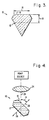
- this diamond in its uncut form is shown in the cross-sectional view of FIG. 3.
- the diamond was cut along the dotted line to form a surface 12 parallel to opposing surface 14.
- Diameter 16 of the surfaces 12 and 14 is approximately 7 millimeters, while the distance between the surfaces 12 and 14 is approximately 2 millimeters.
- the surfaces 12 and 14 were polished to a flatness of approximately half a wavelength at 6328 Angstroms over a circular area having a diameter of approximately 3 millimeters in the center of each of the surfaces 12 and 14.
- the cut diamond 10 was installed in the laser test setup shown in FIG. 4.
- the crystal 10 was oriented so that angle 19 between an axis 26 perpendicular to the surfaces 12 and 14 and the axis of an excitation beam 20 was approximately twenty degrees.
- the excitation beam 20 was provided by a laser pump source which produced light at 494 nanometers, which is approximately the center of the absorption band for the H3 color centers.
- the excitation beam 20 was focused on the crystal 10.
- the uncoated surfaces 12 and 14 acted as Fresnel reflectors having approximately 18 % reflection. In this experimental test setup, no effort was made to coat the surfaces 12 and 14 or to provide external feedback mirrors.
- the H3 centers in the crystal 10 lased producing coherent radiation along axes 26 and 28 which are parallel to the [100] crystal plane of the diamond 10, and are normal to the surfaces 12 and 14.
- the central wavelength of the output laser beam thus produced was approximately 540 nanometers, corresponding to the peak of the fluorescence spectra for the H3 color centers.
- the gain coefficient for the H3 centers was calculated as 0.09 cm- 1 while the gain coefficient for N3 centers is estimated at about 0.009 cm- 1.
- the efficiency of the setup may be improved significantly by polishing the surfaces 10 and 14 to obtain a smoother surface and by using reflective coatings or external mirrors. It is anticipated that the threshold excitation levels for production versions of color center lasers using a diamond as a laser active material would be comparable to the threshold levels for alkali halide color center lasers.
- a production version of a color center laser employing diamond as the laser active material would typically employ a laser resonator which is external to the diamond crystal.
- a laser resonator which is external to the diamond crystal.
- Such resonators are well known to those skilled in the art and may consist of plane and/or spherical mirrors, diffraction gratings, prisms, polarizers and/or birefringent filters.
- the beam produced by the H3 centers in diamond is tunable over the range from 500 to 600 nanometers.
- the various elements of the resonator may be used to provide for selection of wavelength and polarization of the laser output beam. Examples of a suitable tuning arrangement using mirrors and gratings in color center laser may be found in previously cited U.S. Patent No. 3 970 960.
- a color center laser employing diamond as the laser active material may be made to operate either as a continuous-wave laser or as a pulsed laser.
- the pulses produced in the pulsed laser may be singly Q-switched, repetitively Q-switched, or mode locked.
- diamond is non- hygroscopic, and exhibits an extremely high thermal conductance as well as a high threshold of optical damage. Accordingly, a diamond laser active material may be operated at substantial power levels without damage and without the necessity for artificial cooling.
- the H3 and N3 centers in diamond have also been found to be thermally stable to temperatures above 800°K, and to be photostable at absorption band power levels up to 100 megawatts per square centimeter. Tests run for one hour at power levels of 50 megawatts per square centimeter have shown no evidence of bleaching of the N3 or H3 color centers.
- the color centers in alkali halide host material are, for the most part, formed by vacancies and electrons in the host material and may be modified by adjacent impurities.
- the resultant color centers are characterized as having relatively shallow potential-wells, which contribute to the instability of these centers.
- the color centers which are the subject of this invention are formed by substitution of a foreign atom such as nitrogen for a basic component atom such as carbon in the intrinsic crystal lattice. Color centers of this latter type are characterized as having relatively deep potential-wells, which contributes to their extreme stability.
- H3 color centers may be artificially created in a diamond having large concentrations of A aggregates.
- the key to forming H3 color centers from A aggregates is to create vacancies in the carbon lattice and to cause individual vacancies to migrate to a position between the two adjacent nitrogen atoms in the A aggregate, thus forming an H3 center.
- the artificial formation of H3 color centers in a diamond may be performed as follows.
- the starting material is a Type I raw diamond containing nitrogen substitutions on the order of 0.1 atomic percent.
- the level of nitrogen concentration can be determined using infrared absorption spectroscopy methods described in the prior art.
- the selected diamond is irradiated with one million electron volt ( or higher energy) electrons using beam current densities in the range of 20 to 50 microamperes per square centimeter for a total dosage of approximately 1018 electrons per square centimeter. This irradiation step creates carbon vacancies in the diamond sample.
- other sources of radiation which may be used for this step include gamma, neutron and X-ray radiation. However, it has been found that neutron radiation produces undesirable effects on the absorption spectra of the sample.
- the irradiated sample is heated above 500° C, preferably to 900°C, and annealed for about 20 hours. This step causes migration of single vacancies to a position between two nitrogen substitution impurities, thus forming an H3 center from an A aggregate. This procedure, particularly the heat treatment, ensures high concentrations of H3 centers.
- N3 centers may have significant advantages over those crystals containing both. For example, the absence of H3 centers would prevent portions of the energy targeted for N3 centers from being absorbed by the H3 centers. Accordingly, the N3 centers may be excited to produce a relatively pure laser beam tunable over the 400 to 500 nanometer blue portion of the visible spectrum.
- a likely candidate for a pump source to excite N3 centers in diamond is a neodymium-glass laser which produces a beam whose third harmonic has a wavelength close to the peak of the absorption band for N3 color centers.
- a likely candidate for a pump source is either a YAG laser or a Xenon flash tube.
Landscapes
- Chemical & Material Sciences (AREA)
- Engineering & Computer Science (AREA)
- Crystallography & Structural Chemistry (AREA)
- Materials Engineering (AREA)
- Metallurgy (AREA)
- Organic Chemistry (AREA)
- Physics & Mathematics (AREA)
- Electromagnetism (AREA)
- Plasma & Fusion (AREA)
- Optics & Photonics (AREA)
- Crystals, And After-Treatments Of Crystals (AREA)
- Lasers (AREA)
Claims (15)
Applications Claiming Priority (2)
| Application Number | Priority Date | Filing Date | Title |
|---|---|---|---|
| US673304 | 1984-11-20 | ||
| US06/673,304 US4638484A (en) | 1984-11-20 | 1984-11-20 | Solid state laser employing diamond having color centers as a laser active material |
Publications (2)
| Publication Number | Publication Date |
|---|---|
| EP0201600A1 EP0201600A1 (de) | 1986-11-20 |
| EP0201600B1 true EP0201600B1 (de) | 1989-09-13 |
Family
ID=24702104
Family Applications (1)
| Application Number | Title | Priority Date | Filing Date |
|---|---|---|---|
| EP86900685A Expired EP0201600B1 (de) | 1984-11-20 | 1985-10-28 | Einen diamanten mit farbzentren als aktives material benutzender festkörperlaser |
Country Status (5)
| Country | Link |
|---|---|
| US (1) | US4638484A (de) |
| EP (1) | EP0201600B1 (de) |
| JP (1) | JPS62501251A (de) |
| DE (1) | DE3573047D1 (de) |
| WO (1) | WO1986003347A1 (de) |
Families Citing this family (33)
| Publication number | Priority date | Publication date | Assignee | Title |
|---|---|---|---|---|
| EP0275063A3 (de) * | 1987-01-12 | 1992-05-27 | Sumitomo Electric Industries Limited | Diamanthaltiges lichtausstrahlendes Element und Verfahren zu seiner Herstellung |
| DE3726279A1 (de) * | 1987-08-07 | 1989-02-16 | Schott Glaswerke | Laser mit einem laseraktiven festkoerpermedium und mehreren pumpquellen |
| JP2571795B2 (ja) * | 1987-11-17 | 1997-01-16 | 住友電気工業株式会社 | 紫色ダイヤモンドおよびその製造方法 |
| JPH01201976A (ja) * | 1988-02-05 | 1989-08-14 | Sumitomo Electric Ind Ltd | ダイヤモンド固体レーザ素子、その製造方法およびその発振方法 |
| JPH0288498A (ja) * | 1988-06-13 | 1990-03-28 | Sumitomo Electric Ind Ltd | ダイヤモンドレーザ結晶およびその作製方法 |
| US4985226A (en) * | 1988-06-20 | 1991-01-15 | Sumitomo Electric Industries, Ltd. | Hole-burning material and production thereof |
| US4899347A (en) * | 1989-05-11 | 1990-02-06 | General Electric Company | Solid state laser gain medium with diamond coating |
| US5267254A (en) * | 1992-04-15 | 1993-11-30 | The United States Of America As Represented By The Secretary Of The Navy | Color center laser with transverse auxiliary illumination |
| JP3462514B2 (ja) * | 1992-09-16 | 2003-11-05 | 住友電気工業株式会社 | 固体レーザ |
| JP3584450B2 (ja) * | 1995-03-17 | 2004-11-04 | 住友電気工業株式会社 | レーザー発振素子及びレーザー発振装置 |
| US5504767A (en) * | 1995-03-17 | 1996-04-02 | Si Diamond Technology, Inc. | Doped diamond laser |
| US6377340B1 (en) * | 1999-10-29 | 2002-04-23 | General Electric Company | Method of detection of natural diamonds that have been processed at high pressure and high temperatures |
| US7224532B2 (en) * | 2002-12-06 | 2007-05-29 | Chevron U.S.A. Inc. | Optical uses diamondoid-containing materials |
| US20050019955A1 (en) * | 2003-07-23 | 2005-01-27 | Dahl Jeremy E. | Luminescent heterodiamondoids as biological labels |
| US20110308605A1 (en) * | 2008-01-31 | 2011-12-22 | Justus-Liebig-Universitaet Giessen | Applicable Fluorescence of Diamondoids |
| US8866065B2 (en) | 2010-12-13 | 2014-10-21 | Zena Technologies, Inc. | Nanowire arrays comprising fluorescent nanowires |
| US9343490B2 (en) | 2013-08-09 | 2016-05-17 | Zena Technologies, Inc. | Nanowire structured color filter arrays and fabrication method of the same |
| US8274039B2 (en) | 2008-11-13 | 2012-09-25 | Zena Technologies, Inc. | Vertical waveguides with various functionality on integrated circuits |
| US8889455B2 (en) | 2009-12-08 | 2014-11-18 | Zena Technologies, Inc. | Manufacturing nanowire photo-detector grown on a back-side illuminated image sensor |
| US8546742B2 (en) | 2009-06-04 | 2013-10-01 | Zena Technologies, Inc. | Array of nanowires in a single cavity with anti-reflective coating on substrate |
| US8835831B2 (en) | 2010-06-22 | 2014-09-16 | Zena Technologies, Inc. | Polarized light detecting device and fabrication methods of the same |
| US9515218B2 (en) | 2008-09-04 | 2016-12-06 | Zena Technologies, Inc. | Vertical pillar structured photovoltaic devices with mirrors and optical claddings |
| US9406709B2 (en) | 2010-06-22 | 2016-08-02 | President And Fellows Of Harvard College | Methods for fabricating and using nanowires |
| US8229255B2 (en) | 2008-09-04 | 2012-07-24 | Zena Technologies, Inc. | Optical waveguides in image sensors |
| US8748799B2 (en) | 2010-12-14 | 2014-06-10 | Zena Technologies, Inc. | Full color single pixel including doublet or quadruplet si nanowires for image sensors |
| US9478685B2 (en) | 2014-06-23 | 2016-10-25 | Zena Technologies, Inc. | Vertical pillar structured infrared detector and fabrication method for the same |
| US8890271B2 (en) | 2010-06-30 | 2014-11-18 | Zena Technologies, Inc. | Silicon nitride light pipes for image sensors |
| US8735797B2 (en) | 2009-12-08 | 2014-05-27 | Zena Technologies, Inc. | Nanowire photo-detector grown on a back-side illuminated image sensor |
| US9000353B2 (en) | 2010-06-22 | 2015-04-07 | President And Fellows Of Harvard College | Light absorption and filtering properties of vertically oriented semiconductor nano wires |
| US9299866B2 (en) | 2010-12-30 | 2016-03-29 | Zena Technologies, Inc. | Nanowire array based solar energy harvesting device |
| US8299472B2 (en) | 2009-12-08 | 2012-10-30 | Young-June Yu | Active pixel sensor with nanowire structured photodetectors |
| US9082673B2 (en) | 2009-10-05 | 2015-07-14 | Zena Technologies, Inc. | Passivated upstanding nanostructures and methods of making the same |
| US9923339B2 (en) * | 2014-04-13 | 2018-03-20 | Hong Kong Baptist University | Tunable amplified spontaneous emission (ASE) laser |
Family Cites Families (1)
| Publication number | Priority date | Publication date | Assignee | Title |
|---|---|---|---|---|
| US3970960A (en) * | 1974-01-31 | 1976-07-20 | Bell Telephone Laboratories, Incorporated | Broadly tunable continuous-wave laser using color centers |
-
1984
- 1984-11-20 US US06/673,304 patent/US4638484A/en not_active Expired - Lifetime
-
1985
- 1985-10-28 DE DE8686900685T patent/DE3573047D1/de not_active Expired
- 1985-10-28 JP JP61500837A patent/JPS62501251A/ja active Pending
- 1985-10-28 WO PCT/US1985/002122 patent/WO1986003347A1/en not_active Ceased
- 1985-10-28 EP EP86900685A patent/EP0201600B1/de not_active Expired
Also Published As
| Publication number | Publication date |
|---|---|
| EP0201600A1 (de) | 1986-11-20 |
| DE3573047D1 (en) | 1989-10-19 |
| JPS62501251A (ja) | 1987-05-14 |
| WO1986003347A1 (en) | 1986-06-05 |
| US4638484A (en) | 1987-01-20 |
Similar Documents
| Publication | Publication Date | Title |
|---|---|---|
| EP0201600B1 (de) | Einen diamanten mit farbzentren als aktives material benutzender festkörperlaser | |
| Hubert et al. | Emission properties, oscillator strengths and laser parameters of Er3+ in LiYF4 at 2.7 μm | |
| Dubinskii et al. | Spectral-kinetic and lasing characteristics of new Nd3+-activated laser hosts of the KF-YF3 system | |
| EP0327111B1 (de) | Diamant-Laser und Verfahren zu seiner Herstellung und zu seinem Betrieb | |
| Görlich | Spectroscopic Properties of Activated Laser Crystals (III) | |
| US4464761A (en) | Chromium-doped beryllium aluminum silicate laser systems | |
| US4809283A (en) | Method of manufacturing chromium-doped beryllium aluminate laser rod and lasers incorporating the rods therein | |
| EP0268670A1 (de) | Methode für den kontinuierlichen betrieb eines lasers. | |
| Kaminskii et al. | Quasi-cw Pr3+: LiYF4 laser with λ= 0.6395 μm and an average output power of 2.3 W | |
| US4132962A (en) | Tunable laser system | |
| US4301426A (en) | Solid state laser and material | |
| US3786365A (en) | Laser materials from calcium fluoride - rare earth fluoride expanded lattice structures | |
| US4990322A (en) | NaCl:OH color center laser | |
| US5471493A (en) | Sc2+ based active crystalline luminescent media for laser systems tunable in UV-visible spectral range | |
| US4638485A (en) | Solid state vibrational lasers using F-center/molecular-defect pairs in alkali halides | |
| Lotem et al. | A 2 mu m holmium laser | |
| US4839009A (en) | NaCl: on color center laser | |
| US4672619A (en) | Color centers for tunable lasers in the near infrared region | |
| Voĭtovich et al. | Investigation of spectral and energy characteristics of green radiation generated in lithium fluoride with radiation color centers | |
| US5640408A (en) | Quasi four-level Tm:LuAG laser | |
| US4599727A (en) | Strontium aluminum fluoride laser | |
| US3719901A (en) | LASER WITH A MONOCRYSTALLINE YALO :Nd ACTIVE MEDIUM | |
| Kalisky et al. | Continuous wave operation of multiply doped Ho: YLF and Ho: YAG laser | |
| US3503006A (en) | Solid state laser device including lanthanum oxide as the host material | |
| US3258716A (en) | Optical maser comprising the active medium CaWO4:Pr |
Legal Events
| Date | Code | Title | Description |
|---|---|---|---|
| PUAI | Public reference made under article 153(3) epc to a published international application that has entered the european phase |
Free format text: ORIGINAL CODE: 0009012 |
|
| 17P | Request for examination filed |
Effective date: 19860717 |
|
| AK | Designated contracting states |
Kind code of ref document: A1 Designated state(s): DE FR GB IT SE |
|
| 17Q | First examination report despatched |
Effective date: 19871228 |
|
| GRAA | (expected) grant |
Free format text: ORIGINAL CODE: 0009210 |
|
| ITF | It: translation for a ep patent filed | ||
| AK | Designated contracting states |
Kind code of ref document: B1 Designated state(s): DE FR GB IT SE |
|
| REF | Corresponds to: |
Ref document number: 3573047 Country of ref document: DE Date of ref document: 19891019 |
|
| ET | Fr: translation filed | ||
| PLBE | No opposition filed within time limit |
Free format text: ORIGINAL CODE: 0009261 |
|
| STAA | Information on the status of an ep patent application or granted ep patent |
Free format text: STATUS: NO OPPOSITION FILED WITHIN TIME LIMIT |
|
| 26N | No opposition filed | ||
| ITTA | It: last paid annual fee | ||
| PGFP | Annual fee paid to national office [announced via postgrant information from national office to epo] |
Ref country code: FR Payment date: 19940912 Year of fee payment: 10 |
|
| PGFP | Annual fee paid to national office [announced via postgrant information from national office to epo] |
Ref country code: GB Payment date: 19940914 Year of fee payment: 10 |
|
| PGFP | Annual fee paid to national office [announced via postgrant information from national office to epo] |
Ref country code: SE Payment date: 19940916 Year of fee payment: 10 |
|
| PGFP | Annual fee paid to national office [announced via postgrant information from national office to epo] |
Ref country code: DE Payment date: 19940919 Year of fee payment: 10 |
|
| EAL | Se: european patent in force in sweden |
Ref document number: 86900685.8 |
|
| PG25 | Lapsed in a contracting state [announced via postgrant information from national office to epo] |
Ref country code: GB Effective date: 19951028 |
|
| PG25 | Lapsed in a contracting state [announced via postgrant information from national office to epo] |
Ref country code: SE Effective date: 19951029 |
|
| GBPC | Gb: european patent ceased through non-payment of renewal fee |
Effective date: 19951028 |
|
| PG25 | Lapsed in a contracting state [announced via postgrant information from national office to epo] |
Ref country code: FR Effective date: 19960628 |
|
| EUG | Se: european patent has lapsed |
Ref document number: 86900685.8 |
|
| PG25 | Lapsed in a contracting state [announced via postgrant information from national office to epo] |
Ref country code: DE Effective date: 19960702 |
|
| REG | Reference to a national code |
Ref country code: FR Ref legal event code: ST |