EP0200309A2 - Metallgekapselte gasisolierte Leistungsanlage - Google Patents
Metallgekapselte gasisolierte Leistungsanlage Download PDFInfo
- Publication number
- EP0200309A2 EP0200309A2 EP86301510A EP86301510A EP0200309A2 EP 0200309 A2 EP0200309 A2 EP 0200309A2 EP 86301510 A EP86301510 A EP 86301510A EP 86301510 A EP86301510 A EP 86301510A EP 0200309 A2 EP0200309 A2 EP 0200309A2
- Authority
- EP
- European Patent Office
- Prior art keywords
- bushing
- conductor
- gas
- cylindrical
- insulating
- Prior art date
- Legal status (The legal status is an assumption and is not a legal conclusion. Google has not performed a legal analysis and makes no representation as to the accuracy of the status listed.)
- Granted
Links
Images




Classifications
-
- H—ELECTRICITY
- H02—GENERATION; CONVERSION OR DISTRIBUTION OF ELECTRIC POWER
- H02B—BOARDS, SUBSTATIONS OR SWITCHING ARRANGEMENTS FOR THE SUPPLY OR DISTRIBUTION OF ELECTRIC POWER
- H02B11/00—Switchgear having carriage withdrawable for isolation
- H02B11/26—Arrangements of fuses, resistors, voltage arresters or the like
-
- H—ELECTRICITY
- H01—ELECTRIC ELEMENTS
- H01B—CABLES; CONDUCTORS; INSULATORS; SELECTION OF MATERIALS FOR THEIR CONDUCTIVE, INSULATING OR DIELECTRIC PROPERTIES
- H01B17/00—Insulators or insulating bodies characterised by their form
- H01B17/26—Lead-in insulators; Lead-through insulators
- H01B17/30—Sealing
- H01B17/301—Sealing of insulators to support
-
- H—ELECTRICITY
- H01—ELECTRIC ELEMENTS
- H01B—CABLES; CONDUCTORS; INSULATORS; SELECTION OF MATERIALS FOR THEIR CONDUCTIVE, INSULATING OR DIELECTRIC PROPERTIES
- H01B17/00—Insulators or insulating bodies characterised by their form
- H01B17/26—Lead-in insulators; Lead-through insulators
- H01B17/30—Sealing
- H01B17/303—Sealing of leads to lead-through insulators
- H01B17/308—Sealing of leads to lead-through insulators by compressing packing material
-
- H—ELECTRICITY
- H02—GENERATION; CONVERSION OR DISTRIBUTION OF ELECTRIC POWER
- H02B—BOARDS, SUBSTATIONS OR SWITCHING ARRANGEMENTS FOR THE SUPPLY OR DISTRIBUTION OF ELECTRIC POWER
- H02B11/00—Switchgear having carriage withdrawable for isolation
- H02B11/02—Details
- H02B11/04—Isolating-contacts, e.g. mountings or shieldings
Definitions
- the present invention relates generally to a gas insulation metal-clad power equipment, and more particularly to the metal-clad power equipment provided with a single or plural conductors disposed passing through a compartment wall of the equipment filled with an insulating gas.
- the size or dimensions of the insulating bushing are inevitably increased outside the bus compartment in order to prevent flashover (dielectric breakdown on or along the surface of : an insulator) from being generated between the conductor and the wall within air ambience.
- flashover voltage is intended to be increased in dependence upon only an increase in flashover distance (distance along the surface of the insulator).
- the flashover distance is excessively increased, there exists another problem in that dielectric breakdown may occur between the conductor and the wall directly through inside the insulating bushing without occurrence of flashover along the surface of the insulator, thus it being impossible to effectively increase flashover voltage.
- the advantage of the use of gas insulation metal-clad power equipment is to reduce the size of the equipment.
- the size or the dimensions of the insulating bushing is excessively great, it is impossible to effectively reduce the size of the whole power equipment by making the best use of the advantage of the gas thus insulation, resulting in a high cost, a heavy weight, and a large installation space, etc.
- a gas insulation metal-clad power equipment filled with an insulating gas for housing a power device having: - a grounded compartment wall including a grounded compartment wall member; - a cylindrical insulating bushing air-tightly fixed to the grounded wall member formed with a through hole; and - a loaded conductor supported by said cylindrical insulating bushing at a center thereof for connecting the power device housed inside said power equipment to another device installed outside said power equipment, the conductor being passed through an inner cylindrical space of said bushing filled with the insulating gas
- one end of said cylindrical bushing is air-tightly fixed to said grounded compartment wall member in such a way that an outer circumferential surface of said loaded conductor directly faces an inner circumferential surface of the through hole formed in said grounded compartment wall member with a space distance g filled with an insulating gas and without any intervening portion of said cylindrical bushing, the outer circumferential surface of said loaded conductor being air-tightly supported by the other bottom end of said
- a difference between a diameter ⁇ 2 of the inner cylindrical space and a diameter ⁇ 1 of the through hole is equal to or larger than 4 mm ( ⁇ 2 - ⁇ 1 ⁇ 4).
- an insertion distance B of an end of the inner fixed conductor into the inner cylindrical space is equal to or longer than one-fifth of a distance g between the circumferential surface of the through hole and an outer circumferential surface of the conductor (B > g/5).
- the dielectric strength between the conductor and the grounded compartment wall is rather dependent upon dielectric strength against dielectric breakdown within insulating gas ambience, than dependent upon that against flashover within air ambience, thus making the best use of the presence of insulating gas.
- Fig. 1 shows a gas insulation enclosed switchgear by way of example of the gas insulation metal-clad power equipment.
- the gas insulation switchgear compartment 1 of cubicle type is divided into two of a circuit breaker compartment 2 and a bus compartment 3 by a grounded metallic compartment wall 4.
- the compartment wall 4 there is disposed two cylindrical insulating bushings 3A and 5B made of plastics or porcelain and fixed to the compartment wall 4 penetrating therethrough. Passing through a center of each cylindrical insulating bushing 5A or 5B, an inner fixed conductor 6A or 6B is fixed to the bushing at one end thereof and connected to a power supply bus or a load bus (both not shown), respectively, at the other end thereof.
- a truck type circuit breaker 7 is movably housed.
- the breaker 7 is provided with two outer movable conductors 8A and 8B so as to be connected to or disconnected from the inner fixed conductors 5A and 5B, respectively, when moved to and fro within the breaker compartment 2.
- bus bars (not shown) are arranged.
- This bus compartment 3 is filled with an insulating gas such as SF 6 (sulfur hexafluoride gas), for instance, or a mixture of the gas and air under a pressure equal to or higher than the atmospheric pressure (0.10 to 0.2 MPa).
- the present invention closely relates to the cylindrical insulating bushing 5A or 5B. Therefore, only the cylindrical insulating bushing will be described in further detail with reference to Fig. 2.
- a through hole 41 is formed in the grounded metallic compartment wall 4, through which the cylindrical insulating bushing 5 is disposed and fixed.
- the bushing 5 is formed with a cylindrical wall 51, an bottom end 52 and a flange 53.
- the flange 53 is air-tightly fixed to the compartment wall 4 from the outside via a sealing member such as an O ring 54 by use of bolts 55.
- the inner fixed conductor 6 is also air- tightly fixed to the bottom end 52 of the bushing 5 via a sealing member such as another O ring 56, being passed through the center of the bushing 5 .
- 0 1 denotes a diameter of the through hole 41 formed in the wall 4
- 0 2 denotes an inner diameter of the inner cylindrical wall 51 of the bushing 5
- ⁇ 3 denotes an outer diameter of the cylindrical wall 51 of the bushing 5 which is smaller than ⁇ 1
- L i denotes an inner projection length of the bushing (between the inner surface of the wall 4 and the inner end surface of the cylindrical wall 51 of the bushing 5 )
- L o denotes an outer projection length of the bushing (between the outer surface of the wall 4 and an outer surface of the bottom end 5 2 of the bushing 5)
- a ( ⁇ 1 - ⁇ 3 ) denotes a gap between the circumferential surface of the through hole 41 and the outer circumferential surface of the cylindrical wall 51 of the bushing 5.
- Fig. 3 shows a model of the bushing 5 equivalent to that shown in Fig. 2 from the insulation standpoint.
- a high voltage is applied to the conductor 6 and the metallic compartment wall 4 is grounded as shown.
- the insulating bushing 5 has no bottom end 52. This is because various experiments have indicated that the bottom end 52 of the bushing 5 exerts neither a good or bad influence upon the flashover characteristics. This may be natural because when a high voltage is applied between the inner fixed conductor 6 and the compartment wall 4, flashover will occur between the along an outer cylindrical surface of the cylindrical wall 51 of the bushing 5.
- Fig. 4 shows test results of the relationship between the dielectric breakdown voltage (50% in occurrence probability) and the outer projection length L of the bushing 5.
- a positive polarity impulse voltage and a negative polarity impulse voltage have been applied to the conductor 6, independently.
- Each impulse voltage (1.2 x 50 ⁇ s) has a pulse rise time of about 1. 2 ⁇ s and a pulse width of about 50 ⁇ s.
- Fig. 5 shows an enclosed switchgear by way of example, to which a first embodiment of the cylindrical insulating bushing according to the present invention is applied.
- the gas insulation enclosed switchgear 1 shown in Fig. 5 is the same in structure as the prior art one shown in Fig. 1 except the insulating bushings 100A and 100B. Therefore, the structural features and functional effects of this enclosed switchgear other than those of the insulating bushings are substantially the same as with the prior art ones previously described.
- the same references have been retained for similar parts or sections which have the same functions and any detailed description of them is believed to be unnecessary.
- a cylindrical insulating bushing 100A according to the present invention is fixed to the metallic compartment wall 4 projecting toward the outside, in particularly toward the outer atmosphere side, without penetrating through the wall 4 .
- This structure of the cylindrical insulating bushing 1 0 0 A is the primary feature of the present invention.
- the above structure will be described in further detail with reference to Fig. 6.
- the bushing 100 made of plastics or porcelain according to the present invention is formed with a cylindrical wall 101, a bottom end 1 0 2 and a flange surface 103.
- the flange surface 1 03 is air-tightly fixed to the grounded metallic compartment wall 4 through a sealing member such as an 0 ring 54 by use of bolts 55.
- the inner fixed conductor 6 is air-tightly fixed to the bottom end 102 of the bushing 100 at its center through a sealing member such as another 0 ring 56 passing through the inner cylindrical space thereof.
- 0 1 denotes a diameter of the through hole 41 formed in the wall 4
- 0 2 denotes an inner diameter of the cylindrical wall 101 and the flange 103 of the bushing 100 which is larger than ⁇ 1
- f denotes a length of the inner projecting cylindrical space of the bushing 1 00
- g denotes a distance between the circumferential surface of the through hole 41 and the outer circumferential surface of the inner fixed conductor 6
- d denotes the diameter of the conductor 6.
- the length ⁇ of the inner cylindrical space is roughly equal to the distance g between the through hole 41 and the conductor 6; the inner diameter 0 2 of the bushing 100 is greater than the diameter 0 1 of the through hole 41; and the diameter ⁇ 1 of the through hole 41 is smaller about 5 mm than the inner diameter 0 2 of the bushing 100.
- the reason why ⁇ 1 is smaller than 0 2 is to positively allow dielectric breakdown to be produced between the grounded metallic wall 4 and the conductor 6. Further, the through hole 41 is deburred from both the sides.
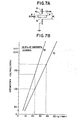
- Fig. 7A illustrates the test conditions in which a through hole 41 is formed in the wall 4 and only the conductor 6 is passed therethrough.
- the thickness of the wall 4 is 1.2 mm; the diameter of the conductor (aluminum rod) 6 is 30 mm.
- the diameter 0 1 of the through hole 4 1 is changed to vary the distance g between the hole 41 and the conductor 6.
- the test box within which the above wall 4 and conductor 6 are housed is first evacuated and then filled with 100% SF 6 gas at the atmospheric pressure (about 0.1 MPa). A high test voltage is applied to the conductor 6, and the wall 4 is grounded.
- the positive and negative polarity impulse dielectric breakdown voltages have been determined for each distance g when breakdown occurs in 50% or more probability.
- Fig. 7B shows the test results, which indicate that (1) the breakdown voltage increases in proportion to the distance g or the hole diameter ⁇ 1 against both positive and negative polarity impulse high voltages, and (2) the positive polarity impulse breakdown voltage is higher than the negative one.
- Fig. 8A illustrates the test conditions, in which the cylindrical insulating bushing 100 having a length f in the inner cylindrical space and made of a , bakelite material is air-tightly fixed to the outer surface of the wall 4 under condition ⁇ 1 ⁇ 0 2 .
- the conductor 6 is also air-tightly passed through the cylindrical bushing 100.
- the test box having the wall 4 and the bushing 100 is filled with a gas of SF 6 at the atmospheric pressure (about 0.10 MPa).
- the wall thickness is 1.2 mm
- the conductor diameter d is 30 mm.
- the dimensions are as follows:
- the length 1 of the bushing 100 is changed.
- a high test voltage is applied to the conductor 6 and the wall 4 is grounded.
- the positive and negative polarity impulse breakdown voltages have been determined for each length 1 when breakdown occurs in 50% probability.
- Fig. 8B shows the test results,
- Fig. 9 shows the other test results similar to those shown in Fig. 8B.
- the test conditions of Fig. 9 roughly correspond to the first test shown in Fig. 8B as follows:
- the above test results shown in Fig. 9 indicates that the breakdown voltage is roughly saturated when ( ⁇ 2 - ⁇ 1 )/2 is 2 mm or more, and sharply lowered when (02 - ⁇ 1 )/2 is less than 2 mm.
- the length f of the inner cylindrical space of the cylindrical insulating bushing 100 is effective upon an improvement in insulation withstand voltage when l ⁇ g/4.
- the high saturated positive and negative polarity impulse breakdown voltages can be obtained when ( ⁇ 2 - ⁇ 1 )/2 ⁇ 2 mm; that is, when the diameter ⁇ 1 of the wall hole 41 is reduced by 4 mm as compared with the inner diameter 0 2 of the bushing 100.
- the inner edge of the through hole 41 is deburred.
- the impulse voltage (1.2 x 50 ⁇ s) of only the negative polarity has been applied to the conductor. This is because dielectric breakdown voltage in the embodiments of the invention is usually lower in negative polarity than in positive polarity, so that it is possible to know the tendency of the insulation characteristics when negative impulse test voltages are applied to the conductor.
- Fig. 11B indicates that the breakdown voltage is relatively low when l varies between 0 and 10 mm, but almost similar to that shown in Fig. 11A when l ranges between 40 and 100 mm without being subjected to the change of the length l Further, although the breakdown voltage is a little (about 5 kV) improved, it is possible to determine that there exists no marked difference between the two embodiments; that is, it is unnecessary to round the edge of the wall if the wall edge is deburred.
- cylindrical insulating bushing according to the present invention can be applied to other enclosed switchgears as described hereinbelow with reference to the attached drawings.
- Fig. 13 shows the second embodiment of the cylindrical insulating bushing 140 according to the present invention formed with another cylindrical extension 141 having plural annular grooves 141a for increasing the flashover distance within air ambience.
- the length l of the inner cylindrical space of the bushing 140 is determined to be l ⁇ g/4.
- another cylindrical insulating bushing 140a as shown by the dot-dot-dashed lines in Fig. 13, within the switchgear 1.
- a communication passage 140a-1 is formed in the bushing 140a or the space enclosed by two bushings 140 and 140a is filled with another insulation gas.
- Fig. 14 shows another gas insulation enclosed switchgear by way of example, to which the third embodiment of the cylindrical insulating bushing according to the present invention is applied.
- the enclosed switchgear 1 shown in Fig. 14 is the same in structure as that shown in Fig. 5 except the inner movable conductor 6A-1 or 6B-1 and the inner fixed conductor 6A-2 or 6B-2. Therefore, the same references have been retained for similar parts or sections without any description thereof.
- the feature of the switchgear 1 is to disconnect the truck-type circuit breaker 7 from the inner fixed conductors 6A-2 and 6B-2 within the insulating gas ambience. This is because it is possible to increase the insulation withstand voltage as compared when the circuit breaker 7 is disconnected within air ambience and therefore to reduce the disconnected distance between two.
- the inner fixed conductor 6 shown in Fig. 14 is divided into an inner movable conductor 6-1 and an inner fixed conductor 6-2.
- the inner movable conductor 6A-1 or 6B-1 is movably supported by the cylindrical bushing 100, respectively.
- the inner movable conductor 6A-1 or 6B-1 is connected to or disconnected from an outer movable conductor 8A or 8B of the circuit breaker 7 outside the switchgear 1 and further to or from the inner fixed conductor 6A-2 or 6B-2 inside the switchgear box 1.
- the inner movable conductors 6A-1 and 6B-1 are first disconnected from the inner fixed conductors 6A-2 and 6B-2 under non-loaded condition within the compartment 3 by moving the truck-type circuit breaker 7.
- the movable conductors 6A-1 and 6B-1 are still in contact with the outer movable conductors 8A or 8B.
- the outer movable conductors 8A and 8B are disconnected from the inner movable conductors 6A-1 and 6B-1 under non-loaded condition in air ambience.
- Fig. 15 shows the third embodiment of the cylindrical insulating bushing according to the present invention.
- the inner movable conductor 6-1, the second inner fixed conductor 6-2, and the cylindrical insulating bushing 100 are enlarged in further detail.
- the inner movable conductor 6-1 is air-tightly and movably disposed passing through the bottom end surface 102 of the bushing 100 via a sealing member 56.
- the reference numeral 57 denotes a stop ring fixed to the inner movable conductor 6-1 at an appropriate position. It may be preferable to cover the conductor 6-1 by an appropriate insulating material outside the bushing for safety.
- the inner fixed conductor 6-2 is formed with a multiple contact 59 at its end so as to be engageable with the end of the movable conductor 6-1 when the conductor 6-1 is moved toward the right side in Fig. 15.
- the end of the second fixed conductor 6-2 projects by a distance B beyond the through hole 41 formed in the grounded metallic compartment wall 4 into the inner space of the bushing 100.
- d 30 mm
- G connection gap between two conductors
- g 30 mm
- ⁇ 1 90 mm
- ⁇ 2 95 mm
- B 18 mm
- l 110 mm.
- Figs. 17A and 17B show the fourth embodiment of the cylindrical insulating bushing according to the present invention.
- a cylindrical insulating bushing 150 is movably passed through a through hole 41 formed in the grounded metallic compartment wall 4.
- the bushing 150 is supported-by an elastic bushing cover 60 such as a conical metalic bellows.
- the top portion of the bushing cover 60 is air-tightly fixed to the flange portion 153 of the bushing 150 by bolts.
- the bottom portion of the bushing cover 60 is air-tightly fixed to the compartment wall 4 by bolts via an annular metal mounting base 61 having O rings 62 disposed between the wall 4 and the base 61.
- the through hole 63 formed in the top portion of the bushing cover 60 is smaller in diameter than the inner diameter of the bushing 150.
- the reference numeral 64 denotes a shock absorbing stopper member made of rubber and attached to the flange portion 153 of the bushing 150.
- a inner fixed conductor 6-2 is supported by a plastics or porcelain insulator 9 within the switchgear 1.
- An inner movable conductor 6-1 is fixed to the center of the bushing 150. Both the ends of the movable inner conductor 6-1 is so designed as to be engageable with or disengageable from the end of the inner fixed conductor 6-2 or the end of the outer movable conductor 8 as shown in Figs. 17A and 17B.
- the inner movable conductor 6-1 is covered by an extension of the bushing 150 outside the switchgear 1.
- the outer conductor 8 When the circuit breaker 7 is moved into the compartment 1, the outer conductor 8 is first brought into contact with the inner movable conductor 6-1 and then pushes the bushing 150 inside, so that the bushing cover 60 is also pushed inside until the inner movable conductor 6-1 is engaged with the inner fixed conductor 6-2, as shown in Fig. 17A.
- the bushing cover 60 is grounded through the wall 4. Therefore, dielectric breakdown occurs between the bushing cover 60 and the inner movable conductor 6-1.
- the dimensions of the bushing 150 are of course determined so as to satisfy the conditions already explained in detail hereinabove.
- the cylindrical insulating bushing is fixed to the compartment wall so as to project from the wall outside the compartment.
- the bushing is fixed to the grounded metallic compartment wall in such a way as to project from the compartment wall toward inside or outside and since the axial length l of the inner cylindrical space of the bushing is so determined as to be I > g/4 (g: the distance between the surface of through hole and the conductor), it is possible to increase the insulation withstand voltage between the conductor passing through the bushing and the grounded metallic compartment wall without generating dielectric breakdown along the surface of the bushing.
- the difference in diameter between the through hole ⁇ 1 formed in the compartment wall and the inner cylindrical space 0 2 of the bushing is determined to be equal to or larger than 4 mm, it is possible to further reliably prevent dielectric breakdown from being generated along the bushing surface.
- the insertion distance B of the conductor into the inner cylindrical space of the bushing is determined to be equal to or longer than g/5 to prevent dielectric breakdown from being generated along the bushing surface.
- cylindrical insulating bushing since dielectric breakdown occurs between the grounded compartment wall and the conductor within insulation gas ambient rather than dielectric breakdown along the surface of the bushing within air ambient, it is possible to effectively reduce the size, space, weight, cost, etc. of the cylindrical insulating bushing provided for a gas insulation gas metal-clad power equipment.
Landscapes
- Engineering & Computer Science (AREA)
- Power Engineering (AREA)
- Gas-Insulated Switchgears (AREA)
- Insulators (AREA)
- Installation Of Bus-Bars (AREA)
Applications Claiming Priority (6)
| Application Number | Priority Date | Filing Date | Title |
|---|---|---|---|
| JP3070785U JPH0314892Y2 (de) | 1985-03-04 | 1985-03-04 | |
| JP30707/85U | 1985-03-04 | ||
| JP30708/85U | 1985-03-04 | ||
| JP1985030708U JPH0537611Y2 (de) | 1985-03-04 | 1985-03-04 | |
| JP286199/85 | 1985-12-19 | ||
| JP60286199A JPS62144510A (ja) | 1985-12-19 | 1985-12-19 | ガス絶縁電気機器 |
Publications (3)
| Publication Number | Publication Date |
|---|---|
| EP0200309A2 true EP0200309A2 (de) | 1986-11-05 |
| EP0200309A3 EP0200309A3 (en) | 1987-10-28 |
| EP0200309B1 EP0200309B1 (de) | 1990-11-14 |
Family
ID=27287066
Family Applications (1)
| Application Number | Title | Priority Date | Filing Date |
|---|---|---|---|
| EP86301510A Expired - Lifetime EP0200309B1 (de) | 1985-03-04 | 1986-03-04 | Metallgekapselte gasisolierte Leistungsanlage |
Country Status (8)
| Country | Link |
|---|---|
| US (1) | US4730231A (de) |
| EP (1) | EP0200309B1 (de) |
| KR (1) | KR860007056A (de) |
| CN (1) | CN1008959B (de) |
| DE (1) | DE3675572D1 (de) |
| IN (1) | IN165223B (de) |
| MY (1) | MY101109A (de) |
| SG (1) | SG76891G (de) |
Cited By (2)
| Publication number | Priority date | Publication date | Assignee | Title |
|---|---|---|---|---|
| EP0704950A1 (de) * | 1994-09-30 | 1996-04-03 | Abb Sace Spa | Isolator für einen durchgehenden Leiter |
| WO2006049567A1 (en) | 2004-11-01 | 2006-05-11 | Abb Technology Ltd. | Electric bushing and a method of manufacturing an electric bushing |
Families Citing this family (7)
| Publication number | Priority date | Publication date | Assignee | Title |
|---|---|---|---|---|
| US4965407A (en) * | 1988-12-09 | 1990-10-23 | Cooper Industries, Inc. | Modular bushing |
| US5281767A (en) * | 1992-10-30 | 1994-01-25 | A.B. Chance Company | Reduced mechanical stress bushing and conductor rod assembly |
| FR2865859B1 (fr) * | 2004-01-30 | 2006-05-19 | Schneider Electric Ind Sas | Dispositif de fixation d'une traversee |
| WO2006088387A1 (en) * | 2005-02-17 | 2006-08-24 | Zakrytoe Aktsionernoe Obshchestvo 'elox-Prom' | Electrical hermetic penetrant structure of average voltage |
| CN104285347A (zh) * | 2011-12-21 | 2015-01-14 | Abb技术有限公司 | 可扩展电气环网柜 |
| WO2019144293A1 (en) * | 2018-01-23 | 2019-08-01 | Abb Schweiz Ag | A sealing arrangement for a bushing and a bushing with such a sealing arrangement |
| GB2594101A (en) * | 2020-04-14 | 2021-10-20 | Eaton Intelligent Power Ltd | Sealing for an intermittent and partial rotating and translating shaft |
Family Cites Families (8)
| Publication number | Priority date | Publication date | Assignee | Title |
|---|---|---|---|---|
| CA688761A (en) * | 1964-06-16 | Allis-Chalmers Manufacturing Company | Shutter mechanism | |
| US3030463A (en) * | 1960-04-29 | 1962-04-17 | Westinghouse Electric Corp | Levering mechanism for metal-clad switchgear |
| US3130353A (en) * | 1961-12-04 | 1964-04-21 | Gen Electric | Electric power switchgear |
| US3188415A (en) * | 1962-12-11 | 1965-06-08 | Gen Electric | Switchgear disconnect mechanism |
| US3461348A (en) * | 1968-10-21 | 1969-08-12 | Gen Electric | Mounting means for the stationary studs of draw-out metal clad switchgear |
| DE2035064A1 (de) * | 1970-07-15 | 1972-01-20 | Hamburger Flugzeugbau GmbH, 2103 Hamburg | Druckdichte Durchführung fur Leitun gen u dgl durch Druckspante von Luft oder Wasserfahrzeugen |
| US3746817A (en) * | 1972-05-24 | 1973-07-17 | Westinghouse Electric Corp | Metal-enclosed switchgear |
| JPS5740225U (de) * | 1980-08-18 | 1982-03-04 |
-
1986
- 1986-02-24 US US06/832,376 patent/US4730231A/en not_active Expired - Lifetime
- 1986-03-03 IN IN158/CAL/86A patent/IN165223B/en unknown
- 1986-03-03 KR KR1019860001458A patent/KR860007056A/ko not_active Ceased
- 1986-03-03 CN CN86101374A patent/CN1008959B/zh not_active Expired
- 1986-03-04 EP EP86301510A patent/EP0200309B1/de not_active Expired - Lifetime
- 1986-03-04 DE DE8686301510T patent/DE3675572D1/de not_active Expired - Fee Related
-
1987
- 1987-09-29 MY MYPI87002142A patent/MY101109A/en unknown
-
1991
- 1991-09-17 SG SG768/91A patent/SG76891G/en unknown
Cited By (4)
| Publication number | Priority date | Publication date | Assignee | Title |
|---|---|---|---|---|
| EP0704950A1 (de) * | 1994-09-30 | 1996-04-03 | Abb Sace Spa | Isolator für einen durchgehenden Leiter |
| WO2006049567A1 (en) | 2004-11-01 | 2006-05-11 | Abb Technology Ltd. | Electric bushing and a method of manufacturing an electric bushing |
| CN100580822C (zh) * | 2004-11-01 | 2010-01-13 | Abb技术有限公司 | 电套管和制造电套管的方法 |
| US7875803B2 (en) | 2004-11-01 | 2011-01-25 | Abb Technology Ltd. | Electric bushing and a method of manufacturing an electric bushing |
Also Published As
| Publication number | Publication date |
|---|---|
| CN1008959B (zh) | 1990-07-25 |
| MY101109A (en) | 1991-07-16 |
| EP0200309B1 (de) | 1990-11-14 |
| SG76891G (en) | 1991-11-15 |
| DE3675572D1 (de) | 1990-12-20 |
| US4730231A (en) | 1988-03-08 |
| IN165223B (de) | 1989-09-02 |
| KR860007056A (ko) | 1986-10-06 |
| EP0200309A3 (en) | 1987-10-28 |
| CN86101374A (zh) | 1986-09-10 |
Similar Documents
| Publication | Publication Date | Title |
|---|---|---|
| US4670625A (en) | Electrical insulating bushing with a weather-resistant sheath | |
| EP0053363B1 (de) | Durchführung für gasisolierte, elektrische Geräte | |
| EP0570688B1 (de) | Schaltgerät | |
| EP1207603A2 (de) | Gasisolierte Schaltanlage | |
| US4730231A (en) | Gas insulated metal-clad high voltage equipment with insulating bushing | |
| US4654489A (en) | Insulating support column with operating member | |
| US4468716A (en) | Gas-insulated switchgear | |
| KR920007581B1 (ko) | 스위치 장치(Switch Gear) | |
| CA2145456A1 (en) | Metal-enclosed gas-insulated switching installation | |
| US3231666A (en) | Terminal bushing for ground flange mounting having a corona reducing electrostatic shield between the flange and the conductor | |
| US3624450A (en) | Metal enclosed gas insulated lightning arrester | |
| US3842318A (en) | Shielded metal enclosed electrical equipment | |
| US3753045A (en) | Shielded metal enclosed lightning arrester | |
| JPH0158725B2 (de) | ||
| US4275372A (en) | Protected electrical inductive apparatus | |
| US4476361A (en) | Disconnect contact assembly | |
| US4754363A (en) | Metal-encapsulated gas-insulated high-voltage installation with an overvoltage arrester | |
| US4135130A (en) | Method of testing gas insulated systems for the presence of conducting particles utilizing a gas mixture of nitrogen and sulfur hexafluoride | |
| US6140573A (en) | Hollow core composite bushings | |
| JP3432407B2 (ja) | ガス絶縁開閉装置と変圧器の接続装置 | |
| US4123636A (en) | Double-flow puffer-type single-pressure compressed-gas circuit-interrupter | |
| GB1130708A (en) | Circuit switching and protecting arrangement | |
| US4101727A (en) | High-tension electric cable | |
| JP4062847B2 (ja) | 固体絶縁母線 | |
| CA1067593A (en) | Interface for high voltage oil-filled and gas-filled apparatus |
Legal Events
| Date | Code | Title | Description |
|---|---|---|---|
| PUAI | Public reference made under article 153(3) epc to a published international application that has entered the european phase |
Free format text: ORIGINAL CODE: 0009012 |
|
| AK | Designated contracting states |
Kind code of ref document: A2 Designated state(s): CH DE FR GB LI NL SE |
|
| PUAL | Search report despatched |
Free format text: ORIGINAL CODE: 0009013 |
|
| AK | Designated contracting states |
Kind code of ref document: A3 Designated state(s): CH DE FR GB LI NL SE |
|
| 17P | Request for examination filed |
Effective date: 19880425 |
|
| 17Q | First examination report despatched |
Effective date: 19900212 |
|
| GRAA | (expected) grant |
Free format text: ORIGINAL CODE: 0009210 |
|
| AK | Designated contracting states |
Kind code of ref document: B1 Designated state(s): CH DE FR GB LI NL SE |
|
| REF | Corresponds to: |
Ref document number: 3675572 Country of ref document: DE Date of ref document: 19901220 |
|
| ET | Fr: translation filed | ||
| PLBI | Opposition filed |
Free format text: ORIGINAL CODE: 0009260 |
|
| 26 | Opposition filed |
Opponent name: SACHSENWERK AKTIENGESELLSCHAFT Effective date: 19910710 |
|
| NLR1 | Nl: opposition has been filed with the epo |
Opponent name: SACHSENWERK AKTIENGESELLSCHAFT |
|
| PLAB | Opposition data, opponent's data or that of the opponent's representative modified |
Free format text: ORIGINAL CODE: 0009299OPPO |
|
| R26 | Opposition filed (corrected) |
Opponent name: AEG SACHSENWERK GMBH Effective date: 19910710 |
|
| NLXE | Nl: other communications concerning ep-patents (part 3 heading xe) |
Free format text: IN PAT.BUL.21/91,CORR.:AEG SACHSENWERK GMBH |
|
| PGFP | Annual fee paid to national office [announced via postgrant information from national office to epo] |
Ref country code: SE Payment date: 19930205 Year of fee payment: 8 |
|
| PGFP | Annual fee paid to national office [announced via postgrant information from national office to epo] |
Ref country code: FR Payment date: 19930215 Year of fee payment: 8 |
|
| PGFP | Annual fee paid to national office [announced via postgrant information from national office to epo] |
Ref country code: GB Payment date: 19930219 Year of fee payment: 8 |
|
| PGFP | Annual fee paid to national office [announced via postgrant information from national office to epo] |
Ref country code: CH Payment date: 19930223 Year of fee payment: 8 |
|
| PGFP | Annual fee paid to national office [announced via postgrant information from national office to epo] |
Ref country code: DE Payment date: 19930427 Year of fee payment: 8 |
|
| PG25 | Lapsed in a contracting state [announced via postgrant information from national office to epo] |
Ref country code: GB Effective date: 19940304 |
|
| PG25 | Lapsed in a contracting state [announced via postgrant information from national office to epo] |
Ref country code: SE Free format text: LAPSE BECAUSE OF NON-PAYMENT OF DUE FEES Effective date: 19940305 |
|
| PG25 | Lapsed in a contracting state [announced via postgrant information from national office to epo] |
Ref country code: LI Effective date: 19940331 Ref country code: CH Effective date: 19940331 |
|
| PLBN | Opposition rejected |
Free format text: ORIGINAL CODE: 0009273 |
|
| STAA | Information on the status of an ep patent application or granted ep patent |
Free format text: STATUS: OPPOSITION REJECTED |
|
| 27O | Opposition rejected |
Effective date: 19940531 |
|
| NLR2 | Nl: decision of opposition | ||
| GBPC | Gb: european patent ceased through non-payment of renewal fee |
Effective date: 19940304 |
|
| PG25 | Lapsed in a contracting state [announced via postgrant information from national office to epo] |
Ref country code: FR Effective date: 19941130 |
|
| REG | Reference to a national code |
Ref country code: CH Ref legal event code: PL |
|
| PG25 | Lapsed in a contracting state [announced via postgrant information from national office to epo] |
Ref country code: DE Effective date: 19941201 |
|
| REG | Reference to a national code |
Ref country code: FR Ref legal event code: ST |
|
| EUG | Se: european patent has lapsed |
Ref document number: 86301510.3 Effective date: 19941010 |
|
| PGFP | Annual fee paid to national office [announced via postgrant information from national office to epo] |
Ref country code: NL Payment date: 19980331 Year of fee payment: 13 |
|
| PG25 | Lapsed in a contracting state [announced via postgrant information from national office to epo] |
Ref country code: NL Free format text: LAPSE BECAUSE OF NON-PAYMENT OF DUE FEES Effective date: 19991001 |
|
| NLV4 | Nl: lapsed or anulled due to non-payment of the annual fee |
Effective date: 19991001 |