EP0199685A2 - Verfahren zur Herstellung von Siebdruckschablonen für Siebdruckmaschinen - Google Patents
Verfahren zur Herstellung von Siebdruckschablonen für Siebdruckmaschinen Download PDFInfo
- Publication number
- EP0199685A2 EP0199685A2 EP86850043A EP86850043A EP0199685A2 EP 0199685 A2 EP0199685 A2 EP 0199685A2 EP 86850043 A EP86850043 A EP 86850043A EP 86850043 A EP86850043 A EP 86850043A EP 0199685 A2 EP0199685 A2 EP 0199685A2
- Authority
- EP
- European Patent Office
- Prior art keywords
- layer
- screen
- light
- sensitive
- remaining
- Prior art date
- Legal status (The legal status is an assumption and is not a legal conclusion. Google has not performed a legal analysis and makes no representation as to the accuracy of the status listed.)
- Withdrawn
Links
- 238000000034 method Methods 0.000 title claims abstract description 41
- 238000007650 screen-printing Methods 0.000 title claims abstract description 34
- 239000000758 substrate Substances 0.000 claims abstract description 27
- 238000007639 printing Methods 0.000 claims abstract description 25
- 238000004061 bleaching Methods 0.000 claims abstract description 15
- 238000005530 etching Methods 0.000 claims abstract description 12
- 238000004519 manufacturing process Methods 0.000 claims description 8
- 230000003993 interaction Effects 0.000 claims description 4
- KMUONIBRACKNSN-UHFFFAOYSA-N potassium dichromate Chemical compound [K+].[K+].[O-][Cr](=O)(=O)O[Cr]([O-])(=O)=O KMUONIBRACKNSN-UHFFFAOYSA-N 0.000 claims description 4
- 108010010803 Gelatin Proteins 0.000 claims description 3
- 206010034960 Photophobia Diseases 0.000 claims description 3
- QAOWNCQODCNURD-UHFFFAOYSA-N Sulfuric acid Chemical compound OS(O)(=O)=O QAOWNCQODCNURD-UHFFFAOYSA-N 0.000 claims description 3
- 229920000159 gelatin Polymers 0.000 claims description 3
- 239000008273 gelatin Substances 0.000 claims description 3
- 235000019322 gelatine Nutrition 0.000 claims description 3
- 235000011852 gelatine desserts Nutrition 0.000 claims description 3
- 208000013469 light sensitivity Diseases 0.000 claims description 3
- 239000001117 sulphuric acid Substances 0.000 claims description 3
- 235000011149 sulphuric acid Nutrition 0.000 claims description 3
- 238000001035 drying Methods 0.000 claims description 2
- 150000003839 salts Chemical class 0.000 claims 1
- 239000000839 emulsion Substances 0.000 description 13
- XLYOFNOQVPJJNP-UHFFFAOYSA-N water Substances O XLYOFNOQVPJJNP-UHFFFAOYSA-N 0.000 description 9
- MHAJPDPJQMAIIY-UHFFFAOYSA-N Hydrogen peroxide Chemical compound OO MHAJPDPJQMAIIY-UHFFFAOYSA-N 0.000 description 8
- 239000000976 ink Substances 0.000 description 8
- QTBSBXVTEAMEQO-UHFFFAOYSA-N Acetic acid Chemical compound CC(O)=O QTBSBXVTEAMEQO-UHFFFAOYSA-N 0.000 description 4
- 239000000463 material Substances 0.000 description 3
- 239000003208 petroleum Substances 0.000 description 3
- 238000005507 spraying Methods 0.000 description 3
- 229960000583 acetic acid Drugs 0.000 description 2
- ORTQZVOHEJQUHG-UHFFFAOYSA-L copper(II) chloride Chemical compound Cl[Cu]Cl ORTQZVOHEJQUHG-UHFFFAOYSA-L 0.000 description 2
- 239000012362 glacial acetic acid Substances 0.000 description 2
- XFXPMWWXUTWYJX-UHFFFAOYSA-N Cyanide Chemical compound N#[C-] XFXPMWWXUTWYJX-UHFFFAOYSA-N 0.000 description 1
- 241000811158 Developea Species 0.000 description 1
- ZLMJMSJWJFRBEC-UHFFFAOYSA-N Potassium Chemical compound [K] ZLMJMSJWJFRBEC-UHFFFAOYSA-N 0.000 description 1
- 230000015572 biosynthetic process Effects 0.000 description 1
- IQKQUSLYXMWMQZ-UHFFFAOYSA-N copper;oxido-(oxido(dioxo)chromio)oxy-dioxochromium Chemical compound [Cu+2].[O-][Cr](=O)(=O)O[Cr]([O-])(=O)=O IQKQUSLYXMWMQZ-UHFFFAOYSA-N 0.000 description 1
- 238000004090 dissolution Methods 0.000 description 1
- 239000000203 mixture Substances 0.000 description 1
- 239000011148 porous material Substances 0.000 description 1
- 229910052700 potassium Inorganic materials 0.000 description 1
- 239000011591 potassium Substances 0.000 description 1
- -1 potassium ferricyanide Chemical compound 0.000 description 1
- 238000003825 pressing Methods 0.000 description 1
- 230000005855 radiation Effects 0.000 description 1
- 230000002787 reinforcement Effects 0.000 description 1
- AKHNMLFCWUSKQB-UHFFFAOYSA-L sodium thiosulfate Chemical compound [Na+].[Na+].[O-]S([O-])(=O)=S AKHNMLFCWUSKQB-UHFFFAOYSA-L 0.000 description 1
- 235000019345 sodium thiosulphate Nutrition 0.000 description 1
- 238000005406 washing Methods 0.000 description 1
Images
Classifications
-
- G—PHYSICS
- G03—PHOTOGRAPHY; CINEMATOGRAPHY; ANALOGOUS TECHNIQUES USING WAVES OTHER THAN OPTICAL WAVES; ELECTROGRAPHY; HOLOGRAPHY
- G03C—PHOTOSENSITIVE MATERIALS FOR PHOTOGRAPHIC PURPOSES; PHOTOGRAPHIC PROCESSES, e.g. CINE, X-RAY, COLOUR, STEREO-PHOTOGRAPHIC PROCESSES; AUXILIARY PROCESSES IN PHOTOGRAPHY
- G03C5/00—Photographic processes or agents therefor; Regeneration of such processing agents
- G03C5/26—Processes using silver-salt-containing photosensitive materials or agents therefor
- G03C5/40—Chemically transforming developed images
-
- G—PHYSICS
- G03—PHOTOGRAPHY; CINEMATOGRAPHY; ANALOGOUS TECHNIQUES USING WAVES OTHER THAN OPTICAL WAVES; ELECTROGRAPHY; HOLOGRAPHY
- G03F—PHOTOMECHANICAL PRODUCTION OF TEXTURED OR PATTERNED SURFACES, e.g. FOR PRINTING, FOR PROCESSING OF SEMICONDUCTOR DEVICES; MATERIALS THEREFOR; ORIGINALS THEREFOR; APPARATUS SPECIALLY ADAPTED THEREFOR
- G03F7/00—Photomechanical, e.g. photolithographic, production of textured or patterned surfaces, e.g. printing surfaces; Materials therefor, e.g. comprising photoresists; Apparatus specially adapted therefor
- G03F7/12—Production of screen printing forms or similar printing forms, e.g. stencils
Definitions
- the present invention relates to a method of forming a stencil for screen printing machines. especially a siencll comprising a screen stretched in a frame and a layer affixed to said screen and provided with a printing pattern. by causing a light-sensitive film comprising a light-sensitive layer applied to a layer substrate to be exposed with an image corresponding to the printing pattern, and then causing the light-sensitive layer of the exposed light-sensitive film to be developed, thereby to produce dark portions corresponding to portions illuminated during exposure.
- the "indirect screen printing method” utilises a film, a so-called stencil film, which comprises a substrate and a light-sensitive material or emulsion . applied thereto.
- the film is treated with light from high-efficiency lamps via a positive film with a pattern wnich is equivalent to the pattern to be pnnted. By this light-treatment, the pattern of the positive film is transferred to the stencil film.
- the film is then hung up and rinsed and flushed with water to make the pattern appear, the resulting product being termed "stencil".
- the stencil is placed or rolled out on a screen previously stretched in a frame with the light-treated emulsion facing the screen, which means that the substrate wili be facing away from the screen.
- the stencil which thus is pressed into the screen, is slightly dried, whereupon the substrate can be removed by so-called stripping.
- the emulsion proper, with the desired printing pattern formed therein, has now stuck fast in the screen and is further dried.
- a stencil made in this manner may preferably be used for inks on a petroleum base, i.e. thinner and the like.
- the emulsion can be rinsed off by spraying it with water and;or hydrogen peroxide, and the frame and the screen stretched therein may be used again in a screen printing machine for other or similar patterns.
- the "direct screen printing method” utilises a screen previously stretched in a frame and coated with a light-sensitive emulsion. usually of a different character than the one mentioned above.
- the light-sensitive emulsion is illuminated. via a oattern. with high-efficiency lamps, and the emulsion is nar- dened in those portions where high-luminous radiation has occurred.
- a positive film is employed, and its pattern is then transferred to the screen and the emulsion coated thereon.
- the screen is then rinsed and flushed with water and;or hydrogen peroxide to make the pattern appear, whereupon drying is effected.
- a stencil produced in accordance with the direct screen printing method may be used not only for inks on a petroleum base, but also for inks on a water base.
- the indirect screen printing method has proved to be superior to the direct screen printing method for printing work where high sharpness and correct reproduction of fine screen lines are required. Furthermore, it should be mentioned that the indirect screen printing method is being used especially in the production of multi-colour screen printing. The direct screen printing method is used especially for water-based inks.
- the film can be treated with light from low-efficiency lamps and still to establish the premises for a light-treatment of short duration, and for a sufficiently full exposure of the light-sensitive layer applied to a layer substrate which constitutes the light-sensitive film.
- the present invention now proposes a method of forming a stencil for screen printing machines, said stencil comprising a screen stretched in a frame and a layer affixed to said screen and provided with a pattern to be printed, by exposing a light-sensitive film which consists of a light-sensitive layer applied to a layer substrate, with an image corresponding to the printing pattern, and then developing the light-sensitive layer of the exposed light-sensitive film, thereby to form dark portions corresponding to the portions illuminated during the exposure.
- the present invention proposes removing the said dark portions by means of an etching or bleaching process from the layer to leave the layer substrate exposed to form the printing pattern. the remaining layer forming margin lines against the desired printing pattern.
- Futhermore. ii order to form margin ii-es against the desired printing pattern. tne said substrate with the remaining unetched or unbleached layer is placed against the screen stretched in the frame, such that the said remaining layer can be made to interact with the screen, when the said layer has a gel-like consistency.
- the present invention proposes that, after the said interaction between the remaining layer and the screen has been established, the remaining layer is slightly dried and made to stick against the screen, such that only the substrate can be removed.
- the invention also includes the possibility of developing the remaining layer applied to the screen, in which case development should be effected after the said dark portions have been removed by etching or bleaching.
- the invention proposes that the said etching or bleaching be carried out by treating at least the dark film portions with a solution of, for instance, sulphuric acid and potassium dichromate.
- the present invention proposes that the light-sensitive layer be selected as a layer of high light sensitivity, such that processing and production must be carried out in a dark-room or under a red lamp, whereby the exposure time can be substantially reduced as compared to prior art methods.
- the present invention proposes that the light-sensitive layer be selected among gelatin and silver salts having a thickness exceeding 0.2 mm.
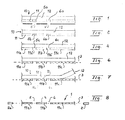
- the present invention relates to a method of forming a stencil 1, shown in Fig. 8, for a screen printing machine.
- the stencil comprises a screen 3 stretched in a frame 2, 2a and a layer 4 affixed to said screen 3 and provided with a pattern to be printed (alternative layers are 11 a, 11 b and 11 c).
- the printing pattern 5, 6 is illustrated merely as a free passage through the stencil screen 3 of an ink placed on the stencil 1 and applied thereto by means of a squeegee (not shown).
- Fig. 1 illustrates a light-sensitive film 10 comprising a light-sensitive layer 11 applied to a layer substrate 12, said light-sensitive film being exposed with an image corresponding to the printing pattern 5'. 6', or for transferring an original 5'. 6' to said light-sensitive layer 11. This is normally done by ioading the light-sensitive film in a camera not snown).
- the light-sensitive layer 11 of the light-sensitive film 10 thus exposed is developed, thereby to produce dark portions 5b, 6b corresponding to portions 5a, 6a illuminated during exposure.
- the invention proposes especially removing the said dark portions 5b, 6b by etching or bleaching from the layer 11, thus leaving the substrate 12 bare at positions 5c and 6c, thereby to form the pattern to be printed. In this manner, the remaining layers 11 a. 11 b and 11 c will form, for example at positions 11a' and 11b', margin lines against the desired printing pattern.
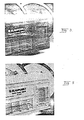
- Fig. 5 shows an example of such an image on which the remaining portions have been blacked out to make them more conspicuous.
- Fig. 6 shows how the substrate with the remaining unetched or unbleached layer 11a, 11b and 11c, respectively, to form margin lines against the desired printing pattern, is placed against the screen stretched in the frame, thereby to make the remaining layers 11 a, 11 b and 11 c interact with the screen 3.
- the remaining layer 11 a, 11 b and 11c, respectively, must have a slightly gel-like consistency.
- the stencil 1 for the screen printing machine is formed with a layer 11a, 11 b and 11 c, respectively, serving to define the printing pattern 5, 6.
- the remaining layer applied to the screen can be further developed, in which case it is suggested that development be carried out after the dark portions have been removed by etching or bleaching.
- the etching or bleaching operation is carried out by treating at least the dark portions of the film with, for instance, a solution consisting of 5 g copper dichromate and 5 cc concentrated sulphuric acid diluted with one litre of water.
- the bare portions 5c and 6c may be further cleaned by a mixture of glacial acetic acid. copper chloride and hydrogen peroxide. This bath may also be used as the only bleaching bath, instead of the one mentioned above.
- the light-sensitive layer 11 be a layer of high light sensiuvity. suen that processing and production must occur in a dark-room or under a red lamp. thereby to establish the premises for a reduced exposure time.
- Such light-sensitive layers are known in the art and utilised on film for conventional photography.
- the light-sensitive layer 11 be selected among gelatin and silver salts having a thickness exceeding 0.2 mm, although this thickness must obviously be chosen with due regard to the screen material and only be so thick that the remaining layer will unfailingly seal any pores formed in the screen. It is suggested that the thickness should not exceed 0.5 mm.
- the film employed must have high light sensitivity, type lith film hardness, a thick. emulsion layer between 0.2 and 0.5 mm, and a consistency such that it can be partially pressed into the screen and get stuck therein. Furthermore, its attachment to the substrate should be as light as possible so that the substrate can be easily stripped off.
- a negative is exposed in a camera or an enlarger via a lens. Suitable enlargement 3-10. The negative is exposed to a positive.
- the exposed film is developed by high-con- strast lith development, type rapid access or the like. It is important that the film be fully developed.
- the developed film is now positive, and the future print image is black.
- the film is placed or hung in a bleaching bath, and after two minutes white light may be switched on.
- the bleaching bath can contain the following components: Glacial acetic acid + copper chloride (solution A), 30% hydrogen peroxide (solution B).
- the beaching bath may consist of 1 part A + 1 part B + 4 parts of water.
- the black portions on the film are dissolved. Dissolution may be accelerated by douching or spraying, or by careful washing with the bleaching bath solution. Any residues of the black portions can be etched away in an etching bath of the type potassium ferricyanide (red potassium prussiate) and sodium thiosulfate - (Hypo) or the like. The black portions should then have disappeared completely. and the layer should be clean so that the substrate will be entirely free. Also the remaining layer has now been illuminated and can be devetooed to oroduce a sharp image.
- the processed frim is then transierrea to the screen in per se Known manner. for examoie oy pressing or mangling. Those parts of the film layer which have not oeen bleached away now constitute a stencil that stops the ink to be pressed through the screen by the squeegee after the substrate has been stripped off.
Landscapes
- Physics & Mathematics (AREA)
- General Physics & Mathematics (AREA)
- Manufacture Or Reproduction Of Printing Formes (AREA)
- Printing Plates And Materials Therefor (AREA)
- Printing Methods (AREA)
- Photosensitive Polymer And Photoresist Processing (AREA)
- Coloring (AREA)
Applications Claiming Priority (2)
| Application Number | Priority Date | Filing Date | Title |
|---|---|---|---|
| SE8501546 | 1985-03-28 | ||
| SE8501546A SE448215B (sv) | 1985-03-28 | 1985-03-28 | Sett att bilda en for en stenciltryckmaskin avsedd stencil |
Publications (2)
| Publication Number | Publication Date |
|---|---|
| EP0199685A2 true EP0199685A2 (de) | 1986-10-29 |
| EP0199685A3 EP0199685A3 (de) | 1987-05-27 |
Family
ID=20359692
Family Applications (1)
| Application Number | Title | Priority Date | Filing Date |
|---|---|---|---|
| EP86850043A Withdrawn EP0199685A3 (de) | 1985-03-28 | 1986-02-12 | Verfahren zur Herstellung von Siebdruckschablonen für Siebdruckmaschinen |
Country Status (3)
| Country | Link |
|---|---|
| EP (1) | EP0199685A3 (de) |
| JP (1) | JPS6253836A (de) |
| SE (1) | SE448215B (de) |
Families Citing this family (1)
| Publication number | Priority date | Publication date | Assignee | Title |
|---|---|---|---|---|
| JP2005238687A (ja) * | 2004-02-27 | 2005-09-08 | Fujicopian Co Ltd | スクリーン印刷版の製造方法 |
Family Cites Families (5)
| Publication number | Priority date | Publication date | Assignee | Title |
|---|---|---|---|---|
| GB497024A (en) * | 1936-08-01 | 1938-12-12 | Ig Farbenindustrie Ag | Improved manufacture of printing stencils |
| US2500877A (en) * | 1944-10-24 | 1950-03-14 | Sharples Corp | Photographic stencil screen and method of making the same |
| GB587957A (en) * | 1944-10-27 | 1947-05-09 | Kodak Ltd | Method of making screens for silk screen printing |
| GB641545A (en) * | 1946-08-15 | 1950-08-16 | Dan Walker | Improvements in photo-mechanical silk-screen printing processes |
| US3615472A (en) * | 1969-02-10 | 1971-10-26 | Robert Cone | High-speed photographic emulsion and method of using same |
-
1985
- 1985-03-28 SE SE8501546A patent/SE448215B/sv not_active IP Right Cessation
-
1986
- 1986-02-12 EP EP86850043A patent/EP0199685A3/de not_active Withdrawn
- 1986-03-27 JP JP6739986A patent/JPS6253836A/ja active Pending
Also Published As
| Publication number | Publication date |
|---|---|
| SE448215B (sv) | 1987-02-02 |
| SE8501546L (sv) | 1986-09-29 |
| JPS6253836A (ja) | 1987-03-09 |
| SE8501546D0 (sv) | 1985-03-28 |
| EP0199685A3 (de) | 1987-05-27 |
Similar Documents
| Publication | Publication Date | Title |
|---|---|---|
| EP0096865B1 (de) | Automatische Repetier-Positionierung und Belichtung für Filmsubstrate | |
| US2500877A (en) | Photographic stencil screen and method of making the same | |
| JPH05509177A (ja) | 印刷部材 | |
| US2833702A (en) | Method for the manufacture of a metal relief printing plate | |
| EP0385480B1 (de) | Aperturmusterdruckplatte für eine Schattenmaske und Herstellungsverfahren dafür | |
| US4263392A (en) | Ultra high speed presensitized lithographic plates | |
| US2907657A (en) | Process for making printing media with resist-type orthochromatic film material | |
| US3666648A (en) | In-situ reclamation of master patterns for printing microcircuit images on reversely sensitized material | |
| JPS6253836A (ja) | スクリン印刷機用ステンシルの製造方法 | |
| US2100346A (en) | Intaglio printing elements and method of producing the same | |
| EP0150623A2 (de) | Lichtempfindliches Schablonenmaterial | |
| US2071821A (en) | Photographic image bearer and method of making same | |
| RU2079211C1 (ru) | Способ изготовления печатных плат | |
| US1957433A (en) | Method of making a photographic printing plate | |
| US2734298A (en) | Mechanical negative process and resist | |
| US2149846A (en) | Process for printing | |
| US1417328A (en) | Light film | |
| US1789615A (en) | Photographic line print and method of making the same | |
| JPS5950059B2 (ja) | グラビア校正法 | |
| US1659949A (en) | Engraving process | |
| US1709600A (en) | Camera copy, and method of, and medium for making the same | |
| US2027271A (en) | Production of negatives with photographic images thereon of enhanced quality | |
| KR920008721B1 (ko) | 망점 에칭을 이용한 ic 회로 인쇄용 금속제판의 제조방법 | |
| US2013010A (en) | Method of preparing outlines of designs | |
| US1812981A (en) | Process for transferring gelatine silver bromide pictures |
Legal Events
| Date | Code | Title | Description |
|---|---|---|---|
| PUAI | Public reference made under article 153(3) epc to a published international application that has entered the european phase |
Free format text: ORIGINAL CODE: 0009012 |
|
| AK | Designated contracting states |
Kind code of ref document: A2 Designated state(s): BE CH DE FR GB IT LI SE |
|
| PUAL | Search report despatched |
Free format text: ORIGINAL CODE: 0009013 |
|
| AK | Designated contracting states |
Kind code of ref document: A3 Designated state(s): BE CH DE FR GB IT LI SE |
|
| 17P | Request for examination filed |
Effective date: 19871107 |
|
| STAA | Information on the status of an ep patent application or granted ep patent |
Free format text: STATUS: THE APPLICATION IS DEEMED TO BE WITHDRAWN |
|
| 18D | Application deemed to be withdrawn |
Effective date: 19890829 |