EP0197652B1 - A heat exchanger core construction utilizing a plate member adaptable for producing either a single or double pass flow arrangement - Google Patents
A heat exchanger core construction utilizing a plate member adaptable for producing either a single or double pass flow arrangement Download PDFInfo
- Publication number
- EP0197652B1 EP0197652B1 EP86301569A EP86301569A EP0197652B1 EP 0197652 B1 EP0197652 B1 EP 0197652B1 EP 86301569 A EP86301569 A EP 86301569A EP 86301569 A EP86301569 A EP 86301569A EP 0197652 B1 EP0197652 B1 EP 0197652B1
- Authority
- EP
- European Patent Office
- Prior art keywords
- portions
- plate member
- plate
- header
- plate members
- Prior art date
- Legal status (The legal status is an assumption and is not a legal conclusion. Google has not performed a legal analysis and makes no representation as to the accuracy of the status listed.)
- Expired
Links
- 238000010276 construction Methods 0.000 title claims description 24
- 239000012530 fluid Substances 0.000 claims description 32
- 238000000638 solvent extraction Methods 0.000 claims description 26
- 230000013011 mating Effects 0.000 claims description 14
- 230000002093 peripheral effect Effects 0.000 claims description 10
- 238000009826 distribution Methods 0.000 claims description 3
- 230000001419 dependent effect Effects 0.000 claims 3
- 239000004020 conductor Substances 0.000 claims 1
- 230000000712 assembly Effects 0.000 description 33
- 238000000429 assembly Methods 0.000 description 33
- 230000000295 complement effect Effects 0.000 description 15
- 239000002826 coolant Substances 0.000 description 6
- 238000005219 brazing Methods 0.000 description 4
- 238000005304 joining Methods 0.000 description 4
- WYTGDNHDOZPMIW-RCBQFDQVSA-N alstonine Natural products C1=CC2=C3C=CC=CC3=NC2=C2N1C[C@H]1[C@H](C)OC=C(C(=O)OC)[C@H]1C2 WYTGDNHDOZPMIW-RCBQFDQVSA-N 0.000 description 3
- 238000004519 manufacturing process Methods 0.000 description 3
- RYGMFSIKBFXOCR-UHFFFAOYSA-N Copper Chemical compound [Cu] RYGMFSIKBFXOCR-UHFFFAOYSA-N 0.000 description 2
- 238000002485 combustion reaction Methods 0.000 description 2
- 229910052802 copper Inorganic materials 0.000 description 2
- 239000010949 copper Substances 0.000 description 2
- 230000000694 effects Effects 0.000 description 2
- 238000000034 method Methods 0.000 description 2
- 238000000926 separation method Methods 0.000 description 2
- 239000007787 solid Substances 0.000 description 2
- 229910045601 alloy Inorganic materials 0.000 description 1
- 239000000956 alloy Substances 0.000 description 1
- 239000004411 aluminium Substances 0.000 description 1
- 229910052782 aluminium Inorganic materials 0.000 description 1
- XAGFODPZIPBFFR-UHFFFAOYSA-N aluminium Chemical compound [Al] XAGFODPZIPBFFR-UHFFFAOYSA-N 0.000 description 1
- 230000003466 anti-cipated effect Effects 0.000 description 1
- 238000004134 energy conservation Methods 0.000 description 1
- 239000000446 fuel Substances 0.000 description 1
- 239000000463 material Substances 0.000 description 1
- 229910052751 metal Inorganic materials 0.000 description 1
- 239000002184 metal Substances 0.000 description 1
- 239000010935 stainless steel Substances 0.000 description 1
- 229910001220 stainless steel Inorganic materials 0.000 description 1
Images



Classifications
-
- F—MECHANICAL ENGINEERING; LIGHTING; HEATING; WEAPONS; BLASTING
- F28—HEAT EXCHANGE IN GENERAL
- F28D—HEAT-EXCHANGE APPARATUS, NOT PROVIDED FOR IN ANOTHER SUBCLASS, IN WHICH THE HEAT-EXCHANGE MEDIA DO NOT COME INTO DIRECT CONTACT
- F28D1/00—Heat-exchange apparatus having stationary conduit assemblies for one heat-exchange medium only, the media being in contact with different sides of the conduit wall, in which the other heat-exchange medium is a large body of fluid, e.g. domestic or motor car radiators
- F28D1/02—Heat-exchange apparatus having stationary conduit assemblies for one heat-exchange medium only, the media being in contact with different sides of the conduit wall, in which the other heat-exchange medium is a large body of fluid, e.g. domestic or motor car radiators with heat-exchange conduits immersed in the body of fluid
- F28D1/03—Heat-exchange apparatus having stationary conduit assemblies for one heat-exchange medium only, the media being in contact with different sides of the conduit wall, in which the other heat-exchange medium is a large body of fluid, e.g. domestic or motor car radiators with heat-exchange conduits immersed in the body of fluid with plate-like or laminated conduits
- F28D1/0308—Heat-exchange apparatus having stationary conduit assemblies for one heat-exchange medium only, the media being in contact with different sides of the conduit wall, in which the other heat-exchange medium is a large body of fluid, e.g. domestic or motor car radiators with heat-exchange conduits immersed in the body of fluid with plate-like or laminated conduits the conduits being formed by paired plates touching each other
- F28D1/0325—Heat-exchange apparatus having stationary conduit assemblies for one heat-exchange medium only, the media being in contact with different sides of the conduit wall, in which the other heat-exchange medium is a large body of fluid, e.g. domestic or motor car radiators with heat-exchange conduits immersed in the body of fluid with plate-like or laminated conduits the conduits being formed by paired plates touching each other the plates having lateral openings therein for circulation of the heat-exchange medium from one conduit to another
- F28D1/0333—Heat-exchange apparatus having stationary conduit assemblies for one heat-exchange medium only, the media being in contact with different sides of the conduit wall, in which the other heat-exchange medium is a large body of fluid, e.g. domestic or motor car radiators with heat-exchange conduits immersed in the body of fluid with plate-like or laminated conduits the conduits being formed by paired plates touching each other the plates having lateral openings therein for circulation of the heat-exchange medium from one conduit to another the plates having integrated connecting members
-
- Y—GENERAL TAGGING OF NEW TECHNOLOGICAL DEVELOPMENTS; GENERAL TAGGING OF CROSS-SECTIONAL TECHNOLOGIES SPANNING OVER SEVERAL SECTIONS OF THE IPC; TECHNICAL SUBJECTS COVERED BY FORMER USPC CROSS-REFERENCE ART COLLECTIONS [XRACs] AND DIGESTS
- Y10—TECHNICAL SUBJECTS COVERED BY FORMER USPC
- Y10T—TECHNICAL SUBJECTS COVERED BY FORMER US CLASSIFICATION
- Y10T29/00—Metal working
- Y10T29/49—Method of mechanical manufacture
- Y10T29/4935—Heat exchanger or boiler making
- Y10T29/49366—Sheet joined to sheet
Definitions
- the present invention relates to a plate member for use in constructing a heat exchanger core assembly, for instance as used in charged air cooler assemblies for turbo-charged internal combustion engines and, more particularly, to a heat exchanger core assembly of the plate and fin type wherein a plurality of the plate members are joined together in a stackable mating arrangement.
- a heat exchanger element is formed having a central flow region therebetween.
- heat exchanger core constructions have been designed and manufactured for use as heat exchangers in a wide variety of applications such as for use in turbo-charged internal combustion engines and other applications.
- the use of heat exchangers in an extremely wide range of industrial and commercial applications coupled with the highly desirable goals of energy conservation and fuel economy in all heat and energy related devices have resulted in a rapidly growing worldwide demand for the design of efficient, reliable, and economical heat exchanger equipment.
- Typical of such heat exchanger core constructions is the plate and fin type construction wherein heat transfer is effected between one fluid medium flowing through the central flow region formed by a pair of mated plate members and a second fluid medium flowing externally over the central flow region through flow passageways formed by and between fin elements that are interposed between adjacent plate assemblies to increase the effective heat transfer therebetween.
- a transfer of heat occurs directly between the fluid medium flowing within the central flow region and the external fluid medium flowing over and around the plate members.
- a typical plate member generally includes a header portion at each opposite end thereof.
- a pair of plate members are mated together to form a plate assembly and when stacked one upon the other, the header portions associated with each plate assembly mate with the header portions of adjacent plate assemblies and form inlet or outlet headers adaptable to receive and discharge a fluid medium therethrough.
- the construction of each plate member limits the use thereof to a specific type of fluid flow through the core construction.
- US-A-3207216 discloses a core plate construction wherein the plate members are constructed such that when the plate members are mated together, a single-pass flow arrangement is produced.
- US-A-3017161 discloses a core plate construction wherein each plate member includes intermediate portions such that, when mated together, they produce a double-pass flow arrangement.
- US-A-3907032 discloses a heat exchanger construction wherein a plurality of tubes and header portions produce a multi-pass flow arrangement.
- FR-A-2010517 discloses a heat exchanger core assembly comprising a stack of similar plate members mated together in pairs to form a central flow region between the mated plate members, each of the plate members having oppositely facing surfaces, opposed side edge portions, opposed end portions and a header portion located respectively adjacent each of the end portions, each of the header portions comprising an opening positioned and arranged so as to be able to register with the header openings of similarly constructed plate members when placed in stackable arrangement therewith, the plate member also having flanged portions along the periphery thereof arranged such that the flanged portions of one plate member are able to co-operate with those of a similarly constructed plate member paired therewith to form a continuous side wall therearound regardless of which of the header portions are positioned to register with each other when the pair of plate members are mated together.
- the present invention relates to a plate member for stacking with similar plate members in pairs to construct a heat exchanger core assembly, the plate member having a longitudinal axis and a lateral axis, and comprising: opositely facing surfaces; opposed side edge portions; opposed end portions; a header portion located respectively adjacent each of the end portions, each header portion comprising a pair of openings which are disposed substantially symmetrically about the longitudinal axis, the pairs of openings being disposed substantially symmetrically about the lateral axis and each opening being adapted for registration with a complementary opening in another, similar plate member, which complementary opening is substantially identical to the other opening of the respective header portion and to the opening of the other header portion that is on the same side of the longitudinal axis as is the first-mentioned opening; a plurality of spaced flange tab portions extending outwardly from one of the plate surfaces along the periphery thereof and a plurality of untabbed portions defined by the spaces between the flange tab portions, each tab portion being substantially symmetrically
- Plate members according to the invention can thus be joined together in a stackable mating arrangement such that either a single-pass or a double-pass system is formed between each respective pair of plate members so joined depending upon the particular orientation thereof.
- the mated core plate members form a double-pass flow arrangement therebetween whereas a single-pass flow arrangement may be achieved by simple reorientation of the mating core plate members.
- the provision for achieving single or double pass fluid flow arrangements by utilizing a universal core plate member significantly reduces the tooling requirements for producing a family of heat exchanger constructions as needed for a wide variety of applications.
- a heat exchanger core assembly comprising a stack of plate members according to ⁇ he invention thus overcomes many of the disadvantages and shortcomings associated with prior art plate type heat exchanger constructions.
- the construction of the universal core plate member utilized in the present invention substantially reduces the costly tooling requirements necessary to manufacture a wide variety of plate member constructions. Since users of both single-pass and double-pass core assemblies will no longer need to purchase and stock multiple core plate constructions to achieve the desired pass flow reduce user cost and inventory.
- a preferred embodiment of the heat exchanger core construction which incorporate this invention comprises individual core plate members having a dished or header portion formed integrally therewith at each opposite end thereof.
- Each header portion includes at least a pair of openings adaptable for registration with corresponding openings on an adjacent plate member to fluidly interconnect the adjacent header portions such that one fluid medium may pass therethrough and circulate through the central flow region formed between mating plate members as will be hereinafter explained.
- the openings located in the dished or header portions of each plate member are symmetrically arranged at each end thereof and the openings associated with the header portion located at one end of the plate member have corresponding complementary openings associated with the header portion located at the opposite end thereof.
- one header portion of the formed heat exchanger element is separated into two distinct sections thereby providing separate means for coolant fluid to enter and exit the central flow region formed therebetween.
- each pair of core plate members so joined is effectively separated into two coolant passes thereby achieving a double-pass flow arrangement within each heat exchanger element or plate assembly.
- a single-pass flow arrangement may likewise be produced by joining together two core plate members in face-to-face relationship with each other such that the raised pass ribs associated with the one header portion of the respective plate members are located at opposite ends thereof.
- This arrangement allows a coolant fluid to enter one header portion and flow freely within the single flow region formed between the mated core plate members and thereafter exit through the header portion located at the opposite end thereof.
- Use of the present core plate members provides an improved means for providing separation of adjacent flow passageways within the central flow region formed between the respective pairs of mated plate members and this makes the present plate members particularly suitable for, but not limited to, use in charged air cooler assemblies for turbo charged engines.
- a typical core assembly embodying the present core plate members is produced by stacking the mated plate assemblies one upon the other and interposing heat transfer fin elements between adjacent plate assemblies, the fin elements extending throughout the full interior area therebetween forming a second series of relatively small fluid flow passageways therewithin for receiving and transporting a second fluid medium, such as air, therethrough.
- the second series of fluid passageways extend in a direction perpendicular to the central flow region formed between each pair of mated plate members thereby achieving a cross-flow pattern of fluid distribution through the heat exchanger core structure.
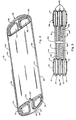
- number 10 in fig. 1 and 2 refers to a core plate member constructed according to the teachings of the present invention.
- Each plate member 10 is substantially flat in shape and each includes dished or header portions 12 and 14 located respectively at each opposite end thereof.
- the header portions 12 and 14 are preferably integrally formed with each plate member 10 although any suitable means for attaching the header portions to the plate number 10 may be utilized.
- Each header portion 12 includes a pair of spaced openings 16 and 18 and each header portion 14 includes a pair of spaced openings 20 and 22 as shown in fig. 1 and 2.
- the header openings 16, 18, 20 and 22 are adaptable for registration with corresponding openings on an adjacent plate member 10 to fluidly interconnect adjacent header portions such that one fluid medium may pass therethrough and circulate through the central flow region formed between mating plate members as will be explained.
- the openings located in the dished or header portions 12 and 14 of each plate member 10 are symmetrically arranged at each end thereof and the openings associated with the header portion 12 have corresponding complementary openings associated with the header portion 14.
- the respective header portions form the header tanks of the present core constructions.
- Circumferential flange members 24 and 26 are likewise utilized to further secure the connection between respective header portions as will be hereinafter explained.
- Each core plate member 10 also includes a raised pass or partitioning rib 28 preferably integrally formed with only one of the header portions associated with each plate member such as the header portion 12 shown in fig. 1 and 2.
- the pass rib 28 is positioned between the pair of openings 16 and 18 and extends from one end 30 of the header portion 12 to the other end 32 thereof.
- a continuous raised peripheral edge portion 34 (fig.
- Each core plate member additionally includes spaced flange tabs 36 and 38 arranged and positioned asymmetrically along the peripheral edge 34 to facilitate the positioning of one plate member 10 relative to another when assembling the same.
- the flange tabs 36 and 38 are positioned and located as shown in fig. 1 and 2 so as to be adaptable to register with and engage complementary untabbed edge portions such as the untabbed portions 39 and 40 of a complementary plate member 10 when placed in face-to-face mating relationship therewith.
- the complementary untabbed edge portions associated with the present plate member 10 are substantially equal in length to the corresponding flange tabs and the untabbed portions are positioned substantially directly opposite the position of the flange tabs as shown in fig. 1 and 2.
- the flange tabs 36 and 38 of one plate member engage respective untabbed portions 39 and 40 of the other plate member thereby forming a continuous sidewall 41 between pairs of mated plate members 10 as best shown in fig. 3.
- the flange tabs 36 and 38 are arranged along the periphery of plate member 10 such that the flange tab 36 extends from a position adjacent the partitioning rib 28 to an intermediate position along the peripheral side edge 34 such that the length thereof is equal to approximately one quarter of the distance around the entire periphery thereof.
- the flange tab 38 is spaced from the flange tab 36 a distance equal to the length of the flange tab 36 and extends similarly from a position adjacent the space between the pair of openings 20 and 22 associated with the header portion 14 to an intermediate position along the opposite peripheral side edge 34 such that the length thereof is likewise equal to approximately one quarter of the distance around the entire periphery of plate member 10.
- This specific arrangement of the flange tabs 36 and 38 not only facilitates the positioning of the core plate members 10 during assembly but also assists in securing a solid bond between the respective plate members during the brazing operation.
- the bonding material for example, a brazing alloy, can flow readily into the juncture between the peripheral flange tabs 36 and 38 of one plate member 10 and the untabbed edged portions 39 and 40 associated with the mating plate member 10 to firmly seal the same and provide an effective joinder therebetween.
- each flange tab on one plate member 10 is registrable and engageable with a corresponding untabbed portion on a complementary member 10 when said plate members are placed in face-to-face mating relationship with one another.
- the specific arrangement of tabb.- d and untabbed portions hereinbefore descrit - : and shown in fig. 1 and 2 is preferred because plate members utilizing such an arrangement have a minimum of continuous tabbed and untabbed portions associated therewith and are therefore simpler and less expensive ; to manufacture as compared to plate members having a different arrangement and a greater plurality of such tabbed and untabbed portions.
- a heat exchanger core assembly 42 is formed by joining together a plurality of plate members 10. More specifically, when two of the present plate members 10 are joined together in face-to-face relationship with the flange tabs 36 and 38 of one plate member engaging the untabbed portions 39 and 40 of a complementary plate member as previously explained, a heat exchanger element or plate assembly 43 is formed having a central flow region 44 extending substantially the entire width between the joined plate members. To provide a further secured connection between adjacent of mated plate members 10, one opening in each of the header portions 12 and 14 such as the openings 16 and 20 is provided with a circumferential flange member surrounding the same such as the flange members 24 and 26 respectively as shown in fig. 1 and 2.
- the flange members 24 and 26 are receivable and insertable within the complementary un- flanged header openings 18 and 22 in an adjacent pair of mated plate members or plate assemblies 43 to further aid in positioning and stacking the plate assemblies 43 without the use of jigs or other supporting hardware. This likewise improves the strength and stability of the entire core unit 42 and also helps to provide a solid bond between the respective pairs of plate members or assemblies 43 during the brazing operation.
- the circumferential flange members 24 and 26 also serve to fluidly interconnect the respective header openings between adjacent plate assemblies.
- a typical heat exchanger core assembly 42 embodying the present invention comprises a plurality of the plate assemblies 43 stacked one upon the other with serpentine heat transfer fins 46 interposed between adjacent plate assemblies.
- the serpentine fin elements 46 extend throughout the full interior area 48 formed between the stacked plate assemblies 43 and form a second series of relatively small fluid flow passageways 50 therewithin for receiving and transporting a second fluid medium, such as air, therethrough.
- a second fluid medium such as air
- the header portions 12 and 14 associated with each pair of mated plate members 10 mate with adjacent plate assemblies 43 and form common inlet and outlet headers 52 and 54 respectively adaptable to receive and discharge a fluid medium therethrough as previously explained.
- the serpentine fin elements 46 are positioned such that the second series of fluid flow passageways 50 extend in a direction perpendicular to the central flow region 44 formed between each pair of mated plate members thereby achieving a cross-flow pattern of fluid distribution through the heat exchanger core structure 42.
- a single-pass or a double-pass flow system within each plate assembly may be achieved.
- a mated plate assembly 60 (fig. 5) is formed wherein the raised partitioning or pass ribs 28 of the respective header portions 12 are positioned and arranged in abutting relationship with each other such that the assembled header portion 62 formed thereby at one end portion thereof is separated into two distinct flow sections 64 and 66 as shown in fig. 5.
- FIG. 5 is a cross-sectional view of the plate assembly 60 taken through the plane 5-5 of fig. 4 showing one method of joining complementary plate members together wherein each of the flange tabs 36 and 38 is folded over or crimped around the respective untabbed portions 39 and 40.
- This method of mating a pair of complementary plate members provides additional strength and stability to the plate assemblies 43.
- the flow sections 64 and 66 provide a means for coolant fluid to enter and exit the central flow region formed between the mated plate members 10.
- each plate assembly 60 so assembled is effectively separated into two coolant passes 70 and 72 (fig. 4). This means that one fluid medium may enter one opening associated with the separated header portion 62 and flow the full length of the plate assembly 60 along one of the passageways 70 or 72 formed therewithin.
- a double-pass cross-flow core assembly is formed by stacking a plurality of the double-pass plate assemblies 60 one upon the other and interposing heat transfer fin elements such as the fin elements 46 between adjacent plate assemblies as previously discussed with respect to the core assembly 42 shown in fig. 3.
- An important aspect of the construction of the present plate members 10 is to provide a plate design which can also be utilized in the assembly of a single-pass core unit.
- a double-pass plate assembly is achieved by rotating one of the plate members 10 forming each pair of mated plate members 180° about its longitudinal axis as shown in fig. 4 and 5.
- a single-pass flow arrangement can be achieved by rotating one of said pair of plate members 10 180° about its transverse axis A-A shown in fig. 1 and 6 and thereafter joining said plate members 10 in face-to-face relationship with each other as previously explained to form a mated plate assembly such as the plate assemblies 74 shown in fig. 6 and 7.
- a space 76 exists within both header portions formed thereby such as the header portion 80 shown in fig. 7 for allowing a fluid medium to communicate from one side 82 to the other side 84 therewithin and neither header portion is separated as hereinbefore described.
- Fig. 7 is a cross-sectional view of one of the plate assemblies 74 taken through the plane 7-7 of fig. 6. This orientation of mated plate members 10 enables a coolant fluid to enter one header portion and flow freely within the single flow region 86 formed therebetween and thereafter exit through the header portion located at the opposite end thereof.
- a single pass cross-flow core assembly can be achieved by simply stacking a plurality of single-pass plate assemblies 74 in a manner substantially similar to the forming of the double-pass cross-flow core assembly previously described with respect to fig. 4 and 5 and interposing head transfer fin elements such as the fin elements 88 (fig. 6) between the adjacent plate assemblies 74. It is also important to note that when two of the present plate members 10 are joined together in mating relationship as just described to form a single-pass flow arrangement within each plate assembly 74, the flange tabs 36 and 38 of one plate member 10 still register with and engage respective untabbed portions 39 and 40 of the complementary plate member 10.
- each of the flange tabs 36 and 38 can be folded over or crimped around the respective untabbed portions 39 and 40 to further provide additional strength and stability to the plate assemblies 74.
- the openings in the respective header portions of the plate assemblies formed thereby will always lie in registration with the corresponding openings on an adjacent plate assembly to fluidly interconnect said pair of plate members and any plurality thereof.
- all of the structural members comprising the two core embodiments which utilize the present plate members 10 are formed of a suitable heat conducting metal such as aluminium, copper and/or copper clad, or stainless steel, and all such members may be interconnected by any suitable bonding means such as by brazing to form the unitized core structure.
- suitable manifolding at one or both ends of the core structure is also provided for directing the two fluid media through their respective flow passageways formed within the core assembly in heat exchange relationship with each other to effect heat transfer therebetween.
- the overall size and shape of the individual plate members 10 may be conveniently fashioned into a variety of sizes and configurations, for example, rectangular, square, oval, circular, hexagonal, or other configurations, so as to be compatible with the size and shape of the manifold housing into which it may be mounted or to conform with any other space limitations without impairing the teachings and practice of the present plate construction.
- Use of the present plate members 10 provides an improved means for providing separation of adjacent flow passageways within the central flow region formed between the respective pairs of mated plate members and although the present plate members are particularly suitable for use in charged air cooler assemblies for turbo-charged engines, they may likewise be effectively utilized in a wide variety of heat exchanger applications.
Landscapes
- Engineering & Computer Science (AREA)
- Physics & Mathematics (AREA)
- Thermal Sciences (AREA)
- Mechanical Engineering (AREA)
- General Engineering & Computer Science (AREA)
- Heat-Exchange Devices With Radiators And Conduit Assemblies (AREA)
Description
- The present invention relates to a plate member for use in constructing a heat exchanger core assembly, for instance as used in charged air cooler assemblies for turbo-charged internal combustion engines and, more particularly, to a heat exchanger core assembly of the plate and fin type wherein a plurality of the plate members are joined together in a stackable mating arrangement. When two of the present core plate members are joined together in face-to-face relationship, a heat exchanger element is formed having a central flow region therebetween.
- A wide variety of heat exchanger core constructions have been designed and manufactured for use as heat exchangers in a wide variety of applications such as for use in turbo-charged internal combustion engines and other applications. The use of heat exchangers in an extremely wide range of industrial and commercial applications coupled with the highly desirable goals of energy conservation and fuel economy in all heat and energy related devices have resulted in a rapidly growing worldwide demand for the design of efficient, reliable, and economical heat exchanger equipment.
- Typical of such heat exchanger core constructions is the plate and fin type construction wherein heat transfer is effected between one fluid medium flowing through the central flow region formed by a pair of mated plate members and a second fluid medium flowing externally over the central flow region through flow passageways formed by and between fin elements that are interposed between adjacent plate assemblies to increase the effective heat transfer therebetween. In such a construction, a transfer of heat occurs directly between the fluid medium flowing within the central flow region and the external fluid medium flowing over and around the plate members.
- The construction of a typical plate member generally includes a header portion at each opposite end thereof. A pair of plate members are mated together to form a plate assembly and when stacked one upon the other, the header portions associated with each plate assembly mate with the header portions of adjacent plate assemblies and form inlet or outlet headers adaptable to receive and discharge a fluid medium therethrough. Typically, however, the construction of each plate member limits the use thereof to a specific type of fluid flow through the core construction. For example, US-A-3207216 discloses a core plate construction wherein the plate members are constructed such that when the plate members are mated together, a single-pass flow arrangement is produced. US-A-3017161 discloses a core plate construction wherein each plate member includes intermediate portions such that, when mated together, they produce a double-pass flow arrangement. US-A-3907032 discloses a heat exchanger construction wherein a plurality of tubes and header portions produce a multi-pass flow arrangement. FR-A-2010517 discloses a heat exchanger core assembly comprising a stack of similar plate members mated together in pairs to form a central flow region between the mated plate members, each of the plate members having oppositely facing surfaces, opposed side edge portions, opposed end portions and a header portion located respectively adjacent each of the end portions, each of the header portions comprising an opening positioned and arranged so as to be able to register with the header openings of similarly constructed plate members when placed in stackable arrangement therewith, the plate member also having flanged portions along the periphery thereof arranged such that the flanged portions of one plate member are able to co-operate with those of a similarly constructed plate member paired therewith to form a continuous side wall therearound regardless of which of the header portions are positioned to register with each other when the pair of plate members are mated together.
- Each of these constructions, however, is limited to the specific flow arrangement described therein and to change any one of the specific types of flow arrangements disclosed respectively therein would require complete restructuring of the core plate members to achieve the newly desired pass flow arrangement. Thus, a user of a variety of fluid flow arrangements must have a variety of plate member constructions available and the manufacturers of such plate members must produce and provide this variety of plate members to meet the specific needs of the user. Manufacture and use of the prior art core plate devices are therefore not only expensive but likewise inconvenient.
- The present invention relates to a plate member for stacking with similar plate members in pairs to construct a heat exchanger core assembly, the plate member having a longitudinal axis and a lateral axis, and comprising: opositely facing surfaces; opposed side edge portions; opposed end portions; a header portion located respectively adjacent each of the end portions, each header portion comprising a pair of openings which are disposed substantially symmetrically about the longitudinal axis, the pairs of openings being disposed substantially symmetrically about the lateral axis and each opening being adapted for registration with a complementary opening in another, similar plate member, which complementary opening is substantially identical to the other opening of the respective header portion and to the opening of the other header portion that is on the same side of the longitudinal axis as is the first-mentioned opening; a plurality of spaced flange tab portions extending outwardly from one of the plate surfaces along the periphery thereof and a plurality of untabbed portions defined by the spaces between the flange tab portions, each tab portion being substantially symmetrically disposed about the longitudinal axis with an untabbed portion of substantially the same length and about the lateral axis with another untabbed portion of substantially the same length, and each tab portion being registrable and engageable with a corresponding untabbed portion of another, similar plate member, which corresponding untabbed portion is substantially identical to either of said symmetrically disposed untabbed portions of substantially the same length as that tab portion; and a partitioning rib member extending longitudinally between the pair of openings of one of the header portions such that, when the said one of the header portions is registered with the corresponding header portion of a similarly constructed plate member mated therewith, the partitioning rib member of one plate is positioned in abutting relationship with the partitioning rib member of the other plate member whereas when the said one of the header portions is registered with the other header portion of a similarly constructed plate member mated therewith no such abutting relationship is formed between the respective partitioning rib members.
- Plate members according to the invention can thus be joined together in a stackable mating arrangement such that either a single-pass or a double-pass system is formed between each respective pair of plate members so joined depending upon the particular orientation thereof. In one orientation, the mated core plate members form a double-pass flow arrangement therebetween whereas a single-pass flow arrangement may be achieved by simple reorientation of the mating core plate members. The provision for achieving single or double pass fluid flow arrangements by utilizing a universal core plate member significantly reduces the tooling requirements for producing a family of heat exchanger constructions as needed for a wide variety of applications.
- A heat exchanger core assembly comprising a stack of plate members according to<he invention thus overcomes many of the disadvantages and shortcomings associated with prior art plate type heat exchanger constructions. The construction of the universal core plate member utilized in the present invention substantially reduces the costly tooling requirements necessary to manufacture a wide variety of plate member constructions. Since users of both single-pass and double-pass core assemblies will no longer need to purchase and stock multiple core plate constructions to achieve the desired pass flow reduce user cost and inventory.
- A preferred embodiment of the heat exchanger core construction which incorporate this invention comprises individual core plate members having a dished or header portion formed integrally therewith at each opposite end thereof. Each header portion includes at least a pair of openings adaptable for registration with corresponding openings on an adjacent plate member to fluidly interconnect the adjacent header portions such that one fluid medium may pass therethrough and circulate through the central flow region formed between mating plate members as will be hereinafter explained. The openings located in the dished or header portions of each plate member are symmetrically arranged at each end thereof and the openings associated with the header portion located at one end of the plate member have corresponding complementary openings associated with the header portion located at the opposite end thereof. In addition, circumferential flange members surround at least one of the openings in each header portion to aid in positioning and stacking the respective pairs of mated plate members. Each core plate member also includes a raised partitioning or pass rib preferably formed integral therewith and positioned between the pair of openings associated with only one of the header portions. This raised pass rib is important to the present invention because it is the positioning of the respective pass ribs associated with each pair of mated plate members relative to one another which determines the particular flow arrangement of the core assembly embodying the present plate members. Each core plate member additionally includes spaced flange tabs arranged asymmetrically along the periphery thereof to facilitate the positioning of one core plate member relative to another when assembling the same. These flange tabs are positioned so as to be adaptable to register with and engage an untabbed edge portion of a complementary plate member when placed in mating relationship therewith to form either of the flow arrangements hereinafter described.
- When two of the present core plate members are assembled in face-to-face relationship with each other and the raised pass ribs associated with one of the header portions on each of the respective plate members are positioned and arranged in abutting relationship with each other, one header portion of the formed heat exchanger element is separated into two distinct sections thereby providing separate means for coolant fluid to enter and exit the central flow region formed therebetween. By arranging one corrugation of an interposed elongated single strip fin member or other partitioning member in alignment with the abutting pass ribs at one end portion of the plate assembly and extending the elongated partitioning member the full length of the mated core plate members, each pair of core plate members so joined is effectively separated into two coolant passes thereby achieving a double-pass flow arrangement within each heat exchanger element or plate assembly. A single-pass flow arrangement may likewise be produced by joining together two core plate members in face-to-face relationship with each other such that the raised pass ribs associated with the one header portion of the respective plate members are located at opposite ends thereof. This arrangement allows a coolant fluid to enter one header portion and flow freely within the single flow region formed between the mated core plate members and thereafter exit through the header portion located at the opposite end thereof. Use of the present core plate members provides an improved means for providing separation of adjacent flow passageways within the central flow region formed between the respective pairs of mated plate members and this makes the present plate members particularly suitable for, but not limited to, use in charged air cooler assemblies for turbo charged engines.
- A typical core assembly embodying the present core plate members is produced by stacking the mated plate assemblies one upon the other and interposing heat transfer fin elements between adjacent plate assemblies, the fin elements extending throughout the full interior area therebetween forming a second series of relatively small fluid flow passageways therewithin for receiving and transporting a second fluid medium, such as air, therethrough. The second series of fluid passageways extend in a direction perpendicular to the central flow region formed between each pair of mated plate members thereby achieving a cross-flow pattern of fluid distribution through the heat exchanger core structure.
- Several embodiments of the invention will now be described, merely by way of example in conjunction with the accompanying drawings.
- Brief Description Of The Drawings
- Fig. 1 is a perspective view of a core plate member constructed according to the teachings of the present invention;
- fig. 2 is a perspective view of the plate member of fig. 1 rotated 180° about the transverse axis A-A;
- fig. 3 is a side elevational view of a plurality of plate assemblies stacked one upon the other with heat transfer fin elements interposed between adjacent plate assemblies, each plate assembly being formed by mating together two of the plate members of fig. 1;
- fig. 4 is an exploded perspective view of a double-pass arrangement of one plate assembly utilizing the plate members of fig. 1;
- fig. 5 is a cross-sectional view of the double-pass plate assembly of fig. 4 in assembled condition taken through the plane 5-5;
- fig. 6 is an exploded perspective view of a single-pass arrangement of two plate assemblies utilizing the plate members of fig. 1 with a heat transfer fin element interposed between the adjacent plate assemblies; and,
- fig. 7 is a cross-sectional view of one of the single-pass plate assemblies of fig. 6 in assembled condition taken through the plane 7-7.
- Detailed Description Of A Preferred Embodiment
- Referring to the drawings more particularly by reference numbers wherein like numerals refer to like parts,
number 10 in fig. 1 and 2 refers to a core plate member constructed according to the teachings of the present invention. Eachplate member 10 is substantially flat in shape and each includes dished orheader portions header portions plate member 10 although any suitable means for attaching the header portions to theplate number 10 may be utilized. Eachheader portion 12 includes a pair of spacedopenings header portion 14 includes a pair of spacedopenings header openings adjacent plate member 10 to fluidly interconnect adjacent header portions such that one fluid medium may pass therethrough and circulate through the central flow region formed between mating plate members as will be explained. The openings located in the dished orheader portions plate member 10 are symmetrically arranged at each end thereof and the openings associated with theheader portion 12 have corresponding complementary openings associated with theheader portion 14. When stacked one upon the other, the respective header portions form the header tanks of the present core constructions.Circumferential flange members - Each
core plate member 10 also includes a raised pass or partitioningrib 28 preferably integrally formed with only one of the header portions associated with each plate member such as theheader portion 12 shown in fig. 1 and 2. Thepass rib 28 is positioned between the pair ofopenings end 30 of theheader portion 12 to theother end 32 thereof. A continuous raised peripheral edge portion 34 (fig. - 2) extends around each of the
plate members 10 on one surface thereof and the partitioning orpass rib 28 associated with eachheader portion 12 extends from and lies coplanar with theperipheral edge portion 34. Each core plate member additionally includes spacedflange tabs peripheral edge 34 to facilitate the positioning of oneplate member 10 relative to another when assembling the same. Theflange tabs untabbed portions complementary plate member 10 when placed in face-to-face mating relationship therewith. It is important to note that the complementary untabbed edge portions associated with thepresent plate member 10 are substantially equal in length to the corresponding flange tabs and the untabbed portions are positioned substantially directly opposite the position of the flange tabs as shown in fig. 1 and 2. When two of thepresent plate members 10 are joined in mating face-to-face relationship with one another, theflange tabs untabbed portions continuous sidewall 41 between pairs of matedplate members 10 as best shown in fig. 3. - In the preferred embodiment shown in fig. 1 and 2, the
flange tabs plate member 10 such that theflange tab 36 extends from a position adjacent thepartitioning rib 28 to an intermediate position along theperipheral side edge 34 such that the length thereof is equal to approximately one quarter of the distance around the entire periphery thereof. Theflange tab 38 is spaced from the flange tab 36 a distance equal to the length of theflange tab 36 and extends similarly from a position adjacent the space between the pair ofopenings header portion 14 to an intermediate position along the oppositeperipheral side edge 34 such that the length thereof is likewise equal to approximately one quarter of the distance around the entire periphery ofplate member 10. This specific arrangement of theflange tabs core plate members 10 during assembly but also assists in securing a solid bond between the respective plate members during the brazing operation. In this situation, the bonding material, for example, a brazing alloy, can flow readily into the juncture between theperipheral flange tabs plate member 10 and the untabbed edgedportions mating plate member 10 to firmly seal the same and provide an effective joinder therebetween. It is also recognized and anticipated that other arrangements of the flange tabs around the periphery of theplate members 10 may likewise be utilized wherein each flange tab on oneplate member 10 is registrable and engageable with a corresponding untabbed portion on acomplementary member 10 when said plate members are placed in face-to-face mating relationship with one another. However, the specific arrangement of tabb.- d and untabbed portions hereinbefore descrit - : and shown in fig. 1 and 2 is preferred because plate members utilizing such an arrangement have a minimum of continuous tabbed and untabbed portions associated therewith and are therefore simpler and less expensive;to manufacture as compared to plate members having a different arrangement and a greater plurality of such tabbed and untabbed portions. - As shown in fig. 3, a heat
exchanger core assembly 42 is formed by joining together a plurality ofplate members 10. More specifically, when two of thepresent plate members 10 are joined together in face-to-face relationship with theflange tabs untabbed portions plate assembly 43 is formed having acentral flow region 44 extending substantially the entire width between the joined plate members. To provide a further secured connection between adjacent of matedplate members 10, one opening in each of theheader portions openings flange members flange members flanged header openings plate assemblies 43 to further aid in positioning and stacking theplate assemblies 43 without the use of jigs or other supporting hardware. This likewise improves the strength and stability of theentire core unit 42 and also helps to provide a solid bond between the respective pairs of plate members orassemblies 43 during the brazing operation. Thecircumferential flange members - A typical heat
exchanger core assembly 42 embodying the present invention comprises a plurality of theplate assemblies 43 stacked one upon the other with serpentineheat transfer fins 46 interposed between adjacent plate assemblies. Theserpentine fin elements 46 extend throughout the fullinterior area 48 formed between thestacked plate assemblies 43 and form a second series of relatively smallfluid flow passageways 50 therewithin for receiving and transporting a second fluid medium, such as air, therethrough. It should be noted that various types of serpentine fin elements may be utilized, for example, they may be smooth, perforated, lanced, or they may be louvered. When stacked one upon the other, theheader portions adjacent plate assemblies 43 and form common inlet andoutlet headers serpentine fin elements 46 are positioned such that the second series offluid flow passageways 50 extend in a direction perpendicular to thecentral flow region 44 formed between each pair of mated plate members thereby achieving a cross-flow pattern of fluid distribution through the heatexchanger core structure 42. - Depending upon how each pair of
core plate members 10 forming theplate assemblies 43 are joined together, either a single-pass or a double-pass flow system within each plate assembly may be achieved. For example, when twoplate members 10 are assembled in face-to-face relationship with each other by rotating one plate member 180° about its longitudinal axis B-B as shown in fig. 4, a mated plate assembly 60 (fig. 5) is formed wherein the raised partitioning or passribs 28 of therespective header portions 12 are positioned and arranged in abutting relationship with each other such that the assembledheader portion 62 formed thereby at one end portion thereof is separated into twodistinct flow sections plate assembly 60 taken through the plane 5-5 of fig. 4 showing one method of joining complementary plate members together wherein each of theflange tabs untabbed portions plate assemblies 43. Theflow sections plate members 10. By arranging one corrugation of an interposed elongated single strip fin member or partitioningrib 68 in alignment with the abuttingpass ribs 28 at one end portion thereof and extending the fin member or partitioningrib 68 the full length of theplate assembly 60 to a position adjacent theheader portion 14, eachplate assembly 60 so assembled is efectively separated into two coolant passes 70 and 72 (fig. 4). This means that one fluid medium may enter one opening associated with the separatedheader portion 62 and flow the full length of theplate assembly 60 along one of thepassageways plate assembly 60, the fluid medium will reverse direction within the unseparated header portion located at the opposite end thereof and traverse the full length of thesecond passageway header portion 62. A double-pass cross-flow core assembly is formed by stacking a plurality of the double-pass plate assemblies 60 one upon the other and interposing heat transfer fin elements such as thefin elements 46 between adjacent plate assemblies as previously discussed with respect to thecore assembly 42 shown in fig. 3. - An important aspect of the construction of the
present plate members 10 is to provide a plate design which can also be utilized in the assembly of a single-pass core unit. As described above, a double-pass plate assembly is achieved by rotating one of theplate members 10 forming each pair of mated plate members 180° about its longitudinal axis as shown in fig. 4 and 5. In contrast, a single-pass flow arrangement can be achieved by rotating one of said pair ofplate members 10 180° about its transverse axis A-A shown in fig. 1 and 6 and thereafter joining saidplate members 10 in face-to-face relationship with each other as previously explained to form a mated plate assembly such as theplate assemblies 74 shown in fig. 6 and 7. In this situation, since thepartitioning ribs 28 of therespective header portions 12 associated with eachplate member 10 are located at opposite ends of theplate assemblies 74, a space 76 (fig. 7) exists within both header portions formed thereby such as theheader portion 80 shown in fig. 7 for allowing a fluid medium to communicate from oneside 82 to theother side 84 therewithin and neither header portion is separated as hereinbefore described. Fig. 7 is a cross-sectional view of one of theplate assemblies 74 taken through the plane 7-7 of fig. 6. This orientation of matedplate members 10 enables a coolant fluid to enter one header portion and flow freely within thesingle flow region 86 formed therebetween and thereafter exit through the header portion located at the opposite end thereof. Like the double-pass cross-flow core construction, a single pass cross-flow core assembly can be achieved by simply stacking a plurality of single-pass plate assemblies 74 in a manner substantially similar to the forming of the double-pass cross-flow core assembly previously described with respect to fig. 4 and 5 and interposing head transfer fin elements such as the fin elements 88 (fig. 6) between theadjacent plate assemblies 74. It is also important to note that when two of thepresent plate members 10 are joined together in mating relationship as just described to form a single-pass flow arrangement within eachplate assembly 74, theflange tabs plate member 10 still register with and engage respectiveuntabbed portions complementary plate member 10. As hereinbefore described, each of theflange tabs untabbed portions plate assemblies 74. This is best shown in fig. 7. Therefore, regardless of how one of thepresent plate members 10 is oriented and mated in face-to-face relationship with itscomplementary plate member 10, the tabbed and untabbed portions associated respectively therewith will always register with and engage one another to form the continuous sidewall such as the sidewall 41 (fig. 3) between the mated plate members and to effect joinder therebetween. Additionally, regardless of the relative orientation of the matedplate members 10, that is, the forming of a single-pass or a double-pass flow system, the openings in the respective header portions of the plate assemblies formed thereby will always lie in registration with the corresponding openings on an adjacent plate assembly to fluidly interconnect said pair of plate members and any plurality thereof. - It should that all of the structural members comprising the two core embodiments which utilize the
present plate members 10 are formed of a suitable heat conducting metal such as aluminium, copper and/or copper clad, or stainless steel, and all such members may be interconnected by any suitable bonding means such as by brazing to form the unitized core structure. In addition, suitable manifolding at one or both ends of the core structure is also provided for directing the two fluid media through their respective flow passageways formed within the core assembly in heat exchange relationship with each other to effect heat transfer therebetween. The provision for providing either a single-pass or a double-pass flow arrangement within a core structure by utilizing thepresent plate members 10 significantly reduces the tooling requirements for producing a family of heat exchangers as needed for various applications ar previously explained. In addition, it is also recognized that the overall size and shape of theindividual plate members 10 may be conveniently fashioned into a variety of sizes and configurations, for example, rectangular, square, oval, circular, hexagonal, or other configurations, so as to be compatible with the size and shape of the manifold housing into which it may be mounted or to conform with any other space limitations without impairing the teachings and practice of the present plate construction. Use of thepresent plate members 10 provides an improved means for providing separation of adjacent flow passageways within the central flow region formed between the respective pairs of mated plate members and although the present plate members are particularly suitable for use in charged air cooler assemblies for turbo-charged engines, they may likewise be effectively utilized in a wide variety of heat exchanger applications. - Thus there has been shown and described novel means for forming a single-pass or a double-pass cross-flow core arrangement by utilizing a universal core plate member which fulfills all of the objects and advantages sought therefor.
Claims (14)
Applications Claiming Priority (2)
| Application Number | Priority Date | Filing Date | Title |
|---|---|---|---|
| US708827 | 1985-03-06 | ||
| US06/708,827 US4592414A (en) | 1985-03-06 | 1985-03-06 | Heat exchanger core construction utilizing a plate member adaptable for producing either a single or double pass flow arrangement |
Publications (2)
| Publication Number | Publication Date |
|---|---|
| EP0197652A1 EP0197652A1 (en) | 1986-10-15 |
| EP0197652B1 true EP0197652B1 (en) | 1989-07-05 |
Family
ID=24847333
Family Applications (1)
| Application Number | Title | Priority Date | Filing Date |
|---|---|---|---|
| EP86301569A Expired EP0197652B1 (en) | 1985-03-06 | 1986-03-05 | A heat exchanger core construction utilizing a plate member adaptable for producing either a single or double pass flow arrangement |
Country Status (6)
| Country | Link |
|---|---|
| US (1) | US4592414A (en) |
| EP (1) | EP0197652B1 (en) |
| JP (1) | JPS61259086A (en) |
| BR (1) | BR8600975A (en) |
| DE (1) | DE3664235D1 (en) |
| IN (1) | IN167046B (en) |
Families Citing this family (42)
| Publication number | Priority date | Publication date | Assignee | Title |
|---|---|---|---|---|
| SE462059B (en) * | 1986-12-19 | 1990-04-30 | Blackstone Sweden | HEAT EXCHANGE WITH FLAT ROUTES, WHICH ROOTS ARE CREATED BY TWO HALFS WITH OVERLAPPING FLANES |
| DE3883161T2 (en) * | 1987-11-17 | 1994-04-07 | Shinwa Sangyo Kk | Heat exchanger for a cooling tower. |
| US4829780A (en) * | 1988-01-28 | 1989-05-16 | Modine Manufacturing Company | Evaporator with improved condensate collection |
| US4872578A (en) * | 1988-06-20 | 1989-10-10 | Itt Standard Of Itt Corporation | Plate type heat exchanger |
| US4860421A (en) * | 1989-02-23 | 1989-08-29 | General Motors Corporation | Method for assembling plate type heat exchangers |
| US5538077A (en) * | 1989-02-24 | 1996-07-23 | Long Manufacturing Ltd. | In tank oil cooler |
| US5369883A (en) * | 1989-02-24 | 1994-12-06 | Long Manufacturing Ltd. | Method for making an in tank oil cooler |
| CA1313182C (en) * | 1989-02-24 | 1993-01-26 | Allan K. So | In tank oil cooler |
| US4901414A (en) * | 1989-03-27 | 1990-02-20 | General Motors Corporation | Method for assembling pairs of heat exchanger plates |
| JPH03121360U (en) * | 1990-03-16 | 1991-12-12 | ||
| JPH04177094A (en) * | 1990-11-13 | 1992-06-24 | Sanden Corp | Laminated type heat exchanger |
| US5138764A (en) * | 1991-04-18 | 1992-08-18 | General Motors Corporation | Method for assembling heat exchanger plate pairs by snap fit |
| IT226255Z2 (en) * | 1992-02-18 | 1997-06-02 | Miralfin Srl | STRUCTURE OF RADIATOR PARTICULARLY FOR HEATING ROOMS |
| AU668403B2 (en) * | 1992-08-31 | 1996-05-02 | Mitsubishi Jukogyo Kabushiki Kaisha | Stacked heat exchanger |
| DE4307504C1 (en) * | 1993-03-10 | 1994-09-22 | Mtu Friedrichshafen Gmbh | Heat exchanger, in particular charge air cooler of an internal combustion engine |
| DE4307503C2 (en) * | 1993-03-10 | 1995-01-19 | Mtu Friedrichshafen Gmbh | Heat exchanger, in particular charge air cooler of an internal combustion engine |
| US5529120A (en) * | 1994-02-01 | 1996-06-25 | Hubbell Incorporated | Heat exchanger for electrical cabinet or the like |
| JP3814917B2 (en) * | 1997-02-26 | 2006-08-30 | 株式会社デンソー | Stacked evaporator |
| SE509104C2 (en) * | 1997-04-22 | 1998-12-07 | Volvo Lastvagnar Ab | Method of manufacturing a plate heat exchanger |
| DE19723878B4 (en) * | 1997-06-06 | 2007-10-25 | Behr Gmbh & Co. Kg | Heat exchanger |
| EP0895861B1 (en) | 1997-08-05 | 2003-11-26 | Canon Kabushiki Kaisha | A liquid discharge head, a substrate for use of such head and a method of manufacture therefor |
| CA2260890A1 (en) * | 1999-02-05 | 2000-08-05 | Long Manufacturing Ltd. | Self-enclosing heat exchangers |
| JP4056663B2 (en) * | 1999-10-01 | 2008-03-05 | 昭和電工株式会社 | Laminate heat exchanger |
| JP3479477B2 (en) * | 1999-12-16 | 2003-12-15 | Smc株式会社 | Heat exchanger for temperature controller |
| KR20020061757A (en) * | 2001-01-17 | 2002-07-25 | 한국델파이주식회사 | Tube plate of evaporator for vehicle |
| DE10120483A1 (en) * | 2001-04-25 | 2002-10-31 | Modine Mfg Co | Arrangement for cooling |
| US7188417B2 (en) * | 2002-06-28 | 2007-03-13 | United Technologies Corporation | Advanced L-channel welded nozzle design |
| KR100687637B1 (en) * | 2002-07-11 | 2007-02-27 | 한라공조주식회사 | heat transmitter |
| FR2846733B1 (en) * | 2002-10-31 | 2006-09-15 | Valeo Thermique Moteur Sa | CONDENSER, IN PARTICULAR FOR A CIRCUIT FOR CIMATING A MOTOR VEHICLE, AND CIRCUIT COMPRISING THE CONDENSER |
| US7069981B2 (en) * | 2002-11-08 | 2006-07-04 | Modine Manufacturing Company | Heat exchanger |
| SE524307C2 (en) * | 2003-07-24 | 2004-07-27 | Swep Int Ab | Plate type heat exchanger production method, forms plate with double wall construction to allow drainage of any leaking fluid |
| JP2005055074A (en) * | 2003-08-04 | 2005-03-03 | Calsonic Kansei Corp | Heat exchanger |
| DE102005002063A1 (en) * | 2005-01-14 | 2006-07-20 | Behr Gmbh & Co. Kg | Stacking disk heat exchanger |
| SE530574C2 (en) * | 2006-11-20 | 2008-07-08 | Alfa Laval Corp Ab | plate heat exchangers |
| FR2929390B1 (en) * | 2008-03-26 | 2014-10-10 | Valeo Systemes Thermiques | HEAT EXCHANGER PLATE |
| EP2669027B8 (en) * | 2012-06-01 | 2016-03-16 | Kelvion PHE GmbH | Method and press tool for fabricating a plate heat exchanger |
| JP6329756B2 (en) * | 2013-11-26 | 2018-05-23 | 株式会社マーレ フィルターシステムズ | Oil cooler |
| KR101586646B1 (en) * | 2014-03-17 | 2016-01-19 | 주식회사 경동나비엔 | A hot water heating latent heat exchanger and a condensing gas boiler comprising the same |
| CN107208979A (en) * | 2014-10-01 | 2017-09-26 | 三菱重工压缩机有限公司 | Stacked-plate heat exchanger |
| EP3417229A4 (en) * | 2016-02-18 | 2019-03-13 | Ironside Engineering, Inc. | High efficiency heat dissipation methods and systems for electronic circuits and systems |
| WO2018147471A1 (en) * | 2017-02-13 | 2018-08-16 | 株式会社ティラド | Drawn cup type heat exchanger |
| CN206542684U (en) * | 2017-03-10 | 2017-10-03 | 讯凯国际股份有限公司 | Continuously bondable liquid-cooled heat exchangers |
Family Cites Families (21)
| Publication number | Priority date | Publication date | Assignee | Title |
|---|---|---|---|---|
| US1029099A (en) * | 1910-04-13 | 1912-06-11 | Emil Behringer | Manufacture of radiator-tubes. |
| US1158576A (en) * | 1914-04-01 | 1915-11-02 | Pressed Metal Radiator Company | Method of making sheet-metal radiators. |
| GB130104A (en) * | 1917-04-03 | 1919-07-31 | Charles Cuau | Improvements in or relating to Radiators for Internal Combustion Engines. |
| GB487840A (en) * | 1936-12-24 | 1938-06-24 | Ahlborn E Ag | Improvements in and relating to plate heat exchangers for fluids |
| US2538043A (en) * | 1946-02-21 | 1951-01-16 | James A S Roy | Support |
| GB655076A (en) * | 1947-02-24 | 1951-07-11 | Cherry Burrell Corp | Improvements in or relating to gaskets for plate apparatus in particular plate type heat exchangers or filter presses |
| GB739350A (en) * | 1953-01-23 | 1955-10-26 | Ford Motor Co | Improvements in or relating to beam members |
| US2814159A (en) * | 1955-04-11 | 1957-11-26 | Spectoyculars Inc | Building unit and assembly for toys and the like |
| GB1131124A (en) * | 1966-02-10 | 1968-10-23 | Serck Radiators Ltd | Plate-type heat exchangers |
| DE1928146A1 (en) * | 1968-06-06 | 1969-12-11 | Delaney Gallay Ltd | Heat exchanger |
| US3907032A (en) * | 1971-04-27 | 1975-09-23 | United Aircraft Prod | Tube and fin heat exchanger |
| DE2237059A1 (en) * | 1972-07-28 | 1974-02-07 | Volkswagenwerk Ag | ARRANGEMENT FOR THE CENTERING OF PLATE-SHAPED COMPONENTS |
| US3893509A (en) * | 1974-04-08 | 1975-07-08 | Garrett Corp | Lap joint tube plate heat exchanger |
| US4002201A (en) * | 1974-05-24 | 1977-01-11 | Borg-Warner Corporation | Multiple fluid stacked plate heat exchanger |
| FR2280871A1 (en) * | 1974-08-01 | 1976-02-27 | Chausson Usines Sa | Built-up construction heat exchanger - has panels with peripheral support surface and embossed crown sections |
| US4470455A (en) * | 1978-06-19 | 1984-09-11 | General Motors Corporation | Plate type heat exchanger tube pass |
| SE412284B (en) * | 1978-07-10 | 1980-02-25 | Alfa Laval Ab | HEAT EXCHANGER INCLUDING A MULTIPLE IN A STATIVE INPUT, MAINLY RECTANGULATED PLATE |
| US4407359A (en) * | 1980-07-25 | 1983-10-04 | Commissariat A L'energie Atomique | Plate heat exchanger |
| US4298061A (en) * | 1980-08-15 | 1981-11-03 | The Singer Company | Heat exchanger with crimped flange seam |
| US4308915A (en) * | 1980-10-27 | 1982-01-05 | Sanders Nicholas A | Thin sheet heat exchanger |
| US4350201A (en) * | 1981-01-12 | 1982-09-21 | United Aircraft Products, Inc. | Self fixturing heat exchanger |
-
1985
- 1985-03-06 US US06/708,827 patent/US4592414A/en not_active Expired - Fee Related
-
1986
- 1986-03-04 IN IN147/MAS/86A patent/IN167046B/en unknown
- 1986-03-05 DE DE8686301569T patent/DE3664235D1/en not_active Expired
- 1986-03-05 EP EP86301569A patent/EP0197652B1/en not_active Expired
- 1986-03-05 JP JP61046460A patent/JPS61259086A/en active Pending
- 1986-03-06 BR BR8600975A patent/BR8600975A/en not_active IP Right Cessation
Also Published As
| Publication number | Publication date |
|---|---|
| BR8600975A (en) | 1986-11-18 |
| JPS61259086A (en) | 1986-11-17 |
| DE3664235D1 (en) | 1989-08-10 |
| IN167046B (en) | 1990-08-25 |
| EP0197652A1 (en) | 1986-10-15 |
| US4592414A (en) | 1986-06-03 |
Similar Documents
| Publication | Publication Date | Title |
|---|---|---|
| EP0197652B1 (en) | A heat exchanger core construction utilizing a plate member adaptable for producing either a single or double pass flow arrangement | |
| US5538077A (en) | In tank oil cooler | |
| US5125453A (en) | Heat exchanger structure | |
| EP1484567B1 (en) | Heat exchanger with parallel flowing fluids | |
| EP2315995B1 (en) | U-flow heat exchanger | |
| US6918434B2 (en) | Reinforced stacked plate heat exchanger | |
| US3207216A (en) | Heat exchanger | |
| US20050067153A1 (en) | Tube bundle heat exchanger comprising tubes with expanded sections | |
| EP0677716A1 (en) | Stacked-type duplex heat exchanger | |
| US20010054501A1 (en) | Plate heat exchanger | |
| EP0616678B1 (en) | Heat exchange unit for a plate type heat exchanger | |
| JPH074885A (en) | Heat exchanger | |
| JP3043050B2 (en) | Heat exchanger | |
| US5111877A (en) | Multi-tube heat exchanger with mechanically interlocked tubes formed from mechanically interlocked plates | |
| CN101663554B (en) | Heat exchanger construction | |
| CA1313182C (en) | In tank oil cooler | |
| US20240280326A1 (en) | Micro-channel heat exchanger | |
| US5697429A (en) | Heat exchanger having a header in the form of a stack | |
| US20030131979A1 (en) | Oil cooler | |
| EP0745821B1 (en) | Method of manufacturing a heat exchanger with divided header tank | |
| US5373895A (en) | Heat exchanger | |
| US5634519A (en) | Heat exchanger, especially for cooling a high temperature air stream | |
| JPH10238969A (en) | Cold water heat-exchanger | |
| JPH0545336B2 (en) | ||
| JPH07243788A (en) | Heat exchanger |
Legal Events
| Date | Code | Title | Description |
|---|---|---|---|
| PUAI | Public reference made under article 153(3) epc to a published international application that has entered the european phase |
Free format text: ORIGINAL CODE: 0009012 |
|
| AK | Designated contracting states |
Kind code of ref document: A1 Designated state(s): DE GB |
|
| 17P | Request for examination filed |
Effective date: 19870317 |
|
| 17Q | First examination report despatched |
Effective date: 19870827 |
|
| GRAA | (expected) grant |
Free format text: ORIGINAL CODE: 0009210 |
|
| AK | Designated contracting states |
Kind code of ref document: B1 Designated state(s): DE GB |
|
| REF | Corresponds to: |
Ref document number: 3664235 Country of ref document: DE Date of ref document: 19890810 |
|
| PG25 | Lapsed in a contracting state [announced via postgrant information from national office to epo] |
Ref country code: GB Effective date: 19900305 |
|
| PLBE | No opposition filed within time limit |
Free format text: ORIGINAL CODE: 0009261 |
|
| STAA | Information on the status of an ep patent application or granted ep patent |
Free format text: STATUS: NO OPPOSITION FILED WITHIN TIME LIMIT |
|
| 26N | No opposition filed | ||
| GBPC | Gb: european patent ceased through non-payment of renewal fee | ||
| PG25 | Lapsed in a contracting state [announced via postgrant information from national office to epo] |
Ref country code: DE Effective date: 19901201 |