EP0191484B1 - Générateur électrochimique de type primaire ou secondaire - Google Patents
Générateur électrochimique de type primaire ou secondaire Download PDFInfo
- Publication number
- EP0191484B1 EP0191484B1 EP86101803A EP86101803A EP0191484B1 EP 0191484 B1 EP0191484 B1 EP 0191484B1 EP 86101803 A EP86101803 A EP 86101803A EP 86101803 A EP86101803 A EP 86101803A EP 0191484 B1 EP0191484 B1 EP 0191484B1
- Authority
- EP
- European Patent Office
- Prior art keywords
- fact
- electrolyte
- electrochemical battery
- battery according
- negative electrode
- Prior art date
- Legal status (The legal status is an assumption and is not a legal conclusion. Google has not performed a legal analysis and makes no representation as to the accuracy of the status listed.)
- Expired
Links
- 239000003792 electrolyte Substances 0.000 claims abstract description 14
- WHXSMMKQMYFTQS-UHFFFAOYSA-N Lithium Chemical compound [Li] WHXSMMKQMYFTQS-UHFFFAOYSA-N 0.000 claims abstract description 11
- 229910052744 lithium Inorganic materials 0.000 claims abstract description 11
- 239000000203 mixture Substances 0.000 claims abstract description 10
- 238000010438 heat treatment Methods 0.000 claims abstract description 9
- -1 polyoxyethylene Polymers 0.000 claims abstract description 8
- FYYHWMGAXLPEAU-UHFFFAOYSA-N Magnesium Chemical compound [Mg] FYYHWMGAXLPEAU-UHFFFAOYSA-N 0.000 claims abstract description 5
- 229910052749 magnesium Inorganic materials 0.000 claims abstract description 5
- 239000011777 magnesium Substances 0.000 claims abstract description 5
- NUJOXMJBOLGQSY-UHFFFAOYSA-N manganese dioxide Chemical compound O=[Mn]=O NUJOXMJBOLGQSY-UHFFFAOYSA-N 0.000 claims abstract description 5
- 239000007787 solid Substances 0.000 claims abstract description 5
- 229920003171 Poly (ethylene oxide) Polymers 0.000 claims abstract description 4
- 150000003839 salts Chemical class 0.000 claims abstract description 4
- 125000001931 aliphatic group Chemical group 0.000 claims abstract description 3
- 229920002545 silicone oil Polymers 0.000 claims abstract description 3
- 239000011149 active material Substances 0.000 claims abstract 4
- 229920000642 polymer Polymers 0.000 claims abstract 4
- AYTAKQFHWFYBMA-UHFFFAOYSA-N chromium dioxide Chemical compound O=[Cr]=O AYTAKQFHWFYBMA-UHFFFAOYSA-N 0.000 claims abstract 3
- 229910016003 MoS3 Inorganic materials 0.000 claims abstract 2
- 239000004743 Polypropylene Substances 0.000 claims abstract 2
- NINIDFKCEFEMDL-UHFFFAOYSA-N Sulfur Chemical compound [S] NINIDFKCEFEMDL-UHFFFAOYSA-N 0.000 claims abstract 2
- 229910003092 TiS2 Inorganic materials 0.000 claims abstract 2
- 150000001447 alkali salts Chemical class 0.000 claims abstract 2
- 229910045601 alloy Inorganic materials 0.000 claims abstract 2
- 239000000956 alloy Substances 0.000 claims abstract 2
- 229910052960 marcasite Inorganic materials 0.000 claims abstract 2
- 239000000155 melt Substances 0.000 claims abstract 2
- TVWWSIKTCILRBF-UHFFFAOYSA-N molybdenum trisulfide Chemical compound S=[Mo](=S)=S TVWWSIKTCILRBF-UHFFFAOYSA-N 0.000 claims abstract 2
- 229920001155 polypropylene Polymers 0.000 claims abstract 2
- 229920001021 polysulfide Polymers 0.000 claims abstract 2
- 239000005077 polysulfide Substances 0.000 claims abstract 2
- 150000008117 polysulfides Polymers 0.000 claims abstract 2
- NIFIFKQPDTWWGU-UHFFFAOYSA-N pyrite Chemical compound [Fe+2].[S-][S-] NIFIFKQPDTWWGU-UHFFFAOYSA-N 0.000 claims abstract 2
- 229910052683 pyrite Inorganic materials 0.000 claims abstract 2
- 150000004763 sulfides Chemical class 0.000 claims abstract 2
- 239000011593 sulfur Substances 0.000 claims abstract 2
- 229910052717 sulfur Inorganic materials 0.000 claims abstract 2
- 229910052751 metal Inorganic materials 0.000 claims description 8
- 239000002184 metal Substances 0.000 claims description 8
- PXHVJJICTQNCMI-UHFFFAOYSA-N Nickel Chemical compound [Ni] PXHVJJICTQNCMI-UHFFFAOYSA-N 0.000 claims description 7
- RYGMFSIKBFXOCR-UHFFFAOYSA-N Copper Chemical compound [Cu] RYGMFSIKBFXOCR-UHFFFAOYSA-N 0.000 claims description 6
- 229910052802 copper Inorganic materials 0.000 claims description 4
- 239000010949 copper Substances 0.000 claims description 4
- 229910052759 nickel Inorganic materials 0.000 claims description 4
- 239000002131 composite material Substances 0.000 claims description 2
- 239000007774 positive electrode material Substances 0.000 claims description 2
- 239000011532 electronic conductor Substances 0.000 claims 1
- 125000006850 spacer group Chemical group 0.000 description 9
- 229910013470 LiC1 Inorganic materials 0.000 description 2
- 239000000374 eutectic mixture Substances 0.000 description 2
- 229910003002 lithium salt Inorganic materials 0.000 description 2
- 159000000002 lithium salts Chemical class 0.000 description 2
- 239000007784 solid electrolyte Substances 0.000 description 2
- MBMLMWLHJBBADN-UHFFFAOYSA-N Ferrous sulfide Chemical compound [Fe]=S MBMLMWLHJBBADN-UHFFFAOYSA-N 0.000 description 1
- 229910000733 Li alloy Inorganic materials 0.000 description 1
- 229910015015 LiAsF 6 Inorganic materials 0.000 description 1
- 229910000861 Mg alloy Inorganic materials 0.000 description 1
- ZLMJMSJWJFRBEC-UHFFFAOYSA-N Potassium Chemical compound [K] ZLMJMSJWJFRBEC-UHFFFAOYSA-N 0.000 description 1
- GJTDJAPHKDIQIQ-UHFFFAOYSA-L barium(2+);dinitrite Chemical compound [Ba+2].[O-]N=O.[O-]N=O GJTDJAPHKDIQIQ-UHFFFAOYSA-L 0.000 description 1
- BCFSVSISUGYRMF-UHFFFAOYSA-N calcium;dioxido(dioxo)chromium;dihydrate Chemical compound O.O.[Ca+2].[O-][Cr]([O-])(=O)=O BCFSVSISUGYRMF-UHFFFAOYSA-N 0.000 description 1
- 239000006229 carbon black Substances 0.000 description 1
- 150000001875 compounds Chemical class 0.000 description 1
- JQVALDCWTQRVQE-UHFFFAOYSA-N dilithium;dioxido(dioxo)chromium Chemical compound [Li+].[Li+].[O-][Cr]([O-])(=O)=O JQVALDCWTQRVQE-UHFFFAOYSA-N 0.000 description 1
- 239000011491 glass wool Substances 0.000 description 1
- 230000000977 initiatory effect Effects 0.000 description 1
- 239000012212 insulator Substances 0.000 description 1
- 230000028161 membrane depolarization Effects 0.000 description 1
- 239000005518 polymer electrolyte Substances 0.000 description 1
- 229910052700 potassium Inorganic materials 0.000 description 1
- 239000011591 potassium Substances 0.000 description 1
- 230000037452 priming Effects 0.000 description 1
Images




Classifications
-
- H—ELECTRICITY
- H01—ELECTRIC ELEMENTS
- H01M—PROCESSES OR MEANS, e.g. BATTERIES, FOR THE DIRECT CONVERSION OF CHEMICAL ENERGY INTO ELECTRICAL ENERGY
- H01M6/00—Primary cells; Manufacture thereof
- H01M6/14—Cells with non-aqueous electrolyte
- H01M6/18—Cells with non-aqueous electrolyte with solid electrolyte
- H01M6/181—Cells with non-aqueous electrolyte with solid electrolyte with polymeric electrolytes
-
- H—ELECTRICITY
- H01—ELECTRIC ELEMENTS
- H01M—PROCESSES OR MEANS, e.g. BATTERIES, FOR THE DIRECT CONVERSION OF CHEMICAL ENERGY INTO ELECTRICAL ENERGY
- H01M6/00—Primary cells; Manufacture thereof
- H01M6/30—Deferred-action cells
- H01M6/36—Deferred-action cells containing electrolyte and made operational by physical means, e.g. thermal cells
Definitions
- the present invention relates to an electrochemical generator of primary or secondary type comprising a plurality of elements consisting of a negative electrode, an electrolyte, a positive electrode, and provided with a means for heating the electrolyte.
- Thermal batteries are known, the negative electrode of which is based on lithium, the positive electrode based on calcium chromate or iron sulfide, and the electrolyte an eutectic mixture of a lithium salt and a salt. potassium. Such batteries operate at temperatures of the order of 450 ° C to 550 ° C, for a period of a few minutes with a power of the order of 200 watts.
- thermal battery the electrolyte of which consists of a eutectic mixture LiC1 / KC1 supplemented with barium nitrite or lithium chromate. This battery operates at a temperature between 500 and 600 ° C.
- the object of the invention is to produce thermal batteries according to the preamble of claim 1 capable of operating at temperatures much lower than those necessary for the battery according to said document FR-A and with powers much higher than those according to said Solid State lonics document.
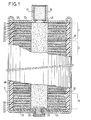
- FIG. 1 a battery enclosed in a cylindrical metal housing consisting of a cup 11 closed by a cover 12. It includes three hundred superimposed electrochemical elements grouped into ten blocks that have been referenced 1, 2, ⁇ 10.
- each element there is a lithium sheet 21 associated with a copper or nickel sheet 20.
- Layer 22 is a solid polymer electrolyte formed of a polyoxyethylene complex with a lithium salt LiCF 3 S0 3 .
- Layer 23 is a composite electrode containing 7% by weight of manganese dioxide Mn0 2 , 10% of carbon black and of the solid electrolyte.
- a metal spacer 30 ensuring electrical contact between these blocks.
- the positive and negative terminals of the generator are referenced 31 and 32, 33 a metal plate ensuring electrical contact, 34, 35, 36 of the insulating parts.
- the entire stack has a central well containing a pyrotechnic composition 40.
- the ignition is ensured by a primer 41 known in itself.
- the thermal conduction is carried out by means of the metal sheets 20 and the spacers 30.
- a 84 W / 84 Wh / 30 volt cylindrical primary generator is produced with 3 blocks of 10 elements in parallel; the elements are analogous to the elements in the example previous.
- the metal spacers 30 are replaced by insulating separators, and additional metal connections are provided between the blocks.
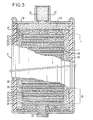
- FIGS. 2 and 3 show an alternative embodiment in which the pyrotechnic composition 40 is distributed in several wells referenced 42 to 47.
- the central well containing the pyrotechnic composition 40 is surrounded by a layer 50 of aliphatic or silicone oil which transmits heat to the electrochemical elements, or of a thermal buffer which fixes the temperature.
- the oil soaks a porous body which serves as a support, such as a glass wool felt.
- the metal spacers 30 can be replaced by insulating layers soaked in oil or pad, which promote heat exchange. Additional electrical connections must then be made between the blocks.
- the stack no longer has a central well.
- the entire stack of elements is surrounded by oil 50 or the thermal buffer heated by the pyrotechnic composition 40 located at the top of the stack.
- An additional electrical connection has been referenced 37 for connecting the stack to the cover 12.
- the elements are grouped into blocks 101 to 110 separated by spacers 130; 136 and 137 indicate terminal connections to the positive 131 and negative 132.
- the pyrotechnic mixture is referenced 140, the layer of oil or the buffer which surrounds the entire stack is indicated 150 and the primer 141.
- the layers insulators are noted 134, 135.
- the spacers 130 are therefore porous insulating layers capable of containing oil or the thermal buffer).
- FIG. 7 has shown how the priming of a cell according to the invention was carried out.
- Thermal cells have been described in detail, the electrolyte of which consists of a polyoxyethylene complex with LiCF 3 S0 3 ; but other salts can be used, for example LiC1 0 4 , LiAsF 6 , Li 2 B 12 H 12 , Li 2 B 10 H 10 .
- the lithium electrode can be replaced by a magnesium or lithium or magnesium alloy electrode.
- the generator can be recovered and recharged.
- the invention therefore also applies to secondary generators.
Landscapes
- Engineering & Computer Science (AREA)
- Manufacturing & Machinery (AREA)
- Chemical & Material Sciences (AREA)
- Chemical Kinetics & Catalysis (AREA)
- Electrochemistry (AREA)
- General Chemical & Material Sciences (AREA)
- Secondary Cells (AREA)
- Battery Electrode And Active Subsutance (AREA)
- Saccharide Compounds (AREA)
- Primary Cells (AREA)
Description
- La présente invention concerne un générateur électrochimique de type primaire ou secondaire comprenant une pluralité d'éléments constitués d'une électrode négative, d'un électrolyte, d'une électrode positive, et muni d'un moyen de chauffage de l'électrolyte.
- On connaît des piles thermiques dont l'électrode négative est à base de lithium, l'électrode positive à base de chromate de calcium ou de sulfure de fer, et l'électrolyte un mélange eutectique d'un sel de lithium et d'un sel de potassium. De telles piles fonctionnent à des températures de l'ordre de 450 °C à 550 °C, pendant une durée de quelques minutes avec une puissance de l'ordre de 200 watts.
- On connaît aussi par le document Solid State lonics 13 (1984), p. 175-179, un générateur expérimental selon le préambule de la revendication 1, qui fonctionne à des températures inférieures à 140 °C. Au delà de cette température, l'électrolyte solide se déstabilise brusquement.
- On connaît, en outre, par le document FR-A-2 244 273, une batterie thermique dont l'électrolyte est constitué d'un mélange eutectique LiC1/KC1 additionné de nitrite de baryum ou de chromate de lithium. Cette pile fonctionne à une température entre 500 et 600 °C.
- L'invention a pour but de réaliser des piles ther- .miques selon le préambule de la revendication 1 susceptibles de fonctionner à des températures bien inférieures à celles nécessaires pour la batte- rié selon ledit document FR-A et avec des puissances très supérieures à celles selon ledit document Solid State lonics.
- Ce but est atteint par le générateur électrochimique tel que défini par la revendication 1. En ce qui concerne des exemples de mise en oeuvre préférée de ce générateur, référence est faite aux sous-revendications.
- Ci-aprés l'invention sera décrite plus en détail à l'aide de modes de réalisation donnés à titre illustratif mais nullement limitatif.
- Dans le dessin annexé:
- - la figure 1 est une vue schématique en coupe d'une pile thermique cylindrique selon l'invention.
- - la figure 2 est une vue partielle schématique en coupe d'une variante de pile selon la figure 1 à plusierus puits,
- - la figure 3 est une vue en coupe selon la ligne III-III de la figure 2,
- - la figure 4 est une vue schématique en coupe d'une variante de pile thermique cylindrique comportant un puits central,
- - la figure 5 est une vue schématique en coupe d'une variante de pile thermique cylindrique sans puits central,
- - la figure 6 est une vue schématique en coupe d'une pile thermique prismatique selon l'invention
- - la figure 7 illustre l'amorçage d'une pile selon l'invention.
- De toutes les figures, des éléments analogues sont référencés par les mêmes nombres.
- On voit dans la figure 1 une pile enfermée dans un boîtier métallique cylindrique constitué d'un godet 11 fermé par un couvercle 12. Elle comprend trois cents éléments électrochimiques superposés regroupés en dix blocs que l'on a référencés 1, 2,··· 10.
- Pour ne pas surcharger la figure on n'a illustré que trois éléments par bloc et non trente; par ailleurs les échelles ne sont pas respectées.
- Dans chaque élément on trouve une feuille de lithium 21 associée à une feuille de cuivre ou de nickel 20.
- La couche 22 est un électrolyte polymère solide formé d'un complexe de polyoxyéthylène avec un sel de lithium LiCF3S03.
- La couche 23 est une électrode composite contenant 7% en poids de bioxyde de manganèse Mn02, 10% de noir de carbone et de l'électrolyte solide.
- Entre deux blocs consécutifs est prévue une entretoise métallique 30 assurant le contact électrique entre ces blocs.
- On a référencé 31 et 32 les bornes positive et négative du générateur, 33 une plaque métallique assurant le contact électrique, 34, 35, 36 des pièces isolantes.
- L'ensemble de l'empilement présente un puits central contenant une composition pyrotechnique 40. La mise à feu est assurée par une amorce 41 connue en elle-même. La conduction thermique est réalisée par l'intermédiaire des feuilles métalliques 20 et les entretoises 30.
- Exemple de caractéristiques dimensionnelles:
- - épaisseur de la feuille de lithium 21: 1/10 mm
- - épaisseur de la feuille de cuivre 20: inférieure à 2/10 mm
- - épaisseur de la couche d'électrolyte 22: de l'ordre de 1 /10 mm
- - épaisseur de la couche 23: de l'ordre de 2/10 mm
- - hauteur totale d'un élément: de l'ordre de 0,6 mm
- - hauteur d'un bloc 1 de 30 éléments: de l'ordre de 1,8 cm
- - diamètre d'un élément: 13 cm
- - épaisseur d'une entretoise 30: 2 mm
- - hauteur totale des éléments dans leur boîtier: 20 cm
- - diamètre du puits central: 3,5 cm
- Pour une température de fonctionnement de 150 °C on a un générateur présentant les caractéristiques suivantes:
- - 10 blocs de 90 volts en série (900 volts)
- - densité de courant: 10 mA/cm2
- - courant disponsible: 1,11 A
- - énergie volumique: 312 wh/cm3
- - puissance: 1000 watts
- - énergie: 1000 wh
- Selon une autre variante on réalise un générateur primaire cylindrique 84 W/84 Wh/30 volts avec 3 blocs de 10 éléments en parallèle; les éléments sont analogues aux éléments de l'exemple précédent.
- Pour la mise en parallèle, on remplace les entretoises métalliques 30 par des séparateurs isolants, et l'on prévoit des connexions métalliques supplémentaires entre les blocs.
- Les caractéristiques dimensionnelles sont:
- - hauteur totale d'un bloc de 10 éléments: 0,6 cm
- - hauteur totale d'un bloc de 10 éléments: 0,6 cm
- - épaisseur de l'entretoise entre deux blocs: 1 mm
- - surface d'un élément: 94 cm2
- - diamètre du puits central: 1 cm
- - hauteur totale des éléments actifs: 2,1 cm
- - volume: de l'ordre de 200 cm3
- Pour une température de fonctionnement de 150 °C on a les caractéristiques suivantes:
- - tension: 30 volts
- - courant disponible: 2,8 A
- - énergie volumique: 420 wh/dm3
- - capacité du générateur: 3 Ah
- Les figures 2 et 3 montrent une variante de réalisation dans laquelle la composition pyrotechnique 40 est répartie dans plusieurs puits référencés 42 à 47.
- Dans la figure 4 le puits central contenant la composition pyrotechnique 40 est entouré d'une couche 50 d'huile aliphatique ou siliconée qui transmet la chaleur aux éléments électrochimiques, ou d'un tampon thermique qui fixe la température. L'huile imbibe un corps poreux qui lui sert de support, tel qu'un feutre de laine de verre.
- Selon une variante non illustrée les entretoises métalliques 30 peuvent être remplacées par des couches isolantes imbibées d'huile or du tampon, qui favorisent les échanges de chaleur. Des connexions électriques supplémentaires doivent alors être prévues entre les blocs.
- Dans la figure 5 la pile n'a plus de puits central. L'ensemble de l'empilement des éléments est entouré d'huile 50 ou du tampon thermique chauffé par la composition pyrotechnique 40 située à la partie supérieure de la pile. On a référencé 37 une connexion électrique supplémentaire pour relier l'empilement au couvercle 12.
- On a montré dansla figure 6 un générateur prismatique selon l'invention logé dans un bac 111 fermé par un couvercle 112. Chaque élément comporte les mêmes couches de base que les éléments des fénérateurs précédents
- - feuille de nickel ou de cuivre: 120
- - couche de lithium: 121
- - couche d'électrolyte: 122
- - électrode positive: 123
- Les éléments sont regroupés en blocs 101 à 110 séparés par des entretoises 130; on a indiqué par 136 et 137 des connexions terminales aux bornes positive 131 et négative 132. Le mélange pyrotechnique est référencé 140, la couche d'huile ou le tampon qui entoure tout l'empilement est indiquée 150 et l'amorce 141. Les couches isolantes sont notées 134, 135.
- txemples de caractéristiques dimensionnelles:
- - 1 bloc comporte 10 éléments électrochi- meiques
- - hauteur d'un bloc: 8 cm
- - largeur d'un bloc: 4,3 cm
- - épaisseur d'un bloc: 5 mm
- - épaisseur d'une entretoise 130: 1 mm
- - surface d'un élément: 34,5 cm2.
- Selon un premier mode de réalisation, on met en oeuvre trois blocs de 30 volts connectés en parallèle (les entretoises 130 sont donc des couches isolantes poreuses susceptibles de contenir de l'huile ou le tampon thermique).
- Pour un fonctionnement à une température de 150 °C on obtient les caractéristiques électriques suivantes:
- - courant disponible: 1 A
- - capacité disponible: 1 Ah
- - puissance: 30 W
- - énergie: 30 Wh
- - énergie volumique: 472 Wh/dm3.
- On choisit le nombre de blocs et les dimensions des éléments en fonction des caractéristiques électriques recherchées.
- On a montré dans la figure 7 comment se réalisait l'amorçage d'une pile selon l'invention. Pour cela on effectue l'opération suivante: On monte dans un boîtier présentant un diamètre de 2 centimètres et une hauteur de 2 millimètres un couple électrochimique analogue à ceux qui apparaissent dans la figure 1. Cette pile est mise à 25 °C sous un courant de 1 Op A. La tension de base de cette pile est 2,1 volts. Au temps t=0, la pile est transférée de la température ambiante à la température 150 °C. La dépolarisation a lieu en moins de 3 secondes comme le montre la courbe V (volts) en fonction du temps t (secondes). La pile présente une tension égale à 80% de sa tension stationnaire après cina dixièmes de seconde.
- Bien entendu l'invention n'est pas limitée aux modes de réalisation décrits et représentés.
- On a décrit en détail des piles thermiques dont l'électrolyte était constitué d'un complexe de polyoxyéthylène avec LiCF3S03; mais d'autres sels peuvent être utilisés, par exemple LiC1 04, LiAsF6, Li2B12H12, Li2B10H10 .
- L'électrode de lithium peut être remplacée par une électrode en magnésium ou en alliage de lithium ou de magnésium.
- Par ailleurs, lorsque la matière active positive est par exemple un composé du type TiS2, NiP-S3wetc, le générateur peut être récupéré et rechargé.
- L'invention s'applique donc également aux générateurs secondaires.
Claims (8)
Priority Applications (1)
| Application Number | Priority Date | Filing Date | Title |
|---|---|---|---|
| AT86101803T ATE45646T1 (de) | 1985-02-15 | 1986-02-13 | Primaer- oder sekundaerelektrochemischer generator. |
Applications Claiming Priority (2)
| Application Number | Priority Date | Filing Date | Title |
|---|---|---|---|
| FR8502208 | 1985-02-15 | ||
| FR8502208A FR2577718B1 (fr) | 1985-02-15 | 1985-02-15 | Generateur electrochimique de type primaire ou secondaire |
Publications (2)
| Publication Number | Publication Date |
|---|---|
| EP0191484A1 EP0191484A1 (fr) | 1986-08-20 |
| EP0191484B1 true EP0191484B1 (fr) | 1989-08-16 |
Family
ID=9316318
Family Applications (1)
| Application Number | Title | Priority Date | Filing Date |
|---|---|---|---|
| EP86101803A Expired EP0191484B1 (fr) | 1985-02-15 | 1986-02-13 | Générateur électrochimique de type primaire ou secondaire |
Country Status (4)
| Country | Link |
|---|---|
| EP (1) | EP0191484B1 (fr) |
| AT (1) | ATE45646T1 (fr) |
| DE (1) | DE3665116D1 (fr) |
| FR (1) | FR2577718B1 (fr) |
Families Citing this family (3)
| Publication number | Priority date | Publication date | Assignee | Title |
|---|---|---|---|---|
| AU649894B2 (en) * | 1991-11-25 | 1994-06-02 | Shigeyuki Yasuda | Electric power generating element |
| US5409786A (en) * | 1993-02-05 | 1995-04-25 | Eveready Battery Company, Inc. | Inactive electrochemical cell having an ionically nonconductive polymeric composition activated by electrolyte salt solution |
| CN102569837B (zh) * | 2010-12-29 | 2014-06-11 | 中国电子科技集团公司第十八研究所 | 消除高压电弧热电池的制备方法 |
Family Cites Families (5)
| Publication number | Priority date | Publication date | Assignee | Title |
|---|---|---|---|---|
| US4044192A (en) * | 1970-07-10 | 1977-08-23 | Catalyst Research Corporation | Thermal batteries |
| US3725132A (en) * | 1970-09-14 | 1973-04-03 | Catalyst Research Corp | Solid state thermally active battery |
| JPS5054838A (fr) * | 1973-09-14 | 1975-05-14 | ||
| FR2442513A1 (fr) * | 1978-11-22 | 1980-06-20 | Anvar | Generateurs electrochimiques de production de courant et nouveaux materiaux pour leur fabrication |
| DK200284A (da) * | 1983-04-22 | 1984-10-23 | Atomic Energy Authority Uk | Elektrokemisk celle |
-
1985
- 1985-02-15 FR FR8502208A patent/FR2577718B1/fr not_active Expired
-
1986
- 1986-02-13 AT AT86101803T patent/ATE45646T1/de not_active IP Right Cessation
- 1986-02-13 DE DE8686101803T patent/DE3665116D1/de not_active Expired
- 1986-02-13 EP EP86101803A patent/EP0191484B1/fr not_active Expired
Also Published As
| Publication number | Publication date |
|---|---|
| FR2577718A1 (fr) | 1986-08-22 |
| ATE45646T1 (de) | 1989-09-15 |
| DE3665116D1 (en) | 1989-09-21 |
| EP0191484A1 (fr) | 1986-08-20 |
| FR2577718B1 (fr) | 1988-06-17 |
Similar Documents
| Publication | Publication Date | Title |
|---|---|---|
| US4119769A (en) | Thermal battery having iron pyrite depolarizer | |
| US6045939A (en) | Lithium secondary battery having thermal switch | |
| US5427872A (en) | Dendrite preventing separator for secondary lithium batteries | |
| US6074776A (en) | Polymerizable additives for making non-aqueous rechargeable lithium batteries safe after overcharge | |
| US5534369A (en) | Battery having divided electrode portions | |
| US7968221B2 (en) | Lithium ion secondary battery | |
| FR2447618A1 (fr) | Nouveaux types de batteries et procede pour leur charge | |
| FR2832859A1 (fr) | Generateur electrochimique au lithium comprenant au moins une electrode bipolaire avec substrats conducteurs en aluminium ou alliage d'aluminium | |
| EP2093820B1 (fr) | Connection électrique pour accumulateur de courant | |
| JPH07302597A (ja) | リチウム電池 | |
| FR2695254A1 (fr) | Electrolyte polymère solide alcalin, électrode et générateur électrochimique comportant un tel électrolyte. | |
| FR2775124A1 (fr) | Accumulateur au lithium, composition cathodique et cathode pour accumulateur au lithium | |
| US5770329A (en) | Thermal battery and improved cell therefor | |
| US3891460A (en) | Thermal battery and molten metal anode therefore | |
| EP0053785B1 (fr) | Générateur électrochimique à électrode négative liquide | |
| US4416958A (en) | Thermal battery cells utilizing AgNO3 in LiClO4 -LiNO3 mixtures | |
| FR2599895A1 (fr) | Accumulateur de reserve a elements multiples | |
| JPH10255757A (ja) | リチウム二次電池 | |
| JPS59203376A (ja) | 非水溶媒電池 | |
| EP0191484A1 (fr) | Générateur électrochimique de type primaire ou secondaire | |
| JPH0740489B2 (ja) | 熱電池 | |
| FR2471685A1 (fr) | Montage de protection de piles | |
| Smith et al. | High energy density lithium rechargeable batteries for underwater vehicle propulsion | |
| JPH06163052A (ja) | 有機電解液電池 | |
| JPH05343101A (ja) | 非水電解質二次電池及びその製造方法 |
Legal Events
| Date | Code | Title | Description |
|---|---|---|---|
| PUAI | Public reference made under article 153(3) epc to a published international application that has entered the european phase |
Free format text: ORIGINAL CODE: 0009012 |
|
| AK | Designated contracting states |
Kind code of ref document: A1 Designated state(s): AT BE CH DE FR GB IT LI LU NL SE |
|
| 17P | Request for examination filed |
Effective date: 19870217 |
|
| 17Q | First examination report despatched |
Effective date: 19880323 |
|
| GRAA | (expected) grant |
Free format text: ORIGINAL CODE: 0009210 |
|
| AK | Designated contracting states |
Kind code of ref document: B1 Designated state(s): AT BE CH DE FR GB IT LI LU NL SE |
|
| REF | Corresponds to: |
Ref document number: 45646 Country of ref document: AT Date of ref document: 19890915 Kind code of ref document: T |
|
| REF | Corresponds to: |
Ref document number: 3665116 Country of ref document: DE Date of ref document: 19890921 |
|
| ITF | It: translation for a ep patent filed | ||
| GBT | Gb: translation of ep patent filed (gb section 77(6)(a)/1977) | ||
| PLBE | No opposition filed within time limit |
Free format text: ORIGINAL CODE: 0009261 |
|
| STAA | Information on the status of an ep patent application or granted ep patent |
Free format text: STATUS: NO OPPOSITION FILED WITHIN TIME LIMIT |
|
| 26N | No opposition filed | ||
| PGFP | Annual fee paid to national office [announced via postgrant information from national office to epo] |
Ref country code: LU Payment date: 19920221 Year of fee payment: 7 |
|
| EPTA | Lu: last paid annual fee | ||
| PG25 | Lapsed in a contracting state [announced via postgrant information from national office to epo] |
Ref country code: LU Free format text: LAPSE BECAUSE OF NON-PAYMENT OF DUE FEES Effective date: 19930213 |
|
| ITTA | It: last paid annual fee | ||
| PGFP | Annual fee paid to national office [announced via postgrant information from national office to epo] |
Ref country code: AT Payment date: 19931230 Year of fee payment: 9 |
|
| PGFP | Annual fee paid to national office [announced via postgrant information from national office to epo] |
Ref country code: BE Payment date: 19940210 Year of fee payment: 9 |
|
| EAL | Se: european patent in force in sweden |
Ref document number: 86101803.4 |
|
| PG25 | Lapsed in a contracting state [announced via postgrant information from national office to epo] |
Ref country code: AT Effective date: 19950213 |
|
| PG25 | Lapsed in a contracting state [announced via postgrant information from national office to epo] |
Ref country code: BE Effective date: 19950228 |
|
| BERE | Be: lapsed |
Owner name: CIE GENERALE D'ELECTRICITE Effective date: 19950228 |
|
| REG | Reference to a national code |
Ref country code: GB Ref legal event code: IF02 |
|
| PGFP | Annual fee paid to national office [announced via postgrant information from national office to epo] |
Ref country code: GB Payment date: 20020115 Year of fee payment: 17 |
|
| PGFP | Annual fee paid to national office [announced via postgrant information from national office to epo] |
Ref country code: CH Payment date: 20020117 Year of fee payment: 17 |
|
| PGFP | Annual fee paid to national office [announced via postgrant information from national office to epo] |
Ref country code: NL Payment date: 20020129 Year of fee payment: 17 |
|
| PGFP | Annual fee paid to national office [announced via postgrant information from national office to epo] |
Ref country code: SE Payment date: 20020204 Year of fee payment: 17 |
|
| PGFP | Annual fee paid to national office [announced via postgrant information from national office to epo] |
Ref country code: FR Payment date: 20020207 Year of fee payment: 17 Ref country code: DE Payment date: 20020207 Year of fee payment: 17 |
|
| PG25 | Lapsed in a contracting state [announced via postgrant information from national office to epo] |
Ref country code: GB Free format text: LAPSE BECAUSE OF NON-PAYMENT OF DUE FEES Effective date: 20030213 |
|
| PG25 | Lapsed in a contracting state [announced via postgrant information from national office to epo] |
Ref country code: SE Free format text: LAPSE BECAUSE OF NON-PAYMENT OF DUE FEES Effective date: 20030214 |
|
| PG25 | Lapsed in a contracting state [announced via postgrant information from national office to epo] |
Ref country code: LI Free format text: LAPSE BECAUSE OF NON-PAYMENT OF DUE FEES Effective date: 20030228 Ref country code: CH Free format text: LAPSE BECAUSE OF NON-PAYMENT OF DUE FEES Effective date: 20030228 |
|
| PG25 | Lapsed in a contracting state [announced via postgrant information from national office to epo] |
Ref country code: NL Free format text: LAPSE BECAUSE OF NON-PAYMENT OF DUE FEES Effective date: 20030901 |
|
| PG25 | Lapsed in a contracting state [announced via postgrant information from national office to epo] |
Ref country code: DE Free format text: LAPSE BECAUSE OF NON-PAYMENT OF DUE FEES Effective date: 20030902 |
|
| EUG | Se: european patent has lapsed | ||
| GBPC | Gb: european patent ceased through non-payment of renewal fee | ||
| REG | Reference to a national code |
Ref country code: CH Ref legal event code: PL |
|
| PG25 | Lapsed in a contracting state [announced via postgrant information from national office to epo] |
Ref country code: FR Free format text: LAPSE BECAUSE OF NON-PAYMENT OF DUE FEES Effective date: 20031031 |
|
| NLV4 | Nl: lapsed or anulled due to non-payment of the annual fee |
Effective date: 20030901 |
|
| REG | Reference to a national code |
Ref country code: FR Ref legal event code: ST |
|
| PG25 | Lapsed in a contracting state [announced via postgrant information from national office to epo] |
Ref country code: IT Free format text: LAPSE BECAUSE OF NON-PAYMENT OF DUE FEES;WARNING: LAPSES OF ITALIAN PATENTS WITH EFFECTIVE DATE BEFORE 2007 MAY HAVE OCCURRED AT ANY TIME BEFORE 2007. THE CORRECT EFFECTIVE DATE MAY BE DIFFERENT FROM THE ONE RECORDED. Effective date: 20050213 |