EP0189552B1 - Pulsators for milking machines - Google Patents
Pulsators for milking machines Download PDFInfo
- Publication number
- EP0189552B1 EP0189552B1 EP85115184A EP85115184A EP0189552B1 EP 0189552 B1 EP0189552 B1 EP 0189552B1 EP 85115184 A EP85115184 A EP 85115184A EP 85115184 A EP85115184 A EP 85115184A EP 0189552 B1 EP0189552 B1 EP 0189552B1
- Authority
- EP
- European Patent Office
- Prior art keywords
- control
- disk
- chambers
- fork
- chamber
- Prior art date
- Legal status (The legal status is an assumption and is not a legal conclusion. Google has not performed a legal analysis and makes no representation as to the accuracy of the status listed.)
- Expired - Lifetime
Links
- 238000013016 damping Methods 0.000 claims abstract description 12
- 230000010349 pulsation Effects 0.000 claims abstract 2
- 238000000638 solvent extraction Methods 0.000 claims 1
- 230000000638 stimulation Effects 0.000 abstract description 14
- 230000005540 biological transmission Effects 0.000 abstract description 5
- 239000012528 membrane Substances 0.000 description 10
- 238000000034 method Methods 0.000 description 3
- 239000008267 milk Substances 0.000 description 1
- 210000004080 milk Anatomy 0.000 description 1
- 235000013336 milk Nutrition 0.000 description 1
Images


Classifications
-
- A—HUMAN NECESSITIES
- A01—AGRICULTURE; FORESTRY; ANIMAL HUSBANDRY; HUNTING; TRAPPING; FISHING
- A01J—MANUFACTURE OF DAIRY PRODUCTS
- A01J5/00—Milking machines or devices
- A01J5/04—Milking machines or devices with pneumatic manipulation of teats
- A01J5/10—Pulsators arranged otherwise than on teat-cups
- A01J5/12—Pulsators arranged otherwise than on teat-cups with membranes
-
- Y—GENERAL TAGGING OF NEW TECHNOLOGICAL DEVELOPMENTS; GENERAL TAGGING OF CROSS-SECTIONAL TECHNOLOGIES SPANNING OVER SEVERAL SECTIONS OF THE IPC; TECHNICAL SUBJECTS COVERED BY FORMER USPC CROSS-REFERENCE ART COLLECTIONS [XRACs] AND DIGESTS
- Y10—TECHNICAL SUBJECTS COVERED BY FORMER USPC
- Y10T—TECHNICAL SUBJECTS COVERED BY FORMER US CLASSIFICATION
- Y10T137/00—Fluid handling
- Y10T137/2496—Self-proportioning or correlating systems
- Y10T137/2544—Supply and exhaust type
- Y10T137/2546—Vacuum or suction pulsator type [e.g., milking machine]
-
- Y—GENERAL TAGGING OF NEW TECHNOLOGICAL DEVELOPMENTS; GENERAL TAGGING OF CROSS-SECTIONAL TECHNOLOGIES SPANNING OVER SEVERAL SECTIONS OF THE IPC; TECHNICAL SUBJECTS COVERED BY FORMER USPC CROSS-REFERENCE ART COLLECTIONS [XRACs] AND DIGESTS
- Y10—TECHNICAL SUBJECTS COVERED BY FORMER USPC
- Y10T—TECHNICAL SUBJECTS COVERED BY FORMER US CLASSIFICATION
- Y10T137/00—Fluid handling
- Y10T137/8593—Systems
- Y10T137/86389—Programmer or timer
- Y10T137/86405—Repeating cycle
-
- Y—GENERAL TAGGING OF NEW TECHNOLOGICAL DEVELOPMENTS; GENERAL TAGGING OF CROSS-SECTIONAL TECHNOLOGIES SPANNING OVER SEVERAL SECTIONS OF THE IPC; TECHNICAL SUBJECTS COVERED BY FORMER USPC CROSS-REFERENCE ART COLLECTIONS [XRACs] AND DIGESTS
- Y10—TECHNICAL SUBJECTS COVERED BY FORMER USPC
- Y10T—TECHNICAL SUBJECTS COVERED BY FORMER US CLASSIFICATION
- Y10T137/00—Fluid handling
- Y10T137/8593—Systems
- Y10T137/86389—Programmer or timer
- Y10T137/86405—Repeating cycle
- Y10T137/86421—Variable
Definitions
- the invention relates to a pulsator for milking machines with two membranes connected by a rod, each of which divides a pressure can into a working space and a damping space, of which the damping spaces are connected to one another via a connecting channel provided with the throttle point, while the working spaces alternately a vacuum source or the atmosphere can be connected, and with a reversing device connected to the rod for alternately connecting lines leading to the pulse spaces of teat cups with the atmosphere or a main line leading to the vacuum source and provided with a throttle point, the throttle points in the connecting channel and are bypassed in the main line by bypass lines which are provided with shut-off elements which can be actuated by means of negative pressure via control channels.
- Such a pulsator is known, for example, from EP-A 0032752 and is used during a stimulation phase preceding the actual milking process to apply a significantly increased number of pulsator cycles to the pulse chambers of the teat cups while simultaneously reducing the pressure differences that become effective in the pulse chambers.
- the desired duration of the stimulation phase is set on a timer, after which the shut-off elements arranged in the control lines are actuated.
- Squeezing devices are used as shut-off devices, which compress and thus close the control channels, which are at least partially designed as elastic hoses. Such hoses that are mechanically stressed, however, can be easily damaged and then lead to failure of the pulsator.
- the invention has for its object to improve the known pulsator so that there is no need for susceptible hoses and time clocks and the duration of the stimulation phase can be set independently of time.
- control channels are each connected to one of the control chambers of a control disc, of which one control chamber is permanently connected to the negative pressure source and the other control chambers are under atmospheric pressure, the control disc via a transmission which is different from the reciprocating rod is driven, is rotatable and thereby the control channels are alternately connected to the negative pressure control chamber or one of the control chambers under atmospheric pressure.
- the length of the stimulation phase is determined by the number of pulsator cycles and the associated changes in direction of the rod connected to the membranes, as well as by the translation of the gear driven by the rod and the design of the control disk rotatable by the gear.
- the transmission is provided with a drive fork which can be pivoted about a fulcrum, which is connected to a driver fastened to the rod and at its fulcrum via a flat toothing which is only positive in one direction of rotation and is connected to a drive pulley which is connected via a at its eccentrically arranged driver is connected to a control fork, which is connected at its pivot point to the control disk via a flat toothing that is only positive in one direction of rotation, the toothing of the control disk being interrupted by a tooth gap at least at one point and the control fork at least has a tooth.
- the oscillating movement of the drive fork is transmitted via the toothing as a rotary movement only in one direction to the drive pulley, which moves one tooth pitch with each complete pulsator cycle.
- a full rotation of the drive pulley causes the control pulley to rotate by one tooth pitch in the same way.
- the control disc is no longer moved despite the continuous oscillating movement of the control fork.
- a rotation of the drive disk by frictional forces in the toothing when the control fork swings back against the desired direction of rotation can be prevented, for example, by the drive disk being provided with an annular channel on its non-toothed side and being arranged with this side on a flat surface provided in the pulsator and in the Flat surface is provided a channel that is connected to the vacuum source and opens into the ring channel. Due to the negative pressure, the drive pulley is pressed against the flat surface and the friction generated thereby prevents the drive pulley from turning back.
- connection of the control channels with the control chambers of the control disk can be established simply and effectively in that the control chambers are provided on the non-toothed side of the control disk, the control disk is arranged with one side on the plane surface in which the control channels and a channel leading to the vacuum source are arranged so that a control chamber is permanently connected to the vacuum source and the control channels are connected to this control chamber or one of the other control chambers, depending on the position of the control disk.
- the connection is free of play, low wear and self-adjusting and at the same time prevents the control disc from turning back due to the oscillating control fork due to the negative pressure present.
- Secure driving of the drive disk and control disk via the toothing in the desired direction of rotation can be achieved in that the drive fork and the control fork are each pressed against the drive disk or control disk by springs.
- the control disk Since the tooth of the control fork is in the tooth gap of the control disk after the milking process has ended, the control disk must be moved one tooth pitch in the direction of rotation in order to carry out renewed stimulation.
- a starting lever is provided on the control disc, which is connected to the control disc via a toothing that is only positive in one direction of rotation, the starting lever being held in a starting position by a resilient element and a stop limiting the actuation path of the starting lever .
- Fig. 1 denotes the rod which is connected to the two membranes 2, 3 in the pressure sockets 4, 5.
- the pressure cells 4, 5 are divided by the membranes 2, 3 into a work space 6, 7 and a damping space 8, 9 each.
- the work rooms 6, 7 are alternately pressurized by a control device, not shown.
- the damping spaces are connected to one another via a connecting duct 11 provided with a throttle point 10.
- a change-over device 12 is provided on the rod 1, which connects the lines 13, 14 leading to the pulse spaces of milking cups with the atmosphere or a main line 16 leading to the vacuum source and provided with a throttle point 15.
- Both the throttle point 10 and the throttle point 15 are bridged by bypass lines 17, 18, in which shut-off devices 19, 20 are provided, which can be actuated by means of negative pressure via control channels 21, 22.
- the control channels 21, 22 are each connected to one of the control chambers 23, 24, 25 of the control disk 26, of which the control chamber 23 is permanently connected to the vacuum source via a channel 27, while the other control chambers 24, 25 are connected via channels 28, 29 associated with the atmosphere.
- a driver 30 is provided on the rod 1 and is connected to the drive fork 31 of a transmission 32.
- the drive fork 31 is connected at its pivot point 33 to the drive disk 35 via a toothing 34 that can be seen in FIGS. 2 to 5.
- a driver 36 arranged eccentrically on the drive disk 35 is connected to the control fork 37, which is connected at its pivot point 38 to the control disk 26 via a toothing 39.
- the control fork 37 is surrounded at its pivot point 38 by a start lever 40 which is connected to the control disk 26 via the toothing 41.
- the start lever 40 is held in a starting position by a resilient element 42 and its actuation path is limited by a stop 43.
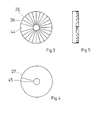
- the toothing 39 of the control disk 26 is interrupted at one point by a tooth gap 44 and the control fork 37 is provided with only one tooth 45.
- the drive disc 35 is provided on its toothless side with an annular channel 46 which is permanently connected to the vacuum source via a channel 48 provided in the flat surface 47.
- the drive fork 31 and the control fork 37 are pressed against the toothings 34, 39 by springs 49, 50.
- control rooms 23, 24, 25 of the control disk 26, relative to the control channels 21, 22, is shown in FIG. 6 in the stimulation phase and FIG. 7 in the milking phase.
- the tooth 45 of the control fork 37 is in the tooth gap 44 of the control disk 26, which is now not rotated further despite the oscillating movement of the control fork 37.
- the channel 21 is connected to the control chamber 24 and the channel 22 to the control chamber 23.
- the shut-off device 19 in the bypass line 17 is thereby ventilated and closes the bypass line 17 by means of a spring-loaded membrane 51, as a result of which the damping chambers 8, 9 are connected to one another only via the throttle point 10, which represents a high resistance.
- the pulsator now works with a cycle number that is usual for the milking process.
- the membrane 52 in the shut-off device 20 in the bypass line 18 is under negative pressure on both sides and the shut-off device 20 is thereby opened.
- the start lever 40 To trigger the stimulation phase, the start lever 40 must be moved as far as the stop 43, as a result of which the control disk 26 is moved one tooth pitch in its direction of rotation and the tooth 45 of the control fork with the toothing 39 comes into engagement.
- the control disk 26 now has the position shown in FIG. 6, as a result of which vacuum is applied to the diaphragm 51 of the shut-off element 19 via control channel 21 and thereby opens, while via control channel 22 the diaphragm 52 of the shut-off element 20 is ventilated on one side and thereby closes.
- the two damping chambers 8, 9 are connected to one another over a large cross-section, which leads to a multiplication of the number of cycles, while the supply of the lines 13, 14 with negative pressure is only via the throttle point 15 takes place so that only a reduced vacuum can build up in the pulse chambers of the teat cup.
- the drive fork 31 With each reciprocating movement of the rod 1, the drive fork 31 is also deflected about the pivot point 33 in both directions of rotation via the driver 30.
- Via the toothing 34 which is form-fitting only in one direction of rotation, it transmits its movement only in one direction of rotation, while it is offset in the opposite direction by one tooth pitch with respect to the drive disk 35.
- the control fork With a full rotation of the drive disk 35, the control fork also carries out a full oscillating movement via the driver 36 and transmits this in the same way as the drive fork 31 to the control disk 26.
- the rotary movement of the control disk 26 is ended as soon as it has completed a full rotation and the tooth 45 of the control fork 37 is again in the tooth gap 44 of the control disk 26 and thus again in the starting position described above.
- the duration of the stimulation phase depends on the number of pulsator cycles during the stimulation phase and on the gear ratio selected.
- the pulsator cycle number can be determined by the choice of the cross section of the bypass line 17. If the pulsator cycle number during the stimulation phase is, for example, 300 min-1 and the gear ratio is 1: 300, the stimulation phase lasts 60 seconds.
Landscapes
- Life Sciences & Earth Sciences (AREA)
- Animal Husbandry (AREA)
- Environmental Sciences (AREA)
- External Artificial Organs (AREA)
- Soil Working Implements (AREA)
- Dairy Products (AREA)
- Transmission Devices (AREA)
- Actuator (AREA)
- Reciprocating Pumps (AREA)
- Percussion Or Vibration Massage (AREA)
- Massaging Devices (AREA)
- Dynamo-Electric Clutches, Dynamo-Electric Brakes (AREA)
- Saccharide Compounds (AREA)
- Disintegrating Or Milling (AREA)
- Medicines Containing Plant Substances (AREA)
- Push-Button Switches (AREA)
- Electrophonic Musical Instruments (AREA)
- Multiple-Way Valves (AREA)
Abstract
Description
Die Erfindung bezieht sich auf einen Pulsator für Melkmaschinen mit zwei durch eine Stange miteinander verbundenen Membranen, die jeweils eine Druckdose in einen Arbeitsraum und einen Dämpfungsraum unterteilen, von denen die Dämpfungsräume über einen mit der Drosselstelle versehenen Verbindungskanal miteinander verbunden sind, während die Arbeitsräume wechselweise mit einer Unterdruckquelle bzw. der Atmosphäre verbindbar sind, und mit einer mit der Stange verbundenen Umsteuervorrichtung zum wechselweisen Verbinden von zu den Pulsräumen von Melkbechern führenden Leitungen mit der Atmosphäre oder einer zu der Unterdruckquelle führenden, mit einer Drosselstelle versehenen Hauptleitung, wobei die Drosselstellen im Verbindungskanal und in der Hauptleitung durch Bypassleitungen überbrückt sind, die mit Absperrorganen versehen sind, die über Steuerkanäle mittels Unterdruck betätigbar sind.The invention relates to a pulsator for milking machines with two membranes connected by a rod, each of which divides a pressure can into a working space and a damping space, of which the damping spaces are connected to one another via a connecting channel provided with the throttle point, while the working spaces alternately a vacuum source or the atmosphere can be connected, and with a reversing device connected to the rod for alternately connecting lines leading to the pulse spaces of teat cups with the atmosphere or a main line leading to the vacuum source and provided with a throttle point, the throttle points in the connecting channel and are bypassed in the main line by bypass lines which are provided with shut-off elements which can be actuated by means of negative pressure via control channels.
Ein derartiger Pulsator ist beispielsweise bekannt aus der EP-A 0032752 und dient dazu, während einer dem eigentlichen Melkvorgang vorgeschalteten Stimulationsphase die Pulsräume der Melkbecher mit einer wesentlich erhöhten Pulsatortaktzahl bei gleichzeitiger Erniedrigung der in den Pulsräumen wirksam werdenden Druckdifferenzen zu beaufschlagen. Die gewünschte Zeitdauer der Stimulationsphase wird dabei an einer Zeituhr eingestellt, nach deren Ablauf die Betätigung der in den Steuerleitungen angeordneten Absperrorganen erfolgt. Als Absperrorgane werden Quetschvorrichtungen benutzt, die die zumindest teilweise als elastische Schläuche ausgeführten Steuerkanäle zusammendrücken und damit verschließen. Derartige Schläuche, die mechanisch beansprucht werden, können jedoch sehr leicht beschädigt werden und führen dann zum Ausfall des Pulsators.Such a pulsator is known, for example, from EP-A 0032752 and is used during a stimulation phase preceding the actual milking process to apply a significantly increased number of pulsator cycles to the pulse chambers of the teat cups while simultaneously reducing the pressure differences that become effective in the pulse chambers. The desired duration of the stimulation phase is set on a timer, after which the shut-off elements arranged in the control lines are actuated. Squeezing devices are used as shut-off devices, which compress and thus close the control channels, which are at least partially designed as elastic hoses. Such hoses that are mechanically stressed, however, can be easily damaged and then lead to failure of the pulsator.
Auch die Zeituhr als Steuerelement ist mit ihrer notwendigerweise vorhandenen Feinmechanik empfindlich gegenüber den in Melkräumen üblicherweise herrschenden Bedingungen und kann daher zu Störungen führen.Even the timer as a control element, with its necessarily existing precision mechanics, is sensitive to the conditions usually prevailing in milking rooms and can therefore lead to faults.
Der Erfindung liegt die Aufgabe zugrunde, den bekannten Pulsator so zu verbessern, daß auf anfällige Schläuche und Zeituhren verzichtet werden kann und die Dauer der Stimulationsphase zeitunabhängig eingestellt werden kann.The invention has for its object to improve the known pulsator so that there is no need for susceptible hoses and time clocks and the duration of the stimulation phase can be set independently of time.
Diese Aufgabe wird dadurch gelöst, daß die Steuerkanäle mit jeweils einer der Steuerkammern einer Steuerscheibe in Verbindung stehen, von denen eine Steuerkammer dauernd mit der Unterdruckquelle verbunden ist und die übrigen Steuerkammern unter atmosphärischem Druck stehen, wobei die Steuerscheibe über ein Getriebe, das von der sich hin- und herbewegenden Stange angetrieben wird, rotierbar ist und dadurch die Steuerkanäle abwechselnd mit der unter Unterdruck stehenden Steuerkammer oder einer der unter atmosphärischem Druck stehenden Steuerkammern verbunden sind. Die Länge der Stimulationsphase wird dabei bestimmt von der Pulsatortaktzahl und den damit verbundenen Richtungswechseln der mit den Membranen verbundenen Stange, sowie von der Übersetzung des von der Stange angetriebenen Getriebes und der Ausbildung der vom Getriebe rotierbaren Steuerscheibe.This object is achieved in that the control channels are each connected to one of the control chambers of a control disc, of which one control chamber is permanently connected to the negative pressure source and the other control chambers are under atmospheric pressure, the control disc via a transmission which is different from the reciprocating rod is driven, is rotatable and thereby the control channels are alternately connected to the negative pressure control chamber or one of the control chambers under atmospheric pressure. The length of the stimulation phase is determined by the number of pulsator cycles and the associated changes in direction of the rod connected to the membranes, as well as by the translation of the gear driven by the rod and the design of the control disk rotatable by the gear.
In einer bevorzugten Ausführungsform ist das Getriebe mit einer um einen Drehpunkt schwenkbaren Antriebsgabel versehen, die mit einem an der Stange befestigten Mitnehmer in Verbindung steht und in ihrem Drehpunkt über eine plane, nur in einer Drehrichtung formschlüssige Verzahnung mit einer Antriebsscheibe verbunden ist, die über einen an ihr exzentrisch angeordneten Mitnehmer mit einer Steuergabel in Verbindung steht, die in ihrem Drehpunkt über eine plane, nur in einer Drehrichtung formschlüssige Verzahnung mit der Steuerscheibe verbunden ist, wobei die Verzahnung der Steuerscheibe an mindestens einer Stelle durch eine Zahnlücke unterbrochen ist und die Steuergabel mindestens einen Zahn besitzt.In a preferred embodiment, the transmission is provided with a drive fork which can be pivoted about a fulcrum, which is connected to a driver fastened to the rod and at its fulcrum via a flat toothing which is only positive in one direction of rotation and is connected to a drive pulley which is connected via a at its eccentrically arranged driver is connected to a control fork, which is connected at its pivot point to the control disk via a flat toothing that is only positive in one direction of rotation, the toothing of the control disk being interrupted by a tooth gap at least at one point and the control fork at least has a tooth.
Die pendelnde Bewegung der Antriebsgabel wird dabei über die Verzahnung als Drehbewegung nur in einer Richtung auf die Antriebsscheibe übertragen, die sich bei jedem vollständigen Pulsatortakt um eine Zahnteilung weiterbewegt. Eine volle Umdrehung der Antriebsscheibe bewirkt dabei auf gleiche Weise die Drehung der Steuerscheibe um eine Zahnteilung. Sobald jedoch der Zahn der Steuergabel in die Zahnlücke der Steuerscheibe greift, wird die Steuerscheibe trotz fortlaufender Schwingbewegung der Steuergabel nicht mehr weiterbewegt.The oscillating movement of the drive fork is transmitted via the toothing as a rotary movement only in one direction to the drive pulley, which moves one tooth pitch with each complete pulsator cycle. A full rotation of the drive pulley causes the control pulley to rotate by one tooth pitch in the same way. However, as soon as the tooth of the control fork engages in the tooth gap of the control disc, the control disc is no longer moved despite the continuous oscillating movement of the control fork.
Eine Drehung der Antriebsscheibe durch Reibkräfte in der Verzahnung beim Rückenschwingen der Steuergabel gegen den gewünschten Drehsinn kann beispielsweise dadurch verhindert werden, daß die Antriebsscheibe auf ihrer nichtverzahnten Seite mit einem Ringkanal versehen ist und mit dieser Seite auf einer im Pulsator vorgesehenen Planfläche angeordnet ist und in der Planfläche ein Kanal vorgesehen ist, der mit der Unterdruckquelle in Verbindung steht und in den Ringkanal mündet. Durch den Unterdruck wird die Antriebsscheibe gegen die Planfläche gepreßt und die dadurch erzeugte Reibung verhindert ein Zurückdrehen der Antriebsscheibe.A rotation of the drive disk by frictional forces in the toothing when the control fork swings back against the desired direction of rotation can be prevented, for example, by the drive disk being provided with an annular channel on its non-toothed side and being arranged with this side on a flat surface provided in the pulsator and in the Flat surface is provided a channel that is connected to the vacuum source and opens into the ring channel. Due to the negative pressure, the drive pulley is pressed against the flat surface and the friction generated thereby prevents the drive pulley from turning back.
Die Verbindung der Steuerkanäle mit den Steuerkammern der Steuerscheibe läßt sich einfach und effektiv dadurch herstellen, daß die Steuerkammern auf der nichtverzahnten Seite der Steuerscheibe vorgesehen sind, die Steuerscheibe mit einer Seite auf der Planfläche angeordnet ist, in der die Steuerkanäle und ein zur Unterdruckquelle führender Kanal so angeordnet sind, daß eine Steuerkammer dauernd mit der Unterdruckquelle verbunden ist und die Steuerkanäle je nach Stellung der Steuerscheibe mit dieser Steuerkammer oder einer der anderen Steuerkammern verbunden sind. Die Verbindung ist spielfrei, verschleißarm und selbstnachstellend und verhindert gleichzeitig ein Zurückdrehen der Steuerscheibe durch die schwingende Steuergabel aufgrund des anliegenden Unterdruckes.The connection of the control channels with the control chambers of the control disk can be established simply and effectively in that the control chambers are provided on the non-toothed side of the control disk, the control disk is arranged with one side on the plane surface in which the control channels and a channel leading to the vacuum source are arranged so that a control chamber is permanently connected to the vacuum source and the control channels are connected to this control chamber or one of the other control chambers, depending on the position of the control disk. The connection is free of play, low wear and self-adjusting and at the same time prevents the control disc from turning back due to the oscillating control fork due to the negative pressure present.
Eine sichere Mitnahme von Antriebsscheibe und Steuerscheibe über die Verzahnung in der gewünschten Drehrichtung kann dadurch erzielt werden, daß die Antriebsgabel und die Steuergabel jeweils durch Federn gegen die Antriebsscheibe bzw. Steuerscheibe gepreßt werden.Secure driving of the drive disk and control disk via the toothing in the desired direction of rotation can be achieved in that the drive fork and the control fork are each pressed against the drive disk or control disk by springs.
Da der Zahn der Steuergabel nach Beendigung des Melkvorganges in der Zahnlücke der Steuerscheibe steht, muß zur Durchführung einer erneuten Stimulation die Steuerscheibe um eine Zahnteilung in Drehrichtung weiterbewegt werden. Dies kann dadurch ermöglicht werden, daß an der Steuerscheibe ein Starthebel vorgesehen ist, der über eine nur in einer Drehrichtung formschlüssige Verzahnung mit der Steuerscheibe verbunden ist, wobei der Starthebel durch ein federndes Element in einer Ausgangsposition gehalten wird und ein Anschlag den Betätigungsweg des Starthebels begrenzt.Since the tooth of the control fork is in the tooth gap of the control disk after the milking process has ended, the control disk must be moved one tooth pitch in the direction of rotation in order to carry out renewed stimulation. This can be made possible by the fact that a starting lever is provided on the control disc, which is connected to the control disc via a toothing that is only positive in one direction of rotation, the starting lever being held in a starting position by a resilient element and a stop limiting the actuation path of the starting lever .
Ein Ausführungsbeispiel der Erfindung ist in der Zeichnung dargestellt und wird nachstehend näher erläutert. Es zeigt:
- Fig. 1 schematisch den Aufbau des Pulsators
- Fig. 2 einen Querschnitt A-A durch das Getriebe gemäß Fig. 1
- Fig. 3 eine Ansicht der Verzahnung der Steuerscheibe
- Fig. 4 eine Ansicht der Verzahnung der Steuergabel
- Fig. 5 die Verzahnung von Steuerscheibe und Starthebel in der Seitenansicht
- Fig. 6 eine Ansicht der Steuerräume der Steuerscheibe in der Stellung «Stimulation» (Schnitt B-B)
- Fig. 7 Die Stellung der Steuerscheibe gemäß Fig. beim Milchentzug (Schnitt B-B).
- Fig. 1 shows schematically the structure of the pulsator
- 2 shows a cross section AA through the transmission according to FIG. 1
- Fig. 3 is a view of the toothing of the control disc
- Fig. 4 is a view of the toothing of the control fork
- Fig. 5 shows the toothing of the control disc and start lever in a side view
- 6 is a view of the control rooms of the control disc in the “stimulation” position (section BB)
- Fig. 7 The position of the control disc according to Fig. With milk withdrawal (section BB).
In der Fig. 1 ist mit 1 die Stange bezeichnet, die mit den beiden Membranen 2, 3 in den Druckdosen 4, 5 verbunden ist. Die Druckdosen 4, 5 werden durch die Membranen 2, 3 in je einen Arbeitsraum 6, 7 und je einen Dämpfungsraum 8, 9 unterteilt. Die Arbeitsräume 6, 7 werden durch eine nicht dargestellte Steuervorrichtung abwechselnd mit Unterdruck beaufschlagt. Die Dämpfungsräume stehen über einen mit einer Drosselstelle 10 versehenen Verbindungskanal 11 miteinander in Verbindung. An der Stange 1 ist eine Umsteuervorrichtung 12 vorgesehen, die die zu den Pulsräumen von Melkbechern führenden Leitungen 13, 14 mit der Atmosphäre oder einer zu der Unterdruckquelle führenden, mit einer Drosselstelle 15 versehenen Hauptleitung 16 verbindet. Sowohl die Drosselstelle 10 als auch die Drosselstelle 15 sind durch Bypassleitungen 17, 18 überbrückt, in denen Absperrorgane 19, 20 vorgesehen sind, die über Steuerkanäle 21, 22 mittels Unterdruck betätigbar sind. Die Steuerkanäle 21,22 stehen jeweils mit einer der Steuerkammern 23, 24, 25 der Steuerscheibe 26 in Verbindung, von denen die Steuerkammer 23 dauernd über einen Kanal 27 mit der Unterdruckquelle verbunden ist, während die übrigen Steuerkammern 24, 25 über Kanäle 28, 29 mit der Atmosphäre verbunden sind. An der Stange 1 ist ein Mitnehmer 30 vorgesehen, der mit der Antriebsgabel 31 eines Getriebes 32 in Verbindung steht. Die Antriebsgabel 31 ist in ihrem Drehpunkt 33 über eine aus den Fig. 2 bis 5 ersichtliche Verzahnung 34 mit der Antriebsscheibe 35 verbunden. Ein an der Antriebsscheibe 35 exzentrisch angeordneter Mitnehmer 36 steht mit der Steuergabel 37 in Verbindung, die in ihrem Drehpunkt 38. über eine Verzahnung 39 mit der Steuerscheibe 26 verbunden ist. Die Steuergabel 37 ist in ihrem Drehpunkt 38 von einem Starthebel 40 umgeben, der über die Verzahnung 41 mit der Steuerscheibe 26 verbunden ist. Der Starthebel 40 wird durch ein federndes Element 42 in einer Ausgangsposition gehalten und sein Betätigungsweg wird durch einen Anschlag 43 begrenzt. Die Verzahnung 39 der Steuerscheibe 26 ist an einer Stelle durch eine Zahnlücke 44 unterbrochen und die Steuergabel 37 ist nur mit einem Zahn 45 versehen. Die Antriebsscheibe 35 ist an ihrer unverzahnten Seite mit einem Ringkanal 46 versehen, der über einen in der Planfläche 47 vorgesehenen Kanal 48 dauernd mit der Unterdruckquelle verbunden ist. Die Antriebsgabel 31 und die Steuergabel 37 werden durch Federn 49, 50 gegen die Verzahnungen 34, 39 gedrückt.In Fig. 1, 1 denotes the rod which is connected to the two
Die Position der Steuerräume 23, 24, 25 der Steuerscheibe 26, bezogen auf die Steuerkanäle 21, 22, zeigt Fig.6 in der Stimulationsphase und Fig.7 in der Melkphase.The position of the
Vor dem Anrüsten des Melkzeuges befindet sich der Zahn 45 der Steuergabel 37 in der Zahnlücke 44 der Steuerscheibe 26, die jetzt trotz der Schwingbewegung der Steuergabel 37 nicht weitergedreht wird. In dieser Stellung ist gemäß Fig. 7 der Kanal 21 mit der Steuerkammer 24 und der Kanal 22 mit der Steuerkammer 23 verbunden. Die Absperrvorrichtung 19 in der Bypassleitung 17 ist dadurch belüftet und verschließt die Bypassleitung 17 mittels einer federbelastenden Membran 51, wodurch die Dämpfungskammern 8, 9 nur über die Drosselstelle 10 miteinander verbunden sind, die einen großen Widerstand darstellt. Der Pulsator arbeitet jetzt mit einer für den Melkvorgang üblichen Taktzahl. Die Membran 52 im Absperrorgan 20 in der Bypassleitung 18 steht beidseitig unter Unterdruck und das Absperrorgan 20 ist dadurch geöffnet. In den zu den Pulsräumen der Melkbecher führenden Leitungen 13, 14 kann sich damit der volle Unterdruck aufbauen. Zur Auslösung der Stimulationsphase muß der Starthebel 40 bis zum Anschlag 43 bewegt werden, wodurch die Steuerscheibe 26 um eine Zahnteilung in ihre Drehrichtung weiterbewegt wird und der Zahn 45 der Steuergabel mit der Verzahnung 39 zum Eingriff kommt. Die Steuerscheibe 26 hat jetzt die in Fig.6 gezeigte Stellung, wodurch über Steuerkanal 21 die Membran 51 des Absperrorgans 19 mit Unterdruck beaufschlagt wird und dadurch öffnet, während über Steuerkanal 22 die Membran 52 des Absperrorgans 20 einseitig belüftet ist und dadurch schließt. Jetzt stehen die beiden Dämpfungskammern 8, 9 über einen großen Querschnitt miteinander in Verbindung, was zu einer Vervielfachung der Taktzahl führt, während die Versorgung der Leitungen 13, 14 mit Unterdruck nur noch über die Drosselstelle 15 erfolgt, so daß sich in den Pulsräumen der Melkbecher nur ein verringerter Unterdruck aufbauen kann. Mit jeder Hin- und Herbewegung der Stange 1 wird auch die Antriebsgabel 31 über den Mitnehmer 30 um den Drehpunkt 33 in beide Drehrichtungen ausgelenkt. Über die nur in einer Drehrichtung formschlüssige Verzahnung 34 gibt sie ihre Bewegung nur in eine Drehrichtung weiter, während sie in der Gegenrichtung um eine Zahnteilung gegenüber der Antriebsscheibe 35 versetzt wird. Bei einer vollen Umdrehung der Antriebsscheibe 35 führt auch die Steuergabel über den Mitnehmer 36 eine volle Schwingbewegung aus und überträgt diese in gleicher Weise wie die Antriebsgabel 31 auf die Steuerscheibe 26. Die Drehbewegung der Steuerscheibe 26 wird beendet, sobald sie eine volle Umdrehung durchgeführt hat und sich der Zahn 45 der Steuergabel 37 wieder in der Zahnlücke 44 der Steuerscheibe 26 befindet und damit wieder in der oben beschriebenen Ausgangsposition. Die Dauer der Stimulationsphase ist abhängig von der Pulsatortaktzahl während der Stimulationsphase und von der gewählten Getriebeübersetzung. Die Pulsatortaktzahl kann durch die Wahl des Querschnitts der Bypassleitung 17 bestimmt werden. Beträgt die Pulsatortaktzahl während der Stimulationsphase beispielsweise 300 min-1 und die Getriebeübersetzung 1:300, so dauert die Stimulationsphase 60 Sekunden.Before the milking cluster is set up, the
-
1 Stange 27 Kanal1
rod 27 channel -
2 Membran 28 Kanal2
membrane 28 channel -
3 Membran 29 Kanal3
membrane 29 channel - 4 Druckdose 30 Mitnehmer4 pressure can 30 drivers
-
5 Druckdose 31 Antriebsgabel5
Pressure socket 31 drive fork -
6 Arbeitsraum 32 Getriebe6 working
area 32 gearbox -
7 Arbeitsraum 33 Drehpunkt7
Work area 33 pivot point -
8 Dämpfungsraum 34 Verzahnung8 damping
space 34 gearing -
9 Dämpfungsraum 35 Antriebsscheibe9 damping
chamber 35 drive pulley -
10 Drosselstelle 36 Mitnehmer10
throttling point 36 drivers -
11 Verbindungskanal 37 Steuergabel11 connecting
channel 37 control fork -
12 Umsteuervorrichtung 38 Drehpunkt12 reversing
device 38 fulcrum -
13 Leitung 39 Verzahnung13
Line 39 gearing -
14 Leitung 40 Starthebel14
Line 40 start lever -
15 Drosslstelle 41 Verzahnung15
Throttle point 41 toothing -
16 Hauptleitung 42 Federndes Element16
Main line 42 Spring element -
17 Bypassleitung 43 Anschlag17
Bypass line 43 Stop -
18 Bypassleitung 44 Zahnlücke18
bypass line 44 tooth gap -
19 Absperrorgan 45 Zahn19 shut-off
device 45 tooth -
20 Absperrorgan 46 Ringkanal20 shut-off
device 46 ring channel -
21 Steuerkanal 47 Planfläche21
control channel 47 flat surface -
22 Steuerkanal 48 Kanal22
control channel 48 channel -
23 Steuerkammer 49 Feder23
control chamber 49 spring -
24 Steuerkammer 50 Feder24
control chamber 50 spring -
25 Steuerkammer 51 Membran25
control chamber 51 membrane -
26 Steuerscheibe 52 Membran26
control disc 52 membrane
Claims (6)
Priority Applications (1)
| Application Number | Priority Date | Filing Date | Title |
|---|---|---|---|
| AT85115184T ATE49849T1 (en) | 1985-01-31 | 1985-11-29 | PULSATOR FOR MILKING MACHINES. |
Applications Claiming Priority (2)
| Application Number | Priority Date | Filing Date | Title |
|---|---|---|---|
| DE3503245A DE3503245C1 (en) | 1985-01-31 | 1985-01-31 | Pulsator for milking machines |
| DE3503245 | 1985-01-31 |
Publications (3)
| Publication Number | Publication Date |
|---|---|
| EP0189552A2 EP0189552A2 (en) | 1986-08-06 |
| EP0189552A3 EP0189552A3 (en) | 1988-01-20 |
| EP0189552B1 true EP0189552B1 (en) | 1990-01-31 |
Family
ID=6261287
Family Applications (1)
| Application Number | Title | Priority Date | Filing Date |
|---|---|---|---|
| EP85115184A Expired - Lifetime EP0189552B1 (en) | 1985-01-31 | 1985-11-29 | Pulsators for milking machines |
Country Status (15)
| Country | Link |
|---|---|
| US (1) | US4643132A (en) |
| EP (1) | EP0189552B1 (en) |
| JP (1) | JPS62122539A (en) |
| AT (1) | ATE49849T1 (en) |
| AU (1) | AU580125B2 (en) |
| BR (1) | BR8600343A (en) |
| CA (1) | CA1248903A (en) |
| DD (1) | DD241543A5 (en) |
| DE (1) | DE3503245C1 (en) |
| DK (1) | DK167087B1 (en) |
| ES (1) | ES8706014A1 (en) |
| FI (1) | FI79776C (en) |
| IL (1) | IL77592A (en) |
| NZ (1) | NZ214976A (en) |
| RU (1) | RU1793857C (en) |
Families Citing this family (3)
| Publication number | Priority date | Publication date | Assignee | Title |
|---|---|---|---|---|
| SE9702029D0 (en) * | 1997-05-29 | 1997-05-29 | Alfa Laval Agri Ab | pulsator |
| DE102005018335A1 (en) | 2005-04-20 | 2006-11-02 | Lactocorder Ag | Device for stimulating an udder during a milking process |
| RU2701323C1 (en) * | 2018-11-14 | 2019-09-25 | Евгений Дмитриевич Свияженинов | Multiplicative spool pulinter of the alternate milking unit |
Family Cites Families (8)
| Publication number | Priority date | Publication date | Assignee | Title |
|---|---|---|---|---|
| US2822823A (en) * | 1954-08-04 | 1958-02-11 | Mcneil Machine & Eng Co | Rotary disk valve with ratchet operating means |
| DE1750003A1 (en) * | 1968-03-20 | 1971-01-07 | Bizerba Werke Kraut Kg Wilh | Control spool |
| IT1104875B (en) * | 1978-09-20 | 1985-10-28 | Ligabue Interpuls Snc | PULSATOR APPARATUS FOR MILKING SYSTEMS |
| NL179781C (en) * | 1979-04-11 | Westfalia Separator Ag | ||
| SU827861A2 (en) * | 1979-06-07 | 1981-05-07 | Plotko Mikhail A | Small-feed hydraulic drive |
| DE2931265A1 (en) * | 1979-08-01 | 1981-02-19 | Fritz Happel | PULSATOR FOR MILKING MACHINES |
| DK152321C (en) * | 1980-01-21 | 1988-07-11 | Hoefelmayr Bio Melktech | PROCEDURE AND APPARATUS FOR MACHINE MILKING |
| US4298025A (en) * | 1980-05-05 | 1981-11-03 | Kinetico, Inc. | Control valve for water softeners |
-
1985
- 1985-01-31 DE DE3503245A patent/DE3503245C1/en not_active Expired
- 1985-11-29 EP EP85115184A patent/EP0189552B1/en not_active Expired - Lifetime
- 1985-11-29 AT AT85115184T patent/ATE49849T1/en not_active IP Right Cessation
-
1986
- 1986-01-02 AU AU51826/86A patent/AU580125B2/en not_active Ceased
- 1986-01-06 DK DK004886A patent/DK167087B1/en active
- 1986-01-14 IL IL77592A patent/IL77592A/en unknown
- 1986-01-17 US US06/820,755 patent/US4643132A/en not_active Expired - Lifetime
- 1986-01-21 CA CA000500033A patent/CA1248903A/en not_active Expired
- 1986-01-22 RU SU864011816A patent/RU1793857C/en active
- 1986-01-28 FI FI860408A patent/FI79776C/en not_active IP Right Cessation
- 1986-01-29 BR BR8600343A patent/BR8600343A/en not_active IP Right Cessation
- 1986-01-29 DD DD86286587A patent/DD241543A5/en not_active IP Right Cessation
- 1986-01-29 NZ NZ214976A patent/NZ214976A/en unknown
- 1986-01-30 JP JP61016981A patent/JPS62122539A/en active Granted
- 1986-01-31 ES ES551533A patent/ES8706014A1/en not_active Expired
Also Published As
| Publication number | Publication date |
|---|---|
| JPS62122539A (en) | 1987-06-03 |
| DD241543A5 (en) | 1986-12-17 |
| ATE49849T1 (en) | 1990-02-15 |
| IL77592A (en) | 1990-04-29 |
| CA1248903A (en) | 1989-01-17 |
| ES551533A0 (en) | 1987-05-16 |
| AU5182686A (en) | 1986-08-07 |
| JPS639809B2 (en) | 1988-03-02 |
| EP0189552A3 (en) | 1988-01-20 |
| RU1793857C (en) | 1993-02-07 |
| BR8600343A (en) | 1986-10-14 |
| FI860408A7 (en) | 1986-08-01 |
| AU580125B2 (en) | 1989-01-05 |
| FI79776C (en) | 1990-03-12 |
| NZ214976A (en) | 1988-02-29 |
| DK4886A (en) | 1986-08-01 |
| FI79776B (en) | 1989-11-30 |
| ES8706014A1 (en) | 1987-05-16 |
| DK4886D0 (en) | 1986-01-06 |
| EP0189552A2 (en) | 1986-08-06 |
| FI860408A0 (en) | 1986-01-28 |
| US4643132A (en) | 1987-02-17 |
| DK167087B1 (en) | 1993-08-30 |
| DE3503245C1 (en) | 1986-02-13 |
Similar Documents
| Publication | Publication Date | Title |
|---|---|---|
| DE2102441B2 (en) | Timing element for binary pneumatic signals | |
| DE3503245C1 (en) | Pulsator for milking machines | |
| DE2140972C3 (en) | Indirectly controllable servo valve | |
| DE1917368B2 (en) | Auxiliary power switching device working with compressed air for synchronized gearboxes in motor vehicles | |
| DE2146934B2 (en) | Electromechanical lifting device | |
| DE2242086A1 (en) | A DEVICE FOR A PRINTER | |
| DE2753638B2 (en) | Device for dividing a warp with crosshairs | |
| DE675501C (en) | Pressure medium switching device for gear change transmissions, especially of motor vehicles | |
| DE3009418C2 (en) | Device for generating a periodically swelling rotational movement of a component | |
| DE2631705A1 (en) | CONTROL DEVICE FOR A LINEAR SLIDING ELEMENT | |
| DE3340580C2 (en) | ||
| DE3208226C2 (en) | ||
| DE2042826B2 (en) | STEPPING DEVICE | |
| DE612518C (en) | Spindle drive with detachable connection between spindle and handwheel for valves, slides or the like. | |
| DE2703893C3 (en) | Time control device for pneumatic signals | |
| DE3639501C2 (en) | ||
| DE552492C (en) | Combined brake and clutch transmission | |
| DE1010794B (en) | Hydraulic drive device to achieve simultaneous movements around two mutually perpendicular axes | |
| DE584030C (en) | Control for mechanically driven clamping devices on automatic feeders | |
| DE3130291C2 (en) | Indexing gear | |
| DE854898C (en) | Rotary slide valve for pressure medium door actuation devices, especially for motor vehicles | |
| DE1472402C3 (en) | Coupling device for setting devices for tuning and display devices in radio receivers for AM and FM reception, which can be optionally connected to a common operating handle | |
| DE511371C (en) | Control of the hydraulic drive on machine tools, especially grinding machines | |
| DE500141C (en) | Rock drilling machine | |
| DE3035990C2 (en) |
Legal Events
| Date | Code | Title | Description |
|---|---|---|---|
| PUAI | Public reference made under article 153(3) epc to a published international application that has entered the european phase |
Free format text: ORIGINAL CODE: 0009012 |
|
| 17P | Request for examination filed |
Effective date: 19851212 |
|
| AK | Designated contracting states |
Kind code of ref document: A2 Designated state(s): AT BE CH FR GB IT LI NL SE |
|
| PUAL | Search report despatched |
Free format text: ORIGINAL CODE: 0009013 |
|
| AK | Designated contracting states |
Kind code of ref document: A3 Designated state(s): AT BE CH FR GB IT LI NL SE |
|
| 17Q | First examination report despatched |
Effective date: 19890510 |
|
| GRAA | (expected) grant |
Free format text: ORIGINAL CODE: 0009210 |
|
| AK | Designated contracting states |
Kind code of ref document: B1 Designated state(s): AT BE CH FR GB IT LI NL SE |
|
| REF | Corresponds to: |
Ref document number: 49849 Country of ref document: AT Date of ref document: 19900215 Kind code of ref document: T |
|
| GBT | Gb: translation of ep patent filed (gb section 77(6)(a)/1977) | ||
| ITF | It: translation for a ep patent filed | ||
| ET | Fr: translation filed | ||
| PLBE | No opposition filed within time limit |
Free format text: ORIGINAL CODE: 0009261 |
|
| STAA | Information on the status of an ep patent application or granted ep patent |
Free format text: STATUS: NO OPPOSITION FILED WITHIN TIME LIMIT |
|
| 26N | No opposition filed | ||
| ITTA | It: last paid annual fee | ||
| EAL | Se: european patent in force in sweden |
Ref document number: 85115184.5 |
|
| PGFP | Annual fee paid to national office [announced via postgrant information from national office to epo] |
Ref country code: GB Payment date: 19981026 Year of fee payment: 14 |
|
| PGFP | Annual fee paid to national office [announced via postgrant information from national office to epo] |
Ref country code: AT Payment date: 19981028 Year of fee payment: 14 |
|
| PGFP | Annual fee paid to national office [announced via postgrant information from national office to epo] |
Ref country code: FR Payment date: 19981117 Year of fee payment: 14 |
|
| PGFP | Annual fee paid to national office [announced via postgrant information from national office to epo] |
Ref country code: SE Payment date: 19981120 Year of fee payment: 14 Ref country code: BE Payment date: 19981120 Year of fee payment: 14 |
|
| PGFP | Annual fee paid to national office [announced via postgrant information from national office to epo] |
Ref country code: NL Payment date: 19981126 Year of fee payment: 14 |
|
| PGFP | Annual fee paid to national office [announced via postgrant information from national office to epo] |
Ref country code: CH Payment date: 19981207 Year of fee payment: 14 |
|
| PG25 | Lapsed in a contracting state [announced via postgrant information from national office to epo] |
Ref country code: GB Free format text: LAPSE BECAUSE OF NON-PAYMENT OF DUE FEES Effective date: 19991129 Ref country code: AT Free format text: LAPSE BECAUSE OF NON-PAYMENT OF DUE FEES Effective date: 19991129 |
|
| PG25 | Lapsed in a contracting state [announced via postgrant information from national office to epo] |
Ref country code: SE Free format text: LAPSE BECAUSE OF NON-PAYMENT OF DUE FEES Effective date: 19991130 Ref country code: LI Free format text: LAPSE BECAUSE OF NON-PAYMENT OF DUE FEES Effective date: 19991130 Ref country code: CH Free format text: LAPSE BECAUSE OF NON-PAYMENT OF DUE FEES Effective date: 19991130 Ref country code: BE Free format text: LAPSE BECAUSE OF NON-PAYMENT OF DUE FEES Effective date: 19991130 |
|
| BERE | Be: lapsed |
Owner name: WESTFALIA SEPARATOR A.G. Effective date: 19991130 |
|
| PG25 | Lapsed in a contracting state [announced via postgrant information from national office to epo] |
Ref country code: NL Free format text: LAPSE BECAUSE OF NON-PAYMENT OF DUE FEES Effective date: 20000601 |
|
| REG | Reference to a national code |
Ref country code: CH Ref legal event code: PL |
|
| EUG | Se: european patent has lapsed |
Ref document number: 85115184.5 |
|
| GBPC | Gb: european patent ceased through non-payment of renewal fee |
Effective date: 19991129 |
|
| PG25 | Lapsed in a contracting state [announced via postgrant information from national office to epo] |
Ref country code: FR Free format text: LAPSE BECAUSE OF NON-PAYMENT OF DUE FEES Effective date: 20000731 |
|
| NLV4 | Nl: lapsed or anulled due to non-payment of the annual fee |
Effective date: 20000601 |
|
| REG | Reference to a national code |
Ref country code: FR Ref legal event code: ST |