EP0188198B1 - Polyester film - Google Patents
Polyester film Download PDFInfo
- Publication number
- EP0188198B1 EP0188198B1 EP86100072A EP86100072A EP0188198B1 EP 0188198 B1 EP0188198 B1 EP 0188198B1 EP 86100072 A EP86100072 A EP 86100072A EP 86100072 A EP86100072 A EP 86100072A EP 0188198 B1 EP0188198 B1 EP 0188198B1
- Authority
- EP
- European Patent Office
- Prior art keywords
- film
- particles
- acid
- polyester
- crosslinked
- Prior art date
- Legal status (The legal status is an assumption and is not a legal conclusion. Google has not performed a legal analysis and makes no representation as to the accuracy of the status listed.)
- Expired - Lifetime
Links
Classifications
-
- C—CHEMISTRY; METALLURGY
- C08—ORGANIC MACROMOLECULAR COMPOUNDS; THEIR PREPARATION OR CHEMICAL WORKING-UP; COMPOSITIONS BASED THEREON
- C08J—WORKING-UP; GENERAL PROCESSES OF COMPOUNDING; AFTER-TREATMENT NOT COVERED BY SUBCLASSES C08B, C08C, C08F, C08G or C08H
- C08J5/00—Manufacture of articles or shaped materials containing macromolecular substances
- C08J5/18—Manufacture of films or sheets
-
- C—CHEMISTRY; METALLURGY
- C08—ORGANIC MACROMOLECULAR COMPOUNDS; THEIR PREPARATION OR CHEMICAL WORKING-UP; COMPOSITIONS BASED THEREON
- C08L—COMPOSITIONS OF MACROMOLECULAR COMPOUNDS
- C08L67/00—Compositions of polyesters obtained by reactions forming a carboxylic ester link in the main chain; Compositions of derivatives of such polymers
- C08L67/02—Polyesters derived from dicarboxylic acids and dihydroxy compounds
-
- C—CHEMISTRY; METALLURGY
- C08—ORGANIC MACROMOLECULAR COMPOUNDS; THEIR PREPARATION OR CHEMICAL WORKING-UP; COMPOSITIONS BASED THEREON
- C08J—WORKING-UP; GENERAL PROCESSES OF COMPOUNDING; AFTER-TREATMENT NOT COVERED BY SUBCLASSES C08B, C08C, C08F, C08G or C08H
- C08J2367/00—Characterised by the use of polyesters obtained by reactions forming a carboxylic ester link in the main chain; Derivatives of such polymers
- C08J2367/02—Polyesters derived from dicarboxylic acids and dihydroxy compounds
Definitions
- the present invention relates to a polyester film with improved dimensional stability, abrasion resistance, stretchability and improved sliding properties.
- Biaxial or multiaxially oriented films made of polyester, e.g. Polyethylene terephthalate, because of their superior properties such as their tensile strength, their tensile strength, their elastic modulus, their transparency, their chemical and thermal resistance in the packaging sector and various technical fields such as e.g. in the reprographic sector as dielectric for capacitors, as carrier foils for magnetic recording media such as used for video, audio and computer tapes, for magnetic cards and floppy disks and the like.
- polyester films must meet specific requirements for the various areas of application, which can be set via the raw material formulation or the process parameters during film production.
- polyester films for magnetic tapes must also have a uniform surface roughness as well as good abrasion resistance and dimensional stability.
- inorganic pigments during the stretching process easily leads to the formation of voids at the points at which the matrix breaks away from the pigment grain.
- parts of the polymer coating can then peel off in the area near the surface and, as a result of the abrasion caused thereby, the quality of the tapes in the coating and thus their electromagnetic properties deteriorate in an uncontrolled manner.
- US Pat. No. 4,320,207 describes organic particles in an amount of 0.001 to 4% by weight, which are produced by pulverizing crosslinked polymers and have an average diameter of 0.1 to 5 ⁇ m.
- EP-A-125 482 relates to a polyester raw material which contains 0.005 to 5.0% by weight of organic, crosslinked polymer particles with a narrow particle size distribution in the range from 0.02 to 2.0 ⁇ m.
- Films that contain cross-linked spherical particles with a narrow particle size distribution and functional groups for better integration in the matrix have a defined surface roughness and thus good electromagnetic properties. Since they still have good hatching and excellent transparency, they should be used as base films for packaging materials and technical applications such as photo films, magnetic tapes, etc. be ideally suited, especially since their mechanical properties can be set via the process parameters of the manufacturing process.
- EP-A-176 017 describes as prior art under Article 54 (3) EPC that the dimensional stability and the abrasion resistance of polyester films are improved by adding 0.01 to 10% by weight of nucleating agents. However, such films do not yet have optimal sliding properties.
- the present invention is therefore based on the object of providing a polyester film with a very uniform surface which has both good sliding properties and excellent abrasion resistance, improved dimensional stability and stretchability.
- a film of the type mentioned at the outset which contains 0.005 to 5.0% by weight of organic, preferably hardened or crosslinked, particles having a narrow particle size distribution of D w / D n ⁇ 1.1 in the range from 0.01 to 5.0 microns and a nucleating agent in an amount of 0.01 to 10 wt .-%, both data based on the weight of the film forming thermoplastic polymer.
- thermoplastic polyester materials are considered polyester homopolymers and copolymers, mixtures of different polyesters and blends or blends of polyesters with other polymers.
- the polyester can be produced by the transesterification process e.g. with the help of the catalytic effect of e.g. Zn, Ca, Mn, Li or Ge salts as well as the direct ester process.
- the catalytic effect e.g. Zn, Ca, Mn, Li or Ge salts as well as the direct ester process.
- polyesters are mono- or polycondensates of terephthalic acid or isophthalic acid, 2,6-naphthalenedicarboxylic acid with glycols having 2 to 10 carbon atoms such as polyethylene terephthalate, polytetramethylene terephthalate, polybutylene terephthalate, poly-1,4-cyclohexylene-dimethylene terephthalate, polyethylene-2,6-naphthalene or polyethylene-2,6-naphthalene or Polyethylene p-hydroxybenzoate.
- glycols having 2 to 10 carbon atoms such as polyethylene terephthalate, polytetramethylene terephthalate, polybutylene terephthalate, poly-1,4-cyclohexylene-dimethylene terephthalate, polyethylene-2,6-naphthalene or polyethylene-2,6-naphthalene or Polyethylene p-hydroxybenzoate.
- the copolyesters can also contain adipic acid, sebacic acid, phthalic acid, isophthalic acid, 5-Na sulfoisophthalate, polyfunctional components such as trimellitic acid, among others, as building blocks.
- the polyester mixtures can consist, for example, of polyethylene terephthalate and polybutylene terephthalate or polyethylene terephthalate and at least one alkali metal salt of a derivative of sulfonic acid, such as sulfosiophthalic acid.
- the hardened particles contained in the film can consist of, for example, melamine-formaldehyde resin, benzoguanamine-formaldehyde resin, phenol-formaldehyde resin or an epoxy resin.
- the cross-linked organic particles can be used as building blocks, among others.
- unsaturated nonionic monomers such as esters of acrylic and methacrylic acid such as methyl methacrylate and butyl acrylate, the esters of unsaturated dicarboxylic acids such as maleic acid dialkyl esters, unsaturated vinyl compounds such as styrene, unsaturated nitriles such as acrylonitrile, functional monomers such as unsaturated carboxylic acids, hydroxyl-containing monomers such as hydroxyethyl group methacrylate monomers such as hydroxyethyl methacrylate methacrylate Sulfonic acids and others contain.
- crosslinking components are diallyl phthalate, divinylbenzene and others.
- Components which carry functional groups and are polymerized into the particles for this purpose so that they can preferably form covalent bonds between polyester matrix and crosslinked particles in polyester synthesis are hydroxyethylene methacrylate, acrylic acid and methacrylic acid.
- the degree of hardening and crosslinking of the particles can be varied within wide limits by the composition, in particular the hardening and crosslinking component.
- the polymeric, preferably crosslinked or hardened, solid particles have a diameter in the range from 0.01 to 5 ⁇ m, preferably from 0.02 to 3.0 ⁇ m, with a narrow particle size distribution.
- the quotient of the weight average of the particle diameter (D w ) and the number average of the particle diameter (D n ) is ⁇ 1.1.
- D w and D n see UE Woods, JS Dodge, IM Krieger, P. Pierce, Journal of Paint Technology, Vol. 40, No. 527, p. 545 (1968).
- the film contains particles described above in an amount of 0.005 to 5% by weight, preferably 0.02 to 3% by weight, based on the weight of the film.
- nucleating agents e.g. Alkali or alkaline earth salts of ester waxes or partially saponified ester waxes, e.g. of montanic acid, ionic copolymers of ethylene and alkali metal salts of methacrylic acid, alkali metal salts of phenol sulfonic acids, alkali metal salts or alkaline earth metal salts of benzoates or stearates, sorbitol derivatives or inorganic nucleating agents.
- alkali or alkaline earth salts of ester waxes or partially saponified ester waxes e.g. of montanic acid, ionic copolymers of ethylene and alkali metal salts of methacrylic acid, alkali metal salts of phenol sulfonic acids, alkali metal salts or alkaline earth metal salts of benzoates or stearates, sorbitol derivatives or inorganic nucleating agents.
- Suitable inorganic nucleating agents are e.g. Alkaline earth carbonates and oxides such as titanium dioxide and aluminum oxide, talc and silicates, boron nitride etc.
- Suitable montan wax ester salts are obtained by partial esterification of the montanic acid with up to 0.90 equivalent, preferably 0.5 to 0.8 equivalent, divalent Alcohols with 2 to 4 carbons in the alkylene group and subsequent neutralization with oxides or hydroxides of the metals mentioned.
- Particularly suitable diols are, for example, ethylene glycol, 1,2- or 1,3-propanediol and 1,3- or 1,4-butanediol.
- films can be produced from polyester materials with the addition of hardened or crosslinked organic particles and nucleating agents, which have particularly good abrasion resistance and improved dimensional stability and stretchability with excellent transparency.
- the additions of nucleating agents which are preferably in the range from 0.1 to 5.0% by weight, based on the weight of the polyester, can be added to the polyester material during or after production.
- nucleating agents which are preferably in the range from 0.1 to 5.0% by weight, based on the weight of the polyester, can be added to the polyester material during or after production.
- the films of the present invention can also have means for optimizing the Slip and sliding properties such as inert inorganic particles, which may also be in colloidal form, catalyst residue particles, etc., as well as other conventional additives such as antioxidants, antistatic agents, thermal stabilizers, dyes, etc.
- the film according to the invention is produced by the extrusion process, the polyester material mixed with the nucleating agent being melted, extruded into a pre-film and quenched on a cooling roll.
- This film is then stretched in the longitudinal direction and / or in the transverse direction at temperatures between the glass point of the polymer and 160 ° C. and a stretching ratio, preferably in the range from 2.0 to 6.0, and then heat-set at temperatures between 150 and 240 ° C.
- the number and sequence of the longitudinal and transverse stretching stages is not fixed, but depends on the requirements.
- the individual stretching processes "lengthwise” and “crosswise” can be carried out in one or more stages. Simultaneous longitudinal and transverse stretching (simultaneous stretching) is also possible.
- the films resulting from the stretching process can only have strength in one direction (monoaxially stretched), have balanced mechanical properties in both directions (balanced films) or have special strengths in the transverse and / or longitudinal direction (tensilized or supertensilized films).
- the structure of the coextruded films can be both symmetrical and asymmetrical.
- Examples include copolyesters, polyurethanes, thermosetting acrylic acid derivatives, polysiloxanes, styrene-butadiene rubbers or substances which - as described above - can be incorporated into the polymer.
- the dispersions or solutions can contain organic additives such as Na montanate, fatty acid esters, silane or siloxane coupling reagents and inorganic additives such as colloidal SiO2, TiO2 particles to improve the properties of the applied layer.
- organic additives such as Na montanate, fatty acid esters, silane or siloxane coupling reagents and inorganic additives such as colloidal SiO2, TiO2 particles to improve the properties of the applied layer.
- the films according to the invention described in detail above are particularly suitable for use as a carrier film for magnetic recording materials, for reprographic and photographic purposes, as an electrical film or an embossing film.
- the film can equally well be used advantageously as packaging film or as part of a packaging film.
- a raw material which contains finely divided, crosslinked acrylate-based polymer particles which have been produced by emulsion polymerization and have a narrow particle size distribution. They were incorporated into the raw material via dispersions under defined conditions during the production of the polyester.
- the abrasion behavior of the foils was determined on a measuring device in which a 12.5 mm wide foil strip with a constant web tension (1 N) was first pulled out of a cassette over a rubber cleaning roller, then over a fixed deflection pin, and then over two serving as measuring rollers Rubber rollers and then rolled up. The loading of the rubber rolls with abraded material was assessed on a scale from 1 to 5, ie from "very good" to "poor”.
- Example 1 As in Example 1, a stepwise biaxially oriented film was produced without the addition of sodium montanate.
- Example 2 As in Example 2, a stepwise biaxially oriented film was produced without the addition of sodium montanate.
Landscapes
- Chemical & Material Sciences (AREA)
- Engineering & Computer Science (AREA)
- Manufacturing & Machinery (AREA)
- Medicinal Chemistry (AREA)
- Polymers & Plastics (AREA)
- Organic Chemistry (AREA)
- Health & Medical Sciences (AREA)
- Chemical Kinetics & Catalysis (AREA)
- Materials Engineering (AREA)
- Manufacture Of Macromolecular Shaped Articles (AREA)
- Compositions Of Macromolecular Compounds (AREA)
- Laminated Bodies (AREA)
- Polyesters Or Polycarbonates (AREA)
- Shaping By String And By Release Of Stress In Plastics And The Like (AREA)
Description
Die vorliegende Erfindung bezieht sich auf eine Polyesterfolie mit verbesserter Dimensionsstabilität, Abriebfestigkeit, Streckbarkeit und verbesserten Gleiteigenschaften.The present invention relates to a polyester film with improved dimensional stability, abrasion resistance, stretchability and improved sliding properties.
Biaxial oder multiaxial orientierte Folien aus Polyester, z.B. Polyethylenterephthalat, werden wegen ihrer überlegenen Eigenschaften wie ihrer Zugfestigkeit, ihrer Reißfestigkeit, ihres Elastizitätsmoduls, ihrer Transparenz, ihrer chemischen und thermischen Beständigkeit auf dem Verpackungssektor und verschiedenen technischen Gebieten wie z.B. dem reprografischen Sektor als Dielektrikum für Kondensatoren, als Trägerfolien für magnetische Aufzeichnungsmedien wie z.B. für Video-, Audio- und Computerbänder, für Magnetkarten sowie Floppy Disks und dergleichen eingesetzt.Biaxial or multiaxially oriented films made of polyester, e.g. Polyethylene terephthalate, because of their superior properties such as their tensile strength, their tensile strength, their elastic modulus, their transparency, their chemical and thermal resistance in the packaging sector and various technical fields such as e.g. in the reprographic sector as dielectric for capacitors, as carrier foils for magnetic recording media such as used for video, audio and computer tapes, for magnetic cards and floppy disks and the like.
Die Polyesterfolien müssen für die verschiedenen Einsatzgebiete spezifische Anforderungen erfüllen, die sich über die Rohstoffrezeptur oder die Verfahrensparameter während der Folienherstellung einstellen lassen.The polyester films must meet specific requirements for the various areas of application, which can be set via the raw material formulation or the process parameters during film production.
Eine der Voraussetzungen für eine einwandfreie Handhabung der Folien während der Produktion, der Verarbeitung und der Anwendung ist ein ausreichend niedriger Reibungskoeffizient der Folienoberfläche. Je rauher die Folienoberfläche ist, umso besser ist das Wickelverhalten und damit die Ausbeute in der Produktion.One of the prerequisites for proper handling of the films during production, processing and application is a sufficiently low coefficient of friction on the film surface. The rougher the film surface, the better the winding behavior and thus the yield in production.
Polyesterfolien für Magnetbänder müssen außer einem niedrigen Reibungskoeffizienten und guten mechanischen Eigenschaften noch eine gleichmäßige Oberflächenrauhigkeit sowie eine gute Abriebfestigkeit und Dimensionsstabilität aufweisen.In addition to a low coefficient of friction and good mechanical properties, polyester films for magnetic tapes must also have a uniform surface roughness as well as good abrasion resistance and dimensional stability.
Die Einstellung einer diesen Anforderungen genügenden Oberflächentopografie erfolgt bei Magnetbandträgerfolien durch
- Einarbeitung von vorzugsweise anorganischen Pigmenten wie Calciumcarbonat, Siliciumdioxid, Kaolin, Bariumsulfat, Titandioxid u.a.,
- eine gesteuerte Präzipitatfällung aus Katalysatorrückständen und Monomeren oder Oligomeren der eingesetzten Polyester (Erzeugung sogenannter innerer Teilchen).
- Incorporation of preferably inorganic pigments such as calcium carbonate, silicon dioxide, kaolin, barium sulfate, titanium dioxide and others,
- a controlled precipitation of precipitates from catalyst residues and monomers or oligomers of the polyesters used (generation of so-called inner particles).
Die Anwendung anorganischer Pigmente führt während des Streckprozesses leicht zur Ausbildung von Hohlräumen (voids) an den Stellen, an denen die Matrix vom Pigmentkorn abreißt. Bei der weiteren Verarbeitung der Folie wie z.B. beim Beschichten, d.h. dem Auftragen der Magnetdispersion, können sich dann im oberflächennahen Bereich Teile des Polymerüberzuges ablösen und, infolge des hierdurch bedingten Abriebs, die Qualität der Bänder bei der Beschichtung und damit ihre elektromagnetischen Eigenschaften unkontrolliert verschlechtern.The use of inorganic pigments during the stretching process easily leads to the formation of voids at the points at which the matrix breaks away from the pigment grain. When further processing the film such as when coating, i.e. application of the magnetic dispersion, parts of the polymer coating can then peel off in the area near the surface and, as a result of the abrasion caused thereby, the quality of the tapes in the coating and thus their electromagnetic properties deteriorate in an uncontrolled manner.
Die mehr oder weniger breite Korngrößenverteilung anorganischer Pigmente sowie die Neigung zur Bildung von Agglomeraten trotz aufwendiger Aufbereitungsverfahren wirken sich ebenfalls negativ auf die Folienqualität aus.The more or less broad grain size distribution of inorganic Pigments and the tendency to form agglomerates in spite of complex preparation processes also have a negative effect on the film quality.
Die Erzeugung sogenannter innerer Teilchen (Katalysatorpräzipitat) definierter Größe und Menge ist verfahrenstechnisch aufwendig.The production of so-called inner particles (catalyst precipitate) of a defined size and amount is technically complex.
Die US-A-4,320,207 beschreibt statt des Zusatzes anorganischer Partikel zu Polyesterfolien organische Teilchen in einer Menge von 0,001 bis 4 Gew.%, die durch Pulverisieren von vernetzten Polymeren erzeugt werden und einen mittleren Durchmesser von 0,1 bis 5 µm besitzen. Die EP-A-125 482 betrifft einen Polyesterrohstoff, der 0,005 bis 5,0 Gew.-% an organischen, vernetzten Polymerteilchen mit einer engen Korngrößenverteilung im Bereich von 0,02 bis 2,0 µm enthält. Folien, die vernetzte kugelförmige Partikel mit enger Korngrößenverteilung sowie funktionellen Gruppen zur besseren Einbindung in Matrix enthalten, weisen eine definierte Oberflächenrauhigkeit und damit gute elektromagnetische Eigenschaften auf. Da sie weiterhin einen guten Schlupf sowie eine exzellente Transparenz haben, sollten sie als Basisfilme für Verpackungsmaterialien sowie technische Anwendungen wie Fotofilme, Magnetbänder u.a. bestens geeignet sein, zumal sich ihre mechanischen Eigenschaften über die Verfahrensparameter des Herstellprozesses einstellen lassen.Instead of adding inorganic particles to polyester films, US Pat. No. 4,320,207 describes organic particles in an amount of 0.001 to 4% by weight, which are produced by pulverizing crosslinked polymers and have an average diameter of 0.1 to 5 μm. EP-A-125 482 relates to a polyester raw material which contains 0.005 to 5.0% by weight of organic, crosslinked polymer particles with a narrow particle size distribution in the range from 0.02 to 2.0 μm. Films that contain cross-linked spherical particles with a narrow particle size distribution and functional groups for better integration in the matrix have a defined surface roughness and thus good electromagnetic properties. Since they still have good hatching and excellent transparency, they should be used as base films for packaging materials and technical applications such as photo films, magnetic tapes, etc. be ideally suited, especially since their mechanical properties can be set via the process parameters of the manufacturing process.
In der Praxis hat sich jedoch gezeigt, daß die Folien ein unzureichendes Abriebverhalten sowie eine unbefriedigende Dimensionsstabilität aufweisen und damit für viele Anwendungen ungeeignet sind.In practice, however, it has been shown that the films have an inadequate abrasion behavior and an unsatisfactory one Have dimensional stability and are therefore unsuitable for many applications.
Die EP-A-176 017 beschreibt als Stand der Technik nach Artikel 54(3) EPÜ, daß die Dimensionsstabilität und die Abriebfestigkeit von Polyesterfolien durch Zusatz von 0,01 bis 10 Gew.-% an Nukleierungsmitteln verbessert werden. Derartige Folien weisen allerdings noch keine optimalen Gleiteigenschaften auf.EP-A-176 017 describes as prior art under Article 54 (3) EPC that the dimensional stability and the abrasion resistance of polyester films are improved by adding 0.01 to 10% by weight of nucleating agents. However, such films do not yet have optimal sliding properties.
Der vorliegenden Erfindung liegt daher die Aufgabe zugrunde, eine Polyesterfolie mit sehr gleichmäßiger Oberfläche zu schaffen, die sowohl gute Gleiteigenschaften als auch eine ausgezeichnete Abriebfestigkeit, eine verbesserte Dimensionsstabilität und Streckbarkeit aufweist.The present invention is therefore based on the object of providing a polyester film with a very uniform surface which has both good sliding properties and excellent abrasion resistance, improved dimensional stability and stretchability.
Gelöst wird diese Aufgabe durch eine Folie der eingangs genannten Gattung, die 0,005 bis 5,0 Gew.-% an organischen, vorzugsweise gehärteten oder vernetzten, Partikeln enger Korngrößenverteilung von Dw/Dn < 1,1 im Bereich von 0,01 bis 5,0 µm sowie ein Nukleierungsmittel in einer Menge von 0,01 bis 10 Gew.-%, beide Angaben bezogen auf das Gewicht des die Folie bildenden thermoplastischen Polymeren, enthält.This object is achieved by a film of the type mentioned at the outset, which contains 0.005 to 5.0% by weight of organic, preferably hardened or crosslinked, particles having a narrow particle size distribution of D w / D n <1.1 in the range from 0.01 to 5.0 microns and a nucleating agent in an amount of 0.01 to 10 wt .-%, both data based on the weight of the film forming thermoplastic polymer.
Als thermoplastische Polyestermaterialien werden im Rahmen der Erfindung Polyester-Homo- und Copolymere, Gemische verschiedener Polyester sowie Abmischungen oder Blends von Polyestern mit anderen Polymeren angesehen.Within the scope of the invention, thermoplastic polyester materials are considered polyester homopolymers and copolymers, mixtures of different polyesters and blends or blends of polyesters with other polymers.
Die Herstellung der Polyester kann sowohl nach dem Umesterungsverfahren z.B. mit Hilfe der katalytischen Wirkung von z.B. Zn-, Ca-, Mn-, Li- oder Ge-Salzen als auch nach dem Direktesterverfahren erfolgen.The polyester can be produced by the transesterification process e.g. with the help of the catalytic effect of e.g. Zn, Ca, Mn, Li or Ge salts as well as the direct ester process.
Beispiele für Polyester sind Mono- oder Polykondensate aus Terephthalsäure oder Isophthalsäure, 2,6-Naphthalindicarbonsäure mit Glykolen mit 2 bis 10 Kohlenstoffatomen wie Polyethylenterephthalat, Polytetramethylenterephthalat, Polybutylenterephthalat, Poly-1,4-cyclohexylen-dimethylenterepthalat, Polyethylen-2,6-naphthalindicarboxylat oder Polyethylen-p-hydroxybenzoat.Examples of polyesters are mono- or polycondensates of terephthalic acid or isophthalic acid, 2,6-naphthalenedicarboxylic acid with glycols having 2 to 10 carbon atoms such as polyethylene terephthalate, polytetramethylene terephthalate, polybutylene terephthalate, poly-1,4-cyclohexylene-dimethylene terephthalate, polyethylene-2,6-naphthalene or polyethylene-2,6-naphthalene or Polyethylene p-hydroxybenzoate.
Die Copolyester können als Bausteine auch Adipinsäure, Sebazinsäure, Phthalsäure, Isophthalsäure, 5-Na-sulfoisophthalat, polyfunktionelle Komponenten wie Trimellithsäure u.a. enthalten.
Die Polyestergemische können beispielsweise aus Polyethylenterephthalat und Polybutylenterephthalat oder Polyethylenterephthalat und wenigstens einem Alkalimetallsalz eines Derivats der Sulfonsäure, wie z.B. der Sulfosiophthalsäure, bestehen.The copolyesters can also contain adipic acid, sebacic acid, phthalic acid, isophthalic acid, 5-Na sulfoisophthalate, polyfunctional components such as trimellitic acid, among others, as building blocks.
The polyester mixtures can consist, for example, of polyethylene terephthalate and polybutylene terephthalate or polyethylene terephthalate and at least one alkali metal salt of a derivative of sulfonic acid, such as sulfosiophthalic acid.
Beispiele für Polymere, die in den Polyester eingearbeitet oder eingemischt werden können, sind Polyolefin-Homo- oder Copolymere wie Polyethylen, Polypropylen, Poly-4-methylpenten, Ethylen-Vinylacetat-Copolymere, die ihrerseits verseift sein können, Ionomere, Polyamide, Polycarbonate, Polytetrafluorethylen, Polysulfone u.a.Examples of polymers which can be incorporated or mixed into the polyester are polyolefin homo- or copolymers such as polyethylene, polypropylene, poly-4-methylpentene, ethylene-vinyl acetate copolymers, which in turn can be saponified, ionomers, polyamides, polycarbonates, Polytetrafluoroethylene, polysulfones and others
Die in der Folie enthaltenen gehärteten Teilchen können beispielsweise aus Melamin-Formaldehyd-Harz, Benzoguanamin-Formaldehyd-Harz, Phenol-Formaldehyd-Harz oder einem Epoxyharz bestehen.The hardened particles contained in the film can consist of, for example, melamine-formaldehyde resin, benzoguanamine-formaldehyde resin, phenol-formaldehyde resin or an epoxy resin.
Die vernetzten organischen Partikel können als Bausteine u.a. ungesättigte nichtionische Monomere wie Ester der Acryl- und Methacrylsäure wie Methylmethacrylat und Butylacrylat, die Ester von ungesättigten Dicarbonsäuren wie Maleinsäuredialkylester, ungesättigte Vinylverbindungen wie Styrol, ungesättigte Nitrile wie Acrylnitril, funktionelle Monomere wie ungesättigte Carbonsäuren, hydroxylhaltige Monomere wie Hydroxyethylmethacrylat, epoxidgruppenhaltige Monomere wie Glycidylmethacrylat, ungesättigte Sulfonsäuren u.a. enthalten.The cross-linked organic particles can be used as building blocks, among others. unsaturated nonionic monomers such as esters of acrylic and methacrylic acid such as methyl methacrylate and butyl acrylate, the esters of unsaturated dicarboxylic acids such as maleic acid dialkyl esters, unsaturated vinyl compounds such as styrene, unsaturated nitriles such as acrylonitrile, functional monomers such as unsaturated carboxylic acids, hydroxyl-containing monomers such as hydroxyethyl group methacrylate monomers such as hydroxyethyl methacrylate methacrylate Sulfonic acids and others contain.
Beispiele für vernetzende Komponenten sind Diallylphthalat, Divinylbenzol u.a.Examples of crosslinking components are diallyl phthalate, divinylbenzene and others.
Komponenten, die funktionelle Gruppen tragen und zu diesem Zweck in die Teilchen einpolymerisiert werden, daß sie bevorzugt in der Polyestersynthese kovalente Bindungen zwischen Polyestermatrix und vernetzten Teilchen ausbilden können, sind Hydroxyethylenmethacrylat, Acrylsäure und Methacrylsäure.Components which carry functional groups and are polymerized into the particles for this purpose so that they can preferably form covalent bonds between polyester matrix and crosslinked particles in polyester synthesis are hydroxyethylene methacrylate, acrylic acid and methacrylic acid.
Der Härtungs- und Vernetzungsgrad der Teilchen kann durch die Zusammensetzung, insbesondere der härtenden und vernetzenden Komponente in weiten Grenzen variiert werden.The degree of hardening and crosslinking of the particles can be varied within wide limits by the composition, in particular the hardening and crosslinking component.
Wesentlich ist, daß die organischen Partikel, die gehärtet oder vernetzt sein können, während der Polymersynthese nicht löslich und nicht schmelzbar sind und auch beim Aufschmelzen des Polymeren, insbesondere bei der Herstellung von Formkörpern wie Folien oder der Regenerierung von Abfällen, erhalten bleiben.It is essential that the organic particles that are hardened or can be crosslinked, are insoluble and not meltable during the polymer synthesis and are also retained when the polymer is melted, in particular when producing shaped articles such as films or the regeneration of waste.
Die Teilchen können mittels der bekannten Verfahren wie z.B. durch Emulsions- als auch Suspensionspolymerisation hergestellt werden. In die Polymermatrix können sie bei der Polymerherstellung in Form von wäßrigen oder glykolischen Dispersionen oder über ein Konzentrat eingearbeitet werden. Die Einarbeitung während der Polymersynthese führt zu einer besonders guten Einbindung in die Matrix sowie guten Verteilung in dem Polymeren selbst.The particles can be extracted using known methods such as e.g. be prepared by emulsion as well as suspension polymerization. They can be incorporated into the polymer matrix during polymer production in the form of aqueous or glycolic dispersions or via a concentrate. The incorporation during the polymer synthesis leads to a particularly good integration into the matrix and good distribution in the polymer itself.
Die polymeren, vorzugsweise vernetzten oder gehärteten Feststoffpartikel weisen einen Durchmesser im Bereich von 0,01 bis 5 µm, vorzugsweise von 0,02 bis 3,0 µm, bei enger Korngrößenverteilung auf. Der Quotient aus dem Gewichtsmittel des Teilchendurchmessers (Dw) und dem Zahlenmittel des Teilchendurchmessers (Dn) beträgt < 1,1. Zur Bestimmung von Dw und Dn siehe U.E. Woods, J.S. Dodge, I.M. Krieger, P. Pierce, Journal of Paint Technology, Vol. 40, No. 527, S. 545 (1968).The polymeric, preferably crosslinked or hardened, solid particles have a diameter in the range from 0.01 to 5 μm, preferably from 0.02 to 3.0 μm, with a narrow particle size distribution. The quotient of the weight average of the particle diameter (D w ) and the number average of the particle diameter (D n ) is <1.1. For the determination of D w and D n see UE Woods, JS Dodge, IM Krieger, P. Pierce, Journal of Paint Technology, Vol. 40, No. 527, p. 545 (1968).
Je nach Bedarf können nur Partikel einheitlicher Größe oder Mischungen eng verteilter Partikel eingesetzt werden.Depending on requirements, only particles of uniform size or mixtures of narrowly distributed particles can be used.
Die Folie enthält vorstehend beschriebene Partikel in einer Menge von 0,005 bis 5 Gew.-%, bevorzugt von 0,02 bis 3 Gew.-%, bezogen auf das Gewicht der Folie.The film contains particles described above in an amount of 0.005 to 5% by weight, preferably 0.02 to 3% by weight, based on the weight of the film.
Als Nukleierungsmittel können z.B. Alkali- oder Erdalkalisalze von Esterwachsen oder teilverseiften Esterwachsen, z.B. der Montansäure, ionische Copolymerisate aus Ethylen und Alkalisalzen der Methacrylsäure, Alkalisalze von Phenolsulfonsäuren, Alkalisalze oder Erdalkalisalze von Benzoaten oder Stearaten, Sorbitolabkömmlingen oder anorganischen Nukleierungsmitteln eingesetzt werden.As nucleating agents e.g. Alkali or alkaline earth salts of ester waxes or partially saponified ester waxes, e.g. of montanic acid, ionic copolymers of ethylene and alkali metal salts of methacrylic acid, alkali metal salts of phenol sulfonic acids, alkali metal salts or alkaline earth metal salts of benzoates or stearates, sorbitol derivatives or inorganic nucleating agents.
Als anorganische Nukleierungsmittel eignen sich z.B. Erdalkalicarbonate und Oxide wie Titandioxid und Aluminiumoxid, Talkum und Silikate, Bornitrid u.a.Suitable inorganic nucleating agents are e.g. Alkaline earth carbonates and oxides such as titanium dioxide and aluminum oxide, talc and silicates, boron nitride etc.
Die Montansäure ist ein Säuregemisch, das hauptsächlich aus aliphatischen Monocarbonsäuren einer Kettenlänge zwischen 26 und 23 Kohlenstoffatomen besteht. Geeignete Montanwachssalze enthalten als Kationen vor allem Metalle der 1. bis 3. Hauptgruppe des Periodensystems, vorzugsweise Li, Na, K, Be, Mg, Ca und Al. Bevorzugt wird Na-Montanat verwendet. Als teilneutralisierte Montanwachssalze werden durch Reaktion der Montansäure mit 0,1 bis 1 Äquivalent Alkalihydroxid oder -oxid, vorzugsweise mit 0,25 bis 0,9 Äquivalent Natronlauge hergestellte Salze, verwendet.Montanic acid is a mixture of acids consisting mainly of aliphatic monocarboxylic acids with a chain length between 26 and 23 carbon atoms. Suitable montan wax salts mainly contain metals from the 1st to 3rd main groups of the periodic table, preferably Li, Na, K, Be, Mg, Ca and Al. Na montanate is preferably used. Salts prepared by partially reacting the montanic acid with 0.1 to 1 equivalent of alkali metal hydroxide or oxide, preferably with 0.25 to 0.9 equivalent of sodium hydroxide solution, are used as partially neutralized montan wax salts.
Geeignete Montanwachsestersalze erhält man durch teilweise Veresterung der Montansäure mit bis zu 0,90 Äquivalent, vorzugsweise 0,5 bis 0,8 Äquivalent, zweiwertiger Alkohole mit 2 bis 4 Kohlenstoffen in der Alkylen-Gruppe und anschließende Neutralisierung mit Oxiden oder Hydroxiden der genannten Metalle.
Besonders geeignete Diole sind z.B. Ethylenglykol, 1,2- bzw. 1,3-Propandiol und 1,3- bzw. 1,4-Butandiol.Suitable montan wax ester salts are obtained by partial esterification of the montanic acid with up to 0.90 equivalent, preferably 0.5 to 0.8 equivalent, divalent Alcohols with 2 to 4 carbons in the alkylene group and subsequent neutralization with oxides or hydroxides of the metals mentioned.
Particularly suitable diols are, for example, ethylene glycol, 1,2- or 1,3-propanediol and 1,3- or 1,4-butanediol.
Nukleierungsmittel auf Basis von Montansäure und deren Einsatz in Folien sind z.B. beschrieben in der JP-A-56139551 (siehe auch Chem.Abstr. 96: 53440 g). In dieser Druckschrift sind die Transparenz und der Reibungskoeffizient von mit den genannten Zusätzen hergestellten Folien beschrieben.Nucleating agents based on montanic acid and their use in foils are e.g. described in JP-A-56139551 (see also Chem. Abstr. 96: 53440 g). This publication describes the transparency and the coefficient of friction of films produced with the additives mentioned.
Es hat sich aber überraschend gezeigt, daß sich aus Polyestermaterialien mit Zusatz an gehärteten oder vernetzten organischen Partikeln sowie Nukleierungsmitteln Folien herstellen lassen, die eine besonders gute Abriebfestigkeit sowie eine verbesserte Dimensionsstabilität und Streckbarkeit bei gleichzeitig exzellenter Transparenz aufweisen. Die Zusätze an Nukleierungsmitteln, die bevorzugt im Bereich von 0,1 bis 5,0 Gew.-%, bezogen auf das Gewicht des Polyesters, liegen, können dem Polyestermaterial während oder nach der Herstellung zugesetzt werden. In der Praxis hat es sich im Hinblick auf optimale Dimensionsstabilität und Abriebfestigkeit als vorteilhaft erwiesen, das Nukleierungsmittel entweder in Form eines Masterbatches zuzugeben oder es auf das getrocknete Granulat durch Zumischen aufzubringen.However, it has surprisingly been found that films can be produced from polyester materials with the addition of hardened or crosslinked organic particles and nucleating agents, which have particularly good abrasion resistance and improved dimensional stability and stretchability with excellent transparency. The additions of nucleating agents, which are preferably in the range from 0.1 to 5.0% by weight, based on the weight of the polyester, can be added to the polyester material during or after production. In practice, with regard to optimum dimensional stability and abrasion resistance, it has proven to be advantageous either to add the nucleating agent in the form of a masterbatch or to apply it to the dried granules by mixing.
Die Folien der vorliegenden Erfindung können neben den Nukleierungsmitteln noch Mittel zur Optimierung der Schlupf- und Gleiteigenschaften wie z.B. inerte anorganische Partikel, die auch in kolloidaler Form vorliegen können, Katalysatorrückstandsteilchen u.a. sowie weitere übliche Zusätze wie Antioxidantien, Antistatika, Thermostabilisatoren, Farbstoffe u.a. enthalten.In addition to the nucleating agents, the films of the present invention can also have means for optimizing the Slip and sliding properties such as inert inorganic particles, which may also be in colloidal form, catalyst residue particles, etc., as well as other conventional additives such as antioxidants, antistatic agents, thermal stabilizers, dyes, etc.
Die erfindungsgemäße Folie wird nach dem Extrusionsverfahren hergestellt, wobei das mit dem Nukleierungsmittel abgemischte Polyestermaterial aufgeschmolzen, zu einer Vorfolie extrudiert und auf einer Kühlwalze abgeschreckt wird. Dieser Film wird anschließend in Längsrichtung und/oder in Querrichtung bei Temperaturen zwischen dem Glaspunkt des Polymeren und 160°C sowie einem Streckverhältnis vorzugsweise im Bereich von 2,0 bis 6,0 verstreckt und anschließend bei Temperaturen zwischen 150 und 240°C hitzefixiert. Die Anzahl und Reihenfolge der Längs- und Querstreckstufen ist nicht fest vorgegeben, sondern richtet sich nach den Erfordernissen. Die einzelnen Streckvorgänge "längs" und "quer" können ein- oder mehrstufig durchgeführt werden. Eine gleichzeitige Längs- und Querstreckung (Simultanstreckung) ist ebenso möglich.The film according to the invention is produced by the extrusion process, the polyester material mixed with the nucleating agent being melted, extruded into a pre-film and quenched on a cooling roll. This film is then stretched in the longitudinal direction and / or in the transverse direction at temperatures between the glass point of the polymer and 160 ° C. and a stretching ratio, preferably in the range from 2.0 to 6.0, and then heat-set at temperatures between 150 and 240 ° C. The number and sequence of the longitudinal and transverse stretching stages is not fixed, but depends on the requirements. The individual stretching processes "lengthwise" and "crosswise" can be carried out in one or more stages. Simultaneous longitudinal and transverse stretching (simultaneous stretching) is also possible.
Die aus den Streckverfahren resultierenden Folien können nur in einer Richtung eine Festigkeit aufweisen (monoaxial gestreckt), in beiden Richtungen ausgewogene mechanische Eigenschaften aufweisen (balanced Folien) oder in Quer- und/oder Längsrichtung besondere Festigkeiten aufweisen (tensilized oder supertensilized Folien).The films resulting from the stretching process can only have strength in one direction (monoaxially stretched), have balanced mechanical properties in both directions (balanced films) or have special strengths in the transverse and / or longitudinal direction (tensilized or supertensilized films).
Die Folien können auch zwei- oder mehrschichtig sein, wobei verschieden nukleierte bzw. rezepturierte oder verschieden nukleierte bzw. rezepturierte und gar nicht nukleierte bzw. rezepturierte Polyestermaterialien durch Coextrusion oder Kaschierung zu Mehrschichtfolien verbunden sein können.The films can also have two or more layers, different nucleated or formulated or different nucleated or formulated and non-nucleated or formulated polyester materials can be joined to form multilayer films by coextrusion or lamination.
Durch die Schichtenbildung können besonders die Vorteile der verschiedenen Nukleierungsmittel und Additive gezielt auf den jeweiligen Verwendungszweck der Folie eingesetzt werden.Due to the layer formation, the advantages of the different nucleating agents and additives can be used specifically for the particular purpose of the film.
Der Aufbau der coextrudierten Folien kann hierbei sowohl symmetrisch als auch unsymmetrisch sein.The structure of the coextruded films can be both symmetrical and asymmetrical.
Bei der Durchführung der im vorstehenden beschriebenen Verfahren ist es besonders überraschend, daß beim Abkühlen der Polyesterschmelze auf der Kühlwalze durch das Nukleierungsmittel keine verstärkte Kristallitbildung beobachtet wird. Die Dichte der Vorfolie liegt unter 1,34 g/cm³. Auch bei der Streckung der Folie werden keine negativen Einflüsse durch das Nukleierungsmittel und die damit vorliegenden Keime für die Bildung von Kristalliten beobachtet. Diese Keime kommen erst bei dem Verfahrensschritt der Hitzefixierung zum Tragen, wobei die Schrumpfungstendenz der Folie stark reduziert wird.When carrying out the processes described above, it is particularly surprising that no increased crystallite formation is observed when the polyester melt is cooled on the cooling roll by the nucleating agent. The density of the pre-film is less than 1.34 g / cm³. Even when the film is stretched, no negative influences by the nucleating agent and the germs present for the formation of crystallites are observed. These germs only come into play in the heat fixing process step, whereby the tendency to shrink the film is greatly reduced.
Innerhalb der einzelnen Streckstufen besteht ein bestimmtes Verhältnis zwischen Dichte, Orientierung und Kristallitgröße bzw. -anzahl. Dieses Verhältnis läßt sich durch erfindungsgemäß der Folie zugefügte Nukleierungsmittel regulieren.Within the individual drawing stages there is a certain relationship between density, orientation and crystallite size or number. This ratio can be regulated by nucleating agents added to the film according to the invention.
Überraschenderweise wird das mechanische Eigenschaftsbild der Folie nicht verschlechtert.Surprisingly, the mechanical properties of the film do not deteriorate.
Neben der verbesserten Abriebfestigkeit, Dimensionsstabilität und Streckbarkeit der Folie sind weitere Vorteile der vorliegenden Erfindung, daß bei der Trocknung des Polyestergranulats bei höheren Temperaturen durch den Zusatz der Nukleierungsmittel eine geringere Neigung zu Verklebungen der Polyesterteilchen festgestellt wird. Dadurch kann der Durchsatz in diesem Arbeitsgang erhöht werden. Somit lassen sich mit der vorliegenden Erfindung höhere Produktionsgeschwindigkeiten bei gleicher Folienqualität und damit eine Verbesserung der Wirtschaftlichkeit erreichen.In addition to the improved abrasion resistance, dimensional stability and stretchability of the film, further advantages of the present invention are that when the polyester granules are dried at higher temperatures, the addition of the nucleating agents results in a lower tendency to stick to the polyester particles. This increases the throughput in this operation. Thus, higher production speeds with the same film quality and thus an improvement in economy can be achieved with the present invention.
Die Oberflächeneigenschaften und Oberflächenrauhigkeiten können über zusätzliche Beschichtung der Folien mit Lösungen oder Dispersionen, die u.a. vernetzbare, härtbare oder bereits gehärtete oder vernetzte Substanzen bzw. Partikel enthalten, beeinflußt werden.The surface properties and surface roughness can be covered by additional coating of the films with solutions or dispersions, which include contain crosslinkable, curable or already hardened or crosslinked substances or particles.
Beispiele hierfür sind Copolyester, Polyurethane, wärmehärtbare Acrylsäureabkömmlinge, Polysiloxane, Styrol-Butadien-Kautschuke oder Substanzen, die - wie oben beschrieben - in das Polymere eingearbeitet werden können.Examples include copolyesters, polyurethanes, thermosetting acrylic acid derivatives, polysiloxanes, styrene-butadiene rubbers or substances which - as described above - can be incorporated into the polymer.
Die Dispersionen oder Lösungen können zur Verbesserung der Eigenschaften der aufgetragenen Schicht organische Additive wie z.B. Na-Montanat, Fettsäureester, Silan- oder Siloxan-Kopplungsreagenzien sowie anorganische Additive wie z.B. kolloidale SiO₂-, TiO₂-Partikel enthalten.The dispersions or solutions can contain organic additives such as Na montanate, fatty acid esters, silane or siloxane coupling reagents and inorganic additives such as colloidal SiO₂, TiO₂ particles to improve the properties of the applied layer.
Die Beschichtungen können im In-line-Verfahren, d.h. zwischen den Streckstufen oder nach der Orientierung, erfolgen.The coatings can be made in-line, i.e. between the drawing stages or after orientation.
Die im vorstehenden in allen Einzelheiten beschriebenen erfindungsgemäßen Folien eignen sich insbesondere zur Verwendung als Trägerfolie für magnetische Aufzeichnungsmaterialien, für reprografische und fotografische Zwecke, als Elektrofolie oder Prägefolie. Die Folie kann aber genausogut auch vorteilhaft als Verpackungsfolie oder als Teil einer Verpackungsfolie verwendet werden.The films according to the invention described in detail above are particularly suitable for use as a carrier film for magnetic recording materials, for reprographic and photographic purposes, as an electrical film or an embossing film. However, the film can equally well be used advantageously as packaging film or as part of a packaging film.
Die Erfindung wird durch nachstehende Beispiele, die nicht einschränkend sind, näher beschrieben. Eingesetzt wird hierbei ein Rohstoff, der feinverteilte vernetzte Polymerteilchen auf Acrylatbasis enthält, die durch Emulsionspolymerisation hergestellt wurden und eine enge Korngrößenverteilung aufweisen. Sie wurden während der Herstellung des Polyesters über Dispersionen in den Rohstoff unter definierten Bedingungen eingearbeitet. Das Abriebverhalten der Folien wurde an einem Meßgerät ermittelt, bei dem ein 12,5 mm breites Folienband mit einer konstanten Bahnspannung (1 N) zunächst über eine Reinigungswalze aus Gummi, dann über einen feststehenden Umlenkstift aus einer Kassette gezogen, anschließend über zwei als Meßrollen dienende Gummirollen geführt und dann aufgerollt wurde. Die Beladung der Gummirollen mit abgeriebenem Material wurde nach einer Meßskala von 1 bis 5, d.h. von "sehr gut" bis "mangelhaft" beurteilt.The invention is described in more detail by the following examples, which are not restrictive. Here, a raw material is used which contains finely divided, crosslinked acrylate-based polymer particles which have been produced by emulsion polymerization and have a narrow particle size distribution. They were incorporated into the raw material via dispersions under defined conditions during the production of the polyester. The abrasion behavior of the foils was determined on a measuring device in which a 12.5 mm wide foil strip with a constant web tension (1 N) was first pulled out of a cassette over a rubber cleaning roller, then over a fixed deflection pin, and then over two serving as measuring rollers Rubber rollers and then rolled up. The loading of the rubber rolls with abraded material was assessed on a scale from 1 to 5, ie from "very good" to "poor".
Einem Polyethylenterephthalatrohstoff der 1000 ppm an vernetzten, durch Emulsionspolymerisation hergestellten organischen Partikeln aus Methylmethacrylat, Butylacrylat und Hydroxymethylacrylat wurden 0,4 Gew.-%, bezogen auf das Gewicht des Polyesters, an Natriummontanat zugemischt. Das Gemisch wurde aufgeschmolzen, in einer Breitschlitzdüse zu einer Folie geformt und auf einer hochglanzpolierten Abkühlwalze zu einer amorphen Folie abgeschreckt. Die Vorfolie wurde anschließend stufenweise biaxial gestreckt, wobei ein Flächenstreckverhältnis von λ = 13 erreicht wurde. Die biaxial orientierte, ca. 14,4 µm dicke Folie wurde anschließend bei 195°C thermofixiert.0.4% by weight, based on the weight of the polyester, of sodium montanate was mixed into a polyethylene terephthalate raw material of 1000 ppm of crosslinked organic particles of methyl methacrylate, butyl acrylate and hydroxymethyl acrylate, which had been prepared by emulsion polymerization. The mixture was melted, formed into a film in a slot die and on a highly polished Cooling roller quenched into an amorphous film. The pre-film was then biaxially stretched in stages, with an area stretch ratio of λ = 13 being achieved. The biaxially oriented, approximately 14.4 μm thick film was then heat-set at 195 ° C.
Wie in Beispiel 1 wurde eine stufenweise biaxial orientierte Folie ohne den Zusatz von Natriummontanat hergestellt.

Entsprechend Beispiel 1 wurde eine Folie geformt, die auf eine hochglanzpolierte Walze mit einer Oberflächentemperatur von 54°C aufgelegt wurde. Die amorphe Vorfolie wurde anschließend stufenweise bei 117°C und einem Flächenstreckverhältnis von λ = 4,7 längs und bei 95°C bei einem Querstreckverhältnis von λ = 3,6 gestreckt und bei 195°C thermofixiert.In accordance with Example 1, a film was formed which was placed on a highly polished roller with a surface temperature of 54 ° C. The amorphous prefilm was then gradually stretched at 117 ° C and a surface stretching ratio of λ = 4.7 along and at 95 ° C with a transverse stretching ratio of λ = 3.6 and heat set at 195 ° C.
Wie in Beispiel 2 wurde eine stufenweise biaxial orientierte Folie ohne Zusatz von Natriummontanat hergestellt.
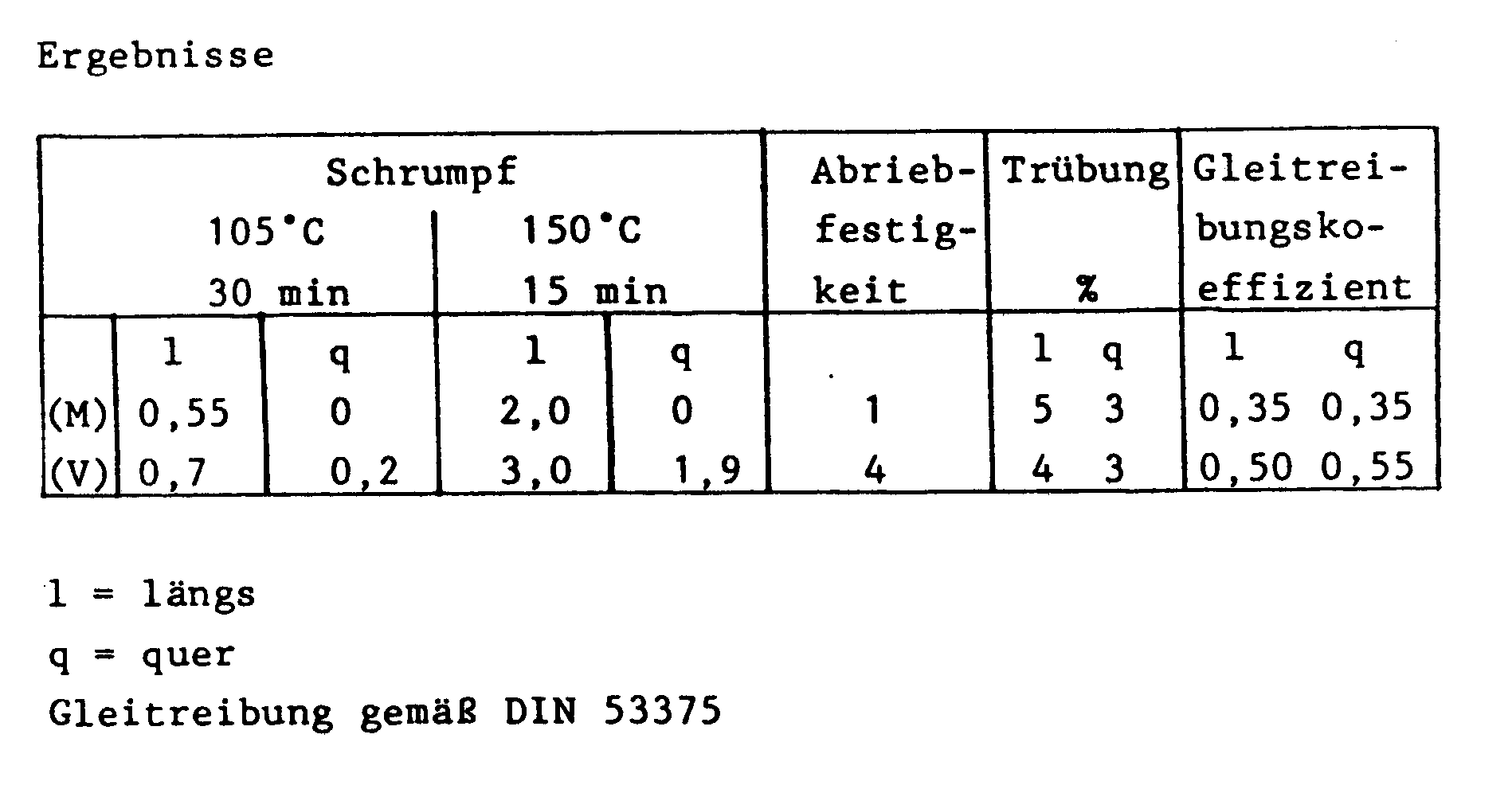
Claims (23)
- Polyester film possessing improved abrasion resistance, dimensional stability, stretchability and improved slip properties, which contains from 0.005 to 5.0 % by weight of organic, preferably cured or crosslinked, particles of a narrow grain size distribution with Dw/Dn < 1.1, the grain size being in the range of 0.01 to 5 µm, and a nucleating agent in an amount of 0.01 to 10 % by weight, the percentages each time being related to the weight of the polymer constituting the film.
- The film as claimed in claim 1, characterized in that th nucleating agents used comprise alkali or alkaline earth metal salts of ester waxes or partially saponified ester waxes, e.g., of montan acid, ionic copolymers obtained from ethylene and alkali metal salts of methacrylic acid, alkali metal salts of phenolsulfonic acid and/or inorganic nucleating agents.
- The film as claimed in claim 1 or 2, characterized in that sodium montanate and/or copolymers of ethylene and alkali metal salts of methacrylic acid are used as nucleating agents.
- The film as claimed in any of claims 1 to 3, characterized in that it contains 0.1 to 5 % by weight, relative to the polyester, of nucleating agent.
- The film as claimed in any of claims 1 to 4, characterized in that it contains hardened or crosslinked organic particles, which are preferably based on a melamine/formaldehyde resin, on a benzoguanamine/formaldehyde resin,on a phenol/formaldehyde resin or on an epoxy resin or acrylate.
- The film as claimed in claim 5, characterized in that the particles are prepared by suspension or emulsion polymerization.
- The film as claimed in any of claims 1 to 6, characterized in that it is stretched monoaxially.
- The film as claimed in any of claims 1 to 6, characterized in that it is stretched biaxially or multiaxially.
- The film as claimed in any of claims 1 to 6, characterized in that it is heat-set.
- The film as claimed in any of claims 1 to 9, characterized in that it is comprised of a homo- or copolycondensate obtained from terephthalic acid or isophthalic acid and glycols having 2 to 10 carbon atoms.
- The film as claimed in any of claims 1 to 9, characterized in that it is comprised of polyethylene terephthalate.
- The film as claimed in any of claims 1 to 9, characterized in that it is comprised of a blend of various polyesters.
- The film as claimed in any of claims 1 to 12, characterized in that it contains at least one further thermoplastic polymer.
- The film as claimed in any of claims 1 to 13, characterized in that it contains inorganic additives.
- The film as claimed in any of claims 1 to 14, characterized in that it contains further organic additives to improve the film properties.
- The film as claimed in any of claims 1 to 15, characterized in that it is comprised of several layers.
- The film as claimed in any of claims 1 to 16, characterized in that the layers are comprised of different polymers.
- The film as claimed in claim 16, characterized in that at least one of the layers contains a nucleating agent.
- The film as claimed in claim 16, characterized in that all layers are extruded simultaneously.
- The film as claimed in any of claims 1 to 19, characterized in that it is provided with a single- or double-sided coating comprising a solution or dispersion, whereby crosslinkable or crosslinked constituents may be contained in said solution or dispersion.
- A process for the manufacture of a monoaxially or multiaxially stretched, heat-set film possessing good abrasion resistance and improved dimensional stability and stretchability, as claimed in any of claims 1 to 19, characterized in that the nucleating agent is mixed with the polymer containing the organic, preferably crosslinked or hardened particles, the resulting mixture is molten, extruded through a slot die to give a cast film, chilled on a chill roller, then subjected to monoaxial, simultaneous longitudinal and transverse or multiaxial stretching, and subsequently heat-set at temperatures between 150 and 240 °C.
- Use of a film as claimed in any of claims 1 to 20 as a support film for magnetic recording materials, reprographic and photographic materials, electrofoils or embossing film.
- Use of a film as claimed in claims 1 to 20 as a packaging film or part of a packaging film.
Applications Claiming Priority (2)
| Application Number | Priority Date | Filing Date | Title |
|---|---|---|---|
| DE19853501018 DE3501018A1 (en) | 1985-01-15 | 1985-01-15 | POLYESTER FILM |
| DE3501018 | 1985-01-15 |
Publications (3)
| Publication Number | Publication Date |
|---|---|
| EP0188198A2 EP0188198A2 (en) | 1986-07-23 |
| EP0188198A3 EP0188198A3 (en) | 1989-01-04 |
| EP0188198B1 true EP0188198B1 (en) | 1992-06-17 |
Family
ID=6259804
Family Applications (1)
| Application Number | Title | Priority Date | Filing Date |
|---|---|---|---|
| EP86100072A Expired - Lifetime EP0188198B1 (en) | 1985-01-15 | 1986-01-04 | Polyester film |
Country Status (6)
| Country | Link |
|---|---|
| US (1) | US4801640A (en) |
| EP (1) | EP0188198B1 (en) |
| JP (1) | JPH0696647B2 (en) |
| KR (1) | KR940000113B1 (en) |
| DE (2) | DE3501018A1 (en) |
| IN (1) | IN166566B (en) |
Families Citing this family (32)
| Publication number | Priority date | Publication date | Assignee | Title |
|---|---|---|---|---|
| DE3501017A1 (en) * | 1985-01-15 | 1986-07-17 | Hoechst Ag, 6230 Frankfurt | ORIENTED PLASTIC FILM |
| JPH0747649B2 (en) * | 1987-11-10 | 1995-05-24 | 帝人株式会社 | Biaxially oriented polyester film |
| JP2643257B2 (en) * | 1988-03-16 | 1997-08-20 | 東レ株式会社 | Polyester composition and film comprising the same |
| JPH01319127A (en) * | 1988-06-20 | 1989-12-25 | Toray Ind Inc | Magnetic recording medium |
| EP0420988B1 (en) * | 1989-03-23 | 1998-01-07 | Nippon Shokubai Co., Ltd. | A coating composition comprising crosslinked spherical fine particles |
| JPH0778133B2 (en) * | 1989-12-14 | 1995-08-23 | ダイアホイルヘキスト株式会社 | Biaxially oriented polyester film |
| JPH0639539B2 (en) * | 1989-12-22 | 1994-05-25 | ダイアホイルヘキスト株式会社 | Biaxially oriented polyester film |
| US5143765A (en) * | 1989-12-27 | 1992-09-01 | Eastman Kodak Company | Shaped articles from orientable polymers and polymer microbeads |
| US5223383A (en) * | 1989-12-27 | 1993-06-29 | Eastman Kodak Company | Photographic elements containing reflective or diffusely transmissive supports |
| US5141685A (en) * | 1989-12-27 | 1992-08-25 | Eastman Kodak Company | Forming shaped articles from orientable polymers and polymer microbeads |
| US4994312A (en) * | 1989-12-27 | 1991-02-19 | Eastman Kodak Company | Shaped articles from orientable polymers and polymer microbeads |
| US5102943A (en) * | 1990-12-04 | 1992-04-07 | E. I. Du Pont De Nemours And Company | Thermoformed articles with improved ease of cutting and resistance to sticking |
| KR0171632B1 (en) * | 1992-01-16 | 1999-03-30 | 이따가끼 히로시 | Polyester film for metal plate joining and its use |
| CA2127702C (en) * | 1992-11-11 | 2000-11-07 | Nobuyuki Kagami | Polyester composition and film made therefrom |
| US5405921A (en) * | 1993-02-03 | 1995-04-11 | E. I. Du Pont De Nemours And Company | Polyester compositions having improved optical properties and heat stability |
| CA2127636C (en) * | 1993-07-21 | 2009-10-20 | Cheng-Kung Liu | Plasticizers for fibers used to form surgical devices |
| US6005019A (en) * | 1993-07-21 | 1999-12-21 | United States Surgical Corporation | Plasticizers for fibers used to form surgical devices |
| US6037063A (en) * | 1993-09-07 | 2000-03-14 | E. I. Du Pont De Nemours And Company | High barrier, coextruded compositions useful in the manufacture of clear, heat-stable articles and methods relating thereto |
| KR100188038B1 (en) * | 1993-09-14 | 1999-06-01 | 장용균 | Manufacturing method of biaxially oriented polyester film |
| US6579611B1 (en) * | 1998-12-01 | 2003-06-17 | Toyo Kohan Co., Ltd. | Resin film for producing decorative laminate and decorative laminate containing the resin film |
| US6686031B2 (en) | 2000-02-23 | 2004-02-03 | Fuji Photo Film Co., Ltd. | Hard coat film and display device having same |
| US6660397B2 (en) | 2002-02-21 | 2003-12-09 | Toray Plastics (America), Inc. | Thermoplastic sheet with scratch resistant surface and method of making same |
| US6893722B2 (en) * | 2002-04-29 | 2005-05-17 | Exxonmobil Oil Corporation | Cationic, amino-functional, adhesion-promoting polymer for curable inks and other plastic film coatings, and plastic film comprising such polymer |
| US7195818B2 (en) | 2002-05-01 | 2007-03-27 | Exxonmobil Oil Corporation | Sealable multi-layer opaque film |
| US20040105994A1 (en) * | 2002-12-03 | 2004-06-03 | Pang-Chia Lu | Thermoplastic film structures with a low melting point outer layer |
| US20050186415A1 (en) | 2003-11-21 | 2005-08-25 | Mccormick Chris E. | Protective laminate for windshields |
| US20060046005A1 (en) * | 2004-08-24 | 2006-03-02 | Mcgee Dennis E | Coating for polymeric labels |
| DE102010019010A1 (en) | 2010-05-03 | 2011-11-03 | Mitsubishi Polyester Film Gmbh | Biaxially oriented polyester film with spherical particles and titanium dioxide particles |
| DE102010026328A1 (en) | 2010-07-07 | 2012-01-12 | Mitsubishi Polyester Film Gmbh | Biaxially oriented matte polyester film with high roughness |
| JP5697461B2 (en) * | 2011-01-17 | 2015-04-08 | ユニチカ株式会社 | Polyester film and photosensitive resin structure |
| US9834713B2 (en) | 2016-02-23 | 2017-12-05 | 3M Innovative Properties Company | Oriented thermally conductive dielectric film |
| JP6721269B2 (en) * | 2016-04-20 | 2020-07-08 | 興人フィルム&ケミカルズ株式会社 | Polyamide film |
Citations (2)
| Publication number | Priority date | Publication date | Assignee | Title |
|---|---|---|---|---|
| EP0125482A1 (en) * | 1983-04-16 | 1984-11-21 | Hoechst Aktiengesellschaft | Polyester raw material, moulding mass produced therefrom, especially a foil, and use of the moulding mass |
| EP0176017A2 (en) * | 1984-09-22 | 1986-04-02 | Hoechst Aktiengesellschaft | The use of nucleating agents for improving dimensional stability, abrasion resistance and stretchability of polyester films |
Family Cites Families (18)
| Publication number | Priority date | Publication date | Assignee | Title |
|---|---|---|---|---|
| US4104261A (en) * | 1974-01-17 | 1978-08-01 | Chemische Werke Huls, Ag | Low pilling polyester fibers and process for their manufacture |
| GB1541014A (en) * | 1975-02-18 | 1979-02-21 | Flecto Coatings Ltd | Stable aqueous polymer emulsions preparation and uses thereof |
| US4172859A (en) * | 1975-05-23 | 1979-10-30 | E. I. Du Pont De Nemours And Company | Tough thermoplastic polyester compositions |
| DE2614980C2 (en) * | 1976-04-07 | 1987-05-27 | Chemische Werke Hüls AG, 4370 Marl | Process for the production of saturated, high molecular weight polyesters |
| US4125700A (en) * | 1977-03-22 | 1978-11-14 | E. I. Du Pont De Nemours And Company | Preparation of methyl methacrylate polymer powders for use in plastisols |
| JPS6035267B2 (en) * | 1978-01-09 | 1985-08-13 | 東レ株式会社 | surface modified polyester film |
| US4320207A (en) * | 1979-01-25 | 1982-03-16 | Diafoil Company Limited | Polyester film containing fine powder of crosslinked polymer |
| DE2927576A1 (en) * | 1979-07-07 | 1981-01-15 | Bayer Ag | HIGH IMPACT POLYBUTYLENE TEREPHTHALATE |
| JPS5638321A (en) * | 1979-09-07 | 1981-04-13 | Kanegafuchi Chem Ind Co Ltd | Polyester copolymer for molding use |
| GB2064562B (en) * | 1979-12-06 | 1983-04-07 | Ici Ltd | Production of non-aqueous polymer microparticle dispersions |
| JPS56139551A (en) * | 1980-04-03 | 1981-10-31 | Teijin Ltd | Transparent, easily slipping polyethylene terephthalate film |
| DE3039114A1 (en) * | 1980-10-16 | 1982-05-13 | Bayer Ag, 5090 Leverkusen | THERMOPLASTIC POLYESTER MOLDS WITH IMPROVED TOUGHNESS |
| DE3039115A1 (en) * | 1980-10-16 | 1982-05-13 | Bayer Ag, 5090 Leverkusen | THERMOPLASTIC POLYESTER MOLDS WITH IMPROVED TOUGHNESS |
| DE3117052A1 (en) * | 1981-04-29 | 1982-11-18 | Bayer Ag, 5090 Leverkusen | "AGING-RESISTANT, PROCESS-STABLE MIXTURES OF HIGH TOUGHNESS BASED ON THERMOPLASTIC POLYESTER" |
| US4401792A (en) * | 1982-03-16 | 1983-08-30 | General Electric Company | Process for increasing the rate of crystallization of polyesters |
| JPS595216A (en) * | 1982-06-30 | 1984-01-12 | Fujitsu Ltd | Optical fiber connector |
| US4511527A (en) * | 1982-12-16 | 1985-04-16 | Celanese Corporation | Alkali metal salts of cross-linked polymeric microgels as nucleating agents for polyethylene terephthalate molding compositions and method for molding |
| US4483949A (en) * | 1983-08-22 | 1984-11-20 | Ethyl Corporation | Polyethylene terephthalate blends |
-
1985
- 1985-01-15 DE DE19853501018 patent/DE3501018A1/en not_active Withdrawn
- 1985-12-24 IN IN1023/MAS/85A patent/IN166566B/en unknown
-
1986
- 1986-01-04 DE DE8686100072T patent/DE3685659D1/en not_active Expired - Fee Related
- 1986-01-04 EP EP86100072A patent/EP0188198B1/en not_active Expired - Lifetime
- 1986-01-09 US US06/817,238 patent/US4801640A/en not_active Expired - Lifetime
- 1986-01-14 KR KR1019860000172A patent/KR940000113B1/en not_active Expired - Fee Related
- 1986-01-14 JP JP61004403A patent/JPH0696647B2/en not_active Expired - Lifetime
Patent Citations (2)
| Publication number | Priority date | Publication date | Assignee | Title |
|---|---|---|---|---|
| EP0125482A1 (en) * | 1983-04-16 | 1984-11-21 | Hoechst Aktiengesellschaft | Polyester raw material, moulding mass produced therefrom, especially a foil, and use of the moulding mass |
| EP0176017A2 (en) * | 1984-09-22 | 1986-04-02 | Hoechst Aktiengesellschaft | The use of nucleating agents for improving dimensional stability, abrasion resistance and stretchability of polyester films |
Also Published As
| Publication number | Publication date |
|---|---|
| DE3685659D1 (en) | 1992-07-23 |
| US4801640A (en) | 1989-01-31 |
| IN166566B (en) | 1990-06-09 |
| KR860005857A (en) | 1986-08-13 |
| JPH0696647B2 (en) | 1994-11-30 |
| JPS61174254A (en) | 1986-08-05 |
| DE3501018A1 (en) | 1986-07-17 |
| EP0188198A3 (en) | 1989-01-04 |
| EP0188198A2 (en) | 1986-07-23 |
| KR940000113B1 (en) | 1994-01-05 |
Similar Documents
| Publication | Publication Date | Title |
|---|---|---|
| EP0188198A2 (en) | Polyester film | |
| EP0188197B1 (en) | Oriented plastic film | |
| DE69004621T2 (en) | Biaxially oriented polyester film. | |
| DE3752302T2 (en) | Biaxially oriented polyester films | |
| EP0238985B1 (en) | Multilayer polyester foil for magnetic information carriers | |
| DE3855033T2 (en) | Films containing liquid crystal polymers | |
| DE69424518T2 (en) | Biaxially oriented film made of polyethylene-2,6-naphthalenedicarboxylate | |
| DE69621858T2 (en) | Film with improved adhesiveness and process for its production | |
| DE69922919T2 (en) | BIAXIALLY ORIENTED POLYESTER FOIL FOR THERMAL TRANSFER BELT AND LAMINATED FILM CONTAINING THEREOF, AND METHOD OF PRODUCTION THEREOF | |
| DE69818036T2 (en) | BIAXIAL-ORIENTED POLYESTER FILM FOR MAGNETIC RECORDING MEDIA | |
| DE69122154T2 (en) | Biaxially oriented polyester film for magnetic recording media | |
| DE69233633T2 (en) | Polyester film for magnetic recording | |
| EP0176017B1 (en) | The use of nucleating agents for improving dimensional stability, abrasion resistance and stretchability of polyester films | |
| EP0483676A2 (en) | Flat product with at least one regularly structured surface | |
| DE60023298T2 (en) | MAGNETIC RECORDING FILM AND BASIC FILM THEREFOR | |
| DE69127188T2 (en) | THERMOPLASTIC POLYESTER COMPOSITION AND FILM MADE THEREOF | |
| DE69202628T2 (en) | Multi-layer polyester film for HD magnetic disk. | |
| DE69721701T2 (en) | composite film | |
| DE69331627T2 (en) | Polyester films for magnetic recordings | |
| DE69327489T2 (en) | Biaxially oriented film | |
| DE69220932T2 (en) | POLYESTER COMPOSITION AND BIAXIAL ORIENTED POLYESTER FILM MADE THEREOF | |
| DE69333590T2 (en) | Thermoplastic polyester composition and film made therefrom | |
| EP0406727B1 (en) | Method of preparation of a polyester raw material | |
| DE69124449T2 (en) | Film containing organic particles | |
| DE19510407A1 (en) | Polyester film with improved surface properties |
Legal Events
| Date | Code | Title | Description |
|---|---|---|---|
| PUAI | Public reference made under article 153(3) epc to a published international application that has entered the european phase |
Free format text: ORIGINAL CODE: 0009012 |
|
| AK | Designated contracting states |
Kind code of ref document: A2 Designated state(s): DE FR GB IT LU NL |
|
| PUAL | Search report despatched |
Free format text: ORIGINAL CODE: 0009013 |
|
| AK | Designated contracting states |
Kind code of ref document: A3 Designated state(s): DE FR GB IT LU NL |
|
| 17P | Request for examination filed |
Effective date: 19890620 |
|
| 17Q | First examination report despatched |
Effective date: 19900926 |
|
| GRAA | (expected) grant |
Free format text: ORIGINAL CODE: 0009210 |
|
| AK | Designated contracting states |
Kind code of ref document: B1 Designated state(s): DE FR GB IT LU NL |
|
| REF | Corresponds to: |
Ref document number: 3685659 Country of ref document: DE Date of ref document: 19920723 |
|
| ET | Fr: translation filed | ||
| ITF | It: translation for a ep patent filed | ||
| GBT | Gb: translation of ep patent filed (gb section 77(6)(a)/1977) | ||
| PLBI | Opposition filed |
Free format text: ORIGINAL CODE: 0009260 |
|
| 26 | Opposition filed |
Opponent name: TORAY INDUSTRIES, INC. Effective date: 19930317 |
|
| NLR1 | Nl: opposition has been filed with the epo |
Opponent name: TORAY INDUSTRIES, INC. |
|
| EPTA | Lu: last paid annual fee | ||
| ITTA | It: last paid annual fee | ||
| PLBO | Opposition rejected |
Free format text: ORIGINAL CODE: EPIDOS REJO |
|
| APAC | Appeal dossier modified |
Free format text: ORIGINAL CODE: EPIDOS NOAPO |
|
| APAA | Appeal reference recorded |
Free format text: ORIGINAL CODE: EPIDOS REFN |
|
| APAC | Appeal dossier modified |
Free format text: ORIGINAL CODE: EPIDOS NOAPO |
|
| PLBN | Opposition rejected |
Free format text: ORIGINAL CODE: 0009273 |
|
| STAA | Information on the status of an ep patent application or granted ep patent |
Free format text: STATUS: OPPOSITION REJECTED |
|
| 27O | Opposition rejected |
Effective date: 19990112 |
|
| NLR2 | Nl: decision of opposition | ||
| REG | Reference to a national code |
Ref country code: GB Ref legal event code: IF02 |
|
| PGFP | Annual fee paid to national office [announced via postgrant information from national office to epo] |
Ref country code: FR Payment date: 20020111 Year of fee payment: 17 |
|
| PGFP | Annual fee paid to national office [announced via postgrant information from national office to epo] |
Ref country code: NL Payment date: 20020117 Year of fee payment: 17 Ref country code: LU Payment date: 20020117 Year of fee payment: 17 |
|
| PGFP | Annual fee paid to national office [announced via postgrant information from national office to epo] |
Ref country code: GB Payment date: 20020118 Year of fee payment: 17 |
|
| PGFP | Annual fee paid to national office [announced via postgrant information from national office to epo] |
Ref country code: DE Payment date: 20020211 Year of fee payment: 17 |
|
| PG25 | Lapsed in a contracting state [announced via postgrant information from national office to epo] |
Ref country code: LU Free format text: LAPSE BECAUSE OF NON-PAYMENT OF DUE FEES Effective date: 20030104 Ref country code: GB Free format text: LAPSE BECAUSE OF NON-PAYMENT OF DUE FEES Effective date: 20030104 |
|
| PG25 | Lapsed in a contracting state [announced via postgrant information from national office to epo] |
Ref country code: NL Free format text: LAPSE BECAUSE OF NON-PAYMENT OF DUE FEES Effective date: 20030801 Ref country code: DE Free format text: LAPSE BECAUSE OF NON-PAYMENT OF DUE FEES Effective date: 20030801 |
|
| GBPC | Gb: european patent ceased through non-payment of renewal fee |
Effective date: 20030104 |
|
| PG25 | Lapsed in a contracting state [announced via postgrant information from national office to epo] |
Ref country code: FR Free format text: LAPSE BECAUSE OF NON-PAYMENT OF DUE FEES Effective date: 20030930 |
|
| NLV4 | Nl: lapsed or anulled due to non-payment of the annual fee |
Effective date: 20030801 |
|
| REG | Reference to a national code |
Ref country code: FR Ref legal event code: ST |
|
| PG25 | Lapsed in a contracting state [announced via postgrant information from national office to epo] |
Ref country code: IT Free format text: LAPSE BECAUSE OF NON-PAYMENT OF DUE FEES;WARNING: LAPSES OF ITALIAN PATENTS WITH EFFECTIVE DATE BEFORE 2007 MAY HAVE OCCURRED AT ANY TIME BEFORE 2007. THE CORRECT EFFECTIVE DATE MAY BE DIFFERENT FROM THE ONE RECORDED. Effective date: 20050104 |
|
| APAH | Appeal reference modified |
Free format text: ORIGINAL CODE: EPIDOSCREFNO |