EP0184949B2 - Verfahren zur Wiedererzeugung von aus Nickelbasis-Superlegierung hergestellten Einzelteilen am Ende ihrer Brauchbarkeit - Google Patents
Verfahren zur Wiedererzeugung von aus Nickelbasis-Superlegierung hergestellten Einzelteilen am Ende ihrer Brauchbarkeit Download PDFInfo
- Publication number
- EP0184949B2 EP0184949B2 EP85402131A EP85402131A EP0184949B2 EP 0184949 B2 EP0184949 B2 EP 0184949B2 EP 85402131 A EP85402131 A EP 85402131A EP 85402131 A EP85402131 A EP 85402131A EP 0184949 B2 EP0184949 B2 EP 0184949B2
- Authority
- EP
- European Patent Office
- Prior art keywords
- temperature
- rejuvenation
- cooling
- creep
- nickel
- Prior art date
- Legal status (The legal status is an assumption and is not a legal conclusion. Google has not performed a legal analysis and makes no representation as to the accuracy of the status listed.)
- Expired - Lifetime
Links
- 238000000034 method Methods 0.000 title claims description 24
- PXHVJJICTQNCMI-UHFFFAOYSA-N Nickel Chemical compound [Ni] PXHVJJICTQNCMI-UHFFFAOYSA-N 0.000 title claims description 18
- 229910052759 nickel Inorganic materials 0.000 title claims description 9
- 230000003716 rejuvenation Effects 0.000 title claims description 6
- 229910000601 superalloy Inorganic materials 0.000 title description 4
- 229910045601 alloy Inorganic materials 0.000 claims description 24
- 239000000956 alloy Substances 0.000 claims description 24
- 238000011282 treatment Methods 0.000 claims description 21
- 238000001816 cooling Methods 0.000 claims description 18
- 238000001556 precipitation Methods 0.000 claims description 10
- 230000005496 eutectics Effects 0.000 claims description 9
- 239000000203 mixture Substances 0.000 claims description 6
- 229910052804 chromium Inorganic materials 0.000 claims description 5
- 229910052799 carbon Inorganic materials 0.000 claims description 4
- 229910052719 titanium Inorganic materials 0.000 claims description 4
- 238000005056 compaction Methods 0.000 claims description 3
- 229910052750 molybdenum Inorganic materials 0.000 claims description 3
- 238000010790 dilution Methods 0.000 claims description 2
- 239000012895 dilution Substances 0.000 claims description 2
- 229910052720 vanadium Inorganic materials 0.000 claims description 2
- 239000011253 protective coating Substances 0.000 claims 1
- 238000012360 testing method Methods 0.000 description 15
- 239000012071 phase Substances 0.000 description 14
- 150000001247 metal acetylides Chemical class 0.000 description 11
- 230000008929 regeneration Effects 0.000 description 9
- 238000011069 regeneration method Methods 0.000 description 9
- 238000004581 coalescence Methods 0.000 description 8
- 238000010438 heat treatment Methods 0.000 description 8
- 239000011159 matrix material Substances 0.000 description 6
- 238000009792 diffusion process Methods 0.000 description 5
- 239000002244 precipitate Substances 0.000 description 5
- 230000035882 stress Effects 0.000 description 5
- XKRFYHLGVUSROY-UHFFFAOYSA-N Argon Chemical compound [Ar] XKRFYHLGVUSROY-UHFFFAOYSA-N 0.000 description 4
- 229910052782 aluminium Inorganic materials 0.000 description 4
- XAGFODPZIPBFFR-UHFFFAOYSA-N aluminium Chemical compound [Al] XAGFODPZIPBFFR-UHFFFAOYSA-N 0.000 description 4
- 239000011651 chromium Substances 0.000 description 4
- 230000007797 corrosion Effects 0.000 description 4
- 238000005260 corrosion Methods 0.000 description 4
- 230000000694 effects Effects 0.000 description 4
- 230000001376 precipitating effect Effects 0.000 description 4
- 230000008034 disappearance Effects 0.000 description 3
- 238000012423 maintenance Methods 0.000 description 3
- 239000000463 material Substances 0.000 description 3
- 239000000243 solution Substances 0.000 description 3
- 239000000126 substance Substances 0.000 description 3
- 239000010936 titanium Substances 0.000 description 3
- OKTJSMMVPCPJKN-UHFFFAOYSA-N Carbon Chemical compound [C] OKTJSMMVPCPJKN-UHFFFAOYSA-N 0.000 description 2
- NPXOKRUENSOPAO-UHFFFAOYSA-N Raney nickel Chemical compound [Al].[Ni] NPXOKRUENSOPAO-UHFFFAOYSA-N 0.000 description 2
- 229910052786 argon Inorganic materials 0.000 description 2
- 150000001875 compounds Chemical class 0.000 description 2
- 210000001787 dendrite Anatomy 0.000 description 2
- 239000010419 fine particle Substances 0.000 description 2
- 239000007789 gas Substances 0.000 description 2
- 239000010410 layer Substances 0.000 description 2
- 229910000907 nickel aluminide Inorganic materials 0.000 description 2
- 230000003647 oxidation Effects 0.000 description 2
- 238000007254 oxidation reaction Methods 0.000 description 2
- 239000011148 porous material Substances 0.000 description 2
- 230000001681 protective effect Effects 0.000 description 2
- 239000011241 protective layer Substances 0.000 description 2
- 230000001172 regenerating effect Effects 0.000 description 2
- 238000007711 solidification Methods 0.000 description 2
- 230000008023 solidification Effects 0.000 description 2
- 238000005496 tempering Methods 0.000 description 2
- IRPGOXJVTQTAAN-UHFFFAOYSA-N 2,2,3,3,3-pentafluoropropanal Chemical compound FC(F)(F)C(F)(F)C=O IRPGOXJVTQTAAN-UHFFFAOYSA-N 0.000 description 1
- 229910000951 Aluminide Inorganic materials 0.000 description 1
- KLZUFWVZNOTSEM-UHFFFAOYSA-K Aluminum fluoride Inorganic materials F[Al](F)F KLZUFWVZNOTSEM-UHFFFAOYSA-K 0.000 description 1
- ZAMOUSCENKQFHK-UHFFFAOYSA-N Chlorine atom Chemical compound [Cl] ZAMOUSCENKQFHK-UHFFFAOYSA-N 0.000 description 1
- VYZAMTAEIAYCRO-UHFFFAOYSA-N Chromium Chemical compound [Cr] VYZAMTAEIAYCRO-UHFFFAOYSA-N 0.000 description 1
- PXGOKWXKJXAPGV-UHFFFAOYSA-N Fluorine Chemical compound FF PXGOKWXKJXAPGV-UHFFFAOYSA-N 0.000 description 1
- ZOKXTWBITQBERF-UHFFFAOYSA-N Molybdenum Chemical compound [Mo] ZOKXTWBITQBERF-UHFFFAOYSA-N 0.000 description 1
- 241000135309 Processus Species 0.000 description 1
- NINIDFKCEFEMDL-UHFFFAOYSA-N Sulfur Chemical compound [S] NINIDFKCEFEMDL-UHFFFAOYSA-N 0.000 description 1
- 238000003917 TEM image Methods 0.000 description 1
- RTAQQCXQSZGOHL-UHFFFAOYSA-N Titanium Chemical compound [Ti] RTAQQCXQSZGOHL-UHFFFAOYSA-N 0.000 description 1
- 229910011214 Ti—Mo Inorganic materials 0.000 description 1
- 238000004873 anchoring Methods 0.000 description 1
- 230000015572 biosynthetic process Effects 0.000 description 1
- 238000005266 casting Methods 0.000 description 1
- 230000015556 catabolic process Effects 0.000 description 1
- 238000006243 chemical reaction Methods 0.000 description 1
- 239000000460 chlorine Substances 0.000 description 1
- 229910052801 chlorine Inorganic materials 0.000 description 1
- 239000011362 coarse particle Substances 0.000 description 1
- 239000011248 coating agent Substances 0.000 description 1
- 238000000576 coating method Methods 0.000 description 1
- 239000010941 cobalt Substances 0.000 description 1
- 229910017052 cobalt Inorganic materials 0.000 description 1
- GUTLYIVDDKVIGB-UHFFFAOYSA-N cobalt atom Chemical compound [Co] GUTLYIVDDKVIGB-UHFFFAOYSA-N 0.000 description 1
- 230000002301 combined effect Effects 0.000 description 1
- 239000000567 combustion gas Substances 0.000 description 1
- 238000002485 combustion reaction Methods 0.000 description 1
- 230000000052 comparative effect Effects 0.000 description 1
- 230000006835 compression Effects 0.000 description 1
- 238000007906 compression Methods 0.000 description 1
- 239000000470 constituent Substances 0.000 description 1
- 235000019628 coolness Nutrition 0.000 description 1
- 230000007423 decrease Effects 0.000 description 1
- 230000003247 decreasing effect Effects 0.000 description 1
- 238000006731 degradation reaction Methods 0.000 description 1
- 230000006866 deterioration Effects 0.000 description 1
- 230000001627 detrimental effect Effects 0.000 description 1
- 238000011161 development Methods 0.000 description 1
- 230000018109 developmental process Effects 0.000 description 1
- 238000004090 dissolution Methods 0.000 description 1
- 238000009826 distribution Methods 0.000 description 1
- 238000002474 experimental method Methods 0.000 description 1
- 230000002349 favourable effect Effects 0.000 description 1
- 239000011737 fluorine Substances 0.000 description 1
- 229910052731 fluorine Inorganic materials 0.000 description 1
- 239000011261 inert gas Substances 0.000 description 1
- 230000000977 initiatory effect Effects 0.000 description 1
- 229910000765 intermetallic Inorganic materials 0.000 description 1
- 230000007774 longterm Effects 0.000 description 1
- 238000004519 manufacturing process Methods 0.000 description 1
- 230000007246 mechanism Effects 0.000 description 1
- 238000002844 melting Methods 0.000 description 1
- 230000008018 melting Effects 0.000 description 1
- 229910052751 metal Inorganic materials 0.000 description 1
- 239000002184 metal Substances 0.000 description 1
- 238000010310 metallurgical process Methods 0.000 description 1
- 238000001000 micrograph Methods 0.000 description 1
- 239000011733 molybdenum Substances 0.000 description 1
- 238000005457 optimization Methods 0.000 description 1
- 239000007800 oxidant agent Substances 0.000 description 1
- 238000010791 quenching Methods 0.000 description 1
- 238000010583 slow cooling Methods 0.000 description 1
- 239000006104 solid solution Substances 0.000 description 1
- 239000000758 substrate Substances 0.000 description 1
- 229910052717 sulfur Inorganic materials 0.000 description 1
- 239000011593 sulfur Substances 0.000 description 1
- 238000010408 sweeping Methods 0.000 description 1
- 230000009897 systematic effect Effects 0.000 description 1
- 238000002076 thermal analysis method Methods 0.000 description 1
- 230000008646 thermal stress Effects 0.000 description 1
- 238000007669 thermal treatment Methods 0.000 description 1
- LEONUFNNVUYDNQ-UHFFFAOYSA-N vanadium atom Chemical compound [V] LEONUFNNVUYDNQ-UHFFFAOYSA-N 0.000 description 1
- 239000012808 vapor phase Substances 0.000 description 1
- 229910052726 zirconium Inorganic materials 0.000 description 1
Images

Classifications
-
- C—CHEMISTRY; METALLURGY
- C22—METALLURGY; FERROUS OR NON-FERROUS ALLOYS; TREATMENT OF ALLOYS OR NON-FERROUS METALS
- C22F—CHANGING THE PHYSICAL STRUCTURE OF NON-FERROUS METALS AND NON-FERROUS ALLOYS
- C22F1/00—Changing the physical structure of non-ferrous metals or alloys by heat treatment or by hot or cold working
- C22F1/10—Changing the physical structure of non-ferrous metals or alloys by heat treatment or by hot or cold working of nickel or cobalt or alloys based thereon
Definitions
- the invention relates to a method of heat treatment for parts arriving at the end of operating potential after having undergone damage by creep in particular; the aim of the method is to make them recover their initial properties in order to prolong their lifespan. It relates to parts made of heat resistant alloy with a nickel base comprising a hardening phase y ′ and applies in particular to the moving blades of a turbomachine.
- the blades must be able to resist creep at high temperature because they are mounted on a disc rotating between 5,000 and 20,000 rpm while being exposed to hot gases from 900 ° C to 1300 ° C and oxidants leaving the combustion chamber .
- the nickel-based superalloys used in aeronautics have a hardening phase y ′, the volume fraction of which can reach 70%.
- the blades subjected to such mechanical and thermal stresses undergo permanent elongation by creep which inevitably leads to their systematic scrapping after a certain number of hours of use in order to avoid the risks of catastrophic rupture.
- the high pressure turbine blades of a certain number of engines currently have their operating potential limited to about 800 hours by creep.
- This creep deformation process resulting in a degradation of the microcrystalline structure is the production of a heat treatment method allowing the restoration of the initial structure under conditions compatible with the geometrical criteria of the parts.
- the invention therefore has the second objective of carrying out a heat treatment which does not require the prior operation of removing the protective layer.
- the method of regenerating parts of heat-resistant alloy based on nickel NK15 CAT comprising in particular Co 13 to 17%, Cr 8 to 11%, Ai 5 to 6%, Ti 4 to 5%, Mo 2 at 4%, Va 0.7 to 1.7%, C 0.1 to 0.2% and forming an eutectic yy 'comprising a hardening phase y', the part having consumed at least part of its operating potential at cause in particular of damage by creep at high temperature, consists in maintaining the part at a temperature between 1160 ° C and 1220 ° C and for a period between 1 h and 4 h to re-dissolve at least 50% of phase y ′, the method consists in subsequently cooling the part at a controlled speed to a temperature below 700 ° C. corresponding to the precipitation range of phase y ′, this speed being chosen as a function
- patent FR 2 292 049 describes a method for extending the duration of the secondary creep of certain alloys; it consists of an unconstrained heat treatment, carried out at a temperature lower than that of dissolution of the compounds.
- This temperature corresponds in practice to the maximum operating temperature of the room; moreover, maintaining the temperature is quite long because, according to the hypothesis put forward, it should allow the annihilation of the lacunar networks by a diffusion process.
- This treatment limited in temperature, is certainly ineffective for parts having operated at high temperatures, such as 1100 ° C., because it does not allow the regeneration of the microcrystalline structure because it excludes the re-solution of the hardening compounds. .
- its duration makes it economically uninteresting in an industrial application.
- Patent FR 2 313 459 relates to a method for improving the service performance of metal parts which have undergone permanent elongation. It consists in subjecting these parts, before the appearance of surface cracks, to hot isostatic compression, at a temperature lower than that where a magnification of the grains occurs, then to apply a treatment of re-solution of the phases followed by 'a hardening income.
- the major advantage of compaction lies in the fact that it closes the creep decohesions and the non-opening foundry pores.
- the IN 100 alloy of formula NK 15 CAT is a nickel-base cast alloy. Its composition is as follows: Cobalt 13 to 17%, Chromium 8 to 11%, aluminum 5 to 6%, titanium 4 to 5%, molybdenum 2 to 4%, vanadium 0.7 to 1.7%, Carbon 0.1 at 0.2% etc ...
- the IN 100 is designed for long-term use at 1000 ° C and 1100 ° C for short-term. In all cases, its poor resistance to corrosion, in particular in a sulfurous atmosphere, requires protection, obtained for example by the vapor phase aluminization method of patent FR 1 433 497.
- the IN 100 has a dendritic structure y-y 'decorated by eutectic aggregates and carbides.
- the size of the basalt grain dendrites and the morphology of the hardening phase depend on the rate of cooling on casting, therefore on the local thickness of material in the part, and on the content of B and Zr. It varies from a few tenths to several mm for thicknesses ranging from 1 to 10 mm.
- the matrix y hardened by the effect of a solid solution of Cr and Co in Ni crystallizes in the CFC system
- the maximum hardening comes from the precipitation of the phase y ', ordered, of type L1 2 (Cu 3 Au) of the same crystalline system and consistent with the matrix. Its volume fraction is around 70%.
- the approximate composition is (Ni, Co) 3 (T, AI).
- the exceptional mechanical resistance when hot gives y 'to nickel-based superalloys comes essentially from the flow stress of this phase which has the remarkable property of increasing when the temperature increases.
- the alloy is rich in eutectic flows y-y ', located in interdendritic spaces.
- the temperature of formation of these aggregates is linked to their chemistry during the passage of the solidus, and can vary within wide proportions.
- the thermal analysis places it between 1210 and 1275 ° C depending in particular on the carbon content.
- the new dawn presents at the leading edge as at the trailing edge a structure y-y 'rich in eutectics and primary carbides.
- y' coarse 'of size close to 2 f..lm precipitating shortly after the solidification of the alloy
- fine of size close to 0.2 f .. lm precipitating during cooling following the protective treatment.
- the primary carbides precipitating while the alloy is not fully solidified, are repelled in the interdendritic sites where the grain boundaries are located, which are essentially distinguished by the difference in orientation of the y 'between 2 contiguous grains.
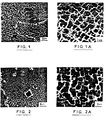
- the first microstructural evolution observed consists in the precipitation of secondary intergranular carbides, around the primary carbides and at the interfaces y-y 'of the eutectics, after 50 h of operation (FIGS. 1 and 1 A).
- the precipitation intensifies to become intragranular.
- phenomena of coalescence of the phase y ' cause the gradual disappearance of the precipitated ends y'.
- the size of the globules reaches 3 to 4 ⁇ m there and can double in the vicinity of eutectics, primary carbides and grain boundaries ( Figures 2 and 2A).
- the microstructure at the leading edge in the middle of the blade has a dendritic appearance.
- the interdendritic spaces are rich in eutectic and consist of precipitates y 'substantially larger than in the heart of the dendrites.
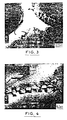
- the geometry of certain foundry pores reveals a beginning of deformation, as already observed after 800 hours; the coalescence of the y 'phase causes the disappearance of the fine precipitates.
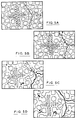
- FIGS. 5A to D give in summary a schematic representation of the process of damage by creep of the alloy subjected to a stress of 130 MPa and a temperature of 1000 ° C., in particular observed on test pieces.
- FIG. 5A shows the state of the structure after aluminization, there are 3 populations of y ′: relatively coarse particles of interdendritic y ′, fine particles of y ′ dendritic and very fine particles uniformly distributed obtained during cooling after aluminization treatment.
- the invention relates to a known type of process in which the alloy is subjected to a creep potential regeneration treatment comprising a thermal cycle erasing the microstructural effects of the deformation and leading to a microstructure approaching that of the alloy before stress.
- the part to be treated as observed, that is to say after 1000 hours of operation, is placed in an oven, preferably under vacuum in order to overcome oxidation problems. It is heated to a chosen temperature to re-dissolve a sufficient volume fraction of the hardening phase. In the present case of IN 100 alloy vanes protected by aluminization, this temperature is also determined as a function of its compatibility with maintaining the protection; in fact a too high temperature would cause the diffusion of aluminum and the dilution of the layer of nickel aluminide.
- this temperature was chosen at 1190 ° C but may vary depending on the case between 1160 ° C and 1220 ° C.
- the choice of temperature is also guided by the need for a sufficient margin with the melting temperature of the eutecti than for industrial application.
- the part was cooled by injecting a flow of inert gas, argon, into the oven. We controlled the flow in order to control the cooling rate of the room.
- the part is cooled by controlling the cooling rate to a temperature below 700 ° C corresponding to the precipitation range of phase y '.
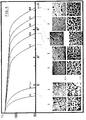
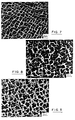
- the set of microstructures obtained is represented in FIG. 6. It is observed that the argon coolings lead to the precipitation of two populations of y ', and that the volume fraction of "large” y' increases while the content of fine constituents decreases , while decreasing the cooling rate. Microstructural observation reveals a complex phenomenon of "germination-growing” and “growth-coalescence", the respective kinetics of which vary according to the local chemical composition of the matrix giving rise to y '. There is therefore a compromise between the volume fractions of large y 'and of fine y' allowing the best mechanical behavior to be obtained as a function of the criteria sought.
- the cooling rate is controlled between 1085 ° C / h and 1145 ° C / h which leads to the microstructure of Figure 9. Under these conditions, it is no longer possible to differentiate a new blade ( Figure 7) of a regenerated blade (FIG. 9) by the sole examination of their microstructure: distribution of ⁇ - ⁇ 'identical in the two cases, absence of secondary carbides, the latter having been dissolved during the treatment.
- Tests were also carried out on test pieces in order to characterize them in creep.
- the IN 100 alloy test pieces underwent: 0.5%, 1% and 3% elongation under a stress of 130 MPa at 1000 ° C; in engine operating equivalent, 1% elongation is equivalent to 800 hours of operation for the above conditions.
- the test pieces are regenerated and then reassembled in creep.
- the test results are shown in FIG. 10. It is observed that, under the test conditions, the alloy present after regeneration of the primary and secondary cloud stages, the smaller the pre-deformation.
- the maximum gain in treatment is obtained after a pre-deformation of 0.5%.
- the time to obtain 1% elongation is 83 ⁇ 10 hours, the time to obtain this same elongation after treatment with 0.5% elongation increases to 103 ⁇ 16 hours, ie a gain of 24% .
- the gain is similar on the break time. It is 145 hours normally and goes to 180 hours after regeneration at 0.5% elongation.
Landscapes
- Chemical & Material Sciences (AREA)
- Mechanical Engineering (AREA)
- Thermal Sciences (AREA)
- Crystallography & Structural Chemistry (AREA)
- Engineering & Computer Science (AREA)
- Materials Engineering (AREA)
- Physics & Mathematics (AREA)
- Metallurgy (AREA)
- Organic Chemistry (AREA)
- Turbine Rotor Nozzle Sealing (AREA)
- Solid-Sorbent Or Filter-Aiding Compositions (AREA)
- Manufacture And Refinement Of Metals (AREA)
- Chemically Coating (AREA)
Claims (4)
dadurch gekennzeichnet,
daß noch eine zweite Stufe vorgesehen ist, die besteht aus dem Abkühlen des Einzelteils unter Regelung der Abkühlgeschwindigkeit bis auf eine Temperatur des Einzelteils unterhalb von 700 °C entsprechend dem Bereich der Phasenausscheidung für die Phase y' bei einer Abkühlgeschwindigkeit zwischen 1085 K/h und 1145 K/h.
dadurch gekennzeichnet,
daß die Überführungstemperatur niedriger gewählt ist als die für diese Schutzbehandlung eigentümliche Verdünnungstemperatur.
dadurch gekennzeichnet,
daß die Überführungstemperatur in die Lösung zwischen 1185 °C und 1195 °C liegt.
dadurch gekennzeichnet,
daß man das Einzelteil einer vorangehenden isostatischen Wärmeverdichtung unterzieht.
Applications Claiming Priority (2)
| Application Number | Priority Date | Filing Date | Title |
|---|---|---|---|
| FR8416974 | 1984-11-08 | ||
| FR8416974A FR2572738B1 (fr) | 1984-11-08 | 1984-11-08 | Methode de regeneration de pieces en superalliage base nickel en fin de potentiel de fonctionnement |
Publications (3)
| Publication Number | Publication Date |
|---|---|
| EP0184949A1 EP0184949A1 (de) | 1986-06-18 |
| EP0184949B1 EP0184949B1 (de) | 1989-07-19 |
| EP0184949B2 true EP0184949B2 (de) | 1992-08-26 |
Family
ID=9309366
Family Applications (1)
| Application Number | Title | Priority Date | Filing Date |
|---|---|---|---|
| EP85402131A Expired - Lifetime EP0184949B2 (de) | 1984-11-08 | 1985-11-06 | Verfahren zur Wiedererzeugung von aus Nickelbasis-Superlegierung hergestellten Einzelteilen am Ende ihrer Brauchbarkeit |
Country Status (7)
| Country | Link |
|---|---|
| US (1) | US4753686A (de) |
| EP (1) | EP0184949B2 (de) |
| JP (1) | JPS61119661A (de) |
| CA (1) | CA1275230C (de) |
| DE (1) | DE3571650D1 (de) |
| FR (1) | FR2572738B1 (de) |
| IL (1) | IL76930A (de) |
Families Citing this family (13)
| Publication number | Priority date | Publication date | Assignee | Title |
|---|---|---|---|---|
| US5498484A (en) * | 1990-05-07 | 1996-03-12 | General Electric Company | Thermal barrier coating system with hardenable bond coat |
| JP3069580B2 (ja) * | 1995-09-08 | 2000-07-24 | 科学技術庁金属材料技術研究所長 | 単結晶材料の再熱処理による余寿命延長方法 |
| JP3722975B2 (ja) * | 1998-02-23 | 2005-11-30 | 三菱重工業株式会社 | Ni基耐熱合金の性能回復処理方法 |
| DE60010405T2 (de) | 1999-10-23 | 2004-09-09 | Rolls-Royce Plc | Korrosionsschutzschicht für metallisches Werkstück und Verfahren zur Herstellung einer korrosionsschützenden Beschichtung auf ein metallisches Werkstück |
| RU2171857C2 (ru) * | 2000-11-13 | 2001-08-10 | ООО "Самаратрансгаз" | Способ восстановления циклической прочности деталей газотурбинных двигателей из жаропрочных сплавов на основе никеля |
| EP1398393A1 (de) * | 2002-09-16 | 2004-03-17 | ALSTOM (Switzerland) Ltd | Verfahren zur Wiederherstellung von Eigenschaften |
| RU2230822C1 (ru) * | 2003-04-10 | 2004-06-20 | Федеральное государственное унитарное предприятие "Всероссийский научно-исследовательский институт авиационных материалов" | Способ упрочнения изделия из литейного сплава на никелевой основе |
| RU2258086C1 (ru) * | 2003-12-17 | 2005-08-10 | Круцило Виталий Григорьевич | Способ термопластического упрочнения деталей и установка для его осуществления |
| RU2459885C1 (ru) * | 2011-07-15 | 2012-08-27 | Общество с ограниченной ответственностью "Производственное предприятие Турбинаспецсервис" | Способ восстановительной термической обработки изделий из жаропрочных никелевых сплавов |
| CN105274459A (zh) * | 2014-07-23 | 2016-01-27 | 中国人民解放军第五七一九工厂 | 真空热处理恢复镍基高温合金组织和性能的方法 |
| US10689741B2 (en) | 2015-08-18 | 2020-06-23 | National Institute For Materials Science | Ni-based superalloy part recycling method |
| JP2019112702A (ja) * | 2017-12-26 | 2019-07-11 | 三菱日立パワーシステムズ株式会社 | ニッケル基合金再生部材および該再生部材の製造方法 |
| CN119574336B (zh) * | 2024-12-30 | 2025-10-14 | 北京航空航天大学 | 一种合金蠕变试验测试装置及方法 |
Family Cites Families (8)
| Publication number | Priority date | Publication date | Assignee | Title |
|---|---|---|---|---|
| US3310440A (en) * | 1964-10-21 | 1967-03-21 | United Aircraft Corp | Heat treatment of nickel base alloys |
| US3817796A (en) * | 1970-06-30 | 1974-06-18 | Martin Marietta Corp | Method of increasing the fatigue resistance and creep resistance of metals and metal body formed thereby |
| IL46114A (en) * | 1974-11-25 | 1977-01-31 | Israel Aircraft Ind Ltd | Thermal treatment method to extend the second crawling life of alloys |
| CH594480A5 (de) * | 1975-06-03 | 1978-01-13 | Bbc Brown Boveri & Cie | |
| JPS52120913A (en) * | 1976-04-06 | 1977-10-11 | Kawasaki Heavy Ind Ltd | Heat treatment for improving high temperature low cycle fatigue strength of nickel base cast alloy |
| US4161412A (en) * | 1977-11-25 | 1979-07-17 | General Electric Company | Method of heat treating γ/γ'-α eutectic nickel-base superalloy body |
| US4328045A (en) * | 1978-12-26 | 1982-05-04 | United Technologies Corporation | Heat treated single crystal articles and process |
| FR2503188A1 (fr) * | 1981-04-03 | 1982-10-08 | Onera (Off Nat Aerospatiale) | Superalliage monocristallin a matrice a matuice a base de nickel, procede d'amelioration de pieces en ce superalliage et pieces obtenues par ce procede |
-
1984
- 1984-11-08 FR FR8416974A patent/FR2572738B1/fr not_active Expired
-
1985
- 1985-11-04 IL IL76930A patent/IL76930A/xx not_active IP Right Cessation
- 1985-11-06 DE DE8585402131T patent/DE3571650D1/de not_active Expired
- 1985-11-06 EP EP85402131A patent/EP0184949B2/de not_active Expired - Lifetime
- 1985-11-08 CA CA000494901A patent/CA1275230C/fr not_active Expired - Lifetime
- 1985-11-08 JP JP60250579A patent/JPS61119661A/ja active Granted
-
1986
- 1986-11-17 US US06/931,883 patent/US4753686A/en not_active Expired - Lifetime
Also Published As
| Publication number | Publication date |
|---|---|
| FR2572738A1 (fr) | 1986-05-09 |
| IL76930A (en) | 1988-08-31 |
| US4753686A (en) | 1988-06-28 |
| CA1275230C (fr) | 1990-10-16 |
| DE3571650D1 (en) | 1989-08-24 |
| JPS61119661A (ja) | 1986-06-06 |
| JPH046789B2 (de) | 1992-02-06 |
| FR2572738B1 (fr) | 1987-02-20 |
| EP0184949B1 (de) | 1989-07-19 |
| IL76930A0 (en) | 1986-04-29 |
| EP0184949A1 (de) | 1986-06-18 |
Similar Documents
| Publication | Publication Date | Title |
|---|---|---|
| EP0184949B2 (de) | Verfahren zur Wiedererzeugung von aus Nickelbasis-Superlegierung hergestellten Einzelteilen am Ende ihrer Brauchbarkeit | |
| CA2583140C (fr) | Alliage a base de nickel | |
| EP0971041B1 (de) | Monokristalline Superlegierung auf Nickelbasis mit hoher Gamma-prime-phase | |
| FR2666379A1 (fr) | Anneau de renforcement de turbine a gaz monocristallin resistant a l'environnement. | |
| EP3710610B1 (de) | Superlegierung auf nickelbasis, einkristalline schaufel und turbomaschine | |
| EP3710611B1 (de) | Superlegierung auf nickelbasis, einkristallschaufel und turbomaschine | |
| WO2018078269A1 (fr) | Superalliage a base de nickel, aube monocristalline et turbomachine. | |
| EP3802895B1 (de) | Superlegierung auf nickelbasis, einkristalline schaufel und turbomaschine | |
| FR3113255A1 (fr) | Protection contre l’oxydation ou la corrosion d’une pièce creuse en superalliage | |
| JPS6362582B2 (de) | ||
| EP4314370A1 (de) | Superlegierung auf nickelbasis, einkristalline schaufel und turbomaschine | |
| WO2023281205A1 (fr) | Superalliage a base de nickel, aube monocristalline et turbomachine | |
| EP4359580B1 (de) | Superlegierung auf nickelbasis, einkristalline schaufel und turbomaschine | |
| EP4581183A1 (de) | Superlegierung auf nickelbasis, einkristalline schaufel und turbinenmotor | |
| EP4359579A1 (de) | Superlegierung auf nickelbasis, einkristalline schaufel und turbomaschine | |
| FR3117507A1 (fr) | Procede de fabrication d'une piece en superalliage monocristallin | |
| EP4192635A1 (de) | Schutz gegen oxidation oder korrosion eines hohlkörpers aus einer superlegierung | |
| FR3117506A1 (fr) | Procede de fabrication d'une piece en superalliage monocristallin | |
| FR2729675A1 (fr) | Procede perfectionne d'elaboration et de traitement thermique d'un superalliage polycristallin a base de nickel, resistant a chaud |
Legal Events
| Date | Code | Title | Description |
|---|---|---|---|
| PUAI | Public reference made under article 153(3) epc to a published international application that has entered the european phase |
Free format text: ORIGINAL CODE: 0009012 |
|
| 17P | Request for examination filed |
Effective date: 19851123 |
|
| AK | Designated contracting states |
Kind code of ref document: A1 Designated state(s): BE DE FR GB |
|
| 17Q | First examination report despatched |
Effective date: 19880511 |
|
| GRAA | (expected) grant |
Free format text: ORIGINAL CODE: 0009210 |
|
| AK | Designated contracting states |
Kind code of ref document: B1 Designated state(s): BE DE FR GB |
|
| GBT | Gb: translation of ep patent filed (gb section 77(6)(a)/1977) | ||
| REF | Corresponds to: |
Ref document number: 3571650 Country of ref document: DE Date of ref document: 19890824 |
|
| PLBI | Opposition filed |
Free format text: ORIGINAL CODE: 0009260 |
|
| 26 | Opposition filed |
Opponent name: MTU MOTOREN- UND TURBINEN-UNION MUENCHEN GMBH Effective date: 19900419 |
|
| PUAH | Patent maintained in amended form |
Free format text: ORIGINAL CODE: 0009272 |
|
| STAA | Information on the status of an ep patent application or granted ep patent |
Free format text: STATUS: PATENT MAINTAINED AS AMENDED |
|
| 27A | Patent maintained in amended form |
Effective date: 19920826 |
|
| AK | Designated contracting states |
Kind code of ref document: B2 Designated state(s): BE DE FR GB |
|
| GBTA | Gb: translation of amended ep patent filed (gb section 77(6)(b)/1977) | ||
| REG | Reference to a national code |
Ref country code: GB Ref legal event code: IF02 |
|
| REG | Reference to a national code |
Ref country code: FR Ref legal event code: TP Ref country code: FR Ref legal event code: CD |
|
| PGFP | Annual fee paid to national office [announced via postgrant information from national office to epo] |
Ref country code: FR Payment date: 20031020 Year of fee payment: 19 Ref country code: BE Payment date: 20031020 Year of fee payment: 19 |
|
| PGFP | Annual fee paid to national office [announced via postgrant information from national office to epo] |
Ref country code: GB Payment date: 20031105 Year of fee payment: 19 |
|
| PGFP | Annual fee paid to national office [announced via postgrant information from national office to epo] |
Ref country code: DE Payment date: 20040130 Year of fee payment: 19 |
|
| PG25 | Lapsed in a contracting state [announced via postgrant information from national office to epo] |
Ref country code: GB Free format text: LAPSE BECAUSE OF NON-PAYMENT OF DUE FEES Effective date: 20041106 |
|
| PG25 | Lapsed in a contracting state [announced via postgrant information from national office to epo] |
Ref country code: BE Free format text: LAPSE BECAUSE OF NON-PAYMENT OF DUE FEES Effective date: 20041130 |
|
| BERE | Be: lapsed |
Owner name: SOC. D'ETUDE ET DE CONSTRUCTION DE MOTEURS D'AVIAT Effective date: 20041130 |
|
| PG25 | Lapsed in a contracting state [announced via postgrant information from national office to epo] |
Ref country code: DE Free format text: LAPSE BECAUSE OF NON-PAYMENT OF DUE FEES Effective date: 20050601 |
|
| GBPC | Gb: european patent ceased through non-payment of renewal fee |
Effective date: 20041106 |
|
| PG25 | Lapsed in a contracting state [announced via postgrant information from national office to epo] |
Ref country code: FR Free format text: LAPSE BECAUSE OF NON-PAYMENT OF DUE FEES Effective date: 20050729 |
|
| REG | Reference to a national code |
Ref country code: FR Ref legal event code: ST |
|
| BERE | Be: lapsed |
Owner name: SOC. D'ETUDE ET DE CONSTRUCTION DE MOTEURS D'AVIAT Effective date: 20041130 |