EP0183753B1 - Dispositif de marquage de produits en liaison avec un organisme charge de controler ce marquage - Google Patents
Dispositif de marquage de produits en liaison avec un organisme charge de controler ce marquage Download PDFInfo
- Publication number
- EP0183753B1 EP0183753B1 EP85902565A EP85902565A EP0183753B1 EP 0183753 B1 EP0183753 B1 EP 0183753B1 EP 85902565 A EP85902565 A EP 85902565A EP 85902565 A EP85902565 A EP 85902565A EP 0183753 B1 EP0183753 B1 EP 0183753B1
- Authority
- EP
- European Patent Office
- Prior art keywords
- printer
- terminal
- marking
- messages
- pct
- Prior art date
- Legal status (The legal status is an assumption and is not a legal conclusion. Google has not performed a legal analysis and makes no representation as to the accuracy of the status listed.)
- Expired
Links
Images
Classifications
-
- G—PHYSICS
- G06—COMPUTING OR CALCULATING; COUNTING
- G06Q—INFORMATION AND COMMUNICATION TECHNOLOGY [ICT] SPECIALLY ADAPTED FOR ADMINISTRATIVE, COMMERCIAL, FINANCIAL, MANAGERIAL OR SUPERVISORY PURPOSES; SYSTEMS OR METHODS SPECIALLY ADAPTED FOR ADMINISTRATIVE, COMMERCIAL, FINANCIAL, MANAGERIAL OR SUPERVISORY PURPOSES, NOT OTHERWISE PROVIDED FOR
- G06Q40/00—Finance; Insurance; Tax strategies; Processing of corporate or income taxes
- G06Q40/12—Accounting
- G06Q40/123—Tax preparation or submission
-
- G—PHYSICS
- G07—CHECKING-DEVICES
- G07D—HANDLING OF COINS OR VALUABLE PAPERS, e.g. TESTING, SORTING BY DENOMINATIONS, COUNTING, DISPENSING, CHANGING OR DEPOSITING
- G07D7/00—Testing specially adapted to determine the identity or genuineness of valuable papers or for segregating those which are unacceptable, e.g. banknotes that are alien to a currency
- G07D7/004—Testing specially adapted to determine the identity or genuineness of valuable papers or for segregating those which are unacceptable, e.g. banknotes that are alien to a currency using digital security elements, e.g. information coded on a magnetic thread or strip
- G07D7/0047—Testing specially adapted to determine the identity or genuineness of valuable papers or for segregating those which are unacceptable, e.g. banknotes that are alien to a currency using digital security elements, e.g. information coded on a magnetic thread or strip using checkcodes, e.g. coded numbers derived from serial number and denomination
Definitions
- the invention relates to a device for marking products in conjunction with an organization responsible for controlling this marking.
- the invention aims to avoid these drawbacks and relates to a device making it possible to eliminate both the risks of fraud vis-à-vis the administration or any authority having a right of control over the product and the constraints storage for users.
- a device allowing a first organization to control the quantity of products packaged by a second organization, characterized in that it comprises a printer (A) located at the second organization and controlled from a terminal (B ) issuing ordering instructions placed under the direct control of the first organization and leading to the printing of a message on each packaged product, this printed message being variable for each product and its content coming from an encryption algorithm known to the only first organism to ensure authenticity.
- A printer
- B terminal
- the device essentially consists in connecting the printer responsible for registering a graphic symbolizing a code to a control and command device placed under the supervision of the body responsible for controlling and selecting this registration, whose function is, on the one hand, to allow this registration and, on the other hand, to record the number of registrations actually carried out. It also consists in connecting the printer to the packaging line to carry out the registration when the monitoring and control device gives the signal.
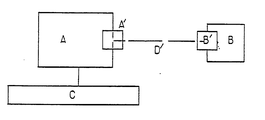
- an assembly (A) consists of a printer provided with interface means (A ') which connects it through a line (D) and an interface (B') to an assembly (B) which constitutes the control and command device already mentioned above.
- the assembly (A) is connected to the packaging unit (C) of the products which must receive the marking, for example a tax sticker.
- the assembly (B) is placed under the direct authority of the one who is invested with a right of control, which, in the example chosen, happens to be the tax services, while the combination subsets (A) and (C), the number of which may be any, is placed directly under the supervision of the user, the latter being defined here as that which affixes the distinctive sign, in this case the tax sticker.
- the sub-assembly (A) is for example constructed around an ink-jet printer of the multi-nozzle type allowing the application of a graphic produced from the successive application of (n) columns of (x) points called frames.
- the choice of such a type of printer, or of any other equivalent means is fundamental, the production of the graphics actually having to be carried out from elementary sub-assemblies such as, for example, dots.
- This printer preferably operates in graphic mode and only the frame generation functions are performed at the printer, the frame storage and / or graphics generation function being carried over to the terminal (B).
- the printer can operate in local mode, as will be explained later, but only on a limited number of graphics.
- a second essential function of this terminal (B) is the accounting of the affixed tax stickers. It also manages the order of the various graphics.
- the user can therefore ensure and verify that everything is going well. It then performs an encryption of the readable content of the message using conventional alphanumeric characters and conventional message elements such as: date, hour, minute, second ... of production or the number of the marked packaging.
- the user can use the combination of this information and print it in whole or in part in plain text and / or in barcode.
- the information thus entered can possibly later be read and compared with the algorithmic information generated by the control and command element (B).
- the user in addition to encrypting the readable content of the message, can also encrypt the graphics. It can, indeed, on the basis of an algorithmic process alter certain frames of the graphics by adding, coalescing or eliminating certain points. In this, the technique of inkjet writing lends itself particularly to these combinations.
- Such a device leads the user to save unnecessary stocks and not to be the owner of surplus stickers, stickers which he risks being stolen, or which in any case constitute for him an unnecessary investment.
- Such a device also has the great advantage of being able to be used when the shape or appearance of the product to be marked does not make it possible to affix thereto, by conventional methods, the taxation marks.
- the user does not have to keep thumbnails for too long before they are the subject of marketing.
- the tax authorities in the example chosen to illustrate the invention
- the body empowered to control the placing on the market of the products concerned has the means to avoid any fraud.
- the terminal (B) from which it can control all the information contained in the "thumbnail" which it ensures printing by delivering the corresponding control signals. He can therefore program this information according to his choice. For example, if we consider that this information is defined by coordinates (x y), he can program the information of his choice for each of these coordinates, completely arbitrarily with respect to the user.
- the thumbnail can add a point in a determined area of the thumbnail, the position of this point being, for example, linked to the number of the user, (conditioner) per minute and second of the packaging.
- This is a parameter which he can play at random, known only to him, but which, with respect to him, remains characteristic of the user.
- connection between the printer (A) and the terminal (B) can be carried out by conventional telecommunication means.
- the terminal (B) is located on the premises of the controlling body, for example the premises of the tax inspectorate.
- the user to obtain the delivery of the signal which will trigger the printing sequence and order his printer (A) must then present his personal code.
- This connection can also be obtained by means of a memory card issued by the controlling body and the terminal (B) will then be located in the premises of the user.
- Each memory card, initially personalized by the client, will then include a certain number of thumbnails which will be deducted from the user's account as they are consumed.
- Tax applications have been described at greater length, but it could also be implemented by franchisors or licensors to control the number of items sold, in particular, under their brand.
Landscapes
- Business, Economics & Management (AREA)
- Accounting & Taxation (AREA)
- Finance (AREA)
- Engineering & Computer Science (AREA)
- Development Economics (AREA)
- General Physics & Mathematics (AREA)
- Physics & Mathematics (AREA)
- Technology Law (AREA)
- Strategic Management (AREA)
- Marketing (AREA)
- General Business, Economics & Management (AREA)
- Economics (AREA)
- Theoretical Computer Science (AREA)
- Computer Security & Cryptography (AREA)
- Record Information Processing For Printing (AREA)
- Accessory Devices And Overall Control Thereof (AREA)
- Credit Cards Or The Like (AREA)
- Control Of Vending Devices And Auxiliary Devices For Vending Devices (AREA)
Description
- L'invention concerne un dispositif de marquage de produits en liaison avec un organisme chargé de contrôler ce marquage.
- Il existe un certain nombre d'applications où le contrôle de la quantité d'objets conditionnés doit être rigoureusement contrôlée. C'est le cas notamment des produits soumis à une taxe fiscale tels que les tabacs et les alcools. Dans ce cas, un marquage spécifique doit être effectué sur chaque produit mis dans le commerce. Par exemple, dans le cas de la fiscalisation des boissons alcoolisées, un graphisme à l'effigie de Marianne et divers accessoires d'identification sont appliqués sur chaque capsule de bouteille.
- A cette nécessité, sont associées plusieurs contraintes :
- des contraintes propres à celui qui contrôle,
- des contraintes propres à l'utilisateur.
- Pour l'Administration ou tout organisme ayant un droit de contrôle, il s'agit avant tout d'éviter la fraude et pour l'utilisateur d'éviter de stocker les emballages porteurs d'une vignette, par exemple fiscale, ce qui conduit à l'immobilisation de sommes importantes, sans compter les risques de détournements frauduleux de ces stocks.
- L'invention a pour but d'éviter ces inconvénients et concerne un dispositif permettant d'éliminer à la fois les risques de fraude vis à vis de l'Administration ou de toute autorité disposant d'un droit de contrôle sur le produit et les contraintes de stockage pour les utilisateurs.
- Elle concerne plus précisément un dispositif permettant à un premier organisme de contrôler la quantité de produits conditionnés par un second organisme, caractérisé en ce qu'il comprend une imprimante (A) située chez le second organisme et commandée à partir d'un terminal (B) délivrant des instructions de commande placées sous le contrôle direct du premier organisme et conduisant à l'impression d'un message sur chaque produit conditionné, ce message imprimé étant variable pour chaque produit et son contenu étant issu d'un algorithme de cryptage connu du seul premier organisme afin d'en assurer l'authenticité.
- L'invention sera mieux comprise à l'aide des explications qui vont suivre et de la figure unique jointe qui illustre schématiquement la combinaison des moyens permettant la mise en oeuvre du dispositif conforme à l'invention.
- Le dispositif selon l'invention consiste essentiellement à connecter l'imprimante chargée de l'inscription d'un graphisme symbolisant un code à un dispositif de contrôle et de commande placé sous la surveillance de l'organisme chargé de contrôler et de sélectionner cette inscription, dont la fonction est, d'une part, de permettre cette inscription et, d'autre part, de comptabiliser le nombre d'inscriptions effectivement réalisées. Il consiste également à connecter l'imprimante à la chaîne de conditionnement pour effectuer l'inscription lorsque le dispositif de contrôle et de commande en donnera le signal.
- Un tel dispositif est illustré au moyen de la figure 1. Plusieurs sous-ensembles coopèrent entre eux de la manière décrite ci-dessous. Tout d'abord, un ensemble (A) est constitué d'une imprimante dotée de moyens d'interface (A') qui la relie à travers une ligne (D) et un interface (B') à un ensemble (B) qui constitue le périphérique de contrôle et de commande déjà énoncé précédemment. Enfin, l'ensemble (A) est relié à l'unité de- conditionnement (C) des produits qui doivent recevoir le marquage, par exemple une vignette de fiscalisation.
- Conformément à l'invention, l'ensemble (B) est placé sous l'autorité directe de celui qui est investi d'un droit de contrôle, qui, dans l'exemple choisi, se trouve être les services fiscaux, tandis que la combinaison des sous-ensembles (A) et (C), dont le nombre peut être quelconque, se trouve directement placée sous la surveillance de l'utilisateur, celui-ci étant ici défini comme étant celui qui appose le signe distinctif, en l'occurrence la vignette fiscale.
- Le sous-ensemble (A) est par exemple construit autour d'une imprimante à projection d'encre du type multibuse permettant l'application d'un graphisme réalisé à partir de l'application successive de (n) colonnes de (x) points appelés trames. Le choix d'un tel type d'imprimante, ou de tout autre moyen équivalent est fondamental, la réalisation du graphisme devant effectivement être réalisée à partir de sous-ensembles élémentaires tels que par exemple des points.
- Cette imprimante fonctionne préférentiellement en mode graphique et seules les fonctions de génération de trames sont réalisées au niveau de l'imprimante, la fonction mémorisation de trames et/ou de la génération du graphisme étant reportée au niveau du terminal (B). L'imprimante a la possibilité de fonctionner en mode local, comme cela sera expliqué ultérieurement, mais uniquement sur un nombre limité de graphismes. Une seconde fonction essentielle de ce terminal (B) est la comptabilisation des vignettes de fiscalisation apposées. Il assure également la gestion de la commande des divers graphismes.
- Deux cas sont à considérer. D'une part, la vérification du bon fonctionnement de l'imprimante sans qu'un décompte intervienne de la part de l'organisme contrôleur. D'autre part, l'intervention de cet organisme lorsque cette première étape s'avère concluante. Pour cela, dans un premier temps, l'utilisateur met l'imprimante en service : il s'agit pour lui de vérifier que son dispositif fonctionne sans problème. Pour ce faire, il exécute un programme, dit programme « test et vérifie que toutes les fonctions peuvent être correctement assurées. Pendant cette phase de fonctionnement, la liaison entre l'ensemble (A) (imprimante) et le terminal (B) placé sous le contrôle de l'organisme concerné est interrompu. Donc, le graphisme de fiscalisation dans l'exemple choisi à titre d'illustration ne risque pas d'être comptabilisé au détriment de l'utilisateur. Par conséquent, aucune comptabilisation au niveau de l'organisme centralisateur (contrôleur) ne peut avoir lieu. Les sous-ensembles (A) et (B) sont déconnectés.
- Dans ces conditions, i'utilisateur peut donc s'assurer et vérifier que tout se passe bien. Il réalise alors un cryptage du contenu lisible du message utilisant des caractères alphanumériques classiques et des éléments de message conventionnels tels par exemple : date, heure, minute, seconde ... de production ou encore le numéro de l'emballage marqué. L'utilisateur peut utiliser la combinaison de ces informations et les imprimer pour tout ou partie en clair et/ou en code-barres. Les informations ainsi inscrites peuvent éventuellement ultérieurement être lues et confrontées avec les informations algorithmiques générées par l'élément de contrôle et de commande (B). L'utilisateur, outre le cryptage du contenu lisible du message, peut également procéder au cryptage du graphisme. Il peut, en effet, sur la base d'un procédé algorithmique altérer certaines trames du graphisme par rajout, coalescence ou élimination de certains points. En cela, la technique de l'écriture par jet d'encre se prête tout particulièrement à ces combinaisons.
- Cette phase de test étant réalisée et toutes les fonctions s'avérant correctement remplies, l'utilisateur juge alors qu'il peut faire entrer dans le jeu le terminal (B) commandé et contrôlé par l'organisme qui le surveille et qui, à ce titre, a la charge de comptabiliser ces actions. Il se met alors volontairement en liaison avec ce terminal (B). Il obtient alors la délivrance des vignettes», c'est-à-dire des signaux commandant son imprimante (A) qui réalise alors le graphisme concerné selon le programme mis préalablement en mémoire. Cette démarche atteste du fait qu'il a ou va acquitter les taxes afférentes à chaque produit marqué. A cette opération de délivrance de la « vignette » correspond, de manière concomitante, la liaison entre l'imprimante (A) et la chaîne de conditionnement (C). Sur chaque objet marqué, se trouve alors inscrit un moyen de preuve dont la comptabilisation est assurée également au niveau de l'organisme qui en contrôle la distribution.
- Ensuite, quand cette opération programmée s'arrête, la déconnection entre l'imprimante (A) et le terminal (B) a lieu, ce qui provoque automatiquement, au niveau de l'imprimante, la perte de la mémoire contenant les informations relatives à l'impression de la vignette. L'imprimante s'arrête.
- Un tel dispositif conduit l'utilisateur à économiser des stocks inutiles et à ne pas se trouver propriétaire de vignettes en surplus, vignettes qu'il risque de se voir voler, ou qui de toute façon, constituent pour lui un investissement inutile.
- Un tel dispositif présente également le grand avantage de pouvoir être mis en oeuvre lorsque la forme ou l'aspect du produit à marquer ne permet pas d'y apposer, par les procédés classiques, les marques de fiscalisation.
- Dans ces conditions, l'utilisateur n'a pas à conserver par devers lui des vignettes trop longtemps avant qu'elles ne fassent l'objet d'une commercialisation. De même, les services fiscaux (dans l'exemple choisi pour illustrer l'invention) sont certains de récupérer les fonds qui leur sont dus. Ceci étant acquis, conformément à une autre caractéristique importante de l'invention, l'organisme habilité à contrôler la mise sur le marché des produits concernés dispose de moyens pour éviter toute fraude. En effet, il dispose du terminal (B) à partir duquel il peut contrôler toute l'information contenue dans la « vignette » dont il assure l'impression en délivrant les signaux de commande correspondants. Il peut donc programmer cette information selon son choix. Par exemple, si l'on considère que cette information est définie par des coordonnées (x y) il peut pour chacune de ces coordonnées programmer l'information de son choix, tout à fait arbitrairement par rapport à l'utilisateur. Ainsi, il peut ajouter un point dans une zone déterminée de la vignette, la position de ce point étant, par exemple, liée au numéro de l'utilisateur, (conditionneur) à la minute et à la seconde du conditionnement. Il s'agit là d'un paramètre dont il peut jouer de manière aléatoire, connu seulement de lui, mais qui, vis à vis de lui, reste caractéristique de l'utilisateur.
- La liaison entre l'imprimante (A) et le terminal (B) peut s'effectuer par les moyens classiques de télécommunication. Dans ce cas, le terminal (B) se trouve dans les locaux de l'organisme contrôleur, par exemple les locaux de l'inspection fiscale. L'utilisateur pour obtenir la délivrance du signal qui déclenchera la séquence d'impression et commandera son imprimante (A) devra alors présenter son code personnel. Cette liaison peut également être obtenue au moyen d'une carte à mémoire délivrée par l'organisme contrôleur et le terminal (B) se trouvera alors implanté dans les locaux de l'utilisateur. Chaque carte à mémoire, initialement personnalisée par le donneur d'ordre comportera alors un certain nombre de vignettes qui seront décomptées à l'utilisateur au fur et à mesure de leur consommation.
- Un tel dispositif conforme à l'invention se prête à de nombreuses applications. On a plus longuement décrit des applications fiscales, mais il pourrait également être mis en oeuvre par des franchiseurs ou des concédants de licences pour contrôler le nombre d'articles commercialisés, notamment, sous leur marque.
Claims (7)
Applications Claiming Priority (2)
| Application Number | Priority Date | Filing Date | Title |
|---|---|---|---|
| FR8408629A FR2565384B1 (fr) | 1984-05-29 | 1984-05-29 | Procede de marquage de produits en liaison avec un organisme charge de controler ce marquage |
| FR8408629 | 1984-05-29 |
Publications (2)
| Publication Number | Publication Date |
|---|---|
| EP0183753A1 EP0183753A1 (fr) | 1986-06-11 |
| EP0183753B1 true EP0183753B1 (fr) | 1989-11-23 |
Family
ID=9304613
Family Applications (1)
| Application Number | Title | Priority Date | Filing Date |
|---|---|---|---|
| EP85902565A Expired EP0183753B1 (fr) | 1984-05-29 | 1985-05-28 | Dispositif de marquage de produits en liaison avec un organisme charge de controler ce marquage |
Country Status (8)
| Country | Link |
|---|---|
| US (1) | US4757187A (fr) |
| EP (1) | EP0183753B1 (fr) |
| JP (1) | JPS61502289A (fr) |
| AU (1) | AU581007B2 (fr) |
| CA (1) | CA1240053A (fr) |
| DE (1) | DE3574422D1 (fr) |
| FR (1) | FR2565384B1 (fr) |
| WO (1) | WO1985005714A1 (fr) |
Families Citing this family (12)
| Publication number | Priority date | Publication date | Assignee | Title |
|---|---|---|---|---|
| US4949381A (en) * | 1988-09-19 | 1990-08-14 | Pitney Bowes Inc. | Electronic indicia in bit-mapped form |
| FR2649229B1 (fr) * | 1989-06-29 | 1993-01-15 | Assistance Prestations | Installation pour le marquage d'objets et notamment pour la realisation de pochoirs |
| WO1998055970A1 (fr) * | 1997-06-05 | 1998-12-10 | Dix It S.R.L. | Methode permettant d'etablir avec precision l'authenticite d'un produit predefini |
| JP2003528368A (ja) | 1999-08-27 | 2003-09-24 | コンフィデックス、コーポレーション | コンピュータネットワークを介して入力されたコンピュータ読取可能なデータと紙ベースのビジネス文書を統合するシステム及び方法 |
| US6189009B1 (en) | 1999-08-27 | 2001-02-13 | The Voice.Com, Inc. | System and method for integrating paper-based business documents with computer-readable data entered via a computer network |
| JP3803518B2 (ja) * | 1999-11-10 | 2006-08-02 | 日本電気株式会社 | 電子印紙発行装置 |
| US20010032138A1 (en) * | 2000-03-15 | 2001-10-18 | Janiak Martin J. | Real time tax indicia system |
| US6968317B1 (en) * | 2000-04-28 | 2005-11-22 | Charles Schwab & Co., Inc. | Method and apparatus for new accounts program |
| FR2886434B1 (fr) | 2005-05-30 | 2007-09-21 | Neopost Ind Sa | Procede de traitement securise de timbres fiscaux |
| DE102005037497A1 (de) * | 2005-08-09 | 2007-02-15 | Man Roland Druckmaschinen Ag | Kennzeichnungssystem und Qualitäts- und Kennzeichnungsverfahren für eine Bogendruckmaschine |
| US20070215263A1 (en) * | 2006-03-14 | 2007-09-20 | Kerry Quinn | Print Cartridge System for Multi-Jurisdictional Tax Stamping |
| FR2989625B1 (fr) | 2012-04-24 | 2015-12-25 | Markem Imaje | Impression d'un motif d'authentification avec une imprimante a jet d'encre continu devie |
Family Cites Families (25)
| Publication number | Priority date | Publication date | Assignee | Title |
|---|---|---|---|---|
| US3348030A (en) * | 1964-12-22 | 1967-10-17 | K & M Electronics Company | Apparatus for photo-electrically scanning and counting physical inventory |
| GB1257163A (fr) * | 1968-02-16 | 1971-12-15 | ||
| GB1285445A (en) * | 1968-08-30 | 1972-08-16 | Smiths Industries Ltd | Improvements in or relating to access-control equipment and item-dispensing systems including such equipment |
| US3651478A (en) * | 1970-07-07 | 1972-03-21 | John J Shandlay | Inventory control system |
| US4024380A (en) * | 1971-01-18 | 1977-05-17 | Damon Mott Gunn | Self service postal apparatus and method |
| CA948591A (en) * | 1971-05-13 | 1974-06-04 | Ronald J. Gold | Display device and method of merchandising and inventory control |
| JPS5234200B2 (fr) * | 1972-04-19 | 1977-09-01 | ||
| IT983954B (it) * | 1972-04-20 | 1974-11-11 | Anker Werke Ag | Procedimento di combinazione e apparecchio per la fabbricazione il controllo e l utilizzazione di etichette per merci preferi bilmente in collegamento con un impianto elettronico di elabora zione dei dati |
| US4191376A (en) * | 1975-05-27 | 1980-03-04 | Systems Operations, Inc. | Highly secure playing cards for instant lottery and games |
| CA1077171A (fr) * | 1976-07-14 | 1980-05-06 | Frank T. Check (Jr.) | Machine a affranchir electronique avec canal entree/sortie antibruit |
| GB1580553A (en) * | 1977-08-22 | 1980-12-03 | Bank Of England | Document carrying a legible code and method and apparatus for producing same |
| US4226360A (en) * | 1978-12-19 | 1980-10-07 | Simjian Luther G | Metering system |
| FR2450011A1 (fr) * | 1979-02-20 | 1980-09-19 | Thomson Csf | Procede d'ecriture et de calcul de donnees numeriques, dispositif de calcul mettant en oeuvre un tel procede et telecopieur comportant un tel dispositif |
| DE2922882A1 (de) * | 1979-06-06 | 1980-12-11 | Stockburger H | Verfahren zur sicherung von tontraegern und deren etiketten und/oder verpackung gegen nachahmung |
| US4258252A (en) * | 1979-07-19 | 1981-03-24 | Simjian Luther G | Check controlled metering device |
| US4263504A (en) * | 1979-08-01 | 1981-04-21 | Ncr Corporation | High density matrix code |
| US4387297B1 (en) * | 1980-02-29 | 1995-09-12 | Symbol Technologies Inc | Portable laser scanning system and scanning methods |
| US4466079A (en) * | 1981-02-17 | 1984-08-14 | Pitney Bowes Inc. | Mailing system peripheral interface with communications formatting memory |
| US4424573A (en) * | 1981-02-26 | 1984-01-03 | Pitney Bowes Inc. | System for entering a postage meter serial number into a nonvolatile memory from an external channel after assembly of the meter |
| FR2528197B1 (fr) * | 1982-06-08 | 1986-12-05 | Grafeille Jean Marie | Procede de controle de l'usage de documents reserves, documents et dispositifs pour sa mise en oeuvre |
| US4529871A (en) * | 1982-09-29 | 1985-07-16 | Loblaw Companies Limited | Price marking system |
| DE3485609D1 (de) * | 1983-07-18 | 1992-04-30 | Pitney Bowes Inc | Vorrichtung zum drucken und lesen von verschluesselten mitteilungen. |
| US4641346A (en) * | 1983-07-21 | 1987-02-03 | Pitney Bowes Inc. | System for the printing and reading of encrypted messages |
| US4649266A (en) * | 1984-03-12 | 1987-03-10 | Pitney Bowes Inc. | Method and apparatus for verifying postage |
| FR2565383B1 (fr) * | 1984-05-29 | 1986-08-14 | Imaje Sa | Procede d'identification d'un produit destine a empecher toute fraude et dispositif mettant en oeuvre ce procede |
-
1984
- 1984-05-29 FR FR8408629A patent/FR2565384B1/fr not_active Expired
-
1985
- 1985-05-28 AU AU44025/85A patent/AU581007B2/en not_active Ceased
- 1985-05-28 CA CA000482627A patent/CA1240053A/fr not_active Expired
- 1985-05-28 WO PCT/FR1985/000132 patent/WO1985005714A1/fr not_active Ceased
- 1985-05-28 JP JP60502383A patent/JPS61502289A/ja active Pending
- 1985-05-28 DE DE8585902565T patent/DE3574422D1/de not_active Expired
- 1985-05-28 US US06/840,579 patent/US4757187A/en not_active Expired - Fee Related
- 1985-05-28 EP EP85902565A patent/EP0183753B1/fr not_active Expired
Also Published As
| Publication number | Publication date |
|---|---|
| DE3574422D1 (en) | 1989-12-28 |
| WO1985005714A1 (fr) | 1985-12-19 |
| JPS61502289A (ja) | 1986-10-09 |
| CA1240053A (fr) | 1988-08-02 |
| FR2565384A1 (fr) | 1985-12-06 |
| AU581007B2 (en) | 1989-02-09 |
| AU4402585A (en) | 1985-12-31 |
| EP0183753A1 (fr) | 1986-06-11 |
| FR2565384B1 (fr) | 1987-06-19 |
| US4757187A (en) | 1988-07-12 |
Similar Documents
| Publication | Publication Date | Title |
|---|---|---|
| US6453300B2 (en) | Personalized greeting card with electronic storage media and method of personalizing same | |
| US7797378B2 (en) | Method and apparatus for distribution of greeting cards with electronic commerce transaction | |
| CA1240053A (fr) | Procede de marquage de produits en liaison avec un organisme charge de controler ce marquage | |
| CH677702A5 (fr) | ||
| MXPA05004945A (es) | Activacion y personalizacion de contenido descargable. | |
| CH675313A5 (fr) | ||
| JP2011505300A (ja) | 手首バンド適用機 | |
| CH653157A5 (fr) | Dispositif pour personnaliser des formules de cheque. | |
| EP1344169A1 (fr) | Systemes et procedes de fidelisation sur internet | |
| EP1285386A1 (fr) | Procede d'acces a des contenus multimedia disponibles sur un reseau de donnees et support unite de valeur utilisable dans un tel procede. | |
| FR2780339A1 (fr) | Procede et systeme pour realiser des zones masquees sur des supports de donnees tels que des cartes | |
| EP0986804A1 (fr) | Complexe et dispositif pour garantir l'inviolabilite et l'authenticite d'un document ou d'une marchandise | |
| FR2712104A1 (fr) | Appareil de distribution et/ou modification des supports d'informations. | |
| EP0826184A1 (fr) | Reseau de repartition et de gestion d'ordres de transports | |
| FR2718718A1 (fr) | Enveloppe contenant une carte imprimée séparée et leur procédé de fabrication. | |
| CA2595175C (fr) | Procede et appareil de creation, personnalisation et de realisation de cartes de voeux avec des cartes cadeaux a securite renforcee | |
| WO2022122821A1 (fr) | Dispositif et procédé d'authentification de produits | |
| WO2001025981A1 (fr) | Systeme d'identification et de validation de donnees, notamment de points de fidelite pour la promotion des ventes | |
| GB2356731A (en) | Producing a personalised multimedia carrier | |
| WO2003036531A2 (fr) | Systeme de controle de transfert de produits | |
| FR2807250A1 (fr) | Systeme d'elaboration de coupons electroniques | |
| Costes | Legal Aspects of Electronic Commerce in the United States | |
| EP1272354A1 (fr) | Procede et moyen de paiement sur internet | |
| KR20090001495A (ko) | 정품 꼬리표와 유무선통신을 이용한 상품의 정품 확인방법 | |
| WO2002070280A1 (fr) | Titre de paiement constitue par un support presentant une zone masquee |
Legal Events
| Date | Code | Title | Description |
|---|---|---|---|
| PUAI | Public reference made under article 153(3) epc to a published international application that has entered the european phase |
Free format text: ORIGINAL CODE: 0009012 |
|
| AK | Designated contracting states |
Kind code of ref document: A1 Designated state(s): DE FR GB IT SE |
|
| 17P | Request for examination filed |
Effective date: 19860611 |
|
| 17Q | First examination report despatched |
Effective date: 19871126 |
|
| GRAA | (expected) grant |
Free format text: ORIGINAL CODE: 0009210 |
|
| AK | Designated contracting states |
Kind code of ref document: B1 Designated state(s): DE FR GB IT SE |
|
| ITF | It: translation for a ep patent filed | ||
| REF | Corresponds to: |
Ref document number: 3574422 Country of ref document: DE Date of ref document: 19891228 |
|
| GBT | Gb: translation of ep patent filed (gb section 77(6)(a)/1977) | ||
| PLBE | No opposition filed within time limit |
Free format text: ORIGINAL CODE: 0009261 |
|
| STAA | Information on the status of an ep patent application or granted ep patent |
Free format text: STATUS: NO OPPOSITION FILED WITHIN TIME LIMIT |
|
| 26N | No opposition filed | ||
| PGFP | Annual fee paid to national office [announced via postgrant information from national office to epo] |
Ref country code: SE Payment date: 19930413 Year of fee payment: 9 Ref country code: DE Payment date: 19930413 Year of fee payment: 9 |
|
| ITTA | It: last paid annual fee | ||
| REG | Reference to a national code |
Ref country code: FR Ref legal event code: TP |
|
| PGFP | Annual fee paid to national office [announced via postgrant information from national office to epo] |
Ref country code: FR Payment date: 19940419 Year of fee payment: 10 |
|
| PGFP | Annual fee paid to national office [announced via postgrant information from national office to epo] |
Ref country code: GB Payment date: 19940428 Year of fee payment: 10 |
|
| PG25 | Lapsed in a contracting state [announced via postgrant information from national office to epo] |
Ref country code: SE Effective date: 19940529 |
|
| EUG | Se: european patent has lapsed |
Ref document number: 85902565.2 Effective date: 19941210 |
|
| PG25 | Lapsed in a contracting state [announced via postgrant information from national office to epo] |
Ref country code: DE Effective date: 19950201 |
|
| EUG | Se: european patent has lapsed |
Ref document number: 85902565.2 |
|
| PG25 | Lapsed in a contracting state [announced via postgrant information from national office to epo] |
Ref country code: GB Effective date: 19950528 |
|
| GBPC | Gb: european patent ceased through non-payment of renewal fee |
Effective date: 19950528 |
|
| PG25 | Lapsed in a contracting state [announced via postgrant information from national office to epo] |
Ref country code: FR Effective date: 19960229 |
|
| REG | Reference to a national code |
Ref country code: FR Ref legal event code: ST |
|
| REG | Reference to a national code |
Ref country code: FR Ref legal event code: ST |