EP0183674B1 - Verfahren zur Inaktivierung von vermehrungsfähigen filtrierbaren Krankheitserregern - Google Patents
Verfahren zur Inaktivierung von vermehrungsfähigen filtrierbaren Krankheitserregern Download PDFInfo
- Publication number
- EP0183674B1 EP0183674B1 EP85890227A EP85890227A EP0183674B1 EP 0183674 B1 EP0183674 B1 EP 0183674B1 EP 85890227 A EP85890227 A EP 85890227A EP 85890227 A EP85890227 A EP 85890227A EP 0183674 B1 EP0183674 B1 EP 0183674B1
- Authority
- EP
- European Patent Office
- Prior art keywords
- factor xiii
- fibrinogen
- tissue adhesive
- preparation
- virus
- Prior art date
- Legal status (The legal status is an assumption and is not a legal conclusion. Google has not performed a legal analysis and makes no representation as to the accuracy of the status listed.)
- Expired
Links
Classifications
-
- A—HUMAN NECESSITIES
- A61—MEDICAL OR VETERINARY SCIENCE; HYGIENE
- A61L—METHODS OR APPARATUS FOR STERILISING MATERIALS OR OBJECTS IN GENERAL; DISINFECTION, STERILISATION OR DEODORISATION OF AIR; CHEMICAL ASPECTS OF BANDAGES, DRESSINGS, ABSORBENT PADS OR SURGICAL ARTICLES; MATERIALS FOR BANDAGES, DRESSINGS, ABSORBENT PADS OR SURGICAL ARTICLES
- A61L2/00—Disinfection or sterilisation of materials or objects, in general; Accessories therefor
- A61L2/02—Disinfection or sterilisation of materials or objects, in general; Accessories therefor using physical processes
- A61L2/04—Heat
-
- A—HUMAN NECESSITIES
- A61—MEDICAL OR VETERINARY SCIENCE; HYGIENE
- A61L—METHODS OR APPARATUS FOR STERILISING MATERIALS OR OBJECTS IN GENERAL; DISINFECTION, STERILISATION OR DEODORISATION OF AIR; CHEMICAL ASPECTS OF BANDAGES, DRESSINGS, ABSORBENT PADS OR SURGICAL ARTICLES; MATERIALS FOR BANDAGES, DRESSINGS, ABSORBENT PADS OR SURGICAL ARTICLES
- A61L2103/00—Materials or objects being the target of disinfection or sterilisation
- A61L2103/05—Living organisms or biological materials
Definitions
- the invention relates to a method for inactivating reproducible, filterable pathogens in tissue adhesives containing fibrinogen and factor XIII while largely maintaining their biological activity.
- Tissue adhesives are made from human or animal blood or plasma and are used for the physiological bonding of tissue or bone parts, wound sealing, hemostasis and promoting wound healing. They contain as active ingredients fibrinogen and factor XIII and can optionally other plasma proteins, such as. B. fibronectin, albumin, plasminogen activator inhibitors and / or plasmin inhibitors, and other additives. Such a tissue adhesive is e.g. B. is described in GB-A-2 041 942.
- this tissue adhesives based on the conversion of soluble fibrinogen to insoluble fibrin at the activation of factor XIII to factor XIIIa by thrombin in the presence of Ca 2+ ions and the crosslinking of fibrin by Factor XIIIa formed to a high polymer.
- the crosslinking of the fibrin, in particular the fibrin-a chains, is of particular importance here because it significantly increases the strength of the clot formed and thus the bond (LLShen, RP McDonagh, J. Hermans jr .: "Fibringel structure influence of calcium and covalent crosslinking on the elasticity ". Biochem. Biophys. Res. Comm. 56, 793-798, 1974; T. Seelich, H.
- the quality of a tissue adhesive thus essentially depends on its content of soluble, intact fibrinogen which can be clotted with thrombin and on the crosslinkability of the fibrin formed by the factor XIII present.
- the published PCT application WO 82/03871 describes a process for the treatment of preparations containing blood coagulation enzymes, these being heated in a dry state to inactivate existing infectious viruses; “dry state” means a water content of up to 0.05 (5% by weight).
- dry state means a water content of up to 0.05 (5% by weight).
- the preparations listed there contain no fibrinogen and no factor XIII; it is not a tissue adhesive preparation.
- a method for producing a tissue adhesive preparation in which a tissue adhesive solution is heated during the fractionation process in the presence of calcium ions and large amounts of sucrose and glycine as stabilizers; however, the process has the disadvantage that large amounts of stabilizing agents have to be added during the heating and then removed again. Part of the fibrinogen is denatured and must be removed after the heating step.
- treatments of this type have the disadvantage that the stabilizers added not only stabilize the proteins but also the viruses which may be present against heat.
- EP-A-0 142 059 describes a process for the heat treatment of virus-contaminated plasma proteins, including the coagulation factors II, V, VII, VIII, IX, X or fibrinogen, plasminogen and thrombin, the preparations in the dry state in the presence of a acidic amino acid and a basic amino acid.
- the combination of the acids is expected to have a stabilizing effect on the plasma proteins; however, this stabilizing effect also extends to the viruses, so that inactivation is delayed or made more difficult.
- the invention aims to avoid the disadvantages of the known inactivation methods and has as its object to create a tissue adhesive preparation of human or animal origin which has a high level of security against reproducible, filterable pathogens, such as viruses, and whose biological activity is largely retained, i.e. H. that the fibrinogen remains soluble in a high concentration and can be clotted with thrombin and that the fibrin formed has a high crosslinkability.
- the tissue adhesive produced according to the invention after treatment, after the wound treatment, sufficient strength of the adhesive site and rapid, uncomplicated wound healing should be ensured.
- the method according to the invention consists in that tissue adhesive preparations which have a minimum content of 100 units of factor XIII / g fibrinogen in the presence of an oxygen-free inert protective gas, preferably nitrogen, or under vacuum in the dry state at a temperature in the range from 50 to 120 ° C for at least 1 min.
- “Dry state” means a water content of up to 0.05 (5% by weight). The highest temperature corresponds to the shortest heating time and vice versa.
- the heat treatment can be carried out at any stage of the manufacturing process and / or after the preparation has been filled into final containers.
- the "dry state" of the tissue adhesive preparation can be brought about or ensured by drying with water-binding agents such as phosphorus pentoxide.
- a tissue adhesive preparation is prepared by fractionating human cryoprecipitate and, in addition to the native content of factor XIII, further factor XIII, preferably until a total content of factor XIII of about 500 units / g fibrinogen is reached, the heat treatment in any one Stage of the fractionation process and / or after the preparation has been filled into final containers.
- the heat-treated preparation can advantageously be stored in a dry state in final containers and dissolved before use to a concentration of at least 70 mg fibrinogen per ml.
- a tissue adhesive preparation was prepared in a known manner by the method according to AT-B-359 652: 277 l of human fresh plasma frozen at -20 ° C. were heated to + 2 ° C., the cryoprecipitate formed was separated off by centrifugation and the pH was reduced with a buffer solution. Value 6.5, containing 6.6 g Na 3 citrate. 2H 2 0, 3.4 g NaCl, 10.0 g glycine, 25,000 KIE aprotinin and 200 IU heparin per liter, treated and centrifuged again at + 2 ° C .
- the separated precipitate was dissolved in a further buffer solution with a pH of 7.9, containing 19.0 g human albumin, 9.0 g glycine, 1.0 g trisodium citrate. 2H 2 O, 25,000 KIE aprotinin and 200 IU heparin per liter and adjusted to a protein concentration of 50 g per liter.
- This solution was sterile filtered, filled into final containers (glass vials) of 12.5 ml each, deep-frozen and freeze-dried.
- the ratio of factor XIII: fibrinogen, expressed in units of factor XIII per gram of fibrinogen was 109; the water content (residual moisture) of the preparation was less than 0.01 (1% by weight).
- the content of fibrinogen was determined according to the specification according to USP XVI, page 298, as the thrombin-clottable protein according to the Kjeldahl method.
- the water content was determined by extraction with anhydrous methanol, etc. according to the Karl Fischer method in a titrator according to the coulometric method (E. Scholz, Fresenius' Z. anal. Chem. 314,567 - 571, 1983).
- a portion of the freeze-dried tissue adhesive preparation obtained in the manner described was dissolved to a protein concentration of 50 mg / ml, filled into 2.5 ml glass vials, deep-frozen and again freeze-dried.
- samples with different water contents were set, etc. with 0.007 (0.7% by weight), 0.03 (3% by weight) and 0.05 (5% by weight).
- the samples with a water content of 0.007 were sealed airtight either under vacuum ( ⁇ 10 Pa, ds ( ⁇ 0.1 mbar) or under N 2 or under air at normal pressure.
- the samples with a water content of 0.03 and 0.05 either sealed under N 2 or under air, and several samples of each type were then heated at 60 ° C.
- the residual activity ie the content of intact thrombin-clottable fibrinogen and the cross-linkability of the fibrin-a chains as a measure of the biological activity is determined, the freeze-dried, heated or unheated samples being dissolved with 1.0 ml of distilled water.
- the crosslinkability of the fibrin-a chains was determined using a crosslinking test (T. Seelich, H. Redl: “Theoretical basis of fibrin glue” in K. Schimpf: “Fibrinogen, fibrin and fibrin glue", FK Schattauer Verlag, Stuttgart-New York , 199 - 208, 1980), in which, after mixing the dissolved, ready-to-use tissue adhesive with the same volume of a solution containing 40 ⁇ mol CaC1 2 and 15 IU thrombin per ml, the mixture is incubated at 37 ° C.
- the degree of crosslinking of the fibrin a chains is determined by stopping the reaction and reductively cleaving the disulfide bridges contained in the proteins by adding a mixture of urea, sodium dodecyl sulfate (SDS) and ⁇ -mercaptoethanol by means of SDS polyacrylamide gel electrophoresis (K. Weber, M. Osborn: "The reliability of molecular weight determinations by dodecyl sulfatepolyacrylamide gel electrophoresis", J. Biol. Chem. 244, 4406 - 4412, 1969) and staining with Goomassie blue determined densitometrically.
- a non-heated sample served as a comparison for the samples heated under different conditions.
- a part was mixed with 15 units of factor XIII per ml. Both parts were then filled into a number of glass vials of 2.5 ml each, deep-frozen, freeze-dried and sealed under N 2 .
- the content of fibrinogen and factor XIII was determined as described in experiment 1 and the content of factor XIII per gram of fibrinogen was calculated for each of the two preparations.
- tissue adhesive preparations can be heated considerably longer than in this experiment under the conditions mentioned, without having to accept excessive losses in quality.
- the method according to the invention including the inactivation of pathogens capable of reproduction, is explained in more detail in the following examples. Since the necessary studies on virus inactivation in blood products cannot be carried out immediately on humans, the effectiveness of the inactivation is assessed with the help of model viruses.
- Part of the freeze-dried tissue adhesive preparation obtained was dissolved to a protein concentration of 50 mg / ml, mixed with a Sindbis virus suspension in TCM 199 cell culture medium or with virus-free cell culture medium, filled into 2.6 ml glass vials, deep-frozen and to a water content of 0.005 (0.5% by weight) freeze-dried.
- a part of the samples was sealed under vacuum (10 Pa), another part under N 2 and a further part under air at normal pressure.
- the sealed samples were heated at a temperature of 60 ° C for different times. Three samples were taken before heating and at certain times during the heating process to measure the virus titer on the one hand and the residual activity on the other.
- the residual activity was determined as described in Experiment 1.
- the results are summarized in Table 4. They not only show that it is possible to completely inactivate Sindbis virus in tissue adhesive preparations of the type described, but above all also lead to the important finding that the relationship between virus inactivation on the one hand and residual activity of the preparation on the other hand can be significantly improved by the fact that the heating is carried out in the absence of oxygen, ie under an inert protective gas or under vacuum.
- Example 2 The procedure according to Example 1 was repeated, with the difference that after freeze-drying in the presence of a P 2 0 5 -containing drying agent, the samples were subsequently dried under vacuum to a water content of 0.002, sealed under vacuum ( ⁇ 10 Pa) and of different lengths 70 ° C were heated.
- a tissue adhesive preparation was prepared as described in Experiment 1 and 12 units of factor XIII per ml were added to the dilute solution of the tissue adhesive prior to sterile filtration. After freeze-drying, the preparation contained 520 units of factor XIII per gram of fibrinogen.
- a portion of the preparation obtained was dissolved at a concentration of 50 mg protein per ml and a portion of the solution with a suspension of Sindbis virus or a suspension of VSV (vesicular stomatitis virus) or a suspension of LCM (! Ymphotropes choriomeningitis ) Virus in TCM 199 cell culture medium or mixed with virus-free cell culture medium, filled into 2.6 ml glass vials, deep-frozen, up to a water content of 0.006 freeze-dried and sealed under N 2 . Samples of the preparations were heated to 60 ° C. and, as described in Example 1, the virus titer and the residual activity were determined before the heating and after certain heating times.
- Example 1 The result of Example 1, namely that Sindbis virus can be completely inactivated in a tissue adhesive preparation by dry heating at 60 ° C. for 30 hours, was confirmed again according to this example.
- the LCM virus and VSV were completely inactivated after only 10 hours of heating.
- the activity of the tissue adhesive preparation was almost completely retained after heating for 30 hours.
- a tissue adhesive preparation was made as described in Example 3.
- Part of the preparation obtained was dissolved in a protein concentration of 50 mg / ml and the solution was mixed with a suspension of bacteriophage X 174 in culture medium for Escherichia coli 11303 or with virus-free culture medium, filled into glass vials of 2.6 ml each, deep-frozen, Freeze-dried to a water content of 0.005 and sealed under N 2 .
- Some of the samples were heated to 90 ° C for different lengths and the virus titer and the residual activity before the heating and at certain times during the heating process were determined.
- the residual activity was determined as described in experiment 1.
- the results are summarized in Table 7. They show that the (relatively heat-stable) bacteriophage X 174 can be completely inactivated in a tissue adhesive preparation by dry heating under N 2 to 90 ° C., the activity of the tissue adhesive preparation being almost completely retained.
- a tissue adhesive preparation was made as described in Example 3.
- Part of the freeze-dried tissue adhesive preparation obtained was dissolved to a protein concentration of 50 mg / ml, mixed with a Sindbis virus suspension or a dog hepatitis virus suspension in cell culture medium TCM 199 or with virus-free cell culture medium, filled into glass vials of 2.6 ml each, deep-frozen , freeze-dried to a water content of 0.005 and sealed under N 2 .
- the samples were heated at a temperature of 110 ° C. for different lengths and, as described, the activity of the preparation and the virus titer were determined before the heating and at certain times during the heating process.
- the example shows that not only Sindbis virus, but also the dog hepatitis virus, which is known to be particularly heat-stable, can be completely inactivated in a tissue adhesive preparation by the method according to the invention without having to accept excessive losses in the biological activity of the preparation.
- a tissue adhesive preparation was made as described in Example 3.
- Part of the freeze-dried tissue adhesive preparation obtained became one Protein concentration of 50 mg / ml dissolved and each part of the solution with a suspension of Sindbis virus or a suspension of VSV (vesicular stomatitis virus) or a suspension of corona virus in cell culture medium TCM 199 or with virus-free cell culture medium, 2.6 ml each filled into glass vials, deep-frozen, freeze-dried, adjusted to a water content of 0.04 and sealed under N 2 .
- Sindbis virus or a suspension of VSV (vesicular stomatitis virus) or a suspension of corona virus in cell culture medium TCM 199 or with virus-free cell culture medium 2.6 ml each filled into glass vials, deep-frozen, freeze-dried, adjusted to a water content of 0.04 and sealed under N 2 .
- Samples of the preparation were heated to 60 ° C. and the residual activity and the virus titer were determined before the heating and after certain heating times, as described in Example 1.
- Sindbis virus was completely inactivated after only 3 hours of heating, VSV and corona virus even after 1 hour, the activity of the preparation being largely retained.
Landscapes
- Health & Medical Sciences (AREA)
- Epidemiology (AREA)
- Life Sciences & Earth Sciences (AREA)
- Animal Behavior & Ethology (AREA)
- General Health & Medical Sciences (AREA)
- Public Health (AREA)
- Veterinary Medicine (AREA)
- Materials For Medical Uses (AREA)
- Medicines That Contain Protein Lipid Enzymes And Other Medicines (AREA)
- Medicines Containing Material From Animals Or Micro-Organisms (AREA)
- Cosmetics (AREA)
- Optical Filters (AREA)
- Pharmaceuticals Containing Other Organic And Inorganic Compounds (AREA)
- Networks Using Active Elements (AREA)
- Harvester Elements (AREA)
- External Artificial Organs (AREA)
- Filtering Materials (AREA)
Description
- Die Erfindung betrifft ein Verfahren zur Inaktivierung von vermehrungsfähigen filtrierbaren Krankheitserregern in Fibrinogen und Faktor XIII enthaltenden Gewebeklebstoffen bei weitgehender Erhaltung ihrer biologischen Aktivität.
- Gewebeklebstoffe werden aus menschlichem oder tierischem Blut bzw. Plasma hergestellt und dienen zur physiologischen Verklebung von Gewebe- oder Knochenteilen, Wundversiegelung, Blutstillung und Förderung der Wundheilung. Sie enthalten als wirksame Bestandteile Fibrinogen und Faktor XIII und können gegebenenfalls weitere Plasmaproteine, wie z. B. Fibronectin, Albumin, Plasminogen-Aktivator-Inhibitoren und/oder Plasmin-Inhibitoren, sowie weitere Zusätze enthalten. Ein derartiger Gewebeklebstoff ist z. B. in der GB-A-2 041 942 beschrieben.
- Die Wirkungsweise dieser Gewebeklebstoffe beruht auf der Umwandlung von löslichem Fibrinogen in unlösliches Fibrin, auf der Aktivierung von Faktor XIII zu Faktor Xllla durch Thrombin in Gegenwart von Ca2+-Ionen und der Vernetzung des gebildeten Fibrins durch Faktor Xllla zu einem Hochpolymer. Der Vernetzung des Fibrins, insbesondere der Fibrin-a-Ketten, kommt dabei besondere Bedeutung zu, weil dadurch die Festigkeit des gebildeten Clots und damit der Klebung wesentlich erhöht wird (L. L.Shen, R. P. McDonagh, J. Hermans jr.: "Fibringel structure influence of calcium and covalent crosslinking on the elasticity". Biochem. Biophys. Res. Comm. 56, 793 - 798, 1974; T. Seelich, H. Redl: "Theoretische Grundlagen des Fibrinklebers" in: K. Schimpf: "Fibrinogen, Fibrin und Fibrinkleber", F. K. Schattauer Verlag, Stuttgart-New York, 199 - 208, 1980).
- Die Qualität eines Gewebeklebstoffes hängt somit wesentlich von dessen Gehalt an löslichem, intaktem, mit Thrombin gerinnbarem Fibrinogen und von der Vernetzbarkeit des gebildeten Fibrins durch den vorhandenen Faktor XIII ab.
- Trotz sorgfältiger überprüfung der Ausgangsprodukte bei der Herstellung von Blutpräparationen ist das Risiko, daß Patienten nach einer Behandlung an mikrobiellen Infektionen erkranken, nicht gering. Es gibt zwar mehrfach Bemühungen, Krankheitserreger zu inaktivieren, doch ist die Sicherheit der Präparation nicht immer gewährleistet bzw. wird die biologische Aktivität der Wirkstoffe beeinträchtigt.
- Bei Präparationen, die für Infusionszwecke bestimmt sind, ist es möglich, Verluste an biologischer Aktivität durch entsprechend höhere Dosierung zu kompensieren, was zwar die Wirtschaftlichkeit, nicht aber die Wirksamkeit der Produkte beeinträchtigt; bei Gewebeklebstoffen hingegen ist es nicht möglich, eine verminderte biologische Aktivität (ausgedrückt im Gehalt an intaktem, löslichem, mit Thrombin gerinnbarem Fibrinogen und der Vernetzbarkeit des daraus gebildeten Fibrins) durch höhere Dosierung zu kompensieren; denn eine Klebung wird keinesfalls dadurch fester, daß man mehr Klebstoff von minderer Qualität einsetzt. Darüber hinaus ist bekannt, daß vernetztes Fibrin das Fibroblastenwachstum und damit die Wundheilung stimuliert, während Fibrinogen oder unvernetztes Fibrin diese erwünschte Wirkung kaum zeigen (S. Kasai, T. Kunimoto, K. Nitta: "Cross-linking of fibrin by activated factor XIII stimulates attachment, morphological changes and proliferation of fibroblasts", Biomed Res 4, 155 - 160, 1983).
- Aus der vorstehenden Darstellung ergibt sich die Forderung, daß Inaktivierungsverfahren für Gewebeklebstoffpräparationen nicht nur eine hohe Wirksamkeit gegenüber vermehrungsfähigen filtrierbaren Krankheitserregern, wie Viren, aufweisen müssen, sondern auch, daß die biologische Aktivität der Präparationen weitgehend erhalten bleibt.
- Es sind verschiedene Verfahren bekannt, bei welchen Blutprodukte zwecks Inaktivierung von vermehrungsfähigen filtrierbaren Krankheitserregern in Blutprodukten einer Hitzebehandlung unterworfen werden.
- So ist in der veröffentlichten PCT-Anmeldung WO 82/03871 ein Verfahren zur Behandlung von Blutgerinnungsenzyme enthaltenden Zubereitungen beschrieben, wobei diese zur Inaktivierung vorhandener infektiöser Viren im trockenen Zustand erhitzt werden; unter "trockenem Zustand" wird ein Wassergehalt bis zu 0,05 (5 Gew.-%) verstanden. Die dort angeführten Zubereitungen enthalten jedoch kein Fibrinogen und keinen Faktor XIII; es handelt sich um keine Gewebeklebstoff-Präparationen.
- Ein ähnliches Verfahren ist in der EP-A-0 094 611 für Faktor VIlI-hältige Kompositionen beschrieben.
- Rosenberg et al. beschreiben in einer Abhandlung des XII. International Congress on Blood Transfusion, Abstracts, "MIR" Publishers, Moscow 1969, pp. 473 - 475 ein Verfahren zur Inaktivierung von albuminhältigen Präparationen und Fibrinogen in trockenem Zustand durch 10-stündiges Erhitzen auf 60°C. Diese intravenös zu verabreichenden Präparationen waren zur Behandlung von Fibrinogen-Mangelzuständen bestimmt, wobei das Fibrinogen löslich und gerinnbar sein mußte. Diese Präparationen enthielten keinen Faktor XIII und waren nicht zur Gewebeklebung bestimmt.
- Des weiteren ist gemäß der EP-A-103 196 ein Verfahren zur Herstellung einer Gewebeklebstoffpräparation bekannt, bei welchem während des Fraktionierungsprozesses eine Gewebeklebstofflösung in Gegenwart von Calciumionen sowie großen Mengen an Saccharose und Glycin als Stabilisatoren erhitzt wird; das Verfahren hat allerdings den Nachteil, daß während der Erhitzung große Mengen an Stabilisierungsmitteln zugesetzt und danach wieder entfernt werden müssen. Dabei wird ein Teil des Fibrinogens denaturiert und muß nach dem Erhitzungsschritt abgetrennt werden. Darüber hinaus haben Behandlungen dieser Art den Nachteil, daß die zugesetzten Stabilisatoren nicht nur die Proteine, sondern auch die eventuell vorhandenen Viren gegenüber Hitze stabilisieren. Die Wirksamkeit solcher Verfahren ist daher keinesfalls mit der Wirksamkeit der standardisierten Hitzebehandlung von Albuminlösungen (10-stündiges Erhitzen auf 60°C) zu vergleichen, da diese wegen der außergewöhnlich hohen Hitzestabilität des Albuminmoleküls ohne Zusatz größerer Mengen an Stabilisatoren durchgeführt werden kann.
- In der EP-A-0 142 059 ist ein Verfahren zur Hitzebehandlung von viruskontaminierten Plasmaproteinen, darunter die Gerinnungsfaktoren II, V, VII, VIII, IX, X bzw. Fibrinogen, Plasminogen und Thrombin beschrieben, wobei die Präparationen im trockenen Zustand in Gegenwart einer sauren Aminosäure und einer basischen Aminosäure erhitzt werden. Von der Kombination der Säuren wird eine stabilisierende Wirkung auf die Plasmaproteine erwartet; diese stabilisierende Wirkung erstreckt sich jedoch auch auf die Viren, so daß die Inaktivierung verzögert bzw. erschwert wird.
- Die Erfindung bezweckt die Vermeidung der Nachteile der bekannten Inaktivierungsverfahren und stellt sich die Aufgabe, eine Gewebeklebstoffpräparation menschlichen oder tierischen Ursprungs zu schaffen, die eine hohe Sicherheit gegenüber vermehrungsfähigen filtrierbaren Krankheitserregern, wie Viren, aufweist und deren biologische Aktivität weitgehend erhalten bleibt, d. h. daß das Fibrinogen in hoher Konzentration löslich und mit Thrombin gerinnbar bleibt und das gebildete Fibrin eine hohe Vernetzbarkeit aufweist. Im besonderen soll nach einer Behandlung mit dem erfindungsgemäß hergestellten Gewebeklebstoff nach der Wundbehandlung eine ausreichende Festigkeit der Klebestelle und eine rasche, komplikationslose Wundheilung gewährleistet sein.
- Zur Lösung dieser Aufgabe besteht das erfindungsgemäße Verfahren darin, daß Gewebeklebstoffpräparationen, die einen Mindestgehalt von 100 Einheiten Faktor XIII/g Fibrinogen aufweisen, in Gegenwart eines sauerstofffreien inerten Schutzgases, vorzugsweise Stickstoff, oder unter Vakuum im trockenen Zustand bei einer Temperatur im Bereich von 50 bis 120°C während einer Dauer von mindestens 1 min erhitzt werden. Unter "trockenem Zustand" wird ein Wassergehalt bis zu 0,05 (5 Gew.-%) verstanden. Dabei entspricht der höchsten Temperatur die kürzeste Erhitzungszeit und umgekehrt. Die Hitzebehandlung kann in irgendeiner Stufe des Herstellungsprozesses und/oder nach Abfüllung der Präparation in Endbehälter durchgeführt werden.
- Der "trockene Zustand" der Gewebeklebstoffpräparation kann durch Nachtrocknen mit wasserbindenden Mitteln, wie Phosphorpentoxid, herbeigeführt bzw. sichergestellt werden.
- Nach einer bevorzugten Ausführungsform wird eine Gewebeklebstoffpräparation durch Fraktionieren von humanem Kryopräzipitat hergestellt und zusätzlich zu dem nativen Gehalt an Faktor XIII weiterer Faktor XIII, vorzugsweise bis zum Erreichen eines Gesamtgehaltes an Faktor XIII von etwa 500 Einheiten/g Fibrinogen, zugegeben, wobei die Hitzebehandlung in irgendeiner Stufe des Fraktionierungsprozesses und/oder nach Abfüllung der Präparation in Endbehälter durchgeführt wird.
- Die hitzebehandelte Präparation kann vorteilhaft in trockenem Zustand in Endbehältern gelagert und vor der Anwendung zu einer Konzentration von mindestens 70 mg Fibrinogen pro ml gelöst werden.
- Es ist aber auch möglich, das Produkt nach dem Erhitzungsschritt zu lösen, in Endbehälter abzufüllen und zur Haltbarmachung in tiefgefrorenem Zustand zu lagern.
- Das erfindungsgemäße Verfahren beruht auf neuen Erkenntnissen, uzw.:
- 1) Die Stabilität (thermische Belastbarkeit) der Präparationen während der Hitzebehandlung unter einem sauerstofffreien Schutzgas oder unter Vakuum ist wesentlich höher als bei Luftzutritt.
- 2) Die Stabilität (thermische Belastbarkeit) von Gewebeklebstoffpräparationen nimmt mit steigendem Faktor XIII-Gehalt zu, mit steigendem Wassergehalt (Restfeuchte) hingegen ab.
- 3) Der Inaktivierungsgrad der Hitzebehandlung in trockenem Zustand in sauerstofffreier Atmosphäre ist im wesentlichen gleich hoch wie unter Luftzutritt.
- Diese Tatsachen werden durch die Ergebnisse der nachfolgenden Versuche erläutert;
- Versuch 1:
- Stabilität von Gewebeklebstoffpräparationen bei unterschiedlichen Wassergehalten einerseits unter Stickstoff oder unter Vakuum, andererseits unter Luft
- Eine Gewebeklebstoffpräparation wurde in bekannter Weise nach dem Verfahren gemäß der AT-B-359 652 bereitet: 277 I humanes, bei -20° eingefrorenes Frischplasma wurden auf +2°C erwärmt, das entstandene Kryopräzipitat durch Zentrifugieren abgetrennt und mit einer Pufferlösung vom pH-Wert 6,5, enthaltend 6,6 g Na3-Citrat.2H20, 3,4 g NaCI, 10,0 g Glycin, 25.000 KIE Aprotinin und 200 I.E. Heparin pro I, behandelt und nochmals bei +2°C zentrifugiert. Der abgetrennte Niederschlag wurde in einer weiteren Pufferlösung vom pH-Wert 7,9, enthaltend 19,0 g Humanalbumin, 9,0 g Glycin, 1,0 g Trinatriumcitrat.2H2O, 25.000 KIE Aprotinin und 200 I.E. Heparin pro I, gelöst und auf eine Proteinkonzentration von 50 g pro Liter eingestellt. Diese Lösung wurde sterilfiltriert, in Endbehälter (Glasfläschchen) zu je 12,5 ml abgefüllt, tiefgefroren und gefriergetrocknet. In der so erhaltenen Präparation betrug das Verhältnis Faktor XIII: Fibrinogen, ausgedrückt in Einheiten Faktor XIII pro Gramm Fibrinogen, 109; der Wassergehalt (Restfeuchte) der Präparation betrug weniger als 0,01 (1 Gew.-%).
- Der Gehalt an Fibrinogen wurde entsprechend der Vorschrift nach USP XVI, Seite 298, als das durch Thrombin gerinnbare Protein nach der Methode Kjeldahl bestimmt.
- Der Gehalt an Faktor XIII wurde mittels eines Fibrin-Vernetzungstests, bei dem Faktor XIII-freies Fibrinogen als Substrat verwendet wird, auf folgende Weise bestimmt:
- Je 0,5 ml einer Faktor XIII-freien Fibrinogenlösung mit einem Fibrinogengehalt von 10 mg/ml werden mit je 0,05 ml von verschiedenen Verdünnungen der zu bestimmenden Probe und je 0,1 ml einer Lösung, enthaltend 60 I. E. Thrombin und 130 µMol CaC12 pro ml, vermischt und bei 37°C inkubiert. Nach einer Inkubationszeit von 2 Stunden wird die Reaktion durch Zugabe eines Gemisches von Harnstoff, Na-Dodecylsulfat (SDS) und β-Mercaptoäthanol gestoppt und werden die in den Proteinen enthaltenen Disulfidbrücken reduktiv gespalten. Der Vernetzungsgrad der Fibrin-y-Ketten wird nach SDS-Polyacrylamid-Gelelektrophorese (K. Weber, M. Osborn: "The reliability of molecular weight determinations by dodecyl sulfate-polyacrylamide-gel electrophoresis", J. Biol. Chem. 244, 4406 - 4412, 1969) der so erhaltenen Proben und Färbung mit Coomassie-Blau densitometrisch bestimmt und dient als Maß für den Faktor XIII-Gehalt.
- Als Standard dient gepooltes humanes Citratplasma, wobei per definitionem 1 ml Plasma 1 Einheit Faktor XIII enthält. Diejenigen Verdünnungen der Probe und des Standards, die unter den Testbedingungen eine 50 %-ige Vernetzung der Fibrin-y-Ketten bewirken, werden bestimmt und der Faktor XIII-Gehalt der ursprünglichen Probe nach der Formel
-

- berechnet, wobei
- Vx die Verdünnung der unbekannten Probe und
- Vs die Verdünnung des Standards ist.
- Der Wassergehalt wurde durch Extraktion mit wasserfreiem Methanol bestimmt, uzw. nach der Methode nach Karl Fischer in einem Titrator nach dem coulometrischen Verfahren (E. Scholz, Fresenius' Z. anal. Chem. 314,567 - 571, 1983).
- Ein Teil der in beschriebener Weise erhaltenen gefriergetrockneten Gewebeklebstoffpräparation wurde zu einer Proteinkonzentration von 50 mg/ml gelöst, in Glasfläschchen zu je 2,5 ml abgefüllt, tiefgefroren und neuerlich gefriergetrocknet.
- Anschließend wurden Proben mit verschiedenem Wassergehalt eingestellt, uzw. mit 0,007 (0,7 Gew.-%), 0,03 (3 Gew.-%) bzw. 0,05 (5 Gew.-%). Die Proben mit einem Wassergehalt von 0,007 wurden entweder unter Vakuum (<10 Pa, d. s. (<0,1 mbar) oder unter N2 oder unter Luft bei Normaldruck luftdicht verschlossen. Die Proben mit einem Wassergehalt von 0,03 und 0,05 wurden entweder unter N2 oder unter Luft verschlossen. Mehrere Proben jeder Art wurden sodann 10 Stunden lang auf 60°C erhitzt und sodann die Restaktivität, d. i. der Gehalt an intaktem, mit Thrombin gerinnbarem Fibrinogen und die Vernetzbarkeit der Fibrin-a-Ketten als Maß für die biologische Aktivität bestimmt, wobei die gefriergetrockneten, erhitzten bzw. nicht erhitzten Proben mit je 1,0 ml destilliertem Wasser gelöst wurden.
- Die Bestimmung der Vernetzbarkeit der Fibrin-a-Ketten erfolgte nach einem Vernetzungstest (T. Seelich, H. Redl: "Theoretische Grundlagen des Fibrinklebers" in K. Schimpf: "Fibrinogen, Fibrin und Fibrinkleber", F. K. Schattauer Verlag, Stuttgart-New York, 199 - 208, 1980), bei dem nach Vermischen des gelösten, gebrauchsfertigen Gewebeklebstoffes mit dem gleichen Volumen einer Lösung, enthaltend 40µ Mol CaC12 und 15 I. E. Thrombin pro ml, die Mischung bei 37°C inkubiert wird. Der Vernetzungsgrad der Fibrin-a-Ketten wird nach Stoppen der Reaktion und reduktiver Spaltung der in den Proteinen enthaltenen Disulfid-Brücken durch Zugabe eines Gemisches von Harnstoff, Na-Dodecylsulfat (SDS) und β-Mercaptoäthanol mittels SDS-Polyacrylamid-Gelelektrophorese (K. Weber, M. Osborn: "The reliability of molecular weight determinations by dodecyl sulfatepolyacrylamide gel electrophoresis", J. Biol. Chem. 244, 4406 - 4412, 1969) und Färbung mit Goomassie-Blau densitometrisch bestimmt.
- Die erhaltenen Ergebnisse sind in der Tabelle 1 zusammengestellt.
- Eine nicht erhitzte Probe diente als Vergleich für die unter unterschiedlichen Bedingungen erhitzten Proben.
- Ein Vergleich der gefundenen Werte für die Vernetzung der Fibrin-a-Ketten zeigt deutlich, daß erstens die Stabilität des Gewebeklebstoffes beim Erhitzen unter N2 oder unter Vakuum wesentlich besser ist als unter Luft und zweitens die Stabilität mit steigendem Wassergehalt abnimmt.

- Versuch 2:
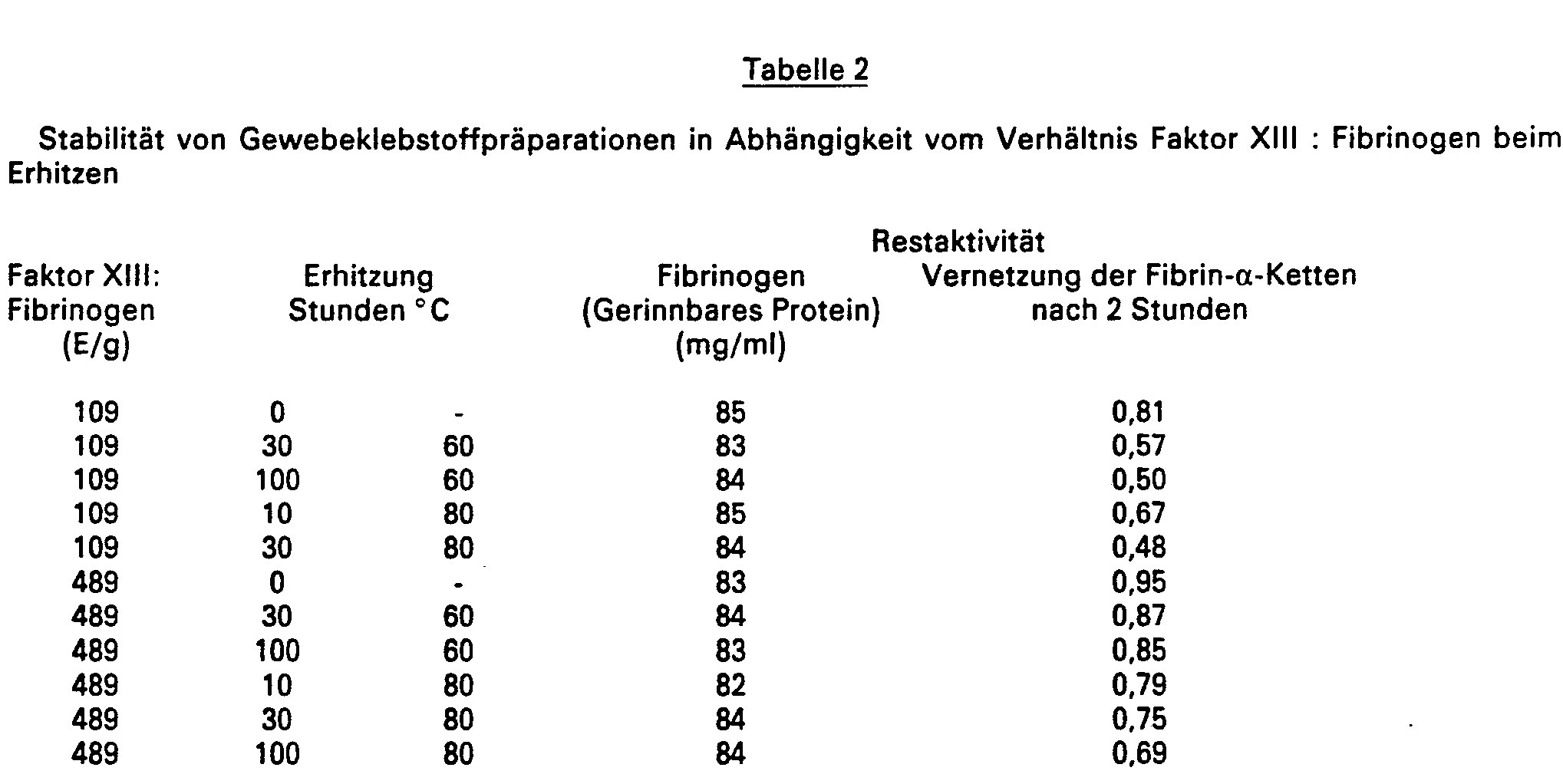
- Stabilität von Gewebeklebstoffpräparationen mit unterschiedlichem Gehalt an Faktor XIII, ausgedrückt durch das Verhältnis Einheiten Faktor XIII pro Gramm Fibrinogen:
- Eine Gewebeklebstoffpräparation wurde in gleicher Weise hergestellt wie bei Versuch 1. Ein Teil davon wurde zu einer Proteinkonzentration von 50 mg/ml aufgelöst; die Lösung wurde in zwei Teile geteilt.
- Ein Teil wurde mit 15 Einheiten Faktor XIII pro ml versetzt. Beide Teile wurden sodann zu je 2,5 ml in eine Anzahl von Glasfläschchen abgefüllt, tiefgefroren, gefriergetrocknet und unter N2 verschlossen. Der Gehalt an Fibrinogen und Faktor XIII wurde, wie in Versuch 1 beschrieben, bestimmt und der Gehalt an Faktor XIII pro Gramm Fibrinogen für jede der beiden Präparationen berechnet.
- Mehrere Proben der beiden Präparationen wurden bei 60°C bzw. bei 80°C verschieden lang erhitzt. Je zwei Proben wurden vor dem Erhitzen bzw. zu bestimmten Zeiten während des Erhitzungsvorganges zur Messung der Restaktivität entnommen.
- Die Bestimmung der Restaktivität erfolgte, wie in Versuch 1 beschrieben. Die Ergebnisse sind in der Tabelle 2 zusammengestellt.
- Ein Vergleich der gefundenen Werte für die Vernetzung der Fibrin-a-Ketten zeigt deutlich, daß die Stabilität von Gewebeklebstoffpräparationen mit steigendem Gehalt an Faktor XIII, ausgedrückt als Verhältnis Einheiten Faktor XIII Gramm Fibrinogen, zunimmt.
- Versuch 3:
- Stabilität von Gewebeklebstoffpräparationen mit einem Faktor XIII-Gehalt von etwa 500 Einheiten pro Gramm Fibrinogen und einem Wassergehalt von 0,005 beim Erhitzen unter N2 auf Temperaturen bis zu 120: C: Die Herstellung der Gewebeklebstoffpräparation erfolgte in gleicher Weise wie bei den Versuchen 1 und 2. Der Wassergehalt der Präparation wurde mit 0,005 und das Verhältnis Einheiten Faktor XIII : Gramm Fibrinogen Mit 496 bestimmt. Proben der Präparation wurden bei verschiedenen Temperaturen im Bereich zwischen 60 C und 120°C verschieden lang erhitzt. Je zwei Proben wurden vor dem Erhitzen bzw. nach bestimmten Erhitzungszeiten zur Messung der Restaktivität entnommen. Die Bestimmung der Restaktivität erfolgte, wie bei Versuch 1 beschrieben.
- Die Ergebnisse sind in der Tabelle 3 zusammengestellt.
- Unter Zugrundelegung der Qualitätsmerkmale, die für Gewebeklebstoffe auf Basis von Fibrinogen und Faktor XIII zu fordern sind, nämlich einem Mindestgehalt an Fibrinogen von 70 mg/ml und eine Vernetzung der Fibrin-a-Ketten in dem beschriebenen Vernetzungstest von mindestens 0,35 (35 %), ergibt sich somit, daß solche Gewebeklebstoffpräparationen unter den angeführten Bedingungen beträchtlich länger als in diesem Versuch erhitzt werden können, ohne zu große Qualitätsverluste in Kauf nehmen zu müssen.

- Das erfindungsgemäße Verfahren einschließlich der Inaktivierung von vermehrungsfähigen Krankheitserregern ist in den folgenden Beispielen näher erläutert. Da die notwendigen Untersuchungen über Virusinaktivierungen in Blutprodukten nicht sofort am Menschen vorgenommen werden können, erfolgt die Bewertung der Wirksamkeit der Inaktivierung mit Hilfe von Modellviren.
- Inaktivierung eines Modellvirus (Sindbis-Virus) und Restaktivität einer Gewebeklebstoffpräparation beim trockenen Erhitzen unter N2 oder Vakuum einerseits und unter Luft andererseits:
- Eine Gewebeklebstoffpräparation wurde in gleicher Weise, wie bei Versuch 1 beschrieben, hergestellt.
- Ein Teil der erhaltenen gefriergetrockneten Gewebeklebstoffpräparation wurde zu einer Proteinkonzentration von 50 mg/ml gelöst, mit einer Sindbis-Virussuspension in Zellkulturmedium TCM 199 bzw. mit virusfreiem Zellkulturmedium versetzt, in Glasfläschchen zu je 2,6 ml abgefüllt, tiefgefroren und bis zu einem Wassergehalt von 0,005 (0,5 Gew.-%) gefriergetrocknet. Ein Teil der Proben wurde unter Vakuum « 10 Pa), ein weiterer Teil unter N2 und ein weiterer Teil unter Luft bei Normaldruck dicht verschlossen.
- Die verschlossenen Proben wurden bei einer Temperatur von 60° C verschieden lang erhitzt. Je drei Proben wurden vor dem Erhitzen und zu bestimmten Zeiten während des Erhitzungsvorganges zur Messung des Virustiters einerseits und der Restaktivität andererseits entnommen.
- Die Bestimmung des Virustiters wurde in folgender Weise durchgeführt:
- Die Proben wurden in je 1,0 ml Wasser gelöst und mit isotoner Kochsalzlösung im Verhältnis 1 : 10 seriell verdünnt. Der Titer des Sindbis-Virus wurde durch Bewertung des zytopathischen Effektes auf sensitive Vero-Zellen in der Mikrotiterplatte bestimmt. Die Ergebnisse wurden nach statistischer Behandlung der Auswertung entsprechend der Formel von Reed und Muench als Logarithmus TCID50 ausgedrückt (J. L. Reed, H. Muench; Amer. J. Hyg. 27,493, 1938).
- Die Bestimmung der Restaktivität erfolgte, wie im Versuch 1 beschrieben. Die Ergebnisse sind in der Tabelle 4 zusammengestellt. Sie zeigen nicht nur, daß es möglich ist, Sindbis-Virus in Gewebeklebstoffpräparationen der beschriebenen Art vollständig zu inaktivieren, sondern führen vor allem auch zu der wichtigen Erkenntnis, daß das Verhältnis zwischen Virusinaktivierung einerseits und Restaktivität des Präparates andererseits dadurch wesentlich verbessert werden kann, daß die Erhitzung unter Ausschluß von Sauerstoff, d. h. unter einem inerten Schutzgas oder unter Vakuum durchgeführt wird.

- Die Arbeitsweise nach Beispiel 1 wurde wiederholt, mit dem Unterschied, daß die Proben nach erfolgter Gefriertrocknung in Gegenwart eines P205-haltigen Trocknungsmittels unter Vakuum bis zu einem Wassergehalt von 0,002 nachgetrocknet, unter Vakuum (<10 Pa) verschlossen und verschieden lang auf 70°C erhitzt wurden.
- Die erhaltenen Ergebnisse sind in Tabelle 5 zusammengefaßt.

- Inaktivierung von drei verschiedenen Modellviren in einer Gewebeklebstoffpräparation durch trockenes Erhitzen auf 60°C unter N2
- Eine Gewebeklebstoffpräparation wurde, wie in Versuch 1 beschrieben, hergestellt und der verdünnten Lösung des Gewebeklebstoffes vor der Sterilfiltration 12 Einheiten Faktor XIII pro ml zugegeben. Nach der Gefriertrocknung enthielt die Präparation 520 Einheiten Faktor XIII pro Gramm Fibrinogen.
- Ein Teil der erhaltenen Präparation wurde zu einer Konzentration von 50 mg Protein pro ml gelöst und je ein Teil der Lösung mit einer Suspension von Sindbis-Virus bzw. einer Suspension von VSV (vesicular stomatitis virus) bzw. einer Suspension von LCM (!ymphotropes choriomeningitis)-Virus in Zellkulturmedium TCM 199 oder mit virusfreiem Zellkulturmedium versetzt, in Glasfläschchen zu je 2,6 ml abgefüllt, tiefgefroren, bis zu einem Wassergehalt von 0,006 gefriergetrocknet und unter N2 verschlossen. Proben der Präparationen wurden auf 60° C erhitzt und wie in Beispiel 1 beschrieben vor der Erhitzung und nach bestimmten Erhitzungszeiten der Virustiter und die Restaktivität bestimmt.
- Die Ergebnisse sind in Tabelle 6 zusammengefaßt.
- Das Ergebnis von Beispiel 1, nämlich, daß Sindbis-Virus in einer Gewebeklebstoffpräparation durch 30- stündiges trockenes Erhitzen auf 60°C vollständig inaktiviert werden kann, wurde nach diesem Beispiel nochmals bestätigt. LCM-Virus und VSV waren bereits nach 10-stündigem Erhitzen vollständig inaktiviert.
- Die Aktivität der Gewebeklebstoffpräparation war nach 30-stündigem Erhitzen noch fast vollständig erhalten.

- Inaktivierung des Bakteriophagen X 174 beim trockenen Erhitzen einer Gewebeklebstoffpräparation auf 90= C
- Eine Gewebeklebstoffpräparation wurde, wie in Beispiel 3 beschrieben, hergestellt.
- Ein Teil der erhaltenen Präparation wurde zu einer Proteinkonzentration von 50 mg/ml gelöst und die Lösung mit einer Suspension des Bakteriophagen X 174 in Kulturmedium für Escherichia coli 11303 bzw. mit virusfreiem Kulturmedium versetzt, in Glasfläschchen zu je 2,6 ml abgefüllt, tiefgefroren, bis zu einem Wassergehalt von 0,005 gefriergetrocknet und unter N2 verschlossen.
- Ein Teil der Proben wurde verschieden lang auf 90°C erhitzt und der Virustiter und die Restaktivität vor dem Erhitzen und zu bestimmten Zeiten während des Erhitzungsvorganges bestimmt.
- Die Bestimmung des Virustiters wurde in folgender Weise durchgeführt:
- Die Proben wurden in je 1,0 ml H20 gelöst und mit 1 mM MgCI2 im Verhältnis 1 : 10 seriell verdünnt. Eine Mischung von 3 ml 0,7 % Bacto-Agar, 43 bis 45° C, 100 µl Suspension von E. coli in Flüssigmedium und 200 ul der bakteriophagenhältigen Probe bzw. Verdünnung wurden durchgemischt und rasch auf einer Nähragarplatte (ATCC 129) ausgegossen. Nach Inkubation über Nacht bei 37°C wurden mit Hilfe eines Zählgerätes die durch vermehrungsfähige Viruspartikel erzeugten Plaques in konfluenten Zellrasen gezählt (PFU, plaque-forming units). Die Ergebnisse wurden als log10 PFU ausgedrückt.
- Die Bestimmung der Restaktivität erfolgte, wie in Versuch 1 beschrieben. Die Ergebnisse sind in der Tabelle 7 zusammengefaßt. Sie zeigen, daß der (relativ hitzestabile) Bakteriophage X 174 in einer Gewebeklebstoffpräparation durch trockenes Erhitzen unter N2 auf 90°C vollständig inaktiviert werden kann, wobei die Aktivität der Gewebeklebstoffpräparation nahezu vollständig erhalten bleibt.

- Inaktivierung von Sindbis-Virus und Hundehepatitis-Virus in einer Gewebeklebstoffpräparation durch trockenes Erhitzen auf 110°C
- Eine Gewebeklebstoffpräparation wurde, wie in Beispiel 3 beschrieben, hergestellt.
- Ein Teil der erhaltenen gefriergetrockneten Gewebeklebstoffpräparation wurde zu einer Proteinkonzentration von 50 mg/ml gelöst, mit einer Sindbis-Virussuspension bzw. einer Hundehepatitis-Virussuspension in Zellkulturmedium TCM 199 bzw. mit virusfreiem Zellkulturmedium versetzt, in Glasfläschchen zu je 2,6 ml abgefüllt, tiefgefroren, bis zu einem Wassergehalt von 0,005 gefriergetrocknet und unter N2 verschlossen. Die Proben wurden bei einer Temperatur von 110°C verschieden lang erhitzt und wie beschrieben, die Aktivität der Präparation und der Virustiter vor dem Erhitzen und zu bestimmten Zeiten während des Erhitzungsvorganges bestimmt.
- Die Ergebnisse sind in Tabelle 8 zusammengefaßt.
- Das Beispiel zeigt, daß nicht nur Sindbis-Virus, sondern auch das als besonders hitzestabil bekannte Hundehepatitis-Virus in einer Gewebeklebstoffpräparation nach dem erfindungsgemäßen Verfahren vollkommen inaktiviert werden kann, ohne daß zu große Verluste an der biologischen Aktivität des Präparates in Kauf genommen werden müßten.

- Inaktivierung von drei verschiedenen Modellviren (Sindbis-Virus, VSV und Corona-Virus) in einer Gewebeklebstoffpräparation mit einem Wassergehalt von 0,04 beim Erhitzen unter N2 auf 60' C
- Eine Gewebeklebstoffpräparation wurde, wie in Beispiel 3 beschrieben, hergestellt.
- Ein Teil der erhaltenen gefriergetrockneten Gewebeklebstoffpräparation wurde zu einer Proteinkonzentration von 50 mg/ml gelöst und je ein Teil der Lösung mit einer Suspension von Sindbis-Virus bzw. einer Suspension von VSV (vesicular stomatitis virus) bzw. einer Suspension von Corona-Virus in Zellkulturmedium TCM 199 bzw. mit virusfreiem Zellkulturmedium versetzt, zu je 2,6 ml in Glasfläschchen abgefüllt, tiefgefroren, gefriergetrocknet, auf einen Wassergehalt von 0,04 eingestellt und unter N2 verschlossen.
- Proben der Präparation wurden auf 60° C erhitzt und vor der Erhitzung und nach bestimmten Erhitzungszeiten die Restaktivität und der Virustiter, wie im Beispiel 1 beschrieben, bestimmt.
- Die Ergebnisse sind in Tabelle 9 zusammengefaßt.
- Unter den angegebenen Bedingungen waren Sindbis-Virus bereits nach einer Erhitzungsdauer von 3 Stunden, VSV und Corona-Virus sogar schon nach 1 Stunde vollständig inaktiviert, wobei die Aktivität der Präparation weitgehend erhalten blieb.

Claims (3)
Gewebeklebstoffpräparationen, die einen Mindestgehalt von 100 Einheiten Faktor XIII/g Fibrinogen aufweisen, in Gegenwart eines sauerstoffreien inerten Schutzgases, vorzugsweise Stickstoff, oder unter Vakuum in trockenem Zustand bei einer Temperatur im Bereich von 50 bis 120° C während einer Dauer von mindestens 1 min erhitzt werden.
Applications Claiming Priority (2)
| Application Number | Priority Date | Filing Date | Title |
|---|---|---|---|
| AT3084/84 | 1984-09-28 | ||
| AT0308484A AT390001B (de) | 1984-09-28 | 1984-09-28 | Verfahren zur inaktivierung von vermehrungsfaehigen filtrierbaren krankheitserregern |
Publications (2)
| Publication Number | Publication Date |
|---|---|
| EP0183674A1 EP0183674A1 (de) | 1986-06-04 |
| EP0183674B1 true EP0183674B1 (de) | 1989-05-10 |
Family
ID=3545088
Family Applications (1)
| Application Number | Title | Priority Date | Filing Date |
|---|---|---|---|
| EP85890227A Expired EP0183674B1 (de) | 1984-09-28 | 1985-09-19 | Verfahren zur Inaktivierung von vermehrungsfähigen filtrierbaren Krankheitserregern |
Country Status (8)
| Country | Link |
|---|---|
| US (1) | US4816251A (de) |
| EP (1) | EP0183674B1 (de) |
| JP (1) | JPS6187628A (de) |
| AT (2) | AT390001B (de) |
| CA (1) | CA1245154A (de) |
| DE (1) | DE3570041D1 (de) |
| DK (1) | DK161366C (de) |
| ES (1) | ES8604776A1 (de) |
Families Citing this family (17)
| Publication number | Priority date | Publication date | Assignee | Title |
|---|---|---|---|---|
| DK475386D0 (da) * | 1986-10-03 | 1986-10-03 | Weis Fogh Ulla Sivertsen | Fremgangsmaade og apparat til fremstilling af biologiske stoffer |
| DE3734923C1 (de) * | 1987-10-15 | 1989-01-26 | Biotest Pharma Gmbh | Verfahren zur Herstellung einer sterilen Plasmaproteinloesung,die Fibrinogen und den Gerinnungsfaktor XIII enthaelt |
| FR2650508A1 (fr) * | 1989-08-01 | 1991-02-08 | Fondation Nale Transfusion San | Colle pasteurisee pour reunir des tissus humain ou animal |
| AT408191B (de) * | 1991-08-19 | 2001-09-25 | Haemosan Erzeugung Pharmazeuti | Verfahren zur inaktivierung von prionen |
| US5792835A (en) * | 1991-09-05 | 1998-08-11 | Baxter International Inc. | Method of preparing a topical fibrinogen complex |
| US5385606A (en) * | 1992-07-06 | 1995-01-31 | Kowanko; Nicholas | Adhesive composition and method |
| JPH06166634A (ja) * | 1992-12-01 | 1994-06-14 | Green Cross Corp:The | プラスミノーゲン含有組成物の製造方法 |
| US5395923A (en) * | 1993-02-23 | 1995-03-07 | Haemacure-Biotech, Inc. | Process for the obtention of a biological adhesive made of concentrated coagulation factors by "salting-out" |
| US5290918A (en) * | 1993-02-23 | 1994-03-01 | Haemacure Biotech Inc. | Process for the obtention of a biological adhesive made of concentrated coagulation factors by acidic precipitation |
| US5330974A (en) * | 1993-03-01 | 1994-07-19 | Fibratek, Inc. | Therapeutic fibrinogen compositions |
| AT402788B (de) * | 1993-08-03 | 1997-08-25 | Immuno Ag | Virussichere blutgerinnungsfaktor xiii-präparation |
| DE4404625C2 (de) * | 1994-02-14 | 1996-10-17 | Ludwig Dr Baumgartner | Verfahren zur Inaktivierung thermolabiler Viren in biologischem Material unter Beibehaltung der kollagenen Eigenschaften |
| GB9424732D0 (en) * | 1994-12-08 | 1995-02-08 | Common Services Agency | Heat treated blood plasma proteins |
| US5837519A (en) * | 1996-11-21 | 1998-11-17 | Bayer Corporation | Dry-heat viral inactivation under controlled moisture conditions |
| GB0214749D0 (en) * | 2002-06-26 | 2002-08-07 | Leuven K U Res & Dev | Time temperature integrators |
| US20090038701A1 (en) * | 2006-01-17 | 2009-02-12 | Baxter International Inc. | Device, system and method for mixing |
| DE602008003459D1 (de) | 2008-11-10 | 2010-12-23 | Sports Art Ind Co Ltd | Sportvorrichtung mit nichtlinearer Gleitschiene |
Family Cites Families (9)
| Publication number | Priority date | Publication date | Assignee | Title |
|---|---|---|---|---|
| GB103196A (en) * | 1916-02-16 | 1917-01-18 | Percy Arthur William Parkyn | Improvements in or in connection with the Automatic Regulation of the Temperature of Gases or Superheated Steam. |
| AT359652B (de) * | 1979-02-15 | 1980-11-25 | Immuno Ag | Verfahren zur herstellung eines gewebekleb- stoffes |
| DE2916711A1 (de) * | 1979-04-25 | 1980-11-06 | Behringwerke Ag | Blutgerinnungsfaktoren und verfahren zu ihrer herstellung |
| US4495278A (en) * | 1981-04-27 | 1985-01-22 | Baxter Travenol Laboratories, Inc. | Process for making novel blood clotting enzyme compositions |
| EP0068149A3 (de) * | 1981-06-25 | 1983-07-20 | Serapharm GmbH & Co. KG | Fibrinogen-haltiges Trockenpräparat, dessen Herstellung und Verwendung |
| US4456590B2 (en) * | 1981-11-02 | 1989-05-30 | Heat treatment of lyphilized blood clotting factor viii concentrate | |
| DE3230849A1 (de) * | 1982-08-19 | 1984-02-23 | Behringwerke Ag, 3550 Marburg | Pasteurisiertes human-fibrinogen (hf) und verfahren zu dessen herstellung |
| JPS6054287B2 (ja) * | 1983-10-19 | 1985-11-29 | 株式会社ミドリ十字 | 血漿蛋白の加熱処理方法 |
| AT389815B (de) * | 1984-03-09 | 1990-02-12 | Immuno Ag | Verfahren zur inaktivierung von vermehrungsfaehigen filtrierbaren krankheitserregern in blutprodukten |
-
1984
- 1984-09-28 AT AT0308484A patent/AT390001B/de not_active IP Right Cessation
-
1985
- 1985-09-12 CA CA000490555A patent/CA1245154A/en not_active Expired
- 1985-09-13 US US06/775,609 patent/US4816251A/en not_active Expired - Lifetime
- 1985-09-17 ES ES547064A patent/ES8604776A1/es not_active Expired
- 1985-09-19 EP EP85890227A patent/EP0183674B1/de not_active Expired
- 1985-09-19 AT AT85890227T patent/ATE42900T1/de not_active IP Right Cessation
- 1985-09-19 DE DE8585890227T patent/DE3570041D1/de not_active Expired
- 1985-09-27 DK DK439485A patent/DK161366C/da not_active IP Right Cessation
- 1985-09-27 JP JP60216082A patent/JPS6187628A/ja active Pending
Also Published As
| Publication number | Publication date |
|---|---|
| ATE42900T1 (de) | 1989-05-15 |
| JPS6187628A (ja) | 1986-05-06 |
| ATA308484A (de) | 1989-08-15 |
| DK439485A (da) | 1986-03-29 |
| US4816251A (en) | 1989-03-28 |
| EP0183674A1 (de) | 1986-06-04 |
| ES547064A0 (es) | 1986-03-01 |
| AT390001B (de) | 1990-03-12 |
| DE3570041D1 (en) | 1989-06-15 |
| CA1245154A (en) | 1988-11-22 |
| DK161366C (da) | 1991-12-09 |
| ES8604776A1 (es) | 1986-03-01 |
| DK439485D0 (da) | 1985-09-27 |
| DK161366B (da) | 1991-07-01 |
Similar Documents
| Publication | Publication Date | Title |
|---|---|---|
| AT390001B (de) | Verfahren zur inaktivierung von vermehrungsfaehigen filtrierbaren krankheitserregern | |
| EP0159311B1 (de) | Verfahren zur Inaktivierung von vermehrungsfähigen filtrierbaren Krankheitserregern in Blutprodukten | |
| DE3382716T2 (de) | Verfahren zur Wärmebehandlung von Plasma oder Plasmafraktionen und so erhaltene Zusammensetzungen. | |
| EP0068047B1 (de) | Angereichertes Plasmaderivat zur Unterstützung von Wundverschluss und Wundheilung | |
| EP0519901B1 (de) | Durch Hitze und/oder Detergens virusinaktiviertes Blutprodukt | |
| AT397203B (de) | Gewebeklebstoff | |
| EP0049469B1 (de) | Kollagene Wundauflage | |
| DE60027695T2 (de) | Verfahren zur herstellung von fibrinogen und fibronectin sowie proteinzusammesetzungen, welche damit herstellbar sind | |
| EP0124506B1 (de) | Verfahren zur Inaktivierung von vermehrungsfähigen Krankheitserregern | |
| DE3002933C2 (de) | Gewebeklebstoff | |
| EP0330047B1 (de) | Verfahren zur Sterilisation von Blut, Plasma, Blut- und Plasmaderivaten, Zellsuspensionen oder dgl. | |
| DE3734923C1 (de) | Verfahren zur Herstellung einer sterilen Plasmaproteinloesung,die Fibrinogen und den Gerinnungsfaktor XIII enthaelt | |
| CH649711A5 (de) | Gewebeklebstoff. | |
| DD201646A5 (de) | Verfahren zur kaltsterilisation von blutgerinnungsfaktor viii enthaltenden praeparaten | |
| DE69231791T2 (de) | Verbesserter Gewebekleber, zubereitet aus Kryopräzipitat | |
| WO1994013329A1 (de) | Verfahren zur herstellung eines virussicheren biologischen präparates | |
| EP0637451B1 (de) | Virussichere Blutgerinnungsfaktor XIII-Präparation | |
| DE69321007T2 (de) | Zusammensetzung zur Stabilisierung von Blutplasma im Laufe der Pasteurisation und Pasteurisationsverfahren unter Verwendung dieser Zusammensetzung | |
| EP0457370B1 (de) | Verfahren zur Pasteurisierung des Gewebeproteins PP4 | |
| EP1007109B1 (de) | Gewebekleber auf basis von fibrinogen | |
| DE2715832B2 (de) | Verfahren zur Gewinnung von gereinigtem antihämophilem Globulin A (Faktor VIII) | |
| DE69529845T2 (de) | Wärmebehandlung von blutplasmaproteinen | |
| DE19859611C2 (de) | Fibrinklebergranulat und Verfahren zu dessen Herstellung | |
| WO1998055140A1 (en) | Fibrinogen concentrate from human plasma | |
| DE3813464A1 (de) | Verfahren zur waermebehandlung von fibrinogen |
Legal Events
| Date | Code | Title | Description |
|---|---|---|---|
| PUAI | Public reference made under article 153(3) epc to a published international application that has entered the european phase |
Free format text: ORIGINAL CODE: 0009012 |
|
| AK | Designated contracting states |
Kind code of ref document: A1 Designated state(s): AT BE CH DE FR GB IT LI NL SE |
|
| 17P | Request for examination filed |
Effective date: 19860905 |
|
| 17Q | First examination report despatched |
Effective date: 19880519 |
|
| GRAA | (expected) grant |
Free format text: ORIGINAL CODE: 0009210 |
|
| AK | Designated contracting states |
Kind code of ref document: B1 Designated state(s): AT BE CH DE FR GB IT LI NL SE |
|
| REF | Corresponds to: |
Ref document number: 42900 Country of ref document: AT Date of ref document: 19890515 Kind code of ref document: T |
|
| REF | Corresponds to: |
Ref document number: 3570041 Country of ref document: DE Date of ref document: 19890615 |
|
| ET | Fr: translation filed | ||
| ITF | It: translation for a ep patent filed | ||
| GBT | Gb: translation of ep patent filed (gb section 77(6)(a)/1977) | ||
| PLBE | No opposition filed within time limit |
Free format text: ORIGINAL CODE: 0009261 |
|
| STAA | Information on the status of an ep patent application or granted ep patent |
Free format text: STATUS: NO OPPOSITION FILED WITHIN TIME LIMIT |
|
| 26N | No opposition filed | ||
| ITTA | It: last paid annual fee | ||
| EAL | Se: european patent in force in sweden |
Ref document number: 85890227.3 |
|
| REG | Reference to a national code |
Ref country code: GB Ref legal event code: IF02 |
|
| PGFP | Annual fee paid to national office [announced via postgrant information from national office to epo] |
Ref country code: AT Payment date: 20030902 Year of fee payment: 19 |
|
| PGFP | Annual fee paid to national office [announced via postgrant information from national office to epo] |
Ref country code: NL Payment date: 20030909 Year of fee payment: 19 |
|
| PGFP | Annual fee paid to national office [announced via postgrant information from national office to epo] |
Ref country code: GB Payment date: 20030910 Year of fee payment: 19 |
|
| PGFP | Annual fee paid to national office [announced via postgrant information from national office to epo] |
Ref country code: FR Payment date: 20030918 Year of fee payment: 19 |
|
| PGFP | Annual fee paid to national office [announced via postgrant information from national office to epo] |
Ref country code: SE Payment date: 20030919 Year of fee payment: 19 |
|
| PGFP | Annual fee paid to national office [announced via postgrant information from national office to epo] |
Ref country code: CH Payment date: 20030923 Year of fee payment: 19 |
|
| PGFP | Annual fee paid to national office [announced via postgrant information from national office to epo] |
Ref country code: BE Payment date: 20031017 Year of fee payment: 19 |
|
| PGFP | Annual fee paid to national office [announced via postgrant information from national office to epo] |
Ref country code: DE Payment date: 20031031 Year of fee payment: 19 |
|
| PG25 | Lapsed in a contracting state [announced via postgrant information from national office to epo] |
Ref country code: GB Free format text: LAPSE BECAUSE OF NON-PAYMENT OF DUE FEES Effective date: 20040919 Ref country code: AT Free format text: LAPSE BECAUSE OF NON-PAYMENT OF DUE FEES Effective date: 20040919 |
|
| PG25 | Lapsed in a contracting state [announced via postgrant information from national office to epo] |
Ref country code: SE Free format text: LAPSE BECAUSE OF NON-PAYMENT OF DUE FEES Effective date: 20040920 |
|
| PG25 | Lapsed in a contracting state [announced via postgrant information from national office to epo] |
Ref country code: LI Free format text: LAPSE BECAUSE OF NON-PAYMENT OF DUE FEES Effective date: 20040930 Ref country code: CH Free format text: LAPSE BECAUSE OF NON-PAYMENT OF DUE FEES Effective date: 20040930 Ref country code: BE Free format text: LAPSE BECAUSE OF NON-PAYMENT OF DUE FEES Effective date: 20040930 |
|
| BERE | Be: lapsed |
Owner name: *IMMUNO A.G. FUR CHEMISCH-MEDIZINISCHE PRODUKTE Effective date: 20040930 |
|
| PG25 | Lapsed in a contracting state [announced via postgrant information from national office to epo] |
Ref country code: NL Free format text: LAPSE BECAUSE OF NON-PAYMENT OF DUE FEES Effective date: 20050401 Ref country code: DE Free format text: LAPSE BECAUSE OF NON-PAYMENT OF DUE FEES Effective date: 20050401 |
|
| EUG | Se: european patent has lapsed | ||
| GBPC | Gb: european patent ceased through non-payment of renewal fee |
Effective date: 20040919 |
|
| REG | Reference to a national code |
Ref country code: CH Ref legal event code: PL |
|
| PG25 | Lapsed in a contracting state [announced via postgrant information from national office to epo] |
Ref country code: FR Free format text: LAPSE BECAUSE OF NON-PAYMENT OF DUE FEES Effective date: 20050531 |
|
| NLV4 | Nl: lapsed or anulled due to non-payment of the annual fee |
Effective date: 20050401 |
|
| REG | Reference to a national code |
Ref country code: FR Ref legal event code: ST |
|
| BERE | Be: lapsed |
Owner name: *IMMUNO A.G. FUR CHEMISCH-MEDIZINISCHE PRODUKTE Effective date: 20040930 |