EP0178680A2 - Feed length control device for consumable electrode welding operations - Google Patents
Feed length control device for consumable electrode welding operations Download PDFInfo
- Publication number
- EP0178680A2 EP0178680A2 EP85113251A EP85113251A EP0178680A2 EP 0178680 A2 EP0178680 A2 EP 0178680A2 EP 85113251 A EP85113251 A EP 85113251A EP 85113251 A EP85113251 A EP 85113251A EP 0178680 A2 EP0178680 A2 EP 0178680A2
- Authority
- EP
- European Patent Office
- Prior art keywords
- feed length
- length control
- current
- welding
- welding current
- Prior art date
- Legal status (The legal status is an assumption and is not a legal conclusion. Google has not performed a legal analysis and makes no representation as to the accuracy of the status listed.)
- Withdrawn
Links
Images
Classifications
-
- B—PERFORMING OPERATIONS; TRANSPORTING
- B23—MACHINE TOOLS; METAL-WORKING NOT OTHERWISE PROVIDED FOR
- B23K—SOLDERING OR UNSOLDERING; WELDING; CLADDING OR PLATING BY SOLDERING OR WELDING; CUTTING BY APPLYING HEAT LOCALLY, e.g. FLAME CUTTING; WORKING BY LASER BEAM
- B23K9/00—Arc welding or cutting
- B23K9/06—Arrangements or circuits for starting the arc, e.g. by generating ignition voltage, or for stabilising the arc
- B23K9/073—Stabilising the arc
- B23K9/0732—Stabilising of the arc current
Definitions
- the present invention relates to a feed length control device for use in consumable electrode welding operations in which a pulse-like welding current is employed.
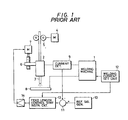
- Fig. 1 of the accompanying drawinqs is a block dia q ram showing a conventional feed length control device used in consumable electrode weldinq operations.
- reference numeral 1 designates a welding machine; 2, a torch for holding a wire electrode; and 4, a wire electrode feeding motor which rotates a pair of drive rollers 5 'to feed the wire electrode 3. Further in Fig.
- reference numeral 6 designates a torch moving mechanism for moving the torch 2 vertically; 7, a torch moving motor for operating the torch moving mechanism 6; 8, a metal base; 9, a current detector for detecting the welding current flowing between the wire electrode 3 and the metal base 8 supplied by the welding machine 1 and outputting a welding current detection signal; 10, a reference signal having a state determined according to the wire electrode feed length set in the welding operation; and 11, a comparator which compares the welding current detection signal outputted by the current detector 9 with the reference signal 10 to provide a deviation signal. Further in Fig.
- reference numeral 12 designates a welding current setting unit for setting the peak current value, base current value, peak current time and base current time of a welding current; 13, a feed length control start instruction circuit which, in response to the deviation signal from the comparator and an output signal of the welding current setting unit 12 establishes the feed control timing; and 14, a motor drive circuit for amplifying the output signal of the circuit 13 to drive the torch moving motor 7.
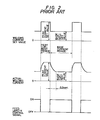
- feed length control device In the feed length control device thus constructed, while the wire electrode 3 is being fed by the wire electrode feeding motor 4, a welding current is caused to flow between the wire electrode 3 and the base 8 so that arcing occurs between the wire electrode 3 and the base 8 to achieve the welding operation. As shown in Fig. 2, feed length control is carried out while the welding current is in the base current period. While the welding current is in the peak current period, feed length control is not carried out, but the welding current is varied to control the weld penetration or the amount of deposition.
- the welding current set value is changed from a peak current set value to a base current set value instantaneously as shown in Fig. 2.
- the actual welding current set value cannot change from a peak current value to a base current value instantaneously. It has been found through measurement that it takes about 0.3 second for the welding current to change as described above.
- feed length control starts at the time instant when the welding current set value is changed from the peak current set value to the base current set value as shown in Fig. 2, in practice, feed length control is started before the welding current changes from the peak current value to the base current value. Further, the reference signal 10 for feed length control is made to coincide with the base current value. Therefore, disadvantageously the feed length is extremely short when feed length control starts.
- An object of the invention is to eliminate the above-described difficulties accompanying a conventional feed length control device used in a consumable electrode welding operation.
- a feed length control device for use in consumable electrode welding operations in which the start of feed length control is delayed for a predetermined period of time from the time instant when the welding current set value changes from the peak current set value to the base current set value; that is, feed length control is started when the actual welding current reaches the base current value. Accordingly, the feed length will not be extremely long when feed length control is started.
- a feed length control device used in consumable electrode welding operations comprises a delay circuit which delays the start of electrode wire feed length control for a predetermined period of time from the start of the base current set period.
- feed length control is carried out when the actual welding current reaches the base current value. Therefore, the feed length will not be excessively long at the start of feed length control, and the resultant weld will be satisfactory, having a deep weld penetration.
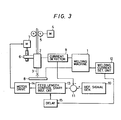
- Fig. 3 is a block diagram showing a welding machine constructed according to the invention.
- reference numerals 1 through 14 designate the same components as those in the above-described conventional device, and reference numeral 15 designates a delay circuit for delaying the start time of the feed length control signal.
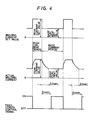
- the start of feed length control is delayed by the delay circuit 15 for a predetermined period of time, for instance, about 0.4 second, from the time instant when the welding current set value is changed from the peak current set value to the base current set value; that is, feed length control is started when the actual welding current reaches the base current value. Therefore, the feed length will not be excessively long, and it is substantially constant at all times.
- the delay circuit 15 is added to the conventional device.
- a method of changing the reference signal 10 according to the actual welding current waveform may be employed, or a reverse bias voltage in the base current period of the welding current detection signal may be applied to make the welding current detecting signal constant for the base current period.
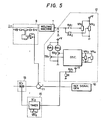
- Fig. 5 is a circuit diagram illustrating the circuits 9, 12, 13 and 15 in detail.
- the current detector 9 is implemented with Hall elements wherein a welding current I flowing therethrough generates a magnetic field in a direction vertical to the flow direction of the welding current due to Hall effect and a Hall voltage whose amplitude is proportional to the strength of the magnetic field is generated. This voltage signal is outputted as the output of the current detector after amplification.
- This type current detector is commercially available.
- the welding current setting unit 12 includes a base current instruction voltage adjustor (variable resistor) VR 1 , a peak current instruction voltage adjustor (variable resistor) VR 2 , a base current time adjustor (variable resistor) VR 3 and a peak current time adjustor (variable resistor) VR 4 .
- an oscillator OSC is provided to periodically turn ON and OFF transistors TR 1 and TR 2 alternately in accordance with set times adjusted by the time adjustors VR 3 and VR 4 .
- the transistor TR 1 is rendered conductive during the base current time
- the transistor TR 2 is rendered conductive during the peak current time.
- Relay circuits RA l and RA 2 are selectively actuated in response to the ON/OFF operation of the transistors TR 1 and TR 2 .
- a first terminal of each of the relay circuits RA 1 and RA 2 is coupled to the wiper terminals of VR 1 and VR 2 , to vary the base current value and the peak current value. The thus adjusted values are applied to the welding apparatus 1.
- the first terminal of the relay circuit RA l is further coupled to a power source +V and a resistor R.
- the junction point between the relay circuit RA l and the resistor R is coupled to the delay circuit 15.
- the feed length control start instruction circuit 13 is a gate circuit which functions to output the output of the comparator 11 to the motor drive circuit 14 at an appropriate time.
- An example of the circuit 13 is an analog switch of a type commercially available.
- the feed length control start instruction circuit 13 is a gate circuit which outputs the output of the comparator 11 to a motor drive circuit 14 at an appropriate time.
- An example of the circuit 13 is an analog switch of a type commercially available.
- the delay circuit 15 functions to delay the output timing of the base time output of the welding current setting unit 12 for the period of time set by a delay time setting time adjustor (variable resistor) VR 5 .
- the welding apparatus 1 When the base current and peak current instruction voltage, set by VR 1 to VR 4 in the welding current setting unit 12, are applied to the welding apparatus 1, the welding apparatus 1 operates to allow a welding current I to flow between the wire electrode 3 and the base metal 8.
- the welding current I is detected by the current detector 9 and compared with a reference signal from the circuit 10. This comparison result is amplified and then outputted as a difference signal.
- the output of the circuit 12 is directly connected to the circuit 13 to control the movement of the torch in both upward and downward directions during the base current period of the welding current.
- this apparatus is disadvantageous in that an undesired delay may occur between the output voltage signal of the circuit 12 and the actual welding current waveform signal, which is caused by the inertial force of the wire feeding motor. This undesired delay results in making it impossible to carry out a suitable control operation.
- the delay circuit 15 is provided to eliminate the difference of 0.3 sec. shown in Fig. 4.
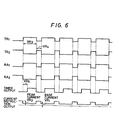
- the timing chart of Fig. 6 shows the ON/OFF operations of the transistors and relay circuits, the output of the timer 15, and the current instruction output signal.
- the start of feed length control is delayed for a predetermined period of time from the time instant when the welding current set value changes from the peak current set value to the base current set value; that is, feed length control is started only after the actual welding current reaches the base current value. Therefore, the feed length will never be excessively long, and therefore the resultant weld will be satisfactory, having a deep weld penetration.
Landscapes
- Engineering & Computer Science (AREA)
- Physics & Mathematics (AREA)
- Plasma & Fusion (AREA)
- Mechanical Engineering (AREA)
- Arc Welding Control (AREA)
Abstract
Description
- The present invention relates to a feed length control device for use in consumable electrode welding operations in which a pulse-like welding current is employed.
- Fig. 1 of the accompanying drawinqs is a block diaqram showing a conventional feed length control device used in consumable electrode weldinq operations. In Fig. 1,
reference numeral 1 designates a welding machine; 2, a torch for holding a wire electrode; and 4, a wire electrode feeding motor which rotates a pair of drive rollers 5 'to feed the wire electrode 3. Further in Fig. 1, reference numeral 6 designates a torch moving mechanism for moving thetorch 2 vertically; 7, a torch moving motor for operating the torch moving mechanism 6; 8, a metal base; 9, a current detector for detecting the welding current flowing between the wire electrode 3 and themetal base 8 supplied by thewelding machine 1 and outputting a welding current detection signal; 10, a reference signal having a state determined according to the wire electrode feed length set in the welding operation; and 11, a comparator which compares the welding current detection signal outputted by thecurrent detector 9 with thereference signal 10 to provide a deviation signal. Further in Fig. 1,reference numeral 12 designates a welding current setting unit for setting the peak current value, base current value, peak current time and base current time of a welding current; 13, a feed length control start instruction circuit which, in response to the deviation signal from the comparator and an output signal of the weldingcurrent setting unit 12 establishes the feed control timing; and 14, a motor drive circuit for amplifying the output signal of thecircuit 13 to drive thetorch moving motor 7. - In the feed length control device thus constructed, while the wire electrode 3 is being fed by the wire
electrode feeding motor 4, a welding current is caused to flow between the wire electrode 3 and thebase 8 so that arcing occurs between the wire electrode 3 and thebase 8 to achieve the welding operation. As shown in Fig. 2, feed length control is carried out while the welding current is in the base current period. While the welding current is in the peak current period, feed length control is not carried out, but the welding current is varied to control the weld penetration or the amount of deposition. - In this case, the welding current set value is changed from a peak current set value to a base current set value instantaneously as shown in Fig. 2. However, the actual welding current set value cannot change from a peak current value to a base current value instantaneously. It has been found through measurement that it takes about 0.3 second for the welding current to change as described above. However, since feed length control starts at the time instant when the welding current set value is changed from the peak current set value to the base current set value as shown in Fig. 2, in practice, feed length control is started before the welding current changes from the peak current value to the base current value. Further, the
reference signal 10 for feed length control is made to coincide with the base current value. Therefore, disadvantageously the feed length is extremely short when feed length control starts. - An object of the invention is to eliminate the above-described difficulties accompanying a conventional feed length control device used in a consumable electrode welding operation.
- The above and other objects are met by the provision of a feed length control device for use in consumable electrode welding operations in which the start of feed length control is delayed for a predetermined period of time from the time instant when the welding current set value changes from the peak current set value to the base current set value; that is, feed length control is started when the actual welding current reaches the base current value. Accordingly, the feed length will not be extremely long when feed length control is started.
- A feed length control device used in consumable electrode welding operations according to the invention comprises a delay circuit which delays the start of electrode wire feed length control for a predetermined period of time from the start of the base current set period.
- In accordance with the invention, feed length control is carried out when the actual welding current reaches the base current value. Therefore, the feed length will not be excessively long at the start of feed length control, and the resultant weld will be satisfactory, having a deep weld penetration.
- For a better understanding of the invention, and to show how the same may be carried into effect, reference will now be made, by way of example, to the accompanying drawings, in which:
- Fig. 1 is a block diagram showing a conventional feed length control device used in a consumable electrode welding operation;
- Fig. 2 is a timing chart used for a description of the operation of the conventional feed length control device;
- Fig. 3 is a block diagram showing a preferred embodiment of a feed length control device of the invention;
- Fig. 4 is a timing chart used for a description of the operation of the preferred embodiment;
- Fig. 5 shows details of feed length control device of Fig. 3; and
- Fig. 6 is a timing diagram used for an ·explanation of Fig. 5.
- A preferred embodiment of the invention will be described with reference first to Figs. 3 and 4.
- Fig. 3 is a block diagram showing a welding machine constructed according to the invention. In Fig. 3,
reference numerals 1 through 14 designate the same components as those in the above-described conventional device, andreference numeral 15 designates a delay circuit for delaying the start time of the feed length control signal. - In the feed length control device thus constructed, as shown in Fig. 4, the start of feed length control is delayed by the
delay circuit 15 for a predetermined period of time, for instance, about 0.4 second, from the time instant when the welding current set value is changed from the peak current set value to the base current set value; that is, feed length control is started when the actual welding current reaches the base current value. Therefore, the feed length will not be excessively long, and it is substantially constant at all times. - In the above-described embodiment, the
delay circuit 15 is added to the conventional device. However, instead of the employment of thedelay circuit 15, a method of changing thereference signal 10 according to the actual welding current waveform may be employed, or a reverse bias voltage in the base current period of the welding current detection signal may be applied to make the welding current detecting signal constant for the base current period. - Fig. 5 is a circuit diagram illustrating the
circuits - In Fig. 5, the
curent detector 9 is implemented with Hall elements wherein a welding current I flowing therethrough generates a magnetic field in a direction vertical to the flow direction of the welding current due to Hall effect and a Hall voltage whose amplitude is proportional to the strength of the magnetic field is generated. This voltage signal is outputted as the output of the current detector after amplification. This type current detector is commercially available. - Further, the welding
current setting unit 12 includes a base current instruction voltage adjustor (variable resistor) VR1, a peak current instruction voltage adjustor (variable resistor) VR2, a base current time adjustor (variable resistor) VR3 and a peak current time adjustor (variable resistor) VR4. In the weldingcurrent setting unit 12, an oscillator OSC is provided to periodically turn ON and OFF transistors TR1 and TR2 alternately in accordance with set times adjusted by the time adjustors VR3 and VR4. In this case, the transistor TR1 is rendered conductive during the base current time, whereas the transistor TR2 is rendered conductive during the peak current time. Relay circuits RAl and RA2 are selectively actuated in response to the ON/OFF operation of the transistors TR1 and TR2. A first terminal of each of the relay circuits RA1 and RA2 is coupled to the wiper terminals of VR1 and VR2, to vary the base current value and the peak current value. The thus adjusted values are applied to thewelding apparatus 1. The first terminal of the relay circuit RAl is further coupled to a power source +V and a resistor R. The junction point between the relay circuit RAl and the resistor R is coupled to thedelay circuit 15. - The feed length control
start instruction circuit 13 is a gate circuit which functions to output the output of thecomparator 11 to themotor drive circuit 14 at an appropriate time. An example of thecircuit 13 is an analog switch of a type commercially available. - The feed length control
start instruction circuit 13 is a gate circuit which outputs the output of thecomparator 11 to amotor drive circuit 14 at an appropriate time. An example of thecircuit 13 is an analog switch of a type commercially available. - The
delay circuit 15 functions to delay the output timing of the base time output of the weldingcurrent setting unit 12 for the period of time set by a delay time setting time adjustor (variable resistor) VR5. - The operation of this circuit will be described.
- When the base current and peak current instruction voltage, set by VR1 to VR4 in the welding
current setting unit 12, are applied to thewelding apparatus 1, thewelding apparatus 1 operates to allow a welding current I to flow between the wire electrode 3 and thebase metal 8. The welding current I is detected by thecurrent detector 9 and compared with a reference signal from thecircuit 10. This comparison result is amplified and then outputted as a difference signal. - In the conventional apparatus shown in Fig. 1, the output of the
circuit 12 is directly connected to thecircuit 13 to control the movement of the torch in both upward and downward directions during the base current period of the welding current. In this case, however, as discussed above, this apparatus is disadvantageous in that an undesired delay may occur between the output voltage signal of thecircuit 12 and the actual welding current waveform signal, which is caused by the inertial force of the wire feeding motor. This undesired delay results in making it impossible to carry out a suitable control operation. - According to the present invention, the
delay circuit 15 is provided to eliminate the difference of 0.3 sec. shown in Fig. 4. - The timing chart of Fig. 6 shows the ON/OFF operations of the transistors and relay circuits, the output of the
timer 15, and the current instruction output signal. - As is apparent from the above description, in the feed length control device of the invention, the start of feed length control is delayed for a predetermined period of time from the time instant when the welding current set value changes from the peak current set value to the base current set value; that is, feed length control is started only after the actual welding current reaches the base current value. Therefore, the feed length will never be excessively long, and therefore the resultant weld will be satisfactory, having a deep weld penetration.
Claims (2)
Applications Claiming Priority (2)
| Application Number | Priority Date | Filing Date | Title |
|---|---|---|---|
| JP219249/84 | 1984-10-18 | ||
| JP59219249A JPS6195775A (en) | 1984-10-18 | 1984-10-18 | Wire extension control device in consumable electrode welding |
Publications (2)
| Publication Number | Publication Date |
|---|---|
| EP0178680A2 true EP0178680A2 (en) | 1986-04-23 |
| EP0178680A3 EP0178680A3 (en) | 1988-01-07 |
Family
ID=16732560
Family Applications (1)
| Application Number | Title | Priority Date | Filing Date |
|---|---|---|---|
| EP85113251A Withdrawn EP0178680A3 (en) | 1984-10-18 | 1985-10-18 | Feed length control device for consumable electrode welding operations |
Country Status (3)
| Country | Link |
|---|---|
| US (1) | US4636610A (en) |
| EP (1) | EP0178680A3 (en) |
| JP (1) | JPS6195775A (en) |
Cited By (1)
| Publication number | Priority date | Publication date | Assignee | Title |
|---|---|---|---|---|
| WO1999046078A1 (en) * | 1998-03-10 | 1999-09-16 | Fronius Schweissmaschinen Produktion Gmbh & Co. Kg | Method for igniting an electric arc between a workpiece and a fusible electrode and device for the implementation thereof |
Families Citing this family (5)
| Publication number | Priority date | Publication date | Assignee | Title |
|---|---|---|---|---|
| DE3545505C2 (en) * | 1985-12-20 | 1995-08-10 | Kuka Schweissanlagen & Roboter | Method and device for locating and tracking a fillet weld in gas-shielded arc welding |
| JPS63220979A (en) * | 1987-03-06 | 1988-09-14 | Sankyo Seiki Mfg Co Ltd | Tig welding method |
| CN1222395C (en) * | 2003-08-19 | 2005-10-12 | 潘际銮 | Method for controlling fully positioning self creeping arc welding robot with permanent magnet caterpillar |
| US7105776B2 (en) * | 2004-01-22 | 2006-09-12 | Illinois Tool Works Inc | Method and apparatus for welding with start control |
| US11383318B2 (en) | 2018-02-02 | 2022-07-12 | Liburdi Engineering Limited | Filler wire position control |
Family Cites Families (8)
| Publication number | Priority date | Publication date | Assignee | Title |
|---|---|---|---|---|
| FR1368492A (en) * | 1963-09-03 | 1964-07-31 | Union Carbide Corp | Adjusting the electrode approach in an arc welding machine |
| JPS53129141A (en) * | 1977-04-19 | 1978-11-10 | Matsushita Electric Ind Co Ltd | Controller for welding arc voltage or arc length |
| JPS5415449A (en) * | 1977-07-06 | 1979-02-05 | Osaka Transformer Co Ltd | Method and apparatus for nonconsumable electrode arc welding |
| JPS5719168A (en) * | 1980-07-08 | 1982-02-01 | Mitsubishi Electric Corp | Pulse arc welding machine |
| JPS5762865A (en) * | 1980-09-22 | 1982-04-16 | Mitsubishi Electric Corp | Pulse arc welding machine |
| JPS58179571A (en) * | 1982-04-14 | 1983-10-20 | Mitsubishi Electric Corp | Pulsed arc welding machine |
| DE3219726C2 (en) * | 1982-05-26 | 1992-07-23 | Universal Tiefpunkt Schweißmaterial GmbH & Co, 7812 Bad Krozingen | Device for arc welding with a tracking consumable electrode |
| JPS5985374A (en) * | 1982-11-09 | 1984-05-17 | Mitsubishi Heavy Ind Ltd | Automatic profiling method of weld line |
-
1984
- 1984-10-18 JP JP59219249A patent/JPS6195775A/en active Pending
-
1985
- 1985-10-18 EP EP85113251A patent/EP0178680A3/en not_active Withdrawn
- 1985-10-18 US US06/789,257 patent/US4636610A/en not_active Expired - Fee Related
Cited By (1)
| Publication number | Priority date | Publication date | Assignee | Title |
|---|---|---|---|---|
| WO1999046078A1 (en) * | 1998-03-10 | 1999-09-16 | Fronius Schweissmaschinen Produktion Gmbh & Co. Kg | Method for igniting an electric arc between a workpiece and a fusible electrode and device for the implementation thereof |
Also Published As
| Publication number | Publication date |
|---|---|
| US4636610A (en) | 1987-01-13 |
| EP0178680A3 (en) | 1988-01-07 |
| JPS6195775A (en) | 1986-05-14 |
Similar Documents
| Publication | Publication Date | Title |
|---|---|---|
| EP0043588B1 (en) | Pulse arc welding machine | |
| US3731049A (en) | Control apparatus for short-circuit arc welding | |
| US3551637A (en) | Magnetic control of a welding arc | |
| JP2809683B2 (en) | Pulse arc welding machine | |
| US4647754A (en) | Consumable electrode type pulse arc welding machine | |
| US3999028A (en) | Method and apparatus for electrical discharge machining | |
| US4620082A (en) | Pulsed arc welding apparatus | |
| US4636610A (en) | Feed length control device for consumable electrode welding operations | |
| KR890000257B1 (en) | Electric discharge machine | |
| US4476376A (en) | Direct-current arc welding machine having current control for preventing arc extinction following short circuits | |
| JPS61203222A (en) | Method and device for measuring consumption rate of tool electrode for electric discharge machining | |
| EP0007968A1 (en) | Improvements in methods and apparatus for electrical discharge machining. | |
| SU1496945A1 (en) | Method and apparatus for determining overhang of electrode | |
| SU693346A1 (en) | System for control of rotational speed of electric motor of electrode wire-feeding mechanism | |
| JPS57202974A (en) | Controlling method for arc welding machine using consumable electrode | |
| JPH0316227B2 (en) | ||
| JPS57171574A (en) | Arc welding machine | |
| JPS6344490B2 (en) | ||
| JPS5762865A (en) | Pulse arc welding machine | |
| KR880001188B1 (en) | Circuit of current detection for arc sensing system | |
| SU463524A1 (en) | Device for automatic control of welding soldering processes | |
| SU759288A1 (en) | AUTOMATIC REGULATOR ME.ZHELECTRODNOGO. SPAN '........ ·' "1 | |
| JPS57168775A (en) | Short circuit transfer arc welding machine | |
| SU1488152A1 (en) | Device for tracing the torch-to-article spacing | |
| JPH0661662B2 (en) | Wire cut electrical discharge machine |
Legal Events
| Date | Code | Title | Description |
|---|---|---|---|
| PUAI | Public reference made under article 153(3) epc to a published international application that has entered the european phase |
Free format text: ORIGINAL CODE: 0009012 |
|
| AK | Designated contracting states |
Kind code of ref document: A2 Designated state(s): DE FR GB |
|
| PUAL | Search report despatched |
Free format text: ORIGINAL CODE: 0009013 |
|
| AK | Designated contracting states |
Kind code of ref document: A3 Designated state(s): DE FR GB |
|
| 17P | Request for examination filed |
Effective date: 19880202 |
|
| 17Q | First examination report despatched |
Effective date: 19880923 |
|
| STAA | Information on the status of an ep patent application or granted ep patent |
Free format text: STATUS: THE APPLICATION IS DEEMED TO BE WITHDRAWN |
|
| 18D | Application deemed to be withdrawn |
Effective date: 19891205 |
|
| RIN1 | Information on inventor provided before grant (corrected) |
Inventor name: NAKANE, RYUJIC/O MITSUBISHI DENKI K.K. Inventor name: SUWAHARA, HIROSHIC/O MITSUBISHI DENKI K.K. Inventor name: KAMO, KAZUHIKOKOBE SHIPYARD ENGINE WORKS |