EP0173544A2 - Verfahren zur Aufarbeitung von niedrigmolekularen Alkoholen von wässrigen Fermentationsmedium - Google Patents
Verfahren zur Aufarbeitung von niedrigmolekularen Alkoholen von wässrigen Fermentationsmedium Download PDFInfo
- Publication number
- EP0173544A2 EP0173544A2 EP85305942A EP85305942A EP0173544A2 EP 0173544 A2 EP0173544 A2 EP 0173544A2 EP 85305942 A EP85305942 A EP 85305942A EP 85305942 A EP85305942 A EP 85305942A EP 0173544 A2 EP0173544 A2 EP 0173544A2
- Authority
- EP
- European Patent Office
- Prior art keywords
- base
- basic salt
- organic acid
- solution
- weak organic
- Prior art date
- Legal status (The legal status is an assumption and is not a legal conclusion. Google has not performed a legal analysis and makes no representation as to the accuracy of the status listed.)
- Granted
Links
Images
Classifications
-
- C—CHEMISTRY; METALLURGY
- C07—ORGANIC CHEMISTRY
- C07C—ACYCLIC OR CARBOCYCLIC COMPOUNDS
- C07C29/00—Preparation of compounds having hydroxy or O-metal groups bound to a carbon atom not belonging to a six-membered aromatic ring
- C07C29/74—Separation; Purification; Use of additives, e.g. for stabilisation
- C07C29/76—Separation; Purification; Use of additives, e.g. for stabilisation by physical treatment
Definitions
- the present invention is concerned with a process for the recovery of weak organic acids, such as low molecular weight alcohols, from aqueous solutions containing such acids.
- the conventional method for concentrating low molecular weight alcohols (for example methanol and ethanol) from dilute aqueous solutions of these alcohols is by distillation.
- concentration of ethanol for example, which can be achieved is 96.5% by volume, at which stage an azeotropic mixture of water and ethanol is formed.
- the preparation of anhydrous ethanol requires further azeotropic distillation with cyclohexane or benzene.
- salts such as potassium carbonate and copper sulphate can be used as a dehydrating agent for removing small quantities of water from concentrated alcohol (see “Inorganic and Theoretical Chemistry", F. Sherwood Taylor, P287 and "Guide to the Analysis of Alcohols", published by Interscience, page A-13).
- the use of potassium carbonate to assist in the partitioning extraction of alcohol from blood has also been reported; equal amounts of blood and propyl acetate were mixed with potassium carbonate and the alcohol from the blood partitioned with the propyl acetate (see “Guide to the Analysis of Alcohols", published by Interscience, Pages A-14 and A-15).
- a process for the recovery of a weak organic acid from an aqueous solution containing not more than 40% by volume of the organic acid which comprises dissolving a base or a basic salt of an acid having a pK a of-greater than 6 in the aqueous solution in an amount of at least 26g/100ml of solution, the base or basic salt being substantially more soluble in water than in the weak organic acid, to form a two phase system comprising a lower phase rich in the base or basic salt and an upper phase rich in the weak organic acid, and recovering the weak organic acid from the upper phase.
- the process of the invention can be operated in a batchwise or continuous manner.
- the weak organic acids which may be separated from dilute aqueous solutions by the process according to the invention are those having a pK a of greater than 14.
- Preferred weak organic acids are the low molecular weight alcohols which have an appreciable solubility in water. Methanol and ethanol are particularly preferred.
- Suitable bases or basic salts for use in the process of the invention are those which are derived for an acid having a pK a of greater than 6; preferred bases or basic salts include, for example, sodium carbonate, potassium carbonate, sodium citrate, sodium hydroxide, potassium hydroxide, rubidium carbonate, and cesium carbonate.
- Anhydrous potassium carbonate which has high solubility in water but is substantially insoluble in lower alcohols and other weak organic acids, is particularly preferred - the acid from which potassium carbonate is derived has a pk a of 10.25.
- the phase separation is induced by dissolving the base or basic salt in the water/alcohol solution in an amount of at least 26g/100ml of solution, preferably until the solution is substantially saturated with the base or basic salt.
- the optimum concentration of the base or basic salt may be determined by simple experimentation; in practice it has been found that a concentration of at least 26g/100ml of solution is required for satisfactory results, preferably at least 100g/100ml. The higher the concentration of base or basic salt in the solution, the less water will the separated organic phase contain.
- the base or basic salt for use in the process of the invention should be substantially insoluble in the organic acid so that it essentially dissolves in only the water component of the mixture.
- carbonate salts since both water and bicarbonate ion are considerably stronger acids than aliphatic alcohols, the relevant equilibria are: reaction where HOH is an aliphatic alcohol.
- the base used to induce the phase separation can be an hydroxide, but hydroxyl salts are less satisfactory because of their relatively high solubility in low molecular weight alcohols.
- the solubility of the basic compound used to induce the phase separation is an important consideration as sufficient must dissolve in the solution to considerably reduce the effective concentration of water by the interaction of the water with the base.
- basic salts other than hydroxide the higher the pK a value of the parent acid, the lower the effective concentration of water upon addition of the salt.
- starch or sugar is fermented by yeasts or bacteria to produce a solution of ethanol and other organic materials in water (usually 8-10% v/v ethanol) which is then concentrated by distillation to give 95-100% v/v ethanol.
- the process of the present invention provides a low energy alternative to distillation for the recovery of ethanol.
- the process of the invention is used for the recovery of ethanol from fermented biomass, for example in an integrated ethanol-water separation/fermentation effluent waste treatment process.
- the major waste from a distillery is the effluent from the first or stripping column. It is known as dunder, stillage, slops, vinasse or vinhoto. The composition depends to some extent on the nature of the substrate.
- Molasses dunder is a rich-brown to black colour with a pleasant smell. There is little precise knowledge of its composition, but it comprises the non-fermentable substances of the substrate, yeast metabolites and yeast cell contents. These include gums and many substances of plant origin.
- the possible disposal options are:
- the most convenient and environmentally sound approach is to concentrate the dunder to 60% v/v solids by evaporation, and then combust it directly in a special incinerator.
- the heat of combustion can be used for the evaporation and the ash from the incineration process is a convenient fertiliser, typically comprising from 30 ⁇ . to 40% of potash (K 2 0) and from 2% to 3% of P 2 O 5 .
- the process of the invention i.e. for the recovery of ethanol from fermented biomass, flocculation of most of the soluble dunder components occurs; according to one aspect of the embodiment, the flocculated material is removed from the solution and dried to give a solid "dunder cake" which is used as a fuel source.
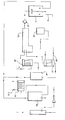
- a pilot plant was constructed in accordance with the block diagram shown in the drawing.
- a synthetic ethanol-water mixture was prepared from 95% v/v ethanol (industrial methylated spirits or IMS) and water. This mixture did not, of course, contain any yeasts, other organic materials, or impurities such as would normally be present in a fermented biomass.
- the prepared feed solution was fed through inlet line 10 and mixed with potassium carbonate (K 2 CO 3 ) in mixing tank 11 until an approximately 50" w/v carbonate solution was obtained.
- the solution was then pumped from tank 11 through filter 12 to a separation tank 13 at a rate of about 6 litres/min.
- the ethanolic phase having a lower specific gravity than the potassium carbonate solution, was decanted into a holding tank 14.
- the underflow from separation tank 13 was passed through a heat exchanger 15 at a pressure of 25 psi and heated to a temperature of 93°C. Any remaining alcohol vaporised in flashing tank 16.
- the alcohol vapour from the flashing tank 16 was condensed in condenser 17 and was then cooled by cooling water flowing through line 18 and returned to the separation tank 13.
- the potassium carbonate solution which remained in flashing tank 16 was pumped through heat exchanger 19, heated by steam admitted through line 21, to a low- pressure, i.e. sub-atmospheric, single stage evaporator 22 operating at a pressure of 2-4 psi. Recirculation through heat exchanger 19 allowed the solution to achieve 67 5 & concentration, which was still a pumpable slurry. This concentrated slurry was then pumped back to mixing tank 11 for dilution with fresh feed solution before being recirculated.
- the process was then carried out in the pilot plant using feedstocks consisting of fermented biomass solutions of the type obtained from industrial fermentation processes.
- the fermented biomass solution is first filtered to remove any solid particulate matter.
- the base or basic salt is then added. This causes the soluble dunder components to flocculate as a result of the high ionic strength of the resulting solution.
- the flocculated material is then removed from the solution by filtration or centrifugation and dried to give a solid dunder cake. Losses of the base or basic salt during this step are minimal and directly proportional to the moisture content of the separated dunder cake; there appears to be no complexing of the bases or salts with the dunder material.
- the two liquid phases are obtained as before.
- the dry dunder cake is used as a fuel source to provide heat for the evaporation of water from the basic phase in order to recover the base or basic salt.
- the amount of alcohol remaining in the lower aqueous potassium carbonate phase represents the solubility of alcohol in the aqueous phase. This figure decreases with higher concentrations of potassium carbonate. Because the vapour pressure of the alcohol in the potassium carbonate solution is higher than that in a solution of alcohol and water alone, the amount of energy required to recover this remaining alcohol is small.
- Tables 1A and 1B list further examples which show that the ability of the base or basic salt to induce phase separation is dependent upon the pK a value of the parent acid and is independent of the ionic strength of the basic compound/water/alcohol solution.
- Potassium iodide, potassium thiocyanate, and potassium acetate are included in the Tables for comparitive purposes only. It will be seen that only those bases or basic salts derived from acids having a pK a of greater than 6 are capable of inducing phase separation.
- Examples 3, 4, and 5 relate to the recovery of ethanol using the pilot plant process described above.
- “Dead wash” (the product formed by the complete fermentation of molasses) is a rich dark brown to black coloured liquid obtained from an alcohol distillery and containing approximately 10% of dissolved solids, 1% of suspended solids and 8% v/v ethanol. To recover the ethanol from the dead wash, the suspended solids were first removed by filtration. The filtered dead wash was then mixed in a mixing tank with anhydrous potassium carbonate in a ratio of 115 grams of potassium carbonate to 100ml of dead wash. Upon mixing, the dissolved solids in the dead wash flocculated. In excess of 99% of the flocculated solids were then removed by filtration and dried to give a solid dunder cake.
- the separated ethanol phase was light brown in colour as it contained colourants and fusel oils representing weak organic acids with a pK a > 14 which were separated along with the ethanol.
- the concentration of the separated ethanol phase was approximately 97% v/v ethanol.
Landscapes
- Chemical & Material Sciences (AREA)
- Organic Chemistry (AREA)
- Preparation Of Compounds By Using Micro-Organisms (AREA)
Priority Applications (1)
| Application Number | Priority Date | Filing Date | Title |
|---|---|---|---|
| AT85305942T ATE63739T1 (de) | 1984-08-22 | 1985-08-21 | Verfahren zur aufarbeitung von niedrigmolekularen alkoholen von waessrigen fermentationsmedium. |
Applications Claiming Priority (3)
| Application Number | Priority Date | Filing Date | Title |
|---|---|---|---|
| AU6711/84 | 1984-08-22 | ||
| AUPG671184 | 1984-08-22 | ||
| AU45938/85A AU576377B2 (en) | 1984-08-22 | 1985-08-08 | Recovery of alcohols |
Publications (3)
| Publication Number | Publication Date |
|---|---|
| EP0173544A2 true EP0173544A2 (de) | 1986-03-05 |
| EP0173544A3 EP0173544A3 (en) | 1986-05-21 |
| EP0173544B1 EP0173544B1 (de) | 1991-05-22 |
Family
ID=25627419
Family Applications (1)
| Application Number | Title | Priority Date | Filing Date |
|---|---|---|---|
| EP85305942A Expired - Lifetime EP0173544B1 (de) | 1984-08-22 | 1985-08-21 | Verfahren zur Aufarbeitung von niedrigmolekularen Alkoholen von wässrigen Fermentationsmedium |
Country Status (1)
| Country | Link |
|---|---|
| EP (1) | EP0173544B1 (de) |
Cited By (3)
| Publication number | Priority date | Publication date | Assignee | Title |
|---|---|---|---|---|
| EP0249648A1 (de) * | 1985-01-22 | 1987-12-23 | Showa Denko Kabushiki Kaisha | Verfahren zum Reinigen von Allylalkohol |
| US8574406B2 (en) | 2010-02-09 | 2013-11-05 | Butamax Advanced Biofuels Llc | Process to remove product alcohol from a fermentation by vaporization under vacuum |
| US8628643B2 (en) | 2010-09-02 | 2014-01-14 | Butamax Advanced Biofuels Llc | Process to remove product alcohol from a fermentation by vaporization under vacuum |
Families Citing this family (2)
| Publication number | Priority date | Publication date | Assignee | Title |
|---|---|---|---|---|
| BR112014013741A2 (pt) | 2011-12-09 | 2017-06-13 | Butamax Advanced Biofuels Llc | métodos para remoção de um álcool, sistema para recuperar o álcool, composições e alimento |
| KR101436428B1 (ko) * | 2013-05-15 | 2014-09-01 | 고려대학교 산학협력단 | 하수 슬러지로부터 바이오디젤을 제조하는 방법 및 제조 장치 |
Family Cites Families (1)
| Publication number | Priority date | Publication date | Assignee | Title |
|---|---|---|---|---|
| US4454359A (en) * | 1982-06-21 | 1984-06-12 | The Procter & Gamble Company | Process for drying alcohols |
-
1985
- 1985-08-21 EP EP85305942A patent/EP0173544B1/de not_active Expired - Lifetime
Cited By (3)
| Publication number | Priority date | Publication date | Assignee | Title |
|---|---|---|---|---|
| EP0249648A1 (de) * | 1985-01-22 | 1987-12-23 | Showa Denko Kabushiki Kaisha | Verfahren zum Reinigen von Allylalkohol |
| US8574406B2 (en) | 2010-02-09 | 2013-11-05 | Butamax Advanced Biofuels Llc | Process to remove product alcohol from a fermentation by vaporization under vacuum |
| US8628643B2 (en) | 2010-09-02 | 2014-01-14 | Butamax Advanced Biofuels Llc | Process to remove product alcohol from a fermentation by vaporization under vacuum |
Also Published As
| Publication number | Publication date |
|---|---|
| EP0173544B1 (de) | 1991-05-22 |
| EP0173544A3 (en) | 1986-05-21 |
Similar Documents
| Publication | Publication Date | Title |
|---|---|---|
| US6258175B1 (en) | Method to produce fermentable sugars from a lignocellulose material | |
| US6478965B1 (en) | Recovery of fermentation salts from dilute aqueous solutions | |
| Li et al. | Extraction of 1, 3-propanediol from glycerol-based fermentation broths with methanol/phosphate aqueous two-phase system | |
| WO2012013004A1 (zh) | 盐析萃取发酵液中丙酮和丁醇的方法 | |
| CA1238765A (en) | Method of recovering hydrochloric acid from a product comprised of sugars and concentrated hydrochloric acid | |
| US4594466A (en) | Recovery of alcohols | |
| CN109502714A (zh) | 一种利用精馏耦合溶析结晶从高盐化工废水中提取高纯度无机盐的工艺方法 | |
| CN103833050A (zh) | 一种含氯化铵的氨基乙酸脱醇母液的处理方法 | |
| EP0173544B1 (de) | Verfahren zur Aufarbeitung von niedrigmolekularen Alkoholen von wässrigen Fermentationsmedium | |
| WO2022017390A1 (zh) | 一种维生素b12粗品的制备方法 | |
| US5868851A (en) | Process for production of solid glucose | |
| CN102093200A (zh) | 一种从生产环已酮副产物废碱液中提取正丁酸、正戊酸、正己酸的方法 | |
| CN105272843B (zh) | 一种从化工生产废渣中回收二甲基亚砜与醋酸钠的方法 | |
| CN106277514A (zh) | 回收处理糖精钠废水的方法 | |
| CN105152447B (zh) | 一种治理丙烯酸废水及回收乙酸钠的方法 | |
| CN219585861U (zh) | 一种针对精对苯二甲酸生产过程的资源化回收利用系统 | |
| CN1837081A (zh) | 一种微乳液和制备方法及在处理含酚工业废水中的用途 | |
| Harris et al. | Glycerol production: A pilot‐plant investigation for continuous fermentation and recovery | |
| CN223607139U (zh) | 一种环十五内酯香料生产废水资源综合利用的生产装置 | |
| Atkinson et al. | Development of downstream processing | |
| CN101012152B (zh) | 一种从发酵液中分离2,3-丁二醇的双水相萃取方法 | |
| CN119430573B (zh) | 环十五内酯香料生产废水处理资源综合利用的方法和装置 | |
| CN101817740A (zh) | 一种用于萃取发酵液中柠檬酸的乳状液及其使用方法 | |
| CN103664848A (zh) | 一种霉酚酸的提取方法 | |
| CN105776707A (zh) | 一种甲硝唑废水的处理方法 |
Legal Events
| Date | Code | Title | Description |
|---|---|---|---|
| PUAI | Public reference made under article 153(3) epc to a published international application that has entered the european phase |
Free format text: ORIGINAL CODE: 0009012 |
|
| 17P | Request for examination filed |
Effective date: 19850903 |
|
| AK | Designated contracting states |
Kind code of ref document: A2 Designated state(s): AT BE CH DE FR GB IT LI LU NL SE |
|
| PUAL | Search report despatched |
Free format text: ORIGINAL CODE: 0009013 |
|
| AK | Designated contracting states |
Kind code of ref document: A3 Designated state(s): AT BE CH DE FR GB IT LI LU NL SE |
|
| 17Q | First examination report despatched |
Effective date: 19870908 |
|
| GRAA | (expected) grant |
Free format text: ORIGINAL CODE: 0009210 |
|
| AK | Designated contracting states |
Kind code of ref document: B1 Designated state(s): AT BE CH DE FR GB IT LI LU NL SE |
|
| PG25 | Lapsed in a contracting state [announced via postgrant information from national office to epo] |
Ref country code: NL Effective date: 19910522 Ref country code: LI Effective date: 19910522 Ref country code: IT Free format text: LAPSE BECAUSE OF FAILURE TO SUBMIT A TRANSLATION OF THE DESCRIPTION OR TO PAY THE FEE WITHIN THE PRESCRIBED TIME-LIMIT;WARNING: LAPSES OF ITALIAN PATENTS WITH EFFECTIVE DATE BEFORE 2007 MAY HAVE OCCURRED AT ANY TIME BEFORE 2007. THE CORRECT EFFECTIVE DATE MAY BE DIFFERENT FROM THE ONE RECORDED. Effective date: 19910522 Ref country code: CH Effective date: 19910522 Ref country code: BE Effective date: 19910522 Ref country code: AT Effective date: 19910522 |
|
| REF | Corresponds to: |
Ref document number: 63739 Country of ref document: AT Date of ref document: 19910615 Kind code of ref document: T |
|
| REF | Corresponds to: |
Ref document number: 3582909 Country of ref document: DE Date of ref document: 19910627 |
|
| PG25 | Lapsed in a contracting state [announced via postgrant information from national office to epo] |
Ref country code: GB Effective date: 19910822 |
|
| REG | Reference to a national code |
Ref country code: CH Ref legal event code: PL |
|
| PG25 | Lapsed in a contracting state [announced via postgrant information from national office to epo] |
Ref country code: LU Free format text: LAPSE BECAUSE OF NON-PAYMENT OF DUE FEES Effective date: 19910831 |
|
| ET | Fr: translation filed | ||
| NLV1 | Nl: lapsed or annulled due to failure to fulfill the requirements of art. 29p and 29m of the patents act | ||
| PLBE | No opposition filed within time limit |
Free format text: ORIGINAL CODE: 0009261 |
|
| STAA | Information on the status of an ep patent application or granted ep patent |
Free format text: STATUS: NO OPPOSITION FILED WITHIN TIME LIMIT |
|
| GBPC | Gb: european patent ceased through non-payment of renewal fee | ||
| 26N | No opposition filed | ||
| EAL | Se: european patent in force in sweden |
Ref document number: 85305942.6 |
|
| PGFP | Annual fee paid to national office [announced via postgrant information from national office to epo] |
Ref country code: DE Payment date: 19960930 Year of fee payment: 12 |
|
| PG25 | Lapsed in a contracting state [announced via postgrant information from national office to epo] |
Ref country code: DE Free format text: LAPSE BECAUSE OF NON-PAYMENT OF DUE FEES Effective date: 19980501 |
|
| PGFP | Annual fee paid to national office [announced via postgrant information from national office to epo] |
Ref country code: SE Payment date: 20010807 Year of fee payment: 17 |
|
| PGFP | Annual fee paid to national office [announced via postgrant information from national office to epo] |
Ref country code: FR Payment date: 20010810 Year of fee payment: 17 |
|
| PG25 | Lapsed in a contracting state [announced via postgrant information from national office to epo] |
Ref country code: SE Free format text: LAPSE BECAUSE OF NON-PAYMENT OF DUE FEES Effective date: 20020822 |
|
| EUG | Se: european patent has lapsed | ||
| PG25 | Lapsed in a contracting state [announced via postgrant information from national office to epo] |
Ref country code: FR Free format text: LAPSE BECAUSE OF NON-PAYMENT OF DUE FEES Effective date: 20030430 |
|
| REG | Reference to a national code |
Ref country code: FR Ref legal event code: ST |