EP0169578A2 - Torque motor - Google Patents
Torque motor Download PDFInfo
- Publication number
- EP0169578A2 EP0169578A2 EP85109418A EP85109418A EP0169578A2 EP 0169578 A2 EP0169578 A2 EP 0169578A2 EP 85109418 A EP85109418 A EP 85109418A EP 85109418 A EP85109418 A EP 85109418A EP 0169578 A2 EP0169578 A2 EP 0169578A2
- Authority
- EP
- European Patent Office
- Prior art keywords
- stationary core
- housing
- coil
- support
- torque motor
- Prior art date
- Legal status (The legal status is an assumption and is not a legal conclusion. Google has not performed a legal analysis and makes no representation as to the accuracy of the status listed.)
- Granted
Links
Images
Classifications
-
- F—MECHANICAL ENGINEERING; LIGHTING; HEATING; WEAPONS; BLASTING
- F02—COMBUSTION ENGINES; HOT-GAS OR COMBUSTION-PRODUCT ENGINE PLANTS
- F02D—CONTROLLING COMBUSTION ENGINES
- F02D11/00—Arrangements for, or adaptations to, non-automatic engine control initiation means, e.g. operator initiated
- F02D11/06—Arrangements for, or adaptations to, non-automatic engine control initiation means, e.g. operator initiated characterised by non-mechanical control linkages, e.g. fluid control linkages or by control linkages with power drive or assistance
- F02D11/10—Arrangements for, or adaptations to, non-automatic engine control initiation means, e.g. operator initiated characterised by non-mechanical control linkages, e.g. fluid control linkages or by control linkages with power drive or assistance of the electric type
-
- H—ELECTRICITY
- H02—GENERATION; CONVERSION OR DISTRIBUTION OF ELECTRIC POWER
- H02K—DYNAMO-ELECTRIC MACHINES
- H02K26/00—Machines adapted to function as torque motors, i.e. to exert a torque when stalled
-
- F—MECHANICAL ENGINEERING; LIGHTING; HEATING; WEAPONS; BLASTING
- F02—COMBUSTION ENGINES; HOT-GAS OR COMBUSTION-PRODUCT ENGINE PLANTS
- F02D—CONTROLLING COMBUSTION ENGINES
- F02D11/00—Arrangements for, or adaptations to, non-automatic engine control initiation means, e.g. operator initiated
- F02D11/06—Arrangements for, or adaptations to, non-automatic engine control initiation means, e.g. operator initiated characterised by non-mechanical control linkages, e.g. fluid control linkages or by control linkages with power drive or assistance
- F02D11/10—Arrangements for, or adaptations to, non-automatic engine control initiation means, e.g. operator initiated characterised by non-mechanical control linkages, e.g. fluid control linkages or by control linkages with power drive or assistance of the electric type
- F02D2011/101—Arrangements for, or adaptations to, non-automatic engine control initiation means, e.g. operator initiated characterised by non-mechanical control linkages, e.g. fluid control linkages or by control linkages with power drive or assistance of the electric type characterised by the means for actuating the throttles
- F02D2011/102—Arrangements for, or adaptations to, non-automatic engine control initiation means, e.g. operator initiated characterised by non-mechanical control linkages, e.g. fluid control linkages or by control linkages with power drive or assistance of the electric type characterised by the means for actuating the throttles at least one throttle being moved only by an electric actuator
Definitions
- the present invention relates to a torque motor, and more particularly to a torque motor suitable for use in driving a throttle valve for automobiles.
- a throttle valve control device of the automobiles comprising a controller, an actuator for driving a throttle valve, and a throttle valve.
- the throttle valve control device has employed a motor rotating over an angular range of 360 0 as the actuator for driving the throttle valve. ( United State Patent Specification No. 4, 388, 913 ).
- the throttle valve of the automobiles does not make a complete revolution; it rotates about 90°. From this reason, rotation of the motor is converted to partial rotation of the throttle valve through a gear or the like.
- rotating 360 0 has involved disadvantages in that no current flows in some of coil due to rectification and torque is not always generated effectively dependent on the form of winding wires. This results in the disadvantage that the motor is relatively large with respect to its torque.
- a motor for driving the throttle valve is enough to rotate through an angular range corresponding to the opening thereof; it need not rotate over 360 0 .
- the motors which rotate 360° have been employed as the actuator for driving the throttle valve in conventional throttle valve control device.
- An object of the present invention is to provide a relatively small torque motor.
- the present invention is to reduce the size of torque motor by preparing a housing provided at its center with a shaft therethrough, fixedly supporting a stationary core at the center of the housing with a support which is not in contact with the shaft, forming a coil fixed to the shaft to surround the stationary core, and by providing magnets within the housing to produce one part of the magnetic flux directed toward the stationary core and the remaining part of the magnetic flux directed outward from the stationary core.
- the present invention is to reduce the size of torque motor by preparing a housing provided at its center with a shaft therethrough, fixedly supporting a disc magnet at the center of the housing with a support which is not in contact with the shaft, and forming a coil fixed to the shaft to surround the disc magnet, whereby magnetic flux emenates from the disc magnet to the housing to form a magnetic circuit, thereby producing forces on the coil.
- the torque motor can be made smaller by effectively utilizing the coil, there can be achieved reduction in the size of torque motors.
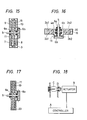
- a throttle valve control device for automobiles comprising a controller A, an actuator B for driving a throttle valve, and a throttle valve C, as shown in Fig.18.
- the present invention relates to a torque motor for use the actuator for the throttle valve C.
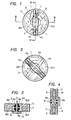
- Fig.l shows an inner structure view of a torque motor of one embodiment of the present invention which is omitted an upper part of a housing when viewed in the axial direction
- Fig.3 shows a sectional view taken along the line III-III in Fig.l
- Fig.4 shows a sectional view taken along the line IV-IV in Fig.l.
- a stationary core 1 made of magnetic permeable material having a doughnut-like disc form is rigidly supported by upper support 2al and 2a2 and by lower support 2bl and 2b2 made of plastic material respectively, each formed into a sector shape within a cylindrically formed housing 3, as shown in Fig.3.
- the same sectorally shaped upper support 2al and 2a2 is provided respectively within the housing 3 to opposite each other on the stationary core 1.
- the same sectorally shaped lower support 2bl and 2b2 is provided respectively within the housing 3 to opposite each other on the stationary core 1.
- both same sectorally shaped upper support 2al and lower support 2bl and the same sectorally shaped upper support 2a2 and lower support 2b2 are disposed respectively to overlap each other on the stationary core 1. And both the upper support 2al, 2a2 and the lower support 2bl, 2b2 rigidly support to sandwich the stationary core 1.
- a shaft 5 is provided through a pair of bearings 6a and 6b as shown Fig. 3 and Fig. 4.
- Two bands of belt-like coil assemblies 4a and 4b as shown in Fig.l are provided round the shaft 5 to surround the stationary core 1 without contacting the stationary core 1.
- the coils 4a and 4b are molded into position with a resin 11 as shown in Fig.3 and Fig.4.
- Two bands of coils 4a and 4b are provided to the outer surface of the stationary core 1, except for those portions including the upper support 2al, 2a2 and the lower support 2bl, 2b2 respectively.
- the two bands of coils 4a and 4b are provided to project from the outer surface of the stationary core 1 and to surround the stationary core 1.
- the coils 4a and 4b are turned within the stationary core 1, except for those portions including the upper support 2al, 2a2 and the lower support 2bl, 2b2 respectively as shown in Fig.2.
- the coils 4a and 4b are turned with the torque, it is capable of turning only within a finite range because of being stopped at the supports 2al, 2bl or the supports 2a2, 2b2 on the stationary core 1.
- such a finite turning range is set to be 85 0 .
- This value of the finit range is set to coincide with the degree of opening of the throttle valve C.
- the adjustable turning angle of the coils 4a and 4b can be increased or decreased by changing the size of the upper support 2al, 2a2 or the lower support 2bl, 2b2.
- magnets 7, 8 and 9, 10 are magnetized such that the inner side of the magnet 7 exhibits an N pole, the inner side of the magnet 8 exhibits an N pole, the inner side of the magnet 9 exhibits an S pole, and the inner side of the magnet 10 exhibits an S pole respectively.
- lead wires of the coils 4a and 4b are led out to the exterior of the housing 3 through the hollow inner portion of the shaft 5.
- magnetic flux emenates from the stationary core 1 to the magnet 10 with the side of the magnet 10 opposite to the stationary core 1 exhibiting an S pole. And current flows from lower to upper through the coils 4a and 4b crossing the magnetic flux thus produced, so that a force emenates from the front to the rear of the view shown in Fig.4.
- the output torque of the shaft 5 is determined from the forces produced on the coil 4a and 4b between the magnets 7, 8, 9 and 10 and the stationary core 1, as well as the as the distance between the coils 4a and 4b and the shaft center.
- the coils 4a and 4b are turned with the torque thus produced, it is capable of turning only within a finite range because of being stopped at the supports 2al, 2bl or at the supports 2a2, 2b2 on the stationary core 1.
- such a finite turning range is set to be 85°.
- This embodiment is a modified embodiment of the torque motor of Embodiment 1 shown from Fig.l to Fig.4.
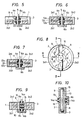
- Only the lower support 2bl and 2b2 for supporting the stationary core 1 is provided on one side of the housing 3 as shown in Fig.5.
- the stationary core 1 is fixed in a cantilevered manner by the lower support 2bl and 2b2. This reduces weight of the torque motor.
- This embodiment is a modified embodiment of the torque motor of Embodiment 1 shown from Fig.l to Fig.4.
- the stationary core comprises a two-stage core 12a and 12b using two doughnut-like disc plates placed one over the other as shown in Fig.6. And two separate stationary cores 12a and 12b are fixed without being in contact so as to produce a gap 12c therebetween.
- the upper stationary core 12a is fixed to the sector shaped supports 2al, 2bl and the lower stationary core 12b is fixed to the sectorally shaped supports 2a2, 2b2 respectively. This reduces weight of the torque motor.
- a still amother embodiment of the torque motor of the present invention will be described.
- This embodiment is a modified embodiment of the torque motor of Embodiment 3 shown in Fig.6.
- the gap 12c between the upper stationary core 12a and the lower stationary core 12B in Fig.6 is filled with a spacer 13 made of metal shown in Fig.7.
- This embodiment is a modified embodiment of the torque motor of Embodiment 1 shown from Fig.l to Fig.4.
- Fig.8 is an inner structure view of a torque motor, which is omitted an upper part of a housing, when viewed in the axial direction
- Fig.9 is a sectional view taken along the line IX-IX in Fig.8
- Fig.10 is a sectional view taken along the line X-X in Fig.8.
- the shaft is divided into two parts 14a and 14b to provide a structure such that one band of belt-like coil assembly 15 is interposed between the two separate shafts 14a and 14b thus divided.
- the coil 15 is molded with a resin 16 to surround the shafts 14a and 14b.
- the coil 15 is provided to the stationary core 1 therebetween, as shown in Fig.8, except for those portions including the sectorally shaped upper support 2al, 2a2 and the sectorally shaped lower support 2b, 2b2 respectively.
- the coil 15 is provided to project from the outer surface of the stationary core 1 and to surround the stationary core 1.
- This coil 15 turns the stationary core 1, except for those portions including the upper support 2al, 2a2 and the lower support 2bl, 2b2 respectively.
- This embodiment is a modified embodiment of the torque motor of Embodiment 5 shown from Fig.8 to Fig.10.
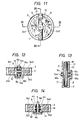
- Fig.ll is an inner structure view of a torque motor, which is omitted an upper part of a housing, when viewed in the axial direction
- Fig.12 is a sectional view taken along the line XII-XII in Fig.ll
- Fig.13 is a sectional view taken along the line XIII-XIII in Fig.ll.
- a complete disc plate 17 is employed as the stationary core, as shown from Fig.ll to Fig.13, in place of the doughnut-like disc core as illustrated in the embodiment of Fig.9.
- the coil 15 is molded with a resin 18.
- This embodiment is a modified embodiment of the torque motor of Embodiment 1 shown from Fig.l to fig.4.
- a magnet 19 shown Fig.14 and Fig.15, in place of the stationary core. More specifically, the magnets 7, 8, 9 and 10 are arranged and magnetized similarly to those explained in connection with Fig.l to Fig.4. Whereas the magnet 19 is magnetized to exhibit an S pole on the lower side of Fig.15 and an N pole on the upper side thereof. The strength of magnetic flux between each of the magnets 7, 8, 9 and 10 and the magnet 19 can be increased.
- This embodiment is a modified the torque motor of Embodiment 7 shown in Fig.14 and Fig.15.
- a housing 20 is arranged to approach the coils 4a and 4b, magnetic flux emenates from the magnet 19 to the housing 20 to form a magnetic circuit, thereby producing forces on the coils 4a and 4b.
Landscapes
- Engineering & Computer Science (AREA)
- Power Engineering (AREA)
- Chemical & Material Sciences (AREA)
- Combustion & Propulsion (AREA)
- Mechanical Engineering (AREA)
- General Engineering & Computer Science (AREA)
- Reciprocating, Oscillating Or Vibrating Motors (AREA)
- Control Of Throttle Valves Provided In The Intake System Or In The Exhaust System (AREA)
- Connection Of Motors, Electrical Generators, Mechanical Devices, And The Like (AREA)
- Permanent Magnet Type Synchronous Machine (AREA)
Abstract
Description
- The present invention relates to a torque motor, and more particularly to a torque motor suitable for use in driving a throttle valve for automobiles.
- A throttle valve control device of the automobiles comprising a controller, an actuator for driving a throttle valve, and a throttle valve. The throttle valve control device has employed a motor rotating over an angular range of 3600 as the actuator for driving the throttle valve. ( United State Patent Specification No. 4, 388, 913 ).
- As is well known, however, the throttle valve of the automobiles does not make a complete revolution; it rotates about 90°. From this reason, rotation of the motor is converted to partial rotation of the throttle valve through a gear or the like.
- Using such motor, rotating 3600 has involved disadvantages in that no current flows in some of coil due to rectification and torque is not always generated effectively dependent on the form of winding wires. This results in the disadvantage that the motor is relatively large with respect to its torque.
- Inherently, therefore, a motor for driving the throttle valve is enough to rotate through an angular range corresponding to the opening thereof; it need not rotate over 3600. Nevertheless, the motors which rotate 360° have been employed as the actuator for driving the throttle valve in conventional throttle valve control device.
- An object of the present invention is to provide a relatively small torque motor.
- The present invention is to reduce the size of torque motor by preparing a housing provided at its center with a shaft therethrough, fixedly supporting a stationary core at the center of the housing with a support which is not in contact with the shaft, forming a coil fixed to the shaft to surround the stationary core, and by providing magnets within the housing to produce one part of the magnetic flux directed toward the stationary core and the remaining part of the magnetic flux directed outward from the stationary core.
- Furthermore, the present invention is to reduce the size of torque motor by preparing a housing provided at its center with a shaft therethrough, fixedly supporting a disc magnet at the center of the housing with a support which is not in contact with the shaft, and forming a coil fixed to the shaft to surround the disc magnet, whereby magnetic flux emenates from the disc magnet to the housing to form a magnetic circuit, thereby producing forces on the coil.
- According to the present invention, as the torque motor can be made smaller by effectively utilizing the coil, there can be achieved reduction in the size of torque motors.
-
- Fig.l is an inner structure sectional view of a torque motor showing a first embodiment of the present invention, which is omitted an upper part of a housing, when viewed in the axial direction.
- Fig.2 is an explanation view of the torque motor showing movement of coil assemblies.
- Fig.3 is a sectional view taken along III-III in Fig.l
- Fig.4 is a sectional view taken along IV-IV in Fig.l.
- Fig.5 is a sectional view of a torque motor showing a second embodiment of the present invention.
- Fig.6 is a sectional view of a torque motor showing a third embodiment of the present invention.
- Fig.7 is a sectional view of a torque motor showing a fourth embodiment of the present invention.
- Fig.8 is an inner structure sectional view of a torque motor showing a fifth embodiment of the present invention, which is omitted an upper part of a housing, when viewed in the axial direction.
- Fig.9 is a sectional view taken along IX-IX in Fig.8.
- Fig.10 is a sectional view taken along X-X in Fig.8.
- Fig.11 is an inner structure sectional view of a torque motor showing a sixth embodiment of the present invention, which is omitted an upper part of a housing, when viewed in the axial direction.
- Fig.12 is a sectional view taken long XII-XII in Fig.11.
- Fig.13 is a sectional view taken along XIII-XIII in Fig.11.
- Fig.14 and Fig.15 are sectional views respectively of a torque motor showing a seventh embodiment of the present invention.
- Fig.16 and Fig.17 are sectional views respectively of a torque motor showing an eighth embodiment of the present invention.
- Fig.l8 is a schematic view of a throttle valve control device system for the automobiles.
- A throttle valve control device for automobiles comprising a controller A, an actuator B for driving a throttle valve, and a throttle valve C, as shown in Fig.18. The present invention relates to a torque motor for use the actuator for the throttle valve C.
- Hereinafter, embodiments of the present invention will be described.
- Fig.l shows an inner structure view of a torque motor of one embodiment of the present invention which is omitted an upper part of a housing when viewed in the axial direction, Fig.3 shows a sectional view taken along the line III-III in Fig.l, and Fig.4 shows a sectional view taken along the line IV-IV in Fig.l.
- A
stationary core 1 made of magnetic permeable material having a doughnut-like disc form is rigidly supported by upper support 2al and 2a2 and by lower support 2bl and 2b2 made of plastic material respectively, each formed into a sector shape within a cylindrically formedhousing 3, as shown in Fig.3. - The same sectorally shaped upper support 2al and 2a2 is provided respectively within the
housing 3 to opposite each other on thestationary core 1. The same sectorally shaped lower support 2bl and 2b2 is provided respectively within thehousing 3 to opposite each other on thestationary core 1. - The both same sectorally shaped upper support 2al and lower support 2bl and the same sectorally shaped upper support 2a2 and lower support 2b2 are disposed respectively to overlap each other on the
stationary core 1. And both the upper support 2al, 2a2 and the lower support 2bl, 2b2 rigidly support to sandwich thestationary core 1. - At the center of the
housing 3, ashaft 5 is provided through a pair ofbearings like coil assemblies shaft 5 to surround thestationary core 1 without contacting thestationary core 1. Thecoils resin 11 as shown in Fig.3 and Fig.4. - Two bands of
coils stationary core 1, except for those portions including the upper support 2al, 2a2 and the lower support 2bl, 2b2 respectively. The two bands ofcoils stationary core 1 and to surround thestationary core 1. - The
coils stationary core 1, except for those portions including the upper support 2al, 2a2 and the lower support 2bl, 2b2 respectively as shown in Fig.2. - Although the
coils stationary core 1. - In this embodiment, "such a finite turning range is set to be 850. This value of the finit range is set to coincide with the degree of opening of the throttle valve C. The adjustable turning angle of the
coils - Further, at the upper and lower inner surfaces of the
housing 3 there are provided fourmagnets stationary core 1 therebetween, as shown in Fig.4, except for those portions including the upper support 2al, 2a2 and the lower support 2bl, 2b2. Thesemagnets magnet 7 exhibits an N pole, the inner side of themagnet 8 exhibits an N pole, the inner side of themagnet 9 exhibits an S pole, and the inner side of themagnet 10 exhibits an S pole respectively. Besides, lead wires of thecoils housing 3 through the hollow inner portion of theshaft 5. - In this construction, when the
coils coils magnet 7 facing thecoils magnet 7 to thestationary core 1. And current flows from upper to lower through thecoils - Between the
magnet 8 and thestationary core 1, magnetic flux emenates from themagnet 8 to thestationary core 1 of Fig.4 with the side of themagnet 8 opposite thecoils coils magnet 7 emenates from rear to front in the view shown in Fig.4. - Between the
magnet 9 and thestationary core 1, magnetic flux emenates from thestationary core 1 to themagnet 9 with the side of themagnet 9 opposite to thecoils coils - Furthermore, between the
magnet 10 and thestationary core 1, magnetic flux emenates from thestationary core 1 to themagnet 10 with the side of themagnet 10 opposite to thestationary core 1 exhibiting an S pole. And current flows from lower to upper through thecoils - Based on those actions, the output torque of the
shaft 5 is determined from the forces produced on thecoil magnets stationary core 1, as well as the as the distance between thecoils coils stationary core 1. In this embodiment, such a finite turning range is set to be 85°. - A modified embodiment of the torque motor of the present invention will be described. This embodiment is a modified embodiment of the torque motor of
Embodiment 1 shown from Fig.l to Fig.4. - Only the lower support 2bl and 2b2 for supporting the
stationary core 1 is provided on one side of thehousing 3 as shown in Fig.5. Thestationary core 1 is fixed in a cantilevered manner by the lower support 2bl and 2b2. This reduces weight of the torque motor. - An another embodiment of the torque motor of the present invention will be described. This embodiment is a modified embodiment of the torque motor of
Embodiment 1 shown from Fig.l to Fig.4. - The stationary core comprises a two-
stage core stationary cores gap 12c therebetween. - The upper
stationary core 12a is fixed to the sector shaped supports 2al, 2bl and the lowerstationary core 12b is fixed to the sectorally shaped supports 2a2, 2b2 respectively. This reduces weight of the torque motor. - A still amother embodiment of the torque motor of the present invention will be described. This embodiment is a modified embodiment of the torque motor of
Embodiment 3 shown in Fig.6. - The
gap 12c between the upperstationary core 12a and the lower stationary core 12B in Fig.6 is filled with aspacer 13 made of metal shown in Fig.7. - Further embodiment of the torque motor of the present invention will be described. This embodiment is a modified embodiment of the torque motor of
Embodiment 1 shown from Fig.l to Fig.4. - Fig.8 is an inner structure view of a torque motor, which is omitted an upper part of a housing, when viewed in the axial direction, Fig.9 is a sectional view taken along the line IX-IX in Fig.8 and Fig.10 is a sectional view taken along the line X-X in Fig.8.
- In this embodiment, as shown in Fig.9 and Fig.10, the shaft is divided into two
parts like coil assembly 15 is interposed between the twoseparate shafts - The
coil 15 is molded with aresin 16 to surround theshafts coil 15 is provided to thestationary core 1 therebetween, as shown in Fig.8, except for those portions including the sectorally shaped upper support 2al, 2a2 and the sectorally shaped lower support 2b, 2b2 respectively. Thecoil 15 is provided to project from the outer surface of thestationary core 1 and to surround thestationary core 1. - This
coil 15 turns thestationary core 1, except for those portions including the upper support 2al, 2a2 and the lower support 2bl, 2b2 respectively. - With this structure, it becomes possible to provide the
coil 15 without the need of bypassing thesingle shaft 5 asEmbodiment 1 of Fig.l to Fig.4. And it is enough to provide thecoil 15 in one pair or in single band. - A still further embodiment of the torque motor of the present invention will be described. This embodiment is a modified embodiment of the torque motor of
Embodiment 5 shown from Fig.8 to Fig.10. - Fig.ll is an inner structure view of a torque motor, which is omitted an upper part of a housing, when viewed in the axial direction, Fig.12 is a sectional view taken along the line XII-XII in Fig.ll, and Fig.13 is a sectional view taken along the line XIII-XIII in Fig.ll.
- In this embodiment, a
complete disc plate 17 is employed as the stationary core, as shown from Fig.ll to Fig.13, in place of the doughnut-like disc core as illustrated in the embodiment of Fig.9. Thecoil 15 is molded with a resin 18. With the stationary core formed into a complete disc shape in this way, it becomes possible to widen a magnetic path and to increase the intensity of magnetic flux. - An another embodiment of the torque motor of the present invention will be described. This embodiment is a modified embodiment of the torque motor of
Embodiment 1 shown from Fig.l to fig.4. - In this embodiment, there is employed a
magnet 19, shown Fig.14 and Fig.15, in place of the stationary core. More specifically, themagnets magnet 19 is magnetized to exhibit an S pole on the lower side of Fig.15 and an N pole on the upper side thereof. The strength of magnetic flux between each of themagnets magnet 19 can be increased. - A still another embodiment of the torque motor of the present invention will be described. This embodiment is a modified the torque motor of
Embodiment 7 shown in Fig.14 and Fig.15. - In this embodiment, as shown in Fig.16 and Fig.17, the
magnets Embodiment 7, as shown in Fig.14 and Fig.15, are all omitted. - A
housing 20 is arranged to approach thecoils magnet 19 to thehousing 20 to form a magnetic circuit, thereby producing forces on thecoils
Claims (16)
said support (2al, 2a2; 2bl, 2b2) is provided to at least one of sides of said housing (3).
characterized in that
said support (2al, 2a2; 2bl, 2b2) has sectoral shape.
characterized in that
said support (2al, 2a2; 2bl, 2b2) has same sectoral shape structure.
characterized in that
said coil (4a, 4b; 15) is provided to said stationary core (1; 12a, 12b; 17), except for those portions including said support (2al, 2a2; 2bl, 2b2) to project from said stationary core (1; 12a, 12b; 17) and to surround said stationary core (1; 12a, 12b; 17) without contacting thereof.
characterized in that
the finite turning range of said stationary core is (1; 12a 12b; 17) is set to be about 850.
characterized in that
said stationary core (1; 12a,12b) has a doughnut-like disc form.
characterized in that
said magnets (7, 8, 9, 10) are provided to said housing (3), except for those portions including said support (2al, 2a2; 2bl, 2b2) to sandwich said stationary core (1; 12a, 12b; 17) therebetween.
said stationary core (1; 12a, 12b) has a doughnut-like disc form, a sectorally formed support (2al, 2a2; 2bl, 2b2) is provided to at least one side of said housing (3) to fixedly support said stationary core (1; 12a, 12b), said magnets (7, 8, 9, 10) are provided to said housing (3), except for those portions including said support (2a, 2a2; 2bl, 2b2),' to sandwich said stationary core (1; 12a, 12b) therebetween, and said coil (4a, 4b; 15) is provided to said stationary core (1; 12a, 12b), except for those portions inclding said support (2al, 2a2; 2bl, 2b2), to project from said stationary core (1; 12a, 12b) and to surround said stationary core (l; 12a, 12b) without . contacting thereof, whereby said coil (4a, 4b; 15) is turned on said stationary core (1; 12a, 12b) within a finite range.
characterized in that
said stationary core (12a, 12b) comprises two doughnut-like, and said stationary core (12a, 12b) having a gap (12c) therebetween and is fixedly suppoted with said support (2al, 2a2; 2bl, 2b2). -
characterized in that
the gap (12c) of two doughnut-lide disc plates (12a, 12b) of said stationary core (12a, 12b) is filled with a spacer (13).
the shaft (14a, 14b) comprises two parts (14a, 14b), a support (2al, 2a2; 2bl, 2b2) is provided to said housing (3) to fixedly suport said stationary core (1; 17), and said coil (15) is formed to surround said stationary core (1; 17) without contacting thereof and is interposed between the two separate shafts (14a, 14b), whereby said coil (15) is turned on said stationary core (1; 17) within a finite range.
the shaft (14a, 14b) comprises two parts (14a, 14b), said stationary core (1; 17) has a doughnut-like disc form, a sectorally formed support (2al, 2a2; 2bl, 2b2) is provided to at least one side of said housing (3) to fixedly support said stationary core (1; 17), said magnets (7, 8, 9, 10) provided to said housing (3), except for those portions including said - support (2al, 2a2; 2bl, 2b2), to sandwich said stationary core (1; 17) therebetween, and said coil (15) is provided to said stationary core (1; 17), except for those portions including said support (2al, 2a2; 2bl, 2b2), to project from said stationary core (1; 17) and to surround said stationary core (1; 17) without contacting thereof and is interposed between the two separate shafts (14a, 14b), whereby said coil (15) is turned on said stationary core (1; 17) within a finite range.
characterized in that
said stationary core (17) has a complete disc form.
a second doughnut-like disc magnet (19) is provided within said housing (3), a sectorally formed support (2al, 2a2; 2bl, 2b2) is provided to at least one side of said housing (3) to fixedly support said second disc magnet (19), said first magnets (7, 8, 9, 10) are provided to said housing (3), except for those portions including said support (2al, 2a2;'2bl, 2b2), to sandwich said second disc magnet (19) therebetween, and said coil (4a, 4b) is provided to said second disc magnet (19), except for those portions including said support (2al, 2a2; 2bl, 2b2), to project from said second disc magnet (19) and to surround said second disc magnet (19) without contacting thereof,. whereby said coil (4a, 4b) is turned on said second disc magnet (19) within a finite range.
said magnet (19) has a doughnut-lilke disc form, a sectorally formed support (2al, 2a2; 2bl, 2b2) is provided to at least one side of said housing (20) to fixdly support said magnet (19), said magnet (19)is provided to said housing (3), except for those portions including said support (2al, 2a2; 2bl, 2b2), to sandwich said magnet (19) therebetween, and said coil (4a, 4b) is provided to said magnet (19) and to surround said magnet (19) without contacting thereof, whereby said coil (4a, 4b) is turned on said magnet (19) within a finite range.
Applications Claiming Priority (2)
| Application Number | Priority Date | Filing Date | Title |
|---|---|---|---|
| JP158258/84 | 1984-07-27 | ||
| JP59158258A JPH0624417B2 (en) | 1984-07-27 | 1984-07-27 | Torque motor |
Publications (3)
| Publication Number | Publication Date |
|---|---|
| EP0169578A2 true EP0169578A2 (en) | 1986-01-29 |
| EP0169578A3 EP0169578A3 (en) | 1987-05-27 |
| EP0169578B1 EP0169578B1 (en) | 1989-11-15 |
Family
ID=15667687
Family Applications (1)
| Application Number | Title | Priority Date | Filing Date |
|---|---|---|---|
| EP85109418A Expired EP0169578B1 (en) | 1984-07-27 | 1985-07-26 | Torque motor |
Country Status (6)
| Country | Link |
|---|---|
| US (1) | US4639624A (en) |
| EP (1) | EP0169578B1 (en) |
| JP (1) | JPH0624417B2 (en) |
| KR (1) | KR900003989B1 (en) |
| CA (1) | CA1234407A (en) |
| DE (1) | DE3574315D1 (en) |
Families Citing this family (20)
| Publication number | Priority date | Publication date | Assignee | Title |
|---|---|---|---|---|
| GB8912537D0 (en) * | 1989-06-01 | 1989-07-19 | Lucas Ind Plc | Throttle actuator and control system |
| DE4019823C2 (en) * | 1989-06-21 | 1996-11-14 | Hitachi Metals Ltd | Swivel actuator |
| US5148071A (en) * | 1990-03-22 | 1992-09-15 | Hitachi Metals, Ltd. | Swing-type actuator with thin reinforced movable coil |
| US5165090A (en) * | 1990-05-24 | 1992-11-17 | Hitachi Metals, Ltd. | Swing-type actuator |
| US5168184A (en) * | 1990-10-04 | 1992-12-01 | Hitachi Metals, Ltd. | Swing-type actuator |
| US5168185A (en) * | 1990-10-09 | 1992-12-01 | Hitachi Metals, Ltd. | Swing-type actuator |
| US5576583A (en) * | 1992-04-30 | 1996-11-19 | Hitachi Metals, Ltd. | Swing-type actuator |
| US5459359A (en) * | 1992-04-30 | 1995-10-17 | Hitachi Metals, Ltd. | Swing-type actuator |
| US5581422A (en) * | 1993-02-09 | 1996-12-03 | Hitachi Metals, Ltd. | Actuator with moveable coil and recording apparatus |
| US5382851A (en) * | 1994-05-04 | 1995-01-17 | Xolox Corporation | Swing-type actuator |
| EP0984549A1 (en) * | 1997-10-28 | 2000-03-08 | Caspar Hohoff | Torque motor as an electric drive for an actuator with an operating range of 0 DEG to 90 DEG for positioning butterfly valves or rotary valves in motor vehicle engines |
| US6106682A (en) * | 1998-05-22 | 2000-08-22 | Cvc Products, Inc. | Thin-film processing electromagnet for low-skew magnetic orientation |
| DE19852650A1 (en) * | 1998-11-16 | 2000-05-25 | Joerg Bobzin | Electrical machine |
| JP3790214B2 (en) * | 2002-12-17 | 2006-06-28 | 株式会社 アサバ | Coreless motor |
| FR2910739B1 (en) * | 2006-12-21 | 2009-03-06 | Teleflex Automotive France Sas | ELECTRIC ACTUATOR, ESPECIALLY FOR DRIVING A GEARBOX SELECTION SHAFT. |
| RU2337458C1 (en) * | 2007-07-18 | 2008-10-27 | Андрей Борисович Захаренко | Face electromagnetic machine (versions) |
| RU2339147C1 (en) * | 2007-11-13 | 2008-11-20 | Андрей Борисович Захаренко | Electrical machine |
| US9739218B2 (en) * | 2015-10-06 | 2017-08-22 | Kohler Co. | Throttle drive actuator for an engine |
| US10815908B2 (en) | 2015-10-06 | 2020-10-27 | Kohler Co. | Throttle drive actuator for an engine |
| CN120153561A (en) * | 2022-09-08 | 2025-06-13 | 伍德沃德有限公司 | Armature displacement limiter |
Family Cites Families (12)
| Publication number | Priority date | Publication date | Assignee | Title |
|---|---|---|---|---|
| FR1341582A (en) * | 1962-09-11 | 1963-11-02 | Electronique & Automatisme Sa | Improvements to rotating electrical machines |
| US3530380A (en) * | 1966-05-05 | 1970-09-22 | Weston Instruments Inc | Moving coil instrument having a magnetic detent mechanism |
| FR2049558A5 (en) * | 1969-06-13 | 1971-03-26 | Compteurs Comp D | |
| GB1352127A (en) * | 1970-08-11 | 1974-05-08 | Lucas Industries Ltd | Electromagnetic torque motor |
| JPS537610U (en) * | 1976-07-06 | 1978-01-23 | ||
| JPS5310807A (en) * | 1976-07-17 | 1978-01-31 | Osamu Taniguchi | Movable coil torque actuator |
| DE3001473A1 (en) * | 1980-01-17 | 1981-07-23 | Robert Bosch Gmbh, 7000 Stuttgart | ADJUSTMENT FOR TURNING ANGLE |
| IT1142978B (en) * | 1980-10-29 | 1986-10-15 | Pierburg Gmbh & Co Kg | ROTARY REGULATOR IN PARTICULAR FOR INTERNAL COMBUSTION ENGINE CARBURETORS |
| JPS57180487A (en) * | 1981-04-30 | 1982-11-06 | Matsushita Electric Works Ltd | Purification tank |
| US4443724A (en) * | 1982-02-19 | 1984-04-17 | The United States Of America As Represented By The Administrator Of The National Aeronautics And Space Administration | Shaft transducer having DC output proportional to angular velocity |
| US4558937A (en) * | 1984-02-06 | 1985-12-17 | Polaroid Corporation | Electromagnetic blade mechanism |
| US4553058A (en) * | 1984-03-30 | 1985-11-12 | Aisin Seiki Kabushiki Kaisha | Low profile direct current motor |
-
1984
- 1984-07-27 JP JP59158258A patent/JPH0624417B2/en not_active Expired - Lifetime
-
1985
- 1985-07-15 KR KR1019850005033A patent/KR900003989B1/en not_active Expired
- 1985-07-24 CA CA000487395A patent/CA1234407A/en not_active Expired
- 1985-07-26 EP EP85109418A patent/EP0169578B1/en not_active Expired
- 1985-07-26 DE DE8585109418T patent/DE3574315D1/en not_active Expired
- 1985-07-29 US US06/759,964 patent/US4639624A/en not_active Expired - Fee Related
Also Published As
| Publication number | Publication date |
|---|---|
| KR900003989B1 (en) | 1990-06-07 |
| KR860001286A (en) | 1986-02-24 |
| DE3574315D1 (en) | 1989-12-21 |
| US4639624A (en) | 1987-01-27 |
| EP0169578A3 (en) | 1987-05-27 |
| EP0169578B1 (en) | 1989-11-15 |
| JPH0624417B2 (en) | 1994-03-30 |
| CA1234407A (en) | 1988-03-22 |
| JPS6139839A (en) | 1986-02-26 |
Similar Documents
| Publication | Publication Date | Title |
|---|---|---|
| EP0169578B1 (en) | Torque motor | |
| JP2000253635A (en) | Axial gap motor | |
| JP2000069734A (en) | DC torque motor and method of manufacturing the same | |
| JPH0340869U (en) | ||
| CN119561271B (en) | A high-efficiency amorphous motor | |
| US4839552A (en) | Brushless DC motor | |
| JP2000078783A (en) | Electric motor | |
| GB2288488A (en) | Limited angular deflection type rotary electromagnetic actuator | |
| JPS6176057A (en) | Rotary driving gear | |
| JPH0135583Y2 (en) | ||
| JPS6070958A (en) | Outer rotor step motor structure | |
| JPS5930619Y2 (en) | Moving coil arc motor | |
| JPS6216056A (en) | Stepping motor | |
| JPS6421215A (en) | Triaxial control magnetic bearing apparatus | |
| JPH0223103Y2 (en) | ||
| JP2543533Y2 (en) | Rotor origin return mechanism for electromagnetic finite rotary motor | |
| JPS6334463Y2 (en) | ||
| JPS62199717U (en) | ||
| JPS59113762A (en) | Arcuate motor | |
| JPS62233054A (en) | Motor | |
| JPS62110464A (en) | Rotor magnet for motor | |
| JPS6345831Y2 (en) | ||
| JPH0289653U (en) | ||
| JPS62110465A (en) | Rotor magnet for motor | |
| JPS62185476U (en) |
Legal Events
| Date | Code | Title | Description |
|---|---|---|---|
| PUAI | Public reference made under article 153(3) epc to a published international application that has entered the european phase |
Free format text: ORIGINAL CODE: 0009012 |
|
| AK | Designated contracting states |
Designated state(s): CH DE FR GB IT LI NL SE |
|
| PUAL | Search report despatched |
Free format text: ORIGINAL CODE: 0009013 |
|
| AK | Designated contracting states |
Kind code of ref document: A3 Designated state(s): CH DE FR GB IT LI NL SE |
|
| 17P | Request for examination filed |
Effective date: 19870529 |
|
| 17Q | First examination report despatched |
Effective date: 19890301 |
|
| RBV | Designated contracting states (corrected) |
Designated state(s): DE GB |
|
| GRAA | (expected) grant |
Free format text: ORIGINAL CODE: 0009210 |
|
| AK | Designated contracting states |
Kind code of ref document: B1 Designated state(s): DE GB |
|
| REF | Corresponds to: |
Ref document number: 3574315 Country of ref document: DE Date of ref document: 19891221 |
|
| PLBE | No opposition filed within time limit |
Free format text: ORIGINAL CODE: 0009261 |
|
| STAA | Information on the status of an ep patent application or granted ep patent |
Free format text: STATUS: NO OPPOSITION FILED WITHIN TIME LIMIT |
|
| 26N | No opposition filed | ||
| PGFP | Annual fee paid to national office [announced via postgrant information from national office to epo] |
Ref country code: GB Payment date: 19930716 Year of fee payment: 9 |
|
| PG25 | Lapsed in a contracting state [announced via postgrant information from national office to epo] |
Ref country code: GB Effective date: 19940726 |
|
| GBPC | Gb: european patent ceased through non-payment of renewal fee |
Effective date: 19940726 |
|
| PGFP | Annual fee paid to national office [announced via postgrant information from national office to epo] |
Ref country code: DE Payment date: 19970930 Year of fee payment: 13 |
|
| PG25 | Lapsed in a contracting state [announced via postgrant information from national office to epo] |
Ref country code: DE Free format text: LAPSE BECAUSE OF NON-PAYMENT OF DUE FEES Effective date: 19990501 |