EP0167299B1 - Monitoring power usage - Google Patents
Monitoring power usage Download PDFInfo
- Publication number
- EP0167299B1 EP0167299B1 EP85303996A EP85303996A EP0167299B1 EP 0167299 B1 EP0167299 B1 EP 0167299B1 EP 85303996 A EP85303996 A EP 85303996A EP 85303996 A EP85303996 A EP 85303996A EP 0167299 B1 EP0167299 B1 EP 0167299B1
- Authority
- EP
- European Patent Office
- Prior art keywords
- power usage
- kwm
- time
- cycle period
- kwa
- Prior art date
- Legal status (The legal status is an assumption and is not a legal conclusion. Google has not performed a legal analysis and makes no representation as to the accuracy of the status listed.)
- Expired - Lifetime
Links
Images
Classifications
-
- H—ELECTRICITY
- H02—GENERATION; CONVERSION OR DISTRIBUTION OF ELECTRIC POWER
- H02J—ELECTRIC POWER NETWORKS; CIRCUIT ARRANGEMENTS OR SYSTEMS FOR SUPPLYING OR DISTRIBUTING ELECTRIC POWER; SYSTEMS FOR STORING ELECTRIC ENERGY
- H02J3/00—Circuit arrangements for AC mains or AC distribution networks
- H02J3/04—Arrangements for connecting networks of the same frequency but supplied from different sources
- H02J3/06—Controlling the transfer of power between connected networks; Controlling load sharing between connected networks
-
- G—PHYSICS
- G01—MEASURING; TESTING
- G01R—MEASURING ELECTRIC VARIABLES; MEASURING MAGNETIC VARIABLES
- G01R21/00—Arrangements for measuring electric power or power factor
Definitions
- This invention relates to the monitoring of power usage. More particularly, but not exclusively, the invention relates to methods of and apparatus for obtaining a correction value relating actual power usage and target power usage during a cycle period.
- a "demand charge" billing technique for electricity is a billing technique which charges the user based on facility requirements (kilowatt-hours (kWh) over a particular time period) for plant power rather than the amount of energy actually used. If, for example, the peak power requirement in a given period (which is typically 30 minutes) is 15kW, the electricity generating utility must maintain generating capacity at 15 kW for the plant, whether all this power is actually used or not.
- a fixed demand window refers to the fact that the demand value is calculated for a given time in sequential time periods, with the largest power requirement then being used for billing purposes. Typically, the demand charge will be between 30% and 80% of the total electricity bill. Therefore, reducing the demand charge is a cost effective approach to reducing energy costs and therefore, for example, overall production costs.
- United States Patent No. 3,522,421 discloses a system for monitoring and adjusting the consumption of power in a local industrial site from a power supplier. The difference between the actual rate of power drain and an ideal rate of power drain up to a given point in a demand period is calculated. The amount of power which can be consumed in the time remaining in the demand period after that point is derived, and a corresponding power consumption increase, or load shedding, is effected. Further, US-A-4110825 discloses a system for the same purpose where the overshoot or undershoot with respect to a target energy consumption at the end of the demand period is predicted based on the measured instantaneous rate and this rate adjusted to bring the actual trajectory onto this target.
- a method of obtaining a correction value used to modify actual total power usage so as to approach target power usage during a cycle period comprising: selecting a target power usage for the cycle period; dividing the cycle period into a plurality of sequential time segments; determining, after each time segment, a fraction of the cycle period that has elapsed since the beginning of the cycle period; after each time segment, multiplying the fraction, by the target power usage to obtain a partial target power usage value; determining, after each time segment, the actual power usage in that segment and adding this value to the actual power usage in any previous time segments to obtain an actual total power usage during the fraction of the cycle period; obtaining, after each time segment, the difference between the partial target power usage value and the actual total power usage to obtain a difference value; determining, after each time segment, the time remaining in the cycle period; and after each time segment, dividing the difference value by the time remaining to obtain the correction value.
- apparatus for obtaining a correction value used to modify actual total power usage so as to approach target power usage during a cycle period
- the apparatus comprising: timer means for setting the cycle period at a selected duration; means to sequentially measure actual power usage in time segments during the cycle period and means to determine the actual total power usage since the beginning of the cycle period from the sum of the actual power usage values in each time segment; cycle time fraction means connected to the timer means for determining a fraction of cycle period which has elapsed since the beginning of the cycle period; time remaining means connected to the timer means for determining the time remaining in the cycle period; calculator means connected to the cycle time fraction means, the time remaining means and the power determining means for calculating the correction value, after each time segment, as a function of the desired target power usage value, the calculator means comprising a multiplier for multiplying the fraction from the cycle time fraction means by the target power usage value to obtain a fraction of the target power usage value utilised from the beginning of the cycle period, means for taking the difference between the
- a so-called "tieline control” is utilised to stabilize the demand for electricity, and thereby reduce demand peaks and their associated high charges.
- a trajectory is first calculated for purchased power. This trajectory, in turn, is utilised to predict a correction required in local or internal generation. When no correction is required, the internal generation is maintained at one operator selected base value.
- the preferred method can operate with multiple turbine generators and the preferred apparatus can be implemented utilising distributed microprocessor based control equipment. Thus, for the case of internal or local generation, the amount of electricity generated at a plant site is regulated. In applications of the invention where electricity is not generated, load shedding can be utilised as an alternative to regulating local generation.
- a turbine is to be regulated to minimise demand and that electricity generated at a plant is more costly than purchased electricity except when a new peak demand charge is set.
- the control arrangement regulates the turbine so that purchased power does not exceed the demand limit and so that generated power is held at a minimum.
- the actual amount of kWh usage for the period is compared to the limit of kWh usage for the same time period. Any difference is then the deviation of power purchased from the desired value. This deviation (or amount of correction required) is divided by the time left within the period to develop a load demand bias to the turbine.
- the target demand continuously compensates for demand changes. Continuously adjusting the target demand causes the actual usage to "home in" on target usage throughout the period.
- the turbine bias is preferably held constant as the time left in a period approaches zero. Also, the bias is preferably held constant during the start of each period to allow data to be gathered for the purpose of establishing a trend.
- control effect calculated from the target and actual usage values may be used to adjust extraction flow or steam vent flow of a turbine.
- Another alternative is to use control effect to provide a rational mechanism to introduce selected load shedding which reduces purchased power. Implementation of a demand limit system must be customised for each individual site and its own economic considerations.
- a variable window can also be utilised.
- the preferred apparatus described hereinbelow is made up of simple function blocks and thus does not require the use of a computer or its associated programming.
- the preferred apparatus is simple in design, rugged in construction and economical to manufacture.
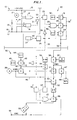
- Figure 1 of the drawings shows a tieline control or logic circuit embodying the invention for generating a correction value which compares an actual amount of power usage (energy) to a desired amount of power usage (energy) so that the actual amount can be regulated or other appropriate actions can be taken.
- the circuit of Figure 1 includes a first section 10 for holding asynchronous pulses on a 24 volt d c line, so that they can be counted in a counting logic circuit section 20.
- a third section 30 contains a timer and logic for calculating a kW correction or correction value needed to bring actual power usage to a target value for the power usage.
- the section 30 also includes an alarm which is activated if a deviation between the actual and target usage is too high.
- KWC is the power correction value
- KWM is the maximum or target energy usage value in kWh (kilowatt-hours)
- FIC is the fraction of time into each cycle, that is the fraction of the time elapsed in each cycle
- KWA is the power usage or energy (kWh) which has been used or accumulated during each cycle
- CT is the total cycle time or cycle period which is in general 30 minutes
- TIC is the time which has elapsed into the cycle.
- the numerator of the algorithm thus calculates the fractional amount of the target energy or power usage value and subtracts from this the actual amount of energy used up to that point in the cycle.
- the denominator represents the time remaining in the cycle.
- the cycle period of generally 30 minutes is divided into a plurality of time segments which are generally fractions of a second, and the power correction value is calculated after each time segment.
- the correction value is artificially held constant during the beginning and ending portions of the time cycle to avoid instability at these times.
- the input section 10 includes a relay 12 which is connected in series with an external input pulse contact 13 between a 24 volt d c line 15 and a ground line 16.
- the pulse contact 13 is for the energy (kWh) purchased.
- a sealed in contact 14 latches the relay 12 in the energised state when the contact 13 is pulsed.
- a sealed in contact 17 is connected in series with a logic unit 18 between the 24 V d c line 15 and the ground line 16.
- the logic unit 19 is connected in a Boolean circuit with an inverter 21. (Boolean logic lines are shown as dotted lines while solid lines indicate the passage of an analog signal).
- the output of the circuit section 10 is a line 22 on which there are developed pulses which correspond to the amount of energy (kWh) actually being used at any point in time.
- the circuit section 20 includes two signal scalers 23 and 24.
- the signal sealer 23 provides pulses from the line 22 to an input of an AND-gate 25. Another input of the AND-gate 25 is connected via an inverter 26 to an output of the signal scaler 24.
- the scaler 24 receives an input from a timer 27 which impresses a reset pulse on a line 28 at the end of each cycle period. Such a pulse is thus generated every 30 minutes, for example.
- the inverter 26 inverts the pulse (which is a high pulse) to a low signal at the output of inverter 26 so the output of the AND-gate 25 is inhibited.
- An output of the AND-gate 25 is connected to a transfer block 29 which receives an input from a summing unit 31.
- the summing unit 31 receives a constant initial input from a constant generator 32 and also is connected over a feedback line 32' to an output line 33 of a second transfer block 34.
- the second transfer block 34 is connected to a line 35 which is connected to the output of the signal scaler 24.
- the second transfer block 34 also receives an initial zeroing value from a constant element 36. In this way, the number of counts is returned to zero on the line 33 after the end of each full cycle.
- a constant element 37 in the circuit section 30 is connected to a multiplier 38 which also receives a number of counts measured from the beginning of each cycle on the line 33.
- the constant element 37 carries a scaling value which indicates the energy (kWh) per count so that the output of the multiplier 38 represents the energy accumulated from the beginning of each cycle, namely the factor KWA in the above-mentioned algorithm.
- the desired maximum power usage KWM is provided at an input 39 to a further multiplier 41 where the desired value is multiplied by the fraction of time (FIC) into each cycle from a line 42.
- the value FIC is measured in a timer 43 which receives an inverted input from the line 35 for resetting the timer to zero at the beginning of each cycle, and initial values from a constant element 44.
- the timer 43 can be reset manually by a constant element 45 which impresses a zero value in the timer 43.
- the input element 39 is also connected over a line 46 to a comparator 47 which receives another input (the value KWA) from the multiplier 38.
- the actual power usage can be compared to the total desired power usage or target power usage after each time segment. If this value represents a difference which is too high, this is sensed by a limiting element 48 which is used as an alarm.
- a comparator 51 receives a negative input from the multiplier 41 which represents the fraction of the desired energy or power usage (kWh) accumulated, that is the fraction (KWM.FIC) of the energy used so far in the cycle, and receives a positive input from the multiplier 38 representing the total amount of energy (KWA) used or accumulated thus far in the cycle.
- a signal on an output of the comparator 51 represents the present deviation between desired value (KWM.FIC) and the actual value (KWA) of the energy (kWh) so far consumed.
- a divider 52 is utilised to divide this deviation by the time remaining in the cycle to obtain the kWh correction value KWC on a line 53.
- the time remaining in the cycle (CT-TIC) is obtained by a comparator 54, which is connected to a constant element 56 which contains a value corresponding to the cycle time (CT) of 30 minutes, and which has a negative input connected to the line 42 on which is present the signal FIC representing the time into the cycle.
- the calculated correction value KWC is held constant during the first and last portions of each cycle period by a timer 54' which is connected via an OR-gate 55 to a transfer block 66.
- the transfer block 66 is instructed to hold the last correction value if it receives a high signal from the OR-gate 55.
- the OR-gate 55 generates a high signal during the first ten minutes of each cycle by means of the timer 54' and during the last ten minutes of each cycle by means of a low value limiting element 57 which has an input connected to the comparator 54 and an output connected to another input of the OR-gate 55.
- the output of the transfer block 66 is connected to a regulating device 58 which outputs a usable signal (KWC) on a line 59.
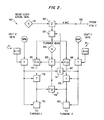
- a circuit 40 is connected to the line 59 and, as indicated above, converts the correction value KWC into a bias signal which can be used to regulate one or more turbines driving respective generators and thus modify the amount of power being generated.
- the line 59 is connected to a summing element 60 which receives an initial setting from an input element 61 corresponding to a base load for local power generation.
- Two control elements 70 and 80 for two turbines can be regulated in accordance with the correction value KWC. They receive a local control signal from respective circuits 71 and 81 and a remote controlling signal on lines 72 and 82 connected to transfer blocks 73 and 83, respectively.
- the total output of the two turbines is measured and summed in a summing unit 91 which has an output connected to a comparator 92.
- the comparator 92 has another input connected to the summing unit 60 which receives the correction value FWC.
- a comparator 92' is connected between outputs of the transfer blocks 73 and 83 and feeds a signal back to a further transfer block 93 which also has a turbine bias value provided thereto by an input unit 94.
- the transfer block 93 outputs values to comparators 95 and 96 which modify the signals on the lines 72 and 82, respectively.
Landscapes
- Engineering & Computer Science (AREA)
- Power Engineering (AREA)
- Physics & Mathematics (AREA)
- General Physics & Mathematics (AREA)
- Supply And Distribution Of Alternating Current (AREA)
- Control Of Electrical Variables (AREA)
- Control Of Eletrric Generators (AREA)
Applications Claiming Priority (2)
| Application Number | Priority Date | Filing Date | Title |
|---|---|---|---|
| US06/628,666 US4670713A (en) | 1984-07-06 | 1984-07-06 | Tieline control |
| US628666 | 1984-07-06 |
Publications (3)
| Publication Number | Publication Date |
|---|---|
| EP0167299A2 EP0167299A2 (en) | 1986-01-08 |
| EP0167299A3 EP0167299A3 (en) | 1987-07-29 |
| EP0167299B1 true EP0167299B1 (en) | 1992-05-06 |
Family
ID=24519824
Family Applications (1)
| Application Number | Title | Priority Date | Filing Date |
|---|---|---|---|
| EP85303996A Expired - Lifetime EP0167299B1 (en) | 1984-07-06 | 1985-06-05 | Monitoring power usage |
Country Status (10)
| Country | Link |
|---|---|
| US (1) | US4670713A (OSRAM) |
| EP (1) | EP0167299B1 (OSRAM) |
| JP (1) | JPS6126431A (OSRAM) |
| KR (1) | KR900005492B1 (OSRAM) |
| AU (1) | AU578475B2 (OSRAM) |
| BR (1) | BR8503272A (OSRAM) |
| CA (1) | CA1235184A (OSRAM) |
| DE (1) | DE3585971D1 (OSRAM) |
| IN (1) | IN162375B (OSRAM) |
| MX (1) | MX158648A (OSRAM) |
Families Citing this family (8)
| Publication number | Priority date | Publication date | Assignee | Title |
|---|---|---|---|---|
| US5732193A (en) * | 1909-01-26 | 1998-03-24 | Aberson; Michael | Method and apparatus for behavioristic-format coding of quantitative resource data/distributed automation protocol |
| JPS61292067A (ja) * | 1985-06-19 | 1986-12-22 | Mitsubishi Electric Corp | 電力量測定方法 |
| JPS63186534A (ja) * | 1987-01-28 | 1988-08-02 | 株式会社東芝 | 発電電力制御装置 |
| FR2650459B1 (fr) * | 1989-07-25 | 1991-10-04 | Renault | Dispositif d'interconnexion et d'extension de bus dans un reseau de transmission d'informations |
| US6020734A (en) * | 1996-08-01 | 2000-02-01 | Siemens Power Transmission & Distribution, Inc. | Electrical utility meter with event-triggered window for highest demands logging |
| JP3753113B2 (ja) * | 2002-08-23 | 2006-03-08 | 三菱電機株式会社 | 発電機制御装置 |
| US7272517B1 (en) * | 2006-04-25 | 2007-09-18 | International Business Machines Corporation | Method and system for providing performance estimations for a specified power budget |
| JP6337861B2 (ja) * | 2015-09-24 | 2018-06-06 | 三菱電機株式会社 | 貯湯式給湯システム |
Citations (2)
| Publication number | Priority date | Publication date | Assignee | Title |
|---|---|---|---|---|
| US3522421A (en) * | 1967-06-29 | 1970-08-04 | William H Miller | System for monitoring and adjusting power demand |
| US4110825A (en) * | 1977-04-28 | 1978-08-29 | Westinghouse Electric Corp. | Control method for optimizing the power demand of an industrial plant |
Family Cites Families (3)
| Publication number | Priority date | Publication date | Assignee | Title |
|---|---|---|---|---|
| DE2362230C3 (de) * | 1973-12-14 | 1982-05-27 | Licentia Patent-Verwaltungs-Gmbh, 6000 Frankfurt | Gerät zur Erfassung der maximalen mittleren Leistung, die in jeweils zeitgleichen Meßperioden eines Überwachungszeitraumes von enem mit einem Festmengengeber ausgestatteten Verbraucher aufgenommen wird |
| FI62902C (fi) * | 1981-07-03 | 1983-03-10 | Heikki Tapio Teittinen | Foerfarande foer maetning av energi- och effektfoerbrukning |
| US4412136A (en) * | 1981-12-15 | 1983-10-25 | The Babcock & Wilcox Company | Load control for energy converters |
-
1984
- 1984-07-06 US US06/628,666 patent/US4670713A/en not_active Expired - Fee Related
-
1985
- 1985-03-30 IN IN242/CAL/85A patent/IN162375B/en unknown
- 1985-04-15 KR KR1019850002518A patent/KR900005492B1/ko not_active Expired
- 1985-05-10 CA CA000481235A patent/CA1235184A/en not_active Expired
- 1985-06-04 AU AU43315/85A patent/AU578475B2/en not_active Ceased
- 1985-06-05 EP EP85303996A patent/EP0167299B1/en not_active Expired - Lifetime
- 1985-06-05 DE DE8585303996T patent/DE3585971D1/de not_active Expired - Fee Related
- 1985-06-07 MX MX205572A patent/MX158648A/es unknown
- 1985-06-19 JP JP13207985A patent/JPS6126431A/ja active Granted
- 1985-07-06 BR BR8503272A patent/BR8503272A/pt not_active IP Right Cessation
Patent Citations (2)
| Publication number | Priority date | Publication date | Assignee | Title |
|---|---|---|---|---|
| US3522421A (en) * | 1967-06-29 | 1970-08-04 | William H Miller | System for monitoring and adjusting power demand |
| US4110825A (en) * | 1977-04-28 | 1978-08-29 | Westinghouse Electric Corp. | Control method for optimizing the power demand of an industrial plant |
Non-Patent Citations (2)
| Title |
|---|
| BABCOCK & WILCOX, Engineering Specification G19-1 REV. E, 12/1/73 * |
| Functional Diagramming of Instruments and Control Systems, Bailey Controls * |
Also Published As
| Publication number | Publication date |
|---|---|
| KR860001509A (ko) | 1986-02-26 |
| US4670713A (en) | 1987-06-02 |
| JPS6126431A (ja) | 1986-02-05 |
| EP0167299A3 (en) | 1987-07-29 |
| EP0167299A2 (en) | 1986-01-08 |
| BR8503272A (pt) | 1986-04-01 |
| MX158648A (es) | 1989-02-16 |
| AU4331585A (en) | 1986-01-09 |
| KR900005492B1 (ko) | 1990-07-30 |
| CA1235184A (en) | 1988-04-12 |
| AU578475B2 (en) | 1988-10-27 |
| IN162375B (OSRAM) | 1988-05-14 |
| JPH0480618B2 (OSRAM) | 1992-12-21 |
| DE3585971D1 (de) | 1992-06-11 |
Similar Documents
| Publication | Publication Date | Title |
|---|---|---|
| US4819180A (en) | Variable-limit demand controller for metering electrical energy | |
| US4253151A (en) | Apparatus for monitoring and controlling consumer power consumption | |
| US3602703A (en) | Power demand predicting control system | |
| CA2250098C (en) | Method and apparatus for charging batteries | |
| US4191918A (en) | Automatic electric battery charging apparatus | |
| CA2935852C (en) | Power consumption management through energy storage devices | |
| EP0167299A2 (en) | Monitoring power usage | |
| US4059747A (en) | Demand controller | |
| US3789201A (en) | Simulated load forecast and control apparatus | |
| US3522421A (en) | System for monitoring and adjusting power demand | |
| EP0467994B1 (en) | A method and an apparatus for charging of a battery | |
| US4125895A (en) | Maximum-power motor | |
| US4556842A (en) | Tracking filter for sensing DC content in an AC waveform | |
| EP4166950B1 (en) | Electrical parameter monitoring | |
| US4405987A (en) | Measuring processes and apparatus for determining tariff values for energy consumers | |
| US3424653A (en) | Method for start-up of a nuclear reactor utilizing a digital computer | |
| EP0083776B1 (en) | Xenon suppression in a nuclear fuelled electric power generation system | |
| CN101331001A (zh) | 用于电阻焊接的带有驱动点电压估计器的改进的相位基准产生器 | |
| DE2717888B2 (de) | Verfahren zur digitalen Steuerung von elektrischen Kochstellen | |
| US4419733A (en) | Time deviation and inadvertent interchange correction for automatic generation control | |
| US4246492A (en) | Method of and apparatus for load and/or load control signaling to customers in a power system | |
| CN115392545A (zh) | 电能需量控制方法、控制装置、系统和存储介质 | |
| RU2019842C1 (ru) | Способ учета электрической энергии и устройство для его осуществления | |
| JP3946548B2 (ja) | 同時同量制御装置および同時同量制御用プログラム | |
| RU1780022C (ru) | Способ контрол потреблени электроэнергии |
Legal Events
| Date | Code | Title | Description |
|---|---|---|---|
| PUAI | Public reference made under article 153(3) epc to a published international application that has entered the european phase |
Free format text: ORIGINAL CODE: 0009012 |
|
| AK | Designated contracting states |
Designated state(s): DE FR GB IT |
|
| PUAL | Search report despatched |
Free format text: ORIGINAL CODE: 0009013 |
|
| AK | Designated contracting states |
Kind code of ref document: A3 Designated state(s): DE FR GB IT |
|
| 17P | Request for examination filed |
Effective date: 19871130 |
|
| 17Q | First examination report despatched |
Effective date: 19891211 |
|
| RAP1 | Party data changed (applicant data changed or rights of an application transferred) |
Owner name: INTERNATIONAL CONTROL AUTOMATION FINANCE S.A. |
|
| GRAA | (expected) grant |
Free format text: ORIGINAL CODE: 0009210 |
|
| AK | Designated contracting states |
Kind code of ref document: B1 Designated state(s): DE FR GB IT |
|
| PG25 | Lapsed in a contracting state [announced via postgrant information from national office to epo] |
Ref country code: IT Free format text: LAPSE BECAUSE OF FAILURE TO SUBMIT A TRANSLATION OF THE DESCRIPTION OR TO PAY THE FEE WITHIN THE PRESCRIBED TIME-LIMIT;WARNING: LAPSES OF ITALIAN PATENTS WITH EFFECTIVE DATE BEFORE 2007 MAY HAVE OCCURRED AT ANY TIME BEFORE 2007. THE CORRECT EFFECTIVE DATE MAY BE DIFFERENT FROM THE ONE RECORDED. Effective date: 19920506 |
|
| REF | Corresponds to: |
Ref document number: 3585971 Country of ref document: DE Date of ref document: 19920611 |
|
| PG25 | Lapsed in a contracting state [announced via postgrant information from national office to epo] |
Ref country code: GB Effective date: 19920806 |
|
| EN | Fr: translation not filed | ||
| PG25 | Lapsed in a contracting state [announced via postgrant information from national office to epo] |
Ref country code: FR Effective date: 19920925 |
|
| PG25 | Lapsed in a contracting state [announced via postgrant information from national office to epo] |
Ref country code: DE Effective date: 19930302 |
|
| PLBE | No opposition filed within time limit |
Free format text: ORIGINAL CODE: 0009261 |
|
| STAA | Information on the status of an ep patent application or granted ep patent |
Free format text: STATUS: NO OPPOSITION FILED WITHIN TIME LIMIT |
|
| GBPC | Gb: european patent ceased through non-payment of renewal fee |
Effective date: 19920806 |
|
| 26N | No opposition filed | ||
| REG | Reference to a national code |
Ref country code: FR Ref legal event code: ST |