EP0165614A2 - Hybridplasmid und dasselbe enthaltender Mikroorganismus - Google Patents
Hybridplasmid und dasselbe enthaltender Mikroorganismus Download PDFInfo
- Publication number
- EP0165614A2 EP0165614A2 EP85107679A EP85107679A EP0165614A2 EP 0165614 A2 EP0165614 A2 EP 0165614A2 EP 85107679 A EP85107679 A EP 85107679A EP 85107679 A EP85107679 A EP 85107679A EP 0165614 A2 EP0165614 A2 EP 0165614A2
- Authority
- EP
- European Patent Office
- Prior art keywords
- coli
- galactosidase
- ptrezl
- plasmid
- hybrid plasmid
- Prior art date
- Legal status (The legal status is an assumption and is not a legal conclusion. Google has not performed a legal analysis and makes no representation as to the accuracy of the status listed.)
- Ceased
Links
Images

Classifications
-
- C—CHEMISTRY; METALLURGY
- C12—BIOCHEMISTRY; BEER; SPIRITS; WINE; VINEGAR; MICROBIOLOGY; ENZYMOLOGY; MUTATION OR GENETIC ENGINEERING
- C12Q—MEASURING OR TESTING PROCESSES INVOLVING ENZYMES, NUCLEIC ACIDS OR MICROORGANISMS; COMPOSITIONS OR TEST PAPERS THEREFOR; PROCESSES OF PREPARING SUCH COMPOSITIONS; CONDITION-RESPONSIVE CONTROL IN MICROBIOLOGICAL OR ENZYMOLOGICAL PROCESSES
- C12Q1/00—Measuring or testing processes involving enzymes, nucleic acids or microorganisms; Compositions therefor; Processes of preparing such compositions
- C12Q1/68—Measuring or testing processes involving enzymes, nucleic acids or microorganisms; Compositions therefor; Processes of preparing such compositions involving nucleic acids
- C12Q1/6897—Measuring or testing processes involving enzymes, nucleic acids or microorganisms; Compositions therefor; Processes of preparing such compositions involving nucleic acids involving reporter genes operably linked to promoters
-
- C—CHEMISTRY; METALLURGY
- C12—BIOCHEMISTRY; BEER; SPIRITS; WINE; VINEGAR; MICROBIOLOGY; ENZYMOLOGY; MUTATION OR GENETIC ENGINEERING
- C12N—MICROORGANISMS OR ENZYMES; COMPOSITIONS THEREOF; PROPAGATING, PRESERVING, OR MAINTAINING MICROORGANISMS; MUTATION OR GENETIC ENGINEERING; CULTURE MEDIA
- C12N15/00—Mutation or genetic engineering; DNA or RNA concerning genetic engineering, vectors, e.g. plasmids, or their isolation, preparation or purification; Use of hosts therefor
- C12N15/09—Recombinant DNA-technology
- C12N15/63—Introduction of foreign genetic material using vectors; Vectors; Use of hosts therefor; Regulation of expression
- C12N15/70—Vectors or expression systems specially adapted for E. coli
- C12N15/71—Expression systems using regulatory sequences derived from the trp-operon
-
- C—CHEMISTRY; METALLURGY
- C12—BIOCHEMISTRY; BEER; SPIRITS; WINE; VINEGAR; MICROBIOLOGY; ENZYMOLOGY; MUTATION OR GENETIC ENGINEERING
- C12N—MICROORGANISMS OR ENZYMES; COMPOSITIONS THEREOF; PROPAGATING, PRESERVING, OR MAINTAINING MICROORGANISMS; MUTATION OR GENETIC ENGINEERING; CULTURE MEDIA
- C12N9/00—Enzymes; Proenzymes; Compositions thereof; Processes for preparing, activating, inhibiting, separating or purifying enzymes
- C12N9/14—Hydrolases (3)
- C12N9/24—Hydrolases (3) acting on glycosyl compounds (3.2)
- C12N9/2402—Hydrolases (3) acting on glycosyl compounds (3.2) hydrolysing O- and S- glycosyl compounds (3.2.1)
- C12N9/2468—Hydrolases (3) acting on glycosyl compounds (3.2) hydrolysing O- and S- glycosyl compounds (3.2.1) acting on beta-galactose-glycoside bonds, e.g. carrageenases (3.2.1.83; 3.2.1.157); beta-agarase (3.2.1.81)
- C12N9/2471—Beta-galactosidase (3.2.1.23), i.e. exo-(1-->4)-beta-D-galactanase
-
- C—CHEMISTRY; METALLURGY
- C12—BIOCHEMISTRY; BEER; SPIRITS; WINE; VINEGAR; MICROBIOLOGY; ENZYMOLOGY; MUTATION OR GENETIC ENGINEERING
- C12Y—ENZYMES
- C12Y302/00—Hydrolases acting on glycosyl compounds, i.e. glycosylases (3.2)
- C12Y302/01—Glycosidases, i.e. enzymes hydrolysing O- and S-glycosyl compounds (3.2.1)
- C12Y302/01023—Beta-galactosidase (3.2.1.23), i.e. exo-(1-->4)-beta-D-galactanase
-
- C—CHEMISTRY; METALLURGY
- C07—ORGANIC CHEMISTRY
- C07K—PEPTIDES
- C07K2319/00—Fusion polypeptide
-
- C—CHEMISTRY; METALLURGY
- C07—ORGANIC CHEMISTRY
- C07K—PEPTIDES
- C07K2319/00—Fusion polypeptide
- C07K2319/01—Fusion polypeptide containing a localisation/targetting motif
- C07K2319/02—Fusion polypeptide containing a localisation/targetting motif containing a signal sequence
-
- C—CHEMISTRY; METALLURGY
- C07—ORGANIC CHEMISTRY
- C07K—PEPTIDES
- C07K2319/00—Fusion polypeptide
- C07K2319/61—Fusion polypeptide containing an enzyme fusion for detection (lacZ, luciferase)
Definitions
- This invention relates to a hybrid plasmid comprising a tryptophan promoter and S-galactosidase gene, and a host microorganism containing or harboring the hybrid plasmid and being capable of producing ⁇ -galactosidase.
- a host microorganism such as Escherichia coli containing a hybrid plasmid is prepared by inserting a DNA having information for producing a useful substance such as human interferon, insulin, or the like into a vector plasmid of the host microorganism, and then subjected to the production of the useful substance in a large scale.
- ⁇ -Galactosidase (S-gal) is an enzyme hydrolyzing lactose into glucose and galactose and is used for modifying milk for persons suffered from alactosia.
- ⁇ -Galactosidase is produced industrially from Escherichia coli (E. coli) Aspergillus niger and Aspergillus foetidus, but not satisfactory.
- This invention provides a hybrid plasmid comprising a tryptophan (trp) promoter and ⁇ -galactosidase ( ⁇ -gal) gene connected to a DNA coding 8 amino acids at an N-terminal side of tryptophane E polypeptide on the downstream side of the trp promoter.
- trp tryptophan
- ⁇ -gal ⁇ -galactosidase
- This invention also provides a process for producing hybrid plasmid pTREZl which comprises
- This invention further provides a microorganism containing a hybrid plasmid comprising a trp promoter and ⁇ -gal gene connected to a DNA coding 8 amino acids at an N-terminal side of trp E polypeptide on the downstream side of the trp promoter.
- This invention also provide a process for producing ⁇ -galactosidase which comprises
- the hybrid plasmid comprising a trp promoter and ⁇ -gal gene connected to a DNA coding 8 amino acids at an N-terminal side of trp E polypeptide on the downstream side of the trp promoter, more concretely pTREZl, can be prepared from a plasmid containing a trp promoter and a plasmid containing ⁇ -gel gene therein.
- the plasmid containing a trp promoter includes, for example, plasmid pTREl, which is obtained by inserting a DNA fragment of about 500 bp (base pairs) comprising a promoter of trp operon of E. coli, trp L (leader peptide) and a part of terminal portion of trp E (an anthranilate synthase) into the EcoRI site of plasmid pBR322 [Gene, 29, 41-49 (1984)].
- the direction of trp promoter is the direction of Tc r (a tetracycline resistance gene) of pBR322.
- Tc r a tetracycline resistance gene
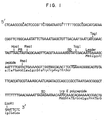
- Fig. 1 shows a base sequence in the trp promoter. As is clear from Fig. 1, it is possible to express a foreign gene in the fused form with the 8 amino acids at the N-terminal side of trp E polypeptide by ligating the foreign gene at the EcoRI site in trp E polypeptide gene.
- Plasmid pMC1403 is obtained by inserting 6.2 kb (kiobase pairs) ⁇ -galactosidase gene (lac Z + lac Y) between the sites of EcoRI and SalI of pBR322.
- Fig. 2 is a schematic diagram showing the construction of plasmid pTREZl from plasmid pTREl and plasmid pMC1403.
- Plasmid pTREl is digested with restriction endonucleases EcoRI and SalI to give 4.21 kb DNA fragment (1) including trp promoter, followed by purification by a conventional method, e.g. agarose gel electrophoresis.
- 6.2 kb of ⁇ -galactosidase gene is cleaved from pMC1403 by digestion with restriction endonucleases EcoRI and SalI, followed by purification by a conventional method, e.g. agarose gel electrophoresis.
- the ⁇ -galactosidase gene and the. DNA fragment (1) are ligated with T 4 DNA ligase to give 10.21 kb of hybrid plasmid pTREZl.
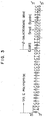
- Fig. 3 shows a base sequence of a connecting portion of trp promoter and ⁇ -galactosidase gene on the hybrid plasmid.
- ⁇ -galactosidase gene is ligated to the DNA fragment coding 8 amino acids on the N-terminal side of trp E polypeptide. Since there are' restriction endonuclease sites of EcoRI, SmaI and BamHI near the connecting portion, it becomes possible to insert a foreign gene into these sites.
- E. coli such as E. coli M182, E. coli HB101, E. coli C600, E. coli X1776, E. coli DHl, etc.
- pTREZl-containing E. coli M182 is deposited in the FRI as FERM BP-816
- pTREZl-containing E. coli HB101 is deposited in the FRI as FERM'BP-815.
- Such a process comprises cultivating the E. coli(pTREZ1) in a culture medium containing a substrate such as glucose and casamino acid, adding an inducer such as IA (3- ⁇ -indolylacrylic acid) during the cultivation to induce the production of ⁇ -galactosidase, accumulating the produced ⁇ -galactosidase in a large amount in the cells, recovering the cultivated E. coli by centrifugation or membrane filtration, lysing cell walls of the recovered E.
- an inducer such as IA (3- ⁇ -indolylacrylic acid
- DNA fragments were recovered by agarose gel electrophoresis. Each recovered DNA fragment was dissolved in a TEN buffer (0.02 M Tris-HCl, 1 mM EDTA and 0.02 M NaCl; pH 8.0) and ligated with 2.5 units of T 4 DNA ligase (a total amount 50 ⁇ l) to give hybrid plasmid pTREZl characterized by the restriction maps shown in Figs. 2 and 3.
- E. coli C600 was transformed to give transformants.
- a transformant containing plasmid pTREZl was selected and cultivated to obtained pTREZl.
- E. coli M182 was transformed.
- One transformant was obtained from about 0.1 ⁇ g of plasmid pTREZ1 by the transformation of E. coli M 182.
- the resulting E. coli M182 containing plasmid pTREZl is depcsited in the FRI as FERM BP-816.
- E. coli M182 containing plasmid pTREZl was cultivated in 10 ml of L-broth culture medium [trypton 10 g, yeast extract 5 g, glucose 1 g, NaCl 5 g, water 1 liter, pH 7.2] added with 50 ⁇ g/ml of ampicillin at 37°C for 15 hours.
- M9-casamino acid culture medium [NH 4 Cl 1 g, Na 2 HPO 4 6 g, KH 2 PO 4 3 g, NaCl 5 g, MgSO 4 ⁇ 7H 2 O 0.1 g , CaCl 2 ⁇ 2H 2 O 15 mg, glucose 2 g, casamino acid 20 g, distilled water 1 liter, pH 7.0] added with 50 ⁇ g/ml of ampicillin at 37°C for 4 hours. After cultivation for one hour, 15 ⁇ g/ml of 3- ⁇ -indolylacrylic acid (IA) was added to start the transcription of mRNA as an inducing substance.
- IA 3- ⁇ -indolylacrylic acid
- ⁇ -galactosidase activity was measured.
- One ml of the culture solution was sampled and 15 ml of toluene was added thereto with vigorous stirring, followed by shaking at 37°C for 30 minutes.
- 2 ml of 0.35 M phosphate buffer (pH 7.25) and 2 ml of 0.25 M lactose solution were added, and the resulting solution was shaked at 30°C for 40 minutes, followed by immersion in boiling water for 15 minutes to stop the enzymatic reaction.
- the amount of glucose in the solution was measured by a glucose analyzer YSI 23A (manufactured by Yellow Springs Instrument Co., Inc.).
- the enzymatic activity of ⁇ -galactosidase was evaluated by defining the amount of hydrolyzing 1 ⁇ mole of lactose for 1 minute as 1 unit (U).
- Trp tryptophan
- the ⁇ -galactosidase activity per ml of the culture solution becomes 1.22 U, which value is about 5 times as large as the case of adding no IA.
- the activity of 1 mg of pure ⁇ -galactosidase when measured by an orthonitrophenyl- galactoside (ONPG) method is 340 U and the activity value of ⁇ -galactosidase measured by the ONPG method is about 5 times as high as the case measured by using the lactose substrate.
- the amount of ⁇ -galactosidase is calculated by using these values and converted to the number of ⁇ -galactosidase molecules per cell, it becomes 86,000 molecules.
- tryptophan (Trp) is added as an repressing substance, the production of ⁇ -galactosidase is a half of the case adding no IA to E. coli Ml82(pTREZl). This means that when tryptophan is added, a repressser is activated and bonded to an operator portion of the tryptophan promoter, so that bonding of RNA polymerase to the trp promoter is prevented.
- ⁇ -galactosidase can be produced in large amounts, new promoters can be reached, and the production of foreign genes can be detected by the expression of ⁇ -galactosidase.
Landscapes
- Chemical & Material Sciences (AREA)
- Health & Medical Sciences (AREA)
- Life Sciences & Earth Sciences (AREA)
- Genetics & Genomics (AREA)
- Organic Chemistry (AREA)
- Engineering & Computer Science (AREA)
- Zoology (AREA)
- Wood Science & Technology (AREA)
- Bioinformatics & Cheminformatics (AREA)
- General Engineering & Computer Science (AREA)
- Biotechnology (AREA)
- Biochemistry (AREA)
- General Health & Medical Sciences (AREA)
- Microbiology (AREA)
- Biomedical Technology (AREA)
- Molecular Biology (AREA)
- Physics & Mathematics (AREA)
- Biophysics (AREA)
- Proteomics, Peptides & Aminoacids (AREA)
- Medicinal Chemistry (AREA)
- Plant Pathology (AREA)
- Analytical Chemistry (AREA)
- Immunology (AREA)
- Measuring Or Testing Involving Enzymes Or Micro-Organisms (AREA)
- Micro-Organisms Or Cultivation Processes Thereof (AREA)
- Enzymes And Modification Thereof (AREA)
Applications Claiming Priority (2)
| Application Number | Priority Date | Filing Date | Title |
|---|---|---|---|
| JP59127471A JPS619287A (ja) | 1984-06-22 | 1984-06-22 | 複合プラスミド及びそれを保持する微生物 |
| JP127471/84 | 1984-06-22 |
Publications (2)
| Publication Number | Publication Date |
|---|---|
| EP0165614A2 true EP0165614A2 (de) | 1985-12-27 |
| EP0165614A3 EP0165614A3 (de) | 1988-01-07 |
Family
ID=14960743
Family Applications (1)
| Application Number | Title | Priority Date | Filing Date |
|---|---|---|---|
| EP85107679A Ceased EP0165614A3 (de) | 1984-06-22 | 1985-06-21 | Hybridplasmid und dasselbe enthaltender Mikroorganismus |
Country Status (2)
| Country | Link |
|---|---|
| EP (1) | EP0165614A3 (de) |
| JP (1) | JPS619287A (de) |
Cited By (2)
| Publication number | Priority date | Publication date | Assignee | Title |
|---|---|---|---|---|
| FR2693475A1 (fr) * | 1992-07-08 | 1994-01-14 | Rhone Poulenc Rorer Sa | Procédé d'identification et/ou de clonage de promoteurs transcriptionnels, et utilisation de ces promoteurs pour l'expression de gènes. |
| EP2803720A4 (de) * | 2012-01-10 | 2016-04-06 | Cj Cheiljedang Corp | Mikroorganismen von escherichia coli mit verbesserter l-tryptophanherstellung und verfahren zur herstellung von l-tryptophan damit |
Family Cites Families (1)
| Publication number | Priority date | Publication date | Assignee | Title |
|---|---|---|---|---|
| JPH078231B2 (ja) * | 1985-03-25 | 1995-02-01 | 株式会社日立製作所 | 培養制御方法及び培養制御装置 |
-
1984
- 1984-06-22 JP JP59127471A patent/JPS619287A/ja active Granted
-
1985
- 1985-06-21 EP EP85107679A patent/EP0165614A3/de not_active Ceased
Cited By (3)
| Publication number | Priority date | Publication date | Assignee | Title |
|---|---|---|---|---|
| FR2693475A1 (fr) * | 1992-07-08 | 1994-01-14 | Rhone Poulenc Rorer Sa | Procédé d'identification et/ou de clonage de promoteurs transcriptionnels, et utilisation de ces promoteurs pour l'expression de gènes. |
| EP2803720A4 (de) * | 2012-01-10 | 2016-04-06 | Cj Cheiljedang Corp | Mikroorganismen von escherichia coli mit verbesserter l-tryptophanherstellung und verfahren zur herstellung von l-tryptophan damit |
| US9587261B2 (en) | 2012-01-10 | 2017-03-07 | Cj Cheiljedang Corporation | Microorganism of the genus Escherichia having enhanced L-tryptophan productivity and a method for producing L-tryptophan using the same |
Also Published As
| Publication number | Publication date |
|---|---|
| JPH046353B2 (de) | 1992-02-05 |
| EP0165614A3 (de) | 1988-01-07 |
| JPS619287A (ja) | 1986-01-16 |
Similar Documents
| Publication | Publication Date | Title |
|---|---|---|
| EP0035384B1 (de) | Desoxyribonukleotid-Segment zur Befestigung an einer klonierten DNS-Codierungssequenz | |
| US4769326A (en) | Expression linkers | |
| FI86886C (fi) | Nya expressionsplasmider och deras anvaendning i foerfarandet foer expressering av prokymosin koderande gen i e. coli | |
| FI96620C (fi) | Hiivapromoottori | |
| Di Nocera et al. | Nucleotide sequence of the attenuator region of the histidine operon of Escherichia coli K-12. | |
| EP0121352A1 (de) | Eine Leitsequenz zur Förderung der Sekretion von Genprodukten | |
| US5795776A (en) | Expression plasmids regulated by an OSMB promoter | |
| Fellinger et al. | Expression of the α‐galactosidase from Cyamopsis tetragonoloba (guar) by Hansenula polymorpha | |
| JP2002508946A (ja) | 高発現エシェリキアコリ発現ベクター | |
| Icho et al. | Molecular cloning and sequencing of the gene for CDP-diglyceride hydrolase of Escherichia coli. | |
| EP0252737B1 (de) | Hefestämme zur Expression fremder Gene | |
| EP0165614A2 (de) | Hybridplasmid und dasselbe enthaltender Mikroorganismus | |
| EP1022332A1 (de) | Beta-fruktofuranosidase und dafür kodierendes gen | |
| JPH08500014A (ja) | K.ラクチス(K.lactis)トランスアルドラーゼ遺伝子のプロモーターおよびその使用 | |
| EP0165613B1 (de) | Verfahren zum Kontrollieren der Züchtung von Rekombinanten | |
| EP0174585A2 (de) | Promotoren und deren Anwendung zur Expression von nichtfusierten prokaryontischen oder enkaryontischen Proteinen in Hefe | |
| EP0590721A1 (de) | Verfahren zur Expression in der Hefe Schizosaccharomyces Pombe von Rezeptoren des menschlichen Nervensystems | |
| AU621277B2 (en) | Shortened phosphoglycerate kinase promoter | |
| WO1986000637A1 (en) | Yeast cloning vehicle | |
| EP0216573B1 (de) | Hefe-Promotor und Verfahren zur Herstellung von heterologen Proteinen | |
| EP0335400B1 (de) | Verfahren zur Herstellung von Epidermal-Wachstumsfaktor durch genetische Transformation | |
| EP0314184A1 (de) | Expressionsplasmide | |
| KR100420313B1 (ko) | 신규 레반슈크라제를 이용한 레반의 생산방법 | |
| US5145782A (en) | DNA expression vector suitable for direct expression of a foreign gene | |
| JPH0673459B2 (ja) | ラット肝チトクロムp―450cおよびnadph―チトクロムp―450還元酵素を同時に酵母内で発現させることを目的とした発現用プラスミドparm1,ならびにparm1を菌体内に保持する酵母菌体 |
Legal Events
| Date | Code | Title | Description |
|---|---|---|---|
| PUAI | Public reference made under article 153(3) epc to a published international application that has entered the european phase |
Free format text: ORIGINAL CODE: 0009012 |
|
| 17P | Request for examination filed |
Effective date: 19850621 |
|
| AK | Designated contracting states |
Designated state(s): DE FR GB |
|
| PUAL | Search report despatched |
Free format text: ORIGINAL CODE: 0009013 |
|
| AK | Designated contracting states |
Kind code of ref document: A3 Designated state(s): DE FR GB |
|
| 17Q | First examination report despatched |
Effective date: 19900622 |
|
| STAA | Information on the status of an ep patent application or granted ep patent |
Free format text: STATUS: THE APPLICATION HAS BEEN REFUSED |
|
| 18R | Application refused |
Effective date: 19911129 |
|
| RIN1 | Information on inventor provided before grant (corrected) |
Inventor name: KURIHARA, TOSHIHARU Inventor name: ODAWARA, YOJI Inventor name: BEPPU, TERUHIKO Inventor name: SHIMIZU, NORIO Inventor name: MASUDA, KEIKO |