EP0162016A2 - Zusätze für Materialien - Google Patents
Zusätze für Materialien Download PDFInfo
- Publication number
- EP0162016A2 EP0162016A2 EP85810221A EP85810221A EP0162016A2 EP 0162016 A2 EP0162016 A2 EP 0162016A2 EP 85810221 A EP85810221 A EP 85810221A EP 85810221 A EP85810221 A EP 85810221A EP 0162016 A2 EP0162016 A2 EP 0162016A2
- Authority
- EP
- European Patent Office
- Prior art keywords
- alkyl
- tert
- butyl
- formula
- compounds
- Prior art date
- Legal status (The legal status is an assumption and is not a legal conclusion. Google has not performed a legal analysis and makes no representation as to the accuracy of the status listed.)
- Granted
Links
Classifications
-
- C—CHEMISTRY; METALLURGY
- C10—PETROLEUM, GAS OR COKE INDUSTRIES; TECHNICAL GASES CONTAINING CARBON MONOXIDE; FUELS; LUBRICANTS; PEAT
- C10M—LUBRICATING COMPOSITIONS; USE OF CHEMICAL SUBSTANCES EITHER ALONE OR AS LUBRICATING INGREDIENTS IN A LUBRICATING COMPOSITION
- C10M135/00—Lubricating compositions characterised by the additive being an organic non-macromolecular compound containing sulfur, selenium or tellurium
- C10M135/32—Heterocyclic sulfur, selenium or tellurium compounds
- C10M135/34—Heterocyclic sulfur, selenium or tellurium compounds the ring containing sulfur and carbon only
-
- C—CHEMISTRY; METALLURGY
- C07—ORGANIC CHEMISTRY
- C07C—ACYCLIC OR CARBOCYCLIC COMPOUNDS
- C07C321/00—Thiols, sulfides, hydropolysulfides or polysulfides
-
- C—CHEMISTRY; METALLURGY
- C07—ORGANIC CHEMISTRY
- C07C—ACYCLIC OR CARBOCYCLIC COMPOUNDS
- C07C323/00—Thiols, sulfides, hydropolysulfides or polysulfides substituted by halogen, oxygen or nitrogen atoms, or by sulfur atoms not being part of thio groups
-
- C—CHEMISTRY; METALLURGY
- C07—ORGANIC CHEMISTRY
- C07D—HETEROCYCLIC COMPOUNDS
- C07D339/00—Heterocyclic compounds containing rings having two sulfur atoms as the only ring hetero atoms
- C07D339/02—Five-membered rings
- C07D339/06—Five-membered rings having the hetero atoms in positions 1 and 3, e.g. cyclic dithiocarbonates
-
- C—CHEMISTRY; METALLURGY
- C08—ORGANIC MACROMOLECULAR COMPOUNDS; THEIR PREPARATION OR CHEMICAL WORKING-UP; COMPOSITIONS BASED THEREON
- C08K—Use of inorganic or non-macromolecular organic substances as compounding ingredients
- C08K5/00—Use of organic ingredients
- C08K5/36—Sulfur-, selenium-, or tellurium-containing compounds
- C08K5/37—Thiols
- C08K5/372—Sulfides, e.g. R-(S)x-R'
-
- C—CHEMISTRY; METALLURGY
- C10—PETROLEUM, GAS OR COKE INDUSTRIES; TECHNICAL GASES CONTAINING CARBON MONOXIDE; FUELS; LUBRICANTS; PEAT
- C10M—LUBRICATING COMPOSITIONS; USE OF CHEMICAL SUBSTANCES EITHER ALONE OR AS LUBRICATING INGREDIENTS IN A LUBRICATING COMPOSITION
- C10M135/00—Lubricating compositions characterised by the additive being an organic non-macromolecular compound containing sulfur, selenium or tellurium
- C10M135/20—Thiols; Sulfides; Polysulfides
- C10M135/22—Thiols; Sulfides; Polysulfides containing sulfur atoms bound to acyclic or cycloaliphatic carbon atoms
- C10M135/24—Thiols; Sulfides; Polysulfides containing sulfur atoms bound to acyclic or cycloaliphatic carbon atoms containing hydroxy groups; Derivatives thereof
-
- C—CHEMISTRY; METALLURGY
- C10—PETROLEUM, GAS OR COKE INDUSTRIES; TECHNICAL GASES CONTAINING CARBON MONOXIDE; FUELS; LUBRICANTS; PEAT
- C10M—LUBRICATING COMPOSITIONS; USE OF CHEMICAL SUBSTANCES EITHER ALONE OR AS LUBRICATING INGREDIENTS IN A LUBRICATING COMPOSITION
- C10M135/00—Lubricating compositions characterised by the additive being an organic non-macromolecular compound containing sulfur, selenium or tellurium
- C10M135/20—Thiols; Sulfides; Polysulfides
- C10M135/22—Thiols; Sulfides; Polysulfides containing sulfur atoms bound to acyclic or cycloaliphatic carbon atoms
- C10M135/26—Thiols; Sulfides; Polysulfides containing sulfur atoms bound to acyclic or cycloaliphatic carbon atoms containing carboxyl groups; Derivatives thereof
-
- C—CHEMISTRY; METALLURGY
- C10—PETROLEUM, GAS OR COKE INDUSTRIES; TECHNICAL GASES CONTAINING CARBON MONOXIDE; FUELS; LUBRICANTS; PEAT
- C10M—LUBRICATING COMPOSITIONS; USE OF CHEMICAL SUBSTANCES EITHER ALONE OR AS LUBRICATING INGREDIENTS IN A LUBRICATING COMPOSITION
- C10M2219/00—Organic non-macromolecular compounds containing sulfur, selenium or tellurium as ingredients in lubricant compositions
- C10M2219/08—Thiols; Sulfides; Polysulfides; Mercaptals
- C10M2219/082—Thiols; Sulfides; Polysulfides; Mercaptals containing sulfur atoms bound to acyclic or cycloaliphatic carbon atoms
- C10M2219/084—Thiols; Sulfides; Polysulfides; Mercaptals containing sulfur atoms bound to acyclic or cycloaliphatic carbon atoms containing hydroxy groups; Derivatives thereof
-
- C—CHEMISTRY; METALLURGY
- C10—PETROLEUM, GAS OR COKE INDUSTRIES; TECHNICAL GASES CONTAINING CARBON MONOXIDE; FUELS; LUBRICANTS; PEAT
- C10M—LUBRICATING COMPOSITIONS; USE OF CHEMICAL SUBSTANCES EITHER ALONE OR AS LUBRICATING INGREDIENTS IN A LUBRICATING COMPOSITION
- C10M2219/00—Organic non-macromolecular compounds containing sulfur, selenium or tellurium as ingredients in lubricant compositions
- C10M2219/08—Thiols; Sulfides; Polysulfides; Mercaptals
- C10M2219/082—Thiols; Sulfides; Polysulfides; Mercaptals containing sulfur atoms bound to acyclic or cycloaliphatic carbon atoms
- C10M2219/085—Thiols; Sulfides; Polysulfides; Mercaptals containing sulfur atoms bound to acyclic or cycloaliphatic carbon atoms containing carboxyl groups; Derivatives thereof
-
- C—CHEMISTRY; METALLURGY
- C10—PETROLEUM, GAS OR COKE INDUSTRIES; TECHNICAL GASES CONTAINING CARBON MONOXIDE; FUELS; LUBRICANTS; PEAT
- C10M—LUBRICATING COMPOSITIONS; USE OF CHEMICAL SUBSTANCES EITHER ALONE OR AS LUBRICATING INGREDIENTS IN A LUBRICATING COMPOSITION
- C10M2219/00—Organic non-macromolecular compounds containing sulfur, selenium or tellurium as ingredients in lubricant compositions
- C10M2219/10—Heterocyclic compounds containing sulfur, selenium or tellurium compounds in the ring
-
- C—CHEMISTRY; METALLURGY
- C10—PETROLEUM, GAS OR COKE INDUSTRIES; TECHNICAL GASES CONTAINING CARBON MONOXIDE; FUELS; LUBRICANTS; PEAT
- C10M—LUBRICATING COMPOSITIONS; USE OF CHEMICAL SUBSTANCES EITHER ALONE OR AS LUBRICATING INGREDIENTS IN A LUBRICATING COMPOSITION
- C10M2219/00—Organic non-macromolecular compounds containing sulfur, selenium or tellurium as ingredients in lubricant compositions
- C10M2219/10—Heterocyclic compounds containing sulfur, selenium or tellurium compounds in the ring
- C10M2219/102—Heterocyclic compounds containing sulfur, selenium or tellurium compounds in the ring containing sulfur and carbon only in the ring
-
- C—CHEMISTRY; METALLURGY
- C10—PETROLEUM, GAS OR COKE INDUSTRIES; TECHNICAL GASES CONTAINING CARBON MONOXIDE; FUELS; LUBRICANTS; PEAT
- C10M—LUBRICATING COMPOSITIONS; USE OF CHEMICAL SUBSTANCES EITHER ALONE OR AS LUBRICATING INGREDIENTS IN A LUBRICATING COMPOSITION
- C10M2219/00—Organic non-macromolecular compounds containing sulfur, selenium or tellurium as ingredients in lubricant compositions
- C10M2219/10—Heterocyclic compounds containing sulfur, selenium or tellurium compounds in the ring
- C10M2219/104—Heterocyclic compounds containing sulfur, selenium or tellurium compounds in the ring containing sulfur and carbon with nitrogen or oxygen in the ring
-
- C—CHEMISTRY; METALLURGY
- C10—PETROLEUM, GAS OR COKE INDUSTRIES; TECHNICAL GASES CONTAINING CARBON MONOXIDE; FUELS; LUBRICANTS; PEAT
- C10M—LUBRICATING COMPOSITIONS; USE OF CHEMICAL SUBSTANCES EITHER ALONE OR AS LUBRICATING INGREDIENTS IN A LUBRICATING COMPOSITION
- C10M2219/00—Organic non-macromolecular compounds containing sulfur, selenium or tellurium as ingredients in lubricant compositions
- C10M2219/10—Heterocyclic compounds containing sulfur, selenium or tellurium compounds in the ring
- C10M2219/104—Heterocyclic compounds containing sulfur, selenium or tellurium compounds in the ring containing sulfur and carbon with nitrogen or oxygen in the ring
- C10M2219/106—Thiadiazoles
-
- C—CHEMISTRY; METALLURGY
- C10—PETROLEUM, GAS OR COKE INDUSTRIES; TECHNICAL GASES CONTAINING CARBON MONOXIDE; FUELS; LUBRICANTS; PEAT
- C10N—INDEXING SCHEME ASSOCIATED WITH SUBCLASS C10M RELATING TO LUBRICATING COMPOSITIONS
- C10N2040/00—Specified use or application for which the lubricating composition is intended
- C10N2040/08—Hydraulic fluids, e.g. brake-fluids
-
- C—CHEMISTRY; METALLURGY
- C10—PETROLEUM, GAS OR COKE INDUSTRIES; TECHNICAL GASES CONTAINING CARBON MONOXIDE; FUELS; LUBRICANTS; PEAT
- C10N—INDEXING SCHEME ASSOCIATED WITH SUBCLASS C10M RELATING TO LUBRICATING COMPOSITIONS
- C10N2050/00—Form in which the lubricant is applied to the material being lubricated
- C10N2050/10—Form in which the lubricant is applied to the material being lubricated semi-solid; greasy
Definitions
- the invention relates to material containing aldosemercaptals, their use as additives in plastics, lubricants or hydraulic fluids, which can be based on oil or water or mixtures thereof, and new aldosemercaptals.
- aldose mercaptals and their preparation are known from the literature, e.g. from Chem. Ber. 27, 673 (1894) or from Chem. Ber. 84: 780 (1951); these served to identify and isolate aldoses.
- the use of certain representatives is described for specific areas in US 3,635,717 and US 3,635,736; They are used there on the one hand to provide an improved light-sensitive photographic silver halide emulsion and on the other hand as flavorings in foods.
- additives are added to the lubricants.
- the oxidation reactions in a lubricant that occur, for example, at elevated temperature due to atmospheric oxygen can be prevented by adding antioxidants.
- Detergents are used, for example, because they in engine oils, keep oil-insoluble oxidation and combustion residues in suspensions and thereby prevent deposits on metal surfaces and sludge deposits in the engine and wear and tear by neutralizing acidic combustion products.
- the lubricant at high pressures between the contacts e.g. Prevent gears, cam-tappet systems, seizures on the metal surfaces; this causes so-called high-pressure and anti-wear additives.
- PVC is thermally stressed, e.g. When thermoplastic deformation occurs, damage can occur through the elimination of hydrogen chloride (dehydrochlorination), autoxidation and mechanochemical fragmentation.
- specific stabilizers are added, which on the one hand delay dehydrochlorination and autoxidation (preventive stabilizer functions), but also at least partially remedy damage that has already occurred (curative stabilizer functions).
- n can be a natural number from 2 to 6 and in which R and R 2 are identical or different and in each case unsubstituted, substituted or interrupted by -0- or -S- C 1 -C 18 alkyl, - (CH 2 ) r - CO-N (C 1 -C 17 alkyl) 2 where r is 1 or 2, phenyl, benzyl or - (CH 2 ) r CO-OR 3 , where r can be 1 or 2 and R 3 is alkali metal or C 1 -C 14 represents alkyl, furthermore where R and R 2 are -CH 2 -CH (OH) -R 4 , where R 4 is hydrogen, unsubstituted or substituted by -OH C 1 -C 16 alkyl or -CH 2 -Y- ( C 1 -C 15 alkyl) where Y is -0- or -S-, or in which R and R together
- the above-mentioned material can be organic material or water or mixtures thereof, but preferably organic material.
- R 1 and / or R 2 are C 1 -C 18 alkyl, they are straight-chain or branched substituents, such as, for example, methyl, ethyl, n-propyl, isopropyl, n-butyl, sec-butyl, tert-butyl, pentyl Hexyl Heptyl, octyl, nonyl, decyl, undecyl, dodecyl, tridecyl, tetradecyl, pentadecyl, hexadecyl, heptadecyl or octadecyl, but especially straight-chain or branched octyl, nonyl, decyl, undecyl or dodecyl, pentadecyl or hexadecyl and especially around 2 -hexyl, 2-butyl-octyl or 2-hexyl-decy
- C 1 -C 17 alkyl and C 1 -C 15 alkyl are straight-chain and branched substituents, such as, for example, methyl, ethyl, n-propyl, isopropyl, n-butyl, sec-butyl, tert-butyl, pentyl, hexyl , Heptyl, octyl, nonyl, decyl, undecyl, dodecyl, tridecyl, tetradecyl, pentadecyl, hexadecyl, heptadecyl.
- substituents such as, for example, methyl, ethyl, n-propyl, isopropyl, n-butyl, sec-butyl, tert-butyl, pentyl, hexyl , Heptyl, octyl, nonyl, decyl, undecy
- R 3 is in - (CH 2 ) r -CO-OR 3 , which can act as a substituent for R 1 and / or R 2 , is alkali metal, it is lithium, sodium or potassium, but in particular Sodium or potassium; if R 3 is C 1 -C 14 alkyl, it is straight-chain or branched substituents, such as methyl, ethyl, n-propyl, isopropyl, n-butyl, sec-butyl, tert-butyl, pentyl, Hexyl, heptyl, octyl, nonyl, decyl, undecyl, dodecyl, tridecyl or tetradecyl.
- R 4 is -CH 2 -CH (OH) -R 4 , which can act as a substituent for R 1 and / or R 2 , is C 1 -C 16 alkyl, it is a straight-chain or branched substituent, such as methyl, ethyl, n-propyl, isopropyl, n-butyl, sec-butyl, tert-butyl, pentyl, hexyl, heptyl, octyl, tert-nonyl, decyl-undecyl, tert-dodecyl, tridecyl, tetradecyl, pentadecyl or Hexadecyl.
- C 1 -C 16 alkyl is substituted as R by -OH, all monohydroxy positional isomers are possible, but multiple substitutions by -OH can also occur, preferably twice.
- R 1 and R 2 together as - (CH 2 ) m form a heterocyclic ring with the S atoms to which they are attached, it is, for example, a ring with 5 to 7 ring atoms, preferably a ring with 5 or 6 ring atoms.
- organic material containing a compound of the formula I, in which n can be a natural number from 3 to 6, and in which R 1 and R 2 are identical and are C 1 -C 16 which is unsubstituted or interrupted by -0- or -S- Alkyl, phenyl, benzyl or - (CH 2 ) r CO-OR 3 , where r can be 1 or 2 and R 3 is alkali metal, or wherein R and R 2 are -CH 2 CH (OH) -R 4 , wherein R 4 is hydrogen or C 1 -C 14 alkyl or -CH 2 -O- (C 1 -C 13 alkyl), or wherein R 1 and R 2 together form - (CH 2 ) m -, where m is a natural number can be from 2 to 4.
- Organic material containing a compound of formula I in which n can be a natural number from 3 to 6, and in which R and R are identical and C 8 -C 16 alkyl or -CH 2 -O- (C 7 - C 15 is alkyl), phenyl, benzyl or -CH 2 -COOK, -CH 2 -COONa or -CH 2 -CH 2 COOK or where R 1 and R 2 are -CH 2 -CH (OH) -R 4 , where R 4 is hydrogen or C 6 -C 14 alkyl or -CH 2 -O- (C 5 -C 13 alkyl), or wherein R 1 and R 2 together form - (CH 2 ) m -, where m is a natural number of Can be 2 to 4.
- the invention further provides compounds of the formula I in which n can be a natural number from 2 to 6, and in which R 1 and R 2 are identical or different and in each case branched C 5 -C 18 alkyl, - (CH 2 ) r -CO-OR 3 , where r can be 1 or 2 and R represents alkali metal or C 1 -C 14 alkyl, or -CH 2 -CH (OH) -R 4 , where R 4 is hydrogen or unsubstituted or by - OH-substituted C 1- C 16 alkyl or -CH 2 -Y- (C 1 -C 15 alkyl) with Y equal to -0- or -S-, but especially - (CH 2 ) r -CO-OR 3 or - CH 2 -CH (OH) -R 4 mean.
- n can be a natural number from 3 to 6 and in which R and R 2 are identical and -CH 2 -CH - [(CH 2 ) 3 -CH 3 ] [(CH 2 ) q +2 -CH 3 ], where q can be 1 to 5, - (CH 2 ) r -CO-OR 3 , where r can be 1 or 2 and R is alkali metal, or -CH 2 -CH (OH) -R 4 mean, where R 4 is hydrogen or C 1 -C 14 alkyl or -CR 2 -O- (C 1 -C 13 alkyl).
- n can be a natural number from 4 to 6, and in which R and R 2 are identical and -2-ethylhexyl, -2-butyloctyl, -2-hexyl-decyl, -CH 2 -COOK, -CH -COONa or -CH 2 -CH 2 -COOK or where R and R 2 are -CH 2 -CH (OH) -R 4 , where R 4 is hydrogen or C 6 -C 14 alkyl or -CH 2 -O- (C 5 -C 13 alkyl).
- an ion exchange resin in the H form is particularly advantageous for the synthesis of aldose mercaptals.
- aldose mercaptals of the formula I are suitable as additives for a number of substrates. At this point, however, only the use in lubricants, hydraulic fluids and plastics will be specifically discussed.
- the lubricant is 0.001-5.0% by weight, but preferably 0.005-3.0% by weight and particularly preferably 0.1-1.0% by weight, of the aldose mercaptal of the formula I, based on the weight of the lubricant Formulation added.
- mineral and synthetic lubricating oils, hydraulic fluids and lubricating greases are equipped in this way, they show excellent properties, which is reflected in greatly reduced wear and tear of the parts to be lubricated; This is due to the fact that the aldose egg capes of the formula I as multipurpose additives increase the antioxidant, anticorrosive and dispersing action in the lubricants; above all, they improve high-pressure behavior and anti-wear effectiveness; as an improver, they prevent oil loss.
- lubricants in question are familiar to the person skilled in the art and e.g. described in the "Lubricant Paperback (Hüthig Verlag, Heidelberg, 1974)".
- mineral oils e.g. Poly-a-olefins, ester-based lubricants, phosphates, glycols, polyglycols and polyalkylene glycols.
- the lubricant formulations can additionally contain other additives which are added to improve further use properties, such as, for example, antioxidants, metal passivators, rust inhibitors, viscosity index improvers, pour point depressants, dispersants / surfactants and wear protection additives.
- additives such as, for example, antioxidants, metal passivators, rust inhibitors, viscosity index improvers, pour point depressants, dispersants / surfactants and wear protection additives. Examples include:
- esters of ⁇ - (3,5-di-tert-butyl-4-hydroxyphenyl) propionic acid with mono- or polyhydric alcohols such as e.g.
- esters of ⁇ - (5-tert-butyl-4-bydroxy-3-methylphenyl) propionic acid with mono- or polyhydric alcohols such as e.g.
- metal passivators examples are:
- rust inhibitors are:
- viscosity index improvers examples are e.g.
- Polymethacrylates vinyl pyrrolidone / methacrylate copolymers, polybutenes, olefin copolymers, styrene / acrylate copolymers.
- pour point lower examples are e.g.
- dispersants / surfactants examples include:
- Polybutenylsuccinic acid imides polybutenylphosphonic acid derivatives, basic magnesium, calcium and barium sulfonates and phenolates.
- wear protection additives examples include:
- Compounds containing sulfur and / or phosphorus and / or halogen such as sulfurized vegetable oils, zinc dialkyldithiophosphates, tritolyl phosphate, chlorinated paraffins, alkyl and aryl disulfides.
- aldose mercaptals of the formula I can also be used as additives for plastics and elastomers, in which they act as thermal stabilizers and antioxidants, e.g. for PVC, and as an adhesion promoter, especially for metal, glass, wood, ceramic and concrete. In addition, they have good antistatic activity.
- the aldose captaptals of the formula I are added to the plastics in a concentration of 0.005 to 5% by weight, based on the weight of the plastic to be stabilized.
- 0.05-2% by weight and in particular 0.1 to 2% by weight of the aldose mercaptals of the formula I, based on the material to be stabilized, are incorporated into this.
- the incorporation can be carried out, for example, by mixing in the compounds of the formula I and, if appropriate, further additives using the methods customary in industry, before or during shaping, or else by applying the dissolved or dispersed ones Connections to the polymer, optionally with subsequent evaporation of the solvent.
- the incorporation can be carried out separately or as a mixture.
- aldose mercaptals of the formula I can also be added to the plastics to be stabilized in the form of a masterbatch which contains these compounds, for example in a concentration of 2.5 to 25% by weight.
- compositions according to the invention are added before the crosslinking.
- the materials stabilized in this way can be used in various forms, e.g. as films, especially agricultural films, fibers, tapes, molding compounds, profiles, foamed articles or as binders for paints, adhesives or putties.
- aldose mercaptals of the formula I can be used together with other stabilizers.
- examples of other additives with which the aldose mercaptals can be used are:
- esters of ß- (3,5-di-tert.butyl-4-hydroxypheny1) propionic acid with mono- or polyhydric alcohols e.g.
- Metal deactivators e.g. N, N'-diphenyloxalic acid diamide, N-salicylal-N'-salicyloyl hydrazine, N, N'-bis-salicyloyl hydrazine, N, N'-bis (3,5-di-tert-butyl-4-hydroxyphenylpropionyl) hydrazine, 3-salicyloylamino-1,2,4-triazole, bis-benzylidene-oxalic acid dihydrazide.
- N, N'-diphenyloxalic acid diamide e.g. N, N'-diphenyloxalic acid diamide, N-salicylal-N'-salicyloyl hydrazine, N, N'-bis-salicyloyl hydrazine, N, N'-bis (3,5-di-tert-butyl-4-hydroxyphenylpropionyl) hydr
- Phosphites and phosphonites e.g. Triphenyl phosphite, diphenylalkyl phosphite, phenyl dialkyl phosphite, tri- (nonylphenyl) phosphite, trilauryl phosphite, trioctadecyl phosphite, distearyl-pentaerythritol diphosphite, tris- (2,4-di-tert.butylphenyl) phosphite, diisodhritol-diisodhritol-di -tert.butylphenyl) pentaerythritol diphosphite, tristearyl sorbitol triphosphite, tetrakis (2,4-di-tert.butylphenyl) -4,4'-biphenylene diphosphonite.
- Peroxide destroying compounds e.g. Esters of ß-thio-dipropionic acid, for example lauryl, stearyl, myristyl or tridecyl esters, mercaptobenzimidazole, the zinc salt of 2-mercaptobenzimidazole, zinc dibutyl dithiocarbamate, dioctadecyl disulfide, pentaerythritol tetrakod (d) tetrakis ( ⁇ ).
- Esters of ß-thio-dipropionic acid for example lauryl, stearyl, myristyl or tridecyl esters
- mercaptobenzimidazole the zinc salt of 2-mercaptobenzimidazole
- zinc dibutyl dithiocarbamate dioctadecyl disulfide
- Polyamide stabilizers e.g. Copper salts in combination with iodides and / or phosphorus compounds and salts of divalent manganese.
- Basic co-stabilizers such as e.g. Melamine, polyvinylpyrrolidone, dicyandiamide, triallyl cyanurate, urea derivatives, hydrazine derivatives, amines, polyamides, polyurethanes, alkali and alkaline earth metal salts of higher fatty acids, for example Ca stearate, Zn stearate, Mg stearate, Na ricinoleate, K palmitate, Antimony catecholate or tin catecholate.
- Basic co-stabilizers such as e.g. Melamine, polyvinylpyrrolidone, dicyandiamide, triallyl cyanurate, urea derivatives, hydrazine derivatives, amines, polyamides, polyurethanes, alkali and alkaline earth metal salts of higher fatty acids, for example Ca stearate, Zn stearate, Mg stearate, Na ricinoleate, K palmitate
- Nucleating agents e.g. 4-tert-butylbenzoic acid, adipic acid, diphenylacetic acid.
- Fillers and reinforcing agents such as e.g. Calcium carbonate, silicates, glass fibers, asbestos, talc, kaolin, mica, barium sulfate, metal oxides and hydroxides, carbon black, graphite.
- additives such as Plasticizers, lubricants, emulsifiers, pigments, optical brighteners, flame retardants, antistatic agents, blowing agents.
- the aldose mercaptals of the formula I are suitable as additives to mineral and synthetic lubricating oils, hydraulic liquids which can be based on Oe1 or water or mixtures thereof, and lubricating greases. They can be used as multipurpose additives and are especially effective against corrosion and oxidation, improve the high pressure, wear protection and dispersion properties and prevent oil from dripping and splashing as an adhesion promoter.
- reaction product is precipitated with water, the solid is suctioned off and washed several times with water. The residue is then recrystallized from the respective organic solvent.
- reaction mixture is mixed with diethyl ether; water is then added until the phase is two, the aqueous phase is separated off and the organic phase is treated with an aqueous sodium bicarbonate solution. After drying over sodium sulfate and clarifying filtration, the solvent is distilled off on a rotary evaporator and the residue is recrystallized from the respective organic solvent.
- a 3 The trifluoroacetic acid is distilled off on a rotary evaporator and the residue is recrystallized from the respective organic solvent.
- a mixture of 200 g of D - (+) - glucose, 156 g of 2-mercaptoethanol, 120 g of LEWASORB AC 10 / H and 150 g of methanol is heated to 45-50 ° C. with stirring for 6-12 hours.
- 400 ml of methanol are added to the reaction mixture, the mixture is stirred vigorously for 10 minutes and, after the solid has settled, the supernatant solution is decanted off. This process is repeated with 200 ml of methanol.
- the combined methanolic solutions are concentrated on a rotary evaporator and the unreacted 2-mercaptoethanol is distilled off using an oil pump.
- this compound is advantageously packaged as an approximately 50% solution in water.
- the reaction can be repeated several times with the same yield as described above.
- Examples 2-14 Analogously to the process described in general Example A, further compounds (Examples 2-6 and 8-14) are prepared, which are compiled in addition to Example 1 in Table I below.
- application examples 1-3 relate to lubricants and application example 4 to plastics.
- Deionized water is used as the test liquid for the effectiveness of the additives (Example Nos. 2 and 7), which as the rust inhibitor is 0.75% by weight of 2,4,6-tris (5'-carboxypentylamino) -1,3,5 -triazine and triethanolamine until the pH of 8.5 is reached. Only deionized water is used as the test liquid for the effectiveness of the additive (example no. 1), the pH being 9.4.
- Example of use 2 The wear cap is determined using the Reichert wear balance (Reichert Wear Test DBGM 1749247).
- Deionized water is used as test liquid for the effectiveness of the additives (Example Nos. 2 and 7), which as a rust inhibitor 0.75% by weight 2,4,6-tris (5'-carboxypentylamino) -1,3,5- triazine and triethanolamine until the pH of 8.5 is reached. Only deionized water is used as the test liquid for the effectiveness of the additive (example no. 1), the pH being 9.4.
- a mixture is prepared in a beaker with water according to certain regulations, which also contains the additive to be investigated.
- Gray cast iron chips are wetted with the freshly prepared mixture on a round filter, exposed to room temperature for 2 hours in a Petri dish and then the round filter is visually assessed for signs of corrosion.
- the degrees of corrosion are evaluated on the basis of a table (cf. DIN 51360 / Part 2), in which 0 means no corrosion and 1, 2, 3 and 4 increasingly severe corrosion.
- Deionized water is used as the test liquid for the effectiveness of the additives (Example Nos. 2 and 7), which as the rust inhibitor is 0.75% by weight of 2,4,6-tris (5'-carboxypentylamino) -1,3,5 -triazine and triethanolamine until the pH of 8.5 is reached. Only deionized water is used as the test liquid for the effectiveness of the additive (example no. 1), the pH being 9.4.
- thermostabilizing effect of certain additives In order to test the thermostabilizing effect of certain additives, a method is used in which the color change of test films is assessed at a constant higher temperature as a function of time.
- test foils are made according to the following recipe:
- the test film is produced on a mixing roll mill at 180 ° C., the film having a thickness of 0.3 mm.
- the optical comparison is carried out by measuring the yellowness index in accordance with DIN 6167 (ASTM D 1925-70).
Landscapes
- Chemical & Material Sciences (AREA)
- Organic Chemistry (AREA)
- Chemical Kinetics & Catalysis (AREA)
- General Chemical & Material Sciences (AREA)
- Oil, Petroleum & Natural Gas (AREA)
- Health & Medical Sciences (AREA)
- Medicinal Chemistry (AREA)
- Polymers & Plastics (AREA)
- Organic Low-Molecular-Weight Compounds And Preparation Thereof (AREA)
- Compositions Of Macromolecular Compounds (AREA)
- Lubricants (AREA)
- Heterocyclic Compounds Containing Sulfur Atoms (AREA)
Abstract

Description
- Die Erfindung betrifft Material, enthaltend Aldosemercaptale, deren Verwendung als Zusätze in Kunststoffen, Schmierstoffen oder Hydraulikflüssigkeiten, die auf Oel oder Wasser oder Gemischen davon basieren können, und neue Aldosemercaptale.
- Einige Aldosemercaptale und deren Herstellung sind aus der Literatur bekannt, z.B. aus Chem.Ber. 27, 673 (1894) oder aus Chem. Ber. 84, 780 (1951); diese dienten der Identifizierung und Isolierung von Aldosen. Die Anwendung bestimmter Vertreter ist für spezielle Gebiete in US 3 635 717 und US 3 635 736 beschrieben; sie werden dort einerseits eingesetzt, um eine verbesserte licht-empfindliche photographische Silberhalogenid-Emulsion zu liefern, und andererseits als Aromastoffe in Nahrungsmitteln.
- Um die Gebrauchseigenschaften von Schmierstoffen zu verbessern und deren natürlichen oder technisch bedingten Alterungserscheinungen entgegenzuwirken, werden den Schmierstoffen Additive beigegeben. Die beispielsweise bei erhöhter Temperatur verstärkt durch Luftsauerstoff eintretenden Oxidationsreaktionen in einem Schmierstoff können durch Zugabe von Antioxidantien unterbunden werden. Detergentien werden beispielsweise eingesetzt, weil sie u.a. in Motorenölen, ölunlösliche Oxidations- und Verbrennungsrückstände in Suspensionen halten und dadurch Ablagerungen an Metalloberflächen und Schlammausscheidungen im Motor und Verschleiss durch Neutralisation saurer Verbrennungsprodukte verhindern. Weiterhin soll der Schmierstoff bei hohen Drücken zwischen den Kontakten, wie z.B. Zahnrädern, Nocken-Stössel-Systemen, Fresserscheinungen auf den Metalloberflächen verhindern; dieses bewirken sog. Hochdruck- und Antiverschleiss-Additive.
- Wenn andererseits z.B. Sauerstoff und Feuchtigkeit gleichzeitig auf eine Metalloberfläche einwirken, kann Korrosion auftreten, weshalb Korrosionsinhibitoren mit dem Ziel zugegeben werden, den Zutritt dieser Stoffe zur Metalloberfläche zu verhindern. Um beispielsweise Oelverluste durch Abtropfen ober Abspritzen zu verhindern, setzt man sog. Haftverbesserer zu. Es ist bekannt, dass bestimmte Stoffe als Additive für Schmierstoffe eine Anzahl von solchen Eigenschaften in sich vereinigen; sie werden als sog. Vielzweck-Additive bezeichnet. Solche Stoffe sind - wie sich leicht vorstellen lässt - aus ökonomischen und praktischen Gründen natürlich sehr gefragt.
- Wenn PVC thermisch belastet wird, wie es z.B. bei der thermoplastischen Verformung geschieht, kann eine Schädigung durch Chlorwasserstoffabspaltung (Dehydrochlorierung),Autoxidation und mechanochemische Fragmentierung auftreten. Um PVC bei der Verarbeitung möglichst nicht zu schädigen und um seine Gebrauchseigenschaften zu erhalten, setzt man spezifische Stabilisatoren zu, welche einerseits die Dehydrochlorierung und Autoxidation verzögern (präventive Stabilisatorfunktionen), aber auch bereits eingetretene Schäden wenigstens teilweise beheben (curative Stabilisatorfunktionen).
- Es ist bekannt, dass natürliche und synthetische Polymere der 0xi dation durch Sauerstoff unterliegen; diese kann während der gesamten Lebenszeit eines Polymeren in unerwünschter Weise wirksam werden. Die damit verbundenen Alterungserscheinungen sind einerseits ästhetischer Art und andererseits erfolgt mehr oder weniger parallel dazu auch ein Verlust an mechanischen Eigenschaften. Bei den in die Polymeren einzuarbeitenden Antioxidantien handelt es sich um chemische Verbindungen, welche die Oxidation und die daraus resultierenden Alterungserscheinungen eines Polymeren verzögern können.
- Da die meisten Kunststoffe aufgrund ihrer chemischen Konstitution ausgesprochene Isolatoren sind, werden sie z.B. auch als Werkstoffe in der Hochfrequenztechnik eingesetzt. Nachteilig ist dabei, dass einmal aufgebrachte Ladungen wegen der geringen Oberflächenleitfähigkeit nicht rasch genug abgeführt werden können, was zu einer hohen Aufladung führt. Durch Antistatika kann die Oberflächenleitfähigkeit verbessert werden, so dass die Ladungen über die Oberfläche abgeleitet werden können.
- Die vorliegende Erfindung betrifft nun Material, enthaltend eine Verbindung der Formel I

- Das oben genannte Material kann organisches Material oder Wasser oder Mischungen davon, bevorzugt aber organisches Material, sein.
- Sind R1 und/oder R2 C1-C18 Alkyl, so handelt es sich um geradkettige oder verzweigte Substituenten, wie beispielsweise Methyl, Ethyl, n-Propyl, Isopropyl, n-Butyl, sec-Butyl, tert-Butyl, Pentyl, Hexyl, Heptyl, Octyl, Nonyl, Decyl, Undecyl, Dodecyl, Tridecyl, Tetradecyl, Pentadecyl, Hexadecyl, Heptadecyl oder Octadecyl, insbesondere aber um geradkettiges oder verzweigtes Octyl, Nonyl, Decyl, Undecyl oder Dodecyl, Pentadecyl oder Hexadecyl und im speziellen um 2-Ethyl-hexyl, 2-Butyl-octyl oder 2-Hexyl-decyl sowie um isoprenoides Decyl oder Pentadecyl.
- Bei C1-C17 Alkyl und C1-C15 Alkyl handelt es sich um geradkettige und verzweigte Substituenten, wie beispielsweise Methyl, Ethyl, n-Propyl, Isopropyl, n-Butyl, sec-Butyl, tert-Butyl, Pentyl, Hexyl, Heptyl, Octyl, Nonyl, Decyl, Undecyl, Dodecyl, Tridecyl, Tetradecyl, Pentadecyl, Hexadecyl, Heptadecyl. Bei C1-C16 Alkyl sind Hexadecyl und Heptadecyl nicht eingeschlossen.
- Dreht es sich bei R3 in -(CH2)r -CO-O-R3, welches als Substituent für R1 und/oder R2 fungieren kann, um Alkalimetall, so handelt es sich um Lithium, Natrium oder Kalium, insbesondere aber um Natrium oder Kalium; dreht es sich bei R3 um C1-C14 Alkyl, so handelt es sich um geradkettige oder verzweigte Substituenten, wie beispielsweise Methyl, Ethyl, n-Propyl, Isopropyl, n-Butyl, sec-Butyl, tert-Butyl, Pentyl, Hexyl, Heptyl, Octyl, Nonyl, Decyl, Undecyl, Dodecyl, Tridecyl oder Tetradecyl.
- Dreht es bei R4 in -CH2-CH(OH)-R4, welches als Substituent für R1 und/oder R2 fungieren kann, um Cl-C16 Alkyl, so handelt es sich um geradkettige oder verzweigte Substituenten, wie beispielsweise Methyl, Ethyl, n-Propyl, Isopropyl, n-Butyl, sec-Butyl, tert-Butyl, Pentyl,Hexyl, Heptyl, Octyl, tert.-Nonyl,DecylUndecyl,tert.-Dodecyl,Tridecyl, Tetradecyl, Pentadecyl oder Hexadecyl. Ist C1-C16 Alkyl als R durch-OH substituiert, so sind alle Monohydroxy-Stellungsisomeren möglich, es können jedoch auch mehrfache Substitutionen durch -OH auftreten, bevorzugt zweifache.
- Bilden R1 und R2 zusammen als -(CH2)m mit den S-Atomen, an die sie gebunden sind, einen heterocyclischen Ring, so handelt es sich beispielsweise um einen Ring mit 5 bis 7 Ringatomen, bevorzugt um einen Ring mit 5 oder 6 Ringatomen.
- Bevorzugt ist organisches Material, enthaltend eine Verbindung der Formel I, worin n eine natürliche Zahl von 3 bis 6 sein kann, und worin R1 und R2 gleich sind und unsubstituiertes oder durch -0- oder -S- unterbrochenes C1-C16 Alkyl, Phenyl, Benzyl oder -(CH2)r CO-O-R3 bedeuten, wobei r gleich 1 oder 2 sein kann und R3 Alkalimetall ist, oder worin R und R2 -CH2 CH(OH)-R4 sind, wobei R4 Wasserstoff oder C1-C14 Alkyl oder -CH2 -O-(C1-C13 Alkyl) ist, oder worin R 1 und R2 zusammen -(CH2)m- bilden, wobei m eine natürliche Zahl von 2 bis 4 sein kann.
- Besonders bevorzugt ist organisches Material, enthaltend eine Verbindung der Formel I, worin n eine natürliche Zahl von 3 bis 6 sein kann, und worin R und R gleich sind und C8-C16 Alkyl oder -CH2-O-(C7-C15 Alkyl), Phenyl, Benzyl oder -CH2-COOK, -CH2-COONa oder -CH2-CH2 COOK bedeuten oder worin R1 und R2 -CH2-CH(OH)-R4 sind, wobei R4 Wasserstoff oder C6-C14 Alkyl oder -CH2-O-(C5-C13 Alkyl) ist, oder worin R1 und R2 zusammen -(CH2)m- bilden, wobei m eine natürliche Zahl von 2 bis 4 sein kann.
- Einen weiteren Gegenstand der Erfindung stellen Verbindungen der Formel I dar, worin n eine natürliche Zahl von 2 bis 6 sein kann, und worin R1 und R2 gleich oder verschieden sind und jeweils verzweigtes C5-C18 Alkyl, -(CH2)r-CO-O-R3, wobei r gleich 1 oder 2 sein kann und R Alkalimetall oder C1-C14 Alkyl darstellt, oder -CH2-CH(OH)-R4 bedeuten, wobei R4 Wasserstoff oder unsubstituiertes oder durch -OH substituiertes C1-C16 Alkyl oder -CH2-Y-(C1-C15 Alkyl) mit Y gleich -0- oder -S- darstellt, insbesondere aber -(CH2)r-CO-OR3 oder -CH2-CH(OH)-R4 bedeuten.
- Bevorzugt sind Verbindungen der Formel I, worin n eine natürliche Zahl von 3 bis 6 sein kann, und worin R und R2 gleich sind und -CH2-CH-[(CH2)3 -CH3][(CH2)q+2 -CH3], wobei q gleich 1 bis 5 sein kann, -(CH2)r-CO-O-R3, wobei r gleich 1 oder 2 sein kann und R Alkalimetall ist, oder -CH2-CH(OH)-R4 bedeuten, wobei R4 Wasserstoff oder C1-C14 Alkyl oder -CR2-O-(C1-C13 Alkyl) bedeutet.
- Besonders bevorzugt sind Verbindungen der Formel I, worin n eine natürliche Zahl von 4 bis 6 sein kann, und worin R und R2 gleich sind und -2-Ethyl-hexyl, -2-Butyl-octyl, -2-Hexyl-decyl, -CH2-COOK, -CH -COONa oder -CH2-CH2-COOK bedeuten oder worin R und R2 -CH2-CH(OH)-R4 sind, wobei R4 Wasserstoff oder C6-C14 Alkyl oder -CH2-O-(C5-C13 Alkyl) darstellt.
- Die bereits gegebene beispielhafte Bedeutung von R3 und R4 soll auch hier für die neuen Aldosemercaptale der Formel I gelten.
- Als Beispiele für neue Verbindungen der Formel I sind hier die folgen-


- Besonders vorteilhaft für die Synthese von Aldosemercaptale ist die Verwendung eines Ionenaustauscherharzes in der H-Form.
- Die Aldosemercaptale der Formel I sind als Additive für eine Reihe von Substraten geeignet. An dieser Stelle soll spezifisch jedoch nur auf die Verwendung in Schmierstoffen, Hydraulikflüssigkeiten und Kunststoffen eingegangen werden.
- Dem Schmierstoff werden 0,001-5,0 Gew.-%, bevorzugt jedoch 0,005-3,0 Gew.-% und besonders bevorzugt 0,1-1,0 Gew.-Z des Aldosemercaptals der Formel I, bezogen auf das Gewicht der Schmierstoff-Formulierung zugesetzt.
- Sind mineralische und synthetische Schmieröle, hydraulische Flüssigkeiten und Schmierfette auf solche Weise ausgerüstet, so zeigen sie ausgezeichnete Eigenschaften, was sich in stark reduzierten Abnutzungserscheinungen der zu schmierenden Teile bemerkbar macht; dieses ist darauf zurückzuführen, dass die Aldoseniercaptale der Formel I als Vielzweck-Additive die antioxidierende, antikorrosive und dispergierende Wirkung in den Schmierstoffen steigern; vor allem verbessern sie das Hochdruck-Verhalten und die Antiverschleiss-Wirksamkeit; als Haftverbesserer beugen sie Oelverlusten vor.
- Die in Frage kommenden Schmierstoffe sind dem Fachmann geläufig und z.B. im "Schmiermittel-Taschenbuch (Hüthig Verlag, Heidelberg, 1974)" beschrieben. Besonders geeignet sind neben Mineralölen z.B. Poly-a-Olefine, Schmierstoffe auf Esterbasis, Phosphate, Glykole, Polyglykole und Polyalkylenglykole.
- Die Schmierstoff-Formulierungen können zusätzlich noch andere Additive enthalten, die zugegeben werden, um weitere Gebrauchs-Eigenschaften zu verbessern, wie z.B. Antioxidantien, Metallpassivatoren, Rostinhibitoren, Viskositätsindex-Verbesserer, Stockpunkterniedriger, Dispergiermittel/Tenside und Verschleisschutz-Additive. Als Beispiele sind zu nennen:
-
- 2,6-Di-tert.-butyl-4-methylphenol
- 2,6-Di-tert.-butylphenol
- 2-tert.-butyl-4,6-Dimethylphenyl
- 2,6-Di-tert.-butyl-4-ethylphenol
- 2,6-Di-tert.-butyl-4-ethylphenol
- 2,6-Di-tert.-butyl-4-n-butylphenol
- 2,6-Di-tert.-butyl-4-i-butylphenol
- 2,6-Di-cyclopentyl-4-methylphenol
- 2-(a-Methylcyclohexyl)-4,6-dimethylphenol
- 2,6-Di-octadecyl-4-methylphenol
- 2,4,6-Tri-cyclohexylphenol
- 2,6-Di-tert.-butyl-4-methoxymethylphenyl
- o-tert.-Butylphenol
-
- 2,6-Di-tert.-butyl-4-methoxyphenol
- 2,5-Di-tert.-butyl-hydrochinon
- 2,5-Di-tert.-amyl-hydrochinon
- 2,6-Diphenyl-4-octadecyloxyphenol
-
- 2,2*-Thio-bis-(6-tert.-butyl-4-methylphenol)
- 2,2'-Thio-bis-(4-octylphenol)
- 4,4'-Thio-bis-(6-tert.-butyl-3-methylphenol)
- 4,4'-Thio-bis-(6-tert.-butyl-2-methylphenol)
-
- 2,2'-Methylen-bis-(6-tert.-butyl-4-methylphenol)
- 2,2'-Methylen-bis-(6-tert.-butyl-4-ethylphenol)
- 2,2'-elethylen-bis-[4-methyl-6-(a-methylcyclohexyl)-phenol]
- 2,2'-Methylen-bis-(4-methyl-6-cyclohexylphenol)
- 2,2'-Methylen-bis-(6-nonyl-4-methylphenol)
- 2,2' -Methylen-bis-(4,6-di-tert.-butylphenol)
- 2,2'-Ethyliden-bis-(4,6-di-tert.-butylphenol)
- 2,2'-Ethyliden-bis-(6-tert.-butyl-4-isobutylphenol)
- 2,2'-Methylen-bis-[6-(α-methylbenzyl)-4-nonylphenol]
- 2,2'-i,lethylen-bis-[6-(α,α-dimethylbenzyl)-4-nonylphenol]
- 4,4'-Methylen-bis-(2,6-di-t:ert.-butylphenol)
- 4,4'-Methylen-bis-(6-tert.-butyl-2-methylphenol) 1,1-Bis-(5-tert.-butyl-4-hydroxy-2-methylphenyl)-butan
- 2,6-Di-(3-tert.-butyl-5-methyl-2-hydroxybenzyl)-4-methylphenol 1,1,3-Tris-(5-tert.-butyl-4-hydroxy-2-methylphenyl)-3-n-dodecyl- mercaptobutan
- Ethylenglycol-bis-[3,3-bis-(3'-tert.-butyl-4'-hydroxyphenyl)-butyrat]
- Di-(3-tert.-butyl-4-hydroxy-5-methylphenyl)-dicyclopentadien
- Di-[2-(3'-tert.-butyl-2'-hydroxy-5'-methyl-benzyl)-6-tert.-butyl-4-methyl-phenyl]-terephthalat.
-
- 1,3,5-Tri-(3,5-di-tert.-butyl-4-hydroxybenzyl)-2,4,6-trimethylbenzol
- Di-(3,5-di-tert.-butyl-4-hydroxybenzyl)-sulfid
- 3,5-Di-tert.butyl-4-hydroxybenzyl-mercaptoessigsäure-isooctylester
- Bis-(4-tert.-butyl-3-hydroxy-2,6-dimethylbenzyl)dithiol-terephthalat
- 1,3,5-Tris-(3,5-di-tert.-butyl-4-hydroxybenzyl)-isocyanurat
- 1,3,5-Tris-(4-tert.-butyl-3-hydroxy-2,6-dimethylbenzyl)-isocyanurat
- 3,5-Di-tert.-butyl-4-hydroxybenzyl-phosphonsäure-dioctadecylester
- 3,5-Di-tert.-butyl-4-hydroxybenzyl-phosphonsäure-monoethylester Calcium-salz.
-
- 4-Hydroxy-laurinsäureanilid
- 4-Hydroxy-stearinsäureanilid
- 2,4-Bis-octylmercapto-6-(3,5-di-tert.-butyl-4-hydroxyanilino)-s-triazin
- N-(3.5-di-tert.-butyl-4-hydroxyphenyl)-carbaminsäureoctylester.
-

-

-
- N.N'-Di-(3,5-di-tert.-butyl-4-hydroxyphenylpropionyl)-hexamethylendiamin
- N,Nt-Di-(3,5-di-tert.-butyl-4-hydroxyphenylpropionyl)-trimethylen- diamin
- N,N'-Di-(3,5-di-tert.-butyl-4-hydroxyphenylpropionyl)-hydrazin.
-
- N,N'-Di-isopropyl-p-phenylendiamin
- N,N'-Di-sec.-butyl-p-phenylendiamin
- N,N'-Bis(1,4-dimethyl-pentyl)-p-phenylendiamin
- N,N'-Bis(1-ethyl-3-methyl-pentyl)-p-phenylendiamin
- N,N'-Bis(1-methyl-heptyl)-p-phenylendiamin
- N,N'-Dicyclohexyl-p-phenylendiamin
- N,N'-Diphenyl-p-phenylendiamin
- N,N'-Di-(naphthyl-2-)-p-phenylendiamin
- N-Isopropyl-N'-phenyl-p-phenylendiamin
- N-(1,3-Dimethyl-butyl)-N'-phenyl-p-phenylendiamin
- N-(1-Methyl-heptyl)-N'-phenyl-p-phenylendiamin
- N-Cyclohexyl-N'-phenyl-p-phenylendiamin
- 4-(p-Toluol-sulfonamido)-diphenylamin
- N,N'-Dimethyl-N,N'-dL-sec.-butyl-p-phenylendiamin Diphenylamin
- 4-Isopropoxy-diphenylamin
- N-Phenyl-1-naphthylamin
- N-Phenyl-2-naphthylamin
- tert.-octyliertes N-Phenyl-1-naphthylamin octyliertes Diphenylamin
- 4-n-Butylaminophenol
- 4-Butyrylamino-phenol
- 4-Nonanoylamino-phenol
- 4-Dodecanoylamino-phenol
- 4-Octadecanoylamino-phenol
- Di-(4-methoxy-phenyl)-amin
- 2,6-Di-tert.-butyl-4-dimethylamino-methyl-phenol
- 2,4'-Diamino-diphenylmethan
- 4,4'-Diamino-diphenylmethan
- N,N,N,N'-Tetramethyl-4,4'-diamino-diphenylmethan
- 1,2-Di-(phenylamino)-ethan
- 1,2-Di-[(2-methyl-phenyl)-amino]-ethan
- 1,3-Di-(phenylamino)-propan
- (o-Tolyl)-biguanid
- Di-[4-(1',3'-dimethyl-butyl)-phenyl)amin
- tert.-octyliertes N-Phenyl-1-naphthylamino
- Gemisch aus mono- und dialkylierten tert.-Butyl-/tert.-Octyl- diphenylaminen.
-
- für Kupfer, z.B.:
- Benztriazol, Tetrahydrobenztriazol, 2-Mercaptobenzthiazol 2,5-Dimercaptothiadiazol, Salicyliden-propylendiamin, Salze
- von Salicylaminoguanidin.
-
- a) Organische Säuren, ihre Ester, Metallsalze und Anhydride, z.B.: N-Oleoyl-sarcosin, Sorbitan-mono-oleat, Blei-naphthenat, Dodecenylbernsteinsäure-anhydrid, Alkenylbernsteinsäure-Halbester, 4-Nonylphenoxy-essigsäure.
- b) Stickstoffhaltige Verbindungen, z.B.: I. Primäre, sekundäre oder tertiäre aliphatische oder cycloaliphatische Amine und Amin-Salze von organischen und anorganischen Säuren, z.B. öllösliche Alkylammoniumcarboxylate.
- c) Phosphorhaltige Verbindungen, z.B.: Aminsalze von Phosphorsäurepartialestern.
- d) Schwefelhaltige Verbindungen, z.B.: Barium-dinonylnaphthalin-sulfonate, Calciumpetroleum-sulfonate.
- Polymethacrylate, Vinylpyrrolidon/Methacrylat-Copolymere, Polybutene, Olefin-Copolymere, Styrol/Acrylat-Copolymere.
- Polymethacrylat, alkylierte Naphthalinderivate.
- Polybutenylbernsteinsäure-imide, Polybutenylphosphonsäurederivate, basische Magnesium-, Calcium-, und Bariumsulfonate und -phenolate.
- Schwefel und/oder Phosphor und/oder Halogen enthaltende Verbindungen, wie geschwefelte pflanzliche Oele, Zinkdialkyldithiophosphate, Tritolyl-phosphat, chlorierte Paraffine, Alkyl- und Aryldisulfide.
- Weiterhin können die Aldosemercaptale der Formel I auch als Zusätze für Kunststoffe und Elastomere verwendet werden, worin sie als Thermostabilisatoren und Antioxidantien, z.B. für PVC, und als Haftvermittler, speziell für Metall, Glas, Holz, Keramit und Beton, wirksam sind. Ausserdem weisen sie eine gute Antistatika-Wirksamkeit auf.
- Die Aldosenercaptale der Formel I werden den Kunststoffen in einer Konzentration von 0,005 bis 5 Gew.-%, bezogen auf das Gewicht des zu stabilisierenden Kunststoffes, zugesetzt. Vorzugsweise werden 0,05-2 Gew.-% und insbesondere 0,1 bis 2 Gew.-% der Aldosemercaptale der Formel I, bezogen auf das zu stabilisierende Material, in dieses eingearbeitet.
- Die Einarbeitung kann beispielsweise durch Einmischen der Verbindungen der Formel I und gegebenenfalls weiterer Additive nach den in der Technik üblichen Methoden, vor oder während der Formgebung,oder auch durch Aufbringen der gelösten oder dispergierten Verbindungen auf das Polymere, gegebenenfalls unter nachträglichem Verdunsten des Lösungsmittels, erfolgen. Die Einarbeitung kann separat oder als Gemisch durchgeführt werden.
- Die Aldosemercaptale der Formel I können auch in Form eines Masterbatches, der diese Verbindungen beispielsweise in einer Konzentration von 2,5 bis 25 Gew.-% enthält, den zu stabilisierenden Kunststoffen zugesetzt werden.
- Im Falle von vernetztem Polyethylen werden die erfindungsgemässen Zusammensetzungen vor der Vernetzung beigefügt.
- Die so stabilisierten Materialien können in verschiedenster Form angewendet werden, z.B. als Folien, insbesondere Agrofolien, Fasern, Bändchen, Formmassen, Profile, geschäumte Artikel oder als Bindemittel für Lacke, Klebstoffe oder Kitte.
- Als Beispiele für Kunststoffe, die mit den Aldosemercaptalen der Formel 1 ausgerüstet werden können, seien genannt:
- 1. Polymere von Mono- und Diolefinen, beispielsweise Polyethylen (das gegebenenfalls vernetzt sein kann), Polypropylen, Polyisobutylen, Polybuten-1, Polymethylpenten-1, Polyisopren oder Polybutadien sowie Polymerisate von Cycloolefinen wie z.B. von Cyclopenten oder Norbornen.
- 2. Mischungen der unter 1) genannten Polymeren, z.B. Mischungen von Polypropylen mit Polyisobutylen.
- 3. Copolymere von Mono- und Diolefinen untereinander oder mit anderen Vinylmonomeren, wie z.B. Ethylen-Propylen-Copolymere, Propylen-Buten-1-Copolymere, Propylen-Isobutylen-Copolymere, Ethylen-Buten-1-Copolymere, Propylen-Butadien-Copolymere, Isobutylen-Isopren-Copolymere, Ethylen-Alkylacrylat-Copolymere, Ethylen-Alkylmethacrylat-Copolymere, Ethylen-Vinylacetat-Copolymere oder Ethylen-Acrylsäure-Copolymere und deren Salze (Ionomere), sowie Terpolymere von Ethylen mit Propylen und einem Dien, wie Hexadien, Dicyclopentadien oder Ethylidennorbornen.
- 4. Copolymere von Styrol oder a-Methylstyrol mit Dienen oder Acrylderivaten, wie z.B. Styrol-Butadien, Styrol-Acrylnitril, Styrol-Alkylmethacrylat, Styrol-Maleinanhydrid, Styrol-Acrylnitril-Methylacrylat; Mischungen von hoher Schlagzähigkeit aus Styrol-Copolymeren und einem anderen Polymer wie z.B. einem Polyacrylat, einem Dien-Polymeren oder einem Ethylen-Propylen-Dien-Terpolymeren; sowie Block-Copolymere des Styrols, wie z.B. Styrol-Butadien-Styrol, Styrol-Isopren-Styrol, Styrol-Ethylen/Butylen-Styrol oder Styrol-Ethylen/Propylen-Styrol.
- 5. Pfropfcopolymere von Styrol, wie z.B. Styrol auf Polybutadien, Styrol und Acrylnitril auf Polybutadien, Styrol und Maleinsäureanhydrid auf Polybutadien, Styrol und Alkylacrylate bzw. Alkylmethacrylate auf Polybutadien, Styrol und Acrylnitril auf Ethylen-Propylen-Dien-Terpolymeren, Styrol und Acrylnitril auf Polyalkylacrylaten oder Polyalkylmethacrylaten, Styrol und Acrylnitril auf Acrylat-Butadien-Copolymeren, sowie deren Mischungen mit den unter 4) genannten Copolymeren, wie sie z.B. als sogenannte ABS, MBS, ASA oder AES-Polymere bekannt sind.
- 6. Halogenhaltige Polymere, wie z.B. Polychloropren, Chlorkautschuk, chloriertes oder chlorsulfoniertes Polyethylen, Epichlorhydrinhomo- und -copolymere, insbesondere Polymere aus halogenhaltigen Vinylverbindungen, wie z.B. Polyvinylchlorid, Polyvinylidenchlorid, Polyvinylfluorid, Polyvinylidenfluorid; sowie deren Copolymere wie Vinylchlorid-Vinylidenchlorid, Vinylchlorid-Vinylacetat oder Vinylidenchlorid-Vinylacetat.
- 7. Copolymere von Monomeren wie a,ß-ungesättigte Säuren und deren Derivate mit andern ungesättigten Monomeren, wie z.B. Acrylnitril-Butadien-Copolymere, Acrylnitril-Alkylacrylat-Copolymere, Acrylnitril-Alkoxyalkylacrylat-Copolymere, Acrylnitril-Vinylhalogenid-Copolymere oder Acrylnitril-Alkylmethacrylat-Butadien-Terpolymere.
- 8. Homo- und Copolymere von cyclischen Ethern, wie Polyalkylenglykole, Polyethylenoxyd, Polypropylenoxyd oder deren Copolymere mit Bisglycidylethern.
- 9. Polyurethane, die sich von Polyethern, Polyestern und Polybutadienen mit endständigen Hydroxylgruppen einerseits und aliphatischen oder aromatischen Polyisocyanaten andererseits ableiten sowie deren Vorprodukte.
- 10. Natürliche Polymere, wie Cellulose, Naturkautschuk, Gelatine, sowie deren polymerhomolog chemisch abgewandelte Derivate, wie Celluloseacetate, -propionate und -butyrate, bzw. die Celluloseether, wie Methylcellulose.
- 11. Mischungen (Polyblends) der vorgenannten Polymeren wie z.B. PP/EPDM, Polyamid 6/EPDM oder ABS, PVC/EVA, PVC/ABS, PVC/MBS, PC/ABS, PBTP/ABS•
- 12. Natürliche und synthetische organische Stoffe, die reine monomere Verbindungen oder Mischungen von solchen darstellen, beispielsweise Mineralöle, tierische oder pflanzliche Fette, Oele und Wachse, oder Oele, Wachse und Fette auf Basis synthetischer Ester (z.B. Phthalate, Adipate, Phosphate oder Trimellithate), sowie Abmischungen synthetischer Ester mit Mineralölen in beliebigen Gewichtsverhältnissen, wie sie z.B. als Spinnpräparationen Anwendung finden, sowie deren wässrigen Emulsionen.
- 13. Wässrige Emulsionen natürlicher oder synthetischer Kautschuke, wie z.B. Naturkautschuk-Latex oder Latices von carboxylierten Styrol-Butadien-Copolymeren.
- In der Praxis können die Aldosemercaptale der Formel I zusammen mit anderen Stabilisatoren eingesetzt werden. Als weitere Additive, mit denen die Aldosemercaptale zusammen eingesetzt werden können, sind beispielsweise zu nennen:
-
- 2,6-Di-tert.butyl-4-methylphenol
- 2-Tert.butyl-4,6-dimethylphenol
- 2,6-Di-tert.butyl-4-ethylphenol
- 2,6-Di-tert.butyl-4-n-butylphenol
- 2,6-Di-tert.butyl-4-i-butylphenol
- 2,6-Di-cyclopentyl-4-methylphenol
- 2-(a-Methylcyclohexyl)-4,6-dimethylphenol
- 2,6-Di-octadecyl-4-methylphenol
- 2,4,6-Tri-cyclohexylphenol
- 2,6-Di-tert.butyl-4-methoxymethylphenol
-
- 2,6-Di-tert.butyl-4-methoxyphenol
- 2,5-Di-tert.butyl-hydrochinon
- 2,5-Di-tert.amyl-hydrochinon
- 2,6-Diphenyl-4-octadecyloxyphenol
-
- 2,2'-Thio-bis-(6-tert.butyl-4-methylphenol)
- 2,2'-Thio-bis-(4-octylphenol)
- 4,4'-Thio-bis-(6-tert.butyl-3-methylphenol)
- 4,4'-Thio-bis-(6-tert.butyl-2-methylphenol)
-
- 2,2'-Methylen-bis-(6-tert. butyl-4-methylphenol)
- 2,2'-Methylen-bis-(6-tert.butyl-4-ethylphenol)
- 2,2'-Methylen-bis-[4-methyl-6-(α-methylcyclohexyl)-phenol]
- 2,Z'-Methylen-bis-(4-methyl-6-cyclohexylphenol)
- 2,2'-Methylen-bis-(6-nonyl-4-methylphenol)
- 2,2'-Methylen-bis-(4,6-di-tert.butylphenol)
- 2,2'-Ethyliden-bis-(4,6-di-tert.butylphenol)
- 2,2'-Ethyliden-bis-(6-tert.butyl-4-isobutylphenel)
- 2,2'-Methylen-bis-[6-(α-methylbenzyl)-4-nonylphenol]
- 2,2'-Methlyen-bis-[6-(α,α-dimethylbenzyl)-4-nonylphenol]
- 4,4'-Methylen-bis-(2,6-di-tert.butylphenol)
- 4,4'-Methylen-bis-(6-tert.butyl-2-methylphenol)
- 1,1-Bis-(5-tert.butyl-4-hydroxy-2-methylphenyl)-butan
- 2,6-Di-(3-tert.butyl-5-methyl-2-hydroxybenzyl)-4-methylphenol
- 1,1,3-Tris-(5-tert.butyl-4-hydroxy-2-methylphenyl)-butan
- 1,1-Bis-(5-tert.butyl-4-hydroxy-2-methylphenyl)-3-n-dodecylmercapto- butan
- Ethylenglycol-bis-[3,3-bis-(3'-tert.butyl-4'-hydroxyphenyl)-butyrat]
- Di-(3-tert.butyl-4-hydroxy-5-methylphenyl)-dicyclopentadien
- Di-[2-(3'-tert.butyl-2'-hydroxy-5'-methyl-benzyl)-6-tert.butyl-4-methyl-phenyl]-terephthalat.
-
- 1,3,5-Tri-(3,5-di-tert.butyl-4-hydroxybenzyl)-2,4,6-trimethylbenzol
- Di-(3,5-di-tert.butyl-4-hydroxybenzyl)-sulfid
- 3,5-di-tert.butyl-4-hydroxybenzyl-mercaptoessigsUure-isooctylester
- Bis-(4-tert.butyl-3-hydroxy-2,6-dimethylbenzyl)dithiol-terephthalat
- 1,3,5-Tris-(3,5-di-tert.butyl-4-hydroxybenzyl)-isocyanurat
- 1,3,5-Tris-(4-tert.butyl-3-hydroxy-2,6-dimethylbenzyl)-isocyanurat
- 3,5-Di-tert.butyl-4-hydroxybenzyl-phosphonsäure-dioctadecylester
- 3,5-Di-tert.butyl-4-hydroxybenzyl-phosphonsäure-monoethylester, Calcium-salz.
-
- 4-Hydroxy-laurinsäureanilid
- 4-Hydroxy-stearinsäureanilid
- 2,4-Bis-octylmercapto-6-(3,5-di-tert.butyl-4-hydroxyanilino)-s-triazin
- N-(3,5-di-tert.butyl-4-hydroxyphenyl)-carbaminsäureoctylester.
-

-

-
- N,N'-Di-(3,5-di-tert.butyl-4-hydroxyphenylpropionyl)-hexamethylendiamin
- N,N'-Di-(3,5-di-tert.butyl-4-hydroxyphenylpropionyl)-trimethylen- diamin
- N,N'-Di-(3,5-di-tert.butyl-4-hydroxyphenylpropionyl)-hydrazin
-
- 2.1. 2-(2'-Hydroxyphenyl)-benztriazole, wie z.B. das 5'-Methyl-, 3',5'-Di-tert.butyl-, 5'-Tert.butyl-, 5'-(1,1,3,3-Tetramethylbutyl)-, 5-Chlor-3',5'-di-tert.butyl-, 5-Chlor-3'-tert.butyl-5'-methyl-, 3'-sec.Butyl-5'-cert.butyl, 4'-Octoxy-, 3',5'-Di- tert.amyl-, 3',5'-Bis-(α,α-dimethylbenzyl)-Derivat.
- 2.2. 2-Hydroxybenzophenone, wie z.B. das 4-Hydroxy-, 4-Methoxy-, 4-Octoxy-, 4-Decyloxy-, 4-Dodecyloxy-, 4-Benzyloxy-, 4,2',4'-Trihydroxy-, 2'-Hydroxy-4,4'-dimethoxy-Derivat.
- 2.3. Ester von gegebenenfalls substituierten Benzoesäuren, wie z.B. 4-Tert.butyl-phenylsalicylat, Phenylsalicylat, Octylphenylsalicylat, Dibenzoylresorcin, Bis-(4-tert.butylbenzoyl)-resorcin, Benzoylresorcin, 3,5-Di-tert.butyl-4-hydroxybenzoesäure-2,4-di- tert.butylphenylester, 3,5-Di-tert.butyl-4-hydroxybenzoesäurehexa- decylester.
- 2.4. Acrylate, wie z.B. a-Cyan-ß,ß-diphenylacrylsäure-ethylester bzw. -isooctylester, a-Carbomethoxy-zimtsäuremethylester, a-Cyano-ß-methyl-p-methoxy-zimtsäuremethylester bzw. -butylester, a-Carbomethoxy-p-methoxy-zimtsäure-methylester, N-(ß-Carbomethoxy-β-cyanovinyl)-2-methyl-indolin,
- 2.5. Nickelverbindungen, wie z.B. Nickelkomplexe des 2,2'-Thio- bis-[4-(1,1,3,3-tetramethylbutyl)-phenols], wie der 1:1- oder der 1:2-Komplex, gegebenenfalls mit zusätzlichen Liganden wie n-Butylamin, Triethanolamin oder N-Cyclohexyl-diethanolamin, Nickeldibutyldithiocarbamat, Nickelsalze von 4-Hydroxy-3,5-di-tert.butylbenzyl- phosphonsäure-monoalkylestern wie vom Methyl- oder Ethylester, Nickelkomplexe von Ketoximen wie von 2-Hydroxy-4-methyl-phenyl-unde- cylketonoxim, Nickelkomplexe des l-Phenyl-4-lauroyl-5-hydroxy-pyra- zols, gegebenenfalls mit zusätzlichen Liganden.
- 2.6 Sterisch gehinderte Amine, wie z.B. Bis-(2,2,6,6-tetramethylpiperidyl)-sebacat Bis-(1,2,2,6,6-pentamethylpiperidyl)-sebacat n-Butyl-3,5-di-tert.butyl-4-hydroxybenzyl-malonsäure-bis(1,2,2,6,6-pentamethylpiperidyl)-ester, Kondensationsprodukt aus 1-Hydroxyethyl-2,2,6,6-Tetramethyl-4-hydroxypiperidin und Bernsteinsäure, Kondensationsprodukt aus N,N'-(2,2,6,6-Tetramethylpiperidyl)-hexamethylendiamin und 4-tert.octylamino-2,6-dichlor-1,3,5-s-triazin,
Tris-(2,2,6,6-tetramethylpiperidyl)-nitrilotriacetat, Tetrakis-(2,2,6,6-tetramethyl-4-piperidyl)-1,2,3,4-butantetracarbon- säure, 1,1'-(1,2-ethandiyl)-bis-(3,3,5,5-tetramethyl-piperazinon). - 2.7. Oxalsäurediamide, wie z.B. 4,4'-Di-octyloxy-oxanilid, 2,2'-Di-octyloxy-5,5'-di-tert.butyl-oxanilid, 2,2'-Di-dodecyloxy-5,5'-di-tert.butyl-oxanilid, 2-Ethoxy-2'-ethyl-oxanilid, N,N'-Bis-(3-dimethylaminopropyl)-oxalamid, 2-Ethoxy-5-tert.butyl-2'-ethyl- oxanilid und dessen Gemisch mit 2-Ethoxy-2'-ethyl-5,4'-di-tert.butyl-oxanilid, Gemische von ortho-und para-Methoxy- sowie von o- und p-Ethoxy-di-substituierte Oxaniliden.
- 3. Metalldesaktivatoren, wie z.B. N,N'-Diphenyloxalsäurediamid, N-Salicylal-N'-salicyloylhydrazin, N,N'-Bis-salicyloylhydrazin, N,N'-Bis-(3,5-di-tert.butyl-4-hydroxyphenylpropionyl)-hydrazin, 3-Salicyloylamino-1,2,4-triazol, Bis-benzyliden-oxalsäuredihydrazid.
- 4. Phosphite und Phosphonite, wie z.B. Triphenylphosphit, Diphenylalkylphosphite, Phenyldialkylphosphite, Tri-(nonylphenyl)-phosphit, Trilaurylphosphit, Trioctadecylphosphit, Distearyl-pentaerythritdiphosphit, Tris-(2,4-di-tert.butylphenyl)-phosphit, Diisodecylpentaerythrit-diphosphit, Di-(2,4-di-tert.butylphenyl)-pentaerythritdi- phosphit, Tristearyl-sorbit-triphosphit, Tetrakis-(2,4-di-tert.butylphenyl)-4,4'-biphenylen-diphosphonit.
- 5. Peroxidzerstörende Verbindungen, wie z.B. Ester der ß-Thio-dipropionsäure, beispielsweise der Lauryl-, Stearyl-, Myristyl- oder Tridecylester, Mercaptobenzimidazol, das Zinksalz des 2-Mercaptobenzimidazols, Zink-dibutyl-dithiocarbamat, Dioctadecyldisulfid, Pentaerythrit-tetrakis-(ß-dodecylmercapto)-propionat.
- 6. Polyamidstabilisatoren, wie z.B. Kupfersalze in Kombination mit Jodiden und/oder Phosphorverbindungen und Salze des zweiwertigen Mangans.
- 7. Basische Co-Stabilisatoren, wie z.B. Melamin, Polyvinylpyrrolidon, Dicyandiamid, Triallylcyanurat, Harnstoff-Derivate, Hydrazin-Derivate, Amine, Polyamide, Polyurethane, Alkali- und Erdalkalisalze höherer Fettsäuren, beispielsweise Ca-Stearat, Zn-Stearat, Mg-Stearat, Na-Ricinoleat, K-Palmitat, Antimonbrenzcatechinat oder Zinnbrenzcatechinat.
- 8. Nukleierungsmittel, wie z.B. 4-tert.Butylbenzoesäure, Adipinsäure, Diphenylessigsäure.
- 9. Füllstoffe und Verstärkungsmittel, wie z.B. Calciumcarbonat, Silikate, Glasfasern, Asbest, Talk, Kaolin, Glimmer, Bariumsulfat, Metalloxide und -hydroxide, Russ, Graphit.
- 10. Sonstige Zusätze, wie z.B. Weichmacher, Gleitmittel, Emulgatoren, Pigmente, Optische Aufheller, Flammschutzmittel, Antistatika, Treibmittel.
- Die Aldosemercaptale der Formel I eignen sich als Zusätze zu mineralischen und synthetischen Schmierölen, hydraulischen Flüssigkeiten, die auf Oe1 oder Wasser oder Gemischen davon basieren können, und Schmierfetten. Sie können als Vielzweck-Additive eingesetzt werden und wirken speziell gegen Korrosion und Oxidation, verbessern die Hochdruck-, Verschleissschutz und Dispergier-Eigenschaften und verhindern als Haftverbesserer das Abtropfen und Verspritzen von Oel.
- Die folgenden Beispiele erläutern die Herstellung der Aldosemercaptale dieser Erfindung näher.
- Eine Aldose wird mit der doppelten Molmenge eines Mercaptans und dann mit so viel Trifluoressigsäure versetzt,dass etwa eine 50%-ige Lösung entsteht. Die klare Lösung wird bei Raumtemperatur stehen gelassen und der Reaktionsverlauf durch SH-Bestimmungen kontrolliert. Nach beendeter SH-Abnahme kann über die folgenden drei Wege A1, A2 und A3 aufgearbeitet werden.
- A1 Das Reaktionsprodukt wird mit Wasser ausgefällt, der Festkörper abgesaugt und mehrfach mit Wasser gewaschen. Der Rückstand wird dann aus dem jeweiligen organischen Lösungsmittel umkristallisiert.
- A2 Das Reaktionsgemisch wird mit Diäthyläther versetzt; anschliessend wird bis zur Zweiphasigkeit Wasser zugegeben, die wässrige Phase abgetrennt und die organische Phase mit einer wässrigen Natriumbicarbonatlösung behandelt. Nach dem Trocknen über Natriumsulfat und einer Klärfiltration wird das Lösungsmittel am Rotationsverdampfer abdestilliert und der Rückstand aus dem jeweiligen organischen Lösungsmittel umkristallisiert.
- A3 Die Trifluoressigsäure wird am Rotationsverdampfer abdestilliert und der Rückstand aus dem jeweiligen organischen Lösungsmittel umkristallisiert.
- 36 Gew.-Teile D-(+)-Glucose, 31 Gew.-Teile 2-Mercaptoäthanol, 16 Gew.-Teile LEWASORB AC 10/H und 30 Gew.-Teile Wasser werden 8 bis 12 Stunden bei 45-50°C gerührt. Der Reaktionsverlauf wird durch SH-Bestimmungen kontrolliert. Nach beendeter Reaktion wird das Gemisch mit 100 Gew.-Teilen H20 versetzt, das Harz durch Filtration abgetrennt, mit 100 Gew.-Teilen Wasser gewaschen und die vereinigten Filtrate am Rotationsverdampfer eingeengt. Der Rückstand von 57,8 g wird aus 150 ml Aethanol umkristallisiert.
- Ausbeute: 28,3 Gew.-Teile 9 45% der theoretischen Ausbeute; weisse Kristalle, Smp. 84-86°C

- Ein Gemisch aus 200 g D-(+)-Glucose, 156 g 2-Mercaptoäthanol, 120 g LEWASORB AC 10/H und 150 g Methanol wird 6-12 Stunden unter Rühren auf 45-50°C erwärmt. Nach beendeter Reaktion wird dem Reaktionsgemisch 400 ml Methanol zugesetzt, 10 Minuten stark gerührt und nach dem Absetzen des Festkörpers die überstehende Lösung abdekantiert. Dieser Vorgang wird nochmals mit 200 ml Methanol wiederholt. Die vereinigten methanolischen Lösungen werden am Rotationsverdampfer eingeengt und das nicht umgesetzte 2-Mercaptoäthanol mittels Oelpumpe abdestilliert.
- Ausbeute: 294 g92% der theoretischen Ausbeute.

- Diese Verbindung wird wegen ihrer geringen Kristallisationsneigung vorteilhaft als ca. 50%ige Lösung in Wasser konfektioniert.
- Mit dem im Reaktionskolben verbleibenden Katalysator kann die Reaktion wie oben beschrieben, noch mehrmals mit der gleichen Ausbeute wiederholt werden.
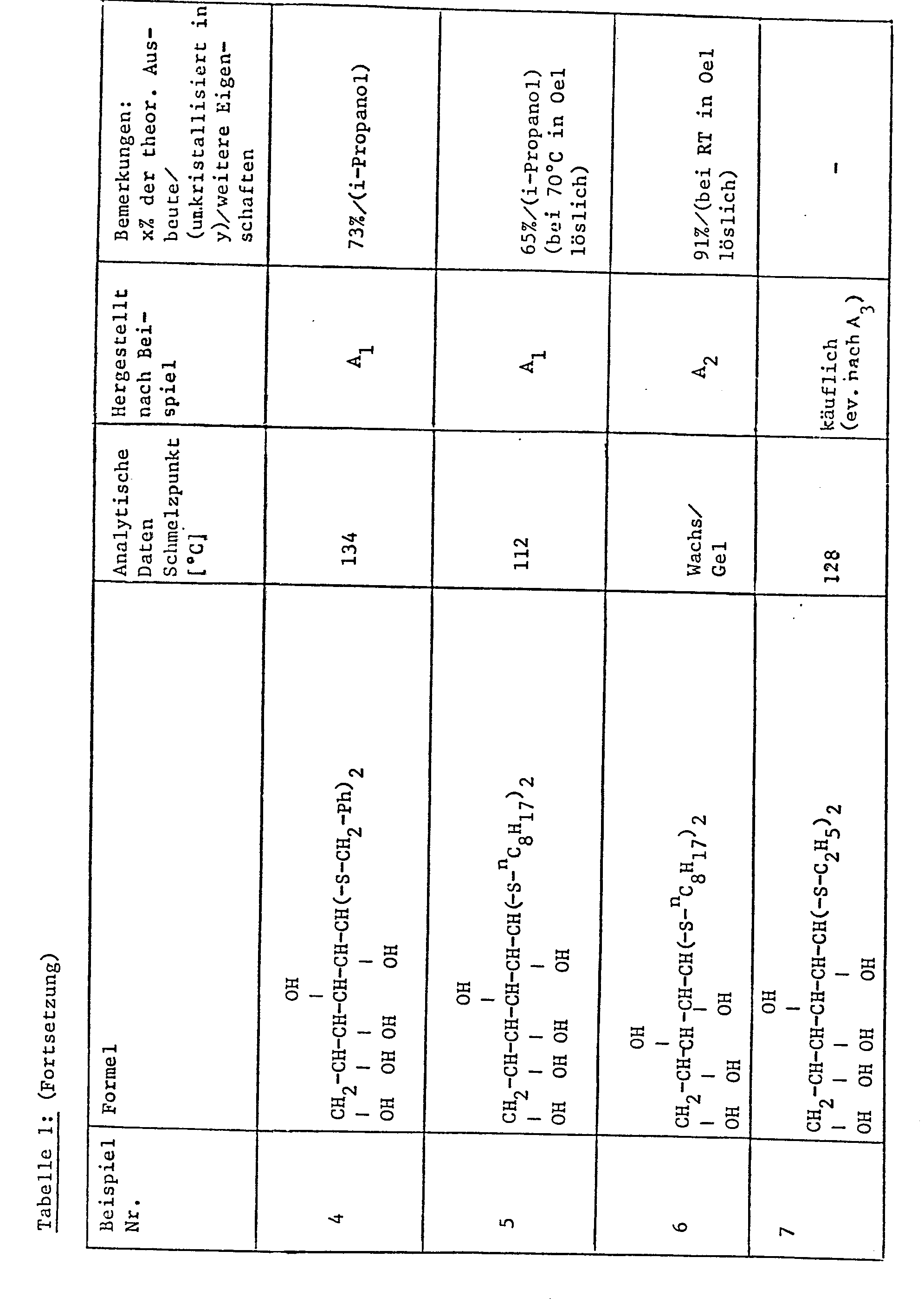
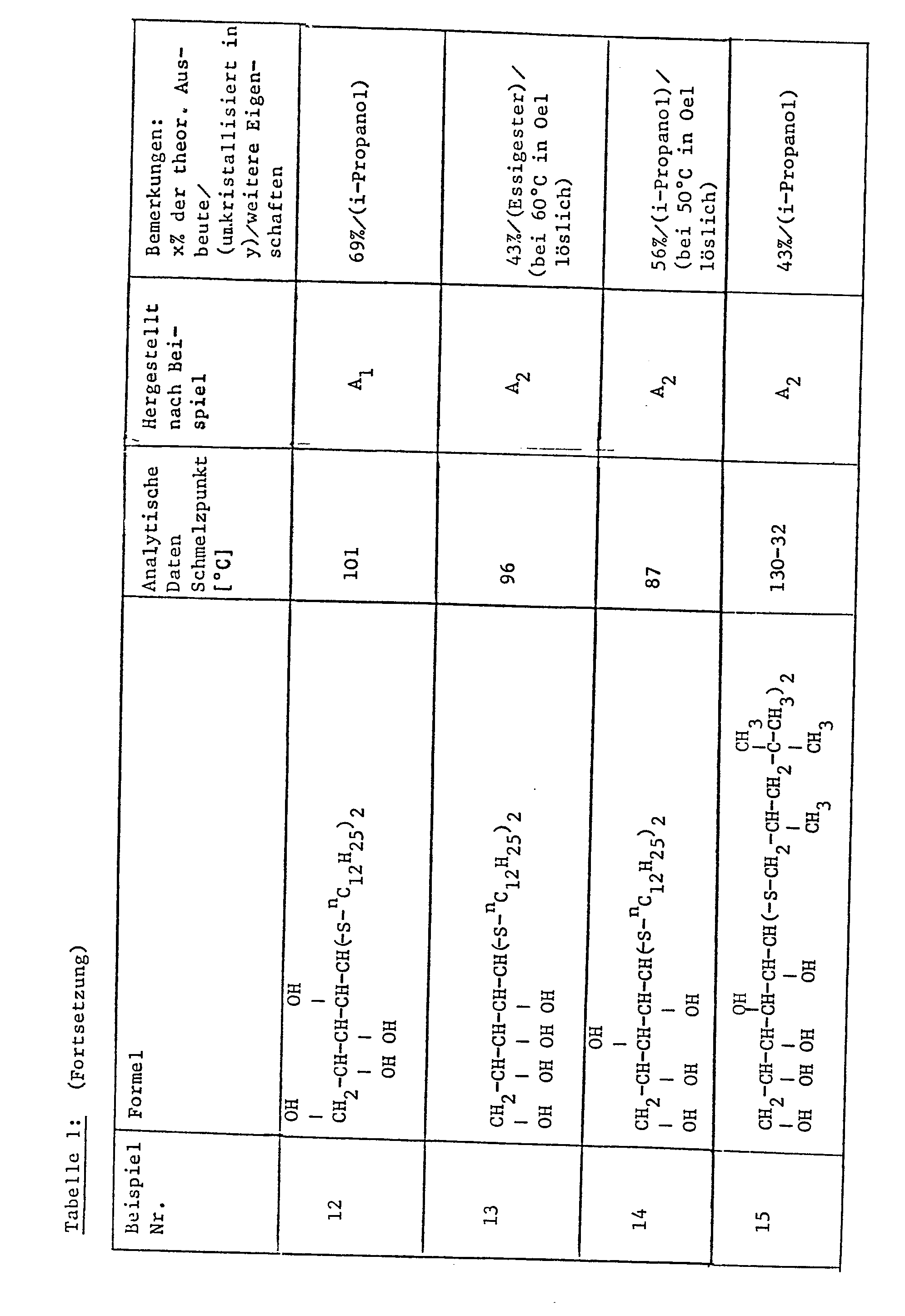
- Beispiele 2-14: Analog dem in dem allgemeinen Beispiel A beschriebenen Verfahren werden weitere Verbindungen (Beispiele 2-6 und 8-14)hergestellt, die zusätzlich zu Beispiel 1 in der folgenden Tabelle I zusammengestellt sind.


- Die folgenden Anwendungsbeispiele dienen der näheren Erläuterung der anwendungstechnisch erhaltenen Ergebnisse; die Anwendungsbeispiele 1-3 beziehen sich auf Schmierstoffe und das Anwendungsbeispiel 4 auf Kunststoffe.
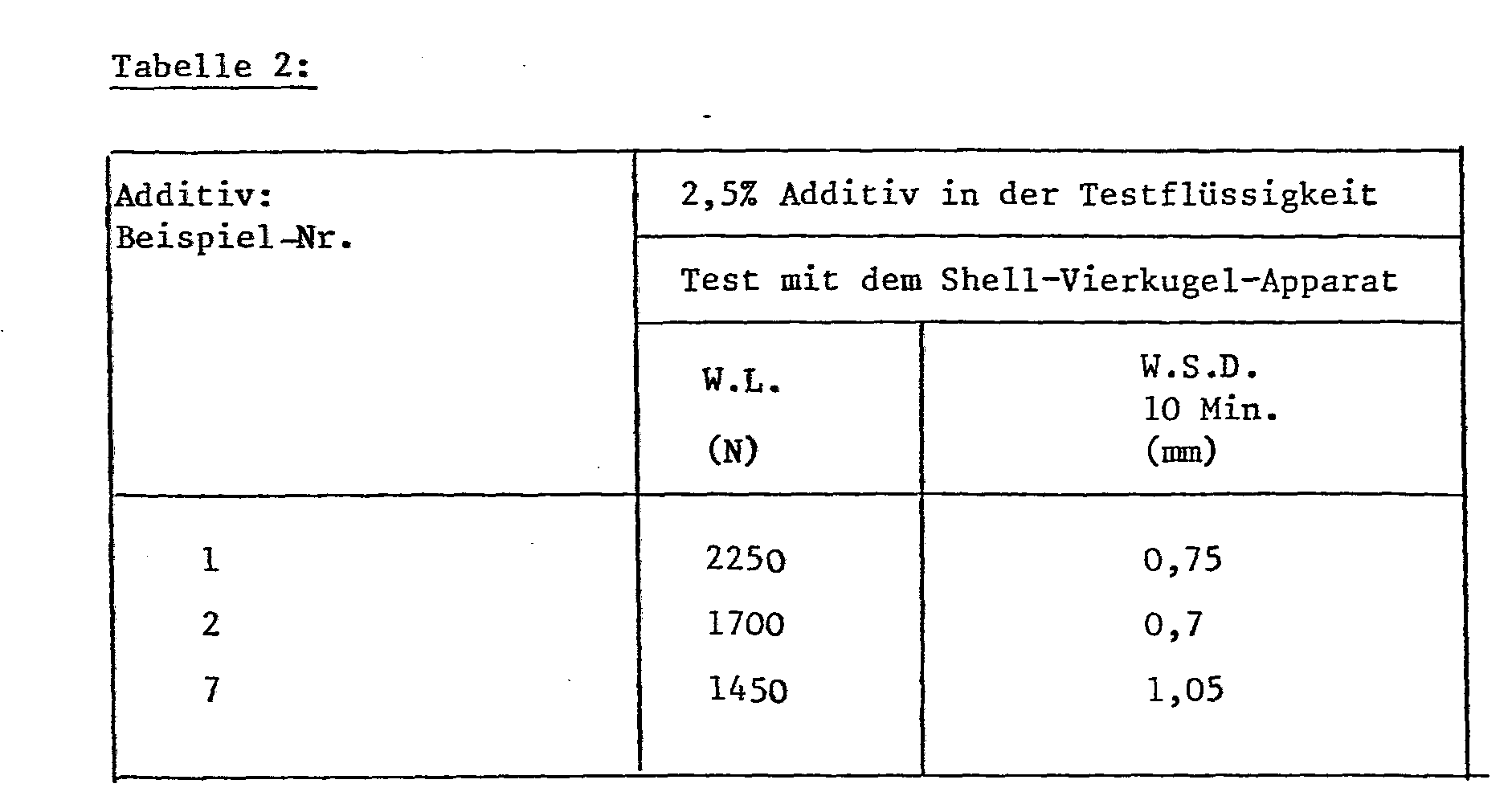
- Anwendungsbeispiel 1: Mit dem Shell-Vierkugel-Apparat (IP 239/73 Extreme pressure and wear lubricant test for oils and greases-four ball-machine) werden folgende Werte bestimmt:
- 1. W.L. = Weld load (Schweisslast). Das ist die Last, bei der die 4 Kugeln innerhalb von 10 Sekunden zusammenschweissen.
- 2. W.S.D. = Wear Scar Diameter in mm: Das ist der mittlere Verschleissdurchmesser bei einer Belastung von 400 N während 10 Minuten.
- Als Testflüssigkeit für die Wirksamkeit der Additive (Beispiel-Nr. 2 und 7) wird deionisiertes Wasser verwendet, welches als Rostinhibitor 0,75 Gew.X 2,4,6-Tris-(5'-carboxypentylamino)-1,3,5-triazin und so viel Triäthanolamin enthält, bis der pH-Wert von 8,5 erreicht wird. Als Testflüssigkeit für die Wirksamkeit des Additivs (Beispiel-Nr. 1) wird nur deionisiertes Wasser genommen, wobei der pH-Wert 9,4 beträgt.
-
- Anwendungsbeispiel 2: Mit der Reibverschleisswaage nach Reichert (Reichert Wear Test DBGM 1749247) wird die Verschleisskalotte bestimmt.
- Bei diesem Reibungsprüfgerät wird über ein Doppelhebelsystem eine fest eingespannte Prüfrolle an einen umlaufenden Schleifring angepresst, der mit seinem unteren Drittel in die zu prüfende Flüssigkeit taucht, deren Druckaufnahmevermögen beurteilt werden soll. Bei umlaufendem Schleifring entstehen je nach Druckaufnahmevermögen der Flüssigkeit auf die Prüfrolle Abschliffflächen (Verschleisskalotten), deren Grösse von der Tragfähigkeit des Prüfstoffes abhängt.

- Als Testflüssigkeit für die Wirksamkeit der Additive (Beispiel-Nr. 2 und 7) wird deionisiertes Wasser verwendet, welches als Rostinhibitor 0,75 Gew.% 2,4,6-Tris(5'-carboxypentylamino)-1,3,5-triazin und so viel Triäthanolamin enthält, bis der pH-Wert von 8,5 erreicht wird. Als Testflüssigkeit für die Wirksamkeit des Additivs (Beispiel-Nr. 1) wird nur deionisiertes Wasser genommen, wobei der pH-Wert 9,4 beträgt.
- Um die Wirksamkeit der Testflüssigkeiten aufzuzeigen, wird hier zum Vergleich der im Reichert-Test erzielte Wert für eine Referenzflüssigkeit, die aus 50% deionisiertem Wasser und 50% Aethanol besteht, angegeben; dieser Wert liegt im Bereich 28 bis 30 mm2.

- Bei diesem Verfahren wird in einem Becher mit Wasser nach bestimmten Vorschriften eine Mischung, die unter anderem auch das zu untersuchende Additiv enthält, hergestellt. Graugussspäne werden auf einem Rundfilter mit der frisch hergestellten Mischung benetzt, 2 Stunden lang in einer Petri-Schale der Raumtemperatur ausgesetzt und anschliessend das Rundfilter auf Korrosionserscheinungen visuell bewertet.
- Die Korrosionsgrade werden aufgrund einer Tabelle (vgl. DIN 51360/ Teil 2) ausgewertet, in welcher 0 keine und 1, 2, 3 und 4 zunehmend stärkere Korrosion bedeuten.
- Als Testflüssigkeit für die Wirksamkeit der Additive (Beispiel-Nr. 2 und 7) wird deionisiertes Wasser verwendet, welches als Rostinhibitor 0,75 Gew.% 2,4,6-Tris-(5'-carboxypentylamino)-1,3,5-triazin und so viel Triäthanolamin enthält, bis der pH-Wert von 8,5 erreicht wird. Als Testflüssigkeit für die Wirksamkeit des Additivs (Beispiel-Nr. 1) wird nur deionisiertes Wasser genommen, wobei der pH-Wert 9,4 beträgt.

- Um die thermostabilisierende Wirkung von bestimmten Additiven zu prüfen, wird ein Verfahren eingesetzt, bei dem die Farbänderung von Prüffolien bei konstanter höherer Temperatur in Abhängigkeit von der Zeit beurteilt.
- Die Prüffolien werden nach der folgenden Rezeptur hergestellt:

- Dann werden Folienabschnitte gleicher Abmessungen in einem Wärmeschrank bei konstanter Temperatur, 180°C, gelagert. Nach festgelegten Zeitabschnitten (vgl. Tabelle 5) wird ein Muster zur Beurteilung der Farbveränderung entnommen. Die Prüfung wird so lange fortgesetzt, bis ein deutlicher Umschlag nach dunkleren Farbtönen eingetreten ist. Durch optischen Vergleich lassen sich so Rückschlüsse auf die Wirksamkeit der Stabilisatoren ziehen.
- Der optische Vergleich wird durch Messung des Yellowness-Index nach DIN 6167 (ASTM D 1925-70) vorgenommen.

II. Heterocyclische Verbindungen z.B.:
Substituierte Imidazoline und Oxazoline.
Claims (19)

Applications Claiming Priority (2)
| Application Number | Priority Date | Filing Date | Title |
|---|---|---|---|
| CH2388/84 | 1984-05-15 | ||
| CH238884 | 1984-05-15 |
Publications (3)
| Publication Number | Publication Date |
|---|---|
| EP0162016A2 true EP0162016A2 (de) | 1985-11-21 |
| EP0162016A3 EP0162016A3 (en) | 1986-03-26 |
| EP0162016B1 EP0162016B1 (de) | 1992-06-03 |
Family
ID=4232616
Family Applications (1)
| Application Number | Title | Priority Date | Filing Date |
|---|---|---|---|
| EP85810221A Expired - Lifetime EP0162016B1 (de) | 1984-05-15 | 1985-05-09 | Zusätze für Materialien |
Country Status (5)
| Country | Link |
|---|---|
| US (1) | US4737300A (de) |
| EP (1) | EP0162016B1 (de) |
| JP (1) | JPS6165A (de) |
| CA (1) | CA1261345A (de) |
| DE (1) | DE3586144D1 (de) |
Cited By (1)
| Publication number | Priority date | Publication date | Assignee | Title |
|---|---|---|---|---|
| EP0331608A1 (de) * | 1988-03-03 | 1989-09-06 | The Goodyear Tire & Rubber Company | Organothioäthylalkohole als Synergisten für Antidegradantien |
Families Citing this family (5)
| Publication number | Priority date | Publication date | Assignee | Title |
|---|---|---|---|---|
| EP0323403A3 (de) * | 1987-12-24 | 1989-10-11 | Ciba-Geigy Ag | Schmierstoffzusammensetzung |
| JPH0593195A (ja) * | 1991-10-01 | 1993-04-16 | Neos Co Ltd | 硫黄系極圧添加剤 |
| US6521569B2 (en) * | 1993-03-19 | 2003-02-18 | Radiator Specialty Company | Non-flammable liquid penetrating lubricant |
| US5730906A (en) * | 1996-07-12 | 1998-03-24 | Exxon Research And Engineering Company | Additive combination to reduce deposit forming tendencies and improve antioxidancy of aviation turbine oils (Law406) |
| WO2006070862A1 (ja) * | 2004-12-28 | 2006-07-06 | Asubio Pharma Co., Ltd. | アルドース類の減炭素化合物の製造方法 |
Family Cites Families (10)
| Publication number | Priority date | Publication date | Assignee | Title |
|---|---|---|---|---|
| US2559510A (en) * | 1949-04-21 | 1951-07-03 | Standard Oil Dev Co | Synthetic lubricants |
| US2644793A (en) * | 1950-08-30 | 1953-07-07 | Standard Oil Dev Co | Rust inhibiting composition |
| FR3854M (fr) * | 1964-09-08 | 1966-01-17 | Novalis Lab | Dérivés di-s-alkylmercaptal d'oses a activité hépatotrope. |
| US3376322A (en) * | 1964-12-28 | 1968-04-02 | Monsanto Co | Diorganooxydisulfide esters |
| US3494963A (en) * | 1965-06-03 | 1970-02-10 | Chevron Res | Amino substituted lower alkyl polyisobutenyl sulfides,sulfoxides and sulfones |
| GB1169217A (en) * | 1966-11-18 | 1969-10-29 | Shell Int Research | Polyphenylene Polyethers |
| DE2814256A1 (de) * | 1977-04-05 | 1978-10-12 | Ciba Geigy Ag | Schmieroelzusatzstoffe |
| US4178253A (en) * | 1977-04-05 | 1979-12-11 | Ciba-Geigy Corporation | Corrosion inhibited lubricant compositions |
| US4250046A (en) * | 1979-03-05 | 1981-02-10 | Pennwalt Corporation | Diethanol disulfide as an extreme pressure and anti-wear additive in water soluble metalworking fluids |
| US4384967A (en) * | 1981-07-29 | 1983-05-24 | Chevron Research Company | Lubricant composition containing an alkali metal borate and a sulfur-containing polyhydroxy compound |
-
1985
- 1985-05-09 DE DE8585810221T patent/DE3586144D1/de not_active Expired - Lifetime
- 1985-05-09 EP EP85810221A patent/EP0162016B1/de not_active Expired - Lifetime
- 1985-05-10 US US06/733,180 patent/US4737300A/en not_active Expired - Fee Related
- 1985-05-13 CA CA000481366A patent/CA1261345A/en not_active Expired
- 1985-05-15 JP JP60103642A patent/JPS6165A/ja active Granted
Cited By (1)
| Publication number | Priority date | Publication date | Assignee | Title |
|---|---|---|---|---|
| EP0331608A1 (de) * | 1988-03-03 | 1989-09-06 | The Goodyear Tire & Rubber Company | Organothioäthylalkohole als Synergisten für Antidegradantien |
Also Published As
| Publication number | Publication date |
|---|---|
| EP0162016B1 (de) | 1992-06-03 |
| JPH0569101B2 (de) | 1993-09-30 |
| DE3586144D1 (de) | 1992-07-09 |
| EP0162016A3 (en) | 1986-03-26 |
| JPS6165A (ja) | 1986-01-06 |
| US4737300A (en) | 1988-04-12 |
| CA1261345A (en) | 1989-09-26 |
Similar Documents
| Publication | Publication Date | Title |
|---|---|---|
| EP0165209B1 (de) | o,p-Bifunktionalisierte, o'-substituierte Phenole | |
| EP0224442B1 (de) | Substituierte Phenole als Stabilisatoren | |
| EP0273013B1 (de) | Substituierte Phenole als Stabilisatoren | |
| EP0475904A2 (de) | Stoffgemische und Zusammensetzungen enthaltend Phenothiazine | |
| EP0214932B1 (de) | Schwefelhaltige Phenolderivate enthaltende Schmiermittel- und Hydraulikflüssigkeitszusammensetzungen und neue schwefelhaltige Phenolderivate | |
| EP0170624B1 (de) | 2,4,6-Trifunktionalisierte Phenole | |
| EP0145658B1 (de) | Amide von Hydroxyphenylalkylthio-alkancarbonsäuren | |
| EP0081457A2 (de) | Phenole und ihre Verwendung als Stabilisatoren | |
| EP0162016B1 (de) | Zusätze für Materialien | |
| EP0366040B1 (de) | Phenolgruppenhaltige Verbindungen als Antioxidantien in organischen Materialien | |
| EP0497735A1 (de) | Hydrochinolinverbindungen | |
| EP0286595A2 (de) | Schwefelhaltige Verbindungen als Antioxidantien für Schmiermittel und Elastomere | |
| EP0252006B1 (de) | Neue substituierte Phenole und deren Verwendung als Stabilisatoren | |
| EP0155474B1 (de) | Bis-,Tris-, Tetrakis-und Pentakis-(substituiertes hydroxy-phenylthio)-alkane und-cycloalkane und sie enthaltende Stoffzusammensetzungen | |
| EP0463994B1 (de) | Dioxaphosphorinanverbindungen als Stabilisatoren für organische Materialien | |
| EP0174277B1 (de) | Antioxidantien für organisches Material | |
| EP0134194B1 (de) | S-(4-Hydroxyphenyl)-thioester | |
| EP0473549B1 (de) | Sulfoxide von Alkylthiomethylphenolen | |
| EP0140362B1 (de) | Alkylierte S-(2-Hydroxyphenylthio)-carbonsäureester | |
| EP0137395B1 (de) | Neue 4-(Hydroxyphenylthio)-benzoate | |
| EP0441742B1 (de) | Sulfoxide von bis- und tristhiomethylierten Phenolen | |
| EP0246190A2 (de) | Isocyanursäurederivate | |
| EP0145650B1 (de) | 1H-Polyalkyl-Phosphorinane | |
| EP0140298B1 (de) | Substituierte 4-Hydroxybenzylthioaldehyde und -ketone | |
| EP0530139B1 (de) | Zusammensetzungen enthaltend mit Phosphonatgruppen substituierte N-Heterozyklen mit 6 Ringgliedern |
Legal Events
| Date | Code | Title | Description |
|---|---|---|---|
| PUAI | Public reference made under article 153(3) epc to a published international application that has entered the european phase |
Free format text: ORIGINAL CODE: 0009012 |
|
| 17P | Request for examination filed |
Effective date: 19850511 |
|
| AK | Designated contracting states |
Designated state(s): BE DE FR GB IT |
|
| PUAL | Search report despatched |
Free format text: ORIGINAL CODE: 0009013 |
|
| AK | Designated contracting states |
Kind code of ref document: A3 Designated state(s): BE DE FR GB IT |
|
| 17Q | First examination report despatched |
Effective date: 19871223 |
|
| GRAA | (expected) grant |
Free format text: ORIGINAL CODE: 0009210 |
|
| AK | Designated contracting states |
Kind code of ref document: B1 Designated state(s): BE DE FR GB IT |
|
| REF | Corresponds to: |
Ref document number: 3586144 Country of ref document: DE Date of ref document: 19920709 |
|
| GBT | Gb: translation of ep patent filed (gb section 77(6)(a)/1977) | ||
| ITF | It: translation for a ep patent filed | ||
| ET | Fr: translation filed | ||
| PLBE | No opposition filed within time limit |
Free format text: ORIGINAL CODE: 0009261 |
|
| STAA | Information on the status of an ep patent application or granted ep patent |
Free format text: STATUS: NO OPPOSITION FILED WITHIN TIME LIMIT |
|
| 26N | No opposition filed | ||
| BECN | Be: change of holder's name |
Effective date: 19961129 |
|
| PGFP | Annual fee paid to national office [announced via postgrant information from national office to epo] |
Ref country code: FR Payment date: 19970319 Year of fee payment: 13 |
|
| PGFP | Annual fee paid to national office [announced via postgrant information from national office to epo] |
Ref country code: DE Payment date: 19970411 Year of fee payment: 13 |
|
| PGFP | Annual fee paid to national office [announced via postgrant information from national office to epo] |
Ref country code: GB Payment date: 19970421 Year of fee payment: 13 |
|
| REG | Reference to a national code |
Ref country code: GB Ref legal event code: 732E |
|
| PGFP | Annual fee paid to national office [announced via postgrant information from national office to epo] |
Ref country code: BE Payment date: 19970703 Year of fee payment: 13 |
|
| REG | Reference to a national code |
Ref country code: FR Ref legal event code: TP |
|
| PG25 | Lapsed in a contracting state [announced via postgrant information from national office to epo] |
Ref country code: GB Free format text: LAPSE BECAUSE OF NON-PAYMENT OF DUE FEES Effective date: 19980509 |
|
| PG25 | Lapsed in a contracting state [announced via postgrant information from national office to epo] |
Ref country code: FR Free format text: LAPSE BECAUSE OF NON-PAYMENT OF DUE FEES Effective date: 19980531 Ref country code: BE Free format text: LAPSE BECAUSE OF NON-PAYMENT OF DUE FEES Effective date: 19980531 |
|
| BERE | Be: lapsed |
Owner name: CIBA SPECIALTY CHEMICALS HOLDING INC. Effective date: 19980531 |
|
| GBPC | Gb: european patent ceased through non-payment of renewal fee |
Effective date: 19980509 |
|
| PG25 | Lapsed in a contracting state [announced via postgrant information from national office to epo] |
Ref country code: DE Free format text: LAPSE BECAUSE OF NON-PAYMENT OF DUE FEES Effective date: 19990302 |
|
| REG | Reference to a national code |
Ref country code: FR Ref legal event code: ST |