EP0157623B1 - Optically active isomers of benzopyran derivatives useful for treating cardiovascular disease - Google Patents
Optically active isomers of benzopyran derivatives useful for treating cardiovascular disease Download PDFInfo
- Publication number
- EP0157623B1 EP0157623B1 EP85302263A EP85302263A EP0157623B1 EP 0157623 B1 EP0157623 B1 EP 0157623B1 EP 85302263 A EP85302263 A EP 85302263A EP 85302263 A EP85302263 A EP 85302263A EP 0157623 B1 EP0157623 B1 EP 0157623B1
- Authority
- EP
- European Patent Office
- Prior art keywords
- formula
- benzopyran
- dihydro
- nitroxy
- isomer
- Prior art date
- Legal status (The legal status is an assumption and is not a legal conclusion. Google has not performed a legal analysis and makes no representation as to the accuracy of the status listed.)
- Expired
Links
- 0 COc1cccc2c1*CCC2 Chemical compound COc1cccc2c1*CCC2 0.000 description 3
- SMRUADNIAGFYRD-UHFFFAOYSA-N COC1=CCCC2=C1OCCC2 Chemical compound COC1=CCCC2=C1OCCC2 SMRUADNIAGFYRD-UHFFFAOYSA-N 0.000 description 1
Classifications
-
- C—CHEMISTRY; METALLURGY
- C07—ORGANIC CHEMISTRY
- C07D—HETEROCYCLIC COMPOUNDS
- C07D407/00—Heterocyclic compounds containing two or more hetero rings, at least one ring having oxygen atoms as the only ring hetero atoms, not provided for by group C07D405/00
- C07D407/02—Heterocyclic compounds containing two or more hetero rings, at least one ring having oxygen atoms as the only ring hetero atoms, not provided for by group C07D405/00 containing two hetero rings
- C07D407/12—Heterocyclic compounds containing two or more hetero rings, at least one ring having oxygen atoms as the only ring hetero atoms, not provided for by group C07D405/00 containing two hetero rings linked by a chain containing hetero atoms as chain links
-
- A—HUMAN NECESSITIES
- A61—MEDICAL OR VETERINARY SCIENCE; HYGIENE
- A61P—SPECIFIC THERAPEUTIC ACTIVITY OF CHEMICAL COMPOUNDS OR MEDICINAL PREPARATIONS
- A61P25/00—Drugs for disorders of the nervous system
- A61P25/02—Drugs for disorders of the nervous system for peripheral neuropathies
-
- A—HUMAN NECESSITIES
- A61—MEDICAL OR VETERINARY SCIENCE; HYGIENE
- A61P—SPECIFIC THERAPEUTIC ACTIVITY OF CHEMICAL COMPOUNDS OR MEDICINAL PREPARATIONS
- A61P9/00—Drugs for disorders of the cardiovascular system
- A61P9/08—Vasodilators for multiple indications
-
- A—HUMAN NECESSITIES
- A61—MEDICAL OR VETERINARY SCIENCE; HYGIENE
- A61P—SPECIFIC THERAPEUTIC ACTIVITY OF CHEMICAL COMPOUNDS OR MEDICINAL PREPARATIONS
- A61P9/00—Drugs for disorders of the cardiovascular system
- A61P9/12—Antihypertensives
-
- C—CHEMISTRY; METALLURGY
- C07—ORGANIC CHEMISTRY
- C07D—HETEROCYCLIC COMPOUNDS
- C07D303/00—Compounds containing three-membered rings having one oxygen atom as the only ring hetero atom
- C07D303/02—Compounds containing oxirane rings
- C07D303/12—Compounds containing oxirane rings with hydrocarbon radicals, substituted by singly or doubly bound oxygen atoms
- C07D303/16—Compounds containing oxirane rings with hydrocarbon radicals, substituted by singly or doubly bound oxygen atoms by esterified hydroxyl radicals
-
- C—CHEMISTRY; METALLURGY
- C07—ORGANIC CHEMISTRY
- C07D—HETEROCYCLIC COMPOUNDS
- C07D311/00—Heterocyclic compounds containing six-membered rings having one oxygen atom as the only hetero atom, condensed with other rings
- C07D311/02—Heterocyclic compounds containing six-membered rings having one oxygen atom as the only hetero atom, condensed with other rings ortho- or peri-condensed with carbocyclic rings or ring systems
- C07D311/04—Benzo[b]pyrans, not hydrogenated in the carbocyclic ring
- C07D311/58—Benzo[b]pyrans, not hydrogenated in the carbocyclic ring other than with oxygen or sulphur atoms in position 2 or 4
- C07D311/64—Benzo[b]pyrans, not hydrogenated in the carbocyclic ring other than with oxygen or sulphur atoms in position 2 or 4 with oxygen atoms directly attached in position 8
Definitions
- This invention relates to novel optical isomers of 3,4-dihydro-8-(2'-hydroxy-3'-isopropylamino)-propoxy-3-nitroxy-2H-1-benzopyran (to be sometimes abbreviated K-351 in this invention), acid addition salts thereof, processes for production thereof, and also to a pharmaceutical composition comprising such an isomer or an acid addition salt thereof.
- this invention relates to an optical isomer selected from the group consisting of (2'R),(3R)-3,4-dihydro-8-(2'-hydroxy-3'-isopropylamino)propoxy-3-nitroxy-2H-1-benzopyran (to be sometimes abbreviated as R-R.K-351 in this invention) represented by the following formula (A-2), (2'S),(3R)-3,4-dihydro-8-(2'-hydroxy-3'-isopropylamino)propoxy-3-nitroxy-2H-1-benzopyran (to be sometimes abbreviated as S-R.K-351 in this invention) represented by the following formula (B-2) and acid addition salts of these isomers, processes for production thereof, and to pharmaceutical compositions comprising these compounds.
- K-351 is a known compound represented by the following formula It is useful as a drug for the cardiovascular diseases having beta-blocking activity and vasodilating activity (direct vasodilating activity and alpha-blocking activity) (Japanese Laid-Open Patent Publications Nos. 7481/1982 and 106619/1982, and corresponding US ⁇ A ⁇ 4,394,382 and EP-A-42299).
- K-351 has asymmetric carbon atoms at the 3-position of the benzopyran ring and the 2'- position of the side chain, two racemates, i.e. 4-optical isomers, can exist theoretically. However, no mention has previously been made on the optical isomers of K-351, and no method for their separation or resolution has been known.
- the present nventors have studied the optical isomers of K-351 and their pharmacological activities, and have found that K-351 can be easily separated into two racemates, and the separated two racemates exhibit different pharmacological activities.
- the inventors have further discovered that by selectively administering one of the racemates to a patient according to his condition, the trouble of side effects can be reduced, and a therapeutic effect can be obtained efficiently.
- racemate K-351 A shows toxicity, vasodilating activity and hypotensitive activity nearly equivalent to those of K-351 but its beta-blocking. activity is about one-tenth of that of K-351, and that the racemate K-351 B has toxicity, vasodilating activity and hypotensive activity nearly equivalent to those of K-351 but its beta-blocking activity is about 2 times as strong as that of K-351.
- the racemate K-351A has been found to be useful as drugs for cardiovascular diseases such as an agent for treating the hypertension of patients who have a tendency to cardiac failure, bradycardia, etc., an agent for treating angina pectoris with a spasm of the coronary artery, and an agent for treating myocardial infarction.
- the racemate K-351 B has been found to be useful as drugs for cardiovascular diseases such as a hypotensive agent and an antiarrhythmic agent.
- a method of obtaining one of the racemates K-351A and K-351 B by separating K-351 into the two racemates and purifying them cannot give the desired one racemate in quantities, and is also disadvantageous in regard to industrial operations and cost. Further investigations of the inventors made in order to overcome this disadvantage have led to the finding of an industrially advantageous process for converting the racemate K-351A into the racemate K-351B or vice-versa.
- the present inventors examined the pharmacological activities of these optical isomers, and found that the beta-blocking activity of R-R.K-351 of formula (A-2) is much weaker than that of K-351 but its vasodilating activity is equivalent to, or higher than, the vasodilating activity of K-351, and that S-R.K-351 of formula (B-2) shows the strongest beta-blocking and vasodilating activities among the aforesaid optical isomers.
- R-R.K-351 of formula (A-2) has beta-blocking activity about one-tenth of that of K-351, vasodilating activity about 1 to 1.5 times as high as that of K-351 and nearly equivalent hypotensive activity to K-351. Accordingly, R-R.K-351 has been found to be useful as a therapeutic agent for the hypertension of a patient having a tendency to cardiac failure, bradycardia, etc. and a therapeutic agent for angina pectoris with a spasm of the coronary artery.
- S-R.K-351 of formula (B-2) has beta-blocking activity about 3 to 8 times as high as that of K-351, direct vaso-relaxing activity about 1.2 times as high as that of K-351, alpha-blocking activity about two times as high as that of K-351, and hypotensive activity about 1.5 times as high as that of K-351. Accordingly, S-R.K-351 has been found to be useful as a hypotensive agent having strong beta-blocking activity and vasodilating activity.
- the optical isomers R-R.K-351 of formula (A-2) and S-R.K-351 of formula (B-2) can be easily produced by the following process (a) or (b).
- the acid addition salts of such isomers can be easily produced by contacting the resulting R-R.K-351 and S-R.K-351 in the form of a free base with acids.
- the starting compound of formula (II) can be easily produced from 3,4-dihydro-3-nitroxy-2H-1-benzopyran-8-ol of formula (I) given below.
- the above embodiments of production can be schematically shown as follows:-
- the known compound of formula (I) can be obtained, for example, by protecting the 8-position hydroxyl group of 3,4-dihydro-3,8-dihydroxy-2H-1-benzopyran, esterifying the hydroxyl group at the 3- position with nitric acid, and splitting off the protective group for the 8-position hydroxyl group (see Japanese Laid-Open Patent Publication No. 167981/1982).
- the optically active amino acid used in the formation of the esster may, for example, be L-phenylalanine and L-alanine.
- the amino group of such amino acids is protected.
- Protective groups for the amino group may be suitably selected from those which are usually employed in the field of peptide synthesis. Examples include acyl groups such as acetyl, propionyl, benzoyl and p-nitrobenzoyl groups, sulfonyl groups such as mesyl, benzenesulfonyl and tosyl groups, alkyloxycarbonyl groups, cycloalkyloxycarbonyl groups, aralkyloxycarbonyl groups, and aryloxycarbonyl groups.
- the above esterification reaction may also be carried out by the action of an optically active free amino acid on the compound of formula (I) in the presence of a dehydrating agent or condensing agent, or by the action of a reactive derivative of the optically active amino acid on the compound (I).
- a dehydrating agent or condensing agent used in this reaction is N,N'-dicyclohexylcarbodiimide
- examples of the condensing agent are chloroformate esters, and phosphite esters.
- the reactive derivatives of the amino acid are acid chlorides, azides, acid anhydrides, mixed acid anhydrides, and active esters.
- Specific examples of the known active esters are phenyl esters, cyanomethyl esters, N-hydroxysuccinimide esters and N-hydroxyphthalimide esters which are known in the synthesis of peptides.
- the ester-forming reaction described above can be carried out, for example, by reacting the compound of formula (I), the optically active amino acid and the dehyrating or condensing agent and a reactive derivative of the optically active amino acid in a solvent in the presence or absence of a base at a temperature of about 0 to 100°C for about 1 to 30 hours.
- a solvent used in this reaction include halogenated hydrocarbons such as chloroform and methylene chloride, hydrocarbons such as n-hexane, benzene and toluene, and ethers such as diethyl ether, dioxane and tetrahydrofuran.
- the base is, for example, an amine such as triethylamine, pyridine or dimethylaminopyridine.
- the (3R) ester may be separated from the resulting ester by utilizing, for example, recrystallization or chromatographic techniques.
- the recrystallization technique is particularly preferred.
- recrystallization of an ester formed by using L-phenylalanine having the protected amino group gives the desired (3R) ester in the first place.
- suitable solvents used in the recrystallization technique include ethers such as diethyl ether, dioxane and tetrahydrofuran, hydrocarbons such as chloroform, methylene chloride, n-hexane, benzene, toluene and xylene, alcohols such as methanol, ethanol and propanol, and water. These solvents may be used singly or in combination.
- Hydrolysis of the resulting optically active (3R) ester can give the (3R) 8-hydroxy compound (II).
- the hydrolysis can be carried out by using acids or alkalies, but alkaline hydrolysis is preferred. Examples of the alkali used are alkali hydroxides such as sodium hydroxide and potassium hydroxide.
- the hydrolysis reaction can be carried out for several minutes to about 20 hours at a temperature of about 0 to about 100°C in the aforesaid solvent.
- the alkyl group as the substituent A of the epoxy compound (ilia) is preferably a linear or branched alkyl group having 1 to 6 carbon atoms.
- Preferred aralkyl groups as substituent A are aralkyl groups having 7 or 8 carbon atoms such as benzyl and phenethyl groups.
- Preferred aryl groups as substituent A are aryl groups having 6 to 10 carbon atoms such as phenyl and naphthyl groups. These groups may be substituted by a halogen atom, a lower alkyl group (when A is an aralkyl or aryl group), a hydroxyl group, an alkoxy group, a nitro group, etc.
- the reaction is carried out in the presence of a base in a solvent.
- the solvent may be the same hydrocarbons, halogenated hydrocarbons and ethers as exemplified hereinabove for the reaction of the compound of formula (I) with the optically active amino acid or its reactive derivative.
- the reaction temperature can be properly selected, and is preferably -30 to about 150°C, and the reaction time is, for example, several minutes to about 10 hours.
- the desired R-R.K-351 can be obtained by contacting the (2'R),(3R)-epoxy compound (lVa) obtained in (2) above with isopropylamine.
- the contacting can be effected by reacting the compound (lVa) with isopropylamine in the presence or absence of the same solvent as exemplified hereinabove at a temperature of about D to about 150°C for a period of several minutes to about 5 hours. Separation and purification of the resulting R-R.K-351 can be carried out in a customary manner.
- the R-R.K-351 and S-R.K-351 and pharmaceutically acceptable acid addition salts thereof have vasodilating activity and beta-blocking activity, and are useful as therapeutic agents for cardiovascular diseases.
- optical isomers of this invention may be used as agents for treating cardiovascular diseases in the form of free bases or pharmaceutically acceptable acid addition salts such as salts with hydrochloric acid, sulfuric acid, nitric acid, hydrobromic acid, acetic acid, lactic acid, oxalic acid, maleic acid and p-toluenesulfonic acid.
- a pharmaceutical composition comprising (1) an amount, effective for the treatment of cardiovascular diseases, of an optical isomer selected from the group consisting of (2'R),13R)-3,4-dihydro-8-(2'-hydroxy-3'-isopropylamino)propoxy-3-nitroxy-2H-1-benzopyran represented by the following formula (A-2), (2'S),(3R)-3,4-dihydro-8-(2'-hydroxy-3'-isopropylamino)-propoxy-3-nitroxy-2H-1-benzopyran represented by the following formula (B-2) and pharmaceutically acceptable acid addition salts of these isomers, and (2) a pharmaceutical acceptable diluent or carrier.
- an optical isomer selected from the group consisting of (2'R),13R)-3,4-dihydro-8-(2'-hydroxy-3'-isopropylamino)propoxy-3-nitroxy-2H-1-benzopyran represented by the following formula (A-2), (2'S),(3R)
- the amount of the optical isomer or its acid addition salt in the pharmaceutical composition is, for example, about 0.01 to about 99% by weight based on the total weight of the pharmaceutical composition.
- Liquid or solid carriers or diluents may be used in formulating the pharmaceutical composition of this invention. They may include excipients, binders, lubricants, emulsifiers, etc. known in pharmaceutical production.
- these carriers or diluents include starches such as potato starch, wheat starch, corn starch and rice starch; sugars such as lactose, sucrose, glucose, mannitol and sorbitol; celluloses such as crystalline cellulose, calcium carboxymethyl cellulose and hydroxypropyl cellulose of a low degree of substitution; inorganic substances such as potassium phosphate, calcium sulfate, calcium carbonate and talc; binder compounds such as gelatin, gum arabic, methyl cellulose, sodium carboxymethyl cellulose, polyvinyl pyrrolidone and hydroxypropyl cellulose; polyhydric alcohol ester-type nonionic surfactants such as fatty acid monoglycerides, sorbitan fatty acid esters, sucrose and
- compositions may be in any dosage forms known in the art of formulating pharmaceuticals, such as suppositories, powders, granules, tablets, sublingual tablets, liquid preparations, injectable preparations and suspensions.
- compositions of this invention may be administered through any of peroral and parenteral routes, such as an intravenous, sublingual or intrarectal route.
- peroral and parenteral routes such as an intravenous, sublingual or intrarectal route.
- the oral route is preferred.
- the dose may be changed as desired.
- the R-R.K-351, S-R.K-351, or a pharmaceutically acceptable acid addition salt thereof may be administered in a dose of about 1 to about 100 mg/body/day, preferably about 5 to about 50 mg/body/day.
- the compounds of this invention have low toxicity.
- pA 2 shows the reciprocal logarithm of the molar concentration of each test compound required to shift the dose-response curve of isoproterenol parallel toward a higher dose side by 2 times.
- the parenthesized figures show efficacy ratios based on K-351.
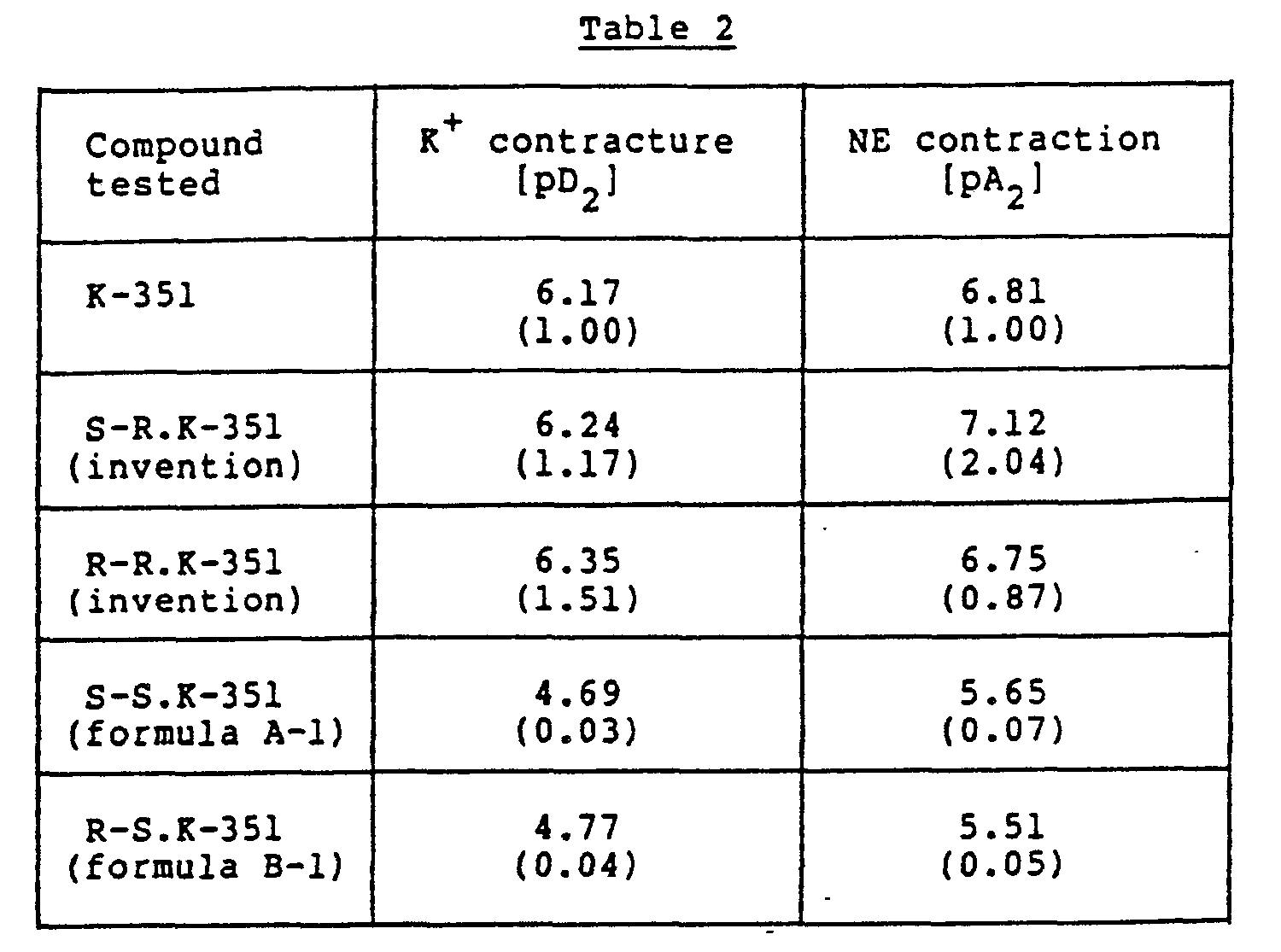
- pD 2 represents the reciprocal logarithm of the molar concentration of each test compound required to inhibit the maximum reaction of potassium (25 m MK + ) by an extent of 50%; and pA 2 represents the reciprocal logarithm of the molar concentration of each test compound required to shift the dose-response curve of norepinephrine parallel toward a high dose side by 2 times.
- the compounds indicated in Table 3 were intravenously administered in a dose of 100 y/kg to anesthetized dogs, and changes in average blood pressure and heart rate were determned. The results are shown in Table 3.
- Each of the test compounds was used in the form of a solution in physiological saline together with an equimolar amount of hydrochloric acid which contained the test compound in a concentration of 1 mg/ml.
- the above ingredients were uniformly mixed and tableted into tablets each having a diameter of 5 mm and weighing 50 mg by a direct tableted method.
- the ingredients in A) were uniformly mixed and then kneaded with the solution B).
- the mixture was granulated by an extrusion method, dried in vacuum at 50°C, and sieved to form granules.
- the above ingredients were uniformly mixed and by adding 25 parts of ethanol, kneaded.
- the mixture was granulated by a crushing method, then dried in vacuum at 50°C, and sieved to form subtilized granules.
Landscapes
- Organic Chemistry (AREA)
- Chemical & Material Sciences (AREA)
- Health & Medical Sciences (AREA)
- Medicinal Chemistry (AREA)
- General Chemical & Material Sciences (AREA)
- Veterinary Medicine (AREA)
- Chemical Kinetics & Catalysis (AREA)
- Life Sciences & Earth Sciences (AREA)
- Pharmacology & Pharmacy (AREA)
- Nuclear Medicine, Radiotherapy & Molecular Imaging (AREA)
- Engineering & Computer Science (AREA)
- Bioinformatics & Cheminformatics (AREA)
- Public Health (AREA)
- Animal Behavior & Ethology (AREA)
- General Health & Medical Sciences (AREA)
- Heart & Thoracic Surgery (AREA)
- Cardiology (AREA)
- Biomedical Technology (AREA)
- Neurology (AREA)
- Neurosurgery (AREA)
- Pharmaceuticals Containing Other Organic And Inorganic Compounds (AREA)
- Pyrane Compounds (AREA)
- Plural Heterocyclic Compounds (AREA)
Description
- This invention relates to novel optical isomers of 3,4-dihydro-8-(2'-hydroxy-3'-isopropylamino)-propoxy-3-nitroxy-2H-1-benzopyran (to be sometimes abbreviated K-351 in this invention), acid addition salts thereof, processes for production thereof, and also to a pharmaceutical composition comprising such an isomer or an acid addition salt thereof.
- More specifically, this invention relates to an optical isomer selected from the group consisting of (2'R),(3R)-3,4-dihydro-8-(2'-hydroxy-3'-isopropylamino)propoxy-3-nitroxy-2H-1-benzopyran (to be sometimes abbreviated as R-R.K-351 in this invention) represented by the following formula (A-2), (2'S),(3R)-3,4-dihydro-8-(2'-hydroxy-3'-isopropylamino)propoxy-3-nitroxy-2H-1-benzopyran (to be sometimes abbreviated as S-R.K-351 in this invention) represented by the following formula (B-2)


- K-351 is a known compound represented by the following formula

- Since K-351 has asymmetric carbon atoms at the 3-position of the benzopyran ring and the 2'- position of the side chain, two racemates, i.e. 4-optical isomers, can exist theoretically. However, no mention has previously been made on the optical isomers of K-351, and no method for their separation or resolution has been known.
- The present nventors have studied the optical isomers of K-351 and their pharmacological activities, and have found that K-351 can be easily separated into two racemates, and the separated two racemates exhibit different pharmacological activities. The inventors have further discovered that by selectively administering one of the racemates to a patient according to his condition, the trouble of side effects can be reduced, and a therapeutic effect can be obtained efficiently.
- Investigations of the present inventors have shown that separation of K-351 by, for example, recrystallization gives two kinds of crystals, i.e. a racemate having high crystallinity and a racemate having low crystallinity. A high-performance liquid chromatographic study of derivatives of these racemates has shown that the racemate having high crystallinity is a racemate (to be referred to as racemate K-351A in this invention) composed of an optical isomer (2'S),(3S) K-351 of the following formula (A-1) and an optical isomer (2'R),(3R) K-351 of the following formula (A-2), and that the racemate having low crystallinity is a racemate (to be referred to as racemate K-351 B in this invention) composed of an optical isomer (2'R),(3S) K-351 of the following formula (B-1) and an optical isomer (2'S),(3R) K-351 of the following formula (B-2).


- The investigations of the present inventors have also shown that the racemate K-351 A shows toxicity, vasodilating activity and hypotensitive activity nearly equivalent to those of K-351 but its beta-blocking. activity is about one-tenth of that of K-351, and that the racemate K-351 B has toxicity, vasodilating activity and hypotensive activity nearly equivalent to those of K-351 but its beta-blocking activity is about 2 times as strong as that of K-351. The racemate K-351A has been found to be useful as drugs for cardiovascular diseases such as an agent for treating the hypertension of patients who have a tendency to cardiac failure, bradycardia, etc., an agent for treating angina pectoris with a spasm of the coronary artery, and an agent for treating myocardial infarction. The racemate K-351 B has been found to be useful as drugs for cardiovascular diseases such as a hypotensive agent and an antiarrhythmic agent.
- It has been found therefore that by separating K-351 into these two racemates K-351 A and K-351 B and administering one of the racemates according to the condition of a patient, the patient can be treated efficiently with reduced manifestation of side-effects.
- A method of obtaining one of the racemates K-351A and K-351 B by separating K-351 into the two racemates and purifying them cannot give the desired one racemate in quantities, and is also disadvantageous in regard to industrial operations and cost. Further investigations of the inventors made in order to overcome this disadvantage have led to the finding of an industrially advantageous process for converting the racemate K-351A into the racemate K-351B or vice-versa.
- On the basis of the aforesaid findings, the present inventors disclosed the aforesaid two racemates K-351A and K-351 B, processes for converting them and pharmaceutical compositions comprising them in Japanese Patent Application No. 36178/1984 (corresponding to EP-A-154511 and comprised in the state of the art pursuant to Article 54(3) and (4) EPC).
- On further investigations, the present inventors have succeeded in stereospecifically synthesizing the four optical isomers represented by the above formulae (A-1), (A-2), (B-1) and (B-2) which have previously been unable to be isolated.
- The present inventors examined the pharmacological activities of these optical isomers, and found that the beta-blocking activity of R-R.K-351 of formula (A-2) is much weaker than that of K-351 but its vasodilating activity is equivalent to, or higher than, the vasodilating activity of K-351, and that S-R.K-351 of formula (B-2) shows the strongest beta-blocking and vasodilating activities among the aforesaid optical isomers. Investigations of the present inventors have shown that R-R.K-351 of formula (A-2) has beta-blocking activity about one-tenth of that of K-351, vasodilating activity about 1 to 1.5 times as high as that of K-351 and nearly equivalent hypotensive activity to K-351. Accordingly, R-R.K-351 has been found to be useful as a therapeutic agent for the hypertension of a patient having a tendency to cardiac failure, bradycardia, etc. and a therapeutic agent for angina pectoris with a spasm of the coronary artery.
- The investigations of the present inventors have also shown that S-R.K-351 of formula (B-2) has beta-blocking activity about 3 to 8 times as high as that of K-351, direct vaso-relaxing activity about 1.2 times as high as that of K-351, alpha-blocking activity about two times as high as that of K-351, and hypotensive activity about 1.5 times as high as that of K-351. Accordingly, S-R.K-351 has been found to be useful as a hypotensive agent having strong beta-blocking activity and vasodilating activity.
- According to this invention, the optical isomers R-R.K-351 of formula (A-2) and S-R.K-351 of formula (B-2) can be easily produced by the following process (a) or (b). The acid addition salts of such isomers can be easily produced by contacting the resulting R-R.K-351 and S-R.K-351 in the form of a free base with acids.
- (a) A process which comprises reacting (3R)-3,4-dihydro-3-nitroxy-2H-1-benzopyran-8-ol of the following formula (II)


- (b) A process which comprises reacting (3R)-3,4-dihydro-3-nitroxy-2H-1-benzopyran-8-ol of formula (II) with a (2S)-epoxy compound represented by the following formula (Illb)


- The starting compound of formula (II) can be easily produced from 3,4-dihydro-3-nitroxy-2H-1-benzopyran-8-ol of formula (I) given below. The above embodiments of production can be schematically shown as follows:-

- The synthesis of the optical isomers of this invention by the above embodiments will be described below in detail step by step.
- (1) An optically active amino acid or its reactive derivative is caused to act on the 3,4-dihydro-3-nitroxy-2H-1-benzopyran to form an ester. The (3R) ester is separated and hydrolyzed to give (3R)-3,4-dihydro-3-nitroxy-2H-1-benzopyran (II).
- The known compound of formula (I) can be obtained, for example, by protecting the 8-position hydroxyl group of 3,4-dihydro-3,8-dihydroxy-2H-1-benzopyran, esterifying the hydroxyl group at the 3- position with nitric acid, and splitting off the protective group for the 8-position hydroxyl group (see Japanese Laid-Open Patent Publication No. 167981/1982).
- The optically active amino acid used in the formation of the esster may, for example, be L-phenylalanine and L-alanine. Preferably, the amino group of such amino acids is protected. Protective groups for the amino group may be suitably selected from those which are usually employed in the field of peptide synthesis. Examples include acyl groups such as acetyl, propionyl, benzoyl and p-nitrobenzoyl groups, sulfonyl groups such as mesyl, benzenesulfonyl and tosyl groups, alkyloxycarbonyl groups, cycloalkyloxycarbonyl groups, aralkyloxycarbonyl groups, and aryloxycarbonyl groups.
- The above esterification reaction may also be carried out by the action of an optically active free amino acid on the compound of formula (I) in the presence of a dehydrating agent or condensing agent, or by the action of a reactive derivative of the optically active amino acid on the compound (I). An example of the dehydrating agent used in this reaction is N,N'-dicyclohexylcarbodiimide, and examples of the condensing agent are chloroformate esters, and phosphite esters. Examples of the reactive derivatives of the amino acid are acid chlorides, azides, acid anhydrides, mixed acid anhydrides, and active esters. Specific examples of the known active esters are phenyl esters, cyanomethyl esters, N-hydroxysuccinimide esters and N-hydroxyphthalimide esters which are known in the synthesis of peptides.
- The ester-forming reaction described above can be carried out, for example, by reacting the compound of formula (I), the optically active amino acid and the dehyrating or condensing agent and a reactive derivative of the optically active amino acid in a solvent in the presence or absence of a base at a temperature of about 0 to 100°C for about 1 to 30 hours. Examples of the solvent used in this reaction include halogenated hydrocarbons such as chloroform and methylene chloride, hydrocarbons such as n-hexane, benzene and toluene, and ethers such as diethyl ether, dioxane and tetrahydrofuran. The base is, for example, an amine such as triethylamine, pyridine or dimethylaminopyridine.
- The (3R) ester may be separated from the resulting ester by utilizing, for example, recrystallization or chromatographic techniques. The recrystallization technique is particularly preferred. For example, recrystallization of an ester formed by using L-phenylalanine having the protected amino group gives the desired (3R) ester in the first place. Examples of suitable solvents used in the recrystallization technique include ethers such as diethyl ether, dioxane and tetrahydrofuran, hydrocarbons such as chloroform, methylene chloride, n-hexane, benzene, toluene and xylene, alcohols such as methanol, ethanol and propanol, and water. These solvents may be used singly or in combination.
- Hydrolysis of the resulting optically active (3R) ester can give the (3R) 8-hydroxy compound (II). The hydrolysis can be carried out by using acids or alkalies, but alkaline hydrolysis is preferred. Examples of the alkali used are alkali hydroxides such as sodium hydroxide and potassium hydroxide. The hydrolysis reaction can be carried out for several minutes to about 20 hours at a temperature of about 0 to about 100°C in the aforesaid solvent.
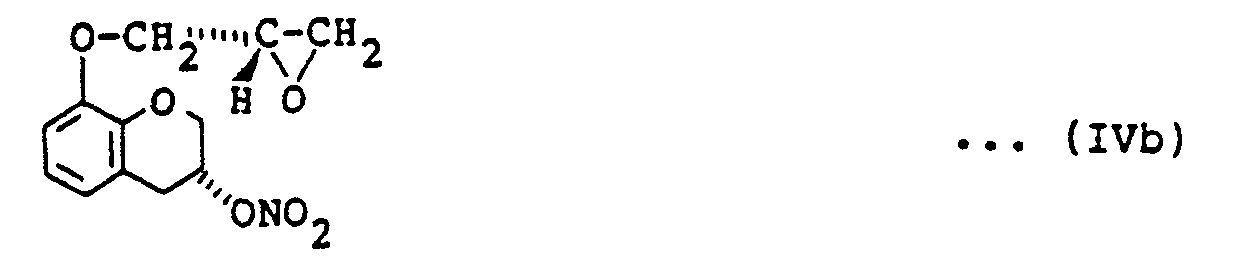
- (2) Action of the optically active (2R) epoxy compound of formula (ilia) on the (3R) compound (II) obtained in (1) above gives (2'R),(3R)-3,4-dihydro-8-(2',3'-epoxy)propoxy-3-nitroxy-2H-1-benzopyran (lVa).
- The alkyl group as the substituent A of the epoxy compound (ilia) is preferably a linear or branched alkyl group having 1 to 6 carbon atoms. Preferred aralkyl groups as substituent A are aralkyl groups having 7 or 8 carbon atoms such as benzyl and phenethyl groups. Preferred aryl groups as substituent A are aryl groups having 6 to 10 carbon atoms such as phenyl and naphthyl groups. These groups may be substituted by a halogen atom, a lower alkyl group (when A is an aralkyl or aryl group), a hydroxyl group, an alkoxy group, a nitro group, etc.
- Preferably, the reaction is carried out in the presence of a base in a solvent. The solvent may be the same hydrocarbons, halogenated hydrocarbons and ethers as exemplified hereinabove for the reaction of the compound of formula (I) with the optically active amino acid or its reactive derivative. The reaction temperature can be properly selected, and is preferably -30 to about 150°C, and the reaction time is, for example, several minutes to about 10 hours.
- (3) The desired R-R.K-351 can be obtained by contacting the (2'R),(3R)-epoxy compound (lVa) obtained in (2) above with isopropylamine. The contacting can be effected by reacting the compound (lVa) with isopropylamine in the presence or absence of the same solvent as exemplified hereinabove at a temperature of about D to about 150°C for a period of several minutes to about 5 hours. Separation and purification of the resulting R-R.K-351 can be carried out in a customary manner.
- (4) By the action of the optically active (2S) epoxy compound of formula (llIb) on the (3R) compound in the same way as in (2) above, (2'S),(3R)-3,4-dihydro-8-(2',3'-epoxy)propoxy-3-nitroxy-2H-1-benzopyran (lVb) can be obtained. Action of isopropylamine on the (2'S),(3R)-epoxy compound (lVb) gives S-R.K-351. These reactions can be carried out under the same conditions as described above with regard to the production of R-R.K-351.
- The R-R.K-351 and S-R.K-351 and pharmaceutically acceptable acid addition salts thereof have vasodilating activity and beta-blocking activity, and are useful as therapeutic agents for cardiovascular diseases.
- Thus, the optical isomers of this invention, R-R.K-351 and S-R.K-351, may be used as agents for treating cardiovascular diseases in the form of free bases or pharmaceutically acceptable acid addition salts such as salts with hydrochloric acid, sulfuric acid, nitric acid, hydrobromic acid, acetic acid, lactic acid, oxalic acid, maleic acid and p-toluenesulfonic acid.
- According'to this invention, there is also provided a pharmaceutical composition comprising (1) an amount, effective for the treatment of cardiovascular diseases, of an optical isomer selected from the group consisting of (2'R),13R)-3,4-dihydro-8-(2'-hydroxy-3'-isopropylamino)propoxy-3-nitroxy-2H-1-benzopyran represented by the following formula (A-2), (2'S),(3R)-3,4-dihydro-8-(2'-hydroxy-3'-isopropylamino)-propoxy-3-nitroxy-2H-1-benzopyran represented by the following formula (B-2)


- The amount of the optical isomer or its acid addition salt in the pharmaceutical composition is, for example, about 0.01 to about 99% by weight based on the total weight of the pharmaceutical composition.
- Liquid or solid carriers or diluents may be used in formulating the pharmaceutical composition of this invention. They may include excipients, binders, lubricants, emulsifiers, etc. known in pharmaceutical production. Examples of these carriers or diluents include starches such as potato starch, wheat starch, corn starch and rice starch; sugars such as lactose, sucrose, glucose, mannitol and sorbitol; celluloses such as crystalline cellulose, calcium carboxymethyl cellulose and hydroxypropyl cellulose of a low degree of substitution; inorganic substances such as potassium phosphate, calcium sulfate, calcium carbonate and talc; binder compounds such as gelatin, gum arabic, methyl cellulose, sodium carboxymethyl cellulose, polyvinyl pyrrolidone and hydroxypropyl cellulose; polyhydric alcohol ester-type nonionic surfactants such as fatty acid monoglycerides, sorbitan fatty acid esters, sucrose and polyglycerol fatty acid esters; and polyoxyethylene-type nonionic surfactants.
- The pharmaceutical compositions may be in any dosage forms known in the art of formulating pharmaceuticals, such as suppositories, powders, granules, tablets, sublingual tablets, liquid preparations, injectable preparations and suspensions.
- The pharmaceutical compositions of this invention may be administered through any of peroral and parenteral routes, such as an intravenous, sublingual or intrarectal route. For long-term administration, the oral route is preferred.
- The dose may be changed as desired. For example, the R-R.K-351, S-R.K-351, or a pharmaceutically acceptable acid addition salt thereof may be administered in a dose of about 1 to about 100 mg/body/day, preferably about 5 to about 50 mg/body/day. The compounds of this invention have low toxicity.
- Some examples are given below for testing the pharmacological efficacy of the compounds in accordance with this invention.
- The compounds indicated in Table 1 were tested for their antagonistic action on isoproterenol, i.e. their beta-blocking action, using isolated atrium and trachea of guinea pigs. The results are shown in Table 1.
- In the table, pA2 shows the reciprocal logarithm of the molar concentration of each test compound required to shift the dose-response curve of isoproterenol parallel toward a higher dose side by 2 times.
- The parenthesized figures show efficacy ratios based on K-351.
- The results demonstrate that the beta-blocking activity of R-R.K-351 is about one-tenth of that of K-351, and the beta-blocking activity of S-R.K-351 is about 3 to 8 times as strong as that of K-351.

- The compounds indicated in Table 2 were tested for their antagonistic action on potassium contracture (direct vaso-relaxing activity) and their antagonistic action on the contractile activity of norepinephrine (NE) (alpha-blocking activity) using the isolated superior mesenteric artery of dogs. The results are shown in Table 2.
- In the table pD2 represents the reciprocal logarithm of the molar concentration of each test compound required to inhibit the maximum reaction of potassium (25 m MK+) by an extent of 50%; and pA2 represents the reciprocal logarithm of the molar concentration of each test compound required to shift the dose-response curve of norepinephrine parallel toward a high dose side by 2 times.
- The parenthesized figures have the same meanings as indicated above with reference to Table 1.
- The above results demonstrate that the vasodilating activity of R-R.K-351 is nearly equivalent to that of K-351, and the vasodilating activity of S-R.K-351 is about 1.1 to 2 times as high as that of K-351.
- The compounds indicated in Table 3 were intravenously administered in a dose of 100 y/kg to anesthetized dogs, and changes in average blood pressure and heart rate were determned. The results are shown in Table 3. Each of the test compounds was used in the form of a solution in physiological saline together with an equimolar amount of hydrochloric acid which contained the test compound in a concentration of 1 mg/ml.
- The results demonstrate that the hypotensive activity of R-R.K-351 is nearly equivalent to that of K-351, and the hypotensive activity of S-R.K-351 is about 1.5 times as high as that of K-351.

- (A) 8.6 g of (R)-glycerol acetonide [bp.: 88-106°C (18 mmHg); specific rotation: [α]25 D -12.10° (c 5.64, methanol)] was dissolved in 70 ml of chloroform, and 10.0 g of triethylamine was added. With stirring and ice cooling, a solution of 13.8 g of tosyl chloride in 30 ml of chloroform was added dropwise, and the mixture was stirred overnight. The reaction mixture was washed with an aqueous solution of potassium hydrogen carbonate and water, and the solvent was evaporated. The residue (18.7 g) was dissolved in 75 ml of acetone, and 225 ml of 1 N hydrochloric acid was added. The mixture was stirred at 80°C for 30 minutes. The reaction mixture was concentrated and extracted with 450 ml of ethyl acetate. The extract was washed with water, and the solvent was evaporated. The residue was purified by silica gel column chromatography [solvent: chloroform-methanol (40:1)] to give 10.86 g (yield 67.8%) of (S)-3-tosyloxy-1,2-propanediol as colorless needles having a melting point of 57 to 60°C.
- Specific rotation: [α]25 D +9.66° (c 7.35 CH30H)
- 'H-NMR: δCDCl3, ppm
- 2.40 (3H, S, CH3),

- 7.25 (2H, d, J=7.5Hz, aromatic H),
- 7.70 (2H, d, J=7.5Hz, aromatic H).
- 2.40 (3H, S, CH3),
- (B) 14.90 g of the diol compound obtained in (A) above was dissolved in 150 ml of tetrahydrofuran, and with ice cooling, 6.49 g of sodium methoxide was added. The mixture was stirred for 2 hours. To the reaction mixture was added 27.8 ml of triethylamine, and a solution of 22.2 g of o-nitrobenzenesulfonyl chloride in 50 ml of tetrahyrofuran was added dropwise. The mixture was stirred overnight. The reaction mixture was filtered, and the filtrate was concentrated. The residue was purified by silica gel column chromatography [solvent: benzene-chloroform (2:1)] to give 7.31 g (yield 46.6%) of the desired compound as a pale yellow viscous oil.
- Specific rotation: [α]25 D +2.8° (c 15.2, CHCI3)
- 1H―NMR: 6 CDCI3, ppm


- 4.00-4.66 (2H, m, ―O―CH2―S―),
- 7.62―8.16 (4H, m, aromatic H).
- IR: VFilm max, cm-1

- 1365 and 1180 (S02)
- Elemental analysis for C9H9NO6S:

- 24.4 g of (R)-3-tosyloxy-1,2-propanediol [mp.: 60-62°C; specific rotation: [α]24 D -9.25°C (c 2.12, methanol)] was dissolved in a mixture of 30 ml of methanol and 15 ml of ether. With ice cooling and stirring, 6.5 g of sodium methoxide was added in four portions at intervals of one hour. The insoluble materials were than removed by filtration from the reaction mixture, and the solvent as evaporated at below 30°C to give 8.4 g of crude (R)-glycidol. The crude product (8.4 g) was dissolved in 120 ml of tetrahydrofuran and 11.1 g of triethylamine was added. Then, 24.2 g of o-nitrobenzenesulfonyl chloride was added with cooling and stirring, and the mixture was stirred for 2 hours. The insoluble materials were removed from the reaction mixture by filtration, and the solvent was evaporated. The residue was purified by silica gel column chromatography [solvent: benzene-chloroform (2:3)] to give 15.45 g (yeld 60.1 %) of the desired product.
- Specific rotation: [α]25 D -2.8° (c 10.0, CHCI3)
- 'H-NMR: δCDCl3, ppm


- 4.00―4.66 (2H, m, ―CH2―O―S),
- 7.60―8.16 (4H, m, aromatic H).
- IR: VFilm max, cm-1

- 1370 and 1190 (S02)
- Elemental analysis for C9H9NO6S:

- 31.8 g of 3,4-dihydro-8-hydroxy-3-nitroxy-2H-1-benzopyran was dissolved in 500 ml of methylene chloride, and 36.6 g of N-mesyl-L-phenylalanine and 3.7 g of 4-dimethylaminopyridine were added. With stirring at room temperature, a solution of 40 g of dicyclohexylcarbodiimide in 130 ml of methylene chloride was added, and the mixture was stirred overnight at room temperature. The precipitate was removed from the reaction mixture by filtration. The filtrate was concentrated, and the residue was dissolved in ethyl acetate and washed successively with 5% hydrochloric acid, a 5% aqueous solution of sodium hydroxide and water. The solvent was then evaporated. The residue was dissolved in tetrahydrofuran. The insoluble materials were removed by filtration. Hexane was added, and the solution was left to stand. The precipitated crystals were collected by filtration, and recrystallized from acetone to give 12.8 g (yield 19.4%) of the desired product as colorless prisms having a melting point of 191 to 195°C (decomp.).
- Specific rotation: [α]25 D -17.2° (c 3, THF)
- 1H―NMR: δCDCl3, ppm
- 2.74 (3H, s, -CH3),

- 4.24-4.36 (2H, m, C2-H),
- 4.60-4.80 (1H, m, -CHNH),
- 4.92 (1 H, d, J=9Hz, -NH),
- 5.36-5.56 (1H, m, C3-H),
- 6.80-7.10 (3H, m, aromatic H),
- 7.32 (5H, s, aromatic H).
- 2.74 (3H, s, -CH3),
- IR: VKBR max, cm-1
- 3240 (NH), 1778 (COO),
- 1635 and 1272 (ON02),
- 1325 and 1150 (S02NH).
- Mass spectrum: m/e
- 436 (M+)
- Elemental analysis for C19H20N2O8S:

- 21.6 g of the ester obtained in (A) was dissolved in 200 ml of tetrahydrofuran, and at room temperature, 100 ml of methanol and then 40 ml of a 10% aqueous solution of sodium hydroxide were added. The mixture was stirred for 1 hour. The reaction mixture was adjusted to a pH of about 4 with cold hydrochloric acid, and concentrated. To the residue were added 300 ml of chloroform and dilute hydrochloric acid. The aqueous layer was adjusted to pH 2, and the chloroform layer was separated. The chloroform layer was washed with an aqueous solution of sodium hydrogen carbonate and also with water, and the solvent was evaporated. Recrstallization of the residue from ethyl acetate-hexane gave 9.2 g (yield 38.0%) of the desired product as colorless prisms having a melting point of 129.0 to 130.5°C.
- Specific rotation: [α]25 D +40.8° (c 3, CHCI3)
- 1H―NMR: δCDCl3, ppm
- 2.84-3.42 (2H, m, C4-H),
- 4.12-4.52 (2H, m, C2―H),
- 5.32―5.50(1H, m, C3―H),
- 5.44 (1 H, s, OH),
- 6.48―6.90 (3H, m, aromatic H).
- IR: vKBR max, cm-1
- 3330 (OH)
- 1620 and 1290 (ON02).
- Elemental analysis for C9H9NO5:

- 3.75 g of the (3R)-8-hydroxy compound obtained in (B) was dissolved in 30 ml of anhydrous tetrahydrofuran, and with ice cooling, a suspension of 0.85 g of 50% sodium hydride in. 9 ml of tetrahydrofuran was added. The mixture was stirred for 15 minutes. A solution of 4.6 g of the (2R)-3-(o-nitrobenzenesulfonyloxy)-1,2-epoxypropane obtained in Referential Example 1 in 25 ml of tetrahydrofuran was added, and the mixture was stirred at a bath temperature of 70 to 75°C for 1.5 hours. The precipitate was removed from the reaction mixture by filtration, and the solvent was evaporated. The residue was dissolved in 50 ml of chloroform, and washed with a 5% aqueous solution of sodium hydroxide and then with water. The solvent was evaporated. Recrystallization of the residue from acetone-methanol gave 3.89 g (yield 82.0%) of the desired product as colorless needles having a melting point of 141.0 to 142.5°C.
- Specific rotation: [α]25 D +34.0° (c 2, CHCl3)
- 1H-NMR: δCDCl3, ppm


- 3.84-4.52 (4H, m, C2―H and ―OCH2CH<),
- 5.26-5.88 (1 H, m, C3-H),
- 6.52-6.88 (3H, m, aromatic H).
- IR: vKBR max, cm-1
- 1620 and 1280 (ONOz).
- Elemental analysis for C12H13NO6:

- 40 ml of isopropylamine and 80 ml of ethanol were mixed, and 3.9 g of the (2'S),(3R)-epoxy compound obtained in (C) above was added to the mixture. The mixture was stirred at a bath temperature of 70°C for 1 hour. The solvent was evaporated from the reaction mixture. The residue was dissolved in chloroform and extracted with an aqueous solution of acetic acid. The extract was washed with benzene, made alkaline with an aqueous solution of some hydroxide, and extracted with chloroform. The extract was washed with water, and the solvent was evaporated. The residue was purified by alumina column chromatography (solvent: chloroform), and then recrystallized from benzene-hexane to give 4.08 g (yield 85.7%) of the desired product as colorless needles having a melting point of 144.0 to 144.5°C.
- Specific rotation: [α]25 D +15.5° (c 2, CHCI3)
- 1H―NMR: δCDCl3, ppm
- 1.07 (6H, d, J=6Hz, CH3),
- 2.20-3.44 (7H, m, -CH2NHCH< and OH),
- 3.92-4.16 (3H, m, ―OCH2CH(OH)―).
- 4.16―4.54 (2H, m, C2-H),
- 5.33-5.53 (1 H, m, C3-H),
- 6.58―6.92 (3H, m, aromatic H).
- IR: vKBR max, cm-1
- 1620 and 1278 (ONO2).
- Elemental analysis for C15H22N2O6:

- 3.75 g of the (3R)-8-hydroxy compound obtained in Example 1, (B) was dissolved in 30 ml of anhydrous tetrahydrofuran, and with ice cooling, a suspension of 0.85 g of 50% sodium hydride in 9 ml of tetrahydrofuran was added. The mixture was stirred for 15 minutes. To the reaction mixture was added a solution of 4.6 g of the (2S)-3-(o-nitrobenzenesulfonyloxy)-1,2-epoxypropane obtained in Referential Example 2 in 25 ml of tetrahydrofuran, and the mixture was stirred at a bath temperature of 70 to 75°C for 1.5 hours. The precipitate was removed from the reaction mixture by filtration, and the solvent was evaporated. The residue was dissolved in 50 ml of chloroform, and washed with a 5% aqueous solution of sodium hydride and then with water. The solvent was evaporated. Recrystallization of the residue from acetone-methanol gave 4.3 g (yield 90.6%) of the desired product as colorless needles having a melting point of 131.5 to 132.0°C.
- Specific rotation: [α]25 D +25.3° (c 2, CHCI3)
- 1H―NMR: δCDCl3, ppm


- 3.92-4.52 (4H, m, C2-H and -OCH2CH<),
- 5.28-5.52 (1 H, m, C3-H),
- 6.57―6.92 (3H, m, aromatic H).
- IR: vKBR max, cm-1
- 1620 and 1280 (ON02).
- Elemental analysis for C12H13NO6:

- 40 ml of isopropylamine and 80 ml of ethanol were mixed, and 3.9 g of the (2'S),(3R)-epoxy compound obtained in (A) above was added to the mixture. The mixture was stirred at a bath temperature of 70°C for 1 hour. The solvent was evaporated from the reaction mixture. The residue was dissolved in chloroform and extracted with an aqueous solution of acetic acid. The extract was washed with benzene, made alkaline with an aqueous solution of sodium hydroxide, and extracted with chloroform. The extract was washed with water, and the solvent was evaporated. The residue was purified by alumina column chromatography (solvent: chloroform), and recrystallized from benzene-hexane to give 3.91 g (yield 82.1 %) as colorless needles having a melting point of 107.5 to 108.5°C.
- Specific rotation: [α]25 D +16.2° (c 2, CHCI3)
- 1H―NMR: δCDCl3, ppm
- 1.07 (6H, d, J=6Hz, CH3),
- 2.20-3.44 (7H, m, C4―H, -CH2NHCH< and OH),
- 3.88―4.12 (3H, m,

- 4.12―4.52 (2H, m, C2―H),
- 5.32―5.52(1H, m, C3―H),
- 6.56―6.92 (3H, m, aromatic H).
- IR: vKBR max, cm-1
- 1620 and 1278 (ONO2).
- Elemental analysis for C15H22N2O6:

-

- The above ingredients were uniformly mixed and tableted into tablets each having a diameter of 5 mm and weighing 50 mg by a direct tableted method.
-

- The ingredients in A) were uniformly mixed and then kneaded with the solution B). The mixture was granulated by an extrusion method, dried in vacuum at 50°C, and sieved to form granules.
-

- The above ingredients were uniformly mixed and by adding 25 parts of ethanol, kneaded. The mixture was granulated by a crushing method, then dried in vacuum at 50°C, and sieved to form subtilized granules.
-

- The above ingredients were uniformly mixed. 90 g of the resulting mixture were filled in each of No. 5 lock capsules to form capsules.
Claims (4)


Applications Claiming Priority (2)
| Application Number | Priority Date | Filing Date | Title |
|---|---|---|---|
| JP59062177A JPS60208973A (en) | 1984-03-31 | 1984-03-31 | Novel optically active compound, its preparation, and drug containing it |
| JP62177/84 | 1984-03-31 |
Publications (3)
| Publication Number | Publication Date |
|---|---|
| EP0157623A2 EP0157623A2 (en) | 1985-10-09 |
| EP0157623A3 EP0157623A3 (en) | 1986-06-25 |
| EP0157623B1 true EP0157623B1 (en) | 1989-03-22 |
Family
ID=13192576
Family Applications (1)
| Application Number | Title | Priority Date | Filing Date |
|---|---|---|---|
| EP85302263A Expired EP0157623B1 (en) | 1984-03-31 | 1985-04-01 | Optically active isomers of benzopyran derivatives useful for treating cardiovascular disease |
Country Status (4)
| Country | Link |
|---|---|
| US (1) | US4678803A (en) |
| EP (1) | EP0157623B1 (en) |
| JP (1) | JPS60208973A (en) |
| DE (1) | DE3568986D1 (en) |
Families Citing this family (9)
| Publication number | Priority date | Publication date | Assignee | Title |
|---|---|---|---|---|
| US5153338A (en) * | 1986-06-25 | 1992-10-06 | Massachusetts Institute Of Technology | Optically active derivatives of glycidol |
| US4946974A (en) * | 1986-10-01 | 1990-08-07 | Massachusetts Institute Of Technology | Optically active derivatives of glycidol |
| WO1988000190A1 (en) * | 1986-06-25 | 1988-01-14 | Massachusetts Institute Of Technology | Optically active derivatives of glycidol |
| US5344947A (en) * | 1986-10-01 | 1994-09-06 | Massachusetts Institute Of Technology | Optically active derivatives of glycidol |
| GB8730051D0 (en) * | 1987-12-23 | 1988-02-03 | Beecham Group Plc | Novel compounds |
| JP2006182740A (en) * | 2004-12-28 | 2006-07-13 | Daiso Co Ltd | Method for preparing glycidyl sulfonate |
| JP4749759B2 (en) * | 2005-05-12 | 2011-08-17 | 株式会社トクヤマ | Method for producing dihydrobenzopyran compound |
| JP4810136B2 (en) * | 2005-06-28 | 2011-11-09 | 株式会社トクヤマ | Method for producing dihydrobenzopyran compound |
| JP2007297321A (en) * | 2006-04-28 | 2007-11-15 | Daiso Co Ltd | Method for producing aryl 2-methylglycidyl ether |
Family Cites Families (4)
| Publication number | Priority date | Publication date | Assignee | Title |
|---|---|---|---|---|
| US4394382A (en) * | 1980-06-17 | 1983-07-19 | Kowa Company, Ltd. | Dihydrobenzopyran compounds and pharmaceutical composition comprising said compounds |
| JPS57106619A (en) * | 1980-12-25 | 1982-07-02 | Kowa Co | Remedy for circulatory disease |
| JPS6054317B2 (en) * | 1980-06-17 | 1985-11-29 | 興和株式会社 | New benzopyran derivatives |
| JPS5821692A (en) * | 1981-07-29 | 1983-02-08 | Microbial Chem Res Found | Novel aminoglycoside |
-
1984
- 1984-03-31 JP JP59062177A patent/JPS60208973A/en active Granted
-
1985
- 1985-03-27 US US06/716,462 patent/US4678803A/en not_active Expired - Fee Related
- 1985-04-01 EP EP85302263A patent/EP0157623B1/en not_active Expired
- 1985-04-01 DE DE8585302263T patent/DE3568986D1/en not_active Expired
Also Published As
| Publication number | Publication date |
|---|---|
| EP0157623A3 (en) | 1986-06-25 |
| JPS60208973A (en) | 1985-10-21 |
| DE3568986D1 (en) | 1989-04-27 |
| US4678803A (en) | 1987-07-07 |
| JPH0422887B2 (en) | 1992-04-20 |
| EP0157623A2 (en) | 1985-10-09 |
Similar Documents
| Publication | Publication Date | Title |
|---|---|---|
| EP0354583B1 (en) | DC-88A derivatives | |
| US5516784A (en) | Anti-HIV (AIDS) agents | |
| HK91989A (en) | Cardioselective aryloxy-and arylthio-hydroxypropyl piperazinyl acetanilides which affect calcium entry | |
| EP1219596B1 (en) | Salicylamide derivatives | |
| HU202515B (en) | Process for producing new forscholine derivatives and pharmaceutical compositions comprising such compounds | |
| US4482562A (en) | Aromatic aminoethanol compounds, and utilization thereof as cardiovascular agents | |
| US4394382A (en) | Dihydrobenzopyran compounds and pharmaceutical composition comprising said compounds | |
| US4678803A (en) | Optical isomers, processes for production thereof and pharmaceutical composition thereof | |
| US4868303A (en) | Bis-dioxopiperazine derivatives | |
| EP0314446A2 (en) | Novel antihypertensive benzopyran derivatives | |
| EP0637583B1 (en) | 1-Aryloxy-3-alkylamino-2-propanol nitrate esters, the use thereof and corresponding pharmaceutical composition | |
| US4882316A (en) | Pyrimidine derivatives | |
| JPH0249788A (en) | Pyranobenzoxadiazole derivative | |
| FR2596051A1 (en) | NOVEL DERIVATIVES OF PURINE, THEIR PREPARATION AND THEIR USE AS MEDICAMENTS | |
| EP0154511B1 (en) | Benzopyran racemates useful for treating cardiovascular diseases | |
| EP0113910B1 (en) | Isocarbostyril derivatives, processes for their preparation and pharmaceutical compositions containing them | |
| US4064259A (en) | Thiazole cardiovascular agents | |
| GB2171997A (en) | 4-Amino-6,7-dimethoxy-2-Piperazin-1-ylquinazoline derivatives | |
| CZ263692A3 (en) | Thiadiazinones, process of their preparation and pharmaceutical compositions based thereon | |
| EP0083256B1 (en) | Benzamide derivatives | |
| EP0602458A1 (en) | 1,4-Benzoxazine derivatives | |
| EP0140327B1 (en) | Bis-dioxopiperazine derivatives, process for their preparation, antitumor agents comprising them and compositions containing them | |
| JP2802996B2 (en) | Production method of optically active compound | |
| KR20060120164A (en) | Nitrox derivatives of antihypertensive agents | |
| US4883796A (en) | Oxime ethers of 2,6-dioxabicyclo(3.3.0)octanones, and compositions and methods for treatment of a cardiac disease or circulatory with them |
Legal Events
| Date | Code | Title | Description |
|---|---|---|---|
| PUAI | Public reference made under article 153(3) epc to a published international application that has entered the european phase |
Free format text: ORIGINAL CODE: 0009012 |
|
| AK | Designated contracting states |
Designated state(s): BE CH DE FR GB IT LI NL SE |
|
| PUAL | Search report despatched |
Free format text: ORIGINAL CODE: 0009013 |
|
| AK | Designated contracting states |
Kind code of ref document: A3 Designated state(s): BE CH DE FR GB IT LI NL SE |
|
| 17P | Request for examination filed |
Effective date: 19860818 |
|
| 17Q | First examination report despatched |
Effective date: 19871005 |
|
| GRAA | (expected) grant |
Free format text: ORIGINAL CODE: 0009210 |
|
| AK | Designated contracting states |
Kind code of ref document: B1 Designated state(s): BE CH DE FR GB IT LI NL SE |
|
| ITF | It: translation for a ep patent filed | ||
| REF | Corresponds to: |
Ref document number: 3568986 Country of ref document: DE Date of ref document: 19890427 |
|
| ET | Fr: translation filed | ||
| PLBE | No opposition filed within time limit |
Free format text: ORIGINAL CODE: 0009261 |
|
| STAA | Information on the status of an ep patent application or granted ep patent |
Free format text: STATUS: NO OPPOSITION FILED WITHIN TIME LIMIT |
|
| 26N | No opposition filed | ||
| ITTA | It: last paid annual fee | ||
| EAL | Se: european patent in force in sweden |
Ref document number: 85302263.0 |
|
| PGFP | Annual fee paid to national office [announced via postgrant information from national office to epo] |
Ref country code: GB Payment date: 19970324 Year of fee payment: 13 |
|
| PGFP | Annual fee paid to national office [announced via postgrant information from national office to epo] |
Ref country code: DE Payment date: 19970404 Year of fee payment: 13 |
|
| PGFP | Annual fee paid to national office [announced via postgrant information from national office to epo] |
Ref country code: FR Payment date: 19970409 Year of fee payment: 13 |
|
| PGFP | Annual fee paid to national office [announced via postgrant information from national office to epo] |
Ref country code: SE Payment date: 19970418 Year of fee payment: 13 |
|
| PGFP | Annual fee paid to national office [announced via postgrant information from national office to epo] |
Ref country code: CH Payment date: 19970421 Year of fee payment: 13 |
|
| PGFP | Annual fee paid to national office [announced via postgrant information from national office to epo] |
Ref country code: NL Payment date: 19970428 Year of fee payment: 13 |
|
| PGFP | Annual fee paid to national office [announced via postgrant information from national office to epo] |
Ref country code: BE Payment date: 19970529 Year of fee payment: 13 |
|
| PG25 | Lapsed in a contracting state [announced via postgrant information from national office to epo] |
Ref country code: GB Free format text: LAPSE BECAUSE OF NON-PAYMENT OF DUE FEES Effective date: 19980401 |
|
| PG25 | Lapsed in a contracting state [announced via postgrant information from national office to epo] |
Ref country code: SE Free format text: LAPSE BECAUSE OF NON-PAYMENT OF DUE FEES Effective date: 19980402 |
|
| PG25 | Lapsed in a contracting state [announced via postgrant information from national office to epo] |
Ref country code: LI Free format text: LAPSE BECAUSE OF NON-PAYMENT OF DUE FEES Effective date: 19980430 Ref country code: FR Free format text: THE PATENT HAS BEEN ANNULLED BY A DECISION OF A NATIONAL AUTHORITY Effective date: 19980430 Ref country code: CH Free format text: LAPSE BECAUSE OF NON-PAYMENT OF DUE FEES Effective date: 19980430 Ref country code: BE Free format text: LAPSE BECAUSE OF NON-PAYMENT OF DUE FEES Effective date: 19980430 |
|
| BERE | Be: lapsed |
Owner name: KOWA CY LTD Effective date: 19980430 |
|
| PG25 | Lapsed in a contracting state [announced via postgrant information from national office to epo] |
Ref country code: NL Free format text: LAPSE BECAUSE OF NON-PAYMENT OF DUE FEES Effective date: 19981101 |
|
| GBPC | Gb: european patent ceased through non-payment of renewal fee |
Effective date: 19980401 |
|
| REG | Reference to a national code |
Ref country code: CH Ref legal event code: PL |
|
| NLV4 | Nl: lapsed or anulled due to non-payment of the annual fee |
Effective date: 19981101 |
|
| EUG | Se: european patent has lapsed |
Ref document number: 85302263.0 |
|
| PG25 | Lapsed in a contracting state [announced via postgrant information from national office to epo] |
Ref country code: DE Free format text: LAPSE BECAUSE OF NON-PAYMENT OF DUE FEES Effective date: 19990202 |
|
| REG | Reference to a national code |
Ref country code: FR Ref legal event code: ST |