EP0157579A2 - Beutel für Probe und Anstechteil - Google Patents
Beutel für Probe und Anstechteil Download PDFInfo
- Publication number
- EP0157579A2 EP0157579A2 EP85302091A EP85302091A EP0157579A2 EP 0157579 A2 EP0157579 A2 EP 0157579A2 EP 85302091 A EP85302091 A EP 85302091A EP 85302091 A EP85302091 A EP 85302091A EP 0157579 A2 EP0157579 A2 EP 0157579A2
- Authority
- EP
- European Patent Office
- Prior art keywords
- chamber
- bag
- septum
- bag according
- frangible
- Prior art date
- Legal status (The legal status is an assumption and is not a legal conclusion. Google has not performed a legal analysis and makes no representation as to the accuracy of the status listed.)
- Withdrawn
Links
Images



Classifications
-
- A—HUMAN NECESSITIES
- A61—MEDICAL OR VETERINARY SCIENCE; HYGIENE
- A61J—CONTAINERS SPECIALLY ADAPTED FOR MEDICAL OR PHARMACEUTICAL PURPOSES; DEVICES OR METHODS SPECIALLY ADAPTED FOR BRINGING PHARMACEUTICAL PRODUCTS INTO PARTICULAR PHYSICAL OR ADMINISTERING FORMS; DEVICES FOR ADMINISTERING FOOD OR MEDICINES ORALLY; BABY COMFORTERS; DEVICES FOR RECEIVING SPITTLE
- A61J1/00—Containers specially adapted for medical or pharmaceutical purposes
- A61J1/14—Details; Accessories therefor
- A61J1/1406—Septums, pierceable membranes
-
- A—HUMAN NECESSITIES
- A61—MEDICAL OR VETERINARY SCIENCE; HYGIENE
- A61J—CONTAINERS SPECIALLY ADAPTED FOR MEDICAL OR PHARMACEUTICAL PURPOSES; DEVICES OR METHODS SPECIALLY ADAPTED FOR BRINGING PHARMACEUTICAL PRODUCTS INTO PARTICULAR PHYSICAL OR ADMINISTERING FORMS; DEVICES FOR ADMINISTERING FOOD OR MEDICINES ORALLY; BABY COMFORTERS; DEVICES FOR RECEIVING SPITTLE
- A61J1/00—Containers specially adapted for medical or pharmaceutical purposes
- A61J1/14—Details; Accessories therefor
- A61J1/20—Arrangements for transferring or mixing fluids, e.g. from vial to syringe
- A61J1/2093—Containers having several compartments for products to be mixed
-
- B—PERFORMING OPERATIONS; TRANSPORTING
- B01—PHYSICAL OR CHEMICAL PROCESSES OR APPARATUS IN GENERAL
- B01L—CHEMICAL OR PHYSICAL LABORATORY APPARATUS FOR GENERAL USE
- B01L3/00—Containers or dishes for laboratory use, e.g. laboratory glassware; Droppers
- B01L3/50—Containers for the purpose of retaining a material to be analysed, e.g. test tubes
- B01L3/505—Containers for the purpose of retaining a material to be analysed, e.g. test tubes flexible containers not provided for above
-
- C—CHEMISTRY; METALLURGY
- C12—BIOCHEMISTRY; BEER; SPIRITS; WINE; VINEGAR; MICROBIOLOGY; ENZYMOLOGY; MUTATION OR GENETIC ENGINEERING
- C12Q—MEASURING OR TESTING PROCESSES INVOLVING ENZYMES, NUCLEIC ACIDS OR MICROORGANISMS; COMPOSITIONS OR TEST PAPERS THEREFOR; PROCESSES OF PREPARING SUCH COMPOSITIONS; CONDITION-RESPONSIVE CONTROL IN MICROBIOLOGICAL OR ENZYMOLOGICAL PROCESSES
- C12Q1/00—Measuring or testing processes involving enzymes, nucleic acids or microorganisms; Compositions therefor; Processes of preparing such compositions
- C12Q1/56—Measuring or testing processes involving enzymes, nucleic acids or microorganisms; Compositions therefor; Processes of preparing such compositions involving blood clotting factors, e.g. involving thrombin, thromboplastin, fibrinogen
-
- G—PHYSICS
- G01—MEASURING; TESTING
- G01N—INVESTIGATING OR ANALYSING MATERIALS BY DETERMINING THEIR CHEMICAL OR PHYSICAL PROPERTIES
- G01N33/00—Investigating or analysing materials by specific methods not covered by groups G01N1/00 - G01N31/00
- G01N33/48—Biological material, e.g. blood, urine; Haemocytometers
- G01N33/483—Physical analysis of biological material
- G01N33/487—Physical analysis of biological material of liquid biological material
- G01N33/49—Blood
- G01N33/4905—Determining clotting time of blood
-
- G—PHYSICS
- G01—MEASURING; TESTING
- G01N—INVESTIGATING OR ANALYSING MATERIALS BY DETERMINING THEIR CHEMICAL OR PHYSICAL PROPERTIES
- G01N33/00—Investigating or analysing materials by specific methods not covered by groups G01N1/00 - G01N31/00
- G01N33/48—Biological material, e.g. blood, urine; Haemocytometers
- G01N33/50—Chemical analysis of biological material, e.g. blood, urine; Testing involving biospecific ligand binding methods; Immunological testing
- G01N33/86—Chemical analysis of biological material, e.g. blood, urine; Testing involving biospecific ligand binding methods; Immunological testing involving blood coagulating time or factors, or their receptors
-
- A—HUMAN NECESSITIES
- A61—MEDICAL OR VETERINARY SCIENCE; HYGIENE
- A61J—CONTAINERS SPECIALLY ADAPTED FOR MEDICAL OR PHARMACEUTICAL PURPOSES; DEVICES OR METHODS SPECIALLY ADAPTED FOR BRINGING PHARMACEUTICAL PRODUCTS INTO PARTICULAR PHYSICAL OR ADMINISTERING FORMS; DEVICES FOR ADMINISTERING FOOD OR MEDICINES ORALLY; BABY COMFORTERS; DEVICES FOR RECEIVING SPITTLE
- A61J1/00—Containers specially adapted for medical or pharmaceutical purposes
- A61J1/05—Containers specially adapted for medical or pharmaceutical purposes for collecting, storing or administering blood, plasma or medical fluids ; Infusion or perfusion containers
- A61J1/10—Bag-type containers
-
- A—HUMAN NECESSITIES
- A61—MEDICAL OR VETERINARY SCIENCE; HYGIENE
- A61J—CONTAINERS SPECIALLY ADAPTED FOR MEDICAL OR PHARMACEUTICAL PURPOSES; DEVICES OR METHODS SPECIALLY ADAPTED FOR BRINGING PHARMACEUTICAL PRODUCTS INTO PARTICULAR PHYSICAL OR ADMINISTERING FORMS; DEVICES FOR ADMINISTERING FOOD OR MEDICINES ORALLY; BABY COMFORTERS; DEVICES FOR RECEIVING SPITTLE
- A61J1/00—Containers specially adapted for medical or pharmaceutical purposes
- A61J1/14—Details; Accessories therefor
- A61J1/1475—Inlet or outlet ports
-
- A—HUMAN NECESSITIES
- A61—MEDICAL OR VETERINARY SCIENCE; HYGIENE
- A61J—CONTAINERS SPECIALLY ADAPTED FOR MEDICAL OR PHARMACEUTICAL PURPOSES; DEVICES OR METHODS SPECIALLY ADAPTED FOR BRINGING PHARMACEUTICAL PRODUCTS INTO PARTICULAR PHYSICAL OR ADMINISTERING FORMS; DEVICES FOR ADMINISTERING FOOD OR MEDICINES ORALLY; BABY COMFORTERS; DEVICES FOR RECEIVING SPITTLE
- A61J1/00—Containers specially adapted for medical or pharmaceutical purposes
- A61J1/14—Details; Accessories therefor
- A61J1/20—Arrangements for transferring or mixing fluids, e.g. from vial to syringe
- A61J1/2003—Accessories used in combination with means for transfer or mixing of fluids, e.g. for activating fluid flow, separating fluids, filtering fluid or venting
- A61J1/202—Separating means
- A61J1/2024—Separating means having peelable seals
-
- G—PHYSICS
- G01—MEASURING; TESTING
- G01N—INVESTIGATING OR ANALYSING MATERIALS BY DETERMINING THEIR CHEMICAL OR PHYSICAL PROPERTIES
- G01N2333/00—Assays involving biological materials from specific organisms or of a specific nature
- G01N2333/435—Assays involving biological materials from specific organisms or of a specific nature from animals; from humans
- G01N2333/745—Assays involving non-enzymic blood coagulation factors
- G01N2333/75—Fibrin; Fibrinogen
Definitions
- This invention relates in general to new and useful improvements in disposable specimen collection and analysis bags, and particularly in the manner in which the specimen is introduced into such bags.
- An important application of the present invention is in the form of clotting tests for blood.
- the present invention provides a specimen bag comprising at least one chamber having an injection assembly whereby a substance may be injected into the collection chamber, said injection assembly comprising an elastic septum and means for stretching said septum.
- US-A-4,445,896 is of special interest in that it teaches that the self-sealing properties of the septum may be enhanced by maintaining it in a state of compression. (See also Martinez, US-A-3,814,137; Morgan, US-A-3,850,202; L undquist, US-A-3,990,445.) Instead, applicants stretch the septum prior to penetration and allow it to relax after penetration.
- a puncturable, self-sealing septum is used to seal the inlet. Gas samples are injected through the septum, which heals when the needle is withdrawn. See, e.g., Tracht, US-A-2,839,152; McKinney, US-A-3,374,660; and Barre, US-A-3,537,321.
- the present invention recites a novel injection assembly less liable to leakage upon repeated use than a simple septum.
- Multicompartmented specimen collection or analysis bags with rupturable sealing means are known.
- Steinberg, US-A-3,520,659 describes apparatus for determining the prothrombin time of a blood sample which includes prepackaged reagents in "top hat” reagent storage compartments, rather than in integrally formed compartments, which are easier to manufacture.
- a number of blood collection devices are equipped with specimen treating means.
- Fox, US-A-2,690,179 describes a syringe equipped with a number of pods anchored to the inside wall of the collection chamber. The contents of these pods include anti-coagulants, preservatives, culture media, dyes and indicators. These pods are frangible.
- rupturable sealing means include weakened plastic walls, and sealing means cooperating with piercing means. See, e.g., Luhleich, US-A-3,552,441.
- the rupturable sealing means of the present invention unlike the recited structures, encourages a gentle fluid flow upon rupture, while also favouring rupture in the desired direction.
- Prenntzell US-A-3,964,604 shows a flexible compartmented package with frangible sealing means in the form of a destructible "nose" extending from the primary or reaction chamber into the secondary or reagent chamber. These nose portions form a middle section in what is otherwise a permanent seam. The "nose” is ruptured by pressure on the secondary chamber (into which the nose extends) in order to expel material into the primary chamber.
- Prenntzell's "nose” points away from that direction.
- the bag of the present invention includes a plurality of chambers with adjacent communicating chambers separated by independently frangible seals which, more preferably, are trapezoidal.
- frangible seals which, more preferably, are trapezoidal.
- Such trapezoidal frangible seals are to be preferred to Prenntzell's triangular seal which is likely to break at the point, resulting in "jetting” rather than in a smooth flow.
- Our trapezoidal seal experiences a larger break, diminishing "jetting”.
- Shmelkin US-A-4,365,727 describes a device employing two hinged frames to squeeze contents from a tube.
- the frames are not adhesive and therefore cannot be used to expand as well as compress the tube.
- the invention is a substantially flat, disposable, flexible, transparent plastic pouch, preferably formed of two main sheets, for specimen collection and analysis (and particularly for medical diagnosis), having a collection or viewing chamber, a reagent chamber, and a diluent chamber, separated by frangible sealing means that rupture rapidly but smoothly.
- the preferred frangible sealing means may be directionally biased so reagents are released in the proper sequence.
- the collection chamber preferably receives specimens through an injection assembly which, by stretching a septum prior to injection of the specimen into the chamber, facilitates the healing of the septum after withdrawal of the needle.
- the injector prefferably protected from contamination by the contents of a viewing chamber of the bag.
- Adhesive material may be provided at the opposing hard surfaces around the compartments of the bag to adhere together the opposing hard surfaces to maintain the compartment collapsed to prevent liquid from returning to a compartment after having been expelled.
- the bag should include a simple, easy to use and inexpensive means of rapidly but smoothly rupturing a frangible seal between compartments, encouraging nearly all fluid contained in one compartment to be moved into one or more adjacent compartments.
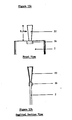
- FIGURE 18 presents views of three embodiments of the preferred directional frangible sealing means.
- Figure 1 is a schematic front view of the device
- Figure 2 is a longitudinal section to one side of the mid-line
- Figure 3 is a perspective of the injection assembly
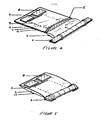
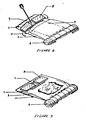
- Figures 4-7 illustrate the use of the device.
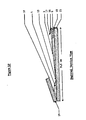
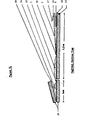
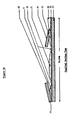
- Figures 8-17 illustrate additional embodiments.
- the device is a thin, rectangular closed pouch approximately 5 cm. in width and 16 cm. in length, formed by sealing the edges of a front leaf 1 to a back leaf 11. Of course, other dimensions may be selected.
- the front leaf 1 and back leaf 11 are preferably about 0.005 inch (0.1270 mm) in thickness.
- the front leaf is formed, at least in part, of a substantially transparent material, and preferably is made of a plastic such as polyvinyl chloride or the film known by the Trade Mark Surlyn.
- the injection assembly consisting of a pliable latex membrane or septum 7 and two rigid lever means 8 attached to the latex membrane about 3 mm. lateral to the midline of the membrane, on opposite ends, as shown in Figure 3.
- back plate 9 which is appropriately 6 cm. in length and 2 cm. in width.
- the edges of this back plate are so positioned as to act as fulcrum means for the operation of the lever means 8. (However, the operator's finger may also serve as a fulcrum.)
- the back plate may be located either within or without the viewing chamber.
- This backing means 9 may be a simple rectangular frame, but preferably is a solid plate. If located within the collection chamber, it acts to shield the back leaf from a needle piercing the membrane 7. For manufacturing reasons, it may be placed outside the chamber, where it will still prevent leakage.
- a rolling and securing seans preferably a strip of adhesive-backed aluminum foll 6 attached to each leaf. These strips extend beyond the lateral ends of the pouch, and over this extension adhere to one another.
- the pouch is divided into three compartments. The upper and largest compartment is the collection or viewing chamber 2. This chamber is separated from the middle compartment, the dry component chamber 3 by a frangible seal 10, preferably of trapezoidal shape. This shape facilitates the snooth rupture of the seal in the desired direction.
- a permanent seal 5 Preferably, above each descending margin of the frangible seal is a permanent seal 5, which also acts to directionally bias the seal. Similar seals divide the middle from the lower compartment, the diluent chamber 4.
- the reagent chamber contains reagent, such as dry 50 ag, of thronboplastin with a calcium salt 13, and the diluent chamber contains a diluent, such as 2 al. of buffered saline diluent 12.
- the device may be used to measure the prothrombin time of a specimen of whole blood or plasma.
- the first element of which is the occurrence of a filmy fibrin web most readily visualized at the edges of the blood-diluent mixture.
- the amount of throaboplastin used is slightly in excess of the total amount needed to maximize the rapidity of the reaction.
- the throaboplastin is preferably segregated from the diluent during atorage because while dry thromboplastin is cheaically stable, in solution thromboplastin is unstable, deteriorating within a few hours.
- Calcium ion is preferably added to the thromboplastin so that the reaction rate will not be dependent on calcium concentration in the teat ssapls.
- the diluent serves to diasolve the thrombo-plastin, and to dilute the blood that is to be tsated.
- the blood dilution retarda the clotting reaction and lengthens by a few saconds the time interval between the viaible formation of the fibrin web and the actual viaible clot formation.
- the bottom part of the pouch is rolled forward firmly on the aluminum foil atripa (Figurs 4).
- This action incrsaeesthe pressura within the diluent chnmber, cauaing the lower frangibls seal to rupture, and admitting the diluent to the reagent (dry component) chamber, where the thromboplastin and calcium are immediately dissolved.
- Further forward rolling of the pouch causes the rupture of the remaining frangible aeal, admitting the solution to the viewing chamber.
- the ends of the foil strips then are bent under the roll ( Figure 5) to fix the roll in place. The 0.5 ml.
- the injection assembly for the introduction of fluids into an otherwise nearly closed flexible chamber has several advantages. Firat, a space sevaral nm. wide is created between the leavea of the chamber, making it more difficult to pierce the back leaf. Second, the back plate, besides providing a fulcrum, also shields the back leaf from the needle. Thus, with reasonable care, needle puncture leaks in the pouch will not occur. Third, the hole produced by the hypodermic needle in the stretched latex membrane during injection becomes much smaller after the levers are relessed, thus cooperating with the natural elasticity of the rubber in the prevention of leaks through the needle track in the latex. Fourth, the specimen may be introduced into the chamber even when fluid is already present therein.
- the diluent chanber also contributes to the utility of the device.
- the volume of diluent in the diluent chamber is at least four times the volume of the sample itself.
- the dilution of the blood lengthens the clotting, or other reactions, reducing percentage error in the measurement of the time interval.
- the device can easily be used in inverse manner, i.e., first injecting the specimen, then exposing it to the reagent.
- the latter approach is recommended in the case where APTT reagent is used in the measurement of activated partial thromboplastin time (APTT).
- the reagents may include dry components unstable in solution, such as the prothrimbin of the example above, or they may be solutions.
- the reagents may be immediately released into the viewing chamber after rupture of a seal, or their release may be prolonged over time. Alternatively, reagents may already be present in the viewing chambers as intimated above.
- the pooch may be of various dimensions and constructed of a variety of materials such as Polyvinyl chloride and SURLYN (Trade Mark).
- the dry and liquid components can be used in varying quantities and can be varying composition.
- thrombo- plastin other clot-inducing substances may be used: thrombin rsageat may be used to measure "thrombin'' time, or activated partial thromboplastin time (APTT) reagent may be used to measure APTT.
- the diluent may contain various buffering and stabilizing agents. Coloring agents (e.g. stains or dyes) or shaded backings may be employed to enhance clot visualization. Additional compartments may be constructed in the device to include different material in the reaction.
- an additional compartment containing a blood serum known to be deficient only in a specific clotting factor may be added to the reaction to test for the presence of that factor in a test sample. If all reagents used are stable in solution, then the reagent chamber and the diluent chamber may be the same chamber. Samples other than blood may be tested for physical responses to chemical additives. For example, Limulus amebocyte lysate (LAL), in conjunction with cations and clotting proteins and enzymes, may be used in the gel-clot LAL test for endotoxins or pyrogens. LAL tests are summarized in T.J. Novitaky, LAL Methodology: the Choice Is Yours, Medical Devices and Diagnoatica Industry, 49 (January 1984), incorporated by reference herein.
- LAL Limulus amebocyte lysate
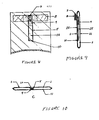
- Figures 8-10 present views of the upper portion of a second enbodiment in which Figure 8 is a front view, Figure 9 is a sagittal section, and Figure 10 is a cross section at the level of the back plate.
- An elongated narrow aliquoting channel (14) is formed by a section of transparent film (15) being attached by a permanent seal (5) to the under surface of the front leaf, except at the listal end of the aliquoting channel the attachment is a non- permanent frangible seal (10).
- the back plate (9) is reduced in size from that of the preferred embodiment, and instead of being attached to the back leaf is attached to the under surface of the apper portion of the transparent film.
- the aliquoting channel when full contains a defined quantity of liquid, e.g. 9.5 ml.
- blood is injected through the latex nombraos into the aliquoting channel.
- the needle is withdrawn and the frangible seal ruptured by external pressure over the channel.
- the use otharwise does not differ from that of the preferred embodiment.
- Figure 11 shows the front aurface of a two chamber specimen bag.
- the dilueat cbamber 4 contains liquid and substances (such as latex particles) which may be stored in liquid for later use.
- the dry reagent chamber 21 contains substances which deteriorate or inappropriately react when stored in liquid form, for example lyophilized thrombin or thromboplastin.
- the reagent chamber also serves as a viewing chamber.
- the two chambers are separated by a frangible seal 10.
- the viewing and reagent chamber 21 has attachments to its under surface and its upper surface. Attached to the outside of the upper surface is an elastic membrane 16 which stretches and which closes after itself after being punctured, for example latex or rubber.
- a pull tab 17 made of any convenient material, such as transparent polycarbonate.
- the reinforcing plate 9 attached to the outside of the undersurface consists of any hard material such as PVC or polycarbonate.
- Preparation of the device for sample testing consists of mixing the contents of the diluent chamber with other contents of the viewing chamber.
- the frangible seal 10 separating the two compartments is opened by increasing internal pressure between the upper and under sides of the bag.
- the interual pressure may be increased in the diluent chambar by applying external pressure, by squeezing with the fingers, pressing between the hand and a hard surface, or by rolling upward the bottom edge of the bag, comprassing fluid againet the edge of the frangible seal.
- Aftor breaking the frangible seal breaking the frangible seal, the diluent reagent and dry resgent are mixed.
- a gaseous bobble previously introduced into one or both chambers may be used as a stirring means to facilitate agitation and mixing.
- Nearly all of the diluent material may be moved into the dry reagent chamber by rolling or other external pressure applied to the diluent chamber. Continued exclusion of reagent from the diluent chamber permits subsequent analysis to be confined to the dry reagent chamber.
- the frangible seal may be made to open broadly to allow access of reagent to both chambers so that subsequent analysis may occur in either one or both chambers simultaneously.
- a test sample (or other substance) is introduced into the analysis bag through the membrane 16 by injection after pulling apart the under and upper sides of the bag by pulling outward on the pull tab and applying an opposing resistance to the reinforcing plate.
- the reinforcing plate may be small, as in figure 11, or may be larger, forming a flat surface acting as a backing of the device, or even larger than the bag itself. It is rigged to resist the force exerted through the pull tab, and its surface is hard to resist puncture by and to deflect a hypodermic needle.
- the opposing forces applied through the pull tab and the reinforcing plate separate the sides of the bag to form a vacant tent even if air has been evacuated from the dry reagent chamber.
- the force required to form the tent also stretches the elastic membrane 16 and pulls the underlying upper side of the bag taut which facilitates puncture by a piercing means (e.g., hypodermic needle). If the piercing means continues its traverse through to the under side of the bag, then its penetration of the under side is prevented and deflected by the hard surface of the reinforcing plate.
- a test sample (or other substance) is injected into the analysis bag through the pointed instrument. When the piercing means is withdrawn, the elastic membrane seals behind it and prevents leakage from the bag.
- chambers may be modified to facilitate the receipt of a sample.
- the order of introduction of the sample and the mixing of reagents, diluents, etc. held in the bag may be varied as desired for particular spacimen preservation or analysis.
- the dry reagent When the dry reagent is unstable, use of the two-chambered bag requires that the liquid and dry reagents be mixed prior to injection of the sample, and the timing of the reaction initiated with the injection of the sample. External pressure is applied to the diluent chamber to break the frangible seal allowing access of the liquid to the dry reagent. Gentle massage of the reagents through the pouch facilitates mixing.
- a selected quantity of air (or some other gas such as nitrogen) may be included in the diluent or dry reagant chamber to form a bubble in the device. The bubble is a mechanical aid to mixing the reagents or to mixing the reagent with the sample.
- the bubble may be massaged or the ievice may be rotated to produce movement of the bubble to increase agitation of the solution.
- the mixing of reagents should be complete prior to addition of the test sample. This requires about 5 seconds for thrombin, thromboplastin or partial thromboplastin and salins in the clotting time experiments.
- the device is prepared for receiving the sample by pulling on the pull tab and causing the reinforcing plate to resist that force.
- the opposing forces may be applied by holding the pull tab in one hand and the reinforcing plate in the other. Afterward the tent shape may be maintained with one hand, while the other is used to inject a specimen. If the reinforcing plate is made sufficiently large, or attached to a sufficiently large backing, then the little finger or flat of the hand may be rested on it to hold it in place as the pull tab is grasped between thumb and forefinger and pulled in order to expand the pouch.
- a hypodermic needle easily penetrates the stretched elastic membrane and pouch and facilitates specimen injection.
- the pull tab is released after the needle is inserted into the pouch and the hand formerly holding the pull tab used to start a timer as the specimen is injected.
- the needle is removed and the device gently rotated to promote mixing. Inclusion of an air bubble as an internal stirring means promotes this mixing.
- the timer is stopped when the reaction appears (e.g. fibrin web forms).
- Figure 12 is a sagittal view that helps visualize a means constructed to aid the operation of the two chambered pouch.
- Figure 12 also shows a two chambered pouch fixed to an external compression means prior to use.
- the compression means preferably consists of two rigid or semi-rigid panels 23 and 19.
- the width of the compression means should be equal to or greater than the width of the pouch.
- the length of the panel underlying the combined viewing and dry reagent chamber should be as long as or langer than that chamber.
- the extent of other panel should be equal to or greater than the comparable extent of the diluent chamber.
- the two panels are hinged at their upper surfaces, facing the pouch, so that they may be folded over one another and their opposed surfaces fit flush to one another when folded.
- the hinges may be formed of a strip or sheet of fabric or plastic 18 adhered to the upper surface of the panels or by recessed metal or plastic hinges.
- the hinged apace between the panel underlying the combined dry reagent and viewing chamber and the panel overlying the diluent chamber should underlie the bottom of the pouch.
- the lowermost panel is folded over the diluent
- the upper surface of the operating means is coated partially or entirely with adhesive (e.g. liquid glue or two-sided tape) sufficiently tacky to hold the pouch in place, and to hold the panels flush to one another when folded, but also sufficiently loosely adhesive to permit unfolding of the panels and removal of the disposable plastic pouch.
- adhesive e.g. liquid glue or two-sided tape
- Several pouches may be used in succession before requiring re-application of adhesive, and the hinged panels used through many applications of adhesive before requiring replacement. Since the hinged panel compression means is to be used many times it may be made of metal, wood, glass or plastic and still be economical, or it may be made of cardboard.
- the compression means required placement of a disposable analysis pouch on the upper surface of the hinged panels so that the frangible seal overlies the hinged space.
- the bottom panel is folded over the top of the diluent chamber and pressed down so that the frangible seal breaks the diluent into the dry reagent. Pressing the two panels enclosing the diluent chamber tightly together ensures expulsion of diluent from its chamber and opposition of the two adhesive surfaces of those panels insures prevention of the diluent from returning into the chamber.
- a locking mechanism to hold the two panels together without the use of adhesive also works well (though it is not illustrated), but adhesive is advantageous in holding the pouch in place during operation.
- the back plate underlying the viewing chamber may be colored or transparent,plastic or other material. It should be sufficiently rigid to hold or to act as the reinforcing plate 9 in order to resist the force of pulling on the tab in preparation for specimen infection.
- the "pull tab expander" injection means is adapted to a three chamber analysis bag.
- the main benefit of a three chambered device is that a sample may be injected into the viewing chamber 2 and, subsequently, the timing of the reaction initiated as the previously mixed liquid and dry reagents are forced into the viewing chamber.
- the three chambered analysis bag is used by breaking the frangible seal 10 between the diluent chamber 14 and dry reagent chamber 3, and as the two reagents are mixing injecting a sample into the viewing chamber 2 by way of the elastic membrane 16 stretched between the pull tab 17 and the reinforcing plate 9. Timing of the reaction begins as the mixed liquid and dry reagents are expelled into the viewing chamber. Expulsion of the reagents is easily accomplished by rolling the bottom of the pouch into a coil which gradually incresses internal pressure of the reagents against the frangible seal leading to the viewing chamber.
- Figure 14 shows the adaptation of the hinged panel means to a three chambered analysis bag.
- the compression means differs from that shown in figure 12 in that a middle hinged panel 19 was added.
- the analysis bag is fitted to the compression means so that the frangible seal 10 separating the diluent chamber 14 and dry reagent chamber 3 overlies the top hinged edge of the middle panel, and the bottom of the analysis bag ends at the bottom edge of the middle panel.
- the bottom panel is folded over to rest on the top of the diluent chamber.
- the middle and the bottom panels are of the same width as the diluent chamber so that the top edge of the middle panel meet at the frangible seal when the two panels are folded closed during operation.
- the hinged gap between the panel underlying the viewing chamber and middle panel is equal to the thickness of the bottom panel.
- the middle and bottom panels with the diluent chamber 14 tightly interposed between them, may then be folded over the dry reagent chamber and pressed flush to the surface of the panel underlying the viewing chamber.
- the opposing surfaces of the three panels, as they are folded over one another, are coated with adhesive so that they maintain the intervening chamber in a compressed state after pressure is released. This means that reagent does not return to chambers from which it has been expelled.
- the operator may choose first to inject a specimen into the viewing chamber 2, or to first expel the diluent into the dry reagent chamber 3 by compressing the bottom and middle hinged panels 19 together.
- the operator may also expel the mixed reagents into the viewing chamber by folding and pressing the compressed panels over the dry reagent chamber either before or after injection of the specimen. Timing of the reaction begins as the reagents and specimen combine.
- Figure 15 shows another adaptation of the elastic membrane injection assembly. Comparison of a front view (a) and a sagittal view (b) shows that the elastic membrane 16 is adhered to the pouch around one edge. The membrane is attached for injection into the viewing chamber in this case, but may be located on other chambers if desired. No further attachment is required for a self-sealing injection port.
- the elastic membrane and enclosed edge are held firmly in place as a piercing means (e.g. hypodermic needle) is inserted and withdrawn through them so that its trajectory is parallel to the flat sides of the chamber. Care must be taken to keep the point's trajectory parallel to prevent punctures of the flat sides of the pouch.
- a piercing means e.g. hypodermic needle
- the funnel (or tube) guide 20 shown attached to the elastic membrane 16 acts as a guide for casy access to the membrane and to maintain the point's trajectory parallel to the pouches sides.
- the length of the funnel is selected so aa to limit the distance the puncturing seans may be inserted before the main body of the injection instrument (e.g. syringe barrel) is blocked by the mouth of the funnel.
- the funnel is held firmly in place as the injection inatrument point is inserted into the wide mouth of the funnel.
- the injection instrument then is pushed toward the pouch until stopped by the mouth of the funnel, at which time the injection instrument's point is automatically correctly positioned within the chamber for injection.
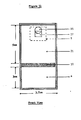
- Figure 16 shows a three chambered analysis bag in which the central chamber contains the dry reagent and is also the viewing chamber 21.
- the disposable pouch containing all necessary reagents consists of a diluent chamber 4 separated by a frangible seal 10 from the central viewing chamber 21 which also contains dry reagent and a specimen chamber 22 which has an elastic membrane 1 (not shown) attached to its top edge as in figure 5.
- the specimen compartment is constructed to hold a predetermined volume (e.g. 0.5 ml of blood) when full. Air is evacuated from the chamber during construction by, for example, inserting a hypodermic needle attached to a syringe and extracting the gas.
- the specimen may be introduced using any sharp pointed injection instrument.
- the diluent compartment then is comprossed breaking the liquid across the frangible seal to mix with the dry reagent.
- the bottom edge of the diluent compartment may be coiled up to the frangible seal to exclude diluent from returning to that compartment.
- Timing of the reaction is initiated as the specimen compartment 22 is compressed, breaking the specimen into the central viewing chamber 21, and the bottom edge of the chamber may also be solid to prevent backflow. Compression may be achieved by a hinged panel device such as that taught above or by other means such as squeezing, rolling or winding.
- the expansion/compression means shown in Figure 16 may be constructed of highly durable materials (e.g. plaatic, wood, or metal) and reused many times with a succession of disposable analysis bags.
- the compression means consists of a back panel 23 with a funnel guide adhered to it at one end and hinged panels attached at other end of the back panel 19 and adjacent to the narrow end of the funnel 24. The opposing surfaces of the panels are coated with a long lasting and renewable tacky substance.
- An analysis bag is placed on and adhered to the panels so that its elastic membrane 16 lies immediately adjacent to the narrow end of the funnel guide and its bottom end lies at the point of flexion of the hinge sheet 18.
- the hinged panel 24 is pressed down on the evacuated specimen compartment (22) so the top of the pouch adheres.
- the top of the pouch rises with it to form a large vacant tent to accommodate the insertion of pointed objects into the specimen compartment. Also, the hard surfaces of the panels deflect and prevent puncture by pointed objects thereby preventing leaks.
- the injector means may be quickly and easily inserted into the funnel guide 20 and into the pouch. Expansion of the evacuated specimen compartment also aids rapid filling of the specimen compartment to the predetermined volume. The diluent is broken across the lower frangible aeal 10 to mix with the dry reagent before the specimen is broken across the upper frangible seal 10 into the same central chamber. Timing is initiated as specimen and reagents are mixed.
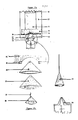
- Figure 17 illuatrates a permanent and reusable means for injection of subatances into disposable flexible pouches through an attached elastic membrane port. Its configuration during operation (a) and its componants (b) are shown.
- a disposable flexible bag e.g. made of plaatic film or rubber
- expansion/compressio panel 24 as described for Figure 16.
- a fulcrum/backstop 30 fixed to the back panel 23 and hinged to the expansion compression panel 24 which functions as the point of pivot as the panel 24 is pulled upward and as a backstop as it is pushed downward.
- Figure 17a shows a funnel guide 20 permanently fixed to a back panel 23 also as described for Figure 16, but widened to contain several inserted components.
- the inserted components are a set of funnels and cones of various sizes which fit one into another as illustrated in Figure 17b.
- the shape of the compression cushion 25 ie a hollow cone (that is, a closed tip or apex whereas the funnel shapes have open tips) with outside wall dimensions identical to the wall dimensions of the inside hollow of the funnel guide 20 within which it fits.
- a hollow friction-fit funnel 26 with attached hollow needle 27 ia fixed inside the hollow of the compression cushion 25.
- the friction-fit funnel 26 is made of hard durable material such as plastic, metal or wood, as is the attached hollow needle.
- the hollow of the friction-fit cone ia shaped and roughened to fit by friction to the tapered end of a sample delivery system 28 such as a syringe as illustrated or pipette (not illuatrated).
- the sample delivery system is not an integral part of the injector system but is provided separately.
- the two funnels 20 and 26 are permanently fixed around the central compression cushion 25.
- the hollow assdle 27 attached at the apex of the friction-fit funnel 26 extends into but does not exit from the apex of compression cushion 25 when the system is at rest.
- Figure 18 illustrates expanded views of some variations in construction of frangible seals to direct the flow of liquid from a lower compartment into an upper compertment.
- Figure 18a shows permanently sealed edges 5 of the pouch and a trapezoidal frangible seal 10 forming the separation between an upper and a lower compartment.
- the frangible seal has two oblique side segments and a central horizontal segment. External pressure applied to liquid in the lower compartment is directed upwards concentrated at the center of the frangible seal making the center most likely to break open to allow flow of the liquid into the upper compartment. This creates a large break which permits smooth and rapid mixing of the contents of the two compartments. If, external pressure is instead applied to the upper compartment, it is directed mainly at the points of attachment of the frangible seal to the compartment walls, where breakage is less likely to occur.
- FIG 18b A more secure configuration is shown in figure 18b, in which oblique permanent seals replace the obliquely oriented frangible seal side segments.
- FIG 18b With the configuration of Figure 18b, flow from the lower to the upper compartment is very likely and flow from the upper to the lower is very unlikely when appropriate external pressures are applied.
- figure 18c functions comparably to that shown in 18b but is more convenient to manufacture. In this configuration, the central segment is extended to contact the permanently sealed edges of the pouch.
Landscapes
- Health & Medical Sciences (AREA)
- Life Sciences & Earth Sciences (AREA)
- Chemical & Material Sciences (AREA)
- Engineering & Computer Science (AREA)
- Hematology (AREA)
- General Health & Medical Sciences (AREA)
- Biomedical Technology (AREA)
- Physics & Mathematics (AREA)
- Molecular Biology (AREA)
- Immunology (AREA)
- Analytical Chemistry (AREA)
- Urology & Nephrology (AREA)
- Biochemistry (AREA)
- Organic Chemistry (AREA)
- Pathology (AREA)
- Pharmacology & Pharmacy (AREA)
- General Physics & Mathematics (AREA)
- Food Science & Technology (AREA)
- Biophysics (AREA)
- Biotechnology (AREA)
- Veterinary Medicine (AREA)
- Microbiology (AREA)
- Public Health (AREA)
- Proteomics, Peptides & Aminoacids (AREA)
- Animal Behavior & Ethology (AREA)
- Wood Science & Technology (AREA)
- Zoology (AREA)
- Medicinal Chemistry (AREA)
- General Engineering & Computer Science (AREA)
- Genetics & Genomics (AREA)
- Bioinformatics & Cheminformatics (AREA)
- Ecology (AREA)
- Neurosurgery (AREA)
- Cell Biology (AREA)
- Clinical Laboratory Science (AREA)
- Chemical Kinetics & Catalysis (AREA)
- Sampling And Sample Adjustment (AREA)
- Investigating Or Analysing Biological Materials (AREA)
Applications Claiming Priority (4)
| Application Number | Priority Date | Filing Date | Title |
|---|---|---|---|
| US59402784A | 1984-03-26 | 1984-03-26 | |
| US594027 | 1984-03-26 | ||
| US66298984A | 1984-10-18 | 1984-10-18 | |
| US662989 | 1984-10-18 |
Publications (2)
| Publication Number | Publication Date |
|---|---|
| EP0157579A2 true EP0157579A2 (de) | 1985-10-09 |
| EP0157579A3 EP0157579A3 (de) | 1987-07-15 |
Family
ID=27081850
Family Applications (1)
| Application Number | Title | Priority Date | Filing Date |
|---|---|---|---|
| EP19850302091 Withdrawn EP0157579A3 (de) | 1984-03-26 | 1985-03-26 | Beutel für Probe und Anstechteil |
Country Status (3)
| Country | Link |
|---|---|
| EP (1) | EP0157579A3 (de) |
| AU (1) | AU4210385A (de) |
| WO (1) | WO1985004348A1 (de) |
Cited By (10)
| Publication number | Priority date | Publication date | Assignee | Title |
|---|---|---|---|---|
| FR2590673A1 (fr) * | 1985-11-05 | 1987-05-29 | Bally Philippe | Dispositif de test autonome miniaturise a usage unique |
| WO1993022020A3 (en) * | 1992-04-23 | 1994-02-03 | Amoco Corp | Closed vessel for isolating target molecules and for performing amplification |
| FR2760837A1 (fr) * | 1997-03-11 | 1998-09-18 | Eau Nan Ci E Centre Int De L | Procede , dispositif, contenant pour l'echantillonnage in-situ de fluides |
| WO2003049860A1 (en) * | 2001-12-13 | 2003-06-19 | The Technology Partnership Plc | Device for chemical or biochemical analysis |
| WO2005084607A1 (en) * | 2004-03-03 | 2005-09-15 | Baxter International Inc. | Peelable seal closure assembly |
| WO2008121298A1 (en) * | 2007-03-30 | 2008-10-09 | Schering Corporation | Multi-compartment package |
| GB2512141A (en) * | 2013-03-22 | 2014-09-24 | Graham Scott Gutsell | Encapsulation System |
| US9004761B2 (en) | 2006-05-01 | 2015-04-14 | Baxter International Inc. | Multiple chamber container with mistake proof administration system |
| WO2020185909A3 (en) * | 2019-03-14 | 2020-12-30 | Terumo Bct Biotechnologies, Llc | Lyophilization loading tray assembly and system |
| US11634257B2 (en) | 2017-10-09 | 2023-04-25 | Terumo Bct Biotechnologies, Llc | Lyophilization container and method of using same |
Families Citing this family (2)
| Publication number | Priority date | Publication date | Assignee | Title |
|---|---|---|---|---|
| WO2002071063A1 (en) * | 2001-03-01 | 2002-09-12 | Isaksson Bjoern | System for handling body fluids |
| ITVR20130286A1 (it) * | 2013-12-18 | 2015-06-19 | Marco Pacini | Metodo per lacerare una o piu' saldature in una sacca per dialisi e relativo attrezzo |
Family Cites Families (18)
| Publication number | Priority date | Publication date | Assignee | Title |
|---|---|---|---|---|
| CA666829A (en) * | 1963-07-16 | H. Land Edwin | Liquid-carrying containers | |
| FR1144814A (fr) * | 1956-03-23 | 1957-10-18 | A M I Applic Mecaniques Ind Et | Récipient pour prélèvements |
| US2895475A (en) * | 1956-12-03 | 1959-07-21 | Everett L Cole | Container for collecting, storing and dispensing biological fluids |
| US3036894A (en) * | 1958-10-22 | 1962-05-29 | Jasper A Forestiere | Method of using testing containers |
| US3105613A (en) * | 1960-05-09 | 1963-10-01 | Baxter Don Inc | Blood container |
| US3289723A (en) * | 1964-03-09 | 1966-12-06 | Plastronics Inc | Closure construction for a flexible container |
| US3294227A (en) * | 1965-03-05 | 1966-12-27 | Wayne Rodgers V | Multiple compartment package |
| US3537321A (en) * | 1968-08-07 | 1970-11-03 | Hewlett Packard Co | Septum assembly |
| US3608709A (en) * | 1969-09-08 | 1971-09-28 | Wayne Rogers V | Multiple compartment package |
| US3853127A (en) * | 1973-04-03 | 1974-12-10 | R Spademan | Elastic sealing member |
| DE2363904B2 (de) * | 1973-12-21 | 1976-09-09 | Prenntzell, Kurt, 2420 Eutin | Flexible beutelpackung aus kunststofffolie |
| US3990445A (en) * | 1975-01-03 | 1976-11-09 | Valleylab, Inc. | Drug injection device |
| US3983994A (en) * | 1975-01-29 | 1976-10-05 | Ihor Wyslotsky | Flexible package |
| US4049408A (en) * | 1975-03-10 | 1977-09-20 | The Kendall Company | Disposable cold pack for blood specimen |
| US4010648A (en) * | 1975-10-01 | 1977-03-08 | Harris Sr Rano J | Adapter unit for use in sampling fluid specimens |
| US4311137A (en) * | 1980-04-30 | 1982-01-19 | Sherwood Medical Industries Inc. | Infusion device |
| US4365727A (en) * | 1980-08-13 | 1982-12-28 | Mark Shmelkin | Device for squeezing-out viscous materials from tubes made of plastics |
| US4399103A (en) * | 1981-01-28 | 1983-08-16 | Ferrara Louis T | Blood dispenser device |
-
1985
- 1985-03-25 AU AU42103/85A patent/AU4210385A/en not_active Abandoned
- 1985-03-25 WO PCT/US1985/000499 patent/WO1985004348A1/en not_active Ceased
- 1985-03-26 EP EP19850302091 patent/EP0157579A3/de not_active Withdrawn
Cited By (17)
| Publication number | Priority date | Publication date | Assignee | Title |
|---|---|---|---|---|
| FR2590673A1 (fr) * | 1985-11-05 | 1987-05-29 | Bally Philippe | Dispositif de test autonome miniaturise a usage unique |
| WO1993022020A3 (en) * | 1992-04-23 | 1994-02-03 | Amoco Corp | Closed vessel for isolating target molecules and for performing amplification |
| FR2760837A1 (fr) * | 1997-03-11 | 1998-09-18 | Eau Nan Ci E Centre Int De L | Procede , dispositif, contenant pour l'echantillonnage in-situ de fluides |
| WO2003049860A1 (en) * | 2001-12-13 | 2003-06-19 | The Technology Partnership Plc | Device for chemical or biochemical analysis |
| US7473397B2 (en) | 2001-12-13 | 2009-01-06 | The Technology Partnership Plc | Device for chemical or biochemical analysis |
| WO2005084607A1 (en) * | 2004-03-03 | 2005-09-15 | Baxter International Inc. | Peelable seal closure assembly |
| CN1925825B (zh) * | 2004-03-03 | 2011-05-11 | 巴克斯特国际公司 | 可剥密封闭合组件 |
| US9004761B2 (en) | 2006-05-01 | 2015-04-14 | Baxter International Inc. | Multiple chamber container with mistake proof administration system |
| WO2008121298A1 (en) * | 2007-03-30 | 2008-10-09 | Schering Corporation | Multi-compartment package |
| GB2512141A (en) * | 2013-03-22 | 2014-09-24 | Graham Scott Gutsell | Encapsulation System |
| US11634257B2 (en) | 2017-10-09 | 2023-04-25 | Terumo Bct Biotechnologies, Llc | Lyophilization container and method of using same |
| WO2020185909A3 (en) * | 2019-03-14 | 2020-12-30 | Terumo Bct Biotechnologies, Llc | Lyophilization loading tray assembly and system |
| US11609043B2 (en) | 2019-03-14 | 2023-03-21 | Terumo Bct Biotechnologies, Llc | Lyophilization container fill fixture, system and method of use |
| US11609042B2 (en) | 2019-03-14 | 2023-03-21 | Terumo Bct Biotechnologies, Llc | Multi-part lyophilization container and method of use |
| US11747082B2 (en) | 2019-03-14 | 2023-09-05 | Terumo Bct Biotechnologies, Llc | Multi-part lyophilization container and method of use |
| US11815311B2 (en) | 2019-03-14 | 2023-11-14 | Terumo Bct Biotechnologies, Llc | Lyophilization container fill fixture, system and method of use |
| US11994343B2 (en) | 2019-03-14 | 2024-05-28 | Terumo Bct Biotechnologies, Llc | Multi-part lyophilization container and method of use |
Also Published As
| Publication number | Publication date |
|---|---|
| WO1985004348A1 (en) | 1985-10-10 |
| AU4210385A (en) | 1985-11-01 |
| EP0157579A3 (de) | 1987-07-15 |
Similar Documents
| Publication | Publication Date | Title |
|---|---|---|
| US4707450A (en) | Specimen collection and test unit | |
| EP0157579A2 (de) | Beutel für Probe und Anstechteil | |
| US10119968B2 (en) | Self-contained diagnostic test with advanceable test strip | |
| EP3515521B1 (de) | Flüssigkeitskartusche für die verabreichung von körperflüssigkeiten auf ein fasersubstrat | |
| US7257991B2 (en) | Sample testing device | |
| US7749770B2 (en) | Mechanical device for mixing a fluid sample with a treatment solution | |
| US4534939A (en) | Gas flow cartridge with improved coagulation detection and expanded analytical test capability | |
| US5400923A (en) | Apparatus for discharging contents of a sealed container | |
| US4820297A (en) | Fluid delivery system with integrally formed sample cell | |
| US4846005A (en) | Set with attachable sample cell | |
| US4645486A (en) | Device for drawing and processing blood and for administering liquid via parenteral injection | |
| US7225689B2 (en) | Sample testing device with funnel collector | |
| EP4012408B1 (de) | Probensammel- und detektionsvorrichtung und -verfahren | |
| US5204063A (en) | Eluent release system and automated assay device | |
| EP0188497A1 (de) | Vorrichtung zur entnahme einer flüssigkeitsprobe | |
| CN202960531U (zh) | 一种血液样本快速检测组件及包括该组件的分析装置 | |
| US20060039833A1 (en) | Biological specimen collection, transportation, and dispensing system | |
| EP3458185B1 (de) | Systeme und verfahren für einen mehrkammerprobenehmer | |
| US20070025886A1 (en) | Biological specimen collection, transportation, and dispensing system | |
| CA2125811A1 (en) | Perforable cap for a biological specimen container | |
| US4790842A (en) | Blood sample segment detaching and tearing device | |
| KR102483098B1 (ko) | 검체 삽입형 진단키트 | |
| JP2001161669A (ja) | 収集アセンブリ | |
| KR102784971B1 (ko) | 자가진단키트용 튜브 용기 | |
| US20250153163A1 (en) | Pre-mix test vessel |
Legal Events
| Date | Code | Title | Description |
|---|---|---|---|
| PUAI | Public reference made under article 153(3) epc to a published international application that has entered the european phase |
Free format text: ORIGINAL CODE: 0009012 |
|
| AK | Designated contracting states |
Designated state(s): AT BE CH DE FR GB IT LI LU NL SE |
|
| PUAL | Search report despatched |
Free format text: ORIGINAL CODE: 0009013 |
|
| AK | Designated contracting states |
Kind code of ref document: A3 Designated state(s): AT BE CH DE FR GB IT LI LU NL SE |
|
| STAA | Information on the status of an ep patent application or granted ep patent |
Free format text: STATUS: THE APPLICATION IS DEEMED TO BE WITHDRAWN |
|
| 18D | Application deemed to be withdrawn |
Effective date: 19870401 |
|
| RIN1 | Information on inventor provided before grant (corrected) |
Inventor name: STEWART, DAVID L. Inventor name: NGUYEN, THE THANH Inventor name: BEAL, C.B. |