EP0155949B1 - Method for the manufacture of product comprising foamed plastic material and using a low-pressure chamber - Google Patents
Method for the manufacture of product comprising foamed plastic material and using a low-pressure chamber Download PDFInfo
- Publication number
- EP0155949B1 EP0155949B1 EP19840903298 EP84903298A EP0155949B1 EP 0155949 B1 EP0155949 B1 EP 0155949B1 EP 19840903298 EP19840903298 EP 19840903298 EP 84903298 A EP84903298 A EP 84903298A EP 0155949 B1 EP0155949 B1 EP 0155949B1
- Authority
- EP
- European Patent Office
- Prior art keywords
- polyester
- propellant
- layer
- pressure
- accordance
- Prior art date
- Legal status (The legal status is an assumption and is not a legal conclusion. Google has not performed a legal analysis and makes no representation as to the accuracy of the status listed.)
- Expired
Links
- 239000000463 material Substances 0.000 title claims description 35
- 238000000034 method Methods 0.000 title claims description 28
- 238000004519 manufacturing process Methods 0.000 title claims description 15
- 239000004033 plastic Substances 0.000 title claims description 7
- 229920003023 plastic Polymers 0.000 title claims description 7
- 239000003380 propellant Substances 0.000 claims abstract description 59
- 229920000728 polyester Polymers 0.000 claims abstract description 51
- 238000005187 foaming Methods 0.000 claims abstract description 12
- 230000000694 effects Effects 0.000 claims abstract description 8
- 239000007921 spray Substances 0.000 claims abstract description 8
- 229920006305 unsaturated polyester Polymers 0.000 claims abstract description 7
- 230000000977 initiatory effect Effects 0.000 claims abstract 2
- CURLTUGMZLYLDI-UHFFFAOYSA-N Carbon dioxide Chemical compound O=C=O CURLTUGMZLYLDI-UHFFFAOYSA-N 0.000 claims description 18
- 239000003795 chemical substances by application Substances 0.000 claims description 18
- 230000002787 reinforcement Effects 0.000 claims description 12
- 229910002092 carbon dioxide Inorganic materials 0.000 claims description 9
- 239000001569 carbon dioxide Substances 0.000 claims description 9
- 210000000056 organ Anatomy 0.000 claims description 9
- 150000002978 peroxides Chemical class 0.000 claims description 6
- 239000003365 glass fiber Substances 0.000 claims description 5
- 239000000203 mixture Substances 0.000 claims description 4
- 230000009974 thixotropic effect Effects 0.000 claims description 3
- OKTJSMMVPCPJKN-UHFFFAOYSA-N Carbon Chemical compound [C] OKTJSMMVPCPJKN-UHFFFAOYSA-N 0.000 claims description 2
- 229910052799 carbon Inorganic materials 0.000 claims description 2
- 239000003999 initiator Substances 0.000 claims description 2
- 238000010030 laminating Methods 0.000 claims description 2
- 239000000126 substance Substances 0.000 description 13
- 125000006850 spacer group Chemical group 0.000 description 7
- 239000000654 additive Substances 0.000 description 4
- 238000010276 construction Methods 0.000 description 4
- 238000013019 agitation Methods 0.000 description 3
- 230000015572 biosynthetic process Effects 0.000 description 3
- CYRMSUTZVYGINF-UHFFFAOYSA-N trichlorofluoromethane Chemical compound FC(Cl)(Cl)Cl CYRMSUTZVYGINF-UHFFFAOYSA-N 0.000 description 3
- 238000005452 bending Methods 0.000 description 2
- 239000000945 filler Substances 0.000 description 2
- 125000001174 sulfone group Chemical group 0.000 description 2
- 239000000080 wetting agent Substances 0.000 description 2
- 229920005830 Polyurethane Foam Polymers 0.000 description 1
- 230000004913 activation Effects 0.000 description 1
- 239000003054 catalyst Substances 0.000 description 1
- 238000011161 development Methods 0.000 description 1
- 230000018109 developmental process Effects 0.000 description 1
- 238000010494 dissociation reaction Methods 0.000 description 1
- 230000005593 dissociations Effects 0.000 description 1
- 238000009826 distribution Methods 0.000 description 1
- 239000000835 fiber Substances 0.000 description 1
- 239000011152 fibreglass Substances 0.000 description 1
- 239000006260 foam Substances 0.000 description 1
- 229940042795 hydrazides for tuberculosis treatment Drugs 0.000 description 1
- 239000003112 inhibitor Substances 0.000 description 1
- 150000001451 organic peroxides Chemical class 0.000 description 1
- 239000011496 polyurethane foam Substances 0.000 description 1
- 238000005507 spraying Methods 0.000 description 1
- 230000003068 static effect Effects 0.000 description 1
- 238000003756 stirring Methods 0.000 description 1
- 238000003860 storage Methods 0.000 description 1
- 230000001629 suppression Effects 0.000 description 1
Images
Classifications
-
- B—PERFORMING OPERATIONS; TRANSPORTING
- B29—WORKING OF PLASTICS; WORKING OF SUBSTANCES IN A PLASTIC STATE IN GENERAL
- B29C—SHAPING OR JOINING OF PLASTICS; SHAPING OF MATERIAL IN A PLASTIC STATE, NOT OTHERWISE PROVIDED FOR; AFTER-TREATMENT OF THE SHAPED PRODUCTS, e.g. REPAIRING
- B29C44/00—Shaping by internal pressure generated in the material, e.g. swelling or foaming ; Producing porous or cellular expanded plastics articles
- B29C44/34—Auxiliary operations
- B29C44/3403—Foaming under special conditions, e.g. in sub-atmospheric pressure, in or on a liquid
-
- B—PERFORMING OPERATIONS; TRANSPORTING
- B29—WORKING OF PLASTICS; WORKING OF SUBSTANCES IN A PLASTIC STATE IN GENERAL
- B29K—INDEXING SCHEME ASSOCIATED WITH SUBCLASSES B29B, B29C OR B29D, RELATING TO MOULDING MATERIALS OR TO MATERIALS FOR MOULDS, REINFORCEMENTS, FILLERS OR PREFORMED PARTS, e.g. INSERTS
- B29K2067/00—Use of polyesters or derivatives thereof, as moulding material
-
- B—PERFORMING OPERATIONS; TRANSPORTING
- B29—WORKING OF PLASTICS; WORKING OF SUBSTANCES IN A PLASTIC STATE IN GENERAL
- B29K—INDEXING SCHEME ASSOCIATED WITH SUBCLASSES B29B, B29C OR B29D, RELATING TO MOULDING MATERIALS OR TO MATERIALS FOR MOULDS, REINFORCEMENTS, FILLERS OR PREFORMED PARTS, e.g. INSERTS
- B29K2105/00—Condition, form or state of moulded material or of the material to be shaped
- B29K2105/06—Condition, form or state of moulded material or of the material to be shaped containing reinforcements, fillers or inserts
- B29K2105/12—Condition, form or state of moulded material or of the material to be shaped containing reinforcements, fillers or inserts of short lengths, e.g. chopped filaments, staple fibres or bristles
-
- B—PERFORMING OPERATIONS; TRANSPORTING
- B29—WORKING OF PLASTICS; WORKING OF SUBSTANCES IN A PLASTIC STATE IN GENERAL
- B29K—INDEXING SCHEME ASSOCIATED WITH SUBCLASSES B29B, B29C OR B29D, RELATING TO MOULDING MATERIALS OR TO MATERIALS FOR MOULDS, REINFORCEMENTS, FILLERS OR PREFORMED PARTS, e.g. INSERTS
- B29K2707/00—Use of elements other than metals for preformed parts, e.g. for inserts
- B29K2707/04—Carbon
-
- B—PERFORMING OPERATIONS; TRANSPORTING
- B29—WORKING OF PLASTICS; WORKING OF SUBSTANCES IN A PLASTIC STATE IN GENERAL
- B29K—INDEXING SCHEME ASSOCIATED WITH SUBCLASSES B29B, B29C OR B29D, RELATING TO MOULDING MATERIALS OR TO MATERIALS FOR MOULDS, REINFORCEMENTS, FILLERS OR PREFORMED PARTS, e.g. INSERTS
- B29K2709/00—Use of inorganic materials not provided for in groups B29K2703/00 - B29K2707/00, for preformed parts, e.g. for inserts
- B29K2709/08—Glass
-
- Y—GENERAL TAGGING OF NEW TECHNOLOGICAL DEVELOPMENTS; GENERAL TAGGING OF CROSS-SECTIONAL TECHNOLOGIES SPANNING OVER SEVERAL SECTIONS OF THE IPC; TECHNICAL SUBJECTS COVERED BY FORMER USPC CROSS-REFERENCE ART COLLECTIONS [XRACs] AND DIGESTS
- Y10—TECHNICAL SUBJECTS COVERED BY FORMER USPC
- Y10S—TECHNICAL SUBJECTS COVERED BY FORMER USPC CROSS-REFERENCE ART COLLECTIONS [XRACs] AND DIGESTS
- Y10S264/00—Plastic and nonmetallic article shaping or treating: processes
- Y10S264/05—Use of one or more blowing agents together
-
- Y—GENERAL TAGGING OF NEW TECHNOLOGICAL DEVELOPMENTS; GENERAL TAGGING OF CROSS-SECTIONAL TECHNOLOGIES SPANNING OVER SEVERAL SECTIONS OF THE IPC; TECHNICAL SUBJECTS COVERED BY FORMER USPC CROSS-REFERENCE ART COLLECTIONS [XRACs] AND DIGESTS
- Y10—TECHNICAL SUBJECTS COVERED BY FORMER USPC
- Y10T—TECHNICAL SUBJECTS COVERED BY FORMER US CLASSIFICATION
- Y10T428/00—Stock material or miscellaneous articles
- Y10T428/249921—Web or sheet containing structurally defined element or component
- Y10T428/249953—Composite having voids in a component [e.g., porous, cellular, etc.]
- Y10T428/249955—Void-containing component partially impregnated with adjacent component
Definitions
- the present invention relates to a method for the manufacture of a product comprising foamed plastic material in a first layer.
- the product comprises a second layer as well.
- the second layer is connected to the first layer and having higher density than the first layer.
- a wish associated with foamed plastic products falling within this category is for manufacturing processes to be available which provide the conditions necessary for a major reduction to be achieved in the quantity of the foaming additives used. Said additives have tendencies to disturb the curing process and cause cracks. Demands on durable and cheap products are available as well.
- the present invention proposes a method for the manufacture of a product having a foamed plastic material which will resolve, amongst other things, the problem outlined above on the basis of the usage of unsaturated polyester and that considerably increased foaming effect can be achieved from the use of a propellant at a high degree of low pressure, with a vaccuum of 60-95% being envisaged in this case.
- the essential characteristics of the new method are that inside a first space, which is at a first pressure, the aforementioned propellant is mixed with or dissolved in a curing agent-compatible unsaturated polyester.
- Second feature of the invention comprises the usage of a second space in the form of a negative pressure chamber which is at that high degree of negative pressure of 60-95% vacuum. The last mentioned pressure is quite below the first pressure.
- Said chamber has an open or exposed mould and on this one the mixed polyester is sprayed.
- polyester mixed with a first amount of propellant is sprayed on the whole or parts of the mould in said low pressure.
- the foaming effect is initiated by means of a curing agent, initiator(-s) and/or said negative pressures and the propellant causes a powerful foaming effect in which bubbles are created and/or expanded in the sprayed polyester.
- polyester having a second amount propellant, or no propellant at all is sprayed on the whole or parts of the mould. Then fewer bubbles than in the case with the first amount, or no bubbles at all, are created and/or expanded in the second polyester layer.
- Said first layer is sprayed on the mould before said second layer, or vice versa.
- Said created and/ or expanded bubbles, in at least the first layer, are bound in the polyester by allowing the polyester to take a rigid shape, i.e. to be polymerized in the negative pressure for a short time, for example 30 seconds-20 minutes, preferably 2-10 minutes.
- the spacer material in certain embodiments is reinforced with carbon fibres or glass fibres.
- the spacer material can be provided in a preferred sandwich construction with a covering layer of higher density on each side of the foamed core. Designs having several layers of foamed or not/ less foamed polyester are simple to manufacture (control) according to the invention.
- the base material must, for example, be essentially free from wetting agents.
- the use of small bubbles is preferably in order to reduce the rate of ascent.
- the material selected will preferably by a thixotropic polyestyer having a viscosity at high shear rates of preferably 140-300 mPa - s.
- the use of a curing agent system providing a short curing time is also recommended. Bubbles are able to be created in the polyester in the first space. Said bubbles are expanded in the low-pressure, together with newly created bubbles, if any, in the low pressure.
- a chamber of this type can include a suitable space for the product and can be equipped with, amongst other things, openable and closable hatches and, if appropriate, material application organs and air evacuation equipment, etc.
- the gas bubbles are formed either from gas, for example carbon dioxide, dissolved in the material, or by causing gas to be driven off in conjunction with the dissociation of a chemical propellant.
- the different layers can be sprayed wet in wet or with certain time intervals where the preceding layer takes a more or less rigid shape before the application of the next layer.
- a product having a foamed layer which comprises a significantly reduced amount of chemical foaming additives or physical propellants dissolved in the base material. It is worth mentioning in this respect that it is possible, by the use of a 85-90% vacuum, to reduce the quantity of propellant to 1/8 of that encounted in commercially available foamed products of equi- valtent kind. In this way products which exhibit high mechanical characteristics (less dependence of strength) can be obtained at low cost.
- the working environment can be designed to a high standard.
- the density and/or the reinforcement of the finished product is easily controlled by the equipment which is used.
- the curing of the product may be made more simple and more distinct, thereby providing the necessary conditions for high-quality products.
- Each second layer can be made reinforced and not foamed. Only certain parts of the mould can be provided with foamed polyester while other parts can be provided with second layers, which easily can be made for attaining reinforced portions.
- the polyester proposes conditions for stronger products and the new method solves the problems of the low gel temperature of polyester. Low bubble pressure is attained which proposes possibility for crack free curing process.
- unsaturated polyester suitable for spray-up operation
- the polyester is thixotropic and exhibits a viscosity at high shear rates of, for example 150 mPa - s.
- the polyester should preferably be at least essentially free from the wetting agents which are otherwise normally used to facilitate the admixture of the filler.
- the unsaturated polyester should preferably be modified in such a way that rapid binding can be achieved after the addition of the curing agents, for example peroxides.
- the curing time or the gel time should preferably be selected within the range 30 seconds-20 minutes, and preferably 2-10 minutes. The curing time can be adjusted in a previously disclosed fashion by means of accelerators, inhibitors and curing agents.
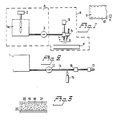
- a slowly-rotating agitator 2 for example an agitator rotating at a speed of about 15-50 r/min, is utilized for stirring in conjunction with the admixture of a chemical propellant, for example a sulphone hydrazide, or a physical propellant, which may be in the form of Freon 11.
- a chemical propellant for example a sulphone hydrazide, or a physical propellant, which may be in the form of Freon 11.
- the quantity of propellant used in the case of a chemical propellant is about 0.2-1.0, and preferably about 0.5 per cent by weight of the total mixture of polyester and propellant. (Under normal circumstances using a previously disclosed method 3-5 per cent by weight of the same propellant would be needed).
- the corresponding values in the case of physical propellants are about 0.05-0.5, and preferably about 0.1 per cent by weight of the total mixture of polyester and propellant.
- the admixture of the propellant is carried out in a first space A having a first pressure which
- the material is pumped by means of a pump 3 to a material application device 4, for example a spray pistol of a previously known type.
- a material application device 4 for example a spray pistol of a previously known type.
- a similarly previously known cutter 5 for example a fibre glass cutter, may be mounted on the pistol. With the help of the cutter chopped fibres 6 are thrown into the jet of polyester 7 which is directed towards an open or exposed mould F.
- Curing agents, for example peroxides, for the polyester are added from a container B and are mixed in the pistol 4 with the polyester in a previously known fashion. The curing agent may alternatively be mixed with the jet outside the pistol.
- the cutter is not activated or may be omitted.
- Spraying on the mould takes place in a second space 8 which can comprise a space 9 inside a low-pressure chamber 10 in accordance with Figure 1.
- the chamber is provided with material application (spray) organs and, if appropriate, with cutter equipment corresponding to those illustrated.
- Said application organs can be adapted on a not shown robot which is auto- maticly controlled.
- the application can be made on the whole or parts of the mould and with different thicknesses, distribution, etc., of polyester, reinforcements, etc.
- the entire process that is to say including the agitation operation, may take place inside the chamber 10, the space 9 of which is in that case kept at the first pressure during agitation and during the addition of the propellant.
- the curing agent may be added during the agitation operation, during addition to the mould and/or after the chamber has been actuated so as to provide low pressure.
- the chamber in dependence of actuation of the air evacuation equipment will in this case be of the previously disclosed kind which is able to produce a high degree of low pressure at 60-95%, and preferably 70-90% vacuum.
- a chemical propellant being used, this is activated to give off gas preferably by means of the curing agent.
- the low pressure permits a higher degree of expansion of the gas bubbles to take place than is possible at atmospheric pressure.
- a physical propellant being used, this is activated by the low pressure, which also permits a lower density to be achieved in the finished foam than is possible at atmospheric pressure for an identical quantity of propellant.
- the short curing time or gel time of 30 seconds-20 minutes, and preferably of 2-10 minutes for the material results in the formed and expanded bubbles being bound in the material in a rapid and effective manner.
- the application of the plastics material and the curing agent may take place at low pressure.
- the admixture of the proplellant always takes place essentially at atmospheric pressure or a pressure above (for example 40-60 bar according to below) the same.
- the curing of the spacer material takes place at low pressure.
- Products of least two layers can be made.
- the first layer is foamed and the second layer is less foamed than the first layer or having a higher density.
- the choice of porosity is controlled by means of the amount propellant, the negative pressure and the polyester type.
- the layers are applied preferably wet in wet.
- the admixture for example, 30 per cent by weight of chopped fibres (glass fibre) at a density of about 800 kg/m 3 (which must be compared with a density of about 1500 kg/m 3 for non-foamed products) will result in a bending strength of about 22 mPa, a modulus of elasticity on bending of about 1000 mPa, and a compressive strength of about 14 mPa.
- the finished material may also be used for sandwich constructions having two or more layers. It may be mentioned from a purely general point of view that the degree of reinforcement of the first layer can be selected within a range of 10-14 per cent by weight, and preferably 20-30 per cent by weight.
- a propellant gas other than Freon 11, for example carbon dioxide, may be used and is applied at a pressure such that the carbon dioxide will be dissolved either in full or in part in the polyester or equivalent substance.
- the polyester may be of the same quality as above.
- polyester is pumped by means of a pump 12 from the container 1 to a material application, organ, for example a spray pistol 13.
- a source 15 of carbon dioxide a cylinder
- a mixing organ 16 a so-called static mixer
- the curing agent and of any reinforcement which may be required can take place either at the first pressure or at the high degree of low pressure produced by the chamber and which is of the order or magnitude indicated above.
- the curing time will be short; see above.
- FIG 3 illustrates examples of sandwich construction in which the spacer material (the core) is identified by the reference designation 18, the covering layer by 19 and 20, and the expanded bubbles of the spacer material by 21.
- the fibre reinforcement is identified by the reference designation 22.
- the porosity is controlled by the amount of applied carbon dioxide.
- Polyester and a chemical propellant are mixed together inside a container in accordance with the above by means of a slowly-rotating agitator and at atmospheric pressure.
- the resulting mixture is applied on a mould together with a curing agent, for example organic peroxide and, if necessary, glass fibre, at a low pressure of 70-90% of vacuum, for example.
- a curing agent for example organic peroxide and, if necessary, glass fibre
- Polyester and a chemical propellant are mixed together and are applied with a curing agent and, if necessary, with reinforcement on a form in accordance with Example 3.
- the polyester in this case is the form Leguvall@ SF 38 supplied by Bayer AG.
- the propellant is LE supplied by Bayer AG, and the peroxide (2 per cent by weight) is Butanox@ M-50 supplied by AKZO Chemicals.
- Tests for the first layer have shown that the use of 2 per cent by weight of the propellant at atmospheric pressure will provide a density of 1.1 g/cm 3 at 2 per cent by weight and at 90% vacuum the density became 0.4 g/cm 3 , that is to say a lower density can be achieved, or else a considerably reduced propellant consumption can be achieved for a given density.
Landscapes
- Moulding By Coating Moulds (AREA)
- Laminated Bodies (AREA)
- Manufacture Of Porous Articles, And Recovery And Treatment Of Waste Products (AREA)
- Casting Or Compression Moulding Of Plastics Or The Like (AREA)
- Compositions Of Macromolecular Compounds (AREA)
Priority Applications (1)
| Application Number | Priority Date | Filing Date | Title |
|---|---|---|---|
| AT84903298T ATE33587T1 (de) | 1983-09-12 | 1984-08-31 | Herstellungsverfahren fuer gegenstaende aus geschaeumtem kunststoffmaterial unter verwendung einer niedrigdruckkammer. |
Applications Claiming Priority (2)
| Application Number | Priority Date | Filing Date | Title |
|---|---|---|---|
| SE8304872A SE438114B (sv) | 1983-09-12 | 1983-09-12 | Forfarande att medelst en undertryckskammare framstella skummat plastmaterial |
| SE8304872 | 1983-09-12 |
Publications (2)
| Publication Number | Publication Date |
|---|---|
| EP0155949A1 EP0155949A1 (en) | 1985-10-02 |
| EP0155949B1 true EP0155949B1 (en) | 1988-04-20 |
Family
ID=20352451
Family Applications (1)
| Application Number | Title | Priority Date | Filing Date |
|---|---|---|---|
| EP19840903298 Expired EP0155949B1 (en) | 1983-09-12 | 1984-08-31 | Method for the manufacture of product comprising foamed plastic material and using a low-pressure chamber |
Country Status (7)
| Country | Link |
|---|---|
| US (1) | US4743417A (OSRAM) |
| EP (1) | EP0155949B1 (OSRAM) |
| JP (1) | JPS60502149A (OSRAM) |
| CA (1) | CA1220312A (OSRAM) |
| DE (1) | DE3470483D1 (OSRAM) |
| SE (1) | SE438114B (OSRAM) |
| WO (1) | WO1985001238A1 (OSRAM) |
Families Citing this family (15)
| Publication number | Priority date | Publication date | Assignee | Title |
|---|---|---|---|---|
| BE1002899A6 (nl) * | 1989-03-03 | 1991-07-16 | Recticel | Werkwijze voor het vervaardigen van voorwerpen met een elastomeren buitenwand en een kunststofschuim kern. |
| US5434205A (en) * | 1992-01-21 | 1995-07-18 | Solcas Polymer Limited Partnership | Acrylonitrile polymer compositions and articles and methods for their preparation |
| US5304590A (en) * | 1992-01-21 | 1994-04-19 | Solcas Polymer, Inc. | Acrylonitrile polymer compositions and articles and methods for their preparation |
| US5384203A (en) * | 1993-02-05 | 1995-01-24 | Yale University | Foam metallic glass |
| US5439945A (en) * | 1994-01-10 | 1995-08-08 | Smies; John R. | Foams produced under reduced pressure and method of preparing such foams |
| US5628949A (en) * | 1995-04-04 | 1997-05-13 | Bordener; Robert | Mold process for producing a finished solid surface countertop |
| US5723152A (en) * | 1995-08-01 | 1998-03-03 | Bridgestone Corporation | Apparatus for vacuum molding expanded synthetic resin parts |
| US5885503A (en) * | 1997-05-12 | 1999-03-23 | Talon Surfaces, Llc | Mold process for producing a finished solid surface countertop |
| CZ20032630A3 (cs) * | 2001-03-02 | 2004-12-15 | James Hardie Research Pty Limited | Zařízení pro nanášení kaše na substrát |
| US20020137411A1 (en) * | 2001-03-20 | 2002-09-26 | Pasquale Capra | Method for forming coating with embedded particles |
| AUPS151102A0 (en) * | 2002-03-28 | 2002-05-09 | Nuplex Industries (Aust) Pty Ltd | Method of manufacturing foamed composite |
| AU2003212119B2 (en) * | 2002-03-28 | 2007-12-20 | Nuplex Industries (Aust) Pty Ltd | Method of manufacturing foamed composite |
| JP3925396B2 (ja) * | 2002-11-14 | 2007-06-06 | 豊田合成株式会社 | 成形品の製造方法 |
| ITMI20081867A1 (it) * | 2008-10-22 | 2010-04-22 | Dow Global Technologies Inc | Processo per lapreparazione di schiume poliuretaniche rigide a celle chiuse |
| US20100183418A1 (en) * | 2009-01-16 | 2010-07-22 | Premiere, Inc | Pipe manipulating apparatus |
Family Cites Families (20)
| Publication number | Priority date | Publication date | Assignee | Title |
|---|---|---|---|---|
| NO135308L (OSRAM) * | 1968-10-07 | 1900-01-01 | ||
| ES368728A1 (es) * | 1968-10-07 | 1971-07-16 | Sinclair Koppers Co | Procedimiento para expansionar parcialmente particulas de polimero finamente divididas capaces de formar espuma. |
| US3657036A (en) * | 1969-10-02 | 1972-04-18 | Nat Gypsum Co | Method for production of rigid polyurethane articles |
| US4351911A (en) * | 1973-07-02 | 1982-09-28 | General Electric Company | Foamable polyester composition |
| US3970732A (en) * | 1973-09-26 | 1976-07-20 | Kimball International, Inc. | Method of molding rigid foamed polyurethane articles |
| US4082882A (en) * | 1975-08-13 | 1978-04-04 | Delta Truck Body Company, Inc. | Fiberglass reinforced plywood structural sandwich with acrylic facing on one or both sides thereof |
| US4119583A (en) * | 1975-11-13 | 1978-10-10 | Klf Inventions And Patent Development And Marketing Corporation Ltd. | Foamed articles and methods for making same |
| US4030953A (en) * | 1976-02-11 | 1977-06-21 | Scala Radio Corporation | Method of molding fiberglass reflecting antenna |
| GB1582446A (en) * | 1977-07-11 | 1981-01-07 | British Industrial Plastics | Apparatus for the production of aminoplast resin foam |
| US4238176A (en) * | 1976-12-17 | 1980-12-09 | Owens-Corning Fiberglas Corporation | Apparatus for producing sheet resinous materials |
| US4201823A (en) * | 1977-12-29 | 1980-05-06 | Rohm And Haas Company | Method for making fiber reinforced articles |
| FR2413198A1 (fr) * | 1977-12-30 | 1979-07-27 | Stratiforme Sa | Panneau en resine phenolique expanse et son procede de fabrication |
| FR2458381A1 (fr) * | 1979-06-04 | 1981-01-02 | Ameublement Ind Et Tech | Procede et dispositif de formage de matiere plastique cellulaire dans un moule |
| DE2928574C2 (de) * | 1979-07-14 | 1982-06-03 | Manfred 4972 Löhne Mühle | Verfahren und Vorrichtung zum Herstellen eines wärmeisolierenden Verbundprofils |
| US4464320A (en) * | 1980-01-14 | 1984-08-07 | Whitney & Company, Inc. | Reaction injection molding system for expanded synthetic articles |
| US4405538A (en) * | 1980-01-14 | 1983-09-20 | Whitney & Company, Inc. | Resin transfer molding system with controlled induction period for expanded synthetic articles |
| US4404261A (en) * | 1981-10-13 | 1983-09-13 | Owens-Corning Fiberglas Corporation | Method of molding multi-ply polymeric composites including simultaneous curing of plural layers having different catalyst polymerization initiation temperatures and product thereof |
| US4551390A (en) * | 1981-10-13 | 1985-11-05 | Owens-Corning Fiberglas Corporation | Method of molding multi-ply polymeric composites |
| US4444832A (en) * | 1982-02-22 | 1984-04-24 | Snia Viscosa S.P.A. - Societa' Nazionale Industria Applicazioni Viscosa | Process for obtaining reinforced cellular materials based on unsaturated polyester resins |
| US4405681A (en) * | 1983-01-20 | 1983-09-20 | Milsco Manufacturing Company | Foam article and method of preparation |
-
1983
- 1983-09-12 SE SE8304872A patent/SE438114B/sv not_active IP Right Cessation
-
1984
- 1984-08-31 DE DE8484903298T patent/DE3470483D1/de not_active Expired
- 1984-08-31 EP EP19840903298 patent/EP0155949B1/en not_active Expired
- 1984-08-31 WO PCT/SE1984/000287 patent/WO1985001238A1/en not_active Ceased
- 1984-08-31 US US06/734,947 patent/US4743417A/en not_active Expired - Lifetime
- 1984-08-31 JP JP59503320A patent/JPS60502149A/ja active Granted
- 1984-09-05 CA CA000462427A patent/CA1220312A/en not_active Expired
Also Published As
| Publication number | Publication date |
|---|---|
| CA1220312A (en) | 1987-04-14 |
| JPH0553610B2 (OSRAM) | 1993-08-10 |
| WO1985001238A1 (en) | 1985-03-28 |
| SE8304872L (sv) | 1985-03-13 |
| SE438114B (sv) | 1985-04-01 |
| JPS60502149A (ja) | 1985-12-12 |
| DE3470483D1 (en) | 1988-05-26 |
| US4743417A (en) | 1988-05-10 |
| SE8304872D0 (sv) | 1983-09-12 |
| EP0155949A1 (en) | 1985-10-02 |
Similar Documents
| Publication | Publication Date | Title |
|---|---|---|
| EP0155949B1 (en) | Method for the manufacture of product comprising foamed plastic material and using a low-pressure chamber | |
| US4119583A (en) | Foamed articles and methods for making same | |
| US2855021A (en) | Process for producing plates, sheels and shaped elements | |
| US4372900A (en) | Method of forming reinforced foam structure | |
| EP0348033A2 (en) | Foam composite and method of forming same | |
| AU2004219602A1 (en) | Structural and other composite materials and methods for making same | |
| JPH05117309A (ja) | 発泡されるアクリル重合体成分 | |
| WO2010112896A1 (en) | Hydrophobised fibres and their uses | |
| WO2009087610A2 (en) | Composite material and process for the preparation thereof | |
| US4464320A (en) | Reaction injection molding system for expanded synthetic articles | |
| US3193598A (en) | Process of molding laminating preforms of foamed polyurethane having open, connected cells | |
| US3193440A (en) | Laminated articles and laminating preforms therefor | |
| WO2002045960A3 (de) | Steinverbundplatten | |
| US4128981A (en) | Burial vault | |
| KR910009218B1 (ko) | 두꺼운 내탄도물의 제법 | |
| US4405538A (en) | Resin transfer molding system with controlled induction period for expanded synthetic articles | |
| US4465792A (en) | Process for producing flexible polyester foam | |
| WO1985001248A1 (en) | Spacer material and method for the manufacture of the same | |
| US4476076A (en) | Method of open forming an expanded polyester resin article involving a controlled induction period | |
| US3380866A (en) | Method of joining polyester resin structures using foamable polyester adhesive | |
| JPS5838107B2 (ja) | 含泡石膏−金属複合材の製造方法 | |
| WO1983000458A1 (en) | Molding of unsaturated polyester | |
| JP3553235B2 (ja) | 剛性発泡体の製造法 | |
| JPS6356437A (ja) | 繊維強化合成樹脂成形品の製造方法 | |
| JPH0443503B2 (OSRAM) |
Legal Events
| Date | Code | Title | Description |
|---|---|---|---|
| PUAI | Public reference made under article 153(3) epc to a published international application that has entered the european phase |
Free format text: ORIGINAL CODE: 0009012 |
|
| 17P | Request for examination filed |
Effective date: 19850422 |
|
| AK | Designated contracting states |
Designated state(s): AT BE CH DE FR GB LI LU NL SE |
|
| RAP1 | Party data changed (applicant data changed or rights of an application transferred) |
Owner name: ROVAC TECHNOLOGY AB |
|
| 17Q | First examination report despatched |
Effective date: 19861029 |
|
| GRAA | (expected) grant |
Free format text: ORIGINAL CODE: 0009210 |
|
| AK | Designated contracting states |
Kind code of ref document: B1 Designated state(s): AT BE CH DE FR GB LI LU NL SE |
|
| REF | Corresponds to: |
Ref document number: 33587 Country of ref document: AT Date of ref document: 19880515 Kind code of ref document: T |
|
| PG25 | Lapsed in a contracting state [announced via postgrant information from national office to epo] |
Ref country code: SE Effective date: 19880430 |
|
| REF | Corresponds to: |
Ref document number: 3470483 Country of ref document: DE Date of ref document: 19880526 |
|
| ET | Fr: translation filed | ||
| PG25 | Lapsed in a contracting state [announced via postgrant information from national office to epo] |
Ref country code: LU Free format text: LAPSE BECAUSE OF NON-PAYMENT OF DUE FEES Effective date: 19880831 |
|
| PLBE | No opposition filed within time limit |
Free format text: ORIGINAL CODE: 0009261 |
|
| STAA | Information on the status of an ep patent application or granted ep patent |
Free format text: STATUS: NO OPPOSITION FILED WITHIN TIME LIMIT |
|
| 26N | No opposition filed | ||
| PGFP | Annual fee paid to national office [announced via postgrant information from national office to epo] |
Ref country code: BE Payment date: 19900531 Year of fee payment: 7 |
|
| PGFP | Annual fee paid to national office [announced via postgrant information from national office to epo] |
Ref country code: FR Payment date: 19900628 Year of fee payment: 7 |
|
| PGFP | Annual fee paid to national office [announced via postgrant information from national office to epo] |
Ref country code: AT Payment date: 19900717 Year of fee payment: 7 |
|
| PGFP | Annual fee paid to national office [announced via postgrant information from national office to epo] |
Ref country code: NL Payment date: 19900831 Year of fee payment: 7 |
|
| PG25 | Lapsed in a contracting state [announced via postgrant information from national office to epo] |
Ref country code: BE Effective date: 19910831 Ref country code: AT Effective date: 19910831 |
|
| BERE | Be: lapsed |
Owner name: ROVAC TECHNOLOGY A.B. Effective date: 19910831 |
|
| PG25 | Lapsed in a contracting state [announced via postgrant information from national office to epo] |
Ref country code: NL Effective date: 19920301 |
|
| NLV4 | Nl: lapsed or anulled due to non-payment of the annual fee | ||
| PG25 | Lapsed in a contracting state [announced via postgrant information from national office to epo] |
Ref country code: FR Effective date: 19920430 |
|
| REG | Reference to a national code |
Ref country code: FR Ref legal event code: ST |
|
| PGFP | Annual fee paid to national office [announced via postgrant information from national office to epo] |
Ref country code: CH Payment date: 19930628 Year of fee payment: 10 |
|
| PG25 | Lapsed in a contracting state [announced via postgrant information from national office to epo] |
Ref country code: LI Effective date: 19940831 Ref country code: CH Effective date: 19940831 |
|
| REG | Reference to a national code |
Ref country code: CH Ref legal event code: PL |
|
| PGFP | Annual fee paid to national office [announced via postgrant information from national office to epo] |
Ref country code: GB Payment date: 19980828 Year of fee payment: 15 |
|
| PGFP | Annual fee paid to national office [announced via postgrant information from national office to epo] |
Ref country code: DE Payment date: 19980928 Year of fee payment: 15 |
|
| PG25 | Lapsed in a contracting state [announced via postgrant information from national office to epo] |
Ref country code: GB Free format text: LAPSE BECAUSE OF NON-PAYMENT OF DUE FEES Effective date: 19990831 |
|
| GBPC | Gb: european patent ceased through non-payment of renewal fee |
Effective date: 19990831 |
|
| PG25 | Lapsed in a contracting state [announced via postgrant information from national office to epo] |
Ref country code: DE Free format text: LAPSE BECAUSE OF NON-PAYMENT OF DUE FEES Effective date: 20000601 |