EP0155142A2 - Verfahren und Vorrichtung zum Nachweis aus Ferne von Gasen, Dämpfen oder Aerosolnebeln - Google Patents
Verfahren und Vorrichtung zum Nachweis aus Ferne von Gasen, Dämpfen oder Aerosolnebeln Download PDFInfo
- Publication number
- EP0155142A2 EP0155142A2 EP85301544A EP85301544A EP0155142A2 EP 0155142 A2 EP0155142 A2 EP 0155142A2 EP 85301544 A EP85301544 A EP 85301544A EP 85301544 A EP85301544 A EP 85301544A EP 0155142 A2 EP0155142 A2 EP 0155142A2
- Authority
- EP
- European Patent Office
- Prior art keywords
- radiation
- temporal coherence
- gas
- band
- aerosol
- Prior art date
- Legal status (The legal status is an assumption and is not a legal conclusion. Google has not performed a legal analysis and makes no representation as to the accuracy of the status listed.)
- Granted
Links
- 239000000443 aerosol Substances 0.000 title claims abstract description 24
- 238000000034 method Methods 0.000 title claims description 17
- 239000007789 gas Substances 0.000 title description 59
- 230000005855 radiation Effects 0.000 claims abstract description 57
- 230000002123 temporal effect Effects 0.000 claims abstract description 50
- 230000008859 change Effects 0.000 claims abstract description 15
- 239000011521 glass Substances 0.000 claims abstract description 10
- 230000003287 optical effect Effects 0.000 claims abstract description 8
- 238000010521 absorption reaction Methods 0.000 claims description 26
- 230000003595 spectral effect Effects 0.000 claims description 20
- 238000001514 detection method Methods 0.000 claims description 18
- 238000000862 absorption spectrum Methods 0.000 claims description 15
- 230000003993 interaction Effects 0.000 claims description 6
- 230000004044 response Effects 0.000 claims description 6
- 238000005259 measurement Methods 0.000 claims description 3
- 230000006798 recombination Effects 0.000 claims description 2
- 238000005215 recombination Methods 0.000 claims description 2
- 238000001228 spectrum Methods 0.000 description 28
- 238000005286 illumination Methods 0.000 description 17
- RAHZWNYVWXNFOC-UHFFFAOYSA-N Sulphur dioxide Chemical compound O=S=O RAHZWNYVWXNFOC-UHFFFAOYSA-N 0.000 description 10
- 230000000694 effects Effects 0.000 description 5
- 235000010269 sulphur dioxide Nutrition 0.000 description 5
- 239000004291 sulphur dioxide Substances 0.000 description 5
- 230000005540 biological transmission Effects 0.000 description 3
- IJGRMHOSHXDMSA-UHFFFAOYSA-N Atomic nitrogen Chemical compound N#N IJGRMHOSHXDMSA-UHFFFAOYSA-N 0.000 description 2
- 230000008033 biological extinction Effects 0.000 description 2
- 238000001914 filtration Methods 0.000 description 2
- 238000012544 monitoring process Methods 0.000 description 2
- 230000000737 periodic effect Effects 0.000 description 2
- 230000035945 sensitivity Effects 0.000 description 2
- 230000009471 action Effects 0.000 description 1
- 230000003466 anti-cipated effect Effects 0.000 description 1
- 239000003795 chemical substances by application Substances 0.000 description 1
- 238000005100 correlation spectroscopy Methods 0.000 description 1
- 230000001934 delay Effects 0.000 description 1
- 230000003111 delayed effect Effects 0.000 description 1
- 230000001419 dependent effect Effects 0.000 description 1
- 238000013461 design Methods 0.000 description 1
- 238000005516 engineering process Methods 0.000 description 1
- 239000003344 environmental pollutant Substances 0.000 description 1
- 229910052736 halogen Inorganic materials 0.000 description 1
- 150000002367 halogens Chemical class 0.000 description 1
- 238000012986 modification Methods 0.000 description 1
- 230000004048 modification Effects 0.000 description 1
- 229910052757 nitrogen Inorganic materials 0.000 description 1
- 231100000719 pollutant Toxicity 0.000 description 1
- 230000008569 process Effects 0.000 description 1
- 238000012545 processing Methods 0.000 description 1
- 238000005070 sampling Methods 0.000 description 1
- 239000000779 smoke Substances 0.000 description 1
- 239000007787 solid Substances 0.000 description 1
- 230000001360 synchronised effect Effects 0.000 description 1
- WFKWXMTUELFFGS-UHFFFAOYSA-N tungsten Chemical compound [W] WFKWXMTUELFFGS-UHFFFAOYSA-N 0.000 description 1
- 229910052721 tungsten Inorganic materials 0.000 description 1
- 239000010937 tungsten Substances 0.000 description 1
- 238000001429 visible spectrum Methods 0.000 description 1
- 229910052724 xenon Inorganic materials 0.000 description 1
- FHNFHKCVQCLJFQ-UHFFFAOYSA-N xenon atom Chemical compound [Xe] FHNFHKCVQCLJFQ-UHFFFAOYSA-N 0.000 description 1
Images



Classifications
-
- G—PHYSICS
- G01—MEASURING; TESTING
- G01N—INVESTIGATING OR ANALYSING MATERIALS BY DETERMINING THEIR CHEMICAL OR PHYSICAL PROPERTIES
- G01N21/00—Investigating or analysing materials by the use of optical means, i.e. using sub-millimetre waves, infrared, visible or ultraviolet light
- G01N21/17—Systems in which incident light is modified in accordance with the properties of the material investigated
- G01N21/25—Colour; Spectral properties, i.e. comparison of effect of material on the light at two or more different wavelengths or wavelength bands
- G01N21/31—Investigating relative effect of material at wavelengths characteristic of specific elements or molecules, e.g. atomic absorption spectrometry
- G01N21/39—Investigating relative effect of material at wavelengths characteristic of specific elements or molecules, e.g. atomic absorption spectrometry using tunable lasers
-
- G—PHYSICS
- G01—MEASURING; TESTING
- G01J—MEASUREMENT OF INTENSITY, VELOCITY, SPECTRAL CONTENT, POLARISATION, PHASE OR PULSE CHARACTERISTICS OF INFRARED, VISIBLE OR ULTRAVIOLET LIGHT; COLORIMETRY; RADIATION PYROMETRY
- G01J3/00—Spectrometry; Spectrophotometry; Monochromators; Measuring colours
- G01J3/28—Investigating the spectrum
- G01J3/45—Interferometric spectrometry
- G01J3/453—Interferometric spectrometry by correlation of the amplitudes
-
- G—PHYSICS
- G01—MEASURING; TESTING
- G01N—INVESTIGATING OR ANALYSING MATERIALS BY DETERMINING THEIR CHEMICAL OR PHYSICAL PROPERTIES
- G01N21/00—Investigating or analysing materials by the use of optical means, i.e. using sub-millimetre waves, infrared, visible or ultraviolet light
- G01N21/17—Systems in which incident light is modified in accordance with the properties of the material investigated
- G01N2021/1793—Remote sensing
- G01N2021/1795—Atmospheric mapping of gases
-
- G—PHYSICS
- G01—MEASURING; TESTING
- G01N—INVESTIGATING OR ANALYSING MATERIALS BY DETERMINING THEIR CHEMICAL OR PHYSICAL PROPERTIES
- G01N21/00—Investigating or analysing materials by the use of optical means, i.e. using sub-millimetre waves, infrared, visible or ultraviolet light
- G01N21/17—Systems in which incident light is modified in accordance with the properties of the material investigated
- G01N21/25—Colour; Spectral properties, i.e. comparison of effect of material on the light at two or more different wavelengths or wavelength bands
- G01N21/31—Investigating relative effect of material at wavelengths characteristic of specific elements or molecules, e.g. atomic absorption spectrometry
- G01N21/35—Investigating relative effect of material at wavelengths characteristic of specific elements or molecules, e.g. atomic absorption spectrometry using infrared light
- G01N21/3504—Investigating relative effect of material at wavelengths characteristic of specific elements or molecules, e.g. atomic absorption spectrometry using infrared light for analysing gases, e.g. multi-gas analysis
- G01N2021/3531—Investigating relative effect of material at wavelengths characteristic of specific elements or molecules, e.g. atomic absorption spectrometry using infrared light for analysing gases, e.g. multi-gas analysis without instrumental source, i.e. radiometric
Definitions
- the invention relates to the detection of gases and vapours or aerosols by remote or semi-remote sensing and in particular to the measurement of changes in phase and amplitude occurring at the site of interaction between illuminating energy and the remote gas, vapour or aerosol.
- gas is to be understood to include vapour or aerosol.
- the most widely used technique for remote detection is some form of correlation spectroscopy where a set of absorption bands is detected by one of the many basic types of spectrometer.
- the intensity profile of the dispersed spectrum is then modulated by a matching correlation mask, generally having alternate slits and bars, which is made to scan across the appropriate part of the optical spectrum.
- a modulated signal of specific frequency content will appear at the output of a detector arranged behind the mask.
- This technique relies upon the detection of amplitude variation of the received spectrum, ie the change in absorption is detected by a change in signal amplitude (or intensity) against a background whose amplitude profile is a very complicated structure.
- the object of the present invention is to provide a sensor and method for remote detection of gases which is capable of high sensitivity and accuracy.
- the invention comprises in one form a method for remote detection of a gas, vapour or aerosol comprising measurement of the change of temporal coherence of radiation illuminating the gas, vapour or aerosol due to absorption of radiation thereby.
- the temporal coherence of radiation of wavelengthx is inversely proportional to the spectral line widthSX.
- the spectral bandwidth of the scattered energy after passage through the target gas becomes narrower when the bandwidth overlaps an absorption feature in the gas absorption spectrum and thus the effective temporal coherence of the radiation is increased.
- the greater the narrowing of the illuminating spectrum the greater the change in temporal coherence (or coherence length) and the better the instrumentation can sense the presence of the gas etc.
- the target gas's absorption line may be altered in position relative to the illuminating spectrum.
- the optimum positions can be stated as occurring when the change of Fourier Transform of the illuminating spectrum due to the presence of the target gas is maximised.
- radiation is transmitted and after reflection by the gas, vapour or aerosol is detected by a receiver co-located with the radiation transmitter.
- the receiver maybe arranged to discriminate against the transmitted radiation, responding only to radiation of longer temporal coherence than the transmitted radiation.
- the receiver may be arranged to respond only to increases in temporal coherence within a specified band-width.
- semi-active arrangement use may be made of another illuminating souce such as sunlight or other radiation not purposefully arranged as a transmitter.
- a broadband source like the sun can be appropriately band-limited at the receiver toitnit ate a narrow-band active source.
- the invention may be used to detect a target gas etc. which is self-illuminating.
- provision may be made to spectrally scan the changes in temporal coherence or Fourier Transform.
- the invention also provides apparatus for remote sensing of a gas, vapour or aerosol comprisingin one form: a transmitter capable of emitting radiation having a spectral line or band which at least partly overlaps a feature in the absorption spectrum of the gas, vapour or aerosol; radiation collecting means for receiving radiation from a predetermined field of view; and a detector responsive to changes in the temporal coherence of the transmitted radiation caused by interaction of the radiation with the gas, vapour or aerosol.
- the transmitter is a laser which may be tuned or the laser selected such that the transmitted radiation includes a spectral line or band in a wavelength range over which the target gas, vapour or aerosol has a changing absorption profile.
- the transmitter may be replaced by a narrow-band transmission filter having a band-pass which at least partly overlaps a feature in the absorption jt ectrum of the gas, vapour or aerosol.
- the receiver may include a high pass temporal coherence filter which is insensitive to the transmitted or illuminating radiation.
- the temporal coherence filter includes an interferometer wherein received radiation is split into two beams and then recombined, one of the beams having a longer path length than the other.
- the interferometer can conveniently include a Fresnel biprism, and a glass delay plate may be placed in one of the beams.
- An amplitude modulating reticle may be placed in the path of the recombined beams and cyclically moved so as to sensitise the detector to interference fringes.
- the receiver may include a band pass temporal coherence filter with the lower band pass limit set above the temporal coherence of the transmitted or band-pass limited illuminating radiation.
- the band pass tempor al coherence filter may include a Michelson interferometer wherein the received radiation is split into two beams and then recombined with the path length of the beams being different, an optical delay being placed in a portion of one of the beams so as to increase the path length of the portion of the beam and detector means selectively responsive to interference fringes produced on recombination of one portion only of the one beam with the other beam.
- a prism to separate the recombined beams to respective detectors for the selective response.
- a turnable laser may be used together with means to scan the transmitted frequency such that the wavelength dependance of the change in Fourier Transform or temporal coherence can be determined.
- a tu nable band-pass filter may be used to vary the pass-band of the received illumination, such that the wavelength dpendence of the change in Fourier Transform or temporal coherence can again be determined.
- Figures 1 and 2 illustrate the use of a conventional correlation spectometer applied to the remote detection of gases.
- Light 1 from a target area is collected by an input lens system 2.
- the light is focussed by lens 3 on to an entrance slit 4 and then passes through a modulated refractor plate 5 to a concave mirror 6.
- Light from the concave mirror 6 is focussed on to a diffraction grating 7 and then passes through a correlation mask 8 to a photo-detector 9.
- Figure 2 shows the absorption spectrum for sulphur dioxide in the wavelength region near 300mm and this shows several sbsorption bands.
- the bands in the wavelength range 10 are matched to the alternating opaque and transparent strips on the correlation mask 8.
- the transmitted light will be a minimum.
- the action of the refractor plate 5, which is oscillated by an electronically maintained tuning fork 11, together with the lens 3 and entrance slit 4 arrangement, is to scan the spectral profile of the received light back-and-forth across the mask 8.
- the received light has passed through a region of sulphur dioxide and absorption bands characteristic of sulphur dioxide are present in its spectrum then a modulated signal of specific frequency content will appear at the output of the detector 9.
- a change in absorption is detected by a change in signal amplitude (or intensity) against a background whose amplitude profile may be very complicated.
- the conventional correlation technique depends to a great extent on using compatible regions of the spectrum for both the target and the background. Firstly, adequate illumination must exist at a region which is suitable for a highly discriminating profile, and secondly the region must be reasonably clear from overlapping spectra having similar spatial frequencies. Solar illumination is advantageous because it is both broad-band and intense. Lasers can provide a versatile source of illumination, however they have very narrow band-widths and therefore the exploration of characteristics with wide spectral profiles, as in the correlation spectrometer described above, would be be extremely difficult and in most contexts impractical.
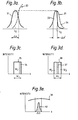
- FIGS. 3a and 3b illustrate the basis for the technique.
- An illuminating source provides a narrow-band spectrum 31 (Figure 3a) of nominal band width A), and mean wavelentgh ⁇ o Superimposed on this spectral profile is the absorption profile 32 of a gas to be detected.
- the spectral profile is shown overlapping the edge of the absorption spectral profile such that the absorption is wavelength dependent in the range ⁇ .
- the profile 31 will be representative of that received by a remote detector as shown in Figure 3b.
- the effective temporal coherence is increased.
- the presence of scattered radiation at the appropriate nominal mean wavelength X. equal to the transmitted wavelength but with increased temporal coherence, is an indication that the target gas is present at the remote site.
- Figures 3c and 3d illustrate the dependence of the change of temporal coherence on the overlap of the illumination and absorption profiles.
- the illumination and absorption spectra have sharp cut-offs and are rectangular in shape.
- Figure 3c corresponds to Figures 3a and 3b, the change in coherence being brought about by the illuminating spectrum 35 being reduced in width from W 1 to W 2 by the absorption profile 36.
- Figures 3a - 3d illustrate narrow band illuminating sources and by contrast figure 3e illustrates how a broad-band source such as the sun may be used.
- the sun's spectrum 39 is band-pass limited to a narrow band which coincides with a target gas absorption profile 40 - by providing a suitable filter at the receiver input.
- Figure 3e shows that broad band illumination, for example the solar spectrum 39, can be band-pass limited by an input filter of bandwidth 4ih to achieve the same effects shown in Figures 3a to 3d by arranging the passband to coincide with the profile 40 of the target gas absorption spectrum.
- a receiver capable of detecting temporal coherence changes for remote sensing should be selectively sensitive to small changes in temporal coherence and also should be insensitive to amplitude and intensity changes.
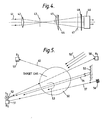
- Figure 4 shows a simple version of a high pass temporal coherence optical receiver which may be used, according to the present invention, in the apparatus for remote detection of gases.
- Light 41 from a remote scene is transmitted via a lens 42 and a stop 43 to a Fresnel bi-prism beam splitter 44.
- One half-beam is delayed by a glass delay plate 45 and the combination of the two half-beams is measured by a detector 46.
- the glass delay plate 45 introduces an additional path length in the upper half-beam and thus interference fringes will be observed by the detector 46 if the path difference is smaller than the coherence length of the light 41.
- the detector is made selectively sensitive to the interference fringes of the appropriate wavelength by the modulating reticle 47 and the filter 48. The reticle is oscillated back and forth while the detector searches for a synchronous signal.
- Sources such the Xenon lamp, with its array of narrow spectral features, can have their broad-band disadvantages offset to a great extent by the processing power of the temporal coherence detection system.
- a spectrum scanning scheme may be employed by the use of an electronically tunable optical filter as are now becoming available.
- the narrow-band illuminating beam can be spectrally scanned across the absorption spectrum to yield a frequency-modulated signal, proportional to the temporal coherence variations caused by the convolution of the two spectra.
- this scheme would be insensitive to amplitude variations as might be caused by for example: changes in transmitted power; variations in atmospheric turbulence and scatter; and changes in concentration of the target gas with position or air movement.
- a periodic modulation at a separately arranged frequency can also be induced by means of a vibrating scanning prism or mirror so that the contours of the extent of the target can be mapped.
- a receiver 51 such as the one shown in Figure 4, is colocated with an illuminating source 52 such as a laser.
- the receiver 51 can collect illumination scattered from the gas itself (indicated by 53) or scattered (54) from some remote surface 55 such as high ground or the side of a building etc.
- a retro-reflector 56 to enhance the illumination (57) received by the detector system.
- the illumination 54, 57 reflected back towards the receiver from behind the target gas has made a double pass through the target gas and so provides an advantageous enhancement of the temporal coherence.
- the illuminating radiation may alternatively be received by a remote receiver 58 after direct-line transmission through the target gas or by a remote receiver 59 responsive to scattered light 60.
- the receiver 51 may receive broad-band solar radiation 50' after transmission through the target gas.
- detector system depends, among other factors, upon the absorption profile of the particular target gas and the spectrum and power of the source of illumination.
- the power incident on the scattering surface is approximately: Wexp (- Sa.R). exp (- Sg.t)
- the scattering surface has a reflectance value of r and is Lambertian, then the reflected power per unit solid angle is:
- the power reaching the receiver is approximately given by:
- the ability of the high pass temporal coherence receiver ( Figure 4) to eliminate background clutter is illustrated by the response curves in Figure 6 obtained by scanning a field of view which includes a remote laser source.
- the upper trace shows the variation of response 61 against bearing measured by the Figure 4 arrangement, but without the Fresnel biprism 44 and modulating reticle 47.
- the laser radiation 62 is indistinguishable from the background clutter 63 because the receiver responds only to intensity variations.
- the lower trace shows the effect of introducing the reticle 47 and fresnel biprism 44 with a thin glass plate delay 45 attached. Even a thin delay plate, discriminating against relatively short temporal coherence radiation, is found to reduce the background clutter (64) substantially and make the laser radiation readily detectable.
- the thickness of the delay plate When used in the remote gas sensor the thickness of the delay plate must then be increased until the laser light from the remote gas detector is just extinguished. Any increase in the temporal coherence of the laser radiation received after interaction with the target gas will then lead to interference fringes in the plane of the reticle 47 and the generation of a modulated signal at the output of the detector 46.
- a phase modulator 83 comprising a glass delay plate which is tilted up and down cyclically produces periodic variations in intensity of any fringe patterns present at the detectors 81 and 82.
- the temporal coherence band pass is determined by varying the offset of the mirror 76 and the thickness of the glass delay plate 78.
- the remote-sensing technique can be optimised.
- a- turnable laser illuminator 52 may be frequency scanned.
- the centre frequency of a turnable narrow bandpass filter 83 at the input to the receiver may be channel.
- the method of the invention is also applicable when the area of interest is illuminated by sun's radiation, or when the area is illuminated by broad-band artificial sources such as arc lights, tungsten lamps, pyrotechnics, flares etc.
- a band-pass filter at the receiver input would be used to transmit an appropriate narrow spectral band unaffected by other sharp absorption spectra.
Landscapes
- Physics & Mathematics (AREA)
- Spectroscopy & Molecular Physics (AREA)
- General Physics & Mathematics (AREA)
- Health & Medical Sciences (AREA)
- Life Sciences & Earth Sciences (AREA)
- Chemical & Material Sciences (AREA)
- Analytical Chemistry (AREA)
- Biochemistry (AREA)
- General Health & Medical Sciences (AREA)
- Optics & Photonics (AREA)
- Immunology (AREA)
- Pathology (AREA)
- Investigating Or Analysing Materials By Optical Means (AREA)
Applications Claiming Priority (2)
| Application Number | Priority Date | Filing Date | Title |
|---|---|---|---|
| GB848406690A GB8406690D0 (en) | 1984-03-14 | 1984-03-14 | Remote sensing of gases &c |
| GB8406690 | 1984-03-14 |
Publications (3)
| Publication Number | Publication Date |
|---|---|
| EP0155142A2 true EP0155142A2 (de) | 1985-09-18 |
| EP0155142A3 EP0155142A3 (en) | 1986-06-25 |
| EP0155142B1 EP0155142B1 (de) | 1989-05-03 |
Family
ID=10558087
Family Applications (1)
| Application Number | Title | Priority Date | Filing Date |
|---|---|---|---|
| EP85301544A Expired EP0155142B1 (de) | 1984-03-14 | 1985-03-06 | Verfahren und Vorrichtung zum Nachweis aus Ferne von Gasen, Dämpfen oder Aerosolnebeln |
Country Status (6)
| Country | Link |
|---|---|
| US (1) | US4676642A (de) |
| EP (1) | EP0155142B1 (de) |
| JP (1) | JPS60210741A (de) |
| CA (1) | CA1237177A (de) |
| DE (1) | DE3569981D1 (de) |
| GB (1) | GB8406690D0 (de) |
Cited By (3)
| Publication number | Priority date | Publication date | Assignee | Title |
|---|---|---|---|---|
| US4692026A (en) * | 1984-09-25 | 1987-09-08 | Hoechst Aktiengesellschaft | Process and apparatus for continuous determination of the states of anisotropy of optically active materials |
| WO1993001477A1 (en) * | 1991-07-12 | 1993-01-21 | The Secretary Of State For Defence In Her Britannic Majesty's Government Of The United Kingdom Of Great Britain And Northern Ireland | Optical signal processing |
| EP4305378A4 (de) * | 2021-03-08 | 2025-01-01 | OnPoint Technologies, LLC | Gasleckdetektor und detektionsverfahren |
Families Citing this family (34)
| Publication number | Priority date | Publication date | Assignee | Title |
|---|---|---|---|---|
| US5327219A (en) * | 1992-05-15 | 1994-07-05 | The United States Of America As Represented By The Administrator Of The National Aeronautics And Space Administration | Method and apparatus for removing unwanted reflections from an interferometer |
| US5373160A (en) * | 1993-05-04 | 1994-12-13 | Westinghouse Electric Corporation | Remote hazardous air pullutants monitor |
| GB2297656A (en) * | 1995-02-01 | 1996-08-07 | Northern Telecom Ltd | Optical filtering |
| US5905571A (en) * | 1995-08-30 | 1999-05-18 | Sandia Corporation | Optical apparatus for forming correlation spectrometers and optical processors |
| US5770156A (en) * | 1996-06-04 | 1998-06-23 | In Usa, Inc. | Gas detection and measurement system |
| GB2314617B (en) * | 1996-06-24 | 2000-08-23 | Graviner Ltd Kidde | High sensitivity gas detection |
| WO1998017991A1 (en) * | 1996-10-18 | 1998-04-30 | In Usa, Inc. | Multi-wavelength based ozone measurement method and apparatus |
| DE19856400B4 (de) * | 1998-12-07 | 2009-04-09 | Steinbichler Optotechnik Gmbh | Verfahren und Vorrichtung zur direkten Phasenmessung von Strahlung |
| US6568597B2 (en) | 2000-11-29 | 2003-05-27 | Symbol Technologies, Inc. | Scanning system with adjustable optical characteristics |
| JP2006507478A (ja) * | 2002-05-22 | 2006-03-02 | ファースト レスポンダー システムズ アンド テクノロジー,エル エル シー | 遠隔化学物質同定処理システム |
| US7060992B1 (en) | 2003-03-10 | 2006-06-13 | Tiax Llc | System and method for bioaerosol discrimination by time-resolved fluorescence |
| US20060237665A1 (en) * | 2003-03-10 | 2006-10-26 | Barney William S | Bioaerosol discrimination |
| CA2458123C (en) * | 2003-03-13 | 2012-05-15 | Synodon Inc. | Remote sensing of gas leaks |
| EP1620004A2 (de) * | 2003-04-15 | 2006-02-01 | Optiscan Biomedical Corporation | Analyten-nachweissystem mit doppelter messung |
| ATE494542T1 (de) * | 2004-02-16 | 2011-01-15 | Synodon Inc | Fernerkundung von gaslecks mittels gasfilterkorrelationsradiometrie |
| CN1329715C (zh) * | 2004-11-16 | 2007-08-01 | 中国科学院安徽光学精密机械研究所 | 机载多波段双向大气辐射探测仪的探头 |
| US7355705B1 (en) * | 2005-06-23 | 2008-04-08 | Itt Manufacturing Enterprises, Inc. | Using a fixed-frequency oscillation in a dispersive spectrometer to measure scene inhomogeneity |
| US7791719B1 (en) | 2007-01-12 | 2010-09-07 | Itt Manufacturing Enterprises, Inc. | Using a fixed-frequency oscillation to detect and measure scene inhomogeneity |
| IL190756A0 (en) * | 2008-04-09 | 2009-08-03 | Rafael Advanced Defense Sys | Gas detection, identification and concentration estimation based on spectral spatial misregistration |
| US20120101747A1 (en) * | 2010-10-25 | 2012-04-26 | University Of Louisville Research Foundation, Inc. | Detection and imaging of turbulence in a fluid |
| CN104297117A (zh) * | 2014-10-23 | 2015-01-21 | 浙江省环境保护科学设计研究院 | 基于遥感技术的风景名胜区道路交通污染预警装置及方法 |
| CA2893017C (en) | 2015-01-19 | 2020-03-24 | Tetra Tech, Inc. | Light emission power control apparatus and method |
| CA2893007C (en) | 2015-01-19 | 2020-04-28 | Tetra Tech, Inc. | Sensor synchronization apparatus and method |
| US10349491B2 (en) | 2015-01-19 | 2019-07-09 | Tetra Tech, Inc. | Light emission power control apparatus and method |
| CA2892952C (en) | 2015-01-19 | 2019-10-15 | Tetra Tech, Inc. | Protective shroud |
| CA2892885C (en) | 2015-02-20 | 2020-07-28 | Tetra Tech, Inc. | 3d track assessment system and method |
| WO2017030652A1 (en) | 2015-08-20 | 2017-02-23 | Massachusetts Institute Of Technology | Sensing targets using photothermal speckle detection |
| US10730538B2 (en) | 2018-06-01 | 2020-08-04 | Tetra Tech, Inc. | Apparatus and method for calculating plate cut and rail seat abrasion based on measurements only of rail head elevation and crosstie surface elevation |
| US10807623B2 (en) | 2018-06-01 | 2020-10-20 | Tetra Tech, Inc. | Apparatus and method for gathering data from sensors oriented at an oblique angle relative to a railway track |
| US11377130B2 (en) | 2018-06-01 | 2022-07-05 | Tetra Tech, Inc. | Autonomous track assessment system |
| US10625760B2 (en) | 2018-06-01 | 2020-04-21 | Tetra Tech, Inc. | Apparatus and method for calculating wooden crosstie plate cut measurements and rail seat abrasion measurements based on rail head height |
| CA3130198C (en) | 2019-05-16 | 2022-05-17 | Darel Mesher | System and method for generating and interpreting point clouds of a rail corridor along a survey path |
| CN114544452B (zh) * | 2022-04-25 | 2022-07-26 | 自然资源部第二海洋研究所 | 一种多角度偏振水色遥感器卫星大气校正方法 |
| CN114935553A (zh) * | 2022-05-18 | 2022-08-23 | 光子集成(温州)创新研究院 | 一种污染气体遥测系统 |
Family Cites Families (8)
| Publication number | Priority date | Publication date | Assignee | Title |
|---|---|---|---|---|
| GB957737A (en) * | 1961-06-09 | 1964-05-13 | Ass Elect Ind | Improvements relating to spectrometers |
| US3563663A (en) * | 1966-07-13 | 1971-02-16 | Barringer Research Ltd | Analysis of spectra by correlation of interference patterns |
| GB1195840A (en) * | 1967-01-10 | 1970-06-24 | Barringer Research Ltd | Scanning Interferometer Using Wedge for Producing Fringes |
| JPS5144832B2 (de) * | 1972-03-31 | 1976-12-01 | ||
| US3914055A (en) * | 1974-05-23 | 1975-10-21 | Lansing Research Corp | Instrument for high resolution spectral analysis with large optical throughput |
| US4035643A (en) * | 1974-06-11 | 1977-07-12 | Allied Chemical Corporation | Infrared gas analysis |
| JPS5198072A (en) * | 1975-02-25 | 1976-08-28 | Heterodainhoshiki reeza reedasochi | |
| US4170416A (en) * | 1977-01-17 | 1979-10-09 | The Perkin-Elmer Corporation | Apparatus for analyzing coherent radiation |
-
1984
- 1984-03-14 GB GB848406690A patent/GB8406690D0/en active Pending
-
1985
- 1985-03-06 US US06/708,790 patent/US4676642A/en not_active Expired - Fee Related
- 1985-03-06 EP EP85301544A patent/EP0155142B1/de not_active Expired
- 1985-03-06 DE DE8585301544T patent/DE3569981D1/de not_active Expired
- 1985-03-13 JP JP60050242A patent/JPS60210741A/ja active Pending
- 1985-03-13 CA CA000476359A patent/CA1237177A/en not_active Expired
Cited By (5)
| Publication number | Priority date | Publication date | Assignee | Title |
|---|---|---|---|---|
| US4692026A (en) * | 1984-09-25 | 1987-09-08 | Hoechst Aktiengesellschaft | Process and apparatus for continuous determination of the states of anisotropy of optically active materials |
| WO1993001477A1 (en) * | 1991-07-12 | 1993-01-21 | The Secretary Of State For Defence In Her Britannic Majesty's Government Of The United Kingdom Of Great Britain And Northern Ireland | Optical signal processing |
| GB2272765A (en) * | 1991-07-12 | 1994-05-25 | Secr Defence | Optical signal processing |
| GB2272765B (en) * | 1991-07-12 | 1995-04-05 | Secr Defence | Optical signal processing |
| EP4305378A4 (de) * | 2021-03-08 | 2025-01-01 | OnPoint Technologies, LLC | Gasleckdetektor und detektionsverfahren |
Also Published As
| Publication number | Publication date |
|---|---|
| GB8406690D0 (en) | 1984-04-18 |
| EP0155142A3 (en) | 1986-06-25 |
| JPS60210741A (ja) | 1985-10-23 |
| US4676642A (en) | 1987-06-30 |
| EP0155142B1 (de) | 1989-05-03 |
| CA1237177A (en) | 1988-05-24 |
| DE3569981D1 (en) | 1989-06-08 |
Similar Documents
| Publication | Publication Date | Title |
|---|---|---|
| US4676642A (en) | Apparatus and method for remote sensing of gases, vapors or aerosols | |
| US5339155A (en) | Optical wavelength modulated long-path gas monitoring apparatus | |
| US5451787A (en) | Hazardous air pollutants monitor | |
| US8330957B2 (en) | Device and method for quantification of gases in plumes by remote sensing | |
| US6822236B1 (en) | Method of optimizing a response of a gas correlation radiometer to a trace amount of a target gas | |
| US5026992A (en) | Spectral ratioing technique for NDIR gas analysis using a differential temperature source | |
| US5076699A (en) | Method and apparatus for remotely and portably measuring a gas of interest | |
| CA2365866C (en) | Passive remote sensor of chemicals | |
| US3723007A (en) | Remote quantitative analysis of materials | |
| US20110133089A1 (en) | Remote sensing of gas leaks | |
| US3517190A (en) | Method of remotely monitoring stack effluent | |
| DK2588847T3 (en) | Device and method for the quantification of gases in the tabs by telemetering | |
| WO2018213212A1 (en) | Standoff trace chemical detection with active infrared spectroscopy | |
| US4383181A (en) | Method and apparatus for analyzing a gaseous mixture | |
| US11041754B2 (en) | Standoff trace chemical detection with active infrared spectroscopy | |
| US8514378B2 (en) | Method of optical teledetection of compounds in a medium | |
| CA2804006C (en) | Device and method for quantification of gases in plumes by remote sensing | |
| CN218766604U (zh) | 开放路径气体检测系统 | |
| Vaughan, Chair | Remote sensing terminology | |
| McKay et al. | Direct detection wind speed Doppler lidar systems | |
| Russwurm et al. | Glossary of Terms for Optical Remote Sensing | |
| Chovin | Optical methods of detecting pollutants and measuring their concentration in the atmosphere | |
| JARVIS | 8.40 Open Path Spectrophotometry | |
| Klein et al. | Rapid Multispectral Investigations By A Compact Co2 Lidar |
Legal Events
| Date | Code | Title | Description |
|---|---|---|---|
| PUAI | Public reference made under article 153(3) epc to a published international application that has entered the european phase |
Free format text: ORIGINAL CODE: 0009012 |
|
| AK | Designated contracting states |
Designated state(s): DE FR GB NL |
|
| PUAL | Search report despatched |
Free format text: ORIGINAL CODE: 0009013 |
|
| AK | Designated contracting states |
Kind code of ref document: A3 Designated state(s): DE FR GB NL |
|
| 17P | Request for examination filed |
Effective date: 19861208 |
|
| 17Q | First examination report despatched |
Effective date: 19880801 |
|
| GRAA | (expected) grant |
Free format text: ORIGINAL CODE: 0009210 |
|
| AK | Designated contracting states |
Kind code of ref document: B1 Designated state(s): DE FR GB NL |
|
| REF | Corresponds to: |
Ref document number: 3569981 Country of ref document: DE Date of ref document: 19890608 |
|
| ET | Fr: translation filed | ||
| PLBI | Opposition filed |
Free format text: ORIGINAL CODE: 0009260 |
|
| 26 | Opposition filed |
Opponent name: SOCIETE NATIONALE ELF AQUITAINE Effective date: 19900202 |
|
| NLR1 | Nl: opposition has been filed with the epo |
Opponent name: SOCIETE NATIONALE ELF AQUITAINE |
|
| PLBM | Termination of opposition procedure: date of legal effect published |
Free format text: ORIGINAL CODE: 0009276 |
|
| STAA | Information on the status of an ep patent application or granted ep patent |
Free format text: STATUS: OPPOSITION PROCEDURE CLOSED |
|
| 27C | Opposition proceedings terminated |
Effective date: 19911003 |
|
| NLR2 | Nl: decision of opposition | ||
| PGFP | Annual fee paid to national office [announced via postgrant information from national office to epo] |
Ref country code: FR Payment date: 19950208 Year of fee payment: 11 |
|
| PGFP | Annual fee paid to national office [announced via postgrant information from national office to epo] |
Ref country code: GB Payment date: 19950216 Year of fee payment: 11 |
|
| PGFP | Annual fee paid to national office [announced via postgrant information from national office to epo] |
Ref country code: DE Payment date: 19950217 Year of fee payment: 11 |
|
| PGFP | Annual fee paid to national office [announced via postgrant information from national office to epo] |
Ref country code: NL Payment date: 19950331 Year of fee payment: 11 |
|
| PG25 | Lapsed in a contracting state [announced via postgrant information from national office to epo] |
Ref country code: GB Effective date: 19960306 |
|
| PG25 | Lapsed in a contracting state [announced via postgrant information from national office to epo] |
Ref country code: NL Effective date: 19961001 |
|
| GBPC | Gb: european patent ceased through non-payment of renewal fee |
Effective date: 19960306 |
|
| PG25 | Lapsed in a contracting state [announced via postgrant information from national office to epo] |
Ref country code: FR Effective date: 19961129 |
|
| NLV4 | Nl: lapsed or anulled due to non-payment of the annual fee |
Effective date: 19961001 |
|
| PG25 | Lapsed in a contracting state [announced via postgrant information from national office to epo] |
Ref country code: DE Effective date: 19961203 |
|
| REG | Reference to a national code |
Ref country code: FR Ref legal event code: ST |