EP0152599A2 - Verfahren zur Herstellung von Presslingen aus pyrogen hergesellten Oxiden - Google Patents
Verfahren zur Herstellung von Presslingen aus pyrogen hergesellten Oxiden Download PDFInfo
- Publication number
- EP0152599A2 EP0152599A2 EP84115509A EP84115509A EP0152599A2 EP 0152599 A2 EP0152599 A2 EP 0152599A2 EP 84115509 A EP84115509 A EP 84115509A EP 84115509 A EP84115509 A EP 84115509A EP 0152599 A2 EP0152599 A2 EP 0152599A2
- Authority
- EP
- European Patent Office
- Prior art keywords
- pyrogenic
- compacts
- water
- oxides
- mixture
- Prior art date
- Legal status (The legal status is an assumption and is not a legal conclusion. Google has not performed a legal analysis and makes no representation as to the accuracy of the status listed.)
- Withdrawn
Links
- 230000001698 pyrogenic effect Effects 0.000 title claims abstract description 12
- 238000000034 method Methods 0.000 title claims description 9
- 239000008187 granular material Substances 0.000 title claims description 5
- 239000000843 powder Substances 0.000 claims abstract description 16
- XLYOFNOQVPJJNP-UHFFFAOYSA-N water Substances O XLYOFNOQVPJJNP-UHFFFAOYSA-N 0.000 claims abstract description 15
- 239000000203 mixture Substances 0.000 claims abstract description 9
- 239000000314 lubricant Substances 0.000 claims abstract description 5
- 238000004519 manufacturing process Methods 0.000 claims description 6
- 239000008247 solid mixture Substances 0.000 claims description 5
- 230000006835 compression Effects 0.000 claims description 2
- 238000007906 compression Methods 0.000 claims description 2
- VYPSYNLAJGMNEJ-UHFFFAOYSA-N Silicium dioxide Chemical compound O=[Si]=O VYPSYNLAJGMNEJ-UHFFFAOYSA-N 0.000 abstract description 6
- PNEYBMLMFCGWSK-UHFFFAOYSA-N aluminium oxide Inorganic materials [O-2].[O-2].[O-2].[Al+3].[Al+3] PNEYBMLMFCGWSK-UHFFFAOYSA-N 0.000 abstract description 2
- 229910052593 corundum Inorganic materials 0.000 abstract description 2
- 239000000377 silicon dioxide Substances 0.000 abstract description 2
- 235000012239 silicon dioxide Nutrition 0.000 abstract description 2
- 229910001845 yogo sapphire Inorganic materials 0.000 abstract description 2
- MCMNRKCIXSYSNV-UHFFFAOYSA-N Zirconium dioxide Chemical compound O=[Zr]=O MCMNRKCIXSYSNV-UHFFFAOYSA-N 0.000 abstract 2
- 229910052681 coesite Inorganic materials 0.000 abstract 1
- 229910052906 cristobalite Inorganic materials 0.000 abstract 1
- 229910052682 stishovite Inorganic materials 0.000 abstract 1
- 229910052905 tridymite Inorganic materials 0.000 abstract 1
- PEDCQBHIVMGVHV-UHFFFAOYSA-N Glycerine Chemical compound OCC(O)CO PEDCQBHIVMGVHV-UHFFFAOYSA-N 0.000 description 15
- 235000011187 glycerol Nutrition 0.000 description 7
- 229910004298 SiO 2 Inorganic materials 0.000 description 5
- 239000011734 sodium Substances 0.000 description 4
- 229910002015 Aerosil® 150 Inorganic materials 0.000 description 3
- 239000011230 binding agent Substances 0.000 description 3
- 239000003054 catalyst Substances 0.000 description 3
- 239000011148 porous material Substances 0.000 description 3
- 229910052708 sodium Inorganic materials 0.000 description 3
- 229910002018 Aerosil® 300 Inorganic materials 0.000 description 2
- 229910018072 Al 2 O 3 Inorganic materials 0.000 description 2
- GWEVSGVZZGPLCZ-UHFFFAOYSA-N Titan oxide Chemical compound O=[Ti]=O GWEVSGVZZGPLCZ-UHFFFAOYSA-N 0.000 description 2
- 229910052796 boron Inorganic materials 0.000 description 2
- 239000000919 ceramic Substances 0.000 description 2
- 229910021485 fumed silica Inorganic materials 0.000 description 2
- 239000011521 glass Substances 0.000 description 2
- 238000003825 pressing Methods 0.000 description 2
- 229910002012 Aerosil® Inorganic materials 0.000 description 1
- 238000004438 BET method Methods 0.000 description 1
- ZOXJGFHDIHLPTG-UHFFFAOYSA-N Boron Chemical compound [B] ZOXJGFHDIHLPTG-UHFFFAOYSA-N 0.000 description 1
- OYPRJOBELJOOCE-UHFFFAOYSA-N Calcium Chemical compound [Ca] OYPRJOBELJOOCE-UHFFFAOYSA-N 0.000 description 1
- VYZAMTAEIAYCRO-UHFFFAOYSA-N Chromium Chemical compound [Cr] VYZAMTAEIAYCRO-UHFFFAOYSA-N 0.000 description 1
- DGAQECJNVWCQMB-PUAWFVPOSA-M Ilexoside XXIX Chemical compound C[C@@H]1CC[C@@]2(CC[C@@]3(C(=CC[C@H]4[C@]3(CC[C@@H]5[C@@]4(CC[C@@H](C5(C)C)OS(=O)(=O)[O-])C)C)[C@@H]2[C@]1(C)O)C)C(=O)O[C@H]6[C@@H]([C@H]([C@@H]([C@H](O6)CO)O)O)O.[Na+] DGAQECJNVWCQMB-PUAWFVPOSA-M 0.000 description 1
- WHXSMMKQMYFTQS-UHFFFAOYSA-N Lithium Chemical compound [Li] WHXSMMKQMYFTQS-UHFFFAOYSA-N 0.000 description 1
- ZLMJMSJWJFRBEC-UHFFFAOYSA-N Potassium Chemical compound [K] ZLMJMSJWJFRBEC-UHFFFAOYSA-N 0.000 description 1
- XUIMIQQOPSSXEZ-UHFFFAOYSA-N Silicon Chemical compound [Si] XUIMIQQOPSSXEZ-UHFFFAOYSA-N 0.000 description 1
- 229910010413 TiO 2 Inorganic materials 0.000 description 1
- 238000006887 Ullmann reaction Methods 0.000 description 1
- HCHKCACWOHOZIP-UHFFFAOYSA-N Zinc Chemical compound [Zn] HCHKCACWOHOZIP-UHFFFAOYSA-N 0.000 description 1
- 238000010521 absorption reaction Methods 0.000 description 1
- 229910052782 aluminium Inorganic materials 0.000 description 1
- XAGFODPZIPBFFR-UHFFFAOYSA-N aluminium Chemical compound [Al] XAGFODPZIPBFFR-UHFFFAOYSA-N 0.000 description 1
- 229910052788 barium Inorganic materials 0.000 description 1
- DSAJWYNOEDNPEQ-UHFFFAOYSA-N barium atom Chemical compound [Ba] DSAJWYNOEDNPEQ-UHFFFAOYSA-N 0.000 description 1
- 239000011575 calcium Substances 0.000 description 1
- 229910052791 calcium Inorganic materials 0.000 description 1
- 229910052804 chromium Inorganic materials 0.000 description 1
- 239000011651 chromium Substances 0.000 description 1
- 239000011248 coating agent Substances 0.000 description 1
- 238000000576 coating method Methods 0.000 description 1
- 239000010419 fine particle Substances 0.000 description 1
- 229910052744 lithium Inorganic materials 0.000 description 1
- 150000007524 organic acids Chemical class 0.000 description 1
- 235000005985 organic acids Nutrition 0.000 description 1
- TWNQGVIAIRXVLR-UHFFFAOYSA-N oxo(oxoalumanyloxy)alumane Chemical compound O=[Al]O[Al]=O TWNQGVIAIRXVLR-UHFFFAOYSA-N 0.000 description 1
- RVTZCBVAJQQJTK-UHFFFAOYSA-N oxygen(2-);zirconium(4+) Chemical compound [O-2].[O-2].[Zr+4] RVTZCBVAJQQJTK-UHFFFAOYSA-N 0.000 description 1
- 239000008188 pellet Substances 0.000 description 1
- 229910052700 potassium Inorganic materials 0.000 description 1
- 239000011591 potassium Substances 0.000 description 1
- 150000003839 salts Chemical class 0.000 description 1
- RMAQACBXLXPBSY-UHFFFAOYSA-N silicic acid Chemical compound O[Si](O)(O)O RMAQACBXLXPBSY-UHFFFAOYSA-N 0.000 description 1
- 229910052710 silicon Inorganic materials 0.000 description 1
- 239000010703 silicon Substances 0.000 description 1
- 239000007787 solid Substances 0.000 description 1
- 239000012798 spherical particle Substances 0.000 description 1
- 238000005496 tempering Methods 0.000 description 1
- 239000004408 titanium dioxide Substances 0.000 description 1
- 229910052720 vanadium Inorganic materials 0.000 description 1
- LEONUFNNVUYDNQ-UHFFFAOYSA-N vanadium atom Chemical compound [V] LEONUFNNVUYDNQ-UHFFFAOYSA-N 0.000 description 1
- 229910052725 zinc Inorganic materials 0.000 description 1
- 239000011701 zinc Substances 0.000 description 1
- 229910001928 zirconium oxide Inorganic materials 0.000 description 1
Classifications
-
- B—PERFORMING OPERATIONS; TRANSPORTING
- B01—PHYSICAL OR CHEMICAL PROCESSES OR APPARATUS IN GENERAL
- B01J—CHEMICAL OR PHYSICAL PROCESSES, e.g. CATALYSIS OR COLLOID CHEMISTRY; THEIR RELEVANT APPARATUS
- B01J2/00—Processes or devices for granulating materials, e.g. fertilisers in general; Rendering particulate materials free flowing in general, e.g. making them hydrophobic
- B01J2/22—Processes or devices for granulating materials, e.g. fertilisers in general; Rendering particulate materials free flowing in general, e.g. making them hydrophobic by pressing in moulds or between rollers
-
- B—PERFORMING OPERATIONS; TRANSPORTING
- B01—PHYSICAL OR CHEMICAL PROCESSES OR APPARATUS IN GENERAL
- B01J—CHEMICAL OR PHYSICAL PROCESSES, e.g. CATALYSIS OR COLLOID CHEMISTRY; THEIR RELEVANT APPARATUS
- B01J37/00—Processes, in general, for preparing catalysts; Processes, in general, for activation of catalysts
- B01J37/0009—Use of binding agents; Moulding; Pressing; Powdering; Granulating; Addition of materials ameliorating the mechanical properties of the product catalyst
Definitions
- Pyrogenically produced oxides are characterized by extreme fine j of segments in and correspondingly high specific surface areas, very high purity, spherical particle shape and the absence of pores. Because of these properties, the pyrogenically produced oxides are of increasing interest as supports for catalysts (D. Koth, H. Ferch, Chem. Ing. Techn. 52, 628 (1980).
- DE-OS 32 17 751 discloses the compression of pyrogenically produced titanium dioxide, in which organic acids or acid-reacting salts are used as intermediate binders.
- the invention relates to a process for the production of compacts from pyrogenic oxides, which is characterized in that a mixture consisting of pyrogenic oxide, glaze frit powder, water and lubricant is homogenized, pressed and tempered.
- pyrogenic oxides from the group Si0 2 , Zr0 2 and / or Al203 can be pressed with the method according to the invention.
- Pyrogenically produced SiO 2 can be pressed particularly advantageously to give high-strength compacts.
- a solid mixture consisting of 85 to 10 parts of pyrogenic oxide and 15 to 90 parts of glaze frit powder together in a mixture with 200 to 50% by weight of water (based on the solid mixture) and 10 to 40% by weight Lubricants, preferably glycerin (based on the amount of solids), under compressing conditions over a period of 1 to 60 minutes, preferably 1 to 10 minutes, with, for example homogenize a pan mill, a ball mill or a roller, dry the granules so obtained until sufficient flowability is obtained for the pressing, e.g. with known stamp presses, such as an eccentric press or rotary press, and heat the compacts thus obtained at 600 to 850 ° C, preferably at 700 to 800 ° C, for a period of 30 to 120 minutes.
- Lubricants preferably glycerin (based on the amount of solids)
- glaze powders are used as binders, e.g. be used for the production of slip for coating ceramic plates (see Ullmanns Encyclopedia of Industrial Chemistry, Volume 13, p. 711 Ceramics, 4th edition, Verlag Chemie Weinheim). These powders have grain sizes of less than 50 ⁇ m.
- the composition can vary widely.
- glaze powder or glaze frit powder can contain the elements silicon, aluminum, boron, sodium, potassium, lithium, calcium, zinc, barium, lead, vanadium and / or chromium - mostly in the form of their oxides. Since the pellets to be produced are to be used as catalyst supports, glaze powders should be selected that do not contain any disruptive elements for this purpose.
- the process according to the invention has the advantage that it enables the production of compacts from pyrogenically produced silicon dioxide which have high strength.
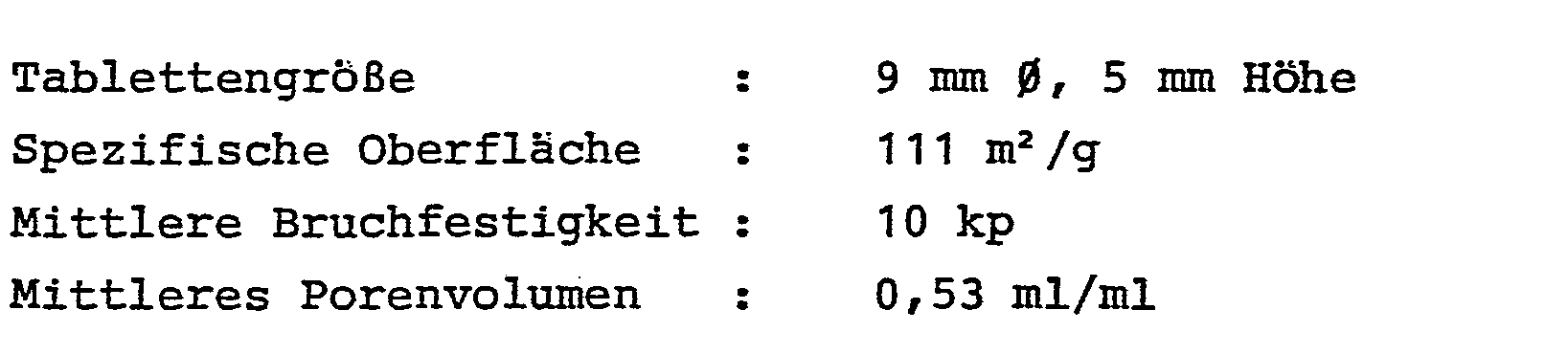
- the breaking strength of the tablets is measured with a breaking strength tester of the type ZE / 205 from Dr.K.Scheleringer & Co. 10 tablets are broken and their mean value is calculated.
- the pore volume of the compacts is determined in a simple manner by letting the compacts absorb water in a glass at room temperature until no more air bubbles rise. The compacts are then removed from the water and covered with a paper dried and weighed. The difference between the weight before and after the water absorption gives the amount of water absorbed and thus the pore volume of the compacts, which is listed as part of the compact volume in the examples.
- the specific surfaces of the compacts are measured using the BET method (DIN 66 131) (J.Am.Chem.Soc. 60 (1983) 309).
- Aerosil® 150 is a fumed silica with a specific surface area of approx. 150 m 2 / g.
- the specified Aerosil® 300 is a pyrogenic silica with a specific surface area of approx. 300 m2f g .
- the pressing takes place on a Korsch eccentric press (approx. 1,200 bar).
- the subsequent tempering is carried out at 700 ° C. for 90 minutes.
- Example I 30 g pyrogenically produced aluminum oxide (specific surface 101 m 2 / g), 6 g glycerin in 15 g water and 8 g glaze powder ver (frit 2) are mixed as indicated in Example I, homogenized, pressed and tempered.
Landscapes
- Chemical & Material Sciences (AREA)
- Organic Chemistry (AREA)
- Chemical Kinetics & Catalysis (AREA)
- Engineering & Computer Science (AREA)
- Materials Engineering (AREA)
- Compositions Of Oxide Ceramics (AREA)
- Glass Compositions (AREA)
- Catalysts (AREA)
- Porous Artificial Stone Or Porous Ceramic Products (AREA)
- Silicates, Zeolites, And Molecular Sieves (AREA)
- Silicon Compounds (AREA)
- Medicinal Preparation (AREA)
Abstract
Description
- Verfahren zur Herstellung von Preßlingen aus pyrogen hergestellten Oxiden
- Pyrogen hergestellte Oxide zeichnen sich durch extreme Fein- j teiligkeit und entsprechend hohe spezifische Oberflächen, sehr hohe Reinheit, sphärische Teilchenform und das Fehlen von Poren aus. Aufgrund dieser Eigenschaften finden die pyrogen hergestellten Oxide zunehmend Interesse als Träger für Katalysatoren (D. Koth, H. Ferch, Chem. Ing. Techn. 52, 628 (1980).
- Da pyrogen hergestellte Oxide besonders feinteilig sind, bereitet die Tablettierung zu Katalysatorträgern einige Schwierigkeiten.
- Aus der DE-OS 31 32 674 ist ein Verfahren zur Herstellung von Preßlingen bekannt, in dem Kieselsol als Bindemittel verwendet wird.
- Aus der DE-OS 32 17 751 ist die Verpressung von pyrogen hergestelltem Titandioxid bekannt, bei welchem organische Säuren oder sauer reagierende Salze als intermediäre Bindemittel verwendet werden.
- Auf andere pyrogen hergestellte Oxide, wie z.B. SiO2, Zr02, Al2O3, kann dieses Verfahren jedoch nicht übertragen werden.
- Gegenstand der Erfindung ist ein Verfahren zur Herstellung von Preßlingen aus pyrogen hergestellten Oxiden, welches dadurch gekennzeichnet ist, daß man eine Mischung, bestehend aus pyrogenem Oxid, Glasurfrittenpulver, Wasser und Gleitmittel homogenisiert, verpreßt und tempert.
- Vorteilhafterweise können mit dem erfindungsgemäßen Verfahren pyrogen hergestellte Oxide aus der Gruppe Si02, Zr02 und/oder Al203 verpreßt werden. Besonders vorteilhaft läßt sich pyrogen hergestelltes SiO2 zu hochbruchfesten Preßlingen verpressen.
- In einer Ausführungsform der Erfindung kann man eine Feststoffmischung, bestehend aus 85 bis 10 Teilen pyrogenem Oxid und 15 bis 90 Teilen Glasurfrittenpulver gemeinsam im Gemisch mit 200 bis 50 Gew.-% Wasser (bezogen auf die Feststoffmischung) und 10 bis 40 Gew.-% Gleitmittel, vorzugsweise Glyzerin (bezogen auf die Feststoffmenge), unter verdichtenden Bedingungen über einen Zeitraum von 1 bis 60 Minuten, vorzugsweise 1 bis 10 Minuten, mit z.B. einem Kollergang, einer Kugelmühle oder einer Walze, homogenisieren, das so erhaltene Granulat trocknen, bis man eine für die Verpressung ausreichende Fließfähigkeit erhält, dieses Granulat z.B. mit bekannten Stempelpressen, wie Exzenterpresse oder Rundlaufpresse verpressen und die so erhaltenen Preßlinge bei 600 bis 850°C, vorzugsweise bei 700 bis 800°C, während einer Zeit von 30 bis 120 Minuten tempern.
- Als Bindemittel werden erfindungsgemäß Glasurpulver verwendet, wie sie z.B. zur Herstellung von Schlickern zur Beschichtung von Keramikplatten verwendet werden (siehe Ullmanns Enzyklopädie der technischen Chemie, Band 13, S. 711 Keramik, 4. Auflage, Verlag Chemie Weinheim). Diese Pulver haben Korngrößen von weniger als 50 µm. Die Zusammensetzung kann sehr weit variieren.
- Diese Glasurpulver oder Glasurfrittenpulver können die Elemente Silizium, Aluminium, Bor, Natrium, Kalium, Lithium, Calcium, Zink, Barium, Blei, Vanadium und/oder Chrom - meist in Form ihrer Oxide - enthalten. Da die herzustellenden Presslinge als Katalysatorträger verwendet werden sollen, sind Glasurpulver auszuwählen, die für diese Zwecke keine störenden Elemente enthalten.
- Das erfindungsgemäße Verfahren weist den Vorteil auf, daß es die Herstellung von Preßlingen aus pyrogen hergestelltem Siliciumdioxid, die eine hohe Festigkeit aufweisen, erlaubt.
- Die Bruchfestigkeit der Tabletten wird mit einem Bruchfestigkeitstester des Typs ZE/205 der Firma Dr.K.Schleuninger & Co. gemessen. Dabei werden 10 Tabletten gebrochen und ihr Mittelwert errechnet.
- Das Porenvolumen der Preßlinge wird auf einfache Weise bestimmt, indem man die Preßlinge in einem Glas bei Zimmertemperatur so lange Wasser aufnehmen läßt, bis keine Luftblasen mehr aufsteigen. Anschließend werden die Preßlinge aus dem Wasser genommen, an der Oberfläche mit einem Papier abgetrocknet und gewogen. Aus der Differenz zwischen dem Gewicht vor und nach der Wasserabsorption ergibt sich die Menge des absorbierten Wassers und damit das Porenvolumen der Preßlinge, das jeweils als Teil des Preßlingsvolumens in den Beispielen aufgeführt wird.
- Die Messung der spezifischen Oberflächen der Presslinge erfolgt nach der BET-Methode (DIN 66 131) (J.Am.Chem.Soc. 60 (1983) 309).
- Das angegebene Aerosil® 150 ist eine pyrogen hergestellte Kieselsäure mit einer spezifischen Oberfläche von ca. 150 m2/g.
- Das angegebene Aerosil® 300 ist eine pyrogen hergestellte Kieselsäure mit einer spezifischen Oberflächen von ca. 300 m2fg.
- 30 g AEROSIL® 150 (spezifische Oberfläche 145 m2jg), 6 g Glyzerin in 35 g Wasser und 7 g Glasurpulver (Fritte 1 = 17,7 % TiO2, 4 % (NH4)3VO4, 31,7 % SiO2, 27,8 % PbO, 8,9 % B203, 2,5 % CuO, 2,5 % Na20) wurden in eine Retsch-Mühle gegeben und 5 Minuten homogenisiert. Die erhaltene Mischung reibt man durch ein 1,5 mm Sieb und trocknet das Granulat bis eine für die Tablettenmaschine ausreichende Fließfähigkeit gegeben ist bei 110°C.
- Die Verpressung erfolgt auf einer Korsch-Exzenterpresse (ca. 1.200 bar). Die anschließende Temperung wird 90 Minuten bei 700°C durchgeführt.
-
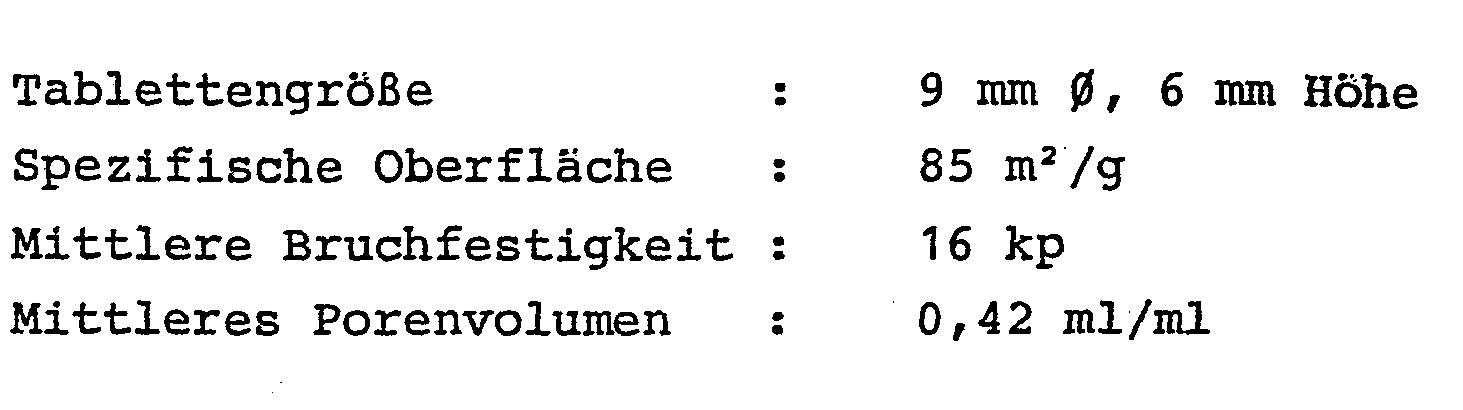
- 30 g AEROSIL® 150 (spezifische Oberfläche 145 m2/g) , 6 g Glyzerin in 35 g Wasser und 8 g Glasurpulver (Fritte 2 = 54,9 % SiO2, 19,5 % CaO, 11,0 % Al2O3, 6,9 B2O3, 4,7 % Na20, 1,5 MgO, 0,6 ZnO, 0,6 % K20) werden wie in Beispiel I angegeben vermischt, homogenisiert, verpreßt und getempert.

- 30 g AEROSIL® 300 (spezifische Oberfläche 310 m2/g), 6 g Glyzerin in 45 g Wasser und 8 g Glasurpulver (Fritte 2) werden wie in Beispiel I angegeben vermischt, homogenisiert, verpreßt und getempert.

- 30 g pyrogen hergestelltes Aluminiumoxid (spezifische Oberfläche 101 m2/g), 6 g Glyzerin in 15 g Wasser und 8 g Glasurpulver (Fritte 2) werden wie in Beispiel I angegeben vermischt, homogenisiert, verpreßt und getempert.

- 30 g AEROSILR 150 (spezifische Oberfläche 145 m2/g), 6 g Glyzerin in 34 g Wasser und 8 g Glasurpulver (Fritte 3 = 47,8 SiO2, 14,0 B2O3, 12,1 ZrO2, 7,2 A1203, 6,8 CaO, 6,0 ZnO, 4,5 Na20, 1,6 K20) werden wie in Beispiel I angegeben vermischt, homogenisiert, verpreßt und 90 Minuten bei 800°C getempert.
- 30 g pyrogenes Zirkonoxid (spezifische Oberfläche 53 m2/g), 6 g Glycerin in 10 g Wasser und 8 g Glaspulver (Fritte 2) werden wie in Beispiel I angegeben vermischt, homogenisiert, verpreßt und getempert.

Claims (2)
Applications Claiming Priority (2)
| Application Number | Priority Date | Filing Date | Title |
|---|---|---|---|
| DE19843406185 DE3406185A1 (de) | 1984-02-21 | 1984-02-21 | Verfahren zur herstellung von presslingen aus pyrogen hergestellten oxiden |
| DE3406185 | 1984-02-21 |
Publications (2)
| Publication Number | Publication Date |
|---|---|
| EP0152599A2 true EP0152599A2 (de) | 1985-08-28 |
| EP0152599A3 EP0152599A3 (de) | 1987-09-30 |
Family
ID=6228350
Family Applications (1)
| Application Number | Title | Priority Date | Filing Date |
|---|---|---|---|
| EP84115509A Withdrawn EP0152599A3 (de) | 1984-02-21 | 1984-12-15 | Verfahren zur Herstellung von Presslingen aus pyrogen hergesellten Oxiden |
Country Status (3)
| Country | Link |
|---|---|
| EP (1) | EP0152599A3 (de) |
| JP (1) | JPS60186456A (de) |
| DE (1) | DE3406185A1 (de) |
Cited By (9)
| Publication number | Priority date | Publication date | Assignee | Title |
|---|---|---|---|---|
| EP0327815A1 (de) * | 1988-02-09 | 1989-08-16 | Degussa Aktiengesellschaft | Presslinge auf Basis von pyrogen hergestelltem Siliciumdioxid-Aluminiumoxid-Mischoxid, Verfahren zu ihrer Herstellung und ihre Verwendung |
| EP0327814A1 (de) * | 1988-02-09 | 1989-08-16 | Degussa Aktiengesellschaft | Presslinge auf Basis von pyrogen hergestelltem Zirkondioxid, Verfahren zu ihrer Herstellung und ihre Verwendung |
| EP0327723A3 (en) * | 1988-02-09 | 1989-10-18 | Degussa Aktiengesellschaft | Die-formed articles based on pyrogenic titanium dioxide, process for their preparation and their use |
| EP0510772A1 (de) * | 1991-04-23 | 1992-10-28 | Shell Internationale Researchmaatschappij B.V. | Verfahren zur Herstellung von einem Katalysator oder von einem Katalysatorvorläufer |
| FR2769307A1 (fr) * | 1997-10-02 | 1999-04-09 | Samsung Electronics Co Ltd | Composition de verre de silice et procede de fabrication du verre de silice utilisant celle-ci |
| WO1999058236A1 (en) * | 1998-05-11 | 1999-11-18 | Nippon Ketjen Co., Ltd. | Process for producing spherical oxide particles |
| SG92657A1 (en) * | 1998-09-24 | 2002-11-19 | Degussa | Mouldings consisting of pyrogenic mixed oxide and use thereof |
| EP1074513A3 (de) * | 1999-08-03 | 2004-02-11 | Degussa AG | Sinterwerkstoffe und deren Herstellungsverfahren und Verwendungen, Dispersionen von Siliciumdioxid-Granulaten und deren Verwendungen, sowie Verwendungen von Siliciumdioxid-Granulaten |
| WO2016005041A1 (de) * | 2014-07-08 | 2016-01-14 | Kronos International, Inc. | Verfahren zur agglomeration feinteiliger rohstoffe für die titandioxidherstellung |
Families Citing this family (10)
| Publication number | Priority date | Publication date | Assignee | Title |
|---|---|---|---|---|
| DE3803897A1 (de) * | 1988-02-09 | 1989-08-10 | Degussa | Presslinge auf basis von pyrogen hergestelltem aluminiumoxid, verfahren zu ihrer herstellung und ihre verwendung |
| DE3912504A1 (de) * | 1989-04-17 | 1990-10-18 | Degussa | Presslinge auf basis von pyrogen hergestelltem siliciumdioxid, verfahren zu ihrer herstellung und ihre verwendung |
| DE4142902A1 (de) * | 1991-12-23 | 1993-06-24 | Sued Chemie Ag | Formlinge auf der basis von pyrogener kieselsaeure |
| DE4142898A1 (de) * | 1991-12-23 | 1993-06-24 | Sued Chemie Ag | Formlinge auf der basis von pyrogener kieselsaeure |
| DE4424044A1 (de) * | 1994-07-11 | 1996-01-18 | Heraeus Quarzglas | Verfahren zur Herstellung von Kieselsäuregranulat und Verwendung des so hergestellten Granulats |
| US7157406B2 (en) | 1994-12-17 | 2007-01-02 | Basf Aktiengesellschaft | Catalysts or carriers which consist essentially of monoclinic zirconium dioxide |
| DE4445142A1 (de) | 1994-12-17 | 1996-06-20 | Basf Ag | Katalysatoren oder Träger die im wesentlichen aus monoklinem Zirconiumdioxid bestehen |
| DE19619961A1 (de) * | 1996-05-17 | 1997-11-20 | Degussa | Preßlinge auf Basis von pyrogen hergestelltem Siliciumdioxid |
| US6207610B1 (en) | 1996-05-17 | 2001-03-27 | Degussa-Huls Ag | Compacts based on pyrogenically produced silicon dioxide |
| DE19750238A1 (de) * | 1997-11-13 | 1999-05-27 | Degussa | Preßlinge auf Basis von pyrogen hergestelltem Siliciumdioxid |
Family Cites Families (8)
| Publication number | Priority date | Publication date | Assignee | Title |
|---|---|---|---|---|
| CH481852A (de) * | 1964-02-10 | 1969-11-30 | Dynamit Nobel Ag | Verfahren zur Herstellung von Sinterprodukten aus feuerfesten Oxyden |
| US3669889A (en) * | 1968-12-20 | 1972-06-13 | Diomid Ilich Juzvuk | Granular ceramic heat carrier and method for manufacture thereof |
| US3965042A (en) * | 1973-12-07 | 1976-06-22 | W. R. Grace & Co. | Formation of alumina-containing particles with aluminum hydroxide binder |
| JPS5092309A (de) * | 1973-12-21 | 1975-07-23 | ||
| GB1543576A (en) * | 1975-06-10 | 1979-04-04 | Bp Chem Int Ltd | Catalyst support |
| US4256676A (en) * | 1978-11-22 | 1981-03-17 | Kovach Julius L | Process for preparing porous metal oxide beads |
| DE3132674C2 (de) * | 1981-08-19 | 1983-12-08 | Degussa Ag, 6000 Frankfurt | Verfahren zur Herstellung von Preßlingen |
| DE3217751A1 (de) * | 1982-05-12 | 1983-11-17 | Degussa Ag, 6000 Frankfurt | Presslinge aus pyrogen hergestelltem titandioxid, verfahren zu ihrer herstellung sowie ihre verwendung |
-
1984
- 1984-02-21 DE DE19843406185 patent/DE3406185A1/de active Granted
- 1984-12-15 EP EP84115509A patent/EP0152599A3/de not_active Withdrawn
-
1985
- 1985-02-21 JP JP60031674A patent/JPS60186456A/ja active Granted
Cited By (10)
| Publication number | Priority date | Publication date | Assignee | Title |
|---|---|---|---|---|
| EP0327815A1 (de) * | 1988-02-09 | 1989-08-16 | Degussa Aktiengesellschaft | Presslinge auf Basis von pyrogen hergestelltem Siliciumdioxid-Aluminiumoxid-Mischoxid, Verfahren zu ihrer Herstellung und ihre Verwendung |
| EP0327814A1 (de) * | 1988-02-09 | 1989-08-16 | Degussa Aktiengesellschaft | Presslinge auf Basis von pyrogen hergestelltem Zirkondioxid, Verfahren zu ihrer Herstellung und ihre Verwendung |
| EP0327723A3 (en) * | 1988-02-09 | 1989-10-18 | Degussa Aktiengesellschaft | Die-formed articles based on pyrogenic titanium dioxide, process for their preparation and their use |
| EP0510772A1 (de) * | 1991-04-23 | 1992-10-28 | Shell Internationale Researchmaatschappij B.V. | Verfahren zur Herstellung von einem Katalysator oder von einem Katalysatorvorläufer |
| FR2769307A1 (fr) * | 1997-10-02 | 1999-04-09 | Samsung Electronics Co Ltd | Composition de verre de silice et procede de fabrication du verre de silice utilisant celle-ci |
| WO1999058236A1 (en) * | 1998-05-11 | 1999-11-18 | Nippon Ketjen Co., Ltd. | Process for producing spherical oxide particles |
| US6802958B1 (en) | 1998-05-11 | 2004-10-12 | Nippon Ketjen Co., Ltd. | Process for producing spherical oxide particles |
| SG92657A1 (en) * | 1998-09-24 | 2002-11-19 | Degussa | Mouldings consisting of pyrogenic mixed oxide and use thereof |
| EP1074513A3 (de) * | 1999-08-03 | 2004-02-11 | Degussa AG | Sinterwerkstoffe und deren Herstellungsverfahren und Verwendungen, Dispersionen von Siliciumdioxid-Granulaten und deren Verwendungen, sowie Verwendungen von Siliciumdioxid-Granulaten |
| WO2016005041A1 (de) * | 2014-07-08 | 2016-01-14 | Kronos International, Inc. | Verfahren zur agglomeration feinteiliger rohstoffe für die titandioxidherstellung |
Also Published As
| Publication number | Publication date |
|---|---|
| EP0152599A3 (de) | 1987-09-30 |
| DE3406185A1 (de) | 1985-09-05 |
| JPS60186456A (ja) | 1985-09-21 |
| DE3406185C2 (de) | 1988-10-13 |
| JPH0416433B2 (de) | 1992-03-24 |
Similar Documents
| Publication | Publication Date | Title |
|---|---|---|
| EP0152599A2 (de) | Verfahren zur Herstellung von Presslingen aus pyrogen hergesellten Oxiden | |
| DE3586779T3 (de) | Keramische Schleifscheibe. | |
| DE3132674C2 (de) | Verfahren zur Herstellung von Preßlingen | |
| EP0327815B1 (de) | Presslinge auf Basis von pyrogen hergestelltem Siliciumdioxid-Aluminiumoxid-Mischoxid, Verfahren zu ihrer Herstellung und ihre Verwendung | |
| DE3803895C1 (de) | ||
| EP0690030A1 (de) | Leucithaltige Phosphosilikat-Glaskeramik | |
| EP0690031A1 (de) | Zr02-haltige Glaskeramik | |
| DE3010545A1 (de) | Gesinterte keramik insbesondere fuer zerspanungswerkzeuge und verfahren zur herstellung derselben | |
| EP0327721B1 (de) | Presslinge auf Basis von pyrogen hergestelltem Aluminiumoxid, Verfahren zu ihrer Herstellung und ihre Verwendung | |
| DE3217751C2 (de) | ||
| EP3819281A1 (de) | Verwendung von titanverbindungen | |
| EP1194113B1 (de) | Verwendung von bioaktivem Glas zur Konservierung von kosmetischen und pharmazeutischen Präparaten | |
| EP0073012A1 (de) | Härter für Wasserglaskitte | |
| DE2932914C2 (de) | Hochfeste Tonerdeporzellanmasse für elektrische Isolatoren | |
| EP0327814A1 (de) | Presslinge auf Basis von pyrogen hergestelltem Zirkondioxid, Verfahren zu ihrer Herstellung und ihre Verwendung | |
| EP0019174A2 (de) | Verfahren zur Herstellung eines Katalysators für die Oxidation von Schwefeldioxid | |
| DE10016884A1 (de) | Synthetische Aluminiumsilikate mit Nephelin- oder Carnegietstruktur | |
| DE3625463A1 (de) | Dielektrische keramische zusammensetzung | |
| CH622484A5 (en) | Process for producing a sintered ceramic product | |
| DE3618758C2 (de) | ||
| EP0202551B1 (de) | Silikatische Rohstoffe für Keramik, Verfahren zur Herstellung und Verwendung derselben | |
| DE3912610A1 (de) | Formmasse zur herstellung von schleifwerkzeugen | |
| DE2459499C2 (de) | Truebungsmittel zur herstellung weissgetruebter keramischer glasuren, emails und glaeser | |
| DE3117008A1 (de) | "verfahren zur herstellung von dichter sintertonerde oder dichter, modifizierter sintertonerde" | |
| AT230260B (de) | Glasartiger Körper und Verfahren zu seiner Herstellung |
Legal Events
| Date | Code | Title | Description |
|---|---|---|---|
| PUAI | Public reference made under article 153(3) epc to a published international application that has entered the european phase |
Free format text: ORIGINAL CODE: 0009012 |
|
| 17P | Request for examination filed |
Effective date: 19841215 |
|
| AK | Designated contracting states |
Designated state(s): AT BE CH DE FR GB IT LI NL SE |
|
| PUAL | Search report despatched |
Free format text: ORIGINAL CODE: 0009013 |
|
| AK | Designated contracting states |
Kind code of ref document: A3 Designated state(s): AT BE CH DE FR GB IT LI NL SE |
|
| 17Q | First examination report despatched |
Effective date: 19900703 |
|
| STAA | Information on the status of an ep patent application or granted ep patent |
Free format text: STATUS: THE APPLICATION HAS BEEN WITHDRAWN |
|
| 18W | Application withdrawn |
Withdrawal date: 19910619 |
|
| R18W | Application withdrawn (corrected) |
Effective date: 19910619 |
|
| RIN1 | Information on inventor provided before grant (corrected) |
Inventor name: HEINEMANN, WOLFGANG, DR. Inventor name: ETTLINGER, MANFRED, DR. Inventor name: SIMON, EDGAR |