EP0146827B1 - Thermoplastische Polysiloxan-Polyester(carbonat)-Block-copolymere, ihre Herstellung und Verwendung - Google Patents
Thermoplastische Polysiloxan-Polyester(carbonat)-Block-copolymere, ihre Herstellung und Verwendung Download PDFInfo
- Publication number
- EP0146827B1 EP0146827B1 EP84114609A EP84114609A EP0146827B1 EP 0146827 B1 EP0146827 B1 EP 0146827B1 EP 84114609 A EP84114609 A EP 84114609A EP 84114609 A EP84114609 A EP 84114609A EP 0146827 B1 EP0146827 B1 EP 0146827B1
- Authority
- EP
- European Patent Office
- Prior art keywords
- polyester
- carbonate
- siloxane
- block copolymers
- ratio
- Prior art date
- Legal status (The legal status is an assumption and is not a legal conclusion. Google has not performed a legal analysis and makes no representation as to the accuracy of the status listed.)
- Expired - Lifetime
Links
- 229920000728 polyester Polymers 0.000 title claims description 37
- 229920001400 block copolymer Polymers 0.000 title claims description 23
- BVKZGUZCCUSVTD-UHFFFAOYSA-L Carbonate Chemical compound [O-]C([O-])=O BVKZGUZCCUSVTD-UHFFFAOYSA-L 0.000 title claims description 15
- 229920001169 thermoplastic Polymers 0.000 title description 5
- 239000004416 thermosoftening plastic Substances 0.000 title description 5
- IISBACLAFKSPIT-UHFFFAOYSA-N bisphenol A Chemical compound C=1C=C(O)C=CC=1C(C)(C)C1=CC=C(O)C=C1 IISBACLAFKSPIT-UHFFFAOYSA-N 0.000 claims description 34
- KKEYFWRCBNTPAC-UHFFFAOYSA-N terephthalic acid group Chemical group C(C1=CC=C(C(=O)O)C=C1)(=O)O KKEYFWRCBNTPAC-UHFFFAOYSA-N 0.000 claims description 15
- QQVIHTHCMHWDBS-UHFFFAOYSA-N isophthalic acid Chemical compound OC(=O)C1=CC=CC(C(O)=O)=C1 QQVIHTHCMHWDBS-UHFFFAOYSA-N 0.000 claims description 13
- 239000000203 mixture Substances 0.000 claims description 10
- 229930185605 Bisphenol Natural products 0.000 claims description 7
- YGYAWVDWMABLBF-UHFFFAOYSA-N Phosgene Chemical compound ClC(Cl)=O YGYAWVDWMABLBF-UHFFFAOYSA-N 0.000 claims description 6
- 239000003054 catalyst Substances 0.000 claims description 6
- 238000000034 method Methods 0.000 claims description 6
- 239000003960 organic solvent Substances 0.000 claims description 6
- 125000004432 carbon atom Chemical group C* 0.000 claims description 4
- 238000004519 manufacturing process Methods 0.000 claims description 4
- 125000003837 (C1-C20) alkyl group Chemical class 0.000 claims description 3
- 125000000882 C2-C6 alkenyl group Chemical class 0.000 claims description 3
- 239000006085 branching agent Substances 0.000 claims description 3
- 238000000465 moulding Methods 0.000 claims description 3
- 125000005915 C6-C14 aryl group Chemical class 0.000 claims description 2
- 239000003513 alkali Substances 0.000 claims description 2
- 125000002877 alkyl aryl group Chemical group 0.000 claims description 2
- 239000003963 antioxidant agent Substances 0.000 claims description 2
- 125000003710 aryl alkyl group Chemical group 0.000 claims description 2
- 238000010406 interfacial reaction Methods 0.000 claims 1
- 125000002496 methyl group Chemical group [H]C([H])([H])* 0.000 claims 1
- 239000000243 solution Substances 0.000 description 24
- MVPPADPHJFYWMZ-UHFFFAOYSA-N chlorobenzene Chemical compound ClC1=CC=CC=C1 MVPPADPHJFYWMZ-UHFFFAOYSA-N 0.000 description 22
- HEMHJVSKTPXQMS-UHFFFAOYSA-M Sodium hydroxide Chemical compound [OH-].[Na+] HEMHJVSKTPXQMS-UHFFFAOYSA-M 0.000 description 21
- YMWUJEATGCHHMB-UHFFFAOYSA-N Dichloromethane Chemical compound ClCCl YMWUJEATGCHHMB-UHFFFAOYSA-N 0.000 description 15
- 125000003118 aryl group Chemical group 0.000 description 10
- -1 polysiloxane Polymers 0.000 description 10
- 229920000642 polymer Polymers 0.000 description 9
- 238000003756 stirring Methods 0.000 description 9
- 150000004649 carbonic acid derivatives Chemical class 0.000 description 7
- 239000011541 reaction mixture Substances 0.000 description 7
- 238000005481 NMR spectroscopy Methods 0.000 description 4
- FDQSRULYDNDXQB-UHFFFAOYSA-N benzene-1,3-dicarbonyl chloride Chemical compound ClC(=O)C1=CC=CC(C(Cl)=O)=C1 FDQSRULYDNDXQB-UHFFFAOYSA-N 0.000 description 4
- 238000006243 chemical reaction Methods 0.000 description 4
- 238000001704 evaporation Methods 0.000 description 4
- 239000000155 melt Substances 0.000 description 4
- 239000012074 organic phase Substances 0.000 description 4
- 150000002989 phenols Chemical class 0.000 description 4
- LXEJRKJRKIFVNY-UHFFFAOYSA-N terephthaloyl chloride Chemical compound ClC(=O)C1=CC=C(C(Cl)=O)C=C1 LXEJRKJRKIFVNY-UHFFFAOYSA-N 0.000 description 4
- VPWNQTHUCYMVMZ-UHFFFAOYSA-N 4,4'-sulfonyldiphenol Chemical class C1=CC(O)=CC=C1S(=O)(=O)C1=CC=C(O)C=C1 VPWNQTHUCYMVMZ-UHFFFAOYSA-N 0.000 description 3
- HVXRCAWUNAOCTA-UHFFFAOYSA-N 4-(6-methylheptyl)phenol Chemical compound CC(C)CCCCCC1=CC=C(O)C=C1 HVXRCAWUNAOCTA-UHFFFAOYSA-N 0.000 description 3
- HTLZVHNRZJPSMI-UHFFFAOYSA-N N-ethylpiperidine Chemical compound CCN1CCCCC1 HTLZVHNRZJPSMI-UHFFFAOYSA-N 0.000 description 3
- 125000000217 alkyl group Chemical group 0.000 description 3
- KPUWHANPEXNPJT-UHFFFAOYSA-N disiloxane Chemical class [SiH3]O[SiH3] KPUWHANPEXNPJT-UHFFFAOYSA-N 0.000 description 3
- 230000006872 improvement Effects 0.000 description 3
- 239000012299 nitrogen atmosphere Substances 0.000 description 3
- 239000012071 phase Substances 0.000 description 3
- QPFMBZIOSGYJDE-UHFFFAOYSA-N 1,1,2,2-tetrachloroethane Chemical compound ClC(Cl)C(Cl)Cl QPFMBZIOSGYJDE-UHFFFAOYSA-N 0.000 description 2
- YIYBRXKMQFDHSM-UHFFFAOYSA-N 2,2'-Dihydroxybenzophenone Chemical compound OC1=CC=CC=C1C(=O)C1=CC=CC=C1O YIYBRXKMQFDHSM-UHFFFAOYSA-N 0.000 description 2
- VXHYVVAUHMGCEX-UHFFFAOYSA-N 2-(2-hydroxyphenoxy)phenol Chemical compound OC1=CC=CC=C1OC1=CC=CC=C1O VXHYVVAUHMGCEX-UHFFFAOYSA-N 0.000 description 2
- BLDLRWQLBOJPEB-UHFFFAOYSA-N 2-(2-hydroxyphenyl)sulfanylphenol Chemical compound OC1=CC=CC=C1SC1=CC=CC=C1O BLDLRWQLBOJPEB-UHFFFAOYSA-N 0.000 description 2
- XSVZEASGNTZBRQ-UHFFFAOYSA-N 2-(2-hydroxyphenyl)sulfinylphenol Chemical compound OC1=CC=CC=C1S(=O)C1=CC=CC=C1O XSVZEASGNTZBRQ-UHFFFAOYSA-N 0.000 description 2
- QUWAJPZDCZDTJS-UHFFFAOYSA-N 2-(2-hydroxyphenyl)sulfonylphenol Chemical compound OC1=CC=CC=C1S(=O)(=O)C1=CC=CC=C1O QUWAJPZDCZDTJS-UHFFFAOYSA-N 0.000 description 2
- NFAOATPOYUWEHM-UHFFFAOYSA-N 2-(6-methylheptyl)phenol Chemical compound CC(C)CCCCCC1=CC=CC=C1O NFAOATPOYUWEHM-UHFFFAOYSA-N 0.000 description 2
- ZGZVGZCIFZBNCN-UHFFFAOYSA-N 4,4'-(2-Methylpropylidene)bisphenol Chemical compound C=1C=C(O)C=CC=1C(C(C)C)C1=CC=C(O)C=C1 ZGZVGZCIFZBNCN-UHFFFAOYSA-N 0.000 description 2
- ODJUOZPKKHIEOZ-UHFFFAOYSA-N 4-[2-(4-hydroxy-3,5-dimethylphenyl)propan-2-yl]-2,6-dimethylphenol Chemical compound CC1=C(O)C(C)=CC(C(C)(C)C=2C=C(C)C(O)=C(C)C=2)=C1 ODJUOZPKKHIEOZ-UHFFFAOYSA-N 0.000 description 2
- IJGRMHOSHXDMSA-UHFFFAOYSA-N Atomic nitrogen Chemical compound N#N IJGRMHOSHXDMSA-UHFFFAOYSA-N 0.000 description 2
- SDDLEVPIDBLVHC-UHFFFAOYSA-N Bisphenol Z Chemical compound C1=CC(O)=CC=C1C1(C=2C=CC(O)=CC=2)CCCCC1 SDDLEVPIDBLVHC-UHFFFAOYSA-N 0.000 description 2
- WKBOTKDWSSQWDR-UHFFFAOYSA-N Bromine atom Chemical compound [Br] WKBOTKDWSSQWDR-UHFFFAOYSA-N 0.000 description 2
- ZAMOUSCENKQFHK-UHFFFAOYSA-N Chlorine atom Chemical compound [Cl] ZAMOUSCENKQFHK-UHFFFAOYSA-N 0.000 description 2
- HEDRZPFGACZZDS-UHFFFAOYSA-N Chloroform Chemical compound ClC(Cl)Cl HEDRZPFGACZZDS-UHFFFAOYSA-N 0.000 description 2
- QIGBRXMKCJKVMJ-UHFFFAOYSA-N Hydroquinone Chemical compound OC1=CC=C(O)C=C1 QIGBRXMKCJKVMJ-UHFFFAOYSA-N 0.000 description 2
- 239000002253 acid Substances 0.000 description 2
- VCCBEIPGXKNHFW-UHFFFAOYSA-N biphenyl-4,4'-diol Chemical group C1=CC(O)=CC=C1C1=CC=C(O)C=C1 VCCBEIPGXKNHFW-UHFFFAOYSA-N 0.000 description 2
- 230000015556 catabolic process Effects 0.000 description 2
- 230000008859 change Effects 0.000 description 2
- 150000001805 chlorine compounds Chemical class 0.000 description 2
- 230000000052 comparative effect Effects 0.000 description 2
- 239000012153 distilled water Substances 0.000 description 2
- 239000003792 electrolyte Substances 0.000 description 2
- 230000008020 evaporation Effects 0.000 description 2
- 125000004464 hydroxyphenyl group Chemical group 0.000 description 2
- 238000001746 injection moulding Methods 0.000 description 2
- QQVIHTHCMHWDBS-UHFFFAOYSA-L isophthalate(2-) Chemical compound [O-]C(=O)C1=CC=CC(C([O-])=O)=C1 QQVIHTHCMHWDBS-UHFFFAOYSA-L 0.000 description 2
- 229920001296 polysiloxane Polymers 0.000 description 2
- 239000000376 reactant Substances 0.000 description 2
- GHMLBKRAJCXXBS-UHFFFAOYSA-N resorcinol Chemical compound OC1=CC=CC(O)=C1 GHMLBKRAJCXXBS-UHFFFAOYSA-N 0.000 description 2
- JRMUNVKIHCOMHV-UHFFFAOYSA-M tetrabutylammonium bromide Chemical compound [Br-].CCCC[N+](CCCC)(CCCC)CCCC JRMUNVKIHCOMHV-UHFFFAOYSA-M 0.000 description 2
- XLYOFNOQVPJJNP-UHFFFAOYSA-N water Chemical compound O XLYOFNOQVPJJNP-UHFFFAOYSA-N 0.000 description 2
- 125000004400 (C1-C12) alkyl group Chemical group 0.000 description 1
- KYGLCUAXJICESS-UHFFFAOYSA-N 2-[2,3-di(propan-2-yl)phenyl]phenol Chemical class CC(C)C1=CC=CC(C=2C(=CC=CC=2)O)=C1C(C)C KYGLCUAXJICESS-UHFFFAOYSA-N 0.000 description 1
- VWGKEVWFBOUAND-UHFFFAOYSA-N 4,4'-thiodiphenol Chemical compound C1=CC(O)=CC=C1SC1=CC=C(O)C=C1 VWGKEVWFBOUAND-UHFFFAOYSA-N 0.000 description 1
- OMHZWZPLGASTIR-UHFFFAOYSA-N CC(C)C1C=CC(O)=CC1 Chemical compound CC(C)C1C=CC(O)=CC1 OMHZWZPLGASTIR-UHFFFAOYSA-N 0.000 description 1
- 0 CC(CC1)C=C*1C(C)(C)c(cc1)ccc1O Chemical compound CC(CC1)C=C*1C(C)(C)c(cc1)ccc1O 0.000 description 1
- CYTYCFOTNPOANT-UHFFFAOYSA-N Perchloroethylene Chemical group ClC(Cl)=C(Cl)Cl CYTYCFOTNPOANT-UHFFFAOYSA-N 0.000 description 1
- ISWSIDIOOBJBQZ-UHFFFAOYSA-N Phenol Chemical compound OC1=CC=CC=C1 ISWSIDIOOBJBQZ-UHFFFAOYSA-N 0.000 description 1
- XSTXAVWGXDQKEL-UHFFFAOYSA-N Trichloroethylene Chemical compound ClC=C(Cl)Cl XSTXAVWGXDQKEL-UHFFFAOYSA-N 0.000 description 1
- 230000002411 adverse Effects 0.000 description 1
- 150000001335 aliphatic alkanes Chemical class 0.000 description 1
- 125000002947 alkylene group Chemical group 0.000 description 1
- 239000000956 alloy Substances 0.000 description 1
- 229910045601 alloy Inorganic materials 0.000 description 1
- 239000007864 aqueous solution Substances 0.000 description 1
- QVGXLLKOCUKJST-UHFFFAOYSA-N atomic oxygen Chemical compound [O] QVGXLLKOCUKJST-UHFFFAOYSA-N 0.000 description 1
- WTEPWWCRWNCUNA-UHFFFAOYSA-M benzyl(triphenyl)phosphanium;bromide Chemical compound [Br-].C=1C=CC=CC=1[P+](C=1C=CC=CC=1)(C=1C=CC=CC=1)CC1=CC=CC=C1 WTEPWWCRWNCUNA-UHFFFAOYSA-M 0.000 description 1
- 230000015572 biosynthetic process Effects 0.000 description 1
- GDTBXPJZTBHREO-UHFFFAOYSA-N bromine Substances BrBr GDTBXPJZTBHREO-UHFFFAOYSA-N 0.000 description 1
- 229910052794 bromium Inorganic materials 0.000 description 1
- 125000005587 carbonate group Chemical group 0.000 description 1
- BVKZGUZCCUSVTD-UHFFFAOYSA-N carbonic acid Chemical compound OC(O)=O BVKZGUZCCUSVTD-UHFFFAOYSA-N 0.000 description 1
- 239000000460 chlorine Substances 0.000 description 1
- 229910052801 chlorine Inorganic materials 0.000 description 1
- AOGYCOYQMAVAFD-UHFFFAOYSA-N chlorocarbonic acid Chemical class OC(Cl)=O AOGYCOYQMAVAFD-UHFFFAOYSA-N 0.000 description 1
- 150000001875 compounds Chemical class 0.000 description 1
- 229920001577 copolymer Polymers 0.000 description 1
- 150000001924 cycloalkanes Chemical class 0.000 description 1
- 125000000753 cycloalkyl group Chemical group 0.000 description 1
- 125000002993 cycloalkylene group Chemical group 0.000 description 1
- 230000002542 deteriorative effect Effects 0.000 description 1
- 150000004816 dichlorobenzenes Chemical class 0.000 description 1
- 229920005645 diorganopolysiloxane polymer Polymers 0.000 description 1
- 239000000975 dye Substances 0.000 description 1
- 229920001971 elastomer Polymers 0.000 description 1
- 239000000806 elastomer Substances 0.000 description 1
- 238000004870 electrical engineering Methods 0.000 description 1
- 125000004185 ester group Chemical group 0.000 description 1
- 230000007717 exclusion Effects 0.000 description 1
- 238000001125 extrusion Methods 0.000 description 1
- 239000000945 filler Substances 0.000 description 1
- 239000003063 flame retardant Substances 0.000 description 1
- 239000003365 glass fiber Substances 0.000 description 1
- 229910052736 halogen Inorganic materials 0.000 description 1
- 125000005843 halogen group Chemical group 0.000 description 1
- 150000002367 halogens Chemical class 0.000 description 1
- 239000004413 injection moulding compound Substances 0.000 description 1
- 239000004310 lactic acid Substances 0.000 description 1
- 229920002521 macromolecule Polymers 0.000 description 1
- 238000005259 measurement Methods 0.000 description 1
- 230000004048 modification Effects 0.000 description 1
- 238000012986 modification Methods 0.000 description 1
- 150000004780 naphthols Chemical class 0.000 description 1
- 229910052757 nitrogen Inorganic materials 0.000 description 1
- 230000003287 optical effect Effects 0.000 description 1
- 229910052760 oxygen Inorganic materials 0.000 description 1
- 239000001301 oxygen Substances 0.000 description 1
- 230000005501 phase interface Effects 0.000 description 1
- 150000004714 phosphonium salts Chemical class 0.000 description 1
- 125000004437 phosphorous atom Chemical group 0.000 description 1
- 229910052698 phosphorus Inorganic materials 0.000 description 1
- 239000000049 pigment Substances 0.000 description 1
- 238000006068 polycondensation reaction Methods 0.000 description 1
- 238000003672 processing method Methods 0.000 description 1
- 125000001453 quaternary ammonium group Chemical group 0.000 description 1
- 238000007127 saponification reaction Methods 0.000 description 1
- 239000002904 solvent Substances 0.000 description 1
- 238000005507 spraying Methods 0.000 description 1
- 239000003381 stabilizer Substances 0.000 description 1
- 230000001954 sterilising effect Effects 0.000 description 1
- 238000004659 sterilization and disinfection Methods 0.000 description 1
- KKEYFWRCBNTPAC-UHFFFAOYSA-L terephthalate(2-) Chemical compound [O-]C(=O)C1=CC=C(C([O-])=O)C=C1 KKEYFWRCBNTPAC-UHFFFAOYSA-L 0.000 description 1
- 150000003512 tertiary amines Chemical class 0.000 description 1
- 229950011008 tetrachloroethylene Drugs 0.000 description 1
- GBXQPDCOMJJCMJ-UHFFFAOYSA-M trimethyl-[6-(trimethylazaniumyl)hexyl]azanium;bromide Chemical compound [Br-].C[N+](C)(C)CCCCCC[N+](C)(C)C GBXQPDCOMJJCMJ-UHFFFAOYSA-M 0.000 description 1
- 238000005199 ultracentrifugation Methods 0.000 description 1
- 239000013585 weight reducing agent Substances 0.000 description 1
Classifications
-
- C—CHEMISTRY; METALLURGY
- C08—ORGANIC MACROMOLECULAR COMPOUNDS; THEIR PREPARATION OR CHEMICAL WORKING-UP; COMPOSITIONS BASED THEREON
- C08G—MACROMOLECULAR COMPOUNDS OBTAINED OTHERWISE THAN BY REACTIONS ONLY INVOLVING UNSATURATED CARBON-TO-CARBON BONDS
- C08G77/00—Macromolecular compounds obtained by reactions forming a linkage containing silicon with or without sulfur, nitrogen, oxygen or carbon in the main chain of the macromolecule
- C08G77/42—Block-or graft-polymers containing polysiloxane sequences
- C08G77/445—Block-or graft-polymers containing polysiloxane sequences containing polyester sequences
-
- C—CHEMISTRY; METALLURGY
- C08—ORGANIC MACROMOLECULAR COMPOUNDS; THEIR PREPARATION OR CHEMICAL WORKING-UP; COMPOSITIONS BASED THEREON
- C08G—MACROMOLECULAR COMPOUNDS OBTAINED OTHERWISE THAN BY REACTIONS ONLY INVOLVING UNSATURATED CARBON-TO-CARBON BONDS
- C08G63/00—Macromolecular compounds obtained by reactions forming a carboxylic ester link in the main chain of the macromolecule
- C08G63/68—Polyesters containing atoms other than carbon, hydrogen and oxygen
- C08G63/695—Polyesters containing atoms other than carbon, hydrogen and oxygen containing silicon
-
- C—CHEMISTRY; METALLURGY
- C08—ORGANIC MACROMOLECULAR COMPOUNDS; THEIR PREPARATION OR CHEMICAL WORKING-UP; COMPOSITIONS BASED THEREON
- C08G—MACROMOLECULAR COMPOUNDS OBTAINED OTHERWISE THAN BY REACTIONS ONLY INVOLVING UNSATURATED CARBON-TO-CARBON BONDS
- C08G77/00—Macromolecular compounds obtained by reactions forming a linkage containing silicon with or without sulfur, nitrogen, oxygen or carbon in the main chain of the macromolecule
- C08G77/42—Block-or graft-polymers containing polysiloxane sequences
- C08G77/445—Block-or graft-polymers containing polysiloxane sequences containing polyester sequences
- C08G77/448—Block-or graft-polymers containing polysiloxane sequences containing polyester sequences containing polycarbonate sequences
Definitions
- polysiloxane-polyester block copolymers with siloxane contents of 90 to 10% by weight, based on block copolymer, are described in DE-OS 2 001 945 (US Pat. No. 3,701,815). These block copolymers are elastomers or rigid copolymers whose heat resistance is significantly lower than that of the underlying polyester.
- Polysiloxane-polyester carbonate block copolymers with 45 to 60% by weight of polysiloxane segments are described in DE-OS 2,640,241. These polymers are elastomeric thermoplastics with improved tensile strength at heat sterilization temperatures, but the heat resistance of these block copolymers is significantly lower than that of the non-polysiloxane-containing polyester carbonates.
- Aromatic polyesters based on bisphenols and iso- / terephthalic acid are known and are e.g. by W. M. Eareckson, J. Polym. Sci. XL, 399-406 (1959) or in the patents FR 1 177 517, US 3 351 624, DE 2 714 544, 2 758 030.
- Aromatic polyester carbonates based on bisphenols, carbonic acid and iso- / terephthalic acid are also known and are e.g. in EP-PS 10 840, DE-PS 3 016 019, 2 714 544 and US-PS 3 207 814. Due to their excellent properties, these polycondensates are used wherever high heat resistance and toughness are required.
- the object of the invention was therefore to achieve a better thermoplastic processability of aromatic polyesters and polyester carbonates by modifying the macromolecule without deteriorating the heat resistance.
- siloxane-polyester (carbonate) block copolymers according to the invention can be obtained by using at least one bisphenol of the formula and at least one diorganosiloxane of the formula with mixtures of the dichlorides of iso- and terephthalic acid and optionally with phosgene in a two-phase system consisting of an aqueous alkali solution and a water-immiscible organic solvent in a phase interface reaction in the presence of a catalyst and optionally chain terminators, branching agents and antioxidants, where Ar, R, R 1 , a, b and c have the meaning given above.
- chain terminators are preferably phenol, alkylphenols with C 1 -C 12 alkyl groups, halogenated phenols, hydroxydiphenyl, naphthols, chlorocarbonic acid esters from such phenolic compounds and chlorides of aromatic monocarboxylic acids, which can optionally be substituted by C 1 -C 22 alkyl groups and halogen atoms, in amounts of 0.1 to 10 mol% (in the case of phenols based on diphenols, in the case of acid chlorides based on acid dichloride).
- 3- or more-functional carboxylic acid chlorides or 3- or higher-value phenols in an amount of 0.01 to 1 mol%, based on the dicarboxylic acid chlorides used or on the diphenols used, can preferably be used as branching agents.
- a catalyst for the polycondensation reaction 0.5 to 5 mol% (based on the sum of the moles of diphenols and diorganosiloxanes used) can be quaternary ammonium or Phosphonium compounds or tertiary amines are introduced into the aqueous alkaline phase.
- catalysts are tetrabutylammonium bromide, triphenylbenzylphosphonium bromide, N-ethyl-piperidine.
- Preferred organic, water-immiscible solvents are, for example, dichloromethane, chloroform, tri- and tetrachlorethylene, tetrachloroethane, chlorobenzene, dichlorobenzenes and mixtures thereof.
- the procedure is appropriately such that the bisphenol is dissolved in an aqueous alkaline phase, added to the catalysts, the aqueous solution is covered with a layer of the organic solvent and the diorganopolysiloxane, in solution in any order or simultaneously, is dissolved, e.g. dissolved in the previously used organic solvent, the chain terminator, the iso- / terephthalic acid dichloride mixture, e.g. in the organic solvent used previously, and optionally phosgene.
- the reaction is kept under vigorous stirring and with the exclusion of atmospheric oxygen at 0 to 40 ° C., preferably 15 to 30 ° C.
- the reaction takes about 10-60 minutes.
- the organic phase is isolated, washed and the polymer is isolated by evaporating off the organic solvent, for example in an evaporation extruder.
- the block polymers according to the invention have an average molecular weight M w (weight average, determined by ultracentrifugation or scattered light measurement) of 10,000 to 200,000, preferably from 15,000 to 50,000 and relative solution viscosities ⁇ rel of 1.15 to 2.15, preferably 1.20 to 1.50, measured in 0.5% by weight solution in dichloromethane at 25 ° C.
- M w weight average, determined by ultracentrifugation or scattered light measurement
- aromatic polyesters and polyester carbonates modified with siloxane blocks according to the invention show, in comparison to the unmodified aromatic polyesters and polyester carbonates, a significantly improved melt flowability and an improved demolding behavior without reducing the heat resistance.
- Dyes, pigments, stabilizers, flame retardants or fillers such as glass fibers can optionally also be added to the block copolymers according to the invention without the improvement in the melt flow behavior and the demolding brought about by the siloxane modification being thereby reduced.
- the block copolymers according to the invention are used wherever large numbers of molded articles with short cycle times are produced fully automatically in the injection molding process, e.g. in the electrical engineering sector, e.g. for the production of power strips, bobbins, complicated housings and switch boxes.
- the improvement in the demolding behavior is determined by measuring the demolding forces required in the demolding of injection molding compounds.
- the pressure that occurs in the oil cylinder of the ejection system during demoulding is made visible by means of an optical and simultaneously writing display device.
- the pressure in the ejector system is checked here, which builds up when a conical cylinder (35 mm long, 40 mm and 42 mm in diameter, wall thickness 2 mm) is filled by the polymer at a certain mold temperature.
- spiral-shaped strips with the dimensions 2 mm x 8 mm are produced on an injection molding machine of the type Arburg E 270 (manufacturer: Arburg) under a pressure of 110 bar and at extrusion temperatures of 340 to 360 ° C, the cross section of the conical spout is 6 and 8 mm 2 .
- the mold temperature is 90 ° C.
- the length of the spiral strips obtained is a proportional measure of the melt flowability of the polymer.
- the relative solution viscosities of the polymers were measured after the spraying of the flat spirals, in order to ensure that no apparent improvement in flowability due to molecular weight reduction is simulated by molecular breakdown.
- a siloxane-polyester block copolymer was synthesized analogously to the procedure mentioned in Example 1, but the following changes were made:
- a siloxane-polyester block copolymer was synthesized analogously to the procedure mentioned in Example 1, but the following changes were made:
- Example 4 The mixture was left to react for 15 minutes, isolated and washed the organic phase as in Example 4 and worked up analogously. 3.0 kg of an aromatic polyester carbonate was obtained which contained 50 mol% of carbonate structures and 50 mol% of iso- / terephthalate structures, the ratio of isophthalate to terephthalate being 1: 1.
- the relative solution viscosity of the polymer nre was 1.278.
Landscapes
- Chemical & Material Sciences (AREA)
- Health & Medical Sciences (AREA)
- Chemical Kinetics & Catalysis (AREA)
- Medicinal Chemistry (AREA)
- Polymers & Plastics (AREA)
- Organic Chemistry (AREA)
- Polyesters Or Polycarbonates (AREA)
Description
- Polysiloxan-Polyester-Blockcopolymere mit Siloxangehalten von 90 bis 10 Gew.-%, bezogen auf Blockcopolymer, werden in der DE-OS 2 001 945 (US-PS 3 701 815) beschrieben. Diese Blockcopolymere sind Elastomere oder starre Copolymere, deren Wärmeformbeständigkeiten deutlich unter denen der zugrunde liegenden Polyester liegen.
- Polysiloxan-Polyestercarbonat-Blockcopolymere mit 45 bis 60 Gew.-% an Polysiloxansegmenten werden in der DE-OS 2 640 241 beschrieben. Diese Polymere sind elastomere Thermoplaste verbesserter Zugfestigkeit bei Hitzesterilisationstemperaturen, wobei jedoch die Wärmeformbeständigkeiten dieser Blockcopolymeren wesentlich niedriger als die der nicht polysiloxanhaltigen Polyestercarbonate sind.
- Aromatische Polyester auf Basis von Bisphenolen und Iso-/Terephthalsäure sind bekannt und werden z.B. von W. M. Eareckson, J. Polym. Sci. XL, 399-406 (1959) oder in den Patentschriften FR 1 177 517, US 3 351 624, DE 2 714 544, 2 758 030 beschrieben. Aromatische Polyestercarbonate auf Basis von Bisphenolen, Kohlensäure sowie lso-/Terephthalsäure sind gleichfalls bekannt und werden z.B. in den EP-PS 10 840, DE-PS 3 016 019, 2 714 544 und US-PS 3 207 814 beschrieben. Diese Polykondensate werden aufgrund ihrer ausgezeichneten Eigenschaften überall dort eingesetzt, wo hohe Wärmeformbeständigeit und Zähligkeit erwünscht sind.
- Aufgrund hoher Erweichungspunkte und relativ hoher Schmelzviskositäten ergeben sich für aromatische Polyester und Polyestercarbonate oftmals Verarbeitungsschwierigkeiten. Deshalb ist es von wesentlichem technischem Interesse, die Fließfähigkeit der Schmelze zu erhöhen, ohne die vorteilhaften anderen technologischen Eigenschaften der Polykondensate negativ zu beeinflussen.
- Zahlreiche Versuche zur Lösung dieser Problematik wurden unternommen, wobei einerseits die Legierungsbildung mit anderen Thermoplasten (DE-OS 2 333 017, japanische veröffentlichte Patentanmeldung 75/5444, DE-OS 2 646 728) vorgeschlagen, andererseits das Zumischen niedermolekularer Hilfsmittel empfohlen wird (japanische veröffentlichte Patentanmeldungen 74/34546, 74/86433, 76/37146).
- Beide Methoden verbessern wohl die Fließfähigkeit der aromatischen Polyesterformassen; jedoch werden gleichzeitig andere wesentliche technologische Eigenschaften, wie insbesondere die Wärmeformbeständigkeit, gemindert. Aufgabe der Erfindung war es daher, ohne Verschlechterung der Wärmeformbeständigkeit eine bessere thermoplastische Verarbeitbarkeit von aromatischen Polyestern und Polyestercarbonaten durch eine Modifizierung des Makromoleküls zu erreichen.
- Gegenstand der Erfindung sind daher Siloxan-Polyester(carbonat)-Blockcopolymere mit wiederkehrenden Struktureinheiten der Formeln
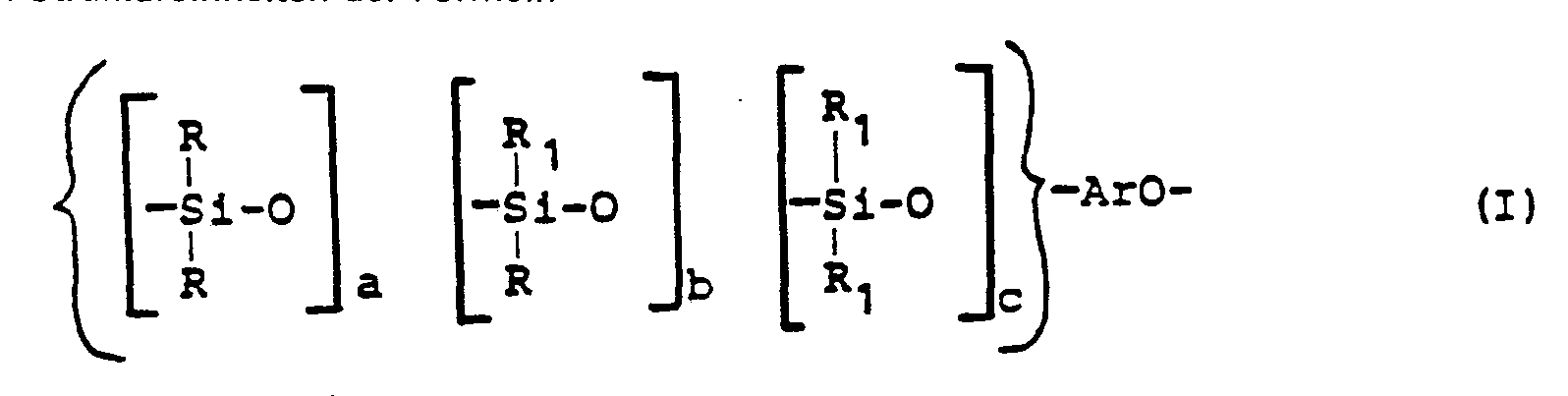


- R und R1 jeweils gegebenenfalls durch Halogen substituiertes C1-C20-Alkyl, C2-C6-Alkenyl, C6-C14-Aryl, C7-C15-Aralkyl oder C7-C15-Alkaryl,
- a, b und c zusammen eine Zahl won 10 bis 100, vorzugsweise 20 bis 80,
- Ar einen ein- oder mehrkernigen aromatischen Rest mit 6 bis 30 C-Atomen bedeuten und
- das Verhältnis m/n 1:9 bis 9:1, insbesondere 3:7 bis 7:3 ist, die dadurch gekennzeichnet sind, daß die Struktureinheiten I 0,5 bis 7,5, vorzugsweise 1 bis 5 Gew.-% und die Summe der Struktureinheiten II und III 99,5 bis 92,5, vorzugsweise 99 bis 95 Gew.-% des Siloxan-Polyester(carbonat)-Blockcopolymeren (ohne Berücksichtigung der Endgruppen), und das Verhältnis der lso- zu Terephthalsäureeinheiten in den Struktureinheiten II und III 3:7 bis 7:3, vorzugsweise 4,5:5,5 bis 5,5:4,5 betragen.
- Die Länge der Blöcke II und III ergibt sich aus der Zahl und Länge der Blöcke I und der Bedingung I+II+III = 100%.
- Die erfindungsgemäßen Siloxan-Polyester(carbonat)-Blockcopolymere können erhalten werden, indem man mindestens ein Bisphenol der Formel


- Besonders bevorzugte Diphenole der Formel (IV) sind Hydrochinon, Resorcin und solche, bei denen Ar der Formel
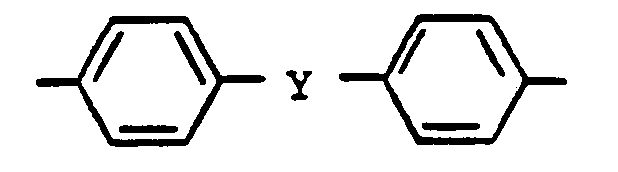
- Y eine Einfachbindung, einen Alkylen- oder Alkylidenrest mit 1-7 C-Atomen, einen Cycloalkylen- oder Cycloalkylidenrest mit 5-12 C-Atomen, -0-, -S-,

- sowie deren kernalkylierte und kernhalogenierte Derivate, z.B. Dihydroxydiphenyle, Bis-(hydroxyphenyl)-alkane, Bis-(hydroxyphenyl)-cycloalkane, Bis-(hydroxyphenyl)-sulfide, Bis-(hydroxyphenyl)-ether, Bis-(hydroxyphenyl)-ketone, Bis-(hydroxyphenyl)-sulfoxide, Bis-(hydroxyphenyl)-sulfone und a,a'-Bis-(hydroxyphenyl)-diisopropylbenzole
- sowie deren kernalkylierte und kernhalogenierte Verbindungen, insbesondere z.B. Bisphenol A, Tetramethylbisphenol A, 1,1-Bis-(4-hydroxyphenyl)-isobutan, 1,1-Bis-(4-hydroxyphenyl)-cyclohexan, 4,4'-Dihydroxydiphenylsulfid, 4,4'-Dihydroxydiphenyl, 4,4'-Dihydroxydiphenylsulfon sowie deren di- und tetrahalogenierten Derivate. Besonders bevorzugt ist Bisphenol A.
- Als Kettenabbrecher werden vorzugsweise Phenol, Alkylphenole mit Cl-C12-Alkylgruppen, halogenierte Phenole, Hydroxydiphenyl, Naphthole, Chlorkohlensäureester aus solchen phenolischen Verbindungen und Chloride von aromatischen Monocarbonsäuren, die gegebenenfalls durch C1-C22-Alkylgruppen und Halogenatome substituiert sein können, in Mengen von 0,1 bis 10 Mol-% (im Falle von Phenolen bezogen auf Diphenole, im Falle von Säurechloriden bezogen auf Säuredichlorid) verwendet.
- Als Verzweigungsmittel lassen sich vorzugsweise 3- oder mehrfunktionelle Carbonsäurechloride oder 3- oder höherwertige Phenole in Menge von 0,01 bis 1 Mol-%, bezogen auf eingesetzte Dicarbonsäurechloride bzw. auf eingesetzte Diphenole, verwenden.
- Als Katalysator für die Polykondensationsreaktion können 0,5 bis 5 Mol-% (bezogen auf die Summe der Mole aus eingesetzten Diphenolen und Diorganosiloxanen) quartärer Ammonium- oder Phosphoniumverbindungen oder tertiärer Amine in die wäßrige alkalische Phase eingetragen werden.
- Bevorzugte Katalysatoren entsprechen der Formel
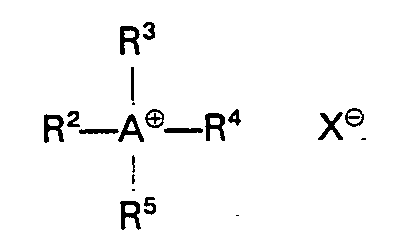
- A ein Stickstoff- oder Phosphoratom,
- X Chlor oder Brom und
- R2, R3, R4, R5 C1-C20-Alkyl, C5 C10-Cycloalkyl, C7-C30-Alkaryl oder -Aralkyl
bedeuten und zwei der Reste R2 bis RS gegebenenfalls verknüpft sind, oder der Formel
- Insbesondere bevorzugte Katalysatoren sind Tetrabutylammoniumbromid, Triphenylbenzylphosphoniumbromid, N-Ethyl-piperidin.
- Bevorzugte organische, mit Wasser nicht mischbare Lösungsmittel sind beispielsweise Dichlormethan, Chloroform, Tri- und Tetrachlorethylen, Tetrachlorethane, Chlorbenzol, Dichlorbenzole und deren Gemische.
- Man geht zweckmäßig so vor, daß man das Bisphenol in wäßrig alkalischer Phase löst, den Katalysatoren zusetzt, die wäßrige Lösung mit dem organischen Lösungsmittel überschichtet und in beliebiger Reihenfolge oder auch gleichzeitig das Diorganopolysiloxan, gelöst z.B. in dem schon zuvor verwendeten organischen Lösungsmittel, den Kettenabbrecher, das lso-/Terephthalsäuredichloridgemisch, gelöst z.B. in dem schon zuvor verwendeten organischen Lösungsmittel, und gegebenenfalls Phosgen einträgt.
- Man hält die Reaktion unter intensivem Rühren und unter Ausschluß von Luftsauerstoff bei 0 bis 40°C, vorzugsweise 15 bis 30°C.
- Die Reaktion dauert etwa 10-60 Minuten. Man isoliert die organische Phase, wäscht diese und isoliert das Polymer durch Abdampfen des organischen Lösungsmittels, z.B. in einem Ausdampfextruder. -
- Die erfindungsgemäßen Blockpolymeren besitzen ein mittleres Molekulargewicht von Mw (Gewichtsmittel, bestimmt durch Ultrazentrifugation oder Streulichtmessung) von 10000 bis 200 000, vorzugsweise von 15 000 bis 50 000 und relative Lösungsviskositäten ηrel von 1,15 bis 2,15, vorzugsweise 1,20 bis 1,50, gemessen in 0,5 gew.%iger Lösung in Dichlormethan bei 25°C.
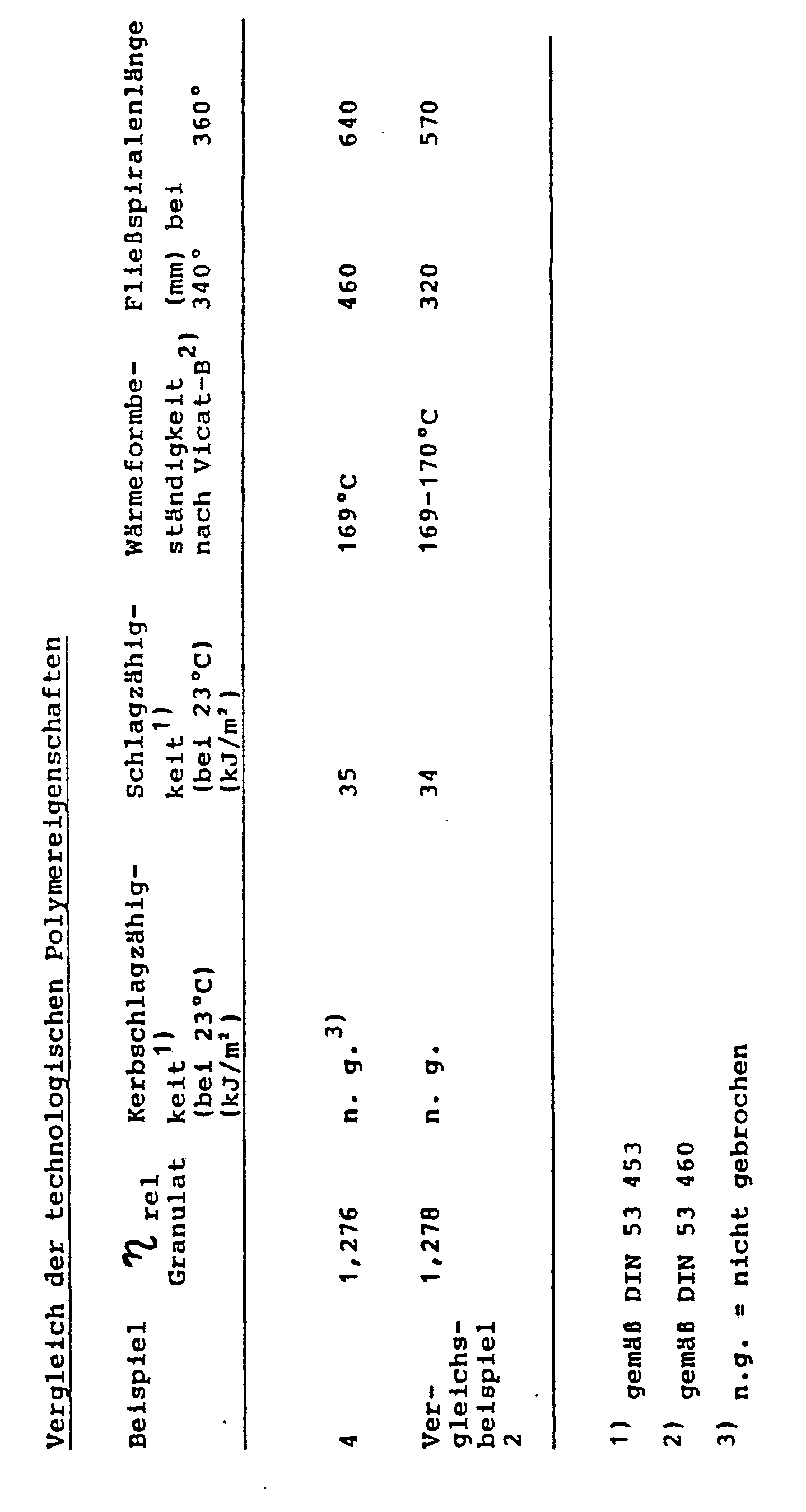
- Die erfindungsgemäß mit Siloxan-Blöcken modifizierten aromatischen Polyester und Polyestercarbonate zeigen im Vergleich zu den unmodifizierten aromatischen Polyestern und Polyestercarbonaten eine wesentlich verbesserte Schmelzfließfähigkeit und ein verbessertes Entformungsverhalten ohne Minderung der Wärmeformbeständigkeit.
- Dadurch wird die technische Verwendung der erfindungsgemäßen siloxan-modifizierten Polyester bzw. Polyestercarbonate zur Herstellung von Formmassen nach thermoplastischen Verarbeitungsverfahren erleichtert.
- Den erfindungsgemäßen Blockcopolymeren können gegebenenfalls noch Farbstoffe, Pigmente, Stabilisatoren, Flammschutzmittel oder Füllstoffe wie Glasfasern zugesetzt werden, ohne daß dadurch die durch die Siloxan-Modifizierung bewirkte Verbesserung des Schmelzfließverhaltens und der Entformung gemindert wird.
- Die erfindungsgemäßen Blockcopolymere finden überall dort Anwendung, wo Formkörper in großer Stückzahl mit kurzen Zykluszeiten vollautomatisch im Spritzgießverfahren hergestellt werden, z.B. auf dem elektrotechnischen Gerätebausektor, z.B. für die Herstellung von Steckerleisten, Spulenkörpern, komplizierten Gehäusen und Schaltkästen.
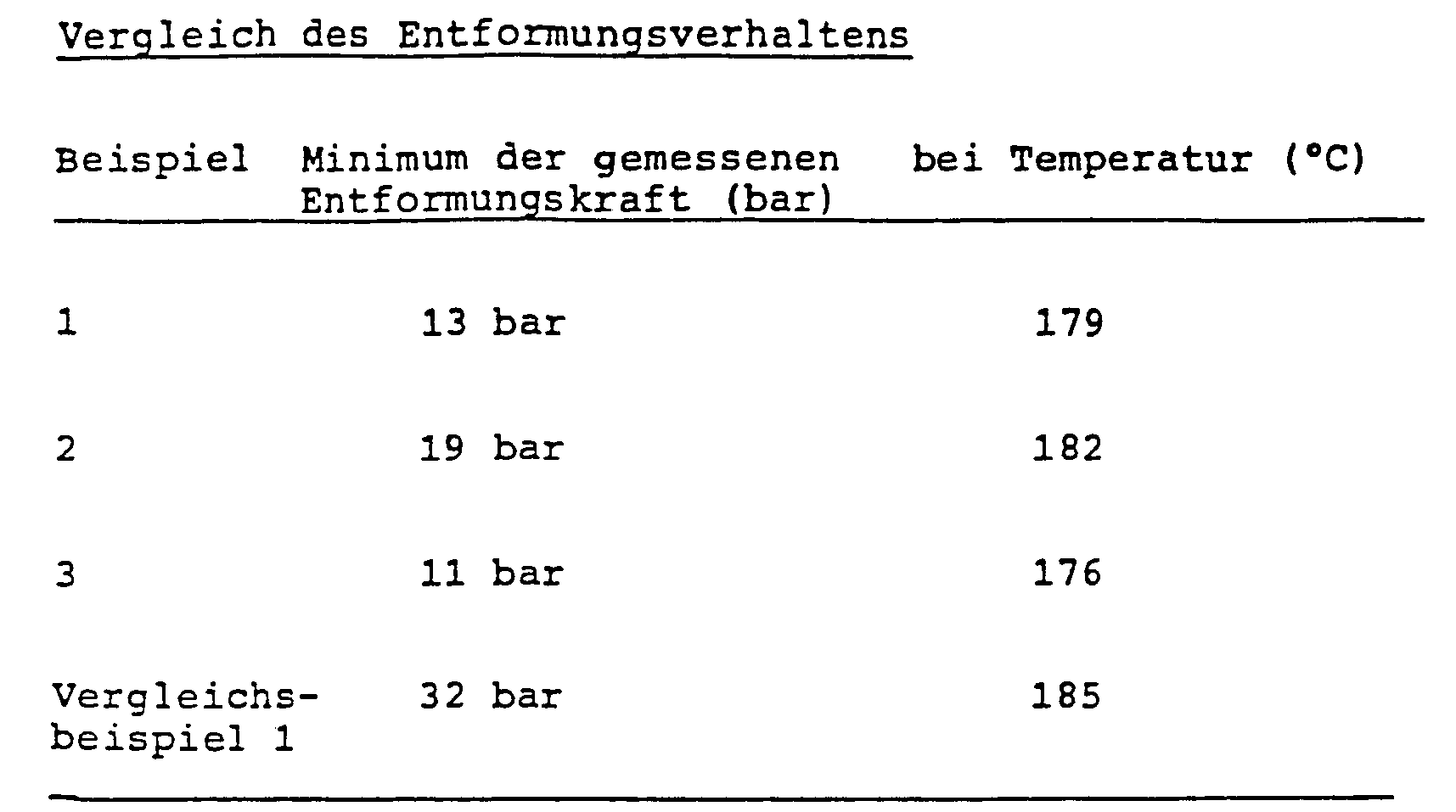
- Die Verbesserung des Entformungsverhaltens wird durch die Messung der bei der Entformung von Spritzgußmassen benötigten_Entformungskräfte ermittelt. Hierbei wird der im Ölzylinder des Auswerfsystems bei der Entformung auftretende Druck über eine optisches und gleichzeitig schreibendes Anzeigegerät sichtbar gemacht. Hierbei wird der Druck in dem Auswerfersystem geprüft, der sich beim Füllen eines konischen Zylinders (35 mm Länge, 40 mm und 42 mm Durchmesser, Wandstärke 2 mm) durch das Polymer bei einer bestimmten Werkzeugtemperatur aufbaut.
- Zur Messung der Schmelzfließfähigkeit werden auf einer Spritzgußmaschine des Typs Arburg E 270 (Hersteller: Fa. Arburg) unter einem Druck von 110 bar und bei Extrusionstemperaturen von 340 bis 360°C spiralenförmige Streifen mit den Abmessungen 2 mm x 8 mm hergestellt, wobei der Querschnitt des konischen Stangenausgusses 6 und 8 mm2 beträgt. Die Formtemperatur beträgt 90°C. Die Länge der erhaltenen spiralenförmigen Streifen ist ein Proportionalmaß für die Schmelzfließfähigkeit des Polymers.
- Zur Überprüfung des Molekülabbaus wurden jeweils nach dem Verspritzen der Flachspiralen die relativen Lösungsviskositäten der Polymeren gemessen, um sicherzustellen, daß keine scheinbare Fließfähigkeitsverbesserung infolge Molekulargewichtsverminderung durch Molekülabbau vorgetäuscht wird.
- 2214 g (9,71 Moi) Bisphenol A wurden enter Stickstoffatmosphäre in 1827,4 g (21,38 Mol) 46,8 gew.- %iger wäßriger Natronlauge und 56 I destilliertem Wasser gelöst.
- Anschließend wurden unter Rühren 32,2 g (1 Mol % bezogen auf Bisphenol) Tetrabutylammoniumbromid 11,7 I Dichlormethan und 6,3 I Chlorbenzol zugegeben.
- Zu diesem Reaktionsgemisch wurde unter intensivem Rühren eine Lösung von 179 g (0,20 Mol) des Diorganosiloxans der Formel V/I

- Bei einer Temperatur von 20 bis 25°C wurde anschließend innerhalb von 2 Minuten eine Lösung von 1015 g (5 Mol) Terephthalsäuredichlorid, 1015 g (5 Mol) Isophthalsäuredichlorid und 119,5 g p-Isooctylphenol (5,8 Mol %, bezogen auf Mole Bisphenol A plus Diorganosiloxan) in 3045 g Chlorbenzol in das Reaktionsgemisch unter Rühren eingetragen. Man ließ bei pH = 11-12 ca. 50 Minuten nachreagieren, isolierte die organische Phase, wusch diese elektrolytfrei und isoliert das resultierende Polymer nach Eingengen der organischen gewaschenen Lösung über einen Ausdampfextruder (Massetemperatur: 325°C).
- Man erhielt 3,8 kg eines Siloxan-Polyester-Blockcopolymers mit einer relativen Lösungsviskosität ηrel von 1,272. Der Gehalt an Dimethylsiloxanstrukturen betrug 4,4 Gew.-% (bestimmt durch NMR-Analyse).
- Es wurde ein Siloxan-Polyester-Blockcopolymer synthetisiert analog der im Beispiel 1 genannten Verfahrensweise, wobei jedoch folgende Einwageänderungen vorgenommen wurden:
- Es wurden 2254,9 g (9,89 Mol) Bisphenol A und 19,7 g (0,022 Mol) des Diorganosiloxans (V/1), gelöst in 1582 g Chlorbenzol, in das Reaktionsgemisch eingebracht, ohne Art und Menge der anderen Reaktionspartner zu ändern. Nach analoger Aufarbeitung erhielt man 3,9 kg eines Siloxan-Polyester-Blockcopolymers mit einer relativen Lösungsviskosität nre) von 1,268. Der Gehalt an Dimethylsiloxanstrukturen betrug 0,5 Gew.-% (bestimmt durch NMR-Analyse).
- Es wurde ein Siloxan-Polyester-Blockcopolymer analog der in Beispiel 1 genannten Verfahrensweise synthetisiert, wobei jedoch folgende Einwageänderungen vorgenommen wurden:
- Es wurden 2192,1 g (9,61 Mol) Bisphenol A und 268,5 g (0,30 Mol) des Diorganosiloxans (Vl1), gelöst in 2130 g Chlorbenzol, in das Reaktionsgemisch eingetragen, ohne Art und Menge der anderen Reaktionspartner zu ändern. Nach analoger Aufarbeitung erhielt man 3,8 kg eines Siloxan-Polyester-Blockcopolymers mit einer relativen Lösungsviskosität ηrel von 1,273. Der Gehalt an Dimethylsiloxanstrukturen betrug 6,7 Gew.-% (bestimmt durch NMR-Analyse).
- Analog der in Beispiel 1 genannten Verfahrenweise wurde ein aromatischer Polyester auf Basis Bisphenol A, lso-/Terephthsalsäure (1:1) und Isooctylphenol als Kettenabbrecher hergestellt, dessen relative Lösungsviskosität ηrel 1,273 beträgt (Verwendung von 3,9 Mol-% Isooctylphenol).

- 2153,7 g (9,446 Mol) Bisphenol A wurden unter Stickstoffatmosphäre in 1795,6 g (20,2 Mol) 45 gew.- %iger wäßriger Natronlauge und 64 I destilliertem Wasser gelöst.
- Anschließend wurden unter Rühren 13,5 ml N-Ethylpiperidin (2 Mol-%, bezogen auf Bisphenol), 10,3 I Dichlormethan und 11,2 I Chlorbenzol zugegeben.
- Zu diesem Reaktionsgemisch wurde unter intensivem Rühren eine Lösung von 138,73 g (0,155 Mol) des Diorganosiloxans gemäß Beispiel 1 in 1413 g Chlorbenzol eingetragen.
- Bei einer Temperatur von 20 bis 25°C wurde anschließend innerhalb von 5 Minuten eine Lösung von 421,2 g (2,075 Mol) Terephthalsäuredichlorid, 421,2,g (2,075 Mol) Isophthalsäuredichlorid un 86,0 g (4,15 Mol-%, bezogen auf Mole Bisphenol A und Diorganosiloxan) p-Isooctylphenol in 1264 g Chlorbenzol in das Reaktionsgemisch unter Rühren eingetragen. Man ließ 1/2 Stunde bei pH 11-12 reagieren, fügte 840 g 45%iger wäßriger Natronlauge zu und leitete bei pH 13 innerhalb von 15 Minuten 890 g (9 Mol) Phosgen ein. Durch Zugabe von 100 g 45 gew.-%iger wäßriger Natronlauge wurde der pH-Wert während der Phosgeneinleitung auf 13 gehalten. Man ließ 15 Minuten nachreagieren, wusch die organische Phase elektrolytfrei und isolierte das Polymer wie im Beispiel 1 beschrieben.
- Men erhielt 2,8 kg eines Siloxan-Polyestercarbonat-Blockcopolymeren mit einer relativen Lösungsviskosistät ηrel von 1,276. Der Gehalt an Dimethylsiloxanstrukturen betrug 4,3 Gew.-% (bestimmt durch NMR-Analyse). Gehalt an Estergruppen im Polyestercarbonatblockanteil: 50,1 Mol-% (bestimmt durch Totalverseifung).
- 2280 g (10 Mol) Bisphenol A wurden unter Stickstoffatmosphäre in einer Lösung von 808 g (20,2 Mol) Natriumhydroxid in 64 I destilliertem H20 gelöst. Unter Rühren wurden 13,5 ml (2 Mol-%, bezogen auf Bisphenol A) N-Ethylpiperidin, 10,3 I Dichlormethan und 11,2 I Chlorbenzol zugegeben. Zu diesem Reaktionsgemisch wurde unter intensivem Rühren eine Lösung von 421,2 g (2,075 Mol) Terephthalsäuredichlorid, 421,2 g (2,075 Mol) Isophthalsäuredichlorid und 82,0 g (4,0 Mol-%, bezogen auf Bisphenol A) p-Isooctylphenol in 1264 g Chlorbenzol innerhalb von 5 Minuten eingetragen. Man ließ eine 1/2 Stunde bei pH 11-12 reagieren, gab 7,5 1 5 gew.-%ige wäßrige Natronlauge zu und leitete bei pH 13 innerhalb von 15 Minuten 890 g (9 Mol) Phosgen ein. Durch Zugabe von 300 g 45 gew.-%iger wäßriger Natronlauge wurde eine pH-Wert von 13 eingehalten. Man ließ 15 Minuten nachreagieren, isolierte und wusch die organische Phase wie in Beispiel 4 und arbeitete analog auf. Man erhielt 3,0 kg eines aromatischen Polyestercarbonats, das 50 Mol-% Carbonatstrukturen und 50 Mol-% Iso-/Terephthalatstrukturen enthielt, wobie das Verhältnis von Isophthalat zu Terephthalat 1:1 war.
- Die relative Lösungsviskosität des Polymers nre) betrug 1,278.

Claims (5)


dadurch gekennzeichnet sind, daß die Struktureinheiten I 0,5 bis 7,5 Gew.-% und die Summe der Struktureinheiten II und III 99,5 bis 92,5 95 Gew.-% des Siloxan-Polyester(carbonat)-Blockcopolymeren (ohne Berücksichtigung der Endgruppen), und das Verhältnis der Iso- zu Terephthalsäureeinheiten in den Struktureinheiten II und III 3:7 bis 7:3 betragen.


Applications Claiming Priority (2)
| Application Number | Priority Date | Filing Date | Title |
|---|---|---|---|
| DE3344911 | 1983-12-13 | ||
| DE19833344911 DE3344911A1 (de) | 1983-12-13 | 1983-12-13 | Thermoplastische polysiloxan-polyester(carbonat)-blockcopolymere, ihre herstellung und verwendung |
Publications (3)
| Publication Number | Publication Date |
|---|---|
| EP0146827A2 EP0146827A2 (de) | 1985-07-03 |
| EP0146827A3 EP0146827A3 (en) | 1987-10-21 |
| EP0146827B1 true EP0146827B1 (de) | 1990-09-19 |
Family
ID=6216727
Family Applications (1)
| Application Number | Title | Priority Date | Filing Date |
|---|---|---|---|
| EP84114609A Expired - Lifetime EP0146827B1 (de) | 1983-12-13 | 1984-12-01 | Thermoplastische Polysiloxan-Polyester(carbonat)-Block-copolymere, ihre Herstellung und Verwendung |
Country Status (4)
| Country | Link |
|---|---|
| US (1) | US4681922A (de) |
| EP (1) | EP0146827B1 (de) |
| JP (1) | JPS60141723A (de) |
| DE (2) | DE3344911A1 (de) |
Families Citing this family (27)
| Publication number | Priority date | Publication date | Assignee | Title |
|---|---|---|---|---|
| DE3535283A1 (de) * | 1985-10-03 | 1987-04-09 | Byk Chemie Gmbh | Polyestergruppenhaltige polysiloxane fuer lacke und formmassen und die verwendung hierfuer |
| US4937277A (en) * | 1988-05-16 | 1990-06-26 | Rhone-Poulenc Specialty Chemicals, L.P. | Alkoxylated silicon polymers |
| DE3838106A1 (de) * | 1988-11-10 | 1990-05-17 | Bayer Ag | Thermoplastische polyestercarbonat-polysiloxan-blockcopolymere |
| US5191036A (en) * | 1989-02-23 | 1993-03-02 | Mitsubishi Rayon Co., Ltd. | Thermoplastic resin composition |
| WO1991000885A1 (fr) * | 1989-07-07 | 1991-01-24 | Idemitsu Petrochemical Co., Ltd. | Copolymere de polycarbonate-polydimethylsiloxane et son procede de production |
| DE3924992A1 (de) * | 1989-07-28 | 1991-01-31 | Bayer Ag | Spezielle polydiorganosiloxanblockcopolycarbonate |
| US5011899A (en) * | 1989-08-15 | 1991-04-30 | General Electric Company | Copoly(aromatic sulfone carbonate - aromatic alkylcarbonate) - polysiloxane block copolymer |
| DE3929401A1 (de) * | 1989-09-05 | 1991-03-07 | Bayer Ag | Thermoplastische polyestercarbonat-polysiloxan-blockcopolymere |
| US5214118A (en) * | 1990-10-05 | 1993-05-25 | General Electric Company | Process for synthesis of polyestercarbonate-siloxane copolymers |
| EP0517927B1 (de) * | 1990-12-27 | 1999-06-02 | Idemitsu Petrochemical Co., Ltd. | Polycarbonatharzzusammensetzung |
| DE69224938T2 (de) * | 1991-07-01 | 1998-10-22 | Gen Electric | Terpolymer mit aliphatischen Polyestersegmenten, Polysiloxansegmenten und Polycarbonatsegmenten |
| US5246807A (en) * | 1991-08-05 | 1993-09-21 | Canon Kabushiki Kaisha | Electrophotographic photosensitive member, and electrophotographic apparatus, device unit, and facsimile machine employing the same |
| US5254423A (en) * | 1991-10-17 | 1993-10-19 | Canon Kabushiki Kaisha | Electrophotographic photosensitive member, and electrophotographic apparatus, device unit and facsimile machine having the photosensitive member |
| US5932677A (en) * | 1993-05-27 | 1999-08-03 | General Electric Company | Terpolymer having aromatic polyester, polysiloxane and polycarbonate segments |
| DE69415594T2 (de) * | 1993-07-09 | 1999-08-12 | General Electric Co., Schenectady, N.Y. | Siloxanpolyestercarbonatblockterpolymerzusammensetzungen und wärmebeständiges Polycarbonat |
| US5523379A (en) * | 1994-12-21 | 1996-06-04 | General Electric Plastics | High molecular weight stabilizer compounds for stabilizing polymers |
| DE19910975A1 (de) | 1999-03-09 | 2000-09-21 | Goldschmidt Ag Th | Carbonatgruppen enthaltende, mit linearen Polyestern modifizierte Polysiloxane und ihre Verwendung als Zsatzstoffe in Beschichtungen |
| US7790292B2 (en) * | 1999-05-18 | 2010-09-07 | Sabic Innovative Plastics Ip B.V. | Polysiloxane copolymers, thermoplastic composition, and articles formed therefrom |
| US7169859B2 (en) * | 1999-05-18 | 2007-01-30 | General Electric Company | Weatherable, thermostable polymers having improved flow composition |
| US7605221B2 (en) * | 1999-05-18 | 2009-10-20 | Sabic Innovative Plastics Ip B.V. | Weatherable, thermostable polymers having improved flow composition |
| EP1611176B1 (de) * | 2003-02-21 | 2015-09-09 | SABIC Global Technologies B.V. | Verfahren zur herstellung von transparenten und wärmebeständigen polycarbonat-polysiloxan copolymeren |
| US7135538B2 (en) * | 2003-11-12 | 2006-11-14 | General Electric Company | Transparent polycarbonate-polysiloxane copolymer blend, method for the preparation thereof, and article derived therefrom |
| US7638091B2 (en) * | 2004-07-02 | 2009-12-29 | Sabic Innovative Plastics Ip B. V. | Methods of sterilizing polycarbonate articles and methods of manufacture |
| US7718733B2 (en) * | 2004-12-20 | 2010-05-18 | Sabic Innovative Plastics Ip B.V. | Optically clear polycarbonate polyester compositions |
| US7321014B2 (en) * | 2004-12-29 | 2008-01-22 | General Electric Company | Transparent compositions, methods for the preparation thereof, and articles derived therefrom |
| US20070083026A1 (en) * | 2005-10-11 | 2007-04-12 | General Electric Company | Polyarylate-siloxane copolymers |
| US20090069489A1 (en) * | 2007-09-12 | 2009-03-12 | Peter Vollenberg | Polycarbonate-poly(ester-ether) copolymer composition, method of manufacture, and articles therefrom |
Family Cites Families (10)
| Publication number | Priority date | Publication date | Assignee | Title |
|---|---|---|---|---|
| US3749757A (en) * | 1970-04-27 | 1973-07-31 | Owens Corning Fiberglass Corp | Siloxane modified polyester fiber containing elastomer |
| US3701815A (en) * | 1971-01-20 | 1972-10-31 | Union Carbide Corp | Thermoplastic siloxane-polyester block copolymers |
| US3861915A (en) * | 1973-03-30 | 1975-01-21 | Eastman Kodak Co | Block copolyesters of polysiloxanes as additives to photoconductive layers |
| US3935154A (en) * | 1973-03-30 | 1976-01-27 | Eastman Kodak Company | Block copolyesters of polysiloxanes |
| US3994988A (en) * | 1975-03-10 | 1976-11-30 | Baxter Laboratories, Inc. | Thermoplastic copolymers of polysiloxane polycarbonate and polyester constituents |
| CA1055641A (en) * | 1976-04-12 | 1979-05-29 | Dean G. Laurin | Thermoplastic copolymers of polysiloxane polycarbonate and polyester constituents |
| DE3007934A1 (de) * | 1980-03-01 | 1981-09-17 | Bayer Ag, 5090 Leverkusen | Aromatische polyestercarbonate, verfahren zu ihrer herstellung und ihre verwendung zur herstellung von spritzgussartikeln, folien und ueberzuegen |
| DE3208332A1 (de) * | 1982-03-09 | 1983-09-15 | Bayer Ag, 5090 Leverkusen | Hochmolekulare aromatishe polyester, verfahren zu ihrer herstellung und ihre verwendung zur herstellung von formkoerpern |
| US4496704A (en) * | 1983-03-07 | 1985-01-29 | The Goodyear Tire & Rubber Company | High slip polyester films containing siloxane units |
| US4539379A (en) * | 1984-05-25 | 1985-09-03 | General Electric Company | Method for making silicone-polyester copolymers |
-
1983
- 1983-12-13 DE DE19833344911 patent/DE3344911A1/de not_active Withdrawn
-
1984
- 1984-11-29 US US06/676,483 patent/US4681922A/en not_active Expired - Lifetime
- 1984-12-01 DE DE8484114609T patent/DE3483250D1/de not_active Expired - Lifetime
- 1984-12-01 EP EP84114609A patent/EP0146827B1/de not_active Expired - Lifetime
- 1984-12-10 JP JP59259428A patent/JPS60141723A/ja active Pending
Non-Patent Citations (1)
| Title |
|---|
| Römpps Chemielexikon, Stichwort "Silikone" * |
Also Published As
| Publication number | Publication date |
|---|---|
| DE3483250D1 (de) | 1990-10-25 |
| EP0146827A2 (de) | 1985-07-03 |
| JPS60141723A (ja) | 1985-07-26 |
| EP0146827A3 (en) | 1987-10-21 |
| DE3344911A1 (de) | 1985-06-13 |
| US4681922A (en) | 1987-07-21 |
Similar Documents
| Publication | Publication Date | Title |
|---|---|---|
| EP0146827B1 (de) | Thermoplastische Polysiloxan-Polyester(carbonat)-Block-copolymere, ihre Herstellung und Verwendung | |
| EP0036080B1 (de) | Aromatische Polyestercarbonate, Verfahren zu ihrer Herstellung und ihre Verwendung zur Herstellung von Spritzgussartikeln, Folien und Überzügen | |
| EP0087038B1 (de) | Verwendung von farbhellen Polyphenylensulfiden in Mischungen mit thermoplastischen Polycarbonaten und/oder thermoplastischen Polyestern | |
| EP0208105B1 (de) | Verfahren zur Herstellung von Copolyphosphonaten mit hoher Zähigkeit | |
| EP0004020B1 (de) | Polycarbonat-Formmassen mit verbesserten zähelastischen Eigenschaften | |
| EP0042561A1 (de) | Flammwidrige Formmassen auf Basis thermoplastischer aromatischer Polyester, Verfahren zu ihrer Herstellung und ihre Verwendung zur Herstellung von Formkörpern | |
| EP0146887B1 (de) | Verfahren zur Herstellung von aromatischen Polyestercarbonaten | |
| DE3751211T2 (de) | In-situ Blockierung mit Endgruppen von in der Schmelze hergestellten aromatischen Polyestern zur Produktion von Polymeren mit verbesserter Stabilität. | |
| DE2423990C3 (de) | Formmasse aus einem aromatischen Copolyester und Poly(äthylenoxybenzoat) | |
| EP0151750A1 (de) | Verfahren zur Herstellung von farblosen aromatischen Polyestercarbonaten | |
| DE69006522T2 (de) | Aromatische Polyester-Siloxan-Blockcopolymere und Verfahren zu deren Herstellung. | |
| EP0416376B1 (de) | Thermoplastische Polyestercarbonat-Polysiloxan-Blockcopolymere | |
| EP0097861B1 (de) | Aromatische Polyestercarbonate mit hoher Kerbschlagzähigkeit und Verfahren zu ihrer Herstellung | |
| EP0201830B1 (de) | Verfahren zur Herstellung von Copolyphosphonaten mit hoher Kerbschlagzähigkeit | |
| EP0065728B1 (de) | Neue Copolyestercarbonate und deren Abmischung mit bekannten Polycarbonaten zu thermoplastischen Formmassen | |
| DE2753230A1 (de) | Verfahren zur herstellung aromatischer polyester | |
| EP0368104B1 (de) | Thermoplastische Polyestercarbonat-Polysiloxan-Blockcopolymere | |
| EP0014412B1 (de) | Thermoplastische Massen und Verfahren zu ihrer Herstellung | |
| DE2333017A1 (de) | Zubereitungen auf copolyester-basis mit herabgesetzter haarrissbildung und verbesserter verpress- bzw. verformbarkeit | |
| DE69423178T2 (de) | Verzweigte Copolyestercarbonate | |
| EP0332998B1 (de) | Mischungen aus aromatischen Polycarbonaten und/oder aromatischen Polyestern mit speziellen Copolymeren | |
| DE3208332A1 (de) | Hochmolekulare aromatishe polyester, verfahren zu ihrer herstellung und ihre verwendung zur herstellung von formkoerpern | |
| EP0312872B1 (de) | Neue Pfropfcopolymere, Verfahren zu ihrer Herstellung und ihre Verwendung | |
| EP0442062B1 (de) | Monofunktionelle Polyacrylate, ihre Herstellung und Verwendung zur Herstellung von Polycarbonaten | |
| EP0219708A1 (de) | Aromatische Polyestercarbonate, Verfahren zu ihrer Herstellung und ihre Verwendung zur Herstellung von Formkörpern, Folien und Überzügen |
Legal Events
| Date | Code | Title | Description |
|---|---|---|---|
| PUAI | Public reference made under article 153(3) epc to a published international application that has entered the european phase |
Free format text: ORIGINAL CODE: 0009012 |
|
| 17P | Request for examination filed |
Effective date: 19841206 |
|
| AK | Designated contracting states |
Designated state(s): DE FR GB IT NL |
|
| PUAL | Search report despatched |
Free format text: ORIGINAL CODE: 0009013 |
|
| AK | Designated contracting states |
Kind code of ref document: A3 Designated state(s): DE FR GB IT NL |
|
| 17Q | First examination report despatched |
Effective date: 19890519 |
|
| GRAA | (expected) grant |
Free format text: ORIGINAL CODE: 0009210 |
|
| AK | Designated contracting states |
Kind code of ref document: B1 Designated state(s): DE FR GB IT NL |
|
| REF | Corresponds to: |
Ref document number: 3483250 Country of ref document: DE Date of ref document: 19901025 |
|
| ET | Fr: translation filed | ||
| ITF | It: translation for a ep patent filed | ||
| ITTA | It: last paid annual fee | ||
| GBT | Gb: translation of ep patent filed (gb section 77(6)(a)/1977) | ||
| PLBE | No opposition filed within time limit |
Free format text: ORIGINAL CODE: 0009261 |
|
| STAA | Information on the status of an ep patent application or granted ep patent |
Free format text: STATUS: NO OPPOSITION FILED WITHIN TIME LIMIT |
|
| 26N | No opposition filed | ||
| PGFP | Annual fee paid to national office [announced via postgrant information from national office to epo] |
Ref country code: GB Payment date: 19911122 Year of fee payment: 8 |
|
| PGFP | Annual fee paid to national office [announced via postgrant information from national office to epo] |
Ref country code: FR Payment date: 19911218 Year of fee payment: 8 |
|
| PGFP | Annual fee paid to national office [announced via postgrant information from national office to epo] |
Ref country code: NL Payment date: 19911231 Year of fee payment: 8 |
|
| PG25 | Lapsed in a contracting state [announced via postgrant information from national office to epo] |
Ref country code: GB Effective date: 19921201 |
|
| PG25 | Lapsed in a contracting state [announced via postgrant information from national office to epo] |
Ref country code: NL Effective date: 19930701 |
|
| GBPC | Gb: european patent ceased through non-payment of renewal fee |
Effective date: 19921201 |
|
| NLV4 | Nl: lapsed or anulled due to non-payment of the annual fee | ||
| PG25 | Lapsed in a contracting state [announced via postgrant information from national office to epo] |
Ref country code: FR Effective date: 19930831 |
|
| REG | Reference to a national code |
Ref country code: FR Ref legal event code: ST |
|
| PGFP | Annual fee paid to national office [announced via postgrant information from national office to epo] |
Ref country code: DE Payment date: 19951114 Year of fee payment: 12 |
|
| PG25 | Lapsed in a contracting state [announced via postgrant information from national office to epo] |
Ref country code: DE Effective date: 19970902 |