EP0143584A2 - Teilband-Codierer, Decodierer und Filter - Google Patents
Teilband-Codierer, Decodierer und Filter Download PDFInfo
- Publication number
- EP0143584A2 EP0143584A2 EP84307934A EP84307934A EP0143584A2 EP 0143584 A2 EP0143584 A2 EP 0143584A2 EP 84307934 A EP84307934 A EP 84307934A EP 84307934 A EP84307934 A EP 84307934A EP 0143584 A2 EP0143584 A2 EP 0143584A2
- Authority
- EP
- European Patent Office
- Prior art keywords
- filters
- delay
- filter
- band
- filter arrangement
- Prior art date
- Legal status (The legal status is an assumption and is not a legal conclusion. Google has not performed a legal analysis and makes no representation as to the accuracy of the status listed.)
- Granted
Links
Images

Classifications
-
- H—ELECTRICITY
- H04—ELECTRIC COMMUNICATION TECHNIQUE
- H04B—TRANSMISSION
- H04B1/00—Details of transmission systems, not covered by a single one of groups H04B3/00 - H04B13/00; Details of transmission systems not characterised by the medium used for transmission
- H04B1/66—Details of transmission systems, not covered by a single one of groups H04B3/00 - H04B13/00; Details of transmission systems not characterised by the medium used for transmission for reducing bandwidth of signals; for improving efficiency of transmission
- H04B1/667—Details of transmission systems, not covered by a single one of groups H04B3/00 - H04B13/00; Details of transmission systems not characterised by the medium used for transmission for reducing bandwidth of signals; for improving efficiency of transmission using a division in frequency subbands
-
- G—PHYSICS
- G10—MUSICAL INSTRUMENTS; ACOUSTICS
- G10L—SPEECH ANALYSIS TECHNIQUES OR SPEECH SYNTHESIS; SPEECH RECOGNITION; SPEECH OR VOICE PROCESSING TECHNIQUES; SPEECH OR AUDIO CODING OR DECODING
- G10L19/00—Speech or audio signals analysis-synthesis techniques for redundancy reduction, e.g. in vocoders; Coding or decoding of speech or audio signals, using source filter models or psychoacoustic analysis
- G10L19/02—Speech or audio signals analysis-synthesis techniques for redundancy reduction, e.g. in vocoders; Coding or decoding of speech or audio signals, using source filter models or psychoacoustic analysis using spectral analysis, e.g. transform vocoders or subband vocoders
- G10L19/0204—Speech or audio signals analysis-synthesis techniques for redundancy reduction, e.g. in vocoders; Coding or decoding of speech or audio signals, using source filter models or psychoacoustic analysis using spectral analysis, e.g. transform vocoders or subband vocoders using subband decomposition
Definitions
- Subband coding has been shown to be an effective method of reducing the bit-rate required for the transmission of telephone band signals (R E Crochiere, S A Webber and J L Flanagan, "Digital coding of speech in subbands", Bell Sys Tech J Vol 55 pp 1069-1085 (1976 Oct)). It is a waveform coding technique that can cope with signals from a wide variety of sources, and could, therefore, prove useful in the public switched network. Coding efficiency is achieved by virtue of the fact that the individual subbands can be encoded using differing coding strategies, and these can be optimised to the statistics of the input signals. The method is especially applicable to speech transmission because the coders can be made to exploit certain perceptual effects connected with hearing.
- the technique will result in the quantisation noise at the output of the codec having a similar power spectral distribution to that of the uncoded signal; it is well-known that the human ear is relatively tolerant to noise in the parts of the spectrum occupied by high level wanted signals. Additionally, the higher frequency components can he represented with reduced accuracy because the ear is less sensitive to their absolute content.
- Quadrature mirror filters with a linear phase response (ie a constant delay).
- a filter arrangement comprising a pair of first and second filters for passing respectively frequencies above and below a transition frequency, in which the amplitude responses and the delay responses of the filters are mirror images about the transition frequency, the filters are not quadrature filters and the delay response with respect to frequency of each filter is non-constant. Since the filters are not quadrature filters, the delay response is asymmetrical about the transition frequency.
- the delay is not a minimum and delays add arithmetically in cascaded systems.
- the present proposal permits a reduction of the delay in each filter, and in multi-band cascaded systems the delay peaks can be arranged not to coincide in subsequent filters.
- the filters are minimum phase response filters (ie the z-plane plot contains no zeros outside the unit circle).
- quadrature filters have been employed - viz the phase shifts introduced by the two filters of the pair always differ by 90°. Recognising, however, that this represents an unnecessary constraint, in the invention the first and second filters are not required to have a phase difference of 90°.
- the peaks of the delay response of each filter lie beyond the transition frequency: in this way, in a system in which a signal is divided in a first pair of filters, subsampled, reconverted to the original sampling rate and filtered by a second pair, the peak delay of the signal path through the system can be less than that of the two channels considered separately.
- phase equalisation can be employed as necessary.
- the filters are recursive: although not essential, this is highly desirable from the practical viewpoint to reduce the number of delay stages.
- the invention provides a sub-band coding apparatus having an input for a sampled input signal, first and second filters of the type described above arranged to filter the sampled signal, and means for down-sampling the filtered outputs; and also a decoding apparatus comprising means for restoring the sampling rates of sub-band inputsignals, first and second filters of the type described above for filtering the restored signals, and means for combining the filter outputs to produce a decoded signal.
- the filter parameters are selected such that the overall delay response of the system is, over a substantial portion of the system bandwidth, substantially equi-ripple (ie that the peak-to-peak ripple is substantially constant) and the spacing of the peaks of the delay response is substantially uniform. Generally these peaks will occur at the band transitions. As a consequence, equalisation can readily be carried out by means of a relatively simple polyphase all-pass filter.
- the subbands in SBC schemes are usually contiguous so as to avoid dead-band regions in the final output signal.
- the design of such schemes is complicated by the fact that sampling-rate changes are necessary in order to achieve coding efficiency.
- alias frequency components are generated, and these will cause gross distortion at the output, unless their contribution can be eliminated.
- Esteban and Galand have found a processing arrangement which guarantees alias cancellation at the band recombination node (D Esteban and C Galand, "Applications of quadrature mirror filters to split band voice coding schemes", in IEEE Int on Conf Acoust, Speech, Signal Processing, pp 191-195, Hartford, CT, 1977), and the analysis that they presented will be discussed here, in brief, in order to develop the argument for using the proposed class of filters.
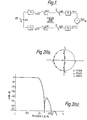
- Fig 1 is the standard block diagram of a 2-band scheme.
- the band-limited input signal is sampled at a rate f s , and separated into two subband components using filters H 1 and H 2 .
- the resulting subband signals are then down-sampled to a rate f s /2 before encoding for transmission.
- Using this strategy there is no net increase in the total number of signal samples/s. This is important because it means that no complicated sampling-rate transformations are involved.
- the band-splitting filters have overlapping transition bands, and will therefore pass signal components with frequencies above the new half-Nyquist value, and this will result in the generation of alias signal components.
- the X(-z) term in this expression represents the z-transform of the alias components. Thus aliases will not appear at the final output if
- the set of network responses that satisfy this condition can be reduced to a useful subset by specifying that the band-splitting be symmetrical about the frequency f s /4, ie H 1 and H 2 have minor image frequency and delay responses. This implies that
- condition 2 will be satisfied if
- Equations 3, 4 and 5 therefore, state a set of criteria that will result in alias-free output signals from this type of subband coder. There is nothing novel about this derivation, but it is reiterated here in order to remind the reader that any extra constraints that the designer applies to the filters are imposed for purposes other than ensuring alias-cancellation.
- RMFs recursive mirror filters
- Equation 3 defines the mirror filter relationship, and equations 4 and 5 define conditions for alias-free signal reconstruction. Substituting these back into equation 1 we get the following expression for the transfer function of the SBC scheme:
- Equation 11 expresses the vector addition of the subband components at the recombination node, and ⁇ (z) is the phase difference between the subband signals at this point.
- Non-quadrature recursive mirror filters have been synthesised using the above procedure, and their performances have been compared with bench-mark FIR QMF designs.
- the order of the recursive networks will be about a quarter of that of their FIR equivalents. This means that the temporary storage requirements for their realisation are approximately halved.
- the abandonment of the quadrature criteria means that more multiplications per second are required for the new class of filters. However, this is offset to some degree by the fact that, because the filters are of much lower order, their responses are less sensitive to coefficient quantisation.
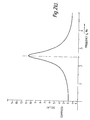
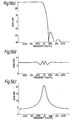
- fig 2(a) The amplitude/frequency response of an 8th-order, half-band recursive mirror filter is shown in fig 2(a), and fig 2(b) is a plot of the locations of the poles and zeros of its transfer function: its delay response is shown in figure 2(c).
- the coefficients are as follows:
- the signal delay at the SBC output will not be the same for all frequencies, whereas, with FIR designs flat delay can be guaranteed.
- the peak of delay in the recursive case can, however, be made substantially less than the system signal delay when using an FIR realisation.
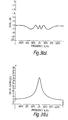
- a plot of the delay response at the SBC output, when using the half-band filters of fig 2, is shown in fig (3b). It can be seen that the peak of delay is around the centre of the band, corresponding to the transition regions of the filters. Hence, in multiband tree-structures, the peaks of delays in the various subbands will not coincide. Thus, with careful design, both the absolute delay and the overall delay ripple can be made small over a large part of the band.
- Table 1 records features of a typical RMF scheme for relative assessment with a comparable FIR QMF design.
- Non-quadrature mirror filters can be designed such that when used in SBC schemes the final output will be free of alias components, and approximate to an "all-pass" amplitude response.
- a particular feature of an SBC scheme using this class of filters is that the peak of the delay response will be reduced compared with the case when QMF pairs are used.
- the new class of filters have the additional advantage of being efficient in filter order. For a given filter amplitude response the order of the recursive filter will be typically one quarter of that of a comparable FIR realisation.
- codec 8-band coder-decoder
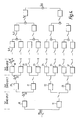
- Figure 4 is a schematic of an 8-band SBC system. It can be seen that this configuration is a 3-tier nesting of the basic 2-band scheme.
- the first pair of band-splitting filters 10,11 should have passband-to-stopband transition regions of approximately ⁇ .045 fl s9 and a minimum stopband rejection of about 40 dB.
- the filters in our solution achieve 40 dBs attenuation by .25 *. 043 fl s , and exhibit much more rejection in the rest of the stophand.
- the peak of delay introduced by this level of band partitioning and recombining should be in the region of 20 sample periods.
- our realisation we chose a pair of filters which resulted in a maximum of 21 samples and a minimum of 3.8 samples delay at the codec output.
- the delays at .25 ⁇ .125 fl are 5 samples.
- Figures 5(a), 5(b) and 5(c) show respectively the amplitude response of the lowband filter 11, the resulting amplitude response contribution to the complete system output, and the delay response contribution at the codec output.
- the signal paths are further split and then processed by the second bank of band-splitting filters 20-23.
- the transition regions of these filters can be broadened with respect to the sampling rate f2 s .
- a relaxed stopband performance is possible with these filters compared with the previous case, because the interband signal level variance is likely to be smaller now that the individual subbands cover less of the original broadband frequency spread.
- a transition regions of around ⁇ .07 f2 and a stopband rejection of about 32 dBs is likely to be adequate.
- the filters used in our realisation have achieved over 30 dBs attenuation by .25 ⁇ .0625 f2 s , and over 35 dBs by .25 ⁇ .07 f2 s .
- the reduced sampling rate does mean, however, that the acceptable number of sample periods delay at each subband recombination node is reduced compared with the previous case.
- a peak delay of approximately 11 sampling periods would be consistent with meeting the delay requirements quoted.
- the peaks of delay were 11.25/f2 s and the minima were 3/f2 s .
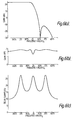
- Figures 6(a), 6(b) and 6(c) show respectively the amplitude responses of the low-band filters, the resulting amplitude response contribution to the complete system at the codec output, and the combined delay response contributions of the first pair of subbands and these second two pairs.
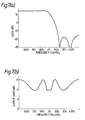
- Figure 7(a) shows the amplitude response of the lowpass filters 31, 33, 35, 37 used in our realisation.
- the stopband rejection is greater than 30 dBs, and this is achieved by .25 +. 8 f3 s .
- Figure 7(b) is a plot of the amplitude response contribution that this stage of processing makes to the final codec output.
- Figure 7(c) is the delay response of the complete system. It should be noted that the residual delay ripple is highly regular and, in consequence, can be equalised with a low-order polyphase all-pass network.
- Figures 8 and 9 are included for completeness.
- Figure 8 is the amplitude response of the 8-band SBC output
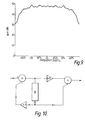
- Figure 9 is the delay response that can be achieved using a lst-order polyphase equaliser.
- the 1st order polyphase equalisation filter used to obtain the results of Figure 9 is shown in Figure 10, and comprises a 16-sample delay, two adders, and two multipliers having coefficients of 0.1. It is not considered necessary when the equipment is used for speech transmission, but it may be required if data is to be passed over the channel; delay variations with frequency can give rise to intersymbol interference.
- the inclusion of this equalisation network brings the delay ripple down to less than : .15 ms across the part of the spectrum used for data transmission. it does, however, increase the absolute delay by about 2 ms, but still results in a delay of less than half the FIR case.
- the stages of band splitting become of progressively lower order and hence the relative width of the transition bands becomes greater and out of band rejection becomes less; this is not objectionable since cross-band quantisation noise becomes subjectively less troublesome as the bands become closer together because of auditory masking properties of human audio perception.
- IIR filters are preferred for computational efficiency, but minimum phase (but not linear phase) FIR filters may be used in some circumstances especially in the later stages where the filters are of lower orders.
Landscapes
- Engineering & Computer Science (AREA)
- Physics & Mathematics (AREA)
- Signal Processing (AREA)
- Spectroscopy & Molecular Physics (AREA)
- Computational Linguistics (AREA)
- Health & Medical Sciences (AREA)
- Audiology, Speech & Language Pathology (AREA)
- Human Computer Interaction (AREA)
- Acoustics & Sound (AREA)
- Multimedia (AREA)
- Computer Networks & Wireless Communication (AREA)
- Compression, Expansion, Code Conversion, And Decoders (AREA)
Priority Applications (1)
| Application Number | Priority Date | Filing Date | Title |
|---|---|---|---|
| AT84307934T ATE34261T1 (de) | 1983-11-25 | 1984-11-15 | Teilband-codierer, decodierer und filter. |
Applications Claiming Priority (4)
| Application Number | Priority Date | Filing Date | Title |
|---|---|---|---|
| GB8331512 | 1983-11-25 | ||
| GB838331512A GB8331512D0 (en) | 1983-11-25 | 1983-11-25 | Sub-band coding |
| GB8405090 | 1984-02-27 | ||
| GB848405090A GB8405090D0 (en) | 1984-02-27 | 1984-02-27 | Sub band coder systems |
Publications (3)
| Publication Number | Publication Date |
|---|---|
| EP0143584A2 true EP0143584A2 (de) | 1985-06-05 |
| EP0143584A3 EP0143584A3 (en) | 1985-07-17 |
| EP0143584B1 EP0143584B1 (de) | 1988-05-11 |
Family
ID=26287035
Family Applications (1)
| Application Number | Title | Priority Date | Filing Date |
|---|---|---|---|
| EP84307934A Expired EP0143584B1 (de) | 1983-11-25 | 1984-11-15 | Teilband-Codierer, Decodierer und Filter |
Country Status (4)
| Country | Link |
|---|---|
| US (1) | US4896356A (de) |
| EP (1) | EP0143584B1 (de) |
| CA (1) | CA1269135A (de) |
| DE (1) | DE3471218D1 (de) |
Cited By (2)
| Publication number | Priority date | Publication date | Assignee | Title |
|---|---|---|---|---|
| US4896356A (en) * | 1983-11-25 | 1990-01-23 | British Telecommunications Public Limited Company | Sub-band coders, decoders and filters |
| EP0721251A1 (de) * | 1995-01-04 | 1996-07-10 | AT&T Corp. | Teilbandsignalverarbeitungsvorrichtung |
Families Citing this family (13)
| Publication number | Priority date | Publication date | Assignee | Title |
|---|---|---|---|---|
| US5408580A (en) * | 1992-09-21 | 1995-04-18 | Aware, Inc. | Audio compression system employing multi-rate signal analysis |
| KR100211830B1 (ko) * | 1995-03-16 | 1999-08-02 | 윤종용 | 미니디스크의 적응변환 오디오 코딩회로 |
| US5926791A (en) * | 1995-10-26 | 1999-07-20 | Sony Corporation | Recursively splitting the low-frequency band with successively fewer filter taps in methods and apparatuses for sub-band encoding, decoding, and encoding and decoding |
| JPH09148937A (ja) * | 1995-11-21 | 1997-06-06 | Sony Corp | 符号化処理方法、復号化処理方法、符号化処理装置および復号化処理装置 |
| GB2351889B (en) * | 1999-07-06 | 2003-12-17 | Ericsson Telefon Ab L M | Speech band expansion |
| US6735561B1 (en) * | 2000-03-29 | 2004-05-11 | At&T Corp. | Effective deployment of temporal noise shaping (TNS) filters |
| US7099830B1 (en) | 2000-03-29 | 2006-08-29 | At&T Corp. | Effective deployment of temporal noise shaping (TNS) filters |
| US6377637B1 (en) * | 2000-07-12 | 2002-04-23 | Andrea Electronics Corporation | Sub-band exponential smoothing noise canceling system |
| US6915264B2 (en) * | 2001-02-22 | 2005-07-05 | Lucent Technologies Inc. | Cochlear filter bank structure for determining masked thresholds for use in perceptual audio coding |
| US8718290B2 (en) | 2010-01-26 | 2014-05-06 | Audience, Inc. | Adaptive noise reduction using level cues |
| US9378754B1 (en) | 2010-04-28 | 2016-06-28 | Knowles Electronics, Llc | Adaptive spatial classifier for multi-microphone systems |
| TWI866996B (zh) | 2019-06-26 | 2024-12-21 | 美商杜拜研究特許公司 | 具有改善頻率解析度的低延遲音訊濾波器組 |
| IL317546A (en) | 2019-09-03 | 2025-02-01 | Dolby Laboratories Licensing Corp | Audio filter array with decoupling elements |
Family Cites Families (1)
| Publication number | Priority date | Publication date | Assignee | Title |
|---|---|---|---|---|
| DE3471218D1 (en) * | 1983-11-25 | 1988-06-16 | British Telecomm | Sub-band coders, decoders and filters |
-
1984
- 1984-11-15 DE DE8484307934T patent/DE3471218D1/de not_active Expired
- 1984-11-15 EP EP84307934A patent/EP0143584B1/de not_active Expired
- 1984-11-16 US US06/672,234 patent/US4896356A/en not_active Expired - Lifetime
- 1984-11-23 CA CA000468566A patent/CA1269135A/en not_active Expired
Non-Patent Citations (3)
| Title |
|---|
| IEEE TRANSACTIONS ON ACOUSTICS, SPEECH, AND SIGNAL PROCESSING, Vol.ASSP-27, No.2, April 1979, pages 154-162, NEW YORK, (US). H.G.MARTINEZ et al.: "A class of infinite-duration impulse response digital filters for sampling rate reduction". * Page 159, right-hand column, last line - page 160, left-hand column, paragraph 1 * * |
| PROCEEDINGS OF EUSIPCO-80: SIGNAL PROCESSING: THEORIES AND APPLICATIONS, September 16-18,1980 Lausanne (CH), pages 747-752, N. Holl. Publ. Co. AMSTERDAM, (NL). A.RAMSTAD et al.: "Sub-band coder design using recursive quadrature mirror filters". * Page 749, right-hand column, line 19 - page 750, left-hand column, line 17 * * |
| THE BELL SYSTEM TECHNICAL JOURNAL, Vol.60, No.7,part 2, September 1981, pages 1633-1653, American Telephone and Telegraph Company, MURRAY HILL, NEW JERSEY, (US). R.E.CROCHIERE: "Sub-band coding". * Page 1634, lines 23-36 ; page 1638, last paragraph - page 1639, line 2 * * |
Cited By (2)
| Publication number | Priority date | Publication date | Assignee | Title |
|---|---|---|---|---|
| US4896356A (en) * | 1983-11-25 | 1990-01-23 | British Telecommunications Public Limited Company | Sub-band coders, decoders and filters |
| EP0721251A1 (de) * | 1995-01-04 | 1996-07-10 | AT&T Corp. | Teilbandsignalverarbeitungsvorrichtung |
Also Published As
| Publication number | Publication date |
|---|---|
| US4896356A (en) | 1990-01-23 |
| EP0143584A3 (en) | 1985-07-17 |
| EP0143584B1 (de) | 1988-05-11 |
| CA1269135A (en) | 1990-05-15 |
| DE3471218D1 (en) | 1988-06-16 |
Similar Documents
| Publication | Publication Date | Title |
|---|---|---|
| EP0143584B1 (de) | Teilband-Codierer, Decodierer und Filter | |
| Smith et al. | A new filter bank theory for time-frequency representation | |
| Barnwell | Subband coder design incorporating recursive quadrature filters and optimum ADPCM coders | |
| Vaidyanathan | Multirate digital filters, filter banks, polyphase networks, and applications: a tutorial | |
| Smith et al. | Exact reconstruction techniques for tree-structured subband coders | |
| EP0176243B1 (de) | Sprachkodierung im Frequenzbereich | |
| US5451954A (en) | Quantization noise suppression for encoder/decoder system | |
| KR970007663B1 (ko) | 신호 양자화 장치 및 방법 | |
| CN1849647B (zh) | 采样速率转换装置、编码装置、解码装置及它们的方法 | |
| EP1083674A2 (de) | Digitales Signalkodierungsgerät, dazugehöriges Dekodiergerät und Aufzeichnungsträger | |
| JP3397001B2 (ja) | 符号化方法及び装置、復号化装置、並びに記録媒体 | |
| EP0713295A1 (de) | Verfahren und vorrichtung zum kodieren und dekodieren von nachrichten und nachrichtenaufzeichnungsträger | |
| US6370507B1 (en) | Frequency-domain scalable coding without upsampling filters | |
| Princen et al. | Audio coding with signal adaptive filterbanks | |
| KR100389487B1 (ko) | 정보부호화방법및장치,정보복호화방법및장치,및정보전송방법 | |
| US6199038B1 (en) | Signal encoding method using first band units as encoding units and second band units for setting an initial value of quantization precision | |
| US5832426A (en) | High efficiency audio encoding method and apparatus | |
| Chan et al. | Theory and design of a class of cosine-modulated non-uniform filter banks | |
| JPH0846517A (ja) | 高能率符号化及び復号化システム | |
| Millar | Recursive quadrature mirror filters--Criteria specification and design method | |
| US20040254797A1 (en) | Audio coding with non-uniform filter bank | |
| Creusere et al. | Efficient audio coding using perfect reconstruction noncausal IIR filter banks | |
| Millar | Mirror filters with minimum delay responses for use in subband coders | |
| JPH09102742A (ja) | 符号化方法および装置、復号化方法および装置、並びに記録媒体 | |
| EP0593850B1 (de) | Verfahren und Einrichtung zur Subbandfilterung eines Stereoaudiosignals |
Legal Events
| Date | Code | Title | Description |
|---|---|---|---|
| PUAI | Public reference made under article 153(3) epc to a published international application that has entered the european phase |
Free format text: ORIGINAL CODE: 0009012 |
|
| PUAL | Search report despatched |
Free format text: ORIGINAL CODE: 0009013 |
|
| AK | Designated contracting states |
Designated state(s): AT BE CH DE FR GB IT LI LU NL SE |
|
| AK | Designated contracting states |
Designated state(s): AT BE CH DE FR GB IT LI LU NL SE |
|
| 17P | Request for examination filed |
Effective date: 19851113 |
|
| 17Q | First examination report despatched |
Effective date: 19861107 |
|
| GRAA | (expected) grant |
Free format text: ORIGINAL CODE: 0009210 |
|
| RAP1 | Party data changed (applicant data changed or rights of an application transferred) |
Owner name: BRITISH TELECOMMUNICATIONS PUBLIC LIMITED COMPANY |
|
| AK | Designated contracting states |
Kind code of ref document: B1 Designated state(s): AT BE CH DE FR GB IT LI LU NL SE |
|
| REF | Corresponds to: |
Ref document number: 34261 Country of ref document: AT Date of ref document: 19880515 Kind code of ref document: T |
|
| ITF | It: translation for a ep patent filed | ||
| REF | Corresponds to: |
Ref document number: 3471218 Country of ref document: DE Date of ref document: 19880616 |
|
| ET | Fr: translation filed | ||
| PLBE | No opposition filed within time limit |
Free format text: ORIGINAL CODE: 0009261 |
|
| STAA | Information on the status of an ep patent application or granted ep patent |
Free format text: STATUS: NO OPPOSITION FILED WITHIN TIME LIMIT |
|
| 26N | No opposition filed | ||
| ITTA | It: last paid annual fee | ||
| EPTA | Lu: last paid annual fee | ||
| PGFP | Annual fee paid to national office [announced via postgrant information from national office to epo] |
Ref country code: LU Payment date: 19941001 Year of fee payment: 11 |
|
| PGFP | Annual fee paid to national office [announced via postgrant information from national office to epo] |
Ref country code: AT Payment date: 19941013 Year of fee payment: 11 |
|
| EAL | Se: european patent in force in sweden |
Ref document number: 84307934.4 |
|
| PG25 | Lapsed in a contracting state [announced via postgrant information from national office to epo] |
Ref country code: LU Free format text: LAPSE BECAUSE OF NON-PAYMENT OF DUE FEES Effective date: 19951115 Ref country code: AT Effective date: 19951115 |
|
| PGFP | Annual fee paid to national office [announced via postgrant information from national office to epo] |
Ref country code: CH Payment date: 19971027 Year of fee payment: 14 |
|
| PG25 | Lapsed in a contracting state [announced via postgrant information from national office to epo] |
Ref country code: LI Free format text: LAPSE BECAUSE OF NON-PAYMENT OF DUE FEES Effective date: 19981130 Ref country code: CH Free format text: LAPSE BECAUSE OF NON-PAYMENT OF DUE FEES Effective date: 19981130 |
|
| REG | Reference to a national code |
Ref country code: CH Ref legal event code: PL |
|
| PGFP | Annual fee paid to national office [announced via postgrant information from national office to epo] |
Ref country code: FR Payment date: 20011012 Year of fee payment: 18 |
|
| PGFP | Annual fee paid to national office [announced via postgrant information from national office to epo] |
Ref country code: SE Payment date: 20011018 Year of fee payment: 18 |
|
| PGFP | Annual fee paid to national office [announced via postgrant information from national office to epo] |
Ref country code: GB Payment date: 20011019 Year of fee payment: 18 |
|
| PGFP | Annual fee paid to national office [announced via postgrant information from national office to epo] |
Ref country code: NL Payment date: 20011026 Year of fee payment: 18 |
|
| PGFP | Annual fee paid to national office [announced via postgrant information from national office to epo] |
Ref country code: DE Payment date: 20011029 Year of fee payment: 18 |
|
| PGFP | Annual fee paid to national office [announced via postgrant information from national office to epo] |
Ref country code: BE Payment date: 20011115 Year of fee payment: 18 |
|
| REG | Reference to a national code |
Ref country code: GB Ref legal event code: IF02 |
|
| PG25 | Lapsed in a contracting state [announced via postgrant information from national office to epo] |
Ref country code: GB Free format text: LAPSE BECAUSE OF NON-PAYMENT OF DUE FEES Effective date: 20021115 |
|
| PG25 | Lapsed in a contracting state [announced via postgrant information from national office to epo] |
Ref country code: SE Free format text: LAPSE BECAUSE OF NON-PAYMENT OF DUE FEES Effective date: 20021116 |
|
| PG25 | Lapsed in a contracting state [announced via postgrant information from national office to epo] |
Ref country code: BE Free format text: LAPSE BECAUSE OF NON-PAYMENT OF DUE FEES Effective date: 20021130 |
|
| BERE | Be: lapsed |
Owner name: *BRITISH TELECOMMUNICATIONS P.L.C. Effective date: 20021130 |
|
| PG25 | Lapsed in a contracting state [announced via postgrant information from national office to epo] |
Ref country code: NL Free format text: LAPSE BECAUSE OF NON-PAYMENT OF DUE FEES Effective date: 20030601 |
|
| PG25 | Lapsed in a contracting state [announced via postgrant information from national office to epo] |
Ref country code: DE Free format text: LAPSE BECAUSE OF NON-PAYMENT OF DUE FEES Effective date: 20030603 |
|
| EUG | Se: european patent has lapsed | ||
| GBPC | Gb: european patent ceased through non-payment of renewal fee | ||
| PG25 | Lapsed in a contracting state [announced via postgrant information from national office to epo] |
Ref country code: FR Free format text: LAPSE BECAUSE OF NON-PAYMENT OF DUE FEES Effective date: 20030731 |
|
| NLV4 | Nl: lapsed or anulled due to non-payment of the annual fee |
Effective date: 20030601 |
|
| REG | Reference to a national code |
Ref country code: FR Ref legal event code: ST |