EP0143533A2 - Expansions- und/oder Ziehungsverfahren und -gerät für Bilddaten - Google Patents
Expansions- und/oder Ziehungsverfahren und -gerät für Bilddaten Download PDFInfo
- Publication number
- EP0143533A2 EP0143533A2 EP84306633A EP84306633A EP0143533A2 EP 0143533 A2 EP0143533 A2 EP 0143533A2 EP 84306633 A EP84306633 A EP 84306633A EP 84306633 A EP84306633 A EP 84306633A EP 0143533 A2 EP0143533 A2 EP 0143533A2
- Authority
- EP
- European Patent Office
- Prior art keywords
- data
- image data
- matrix
- image
- row
- Prior art date
- Legal status (The legal status is an assumption and is not a legal conclusion. Google has not performed a legal analysis and makes no representation as to the accuracy of the status listed.)
- Granted
Links
Images


















Classifications
-
- G—PHYSICS
- G06—COMPUTING OR CALCULATING; COUNTING
- G06T—IMAGE DATA PROCESSING OR GENERATION, IN GENERAL
- G06T3/00—Geometric image transformations in the plane of the image
- G06T3/40—Scaling of whole images or parts thereof, e.g. expanding or contracting
- G06T3/4023—Scaling of whole images or parts thereof, e.g. expanding or contracting based on decimating pixels or lines of pixels; based on inserting pixels or lines of pixels
Definitions
- the present invention relates to a method for expanding and/or contracting image information or data as well as an apparatus for carrying out the method.
- image data image information or data
- image data X which include a string of n picture elements or pixels X 1; X 2 , ..., X arrayed one-dimensionally on latic points, as shown in Fig. 1, is to be contacted to image data Z including m pixels Z 1 , Z 2' ..., Z m .
- the individual pixels X 1 , X 2 , ..., X n of the original image data are transformed to the indivudual pixels Z 1 , Z 2 , ..., Z 5 of the output data 22 which are located on the left side to the corresponding lattice points 24a, 24b, ..., 24h. It will be seen that the pixels X 1 and X 2 are, respectively, transformed into the output pixel Z 1 , while the original pixels X 6 and X 7 are, respectively, transformed into the output pixel Z 4 .
- the output pixel Z 1 is assumed to be constituted by the original pixel X 1 with Z 4 being constituted by X 6 .
- the expansion corresponds to the reversion of the contraction mentioned above.
- the expansion may be considered as the reversion of the contraction in which the original image data is replaced by the output data while the latter is replaced by the former.
- Fig. 3 illustrates a manner in which the original image data 25 of X 1 , ..., X 5 are expanded to the output data 26 of Z l , Z 2 , ... Z 8 .
- the succeeding transformation can be carried out by referring to the stored procedure without necessity for any renewed calculation.
- the calculation was repeated renewedly at every transformation, so that much time was required in accomplishing the transformation.
- an object of the present invention is to eliminate the shortcomings of the prior art and provide a method and apparatus which are capable of performing image expansion and/or contraction at a significantly increased speed.
- an image data expanding and/or contacting apparatus which comprises a first register for storing original image data, a first barrel shifter for shifting the original image data, a register for storing a mapping pattern, an expansion and contraction circuit for expanding or contracting the original image data under the control of the mapping pattern to thereby produce output data, a second barrel shifter for shifting the output data, and a register for storing the output data.
- the image expanding and/or contracting apparatus may comprise a register for storing a mapping pattern which is referred to upon expansion or contraction of image data, and a memory for storing original image data, wherein expansion or contraction of the original image data is performed by referring to the mapping pattern which indicates extraction of data bits or pixels for the contraction of the image and indicates the number of times a pixel is to be copied for the expansion of the image data.
- a image data contracting method wherein at least a reference mask pattern consisting of binary data P 1 , P 2' ..., P n is prepared for image data x 1 , x 2 , ..., x n to be contracted (where n is an integer > 2).
- the image data x 1 , x 2 , ..., x n to be contracted is moved within a matrix including n rows and n columns in the direction from the n-th row toward the first row.
- the reference mask pattern P i (where i is an integer in the range of 1 ⁇ i ⁇ n) has a first value
- the image data x i located at a position (a i , i ) of the matrix is discarded, while image data (x) located at a position (a i, j ) (where i+n ⁇ j ⁇ n) of the matrix is moved to a position (a i-1 , j-1 ) of the matrix.
- the reference mask pattern (P.) has a second value
- the image data (x) located at a position (a., a j-1 ) of the matrix is moved to the position (a i-1 , j-1 ) of the matrix.
- an image data contracting circuit which includes a matrix consisting of n rows and n columns (where n is an integer ⁇ 2), data transmitting means disposed at positions (a k l) (where k and l are integers, respectively, defined by 2 ⁇ k ⁇ n and k > l) of the matrix, and data selecting means disposed at positions (a m , q) ) (where m and q are integers, respectively, defined by 1 ⁇ m ⁇ n and q > m) of the matrix.
- the data transmitting means disposed at the n-th row sends out image data x so that the image data x can be inputted to the data transmitting means or the data selecting means disposed on the (n-l)-th row, while the data transmitting means disposed on the r-th row (where r is an integer in a range of 3 ⁇ r ⁇ n-1) sends out the image data x so that the image data x can be inputted to the data transmitting means or the data selecting means disposed on the (r-l)-th row.
- the data selecting means disposed on the n-th row determines whether the image data x n to be contracted is to be discarded or not in dependence on a control signal which corresponds to the reference mask.pattern, while the data selecting means disposed at the position (a m-1 , q-1 ) of the matrix determines in dependence on the control signal corresponding to the reference mask pattern whether the image data x outputted from the data transmitting means or the data selecting means disposed at the position (a m q ) of the matrix or the image data x outputted from the data transmitting means or the data selecting means disposed at the position (a m , q-1 ) of the matrix is to be received as the input data.
- an image data contracting method wherein at least a reference mask pattern of binary data P 1 , P 2 ' ..., P is prepared for image data x 1 , x 2 , ..., x n to be contracted (where n is an integer ⁇ 2).
- the image data x 1 , x2, ..., x to be contracted is moved within a matrix of n rows and n columns from the n-th row toward the first row, during which a logical ORing operation is performed on the image data x.
- the reference mask pattern P i (where i is an integer in a range of 1 ⁇ i ⁇ n) is of a first value, wherein the result of the operation is moved to a position (a i-1, i-1 ) of the matrix, while image data x located at a position (a i, j ) of the matrix (where j is an integer in the range of i+1 ⁇ j ⁇ a) and a position (a i, u )(where u is an integer in the range of 1 ⁇ u ⁇ i-2) are moved, respectively, to positions (a i-1,j-1 ) and (a i-1,u ) of the matrix.
- the reference mask pattern P i is of a second value
- the image data x located at a position (a. ) (where v is an integer in the range 1 ⁇ v ⁇ n) is moved to a position (a i-1,v )
- an image data contracting circuit which comprises a matrix circuit having n rows and n columns where n is an integer > 2, data transmission means disposed at positions (a k,l ) of the matrix (where k and l are integers given by 2 ⁇ k ⁇ n and k > l+1), and data selecting means disposed at positions (a m,q ) ) of the matrix (where m and g are integers given by 1 ⁇ m ⁇ n and q > m-1).
- the data transmitting means disposed on the n-th row sends out the image data x so that the image data x can be inputted to the data transmitting means or the data selecting means disposed on the (n-l)-th row, while the data transmitting means disposed on the r-th row (where r is an integer in the range of 4 ⁇ r ⁇ n-1) sends out the image data x so that the image data x can be inputted to the data transmitting means or the data selecting means disposed on the (r-l)-th row.
- the data selecting means disposed on the n-th row responds to a control signal corresponding to the reference mask pattern to thereby determine whether the data x to be contracted is to be discarded or not, while the data selecting means disposed at the position (a m-1,q ) of the matrix responds to the control signal corresponding to the reference mask pattern to thereby determine whether the output data x of the data transmitting means or the data selecting means disposed at the position (a m,q+1 ) of the matrix or the output data x of the data transmitting means or the data selecting means disposed at the position (a m ,q ) of the matrix is to be received as the input data.
- the data selecting means disposed at a position (a m-1 m-2 ) adds logical arithmetic means to the data selecting means disposed at the position (a m-1,q ), wherein the logical arithmetic means performs logical operation on the output data of the data transmitting means disposed at a position (a m,m-1 ) and the output data of the data selecting means disposed at the position (a m,m-2 ) of the matrix.
- the data selecting means responds to the control signal corresponding to the reference mask pattern to thereby determine whether the output data of the data transmitting means disposed at the position (a m,m-2 ) or the output data of the logical arithmetic means added to the data selecting means is to be received as the input data.
- an image data expanding method wherein a reference mask pattern of binary data P m (where m is an integer > 1) is prepared for the image data x l , x 2 , ..., x n to be expanded (where n is an integer > 1).
- the image data x located at a position a i,p (where p is an integer in the range 1 ⁇ p ⁇ l) is moved to the position (a i+1,p ) of the matrix.
- an image data expanding apparatus which comprises a matrix of l rows an l' columns (where l and l' are integers 2), data transmitting means disposed at positions (a q,r ) ) of the matrix (where g and r are integers given by 2 ⁇ q ⁇ l and q > r), data selecting means disposed at positions (a s,t ) (where s and t are integers given by 1 ⁇ s ⁇ l, and s ⁇ t ⁇ l') and at the positions of the first row, wherein when the image data x 1 , ..., x n to be expanded (where n is an integer ⁇ 1) are moved from the first row toward the l-th row, the data selecting means disposed on the first row responds to a control signal corresponding to a reference mask pattern (p 1 ) to receive, as the input, one of the image data x u , and x u+1 to be expanded (
- an image expanding and/or contracting apparatus which comrpises storage means for storing image data, a first register for storing a mapping pattern which indicates positions of the image data to be extracted upon contraction of the image and indicates the number of times when the image data is copied upon expansion of the image data, and a second register for storing the last pixel data of a pixel data string generated through the expansion or contraction processing.
- an image expanding and/or contracting apparatus which includes storage means for storing image data, a first register for storing a mapping pattern which indicates the position of the image data to be deleted upon contraction of the image and indicates the number of times when the image data is to be copied upon expansion of the image, a logical arithmetic circuit for extracting the last pixel data of the pixel data string generated through the expansion or contraction processing, and a second register for storing the last pixel data.
- mapping pattern is a vector which includes components "0" and/or "1" and designates positions or locations of the elements of original image data which are to be extracted in the case of the contraction while indicating the number of times at which the individual elements are to be copied.
- mapping pattern P is represented as follows:
- a logical product of the above mapping pattern and the original image data X is determined for each of the elements to thereby obtain the output data Z by extracting the elements of the original image data X which correspond to "0" of the mapping pattern. More particularly, since and
- the mapping pattern is given by as in the case of the contraction.
- the original image data corresponding to "1” is renewed, while the original image data corresponding to "0" is copied. More particularly, on the assumption that and the output data Z are given by
- the two-dimensional data are to be transformed (i.e. expanded or contracted) on the row-by-row basis in the X-direction, as illustrated in Fig. 4, once the mapping pattern for the first row in the X-direction is arithmetically determined and stored at the beginning, the data transformation for the succeeding rows inclusive of the second row can be performed simply by referring to the stored pattern, whereby a high-speed processing can be accomplished.
- the data to be processed is binary image data in which one bit corresponds to one picture element or pixel.
- a data bus is assumed to be 8 bits in width, and the processing is performed on the eight-bit basis. Further, input and output operations to and from each register are performed only on the eight-bit basis. (A set of eight bits may also be referred to as a word).
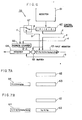
- Fig. 5 shows in a block diagram a general arrangement of the apparatus according to an exemplary embodiment of the invention.
- Original image data loaded in an input register 52 through a data bus 51 is shifted by a first barrel shifter 54 under the control of a control circuit 53.
- the output data of the shifter 54 is expanded or contracted by an expansion and contraction circuit 55 which is controlled in dependence on the mapping pattern.
- the output data of the expansion and contraction circuit 55 is, after having been shifted by a second barrel shifter 56, stored in an output register 57 to be available on the bus 51 for further processing.
- the input register 52 has a capacity of two words each of eight bits, wherein the eight more significant bits (MSB) and the eight less significant bits (LSB) can be inputted and outputted independent of each other. In this connection, it is assumed that the most significant bit is located at the leftmost position with the least significant bit being located at the rightmost position in the figures.
- the output register 57 has a capacity of two words and is so arranged that the more significant word and the less significant word can be inputted and/or outputted. independently.
- the first barrel shifter 54 has an entrance of 16 bits in width and an exit of 8 bits, while the second barrel shifter 56 has an entry of 8 bits and an exit of 16 bits.
- the expansion and contraction circuit 55 is designed to perform the processing on the eight-bit basis.
- the mapping pattern 60 is arithmetically determined by a processing unit 60 and stored in a register 59 to be read out by a control register or mapping pattern register 58 on the eight-bit basis for controlling the expansion and contraction circuit 55.
- Fig. 6 shows an arrangement of the expansion and contraction circuit 55 according to an exemplary embodiment of the invention.
- the mapping pattern is read out from a register 61 on the eight-bit basis (i.e. eight-by-eight bits) and stored in a control register 62.
- the original image data of eight bits is stored in an input register 63.
- the registers 63 and 62 are constituted by shift registers which respond to clock signals a and d, respectively, for shifting the contents or data to the left, wherein the data appearing at the leftmost position of the register 63 is loaded in a buffer register 65.
- the clock signals a, b, c and d are of the same frequency and are delayed in phase by a small amount in the order of a, b, c and d.
- a numeral 67 denotes a switch circuit.
- the mapping pattern value e outputted from the control register 62 in response to the clock d is transmitted to a line f by way of the switch 67.
- the mapping pattern value e is transmitted to a line g.
- the leftmost one of the original image data in the register 63 is loaded in the buffer 65 in response to the clock a and then responds to the clock b to be written in a register 64 at an address h designated by an address counter 66.
- the address counter 66 performs a counting operation, whereby the mapping pattern placed in the control register 62 is shifted to the left in response to the clock d.
- the contracted data illustrated in Fig. 7A can be obtained in the output register 64 when eight cycles have elapsed from the starting time point.
- the original image data placed in the input register 63 is transferred to the buffer 65 in response to the clock a when the output value g of the mapping pattern is logic "1".
- the data in the buffer 65 in turn is written in the register 64 at the address h in response to the clock b.
- the address counter 66 operates in response to the clock c, which is followed by the shifting of the mapping pattern to the left in the register 62 in response to the clock d.
- the registers 62 and 63 are empty, while the register 64 is filled at the most significant five bits, as is illustrated in Fig. 7A.
- the register 62 is found in the empty state after the eight cycles, while the register 64 is fully filled and the register 63 contains three remaining bits, as is illustrated in Fig. 7B.
- mapping pattern and the original image data are supplied both on the eight-bit basis while the output data have to be read out every time the register 64 becomes full, requiring troublesome processing.
- This processing will be referred to as the register overflow processing.
- the mapping pattern is supplied on the eight-bit basis with the output data being read out also on the eight-bit basis.
- the loading of the original image data in the register 63 is required to be performed at the time point when the register 63 becomes empty, rendering the processing troublesome. (This processing will be referred to as the register empty processing).
- the memory for storing the original image data is usually so arranged that the reading of data can be performed on the 8-bit basis or on the 16-bit basis, it is impossible to read out the 8-bit data or 16-bit data from an arbitrarily selected position. It is common that the reading of data is permitted only from a predetermined position. (This position will be referred to as a word boundary.) In other words, the original image data as read out is always of eight bits from the word boundary.
- expansion or contraction processing which is so commanded as to start from a word boundary and come to an end at another word boundary is rather rare. In other words, in many practical cases, it is required that the expansion or contraction processing starts from an intermediate bit of a word and terminates at an intermediate bit of another word. This processing is naturally troublesome. (This processing will be referred to as the word boundary processing.)
- the expansion and contraction circuit 55 is adapted to transform the original image data of eight bits into the left-aligned 5-bit output data at a contraction ratio of 8 5 in the contracting operation mode, as is illustrated in Fig. 8A.
- the expansion and contraction circuit 55 parforms translation of the left-aligned 5-bit original data into 8-bit output data at an expansion ratio of 5 8, as illustrated in Fig. 8B.
- Fig. 9A shows, by way of example, a configuration of the first barrel shifter 54.
- a reference numeral 92 indicates cells each of which is constituted by a transfer gate of a structure schematically illustrated in Figs. 9B and 9C.
- the transfer gate is designed to interrupt the connection between signal lines p and g in response to control signal S.
- a given one of the control signals Sl to S8 is validated, a given set of eight bits can be selected from the two words of 16 bits contained in the original image data register 52.
- the control signal S6 is assumed to be validated or turned on.
- the data bit X' 1 can not be straightforwardly transferred to a bit position of a register 91, this transfer of the bit X I 1 to the register 91 can be accomplsihed by firstly reading out the least significant eight bits and writing them at the most significant eight bit positions, which is followed by the turning-on of the control signal Sl, because the original image data register 52 is so arranged that the input/output of the most and less significant eight bits can be realized indepnendent of each other.
- the second barrel shifter 56 may be of a configuration corresponding to the one shown in Fig. 9A except that the input and output sides are reversed or exchanged each other so that the 8-bit input can be transferred to given bit positions of the 16-bit output register 57.
- FIG. 10A the vertical lines 101 designates the boundary between words each of eight bits, and a hatched area 102 represents a single word consisting of eight bits or pixels (picture elements).
- the stored state is illustrated in Fig. 11.
- Step (I): In the first place, the leading or first two words 104 and 105 of the original image data 103 are placed in the input register 52 in a manner illustrated at 121 in Fig. 12. Since the bits or pixels which undergo contraction are those which follow the pixel X6, inclusive, of the first word, the five pixels X 1 to X 5 are unnecessary. To indicate this, the number of unnecessary pixels C . 5 is set in an input counter 127 (Fig. 12). The remaining member n of the pixels of the original image data is 24.
- the leading one word 111 of the output image 110 is loaded in the output register 57 at the more significant bit positions, as shown at 125 in Fig. 12.
- the number m of empty pixels in the output image is equal to 15.
- the input counter 127 and the output counter 129 are incorporated in the control circuit 53 shown in Fig. 5.
- Step (2) From the mapping pattern register 59, the first eight bits of a mapping pattern are set at the control register 58, as illustrated in Fig. 12 at 123.
- the number C p of "1" present in the mapping pattern is set at a counter 128 (Fig. 12) which is also incorporated in the control circuit 53 shown in Fig. 5.
- Step (3) The eight pixels following the pixel X 6 inclusive thereof are extracted by the first barrel shifter 54.
- Step (4) The contracted data shown at 124 is Fig. 12 is derived with the aid of the expansion and contraction circuit 55 which is controlled in dependence on the mapping pattern 123.
- Step (5) The data thus obtained are loaded in the output register 57 at the bit positions following the bit y 3 through the second barrel shifter 56.
- Step (6) No transfer takes place because the value C o of the output counter 126 is less than 8.
- Step (9) The step (2) mentioned above is regained and the processing is repeated to the step (5). These processing are illustrated at 131 to 134 in Fig. 12.
- Step (10) The contracted data shown at 134 is shifted by the second barrel shifter, as indicated by the content of the output counter 129, say 7, to thereby prepare the shifted output data shown at 135 in Fig. 12.
- Step (11) Since the value C o of the output counter 129 now exceeds the value "8", the most significant eight bits are transferred to the l-th word 111 of the output image data 110, while the least significant eight bits are shifted to the most significant bit positions.
- Step (12): Again the remaining number n of the original image pixels is updated, i.e. n ⁇ n - 8 8.
- Step (13) The (j+l)-th word of the original image data is loaded in the input register 52 at the less significant bit positions in the manner illustrated at 141 in F ig. 12. Since it is designated that the contraction be effected to the pixel X' 5 of the fourth word, the (j+l)-th word is the last data of the first row.
- the processing described above in conjunction with the steps (2) to (5) is performed to thereby derive the contracted data illustrated at 144 in Fig. 12.
- the output data 145 are obtained through the processing of the step (10).
- l ⁇ l + 1 3.
- the steps (2) to (16) described above are repeatedly executed.
- the same mapping pattern as that for the first row can be used. Accordingly, it is convenient to construct the mapping pattern register 59, for example, in a stack configuration, whereby upon completion of the processing for one row, a stack pointer is returned to the initial or start position.
- the image expansion or contraction processing can be accomplished at a high speed because the individual steps can be executed on the eight-bit basis, without involving the register overflow processing or word boundary processing, by virtue of the combination of the expansion and contraction circuit 55 with a pair of 16-bit registers 52 and 57 and a pair of the barrel shifters 54 and 56 according to the teaching of the present invention.
- Step (2) The first eight bits of the mapping pattern is loaded from the mapping pattern register 59 in the control register 58, as illustrated at 153 in Fig. 14.
- Step (3) Eight pixels succeeding y 3 inclusive thereof are extracted by the first barrel shifter 54.
- Step (4) The expanded data 154 is derived from the expansion and contraction circuit 55 under the control of the mapping pattern 153.
- Step (5) The data 154 thus obtained is placed in the output register 57 at the bit position X 6 et seq. with the aid of the second barrel shifter 56.
- Step (6) The most significant eight bits of the output register 57 are transferred to the l-th word 104 of the output image data 103, while the less significant bits are shifted to the more significant bit positions.
- Step (9) Since the value C i of the input counter 127 is equal to 7 and not greater than 8, the input register 52 remains intact.
- Step (10) The step (2) is regained and the processing until the step (8) is repeated, as illustrated at 161 to 166 in Fig. 14.
- Step (11) Since the value of C i exceeds "8", the least significant eight bits in the input register 52 are shifted to the more significant bit positions, while the succeeding word 113 of the original image data is placed at the least significant eight bits position of the input register 52.
- Step (13) The five bits (C ) of the output data 177 are aligned with the least significant three bits of the A-th word 107 of the output image data 103 and written in the word 107.
- Step (14) In dependence on the expansion or contraction ratio in the vertical direction, the row of the original image data to be subsequently processed is determined, and the processing at the steps (2) to (13) is repeated.
- the same mapping pattern as that used in the processing for the first row can be used in the processing of the second row.
- the expansion processing elucidated above can be executed at a high speed without requiring the register empty processing and the word boundary processing by virtue of the combination of the expansion and contraction circuit 55 with a pair of registers 52 and 57 and a pair of barrel shifters 54 and 56.
- the first barrel shifter has the entry of 16 bits in width and the exit of 8 bits in width.
- the entry and the exist of the first barrel shifter may be of more than 2n bits and n bits, respectively.
- width of the data bus is not restricted to eight bits.
- F ig. 16 shows schematically an arrangement of the contraction circuit according to another embodiment of the invention.
- a reference numeral 72 denotes a shift register for storing the original image data
- 76 denotes a shift register for storing output data
- a numeral 71 denotes a shift register for storing the mapping pattern.
- These shift registers 71, 76 and 72 are driven in response to the clock signals a, b and c which are delayed in phase relative to one another by a small amount in this order.
- the clock c applied to the register 72 causes the original image data stored therein to be shifted to the left, resulting in that the data bit located at the leftmost bit position (the most significant bit position) is transferred to a buffer 73.
- the data bit in the buffer 73 is loaded in the output shift register 76, provided that the pattern output d of the register 71 is logic or binary "1".
- the pattern output d is "0"
- the data in the buffer 73 is not written in the output register 76.
- Fig. 17 illustrates a circuit configuration for the expansion of image data. Only when the pattern output d of the mapping pattern register 71 is "1", the original image register 72 is shifted, whereby the data at the leftmost bit position is transferred to the buffer 73. On the other hand, when the pattern output d is "0", the shifting does not take place in the original data register 72, incurring no change in the content of the buffer 73.
- the clocks c, b and a are delayed in phase by a small amount in this order, as in the case of the contracting operation illustrated in Fig. 16.
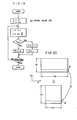
- Fig. 18 This procedure of the arithmetic determination or calculation of the mapping pattern is illustrated in Fig. 18.
- the results of additions are shown at a column 103.
- the result of addition is greater than 1(one)
- the part exceeding l(one) is shown at a column 104.
- This part i.e. the difference resulting from subtraction of l(one) from the result of the addition
- the result of addition is carried over to the succeeding stage.
- elements of the mapping pattern are shown. When the result of addition exceeds 1, the corresponding pattern element assumes "1". Otherwise, the element assumes the value "0".
- Fig. 19 illustrates in a flow chart the calculating procedure mentioned above. Interim values are represented by a.
- mapping pattern is the same as in the case of the contraction, wherein only interpretation needs to be changed. More specifically, X k is changed at the position "1" of P i while X k is left unvaried so long as P i assumes "0".
- the same frequency may be employed as the clock signals for driving the registers 71, 72 and 76 shown in Figs. 16 and 17, involving no necessity for generating the frequency such as (m/n)f.
- the mapping pattern P may be arithmetically determined and stored in a memory when the first row A of the original image is transformed into the first row B of the output image.
- the transformation of the second row as well as the succeeding rows can be carried out by referring to the mapping pattern as stored. Accordingly, the processing speed can be increased ten or more times as high as the speed of processing in which the mapping pattern is determined for every transformation of the row.
- the mapping pattern register of a stack configuration will be described by referring to Fig. 21.
- the image information or data is in general stored in a storage or memory device and processed by a computer, wherein arrangement is so made that the image data can be accessed on the 8-pixel basis or 16-pixel basis.
- the access to the mapping pattern should preferably be compatible with the access to the image data.
- the original image data of 16 bits are stored in the register 72 by way of a data bus 211 of 16 bits in width.
- the mapping pattern is arithmetically determined by a processing unit 213 on the 16-bit basis and stored sequentially in a first-in, first-out stack 214 of 16 bits in width.
- mapping pattern when the mapping pattern is required for the fifty bits, calculation of the mapping pattern is effected four times on the 16-bit basis, wherein the resulting four sets of mapping pattern data are sequentially stored in the stack 214.
- the address of the stored mapping pattern is designated by a stack pointer 215 and outputted to the mapping pattern register 71.
- the pattern output d of the register 71 is produced on a line e in the case of contraction through a switch 216 while the output d is transmitted to a line f in the case of expansion, thereby controlling the output register 76 in the former case or the original image data register 72 in the latter case.
- Step (1) A mapping pattern is calculated and stored in the stack 134.
- Step (2) Initial address is set at the stack pointer 215, whereby the mapping pattern located at the address designated by the stack pointer 215 is read into the mapping pattern register 71.
- Step (3) The registers 72, 76 and 71 are driven in response to the clocks c, b and a, respectively, whereby the output data are prepared from the original image data and placed in the output register 76.
- Step (4) Updating of data is carried out.
- the original image data and the mapping pattern are processed during a period which corresponds to the sixteen clocks.
- the contracted data is stored in the output register 76. In other words, when the sixteen clocks constitute one cycle, the original image data and the mapping pattern are consumed in one cycle.
- mapping pattern is consumed in one cycle, whereby the output data of 16 bits is prepared by consuming a corresponding part of the original image data.
- mapping pattern and the original image data are updated or renewed at every cycle.
- the output data are read out when the output register is filled.
- mapping pattern is updated at every cycle with the output data being read out.
- the original image data are updated at a time point when it has been consumed.
- the stack pointer may be automatically incremented at every cycle.
- Step (5) When a two-dimensional image such as illustrated in Fig. 20 is to be processed, the mapping pattern for one row is divided into segments each of 16 bits and stored in the stack 134. Upon completion of the processing for one row, the stack pointer 135 is returned to the starting position. Thus, the succeeding rows inclusive of the second row can be processed in the similar manner.
- mapping patterns can be sequentially read out automatically merely by setting the stack pointer 215 at the time point when the processing for the first row is initiated, whereby the processing can be performed smoothly.
- the original image data X includes elements or bits x 0 , x l , x 2 , x 3 , x 4 , x 5 , x 6 and x 7 and that the mapping or mask pattern P for the reference consists of 1, 0, 1, 0, 0, 0, 1 and 0, as illustrated in Fig. 22.
- individual elements of the matrix illustrated in Fig. 22 is represented by M i,j where i designates rows and j designates columns.
- empty elements of the matrix may be set to "0".
- this circuit corresponds to the main portion of the circuit shown in Fig. 6 or the circuit shown in Fig. 16.
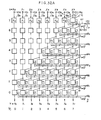
- Fig. 23 shows a wiring diagram of the data contracting circuit according to an exemplary embodiment of the invention.
- reference numerals 10 0 to 10 7 denote input terminals to which image data x 0 , ..., x 7 to be contracted are applied
- 11 0 to 11 7 denote control input terminals to which a binary control signal corresponding to the reference mask pattern (mapping pattern) P 0 , ..., P 7 is applied
- numerals 12 0 to 12 7 denote inverters, respectively.
- a reference numeral 13 denotes data transmitting means each provided at the location of element M j,k (where j and k are both integers and satisfy the conditions that 1 ⁇ j ⁇ 7 and that j > k) of a matrix consisting of eight rows and eight columns.
- the data transmitting means may simply be signal lines and serve for transmitting the data incoming from the above to the elements located below.
- a numeral 14 denotes data selecting means provided at locations of the matrix elements M s,t (where s and t are both integers and satisfy the conditions that 0 ⁇ s ⁇ 7 and s ⁇ t).
- the data selecting means may be constituted by logical elements 14a, 14b, 14c and 14d in a manner illustrated in Fig. 24 and serves for selecting one of data located at the matrix element M s+1, t+1 or the matrix element M s+1,t in dependence on the control signals as and b s which correspond to the reference mask pattern (or mapping pattern) P s supplied through the control signal input terminals 11 s .
- the data selecting means 14 provided at the row 7 of the matrix shown in Fig. 23 serves only for determining whether the image data x 7 is discarded or not.
- Reference numerals 15 0 to 15 7 denote output terminals through which the contracted data Y are obtained.
- the reference mask pattern (or mapping pattern) P consists of 1, 0, 1, 0, 0, 0, 1, 0 and the contracted data derived finally are represented by x 0 , x 2 , x6, as described hereinbefore in conjunction with Fig. 22.
- the original image data bits x 0 , ..., x 5 located at the data transmitting means 13 0 , 13 1 , ..., 13 5 are sent to the data transmitting means 13 7 , 13 8 , ..., 13 12 .
- the original image data x 0 , x 1 , ..., x4 present at the data transmitting means 13 7 , 138, ..., 13 11 are sent out to the data transmitting means 13 13 , 13 14 , ..., 13 17 .
- the original image data x 0 , xl, ..., x 3 present on the data transmitting means 13 13' 1314, ..., 13 16 are sent out to the data transmitting means 13 17 , 13 18 , ..., 13 20 .
- the original image data x 0 , x l , x 2 present at the data transmitting means 13 17 , 1318, 13 19 are sent out to the data transmitting means 1321, 13 22 . 13 23 ⁇
- the data on the line C is selected, allowing the original image data bit x 6 to be inputted.
- the original image data x 0 and x 1 present at the data transmitting means 13 21 and 13 22 are sent out to the data transmitting means 13 24 and 1325, respectively.
- the original image data bit x 0 of the data transmitting means 13 24 are sent out to the data transmitting means 13 26 .
- the contracted data Y can be obtained.
- the matrix-like array of the data transmitting means 13 and the data selecting means 14 data contraction can be carried out at a high speed without requiring the clocking. Further, due to the regular circuit configuration, the matrix circuit is suited to be implemented in the form of LSI (large scale integrated circuit). Besides, merely by varying the control signal applied to the control signal input terminal 11, contracted data Y of the other types can be produced easily.
- LSI large scale integrated circuit
- the data transmitting means is assumed to be provided in the embodiment described above, this is only for convenience of illustration. Since the data transmitting means 13 may be replaced by simple signal lines, as noted earlier, the circuit shown in Fig. 24 may be modified to a configuration shown in Fig. 27.
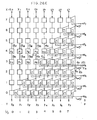
- the original image data X include elements or bits x 0 , x 1 , x 3 , x 4 , x 5 , x 6 , x 7 and that the reference mask pattern P consists of 1, 0, 1, 0, 0, 0, 1, 0, as is illustrated in Fig. 28.
- individual elements of the matrix illustrated in Fig. 28 are represented by M i,j where i designates rows and i designates columns.
- the reference mask pattern P i is "I”
- all the elements present at that time on the row i are moved to the row (i- 1).
- the method described here differs from the one described with reference to Fig. 22 in that the logical sum is got.
- empty elements of the matrix may be set to "0".
- Fig. 29 shows a wiring diagram of the data contracting circuit according to an exemplary embodiment of the invention.
- reference numerals 10 0 to 10 7 denote input terminals to which image data x 0 , ..., x 7 to be contracted are applied
- 11 0 to 11 7 denote control input terminals to which binary control signals corresponding to the reference mask pattern (mapping pattern) P 0 , ..., P 7 are applied
- numerals 12 0 to 12 7 denote inverters, respectively.
- a reference numeral 13 denotes data transmitting means each provided at the location of element M j,k (where j and k are both integers and satisfy the conditions that 1 ⁇ j ⁇ 7 and j > k+ 1) of a matrix consisting of eight rows and eight columns.
- the data transmitting means may simply be signal lines and serve for transmitting the data incoming from the above to the elements located below.
- a numeral 14 denotes data selecting means provided at locations of the matrix elements Ms,t (where s and t are both integers and satisfy the conditions that 0 ⁇ s ⁇ 7 and s ⁇ t.).
- the data selecting means may be constituted by logical elements 14a, 14b, 14c and 14d in a manner illustrated in Fig. 30 and serves for selecting one of data located at the matrix element M s+1, t+1 or the matrix element M s+1, t in dependence on the control signals as and b s which correspond to the reference mask pattern P 5 supplied through the control signal input terminals 11 5 .
- a reference numeral 16 denotes data selecting means located at the position of the matrix element M i,i-1 and serving for selecting either one of the logical sum of the data located at the matrix elements M i+1,i and M i+1,i-1 or the data located at the matrix element M i+1,i-1 in dependence on the control signals a i and b i which correspond to the reference mask pattern P i supplied through the control input terminal 11 i .
- This data selecting means 16 is composed of logical elements 16a, 16b, 16c, 16d and 16e connected in the manner illustrated in Fig. 30.
- the data selecting means 16 differs from the data selecting means 14 in that a logical sum of data d and c is inputted in place of the data c.
- Ref- rence numerals 15 0 to 15 7 denote output terminals through which the contracted data Y are obtained.
- the reference mask pattern P consists of 1, 0, 1, 0, 0, 0, 1, 0 and the contracted data derived finally are represented by x 0 + x 1 , x 2 + x 3 + x 4 + x 5 , x 6 + x 7 , as described hereinbefore in conjunction with Fig. 28.
- the original image data x 0 , x 1 ,..., x7 are supplied to the data transmitting means 13 0 , 13 1 , ..., 13 5 and the data selecting means 16 0 and 14 0 through the data input terminals 10 0 , 10 1 ,..., 10 7 .
- a logical sum of data x 1 , x 2 ,..., x i will be described as x 12...i ⁇ )
- the original image data bits x 0 , ..., x 4 located at the data transmitting means 13 0 , 13 1 , ..., 13 4 are sent to the data transmitting means 136, 13 7 , ..., 13 10 .
- the original image data x 0 , x 1 , x 2' x 3 present at the data transmitting means 136, 13 7 , 13 8 , 13 9 are sent out to the data transmitting means 13 11' 13 12 , 13 13 , 13 14 -
- the data selecting means 14 2 selects the original image data x 67 on the line C
- the data selecting means 16 2 selects the logical sum x 45 of the signals on the lines E and F.
- the original image data x 0 , x l , x 2 present on the data transmitting means 13 11' 13 12 , 13 13 are sent out to the data transmitting means 13 15' 13 16 , 13 17 .
- the original image data information x 0 , x 1 present at the data transmitting means 13 15 and 13 16 are sent out to the data transmitting means 13 18 and 13 19 .
- the data on the line C is selected by the data selecting means 14 4 , allowing the original image data bit x 6 to be inputted, while the data selecting means 16 4 selects the logical sum x 2345 of the signals on the lines E and F.
- the original image data x 0 present at the data transmitting means 13 18 are sent out to the data transmitting means 13 20 .
- the contracted data Y can be obtained.
- the matrix-like array of the data transmitting means 13 and the data selecting means 14 and 16 data contraction can be carried out at a high speed without requiring clocking. Further, due to the regular circuit configuration, the matrix circuit is suited to be implemented in the form of LSI. Further, by deriving the logical sum of the adjacent data upon contraction of the original image data, the logic "1" data will not disappear. Accordingly, the frame of table prepared by the logic "1" bits is not erased by the data contraction. Besides, merely by varying the control signal applied to the control signal input terminal 11, the contracted data Y of the other type can be produced easily.
- the data transmitting means are assumed to be provided in the embodiment described above, this is only for convenience of illustration. Since the data transmitting means 13 may be replaced by simple signal lines, as described earlier, the circuit shown in Fig. 29 may be modified to a configuration shown in Fig. 33.
- the original image data X includes elements or bits x 0 , x 1 , x 2 , x 3 , x 4 , x 5 , x 6 and x 7 and that the mapping or reference mask pattern P consists of 1, 0, 1, 0, 0, 0, 1, 0 as illustrated in Fig. 34.
- Fig. 34 individual elements of the matrix illustrated in Fig. 34 are represented by M i,j where i designates rows and j designates columns.
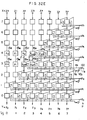
- Fig. 35 shows a wiring diagram of the data expanding circuit according to an exemplary embodiment of the invention.
- reference numerals 10 0 to 10 7 denote input terminals to which image data x 0 , ..., x 7 to be expanded are applied
- 11 0 to 11 7 denote control input terminals to which a binary control signal corresponding to the reference mask pattern (mapping pattern) P 0 , ..., P 7 is applied
- numerals 12 0 to 12 7 denote inverters, respectively.
- a reference numeral 13 denotes data transmitting means each provided at the location of element M j,k (where j and k are both integers and satisfy the conditions that 1 ⁇ j ⁇ 7 and j > k) of a matrix consisting of eight rows and eight columns.
- the data transmitting means may simply be signal lines and serve for transmitting the data incoming from the above to the elements located below.
- a numeral 14 denotes data selecting means provided at locations of the matrix elements M s,t (where s and t are both integers and satisfy the conditions that 0 ⁇ s ⁇ 7 and s ⁇ t).
- the data selecting means may be constituted by logical elements 14a, 14b, 14c and 14d in the manner illustrated in Fig. 36 and serves for selecting one of data located at the matrix element M s-1,t-1 or the matrix element M s-1, t in dependence on the control signals as and b s which correspond to the reference mask pattern (or mapping pattern) P s supplied through the control signal input terminals 11 s .
- Reference numerals 15 0 to 15 7 denote output terminals through which the expanded image Y are obtained.
- the reference mask pattern (or mapping pattern) P consists of 1, 0, 1, 0, 0, 0, 1, 0 and the expanded data to be derived finally is represented by x 0 , x 0 , x 1 , x 1 , x 1 , x 2' x 2 .
- the original image data bits x 0 located at the data selecting means 14 0 is sent to the data transmitting means 13 0 .
- the original image data x 0 present at the data transmitting means 13 0 and the data selecting means 14 8 are sent out to the data transmitting means 13 1 and 13 2 .
- the original image data x 0 and x 1 present on the data transmitting means 13 1 and 13 2 and the data selecting means 1415, respectively, are sent out to the data transmitting means 13 3 , ..., 13 5 .
- the original image data x 0 and x 1 present at the data transmitting means 13 3 , 13 4 , 13 5 and the data selecting means 14 21 are sent out to the data transmitting means 136, ..., 13 9 .
- the data on the lines C12, ..., C 15 are selected, allowing the original image data x 1 , ..., x4 to be inputted.
- the original image data x 0 and x 1 present at the data transmitting means 136, ..., 13 9 and the data selecting means 14 26 , respectively, are sent out to the data transmitting means 13 10 , ..., 13 14 , respectively.
- the original image data bit x 0 and x 1 of the data transmitting means 13 10 , ..., 13 14 and the data selecting means 14 30 , respectively, are sent out to the data transmitting means 13 15 , ..., 13 20 .
- the image data x 0 , x 1 , x 2 at the signal transmitting means 13 5 , ..., 13 16 and the data selecting means 14 33 are sent out to the signal transmitting means 13 21 , ..., 13 27 , respectively.
- the expanded original image data Y x 0 , x 1, x 1 , x 1 , x 1 , x2, x 2 can be derived.
- the matrix-like array of the data transmitting means 13 and the data selecting means 14 data expansion can be carried out at a high speed without requiring clocking. Further, due to the regular circuit configuration, the matrix circuit is suited to be implemented in the form of LSI. Besides, merely by varying the control signal applied to the control signal input terminal 11, the expanded data Y of the other type can be produced easily.
- the data transmitting means 13 are assumed to be provided in the embodiment described above, this is only for convenience of illustration. Since the data transmitting means 13 may be replaced by simple signal lines, as described earlier, the circuit shown in Fig. 35 may be modified to a configuration shown in Fig. 39.
- the wiring from a given element M i,i on the diametrical line to an adjacent element M i,i-1 located on the left side of the given element in the contraction circuit shown in Fig. 23 is changed as shown in Fig. 29.
- the data at M i+1,i-1 are stored as they are.
- the data at M i+1,i-1 is ORed with the data at M i+1,i in the processing at the mapping pattern "0".
- the logical sum for the first data is not got.
- auxiliary register 580 which may be used in the expansion or contraction circuit according to the invention.
- the number of data processed in a single processing corresponds to the number of "1" present in the mapping pattern in the case of the expansion processing, while the number of data processed is always equal to 8 in the case of the contraction processing, as will be seen from Figs. 2 and 3.
- the number of data produced through a single processing is constantly eight in the case of the expansion processing, while the number of data in question corresponds to the number of "1" present in the mapping pattern in the case of contraction.
- the original image data stored in the input register 52 is shifted upon every processing to the left by a number corresponding to the number of bits "1" included in the mapping pattern (the number of bits "1" included in the mapping pattern will be hereinafter represented by NB), wherein the resulting empty bit positions are filled with the bits of the succeeding original image data.
- NB the number of bits “1” included in the mapping pattern
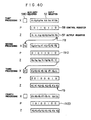
- the auxiliary register 580 for. storing the required data bit in the data produced through the immediately preceding processing is provided on the left side to the input register 52, as is shown in Fig. 40. Since the data x 5 is the final pixel data FB generated through the preceding processing, the data FB is extracted with the aid of an arithmetic circuit 590 and loaded in the auxiliary register 580..
- the arithmetic circuit or unit 590 serves to arithmetically determine the data to be supplied to the auxiliary data register 580 in the expansion or contraction processing. Details of this arithmetic circuit will be described later or by referring to Figs. 45 to 50. In contrast, when the leading bit of the mapping pattern is "1", as indicated in Fig. 40 by a reference numeral 1920, there arises no necessity for returning the final data bit FB to the auxiliary register 580.
- the original image data stored in the input register 52 are all referred to and utilized on the eight-bit basis upon every processing inclusive of the processing in which a logical sum is got. Accordingly, the original image data in the register 52 are all replaced by the fresh data upon every processing.
- the logical sum is to be determined in the contraction processing, the data corresponding to the bit "1" of the mapping pattern is ORed with the data corresponding to the bit "0" of the mapping pattern. Accordingly, when the leading bit of the mapping pattern is "0", as indicated by a reference numeral 2010, the final data bit F B contained in the data prepared through the preceding processing is required for realizing the logical OR-function.
- the final bit FB is extracted by means of the arithmetic circuit 590 and stored in the auxiliary register 580.
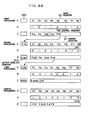
- the number of data bits to be produced corresponds to NB (which represents the number of "1" included in the mapping pattern) plus l(one).
- NB is 4 and 2, respectively, while the number of the produced data is 5 and 3, respectively.
- x78 should be replaced by x 781 '.
- the arithmetic circuit 590 plays no part when the leading bit of-the mapping pattern is "1". In this case, data in the auxiliary register is indeterminate or indefinite. When the leading bit of the mapping pattern is "0" in the expansion processing, the eighth pixel data of those generated through the preceding processing is returned to the auxiliary register 580.
- the counting of the number of "1" contained in the mapping pattern may be realized, for example, by shifting the mapping pattern bit by bit and counting the number of times when the carry is set.
- the left input to the top left element M 00 shown in Fig. 35 is connected to the ground. This left input is disconnected from the ground and connected to the auxiliary register 580 as indicated by an input line 2110 to the element M 00 in Fig. 42.
- a circuit similar to the bottom left element M 00 shown in Fig. 23 is additionally provided on the left side of the latter and connected to the output x M of the auxiliary register 580, as is shown in Fig. 43 (where A represent a circuit point to which the logic "1" signal is applied).
- the leading data x 781 1 generated through the second processing shown in Fig. 41 appears at the output y M which is positioned on the left side to the output y 0 .
- one bit position is additionally provided in the output register at the left, to store the output y M .
- the processing of the generated data may be effected including this data y M .
- the number of data produced through the first processing was not five but in fact four. This fact can be indicated only by the leading bit of the mapping pattern for the second processing, thus involving a difficulty in the execution of the processing.
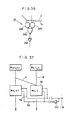
- an output auxiliary register 2110 is provided on the left side to the output register 57 as shown in Fig. 44, wherein the data produced in correspondence to the leading bit of "1" of the mapping pattern are stored in the output auxiliary register 2110 for replacing the final data produced through the preceding processing by the data stored in the register 2110. More specifically, taking as an example the second processing illustrated in Fig. 44, the data x 78 in the auxiliary register 580 is ORed with x', resulting in x 781 ' which is then stored in the output auxiliary register 2110, whereby the final data x 78 produced through the first processing is replaced by x 781 '.
- the fourth data x 7181 is returned to the auxiliary register 580.
- the leading data of the mapping pattern is "1”
- the number of data as generated is equal to NB.
- the NB-the data bit is returned to the auxiliary register 580.
- the data to be stored in the auxiliary register 580 is produced through the preceding processing. Accordingly, a storage means for storing this data is required to be provided independent of the input register.
- a selector 241 is controlled by control signals 242a or 242b which are changed over in dependence on the expansion processing or contraction-OR processing (i.e. contraction processing including the logical OR function), to select the eight data bit 243a of the data 51a generated by the expansion and contraction circuit 55 in the case of the expansion processing.
- the selector 241 responds to a decoded signal 247a outputted from a decoder 246 which is supplied with a singal 245a produced by a binary data counting circuit 244 and representing NB which is the number of bits "1" included in the mapping pattern stored in the control register 58, to thereby select the NB-the data bit 243b of the generated data 51a.
- Figs. 46, 47 and 48 show an exemplary embodiment of the binary data counting circuit 244.
- Fig. 46 shows the same in a block diagram.
- the mapping pattern consisting of 8 bits is divided into two segments each of 4 bits.
- a pair of one-bit adders 1011 and 1012 provided at the first stage determine the number of "1" included in the respective inputs each of 3 bits (i.e. a 7 , a 6 , a 5 for the adder 1011, and a3, a 2 , a 1 for the adder 1012), which is followed by the determination of the number of "1" included in 4 bits by incrementers 1021 and 1022, respectively.
- a three-bit adder 110 determines the number of "1" included in the mapping pattern of 8 bits, this number being outputted as the four-bit signal 245a.
- a circuit configuration of the one-bit adder 1012 and the incrementer 1022 for the four bits a3, a 2 , a 1 , a 0 is shown in Fig. 47.
- Two bits a3 and a 2 of the 4-bi't input data A(a 3 , a 2 , all a 0 ) denoted by a numeral 71 are added by means of an adder constituted by an AND (logical product) circuit 921 and an EOR (Exclusive-OR) circuit 922, whereby a sum signal ⁇ 00 and a carry C 00 are produced.
- the sum signal ⁇ 00 and the bit a 1 of the input data 71 are added by an adder constituted by an AND circuit 931 and an EOR circuit 932, resulting in that a sum signal ⁇ 10 and a carry signal C 10 are produced.
- the signals C 00 and C 10 are combined by a NAND circuit 96 to produce a carry signal C 20 .
- the number of "1" included in three bits a 3 , a 2 , a 1 of the input data 71 is represented by the sum ⁇ 10 and the carry C 20 .
- the sum signal ⁇ 10 and the bit a 0 of the input data 71 are added by an adder constituted by an AND circuit 971 and an EOR circuit 972, whereby a sum signal ⁇ 30 and a carry signal C 30 are produced.
- the carry signals C 30 and C 20 are added by an adder constituted by an AND circuit 981 and an EOR circuit 982, resulting in that sum signals E 31 and E 32 are produced.
- F ig. 49 shows a circuit diagram of the decoder 246 and the selector 241.
- the meaning of symbols used in the decoder 246 is illustrated in Fig. 50. More specifically, a circuit configuration shown in 50A is equivalent to that shown in Fig. 50B.
- E 3 , ⁇ 2 ' ⁇ 1 and ⁇ 0 represent the number NB of "1" contained in the mapping pattern.
- NB is 0 (zero)
- a signal 281a is logic "1"
- y M is outputted as the signal 243b.
- y 0 , y 1 , ..., or y 7 is correspondingly outputted as the signal 243b.
- the signal 242b is logic "1", while the signal 242a is “0”, whereby the signal 243b is outputted on the line 249a to be subsequently stored in the auxiliary register 580.
- the signal 242b is "0” and 242a is "1", whereby y 7 is constantly outputted on the line 249a to be stored in the auxiliary register.
Landscapes
- Physics & Mathematics (AREA)
- General Physics & Mathematics (AREA)
- Engineering & Computer Science (AREA)
- Theoretical Computer Science (AREA)
- Image Processing (AREA)
Applications Claiming Priority (12)
| Application Number | Priority Date | Filing Date | Title |
|---|---|---|---|
| JP182110/83 | 1983-09-29 | ||
| JP58182110A JPS6073789A (ja) | 1983-09-29 | 1983-09-29 | 画像の拡大縮小装置 |
| JP58187882A JPS6079473A (ja) | 1983-10-06 | 1983-10-06 | 画像の拡大縮小装置 |
| JP187882/83 | 1983-10-06 | ||
| JP192757/83 | 1983-10-14 | ||
| JP58192755A JPS6084072A (ja) | 1983-10-14 | 1983-10-14 | 情報圧縮方式 |
| JP192755/83 | 1983-10-14 | ||
| JP58192757A JPS6083182A (ja) | 1983-10-14 | 1983-10-14 | 情報伸張方法およびその回路 |
| JP102143/84 | 1984-05-21 | ||
| JP59102143A JPS60246485A (ja) | 1984-05-21 | 1984-05-21 | 画像の拡大縮小装置 |
| JP157821/84 | 1984-07-27 | ||
| JP15782184A JPS6134678A (ja) | 1984-07-27 | 1984-07-27 | 画像の拡大縮小装置 |
Publications (3)
| Publication Number | Publication Date |
|---|---|
| EP0143533A2 true EP0143533A2 (de) | 1985-06-05 |
| EP0143533A3 EP0143533A3 (en) | 1987-02-04 |
| EP0143533B1 EP0143533B1 (de) | 1993-04-07 |
Family
ID=27552130
Family Applications (1)
| Application Number | Title | Priority Date | Filing Date |
|---|---|---|---|
| EP84306633A Expired - Lifetime EP0143533B1 (de) | 1983-09-29 | 1984-09-28 | Expansions- und/oder Ziehungsverfahren und -gerät für Bilddaten |
Country Status (3)
| Country | Link |
|---|---|
| US (1) | US4747154A (de) |
| EP (1) | EP0143533B1 (de) |
| DE (1) | DE3486126T2 (de) |
Cited By (2)
| Publication number | Priority date | Publication date | Assignee | Title |
|---|---|---|---|---|
| EP0513516A3 (en) * | 1991-05-08 | 1993-05-19 | International Business Machines Corporation | Apparatus for and method of reducing a digital image |
| CN101383049B (zh) * | 2007-09-04 | 2012-06-06 | 富士施乐株式会社 | 图像处理装置及图像处理方法 |
Families Citing this family (18)
| Publication number | Priority date | Publication date | Assignee | Title |
|---|---|---|---|---|
| DE3650486T2 (de) * | 1985-04-13 | 1996-08-01 | Quantel Ltd | Videobildgestaltungssysteme |
| JPH0751366B2 (ja) * | 1985-06-27 | 1995-06-05 | キヤノン株式会社 | 出力制御方法 |
| US5167018A (en) * | 1986-09-24 | 1992-11-24 | Daikin Industries, Ltd. | Polygon-filling apparatus |
| US5150461A (en) * | 1988-05-25 | 1992-09-22 | Sun Electric Corporation | Fixed point method of video display scaling |
| JPH0751370B2 (ja) * | 1988-07-15 | 1995-06-05 | インターナショナル・ビジネス・マシーンズ・コーポレーション | 像形成装置 |
| US5020115A (en) * | 1989-07-10 | 1991-05-28 | Imnet Corporation | Methods and apparatus for dynamically scaling images |
| US4977602A (en) * | 1989-11-20 | 1990-12-11 | Eastman Kodak Company | Character normalization using an elliptical sampling window for optical character recognition |
| US5068905A (en) * | 1989-12-28 | 1991-11-26 | Eastman Kodak Company | Scaler gate array for scaling image data |
| US5218647A (en) * | 1990-12-12 | 1993-06-08 | Ricoh Corporation | Method to convert between 2 color space on a 32 bit μ-processor |
| US5265176A (en) * | 1991-04-17 | 1993-11-23 | Hewlett-Packard Company | Method and apparatus for mapping printer resolution using lock-up-tables |
| EP0529965A3 (en) * | 1991-08-23 | 1993-12-08 | Levien Raphael L | High speed screening of images |
| US5657047A (en) * | 1995-01-12 | 1997-08-12 | Accelgraphics, Inc. | Method and apparatus for zooming images on a video display |
| US6031546A (en) * | 1995-06-19 | 2000-02-29 | Canon Kabushiki Kaisha | Image processing apparatus and method |
| EP0970439B1 (de) * | 1997-03-27 | 2002-04-10 | Océ Printing Systems GmbH | Verfahren und schaltungsanordnung zum erzeugen von gestauchten oder gedehnten bildern sowie drucker mit einer derartigen schaltungsanordnung |
| JPH11283043A (ja) * | 1998-03-27 | 1999-10-15 | Seiko Epson Corp | 画像作成装置およびその装置を備えた印刷装置並びに画像作成方法 |
| JP3753584B2 (ja) * | 2000-02-15 | 2006-03-08 | 富士通株式会社 | 画像処理装置 |
| US7259765B2 (en) | 2003-04-04 | 2007-08-21 | S3 Graphics Co., Ltd. | Head/data scheduling in 3D graphics |
| US7202872B2 (en) * | 2003-10-29 | 2007-04-10 | Via Technologies, Inc. | Apparatus for compressing data in a bit stream or bit pattern |
Family Cites Families (11)
| Publication number | Priority date | Publication date | Assignee | Title |
|---|---|---|---|---|
| JPS5121529B1 (de) * | 1971-07-23 | 1976-07-03 | ||
| US4267573A (en) * | 1978-06-14 | 1981-05-12 | Old Dominion University Research Foundation | Image processing system |
| GB2038142B (en) * | 1978-12-15 | 1982-11-24 | Ibm | Image data compression |
| US4283724A (en) * | 1979-02-28 | 1981-08-11 | Computer Operations | Variable size dot matrix character generator in which a height signal and an aspect ratio signal actuate the same |
| US4394693A (en) * | 1979-03-23 | 1983-07-19 | International Business Machines Corporation | System and method for generating enlarged or reduced images |
| US4275450A (en) * | 1979-08-01 | 1981-06-23 | Xerox Corporation | Magnification/demagnification apparatus and method |
| JPS5676683A (en) * | 1979-11-28 | 1981-06-24 | Ricoh Co Ltd | Processing method for picture deformation |
| JPS57209570A (en) * | 1981-06-19 | 1982-12-22 | Fujitsu Ltd | Vector processing device |
| DE3418624A1 (de) * | 1983-05-19 | 1984-11-22 | Matsushita Electric Industrial Co., Ltd., Kadoma, Osaka | Verfahren und einrichtung zur bilddatenverarbeitung unter anwendung von additions- und subtraktionsvorgaengen |
| JPS6055767A (ja) * | 1983-08-25 | 1985-04-01 | インタ−ナショナル ビジネス マシ−ンズ コ−ポレ−ション | イメージのビット数を減少する方法及び装置 |
| US4569081A (en) * | 1983-12-30 | 1986-02-04 | International Business Machines Corporation | Method for expansion of a digital image |
-
1984
- 1984-09-28 DE DE84306633T patent/DE3486126T2/de not_active Expired - Fee Related
- 1984-09-28 US US06/655,690 patent/US4747154A/en not_active Expired - Lifetime
- 1984-09-28 EP EP84306633A patent/EP0143533B1/de not_active Expired - Lifetime
Cited By (3)
| Publication number | Priority date | Publication date | Assignee | Title |
|---|---|---|---|---|
| EP0513516A3 (en) * | 1991-05-08 | 1993-05-19 | International Business Machines Corporation | Apparatus for and method of reducing a digital image |
| US5335295A (en) * | 1991-05-08 | 1994-08-02 | International Business Machines Corporation | System and method for scaling a digital image |
| CN101383049B (zh) * | 2007-09-04 | 2012-06-06 | 富士施乐株式会社 | 图像处理装置及图像处理方法 |
Also Published As
| Publication number | Publication date |
|---|---|
| US4747154A (en) | 1988-05-24 |
| EP0143533B1 (de) | 1993-04-07 |
| DE3486126D1 (de) | 1993-05-13 |
| EP0143533A3 (en) | 1987-02-04 |
| DE3486126T2 (de) | 1993-11-04 |
Similar Documents
| Publication | Publication Date | Title |
|---|---|---|
| EP0143533A2 (de) | Expansions- und/oder Ziehungsverfahren und -gerät für Bilddaten | |
| EP0250152B1 (de) | Sehr schnelle Transformationsvorrichtung | |
| US5331585A (en) | Orthogonal transformation processor for compressing information | |
| US4907284A (en) | Image processing apparatus having function of enlargement and/or shrinkage of image | |
| EP0177640B1 (de) | Bildverkleinerungsverfahren | |
| US5208770A (en) | Accumulation circuit having a round-off function | |
| KR940007161B1 (ko) | 이미지버퍼를 이용한 전자주밍시스템 | |
| JPS5853781B2 (ja) | 画像拡大縮小装置 | |
| JP2949589B2 (ja) | 2×2ウインドウ・アーキテクチヤを有する並列パイプライン映像プロセツサ | |
| US5668748A (en) | Apparatus for two-dimensional discrete cosine transform | |
| US5400154A (en) | Hybrid interpolation and non-interpolation method and apparatus for image enlarging and contracting | |
| US4809343A (en) | Maximum/minimum value conversion circuit for image processing | |
| EP0963108A2 (de) | Bewegungsvektordetektionsschaltung zur Hochgeschwindigkeits-Bewegungsvektorsuche | |
| US5671169A (en) | Apparatus for two-dimensional inverse discrete cosine transform | |
| JPS6360952B2 (de) | ||
| JP2960328B2 (ja) | シストリックアーキテクチャ内に配置される「n+1」個の演算子にオペランドを供給するための装置 | |
| JP3726971B2 (ja) | 並列プロセツサ装置 | |
| US6473530B2 (en) | Encoding and decoding apparatuses and image processing apparatus using the same | |
| US6741294B2 (en) | Digital signal processor and digital signal processing method | |
| JP2636396B2 (ja) | 画像の縮小変換方法 | |
| JP2868457B2 (ja) | 動きベクトル探索装置 | |
| JPH0221633B2 (de) | ||
| JP2647379B2 (ja) | 画像処理装置 | |
| KR100189876B1 (ko) | 후보블럭 데이타공급 장치 | |
| JP3153294B2 (ja) | アドレスカウンタ |
Legal Events
| Date | Code | Title | Description |
|---|---|---|---|
| PUAI | Public reference made under article 153(3) epc to a published international application that has entered the european phase |
Free format text: ORIGINAL CODE: 0009012 |
|
| AK | Designated contracting states |
Designated state(s): DE |
|
| PUAL | Search report despatched |
Free format text: ORIGINAL CODE: 0009013 |
|
| AK | Designated contracting states |
Kind code of ref document: A3 Designated state(s): DE |
|
| 17P | Request for examination filed |
Effective date: 19870707 |
|
| 17Q | First examination report despatched |
Effective date: 19880725 |
|
| GRAA | (expected) grant |
Free format text: ORIGINAL CODE: 0009210 |
|
| AK | Designated contracting states |
Kind code of ref document: B1 Designated state(s): DE |
|
| REF | Corresponds to: |
Ref document number: 3486126 Country of ref document: DE Date of ref document: 19930513 |
|
| PLBE | No opposition filed within time limit |
Free format text: ORIGINAL CODE: 0009261 |
|
| STAA | Information on the status of an ep patent application or granted ep patent |
Free format text: STATUS: NO OPPOSITION FILED WITHIN TIME LIMIT |
|
| 26N | No opposition filed | ||
| PGFP | Annual fee paid to national office [announced via postgrant information from national office to epo] |
Ref country code: DE Payment date: 19971010 Year of fee payment: 14 |
|
| PG25 | Lapsed in a contracting state [announced via postgrant information from national office to epo] |
Ref country code: DE Free format text: LAPSE BECAUSE OF NON-PAYMENT OF DUE FEES Effective date: 19990701 |