EP0142757A2 - Phenoxyalkanoylderivate, Verfahren zu ihrer Herstellung sowie ihre Verwendung im Pflanzenschutz - Google Patents
Phenoxyalkanoylderivate, Verfahren zu ihrer Herstellung sowie ihre Verwendung im Pflanzenschutz Download PDFInfo
- Publication number
- EP0142757A2 EP0142757A2 EP84113234A EP84113234A EP0142757A2 EP 0142757 A2 EP0142757 A2 EP 0142757A2 EP 84113234 A EP84113234 A EP 84113234A EP 84113234 A EP84113234 A EP 84113234A EP 0142757 A2 EP0142757 A2 EP 0142757A2
- Authority
- EP
- European Patent Office
- Prior art keywords
- alkyl
- compounds
- general formula
- herbicide
- plants
- Prior art date
- Legal status (The legal status is an assumption and is not a legal conclusion. Google has not performed a legal analysis and makes no representation as to the accuracy of the status listed.)
- Withdrawn
Links
- 238000002360 preparation method Methods 0.000 title claims description 10
- 239000003223 protective agent Substances 0.000 title 1
- 150000001875 compounds Chemical class 0.000 claims abstract description 41
- 239000004009 herbicide Substances 0.000 claims abstract description 31
- 125000004178 (C1-C4) alkyl group Chemical group 0.000 claims abstract description 27
- 239000000729 antidote Substances 0.000 claims abstract description 9
- 229910052794 bromium Inorganic materials 0.000 claims abstract description 6
- 229910052801 chlorine Inorganic materials 0.000 claims abstract description 6
- 239000001257 hydrogen Substances 0.000 claims abstract description 6
- 229910052739 hydrogen Inorganic materials 0.000 claims abstract description 6
- 125000001797 benzyl group Chemical group [H]C1=C([H])C([H])=C(C([H])=C1[H])C([H])([H])* 0.000 claims abstract description 5
- 229910052731 fluorine Inorganic materials 0.000 claims abstract description 5
- 230000002363 herbicidal effect Effects 0.000 claims description 27
- -1 CF 3 Inorganic materials 0.000 claims description 25
- 238000000034 method Methods 0.000 claims description 20
- 241000196324 Embryophyta Species 0.000 claims description 18
- 239000004480 active ingredient Substances 0.000 claims description 16
- RWRDLPDLKQPQOW-UHFFFAOYSA-N Pyrrolidine Chemical compound C1CCNC1 RWRDLPDLKQPQOW-UHFFFAOYSA-N 0.000 claims description 10
- NQRYJNQNLNOLGT-UHFFFAOYSA-N Piperidine Chemical compound C1CCNCC1 NQRYJNQNLNOLGT-UHFFFAOYSA-N 0.000 claims description 7
- 230000000694 effects Effects 0.000 claims description 7
- YNAVUWVOSKDBBP-UHFFFAOYSA-N Morpholine Chemical compound C1COCCN1 YNAVUWVOSKDBBP-UHFFFAOYSA-N 0.000 claims description 6
- 244000038559 crop plants Species 0.000 claims description 6
- 230000009931 harmful effect Effects 0.000 claims description 6
- 238000002156 mixing Methods 0.000 claims description 6
- 231100000208 phytotoxic Toxicity 0.000 claims description 5
- 230000000885 phytotoxic effect Effects 0.000 claims description 5
- 229910052736 halogen Inorganic materials 0.000 claims description 4
- 150000002367 halogens Chemical class 0.000 claims description 4
- 150000002431 hydrogen Chemical class 0.000 claims description 4
- 125000000286 phenylethyl group Chemical group [H]C1=C([H])C([H])=C(C([H])=C1[H])C([H])([H])C([H])([H])* 0.000 claims description 4
- VONWPEXRCLHKRJ-UHFFFAOYSA-N 2-chloro-n-phenylacetamide Chemical class ClCC(=O)NC1=CC=CC=C1 VONWPEXRCLHKRJ-UHFFFAOYSA-N 0.000 claims description 3
- 239000013543 active substance Substances 0.000 claims description 3
- BADXJIPKFRBFOT-UHFFFAOYSA-N dimedone Chemical class CC1(C)CC(=O)CC(=O)C1 BADXJIPKFRBFOT-UHFFFAOYSA-N 0.000 claims description 3
- 125000004433 nitrogen atom Chemical group N* 0.000 claims description 3
- 239000002689 soil Substances 0.000 claims description 3
- QIIPQYDSKRYMFG-UHFFFAOYSA-N phenyl hydrogen carbonate Chemical class OC(=O)OC1=CC=CC=C1 QIIPQYDSKRYMFG-UHFFFAOYSA-N 0.000 claims 4
- 244000025254 Cannabis sativa Species 0.000 claims 2
- 125000000217 alkyl group Chemical group 0.000 abstract description 5
- 229940075522 antidotes Drugs 0.000 abstract description 2
- 125000000094 2-phenylethyl group Chemical group [H]C1=C([H])C([H])=C(C([H])=C1[H])C([H])([H])C([H])([H])* 0.000 abstract 1
- 125000004453 alkoxycarbonyl group Chemical group 0.000 abstract 1
- 125000000623 heterocyclic group Chemical group 0.000 abstract 1
- 125000004435 hydrogen atom Chemical class [H]* 0.000 abstract 1
- 239000000203 mixture Substances 0.000 description 14
- 235000014113 dietary fatty acids Nutrition 0.000 description 11
- 239000000194 fatty acid Substances 0.000 description 11
- 229930195729 fatty acid Natural products 0.000 description 11
- 239000002253 acid Substances 0.000 description 8
- 125000002496 methyl group Chemical group [H]C([H])([H])* 0.000 description 8
- IAYPIBMASNFSPL-UHFFFAOYSA-N Ethylene oxide Chemical compound C1CO1 IAYPIBMASNFSPL-UHFFFAOYSA-N 0.000 description 7
- 238000009472 formulation Methods 0.000 description 7
- XLYOFNOQVPJJNP-UHFFFAOYSA-N water Substances O XLYOFNOQVPJJNP-UHFFFAOYSA-N 0.000 description 7
- RTZKZFJDLAIYFH-UHFFFAOYSA-N Diethyl ether Chemical compound CCOCC RTZKZFJDLAIYFH-UHFFFAOYSA-N 0.000 description 6
- DGAQECJNVWCQMB-PUAWFVPOSA-M Ilexoside XXIX Chemical compound C[C@@H]1CC[C@@]2(CC[C@@]3(C(=CC[C@H]4[C@]3(CC[C@@H]5[C@@]4(CC[C@@H](C5(C)C)OS(=O)(=O)[O-])C)C)[C@@H]2[C@]1(C)O)C)C(=O)O[C@H]6[C@@H]([C@H]([C@@H]([C@H](O6)CO)O)O)O.[Na+] DGAQECJNVWCQMB-PUAWFVPOSA-M 0.000 description 6
- QAOWNCQODCNURD-UHFFFAOYSA-N Sulfuric acid Chemical compound OS(O)(=O)=O QAOWNCQODCNURD-UHFFFAOYSA-N 0.000 description 6
- 125000001495 ethyl group Chemical group [H]C([H])([H])C([H])([H])* 0.000 description 6
- 239000011734 sodium Substances 0.000 description 6
- 229910052708 sodium Inorganic materials 0.000 description 6
- 239000002904 solvent Substances 0.000 description 6
- ZMXDDKWLCZADIW-UHFFFAOYSA-N N,N-Dimethylformamide Chemical compound CN(C)C=O ZMXDDKWLCZADIW-UHFFFAOYSA-N 0.000 description 5
- 239000003795 chemical substances by application Substances 0.000 description 5
- 239000004495 emulsifiable concentrate Substances 0.000 description 5
- 239000003995 emulsifying agent Substances 0.000 description 5
- 150000004665 fatty acids Chemical class 0.000 description 5
- 239000000843 powder Substances 0.000 description 5
- UFHFLCQGNIYNRP-UHFFFAOYSA-N Hydrogen Chemical compound [H][H] UFHFLCQGNIYNRP-UHFFFAOYSA-N 0.000 description 4
- 241000209140 Triticum Species 0.000 description 4
- 235000021307 Triticum Nutrition 0.000 description 4
- 235000013339 cereals Nutrition 0.000 description 4
- 239000012141 concentrate Substances 0.000 description 4
- JHIVVAPYMSGYDF-UHFFFAOYSA-N cyclohexanone Chemical compound O=C1CCCCC1 JHIVVAPYMSGYDF-UHFFFAOYSA-N 0.000 description 4
- 239000006185 dispersion Substances 0.000 description 4
- 239000008187 granular material Substances 0.000 description 4
- 229920000151 polyglycol Polymers 0.000 description 4
- 239000010695 polyglycol Substances 0.000 description 4
- 239000000126 substance Substances 0.000 description 4
- FBPFZTCFMRRESA-FSIIMWSLSA-N D-Glucitol Natural products OC[C@H](O)[C@H](O)[C@@H](O)[C@H](O)CO FBPFZTCFMRRESA-FSIIMWSLSA-N 0.000 description 3
- FBPFZTCFMRRESA-JGWLITMVSA-N D-glucitol Chemical compound OC[C@H](O)[C@@H](O)[C@H](O)[C@H](O)CO FBPFZTCFMRRESA-JGWLITMVSA-N 0.000 description 3
- YMWUJEATGCHHMB-UHFFFAOYSA-N Dichloromethane Chemical compound ClCCl YMWUJEATGCHHMB-UHFFFAOYSA-N 0.000 description 3
- 240000005979 Hordeum vulgare Species 0.000 description 3
- 235000007340 Hordeum vulgare Nutrition 0.000 description 3
- XBDQKXXYIPTUBI-UHFFFAOYSA-M Propionate Chemical compound CCC([O-])=O XBDQKXXYIPTUBI-UHFFFAOYSA-M 0.000 description 3
- VYPSYNLAJGMNEJ-UHFFFAOYSA-N Silicium dioxide Chemical compound O=[Si]=O VYPSYNLAJGMNEJ-UHFFFAOYSA-N 0.000 description 3
- HEMHJVSKTPXQMS-UHFFFAOYSA-M Sodium hydroxide Chemical compound [OH-].[Na+] HEMHJVSKTPXQMS-UHFFFAOYSA-M 0.000 description 3
- WFDIJRYMOXRFFG-UHFFFAOYSA-N acetic acid anhydride Natural products CC(=O)OC(C)=O WFDIJRYMOXRFFG-UHFFFAOYSA-N 0.000 description 3
- 239000000460 chlorine Substances 0.000 description 3
- 239000013078 crystal Substances 0.000 description 3
- 239000002270 dispersing agent Substances 0.000 description 3
- 239000003337 fertilizer Substances 0.000 description 3
- 238000000227 grinding Methods 0.000 description 3
- NLYAJNPCOHFWQQ-UHFFFAOYSA-N kaolin Chemical compound O.O.O=[Al]O[Si](=O)O[Si](=O)O[Al]=O NLYAJNPCOHFWQQ-UHFFFAOYSA-N 0.000 description 3
- 238000004519 manufacturing process Methods 0.000 description 3
- 239000000463 material Substances 0.000 description 3
- 125000000951 phenoxy group Chemical group [H]C1=C([H])C([H])=C(O*)C([H])=C1[H] 0.000 description 3
- 239000000047 product Substances 0.000 description 3
- 239000000600 sorbitol Substances 0.000 description 3
- 239000000080 wetting agent Substances 0.000 description 3
- DWDIDIITNMWCKN-UHFFFAOYSA-N 2-(N-ethoxy-C-propylcarbonimidoyl)-3-hydroxy-5-(2-phenylsulfanylpropyl)cyclohex-2-en-1-one Chemical compound C1C(=O)C(C(=NOCC)CCC)=C(O)CC1CC(C)SC1=CC=CC=C1 DWDIDIITNMWCKN-UHFFFAOYSA-N 0.000 description 2
- QTBSBXVTEAMEQO-UHFFFAOYSA-N Acetic acid Chemical compound CC(O)=O QTBSBXVTEAMEQO-UHFFFAOYSA-N 0.000 description 2
- 241001621841 Alopecurus myosuroides Species 0.000 description 2
- 239000005995 Aluminium silicate Substances 0.000 description 2
- 241000209761 Avena Species 0.000 description 2
- 241000209764 Avena fatua Species 0.000 description 2
- 241000219310 Beta vulgaris subsp. vulgaris Species 0.000 description 2
- BMTAFVWTTFSTOG-UHFFFAOYSA-N Butylate Chemical compound CCSC(=O)N(CC(C)C)CC(C)C BMTAFVWTTFSTOG-UHFFFAOYSA-N 0.000 description 2
- 229920000742 Cotton Polymers 0.000 description 2
- GUVLYNGULCJVDO-UHFFFAOYSA-N EPTC Chemical compound CCCN(CCC)C(=O)SCC GUVLYNGULCJVDO-UHFFFAOYSA-N 0.000 description 2
- 244000068988 Glycine max Species 0.000 description 2
- 235000010469 Glycine max Nutrition 0.000 description 2
- 244000299507 Gossypium hirsutum Species 0.000 description 2
- LRHPLDYGYMQRHN-UHFFFAOYSA-N N-Butanol Chemical compound CCCCO LRHPLDYGYMQRHN-UHFFFAOYSA-N 0.000 description 2
- 240000007594 Oryza sativa Species 0.000 description 2
- 235000007164 Oryza sativa Nutrition 0.000 description 2
- 235000021536 Sugar beet Nutrition 0.000 description 2
- 240000008042 Zea mays Species 0.000 description 2
- 235000002017 Zea mays subsp mays Nutrition 0.000 description 2
- 235000012211 aluminium silicate Nutrition 0.000 description 2
- 238000009835 boiling Methods 0.000 description 2
- 239000000969 carrier Substances 0.000 description 2
- 239000003054 catalyst Substances 0.000 description 2
- 239000003085 diluting agent Substances 0.000 description 2
- 150000002170 ethers Chemical class 0.000 description 2
- 150000002191 fatty alcohols Chemical class 0.000 description 2
- 239000000945 filler Substances 0.000 description 2
- 239000007788 liquid Substances 0.000 description 2
- 239000002480 mineral oil Substances 0.000 description 2
- 239000001301 oxygen Substances 0.000 description 2
- 229910052760 oxygen Inorganic materials 0.000 description 2
- 239000011814 protection agent Substances 0.000 description 2
- 235000009566 rice Nutrition 0.000 description 2
- 239000007787 solid Substances 0.000 description 2
- 238000009331 sowing Methods 0.000 description 2
- 238000003756 stirring Methods 0.000 description 2
- 239000000454 talc Substances 0.000 description 2
- 229910052623 talc Inorganic materials 0.000 description 2
- JOXIMZWYDAKGHI-UHFFFAOYSA-N toluene-4-sulfonic acid Chemical compound CC1=CC=C(S(O)(=O)=O)C=C1 JOXIMZWYDAKGHI-UHFFFAOYSA-N 0.000 description 2
- FMPJHEINDXIEHS-UHFFFAOYSA-N (2-phenoxyphenyl) hydrogen carbonate Chemical class OC(=O)OC1=CC=CC=C1OC1=CC=CC=C1 FMPJHEINDXIEHS-UHFFFAOYSA-N 0.000 description 1
- WSWCOQWTEOXDQX-MQQKCMAXSA-M (E,E)-sorbate Chemical compound C\C=C\C=C\C([O-])=O WSWCOQWTEOXDQX-MQQKCMAXSA-M 0.000 description 1
- DHKHKXVYLBGOIT-UHFFFAOYSA-N 1,1-Diethoxyethane Chemical compound CCOC(C)OCC DHKHKXVYLBGOIT-UHFFFAOYSA-N 0.000 description 1
- BWKAYBPLDRWMCJ-UHFFFAOYSA-N 1,1-diethoxy-n,n-dimethylmethanamine Chemical compound CCOC(N(C)C)OCC BWKAYBPLDRWMCJ-UHFFFAOYSA-N 0.000 description 1
- XUJLWPFSUCHPQL-UHFFFAOYSA-N 11-methyldodecan-1-ol Chemical compound CC(C)CCCCCCCCCCO XUJLWPFSUCHPQL-UHFFFAOYSA-N 0.000 description 1
- OVSKIKFHRZPJSS-UHFFFAOYSA-N 2,4-D Chemical compound OC(=O)COC1=CC=C(Cl)C=C1Cl OVSKIKFHRZPJSS-UHFFFAOYSA-N 0.000 description 1
- FUJSJWRORKKPAI-UHFFFAOYSA-N 2-(2,4-dichlorophenoxy)acetyl chloride Chemical compound ClC(=O)COC1=CC=C(Cl)C=C1Cl FUJSJWRORKKPAI-UHFFFAOYSA-N 0.000 description 1
- FOGYNLXERPKEGN-UHFFFAOYSA-N 3-(2-hydroxy-3-methoxyphenyl)-2-[2-methoxy-4-(3-sulfopropyl)phenoxy]propane-1-sulfonic acid Chemical compound COC1=CC=CC(CC(CS(O)(=O)=O)OC=2C(=CC(CCCS(O)(=O)=O)=CC=2)OC)=C1O FOGYNLXERPKEGN-UHFFFAOYSA-N 0.000 description 1
- 241000743985 Alopecurus Species 0.000 description 1
- 235000007320 Avena fatua Nutrition 0.000 description 1
- 235000007319 Avena orientalis Nutrition 0.000 description 1
- WKBOTKDWSSQWDR-UHFFFAOYSA-N Bromine atom Chemical compound [Br] WKBOTKDWSSQWDR-UHFFFAOYSA-N 0.000 description 1
- ZAMOUSCENKQFHK-UHFFFAOYSA-N Chlorine atom Chemical compound [Cl] ZAMOUSCENKQFHK-UHFFFAOYSA-N 0.000 description 1
- QFZAXHKUSFEJNV-UHFFFAOYSA-N ClC1=C(OCC(=O)ON(C(O)=N)C)C=CC(=C1)Cl Chemical compound ClC1=C(OCC(=O)ON(C(O)=N)C)C=CC(=C1)Cl QFZAXHKUSFEJNV-UHFFFAOYSA-N 0.000 description 1
- MYMOFIZGZYHOMD-UHFFFAOYSA-N Dioxygen Chemical compound O=O MYMOFIZGZYHOMD-UHFFFAOYSA-N 0.000 description 1
- 241000192043 Echinochloa Species 0.000 description 1
- PQKBPHSEKWERTG-UHFFFAOYSA-N Fenoxaprop ethyl Chemical group C1=CC(OC(C)C(=O)OCC)=CC=C1OC1=NC2=CC=C(Cl)C=C2O1 PQKBPHSEKWERTG-UHFFFAOYSA-N 0.000 description 1
- 206010053759 Growth retardation Diseases 0.000 description 1
- 239000005909 Kieselgur Substances 0.000 description 1
- 241000209510 Liliopsida Species 0.000 description 1
- XGEGHDBEHXKFPX-UHFFFAOYSA-N N-methyl urea Chemical compound CNC(N)=O XGEGHDBEHXKFPX-UHFFFAOYSA-N 0.000 description 1
- CTQNGGLPUBDAKN-UHFFFAOYSA-N O-Xylene Chemical compound CC1=CC=CC=C1C CTQNGGLPUBDAKN-UHFFFAOYSA-N 0.000 description 1
- RVGRUAULSDPKGF-UHFFFAOYSA-N Poloxamer Chemical compound C1CO1.CC1CO1 RVGRUAULSDPKGF-UHFFFAOYSA-N 0.000 description 1
- 239000004372 Polyvinyl alcohol Substances 0.000 description 1
- ZLMJMSJWJFRBEC-UHFFFAOYSA-N Potassium Chemical compound [K] ZLMJMSJWJFRBEC-UHFFFAOYSA-N 0.000 description 1
- 240000000111 Saccharum officinarum Species 0.000 description 1
- 235000007201 Saccharum officinarum Nutrition 0.000 description 1
- 241000209056 Secale Species 0.000 description 1
- 235000007238 Secale cereale Nutrition 0.000 description 1
- 241000232088 Setaria <nematode> Species 0.000 description 1
- PMZURENOXWZQFD-UHFFFAOYSA-L Sodium Sulfate Chemical compound [Na+].[Na+].[O-]S([O-])(=O)=O PMZURENOXWZQFD-UHFFFAOYSA-L 0.000 description 1
- 229920002125 Sokalan® Polymers 0.000 description 1
- 240000006394 Sorghum bicolor Species 0.000 description 1
- 235000011684 Sorghum saccharatum Nutrition 0.000 description 1
- 244000062793 Sorghum vulgare Species 0.000 description 1
- QAOWNCQODCNURD-UHFFFAOYSA-L Sulfate Chemical compound [O-]S([O-])(=O)=O QAOWNCQODCNURD-UHFFFAOYSA-L 0.000 description 1
- 235000005824 Zea mays ssp. parviglumis Nutrition 0.000 description 1
- 235000016383 Zea mays subsp huehuetenangensis Nutrition 0.000 description 1
- YQSGAPRTTCXZBP-UHFFFAOYSA-N [2-(1,3-benzothiazol-2-yloxy)phenyl] hydrogen carbonate Chemical class OC(=O)OC1=CC=CC=C1OC1=NC2=CC=CC=C2S1 YQSGAPRTTCXZBP-UHFFFAOYSA-N 0.000 description 1
- 230000000895 acaricidal effect Effects 0.000 description 1
- 239000000642 acaricide Substances 0.000 description 1
- 229960000583 acetic acid Drugs 0.000 description 1
- 230000002378 acidificating effect Effects 0.000 description 1
- 239000000853 adhesive Substances 0.000 description 1
- 230000001070 adhesive effect Effects 0.000 description 1
- 230000002411 adverse Effects 0.000 description 1
- 125000002877 alkyl aryl group Chemical group 0.000 description 1
- QVGXLLKOCUKJST-UHFFFAOYSA-N atomic oxygen Chemical group [O] QVGXLLKOCUKJST-UHFFFAOYSA-N 0.000 description 1
- 239000000440 bentonite Substances 0.000 description 1
- 229910000278 bentonite Inorganic materials 0.000 description 1
- SVPXDRXYRYOSEX-UHFFFAOYSA-N bentoquatam Chemical compound O.O=[Si]=O.O=[Al]O[Al]=O SVPXDRXYRYOSEX-UHFFFAOYSA-N 0.000 description 1
- 239000011230 binding agent Substances 0.000 description 1
- GDTBXPJZTBHREO-UHFFFAOYSA-N bromine Substances BrBr GDTBXPJZTBHREO-UHFFFAOYSA-N 0.000 description 1
- CODNYICXDISAEA-UHFFFAOYSA-N bromine monochloride Chemical compound BrCl CODNYICXDISAEA-UHFFFAOYSA-N 0.000 description 1
- BTMVHUNTONAYDX-UHFFFAOYSA-N butyl propionate Chemical compound CCCCOC(=O)CC BTMVHUNTONAYDX-UHFFFAOYSA-N 0.000 description 1
- 159000000007 calcium salts Chemical class 0.000 description 1
- 150000004657 carbamic acid derivatives Chemical class 0.000 description 1
- 150000001733 carboxylic acid esters Chemical class 0.000 description 1
- 239000004927 clay Substances 0.000 description 1
- 239000007859 condensation product Substances 0.000 description 1
- 239000000470 constituent Substances 0.000 description 1
- 235000005822 corn Nutrition 0.000 description 1
- 229940071161 dodecylbenzenesulfonate Drugs 0.000 description 1
- 238000010410 dusting Methods 0.000 description 1
- 239000000839 emulsion Substances 0.000 description 1
- 239000000417 fungicide Substances 0.000 description 1
- 239000012362 glacial acetic acid Substances 0.000 description 1
- 238000005469 granulation Methods 0.000 description 1
- 230000003179 granulation Effects 0.000 description 1
- 231100000001 growth retardation Toxicity 0.000 description 1
- 239000003630 growth substance Substances 0.000 description 1
- 238000010438 heat treatment Methods 0.000 description 1
- 229930195733 hydrocarbon Natural products 0.000 description 1
- 150000002430 hydrocarbons Chemical class 0.000 description 1
- 230000005764 inhibitory process Effects 0.000 description 1
- 239000002917 insecticide Substances 0.000 description 1
- 229910052622 kaolinite Inorganic materials 0.000 description 1
- 235000009973 maize Nutrition 0.000 description 1
- 238000002844 melting Methods 0.000 description 1
- 230000008018 melting Effects 0.000 description 1
- BACHBFVBHLGWSL-UHFFFAOYSA-N methyl 2-[4-(2,4-dichlorophenoxy)phenoxy]propanoate Chemical compound C1=CC(OC(C)C(=O)OC)=CC=C1OC1=CC=C(Cl)C=C1Cl BACHBFVBHLGWSL-UHFFFAOYSA-N 0.000 description 1
- MYUXNKKGOFZPPL-UHFFFAOYSA-N methyl 2-[4-[2-chloro-4-(trifluoromethyl)phenoxy]phenoxy]propanoate Chemical compound C1=CC(OC(C)C(=O)OC)=CC=C1OC1=CC=C(C(F)(F)F)C=C1Cl MYUXNKKGOFZPPL-UHFFFAOYSA-N 0.000 description 1
- RMAHPRNLQIRHIJ-UHFFFAOYSA-N methyl carbamimidate Chemical compound COC(N)=N RMAHPRNLQIRHIJ-UHFFFAOYSA-N 0.000 description 1
- 235000019713 millet Nutrition 0.000 description 1
- 235000010446 mineral oil Nutrition 0.000 description 1
- 125000001624 naphthyl group Chemical group 0.000 description 1
- SNQQPOLDUKLAAF-UHFFFAOYSA-N nonylphenol Chemical class CCCCCCCCCC1=CC=CC=C1O SNQQPOLDUKLAAF-UHFFFAOYSA-N 0.000 description 1
- 229920002113 octoxynol Polymers 0.000 description 1
- 239000003921 oil Substances 0.000 description 1
- 239000012074 organic phase Substances 0.000 description 1
- 239000003960 organic solvent Substances 0.000 description 1
- 239000008188 pellet Substances 0.000 description 1
- YIYBQIKDCADOSF-UHFFFAOYSA-N pent-2-enoic acid Chemical compound CCC=CC(O)=O YIYBQIKDCADOSF-UHFFFAOYSA-N 0.000 description 1
- 125000004193 piperazinyl group Chemical group 0.000 description 1
- 229920003023 plastic Polymers 0.000 description 1
- 239000004033 plastic Substances 0.000 description 1
- 239000004584 polyacrylic acid Substances 0.000 description 1
- 229920001522 polyglycol ester Polymers 0.000 description 1
- 229920002451 polyvinyl alcohol Polymers 0.000 description 1
- 239000011591 potassium Substances 0.000 description 1
- 229910052700 potassium Inorganic materials 0.000 description 1
- 125000003186 propargylic group Chemical group 0.000 description 1
- 125000005554 pyridyloxy group Chemical group 0.000 description 1
- 239000010453 quartz Substances 0.000 description 1
- BACHBFVBHLGWSL-JTQLQIEISA-N rac-diclofop methyl Natural products C1=CC(O[C@@H](C)C(=O)OC)=CC=C1OC1=CC=C(Cl)C=C1Cl BACHBFVBHLGWSL-JTQLQIEISA-N 0.000 description 1
- 239000004576 sand Substances 0.000 description 1
- 229910052938 sodium sulfate Inorganic materials 0.000 description 1
- 235000011152 sodium sulphate Nutrition 0.000 description 1
- 229940075554 sorbate Drugs 0.000 description 1
- 238000005507 spraying Methods 0.000 description 1
- 239000007858 starting material Substances 0.000 description 1
- 230000002459 sustained effect Effects 0.000 description 1
- 230000000007 visual effect Effects 0.000 description 1
- 239000004563 wettable powder Substances 0.000 description 1
- 238000009736 wetting Methods 0.000 description 1
- 239000008096 xylene Substances 0.000 description 1
Classifications
-
- C—CHEMISTRY; METALLURGY
- C07—ORGANIC CHEMISTRY
- C07D—HETEROCYCLIC COMPOUNDS
- C07D295/00—Heterocyclic compounds containing polymethylene-imine rings with at least five ring members, 3-azabicyclo [3.2.2] nonane, piperazine, morpholine or thiomorpholine rings, having only hydrogen atoms directly attached to the ring carbon atoms
- C07D295/16—Heterocyclic compounds containing polymethylene-imine rings with at least five ring members, 3-azabicyclo [3.2.2] nonane, piperazine, morpholine or thiomorpholine rings, having only hydrogen atoms directly attached to the ring carbon atoms acylated on ring nitrogen atoms
- C07D295/20—Heterocyclic compounds containing polymethylene-imine rings with at least five ring members, 3-azabicyclo [3.2.2] nonane, piperazine, morpholine or thiomorpholine rings, having only hydrogen atoms directly attached to the ring carbon atoms acylated on ring nitrogen atoms by radicals derived from carbonic acid, or sulfur or nitrogen analogues thereof
- C07D295/215—Radicals derived from nitrogen analogues of carbonic acid
-
- A—HUMAN NECESSITIES
- A01—AGRICULTURE; FORESTRY; ANIMAL HUSBANDRY; HUNTING; TRAPPING; FISHING
- A01N—PRESERVATION OF BODIES OF HUMANS OR ANIMALS OR PLANTS OR PARTS THEREOF; BIOCIDES, e.g. AS DISINFECTANTS, AS PESTICIDES OR AS HERBICIDES; PEST REPELLANTS OR ATTRACTANTS; PLANT GROWTH REGULATORS
- A01N25/00—Biocides, pest repellants or attractants, or plant growth regulators, characterised by their forms, or by their non-active ingredients or by their methods of application, e.g. seed treatment or sequential application; Substances for reducing the noxious effect of the active ingredients to organisms other than pests
- A01N25/32—Ingredients for reducing the noxious effect of the active substances to organisms other than pests, e.g. toxicity reducing compositions, self-destructing compositions
-
- A—HUMAN NECESSITIES
- A01—AGRICULTURE; FORESTRY; ANIMAL HUSBANDRY; HUNTING; TRAPPING; FISHING
- A01N—PRESERVATION OF BODIES OF HUMANS OR ANIMALS OR PLANTS OR PARTS THEREOF; BIOCIDES, e.g. AS DISINFECTANTS, AS PESTICIDES OR AS HERBICIDES; PEST REPELLANTS OR ATTRACTANTS; PLANT GROWTH REGULATORS
- A01N47/00—Biocides, pest repellants or attractants, or plant growth regulators containing organic compounds containing a carbon atom not being member of a ring and having no bond to a carbon or hydrogen atom, e.g. derivatives of carbonic acid
- A01N47/40—Biocides, pest repellants or attractants, or plant growth regulators containing organic compounds containing a carbon atom not being member of a ring and having no bond to a carbon or hydrogen atom, e.g. derivatives of carbonic acid the carbon atom having a double or triple bond to nitrogen, e.g. cyanates, cyanamides
- A01N47/42—Biocides, pest repellants or attractants, or plant growth regulators containing organic compounds containing a carbon atom not being member of a ring and having no bond to a carbon or hydrogen atom, e.g. derivatives of carbonic acid the carbon atom having a double or triple bond to nitrogen, e.g. cyanates, cyanamides containing —N=CX2 groups, e.g. isothiourea
-
- A—HUMAN NECESSITIES
- A01—AGRICULTURE; FORESTRY; ANIMAL HUSBANDRY; HUNTING; TRAPPING; FISHING
- A01N—PRESERVATION OF BODIES OF HUMANS OR ANIMALS OR PLANTS OR PARTS THEREOF; BIOCIDES, e.g. AS DISINFECTANTS, AS PESTICIDES OR AS HERBICIDES; PEST REPELLANTS OR ATTRACTANTS; PLANT GROWTH REGULATORS
- A01N47/00—Biocides, pest repellants or attractants, or plant growth regulators containing organic compounds containing a carbon atom not being member of a ring and having no bond to a carbon or hydrogen atom, e.g. derivatives of carbonic acid
- A01N47/40—Biocides, pest repellants or attractants, or plant growth regulators containing organic compounds containing a carbon atom not being member of a ring and having no bond to a carbon or hydrogen atom, e.g. derivatives of carbonic acid the carbon atom having a double or triple bond to nitrogen, e.g. cyanates, cyanamides
- A01N47/42—Biocides, pest repellants or attractants, or plant growth regulators containing organic compounds containing a carbon atom not being member of a ring and having no bond to a carbon or hydrogen atom, e.g. derivatives of carbonic acid the carbon atom having a double or triple bond to nitrogen, e.g. cyanates, cyanamides containing —N=CX2 groups, e.g. isothiourea
- A01N47/44—Guanidine; Derivatives thereof
-
- C—CHEMISTRY; METALLURGY
- C07—ORGANIC CHEMISTRY
- C07C—ACYCLIC OR CARBOCYCLIC COMPOUNDS
- C07C275/00—Derivatives of urea, i.e. compounds containing any of the groups, the nitrogen atoms not being part of nitro or nitroso groups
- C07C275/70—Compounds containing any of the groups, e.g. isoureas
-
- C—CHEMISTRY; METALLURGY
- C07—ORGANIC CHEMISTRY
- C07C—ACYCLIC OR CARBOCYCLIC COMPOUNDS
- C07C279/00—Derivatives of guanidine, i.e. compounds containing the group, the singly-bound nitrogen atoms not being part of nitro or nitroso groups
- C07C279/20—Derivatives of guanidine, i.e. compounds containing the group, the singly-bound nitrogen atoms not being part of nitro or nitroso groups containing any of the groups, X being a hetero atom, Y being any atom, e.g. acylguanidines
- C07C279/22—Y being a hydrogen or a carbon atom, e.g. benzoylguanidines
Definitions
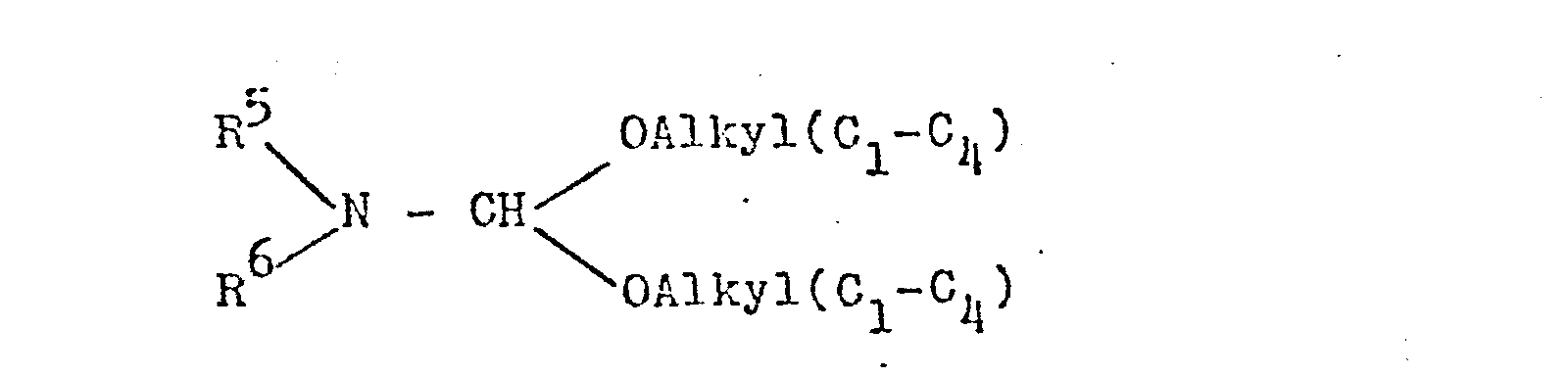
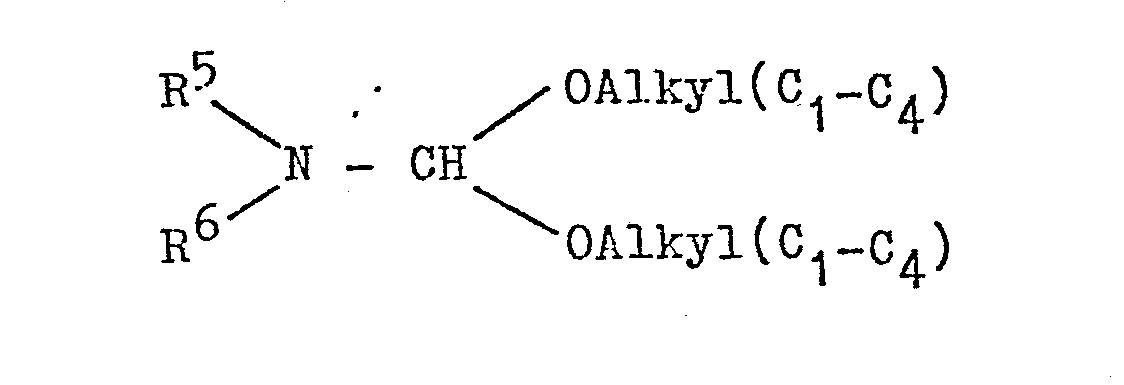
- the invention further relates to a process for the preparation of the compounds I, which is characterized in that compounds of the general formula II with dialkylformamide dialkylacetals of the general formula III implements.
- the reaction is carried out in the presence and absence of a diluent, but in the presence of an acidic catalyst, the temperature being between 20 ° C and 150 ° C.
- the compounds of the general formula II required for the preparation are prepared by known methods from methyl isourea sulfate and the corresponding carboxylic acid chlorides analogously to US Pat. No. 3,914,224.
- Compounds according to the invention therefore control weeds in various agricultural crops, that is to say they have very good herbicidal properties and are tolerated by crop plants such as cereals, maize, rice etc. but also by broadleaved crop plants without damage being observed.
- crop plants such as cereals, maize, rice etc.
- broadleaved crop plants without damage being observed.
- they can be applied in low concentrations in conjunction with other herbicides and are then able to antagonize, ie completely eliminate, harmful side effects of the latter without impairing their herbicidal activity.
- Herbicides whose phytotoxic side effects can be reduced by means of compounds of the formula I are e.g. Carbamates, thiol carbamates, haloacetanilides. Substituted phenoxy and phenoxyphenoxy carboxylic acid esters and pyridyloxy, benzoxazoiyloxy or benzothiazolyloxy phenoxy carboxylic acid esters, dimedonoxime derivatives, and also clairsolyl, naphthyl and quinoxalyloxyphenoxy carboxylic acid esters.
- the compounds of the formula I can be prepared with customary formulation auxiliaries to give dusts, wettable powders, dispersions, emulsion concentrates, etc. which contain the active compound in concentrations of 2-80% and are either used as such (dusts, pellets) or before Application can be dissolved or dispersed in a solvent (water).
- the quantitative ratio of antidote: herbicide can vary within wide limits between 0.01 and 10 parts of antidote to 1 part of herbicide.
- the respectively optimal amounts of herbicide and antidote depend on the type of herbicide or antidote used as well as on the type of plant stand to be treated and can be determined from case to case by appropriate tests.
- the main areas of application for the agents according to the invention are crops of cereals (wheat, rye, barley, oats), rice, corn, sorghum, but also cotton, sugar beet, sugar cane, soybeans and others.
- the agents according to the invention can be used for pretreating the seed of the crop (dressing the seeds) or before sowing into the seed furrows or as a tank mix before or after emergence of the plants.
- Pre-emergence treatment includes both the treatment of the acreage before sowing and the treatment of the sown but not yet overgrown acreage.
- the antidote can be used before, after or at the same time as a herbicide, but preference is given to simultaneous use in the form of tank mixtures or, if appropriate, finished formulations.
- the agents according to the invention can be used as wettable powders, emulsifiable concentrates, sprayable solutions, dusts, mordants, dispersions, granules or microgranules in the usual preparations.
- Wettable powders are preparations which are uniformly dispersible in water and which, in addition to the active ingredient, in addition to, if appropriate, a diluent or inert substance, are also wetting agents, for.
- the production takes place in the usual way, for. B. by grinding and mixing the components.
- Emulsifiable concentrates can e.g. B. by dissolving the active ingredient in an inert organic solvent, e.g. B. butanol, cyclohexanone, dimethylformamide, xylene or higher-boiling aromatics or hydrocarbons with the addition of one or more emulsifiers will.
- an inert organic solvent e.g. B. butanol, cyclohexanone, dimethylformamide, xylene or higher-boiling aromatics or hydrocarbons with the addition of one or more emulsifiers will.
- the solvent content can also be omitted entirely or in part.
- alkyl-arylsulfonic acid calcium salts such as Ca-dodecylbenzenesulfonate or nonionic emulsifiers such as fatty acid polyglycol esters, alkylaryl polyglycol ethers, fatty alcohol polyglycol ethers, propylene oxide-ethylene oxide condensation products, fatty alcohol propylene oxide, ethylene oxide polyorbityl ester fatty acid products, ethylene oxide polyorbityl ester fatty acid products, ethylene oxide polyorbityl ester fatty acid products, ethylene oxide polyorbityl ester fatty acid products, ethylene oxide polyorbityl ester fatty acid fatty acids, ethylene oxide polyorbityl fatty acid fatty acid sorbitol, ethylene oxide polyorbityl fatty acid fatty acid sorbate, sorbitol acid sorbitol, or ethylene oxide polyorbityl ester fatty acid.
- alkyl-arylsulfonic acid calcium salts such
- Dusts can be obtained by grinding the active ingredient with finely divided, solid substances, e.g. B. talc, natural clays such as kaolin, bentonite, pyrophillite or diatomaceous earth.
- finely divided, solid substances e.g. B. talc, natural clays such as kaolin, bentonite, pyrophillite or diatomaceous earth.
- Granules can either be produced by spraying the active ingredient onto adsorbable, granulated inert material or by applying active ingredient concentrates by means of binders, e.g. B. polyvinyl alcohol, sodium polyacrylic acid or mineral oils on the surface of carriers such as sand, kaolinite or granulated inert material. Suitable active ingredients can also be granulated in the manner customary for the production of fertilizer granules, if desired in a mixture with fertilizers.
- binders e.g. B. polyvinyl alcohol, sodium polyacrylic acid or mineral oils
- the active ingredient concentration in wettable powders is e.g. B. about 10 to 90 wt .-%, the rest of 100 wt .-% consists of conventional formulation components. In the case of emulsifiable concentrates, the active substance concentration can be approximately 10 to 80% by weight. Dust-like formulations usually contain 5 to 20 wt .-% of active ingredient, sprayable solutions about 2 to 20 wt .-%. In the case of granules, the active ingredient content depends in part on whether the active compound is in liquid or solid form and which granulation aids, fillers, etc. are used.
- the active ingredient formulations mentioned optionally contain the customary adhesives, wetting agents, dispersants, emulsifiers, penetrants, solvents, fillers or carriers.
- the concentrates which are commercially available, are diluted in the customary manner, if necessary, e.g. for wettable powders, emulsifiable concentrates, dispersions and sometimes also for microgranules using water. Dust-like and granulated preparations as well as sprayable solutions are usually no longer diluted with other inert substances before use.
- a wettable powder which is readily dispersible in water is obtained by mixing 25 parts by weight of active compound, 64 parts by weight of kaolin-containing quartz as an inert substance, 10 parts by weight of lignosulfonic acid potassium and 1 part by weight of oleoylmethyl tauric acid sodium as a wetting and dispersing agent and grinding in a pin mill.
- a dispersion concentrate which is readily dispersible in water is obtained by mixing 20 parts by weight of active compound with 6 parts by weight of alkylphenol polyglycol ether (Triton X 207), 3 parts by weight of isotridecanol polyglycol ether (8 AeO) and 71 parts by weight of paraffinic mineral oil (boiling range e.g. approx. 255 to above 377 ° C) and ground in a attritor to a fineness of less than 5 microns.
- alkylphenol polyglycol ether Triton X 207
- isotridecanol polyglycol ether 8 AeO
- paraffinic mineral oil ground in a attritor to a fineness of less than 5 microns.
- An emulsifiable concentrate is obtained from 15 parts by weight of active ingredient, 75 parts by weight of cyclohexanone as solvent and 10 parts by weight of oxyethylated nonylphenol as emulsifier.
- Mixtures of herbicides and compounds according to the invention are therefore suitable for selective weed control in cereals.
- the herbicidal activity of fenoxaprop-ethyl was not adversely affected by the addition of the safeners according to the invention: it was z.
- the compounds according to the invention show good herbicidal properties against dicotyledonous and in some cases, especially in the pre-run process, also against monocotyledon weeds. They are therefore suitable for selective weed control in agricultural crops, and their use is possible both in the pre-emergence process and in the post-emergence process, especially in cereal crops in broad-leaf crops such as soybean, cotton or sugar beet.
Landscapes
- Organic Chemistry (AREA)
- Life Sciences & Earth Sciences (AREA)
- Chemical & Material Sciences (AREA)
- Health & Medical Sciences (AREA)
- General Health & Medical Sciences (AREA)
- Dentistry (AREA)
- Plant Pathology (AREA)
- Engineering & Computer Science (AREA)
- Pest Control & Pesticides (AREA)
- Agronomy & Crop Science (AREA)
- Wood Science & Technology (AREA)
- Zoology (AREA)
- Environmental Sciences (AREA)
- Toxicology (AREA)
- Agricultural Chemicals And Associated Chemicals (AREA)
- Organic Low-Molecular-Weight Compounds And Preparation Thereof (AREA)
- Heterocyclic Carbon Compounds Containing A Hetero Ring Having Nitrogen And Oxygen As The Only Ring Hetero Atoms (AREA)
Abstract
Description
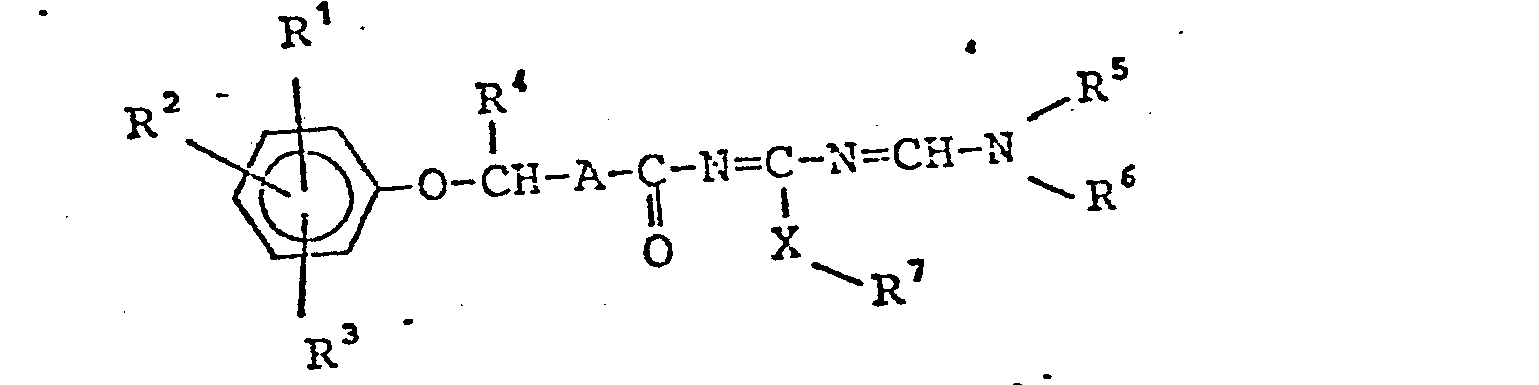
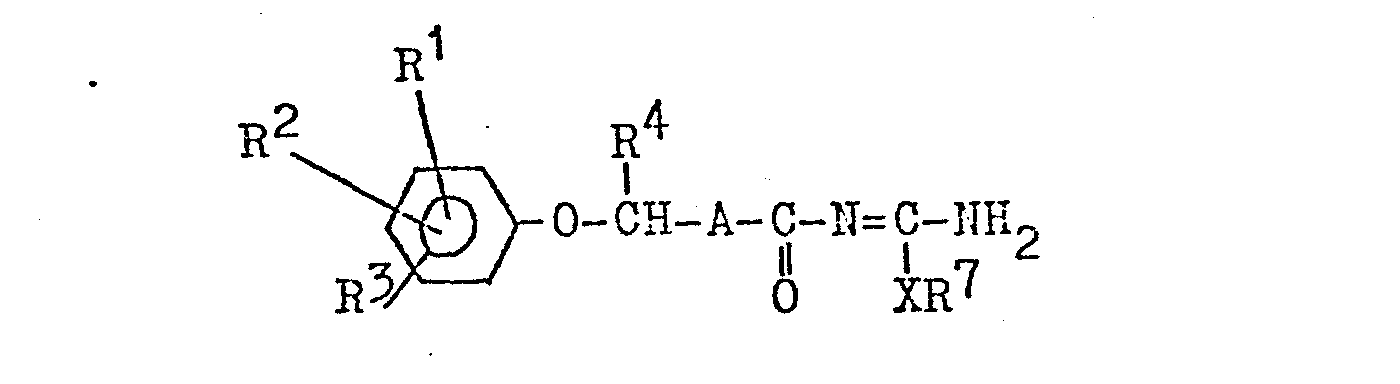
- Gegenstand der vorliegenden Erfindung sind neue Verbindungen der allgemeinen Formel I
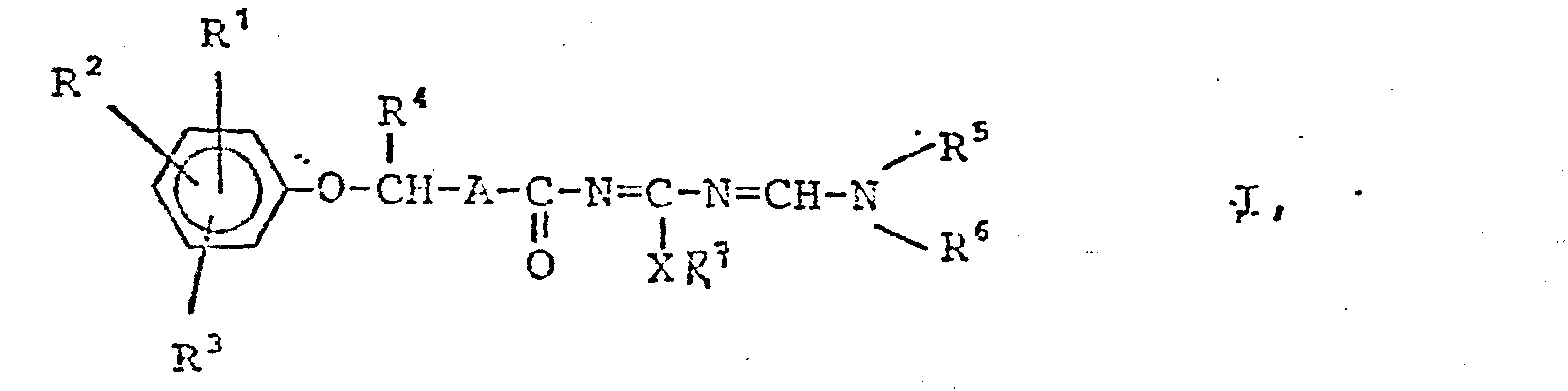
- R1, R2, R3 unabhängig voneinander Wasserstoff, F, Cl, Br oder (C1-C4)-Alkyl; R1 außerdem CF3, CN, NO2 oder COO-(C1-C4)-Alkyl;
- A eine direkte Bindung, -CH2-CH2- oder -CH=CH-;
- X 0, S oder NR8;
- R4 H oder (C1-C4)-Alkyl;
- R5, R6 gleiche oder verschiedene (C1-C4)-Alkyl- reste;
- R7 (C1-C4)-Alkyl, Benzyl oder Phenylethyl, WOrin die Phenylreste ein- oder zweifach durch Halogen, CF3, NO2 oder (C1-C4)-Alkyl substi- tuiert sein können;
- R8 H oder (C1-C4)-Alkyl; sowie R7 und R8 zusammen mit dem Stickstoffatom einen Pyrrolidin-, Piperidin-, Morpholin- oder Piperazinring, die gegebenenfalls noch durch 1-2 CH3-Gruppen substituiert sein können.
- Bevorzugte Verbindungen der allgemeinen Formel I sind diejenigen, in denen
- R 1, R 2, R3 unabhängig voneinander Wasserstoff, Chlor, Brom und/oder Methyl bedeuten, A eine direkte Bindung darstellt, X Sauerstoff, R4 Wasserstoff oder Methyl, R5 und R6 jeweils Methyl und R7 (C1-C4)-Alkyl bedeuten.
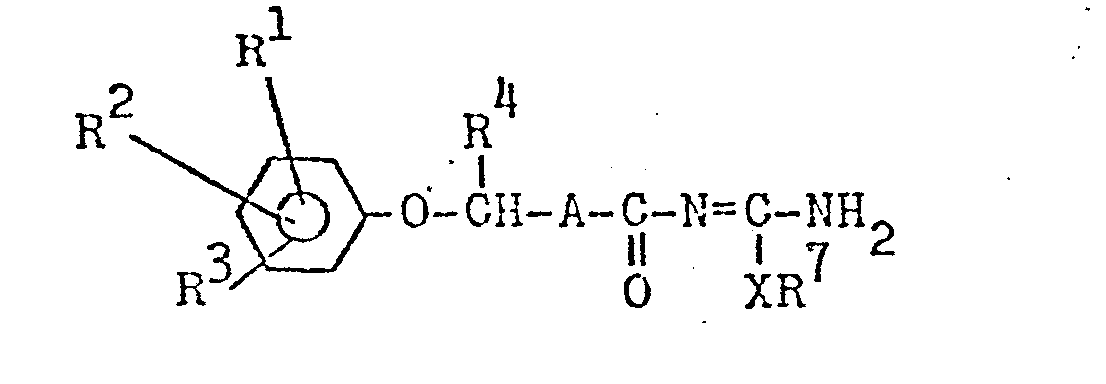
- Gegenstand der Erfindung ist weiterhin ein Verfahren zur Herstellung der Verbindungen I, das dadurch gekennzeichnet ist, daß man Verbindungen der allgemeinen Formel II


- Die Umsetzung wird in An- und Abwesenheit eines Verdünnungsmittels, jedoch in Gegenwart eines sauren Katalysators durchgeführt, wobei die Temperatur zwischen 20°C und 150°C liegen kann.
- Bevorzugt wird ohne Lösungsmittel mit konz. Schwefelsäure als Katalysator bei Temperaturen von 80 - 100°C gearbeitet. Als Katalysatoren kommen außerdem z.B. Eisessig, Essigsäureanhydrid und p-Toluolsulfonsäure in Frage.
- Die für die Herstellung benötigten Verbindungen der allgemeine Formel II weden nach bekannten Methoden aus Methylisoharnstoff-sulfat und den entsprechenden Carbonsäurechloriden analog US-PS 3 914 224 dargestellt.
- Überraschenderweise wurde gefunden, daß Verbindungen der Formel I die Eigenschaften haben, einerseits gegen zahlreiche Unkräuter sehr gut herbizid zu sein und andererseits phytotoxische Nebenwirkungen von Pflanzenschutzmitteln, insbesondere von Herbiziden, beim Einsatz in Nutzpflanzenkulturen zu vermindern und-auszuschalten.
- Erfindungsgemäße Verbindungen bekämpfen also einerseits Unkräuter in verschiedenen landwirtschaftlchen Kulturen, d.h. sie verfügen über sehr gute herbizide Eigenschaften und werden von Kulturpflanzen wie Getreide, Mais, Reis usw. aber auch von breitblättrigen Kulturpflanzen toleriert, ohne daß Schäden beobachtet werden. Andererseits können sie in niedrigen Konzentrationen in Verbindung mit anderen Herbiziden ausgebracht werden und sind dann in der Lage, schädliche Nebenwirkungen der letzteren zu antagonisieren d.h. völlig aufzuheben, ohne deren herbizide Wirksamkeit zu beeinträchtigen.
- Hierdurch kann das Einsatzgebiet herkömmlicher Pflanzenschutzmittel ganz erheblich vergrößert werden. Solche Verbindungen, die die Eigenschaften besitzen Kultur pflanzen gegen phytotoxische Schäden durch Herbizide zu schützen, ohne die eigentliche herbizide Wirkung dieser Mittel zu beeinträchtigen, werden "Antidote" oder "Safener" genannt.
- Herbizide, deren phytotoxische Nebenwirkungen mittels Verbindungen der Formel I herabgesetzt werden können, sind z.B. Carbamate, Thiolcarbamate, Halogenacetanilide. substituierte Phenoxy- und Phenoxyphenoxy-carbonsäureester sowie Pyridyloxy-,Benzoxazoiyloxy- bzw. Benzthiazolyloxy-phenoxycarbonsäureester, Dimedonoximabkömmlinge, ferner Clairsolyl-, Naphthyl- und Chinoxalyloxyphenoxycarbonsäureester.
- Beispielsweise seien, ohne daß dadurch eine Beschränkung erfolgen soll, Herbizide aus folgenden Klassen genannt:
- A) Herbizide vom Typ der Phenoxyphenoxycarbonsäure-(C1-C4)alkyl- (C2-C4)alkenyl- und (C3-C4)alkinylester wie etwa
- 2-(4-(2,4-Dichlorphenoxy)-phenoxy)-propionsäuremethyl- ester,
- 2-(4-(4-Brom-2-chlorphenoxy)-phenoxy)-propionsäure- methylester,
- 2-(4-Trifluormethylphenoxy) -phenoxy)-propionsäure- methylester,
- 2-(4-(2-Chlor-4-trifluormethylphenoxy)-phenoxy)-propion- säurernethylester,
- 2-(4-(2,4-Dichlorbenzyl)-phenoxy)-propionsäuremethylester, 4-(4-(4-Trifluormethylplenoxy)-phenoxy)-pent-2-en-säure- ethylester,
- 2-(4-(3,5-Dichlorpyridyl-2-oxy)-phenox.y)-propionsäure- ethylester,
- 2-(4-(3,5-Dichlorpyridyl-2-oxy)-phenoxy)-propionsäure- propargylester,
- 2-(4-(6-Chlorbenzoxazol- 2-yl-oxy)-phenoxy)-propionsäure- ethylester,
- 2-(4-(6-Chlorbenzthiazol-2-yl-oxy)-phenoxy)-propion- säureethylester,
- 2-(4-(3-Chlor-5-trifluormethyl-2-pyridyloxy)-phenoxy)-propionsäurenethylester,
- 2-(4-(5-Trifluormethy1-2-pyridyloxy)-phenoxy)-propion- säurebutylester,
- 2-(4-(6-Chlor-2-chinoxalinyloxy)-phenoxy)-psopion- säureethylester
- B) Chloracetanilid-Herbizide wie etwa
- N-Methoxymethyl-2,6-diethyl-chloracetanilid, N- (3'-Methoxyprop-2'-yl) -2-methyl-6-ethyl-chloracetanilid,
- N-(3-Methyl-1,2,4-oxdiazol-5-ylmethyl)-chloressigsäure-2,6-diMethylanilid ...
- C) Thiolcarbamate wie etwa
- S-Ethyl-N,N-dipropylthiocarbamat oder S-Ethyl-N,N-diisobutylthiocarbamat
- D) Dimedon-Derivate wie etwa
- 2-N-Ethoyybutyrimidoyl)-5-(2-ethylthiopropyl)-3-hydroxy-2-cyclohexen-1-on,
- 2-(N-Ethoxybutyrimidoyl)-5-(2-phenylthiopropyl)-3-hydroxy-2-cyclohexen-1-on oder
- 2-(1-Allyloxyiminobutyl)-4-methoxycarbonyl-5,5-dimethyl-3-oxocyclohexenol
- Für die Anwendung können die Verbindungen der Formel I mit üblichen Formulierungshilfsmitteln zu Stäubemitteln, Spritzpulvern, Dispersionen, Emulsionskonzentraten usw. zubereitet werden, die den Wirkstoff in Konzentrationen von 2 - 80 % enthalten und entweder als solche angewendet werden (Stäubemittel, Pellets) oder vor der Anwendung in einem Lösungsmittel (Wasser) gelöst oder dispergiert werden.
- Das Mengenverhältnis Antidot : Herbizid kann innerhalb weiter Grenzen zwischen 0,01 und 10 Teilen Antidot auf 1 Teil Herbizid schwanken. Die jeweils optimalen Mengen an Herbizid und Antidot sind abhängig vom Typ des verwendeten Herbizids bzw. Antidots sowie von der Art des zu behandelnden Pflanzenbestandes und lassen sich von Fall zu Fall durch entsprechende Versuche ermitteln.
- Als. Haupteinsatzgebiete für die erfindungsgemäßen Mittel kommen vor allem Kulturen von Getreide (Weizen, Roggen, Gerste, Hafer), Reis, Mais, Sorghum, aber auch Baumwolle, Zuckerrüben, Zuckerrohr, Sojabohne und andere in Frage. Die crfindungsgemäßen Mittel können je nach ihren Eigenschaften zur Vorbehandlung des Saatgutes der Kulturpflanze (Beizung der Samen) oder vor der Saat in die Saatfurchen oder als Tankmischung vor oder nach dem Auflaufen der Pflanzen verwendet werden. Vorauflaufbehandlung schließt sowohl die Behandlung der Anbaufläche vor der Aussaat als auch die Behandlung der angesäten, aber noch nicht bewachsenen Anbauflächen ein.
- Grundsätzlich kann das Antidot vor, nach oder gleichzeitig mit einem Herbizid angewendet werden, bevorzugt ist jedoch die gleichzeitige Anwendung in Form von Tankmischungen oder gegebenenfalls Fertigformulierungen.
- Die erfindungsgemäßen Mittel können als Spritzpulver, emulgierbare Konzentrate, versprühbare Lösungen, Stäubemittel, Beizmittel, Dispersionen, Granulate oder Mikrogranulate in den üblichen Zubereitungen angewendet werden.
- Spritzpulver sind in Wasser gleichmäßig dispergierbare Präparate, die neben dem Wirkstoff außer gegebenenfalls einem Verdünnungs- oder Inertstoff noch Netzmittel, z. B. polyoxethylierte Alkylphenole, polycxethylierte Fettalkohole, Alkyl- oder Alkylphenylsulfonate und Dispergiermittel, z. B. ligninsulfonsaures Natrium, 2,2'-dina?hthyl- methan-6,6'-disulfonsaures Natrium, dibutylnaphtalinsulfonsaures Natrium oder auch oleoyimethyltaurinsaures Natrium enthalten. Die Herstellung erfolgt in üblicher Weise, z. B. durch Mahlen und Vermischen der Komponenten.
- Emulgicrbare Konzentrate können z. B. durch Auflösen des Wirkstoffes in einem inerten organischen Lösungsmittel, z. B. Butanol, Cyclohexanon, Dimethylformamid, Xylol oder auch höhersiedcnden Aromatcn'oder Kohlenwasserstoffen unter Zusatz von einem oder mehreren Emulgatoren hergestellt werden. Bei flüssigen Wirkstoffen kann der Lösungsmittelanteil auch ganz oder teilweise entfallen. Als Emulgatoren können beispielsweise verwendet werden: Alkyl-arylsulfonsaure Calciumsalze wie Ca-dodecylbenzolsulfonat oder nichtionische Emulgatoren wie Fettsäurepolyglykolester, Alkylarylpolyglykolether, Fettalkoholpolyglykolether, Propylenoxid-Ethylenoxid-Kondensationsprodukte, Fettalkohol-Propylenoxid-Ethylenoxid-Kondensationsprodukte, Alkylpolyglykolether, Sorbitanfettsäureester, Polyoxethylensorbitanfettsäureester oder Polyoxethylensorbitester.
- Stäubemittel kann man durch Vermahlen des Wirkstoffes mit fein verteilten, festen Stoffe, z. B. Talkum, natürlichen Tonen wie Kaolin, Bentonit, Pyrophillit oder Diatomeenerde erhalten.
- Granulate können entweder durch Verdüsen des Wirkstoffes auf adsorptionsfähiges, granuliertes Inertmaterial hergestellt werden oder durch Aufbringen von Wirkstoffkonzentraten mittels Bindemitteln, z. B. Polyvinylalkohol, polyacrylsaurem Natrium oder auch Mineralölen auf die Oberfläche von Trägerstoffen wie Sand, Kaolinite oder von granuliertem Inertmaterial. Auch können geeignete Wirkstoffe in der für die Herstellung von Düngemittelgranulaten üblichen Weise, gewünschtenfalls in Mischung mit Düngemitteln, granuliert werden.
- In Spritzpulvern beträgt die Wirkstoffkonzentration z. B. etwa 10 bis 90 Gew.-%, der Rest zu 100 Gew.-% besteht aus üblichen Formulierungsbestandteilen. Bei emulgierbaren Konzentraten kann die Wirkstoffkonzentration etwa 10 bis 80 Gew.-% betragen. Staubförmige Formulierungen enthalten meistens 5 bis 20 Gew.-% an Wirkstoff, versprühbare Lösungen etwa 2 bis 20 Gew.-%. Bei Granulaten hängt der Wirkstoffgehalt zum Teil davon ab, ob die wirksame Verbindung flüssig oder fest vorliegt und welche Granulierhilfsmittel, Füllstoffe usw. verwendet werden.
- Daneben enthalten die genannten Wirkstofformulierungen gegebenenfalls die jeweils üblichen Haft-, Netz-, Dispergier-, Emulgier-, Penetrations-, Lösungsmittel, Füll-oder Trägerstoffe.
- Zur Anwendung werden die in handelsüblicher Form vorliegenden Konzentrate gegebenenfalls in üblicher Weise verdünnt, z.B. bei Spritzpulvern, emulgierbaren Konzentraten, Dispersionen und teilweise auch bei Mikrogranulaten mittels Wasser. Staubförmige und granulierte Zubereitungen sowie versprühbare Lösungen werden vor der Anwendung üblicherweise nicht mehr mit weiteren inerten Stoffen verdünnt.
- Auch Mischungen oder Mischformulierungen mit anderen Wirkstoffen, wie z. B. Insektiziden, Akariziden, Herbiziden, Düngemitteln, Wachstumsregulatoren oder Fungiziden sind gegebenenfalls möglich.
- Nachstehend seien einige Formulierungsbeispiele aufgeführt:
- Ein Stäubemittel wird erhalten, indem man 10 Gewichtsteile Wirkstoff und 90 Gewichtsteile Talkum oder Inertstoff mischt und in einer Schlagmühle zerkleinert.
- Ein in Wasser leicht dispergierbares, benetzbares Pulver wird erhalten, indem man 25 Gewichtsteile Wirkstoff, 64 Gewichtsteile kaolinhaitigen Quarz als Inertstoff, 10 Gewichtsteile ligninsulfonsaures Kalium und 1 Gewichtsteil oleoylmethyltaurinsaures Natrium als Netz- und Dispergiermittel mischt und in einer Stiftmühle mahlt.
- Ein in Wasser leicht dispergierbares Dispersionskonzentrat wird erhalten, Indern man 20 Gewichtsteile Wirkstoff mit 6 Gewichtsteilen Alkylphenolpolyglykolether (Triton X 207), 3 Gewichtsteilen Isotridecanolpolyglykolether (8 AeO) und 71 Gewichtsteilen paraffinischem Mineralöl (Siedebereich z. B. ca. 255 bis über 377 °C) mischt und in einer Reibkugelmühle auf eine Feinheit von unter 5 Mikron vermahlt.
- Ein emulgierbares Konzentrat wird erhalten aus 15 Gewichtsteilen Wirkstoff, 75 Gewichtsteilen Cyclohexanon als Lösungsmittel und 10 Gewichtsteilen oxethyliertes Nonylphenol als Emulgator.
- Zu 28 g (0,1 mol) N-(2,4-Dichlorphenoxy-acetyl)-0-methylisoharnstoff (vgl. Beisp. 1A) und 16,2 g (0,11 mol) DMF-diethylacetal gibt man 1/2 ml konz. Schwefelsäure zu und erhitzt unter Rühren rasch auf 100 °C. Sobald die Lösung zu sieden beginnt, entfernt man die Heizung und läßt auf RT abkühlen. Die ausgefallenen Kristalle werden mit 50 ml Ether verrührt, abgesaugt und über Nacht getrocknet. Man erhält 24 g (72% d. Th.) an N-(2,4-Dichlorphehoxy-acetyl)-N'- dimethylaminomethylen-O-methyl-isoharnstoff in Form farbloser Kristalle mit einem Schmelzpunkt von 105 - 106°C.

- In analoger Weise werden die Verbindungen der Tabelle 1 hergestellt.

- 8,1 g (0,055 mol) Dimethylformamid-diethylacetal und 15,8 g (0,5 mol) 1-(2,4-Dichlorphenoxy-acetyl)-3-tetramethylen-guanidin werden mit 0,3 ml konz. Schwefelsäure 5 min auf 100°C erwärmt. Man destilliert bei 60°C/0,01 bar die flüchtigen Bestandteile ab. Es verbleiben 16 g (86 % d. Th.) 1-(2,4-Dichlorphenoxy-acetyl)-3-dimethyl- aminameth5tlen-4-tetramethylen-guanidin in Form eines zähen, gelben Öles.

- In analoger Weise erhält man:

- Beispiel 1 A (Herstellung der Ausgangsstoffe II)
- 13,5 (0,11 mol) 0-Methyl-isoharnstoffsulfat werden in 50 ml Wasser und 100 ml Methylenchlorid gelöst. Bei 0°C tropft man unter kräftigem Rühren gleichzeitig aus 2 getrennten Gefäßen 16 g 50%ige wäßrige Natronlauge (0,2 mol) und 24 g (0,1 mol) 2,4-Dichlorphenoxyessigsäurechlorid zu. Man rührt 1 h bei 0°C und 3 h bei 40°C, trennt die organische Phase ab, wäscht 2mal mit 100 ml Wasser und trocknet über Natriumsulfat.
- Nach dem Abdestillieren des Lösungsmittels verbleiben 22 g (79 % d. Th.) N-(2,4-Dichlorphenoxy-acetyl)-0-methyl-isoharnstoff in Form farbloser Kristalle vom Smp. 104°C.

- In analoger Weise wurden die anderen Verbindungen der Formel II erhalten.
- Weizen wurde im Gewächshaus in Töpfen von 9 cm d bis zum 5-Blattstadium herangezogen und anschließend mit einem Herbizid und einer erfindungsgemäßen Verbindung tropfnaß gespritzt. 3 Wochen nach der Behandlung wurden die Pflanzena uf jede Art von Schädigung durch die Präparate bonitiert, wobei insbesondere das Ausmaß der anhaltenden Wachstumshemmung berachtet wurde.
- Die Ergebnisse aus Tabelle 3 veranschaulichen, daßdie erfindungsgemäßen Verbindungen starke Herbizidschäden sehr effektiv reduzieren können.
- Mischungen aus Herbiziden und erfindungsgemäßen Verbindungen eignen sich also zur selektiven Unkrautbekämpfung in Getreide.

- Die Safener-Wirkung weiterer Verbindungen zeigte ganz ähnliche Ausmaße bei Aufwandmengen von 2,5 kg AS/ha.
- Die herbizide Wirksamkeit von Fenoxaprop-ethyl wurde durch die Zugabe der erfindungsgemäßen Safener nicht beeinträchtigt: sie betrug bei den angegebenen Aufwandmengen von z. B. 2,0 kg AS durchwegs immer 100% z. B. bei Alopecurus myosuroides, bei Avena fatua und bei Hirsen wie Echinochloa- und Setaria-Arten.
- Weizen, Gerste und 2 wichtige Schadgräser Avena fatua und Alopecurus myosuroides wurden ausgesät und unter Gewächshausbedingungen bis zu 4-Blattstadium angezogen. Sodann wurden die erfindungsgemäßen Verbindungen und ein Herbizid in verschiedenen Dosierungen auf die Versuchspflanzen gesprüht. Nach 4 weiteren Wochen Standzeit im Gewächshaus wurden die Pflanzen auf jede Art von Hemmung oder Schädigung im Vergleich zu unbehandelten Kontrollpflanzen bonitiert. Die Ergebnisse (Tabelle 2) veranschaulichen, daß die erfindungsgemäße Verbindung herbizide Schadwirkungen an Weizen und Gerste sehr stark reduziert bzw. voll- ständig ausschaltet, ohne die herbizide Wirksamkeit gegen die Schadgräser Avena und Alopecurus zu beeinträchtigen.


- In höheren Aufwandmengen zeigen die erfindungsgemäßen Verbindungen gute herbizide Eigenschaften gegen dikotyle und teilweise, besonders im Vorlauflaufverfahren, auch gegen monokotyle Unkräuter. Sie sind dahr zur selektiven Unkrautbekämpfung in landwirtschaftlichen Kulturen geeignet, wobei ihr Einsatz sowohl im Vorlauflaufverfahren wie auch im Nachauflaufverfahren möglich ist, und zwar besonders in Getreidekulturen in breitblättrigen Kulturen wie Sojabohne, Baumwolle oder Zuckerrüben.
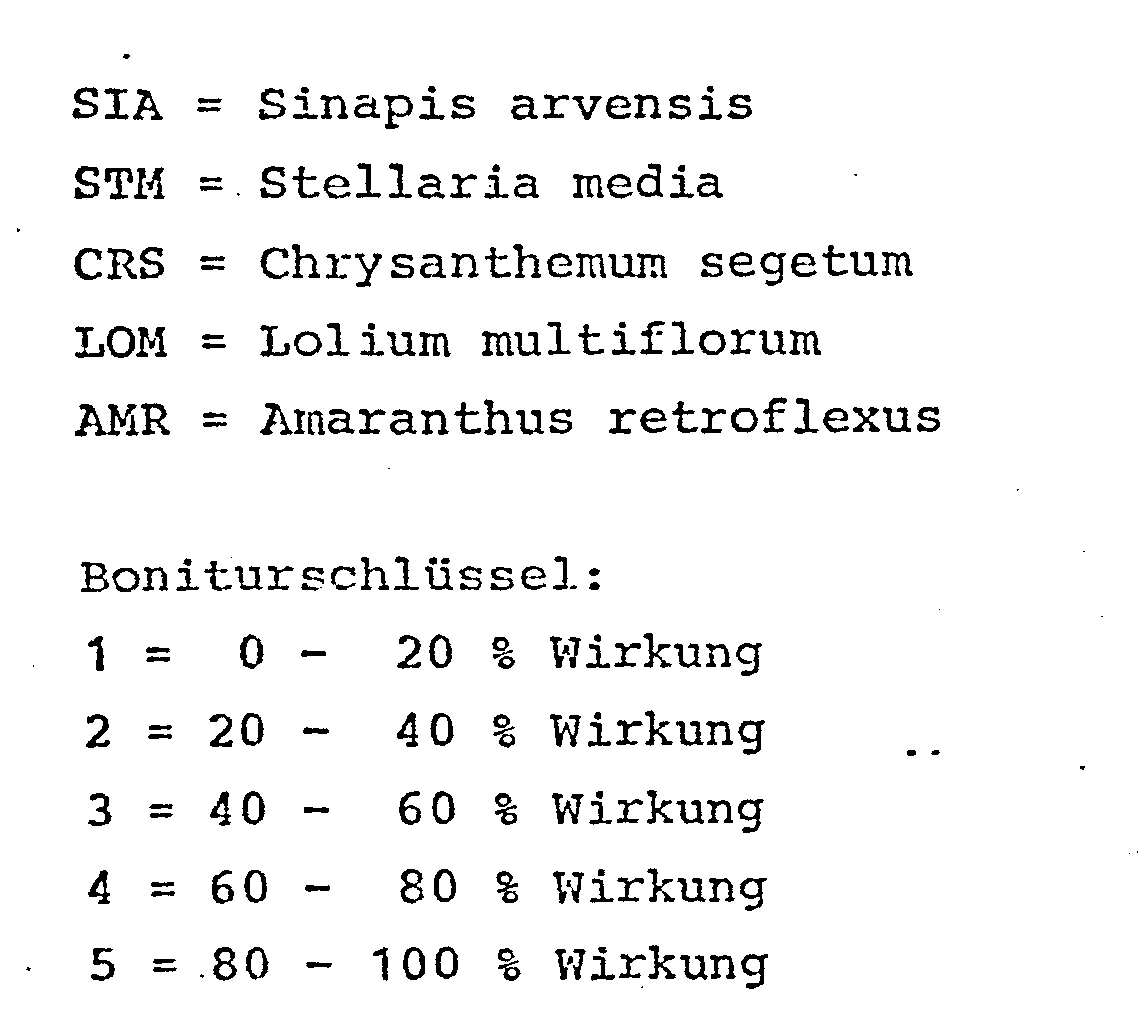
- Breitblättrige und grasartige Unkräuter wurden in Plastiktöpfen von 9 cm φ auf Lehmerde ausgesät und sowohl im Vorauflaufverfahren wie im Nachauflaufverfahren mit den erfindungsgemäßen Verbindungen (Aufwandmenge jeweils 2,4 kg a. i./ha) behandelt. 4 Wochen später wurde die herbizide Wirksamkeit durch visuelle Bonitur geschätzt.
- Die Ergebnisse (Tabelle 3) zeigen, daß die erfindungsgemäßen Verbindungen ein weites Spektrum von Unkräutern im Vor- und Nachauflaufverfahren bekämpfen.

Claims (18)

Applications Claiming Priority (2)
| Application Number | Priority Date | Filing Date | Title |
|---|---|---|---|
| DE19833340770 DE3340770A1 (de) | 1983-11-11 | 1983-11-11 | Phenoxyalkanoylderivate, verfahren zu ihrer herstellung sowie ihre verwendung im pflanzenschutz |
| DE3340770 | 1983-11-11 |
Publications (2)
| Publication Number | Publication Date |
|---|---|
| EP0142757A2 true EP0142757A2 (de) | 1985-05-29 |
| EP0142757A3 EP0142757A3 (de) | 1986-05-07 |
Family
ID=6214030
Family Applications (1)
| Application Number | Title | Priority Date | Filing Date |
|---|---|---|---|
| EP84113234A Withdrawn EP0142757A3 (de) | 1983-11-11 | 1984-11-03 | Phenoxyalkanoylderivate, Verfahren zu ihrer Herstellung sowie ihre Verwendung im Pflanzenschutz |
Country Status (8)
| Country | Link |
|---|---|
| US (1) | US4564382A (de) |
| EP (1) | EP0142757A3 (de) |
| JP (1) | JPS60116661A (de) |
| AU (1) | AU3528984A (de) |
| BR (1) | BR8405720A (de) |
| DE (1) | DE3340770A1 (de) |
| IL (1) | IL73467A0 (de) |
| ZA (1) | ZA848761B (de) |
Families Citing this family (2)
| Publication number | Priority date | Publication date | Assignee | Title |
|---|---|---|---|---|
| DE3340771A1 (de) * | 1983-11-11 | 1985-05-23 | Hoechst Ag, 6230 Frankfurt | Substituierte phenoxypropionyl-isoharnstoffderivate, verfahren zu ihrer herstellung und ihre verwendung im pflanzenschutz |
| DE4039734A1 (de) * | 1990-12-13 | 1992-06-17 | Basf Ag | Substituierte 2-aminothiophene enthaltende herbizide mittel |
Family Cites Families (1)
| Publication number | Priority date | Publication date | Assignee | Title |
|---|---|---|---|---|
| MC1329A1 (fr) * | 1979-05-17 | 1981-04-21 | Wellcome Found | Aryloxy-et arylamino-alcane-thiocarboxamides,leur preparation et leur application en tant que matieres actives de produits pesticides |
-
1983
- 1983-11-11 DE DE19833340770 patent/DE3340770A1/de not_active Withdrawn
-
1984
- 1984-11-03 EP EP84113234A patent/EP0142757A3/de not_active Withdrawn
- 1984-11-08 US US06/669,762 patent/US4564382A/en not_active Expired - Fee Related
- 1984-11-09 IL IL73467A patent/IL73467A0/xx unknown
- 1984-11-09 ZA ZA848761A patent/ZA848761B/xx unknown
- 1984-11-09 BR BR8405720A patent/BR8405720A/pt unknown
- 1984-11-09 JP JP59235339A patent/JPS60116661A/ja active Pending
- 1984-11-09 AU AU35289/84A patent/AU3528984A/en not_active Abandoned
Non-Patent Citations (1)
| Title |
|---|
| CHEMICAL ABSTRACTS, Band 41, Nr. 12, 20. Juni 1947, Spalte 3903c,d; Thompson: "New growth-regulating compounds. I. Summary of growth-inhibitory activities of some organic compounds as determined by three tests" & BOTAN. GAZ. 107, 476-507(1946) * |
Also Published As
| Publication number | Publication date |
|---|---|
| DE3340770A1 (de) | 1985-05-23 |
| IL73467A0 (en) | 1985-02-28 |
| AU3528984A (en) | 1985-05-16 |
| EP0142757A3 (de) | 1986-05-07 |
| JPS60116661A (ja) | 1985-06-24 |
| US4564382A (en) | 1986-01-14 |
| ZA848761B (en) | 1985-06-26 |
| BR8405720A (pt) | 1985-09-10 |
Similar Documents
| Publication | Publication Date | Title |
|---|---|---|
| EP0174562B1 (de) | Pflanzenschützende Mittel auf Basis von 1,2,4-Triazolderivaten sowie neue Derivate des 1,2,4-Triazols | |
| EP0269806B1 (de) | Phenylpyrazolcarbonsäurederivate, ihre Herstellung und Verwendung als Pflanzenwachstumsregulatoren und Safener | |
| DE3817192A1 (de) | 1,2,4-triazolderivate enthaltende pflanzenschuetzende mittel sowie neue derivate des 1,2,4-triazols | |
| DE3875546T2 (de) | Herbizide fluorphenoxy-phenoxyalkancarbonsaeure und ihre derivate. | |
| DE3939010A1 (de) | Isoxazoline, verfahren zu ihrer herstellung und ihre verwendung als pflanzenschuetzende mittel | |
| EP0333131A1 (de) | Pflanzenschützende Mittel auf Basis von Pyrazolcarbonsäurederivaten | |
| EP0152006B1 (de) | Verwendung von Chinolyloxy-Verbindungen als Antidots für Fenoxapropethyl (Ethyl-2[4-(6-chlorbenzoxazolyloxy)-phenoxy]-propionat) | |
| EP0543878B1 (de) | Isoxazoline oder isothiazoline enthaltende pflanzschützende mittel und neue isoxazoline und isothiazoline | |
| DD253754A5 (de) | Herbizides und das pflanzenwachstum hemmendes mittel | |
| EP0075840B1 (de) | Heterocyclische Phenyläther, Verfahren zu deren Herstellung und diese enthaltende herbizide Mittel | |
| DE4017665A1 (de) | Pflanzenschuetzende substituierte isoxazoline, isoxazole, isothiazoline und isothiazole sowie verfahren zu ihrer herstellung und ihre verwendung | |
| DE3419994A1 (de) | Benzoxazolyl- und benzthiazolyl-aminosaeuren, ihre herstellung und verwendung im pflanzenschutz | |
| EP0142757A2 (de) | Phenoxyalkanoylderivate, Verfahren zu ihrer Herstellung sowie ihre Verwendung im Pflanzenschutz | |
| EP0170906B1 (de) | Pflanzenschützende Mittel auf Basis von Oximestern | |
| DE3818848A1 (de) | Pyridazinonderivate, verfahren zu ihrer herstellung, sie enthaltende mittel und ihre verwendung im pflanzenschutz | |
| DE3539476A1 (de) | Neue pyridylverbindungen sowie deren n-oxide, verfahren zu ihrer herstellung und ihre verwendung im pflanzenschutz | |
| EP0227045B1 (de) | Heterocyclische Phenyläther, Verfahren zu deren Herstellung und diese enthaltende herbizide Mittel | |
| EP0254222B1 (de) | Neue Chinolinoxy-Verbindungen, Verfahren zu ihrer Herstellung und ihre Verwendung als Antidots | |
| EP0144001B1 (de) | Substituierte Phenoxypropionyl-isoharnstoffderivate, Verfahren zu ihrer Herstellung und ihre Verwendung im Pflanzenschutz | |
| EP0170905B1 (de) | alpha-Acyloximino-alkanphosphon-(und-phosphin)-säureester, ihre Herstellung und Verwendung im Pflanzenschutz | |
| EP0417626A2 (de) | N-Arylhydrazone enthaltende pflanzenschützende Mittel und neue N-Arylhydrazone | |
| DE2830141A1 (de) | Neue verbindungen aus der gruppe der phenoxypropionsaeuren bzw. ihrer derivate und diese verbindungen enthaltende herbizide mittel | |
| EP0086747A2 (de) | Neue Phenoxy-phenoxy-alkanoyl-thioamide als Herbizide |
Legal Events
| Date | Code | Title | Description |
|---|---|---|---|
| PUAI | Public reference made under article 153(3) epc to a published international application that has entered the european phase |
Free format text: ORIGINAL CODE: 0009012 |
|
| AK | Designated contracting states |
Designated state(s): AT BE CH DE FR GB IT LI NL SE |
|
| RTI1 | Title (correction) | ||
| PUAL | Search report despatched |
Free format text: ORIGINAL CODE: 0009013 |
|
| AK | Designated contracting states |
Kind code of ref document: A3 Designated state(s): AT BE CH DE FR GB IT LI NL SE |
|
| STAA | Information on the status of an ep patent application or granted ep patent |
Free format text: STATUS: THE APPLICATION HAS BEEN WITHDRAWN |
|
| 18W | Application withdrawn |
Withdrawal date: 19860829 |
|
| RIN1 | Information on inventor provided before grant (corrected) |
Inventor name: HANDTE, REINHARD, DR. Inventor name: MILDENBERGER, HILMAR, DR. Inventor name: LIEBL, RAINER, DR. Inventor name: BIERINGER, HERMANN, DR. Inventor name: BAUER, KLAUS, DR. |